


Iberian language

Encyclopedia
The Iberian language was the language of a people identified by Greek
and Roman
sources who lived in the eastern and southeastern regions of the Iberian peninsula
. The ancient Iberians
can be identified as a rather nebulous local culture between the 7th and 1st century BC. The Iberian language, as the other paleohispanic languages
, except Basque, became extinct
by the 1st to 2nd centuries AD, after being gradually replaced by Latin
. Iberian is speculated to be a language isolate
, but while its different scripts have been deciphered to various extents, the language itself remains largely unknown.
Links with other languages have been claimed, especially the Basque language
, but they have not been clearly demonstrated to the satisfaction of modern scholarship.
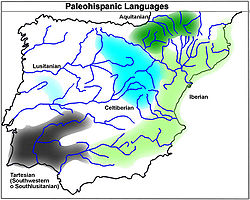 The Iberian language was widely spoken along the Mediterranean coast of the Iberian Peninsula.
In the north, the Iberian language inscriptions reached the south of France up to the Hérault river
. Important written remains have been found in Ensérune
, between Narbonne
and Béziers
in France, in an oppidum
with mixed Iberian and Celt
ic elements. The southern limit would be Porcuna
, in Jaén (Spain
), where splendid sculptures of Iberian riders have been found. Towards inland the exact distribution of the Iberian language inscriptions is uncertain. It seems that the culture reached the interior through the Ebro
river (Iberus in Latin) as far as Salduie (Zaragoza) but not farther.
Among the pre-Roman peoples of the Iberian Peninsula the following might have spoken the Iberian language: Ausetani
(northeastern Catalonia
), Ilergetes
(Lleida
and Huesca
up to the Pyrenees), Indigetes
(coast of Girona
), Laietani
(Barcelona
), Cassetani
(Tarragona
), Ilercavones
(Murcia
and Levante
up to Tarragona), Edetani
(Valencia
, Castellón
and Teruel
), Contestani
(Valencia, Alicante
, Cartagena and Albacete
), Bastetani
(Granada
, Almería
and Murcia) and Oretani
(Jaén, Ciudad Real
, Albacete and Cuenca
). Turduli
and Turdetani
are believed to be of Tartessian language
.
For some scholars, such as Velaza (2006), Iberian could have been the language spoken by the autochthonous population of these territories, while for others, such as De Hoz (1993), Iberian could have been more of a lingua franca.
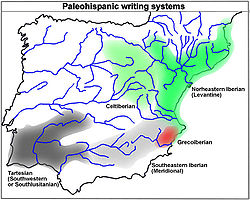 The origin of the language is unknown. Although Iberian ceased to be written in the 1st century AD, it may have survived in some areas until the Visigoth
ic period, according to Menéndez Pidal.
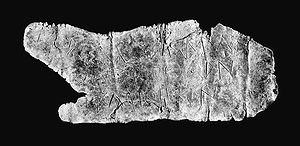
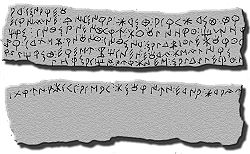 The oldest Iberian inscriptions date to the 4th century BC or maybe the 5th century BC and the latest ones date from the end of the 1st century BC or maybe the beginning of the 1st century AD. More than two thousand Iberian inscriptions are currently known. Most are short texts on ceramic
with personal names, which are usually interpreted as ownership marks. The longest Iberian texts were made on lead
plaques; the longest is from Yátova
(Valencia
) with more than six hundred signs.
Three different scripts have remained for the Iberian language:
.jpg) The northeastern Iberian script
The northeastern Iberian script
is also known as the Iberian script, because it is the Iberian script most frequently used (95% of the extant texts (Untermann 1990)). The northeastern Iberian inscriptions have been found mainly in the northeastern quadrant of the Iberian Peninsula
: mainly on the coast from Languedoc-Roussillon
to Alicante
, but with a deep penetration into the Ebro
valley. This script is almost completely deciphered.
All the paleohispanic scripts
, with the exception of the Greco-Iberian alphabet
, share a common distinctive typological characteristic: they use signs with syllabic value for the occlusives and signs with monophonematic value for the remaining consonants and for vowels. From a writing systems point of view they are neither alphabets nor syllabaries; rather, they are mixed scripts that are normally identified as semi-syllabaries
. Regarding its origin there is no agreement among researchers; for some they are linked only to the Phoenician alphabet
, while for others the Greek alphabet
played a part.
.jpg) The southeastern Iberian script
The southeastern Iberian script
is a semi-syllabary
too, but it is more similar to the Tartessian
script than to the northeastern Iberian script
. The southeastern Iberian inscriptions have been found mainly in the southeastern quadrant of the Iberian Peninsula
: eastern Andalusia
, Murcia
, Albacete
, Alicante
and Valencia. This script is not completely deciphered.
 The Greco-Iberian alphabet
is a direct adaptation of an Ionic
variant of a Greek alphabet
to the specificities of the Iberian language. The inscriptions that use the Greco-Iberian alphabet have been found mainly in Alicante
and Murcia
.
The hypotheses currently proposed are unconfirmed, and are likely to remain so unless the discovery of a bilingual text allows linguists to confirm their deductions.
and Spanish
also have such systems. Although 5 vowel systems are extremely common all over the world, it has been suggested that this may point to a Sprachbund
amongst the ancient languages of the Iberian peninsula.
The front vowels (a, e, i) appear more frequently than the back vowels. Although there are indications of a nasal vowel (⟨⟩), this is thought to be an allophone
. Judging by Greek transcriptions, it seems that there were no vowel length distinctions; if this is correct then Iberian uses the long (Greek
) as opposed to the short epsilon (Greek
).
). The fact that /w/ is lacking in native words casts doubt on whether semivowels really existed in Iberian outside of foreign borrowings and diphthongs.
es, especially applied to last names. For the Iberian language these seem to be postpositional
, and apparently more agglutinative than fusional
.
The best-known are the following.
Salluitana), the forms of Iberian proper names have been unraveled. Iberian names are formed mainly by two interchangeable elements, each usually formed of two syllables, which are written together (Untermann 1998). For example, the element "iltiŕ" can be found in the following names: iltiŕaŕker, iltiŕbaś, iltiŕtikeŕ, tursiltiŕ, baiseiltiŕ or bekoniltiŕ. This discovery was a giant step: from this moment it was possible to identify with some kind of confidence the names of persons in the texts. Nevertheless, the list of components of Iberian names varies between researchers. The basic list comes from Untermann (1990) and was recently updated by Rodríguez Ramos (2002b); complementary data and criteria can be found in the Faria papers (the last two: 2007a and 2007b).
The following list includes some of the elements proposed as components of Iberian names: abaŕ, aibe, aile, ain, aitu, aiun, aker, albe, aloŕ, an, anaŕ, aŕbi, aŕki, aŕs, asai, aster, ata, atin, atun, aunin, auŕ, austin, baiser, balaŕ, balke, bartaś, baś, bastok, bekon, belauŕ, beleś, bels, bene, beŕ, beri, beŕon, betan, betin, bikir, bilos, bin, bir, bitu, biuŕ, bolai, boŕ, boś, boton, ekes, ekaŕ, eler, ena, esto, eten, eter, iar, iaun, ibeś, ibeis, ike, ikoŕ, iltiŕ, iltur, inte, iskeŕ, istan, iunstir, iur, kaisur, kakeŕ, kaltuŕ, kani, kaŕes, kaŕko, katu, keŕe, kibaś, kine, kitaŕ, kon, koŕo, koŕś, kuleś, kurtar, lako, lauŕ, leis, lor, lusban, nalbe, neitin, neŕse, nes, niś, nios, oŕtin, sakaŕ, sakin, saltu, śani, śar, seken, selki, sike, sili, sine, sir, situ, soket, sor, sosin, suise, taker, talsku, tan, tanek, taneś, taŕ, tarban, taŕtin, taś, tautin, teita, tekeŕ, tibaś, tikeŕ, tikirs, tikis, tileis, tolor, tuitui, tumar, tuŕś, turkir, tortin, ulti, unin, uŕke, ustain, ḿbaŕ, nḿkei.
In some cases linguists have encountered simple names, with only one element for a suffix: BELES, AGER-DO and BIVR-NO are in the plaque of Ascoli, neitin in Ullastret and lauŕ-to, bartas-ko or śani-ko in other Iberian texts. More rarely there have been indications of an infix
, which can be -i-, -ke- or -ta- (Untermann used oto-iltiŕ in front of oto-ke-iltiŕ or with AEN-I-BELES). In rare cases Untermann also encountered an element is- or o- prefacing a proper name (is-betartiker; o-tikiŕtekeŕ; O-ASAI).
In the elements that formed Iberian names it is common to encounter patterns of variation, as in eter/eten/ete with the same variations as in iltur/iltun/iltu; kere/keres as lako/lakos; or alos/alor/alo and bikis/bikir/biki).
Some Iberian onomastic elements have look-alikes in Aquitanian
or Basque
. This has been explained by Vascologists like Mitxelena as an "onomastic pool". However, since the meaning of most Iberian words remains opaque to date, the connection remains speculative except in a very small number of cases. An ancient sprachbund
involving these two languages is deemed likely by some linguists. But as Trask notes, Basque has been of no help in translating Iberian inscriptions.
, a precursor of the Basque language
. But there is not enough evidence to date to ascertain whether the two languages belong to the same language family or whether the relationship is due to linguistic borrowing
. Lexical and onomastic coincidences could be due to borrowing, while the similarities in the phonological structures of the two languages could be due to linguistic areal phenomena (cf. the similarities between Basque and Old Spanish in spite of their being languages of two different families). More scientific studies on Iberian language are needed to shed light on this question.
From an historical perspective, the first features where a relationship between Basque and Iberian was claimed were:
Although other pairs have been proposed (such as eban, ars, -ka, -te), the meanings of these Iberian morphs are still controversial. The main arguments today which relate to coinciding surface forms between Basque and Iberian are:
In 2005 Orduña published a study showing some Iberian compounds that according to contextual data would appear to be Iberian numerals and show striking similarities with Basque numerals. The study was expanded upon by Ferrer (2007 and 2009) based on terms found on coins, stating their value, and with new combinatorial and contextual data. The comparison proposes the following:
The basis of this theory is better understood if we compare some of the attested Iberian compounds with Basque complex numbers (the dots denote morpheme boundaries and are not normally written in Basque):
Even so, Orduña does not claim this comparison to be a proof of a family relation between Iberian and Basque, but rather owing to Iberian loanwords in the Basque language. In contrast, Ferrer believes that the similarities could be caused due to both the genetic relationship or the loan, but indicates that the loan of the entire system of numerals is rare (but has known to occur such as the case of Middle Chinese
numeral being borrowed wholesale into Vietnamese
, Japanese
, Korean
and Thai
).
Joseba Lakarra (2010) has rejected both hypotheses: loan or genetic relationship. Lakarra’s arguments focus almost exclusively on the field of Basque historical grammar, but also arguments, following de Hoz (1993) hypothesis, that the hypothesis of the borrowing have already turned out implausible due to the limited and remote extension of the territory where Iberian was spoken as first language in South-East Spain.
Ancient Greece
Ancient Greece is a civilization belonging to a period of Greek history that lasted from the Archaic period of the 8th to 6th centuries BC to the end of antiquity. Immediately following this period was the beginning of the Early Middle Ages and the Byzantine era. Included in Ancient Greece is the...
and Roman
Ancient Rome
Ancient Rome was a thriving civilization that grew on the Italian Peninsula as early as the 8th century BC. Located along the Mediterranean Sea and centered on the city of Rome, it expanded to one of the largest empires in the ancient world....
sources who lived in the eastern and southeastern regions of the Iberian peninsula
Iberian Peninsula
The Iberian Peninsula , sometimes called Iberia, is located in the extreme southwest of Europe and includes the modern-day sovereign states of Spain, Portugal and Andorra, as well as the British Overseas Territory of Gibraltar...
. The ancient Iberians
Iberians
The Iberians were a set of peoples that Greek and Roman sources identified with that name in the eastern and southern coasts of the Iberian peninsula at least from the 6th century BC...
can be identified as a rather nebulous local culture between the 7th and 1st century BC. The Iberian language, as the other paleohispanic languages
Paleohispanic languages
The Paleohispanic languages were the languages of the pre-Roman peoples of the Iberian Peninsula, excluding languages of foreign colonies, such as Greek in Emporion and Phoenician in Qart Hadast...
, except Basque, became extinct
Extinct language
An extinct language is a language that no longer has any speakers., or that is no longer in current use. Extinct languages are sometimes contrasted with dead languages, which are still known and used in special contexts in written form, but not as ordinary spoken languages for everyday communication...
by the 1st to 2nd centuries AD, after being gradually replaced by Latin
Latin
Latin is an Italic language originally spoken in Latium and Ancient Rome. It, along with most European languages, is a descendant of the ancient Proto-Indo-European language. Although it is considered a dead language, a number of scholars and members of the Christian clergy speak it fluently, and...
. Iberian is speculated to be a language isolate
Language isolate
A language isolate, in the absolute sense, is a natural language with no demonstrable genealogical relationship with other languages; that is, one that has not been demonstrated to descend from an ancestor common with any other language. They are in effect language families consisting of a single...
, but while its different scripts have been deciphered to various extents, the language itself remains largely unknown.
Links with other languages have been claimed, especially the Basque language
Basque language
Basque is the ancestral language of the Basque people, who inhabit the Basque Country, a region spanning an area in northeastern Spain and southwestern France. It is spoken by 25.7% of Basques in all territories...
, but they have not been clearly demonstrated to the satisfaction of modern scholarship.
Geographic distribution
In the north, the Iberian language inscriptions reached the south of France up to the Hérault river
Hérault River
The Hérault is a river of southern France. Its length is . Its source is in the Cévennes mountains. It reaches the Mediterranean Sea near Agde...
. Important written remains have been found in Ensérune
Oppidum d'Ensérune
The Oppidum d'Ensérune is an ancient hill-town near the village of Nissan-lez-Ensérune, France, located between Béziers and Narbonne close to the D609 and Canal du Midi....
, between Narbonne
Narbonne
Narbonne is a commune in southern France in the Languedoc-Roussillon region. It lies from Paris in the Aude department, of which it is a sub-prefecture. Once a prosperous port, it is now located about from the shores of the Mediterranean Sea...
and Béziers
Béziers
Béziers is a town in Languedoc in southern France. It is a sub-prefecture of the Hérault department. Béziers hosts the famous Feria de Béziers, centred around bullfighting, every August. A million visitors are attracted to the five-day event...
in France, in an oppidum
Oppidum
Oppidum is a Latin word meaning the main settlement in any administrative area of ancient Rome. The word is derived from the earlier Latin ob-pedum, "enclosed space," possibly from the Proto-Indo-European *pedóm-, "occupied space" or "footprint."Julius Caesar described the larger Celtic Iron Age...
with mixed Iberian and Celt
Celt
The Celts were a diverse group of tribal societies in Iron Age and Roman-era Europe who spoke Celtic languages.The earliest archaeological culture commonly accepted as Celtic, or rather Proto-Celtic, was the central European Hallstatt culture , named for the rich grave finds in Hallstatt, Austria....
ic elements. The southern limit would be Porcuna
Porcuna
Porcuna is a village and municipality in the province of Jaén in Andalusia, Spain, 42 km from Jaén and 50 km from Córdoba. The primary occupation of the 6,990 inhabitants is olive growing...
, in Jaén (Spain
Spain
Spain , officially the Kingdom of Spain languages]] under the European Charter for Regional or Minority Languages. In each of these, Spain's official name is as follows:;;;;;;), is a country and member state of the European Union located in southwestern Europe on the Iberian Peninsula...
), where splendid sculptures of Iberian riders have been found. Towards inland the exact distribution of the Iberian language inscriptions is uncertain. It seems that the culture reached the interior through the Ebro
Ebro
The Ebro or Ebre is one of the most important rivers in the Iberian Peninsula. It is the biggest river by discharge volume in Spain.The Ebro flows through the following cities:*Reinosa in Cantabria.*Miranda de Ebro in Castile and León....
river (Iberus in Latin) as far as Salduie (Zaragoza) but not farther.
Among the pre-Roman peoples of the Iberian Peninsula the following might have spoken the Iberian language: Ausetani
Ausetani
The Ausetani were an ancient Iberian people of the Iberian peninsula . They are believed to be of Iberian language...
(northeastern Catalonia
Catalonia
Catalonia is an autonomous community in northeastern Spain, with the official status of a "nationality" of Spain. Catalonia comprises four provinces: Barcelona, Girona, Lleida, and Tarragona. Its capital and largest city is Barcelona. Catalonia covers an area of 32,114 km² and has an...
), Ilergetes
Ilergetes
The Ilergetes were an ancient Iberian people of the Iberian peninsula who inhabited the area around present-day Lleida. They are believed to be of Iberian language.-External links:*...
(Lleida
Lleida (province)
thumb|250px|Monastery of [[Santa Maria de Bellpuig de les Avellanes]].Lleida is a province of north-eastern Spain, in the western part of the autonomous community of Catalonia. It is bordered by the provinces of Girona, Barcelona, Tarragona, Zaragoza and Huesca and the countries of France and...
and Huesca
Huesca (province)
Huesca , officially Huesca/Uesca, is a province of northeastern Spain, in northern Aragon. The capital is Huesca.Positioned just south of the central Pyrenees, Huesca borders France and the French Departments of Pyrénées-Atlantiques and Hautes-Pyrénées...
up to the Pyrenees), Indigetes
Indigetes
The Indigetes were an ancient Iberian people of the Iberian peninsula...
(coast of Girona
Girona (province)
Girona is a province of north-eastern Spain, in the northern part of the autonomous community of Catalonia. It is bordered by the provinces of Barcelona and Lleida, and by France and the Mediterranean Sea....
), Laietani
Laietani
The Laietani were an ancient Iberian people of the Iberian peninsula . They inhabited the area occupied by the city of Barcelona. One of the main thoroughfares of the city, Via Laietana, is named after the Laietani...
(Barcelona
Barcelona (province)
Barcelona is a province of eastern Spain, in the center of the autonomous community of Catalonia.-Overview:It is bordered by the provinces of Tarragona, Lleida, and Girona, and by the Mediterranean Sea....
), Cassetani
Cassetani
The Cessetani were an ancient Iberian people of the Iberian peninsula . They are believed to be of Iberian language...
(Tarragona
Tarragona (province)
Tarragona is a province of eastern Spain, in the southern part of the autonomous community of Catalonia. It is bordered by the provinces of Castellón, Teruel, Zaragoza, Lleida, Barcelona, and the Mediterranean Sea....
), Ilercavones
Ilercavones
The Ilercavones were an ancient Iberian people of the Iberian peninsula . They are believed to have spoken an Iberian language....
(Murcia
Region of Murcia
The Region of Murcia is an autonomous community of Spain located in the southeast of the country, between Andalusia and Valencian Community, on the Mediterranean coast....
and Levante
Levante, Spain
The Levante is a name used to refer to the eastern region of the Iberian Peninsula, on the Spanish Mediterranean coast. It roughly corresponds to the former Xarq Al-Andalus, but has no modern geopolitical definition...
up to Tarragona), Edetani
Edetani
The Edetani were an ancient Iberian people of the Iberian peninsula . They are believed to have spoken a form of the Iberian language.-External links:*...
(Valencia
Valencia (province)
Valencia or València is a province of Spain, in the central part of the Valencian Community.It is bordered by the provinces of Alicante, Albacete, Cuenca, Teruel, Castellón, and the Mediterranean Sea...
, Castellón
Castellón (province)
Castellón or Castelló is a province in the northern part of the Valencian Community, Spain. It is bordered by the provinces of Valencia to the south, Teruel to the west, Tarragona to the north, and by the Mediterranean Sea to the east. The western side of the province is in the mountainous...
and Teruel
Teruel (province)
Teruel is a province of Aragon, in the northeast of Spain. The capital is Teruel.It is bordered by the provinces of Tarragona, Castellón, Valencia , Cuenca, Guadalajara, and Zaragoza....
), Contestani
Contestani
The Contestani were an ancient Iberian people of the Iberian peninsula . They are believed to have spoken the Iberian language....
(Valencia, Alicante
Alicante (province)
Alicante or Alacant is a province of eastern Spain, in the southern part of the Valencian Community. It is bordered by the provinces of Murcia on the southwest, Albacete on the west, Valencia on the north, and the Mediterranean Sea on the east...
, Cartagena and Albacete
Albacete (province)
Albacete is a province of central Spain, in the southern part of the autonomous community of Castile-La Mancha. It is bordered by the provinces of Granada, Murcia, Alicante, Valencia, Cuenca, Ciudad Real and Jaén....
), Bastetani
Bastetani
The Bastetani or Bastuli were an ancient Iberian people of the Iberian peninsula . They are believed to have spoken the Iberian language....
(Granada
Granada (province)
Granada is a province of southern Spain, in the eastern part of the autonomous community of Andalusia. It is bordered by the provinces of Albacete, Murcia, Almería, Jaén, Córdoba, Málaga, and the Mediterranean Sea . Its capital city is also called Granada.The province covers an area of 12,635 km²...
, Almería
Almería (province)
-History:The rich customs and Fiestas of the denizens retain links deep into the past, unto the Moors, the Romans, the Greeks, and the Phoenicians.During the taifa era, it was ruled by the Moor Banu al-Amiri from 1012 to 1038, briefly annexed by Valencia , then given by Zaragoza to the Banu Sumadih...
and Murcia) and Oretani
Oretani
The Oretani were a pre-Roman ancient Iberian or Celtic people of the Iberian peninsula , in Estremadura, La Mancha, eastern Andalusia and Múrcia...
(Jaén, Ciudad Real
Ciudad Real (province)
The province of Ciudad Real is a province of South-central Spain, in the southwestern part of the autonomous community of Castile-La Mancha. It is bordered by the provinces of Cuenca, Albacete, Jaén, Córdoba, Badajoz, and Toledo. Its extent is effectively that of the old province of La Mancha...
, Albacete and Cuenca
Cuenca (province)
Cuenca is a province of central Spain, in the eastern part of the autonomous community of Castile-La Mancha.-Guide to the area:Located in a natural setting of beauty, the Old Town of Cuenca occupies a superb site between two river gorges. Famous are its 15th Century "hanging houses" , that appear...
). Turduli
Turduli
The Turduli were an ancient Celtiberian tribe of Lusitania, akin to the Lusitanians. They lived in the south of modern Portugal, in the east of the province of Alentejo, along the Guadiana valley , and Extremadura proper...
and Turdetani
Turdetani
The Turdetani were ancient people of the Iberian peninsula , living in the valley of the Guadalquivir in what was to become the Roman Province of Hispania Baetica...
are believed to be of Tartessian language
Tartessian language
The Tartessian language is the extinct Paleohispanic language of inscriptions in the Southwestern script found in the southwest of the Iberian Peninsula: mainly in the south of Portugal , but also in Spain . There are 95 of these inscriptions with the longest having 82 readable signs...
.
For some scholars, such as Velaza (2006), Iberian could have been the language spoken by the autochthonous population of these territories, while for others, such as De Hoz (1993), Iberian could have been more of a lingua franca.
History
Visigoth
The Visigoths were one of two main branches of the Goths, the Ostrogoths being the other. These tribes were among the Germans who spread through the late Roman Empire during the Migration Period...
ic period, according to Menéndez Pidal.
Writing
Ceramic
A ceramic is an inorganic, nonmetallic solid prepared by the action of heat and subsequent cooling. Ceramic materials may have a crystalline or partly crystalline structure, or may be amorphous...
with personal names, which are usually interpreted as ownership marks. The longest Iberian texts were made on lead
Lead
Lead is a main-group element in the carbon group with the symbol Pb and atomic number 82. Lead is a soft, malleable poor metal. It is also counted as one of the heavy metals. Metallic lead has a bluish-white color after being freshly cut, but it soon tarnishes to a dull grayish color when exposed...
plaques; the longest is from Yátova
Yátova
Yátova is a municipality in the comarca of Hoya de Buñol in the Valencian Community, Spain....
(Valencia
Valencia (province)
Valencia or València is a province of Spain, in the central part of the Valencian Community.It is bordered by the provinces of Alicante, Albacete, Cuenca, Teruel, Castellón, and the Mediterranean Sea...
) with more than six hundred signs.
Three different scripts have remained for the Iberian language:
- Northeastern Iberian scriptNortheastern Iberian scriptThe northeastern Iberian script is also known as Levantine Iberian or Iberian, because it is the Iberian script that was most frequently used, and was the main means of written expression of the Iberian language. The language is also expressed by the southeastern Iberian script and by the...
- Dual variant (4th century BC and 3rd century BC)
- Non-dual variant (2nd century BC and 1st century BC)
- Southeastern Iberian scriptSoutheastern Iberian scriptThe southeastern Iberian script, also known as Meridional Iberian, was one of the means of written expression of the Iberian language, which was written mainly in the northeastern Iberian script and residually by the Greco-Iberian alphabet...
- Greco-Iberian alphabetGreco-Iberian alphabetThe Greco-Iberian alphabet is a direct adaptation of an Ionic variant of a Greek alphabet to the specifics of the Iberian language, thus this script is an alphabet and lacks the distinctive characteristic of the rest of paleohispanic scripts that present signs with syllabic value, for the...
(most of the aforementioned Leads of La Serreta are written in this version).
Northeastern (or Levantine) Iberian script
Northeastern Iberian script
The northeastern Iberian script is also known as Levantine Iberian or Iberian, because it is the Iberian script that was most frequently used, and was the main means of written expression of the Iberian language. The language is also expressed by the southeastern Iberian script and by the...
is also known as the Iberian script, because it is the Iberian script most frequently used (95% of the extant texts (Untermann 1990)). The northeastern Iberian inscriptions have been found mainly in the northeastern quadrant of the Iberian Peninsula
Iberian Peninsula
The Iberian Peninsula , sometimes called Iberia, is located in the extreme southwest of Europe and includes the modern-day sovereign states of Spain, Portugal and Andorra, as well as the British Overseas Territory of Gibraltar...
: mainly on the coast from Languedoc-Roussillon
Languedoc-Roussillon
Languedoc-Roussillon is one of the 27 regions of France. It comprises five departments, and borders the other French regions of Provence-Alpes-Côte d'Azur, Rhône-Alpes, Auvergne, Midi-Pyrénées on the one side, and Spain, Andorra and the Mediterranean sea on the other side.-Geography:The region is...
to Alicante
Alicante
Alicante or Alacant is a city in Spain, the capital of the province of Alicante and of the comarca of Alacantí, in the south of the Valencian Community. It is also a historic Mediterranean port. The population of the city of Alicante proper was 334,418, estimated , ranking as the second-largest...
, but with a deep penetration into the Ebro
Ebro
The Ebro or Ebre is one of the most important rivers in the Iberian Peninsula. It is the biggest river by discharge volume in Spain.The Ebro flows through the following cities:*Reinosa in Cantabria.*Miranda de Ebro in Castile and León....
valley. This script is almost completely deciphered.
All the paleohispanic scripts
Paleohispanic scripts
The Paleohispanic scripts are the writing systems created in the Iberian peninsula before the Latin alphabet became the dominant script...
, with the exception of the Greco-Iberian alphabet
Greco-Iberian alphabet
The Greco-Iberian alphabet is a direct adaptation of an Ionic variant of a Greek alphabet to the specifics of the Iberian language, thus this script is an alphabet and lacks the distinctive characteristic of the rest of paleohispanic scripts that present signs with syllabic value, for the...
, share a common distinctive typological characteristic: they use signs with syllabic value for the occlusives and signs with monophonematic value for the remaining consonants and for vowels. From a writing systems point of view they are neither alphabets nor syllabaries; rather, they are mixed scripts that are normally identified as semi-syllabaries
Semi-syllabary
A semi-syllabary is a writing system that behaves partly as an alphabet and partly as a syllabary. The term has traditionally been extended to abugidas, but for the purposes of this article it will be restricted to scripts where some letters are alphabetic and others are syllabic.-Iberian...
. Regarding its origin there is no agreement among researchers; for some they are linked only to the Phoenician alphabet
Phoenician alphabet
The Phoenician alphabet, called by convention the Proto-Canaanite alphabet for inscriptions older than around 1050 BC, was a non-pictographic consonantal alphabet, or abjad. It was used for the writing of Phoenician, a Northern Semitic language, used by the civilization of Phoenicia...
, while for others the Greek alphabet
Greek alphabet
The Greek alphabet is the script that has been used to write the Greek language since at least 730 BC . The alphabet in its classical and modern form consists of 24 letters ordered in sequence from alpha to omega...
played a part.
Southeastern (or Meridional) Iberian script
Southeastern Iberian script
The southeastern Iberian script, also known as Meridional Iberian, was one of the means of written expression of the Iberian language, which was written mainly in the northeastern Iberian script and residually by the Greco-Iberian alphabet...
is a semi-syllabary
Semi-syllabary
A semi-syllabary is a writing system that behaves partly as an alphabet and partly as a syllabary. The term has traditionally been extended to abugidas, but for the purposes of this article it will be restricted to scripts where some letters are alphabetic and others are syllabic.-Iberian...
too, but it is more similar to the Tartessian
Southwest script
The Southwest Script or Southwestern Script, also known as Tartessian or South Lusitanian, is a Paleohispanic script used to write an unknown language usually identified as Tartessian...
script than to the northeastern Iberian script
Northeastern Iberian script
The northeastern Iberian script is also known as Levantine Iberian or Iberian, because it is the Iberian script that was most frequently used, and was the main means of written expression of the Iberian language. The language is also expressed by the southeastern Iberian script and by the...
. The southeastern Iberian inscriptions have been found mainly in the southeastern quadrant of the Iberian Peninsula
Iberian Peninsula
The Iberian Peninsula , sometimes called Iberia, is located in the extreme southwest of Europe and includes the modern-day sovereign states of Spain, Portugal and Andorra, as well as the British Overseas Territory of Gibraltar...
: eastern Andalusia
Andalusia
Andalusia is the most populous and the second largest in area of the autonomous communities of Spain. The Andalusian autonomous community is officially recognised as a nationality of Spain. The territory is divided into eight provinces: Huelva, Seville, Cádiz, Córdoba, Málaga, Jaén, Granada and...
, Murcia
Murcia
-History:It is widely believed that Murcia's name is derived from the Latin words of Myrtea or Murtea, meaning land of Myrtle , although it may also be a derivation of the word Murtia, which would mean Murtius Village...
, Albacete
Albacete
Albacete is a city and municipality in southeastern Spain, 258 km southeast of Madrid, the capital of the province of Albacete in the autonomous community of Castile-La Mancha. The municipality had a population of c. 169,700 in 2009....
, Alicante
Alicante
Alicante or Alacant is a city in Spain, the capital of the province of Alicante and of the comarca of Alacantí, in the south of the Valencian Community. It is also a historic Mediterranean port. The population of the city of Alicante proper was 334,418, estimated , ranking as the second-largest...
and Valencia. This script is not completely deciphered.
Greco-Iberian alphabet
Alphabet
An alphabet is a standard set of letters—basic written symbols or graphemes—each of which represents a phoneme in a spoken language, either as it exists now or as it was in the past. There are other systems, such as logographies, in which each character represents a word, morpheme, or semantic...
is a direct adaptation of an Ionic
Ionic Greek
Ionic Greek was a subdialect of the Attic–Ionic dialect group of Ancient Greek .-History:Ionic dialect appears to have spread originally from the Greek mainland across the Aegean at the time of the Dorian invasions, around the 11th Century B.C.By the end of the Greek Dark Ages in the 5th Century...
variant of a Greek alphabet
Greek alphabet
The Greek alphabet is the script that has been used to write the Greek language since at least 730 BC . The alphabet in its classical and modern form consists of 24 letters ordered in sequence from alpha to omega...
to the specificities of the Iberian language. The inscriptions that use the Greco-Iberian alphabet have been found mainly in Alicante
Alicante
Alicante or Alacant is a city in Spain, the capital of the province of Alicante and of the comarca of Alacantí, in the south of the Valencian Community. It is also a historic Mediterranean port. The population of the city of Alicante proper was 334,418, estimated , ranking as the second-largest...
and Murcia
Murcia
-History:It is widely believed that Murcia's name is derived from the Latin words of Myrtea or Murtea, meaning land of Myrtle , although it may also be a derivation of the word Murtia, which would mean Murtius Village...
.
Current extent of linguistic knowledge
Very little is known for certain about Iberian. The investigation of the language is past its initial phase of transcription and compiling of material, and is currently in the phase of identifying grammatical elements in the texts.The hypotheses currently proposed are unconfirmed, and are likely to remain so unless the discovery of a bilingual text allows linguists to confirm their deductions.
Vowels
Iberian appears to have 5 vowels commonly transcribed as a e i o u. Other modern languages on the peninsula such as BasqueBasque language
Basque is the ancestral language of the Basque people, who inhabit the Basque Country, a region spanning an area in northeastern Spain and southwestern France. It is spoken by 25.7% of Basques in all territories...
and Spanish
Spanish language
Spanish , also known as Castilian , is a Romance language in the Ibero-Romance group that evolved from several languages and dialects in central-northern Iberia around the 9th century and gradually spread with the expansion of the Kingdom of Castile into central and southern Iberia during the...
also have such systems. Although 5 vowel systems are extremely common all over the world, it has been suggested that this may point to a Sprachbund
Sprachbund
A Sprachbund – also known as a linguistic area, convergence area, diffusion area or language crossroads – is a group of languages that have become similar in some way because of geographical proximity and language contact. They may be genetically unrelated, or only distantly related...
amongst the ancient languages of the Iberian peninsula.
The front vowels (a, e, i) appear more frequently than the back vowels. Although there are indications of a nasal vowel (⟨⟩), this is thought to be an allophone
Allophone
In phonology, an allophone is one of a set of multiple possible spoken sounds used to pronounce a single phoneme. For example, and are allophones for the phoneme in the English language...
. Judging by Greek transcriptions, it seems that there were no vowel length distinctions; if this is correct then Iberian uses the long (Greek
Greek language
Greek is an independent branch of the Indo-European family of languages. Native to the southern Balkans, it has the longest documented history of any Indo-European language, spanning 34 centuries of written records. Its writing system has been the Greek alphabet for the majority of its history;...
) as opposed to the short epsilon (Greek
Greek language
Greek is an independent branch of the Indo-European family of languages. Native to the southern Balkans, it has the longest documented history of any Indo-European language, spanning 34 centuries of written records. Its writing system has been the Greek alphabet for the majority of its history;...
).
Diphthongs
It seems that the second element of diphthongs was always a closed vowel, as in /ai/ (śaitabi), /ei/ (neitin), and /au/ (lauŕ). Untermann observed that the diphthong /ui/ could only be found in the first cluster.Semivowels
It is possible that Iberian had the semivowels /j/ (in words such as aiun or iunstir) and /w/ (only in loanwords such as diuiś from GaulishGaulish language
The Gaulish language is an extinct Celtic language that was spoken by the Gauls, a people who inhabited the region known as Gaul from the Iron Age through the Roman period...
). The fact that /w/ is lacking in native words casts doubt on whether semivowels really existed in Iberian outside of foreign borrowings and diphthongs.
Consonants
- VibrantsTrill consonantIn phonetics, a trill is a consonantal sound produced by vibrations between the articulator and the place of articulation. Standard Spanish <rr> as in perro is an alveolar trill, while in Parisian French it is almost always uvular....
: There are two vibrants /r/ and . Iberian specialists do not agree about the phonetic values assigned to either vibrant. Correa (1994) hypothesized that was an alveolar flap [ɾ] and /r/ was a "compound vibrant", that is, a trillAlveolar trillThe alveolar trill is a type of consonantal sound, used in some spoken languages. The symbol in the International Phonetic Alphabet that represents dental, alveolar, and postalveolar trills is , and the equivalent X-SAMPA symbol is r. It is commonly called the rolled R, rolling R, or trilled R...
[r]. Later, Rodríguez Ramos (2004) suggested that was an alveolar flap [ɾ] and /r/ is a retroflex flap [ɽ] in line with Ballester (2001) who thought that /r/ represents a uvular fricative [ʁ]. However, Ballester (2005) later changed his hypothesis and took /r/ for an alveolar flap [ɾ] and for the alveolar trill [r]. Neither /r/ nor occurs word-initially, which is also the case in Basque. - SibilantsSibilant consonantA sibilant is a manner of articulation of fricative and affricate consonants, made by directing a stream of air with the tongue towards the sharp edge of the teeth, which are held close together. Examples of sibilants are the consonants at the beginning of the English words sip, zip, ship, chip,...
: There are two sibilants /s/ and . The distinction is unclear, and there are multiple proposals. Ballester (2001) theorizes that /s/ was an alveolar [s] and was an alveolo-palatal [ɕ]. Rodríguez Ramos (2004) proposes that was alveolar [s] and /s/ was an affricate, either dental [ts] or palatal [tʃ] (like English "ch"). This proposal coincides with the observation by Correa on adaptations of Gallic names in Iberian texts. - LateralsLateral consonantA lateral is an el-like consonant, in which airstream proceeds along the sides of the tongue, but is blocked by the tongue from going through the middle of the mouth....
: The lateral /l/ is normally interpreted as [l]. It is extremely rare in final position and it could be that the distribution is on occasion complementary with : . - NasalsNasal consonantA nasal consonant is a type of consonant produced with a lowered velum in the mouth, allowing air to escape freely through the nose. Examples of nasal consonants in English are and , in words such as nose and mouth.- Definition :...
:- The /n/ was probably alveolar [n].
- /m/: Researchers studying Iberian do not agree on the kind of nasal represented by this letter. The letter /m/ rarely occurs word-initially. Velaza (1996) hypothesizes it could be an allophone of medial /n/, as shown in the example of iumstir/iunstir. José A. Correa (1999) suggests it may be a geminateGeminationIn phonetics, gemination happens when a spoken consonant is pronounced for an audibly longer period of time than a short consonant. Gemination is distinct from stress and may appear independently of it....
or strong nasal. Ballester (2001) considers it to be a labialized nasal in Iberian and in Celtiberian. Rodríguez Ramos (2004) mentions that it could be an allophone of /n/ where it nasalizes the preceding vowel. - There is some controversy over the sound . While it's thought to be some type of nasal, there is no certainty as to its value. Several linguists agree on the value [na], based on similarities with texts written in the Greek alphabet, as there are similarities between the suffixes / -nai, and in the onomasticOnomasticsOnomastics or onomatology is the study of proper names of all kinds and the origins of names. The words are from the Greek: "ὀνομαστικός" , "of or belonging to naming" and "ὀνοματολογία" , from "ὄνομα" "name". Toponymy or toponomastics, the study of place names, is one of the principal branches of...
elements / -nabar-. Another part of this theory seems to contradict itself with the transcription of into Latin as VMARBELES. Correa (1999) proposes that it was a labialized nasal. It is not even clear that the sign is always pronounced in the same form. Rodríguez Ramos (2004) considers it a nasalized vowel, produced by progressive nasalization.
- PlosivesStop consonantIn phonetics, a plosive, also known as an occlusive or an oral stop, is a stop consonant in which the vocal tract is blocked so that all airflow ceases. The occlusion may be done with the tongue , lips , and &...
: There are five plosives.
| unvoiced | voiced | |
| velar | /k/ | /ɡ/ |
| dental | /t/ | /d/ |
| labial | /b/ |
- The evidence indicates the non-existence of a phoneme /p/ as it is not documented either in the Greek alphabet or in the dual Iberian systems. It is only found in Latin inscriptions naming native Iberians and is thought to be an allophone of /b/.
- It has been suggested that the phoneme /b/ would on occasions have been pronounced similar to /w/ (this would be explained by the frequency of the sign /bu/), and as such it could have had a nasalized pronunciation.
Morphology
There are a number of known affixAffix
An affix is a morpheme that is attached to a word stem to form a new word. Affixes may be derivational, like English -ness and pre-, or inflectional, like English plural -s and past tense -ed. They are bound morphemes by definition; prefixes and suffixes may be separable affixes...
es, especially applied to last names. For the Iberian language these seem to be postpositional
Affix
An affix is a morpheme that is attached to a word stem to form a new word. Affixes may be derivational, like English -ness and pre-, or inflectional, like English plural -s and past tense -ed. They are bound morphemes by definition; prefixes and suffixes may be separable affixes...
, and apparently more agglutinative than fusional
Fusional language
A fusional language is a type of synthetic language, distinguished from agglutinative languages by its tendency to overlay many morphemes in a way that can be difficult to segment....
.
The best-known are the following.
- -ar: applied to proper names to mark possession.
- -en: of a similar or identical use to -ar.
- -ka: seems to indicate the person who receives something
- -te: seems to indicate the ergative
- -ku: seems to indicate the ablative Possibly related to the Basque local genitive -ko.
- -ken / -sken: usually understood as genitive plural because of its use on coins in ethnical names (with parallels on Latin and Greek coins).
- -k: has been proposed on occasions to mark the plural. -k is a plural marker in Basque.
Lexicon
There are some words for which there has been surmised a more or less probable meaning:- aŕe take as akin to the Latin formula hic est situs ("here he is") (Untermann 1990, 194) because of a bilingual inscription from TarragonaTarragonaTarragona is a city located in the south of Catalonia on the north-east of Spain, by the Mediterranean. It is the capital of the Spanish province of the same name and the capital of the Catalan comarca Tarragonès. In the medieval and modern times it was the capital of the Vegueria of Tarragona...
C.18.6
- eban and ebanen as equivalent to the Latin coeravit ("he cared [to be done]") in tombstones (Untermann 1990, 194), because of a bilingual inscription from SaguntoSaguntoSagunto or Sagunt is an ancient city in Eastern Spain, in the modern fertile comarca of Camp de Morvedre in the province of Valencia. It is located in a hilly site, c. 30 km north of Valencia, close to the Costa del Azahar on the Mediterranean Sea...
F.11.8 - iltiŕ and iltun as typical Iberian toponyms for city names, meaning something like "city" / "town"
- ekiar: verb or verbal noun with a meaning like "to do" / "to make" compared with the Basque verb egin (Beltrán 1942; Correa 1994, 284). likine-te ekiar usekerte-ku with a meaning akin to "made by Likinos of Osicerda" (Correa 1994, 282)
- seltar and siltar as meaning something like "tomb" on tombstones (Untermann 1990, 194).
- śalir as meaning something like "money" / "coin", because of its use in coins (as iltiŕta-śalir-ban) and its use in lead plaque inscriptions besides numbers and quantities (Untermann 1990, 191).
Personal names
Thanks to the Latin Inscription of the plaque of Ascoli, which includes a list of Iberian cavalry soldiers in the Roman army (the TurmaTurma
A turma was a cavalry squadron in the Roman army of the Republic and Empire. In the Byzantine Empire, it became applied to the larger, regiment-sized military-cum-administrative divisions of a thema....
Salluitana), the forms of Iberian proper names have been unraveled. Iberian names are formed mainly by two interchangeable elements, each usually formed of two syllables, which are written together (Untermann 1998). For example, the element "iltiŕ" can be found in the following names: iltiŕaŕker, iltiŕbaś, iltiŕtikeŕ, tursiltiŕ, baiseiltiŕ or bekoniltiŕ. This discovery was a giant step: from this moment it was possible to identify with some kind of confidence the names of persons in the texts. Nevertheless, the list of components of Iberian names varies between researchers. The basic list comes from Untermann (1990) and was recently updated by Rodríguez Ramos (2002b); complementary data and criteria can be found in the Faria papers (the last two: 2007a and 2007b).
The following list includes some of the elements proposed as components of Iberian names: abaŕ, aibe, aile, ain, aitu, aiun, aker, albe, aloŕ, an, anaŕ, aŕbi, aŕki, aŕs, asai, aster, ata, atin, atun, aunin, auŕ, austin, baiser, balaŕ, balke, bartaś, baś, bastok, bekon, belauŕ, beleś, bels, bene, beŕ, beri, beŕon, betan, betin, bikir, bilos, bin, bir, bitu, biuŕ, bolai, boŕ, boś, boton, ekes, ekaŕ, eler, ena, esto, eten, eter, iar, iaun, ibeś, ibeis, ike, ikoŕ, iltiŕ, iltur, inte, iskeŕ, istan, iunstir, iur, kaisur, kakeŕ, kaltuŕ, kani, kaŕes, kaŕko, katu, keŕe, kibaś, kine, kitaŕ, kon, koŕo, koŕś, kuleś, kurtar, lako, lauŕ, leis, lor, lusban, nalbe, neitin, neŕse, nes, niś, nios, oŕtin, sakaŕ, sakin, saltu, śani, śar, seken, selki, sike, sili, sine, sir, situ, soket, sor, sosin, suise, taker, talsku, tan, tanek, taneś, taŕ, tarban, taŕtin, taś, tautin, teita, tekeŕ, tibaś, tikeŕ, tikirs, tikis, tileis, tolor, tuitui, tumar, tuŕś, turkir, tortin, ulti, unin, uŕke, ustain, ḿbaŕ, nḿkei.
In some cases linguists have encountered simple names, with only one element for a suffix: BELES, AGER-DO and BIVR-NO are in the plaque of Ascoli, neitin in Ullastret and lauŕ-to, bartas-ko or śani-ko in other Iberian texts. More rarely there have been indications of an infix
Infix
An infix is an affix inserted inside a word stem . It contrasts with adfix, a rare term for an affix attached to the end of a stem, such as a prefix or suffix.-Indonesian:...
, which can be -i-, -ke- or -ta- (Untermann used oto-iltiŕ in front of oto-ke-iltiŕ or with AEN-I-BELES). In rare cases Untermann also encountered an element is- or o- prefacing a proper name (is-betartiker; o-tikiŕtekeŕ; O-ASAI).
In the elements that formed Iberian names it is common to encounter patterns of variation, as in eter/eten/ete with the same variations as in iltur/iltun/iltu; kere/keres as lako/lakos; or alos/alor/alo and bikis/bikir/biki).
Some Iberian onomastic elements have look-alikes in Aquitanian
Aquitanian language
The Aquitanian language was spoken in ancient Aquitaine before the Roman conquest and, probably much later, until the Early Middle Ages....
or Basque
Basque language
Basque is the ancestral language of the Basque people, who inhabit the Basque Country, a region spanning an area in northeastern Spain and southwestern France. It is spoken by 25.7% of Basques in all territories...
. This has been explained by Vascologists like Mitxelena as an "onomastic pool". However, since the meaning of most Iberian words remains opaque to date, the connection remains speculative except in a very small number of cases. An ancient sprachbund
Sprachbund
A Sprachbund – also known as a linguistic area, convergence area, diffusion area or language crossroads – is a group of languages that have become similar in some way because of geographical proximity and language contact. They may be genetically unrelated, or only distantly related...
involving these two languages is deemed likely by some linguists. But as Trask notes, Basque has been of no help in translating Iberian inscriptions.
Iberian and Basque
Whether Iberian and Basque are two languages of the same language family is still a much debated question. Many experts on Iberian suspect that there is a relationship of some sort between Iberian and AquitanianAquitanian language
The Aquitanian language was spoken in ancient Aquitaine before the Roman conquest and, probably much later, until the Early Middle Ages....
, a precursor of the Basque language
Basque language
Basque is the ancestral language of the Basque people, who inhabit the Basque Country, a region spanning an area in northeastern Spain and southwestern France. It is spoken by 25.7% of Basques in all territories...
. But there is not enough evidence to date to ascertain whether the two languages belong to the same language family or whether the relationship is due to linguistic borrowing
Language contact
Language contact occurs when two or more languages or varieties interact. The study of language contact is called contact linguistics.Multilingualism has likely been common throughout much of human history, and today most people in the world are multilingual...
. Lexical and onomastic coincidences could be due to borrowing, while the similarities in the phonological structures of the two languages could be due to linguistic areal phenomena (cf. the similarities between Basque and Old Spanish in spite of their being languages of two different families). More scientific studies on Iberian language are needed to shed light on this question.
From an historical perspective, the first features where a relationship between Basque and Iberian was claimed were:
- the suffixes -sken / -ken on Iberian coins (which were compared to the genitive plural on similar ancient coins) with the Basque plural (-k) and genitive (-en) endings
- Iberian town names containing ili (particularly iliberri), where parallels were drawn with Basque hiri ("town") and berri ("new").
Although other pairs have been proposed (such as eban, ars, -ka, -te), the meanings of these Iberian morphs are still controversial. The main arguments today which relate to coinciding surface forms between Basque and Iberian are:
- Phonetics: Proto-Basque phonology, first proposed by MichelenaKoldo MitxelenaKoldo Mitxelena Elissalt was an eminent Basque linguist...
, appears to be very similar to what is known about the Iberian phonological system. It has been claimed that the lack of /m/, common to both Proto-Basque and Iberian, is especially significant ).
- Onomastics: Aquitanian-Latin inscriptions contain personal and deity names which can clearly be related to modern Basque words, but also show structural and lexical resemblances with Iberian personal names. But Iberian influence on the Aquitanian name system, rather than a genetic link, cannot be dismissed either.
- In Iberian iltiŕ and iltur, ili is read "city". Modern Basque hiri, "city", is derived from the very similar Proto-Basque root *ili
- The Iberian genitive ending -en and maybe the genitive plural-(s)ken, compared to the Basque genitive -en and the Basque genitive plural *ag-en as reconstructed by Michelena. But Michelena himself was sceptical about this comparison.
- An Iberian formula which frequently appears on tombstones, aŕe take, with variants such as aŕe teike, which on a bilingual inscription from Tarragona may be equivalent to the Latin hic situs est ("here is"), as proposed by HübnerEmil HübnerEmil Hübner was a German classical scholar.He was born at Düsseldorf, the son of the historical painter Julius Hübner ,...
. This was compared by SchuchardtHugo SchuchardtHugo Ernst Mario Schuchardt was an eminent linguist, best known for his work in the Romance languages, the Basque language, and in mixed languages, including pidgins, creoles, and the Lingua franca of the Mediterranean.-In Germany:Schuchardt grew up in Gotha...
(1907) with Basque "(h)ara dago" “there is/stays”.
- The Iberian word ekiar, explained as something akin to “he made”, proposed to be linked with the Basque verb ‘egin’ "make"
- The Iberian word śalir explained as “money”, “coin” or “value”, proposed to be linked to Basque word ‘sari’ (probably Proto-Basque *sali) meaning “value”, “payment”, “reward”.
In 2005 Orduña published a study showing some Iberian compounds that according to contextual data would appear to be Iberian numerals and show striking similarities with Basque numerals. The study was expanded upon by Ferrer (2007 and 2009) based on terms found on coins, stating their value, and with new combinatorial and contextual data. The comparison proposes the following:
| Iberian | Iberian meaning | Proto-Basque | Modern Basque and meaning |
|---|---|---|---|
| erder / erdi- | "half" | erdi "half" | |
| ban | "one" | *badV / *bade? | bat "one" (but cf -n final compound forms such as bana "one each") |
| bi / bin | a numeral | biga | bi (older biga) "two" (also cf -n final compound forms such as bina "two each") |
| irur | a numeral | hirur | hiru(r) "three" |
| laur | a numeral | laur | lau(r) "four" |
| borste / bors | a numeral | bortz / *bortzV? | bost (older bortz) "five" |
| śei | a numeral | sei "six" | |
| sisbi | a numeral? | zazpi "seven" | |
| sorse | a numeral? | zortzi "eight" | |
| abaŕ / baŕ | a numeral | *[h]anbar ? | hamar "ten" |
| oŕkei | a numeral | hogei "twenty" |
The basis of this theory is better understood if we compare some of the attested Iberian compounds with Basque complex numbers (the dots denote morpheme boundaries and are not normally written in Basque):
| Iberian word | Basque comparison | Basque Meaning | Basque analysis |
|---|---|---|---|
| abaŕ-ke-bi | hama.bi | "twelve" | "10-2" |
| abaŕ-ke-borste | hama.bost | "fifteen" | "10-5" |
| abaŕ-śei | hama.sei | "sixteen" | "10-6" |
| oŕkei-irur | hogei.ta.hiru | "twenty three" | "20 and 3" |
| oŕkei-ke-laur | hogei.ta.lau | "twenty four" | "20 and 4" |
| oŕkei-abaŕ | hogei.ta.(ha)mar | "thirty" | "20 and 10" |
| oŕkei-(a)baŕ-ban | hogei.ta.(ha)maika | "thirty one" | "20 and 11" |
Even so, Orduña does not claim this comparison to be a proof of a family relation between Iberian and Basque, but rather owing to Iberian loanwords in the Basque language. In contrast, Ferrer believes that the similarities could be caused due to both the genetic relationship or the loan, but indicates that the loan of the entire system of numerals is rare (but has known to occur such as the case of Middle Chinese
Middle Chinese
Middle Chinese , also called Ancient Chinese by the linguist Bernhard Karlgren, refers to the Chinese language spoken during Southern and Northern Dynasties and the Sui, Tang, and Song dynasties...
numeral being borrowed wholesale into Vietnamese
Vietnamese numerals
In the Vietnamese language there are two sets of numeric systems, based on the Native Vietnamese and Sino-Vietnamese names of numbers.-Concept:Among the languages of the Sinosphere, Japanese and Korean both use two numeric systems—one native and one Chinese-based—and use the...
, Japanese
Japanese numerals
The system of Japanese numerals is the system of number names used in the Japanese language. The Japanese numerals in writing are entirely based on the Chinese numerals and the grouping of large numbers follow the Chinese tradition of grouping by 10,000...
, Korean
Korean numerals
The Korean language has two regularly used sets of numerals, a native Korean system and Sino-Korean system.-Construction:For both native and Sino- Korean numerals, the teens are represented by a combination of tens and the ones places...
and Thai
Thai numerals
Thai numerals constitute a numeral system of Thai number names for the Khmer numerals traditionally used in Thailand, also used for the more common Arabic numerals, and which follow the Hindu-Arabic numeral system.-Usage:...
).
Joseba Lakarra (2010) has rejected both hypotheses: loan or genetic relationship. Lakarra’s arguments focus almost exclusively on the field of Basque historical grammar, but also arguments, following de Hoz (1993) hypothesis, that the hypothesis of the borrowing have already turned out implausible due to the limited and remote extension of the territory where Iberian was spoken as first language in South-East Spain.
See also
- Paleohispanic languagesPaleohispanic languagesThe Paleohispanic languages were the languages of the pre-Roman peoples of the Iberian Peninsula, excluding languages of foreign colonies, such as Greek in Emporion and Phoenician in Qart Hadast...
- IberiansIberiansThe Iberians were a set of peoples that Greek and Roman sources identified with that name in the eastern and southern coasts of the Iberian peninsula at least from the 6th century BC...
- Iberian scriptsIberian scriptsThe Iberian scripts are the Paleohispanic scripts that were used to represent the extinct Iberian language. Most of them are typologically very unusual in that they are semi-syllabic rather than purely alphabetic...
- Paleohispanic scriptsPaleohispanic scriptsThe Paleohispanic scripts are the writing systems created in the Iberian peninsula before the Latin alphabet became the dominant script...
- Celtiberian languageCeltiberian languageCeltiberian is an extinct Indo-European language of the Celtic branch spoken by the Celtiberians in an area of the Iberian Peninsula lyingbetween the headwaters of the Duero, Tajo, Júcar and Turia rivers and the Ebro river...
- Iberian Romance languagesIberian Romance languagesThe Iberian Romance languages or Ibero-Romance languages are the Romance languages that developed on the Iberian Peninsula, an area consisting primarily of Spain, Portugal, and Andorra....
General works
- Anderson, James, M. (1988) Ancient Languages of the Hispanic Peninsula, University Press of America, New-York, ISBN 978-0819167316.
- Ballester, Xaverio (2005) Lengua ibérica: hacia un debate tipológico, Palaeohispanica 5, pp. 361–392.
- Correa Rodríguez, José Antonio (1994) La lengua ibérica, Revista Española de Lingüística 24/2, pp. 263–287.
- de Hoz Bravo, Javier La epigrafía ibérica de los noventa, Revista de Estudios Ibéricos 3, pp. 127–151. Hacia una tipología del ibérico, Religión, lengua y cultura preromanas de Hispania, pp. 335–362.
- Panosa Domingo, Mª. Isabel (1999) La escritura ibérica en Cataluña y su contexto socioeconómico (siglos V-I a. C.), Argitalpen Zerbitzua, Euskal Herriko Unibertsitatea, Vitoria-Gasteiz, ISBN 84-8373-160-6.
- Rodríguez Ramos, Jesús (2004) Análisis de Epigrafía Íbera, Vitoria-Gasteiz, ISBN 84-8373-678-0.
- Untermann, Jürgen Monumenta Linguarum Hispanicarum II: Die Inschriften in iberischer Schrift in Südfrankreich, Reichert Verlag, Wiesbaden, ISBN 978-3882260984. Monumenta Linguarum Hispanicarum. III Die iberischen Inschriften aus Spanien, Reichert Verlag, Wiesbaden, ISBN 978-3882264913. Los plomos ibéricos: estado actual de su interpretación, Estudios de lenguas y epigrafía antiguas – ELEA 2, pp. 75–108. Die vorrömischen Sprachen der iberischen Halbinsel. Wege und Aporien bei ihrer Entzifferung, Westdeutscher Verlag, Wiesbaden, ISBN 3-531-07375-3. La lengua ibérica en el sur de Francia in Oriol Mercadal Fernández (coord) Món ibèric : als Països Catalans : XIII Col•loqui Internacional d'Arqueologia de Puigcerdà : homenatge a Josep Barberà i Farràs : Puigcerdà, 14 i 15 de novembre de 2003 Vol. 2, ISBN 84-933111-2-X , pp. 1083–1100.
- Valladolid Moya, Juana (1997) La epigrafía ibérica: estado actual de los estudios , Tempus. Revista de Actualización Científica, 17, pp. 5–53.
- Velaza, Javier (1996) Epigrafía y lengua ibéricas, Barcelona.
Iberian writing
- Correa Rodríguez, José Antonio (2004) Los semisilabarios ibéricos: algunas cuestiones, Estudios de lenguas y epigrafía antiguas – ELEA 5, 75-98.
- de Hoz Bravo, Javier La escritura greco-ibérica , Veleia 2-3, pp. 285–298 El desarrollo de la escritura y las lenguas de la zona meridional, Tartessos: Arqueología protohistórica del bajo Guadalquivir, pp. 523–587.
- Ferrer i Jané, Joan (2005) Novetats sobre el sistema dual de diferenciació gràfica de les oclusives sordes i sonores, Palaeohispanica 5, pp. 957–982.
- Rodríguez Ramos, Jesús (2002) La escritura ibérica meridional, Zephyrus: Revista de prehistoria y arqueología 55, pp. 231–245.
Lexicon, phonology and grammar
- Ballester, Xaverio Fono(tipo)logía de las (con)sonantes (celt)ibéricas, Religión, lengua y cultura prerromanas de Hispania, 287-303, Salamanca. El acento en la reconstrucción lingüística: el caso ibérico, Palaeohispánica 3, pp. 43–57
- Correa Rodríguez, José Antonio La transcripción de las vibrantes en la escriptura paleohispanica, Archivo de Prehistoria Levantina 21, pp. 337–341. Las nasales en ibérico, Pueblos, lenguas y escrituras en la Hispania preromana, pp. 375–396, Salamanca. Las silbantes en ibérico, in Francisco Villar, María Pilar Fernández Alvárez (coords) Religión, lengua y cultura prerromanas de Hispania ISBN 84-7800-893-4 , pp. 305–318.
- de Hoz Bravo, Javier Algunas precisiones sobre textos metrológicos ibéricos, Archivo de Prehitoria Levantina 40, pp. 475–486. El complejo sufijal -(e)sken de la lengua ibérica, Palaeohispánica 2, pp. 159–168 Las sibilantes ibéricas, in S. Marchesini & P. Poccetti (eds) Linguistica è storia. Sprachwissenschaft ist Geschichte. Scritti in onore di Carlo de Simone, Pisa, 85-97.
- Faria António M. de (2007) Crónica de onomástica paleo-hispânica (13), Revista Portuguesa de Arqueologia 10:2, 161-187.
- Ferrer i Jané, Joan. Nova lectura de la inscripció ibèrica de La Joncosa (Jorba, Barcelona), Veleia 23, pp. 129–170. Sistemes de marques de valor lèxiques sobre monedes ibèriques, Acta Numismàtica 37, pp. 53–73. "El sistema de numerales ibérico: avances en su conocimiento", Palaeohispanica 9, pp. 451–479.
- Ferrer i Jané, Joan & Giral Royo, Francesc (2007) A propósito de un semis de Ildiŕda con leyenda erder. Marcas de valor léxicas sobre monedas ibéricas, Palaeohispanica 7, pp. 83–89.
- Lakarra Joseba (2010) Haches, diptongos y otros detalles de alguna importancia: notas sobre numerales (proto)vascos y comparación vasco-ibérica (con un apéndice sobre hiri y otro sobre bat-bi), Veleia 27, pp. 191–238.
- Luján Martínez, Eugenio Ramón (2005) Los topónimos en las inscripciones ibéricas, Palaeohispanica 5, pp. 471–490.
- Moncunill Martí, Noemí (2007) Lèxic d'inscripcions ibèriques (1991–2006), doctoral dissertation, UB-Barcelona.
- Orduña Aznar, Eduardo Sobre algunos posibles numerales en textos ibéricos, Palaeohispanica 5, pp. 491–506. Segmentación de textos ibéricos y distribución de los segmentos, doctoral dissertation, UNED-Madrid (unpublished doctoral dissertation). Ergatividad en ibérico Emerita Vol. 76, Nº 2, pp. 275–302
- Pérez Orozco, Santiago (2009) Construcciones posesivas en ibérico, Estudios de lenguas y epigrafía antiguas – ELEA 9, pp. 561–578
- Quintanilla Niño, Alberto Estudios de Fonología Ibérica, Vitoria-Gasteiz, ISBN 84-8373-041-3. Palabras de contenido verbal en ibérico, Palaeohispanica 5, pp. 507–520.
- Rodríguez Ramos, Jesús Vocales y consonantes nasales en la lengua íbera, Faventia 22, Fasc. 2, pp. 25–37. Índice crítico de formantes de compuesto de tipo onomástico en la lengua íbera, Cypsela 14, pp. 251–275. Problemas y cuestiones metodológicas en la identificación de los compuestos de tipo onomástico de la lengua íbera, Arse Nº 36, pp. 15–50. Sobre los fonemas sibilantes de la lengua íbera, Habis 35, pp. 135–150
- Siles Ruiz, Jaime (1985) Léxico de inscripciones ibéricas, Ministerio de Cultura, Dirección General de Bellas Artes y Archivos, Madrid, ISBN 9788450517354.
- Silgo Gauche, Luis (1994) Léxico Ibérico Estudios de lenguas y epigrafía Antiguas – ELEA, ISSN 1135-5026, Nº. 1, pages 1–271.
- Untermann, Jürgen Inscripciones sepulcrales ibéricas, Cuadernos de prehistoria y arqueología Castellonenses 10, pp. 111–120 Las gramática de los plomos ibéricos, Veleia 2-3, pp. 35–56. La onomástica ibérica, Iberia 1, pp. 73–85. Über den Umgang mit ibersichen Bilinguen in E. Seebold, W. Schindler & J. Untermann Grippe, Kamm und Eulenspiegel: Festschrift für Elmar Seebold zum 65. Geburtstag ISBN 9783110156171, pp. 349–358.
- Velaza Frías, Javier Léxico de inscripciones ibéricas: (1976–1989), Universitat Autònoma de Barcelona, ISBN 84-7875-556-X. Iberisch EBAN TEBAN Zeitschrift für Papyrologie und Epigraphik 104, 142-150. Eban, teban, diez años después, Estudios de lenguas y epigrafía antiguas – ELEA 5, pp. 199–210. Ibérico-te, Palaeohispánica 2, pp. 271–275. Tras las huellas del femenino en ibérico: una hipótesis de trabajo, Palaeohispánica 6, pp. 247–254
Origins and relationships
- Ballester, Xaverio (2001) Las adfinitas de las lenguas aquitania e ibérica Palaeohispánica 1, 2001 , pp. 21–33.
- de Hoz Bravo, Javier (1993) La lengua y la escritura ibéricas y las lenguas de los iberos, Lengua y cultura en Hispania prerromana : actas del V Coloquio sobre lenguas y culturas de la Península Ibérica : (Colonia 25-28 de Noviembre de 1989) (Francisco Villar and Jürgen Untermann, eds.), ISBN 84-7481-736-6, Salamanca, pp. 635–666.
- Gorrochategui Churruca, Joaquín (1993) La onomástica aquitana y su relación con la ibérica, Lengua y cultura en Hispania prerromana : actas del V Coloquio sobre lenguas y culturas de la Península Ibérica : (Colonia 25-28 de Noviembre de 1989) (Francisco Villar and Jürgen Untermann, eds.), ISBN 84-7481-736-6 , Salamanca, pp. 609–634.
- Rodríguez Ramos, Jesús La cultura ibérica desde la perspectiva de la epigrafía: un ensayo de síntesis, Iberia: Revista de la Antigüedad 4, pp. 17–38. La hipótesis del vascoiberismo desde el punto de vista de la epigrafía íbera, Fontes linguae vasconum: Studia et documenta, 90, pp. 197–218, ISSN 0046-435X.
- Velaza Frías, Javier (2006) Lengua vs. cultura material: el (viejo) problema de la lengua indígena de Cataluña, Actes de la III Reunió Internacional d'Arqueologia de Calafell (Calafell, 25 al 27 de novembre de 2004), Arqueo Mediterrània 9, 273-280.
External links
- Iberian Epigraphy by Jesús Rodríguez Ramos
- Searcher of regular expressions in Iberian texts by Eduardo Orduña Aznar
- La lengua y las escrituras ibéricas, a self-published book by Francisco Castillo Pina [2009, Valencia, ISBN 978-84-931683-4-6].
- Interesting reproductions of many different inscriptions and its transcription. Iberian alphabets. In Spanish
- Map of the Pre-Roman Peoples and Languages of Iberia (around 200 BC) by Luis Fraga da Silva