
All Topics  
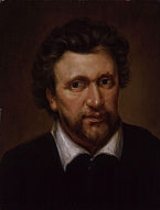
Ben Jonson

 
Ben Jonson

   Email Print
   Bookmark   Link


Ben Jonson


Benjamin Jonson (c. 11 June 1572 – 6 August 1637) was an English
England

native_name =|conventional_long_name = England|common_name = England|image_flag = Flag of England.svg|image_coat = England COA.svg|symbol_type = Royal Coat of Arms...
 Renaissance
English Renaissance

The English Renaissance was a Cultural movement and Art movement in England dating from the early 16th century to the early 17th century. It is associated with the pan-European Renaissance that many cultural historians believe originated in northern Italy in the 14th century....
 dramatist, poet
Poet

A poet is a person who writes poetry....
 and actor
Actor

An actor or actress is a person who acting in a dramatic production and who works in film, television, theatre, or radio programming in that capacity....
. A contemporary of William Shakespeare
William Shakespeare

William Shakespeare was an English people poet and playwright, widely regarded as the greatest writer in the English language and the world's preeminent dramatist....
, he is best known for his satirical
Satire

Satire is often strictly defined as a literary genre; although, in practice, it is also found in the graphic arts and performing arts. In satire, human or individual vices, follies, abuses, or shortcomings are held up to censure by means of ridicule, derision, burlesque, irony, or other methods, ideally with the intent to bring about improv...
 plays, particularly Volpone
Volpone

Volpone is a comedy by Ben Jonson first produced in 1606, drawing on elements of city comedy, black comedy and animal fable. A merciless satire of greed and lust, it remains Jonson's most-performed play, and it is among the finest English literature#Jacobean literature comedies....
, The Alchemist
The Alchemist (play)

The Alchemist is a comedy by English literature playwright Ben Jonson. First performed in 1610 in literature by the King's Men, it is generally considered Jonson's best and most characteristic comedy; Samuel Taylor Coleridge claimed that it had one of the three most perfect plots in literature....
, and Bartholomew Fair
Bartholomew Fair

Bartholomew Fair is a comedy in five acts by Ben Jonson, the last written of his four great comedies. It was first staged on October 31, 1614 in literature at the Hope Theatre by the Lady Elizabeth's Men....
, which are considered his best, and his lyric
Lyric poetry

Lyric poetry refers to a usually short poem that expresses personal feelings, which may or may not be set to music. Aristotle, in Poetics , contrasted lyric poetry with drama and epic poetry....
 poems. A man of vast reading and a seemingly insatiable appetite for controversy, Jonson had an unparalleled breadth of influence on Jacobean and Caroline playwrights and poets.


Discussion
Ask a question about 'Ben Jonson'
Start a new discussion about 'Ben Jonson'
Answer questions from other users
Full Discussion Forum


Recent Posts


Quotations


A cripple in the way out-travels a footman or a post out of the way.

Art hath an enemy called Ignorance.

Every Man out of His Humour (1598), Act I, sc. i

Calumnies are answered best with silence.

Volpone (1606), Act II, sc. ii

Folly often goes beyond her bounds; but Impudence knows none.

For a good poet's made, as well as born.

Line 64

He that fears death, or mourns it, in the just,Shows of the resurrection little trust.

XXXIV, Of Death, lines 1-2


Encyclopedia


Benjamin Jonson (c. 11 June 1572 – 6 August 1637) was an English
England

native_name =|conventional_long_name = England|common_name = England|image_flag = Flag of England.svg|image_coat = England COA.svg|symbol_type = Royal Coat of Arms...
 Renaissance
English Renaissance

The English Renaissance was a Cultural movement and Art movement in England dating from the early 16th century to the early 17th century. It is associated with the pan-European Renaissance that many cultural historians believe originated in northern Italy in the 14th century....
 dramatist, poet
Poet

A poet is a person who writes poetry....
 and actor
Actor

An actor or actress is a person who acting in a dramatic production and who works in film, television, theatre, or radio programming in that capacity....
. A contemporary of William Shakespeare
William Shakespeare

William Shakespeare was an English people poet and playwright, widely regarded as the greatest writer in the English language and the world's preeminent dramatist....
, he is best known for his satirical
Satire

Satire is often strictly defined as a literary genre; although, in practice, it is also found in the graphic arts and performing arts. In satire, human or individual vices, follies, abuses, or shortcomings are held up to censure by means of ridicule, derision, burlesque, irony, or other methods, ideally with the intent to bring about improv...
 plays, particularly Volpone
Volpone

Volpone is a comedy by Ben Jonson first produced in 1606, drawing on elements of city comedy, black comedy and animal fable. A merciless satire of greed and lust, it remains Jonson's most-performed play, and it is among the finest English literature#Jacobean literature comedies....
, The Alchemist
The Alchemist (play)

The Alchemist is a comedy by English literature playwright Ben Jonson. First performed in 1610 in literature by the King's Men, it is generally considered Jonson's best and most characteristic comedy; Samuel Taylor Coleridge claimed that it had one of the three most perfect plots in literature....
, and Bartholomew Fair
Bartholomew Fair

Bartholomew Fair is a comedy in five acts by Ben Jonson, the last written of his four great comedies. It was first staged on October 31, 1614 in literature at the Hope Theatre by the Lady Elizabeth's Men....
, which are considered his best, and his lyric
Lyric poetry

Lyric poetry refers to a usually short poem that expresses personal feelings, which may or may not be set to music. Aristotle, in Poetics , contrasted lyric poetry with drama and epic poetry....
 poems. A man of vast reading and a seemingly insatiable appetite for controversy, Jonson had an unparalleled breadth of influence on Jacobean and Caroline playwrights and poets. A house in Dulwich College
Dulwich College

Dulwich College is a selective independent school for boys in Dulwich, a suburb of south-east London, United Kingdom. The College was founded in 1619 by Edward Alleyn, a successful Elizabethan era actor, with the original purpose of educating 12 poor scholars as the foundation of "God's Gift"....
 is named after him.

Biography


Early life

Although he was born in Westminster
Westminster

Westminster is an area of Central London, within the City of Westminster. It lies on the north bank of the River Thames, southwest of the City of London and southwest of Charing Cross....
, London
London

London is the capital of both England and the United Kingdom, and the most populous municipality in the European Union. An important settlement for two millennia, History of London goes back to its founding by the Roman Empire....
, Jonson claimed his family was of Scottish
Scotland

conventional_long_name = ScotlandAlba|common_name= Scotland|image_flag = Flag of Scotland.svg|flag_width = 130px...
 Border country
Border country

The border country is the area either side of the Anglo-Scottish border including parts of the modern council areas of Dumfries and Galloway and the Scottish Borders, and parts of the Counties of England of Cumbria, County Durham and Northumberland....
 descent, and this claim may have been supported by the fact that his coat of arms
Coat of arms

A coat of arms, more properly called an armorial achievement, armorial bearings or often just arms for short, in European tradition, is a design belonging to a particular person and used by them in a wide variety of ways....
 bears three spindles or rhombi
Rhombus

In geometry, a rhombus , or rhomb is an equilateral polygon parallelogram. In other words, it is a four-sided polygon in which every side has the same length....
, a device shared by a Borders family, the Johnstones of Annandale
Annandale, Dumfries and Galloway

Annandale is a strath in Dumfries and Galloway, Scotland, named after the River Annan. It runs north-south from Moffat to Annan, Dumfries and Galloway on the Solway Firth....
. His father died a month before Ben's birth, and his mother remarried two years later, to a master bricklayer
Bricklayer

A bricklayer or mason is a tradesman who lays bricks to construct brickwork. The term also refers to personnel who use Cinder block to construct blockwork walls and other forms of masonry....
. Jonson attended school in St. Martin's Lane
St. Martin's Lane

St. Martin's Lane is a street in Central London, which runs from the church of St. Martin-in-the-Fields, after which it is named, near Trafalgar Square northwards to Long Acre....
, and was later sent to Westminster School
Westminster School

The Royal College of St. Peter in Westminster, almost always known as Westminster School, is one of Britain's leading independent schools, with the highest Oxbridge acceptance rate of any secondary school or college....
, where one of his teachers was William Camden
William Camden

William Camden was an England antiquarian and historian. He wrote the first topographical survey of the islands of Great Britain and Ireland and the first detailed historical account of the reign of Elizabeth I of England....
. Jonson remained friendly with Camden, whose broad scholarship evidently influenced his own style, until the latter's death in 1623. On leaving, Jonson was once thought to have gone on to the University of Cambridge
University of Cambridge

The University of Cambridge , located in Cambridge, England, is the List of oldest universities in continuous operation university in the Anglosphere....
; Jonson himself said that he did not go to university, but was put to a trade immediately: a legend recorded by Fuller
Thomas Fuller

Thomas Fuller was an English churchman and historian....
 indicates that he worked on a garden wall in Lincoln's Inn
Lincoln's Inn

The Honourable Society of Lincoln's Inn is one of four Inns of Court in London to which barristers of England and Wales belong and where they are Call to the bar....
. He soon had enough of the trade, probably bricklaying, and spent some time in the Low Countries
Low Countries

The Low Countries, the historical region of de Nederlanden, are the country on low-lying land around the river delta of the Rhine, Scheldt, and Meuse River rivers....
 as a volunteer with the regiments of Francis Vere
Francis Vere

Francis Vere , England soldier, was the son of Geoffrey Vere of Crepping Hall, Essex, and nephew of John de Vere, 16th Earl of Oxford.He first went on active service under Robert Dudley, 1st Earl of Leicester in 1585, and was soon in the thick of the war raging in the Low Countries....
. In conversations with the poet William Drummond
William Drummond of Hawthornden

William Drummond , called "of Hawthornden" was a Scotland poet....
, subsequently published as the Hawthornden Manuscripts, Jonson reports that while in the Netherlands he killed an opponent in single combat and stripped him of his weapons.

Ben Jonson married, some time before 1594, a woman he described to Drummond as "a shrew, yet honest." His wife has not been definitively identified, but she is sometimes identified as the Ann Lewis who married a Benjamin Jonson at St Magnus-the-Martyr
St Magnus-the-Martyr

St Magnus-the-Martyr is an Anglican church in Bridge of the City of London, located on Lower Thames Street near the modern London Bridge. It is a part of the Diocese of London and under the care of the Bishop of Fulham....
, near London Bridge
London Bridge

London Bridge is a bridge between the City of London and Southwark in London, England, over the River Thames. Situated between Cannon Street Railway Bridge and Tower Bridge, it forms the western end of the Pool of London....
. The registers of St. Martin's Church state that his eldest daughter Mary died in November, 1593, when she was only six months old. His eldest son Benjamin died of the plague ten years later (Jonson's epitaph to him On My First Sonne
On My First Sonne

On My First Sonne, a poem by Ben Jonson, was written after the 1603 death of Jonson's first son Benjamin at age seven. The poem, a reflection of a father's pain in his young son's death, is rendered more acutely moving when compared with Jonson's other, usually more cynical or mocking, poetry....
 was written shortly after), and a second Benjamin died in 1635. For five years somewhere in this period, Jonson lived separate from his wife, enjoying instead the hospitality of Lord Aubigny.

By the summer of 1597, Jonson had a fixed engagement in the Admiral's Men
Admiral's Men

The Admiral's Men was a playing company or troupe of actors in the Elizabethan era and House of Stuart eras . It is generally considered the second most important acting troupe of English Renaissance theatre ....
, then performing under Philip Henslowe
Philip Henslowe

Philip Henslowe was an Elizabethan era theatrical entrepreneur and impresario. Henslowe's modern reputation rests on the survival of his "Diary", a primary source for information about the theatrical world of Renaissance London....
's management at The Rose
The Rose (theatre)

The Rose was an Elizabethan era Theater . It was the fourth of the public theatres to be built, after The Theatre , the Curtain Theatre , and the theatre at Newington Butts — and the first of several playhouses to be situated in Bankside, Southwark, in a Liberty outside the jurisdiction of the City of London's civic authorities....
. John Aubrey
John Aubrey

John Aubrey was an England antiquary and writer, best known as the author of the collection of short biographical pieces usually referred to as Brief Lives and as the discoverer of the Aubrey holes in Stonehenge....
 reports, on uncertain authority, that Jonson was not successful as an actor; whatever his skills as an actor, he was evidently more valuable to the company as a writer. By this time, Jonson had begun to write original plays for the Lord Admiral's Men; in 1598, he was mentioned by Francis Meres
Francis Meres

Francis Meres , was an England churchman and author.He was born at Kirton, Lincolnshire in the Holland, Lincolnshire of Lincolnshire in 1565. He was educated at Pembroke College, Cambridge, where he received a B.A....
 in his Palladis Tamia as one of "the best for tragedy." None of his early tragedies survive, however. An undated comedy, The Case is Altered
The Case is Altered

The Case is Altered is an early comedy by Ben Jonson. First published in 1609 in literature, the play presents a range of problems for scholars attempting to understand its place in Jonson's canon of works....
, may be his earliest surviving play.

In 1597, a play co-written with Thomas Nashe
Thomas Nashe

Thomas Nashe was an England Elizabethan pamphleteer, poet and satirist. He was the son of the minister of religion William Nashe and his wife Margaret ....
 entitled The Isle of Dogs
The Isle of Dogs (play)

The Isle of Dogs is a play by Thomas Nashe and Ben Jonson which was performed in 1597. It was immediately suppressed, and no copy of it is known to exist....
 was suppressed after causing great offence. Arrest warrants for Jonson and Nashe were subsequently issued by Elizabeth's so-called interrogator, Richard Topcliffe
Richard Topcliffe

Richard Topcliffe was a landowner and Member of Parliament during the reign of Elizabeth I of England. He became notorious as a priest-hunter and torturer and was often referred to as the Queen's principal "interrogator"....
. Jonson was jailed in Marshalsea Prison and famously charged with “Leude and mutynous behavior”, while Nashe managed to escape to Great Yarmouth
Great Yarmouth

Great Yarmouth, often known to locals as Yarmouth, is a coastal town in Norfolk, England. It is at the mouth of the River Yare, 20 miles east of Norwich....
. A year later, Jonson was again briefly imprisoned, this time in Newgate Prison
Newgate Prison

Newgate Prison was a prison in London, at the corner of Newgate and Old Bailey just inside the City of London. It was originally located at the site of a gate in the Ancient Rome London Wall....
, for killing another man, an actor Gabriel Spenser, in a duel
Duel

As practiced from the 11th to 20th centuries in Western societies, a duel is an engagement in combat between two individuals, with matched weapons in accordance with their combat doctrines....
 on 22 September 1598 in Hogsden Fields, (today part of Hoxton
Hoxton

Hoxton is an area in the London Borough of Hackney, immediately north of the financial district of the City of London. The area of Hoxton is bordered by Regents Canal on the north side, Wharf Road and City Road on the west, Old Street on the south, and Kingsland Road on the east....
). While in prison, Jonson was visited by a Roman Catholic priest and converted to Catholicism. Tried on a charge of manslaughter
Manslaughter

Manslaughter is a legal term for the killing of a human being, in a manner considered by law as less culpable than murder.The law generally differentiates between levels of criminal culpability based on the mens rea, or state of mind....
, Jonson pleaded guilty but was subsequently released by benefit of clergy
Benefit of clergy

In England law, the benefit of clergy was originally a provision by which clergymen could claim that they were outside the jurisdiction of the secular courts and be tried instead under canon law....
 (a legal ploy through which he gained leniency by reciting a brief bible verse in Latin
Latin

Latin is an Italic language, historically spoken in Latium and Ancient Rome. Through the Military history of the Roman Empire, Latin spread throughout the Mediterranean and a large part of Europe....
), forfeiting his "goods and chattels" and being branded on his left thumb.

In 1598, Jonson produced his first great success, Every Man in his Humour
Every Man in His Humour

Every Man in His Humour is a 1598 play by the England playwright Ben Jonson. The play belongs to the subgenre of the "humours comedy," in which each major character is dominated by an overriding humour or obsession....
, capitalising on the vogue for humour plays that had been begun by George Chapman
George Chapman

George Chapman was an England dramatist, translator, and poet. He was a classical scholar, and his work shows the influence of Stoicism. Chapman has been identified as the Rival Poet of Shakespeare's Sonnets by William Minto, and as an anticipator of the Metaphysical Poets....
 with An Humorous Day's Mirth
An Humorous Day's Mirth

An Humorous Day's Mirth is an Literature in English#Elizabethan literature era stage play, a comedy by George Chapman, first acted in 1597 in literature and published in 1599 in literature....
. William Shakespeare
William Shakespeare

William Shakespeare was an English people poet and playwright, widely regarded as the greatest writer in the English language and the world's preeminent dramatist....
 was among the first cast. This play was followed the next year by Every Man Out of His Humour
Every Man Out of His Humour

Every Man out of His Humour is a satirical comedy written by English playwright Ben Jonson, acted in 1599 by the Lord Chamberlain's Men. It is a conceptual sequel to his 1598 comedy Every Man in His Humour....
, a pedantic attempt to imitate Aristophanes
Aristophanes

Aristophanes , son of Philippus, of the deme Cydathenaus, was a prolific and much acclaimed comedy playwright of ancient Athens. Eleven of his forty plays have come down to us virtually complete....
. It is not known whether this was a success on stage, but when published, it proved popular and went through several editions.

Jonson's other work for the theater in the last years of Elizabeth I's reign was, unsurprisingly, marked by fighting and controversy. Cynthia's Revels
Cynthia's Revels

Cynthia's Revels, or The Fountain of Self-Love is a late Literature in English#Elizabethan literature stage play, a satire written by Ben Jonson, The play was one element in the so-called Poetomachia or War of the Theatres between Jonson and rival playrwights John Marston and Thomas Dekker ....
 was produced by the Children of the Chapel
Children of the Chapel

The Children of the Chapel was a troupe of boy player in Elizabethan era and Jacobean era England.Sometime in the 12th century, the Chapel Royal was created as a distinct institution of the English Royal Court....
 Royal at Blackfriars Theatre
Blackfriars Theatre

Blackfriars Theatre was the name of a theatre in the Blackfriars, London district of the City of London during the English Renaissance theatre. The theatre began as a venue for boy player associated with the Elizabeth I of England chapel choirs; in this function, the theatre hosted some of the most innovative drama of Elizabeth and James I o...
 in 1600. It satirized both John Marston
John Marston

John Marston was an English people poet, playwright and satirist during the late Elizabethan and Literature in English#Jacobean literature periods....
, who Jonson believed had accused him of lustfulness, probably in Histrio-Mastix, and Thomas Dekker, against whom Jonson's animus
Animus

Animus may stand for:...
 is not known. Jonson attacked the same two poets again in 1601's Poetaster
Poetaster

Poetaster, like rhymester or versifier, is a contemptuous name often applied to bad or inferior poets. Specifically, poetaster has implications of unwarranted pretentions to artistic value....
. Dekker responded with Satiromastix, subtitled "the untrussing of the humorous poet." The final scene of this play, while certainly not to be taken at face value as a portrait of Jonson, offers a caricature that is recognizable from Drummond's report: boasting about himself and condemning other poets, criticizing actors' performances of his plays, and calling attention to himself in any available way.

This "War of the Theatres
War of the Theatres

The War of the Theatres is the name commonly applied to a controversy from the later Elizabethan theatre; Thomas Dekker termed it the Poetomachia....
" appears to have been concluded with reconciliation on all sides. Jonson collaborated with Dekker on a pageant
Pageant

A Medieval pageant is a form of procession traditionally associated with both secular and religious rituals, often with a narrative structure. Pageants were an important aspect of Medieval European seasonal festivals, in particular around the celebration of Corpus Christi , which began after the 13th century....
 welcoming James I
James I of England

James VI and I was List of monarchs of Scotland as James VI, and List of English monarchs and King of Ireland as James I. He ruled in Kingdom of Scotland as James VI from 24 July 1567, when he was only one year old, succeeding his mother Mary I of Scotland....
 to England in 1603, although Drummond reports that Jonson called Dekker a rogue. Marston dedicated The Malcontent to Jonson, and the two collaborated with Chapman on Eastward Ho, a 1605 play whose anti-Scottish sentiment landed both authors in jail for a brief time.

At the beginning of the reign of James I of England
James I of England

James VI and I was List of monarchs of Scotland as James VI, and List of English monarchs and King of Ireland as James I. He ruled in Kingdom of Scotland as James VI from 24 July 1567, when he was only one year old, succeeding his mother Mary I of Scotland....
 in 1603, Jonson joined other poets and playwrights in welcoming the reign of the new King. Jonson quickly adapted himself to the additional demand for masque
Masque

The masque was a form of festive Noble court entertainment which flourished in sixteenth and early seventeenth century Europe, though it was developed earlier in Italy, in forms including the intermedio....
s and entertainments introduced with the new reign and fostered by both the king and his consort, Anne of Denmark
Anne of Denmark

Anne of Denmark was queen consort of Kingdom of Scotland, Kingdom of England, and Kingdom of Ireland as spouse of King James I of England.The second daughter of King Frederick II of Denmark, Anne married James in 1589 at the age of fourteen and bore him three children who survived infancy, including the future Charles I of England....
.

Ben Jonson's ascendance


Jonson flourished as a dramatist during the first decade or so of James's reign; by 1616, he had produced all the plays on which his reputation as a dramatist depends. These include the tragedy of Catiline
Catiline His Conspiracy

Catiline His Conspiracy is a Literature_in_English#Jacobean_literature tragedy written by Ben Jonson. It is one of the two Roman tragedies that Jonson hoped would cement his dramatic achievement and reputation, the other being Sejanus His Fall ....
 (acted and printed 1611), which achieved only limited success, and the comedies Volpone
Volpone

Volpone is a comedy by Ben Jonson first produced in 1606, drawing on elements of city comedy, black comedy and animal fable. A merciless satire of greed and lust, it remains Jonson's most-performed play, and it is among the finest English literature#Jacobean literature comedies....
, (acted 1605 and printed in 1607), Epicoene, or the Silent Woman
Epicoene, or the Silent Woman

Epic?ne, or The silent woman is a comedy by English Renaissance theatre playwright Ben Jonson. It was originally performed by the Children of the Chapel, a group of boy players, in 1609 in literature....
 (1609), The Alchemist
The Alchemist (play)

The Alchemist is a comedy by English literature playwright Ben Jonson. First performed in 1610 in literature by the King's Men, it is generally considered Jonson's best and most characteristic comedy; Samuel Taylor Coleridge claimed that it had one of the three most perfect plots in literature....
 (1610), Bartholomew Fair
Bartholomew Fair

Bartholomew Fair is a comedy in five acts by Ben Jonson, the last written of his four great comedies. It was first staged on October 31, 1614 in literature at the Hope Theatre by the Lady Elizabeth's Men....
 (1614) and The Devil is an Ass
The Devil is an Ass

The Devil is an Ass is a Literature_in_English#Jacobean_literature comedy by Ben Jonson, first performed in 1616 in literature and first published in 1631 in literature....
 (1616). The Alchemist and Volpone appear to have been successful at once. Of Epicoene, Jonson told Drummond of a satirical verse which reported that the play's subtitle was appropriate, since its audience had refused to applaud the play (i.e., remained silent). Yet Epicoene, along with Bartholomew Fair and (to a lesser extent) The Devil is an Ass have in modern times achieved a certain degree of recognition. While his life during this period was apparently more settled than it had been in the 1590s, his financial security was still not assured. In 1603, Overbury
Thomas Overbury

Sir Thomas Overbury , English poet and essayist, and the victim of one of the most sensational crimes in English history, was the son of Nicholas Overbury, of Bourton-on-the-Hill, and was born at Compton Scorpion, near Ilmington, in Warwickshire....
 reported that Jonson was living on Aurelian Townsend and "scorning the world."

His trouble with English authorities continued. In 1603, he was questioned by the Privy Council
Privy Council of the United Kingdom

Her Majesty's Most Honourable Privy Council is a body of advisors to the British monarchy. Its members are largely senior politicians, who were or are members of either the House of Commons of the United Kingdom or House of Lords....
 about Sejanus, a politically-themed play about corruption in the Roman Empire. He was again in trouble for topical allusions in a play, now lost, in which he took part. After the discovery of the Gunpowder Plot
Gunpowder Plot

The Gunpowder Conspiracy of 1605, or the Powder Treason or Gunpowder Plot, as it was then known, was a failed assassination attempt by a group of provincial English Roman Catholic Church against King James I of England....
, he appears to have been asked by the Privy Council
Privy council

A privy council is a body that advises the head of state of a nation on how to exercise their Executive , typically, but not always, in the context of a monarchy....
 to attempt to prevail on a certain priest to cooperate with the government; the priest he found was Father Thomas Wright, who heard Fawkes's confession(Teague, 249).

At the same time, Jonson pursued a more prestigious career as a writer of masque
Masque

The masque was a form of festive Noble court entertainment which flourished in sixteenth and early seventeenth century Europe, though it was developed earlier in Italy, in forms including the intermedio....
s for James' court. The Satyr
The Entertainment at Althorp

The Entertainment at Althorp, or The Althorp Entertainment, is an early Literature in English#Jacobean literature era literary work, written by Ben Jonson....
 (1603) and The Masque of Blackness
The Masque of Blackness

The Masque of Blackness was an early Literature in English#Jacobean literature era masque, first performed at the House of Stuart Court in the Banqueting Hall of Whitehall Palace on Twelfth Night , January 6, 1605....
 (1605) are but two of the some two dozen masques Jonson wrote for James or for Queen Anne; the latter was praised by Swinburne
Algernon Charles Swinburne

Algernon Charles Swinburne was an English poet, controversial in his own day....
 as the consummate example of this now-extinct genre, which mingled speech, dancing, and spectacle. On many of these projects he collaborated, not always peacefully, with designer Inigo Jones
Inigo Jones

Inigo Jones is regarded as the first significant British architecture, and the first to bring Renaissance architecture to England. He also made valuable contributions to stage design....
. Perhaps partly as a result of this new career, Jonson gave up writing plays for the public theaters for a decade. Jonson later told Drummond that he had made less than two hundred pounds on all his plays together.

1616 saw a pension of 100 marks (about £60) a year conferred upon him, leading some to identify him as England's first Poet Laureate
Poet Laureate

A Poet Laureate is a poet officially appointed by a government and is often expected to compose poems for State occasions and other government events....
. This sign of royal favour may have encouraged him to publish the first volume of the folio collected edition of his works that year. Other volumes followed in 1640–41 and 1692. [See: Ben Jonson folios
Ben Jonson folios

The folio collections of Ben Jonson's works published in the seventeenth century were crucial developments in the publication of English literature and English Renaissance drama....
.]

In 1618, Ben Jonson set out for his ancestral Scotland
Scotland

conventional_long_name = ScotlandAlba|common_name= Scotland|image_flag = Flag of Scotland.svg|flag_width = 130px...
 on foot. He spent over a year there, and the best-remembered hospitality which he enjoyed was that of the Scottish poet, Drummond of Hawthornden. Drummond undertook to record as much of Jonson's conversation as he could in his diary, and thus recorded aspects of Jonson's personality that would otherwise have been less clearly seen. Jonson delivers his opinions, in Drummond's terse reporting, in an expansive and even magisterial mood. In the postscript added by Drummond, he is described as "a great lover and praiser of himself, a contemner and scorner of others".

While in Scotland, he was made an honorary citizen of Edinburgh
Edinburgh

Edinburgh ; is the Capital city of Scotland, a position it has held since 1437. It is the seventh largest city in the United Kingdom and the second largest Scottish City status in the United Kingdom after Glasgow....
. On returning to England, he was awarded an honorary
Honorary degree

An honorary degree or a degree honoris causa is an academic degree for which a university has waived the usual requirements . The degree itself is typically a doctorate or, less commonly, a master's degree, and may be awarded to someone who has no prior connection with the institution in question....
 Master of Arts degree
Academic degree

A degree is any of a wide range of status levels conferred by institutions of higher education, such as University, normally as the result of successfully completing a program of study....
 from Oxford University
University of Oxford

The University of Oxford , located in the city of Oxford, Oxfordshire, England, is the List of oldest universities in continuous operation in the English-speaking world....
.

The period between 1605 and 1620 may be viewed as Jonson's heyday. In addition to his popularity on the public stage and in the royal hall, he enjoyed the patronage of aristocrats such as Elizabeth Sidney
Roger Manners, 5th Earl of Rutland

Roger Manners, 5th Earl of Rutland was the son of John Manners, 4th Earl of Rutland.He married Elizabeth Sidney , on 5 March 1599.He died in 1612, aged 35 and his titles passed to his brother, Francis Manners, 6th Earl of Rutland....
 (daughter of Sir Philip Sidney
Philip Sidney

Sir Philip Sidney became one of the Elizabethan era most prominent figures. Famous in his day in England as a poet, courtier and soldier, he remains known as the author of Astrophel and Stella , The Defence of Poetry , and The Countess of Pembroke's Arcadia ....
) and Lady Mary Wroth
Lady Mary Wroth

Lady Mary Wroth was an English poet of the Renaissance. A member of a distinguished literary English family, Wroth was among the first female British writers to have achieved an enduring reputation....
. This connection with the Sidney family provided the impetus for one of Jonson's most famous lyrics, the country house poem
Country house poems

A genre popular in early 17th century England, in which the poet compliments a wealthy patron or a friend through a description of his country house. It may be regarded as a sub-set of the Topographical poem....
 To Penshurst
Penshurst Place

Penshurst Place is an historic building near Tonbridge in Kent, 32 miles to the south east of London, England. It is the ancestral home of the Sidney family, and it and its gardens are open for public viewing....
.

Decline and death


The 1620s begin a lengthy and slow decline for Jonson. He was still well-known; from this time dates the prominence of the Sons of Ben
Sons of Ben

The phrase Sons of Ben is a mildly problematic term applied to followers of Ben Jonson in English poetry and English drama in the first half of the seventeenth century....
 or the "Tribe of Ben", those younger poets such as Robert Herrick
Robert Herrick (poet)

Robert Herrick was a 17th century English poet....
, Richard Lovelace
Richard Lovelace

Richard Lovelace was an England poet in the seventeenth century....
, and Sir John Suckling who took their bearing in verse from Jonson. However, a series of setbacks drained his strength and damaged his reputation.

Jonson returned to writing regular plays in the 1620s, but these are not considered among his best. They are of significant interest for the study of the culture of Charles I
Charles I of England

Charles I was List of English monarchs, List of monarchs of Scotland and King of Ireland from 27 March 1625 until his capital punishment on 30 January 1649....
's England. The Staple of News
The Staple of News

The Staple of News is an early Literature in English#Caroline and Cromwellian literature era play, a satire by Ben Jonson. The play was first performed in late 1625 in literature by the King's Men at the Blackfriars Theatre, and first published in 1631 in literature....
, for example, offers a remarkable look at the earliest stage of English journalism
Journalism

Journalism is the craft of conveying news, descriptive material and editorial via a widening spectrum of Media . These include newspapers, magazines, radio and television, the internet and, more recently, the cellphone....
. The lukewarm reception given that play was, however, nothing compared to the dismal failure of The New Inn
The New Inn

The New Inn, or The Light Heart is a Literature in English#Caroline and Cromwellian literarure era stage play, a comedy by English playwright and poet Ben Jonson....
; the cold reception given this play prompted Jonson to write a poem condemning his audience (the Ode to Myself), which in turn prompted Thomas Carew
Thomas Carew

Thomas Carew was an England poet.He was the son of Sir Matthew Carew, master in chancery, and his wife, Alice Ingpenny, widow of Sir John Rivers, Lord Mayor of the City of London....
, one of the "Tribe of Ben," to respond in a poem that asks Jonson to recognize his own decline.

The principal factor in Jonson's partial eclipse was, however, the death of James and the accession of King Charles I
Charles I of England

Charles I was List of English monarchs, List of monarchs of Scotland and King of Ireland from 27 March 1625 until his capital punishment on 30 January 1649....
 in 1625. Justly or not, Jonson felt neglected by the new court. A decisive quarrel with Jones harmed his career as a writer of court masques, although he continued to entertain the court on an irregular basis. For his part, Charles displayed a certain degree of care for the great poet of his father's day: he increased Jonson's annual pension to £100 and included a tierce
Tierce

The tierce is an old English unit of wine casks, holding about 159 litres. From 1824 on it was defined by English law to be 35 imperial gallons, before that it was 42 wine gallons—the difference being less than a tenth of a percent....
 of wine.

Despite the strokes that he suffered in the 1620s, Jonson continued to write. At his death in 1637 he seems to have been working on another play, The Sad Shepherd. Though only two acts are extant, this represents a remarkable new direction for Jonson: a move into pastoral
Pastoral

Pastoral, as an adjective, refers to the lifestyle of shepherds and pastoralists, moving livestock around larger areas of land according to seasons and availability of water and food....
 drama. During the early 1630s he also conducted a correspondence with James Howell
James Howell

File:Abraham Bosse00.jpgJames Howell , was a 17th-century Great Britain historian and writer who is in many ways an emblematic figure of his age....
, who warned him about disfavour at court in the wake of his dispute with Jones.

Jonson is buried in Westminster Abbey
Westminster Abbey

The Collegiate Church of St Peter at Westminster, which is almost always referred to popularly and informally as Westminster Abbey, is a large, mainly Gothic architecture Church , in Westminster, London, just to the west of the Palace of Westminster....
, with the inscription, "O Rare Ben Johnson," (sic) laid in the slab over his grave. It has been suggested that this could be read "Orare Ben Jonson" (pray for Ben Jonson), which would indicate a deathbed return to Catholicism, but the carving shows a distinct space between "O" and "rare". Researchers suggest that the tribute came from William D’Avenant
William Davenant

Sir William Davenant , also spelled D'Avenant, was an England poet and playwright. Along with Thomas Killigrew, Davenant was one of the rare figures in English Renaissance theatre whose career spanned both the Literature in English#Caroline and Cromwellian literature and Literature in English#Restoration literature eras, and who was a...
, Jonson’s successor as Poet Laureate, as the same phrase appears on his gravestone nearby. The fact that he was buried in an upright grave is an indication of his reduced circumstances at the time of his death.

His work


Drama


Apart from two tragedies, Sejanus
Sejanus (play)

Sejanus His Fall, a 1603 play by Ben Jonson, is a tragedy about Sejanus, the favorite of the Roman emperor Tiberius. It was possibly an allegory of James I of England and his corrupt court....
 and Catiline, that largely failed to impress Renaissance audiences, Jonson's work for the public theatres was in comedy
Comedy

Comedy as a popular meaning, is any humorous discourse generally intended to amuse, especially in television, film, and stand-up comedy. This must be carefully distinguished from its academic definition, namely the comic theatre, whose Western culture origins are found in Ancient Greece....
. These plays vary in some respects. The minor early plays, particularly those written for the boy player
Boy player

Boy player is a common term for the adolescent males employed by Medieval theatre and English Renaissance theatre playing companies....
s, present somewhat looser plots and less-developed characters than those written later, for adult companies. Already in the plays which were his salvos in the Poet's War, he displays the keen eye for absurdity and hypocrisy that marks his best-known plays; in these early efforts, however, plot mostly takes second place to variety of incident and comic set-pieces. They are, also, notably ill-tempered. Thomas Davies
Thomas Davies (bookseller)

Thomas Davies was a Scotland bookseller and author. He studied at the University of Edinburgh and was for several years on the Stage ; but having been ridiculed by Charles Churchill in The Rosciad he gave up acting and opened a bookshop in Covent Garden....
  called Poetaster "a contemptible mixture of the serio-comic, where the names of Augustus Caesar, Mecaenas, Virgil
Virgil

Publius Vergilius Maro was a classical Roman poet, best known for three major works?the Bucolics , the Georgics and the Aeneid?although several Appendix Vergiliana are also attributed to him....
, Horace
Horace

This article is about the Roman poet Horace. For other uses, see Horace .Quintus Horatius Flaccus, , known in the English language world as Horace, was the leading Roman Empire Lyric poetry during the time of Augustus....
, Ovid
Ovid

Publius Ovidius Naso was a Roman Empire poet known as Ovid to the English language-speaking world, who wrote about love, seduction, and Roman mythology transformation....
, and Tibullus
Tibullus

Albius Tibullus was a Latin poet and writer of elegy.Little is known about his life. His first and second books of poetry are extant; many other texts attributed to Tibullus are of questionable origins....
, are all sacrificed upon the altar of private resentment." Another early comedy in a different vein, The Case is Altered
The Case is Altered

The Case is Altered is an early comedy by Ben Jonson. First published in 1609 in literature, the play presents a range of problems for scholars attempting to understand its place in Jonson's canon of works....
, is markedly similar to Shakespeare's romantic comedies in its foreign setting, emphasis on genial wit, and love-plot. Henslowe's diary indicates that Jonson had a hand in numerous other plays, including many in genres such as English history with which he is not otherwise associated.

The comedies of his middle career, from Eastward Ho to The Devil is an Ass
The Devil is an Ass

The Devil is an Ass is a Literature_in_English#Jacobean_literature comedy by Ben Jonson, first performed in 1616 in literature and first published in 1631 in literature....
 are for the most part city comedy
City comedy

City comedy, also called Citizen Comedy, is a common genre of Elizabethan theatre. It is a vague term that different scholars use to mean slightly different things....
, with a London setting, themes of trickery and money, and a distinct moral ambiguity, despite Jonson's professed aim in the Prologue to Volpone
Volpone

Volpone is a comedy by Ben Jonson first produced in 1606, drawing on elements of city comedy, black comedy and animal fable. A merciless satire of greed and lust, it remains Jonson's most-performed play, and it is among the finest English literature#Jacobean literature comedies....
 to "mix profit with your pleasure". His late plays or "dotages," particularly The Magnetic Lady
The Magnetic Lady

The Magnetic Lady, or Humors Reconciled is a Literature in English#Caroline and Cromwellian literature era stage play, the final comedy of Ben Jonson....
 and The Sad Shepherd, exhibit some signs of an accommodation with the romantic tendencies of Elizabethan comedy
English Renaissance theatre

English Renaissance Theatre is English drama written between the English Reformation and the closure of the theatres in 1642. It may also be called early modern English Theatre....
.

Within this general progression, however, Jonson's comic style remained constant and easily recognizable. He announces his programme in the prologue to the folio
Folio

Folio may refer to:* In bookbinding,** A sheet of paper, parchment, or other material folded in half to make two leaves in a codex.** Mainly for manuscripts, a leaf ....
  version of Every Man in His Humour
Every Man in His Humour

Every Man in His Humour is a 1598 play by the England playwright Ben Jonson. The play belongs to the subgenre of the "humours comedy," in which each major character is dominated by an overriding humour or obsession....
; he promises to represent "deeds, and language, such as men do use." He planned to write comedies that revived the classical premises of Elizabethan dramatic theory—or rather, since all but the loosest English comedies could claim some descent from Plautus
Plautus

Titus Maccius Plautus , commonly known as Plautus, was a Ancient Rome playwright. His comedy are among the earliest surviving intact works in Latin literature....
 and Terence
Terence

Publius Terentius Afer , better known as Terence, was a playwright of the Roman Republic. His comedies were performed for the first time around 170–160 BC, and he died young probably in Greece or on his way back to Rome....
, he intended to apply those premises with rigour. This commitment entailed negations: after The Case is Altered
The Case is Altered

The Case is Altered is an early comedy by Ben Jonson. First published in 1609 in literature, the play presents a range of problems for scholars attempting to understand its place in Jonson's canon of works....
, Jonson eschewed distant locations, noble characters, romantic plots, and other staples of Elizabethan comedy. Jonson focused instead on the satiric and realistic inheritance of new comedy. He sets his plays in contemporary settings, peoples them with recognizable types, and sets them to actions that, if not strictly realistic, involve everyday motives such as greed
Greed

Sorry, no overview for this topic
 and jealousy
Jealousy

Jealousy typically refers to the negative thoughts and feelings of insecurity, fear, and anxiety that occur when a person believes an item of value is being threatened ....
. In accordance with the temper of his age, he was often so broad in his characterisation that many of his most famous scenes border on the farcical
Farce

A farce is a comedy written for the stage or film which aims to entertain the audience by means of unlikely, extravagant, and improbable situations, disguise and mistaken identity, verbal humour of varying degrees of sophistication, which may include sexual innuendo and word play, and a fast-paced Plot whose speed usually increases, culminat...
 (as Congreve
William Congreve

William Congreve was an England playwright and poet....
, for example, judged Epicoene.) He was, moreover, more diligent in adhering to the classical unities
Classical unities

The classical unities or three unities are rules for drama derived from a passage in Aristotle's Poetics . In their neoclassicism form they are as follows:...
 than many of his peers--although as Margaret Cavendish
Margaret Cavendish

Margaret Cavendish, Duchess of Newcastle-upon-Tyne , was an English aristocrat and a prolific writer. Born Margaret Lucas, she was the youngest sister of prominent royalists Sir John Lucas and Charles Lucas....
 noted, the unity of action in the major comedies was rather compromised by Jonson's abundance of incident. To this classical model Jonson applies the two features of his style which save his classical imitations from mere pedantry: the vividness with which he depicts the lives of his characters, and the intricacy of his plots. Coleridge, for instance, claimed that The Alchemist
The Alchemist (play)

The Alchemist is a comedy by English literature playwright Ben Jonson. First performed in 1610 in literature by the King's Men, it is generally considered Jonson's best and most characteristic comedy; Samuel Taylor Coleridge claimed that it had one of the three most perfect plots in literature....
 had one of the three most perfect plots in literature.

Poetry

Jonson's poetry, like his drama, is informed by his classical learning. Some of his better-known poems are close translations of Greek or Roman models; all display the careful attention to form and style that often came naturally to those trained in classics in the humanist
Renaissance humanism

Renaissance humanism was a European intellectual movement that was a crucial component of the Renaissance, beginning in Florence in the last years of the 14th century....
 manner. Jonson, however, largely avoided the debates about rhyme and meter that had consumed Elizabethan classicists such as Campion
Thomas Campion

Thomas Campion, was an English composer, poet and physician....
 and Harvey
Gabriel Harvey

Gabriel Harvey was an England writer. Harvey was a notable scholar, though his reputation suffered from his quarrel with Thomas Nashe. Henry Morley, writing in the Fortnightly Review , brought evidence from Harvey's Latin language writings showing that he was distinguished by quite other qualities than the pedantry and conceit usually as...
. Accepting both rhyme and stress, Jonson uses them to mimic the classical qualities of simplicity, restraint, and precision.

“Epigrams” (published in the 1616 folio) is an entry in a genre that was popular among late-Elizabethan and Jacobean audiences. Jonson’s epigrams explore various attitudes, most of them from the satiric stock of the day: complaints against women, courtiers, and spies abound. The condemnatory poems are short and anonymous; Jonson’s epigrams of praise, including a famous poem to Camden and lines to Lucy Harington, are somewhat longer and mostly addressed to specific individuals. The poems of “The Forest” also appeared in the first folio. Most of the fifteen poems are addressed to Jonson’s aristocratic supporters, but the most famous are his country-house poem “To Penshurst” and the poem “To Celia” (“Come, my Celia, let us prove”) that appears also in ‘’Volpone.’’

‘’Underwoods
Underwoods

Underwoods is a collection of poems by Robert Louis Stevenson published in 1887 in literature. It comprises two books, the first in English, the second in Scots....
,’’ published in the expanded folio of 1640, is a larger and more heterogeneous group of poems. It contains ‘’A Celebration of Charis,’’ Jonson’s most extended effort at love poetry; various religious pieces; encomiastic poems including the poem to Shakespeare and a sonnet on Mary Wroth; the ‘’Execration against Vulcan” and others. The 1640 volume also contains three elegies which have often been ascribed to Donne (one of them appeared in Donne’s posthumous collected poems).

Relationship with Shakespeare

There are many legends about Jonson's rivalry with Shakespeare, some of which may be true. Drummond reports that during their conversation, Jonson scoffed at two apparent absurdities in Shakespeare's plays: a nonsensical line in Julius Caesar
Julius Caesar (play)

Julius Caesar is a Shakespearean tragedy by William Shakespeare, believed to have been written in 1599. It portrays the conspiracy against the Roman Empire dictator Julius Caesar, his assassination and its aftermath....
, and the setting of The Winter's Tale
The Winter's Tale

The Winter's Tale is a play by William Shakespeare, first published in the First Folio in 1623. Although it was listed as a comedy when it first appeared, some modern editors have relabeled the play a Romance ....
 on the non-existent seacoast of Bohemia. Drummond also reports Jonson saying that Shakespeare "wanted art." Whether Drummond is viewed as accurate or not, the comments fit well with Jonson's well-known theories about literature.

In Timber
Timber

Timber may refer to:* Lumber, i.e. wood materials* Timber, Oregon, an unincorporated community in the U.S. state of Oregon* Timber , a 1984 arcade game by Bally Midway...
, which was published posthumously and reflects his lifetime of practical experience, Jonson offers a fuller and more conciliatory comment. He recalls being told by certain actors that Shakespeare never blotted (i.e., crossed out) a line when he wrote. His own response, "Would he had blotted a thousand," was taken as malicious. However, Jonson explains, "He was, indeed, honest, and of an open and free nature, had an excellent phantasy, brave notions, and gentle expressions, wherein he flowed with that facility that sometimes it was necessary he should be stopped". Jonson concludes that "there was ever more in him to be praised than to be pardoned." Also when Shakespeare died he said "He was not of an age, but for all time."

Thomas Fuller
Thomas Fuller

Thomas Fuller was an English churchman and historian....
 relates stories of Jonson and Shakespeare engaging in debates in the Mermaid Tavern
Mermaid Tavern

The Mermaid Tavern was a tavern on Cheapside in London during the Elizabethan era, located east of St. Paul's Cathedral on the corner of Friday Street and Bread Street....
; Fuller imagines conversations in which Shakespeare would run rings around the more learned but more ponderous Jonson. That the two men knew each other personally is beyond doubt, not only because of the tone of Jonson's references to him but because Shakespeare's company produced a number of Jonson's plays, at least one of which (Every Man in his Humour
Every Man in His Humour

Every Man in His Humour is a 1598 play by the England playwright Ben Jonson. The play belongs to the subgenre of the "humours comedy," in which each major character is dominated by an overriding humour or obsession....
) Shakespeare certainly acted in. However, it is now impossible to tell how much personal communication they had, and tales of their friendship cannot be substantiated in the present state of knowledge.

Jonson's most influential and revealing commentary on Shakespeare is the second of the two poems that he contributed to the prefatory verse that opens Shakespeare's First Folio
First Folio

Mr. William Shakespeares Comedies, Histories, & Tragedies is the 1623 published collection of William Shakespeare's plays. Modern scholars commonly refer to it as the First Folio....
. This poem, "To the memory of my beloved, The AUTHOR, Mr. William Shakespeare: And what he hath left us," did a good deal to create the traditional view of Shakespeare as a poet who, despite "small Latine, and lesse Greeke", had a natural genius. The poem has traditionally been thought to exemplify the contrast Jonson perceived between himself, the disciplined and erudite classicist, scornful of ignorance and skeptical of the masses, and Shakespeare, represented in the poem as a kind of natural wonder whose genius was not subject to any rules except those of the audiences for which he wrote. But the poem itself qualifies this view:
Yet must I not give Nature all: Thy Art,
My gentle Shakespeare, must enjoy a part.
Some view this elegy as a conventional exercise, but a rising number of critics see it as a heartfelt tribute to the "Sweet Swan Of Avon," the "Soul of the Age!" It has been compellingly argued that Jonson helped to edit the First Folio
First Folio

Mr. William Shakespeares Comedies, Histories, & Tragedies is the 1623 published collection of William Shakespeare's plays. Modern scholars commonly refer to it as the First Folio....
, and he may have been inspired to write this poem, surely one of his greatest, by reading his fellow playwright's works, a number of which had been previously either unpublished or available in less satisfactory versions, in a relatively complete form.

Reception and Influence

During most of the seventeenth century Jonson was a towering literary figure, and his influence was enormous. Before the civil war The Tribe of Ben touted his importance, and during the Restoration Jonson's satirical comedies and his theory and practice of "humour characters" (which are often misunderstood; see William Congreve's letters for clarification) was extremely influential, providing the blueprint for many Restoration comedies. In the eighteenth century Jonson's status began to decline. In the Romantic era, Jonson suffered the fate of being unfairly compared and contrasted to Shakespeare, as the taste for Jonson's type of satirical comedy decreased. Jonson was at times greatly appreciated by the Romantics, but overall he was denigrated for not writing in a Shakespearean vein. In the twentieth century, Jonson's status rose significantly.

Drama

As G. E. Bentley notes in Shakespeare and Jonson: Their Reputations in the Seventeenth Century Compared, Jonson's reputation was in some respects equal to Shakespeare's in the seventeenth century. After the English theatres were reopened on the Restoration
English Restoration

The English Restoration, or simply The Restoration began in 1660 when the English monarchy, Scottish monarchy and Irish monarchy were restored under Charles II of England after the Interregnum that followed the English Civil War....
 of Charles II
Charles II of England

Charles II was the Monarchy of Kingdom of England, Kingdom of Scotland, and Kingdom of Ireland.His father Charles I of England Regicide#The regicide of Charles I of England at Palace of Whitehall on 30 January 1649, at the climax of the English Civil War....
, Jonson's work, along with Shakespeare's and Fletcher
John Fletcher (playwright)

John Fletcher was a Jacobean era playwright. Following William Shakespeare as house playwright for the King's Men , he was among the most prolific and influential dramatists of his day; both during his lifetime and in the early Restoration, his fame rivaled Shakespeare's....
's work, formed the initial core of the Restoration repertory. It was not until after 1710 that Shakespeare's plays (ordinarily in heavily revised forms) were more frequently performed than those of his Renaissance contemporaries. Many critics since the eighteenth century have ranked Jonson below only Shakespeare among English Renaissance dramatists
English Renaissance theatre

English Renaissance Theatre is English drama written between the English Reformation and the closure of the theatres in 1642. It may also be called early modern English Theatre....
. Critical judgment has tended to emphasize the very qualities that Jonson himself lauds in his prefaces, in Timber, and in his scattered prefaces and dedications: the realism and propriety of his language, the bite of his satire, and the care with which he plotted his comedies.

For some critics, the temptation to contrast Jonson (representing art or craft) with Shakespeare (representing nature, or untutored genius) has seemed natural; Jonson himself may be said to initiate this interpretation in his poem on Shakespeare. Leonard Digges echoed this line of thought in his verses affixed to the second folio, and Samuel Butler
Samuel Butler (poet)

Samuel Butler was a poet and satirist. Born in Strensham, Worcestershire and baptised 14 February, 1613, he is remembered now chiefly for a long satire Burlesque poem on Puritanism entitled Hudibras....
 drew the same comparison in his commonplace book later in the century.

At the Restoration, this sensed difference became a kind of critical dogma. Saint-Évremond
Charles de Saint-Évremond

Charles de Marguetel de Saint-Denis, seigneur de Saint-?vremond , was a France soldier, epicurean, essayist and literary critic. After 1661, he lived in exile, mainly in England, as a consequence of his attack on French policy at the time of the peace of the Pyrenees ....
, indeed, placed Jonson's comedies above all else in English drama, and Charles Gildon
Charles Gildon

Charles Gildon , was an English language hack writer who was, by turns, a translator, biographer, essayist, playwright, poet, author of fictional letters, fabulist, short story author, and critic....
 called Jonson the father of English comedy. John Dryden
John Dryden

John Dryden was an influential English poet, literary critic, translator, and playwright who dominated the literary life of English Restoration to such a point that the period came to be known in literary circles as the Age of Dryden....
 offered a more common assessment in the Essay of Dramatic Poesie, in which his avatar
Avatar

Avatar or Avatara , often translated into English as incarnation, literally means descent and usually implies a deliberate descent from higher spiritual realms to lower realms of existence for special purposes....
 Neander compares Shakespeare to Homer
Homer

Homer is traditionally held to be the author of the ancient Greek language epic poems the Iliad and the Odyssey, as well as of the Homeric Hymns....
 and Jonson to Virgil
Virgil

Publius Vergilius Maro was a classical Roman poet, best known for three major works?the Bucolics , the Georgics and the Aeneid?although several Appendix Vergiliana are also attributed to him....
: the former represented profound creativity, the latter polished artifice. But "artifice" was in the seventeenth century almost synonymous with "art"; Jonson, for instance, used "artificer" as a synonym for "artist" (Discoveries, 33). For Lewis Theobald
Lewis Theobald

Lewis Theobald , United Kingdom textual editor and author, was a landmark figure both in the history of William Shakespeare editing and in literary satire....
, too, Jonson “ow[ed] all his Excellence to his Art,” in contrast to Shakespeare, the natural genius. Rowe
Nicholas Rowe (dramatist)

Nicholas Rowe , England dramatist, poet and miscellaneous writer, was appointed Poet Laureate in 1715....
, to whom may be traced the legend that Jonson owed the production of Every Man in his Humour to Shakespeare's intercession, likewise attributed Jonson's excellence to learning, which did not raise him quite to the level of genius. A consensus formed: Jonson was the first English poet to understand classical precepts with any accuracy, and he was the first to apply those precepts successfully to contemporary life. But there were also more negative spins on Jonson's learned art; for instance, in the 1750s, Edward Young
Edward Young

Edward Young was an England poet, best remembered for Night Thoughts ....
 casually remarked on the way in which Jonson’s learning worked, like Samson’s strength, to his own detriment. Earlier, Aphra Behn
Aphra Behn

Aphra Behn was a prolific dramatist of the English Restoration and was one of the first English people professional female writers. Her writing participated in the amatory fiction genre of British literature....
, writing in defence of female playwrights, had pointed to Jonson as a writer whose learning did not make him popular; unsurprisingly, she compares him unfavorably to Shakespeare. Particularly in the tragedies, with their lengthy speeches abstracted from Sallust
Sallust

For the philosopher, see Sallustius; for other uses, see Sallust .Gaius Sallustius Crispus, generally known simply as Sallust, , a Roman Republic historian, belonged to a well-known plebeian family, and was born at Amiternum in the country of the Sabines....
 and Cicero
Cicero

Marcus Tullius Cicero was a Ancient Rome philosopher, statesman, lawyer, political theorist, and Constitution of the Roman Republic. Cicero is widely considered one of Rome's greatest rhetoric and prose stylists....
, Augustan critics saw a writer whose learning had swamped his aesthetic judgment.

In this period, Alexander Pope
Alexander Pope

Alexander Pope is generally regarded as the greatest England poet of the eighteenth century, best known for his satirical verse and for his translation of Homer....
 is exceptional in that he noted the tendency to exaggeration in these competing critical portraits: "It is ever the nature of Parties to be in extremes; and nothing is so probable, as that because Ben Johnson had much the most learning, it was said on the one hand that Shakespear had none at all; and because Shakespear had much the most wit and fancy, it was retorted on the other, that Johnson wanted both." For the most part, the eighteenth century consensus remained committed to the division that Pope doubted; as late as the 1750s, Sarah Fielding
Sarah Fielding

Sarah Fielding was a United Kingdom author and sister of the novelist Henry Fielding. She was the author of The Governess, or The Little Female Academy , which was the first novel in English written especially for children , and had earlier achieved success with her novel The Adventures of David Simple ....
 could put a brief recapitulation of this analysis in the mouth of a "man of sense" encountered by David Simple.

Though his stature declined during the eighteenth century, Jonson was still read and commented on throughout the century, generally in the kind of comparative and dismissive terms just described. Heinrich Wilhelm von Gerstenberg
Heinrich Wilhelm von Gerstenberg

Heinrich Wilhelm von Gerstenberg was a Germany poet and criticHe was born at Tondern, in Schleswig.After studying law at Jena he entered the Denmark military service and took part in the Russian campaign of 1762....
 translated parts of Peter Whalley's edition into German in 1765. Shortly before the Romantic revolution, Edward Capell
Edward Capell

Edward Capell , England Shakespeare critic, was born at Troston Hall in Suffolk.Through the influence of the Charles FitzRoy, 2nd Duke of Grafton he was appointed to the office of deputy-inspector of plays in 1737, with a salary of ?200 per annum, and in 1745 he was made groom of the privy chamber through the same influence....
 offered an almost unqualified rejection of Jonson as a dramatic poet, who (he writes) "has very poor pretensions to the high place he holds among the English Bards, as there is no original manner to distinguish him, and the tedious sameness visible in his plots indicates a defect of Genius." The disastrous failures of productions of Volpone and Epicoene in the early 1770s no doubt bolstered a widespread sense that Jonson had at last grown too antiquated for the contemporary public; if Jonson still attracted enthusiasts such as Earl Camden
Charles Pratt, 1st Earl Camden

Charles Pratt, 1st Earl Camden was an England lawyer, judge and Whig politician. As a lawyer and judge he was a leading proponent of civil liberties, championing the rights of the jury , and limiting the powers of the State in leading cases such as Entick v Carrington....
 and William Gifford
William Gifford

William Gifford , was an English critic, editor and poet, famous as a satire and controversialist....
, he all but disappeared from the stage in the last quarter of the century.

The romantic
Romanticism

Romanticism is a complex artistic, literary, and intellectual movement that originated in the second half of the 18th century in Western Europe, and gained strength during the Industrial Revolution....
 revolution in criticism brought about an overall decline in the critical estimation of Jonson. Hazlitt refers dismissively to Jonson’s “laborious caution.” Coleridge, while more respectful, describes Jonson as psychologically superficial: “He was a very accurately observing man; but he cared only to observe what was open to, and likely to impress, the senses.” Coleridge placed Jonson second only to Shakespeare; other romantic critics were less approving. The early nineteenth century was the great age for recovering Renaissance drama. Jonson, whose reputation had survived, appears to have been less interesting to some readers than writers such as Thomas Middleton
Thomas Middleton

Thomas Middleton was an England English Renaissance theatre and poet. Middleton stands with John Fletcher and Ben Jonson as among the most successful and prolific of playwrights who wrote their best plays during the Jacobean period....
 or John Heywood
John Heywood

Rome wasn't built in a day redirects here, for the Morcheeba song see Rome Wasn't Built in a DayJohn Heywood was an English writer known for his Play , poems, and collection of proverbs....
, who were in some senses “discoveries” of the nineteenth century. Moreover, the emphasis the romantic writers placed on imagination, and their concomitant tendency to distrust studied art, lowered Jonson's status, if it also sharpened their awareness of the difference traditionally noted between Jonson and Shakespeare. This trend was by no means universal, however; William Gifford
William Gifford

William Gifford , was an English critic, editor and poet, famous as a satire and controversialist....
, Jonson's first editor of the nineteenth century, did a great deal to defend Jonson's reputation during this period of general decline. In the next era, Swinburne
Swinburne

Swinburne may refer to:* A place:**Swinburne University of Technology in Melbourne, Australia**Swinburne University of Technology Sarawak Campus in Kuching, Malaysia...
, who was more interested in Jonson than most Victorians, wrote, “The flowers of his growing have every quality but one which belongs to the rarest and finest among flowers: they have colour, form, variety, fertility, vigour: the one thing they want is fragrance” — by “fragrance,” Swinburne means spontaneity.

In the twentieth century, Jonson’s body of work has been subject to a more varied set of analyses, broadly consistent with the interests and programmes of modern literary criticism. In an essay printed in The Sacred Wood T.S. Eliot attempts to repudiate the charge that Jonson was an arid classicist by analysing the role of imagination in his dialogue. Eliot was appreciative of Jonson's overall conception and his "surface," a view consonant with the modernist reaction against Romantic criticism, which tended to denigrate playwrights who did not concentrate on representations of psychological depth. Around mid-century, a number of critics and scholars followed Eliot’s lead, producing detailed studies of Jonson’s verbal style. At the same time, study of Elizabethan themes and conventions, such as those by E.E. Stoll and M. C. Bradbrook
M. C. Bradbrook

Muriel Clara Bradbrook was a United Kingdom literary scholar and authority on Shakespeare. She was Professor of English language at the University of Cambridge, and Mistress of Girton College, Cambridge....
, provided a more vivid sense of how Jonson’s work was shaped by the expectations of his time.

The proliferation of new critical perspectives after mid-century touched on Jonson inconsistently. Jonas Barish was the leading figure in a group of critics that was appreciative of Jonson's artistry. On the other hand, Jonson received less attention from the new critics than did some other playwrights and his work was not of programmatic interest to psychoanalytic critics. But Jonson’s career eventually made him a focal point for the revived sociopolitical criticism
New Historicism

New Historicism is a school of literary theory that developed in the 1980s, primarily through the work of the critic Stephen Greenblatt, and gained widespread influence in the 1990s....
. Jonson’s work, particularly his masques and pageants, offers significant information regarding the relations of literary production and political power, as do his contacts with and poems for aristocratic patrons; moreover, his career at the centre of London’s emerging literary world has been seen as exemplifying the development of a fully commodified literary culture. In this respect, Jonson has been seen as a transitional figure, an author whose skills and ambition led him to a leading role both in the declining culture of patronage
Patronage

Patronage is the support, encouragement, privilege and often financial aid that an organization or individual bestows to another. In the history of art, arts patronage refers to the support that kings or popes have provided to musicians, painters, and sculptors....
 and in the rising culture of mass consumption.

Poetry

If Jonson's reputation as a playwright has traditionally been linked to Shakespeare, his reputation as a poet has, since the early twentieth century, been linked to that of John Donne
John Donne

John Donne was an England Literature in English#Jacobean literature poet, preacher and a major representative of the metaphysical poets of the period....
. In this comparison, Jonson represents the cavalier
Cavalier poet

Cavalier poets is a broad description of a school of English poets of the 17th century, who came from the classes that supported King Charles I of England during the English Civil War....
 strain of poetry, which emphasized grace and clarity of expression; Donne, by contrast, epitomized the metaphysical
Metaphysical poets

The metaphysical poets were a loose group of British lyric poets of the 17th century, who shared an interest in Metaphysics concerns and a common way of investigating them....
 school of poetry, with its reliance on strained, baroque
Baroque

In the the arts, the Baroque was a Western cultural Epoch , starting roughly at the beginning of the 17th century in Rome, Italy. It was exemplified by drama and grandeur in Baroque sculpture, Baroque painting, literature, Baroque dance, and Baroque music....
 metaphors and often vague phrasing. Since the critics who made this comparison (Herbert Grierson for example), were to varying extents rediscovering Donne, this comparison often worked to the detriment of Jonson's reputation.

In his time, though, Jonson was at least as influential as Donne. In 1623, historian Edmund Bolton
Edmund Bolton

Edmund Mary Bolton , England historian and poet, was born in 1575....
 named him the best and most polished English poet. That this judgment was widely shared is indicated by the admitted influence he had on younger poets. The grounds for describing Jonson as the "father" of cavalier poets are clear: many of the cavalier poets described themselves as his "sons" or his "tribe." For some of this tribe, the connection was as much social as poetic; Herrick
Herrick

Herrick can be any of the following:...
 describes meetings at "the Sun, the Dog, the Triple Tunne." All of them, including those like Herrick whose accomplishments in verse are generally regarded as superior to Jonson's, took inspiration from Jonson's revival of classical forms and themes, his subtle melodies, and his disciplined use of wit
WIT

WIT is:* The ticker symbol for Wipro Technologies, India.* The timezone Waktu Indonesia Timur, covering Time_in_Indonesia* National Women's Register - A Women's discussion group in Zimbabwe...
. In all of these respects, Jonson may be regarded as among the most important figures in the prehistory of English neoclassicism.

The best of Jonson's lyrics have remained current since his time; periodically, they experience a brief vogue, as after the publication of Peter Whalley's edition of 1756. Jonson's poetry continues to interest scholars for the light it sheds on English literary history, particularly as regards politics, systems of patronage, and intellectual attitudes. For the general reader, Jonson's reputation rests on a few lyrics that, though brief, are surpassed for grace and precision by very few Renaissance poems: "On My First Sonne
On My First Sonne

On My First Sonne, a poem by Ben Jonson, was written after the 1603 death of Jonson's first son Benjamin at age seven. The poem, a reflection of a father's pain in his young son's death, is rendered more acutely moving when compared with Jonson's other, usually more cynical or mocking, poetry....
"; "To Celia
To Celia

To Celia is a poem first published after March 1616 by Ben Jonson. It was set to music sometime after 1770 in the form of the song, Drink to Me Only with Thine Eyes, the poem's first line....
"; "To Penshurst"; and the epitaph
Epitaph

An epitaph is a short text honoring a deceased person, strictly speaking that inscribed on their tombstone or plaque, but also used figuratively....
 on boy player
Boy player

Boy player is a common term for the adolescent males employed by Medieval theatre and English Renaissance theatre playing companies....
 Solomon Pavy.

Jonson's works


Plays

  • A Tale of a Tub
    A Tale of a Tub (play)

    A Tale of a Tub is a Literature in English#Caroline and Cromwellian literature era stage play, a comedy written by Ben Jonson. The last of his plays to be staged during his lifetime, A Tale of a Tub was performed in 1633 in literature and published in 1640 in literature in the second folio of Jonson's works....
    ,
    comedy (ca. 1596? revised? performed 1633; printed 1640)
  • The Case is Altered
    The Case is Altered

    The Case is Altered is an early comedy by Ben Jonson. First published in 1609 in literature, the play presents a range of problems for scholars attempting to understand its place in Jonson's canon of works....
    ,
    comedy (ca. 1597–98; printed 1609), with Henry Porter and Anthony Munday
    Anthony Munday

    Anthony Munday , was an England dramatist and miscellaneous writer. The chief interest in Munday for the modern reader lies in his collaboration with William Shakespeare and others on the play Sir Thomas More and his writings on Robin Hood....
    ?
  • Every Man in His Humour
    Every Man in His Humour

    Every Man in His Humour is a 1598 play by the England playwright Ben Jonson. The play belongs to the subgenre of the "humours comedy," in which each major character is dominated by an overriding humour or obsession....
    ,
    comedy (performed 1598; printed 1601)
  • Every Man out of His Humour
    Every Man Out of His Humour

    Every Man out of His Humour is a satirical comedy written by English playwright Ben Jonson, acted in 1599 by the Lord Chamberlain's Men. It is a conceptual sequel to his 1598 comedy Every Man in His Humour....
    ,
    comedy ( performed 1599; printed 1600)
  • Cynthia's Revels
    Cynthia's Revels

    Cynthia's Revels, or The Fountain of Self-Love is a late Literature in English#Elizabethan literature stage play, a satire written by Ben Jonson, The play was one element in the so-called Poetomachia or War of the Theatres between Jonson and rival playrwights John Marston and Thomas Dekker ....
     (performed 1600; printed 1601)
  • The Poetaster
    The Poetaster

    The Poetaster is a late Literature in English#Elizabethan literature stage play, a satire written by Ben Jonson, and first performed in 1601 in literature....
    ,
    comedy (performed 1601; printed 1602)
  • Sejanus His Fall, tragedy (performed 1603; printed 1605)
  • Eastward Ho, comedy (performed and printed 1605), a collaboration with John Marston
    John Marston

    John Marston was an English people poet, playwright and satirist during the late Elizabethan and Literature in English#Jacobean literature periods....
     and George Chapman
    George Chapman

    George Chapman was an England dramatist, translator, and poet. He was a classical scholar, and his work shows the influence of Stoicism. Chapman has been identified as the Rival Poet of Shakespeare's Sonnets by William Minto, and as an anticipator of the Metaphysical Poets....
  • Volpone
    Volpone

    Volpone is a comedy by Ben Jonson first produced in 1606, drawing on elements of city comedy, black comedy and animal fable. A merciless satire of greed and lust, it remains Jonson's most-performed play, and it is among the finest English literature#Jacobean literature comedies....
    ,
    comedy (ca. 1605–06; printed 1607)
  • Epicoene, or the Silent Woman
    Epicoene, or the Silent Woman

    Epic?ne, or The silent woman is a comedy by English Renaissance theatre playwright Ben Jonson. It was originally performed by the Children of the Chapel, a group of boy players, in 1609 in literature....
    ,
    comedy (performed 1609; printed 1616)
  • The Alchemist
    The Alchemist (play)

    The Alchemist is a comedy by English literature playwright Ben Jonson. First performed in 1610 in literature by the King's Men, it is generally considered Jonson's best and most characteristic comedy; Samuel Taylor Coleridge claimed that it had one of the three most perfect plots in literature....
    ,
    comedy (performed 1610; printed 1612)
  • Catiline His Conspiracy
    Catiline His Conspiracy

    Catiline His Conspiracy is a Literature_in_English#Jacobean_literature tragedy written by Ben Jonson. It is one of the two Roman tragedies that Jonson hoped would cement his dramatic achievement and reputation, the other being Sejanus His Fall ....
    ,
    tragedy (performed and printed 1611)
  • Bartholomew Fair
    Bartholomew Fair

    Bartholomew Fair is a comedy in five acts by Ben Jonson, the last written of his four great comedies. It was first staged on October 31, 1614 in literature at the Hope Theatre by the Lady Elizabeth's Men....
    ,
    comedy (performed 31 October 1614; printed 1631)
  • The Devil is an Ass
    The Devil is an Ass

    The Devil is an Ass is a Literature_in_English#Jacobean_literature comedy by Ben Jonson, first performed in 1616 in literature and first published in 1631 in literature....
    ,
    comedy (performed 1616; printed 1631)
  • The Staple of News
    The Staple of News

    The Staple of News is an early Literature in English#Caroline and Cromwellian literature era play, a satire by Ben Jonson. The play was first performed in late 1625 in literature by the King's Men at the Blackfriars Theatre, and first published in 1631 in literature....
    ,
    comedy (performed Feb. 1626; printed 1631)
  • The New Inn, or The Light Heart, comedy (licensed 19 January 1629; printed 1631)
  • The Magnetic Lady, or Humors Reconciled, comedy (licensed 12 October 1632; printed 1641)
  • The Sad Shepherd, pastoral (ca. 1637, printed 1641), unfinished
  • Mortimer his Fall, history (printed 1641), a fragment


Masques
Masque

The masque was a form of festive Noble court entertainment which flourished in sixteenth and early seventeenth century Europe, though it was developed earlier in Italy, in forms including the intermedio....

  • The Coronation Triumph
    The Coronation Triumph

    The Coronation Triumph is a Literature in English#Jacobean literature era literary work, usually classed as an "entertainment," written by Ben Jonson for the coronation of King James I of England and performed on March 15, 1604 in literature....
    ,
    or The King's Entertainment (performed 15 March 1604; printed 1604); with Thomas Dekker
  • A Private Entertainment of the King and Queen on May-Day (The Penates) (1 May 1604; printed 1616)
  • The Entertainment of the Queen and Prince Henry at Althorp
    The Entertainment at Althorp

    The Entertainment at Althorp, or The Althorp Entertainment, is an early Literature in English#Jacobean literature era literary work, written by Ben Jonson....
     (The Satyr)
    (25 June 1603; printed 1604)
  • The Masque of Blackness
    The Masque of Blackness

    The Masque of Blackness was an early Literature in English#Jacobean literature era masque, first performed at the House of Stuart Court in the Banqueting Hall of Whitehall Palace on Twelfth Night , January 6, 1605....
     (6 January 1605; printed 1608)
  • Hymenaei
    Hymenaei

    Hymenaei, or The Masgue of Hymen, was a masque written by Ben Jonson for the marriage of Robert Devereux, 3rd Earl of Essex, and Frances Carr, Countess of Somerset, daughter of the Thomas Howard, 1st Earl of Suffolk, and performed on their wedding day, January 5, 1606 in literature....
     (5 January 1606; printed 1606)
  • The Entertainment of the Kings of Great Britain and Denmark (The Hours) (24 July 1606; printed 1616)
  • The Masque of Beauty
    The Masque of Beauty

    The Masque of Beauty was a courtly masque composed by Ben Jonson, and performed to inaugurate the refurbished banqueting hall of Whitehall Palace on January 10, 1608 in literature....
     (10 January 1608; printed 1608)
  • The Masque of Queens
    The Masque of Queens

    The Masque of Queens, Celebrated From the House of Fame is one of the earlier works in the series of masques that Ben Jonson composed for the House of Stuart in the early seventeenth century....
     (2 February 1609; printed 1609)
  • The Hue and Cry after Cupid
    The Hue and Cry After Cupid

    The Hue and Cry After Cupid, or A Hue and Cry After Cupid, also Lord Haddington's Masque or The Masque at Lord Haddington's Marriage, or even The Masque With the Nuptial Songs at the Lord Viscount Haddington's Marriage at Court, was a masque performed on Shrove Tuesday night, February 9, 1608 in lit...
    ,
    or The Masque at Lord Haddington's Marriage (9 February 1608; printed ca. 1608)
  • The Speeches at Prince Henry's Barriers
    The Speeches at Prince Henry's Barriers

    The Speeches at Prince Henry's Barriers, sometimes called The Lady of the Lake, is a masque or entertainment written by Ben Jonson in honour of Henry Frederick, Prince of Wales, the son and heir of King James I of England....
    ,
    or The Lady of the Lake (6 January 1610; printed 1616)
  • Oberon, the Faery Prince
    Oberon, the Faery Prince

    Oberon, the Faery Prince was a masque written by Ben Jonson, with costumes, sets and stage effects designed by Inigo Jones, and music by Alfonso Ferrabosco the younger and Robert Johnson ....
     (1 January 1611; printed 1616)
  • Love Freed from Ignorance and Folly
    Love Freed from Ignorance and Folly

    Love Freed from Ignorance and Folly was a Literature in English#Jacobean literature era masque, witten by Ben Jonson and designed by Inigo Jones, with music by Alfonso Ferrabosco the younger....
     (3 February 1611; printed 1616)
  • Love Restored
    Love Restored

    Love Restored was a Literature in English#Jacobean literature era masque, written by Ben Jonson; it was performed on Twelfth Night , January 6, 1612 in literature, and first published in 1616 in literature....
     (6 January 1612; printed 1616)
  • A Challenge at Tilt, at a Marriage (27 December 1613/1 January 1614; printed 1616)
  • The Irish Masque at Court (29 December 1613; printed 1616)
  • Mercury Vindicated from the Alchemists
    Mercury Vindicated from the Alchemists

    Mercury Vindicated from the Alchemists at Court is a Literature in English#Jacobean literature era masque, written by Ben Jonson and designed by Inigo Jones....
     (6 January 1615; printed 1616)
  • The Golden Age Restored
    The Golden Age Restored

    The Golden Age Restored was a Literature in English#Jacobean literature era masque, written by Ben Jonson and designed by Inigo Jones; it was performed on January 1 and January 6, 1616 in literature, almost certainly at Whitehall Palace....
     (1 January 1616; printed 1616)
  • Christmas, His Masque
    Christmas, His Masque

    Christmas, His Masque, also called Christmas His Show, was a Literature in English#Jacobean literature era masque, written by Ben Jonson and performed at the English royal court at Christmas of 1616 in literature....
     (Christmas 1616; printed 1641)
  • The Vision of Delight
    The Vision of Delight

    The Vision of Delight was a Literature in English#Jacobean literature era masque written by Ben Jonson. It was most likely performed on Twelfth Night , January 6, 1617 in literature in the Banqueting House at Whitehall Palace, and repeated on January 19 of that year....
     (6 January 1617; printed 1641)
  • Lovers Made Men
    Lovers Made Men

    Lovers Made Men, alternatively titled The Masque of Lethe or The Masque at Lord Hay's, was a Literature in English#Jacobean literature era masque, written by Ben Jonson, designed by Inigo Jones, and with music composed by Nicholas Lanier....
    ,
    or The Masque of Lethe, or The Masque at Lord Hay's (22 February 1617; printed 1617)
  • Pleasure Reconciled to Virtue
    Pleasure Reconciled to Virtue

    Pleasure Reconciled to Virtue is a Literature in English#Jacobean literature era masque, written by Ben Jonson and designed by Inigo Jones. It was first performed on Twelfth Night , January 6, 1618 in literature, in the Banqueting House at Whitehall Palace....
     (6 January 1618; printed 1641) The masque was a failure; Jonson revised it by placing the anti-masque first, turning it into:
  • For the Honour of Wales
    For the Honour of Wales

    For the Honour of Wales was a masque written by Ben Jonson and first performed on February 17 1618. It was written in honour of Charles I of England....
     (17 February 1618; printed 1641)
  • News from the New World Discovered in the Moon
    News from the New World Discovered in the Moon

    News from the New World Discovered in the Moon was a Literature in English#Jacobean literature era masque, written by Ben Jonson; it was first performed before King James I of England on January 7, 1620 in literature, with a second performance on February 29 of the same year....
     (7 January 1620: printed 1641)
  • The Entertainment at Blackfriars, or The Newcastle Entertainment (May 1620?; MS)
  • Pan's Anniversary, or The Shepherd's Holy-Day
    Pan's Anniversary

    Pan's Anniversary, or The Shepherd's Holiday was a Literature in English#Jacobean literature era masque, written by Ben Jonson and designed by Inigo Jones....
     (19 June 1620?; printed 1641)
  • The Gypsies Metamorphosed
    The Gypsies Metamorphosed

    The Gypsies Metamorphosed, alternatively titled The Metamorphosed Gypsies, The Gypsies' Metamorphosis, or The Masque of Gypsies, was a Literature in English#Jacobean literature era masque written by Ben Jonson, with music composed by Nicholas Lanier....
     (3 and 5 August 1621; printed 1640)
  • The Masque of Augurs
    The Masque of Augurs

    The Masque of Augurs was a Literature in English#Jacobean literature era masque, written by Ben Jonson and designed by Inigo Jones. It was performed, most likely, on Twelfth Night , January 6, 1622 in literature....
     (6 January 1622; printed 1622)
  • Time Vindicated to Himself and to His Honours
    Time Vindicated to Himself and to His Honours

    Time Vindicated to Himself and to his Honours was a late Literature in English#Jacobean literature era masque, written by Ben Jonson and with costumes, sets, and stage effects designed by Inigo Jones....
     (19 January 1623; printed 1623)
  • Neptune's Triumph for the Return of Albion
    Neptune's Triumph for the Return of Albion

    Neptune's Triumph for the Return of Albion was a Literature in English#Jacobean literature era masque, written by Ben Jonson, and designed by Inigo Jones....
     (26 January 1624; printed 1624)
  • The Masque of Owls at Kenilworth (19 August 1624; printed 1641)
  • The Fortunate Isles and Their Union
    The Fortunate Isles and Their Union

    The Fortunate Isles and Their Union is a Literature in English#Jacobean literature era masque, written by Ben Jonson and designed by Inigo Jones, and performed on January 9, 1625 in literature....
     (9 January 1625; printed 1625)
  • Love's Triumph Through Callipolis
    Love's Triumph Through Callipolis

    Love's Triumph Through Callipolis was the first masque performed at the House of Stuart Court during the reign of King Charles I of England, and the first in which a reigning monarch appeared....
     (9 January 1631; printed 1631)
  • Chloridia: Rites to Chloris and Her Nymphs
    Chloridia

    Chloridia: Rites to Chloris and Her Nymphs was the final masque that Ben Jonson wrote for the House of Stuart Court. It was performed at "Shrovetide," on February 22, 1631, with costumes, sets and stage effects designed by Inigo Jones....
     (22 February 1631; printed 1631)
  • The King's Entertainment at Welbeck in Nottinghamshire (21 May 1633; printed 1641)
  • Love's Welcome at Bolsover
    Love's Welcome at Bolsover

    Love's Welcome at Bolsover is the final masque composed by Ben Jonson. It was performed on July 30, 1634, three years before the poet's death, and published in 1641 in literature....
     ( 30 July 1634; printed 1641)


Other works

  • Epigrams (1612)
  • The Forest (1616), including To Penshurst
  • A Discourse of Love (1618)
  • Barclay
    John Barclay

    John Barclay may refer to:*John Barclay , a Scottish satirist and Latin poet*John Barclay , a Scottish theological writer*John Barclay , Canadian Church of Scotland clergyman...
    's Argenis
    Argenis

    Argenis is a book by John Barclay . It is a work of historical allegory which tells the story of the religious conflict in France under Henry III of France and Henry IV of France, and also touches on more contemporary English events, such as the Overbury scandal....
    ,
    translated by Jonson (1623)
  • The Execration against Vulcan (1640)
  • Horace's Art of Poetry
    Ars Poetica

    Ars Poetica is a term meaning "The Art of Poetry" or "On the Nature of Poetry". Early examples of Ars Poetica by Aristotle and Horace have survived and have since spawned many other poems that bear the same name....
    , translated by Jonson (1640), with a commendatory verse by Edward Herbert
    Edward Herbert, 1st Baron Herbert of Cherbury

    Edward Herbert, 1st Baron Herbert of Cherbury was a Kingdom of Great Britain soldier, diplomat, historian, poet and religious philosopher....
  • Underwoods (1640)
  • English Grammar (1640)
Timber, or Discoveries, a commonplace book.
  • On My First Sonne (1616), elegy
    Elegy

    An elegy is a mournful, melancholic or plaintive Poetry#Elegy, especially a funeral song or a lament for the dead....
  • To Celia, poem
  • Drink to Me Only With Thine Eyes, poem


As with other English Renaissance dramatists, a portion of Ben Jonson's literary output has not survived. In addition to The Isle of Dogs
The Isle of Dogs (play)

The Isle of Dogs is a play by Thomas Nashe and Ben Jonson which was performed in 1597. It was immediately suppressed, and no copy of it is known to exist....
 (1597), the records suggest these lost plays as wholly or partially Jonson's work: Richard Crookback (1602); Hot Anger Soon Cold (1598), with Porter and Henry Chettle
Henry Chettle

Henry Chettle was an England dramatist and miscellaneous writer of the Elizabethan era.The son of Robert Chettle, a London dyer, he was apprenticed in 1577 and became a member of the Worshipful Company of Stationers and Newspaper Makers in 1584, traveling to Cambridge on their behalf in 1588....
; Page of Plymouth (1599), with Dekker; and Robert II, King of Scots (1599), with Chettle and Dekker. Several of Jonson's masques and entertainments also are not extant: The Entertainment at Merchant Taylors (1607); The Entertainment at Salisbury House for James I (1608); The Entertainment at Britain's Burse for James I (1609); and The May Lord (1613–19).

Finally, there are questionable or borderline attributions. Jonson may have had a hand in Rollo, Duke of Normandy, or The Bloody Brother
Rollo Duke of Normandy

Rollo Duke of Normandy, also known as The Bloody Brother, is a play written in collaboration by John Fletcher , Philip Massinger, Ben Jonson, and George Chapman....
, a play in the canon of John Fletcher and his collaborators. The comedy The Widow
The Widow (play)

The Widow is a Literature_in_English#Jacobean_literature stage play first published in 1652 in literature, but written decades earlier.The play was entered into the Stationers' Register on April 12, 1652, and published later that year in book size by the bookseller Humphrey Moseley....
 was printed in 1652 as the work of Thomas Middleton
Thomas Middleton

Thomas Middleton was an England English Renaissance theatre and poet. Middleton stands with John Fletcher and Ben Jonson as among the most successful and prolific of playwrights who wrote their best plays during the Jacobean period....
, Fletcher and Jonson, though scholars have been intensely skeptical about Jonson's presence in the play. A few attributions of anonymous plays, like The London Prodigal
The London Prodigal

The London Prodigal is a play in English Renaissance theatre, a city comedy set in London, in which a prodigal son learns the error of his ways....
,
have been ventured by individual researchers, but have met with cool responses.

Biographies of Ben Jonson

  • Ben Jonson: His Life and Work by Rosalind Miles
    Rosalind Miles

    Rosalind Miles is an author born and raised in England and now living in both Los Angeles and Kent, England. She has written both works of fiction and non-fiction....
  • Ben Jonson: His Craft and Art by Rosalind Miles
    Rosalind Miles

    Rosalind Miles is an author born and raised in England and now living in both Los Angeles and Kent, England. She has written both works of fiction and non-fiction....
  • Ben Jonson: A Literary Life by W. David Kay
  • Ben Jonson: A Life by David Riggs


External links

  • Video interview with scholar David Bevington
http://www.helium.com/items/917911-outpouring-fathers-grief-death