
Home      Discussion      Topics      Dictionary      Almanac
Signup       Login
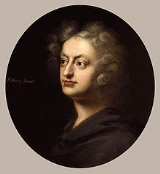
Henry Purcell

Henry Purcell

Overview

Discussion
Ask a question about 'Henry Purcell'
Start a new discussion about 'Henry Purcell'
Answer questions from other users
Full Discussion Forum
 
Unanswered Questions
Encyclopedia

Henry Purcell was an English organist
Organist
An organist is a musician who plays any type of organ. An organist may play solo organ works, play with an ensemble or orchestra, or accompany one or more singers or instrumental soloists...

 and Baroque
Baroque
The Baroque is a period and the style that used exaggerated motion and clear, easily interpreted detail to produce drama, tension, exuberance, and grandeur in sculpture, painting, literature, dance, and music...

 composer of secular
Secular music
Secular music is non-religious music. "Secular" means being separate from religion.In the West, secular music developed in the Medieval period and was used in the Renaissance. Swaying authority from the Church that focused more on Common Law influenced all aspects of Medieval life, including music...

 and sacred music. Although Purcell incorporated Italian and French stylistic elements into his compositions, his legacy was a uniquely English form of Baroque music
Baroque music
Baroque music describes a style of Western Classical music approximately extending from 1600 to 1760. This era follows the Renaissance and was followed in turn by the Classical era...

. He is generally considered to be one of the greatest English composers; no other native-born English composer approached his fame until Edward Elgar
Edward Elgar
Sir Edward William Elgar, 1st Baronet OM, GCVO was an English composer, many of whose works have entered the British and international classical concert repertoire. Among his best-known compositions are orchestral works including the Enigma Variations, the Pomp and Circumstance Marches, concertos...

.

Early life and career


Purcell was born in St Ann's Lane Old Pye Street, Westminster
Westminster
Westminster is an area of central London, within the City of Westminster, England. It lies on the north bank of the River Thames, southwest of the City of London and southwest of Charing Cross...

. Henry Purcell Senior, whose older brother Thomas Purcell (d. 1682) was also a musician, was a gentleman of the Chapel Royal
Chapel Royal
A Chapel Royal is a body of priests and singers who serve the spiritual needs of their sovereign wherever they are called upon to do so.-Austria:...

 and sang at the coronation of King Charles II of England
Charles II of England
Charles II was monarch of the three kingdoms of England, Scotland, and Ireland.Charles II's father, King Charles I, was executed at Whitehall on 30 January 1649, at the climax of the English Civil War...

. Henry the elder had three sons: Edward, Henry and Daniel. Daniel Purcell
Daniel Purcell
Daniel Purcell was an English composer, the younger brother of Henry Purcell.As a teenager, Daniel Purcell joined the choir of the Chapel Royal, and in his mid-twenties he became organist of Magdalen College, Oxford. He began to compose while at Oxford, but in 1695 he moved to London to compose...

 (d. 1717), the youngest of the brothers, was also a prolific composer who wrote the music for much of the final act of The Indian Queen
The Indian Queen (opera)
The Indian Queen , is a semi-opera in five acts with music by Henry Purcell, first performed at the Theatre Royal, Drury Lane, London in 1695. The exact date is unknown but Peter Holman surmises it may have been performed in June, without the Masque in Act 5, which had to be completed after...

after Henry Purcell's death. Henry Purcell's family lived just a few hundred yards west of Westminster Abbey from the year 1659 and onward.

After his father's death in 1664, Purcell was placed under the guardianship of his uncle who showed him great affection and kindness. Thomas was himself a gentleman of His Majesty's chapel, and arranged for Henry to be admitted as a chorister. Henry studied first under Captain Henry Cooke
Henry Cooke
Henry Cooke was an English composer, actor and singer. At the outbreak of the English Civil War he was a Gentleman of the Chapel Royal and joined the Royalist cause, in the service of which he rose to the rank of Captain...

 (d. 1672), Master of the Children
Master of the Children
Master of the Children is a title awarded to an adult musician who is put in charge of the musical training, and in some cases the general education of choir boy , as was common in major church choirs, often attached to a cathedral,...

, and afterwards under Pelham Humfrey
Pelham Humfrey
Pelham Humfrey was the first to prominence of the new generation of English composers at the beginning of the Restoration....

 (d. 1674), Cooke's successor. Henry was a chorister in the Chapel Royal until his voice broke in 1673, when he became assistant to the organ-builder John Hingston
John Hingston
John Hingston was musician-in-ordinary and keeper of the instruments to Charles II of England, as well as builder and tuner of organs and other instruments, from 1660 to his death...

, who held the post of keeper of wind instruments to the King.

Purcell is said to have been composing at nine years old, but the earliest work that can be certainly identified as his is an ode for the King's birthday, written in 1670. (The dates for his compositions are often uncertain, despite considerable research.) It is assumed that the three-part song "Sweet tyranness, I now resign" was written by him as a child. After Humfrey's death, Purcell continued his studies under Dr. John Blow
John Blow
John Blow was an English Baroque composer and organist, appointed to Westminster Abbey in 1669. His pupils included William Croft, Jeremiah Clarke and Henry Purcell. In 1685 he was named a private musician to James II. His only stage composition, Venus and Adonis John Blow (baptised 23 February...

. He attended Westminster School
Westminster School
The Royal College of St. Peter in Westminster, almost always known as Westminster School, is one of Britain's leading independent schools, with the highest Oxford and Cambridge acceptance rate of any secondary school or college in Britain...

 and in 1676 was appointed copyist at Westminster Abbey
Westminster Abbey
The Collegiate Church of St Peter at Westminster, popularly known as Westminster Abbey, is a large, mainly Gothic church, in the City of Westminster, London, United Kingdom, located just to the west of the Palace of Westminster. It is the traditional place of coronation and burial site for English,...

. Henry Purcell's earliest anthem
Anthem
The term anthem means either a specific form of Anglican church music , or more generally, a song of celebration, usually acting as a symbol for a distinct group of people, as in the term "national anthem" or "sports anthem".-Etymology:The word is derived from the Greek via Old English , a word...

 "Lord, who can tell" was composed in 1678. It is a psalm
Psalms
The Book of Psalms , commonly referred to simply as Psalms, is a book of the Hebrew Bible and the Christian Bible...

 that is prescribed for Christmas Day and also to be read at morning prayer on the fourth day of the month.

In 1679, he wrote some songs for John Playford
John Playford
John Playford was a London bookseller, publisher, minor composer, and member of the Stationers' Company, who published books on music theory, instruction books for several instruments, and psalters with tunes for singing in churches...

's Choice Ayres, Songs and Dialogues and also an anthem, the name of which is not known, for the Chapel Royal. From a letter written by Thomas Purcell, and still extant, we learn that this anthem was composed for the exceptionally fine voice of the Rev. John Gostling
John Gostling
John Gostling was a 17th century Church of England clergyman and bass singer famed for his range and power. He was a favourite singer of Charles II and is particularly associated with the music of Henry Purcell.-Background:...

, then at Canterbury
Canterbury
Canterbury is a historic English cathedral city, which lies at the heart of the City of Canterbury, a district of Kent in South East England. It lies on the River Stour....

, but afterwards a gentleman of His Majesty's chapel. Purcell wrote several anthems at different times for Gostling's extraordinary basso profondo voice, which is known to have had a range of at least two full octaves, from D below the bass staff to the D above it. The dates of very few of these sacred compositions are known; perhaps the most notable example is the anthem "They that go down to the sea in ships." In gratitude for the providential escape of King Charles II from shipwreck, Gostling, who had been of the royal party, put together some verses from the Psalms in the form of an anthem and requested Purcell to set them to music. The work is a very difficult one, opening with a passage which traverses the full extent of Gostling's range, beginning on the upper D and descending two octaves to the lower.

Later career and death


In 1679, Blow, who had been appointed organist of Westminster Abbey
Westminster Abbey
The Collegiate Church of St Peter at Westminster, popularly known as Westminster Abbey, is a large, mainly Gothic church, in the City of Westminster, London, United Kingdom, located just to the west of the Palace of Westminster. It is the traditional place of coronation and burial site for English,...

 in 1669, resigned his office in favour of his pupil. Purcell now devoted himself almost entirely to the composition of sacred music, and for six years severed his connection with the theatre. However, during the early part of the year, probably before taking up his new office, he had produced two important works for the stage, the music for Nathaniel Lee
Nathaniel Lee
Nathaniel Lee was an English dramatist.He was the son of Dr Richard Lee, a Presbyterian clergyman who was rector of Hatfield and held many preferments under the Commonwealth...

's Theodosius, and Thomas d'Urfey
Thomas d'Urfey
Thomas D'Urfey was an English writer and wit. He composed plays, songs, and poetry, in addition to writing jokes. He was an important innovator and contributor in the evolution of the Ballad opera....

's Virtuous Wife. Between 1680 and 1688 Purcell wrote music for seven plays. The composition of his chamber opera Dido and Aeneas
Dido and Aeneas
Dido and Aeneas is an opera in a prologue and three acts by the English Baroque composer Henry Purcell to a libretto by Nahum Tate. The first known performance was at Josias Priest's girls' school in London no later than the summer of 1688. The story is based on Book IV of Virgil's Aeneid...

, which forms a very important landmark in the history of English dramatic music, has been attributed to this period, and its earliest production may well have predated the documented one of 1689. It was written to a libretto
Libretto
A libretto is the text used in an extended musical work such as an opera, operetta, masque, oratorio, cantata, or musical. The term "libretto" is also sometimes used to refer to the text of major liturgical works, such as mass, requiem, and sacred cantata, or even the story line of a...

 furnished by Nahum Tate
Nahum Tate
Nahum Tate was an Irish poet, hymnist, and lyricist, who became England's poet laureate in 1692.-Life:Nahum Teate came from a family of Puritan clergymen...

, and performed in 1689 in cooperation with Josias Priest
Josias Priest
Josias Priest was an English dancer, dancing-master and choreographer.- History :In 1669, he was arrested along with four others for dancing and making music without a license. In 1668, he was a dancing-master in Holborn, and in 1675 he moved to Leicester Fields to run a boarding school for...

, a dancing master and the choreographer for the Dorset Garden Theatre
Dorset Garden Theatre
The Dorset Garden Theatre in London, built in 1671, was in its early years also known as the Duke of York's Theatre, or the Duke's Theatre. In 1685, King Charles II died and his brother, the Duke of York, was crowned as James II. When the Duke became King, the theatre became the Queen's Theatre in...

. Priest's wife kept a boarding school for young gentlewomen, first in Leicester Fields and afterwards at Chelsea
Chelsea, London
Chelsea is an area of West London, England, bounded to the south by the River Thames, where its frontage runs from Chelsea Bridge along the Chelsea Embankment, Cheyne Walk, Lots Road and Chelsea Harbour. Its eastern boundary was once defined by the River Westbourne, which is now in a pipe above...

, where the opera was performed. It is occasionally considered the first genuine English opera, though that title is usually given to Blow's Venus and Adonis
Venus and Adonis (opera)
Venus and Adonis is an opera in three acts and a prologue by the English Baroque composer John Blow, composed in about 1683. It was written for the court of King Charles II at either London or Windsor. It is considered by some to be either a semi-opera or a masque, but The New Grove names it as the...

: as in Blow's work, the action does not progress in spoken dialogue but in Italian-style recitative
Recitative
Recitative , also known by its Italian name "recitativo" , is a style of delivery in which a singer is allowed to adopt the rhythms of ordinary speech...

. Both works run to less than one hour. At the time Dido and Aeneas
Dido and Aeneas
Dido and Aeneas is an opera in a prologue and three acts by the English Baroque composer Henry Purcell to a libretto by Nahum Tate. The first known performance was at Josias Priest's girls' school in London no later than the summer of 1688. The story is based on Book IV of Virgil's Aeneid...

never found its way to the theatre, though it appears to have been very popular in private circles. It is believed to have been extensively copied, but only one song was printed by Purcell's widow in Orpheus Britannicus
Orpheus Britannicus
Orpheus Britannicus is a collection of songs by Henry Purcell, published posthumously in London in two volumes, the first in 1698 and the second in 1702...

, and the complete work remained in manuscript until 1840, when it was printed by the Musical Antiquarian Society under the editorship of Sir George Macfarren
George Alexander Macfarren
Sir George Alexander Macfarren was an English composer.-Life:George Alexander Macfarren was born in London on 2 March 1813 to George Macfarren, a dancing-master, dramatic author, and journalist, and Elizabeth Macfarren, née Jackson. At the age of seven, Macfarren was sent to Dr...

. The composition of Dido and Aeneas gave Purcell his first chance to write a sustained musical setting of a dramatic text. It was his only opportunity to compose a work in which the music carried the entire drama. The story of Dido and Aeneas derives from the original source in Virgil's epic the Aeneid.

Soon after Purcell's marriage, in 1682, on the death of Edward Lowe, he was appointed organist of the Chapel Royal, an office which he was able to hold simultaneously with his position at Westminster Abbey
Westminster Abbey
The Collegiate Church of St Peter at Westminster, popularly known as Westminster Abbey, is a large, mainly Gothic church, in the City of Westminster, London, United Kingdom, located just to the west of the Palace of Westminster. It is the traditional place of coronation and burial site for English,...

. His eldest son was born in this same year, but his life was short lived. His first printed composition, Twelve Sonata
Sonata
Sonata , in music, literally means a piece played as opposed to a cantata , a piece sung. The term, being vague, naturally evolved through the history of music, designating a variety of forms prior to the Classical era...

s
, was published in 1683. For some years after this, he was busy in the production of sacred music, odes addressed to the king and royal family, and other similar works. In 1685, he wrote two of his finest anthems, "I was glad" and "My heart is inditing", for the coronation of King James II
James II of England
James II & VII was King of England and King of Ireland as James II and King of Scotland as James VII, from 6 February 1685. He was the last Catholic monarch to reign over the Kingdoms of England, Scotland, and Ireland...

. One of Purcell's most elaborate, most important and most magnificent works was a birthday ode for Queen Mary. It is titled Come ye Sons of Art, and was written by Nahum Tate and set by Purcell.

In 1687, he resumed his connection with the theatre by furnishing the music for Dryden
John Dryden
John Dryden was an influential English poet, literary critic, translator, and playwright who dominated the literary life of Restoration England to such a point that the period came to be known in literary circles as the Age of Dryden.Walter Scott called him "Glorious John." He was made Poet...

's tragedy, Tyrannick Love
Tyrannick Love
Tyrannick Love, or The Royal Martyr is a tragedy by John Dryden in rhymed couplets, first acted in June 1669, and published in 1670. It is a retelling of the story of Saint Catherine of Alexandria and her martyrdom by the Roman Emperor Maximinus, the "tyrant" of the title, who is enraged at...

. In this year, Purcell also composed a march and quick-step, which became so popular that Lord Wharton
Thomas Wharton, 1st Marquess of Wharton
Thomas Wharton, 1st Marquess of Wharton PC was an English nobleman and politician. He was the son of Philip Wharton, 4th Baron Wharton and his second wife, Jane Goodwin, only daughter of Colonel Arthur Goodwin of Upper Winchendon, Buckinghamshire, and heiress to the extensive Goodwin estates in...

 adapted the latter to the fatal verses of Lillibullero
Lillibullero
Lillibullero is a march that sets the words of a satirical ballad generally said to be by Lord Thomas Wharton to music attributed to Henry Purcell. Although Purcell published Lillibullero in his compilation Music's Handmaid of 1689 as "a new Irish tune", it is probable that Purcell hijacked the...

; and in or before January 1688, he composed his anthem "Blessed are they that fear the Lord" by express command of the King. A few months later, he wrote the music for D'Urfey's play, The Fool's Preferment. In 1690, he composed the music for Betterton
Thomas Betterton
Thomas Patrick Betterton , English actor, son of an under-cook to King Charles I, was born in London.-Apprentice and actor:...

's adaptation of Fletcher
John Fletcher (playwright)
John Fletcher was a Jacobean playwright. Following William Shakespeare as house playwright for the King's Men, he was among the most prolific and influential dramatists of his day; both during his lifetime and in the early Restoration, his fame rivalled Shakespeare's...

 and Massinger
Philip Massinger
Philip Massinger was an English dramatist. His finely plotted plays, including A New Way to Pay Old Debts, The City Madam and The Roman Actor, are noted for their satire and realism, and their political and social themes.-Early life:The son of Arthur Massinger or Messenger, he was baptized at St....

's Prophetess (afterwards called Dioclesian
Dioclesian
Dioclesian is a tragicomic semi-opera in five acts by Henry Purcell to a libretto by Thomas Betterton based on the play The Prophetess, by John Fletcher and Philip Massinger, which in turn was based very loosely on the life of the Emperor Diocletian. It was premiered in late May 1690 at the...

) and Dryden's Amphitryon
Amphitryon (Dryden)
Amphitryon is an English language comedy by John Dryden which is based on Molière's 1668 play of the same name which was in turn based on the story of the Greek mythological character Amphitryon as told by Plautus in his play from ca. 190-185 B.C. Dryden's play, which focuses on themes of sexual...

. During the first ten years of his mastership, Purcell composed much- precisely how much we can only guess. In 1691, he wrote the music for what is sometimes considered his dramatic masterpiece, King Arthur
King Arthur (opera)
King Arthur or, The British Worthy , is a semi-opera in five acts with music by Henry Purcell and alibretto by John Dryden. It was first performed at the Queen's Theatre, Dorset Garden, London, in late May or early June 1691....

, with the libretto by Dryden and first published by the Musical Antiquarian Society in 1843. Another one of Purcell's operas is King Arthur, or The British Worthy in 1691. In 1692, he composed The Fairy-Queen
The Fairy-Queen
The Fairy-Queen is a masque or semi-opera by Henry Purcell; a "Restoration spectacular". The libretto is an anonymous adaptation of William Shakespeare's wedding comedy A Midsummer Night's Dream. First performed in 1692, The Fairy-Queen was composed three years before Purcell's death at the age...

(an adaptation of Shakespeare's A Midsummer Night's Dream
A Midsummer Night's Dream
A Midsummer Night's Dream is a play that was written by William Shakespeare. It is believed to have been written between 1590 and 1596. It portrays the events surrounding the marriage of the Duke of Athens, Theseus, and the Queen of the Amazons, Hippolyta...

), the score of which (his longest for theatre) was rediscovered in 1901 and published by the Purcell Society
Purcell Society
The Purcell Society, founded in 1876 is an organization dedicated to making the complete musical works of Henry Purcell available. Between 1876 and 1965, scores of all the known works of Purcell were published, in 32 volumes...

. The Indian Queen followed in 1695, in which year he also wrote songs for Dryden
The Tempest (Dryden)
The Tempest, or The Enchanted Island is a comedy adapted by John Dryden and William D'Avenant from Shakespeare's comedy The Tempest. The musical setting, previously attributed to Henry Purcell, and probably for the London revival of 1712, was very probably by John Weldon.The Dryden/Davenant...

 and Davenant's version of Shakespeare's The Tempest
The Tempest
The Tempest is a play by William Shakespeare, believed to have been written in 1610–11, and thought by many critics to be the last play that Shakespeare wrote alone. It is set on a remote island, where Prospero, the exiled Duke of Milan, plots to restore his daughter Miranda to her rightful place,...

(recently, this has been disputed by music scholars), probably including "Full fathom five" and "Come unto these yellow sands". The Indian Queen was adapted from a tragedy by Dryden and Sir Robert Howard. In these semi-opera
Semi-opera
The terms Semi-opera, dramatic[k] opera and English opera were all applied to Restoration entertainments that combined spoken plays with masque-like episodes employing singing and dancing characters. They usually included machines in the manner of the restoration spectacular...

s (another term for which at the time was "dramatic opera"), the main characters of the plays do not sing but speak their lines: the action moves in dialogue rather than recitative. The related songs are sung "for" them by singers, who have minor dramatic roles.

Purcell's Te Deum
Te Deum
The Te Deum is an early Christian hymn of praise. The title is taken from its opening Latin words, Te Deum laudamus, rendered literally as "Thee, O God, we praise"....

and Jubilate Deo
Jubilate Deo
After the liturgical reforms of Vatican II, Pope Paul VI presented this 1974 document as a "minimum repertoire of Gregorian chant" .-Contents:Chants of the Ordinary*Kyrie XVI*Gloria VIII*Credo III*Sanctus XVIII*Pater Noster*Agnus Dei XVIII*Verbum Domini...

were written for Saint Cecilia
Saint Cecilia
Saint Cecilia is the patroness of musicians and Church music because as she was dying she sang to God. It is also written that as the musicians played at her wedding she "sang in her heart to the Lord". St. Cecilia was an only child. Her feast day is celebrated in the Roman Catholic, Anglican,...

's Day, 1693, the first English Te Deum ever composed with orchestral accompaniment. This work was annually performed at St Paul's Cathedral
St Paul's Cathedral
St Paul's Cathedral, London, is a Church of England cathedral and seat of the Bishop of London. Its dedication to Paul the Apostle dates back to the original church on this site, founded in AD 604. St Paul's sits at the top of Ludgate Hill, the highest point in the City of London, and is the mother...

 until 1712, after which it was performed alternately with Handel
HANDEL
HANDEL was the code-name for the UK's National Attack Warning System in the Cold War. It consisted of a small console consisting of two microphones, lights and gauges. The reason behind this was to provide a back-up if anything failed....

's Utrecht Te Deum and Jubilate
Utrecht Te Deum and Jubilate
Utrecht Te Deum and Jubilate is a sacred choral composition in two parts, written by George Frideric Handel to celebrate the Treaty of Utrecht, which established the Peace of Utrecht in 1713, ending the War of the Spanish Succession. The combination of a Te Deum and Jubilate, the Psalm 100, follows...

until 1743, when both works were replaced by Handel's Dettingen Te Deum
Dettingen Te Deum
The Dettingen Te Deum is a canticle in D major composed by George Frideric Handel in 1743.-Background:On 27 June 1743, the British army and its allies, under the command of King George II and Lord Stair, won a victory at the Battle of Dettingen, over the French army, commanded by the Maréchal de...

.

He composed an anthem and two elegies for Queen Mary II
Mary II of England
Mary II was joint Sovereign of England, Scotland, and Ireland with her husband and first cousin, William III and II, from 1689 until her death. William and Mary, both Protestants, became king and queen regnant, respectively, following the Glorious Revolution, which resulted in the deposition of...

's funeral. Besides the operas and semi-opera
Semi-opera
The terms Semi-opera, dramatic[k] opera and English opera were all applied to Restoration entertainments that combined spoken plays with masque-like episodes employing singing and dancing characters. They usually included machines in the manner of the restoration spectacular...

s already mentioned, Purcell wrote the music and songs for Thomas d'Urfey's The Comical History of Don Quixote, Boudicca, The Indian Queen and others, a vast quantity of sacred music, and numerous ode
Ode
Ode is a type of lyrical verse. A classic ode is structured in three major parts: the strophe, the antistrophe, and the epode. Different forms such as the homostrophic ode and the irregular ode also exist...

s, cantata
Cantata
A cantata is a vocal composition with an instrumental accompaniment, typically in several movements, often involving a choir....

s, and other miscellaneous pieces. The quantity of his instrumental chamber music is minimal after his early career, and his keyboard music consists of an even more minimal number of harpsichord suites and organ pieces. In 1693, Purcell composed music for two Comedies: The Old Bachelor, and The Double Dealer. Purcell also composed for five other plays within the same year. In July 1695, Henry Purcell composed an ode for the Duke of Gloucester for his sixth birthday. The ode is titled Who can from joy refrain? Purcell's four-part sonatas were issued in 1697. In the remaining six years of his life, Henry Purcell wrote music for forty two plays.

Purcell died in 1695 at his home in Dean's Yard, Westminster, at the height of his career. He is believed to have been 35 or 36 years old at the time. The cause of his death is unclear: one theory is that he caught a chill after returning home late from the theatre one night to find that his wife had locked him out. Another is that he succumbed to tuberculosis
Tuberculosis
Tuberculosis, MTB, or TB is a common, and in many cases lethal, infectious disease caused by various strains of mycobacteria, usually Mycobacterium tuberculosis. Tuberculosis usually attacks the lungs but can also affect other parts of the body...

. The beginning of Purcell's will reads:
"In the name of God Amen. I, Henry Purcell, of the City of Westminster, gentleman, being dangerously ill as to the constitution of my body, but in good and perfect mind and memory (thanks be to God) do by these presents publish and declare this to be my last Will and Testament. And I do hereby give and bequeath unto my loving wife, Frances Purcell, all my estate both real and personal of what nature and kind soever..."


Purcell is buried adjacent to the organ in Westminster Abbey. The music that he had earlier composed for Queen Mary's funeral was performed during his as well. Purcell was universally mourned as 'a very great master of music.'  Following his death, the officials at Westminster honoured him by unanimously voting that he be buried with no expense in the north aisle of the Abbey. His epitaph reads: "Here lyes Henry Purcell Esq., who left this life and is gone to that blessed place where only his harmony can be exceeded."

Henry Purcell fathered six children by his wife Frances, four of whom died in infancy
Infant
A newborn or baby is the very young offspring of a human or other mammal. A newborn is an infant who is within hours, days, or up to a few weeks from birth. In medical contexts, newborn or neonate refers to an infant in the first 28 days after birth...

. His wife, as well as his son Edward
Edward Purcell (musician)
Edward Purcell was born in Westminster, London, the only surviving son of the English Baroque master, Henry Purcell. When his mother Frances died in February 1706, she stated in her will, and apparently in accordance with her husband's wishes, that she had given him a good education.Holman, Peter,...

 (1689–1740) and daughter Frances, survived him. Frances the elder died in 1706, having published a number of her husband's works, including the now famous collection called Orpheus Britannicus, in two volumes, printed in 1698 and 1702, respectively. Edward was appointed organist of St Clement Eastcheap
St Clement Eastcheap
St. Clement Eastcheap is a Church of England parish church in Candlewick Ward of the City of London. It is located on Clement's Lane, off King William Street, and close to London Bridge and the River Thames....

, London, in 1711 and was succeeded by his son Edward Henry Purcell
Edward Henry Purcell
Edward Henry Purcell , organist, printer, and music publisher, was the son of Edward Purcell, and grandson of the English Baroque master, Henry Purcell. He was a chorister in the Chapel Royal in 1737...

 (d. 1765). Both men were buried in St Clement's near the organ gallery.

Influence and reputation


After his death, Purcell was honoured by many of his contemporaries, including his old friend John Blow
John Blow
John Blow was an English Baroque composer and organist, appointed to Westminster Abbey in 1669. His pupils included William Croft, Jeremiah Clarke and Henry Purcell. In 1685 he was named a private musician to James II. His only stage composition, Venus and Adonis John Blow (baptised 23 February...

, who wrote "An Ode, on the Death of Mr. Henry Purcell (Mark how the lark and linnet sing)" with text by his old collaborator, John Dryden. More recently, the English poet Gerard Manley Hopkins
Gerard Manley Hopkins
Gerard Manley Hopkins, S.J. was an English poet, Roman Catholic convert, and Jesuit priest, whose posthumous 20th-century fame established him among the leading Victorian poets...

 wrote a famous sonnet entitled simply "Henry Purcell", with a headnote reading: "The poet wishes well to the divine genius of Purcell and praises him that, whereas other musicians have given utterance to the moods of man's mind, he has, beyond that, uttered in notes the very make and species of man as created both in him and in all men generally."

Purcell also had a strong influence on the composers of the English musical renaissance of the early 20th century, most notably Benjamin Britten
Benjamin Britten
Edward Benjamin Britten, Baron Britten, OM CH was an English composer, conductor, and pianist. He showed talent from an early age, and first came to public attention with the a cappella choral work A Boy Was Born in 1934. With the premiere of his opera Peter Grimes in 1945, he leapt to...

, who created and performed a realisation of Dido and Aeneas and whose The Young Person's Guide to the Orchestra
The Young Person's Guide to the Orchestra
The Young Person's Guide to the Orchestra, Op. 34, is a musical composition by Benjamin Britten in 1946 with a subtitle "Variations and Fugue on a Theme of Purcell"...

is based on a theme from Purcell's Abdelazar
Abdelazar
Abdelazer or The Moor's Revenge is a 1676 play by Aphra Behn, an adaptation of the c.1600 tragedy Lust's Dominion....

. Stylistically, the aria "I know a bank" from Britten's opera A Midsummer Night's Dream
A Midsummer Night's Dream (opera)
A Midsummer Night's Dream is an opera with music by Benjamin Britten and set to a libretto adapted by the composer and Peter Pears from William Shakespeare's play, A Midsummer Night's Dream...

is clearly inspired by Purcell's aria "Sweeter than Roses", which Purcell originally wrote as part of incidental music to Richard Norton's Pausanias
Pausanias (general)
Pausanias was a Spartan general of the 5th century BC. He was the son of Cleombrotus and nephew of Leonidas I, serving as regent after the latter's death, since Leonidas' son Pleistarchus was still under-age. Pausanias was also the father of Pleistoanax, who later became king, and Cleomenes...

, the Betrayer of His Country
.

Purcell is honoured together with Johann Sebastian Bach
Johann Sebastian Bach
Johann Sebastian Bach was a German composer, organist, harpsichordist, violist, and violinist whose sacred and secular works for choir, orchestra, and solo instruments drew together the strands of the Baroque period and brought it to its ultimate maturity...

 and George Frideric Handel
George Frideric Handel
George Frideric Handel was a German-British Baroque composer, famous for his operas, oratorios, anthems and organ concertos. Handel was born in 1685, in a family indifferent to music...

 with a feast day on the liturgical calendar of the Episcopal Church (USA)
Calendar of saints (Episcopal Church in the United States of America)
The veneration of saints in the Episcopal Church is a continuation of an ancient tradition from the early Church which honors important people of the Christian faith. The usage of the term "saint" is similar to Roman Catholic and Orthodox traditions. Those in the Anglo-Catholic tradition may...

 on 28 July. In a 1940 interview Ignaz Friedman
Ignaz Friedman
Ignaz Friedman Ignaz Friedman Ignaz Friedman (also spelled by languages Ignace or Ignacy; exactly Solomon (Salomon) Isaac Freudman(n), (February 13, 1882January 26, 1948) was a Polish pianist and composer. Critics (e.g. Harold C. Schonberg) and colleagues (e.g...

 stated that he considered Purcell as great as Bach and Beethoven. In Victoria Street, Westminster, England, there is a bronze monument to Purcell (right), sculpted by Glynn Williams and erected in 1994.

Purcell's works have been catalogued by Franklin Zimmerman
Franklin B. Zimmerman
Franklin Bershir Zimmerman is an American musicologist and conductor who has published extensively in the field of Baroque music, and particularly on the English composer, Henry Purcell. He is most known for his complete catalogue of Purcell's works, considered "one of the most crucial...

, who gave them a number preceded by Z. A Purcell Club was founded in London in 1836 for promoting the performance of his music, but was dissolved in 1863. In 1876 a Purcell Society
Purcell Society
The Purcell Society, founded in 1876 is an organization dedicated to making the complete musical works of Henry Purcell available. Between 1876 and 1965, scores of all the known works of Purcell were published, in 32 volumes...

 was founded, which published new editions of his works. A modern day Purcell Club has been created, and provides guided tours and concerts in support of Westminster Abbey
Westminster Abbey
The Collegiate Church of St Peter at Westminster, popularly known as Westminster Abbey, is a large, mainly Gothic church, in the City of Westminster, London, United Kingdom, located just to the west of the Palace of Westminster. It is the traditional place of coronation and burial site for English,...

.

So strong was his reputation that a popular wedding processional was incorrectly attributed to Purcell for many years. The so-called Purcell's Trumpet Voluntary was in fact written around 1700 by a British composer named Jeremiah Clarke
Jeremiah Clarke
Jeremiah Clarke was an English baroque composer and organist.Thought to have been born in London around 1674, Clarke was a pupil of John Blow at St Paul's Cathedral. He later became organist at the Chapel Royal...

 as the Prince of Denmark's March
Prince of Denmark's March
The Prince of Denmark's March, commonly but erroneously called the Trumpet Voluntary, is a musical composition written circa. 1700, by English baroque composer Jeremiah Clarke .-Composition:For many years the piece was attributed incorrectly to Clarke's elder and more widely known contemporary Henry...

.

In 2009 Pete Townshend
Pete Townshend
Peter Dennis Blandford "Pete" Townshend is an English rock guitarist, vocalist, songwriter and author, known principally as the guitarist and songwriter for the rock group The Who, as well as for his own solo career...

 of The Who
The Who
The Who are an English rock band formed in 1964 by Roger Daltrey , Pete Townshend , John Entwistle and Keith Moon . They became known for energetic live performances which often included instrument destruction...

, an English rock band that established itself in the 1960s, identified Purcell's harmonies as an influence on the band's music (in songs such as "Won't Get Fooled Again
Won't Get Fooled Again
"Won't Get Fooled Again" is a song by the rock band The Who which was written by Pete Townshend The original version of the song appears as the final track on the album Who's Next...

" (1971) and "I Can See for Miles
I Can See For Miles
"I Can See for Miles" is a song written by Pete Townshend of The Who, recorded for the band's 1967 album, The Who Sell Out. It was the only song from the album to be released as a single, on 14 October 1967...

" (1967)).

Michael Nyman
Michael Nyman
Michael Laurence Nyman, CBE is an English composer of minimalist music, pianist, librettist and musicologist, known for the many film scores he wrote during his lengthy collaboration with the filmmaker Peter Greenaway, and his multi-platinum soundtrack album to Jane Campion's The Piano...

, at the request of the director, built the score of Peter Greenaway
Peter Greenaway
Peter Greenaway, CBE is a British film director. His films are noted for the distinct influence of Renaissance and Baroque painting, and Flemish painting in particular...

's 1982 film, The Draughtsman's Contract
The Draughtsman's Contract
The Draughtsman's Contract is a 1982 British film written and directed by Peter Greenaway – his first conventional feature film . Originally produced for Channel 4 the film is a form of murder mystery, set in 1694...

on ostinati
Ostinato
In music, an ostinato is a motif or phrase, which is persistently repeated in the same musical voice. An ostinato is always a succession of equal sounds, wherein each note always has the same weight or stress. The repeating idea may be a rhythmic pattern, part of a tune, or a complete melody in...

 by Purcell from various sources, one misattributed. He credited Purcell as a "music consultant." Another of Purcell's ostinati, in fact the aforementioned Cold Genius aria, was used in Nyman's Memorial
Memorial (composition)
Memorial is an epic funeral march-like piece, composed by Michael Nyman around 1984-1985. This composition is one of the most praised in the work of Michael Nyman. Its first commercial recording was on the soundtrack of The Cook The Thief His Wife & Her Lover and has been rerecorded on the Michael...

.

In popular culture


Purcell is among the Baroque composers who has had a direct influence on modern rock and roll; according to Pete Townshend
Pete Townshend
Peter Dennis Blandford "Pete" Townshend is an English rock guitarist, vocalist, songwriter and author, known principally as the guitarist and songwriter for the rock group The Who, as well as for his own solo career...

 of The Who
The Who
The Who are an English rock band formed in 1964 by Roger Daltrey , Pete Townshend , John Entwistle and Keith Moon . They became known for energetic live performances which often included instrument destruction...

, Purcell was among his influences, particularly evident in the opening bars of The Who's "Pinball Wizard
Pinball Wizard
"Pinball Wizard" is a song written by Pete Townshend and performed by the English rock band The Who, and featured on their 1969 rock opera album Tommy. The original recording was released as a single in 1969 and reached No. 4 in the UK charts and No. 19 on the U.S...

". The processional section from Purcell's "Music for the Funeral of Queen Mary," was also adapted for the synthesiser by Wendy Carlos
Wendy Carlos
Wendy Carlos is an American composer and electronic musician. Carlos first came to notice in the late 1960s with recordings made on the Moog synthesizer, then a relatively new and unknown instrument; most notable were LPs of synthesized Bach and the soundtrack for Stanley Kubrick's film A...

 to serve as the theme music for the 1971 film A Clockwork Orange
A Clockwork Orange (film)
A Clockwork Orange is a 1971 film adaptation of Anthony Burgess's 1962 novel of the same name. It was written, directed and produced by Stanley Kubrick...

, the music is also featured in the final scene of the 1995 film The Young Poisoner's Handbook
The Young Poisoner's Handbook
The Young Poisoner's Handbook is a 1995 British-German-French-produced black comedy film based on the life of Graham Young, more commonly known as "The Teacup Murderer". It was directed by Benjamin Ross and written by Ross and Jeff Rawle...

. Noted cult New Wave artist Klaus Nomi
Klaus Nomi
Klaus Sperber , better known as Klaus Nomi, was a German countertenor noted for his wide vocal range and an unusual, otherworldly stage persona....

 regularly performed "The Cold Song" from King Arthur
King Arthur (opera)
King Arthur or, The British Worthy , is a semi-opera in five acts with music by Henry Purcell and alibretto by John Dryden. It was first performed at the Queen's Theatre, Dorset Garden, London, in late May or early June 1691....

during his career, including a version on his debut self-titled album, Klaus Nomi
Klaus Nomi (album)
Klaus Nomi is the debut album by German countertenor Klaus Nomi.-Track listing:#"Keys Of Life" – 2:26#"Lightning Strikes" – 2:59#"The Twist" – 3:10#"Nomi Song" – 2:47...

, from 1981; his last public performance before his untimely death was an interpretation of the piece done with a full orchestra in December 1982 in Munich. Purcell wrote the song for a bass
Bass (voice type)
A bass is a type of male singing voice and possesses the lowest vocal range of all voice types. According to The New Grove Dictionary of Opera, a bass is typically classified as having a range extending from around the second E below middle C to the E above middle C...

, but numerous countertenor
Countertenor
A countertenor is a male singing voice whose vocal range is equivalent to that of a contralto, mezzo-soprano, or a soprano, usually through use of falsetto, or far more rarely than normal, modal voice. A pre-pubescent male who has this ability is called a treble...

s have performed the piece in homage to Nomi.

In the 1995 film England, My England
England, My England
England, My England is a 1995 British historical film directed by Tony Palmer and starring Michael Ball, Simon Callow and Robert Stephens. It depicts the life of the composer Henry Purcell, seen through the eyes of a playwright in the 1960s who is trying to write a play about him. It was written by...

, the life of Purcell (played by Michael Ball
Michael Ball
Michael Ball may refer to:* Michael Ball , English singer and actor* Michael Ball , American football player* Michael Ball , English football player...

) was depicted as seen through the eyes of a playwright in the 1960s who is trying to write a play about him.

In the 21st century, the soundtrack
Pride & Prejudice (soundtrack)
The soundtrack to the 2005 film Pride & Prejudice was composed by Dario Marianelli and performed by Jean-Yves Thibaudet and the English Chamber Orchestra....

 of the 2005 film version
Pride & Prejudice (2005 film)
Pride & Prejudice is a 2005 British romance film directed by Joe Wright. It is a film adaptation of the 1813 novel of the same name by Jane Austen and the second adaption produced by Working Title Films. It was released on September 16, 2005, in the UK and on November 11, 2005, in the...

 of Pride and Prejudice
Pride and Prejudice
Pride and Prejudice is a novel by Jane Austen, first published in 1813. The story follows the main character Elizabeth Bennet as she deals with issues of manners, upbringing, morality, education and marriage in the society of the landed gentry of early 19th-century England...

features a dance titled "A Postcard to Henry Purcell." This is a version by composer Dario Marianelli
Dario Marianelli
Dario Marianelli is a composer of piano, orchestral, and film music. He has composed the soundtracks for The Brothers Grimm , Pride & Prejudice , and Atonement , the last two for which he received Oscar nominations for Best Achievement in Music Written for Motion Pictures, Original Score...

 of Purcell's Abdelazar
Abdelazar
Abdelazer or The Moor's Revenge is a 1676 play by Aphra Behn, an adaptation of the c.1600 tragedy Lust's Dominion....

theme. In the German-language 2004 movie, Der Untergang ([the] Downfall (film)
Downfall (film)
Downfall is a 2004 German/Italian/Austrian epic war film directed by Oliver Hirschbiegel, depicting the final ten days of Adolf Hitler's life in his Berlin bunker and Nazi Germany in 1945....

, the music of Dido's Lament
Dido's lament
"Dido's Lament" is the commonly-used name for the noted aria, "When I am laid in earth", from the opera, Dido and Aeneas, by Henry Purcell ....

 is used repeatedly as the end of the Third Reich culminates.
.

External links