

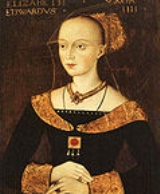
Elizabeth Woodville

Encyclopedia
Elizabeth Woodville was Queen consort of England as the spouse of King Edward IV
from 1464 until his death in 1483. Elizabeth was a key figure in the series of dynastic civil wars known as the Wars of the Roses
. Her first husband, Sir John Grey of Groby
was killed at the Second Battle of St Albans
. As the daughter of Richard Woodville, 1st Earl Rivers
, she was the first commoner to marry an English sovereign. It was because of this that Edward's former staunch ally Richard Neville, 16th Earl of Warwick
, known to history as "The Kingmaker" switched his allegiance to the House of Lancaster
. Her children included the Princes in the Tower
and Elizabeth of York
; the latter made her the maternal grandmother of Henry VIII. Tradition holds that she served as a Maid of Honour to Margaret of Anjou
, but the evidence of this is uncertain.
, Northamptonshire
, the daughter of Richard Woodville, 1st Earl Rivers
and his wife, the former Jacquetta of Luxembourg
, widow of John of Lancaster, Duke of Bedford. Although spelling of the family name has sometimes been modernized to "Woodville", it was spelled "Wydeville" in contemporary publications by Caxton and as "Widvile" on Queen Elizabeth's tomb at St. George's Chapel, Windsor Castle.
She may have been a maid of honour to Margaret of Anjou
, Queen of Henry VI
in 1445, when she was about eight years of age. The identification of Elizabeth as the "Isabel Grey" referred to in the record in question is uncertain, however; as A. R. Myers and George Smith have each noted, assuming that the eight-year-old Elizabeth was then married to John Grey, there were several women by the name of Isabella or Elizabeth Grey, including an Elizabeth Grey who is noted as serving Margaret and as being the widow of a Ralph Grey. In about 1452, she married Sir John Grey of Groby
, who was killed at the Second Battle of St Albans
in 1461, fighting for the Lancastrian
cause, which would become a source of irony as Edward IV
was the Yorkist
claimant to the throne. Elizabeth had two sons from the marriage, Thomas
(later Marquess of Dorset
) and Richard
.
Elizabeth was called "the most beautiful woman in the Island of Britain" with "heavy-lidded eyes like those of a dragon", suggesting a perhaps unusual criterion by which beauty in late medieval England was judged.
, and did not have a reputation for fidelity. His marriage to the widowed Lady Grey took place secretly and though the date is not accepted as exactly accurate is traditionally said to have taken place (with only the bride's mother and two ladies in attendance) at her family home in Northamptonshire
on 1 May 1464, just over three years after he had taken the English throne subsequent to leading the Yorkists in an overwhelming victory over the Lancastrians at the Battle of Towton
. Elizabeth was crowned Queen on Ascension Day, 26 May 1465.
In the early years of his reign, Edward's governance of England was dependent upon a small circle of supporters, most notably his cousin, Richard Neville, Earl of Warwick
. At around the time of Edward's secret marriage, Warwick was negotiating an alliance with France in an effort to thwart a similar arrangement being made by his sworn enemy Margaret of Anjou
, wife of the deposed Henry VI
. The plan was that Edward should marry a French Princess. When the marriage to Elizabeth, who was a commoner, became public, its concealment was the cause of considerable rancour on Warwick's part.
With the arrival on the scene of the new queen came a host of siblings who soon married into some of the most notable families in England. The marriages of her sisters to the sons of the earls of Kent, Essex and Pembroke have left no sign of unhappiness on the parts of the parties involved, nor does that of her sister, Catherine Woodville, to the queen's 11-year-old ward Henry Stafford, 2nd Duke of Buckingham
, though the duke stood with the duke of Gloucester in opposition to the Woodvilles after the death of Edward IV. The one marriage which may be considered shocking was that of her 20-year-old brother John Woodville
to Katherine, Duchess of Norfolk
, daughter of Ralph Neville, 1st Earl of Westmorland
by Joan Beaufort, and widow of John Mowbray, 2nd Duke of Norfolk. The wealthy Katherine had been widowed three times and was probably in her sixties.
 When Elizabeth's relatives, especially her brother, Anthony Woodville, 2nd Earl Rivers
, began to challenge Warwick's pre-eminence in English political society, he conspired with his son-in-law, the Duke of Clarence
, the king's younger brother. One of his followers accused Elizabeth's mother, the Duchess of Bedford, of practising witchcraft. Jacquetta was acquitted the following year. Warwick and Clarence twice rose in revolt and then fled to France. Warwick formed an uneasy alliance with the Lancastrian Queen Margaret of Anjou
and restored her husband Henry VI to the throne in 1470, but, the following year, Edward IV returned from exile and defeated Warwick at the Battle of Barnet
and the Lancastrians at the Battle of Tewkesbury
. Henry VI was murdered soon afterwards.
Following her husband's temporary fall from power, Elizabeth had sought sanctuary
in Westminster Abbey
, where she gave birth to a son, Edward
(later Edward V of England). Her second marriage produced ten children, including another son, Richard, Duke of York
, who would later join his brother as one of the Princes in the Tower
.
Queen Elizabeth engaged in acts of Christian piety, which were in keeping with what was expected of a medieval queen consort. Her acts included making pilgrimages, obtaining a papal indulgence for those who knelt and said the Angelus
three times per day, and founding the chapel of St. Erasmus in Westminster Abbey.
became king, with his uncle, Richard, Duke of Gloucester
acting as Lord Protector. Fearing the assumption of power by the Woodvilles, Richard quickly moved to take control of the young king and had Anthony Woodville, 2nd Earl Rivers
and Richard Grey
, brother and son to Queen Elizabeth arrested and executed. The young king was transferred to the Tower of London
to await the Coronation. Elizabeth again sought sanctuary and conspired against the Lord Protector with Baron Hastings
, who was subsequently also executed.
Richard now moved to take the throne himself and on 25 June 1483, an act of parliament, the Titulus Regius
(1 Ric. 3) declared Edward's and Elizabeth's children illegitimate on the grounds that Edward had made a previous promise (known as a precontract) to marry Lady Eleanor Butler
, which was considered a legally binding contract that rendered any other marriage contract invalid. One source, the Burgundian chronicler Philippe de Commines, claims that Robert Stillington
, Bishop of Bath and Wells
, carried out the ceremony between Edward and Eleanor. The act also contained charges of witchcraft against Elizabeth, but gave no details and had no further repercussions. As a consequence, the Duke of Gloucester became King Richard III. Young Edward and his brother Richard, Duke of York
, remained in the Tower of London
. The exact fate of the so-called Princes in the Tower
has been long debated; whether they died, disappeared, or were murdered is still unknown.
, one of Richard III's closest allies, entered the conspiracy, he claimed that the princes had been murdered. Elizabeth and Buckingham now allied themselves with Lady Margaret Beaufort and espoused the cause of Margaret's son Henry Tudor
, a great-great-great-grandson of King Edward III the closest male heir of the Lancastrian claim to the throne with some questions as to its strength. Elizabeth and Margaret agreed that Henry should marry Elizabeth's daughter, Elizabeth of York
. Henry agreed to this plan and in December publicly swore an oath to that effect in the cathedral in Rennes. In the previous month, an uprising in his favour, led by Buckingham, had been crushed.
Elizabeth's behaviour has been a source of frustration to historians as on 1 March 1484, Elizabeth and her daughters came out of sanctuary after Richard publicly swore an oath that her daughters would not be harmed or ravished and that they would not be imprisoned in the Tower of London or in any other prison. Richard III also promised to provide them with marriage portions and to marry them to "gentlemen born". The family returned to Court, apparently reconciled to King Richard. After the death of Richard's Queen Anne Neville
in 1485, rumours even spread that the now-widowed King was going to marry his niece Elizabeth of York
. Richard issued a denial; though according to the Crowland Chronicle he was pressured to do this by the Woodvilles' enemies who feared, among other things, that they would have to return the lands they had confiscated from the Woodvilles.
Scholars differ about why Dowager Queen Elizabeth spent her last five years living at Bermondsey Abbey
. Among her modern biographers, David Baldwin believes that Henry VII forced her retreat from the Court, while Arlene Okerlund presents evidence that indicates she was planning a religious, contemplative life as early as July 1486. At the Abbey, Elizabeth was treated with all the respect due to a queen dowager, lived a regal life, and received a pension of £400 and small gifts from the King. She was present at the birth of her second grandchild Margaret at Westminster Palace in November 1489. The Queen rarely visited her, although Elizabeth's younger daughter, Viscountess Welles
, is known to have done so more often.
Henry VII briefly contemplated marrying Elizabeth off to King James III of Scotland
, when James' wife, Margaret of Denmark, died in 1486. James was killed in battle later that year, rendering the plans of Henry VII moot.
Elizabeth died at Bermondsey Abbey on 8 June 1492. With the exception of the Queen, who was awaiting the birth of her fourth child, and Cecily (Viscountess Welles)
, her daughters attended the funeral at Windsor Castle: Anne (the future Countess of Surrey), Catherine
(the future Countess of Devon) and Bridget
(a sister at Dartford Priory). Her will specified a simple funeral. Many ardent Yorkists, who considered themselves slighted by the ordinary and very simple burial of Edward IV's Queen on 12 June 1492, were not pleased. Elizabeth was laid to rest in the same chantry
as her husband King Edward IV
in St George's Chapel in Windsor Castle
.
and Henry VI Part 3 by William Shakespeare.
Philippa Gregory
's 2009 novel The White Queen follows a fictionalized account of Elizabeth's life from meeting her future husband, King Edward
, up through the disappearance of her sons and the reign of her brother-in-law, Richard III. The novel places a great deal of focus on the legend of Melusina and Elizabeth and her mother's ties to witchcraft.
Sympathetic fictional portraits of Elizabeth Woodville can be found in Jan Westcott's The White Rose and in A Secret Alchemy by Emma Darwin (novelist)
. A less sympathetic picture is given in Sandra Worth's Lady of the Roses (2008). She is also found in Sharon Kay Penman
's The Sunne in Splendour, where she is seen mainly through the eyes of others. Rosemary Hawley Jarman
's fictionalized biography of Elizabeth Woodville is entitled The King's Grey Mare (1972).
|-
Edward IV of England
Edward IV was King of England from 4 March 1461 until 3 October 1470, and again from 11 April 1471 until his death. He was the first Yorkist King of England...
from 1464 until his death in 1483. Elizabeth was a key figure in the series of dynastic civil wars known as the Wars of the Roses
Wars of the Roses
The Wars of the Roses were a series of dynastic civil wars for the throne of England fought between supporters of two rival branches of the royal House of Plantagenet: the houses of Lancaster and York...
. Her first husband, Sir John Grey of Groby
John Grey of Groby
Sir John Grey, of Groby, Leicestershire was a Lancastrian knight, the great-great-grandfather of Lady Jane Grey.-Titles:...
was killed at the Second Battle of St Albans
Second Battle of St Albans
The Second Battle of St Albans was a battle of the English Wars of the Roses fought on 17 February, 1461, at St Albans. The army of the Yorkist faction under the Earl of Warwick attempted to bar the road to London north of the town. The rival Lancastrian army used a wide outflanking manoeuvre to...
. As the daughter of Richard Woodville, 1st Earl Rivers
Richard Woodville, 1st Earl Rivers
Richard Woodville , 1st Earl Rivers, KG was an English nobleman, best remembered as the father of Elizabeth Woodville, wife of Edward IV....
, she was the first commoner to marry an English sovereign. It was because of this that Edward's former staunch ally Richard Neville, 16th Earl of Warwick
Richard Neville, 16th Earl of Warwick
Richard Neville KG, jure uxoris 16th Earl of Warwick and suo jure 6th Earl of Salisbury and 8th and 5th Baron Montacute , known as Warwick the Kingmaker, was an English nobleman, administrator, and military commander...
, known to history as "The Kingmaker" switched his allegiance to the House of Lancaster
House of Lancaster
The House of Lancaster was a branch of the royal House of Plantagenet. It was one of the opposing factions involved in the Wars of the Roses, an intermittent civil war which affected England and Wales during the 15th century...
. Her children included the Princes in the Tower
Princes in the Tower
The Princes in the Tower is a term which refers to Edward V of England and Richard of Shrewsbury, 1st Duke of York. The two brothers were the only sons of Edward IV of England and Elizabeth Woodville alive at the time of their father's death...
and Elizabeth of York
Elizabeth of York
Elizabeth of York was Queen consort of England as spouse of King Henry VII from 1486 until 1503, and mother of King Henry VIII of England....
; the latter made her the maternal grandmother of Henry VIII. Tradition holds that she served as a Maid of Honour to Margaret of Anjou
Margaret of Anjou
Margaret of Anjou was the wife of King Henry VI of England. As such, she was Queen consort of England from 1445 to 1461 and again from 1470 to 1471; and Queen consort of France from 1445 to 1453...
, but the evidence of this is uncertain.
Early life and first marriage
Elizabeth was born about 1437 at Grafton RegisGrafton Regis
Grafton Regis is a village and civil parish in the south of the English county of Northamptonshire. The village is east of the A508 road, on which it has a short frontage and two bus stops. It is ca. south of Northampton and north of Milton Keynes....
, Northamptonshire
Northamptonshire
Northamptonshire is a landlocked county in the English East Midlands, with a population of 629,676 as at the 2001 census. It has boundaries with the ceremonial counties of Warwickshire to the west, Leicestershire and Rutland to the north, Cambridgeshire to the east, Bedfordshire to the south-east,...
, the daughter of Richard Woodville, 1st Earl Rivers
Richard Woodville, 1st Earl Rivers
Richard Woodville , 1st Earl Rivers, KG was an English nobleman, best remembered as the father of Elizabeth Woodville, wife of Edward IV....
and his wife, the former Jacquetta of Luxembourg
Jacquetta of Luxembourg
Jacquetta of Luxembourg was the elder daughter of Peter I, Count of St Pol, Conversano and Brienne and his wife Margaret de Baux...
, widow of John of Lancaster, Duke of Bedford. Although spelling of the family name has sometimes been modernized to "Woodville", it was spelled "Wydeville" in contemporary publications by Caxton and as "Widvile" on Queen Elizabeth's tomb at St. George's Chapel, Windsor Castle.
She may have been a maid of honour to Margaret of Anjou
Margaret of Anjou
Margaret of Anjou was the wife of King Henry VI of England. As such, she was Queen consort of England from 1445 to 1461 and again from 1470 to 1471; and Queen consort of France from 1445 to 1453...
, Queen of Henry VI
Henry VI of England
Henry VI was King of England from 1422 to 1461 and again from 1470 to 1471, and disputed King of France from 1422 to 1453. Until 1437, his realm was governed by regents. Contemporaneous accounts described him as peaceful and pious, not suited for the violent dynastic civil wars, known as the Wars...
in 1445, when she was about eight years of age. The identification of Elizabeth as the "Isabel Grey" referred to in the record in question is uncertain, however; as A. R. Myers and George Smith have each noted, assuming that the eight-year-old Elizabeth was then married to John Grey, there were several women by the name of Isabella or Elizabeth Grey, including an Elizabeth Grey who is noted as serving Margaret and as being the widow of a Ralph Grey. In about 1452, she married Sir John Grey of Groby
John Grey of Groby
Sir John Grey, of Groby, Leicestershire was a Lancastrian knight, the great-great-grandfather of Lady Jane Grey.-Titles:...
, who was killed at the Second Battle of St Albans
Second Battle of St Albans
The Second Battle of St Albans was a battle of the English Wars of the Roses fought on 17 February, 1461, at St Albans. The army of the Yorkist faction under the Earl of Warwick attempted to bar the road to London north of the town. The rival Lancastrian army used a wide outflanking manoeuvre to...
in 1461, fighting for the Lancastrian
House of Lancaster
The House of Lancaster was a branch of the royal House of Plantagenet. It was one of the opposing factions involved in the Wars of the Roses, an intermittent civil war which affected England and Wales during the 15th century...
cause, which would become a source of irony as Edward IV
Edward IV of England
Edward IV was King of England from 4 March 1461 until 3 October 1470, and again from 11 April 1471 until his death. He was the first Yorkist King of England...
was the Yorkist
House of York
The House of York was a branch of the English royal House of Plantagenet, three members of which became English kings in the late 15th century. The House of York was descended in the paternal line from Edmund of Langley, 1st Duke of York, the fourth surviving son of Edward III, but also represented...
claimant to the throne. Elizabeth had two sons from the marriage, Thomas
Thomas Grey, 1st Marquess of Dorset
Thomas Grey, 7th Baron Ferrers of Groby, 1st Earl of Huntingdon and 1st Marquess of Dorset, KG , was an English nobleman, courtier and a man of mediocre abilities pushed into prominence by his mother Elizabeth Woodville's second marriage to the king, Edward IV.-Family:Thomas was born about 1455,...
(later Marquess of Dorset
Marquess of Dorset
The title Marquess of Dorset has been created three times in the Peerage of England. It was first created in 1397 for John Beaufort, 1st Earl of Somerset, but he lost the title two years later. It was then created in 1442 for Edmund Beaufort, 1st Earl of Dorset, who was created Duke of Somerset...
) and Richard
Richard Grey
Sir Richard Grey was an English knight and the half-brother of King Edward V of England.Grey was the younger son of Sir John Grey of Groby and Elizabeth Woodville, later Queen Consort of King Edward IV...
.
Elizabeth was called "the most beautiful woman in the Island of Britain" with "heavy-lidded eyes like those of a dragon", suggesting a perhaps unusual criterion by which beauty in late medieval England was judged.
Queen consort
Edward IV had many mistresses, the most notorious being Jane ShoreJane Shore
Elizabeth "Jane" Shore was one of the many mistresses of King Edward IV of England, the first of the three whom he described respectively as "the merriest, the wiliest, and the holiest harlots" in his realm...
, and did not have a reputation for fidelity. His marriage to the widowed Lady Grey took place secretly and though the date is not accepted as exactly accurate is traditionally said to have taken place (with only the bride's mother and two ladies in attendance) at her family home in Northamptonshire
Northamptonshire
Northamptonshire is a landlocked county in the English East Midlands, with a population of 629,676 as at the 2001 census. It has boundaries with the ceremonial counties of Warwickshire to the west, Leicestershire and Rutland to the north, Cambridgeshire to the east, Bedfordshire to the south-east,...
on 1 May 1464, just over three years after he had taken the English throne subsequent to leading the Yorkists in an overwhelming victory over the Lancastrians at the Battle of Towton
Battle of Towton
In 1461, England was in the sixth year of the Wars of the Roses, a series of civil wars between the Houses of York and Lancaster over the English throne. The Lancastrians backed the reigning King of England, Henry VI, an indecisive man who suffered bouts of madness...
. Elizabeth was crowned Queen on Ascension Day, 26 May 1465.
In the early years of his reign, Edward's governance of England was dependent upon a small circle of supporters, most notably his cousin, Richard Neville, Earl of Warwick
Richard Neville, 16th Earl of Warwick
Richard Neville KG, jure uxoris 16th Earl of Warwick and suo jure 6th Earl of Salisbury and 8th and 5th Baron Montacute , known as Warwick the Kingmaker, was an English nobleman, administrator, and military commander...
. At around the time of Edward's secret marriage, Warwick was negotiating an alliance with France in an effort to thwart a similar arrangement being made by his sworn enemy Margaret of Anjou
Margaret of Anjou
Margaret of Anjou was the wife of King Henry VI of England. As such, she was Queen consort of England from 1445 to 1461 and again from 1470 to 1471; and Queen consort of France from 1445 to 1453...
, wife of the deposed Henry VI
Henry VI of England
Henry VI was King of England from 1422 to 1461 and again from 1470 to 1471, and disputed King of France from 1422 to 1453. Until 1437, his realm was governed by regents. Contemporaneous accounts described him as peaceful and pious, not suited for the violent dynastic civil wars, known as the Wars...
. The plan was that Edward should marry a French Princess. When the marriage to Elizabeth, who was a commoner, became public, its concealment was the cause of considerable rancour on Warwick's part.
With the arrival on the scene of the new queen came a host of siblings who soon married into some of the most notable families in England. The marriages of her sisters to the sons of the earls of Kent, Essex and Pembroke have left no sign of unhappiness on the parts of the parties involved, nor does that of her sister, Catherine Woodville, to the queen's 11-year-old ward Henry Stafford, 2nd Duke of Buckingham
Henry Stafford, 2nd Duke of Buckingham
Henry Stafford, 2nd Duke of Buckingham, KG played a major role in Richard III of England's rise and fall. He is also one of the primary suspects in the disappearance of the Princes in the Tower...
, though the duke stood with the duke of Gloucester in opposition to the Woodvilles after the death of Edward IV. The one marriage which may be considered shocking was that of her 20-year-old brother John Woodville
John Woodville
Sir John Woodville was the second son, and fourth child, of Richard Woodville, 1st Earl Rivers and Jacquetta of Luxembourg....
to Katherine, Duchess of Norfolk
Lady Katherine Neville
Katherine Neville or Catherine de Neville was the eldest daughter of Ralph Neville, 1st Earl of Westmorland and Joan Beaufort , daughter of John of Gaunt, Duke of Lancaster by his mistress Catherine de Roet.Katherine was married firstly to John Mowbray, 2nd Duke of Norfolk...
, daughter of Ralph Neville, 1st Earl of Westmorland
Ralph Neville, 1st Earl of Westmorland
Sir Ralph de Neville, 1st Earl of Westmorland, 4th Baron Neville de Raby, Lord of Richmond, Earl Marshal, KG, PC , was an English nobleman of the House of Neville...
by Joan Beaufort, and widow of John Mowbray, 2nd Duke of Norfolk. The wealthy Katherine had been widowed three times and was probably in her sixties.
Anthony Woodville, 2nd Earl Rivers
Anthony Woodville, 2nd Earl Rivers was an English nobleman, courtier, and writer.He was the eldest son of Richard Woodville, 1st Earl Rivers and Jacquetta of Luxembourg. Like his father, he was originally a Lancastrian, fighting on that side at the Battle of Towton, but later became a Yorkist...
, began to challenge Warwick's pre-eminence in English political society, he conspired with his son-in-law, the Duke of Clarence
George Plantagenet, 1st Duke of Clarence
George Plantagenet, 1st Duke of Clarence, 1st Earl of Salisbury, 1st Earl of Warwick, KG was the third son of Richard Plantagenet, 3rd Duke of York, and Cecily Neville, and the brother of kings Edward IV and Richard III. He played an important role in the dynastic struggle known as the Wars of the...
, the king's younger brother. One of his followers accused Elizabeth's mother, the Duchess of Bedford, of practising witchcraft. Jacquetta was acquitted the following year. Warwick and Clarence twice rose in revolt and then fled to France. Warwick formed an uneasy alliance with the Lancastrian Queen Margaret of Anjou
Margaret of Anjou
Margaret of Anjou was the wife of King Henry VI of England. As such, she was Queen consort of England from 1445 to 1461 and again from 1470 to 1471; and Queen consort of France from 1445 to 1453...
and restored her husband Henry VI to the throne in 1470, but, the following year, Edward IV returned from exile and defeated Warwick at the Battle of Barnet
Battle of Barnet
The Battle of Barnet was a decisive engagement in the Wars of the Roses, a dynastic conflict of 15th-century England. The military action, along with the subsequent Battle of Tewkesbury, secured the throne for Edward IV...
and the Lancastrians at the Battle of Tewkesbury
Battle of Tewkesbury
The Battle of Tewkesbury, which took place on 4 May 1471, was one of the decisive battles of the Wars of the Roses. The forces loyal to the House of Lancaster were completely defeated by those of the rival House of York under their monarch, King Edward IV...
. Henry VI was murdered soon afterwards.
Following her husband's temporary fall from power, Elizabeth had sought sanctuary
Sanctuary
A sanctuary is any place of safety. They may be categorized into human and non-human .- Religious sanctuary :A religious sanctuary can be a sacred place , or a consecrated area of a church or temple around its tabernacle or altar.- Sanctuary as a sacred place :#Sanctuary as a sacred place:#:In...
in Westminster Abbey
Westminster Abbey
The Collegiate Church of St Peter at Westminster, popularly known as Westminster Abbey, is a large, mainly Gothic church, in the City of Westminster, London, United Kingdom, located just to the west of the Palace of Westminster. It is the traditional place of coronation and burial site for English,...
, where she gave birth to a son, Edward
Edward V of England
Edward V was King of England from 9 April 1483 until his deposition two months later. His reign was dominated by the influence of his uncle Richard, Duke of Gloucester, who succeeded him as Richard III...
(later Edward V of England). Her second marriage produced ten children, including another son, Richard, Duke of York
Richard of Shrewsbury, 1st Duke of York
Richard of Shrewsbury, 1st Duke of York, 1st Duke of Norfolk, 1st Earl of Norfolk, Earl Marshal was the sixth child and second son of King Edward IV of England and Elizabeth Woodville. He was born in Shrewsbury....
, who would later join his brother as one of the Princes in the Tower
Princes in the Tower
The Princes in the Tower is a term which refers to Edward V of England and Richard of Shrewsbury, 1st Duke of York. The two brothers were the only sons of Edward IV of England and Elizabeth Woodville alive at the time of their father's death...
.
Queen Elizabeth engaged in acts of Christian piety, which were in keeping with what was expected of a medieval queen consort. Her acts included making pilgrimages, obtaining a papal indulgence for those who knelt and said the Angelus
Angelus
The Angelus is a Christian devotion in memory of the Incarnation. The name Angelus is derived from the opening words: Angelus Domini nuntiavit Mariæ The Angelus (Latin for "angel") is a Christian devotion in memory of the Incarnation. The name Angelus is derived from the opening words: Angelus...
three times per day, and founding the chapel of St. Erasmus in Westminster Abbey.
Queen Mother
Following Edward's sudden death in April 1483, Elizabeth briefly became Queen Mother as her son, EdwardEdward V of England
Edward V was King of England from 9 April 1483 until his deposition two months later. His reign was dominated by the influence of his uncle Richard, Duke of Gloucester, who succeeded him as Richard III...
became king, with his uncle, Richard, Duke of Gloucester
Richard III of England
Richard III was King of England for two years, from 1483 until his death in 1485 during the Battle of Bosworth Field. He was the last king of the House of York and the last of the Plantagenet dynasty...
acting as Lord Protector. Fearing the assumption of power by the Woodvilles, Richard quickly moved to take control of the young king and had Anthony Woodville, 2nd Earl Rivers
Anthony Woodville, 2nd Earl Rivers
Anthony Woodville, 2nd Earl Rivers was an English nobleman, courtier, and writer.He was the eldest son of Richard Woodville, 1st Earl Rivers and Jacquetta of Luxembourg. Like his father, he was originally a Lancastrian, fighting on that side at the Battle of Towton, but later became a Yorkist...
and Richard Grey
Richard Grey
Sir Richard Grey was an English knight and the half-brother of King Edward V of England.Grey was the younger son of Sir John Grey of Groby and Elizabeth Woodville, later Queen Consort of King Edward IV...
, brother and son to Queen Elizabeth arrested and executed. The young king was transferred to the Tower of London
Tower of London
Her Majesty's Royal Palace and Fortress, more commonly known as the Tower of London, is a historic castle on the north bank of the River Thames in central London, England. It lies within the London Borough of Tower Hamlets, separated from the eastern edge of the City of London by the open space...
to await the Coronation. Elizabeth again sought sanctuary and conspired against the Lord Protector with Baron Hastings
William Hastings, 1st Baron Hastings
William Hastings, 1st Baron Hastings KG was an English nobleman. A follower of the House of York, he became a close friend and the most important courtier of King Edward IV, whom he served as Lord Chamberlain...
, who was subsequently also executed.
Richard now moved to take the throne himself and on 25 June 1483, an act of parliament, the Titulus Regius
Titulus Regius
Titulus Regius is a statute of the Parliament of England, issued in 1484, by which the title of King of England was given to Richard III of England....
(1 Ric. 3) declared Edward's and Elizabeth's children illegitimate on the grounds that Edward had made a previous promise (known as a precontract) to marry Lady Eleanor Butler
Lady Eleanor Talbot
Lady Eleanor Talbot was a daughter of John Talbot, 1st Earl of Shrewsbury. Her alleged pre-contract of marriage with King Edward IV of England was of great significance to the final fate of the Plantagenet dynasty and outcome of the Wars of the Roses.-Marriage:In 1449, 13-year-old Eleanor married...
, which was considered a legally binding contract that rendered any other marriage contract invalid. One source, the Burgundian chronicler Philippe de Commines, claims that Robert Stillington
Robert Stillington
Robert Stillington was Bishop of Bath and Wells and a courtier under Edward IV of England. He twice served as Edward#s Lord Chancellor and in 1483, he was instrumental in the accession of Richard III, leading to reprisals under Henry VII.-Life:Stillington was Archdeacon of Wells when he was made...
, Bishop of Bath and Wells
Bishop of Bath and Wells
The Bishop of Bath and Wells heads the Church of England Diocese of Bath and Wells in the Province of Canterbury in England.The present diocese covers the vast majority of the county of Somerset and a small area of Dorset. The Episcopal seat is located in the Cathedral Church of Saint Andrew in...
, carried out the ceremony between Edward and Eleanor. The act also contained charges of witchcraft against Elizabeth, but gave no details and had no further repercussions. As a consequence, the Duke of Gloucester became King Richard III. Young Edward and his brother Richard, Duke of York
Richard of Shrewsbury, 1st Duke of York
Richard of Shrewsbury, 1st Duke of York, 1st Duke of Norfolk, 1st Earl of Norfolk, Earl Marshal was the sixth child and second son of King Edward IV of England and Elizabeth Woodville. He was born in Shrewsbury....
, remained in the Tower of London
Tower of London
Her Majesty's Royal Palace and Fortress, more commonly known as the Tower of London, is a historic castle on the north bank of the River Thames in central London, England. It lies within the London Borough of Tower Hamlets, separated from the eastern edge of the City of London by the open space...
. The exact fate of the so-called Princes in the Tower
Princes in the Tower
The Princes in the Tower is a term which refers to Edward V of England and Richard of Shrewsbury, 1st Duke of York. The two brothers were the only sons of Edward IV of England and Elizabeth Woodville alive at the time of their father's death...
has been long debated; whether they died, disappeared, or were murdered is still unknown.
Life under Richard III
Elizabeth, now referred to as Dame Elizabeth Grey, conspired to free her sons and restore her eldest to the throne. However, when the Duke of BuckinghamHenry Stafford, 2nd Duke of Buckingham
Henry Stafford, 2nd Duke of Buckingham, KG played a major role in Richard III of England's rise and fall. He is also one of the primary suspects in the disappearance of the Princes in the Tower...
, one of Richard III's closest allies, entered the conspiracy, he claimed that the princes had been murdered. Elizabeth and Buckingham now allied themselves with Lady Margaret Beaufort and espoused the cause of Margaret's son Henry Tudor
Henry VII of England
Henry VII was King of England and Lord of Ireland from his seizing the crown on 22 August 1485 until his death on 21 April 1509, as the first monarch of the House of Tudor....
, a great-great-great-grandson of King Edward III the closest male heir of the Lancastrian claim to the throne with some questions as to its strength. Elizabeth and Margaret agreed that Henry should marry Elizabeth's daughter, Elizabeth of York
Elizabeth of York
Elizabeth of York was Queen consort of England as spouse of King Henry VII from 1486 until 1503, and mother of King Henry VIII of England....
. Henry agreed to this plan and in December publicly swore an oath to that effect in the cathedral in Rennes. In the previous month, an uprising in his favour, led by Buckingham, had been crushed.
Elizabeth's behaviour has been a source of frustration to historians as on 1 March 1484, Elizabeth and her daughters came out of sanctuary after Richard publicly swore an oath that her daughters would not be harmed or ravished and that they would not be imprisoned in the Tower of London or in any other prison. Richard III also promised to provide them with marriage portions and to marry them to "gentlemen born". The family returned to Court, apparently reconciled to King Richard. After the death of Richard's Queen Anne Neville
Anne Neville
Lady Anne Neville was Princess of Wales as the wife of Edward of Westminster and Queen of England as the consort of King Richard III. She held the latter title for less than two years, from 26 June 1483 until her death in March 1485...
in 1485, rumours even spread that the now-widowed King was going to marry his niece Elizabeth of York
Elizabeth of York
Elizabeth of York was Queen consort of England as spouse of King Henry VII from 1486 until 1503, and mother of King Henry VIII of England....
. Richard issued a denial; though according to the Crowland Chronicle he was pressured to do this by the Woodvilles' enemies who feared, among other things, that they would have to return the lands they had confiscated from the Woodvilles.
Life under Henry VII
In 1485, Henry Tudor made his invasion and defeated Richard III at the Battle of Bosworth. As King, Henry married Elizabeth of York and had the Titulus Regius revoked. Elizabeth was accorded the title and honours of a queen dowager.Scholars differ about why Dowager Queen Elizabeth spent her last five years living at Bermondsey Abbey
Bermondsey Abbey
Bermondsey Abbey was an English Benedictine monastery. Most widely known as an 11th-century foundation, it had a precursor mentioned in the early 8th century, and was centred on what is now Bermondsey Square, the site of Bermondsey Market, Bermondsey in the London Borough of Southwark, southeast...
. Among her modern biographers, David Baldwin believes that Henry VII forced her retreat from the Court, while Arlene Okerlund presents evidence that indicates she was planning a religious, contemplative life as early as July 1486. At the Abbey, Elizabeth was treated with all the respect due to a queen dowager, lived a regal life, and received a pension of £400 and small gifts from the King. She was present at the birth of her second grandchild Margaret at Westminster Palace in November 1489. The Queen rarely visited her, although Elizabeth's younger daughter, Viscountess Welles
Cecily of York
Cecily of York, Viscountess Welles was an English Princess and the third, but eventual second surviving, daughter of Edward IV, King of England and his queen consort, née Lady Elizabeth Woodville, daughter of Richard Woodville, 1st Earl Rivers.-Birth and Family:Cecily was born in Westminster Palace...
, is known to have done so more often.
Henry VII briefly contemplated marrying Elizabeth off to King James III of Scotland
James III of Scotland
James III was King of Scots from 1460 to 1488. James was an unpopular and ineffective monarch owing to an unwillingness to administer justice fairly, a policy of pursuing alliance with the Kingdom of England, and a disastrous relationship with nearly all his extended family.His reputation as the...
, when James' wife, Margaret of Denmark, died in 1486. James was killed in battle later that year, rendering the plans of Henry VII moot.
Elizabeth died at Bermondsey Abbey on 8 June 1492. With the exception of the Queen, who was awaiting the birth of her fourth child, and Cecily (Viscountess Welles)
Cecily of York
Cecily of York, Viscountess Welles was an English Princess and the third, but eventual second surviving, daughter of Edward IV, King of England and his queen consort, née Lady Elizabeth Woodville, daughter of Richard Woodville, 1st Earl Rivers.-Birth and Family:Cecily was born in Westminster Palace...
, her daughters attended the funeral at Windsor Castle: Anne (the future Countess of Surrey), Catherine
Catherine of York
Catherine or Katherine of York was the ninth child and sixth daughter of Edward IV of England and Elizabeth Woodville. From birth to death, she was daughter to Edward IV, sister to Edward V, niece to Richard III, sister-in-law to Henry VII and aunt to Henry VIII.-Early life:She was born in Eltham...
(the future Countess of Devon) and Bridget
Bridget of York
Bridget of York was the tenth child and seventh daughter of Edward IV and Elizabeth Woodville.-Family and life:She was a younger sister of Elizabeth of York, Mary of York, Cecily of York, Edward V, Margaret of York, Richard of Shrewsbury, 1st Duke of York, Anne of York, Countess of Surrey and...
(a sister at Dartford Priory). Her will specified a simple funeral. Many ardent Yorkists, who considered themselves slighted by the ordinary and very simple burial of Edward IV's Queen on 12 June 1492, were not pleased. Elizabeth was laid to rest in the same chantry
Chantry
Chantry is the English term for a fund established to pay for a priest to celebrate sung Masses for a specified purpose, generally for the soul of the deceased donor. Chantries were endowed with lands given by donors, the income from which maintained the chantry priest...
as her husband King Edward IV
Edward IV of England
Edward IV was King of England from 4 March 1461 until 3 October 1470, and again from 11 April 1471 until his death. He was the first Yorkist King of England...
in St George's Chapel in Windsor Castle
Windsor Castle
Windsor Castle is a medieval castle and royal residence in Windsor in the English county of Berkshire, notable for its long association with the British royal family and its architecture. The original castle was built after the Norman invasion by William the Conqueror. Since the time of Henry I it...
.
By Sir John Grey
- Thomas GreyThomas Grey, 1st Marquess of DorsetThomas Grey, 7th Baron Ferrers of Groby, 1st Earl of Huntingdon and 1st Marquess of Dorset, KG , was an English nobleman, courtier and a man of mediocre abilities pushed into prominence by his mother Elizabeth Woodville's second marriage to the king, Edward IV.-Family:Thomas was born about 1455,...
, Earl of HuntingdonEarl of HuntingdonEarl of Huntingdon is a title which has been created several times in the Peerage of England. The title is associated with the ruling house of Scotland, and latterly with the Hastings family.-Early history:...
, Marquess of DorsetMarquess of DorsetThe title Marquess of Dorset has been created three times in the Peerage of England. It was first created in 1397 for John Beaufort, 1st Earl of Somerset, but he lost the title two years later. It was then created in 1442 for Edmund Beaufort, 1st Earl of Dorset, who was created Duke of Somerset...
and Lord Ferrers de GrobyBaron Ferrers of GrobyThe peerage title Baron Ferrers of Groby was created in the Peerage of England in 1300 when William Ferrers, 1st Baron Ferrers of Groby was summoned to parliament. He was a grandson of William de Ferrers, 5th Earl of Derby. In 1475 the eighth baron was created the Marquess of Dorset, with which...
(1457- 20 September 1501), married firstly Anne Holland, but she died young without issue; he married secondly on 18 July 1474, Cecily Bonville, suo jureSuo jureSuo jure is a Latin phrase meaning "in her [or his] own right".It is commonly encountered in the context of titles of nobility, especially in cases where a wife may hold a title in her own right rather than through her marriage....
Baroness Harington and Bonville, by whom he had fourteen children. - Richard GreyRichard GreySir Richard Grey was an English knight and the half-brother of King Edward V of England.Grey was the younger son of Sir John Grey of Groby and Elizabeth Woodville, later Queen Consort of King Edward IV...
(1458- 25 June 1483)
By King Edward IV
- Elizabeth of YorkElizabeth of YorkElizabeth of York was Queen consort of England as spouse of King Henry VII from 1486 until 1503, and mother of King Henry VIII of England....
(1466–1503), Queen ConsortQueen consortA queen consort is the wife of a reigning king. A queen consort usually shares her husband's rank and holds the feminine equivalent of the king's monarchical titles. Historically, queens consort do not share the king regnant's political and military powers. Most queens in history were queens consort...
of England - Mary of YorkMary of YorkMary of York was the second daughter of Edward IV of England and his queen consort Elizabeth Woodville.-Family:...
(1467–1482), buried in St George's Chapel, Windsor CastleWindsor CastleWindsor Castle is a medieval castle and royal residence in Windsor in the English county of Berkshire, notable for its long association with the British royal family and its architecture. The original castle was built after the Norman invasion by William the Conqueror. Since the time of Henry I it... - Cecily of YorkCecily of YorkCecily of York, Viscountess Welles was an English Princess and the third, but eventual second surviving, daughter of Edward IV, King of England and his queen consort, née Lady Elizabeth Woodville, daughter of Richard Woodville, 1st Earl Rivers.-Birth and Family:Cecily was born in Westminster Palace...
(1469–1507), ViscountViscountA viscount or viscountess is a member of the European nobility whose comital title ranks usually, as in the British peerage, above a baron, below an earl or a count .-Etymology:...
ess Welles - Edward V of EnglandEdward V of EnglandEdward V was King of England from 9 April 1483 until his deposition two months later. His reign was dominated by the influence of his uncle Richard, Duke of Gloucester, who succeeded him as Richard III...
(1470–1483/5), one of the Princes in the TowerPrinces in the TowerThe Princes in the Tower is a term which refers to Edward V of England and Richard of Shrewsbury, 1st Duke of York. The two brothers were the only sons of Edward IV of England and Elizabeth Woodville alive at the time of their father's death... - Margaret of YorkMargaret of York (1472)Margaret of York was a namesake niece of Margaret of York, Duchess of Burgundy. She was the fifth child and fourth daughter of Edward IV of England and Elizabeth Woodville....
(Apr. 1472-Dec. 1472), buried in Westminster AbbeyWestminster AbbeyThe Collegiate Church of St Peter at Westminster, popularly known as Westminster Abbey, is a large, mainly Gothic church, in the City of Westminster, London, United Kingdom, located just to the west of the Palace of Westminster. It is the traditional place of coronation and burial site for English,... - RichardRichard of Shrewsbury, 1st Duke of YorkRichard of Shrewsbury, 1st Duke of York, 1st Duke of Norfolk, 1st Earl of Norfolk, Earl Marshal was the sixth child and second son of King Edward IV of England and Elizabeth Woodville. He was born in Shrewsbury....
, Duke of YorkDuke of YorkThe Duke of York is a title of nobility in the British peerage. Since the 15th century, it has, when granted, usually been given to the second son of the British monarch. The title has been created a remarkable eleven times, eight as "Duke of York" and three as the double-barreled "Duke of York and...
(1473–1483/5), one of the Princes in the TowerPrinces in the TowerThe Princes in the Tower is a term which refers to Edward V of England and Richard of Shrewsbury, 1st Duke of York. The two brothers were the only sons of Edward IV of England and Elizabeth Woodville alive at the time of their father's death... - Anne of York, Countess of Surrey (1475–1511)
- George PlantagenetGeorge Plantagenet, Duke of BedfordGeorge Plantagenet, 1st Duke of Bedford was the eighth child and third son of Edward IV of England and Elizabeth Woodville....
(1477–1479), Duke of BedfordDuke of Bedfordthumb|right|240px|William Russell, 1st Duke of BedfordDuke of Bedford is a title that has been created five times in the Peerage of England. The first creation came in 1414 in favour of Henry IV's third son, John, who later served as regent of France. He was made Earl of Kendal at the same time...
; buried in St George's Chapel, Windsor CastleWindsor CastleWindsor Castle is a medieval castle and royal residence in Windsor in the English county of Berkshire, notable for its long association with the British royal family and its architecture. The original castle was built after the Norman invasion by William the Conqueror. Since the time of Henry I it... - Catherine of YorkCatherine of YorkCatherine or Katherine of York was the ninth child and sixth daughter of Edward IV of England and Elizabeth Woodville. From birth to death, she was daughter to Edward IV, sister to Edward V, niece to Richard III, sister-in-law to Henry VII and aunt to Henry VIII.-Early life:She was born in Eltham...
(1479–1527), Countess of DevonEarl of DevonThe title of Earl of Devon was created several times in the Peerage of England, and was possessed first by the de Redvers family, and later by the Courtenays... - Bridget of YorkBridget of YorkBridget of York was the tenth child and seventh daughter of Edward IV and Elizabeth Woodville.-Family and life:She was a younger sister of Elizabeth of York, Mary of York, Cecily of York, Edward V, Margaret of York, Richard of Shrewsbury, 1st Duke of York, Anne of York, Countess of Surrey and...
(1480–1517), nun at Dartford Priory, Kent
In literature
Elizabeth is a character in the plays Richard IIIRichard III (play)
Richard III is a history play by William Shakespeare, believed to have been written in approximately 1591. It depicts the Machiavellian rise to power and subsequent short reign of Richard III of England. The play is grouped among the histories in the First Folio and is most often classified...
and Henry VI Part 3 by William Shakespeare.
Philippa Gregory
Philippa Gregory
Philippa Gregory is an English novelist.-Early life and academic career:Philippa Gregory was born in Kenya. When she was two years old, her family moved to England. She was a "rebel" at school, but managed to attend the University of Sussex...
's 2009 novel The White Queen follows a fictionalized account of Elizabeth's life from meeting her future husband, King Edward
Edward IV of England
Edward IV was King of England from 4 March 1461 until 3 October 1470, and again from 11 April 1471 until his death. He was the first Yorkist King of England...
, up through the disappearance of her sons and the reign of her brother-in-law, Richard III. The novel places a great deal of focus on the legend of Melusina and Elizabeth and her mother's ties to witchcraft.
Sympathetic fictional portraits of Elizabeth Woodville can be found in Jan Westcott's The White Rose and in A Secret Alchemy by Emma Darwin (novelist)
Emma Darwin (novelist)
Emma L. Darwin is an English novelist who is the author of the historical fiction novels The Mathematics of Love and A Secret Alchemy . She is the great-great-granddaughter of Charles and Emma Darwin.-Biography:...
. A less sympathetic picture is given in Sandra Worth's Lady of the Roses (2008). She is also found in Sharon Kay Penman
Sharon Kay Penman
Sharon Kay Penman is an American historical novelist, published in the UK as Sharon Penman. She is best known for the Welsh Princes trilogy and the Plantagenet series. In addition, she has written four medieval mysteries, the first of which, The Queen's Man, was a finalist in 1996 for the Best...
's The Sunne in Splendour, where she is seen mainly through the eyes of others. Rosemary Hawley Jarman
Rosemary Hawley Jarman
Rosemary Hawley Jarman is an English novelist and writer of short stories. She was born in Worcester April 27, 1935. She was educated first at Saint Mary's Convent and then at The Alice Ottley School, leaving at eighteen to study singing in London for the next three years, having developed a fine...
's fictionalized biography of Elizabeth Woodville is entitled The King's Grey Mare (1972).
Ancestry
Film
- Richard III (1911): Elizabeth was played by Violet FarebrotherViolet FarebrotherViolet Farebrother was an English film actress. She appeared in 25 films between 1911 and 1965, including three films directed by Alfred Hitchcock...
- Richard IIIRichard III (1912 film)Richard III is a 55-minute film adaptation of Shakespeare's play, starring Frederick Warde as the title character. The film, a French/U.S. coproduction, was produced by Film d'Art and released through the independent states rights film distribution system...
(1912): Elizabeth was played by Carey LeeCarey LeeCarey Lee was an American actress. She appeared in 15 films between 1910 and 1918.-External links:...
. - In the FrenchFrench languageFrench is a Romance language spoken as a first language in France, the Romandy region in Switzerland, Wallonia and Brussels in Belgium, Monaco, the regions of Quebec and Acadia in Canada, and by various communities elsewhere. Second-language speakers of French are distributed throughout many parts...
film, Les enfants d'Édouard (1914), Elizabeth was played by Jeanne DelvairJeanne DelvairJeanne Delvair was a French stage and film actress of the early 20th century.Delvair was born Jeanne Louise Deluermoz in Paris, France. She started acting in stage productions at an early age, and transitioned into film acting with her role portraying "Marie Stuart" in the 1908 film Marie Stuart....
. - Jane ShoreJane ShoreElizabeth "Jane" Shore was one of the many mistresses of King Edward IV of England, the first of the three whom he described respectively as "the merriest, the wiliest, and the holiest harlots" in his realm...
(1915): Elizabeth was played by Maud YatesMaud Yates-Selected filmography:* Jane Shore * What Every Woman Knows * Thelma * The Romance of Lady Hamilton * God's Clay * The Green Terror * Castles in Spain -External links:...
. - Tower of LondonTower of LondonHer Majesty's Royal Palace and Fortress, more commonly known as the Tower of London, is a historic castle on the north bank of the River Thames in central London, England. It lies within the London Borough of Tower Hamlets, separated from the eastern edge of the City of London by the open space...
(1939): Elizabeth was played by Barbara O'NeilBarbara O'Neil-Early life and career:Barbara O'Neil was born in St. Louis, Missouri. She began her acting career in summer stock. In July 1931 Bretaigne Windust, Charles Leatherbee , and Joshua Logan, the three directors of the University Players, a three-year old summer stock company at West Falmouth on Cape...
. - Richard IIIRichard III (1955 film)Richard III is a 1955 British film adaptation of William Shakespeare's historical play of the same name, also incorporating elements from his Henry VI, Part 3. It was directed and produced by Sir Laurence Olivier, who also played the lead role. The cast includes many noted Shakespearean actors,...
(1955): Elizabeth was portrayed by Mary KerridgeMary KerridgeMary Kerridge was an English actress, married to John Counsell, the managing director of the Theatre Royal, Windsor, with whom she worked at the theatre for many years. Their daughter is actress Elizabeth Counsell....
. - In the Hungarian TV movie III. Richárd (1973) Elizabeth was played by Rita Békés.
- Richard IIIRichard III (1995 film)Richard III is a 1995 drama film adapted from William Shakespeare's play of the same name, starring Ian McKellen, Annette Bening, Jim Broadbent, Robert Downey Jr., Nigel Hawthorne, Kristin Scott Thomas, Maggie Smith, John Wood and Dominic West....
(1995): Elizabeth was played by Annette BeningAnnette BeningAnnette Carol Bening is an American actress. Bening is a four-time Oscar nominee for her roles in The Grifters, American Beauty, Being Julia and The Kids Are All Right, winning Golden Globe Awards for the latter two films...
. - Looking For RichardLooking for RichardLooking for Richard is a 1996 documentary film and the first film directed by Al Pacino. It is both a performance of selected scenes of William Shakespeare's Richard III and a broader examination of Shakespeare's continuing role and relevance in popular culture...
(1996): Elizabeth was played by Penelope Allen. - Richard III (2005): Elizabeth was played by Caroline Burns Cooke.
- Richard III (2008): Elizabeth was played by María Conchita AlonsoMaria Conchita AlonsoMaría Conchita Alonso , better known as María Conchita, is a Venezuelan Grammy Award-nominated singer and actress.- Early life :...
.
Television
- An Age of Kings (1960): Elizabeth is portrayed by Jane WenhamJane WenhamJane Wenham was the subject of what is commonly but erroneously regarded as the last witch trial in England. The trial took place in 1712 and was reported widely in printed tracts of the period, notably F...
. - Wars of the Roses (1965): Elizabeth was played by Susan EngelSusan EngelSusan Engel is a British actress.-Theatre:Engel's work in theatre includes: Angels in America , Richard III, King Lear , The Good Person of Sezuan, Watch on the Rhine , Spring Awakening, The Hour We Knew Nothing Of Each Other and Her Naked Skin at the National Theatre, London; Women...
. - The Third Part of Henry the Sixth and The Tragedy of Richard III (1983): Elizabeth was played by Rowena CooperRowena CooperRowena Cooper is an actress who appeared in the last three series of Rumpole of the Bailey as the wife of Chambers Head Sam Ballard; and also appeared in other roles on television. She is married to actor Terrence Hardiman.-Notes:...
.
Further reading
- David Baldwin, Elizabeth Woodville (Stroud, 2002) http://lccn.loc.gov/2003501109
- Christine Carpenter, The Wars of the Roses (Cambridge, 1997) http://lccn.loc.gov/97007038
- Michael Hicks, Edward V (Stroud, 2003) http://lccn.loc.gov/2004401877
- Rosemary Horrox, Richard III: A Study of Service (Cambridge, 1989) http://lccn.loc.gov/88022899
- J.L. Laynesmith, The Last Medieval Queens (Oxford, 2004) http://lccn.loc.gov/2004041528
- A. R. Myers, Crown, Household and Parliament in Fifteenth-Century England. London and Ronceverte: Hambledon Press, 1985.
- Arlene Okerlund, Elizabeth Wydeville: The Slandered Queen (Stroud, 2005); Elizabeth: England's Slandered Queen (paper, Stroud, 2006) http://lccn.loc.gov/2005482149
- Charles Ross, Edward IV (Berkeley, 1974) http://lccn.loc.gov/74079771
- George Smith, The Coronation of Elizabeth Wydeville. Gloucester: Gloucester Reprints, 1975 (originally published 1935).
- Anne Sutton and Livia Visser-Fuchs, "'A Most Benevolent Queen': Queen Elizabeth Woodville's Reputation, Her Piety, and Her Books", The Ricardian, X:129, June 1995. PP. 214–245.
External links
|-