
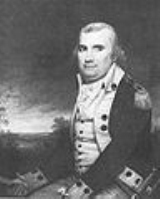
Charles Cotesworth “C. C.” Pinckney (February 25, 1746 August 16, 1825), was an early American
statesmanA statesman is usually a politician or other notable public figure who has had a long and respected career in politics or government at the national and international level. As a term of respect, it is usually left to supporters or commentators to use the term...
of South Carolina, Revolutionary War veteran, and delegate to the Constitutional Convention. He was twice nominated by the Federalist Party as their presidential candidate, but he did not win either election.
Early life and family
Charles C. Pinckney was born into the
PinckneyPinckney is a surname, and may refer to:Pinckney political family of South Carolina* Charles Pinckney , South Carolina politician, father of Charles Cotesworth Pinckney and Thomas Pinckney, and uncle of Colonel Charles Pinckney* Colonel Charles Pinckney , South Carolina politician, British...
family of aristocratic planters in
Charleston, South CarolinaCharleston is the second largest city in the U.S. state of South Carolina. It was made the county seat of Charleston County in 1901 when Charleston County was founded. The city's original name was Charles Towne in 1670, and it moved to its present location from a location on the west bank of the...
, on February 25, 1746. He was the son of
Charles PinckneyCharles Pinckney was a noted South Carolina politician and colonial agent.Pinckney was long prominent in colonial affairs, serving as attorney general of the Province of South Carolina in 1733, speaker of the assembly in 1736, 1738 and 1740, chief justice of the province in 1752–1753, and...
, who would later serve as the chief justice of the
Province of South CarolinaThe South Carolina Colony, or Province of South Carolina, was originally part of the Province of Carolina, which was chartered in 1663. The colony later became the U.S. state of South Carolina....
, and the celebrated planter and agriculturalist,
Eliza LucasEliza Lucas Pinckney changed agriculture in colonial South Carolina, where she developed indigo as one of its most important cash crops. Its cultivation and processing as dye produced one-third the total value of the colony's exports before the Revolutionary War. Manager of three plantations at...
. He was the elder brother of
Thomas PinckneyThomas Pinckney was an early American statesman, diplomat and veteran of both the American Revolutionary War and the War of 1812.-Early life in the military:...
, who served as
Governor of South CarolinaThe Governor of the State of South Carolina is the head of state for the State of South Carolina. Under the South Carolina Constitution, the Governor is also the head of government, serving as the chief executive of the South Carolina executive branch. The Governor is the ex officio...
, as a
U.S. RepresentativeThe United States House of Representatives is one of the two Houses of the United States Congress, the bicameral legislature which also includes the Senate.The composition and powers of the House are established in Article One of the Constitution...
, and as a
George WashingtonGeorge Washington was the dominant military and political leader of the new United States of America from 1775 to 1799. He led the American victory over Great Britain in the American Revolutionary War as commander-in-chief of the Continental Army from 1775 to 1783, and presided over the writing of...
administration diplomat. His first cousin once removed,
Charles PinckneyCharles Pinckney was an American politician who was a signer of the United States Constitution, the 37th Governor of South Carolina, a Senator and a member of the House of Representatives...
, served as Governor of South Carolina, as a U.S. Senator, and as a
Thomas JeffersonThomas Jefferson was the principal author of the United States Declaration of Independence and the Statute of Virginia for Religious Freedom , the third President of the United States and founder of the University of Virginia...
administration diplomat.
In 1753, Pinckney's father moved the family to London, England, to serve as the colony's agent (essentially as a lobbyist to protect South Carolina's commercial and political interests). Both Charles and his brother Thomas were enrolled in the
Westminster SchoolThe Royal College of St. Peter in Westminster, almost always known as Westminster School, is one of Britain's leading independent schools, with the highest Oxford and Cambridge acceptance rate of any secondary school or college in Britain...
, where they remained after the rest of the family returned to South Carolina in 1758. Both brothers also studied at Oxford University. Pinckney graduated from
Christ Church, OxfordChrist Church or house of Christ, and thus sometimes known as The House), is one of the largest constituent colleges of the University of Oxford in England...
with degrees in science and law, and proceeded to further study law with the prestigious
Middle TempleThe Honourable Society of the Middle Temple, commonly known as Middle Temple, is one of the four Inns of Court exclusively entitled to call their members to the English Bar as barristers; the others being the Inner Temple, Gray's Inn and Lincoln's Inn...
society. Pinckney was called to the bar in 1769, but he continued his education in
FranceThe French Republic , The French Republic , The French Republic , (commonly known as France , is a unitary semi-presidential republic in Western Europe with several overseas territories and islands located on other continents and in the Indian, Pacific, and Atlantic oceans. Metropolitan France...
for another year, studying
botanyBotany, plant science, or plant biology is a branch of biology that involves the scientific study of plant life. Traditionally, botany also included the study of fungi, algae and viruses...
and
chemistryChemistry is the science of matter, especially its chemical reactions, but also its composition, structure and properties. Chemistry is concerned with atoms and their interactions with other atoms, and particularly with the properties of chemical bonds....
. He also had a brief stint at the Royal Military College at
CaenCaen is a commune in northwestern France. It is the prefecture of the Calvados department and the capital of the Basse-Normandie region. It is located inland from the English Channel....
.
In 1773, Pinckney married Sarah Middleton, whose father
Henry MiddletonHenry Middleton was a plantation owner and public official from South Carolina. He was the second President of the Continental Congress from October 22, 1774, until Peyton Randolph was able to resume his duties briefly beginning on May 10, 1775.-Early life:Henry Middleton was born in 1717 near...
served as the second President of the
Continental CongressThe Continental Congress was a convention of delegates called together from the Thirteen Colonies that became the governing body of the United States during the American Revolution....
and whose brother
Arthur MiddletonArthur Middleton , of Charleston, South Carolina, was a signer of the United States Declaration of Independence....
signed the
Declaration of IndependenceA declaration of independence is an assertion of the independence of an aspiring state or states. Such places are usually declared from part or all of the territory of another nation or failed nation, or are breakaway territories from within the larger state...
. Sarah died in 1784. In 1786, he remarried to Mary Stead, who came from a wealthy family of planters in
GeorgiaGeorgia is a state located in the southeastern United States. It was established in 1732, the last of the original Thirteen Colonies. The state is named after King George II of Great Britain. Georgia was the fourth state to ratify the United States Constitution, on January 2, 1788...
. Pinckney had three daughters.
Early political career
After returning to South Carolina from Europe, Charles C. Pinckney began to
practice lawIn its most general sense, the practice of law involves giving legal advice to clients, drafting legal documents for clients, and representing clients in legal negotiations and court proceedings such as lawsuits, and is applied to the professional services of a lawyer or attorney at law, barrister,...
in Charleston. He was first elected to a seat in the colonial legislature in 1770. In 1773 he served as a regional attorney general. When war erupted between the thirteen American colonies and
Great BritainGreat Britain or Britain is an island situated to the northwest of Continental Europe. It is the ninth largest island in the world, and the largest European island, as well as the largest of the British Isles...
in 1775, Pinckney stood with the American Patriots; in that year he was a member of the first
South CarolinaSouth Carolina is a state in the Deep South of the United States that borders Georgia to the south, North Carolina to the north, and the Atlantic Ocean to the east. Originally part of the Province of Carolina, the Province of South Carolina was one of the 13 colonies that declared independence...
provincial congress in 1775, which helped South Carolina transition from being a British colony to being an independent state. During the
American Revolutionary WarThe American Revolutionary War , the American War of Independence, or simply the Revolutionary War, began as a war between the Kingdom of Great Britain and thirteen British colonies in North America, and ended in a global war between several European great powers.The war was the result of the...
he would serve in the lower house of the state legislature and as a member of the
South Carolina SenateThe South Carolina Senate is the upper house of the South Carolina General Assembly, the lower house being the South Carolina House of Representatives...
in addition to his military service
Revolutionary War
In 1775, after the
American Revolutionary WarThe American Revolutionary War , the American War of Independence, or simply the Revolutionary War, began as a war between the Kingdom of Great Britain and thirteen British colonies in North America, and ended in a global war between several European great powers.The war was the result of the...
had broken out, Pinckney volunteered for military service as a full-time regular officer in George Washington's
Continental ArmyThe Continental Army was formed after the outbreak of the American Revolutionary War by the colonies that became the United States of America. Established by a resolution of the Continental Congress on June 14, 1775, it was created to coordinate the military efforts of the Thirteen Colonies in...
. As a senior company commander with the rank of captain, Pinckney raised and led the elite Grenadiers of the 1st South Carolina Regiment. He participated in the successful defense of Charleston in the
Battle of Sullivan's IslandThe Battle of Sullivan's Island or the Battle of Fort Sullivan was fought on June 28, 1776, during the American Revolutionary War, also known as the American War of Independence. It took place near Charleston, South Carolina, during the first British attempt to capture the city from American rebels...
in June 1776, when British forces under General
Sir Henry ClintonGeneral Sir Henry Clinton KB was a British army officer and politician, best known for his service as a general during the American War of Independence. First arriving in Boston in May 1775, from 1778 to 1782 he was the British Commander-in-Chief in North America...
staged an amphibious attack on the state capital. Later in 1776 Pinckney took command of the regiment, with the rank of
colonelIn the United States Army, Air Force, and Marine Corps, colonel is a senior field grade military officer rank just above the rank of lieutenant colonel and just below the rank of brigadier general...
, a position he retained to the end of the war.
After this, the British Army shifted its focus to the Northern and Mid-Atlantic states. Pinckney led his regiment north to join General Washington's troops near
PhiladelphiaPhiladelphia is the largest city in the Commonwealth of Pennsylvania and the county seat of Philadelphia County, with which it is coterminous. The city is located in the Northeastern United States along the Delaware and Schuylkill rivers. It is the fifth-most-populous city in the United States,...
,
PennsylvaniaThe Commonwealth of Pennsylvania is a U.S. state that is located in the Northeastern and Mid-Atlantic regions of the United States. The state borders Delaware and Maryland to the south, West Virginia to the southwest, Ohio to the west, New York and Ontario, Canada, to the north, and New Jersey to...
. Pinckney and his regiment then participated in the
Battle of BrandywineThe Battle of Brandywine, also known as the Battle of the Brandywine or the Battle of Brandywine Creek, was fought between the American army of Major General George Washington and the British-Hessian army of General Sir William Howe on September 11, 1777. The British defeated the Americans and...
and the
Battle of GermantownThe Battle of Germantown, a battle in the Philadelphia campaign of the American Revolutionary War, was fought on October 4, 1777, at Germantown, Pennsylvania between the British army led by Sir William Howe and the American army under George Washington...
. Around this time he first met fellow officers and future Federalist statesmen
Alexander HamiltonAlexander Hamilton was a Founding Father, soldier, economist, political philosopher, one of America's first constitutional lawyers and the first United States Secretary of the Treasury...
and
James McHenryJames McHenry was an early American statesman. McHenry was a signer of the United States Constitution from Maryland and the namesake of Fort McHenry...
.
In 1778, Pinckney and his regiment, returning to the South, took part in a failed American expedition attempting to seize British
East FloridaEast Florida was a colony of Great Britain from 1763–1783 and of Spain from 1783–1822. East Florida was established by the British colonial government in 1763; as its name implies it consisted of the eastern part of the region of Florida, with West Florida comprising the western parts. Its capital...
. The expedition ended due to severe logistical difficulties and a British victory in the
Battle of Alligator BridgeThe Battle of Alligator Bridge took place on June 30, 1778, and was the only major engagement in an unsuccessful campaign to conquer British East Florida during the American Revolutionary War...
. Later that year, the British Army shifted its focus to the Southern theater,
capturing Savannah, GeorgiaThe Battle of Savannah, or sometimes the First Battle of Savannah due to a siege later in the campaign, was an American Revolutionary War battle fought on December 29, 1778 between local American Patriot militia and Continental Army units holding the city and a British invasion force under the...
, that December. In October 1779, the Southern army of
Major GeneralIn the United States Army, United States Marine Corps, and United States Air Force, major general is a two-star general-officer rank, with the pay grade of O-8. Major general ranks above brigadier general and below lieutenant general...
Benjamin LincolnBenjamin Lincoln was an American army officer. He served as a major general in the Continental Army during the American Revolutionary War...
, with Pinckney leading one of its brigades, attempted to re-take
SavannahSavannah is the largest city and the county seat of Chatham County, in the U.S. state of Georgia. Established in 1733, the city of Savannah was the colonial capital of the Province of Georgia and later the first state capital of Georgia. Today Savannah is an industrial center and an important...
in the
Siege of SavannahThe Siege of Savannah or the Second Battle of Savannah was an encounter of the American Revolutionary War in 1779. The year before, the city of Savannah, Georgia, had been captured by a British expeditionary corps under Lieutenant-Colonel Archibald Campbell. The siege itself consisted of a joint...
. This attack was disaster for the Americans, who suffered numerous casualties.
Pinckney then participated in
1780 defense of Charleston against British siegeThe Siege of Charleston was one of the major battles which took place towards the end of the American Revolutionary War, after the British began to shift their strategic focus towards the American Southern Colonies. After about six weeks of siege, Continental Army Major General Benjamin Lincoln...
. Major General Lincoln surrendered his 5,000 men to the British on May 12, 1780, whereupon Pinckney became a
prisoner of warA prisoner of war or enemy prisoner of war is a person, whether civilian or combatant, who is held in custody by an enemy power during or immediately after an armed conflict...
. As a prisoner of war, he played a major role in maintaining the troops' loyalty to the Patriots' cause. During this time, he famously said, "If I had a vein that did not beat with the love of my Country, I myself would open it. If I had a drop of blood that could flow dishonorable, I myself would let it out." He was kept in close confinement until his release in 1782. In November 1783, he was commissioned a
brevetIn many of the world's military establishments, brevet referred to a warrant authorizing a commissioned officer to hold a higher rank temporarily, but usually without receiving the pay of that higher rank except when actually serving in that role. An officer so promoted may be referred to as being...
Brigadier GeneralA brigadier general in the United States Army, Air Force, and Marine Corps, is a one-star general officer, with the pay grade of O-7. Brigadier general ranks above a colonel and below major general. Brigadier general is equivalent to the rank of rear admiral in the other uniformed...
in the
Continental ArmyThe Continental Army was formed after the outbreak of the American Revolutionary War by the colonies that became the United States of America. Established by a resolution of the Continental Congress on June 14, 1775, it was created to coordinate the military efforts of the Thirteen Colonies in...
shortly before the southern regiments were disbanded.
Constitutional Convention
Pinckney, who had returned to the lower house of the state legislature, represented South Carolina at the
constitutional conventionThe Constitutional Convention took place from May 14 to September 17, 1787, in Philadelphia, Pennsylvania, to address problems in governing the United States of America, which had been operating under the Articles of Confederation following independence from...
of 1787, where he was an influential member. Pinckney advocated the idea that
slavesSlavery is a system under which people are treated as property to be bought and sold, and are forced to work. Slaves can be held against their will from the time of their capture, purchase or birth, and deprived of the right to leave, to refuse to work, or to demand compensation...
be counted as a basis of representation and opposing
abolitionAbolitionism is a movement to end slavery.In western Europe and the Americas abolitionism was a movement to end the slave trade and set slaves free. At the behest of Dominican priest Bartolomé de las Casas who was shocked at the treatment of natives in the New World, Spain enacted the first...
of the slave trade. He also advocated a strong national government (albeit one with a system of checks and balances) to replace the weak one of the time. He opposed as impracticable the election of
representativesThe United States House of Representatives is one of the two Houses of the United States Congress, the bicameral legislature which also includes the Senate.The composition and powers of the House are established in Article One of the Constitution...
by popular vote. He also opposed paying
senatorThe United States Senate is the upper house of the bicameral legislature of the United States, and together with the United States House of Representatives comprises the United States Congress. The composition and powers of the Senate are established in Article One of the U.S. Constitution. Each...
s, who, he thought, should be men of independent wealth. Pinckney played a key role in requiring treaties to be ratified by the Senate and in the compromise that resulted in the abolition of the
Atlantic slave tradeThe Atlantic slave trade, also known as the trans-atlantic slave trade, refers to the trade in slaves that took place across the Atlantic ocean from the sixteenth through to the nineteenth centuries...
. He also opposed placing a limitation on the size of a federal standing army.
Pinckney played a prominent role in securing the ratification of the
Federal constitutionThe Constitution of the United States is the supreme law of the United States of America. It is the framework for the organization of the United States government and for the relationship of the federal government with the states, citizens, and all people within the United States.The first three...
in the South Carolina convention of 1788, and in framing the
South Carolina ConstitutionThe Constitution of the State of South Carolina is the governing document of the U.S. state of South Carolina. It describes the structure and function of the state's government. The current constitution took effect on December 4, 1895...
in the convention of 1790. After this he announced his retirement from politics.
Later political career
In the
1800 presidential electionIn the United States Presidential election of 1800, sometimes referred to as the "Revolution of 1800," Vice-President Thomas Jefferson defeated President John Adams. The election was a realigning election that ushered in a generation of Democratic-Republican Party rule and the eventual demise of...
, Pinckney was the
FederalistThe Federalist Party was the first American political party, from the early 1790s to 1816, the era of the First Party System, with remnants lasting into the 1820s. The Federalists controlled the federal government until 1801...
candidate for vice-president, running with the incumbent president, John Adams. They were defeated by the Democratic-Republicans
Thomas JeffersonThomas Jefferson was the principal author of the United States Declaration of Independence and the Statute of Virginia for Religious Freedom , the third President of the United States and founder of the University of Virginia...
(who became president) and
Aaron BurrAaron Burr, Jr. was an important political figure in the early history of the United States of America. After serving as a Continental Army officer in the Revolutionary War, Burr became a successful lawyer and politician...
(who became vice president). In
1804The United States presidential election of 1804 pitted incumbent Democratic-Republican President Thomas Jefferson against Federalist Charles Cotesworth Pinckney...
, the Federalist Party nominated Pinckney to run for the presidency against Jefferson. Jefferson, who was very popular due to the acquisition of the
Louisiana PurchaseThe Louisiana Purchase was the acquisition by the United States of America of of France's claim to the territory of Louisiana in 1803. The U.S...
and booming trade defeated Pinckney in a landslide. Pinckney won only 27.2% of the popular vote and carried only two states. In
1808In the United States presidential election of 1808, the Democratic-Republican candidate James Madison defeated Federalist candidate Charles Cotesworth Pinckney...
he was again the Federalist nominee for president, running against Jefferson's
Secretary of StateThe United States Secretary of State is the head of the United States Department of State, concerned with foreign affairs. The Secretary is a member of the Cabinet and the highest-ranking cabinet secretary both in line of succession and order of precedence...
,
James MadisonJames Madison, Jr. was an American statesman and political theorist. He was the fourth President of the United States and is hailed as the “Father of the Constitution” for being the primary author of the United States Constitution and at first an opponent of, and then a key author of the United...
. Pinckney did not fare much better against Madison, carrying only five states and winning 32.4% of the popular vote.
From 1805 until his death, Pinckney was president-general of the
Society of the CincinnatiThe Society of the Cincinnati is a historical organization with branches in the United States and France founded in 1783 to preserve the ideals and fellowship of the American Revolutionary War officers and to pressure the government to honor pledges it had made to officers who fought for American...
. Pinckney died on August 16, 1825 and was buried in
St. Michael's ChurchyardSt. Michael's Churchyard, adjacent to historic St. Michael's Episcopal Church on the corner of Meeting and Broad Streets, is the final resting place of some famous historical figures, including two signers of the Constitution of the United States. The church was established in 1751 as the second...
in Charleston, South Carolina. His tombstone reads, "One of the founders of the American Republic. In war he was a companion in arms and friend of Washington. In peace he enjoyed his unchanging confidence."
Memorialization
- Castle Pinckney
Castle Pinckney was a small masonry fortification constructed by the United States government by 1810 in the harbor of Charleston, South Carolina...
, a fort in Charleston Harbor, was completed in 1797 and named for Charles Cotesworth Pinckney.
- Pinckney Island National Wildlife Refuge
The Pinckney Island National Wildlife Refuge is a National Wildlife Refuge located in Beaufort County, South Carolina between the mainland and Hilton Head Island...
, a national wildlife refugeNational Wildlife Refuge is a designation for certain protected areas of the United States managed by the United States Fish and Wildlife Service. The National Wildlife Refuge System is the world's premiere system of public lands and waters set aside to conserve America's fish, wildlife and plants...
on the site of the Pinckney family's plantation, is named after Charles Cotesworth Pinckney.
- Pinckney Elementary School in Lawrence, Kansas
Lawrence is the sixth largest city in the U.S. State of Kansas and the county seat of Douglas County. Located in northeastern Kansas, Lawrence is the anchor city of the Lawrence, Kansas, Metropolitan Statistical Area, which encompasses all of Douglas County...
is named for Charles Cotesworth Pinckney.
- A school in Fort Jackson, South Carolina
Fort Jackson is a United States Army installation, which TRADOC operates on for Basic Combat Training , and is located in Columbia, South Carolina. This installation is named for Andrew Jackson, a United States Army General and 7th President of the United States.-Overview:Fort Jackson was created...
is called C.C. Pinckney Elementary.
- During World War II
World War II, or the Second World War , was a global conflict lasting from 1939 to 1945, involving most of the world's nations—including all of the great powers—eventually forming two opposing military alliances: the Allies and the Axis...
, a 422-foot Liberty ShipLiberty ships were cargo ships built in the United States during World War II. Though British in conception, they were adapted by the U.S. as they were cheap and quick to build, and came to symbolize U.S. wartime industrial output. Based on vessels ordered by Britain to replace ships torpedoed by...
was built in Wilmington, North CarolinaWilmington is a port city in and is the county seat of New Hanover County, North Carolina, United States. The population is 106,476 according to the 2010 Census, making it the eighth most populous city in the state of North Carolina...
in 1942 and named SS Charles C. Pinckney in his honor.
- Pinckney St. in Madison, WI was named in his honor.
- Pinckneyville, Illinois was named after him.
External links