
All Topics  
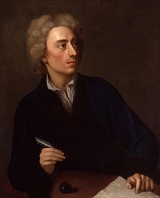
Alexander Pope

 
Alexander Pope

   Email Print
   Bookmark   Link


Alexander Pope


Alexander Pope (21 May 1688 – 30 May 1744) is generally regarded as the greatest English
England

native_name =|conventional_long_name = England|common_name = England|image_flag = Flag of England.svg|image_coat = England COA.svg|symbol_type = Royal Coat of Arms...
 poet
Poet

A poet is a person who writes poetry....
 of the eighteenth century, best known for his satirical verse and for his translation of Homer
Homer

Homer is traditionally held to be the author of the ancient Greek language epic poems the Iliad and the Odyssey, as well as of the Homeric Hymns....
. He is the third most frequently quoted writer in the English language, after Shakespeare
William Shakespeare

William Shakespeare was an English people poet and playwright, widely regarded as the greatest writer in the English language and the world's preeminent dramatist....
 and Tennyson
Alfred Tennyson, 1st Baron Tennyson

Alfred Tennyson, 1st Baron Tennyson was Poet Laureate of the United Kingdom and remains one of the most popular English poets.Tennyson excelled at penning short lyrics, including "In the valley of Cauteretz", "Break, break, break", "The Charge of the Light Brigade ", "Tears, Idle Tears" and "Crossing the Bar"....
. Pope was a master of the heroic couplet
Heroic couplet

A heroic couplet is a traditional form for English literature poetry, commonly used for epic poetry and narrative poetry; it refers to poems constructed from a sequence of rhyming pairs of iambic pentameter lines....
.

Early life
Pope was born in the City of London
City of London

The City of London is a geographically small city status in the United Kingdom within Greater London, England. It is the historic core of London around which, along with Westminster, the modern conurbation grew....
 to Alexander (senior, a linen merchant
Cloth merchant

Cloth merchant is, strictly speaking, like a draper, the term for any vendor of cloth. However, it is generally used for one who owned and/or ran a cloth manufacturing and/or wholesale import and/or export business in the Middle Ages or 16th and 17th centuries....
) and Edith Pope (née Turner), who were both Roman Catholic.


Discussion
Ask a question about 'Alexander Pope'
Start a new discussion about 'Alexander Pope'
Answer questions from other users
Full Discussion Forum


Recent Posts


Quotations


T is mans to fight, but Heavens to give success.

Book VI, line 427

T is true, t is certain; man though dead retainsPart of himself: the immortal mind remains.

Book XXIII, line 122

Tis education forms the common mind:Just as the twig is bent, the trees inclined.

Line 149

Tis not a lip, or eye, we beauty call,But the joint force and full result of all.

Part II, line 45

Tis with our judgements as our watches, noneGo just alike, yet each believes his own.

Part I, line 9

A brain of feathers, and a heart of lead.

Book II, line 44


Encyclopedia


Alexander Pope (21 May 1688 – 30 May 1744) is generally regarded as the greatest English
England

native_name =|conventional_long_name = England|common_name = England|image_flag = Flag of England.svg|image_coat = England COA.svg|symbol_type = Royal Coat of Arms...
 poet
Poet

A poet is a person who writes poetry....
 of the eighteenth century, best known for his satirical verse and for his translation of Homer
Homer

Homer is traditionally held to be the author of the ancient Greek language epic poems the Iliad and the Odyssey, as well as of the Homeric Hymns....
. He is the third most frequently quoted writer in the English language, after Shakespeare
William Shakespeare

William Shakespeare was an English people poet and playwright, widely regarded as the greatest writer in the English language and the world's preeminent dramatist....
 and Tennyson
Alfred Tennyson, 1st Baron Tennyson

Alfred Tennyson, 1st Baron Tennyson was Poet Laureate of the United Kingdom and remains one of the most popular English poets.Tennyson excelled at penning short lyrics, including "In the valley of Cauteretz", "Break, break, break", "The Charge of the Light Brigade ", "Tears, Idle Tears" and "Crossing the Bar"....
. Pope was a master of the heroic couplet
Heroic couplet

A heroic couplet is a traditional form for English literature poetry, commonly used for epic poetry and narrative poetry; it refers to poems constructed from a sequence of rhyming pairs of iambic pentameter lines....
.

Early life


Pope was born in the City of London
City of London

The City of London is a geographically small city status in the United Kingdom within Greater London, England. It is the historic core of London around which, along with Westminster, the modern conurbation grew....
 to Alexander (senior, a linen merchant
Cloth merchant

Cloth merchant is, strictly speaking, like a draper, the term for any vendor of cloth. However, it is generally used for one who owned and/or ran a cloth manufacturing and/or wholesale import and/or export business in the Middle Ages or 16th and 17th centuries....
) and Edith Pope (née Turner), who were both Roman Catholic. Pope's education was affected by the laws
Penal law

In the most general sense, penal is the body of laws that are enforced by the State in its own name and impose penalties for their violation, as opposed to Civil law that seeks to redress private wrongs....
 in force at the time upholding the status of the established Church of England
Church of England

The Church of England is the State religion Christianity Ecclesia in England, the Mother Church of the worldwide Anglican Communion and the oldest among the communion's thirty-eight independent national and regional churches....
, which banned Catholics from teaching on pain of perpetual imprisonment. Pope was taught to read by his aunt and then sent to two surreptitious Catholic schools, at Twyford
Twyford School

Twyford School is a Preparatory school located in the village of Twyford, Hampshire, Hampshire. It claims to be the oldest preparatory school in the United Kingdom....
 and at Hyde Park Corner. Catholic schools, while illegal, were tolerated in some areas.

From early childhood he suffered numerous health problems, including Pott's disease
Pott's disease

Pott disease is a presentation of extrapulmonary tuberculosis that affects the spine, a kind of tuberculous arthritis of the intervertebral joints....
 (a form of tuberculosis
Tuberculosis

Tuberculosis is a common and often deadly infectious disease caused by mycobacterium, mainly Mycobacterium tuberculosis . Tuberculosis usually attacks the lungs but can also affect the central nervous system, the lymphatic system, the circulatory system, the genitourinary system, the gastrointestinal system, bones, joints, and even the...
 affecting the spine
Vertebral column

In human anatomy, the vertebral column is a column of 24 vertebrae, the sacrum, intervertebral discs, and the coccyx situated in the dorsum aspect of the torso, separated by spinal discs....
) which deformed his body and stunted his growth, no doubt helping to end his life at the age of 56. He never grew beyond 1.37 metres (4 feet 6 inches) tall. Although he never married, he had many women friends and wrote them witty letters.

In 1700, his family was forced to move to a small estate in Binfield
Binfield

Binfield is a village and civil parish in the Bracknell Forest borough of Berkshire, England. According to the 2001 census it had a population of 7,475....
, Berkshire
Berkshire

Berkshire is a Home Counties in the South East England of England. It is also often referred to as the Royal County of Berkshire because of the presence of the royal residence of Windsor Castle in the county; this usage, which dates to the 19th century at least, was recognised by the Queen in 1958, and Letters patent issued confirming...
 due to strong anti-Catholic sentiment and a statute preventing Catholics from living within of either London
London

London is the capital of both England and the United Kingdom, and the most populous municipality in the European Union. An important settlement for two millennia, History of London goes back to its founding by the Roman Empire....
 or Westminster
Westminster

Westminster is an area of Central London, within the City of Westminster. It lies on the north bank of the River Thames, southwest of the City of London and southwest of Charing Cross....
. Pope would later describe the countryside around the house in his poem Windsor Forest.

With his formal education now at an end, Pope embarked on an extensive campaign of reading. As he later remembered: "In a few years I had dipped into a great number of the English
England

native_name =|conventional_long_name = England|common_name = England|image_flag = Flag of England.svg|image_coat = England COA.svg|symbol_type = Royal Coat of Arms...
, French
France

France , officially the French Republic , is a country whose Metropolitan France is located in Western Europe and that also comprises various Overseas departments and territories of France....
, Italian
Italy

Italy , officially the Italian Republic , is a country located on the Italian Peninsula in Southern Europe and on the two largest islands in the Mediterranean Sea, Sicily and Sardinia....
, Latin
Latin

Latin is an Italic language, historically spoken in Latium and Ancient Rome. Through the Military history of the Roman Empire, Latin spread throughout the Mediterranean and a large part of Europe....
, and Greek
Ancient Greek

Ancient Greek is the historical stage in the development of the Greek language spanning across the Archaic Greece , Classical Greece , and Hellenistic civilization periods of ancient Greece and the classical antiquity....
 poets. This I did without any design but that of pleasing myself, and got the languages by hunting after the stories...rather than read the books to get the languages." His favourite author was Homer
Homer

Homer is traditionally held to be the author of the ancient Greek language epic poems the Iliad and the Odyssey, as well as of the Homeric Hymns....
, whom he had first read at age eight in the English translation by John Ogilby
John Ogilby

John Ogilby was a Scotland translator, impresario and cartographer. He is known best for his Britannia Atlas of 1675, which was perhaps the first British road atlas, and set the standard for those that followed ....
. Pope was already writing verse: he claimed he wrote one poem, Ode to Solitude
Ode to Solitude

Ode on Solitude is a poem by Alexander Pope, written when he was twelve years old, , and widely included in anthologies. . ,"Happy the man, whose wish and care...
, at the age of twelve.

At Binfield, he also began to make many important friends. One of them, John Caryll
John Caryll the younger

John Caryll, was the second Jacobite Baron Caryll of Durford.A friend of Alexander Pope, Caryll was the son of Richard Caryll , of West Grinstead, Sussex, and Frances , daughter of Sir Henry Bedingfield, and nephew and heir of John Caryll ....
 (the future dedicatee of The Rape of the Lock
The Rape of the Lock

The Rape of the Lock is a mock-heroic narrative poem written by Alexander Pope, first published anonymously in Lintot's Miscellany in May 1712 in two cantos , but then revised, expanded and reissued under Pope's name on March 2 1714, in a much-expanded 5-canto version ....
), was twenty years older than the poet and had made many acquaintances in the London literary world. He introduced the young Pope to the ageing playwright William Wycherley
William Wycherley

William Wycherley was an England dramatist of the English Restoration period....
 and to William Walsh, a minor poet, who helped Pope revise his first major work, The Pastorals. He also met the Blount sisters, Martha and Teresa, who would remain lifelong friends.

Early literary career


First published in 1710 in a volume of Poetical Miscellanies by Jacob Tonson
Jacob Tonson

Jacob Tonson, sometimes referred to as Jacob Tonson the elder was an 18th-century English bookseller and publisher.Tonson published editions of John Dryden and John Milton, and is best known for having obtained a copyright on the plays of William Shakespeare by buying up the rights of the heirs of the publisher of the Fourth Book aft...
, The Pastorals brought instant fame to the twenty-year-old Pope. They were followed by An Essay on Criticism
An Essay on Criticism

An Essay on Criticism was the first major poem written by the English people writer Alexander Pope . However, despite the title, the poem is not as much an original analysis as it is a compilation of Pope's various literary opinions....
 (1711), which was equally well received, although it incurred the wrath of the prominent critic John Dennis
John Dennis

John Dennis , was an England critic and dramatist, born in London, the son of a saddler.He was educated at Harrow School and Caius College, Cambridge, where he took his B.A....
, the first of the many literary enmities which would play such a great role in Pope's life and writings. Windsor Forest (1713) is a topographical poem celebrating the "Tory Peace" at the end of the War of the Spanish Succession
War of the Spanish Succession

War of the Spanish Succession was a war fought in 1701-1714, in which several European powers combined to stop a possible unification of the Kingdoms of Spain and France under a single Bourbon monarch, upsetting the European Balance of power in international relations....
.

Around 1711, Pope made friends with the Tory
Tory

In the political tradition of some List of countries where English is an official language, the term Tory may refer to a variety of Political party and creeds since it was originally used in the late 17th century to describe opponents to the Whig Party ....
 writers John Gay
John Gay

John Gay was an English people poet and dramatist. He is best remembered for The Beggar's Opera , set to music by Johann Christoph Pepusch....
, Jonathan Swift
Jonathan Swift

Jonathan Swift was an Anglo-Irish satire, essayist, political pamphleteer , poet and cleric who became Dean of St. Patrick's Cathedral, Dublin, Dublin....
 and John Arbuthnot
John Arbuthnot

John Arbuthnot, often known simply as Dr. Arbuthnot, , was a physician, satire and polymath in London. He is best remembered for his contributions to mathematics, his membership in the Scriblerus Club , and for inventing the figure of John Bull....
, as well as the Whigs
British Whig Party

The Whigs are often described as one of two political party in Kingdom of England and later the United Kingdom from the late 17th to the mid-19th centuries....
 Joseph Addison
Joseph Addison

??File:Joseph Addison.pngJoseph Addison was an English essayist and poet. He was a man of letters, eldest son of Lancelot Addison, and later the dean of Lichfield....
 and Richard Steele
Richard Steele

Sir Richard Steele was an Ireland writer and politician, remembered as co-founder, with his friend Joseph Addison, of the magazine The Spectator ....
. Pope's friendship with Addison would later cool and he would satirise him as "Atticus" in his Epistle to Doctor Arbuthnot.

Pope, Gay, Swift, Arbuthnot and Thomas Parnell
Thomas Parnell

Thomas Parnell was a poet and clergyman, born in Dublin and educated at Trinity College, Dublin. He was a friend of both Alexander Pope and Jonathan Swift, participating in the Scriblerus Club, contributing to The Spectator , and aiding Pope in his translation of The Iliad....
 formed the Scriblerus Club
Scriblerus Club

The Scriblerus Club was an informal group of friends that included Jonathan Swift, Alexander Pope, John Gay, John Arbuthnot, Henry St John, 1st Viscount Bolingbroke and Thomas Parnell....
 in 1712. The aim of the club was to satirise ignorance and pedantry in the form of the fictional scholar Martinus Scriblerus. Pope's major contribution to the club would be Peri Bathous, or the Art of Sinking in Poetry (1728), a parodic guide on how to write bad verse. The Rape of the Lock
The Rape of the Lock

The Rape of the Lock is a mock-heroic narrative poem written by Alexander Pope, first published anonymously in Lintot's Miscellany in May 1712 in two cantos , but then revised, expanded and reissued under Pope's name on March 2 1714, in a much-expanded 5-canto version ....
 (two-canto
Canto

The 'canto' is a principal form of division in a long poem, especially the epic poetry. The word comes from Italian language, from the Latin cantus, meaning "song," and has a corollary in the Sanskrit , or "chapter." Famous examples of epic poetry which employ the canto division are Valmiki's Ramayana , Dante Alighieri's The Divin...
 version, The Rape of the Locke, 1712; revised version in five cantos, 1714) is perhaps Pope's most popular poem. It is a mock-heroic
Mock-heroic

Mock-heroic or heroi-comic works are typically satires or parodies that mock common Classical stereotypes of heroes and heroic literature....
 epic, written to make fun of a high society quarrel between Arabella Fermor (the "Belinda" of the poem) and Lord Petre
Robert Petre, 7th Baron Petre

Robert Petre, 7th Baron Petre, was a English people Peerage, the son of Thomas Petre, 6th Baron Petre and his wife Mary Clifton, daughter of Sir Thomas Clifton....
, who had snipped a lock of hair from her head without her permission.

In 1714, the political situation worsened with the death of Queen Anne and the disputed succession between the Hanoverians and the Jacobites
Jacobitism

Jacobitism was the political movement dedicated to the restoration of the House of Stuart kings to the thrones of Kingdom of England, Kingdom of Scotland, and Kingdom of Ireland....
, leading to the attempted Jacobite invasion
Jacobite rising

The Jacobite Risings were a series of uprisings, rebellions, and wars in the kingdoms of Kingdom of England, Kingdom of Scotland , and Kingdom of Ireland occurring between 1688 and 1746....
 of 1715. Though Pope as a Catholic might be expected to have supported the Jacobites, according to Maynard Mack, "where Pope himself stood on these matters can probably never be confidently known". These events led to an immediate downturn in the fortunes of the Tories, and Pope's friend, Henry St John, 1st Viscount Bolingbroke
Henry St John, 1st Viscount Bolingbroke

Henry St John, 1st Viscount Bolingbroke , was an English politician and philosopher. He identified predominantly with the Tories , of which he was a prominent member for many years....
 fled to France.

The climax of Pope's early career was the publication of his Works in 1717. As well as the poems mentioned above, the volume included the first appearance of Eloisa to Abelard
Eloisa to Abelard

Published in 1717, Eloisa to Abelard is a poem by Alexander Pope . It is an Ovidian heroic epistle inspired by the 12th-century story of Heloise 's illicit love for, and secret marriage to, her teacher Pierre Ab?lard, perhaps the most popular teacher and philosopher in Paris, and the brutal vengeance her family exacts when they Castratio...
 and Elegy to the Memory of an Unfortunate Lady
Elegy to the Memory of an Unfortunate Lady

"Elegy to the Memory of an Unfortunate Lady" is a poem in heroic couplets by Alexander Pope, first published in his Works of 1717. Though only 82 lines long, it has become one of Pope's most celebrated pieces....
; and several shorter works, of which perhaps the best are the epistles to Martha Blount.

The middle years: Homer and Shakespeare

Alexanderpope
Pope had been fascinated by Homer since childhood. In 1713, he announced his plans to publish a translation of Homer
Homer

Homer is traditionally held to be the author of the ancient Greek language epic poems the Iliad and the Odyssey, as well as of the Homeric Hymns....
's Iliad
ILiad

The iLiad is an electronic handheld device, or e-book device, which can be used for document reading and editing. Like the Sony Reader or Amazon Kindle, the iLiad makes use of an electronic paper display....
. The work would be available by subscription, with one volume appearing every year over the course of six years. Pope secured a revolutionary deal with the publisher Bernard Lintot, which brought him two hundred guineas
Guinea (British coin)

The guinea is an obsolete coin that was minted in the Kingdom of England between 1663 and 1813. It was the first English machine-struck gold coin....
 a volume.

The commercial success of his translation made Pope the first English poet who could live off the sales of his work alone, "indebted to no prince or peer alive", as he put it. His translation of the Iliad duly appeared between 1715 and 1720. It was later acclaimed by Samuel Johnson
Samuel Johnson

Samuel Johnson was an English author. Beginning as a Grub Street journalist, he made lasting contributions to English literature as a poet, essayist, moralist, novelist, literary critic, biographer, editor and lexicographer....
 as "a performance which no age or nation could hope to equal" (although the classical scholar Richard Bentley
Richard Bentley

Richard Bentley was an England theologian, Classics and critic....
 wrote: "It is a pretty poem, Mr. Pope, but you must not call it Homer."). The money he made allowed Pope to move to a villa at Twickenham in 1719, where he created a famous grotto and gardens. The grotto
Grotto

A grotto is any type of natural or artificial cave that is associated with modern, historic or prehistoric use by humans. When it is not an artificial garden feature, a grotto is often a small cave near water and often flooded or liable to flood at high tide....
 he decorated with alabaster
Alabaster

Alabaster is a name applied to varieties of two distinct minerals: gypsum and calcite . The former is the alabaster of the present day; the latter is generally the alabaster of the ancients....
, marble
Marble

Marble is a nonfoliated metamorphic rock resulting from the metamorphism of limestone, composed mostly of calcite . It is extensively used for Marble sculpture, as a architecture material, and in many other applications....
s, ores such as mundic
Mundic

Mundic was used from the 1690s to describe a copper ore, which began to be smelted at Bristol and elsewhere in southwestern Early Modern Britain....
, crystals: Cornish diamonds
Quartz

Quartz is the most abundant mineral in the Earth's continental crust . It is made up of a Crystal structure of silica tetrahedra. Quartz has a hardness of 7 on the Mohs scale and a density of 2.65 g/cm?....
, stalactites, spars
SPARS

SPARS was the United States Coast Guard Women's Reserve created 23 November 1942 with the signing of Public Law 773 by President Franklin Delano Roosevelt....
, snakestones and spongestone
Pumice

File:Pumice stone444.jpgFile:Pumice stone detail444.jpgPumice is a textural term for a volcanic rock that is a solidified frothy lava typically created when super-heated, highly pressurized rock is violently ejected from a volcano....
. Here and there he placed mirrors (very expensive embellishments for those times). He also installed a camera obscura
Camera obscura

The camera obscura is an optical device used, for example, in drawing or for entertainment. It is one of the inventions leading to photography....
 to delight his visitors, of whom there were many. The serendipitous
Serendipity

Serendipity is the effect by which one accidentally discovers something fortunate, especially while looking for something else entirely. The word has been voted as one of the ten English words that were Words hardest to translate in June 2004 by a United Kingdom translation company....
 discovery of a spring during its excavations enabled the subterranean retreat to fill with the relaxing sound of trickling waters, which quietly echoes around its exotic chambers. Pope was said to have remarked that: “Were it to have nymph
Nymph

In Greek mythology, a nymph is any member of a large class of mythological entities in human form. They were typically associated with a particular location or landform....
s as well – it would be complete in everything.“ Although house and gardens have long since been demolished or destroyed, much of this grotto still survives. The grotto now lies beneath St James Independent School for boys, and is opened to the public once a year.

Encouraged by the very favourable reception of the Iliad, Pope translated the Odyssey
Odyssey

The Odyssey is one of two major ancient Hellenic civilization epic poetrys attributed to Homer. It is, in part, a sequel to the Iliad, the other work traditionally ascribed to Homer....
. The translation appeared in 1726, but this time, confronted with the arduousness of the task, he enlisted the help of William Broome
William Broome

William Broome was an England poet and translator. He was born in Haslington, near Crewe, Cheshire and died in Bath, Somerset.He was educated at Eton College and Cambridge, entered the Church, and became rector of Sturston, Suffolk in Suffolk, and later Pulham in Norfolk and Eye in Suffolk....
 and Elijah Fenton
Elijah Fenton

Elijah Fenton was a poet, biographer and translator.Born in Shelton, Stoke-on-Trent, Staffordshire , and educated at Jesus College, Cambridge, for a time he acted as secretary to the Charles Boyle, 4th Earl of Orrery in Flanders, and was then Master of Sevenoaks Grammar School....
. Pope attempted to conceal the extent of the collaboration (he himself translated only twelve books, Broome eight and Fenton four), but the secret leaked out. It did some damage to Pope's reputation for a time, but not to his profits.

In this period, Pope was also employed by the publisher Jacob Tonson
Jacob Tonson

Jacob Tonson, sometimes referred to as Jacob Tonson the elder was an 18th-century English bookseller and publisher.Tonson published editions of John Dryden and John Milton, and is best known for having obtained a copyright on the plays of William Shakespeare by buying up the rights of the heirs of the publisher of the Fourth Book aft...
 to produce an opulent new edition of Shakespeare. When it finally appeared, in 1725, this edition silently "regularised" Shakespeare's metre and rewrote his verse in a number of places. Pope also demoted about 1560 lines of Shakespearean material to footnotes, arguing that they were so "excessively bad" that Shakespeare could never have written them. (Other lines were excluded from the edition altogether.) In 1726, the lawyer, poet, and pantomime
Pantomime

Pantomime is a musical-comedy theatrical production traditionally found in Great Britain, Canada, Jamaica, Australia, South Africa, New Zealand, Zimbabwe, Republic of Ireland, Gibraltar and Republic of Malta, and is usually performed during the Christmas and New Year season....
 deviser Lewis Theobald
Lewis Theobald

Lewis Theobald , United Kingdom textual editor and author, was a landmark figure both in the history of William Shakespeare editing and in literary satire....
 published a scathing pamphlet called Shakespeare Restored, which catalogued the errors in Pope's work and suggested a number of emendations to the text. Pope and Theobald were probably well acquainted, and Pope no doubt interpreted this as a violation of the rules of friendship. Pope retaliated to what he saw as Theobald's impudence by making him the mock-hero of the first version of his satire The Dunciad
The Dunciad

The Dunciad is a landmark literary satire by Alexander Pope published in three different versions at different times. The first version was published in 1728 anonymously....
 (1728), the first of the moral and satiric poems of his last period. A second edition of Pope's Shakespear appeared in 1728, but aside from making some minor revisions to the Preface, it seems that Pope had little to do with it. Most later eighteenth-century editors of Shakespeare dismissed Pope's aesthetically motivated approach to textual criticism
Textual criticism

Textual criticism is a branch of literary criticism that is concerned with the identification and removal of transcription errors in the Writing of manuscripts....
. Pope's , however, continued to be highly rated, and its suggestion that Shakespeare's texts were thoroughly contaminated by actors' interpolations
Interpolation (manuscripts)

In relation to literature and especially ancient manuscripts, an interpolation is an entry or passage in a text that was not written by the original author....
 would influence editors
Shakespeare's editors

Shakespeare's editors were essential in the development of the modern practice of producing printed books and the evolution of textual criticism....
 for most of the eighteenth century.

Alexander Pope became a freemason and member of the Premier Grand Lodge of England
Premier Grand Lodge of England

The Premier Grand Lodge of England was founded on 24 June 1717 as the Grand Lodge of London and Westminster and it existed until 1813 when it united with the Ancient Grand Lodge of England to create the United Grand Lodge of England....
.

Later career: "An Essay on Man" and satires


Though the Dunciad was first published anonymously in Dublin
Dublin

Dublin is both the largest city and capital of Republic of Ireland. It is located near the midpoint of Ireland's east coast, at the mouth of the River Liffey and at the centre of the Dublin Region....
, its authorship was not in doubt. As well as Theobald, it pilloried a host of other "hacks", "scribblers" and "dunces". Mack called its publication "in many ways the greatest act of folly in Pope's life". Though a masterpiece, "it bore bitter fruit. It brought the poet in his own time the hostility of its victims and their sympathizers, who pursued him implacably from then on with a few damaging truths and a host of slanders and lies...". The threats were physical too. According to his sister, Pope would never go for a walk without the company of his Great Dane
Great Dane

The Great Dane, Danish Hound, Deutsche Dogge, Boarhound, or German Mastiff is a dog breed of domestic dog known for its giant size and gentle personality....
, Bounce, and a pair of loaded pistols in his pocket.

In 1731, Pope published his "Epistle to Burlington", on the subject of architecture
Architecture

The term architecture can refer to a process, a profession or documentation.As a process, architecture is the activity of designing and construction buildings and other physical structures by a person or a computer, primarily to provide shelter....
, the first of four poems which would later be grouped under the title Moral Essays
Moral Essays

Moral Essays is a series of four poems on ethical subjects by Alexander Pope, published between 1731 and 1735. The individual poems are as follows:...
 (1731-35). In the epistle, Pope ridiculed the bad taste of the aristocrat "Timon". Pope's enemies claimed he was attacking the Duke of Chandos
James Brydges, 1st Duke of Chandos

James Brydges, 1st Duke of Chandos Privy Council of Great Britain was the first of fourteen children by Sir James Brydges, 3rd Baronet of Wilton Castle, Sheriff of Herefordshire, 8th Lord Chandos; and Elizabeth Barnard....
 and his estate, Cannons
Cannons (house)

Cannons was a stately home in Edgware, Middlesex built for James Brydges, 1st Duke of Chandos between 1713 and 1724 at a cost of ?200,000 but which in 1747 was razed to the ground and its contents dispersed....
. Though the charge was untrue, it did Pope a great deal of damage.

Around this time, Pope began to grow discontented with the ministry of Robert Walpole
Robert Walpole

Robert Walpole, 1st Earl of Orford, Order of the Garter, Order of the Bath, Privy Council of Great Britain , known before 1742 as Sir Robert Walpole, was a Kingdom of Great Britain statesman who is generally regarded as having been the first Prime Minister of the United Kingdom....
 and drew closer to the opposition led by Bolingbroke, who had returned to England in 1725. Inspired by Bolingbroke's philosophical ideas, Pope wrote An Essay on Man
An Essay on Man

An Essay on Man is a poem published by Alexander Pope in 1734 in poetry. It is a rationalistic effort to use philosophy in order to "vindicate the ways of God to man" , a variation of John Milton's claim in the opening lines of Paradise Lost, that he will "justify the ways of God to man" ....
 (1733-4). He published the first part anonymously, in a cunning and successful ploy to win praise from his fiercest critics and enemies.

Despite the 'Essay' being written in heroic couplets, many translations into European languages rapidly followed, especially in Germany, where the 'Essay' was regarded as a serious contribution to philosophy.

The Imitations of Horace followed (1733-38). These were written in the popular Augustan form of the "imitation" of a classical poet, not so much a translation of his works as an updating with contemporary references. Pope used the model of Horace
Horace

This article is about the Roman poet Horace. For other uses, see Horace .Quintus Horatius Flaccus, , known in the English language world as Horace, was the leading Roman Empire Lyric poetry during the time of Augustus....
 to satirise life under George II
George II of Great Britain

George II was King of Great Britain and King of Ireland, Duke of Brunswick-L?neburg and Prince-elector#High Offices and Prince-Elector of the Holy Roman Empire from 11 June 1727 until his death....
, especially what he regarded as the widespread corruption tainting the country under Walpole's influence and the poor quality of the court's artistic taste.

Pope also added a wholly original poem, An Epistle to Doctor Arbuthnot, as an introduction to the "Imitations". It reviews his own literary career and includes the famous portraits of Lord Hervey ("Sporus") and Addison ("Atticus"). In 1738 he wrote the Universal Prayer.

After 1738, Pope wrote little. He toyed with the idea of composing a patriotic epic in blank verse called Brutus, but only the opening lines survive. His major work in these years was revising and expanding his masterpiece The Dunciad
The Dunciad

The Dunciad is a landmark literary satire by Alexander Pope published in three different versions at different times. The first version was published in 1728 anonymously....
. Book Four appeared in 1742, and a complete revision of the whole poem in the following year. In this version, Pope replaced the "hero", Lewis Theobald, with the poet laureate Colley Cibber
Colley Cibber

Colley Cibber was a British actor-manager, playwright, and Poet laureate#British_Poets_Laureate. His colourful memoir Apology for the Life of Colley Cibber started a British tradition of personal, anecdotal, and even rambling autobiography....
 as "king of dunces". By now Pope's health, which had never been good, was failing, and he died in his villa surrounded by friends on 30 May 1744. On the previous day, 29 May 1744, Pope called for a priest and received the Last Rites
Last Rites

Last Rites can refer to* Anointing of the Sick Note: The term "Last Rites" is not equivalent to "Anointing of the Sick", since it refers also to two other distinct rites: Penance and Eucharist, the last of which, when administered to the dying, is known as "Viaticum", a word whose original meaning in Latin was "provision for the jour...
 of the Catholic Church. He lies buried in the nave of the Church of St Mary the Virgin in Twickenham
Twickenham

Twickenham is a town in west London, England.It is the principal town, by population, within the London Borough of Richmond upon Thames....
.

Literary legacy


Pope Dying
The poetry of Alexander Pope holds an acknowledged place in the canon of English literature, although his work has gone in and out of fashion. One edition of the Oxford Dictionary of Quotations includes no fewer than 212 quotations from Pope.

Some quotations from Pope's work have passed so deeply into the English language that they are often taken as proverbial by those who do not know their source: "A little learning is a dang'rous thing" (from the Essay on Criticism); "To err is human, to forgive, divine" (ibid.); "For fools rush in where angels fear to tread" (ibid); "Hope springs eternal in the human breast" and "The proper study of mankind is man" (Essay on Man). This would have greatly pleased Pope, who wrote:

True wit is nature to advantage dress’d;
What oft was thought, but ne’er so well express’d.


Pope dominated his age to an extent few writers before or since have matched. After his death, it was almost inevitable a reaction would set in against his poetry, especially with the first stirrings of Romanticism
Romanticism

Romanticism is a complex artistic, literary, and intellectual movement that originated in the second half of the 18th century in Western Europe, and gained strength during the Industrial Revolution....
 in the late eighteenth century.

In An Essay on the Genius and Writings of Pope (1756 and 1782), Joseph Warton
Joseph Warton

Joseph Warton was an English academic and literary critic.He was born in Dunsfold, Surrey, England, but his family soon moved to Hampshire, where his father, the Reverend Thomas Warton, became vicar of Basingstoke....
 denied Pope was a "true poet", merely a "man of wit" and a "man of sense". In his Lives of the Poets Doctor Johnson countered: "...It is surely superfluous to answer the question that has once been asked, whether Pope was a poet, otherwise than by asking in return, if Pope be not a poet, where is poetry to be found?". But he was fighting a losing battle against changing taste.

The Romantics had little time for Pope, with the notable exception of Lord Byron, who acclaimed him as “the great moral poet of all times, of all climes, of all feelings, and all stages of existence”. Keats dismissed the style of writers who wrote in heroic couplets, saying:

They sway'd about upon a rocking horse,
And thought it Pegasus. (Sleep and Poetry)


In the Victorian era, Matthew Arnold
Matthew Arnold

Matthew Arnold was an England poet, and cultural critic who worked as an inspector of schools. He was the son of Thomas Arnold, the famed headmaster of Rugby School, and brother to both Tom Arnold , literary professor, and William Delafield Arnold, novelist and colonial administrator....
 dismissed Pope and Dryden
John Dryden

John Dryden was an influential English poet, literary critic, translator, and playwright who dominated the literary life of English Restoration to such a point that the period came to be known in literary circles as the Age of Dryden....
 as "classics of our prose". The 19th century considered his diction artificial, his versification too regular, and his satires insufficiently humane. The third charge has been disputed by various 20th century critics including William Empson
William Empson

Sir William Empson was an England literary critic and poet.He is sometimes praised as the greatest English literary critic after Samuel Johnson and William Hazlitt, and widely influential for his practice of close reading literary works, fundamental to the New Critics....
, and the first does not apply at all to his best work. That Pope was constrained by the demands of "acceptable" diction and prosody is undeniable, but the elegance and flexibility with which Pope used this technique shows that great poetry could be written with these constraints. His expression is concise and forceful, conveying emotion as well as reason and wit.

In his time Pope was famous for his witty satires and aggressive, bitter quarrels with other writers. When his edition of William Shakespeare was attacked, he answered with the savage burlesque The Dunciad
The Dunciad

The Dunciad is a landmark literary satire by Alexander Pope published in three different versions at different times. The first version was published in 1728 anonymously....
 (1728), which was widened in 1742. It ridiculed bad writers, scientists, and critics: "While pensive poets painful vigils keep, / Sleepless themselves to give their readers sleep." With the growth of Romanticism Pope's poetry was increasingly seen as outdated and the 'Age of Pope' ended. It was not until the 1930s that any serious attempts were made to rediscover the poet's work.

Isaac Newton's Epitaph

Pope is known to have written Isaac Newton
Isaac Newton

Sir Isaac Newton, Fellow of the Royal Society was an English people physicist, mathematician, Astronomy, Natural philosophy, Alchemy, and Theology and one of the the 100 in human history....
's epitaph
Epitaph

An epitaph is a short text honoring a deceased person, strictly speaking that inscribed on their tombstone or plaque, but also used figuratively....
:

A reference to this epitaph is made in Dan Brown
Dan Brown

Dan Brown is an United States author of thriller fiction, best known for the 2003 bestselling novel, The Da Vinci Code and the 2000 bestselling novel, Angels & Demons....
's novel "The Da Vinci Code
The Da Vinci Code

The Da Vinci Code is a 2003 in literature Mystery -detective fiction fiction novel written by United States author Dan Brown and published by the Doubleday in the United States and Bantam Books in the United Kingdom....
".

Beliefs


Pope openly described himself a Roman Catholic at a time when it was still illegal to profess Catholicism in England, and practise of the religion was subject to stiff penalties.

Works

Twickenham
* (1709) Pastorals
  • (1711) An Essay on Criticism
    An Essay on Criticism

    An Essay on Criticism was the first major poem written by the English people writer Alexander Pope . However, despite the title, the poem is not as much an original analysis as it is a compilation of Pope's various literary opinions....
  • (1712) The Rape of the Lock
    The Rape of the Lock

    The Rape of the Lock is a mock-heroic narrative poem written by Alexander Pope, first published anonymously in Lintot's Miscellany in May 1712 in two cantos , but then revised, expanded and reissued under Pope's name on March 2 1714, in a much-expanded 5-canto version ....
  • (1713) Windsor Forest
  • (1715-1720) Translation of the Iliad
    ILiad

    The iLiad is an electronic handheld device, or e-book device, which can be used for document reading and editing. Like the Sony Reader or Amazon Kindle, the iLiad makes use of an electronic paper display....
  • (1717) Eloisa to Abelard
    Eloisa to Abelard

    Published in 1717, Eloisa to Abelard is a poem by Alexander Pope . It is an Ovidian heroic epistle inspired by the 12th-century story of Heloise 's illicit love for, and secret marriage to, her teacher Pierre Ab?lard, perhaps the most popular teacher and philosopher in Paris, and the brutal vengeance her family exacts when they Castratio...
  • (1717) Elegy to the Memory of an Unfortunate Lady
    Elegy to the Memory of an Unfortunate Lady

    "Elegy to the Memory of an Unfortunate Lady" is a poem in heroic couplets by Alexander Pope, first published in his Works of 1717. Though only 82 lines long, it has become one of Pope's most celebrated pieces....
  • (1723-25) The Works of Shakespear
    William Shakespeare

    William Shakespeare was an English people poet and playwright, widely regarded as the greatest writer in the English language and the world's preeminent dramatist....
    , in Six Volumes
  • (1725-1726) Translation of the Odyssey
    Odyssey

    The Odyssey is one of two major ancient Hellenic civilization epic poetrys attributed to Homer. It is, in part, a sequel to the Iliad, the other work traditionally ascribed to Homer....
  • (1728) The Dunciad
    The Dunciad

    The Dunciad is a landmark literary satire by Alexander Pope published in three different versions at different times. The first version was published in 1728 anonymously....
  • (1734) Essay on Man
  • (1735) The Prologue to the Satires (see the Epistle to Dr Arbuthnot
    Epistle to Dr Arbuthnot

    The "Epistle to Dr. Arbuthnot" is a poem written by Alexander Pope and completed in the summer of 1734. Dr. John Arbuthnot was a physician and was known as a man of wit....
     and Who breaks a butterfly upon a wheel?
    Who breaks a butterfly upon a wheel?

    "Who breaks a butterfly upon a wheel?" is a quotation ? sometimes misquoted with "on" in place of "upon" ? from Alexander Pope's "Epistle to Dr Arbuthnot" of January 1735....
    )


See also

  • Spalding Gentlemen’s Society
    Spalding Gentlemen’s Society

    The Spalding Gentlemen?s Society is one of the learned societies of the United Kingdom. It was founded in 1710 by Maurice Johnson, , called The Antiquary, of Ayscoughfee Hall, Spalding, Lincolnshire....


External links

  • Various biographies:
  • Project Gutenberg
    Project Gutenberg

    Project Gutenberg, abbreviated as PG, is a volunteer effort to digitize, archive and distribute cultural works, as founder Michael Hart said "To encourage the creation and distribution of eBooks."....
     e-text of
  • St Mary Twickenham: Accessed 2007-08-09
  • Richmond Libraries’ Local Studies Collection. Local History Notes: Accessed 2007-08-09