


United States Army Corps of Engineers

Encyclopedia
The United States Army Corps of Engineers (USACE) is a federal agency and a major Army command made up of some 38,000 civilian and military personnel, making it the world's largest public
engineering, design and construction management
agency. Although generally associated with dams, canals and flood protection in the United States, USACE is involved in a wide range of public works
support to the nation and the Department of Defense
throughout the world. The Corps of Engineers provides outdoor recreation opportunities to the public, and provides 24% of U.S. hydropower capacity.
The Corps' mission is to provide vital public engineering services in peace and war to strengthen the nation's security, energize the economy, and reduce risks from disasters.
Their most visible missions include:
The Corps' vision is having a great engineering force of highly disciplined people working with partners through disciplined thought and action to deliver innovative and sustainable solutions to the nation's engineering challenges.
that the Army and the Air Force use to train, house, and deploy troops
. USACE built and maintained navigation
systems and ports provide the means to deploy
vital equipment and other material. Corps Research and Development (R&D) facilities help develop new methods and measures for deployment, force protection, terrain analysis, mapping, and other support.
USACE directly supports the military in the battlezone
, making expertise available to commander
s to help solve and avoid engineering and other problems. Forward Engineer Support Teams, FEST-A's or FEST-M's, may accompany combat engineers to provide immediate support, or to reach back electronically into the rest of the Corps for the necessary expertise. A FEST-A team is an 8 person detachment while a FEST-M is approximately 36 individuals. These teams are designed to provide immediate technical engineering support to the warfighter or in a disaster area. Corps professionals use the knowledge and skills honed on both military and civil projects to support the U.S. and local communities in the areas of real estate, contracting, mapping, construction, logistics, engineering, and management experience. This work currently includes support for rebuilding Iraq
, establishing Afghanistan
infrastructure, and supporting international and interagency services.
In addition, the work of almost 26,000 civilians on civil works programs throughout USACE provide a training ground for similar capabilities worldwide. USACE civilians volunteer for assignments worldwide. For example, hydropower
experts have helped repair, renovate, and run hydropower dams in Iraq in an effort to help get Iraqis to become self-sustaining.
(FEMA) through its security planning, force protection, research and development, disaster
preparedness efforts, and quick response to emergencies and disasters.
The Corps conducts its emergency response activities under two basic authorities — the Flood Control and Coastal Emergency Act , and the Stafford Disaster Relief and Emergency Assistance Act
. In a typical year, the Corps of Engineers responds to more than 30 Presidential disaster declarations, plus numerous state and local emergencies. Emergency responses usually involve cooperation with other military elements and Federal agencies in support of State and local efforts.
More than 67 percent of the goods consumed by Americans and more than half of the nation's oil imports are processed through deepwater ports maintained by the Corps of Engineers, which maintains more than 12000 miles (19,312.1 km) of commercially navigable channels across the U.S.
In both its Civil Works mission and Military Construction program, the Corps is responsible for billions of dollars of the nation's infrastructure. For example, the Corps maintains direct control of 609 dams, maintains and/or operates 257 navigation locks, and operates 75 hydroelectric facilities generating 24% of the nation's hydropower and three percent of its total electricity. USACE inspects over 2,000 Federal and non-Federal levees every two years.
Four billion gallons of water per day are drawn from the Corps' 136 multi-use water supply
projects comprising 9800000 acre.ft of water storage, making it one of the United States' largest water supply agencies.
The 249th Engineer Battalion (Prime Power), the only active duty unit in USACE, generates and distributes prime electrical power in support of warfighting, disaster relief, stability and support operations as well as provides advice and technical assistance in all aspects of electrical power and distribution systems. The battalion deployed in support of recovery operations after 9/11 and was instrumental in getting Wall Street back up and running within a week. The battalion also deployed in support of post-Katrina operations.
All of this work represents a significant investment in the nation's resources.
approach to risk management. As part of this work, the Corps is the number one provider of outdoor recreation in the U.S., so there is a significant emphasis on water safety.
Army involvement in works "of a civil nature," including water resources, goes back almost to the origins of the U.S. Over the years, as the nation's needs have changed, so have the Army's Civil Works missions.
Major areas of emphasis include the following:
. The Corps supports and manages numerous environmental programs, that run the gamut from cleaning up areas on former military installations contaminated by hazardous waste
or munitions to helping establish/reestablish wetlands that helps endangered species
survive. Some of these programs include Ecosystem Restoration, Formerly Used Defense Sites, Environmental Stewardship, EPA Superfund
, Abandoned Mine Lands, Formerly Utilized Sites Remedial Action Program, Base Realignment and Closure, 2005
, and Regulatory.
This mission includes education as well as regulation and cleanup.
The U.S. Army Corps of Engineers has an active environmental program under both its Military and Civil Programs.
The Civil Works environmental mission that ensures all Corps projects, facilities and associated lands meet environmental standards. The program has four functions: compliance, restoration, prevention, and conservation. The Corps also regulates all work in wetlands and waters of the United States.
The Military Programs Environmental Program manages design and execution of a full range of cleanup and protection activities:
The following are major areas of environmental emphasis:
See also Environmental Enforcement below.
organized an army with a chief engineer and two assistants. Colonel
Richard Gridley
became General George Washington
's first chief engineer
; however, it was not until 1779 that Congress created a separate Corps of Engineers. One of its first tasks was to build fortifications near Boston
at Bunker Hill
. The first Corps was mostly composed of French subjects, who had been hired by General Washington from the service of Louis XVI
.
The Corps of Engineers as it is known today came into being on 16 March 1802, when President Thomas Jefferson
was authorized to "organize and establish a Corps of Engineers ... that the said Corps ... shall be stationed at West Point
in the State of New York and shall constitute a Military Academy." Until 1866, the superintendent of the United States Military Academy
was always an engineer officer. During the first half of the 19th century, West Point was the major and, for a while, the only engineering school in the country. The Corps's authority over river works in the United States began with its fortification
of New Orleans after the War of 1812
.
.
In 1841, Congress created the Lake Survey. The Survey, based in Detroit, Mich., was charged with conducting a hydrographical survey of the Northern and Northwestern Lakes and preparing and publishing nautical charts and other navigation aids. The Lake Survey published its first charts in 1852.
In the mid-19th century, Corps of Engineers' officers ran Lighthouse Districts
in tandem with U.S. Naval officers.
Generals George McClellan
, Henry Halleck, George Meade
, and Confederate generals Robert E. Lee
, Joseph Johnston
, and P.G.T. Beauregard. The versatility of officers in the Army Corps of Engineers contributed to the success of numerous missions throughout the Civil War. They were responsible for building pontoon and railroad bridges, forts and batteries, the destruction of enemy supply lines, and the construction of roads. The Union forces were not the only ones to employ the use of engineers throughout the war; and on 6 March 1861, once the South had seceded from the Union, among the different acts passed at the time, a provision was stated that called for the creation of a Confederate Corps of Engineers.
The progression of the war demonstrated the South's disadvantage in engineering expertise; because of the initial 65 cadets who resigned from West Point to accept positions with the Confederate Army, only seven were placed in the Corps of Engineers. To overcome this obstacle, the Confederate Congress passed legislation that gave a company of engineers to every division in the field; and by 1865, they actually had more engineer officers serving in the field of action than the Union Army. The Army Corps of Engineers served as a main function in making the war effort logistically feasible. One of the main projects for the Army Corps of Engineers was constructing railroads and bridges, which Union forces took advantage of because railroads and bridges provided access to resources and industry. One area where the Confederate engineers were able to outperform the North was in the ability to build fortifications that were used both offensively and defensively along with trenches that made them harder to penetrate. This method of building trenches was known as the zigzag pattern.
, and the Pentagon
.
In civilian projects, the Corps became the lead federal flood control agency and significantly expanded its civil works activities, becoming among other things, a major provider of hydroelectric energy and the country's leading provider of recreation; its role in responding to natural disasters also grew dramatically. In the late 1960s, the Corps became a leading environmental preservation and restoration agency.
In 1944, specially-trained army combat engineers were assigned to blow up underwater obstacles and clear defended ports during the invasion of Normandy. During World War II, the Army Corps of Engineers in the European Theater of Operations
was responsible for building countless bridges and building or maintaining roads vital to the Allied advance across Europe into the heart of Germany. In the Pacific theater, the Pioneer troops were formed, a hand-selected unit of volunteer Army combat engineers trained in jungle warfare, knife fighting, and unarmed jujitsu (hand-to-hand combat) techniques. Working in camouflage, the Pioneers cleared jungle and prepared routes of advance and established bridgeheads for the infantry as well as demolishing enemy installations.
Five commanding general
Chiefs of Staff (after the 1903 reorganization) of the United States Army
held Engineer commissions early in their careers. All transferred to other branches before rising to the top. They were Alexander Macomb, George B. McClellan
, Henry W. Halleck, Douglas MacArthur
, and Maxwell D. Taylor
.
Occasional civil disasters including the Great Mississippi Flood of 1927
resulted in greater responsibilities for the Corps. New Orleans is another example of this.
and Acting Commanding General, U.S. Army Corps of Engineers is Major General Merdith W.B. (Bo) Temple. He also remains the Deputy Commanding General.
Four Deputy Commanding Generals assist in supervising General Staff activities and in discharging the responsibilities which devolve upon the Commanding General. The current Deputies are:
USACE has two directors who head up Military Programs and Civil Works.
The current USACE Command Sergeant Major is Micheal L. Buxbaum.
boundaries for civil works projects and by political boundaries for military projects.
or boondoggles
such as the New Madrid Floodway Project
and the New Orleans flood protection. Projects have allegedly been justified based on flawed or manipulated analyses during the planning phase. Some projects are said to have created profound detrimental environmental effects and/or provided questionable economic benefit such as the Mississippi River Gulf Outlet in southeast Louisiana. Faulty design and substandard construction have been cited in the failure of levees in the wake of Hurricane Katrina that caused flooding of 80% of the city of New Orleans.
Review of Corps of Engineers' projects has also been criticized for its lack of impartiality. The investigation of levee failure in New Orleans during Hurricane Katrina was sponsored by the American Society of Civil Engineers
(ASCE) but funded by the Corps of Engineers and involved its employees.
Corps of Engineers projects can be found in all fifty states, and are specifically authorized and funded directly by Congress. Many times, local citizen, special interest, and political groups lobby
Congress for authorization and appropriations for specific projects in their area.
Senator Russ Feingold
and Senator John McCain
sponsored an amendment requiring peer review of corps projects to the Water Resources Development Act of 2006, proclaiming "efforts to reform and add transparency to the way the U.S. Army Corps of Engineers receives funding for and undertakes water projects." A similar bill, the Water Resources Development Act of 2007
, which included the text of the original Corps peer review measure, eventually passed by Congress in 2007, overriding Presidential veto.
in New York State, have reportedly had a negative impact on the surrounding communities. Camp O'Ryan, with its rifle range, has possibly contaminated well and storm runoff water with lead
. This runoff water eventually runs into the Niagara River
and Lake Ontario
, sources of drinking water to millions of people. This situation is exacerbated by a failure to locate the engineering and architectural plans for the camp, which were produced by the New York District in 1949.
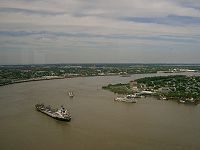 Stems from the Commerce clause of the U.S. Constitution and U.S. Supreme Court decisions. the Corps mission is considered to have begun in 1824 when funds were appropriated to clear snags from the Ohio
and Mississippi River
s. Specific Project Authorizations:
"). This Act authorized the Secretary of the Army to issue permits for the discharge of dredged and fill material.
Section 10 of the Rivers and Harbors Act of 1899
(codified in Chapter 33, Section 403 of the United States Code
) gave the Corps authority over navigable
waters of the United States. As navigable waters are defined as "navigable waters of the United States are those waters that are subject to the ebb and flow of the tide and/or are presently being used, or have been used in the past, or may be susceptible for use to transport interstate or foreign commerce", the Corps has broad authority to enforce this, including licensing of bridges over navigable waters, and the maintenance of pierhead and bulkhead line
s.
There are three types of permits issued by the Corps of Engineers: Nationwide, Regional General, and Individual. 80% of the permits issued are nationwide permits, which include several general types of activities, as published in the Federal Register. To gain authorization under a nationwide permit, an applicant usually needs only send a letter to the regional Corps office notifying them of his or her intent, type and amount of impact, and a site map. Although the nationwide process is fairly simple, Corps approval must be obtained before commencing with any work. Regional general permits are specific to each Corps division office. Individual permits are generally required for projects greater than 0.5 acres (2,023.4 m²) in size.
(AGC).
ERDC provides science, technology, and expertise in engineering and environmental sciences to support both military and civil/civilian customers. ERDC research support includes:
AGC coordinates, integrates, and synchronizes geospatial information requirements and standards across the Army and provides direct geospatial support and products to warfighters. See also Geospatial Information Officer
.
, is believed to have originated on an informal basis. In 1841, cadets at West Point wore insignia of this type. In 1902, the Castle was formally adopted by the Corps of Engineers as branch insignia. The "castle" is actually the Pershing Barracks at the United States Military Academy in West Point, New York
A current tradition was established with the "Gold Castles
" branch insignia of General of the Army Douglas MacArthur
, West Point Class of 1903, who served in the Corps of Engineers early in his career and had received the two pins as a graduation gift of his family. In 1945, near the conclusion of World War II, General MacArthur gave his personal pins to his Chief Engineer, General Leif J. Sverdrup
. On 2 May 1975, upon the 200th anniversary of the Corps, retired General Sverdrup, who had civil engineer
ing projects including the landmark 17 miles (27 km)-long Chesapeake Bay Bridge-Tunnel
to his credit, presented the Gold Castles to then-Chief of Engineers
Lieutenant General William C. Gribble, Jr.
, who had also served under General MacArthur in the Pacific. General Gribble then announced a tradition of passing the insignia along to future Chiefs of Engineers, and it has been done so since.
Public services
Public services is a term usually used to mean services provided by government to its citizens, either directly or by financing private provision of services. The term is associated with a social consensus that certain services should be available to all, regardless of income...
engineering, design and construction management
Construction management
Construction Project Management is the overall planning, coordination and control of a project from inception to completion aimed at meeting a client’s requirements in order to produce a functionally and financially viable project that will be complete mingement is project management that applies...
agency. Although generally associated with dams, canals and flood protection in the United States, USACE is involved in a wide range of public works
Public works
Public works are a broad category of projects, financed and constructed by the government, for recreational, employment, and health and safety uses in the greater community...
support to the nation and the Department of Defense
United States Department of Defense
The United States Department of Defense is the U.S...
throughout the world. The Corps of Engineers provides outdoor recreation opportunities to the public, and provides 24% of U.S. hydropower capacity.
The Corps' mission is to provide vital public engineering services in peace and war to strengthen the nation's security, energize the economy, and reduce risks from disasters.
Their most visible missions include:
- Planning, designing, building, and operating locksLock (water transport)A lock is a device for raising and lowering boats between stretches of water of different levels on river and canal waterways. The distinguishing feature of a lock is a fixed chamber in which the water level can be varied; whereas in a caisson lock, a boat lift, or on a canal inclined plane, it is...
and dams. Other civil engineeringCivil engineeringCivil engineering is a professional engineering discipline that deals with the design, construction, and maintenance of the physical and naturally built environment, including works like roads, bridges, canals, dams, and buildings...
projects include flood controlFlood controlIn communications, flood control is a feature of many communication protocols designed to prevent overwhelming of a destination receiver. Such controls can be implemented either in software or in hardware, and will often request that the message be resent after the receiver has finished...
, beach nourishmentBeach nourishmentBeach nourishment— also referred to as beach replenishment—describes a process by which sediment lost through longshore drift or erosion is replaced from sources outside of the eroding beach...
, and dredging for waterway navigation. - Design and construction of flood protection systems through various federal mandateCivil law (legal system)Civil law is a legal system inspired by Roman law and whose primary feature is that laws are codified into collections, as compared to common law systems that gives great precedential weight to common law on the principle that it is unfair to treat similar facts differently on different...
s (see Public Laws below). - Design and construction management of military facilities for the ArmyUnited States ArmyThe United States Army is the main branch of the United States Armed Forces responsible for land-based military operations. It is the largest and oldest established branch of the U.S. military, and is one of seven U.S. uniformed services...
, Air ForceUnited States Air ForceThe United States Air Force is the aerial warfare service branch of the United States Armed Forces and one of the American uniformed services. Initially part of the United States Army, the USAF was formed as a separate branch of the military on September 18, 1947 under the National Security Act of...
, Army ReserveUnited States Army ReserveThe United States Army Reserve is the federal reserve force of the United States Army. Together, the Army Reserve and the Army National Guard constitute the reserve components of the United States Army....
and Air Force Reserve and other Defense and Federal agencies. - Environmental regulation and ecosystemEcosystemAn ecosystem is a biological environment consisting of all the organisms living in a particular area, as well as all the nonliving , physical components of the environment with which the organisms interact, such as air, soil, water and sunlight....
restoration.
The Corps' vision is having a great engineering force of highly disciplined people working with partners through disciplined thought and action to deliver innovative and sustainable solutions to the nation's engineering challenges.
Warfighting
USACE provides support directly and indirectly to the warfighting effort. They build and help maintain much of the infrastructureInfrastructure
Infrastructure is basic physical and organizational structures needed for the operation of a society or enterprise, or the services and facilities necessary for an economy to function...
that the Army and the Air Force use to train, house, and deploy troops
Troop
A troop is a military unit, originally a small force of cavalry, subordinate to a squadron and headed by the troop leader. In many armies a troop is the equivalent unit to the infantry section or platoon...
. USACE built and maintained navigation
Navigation
Navigation is the process of monitoring and controlling the movement of a craft or vehicle from one place to another. It is also the term of art used for the specialized knowledge used by navigators to perform navigation tasks...
systems and ports provide the means to deploy
Military deployment
Military deployment is the movement of armed forces and their logistical support infrastructure around the world.-United States:The United States Military defines the term as follows:...
vital equipment and other material. Corps Research and Development (R&D) facilities help develop new methods and measures for deployment, force protection, terrain analysis, mapping, and other support.
USACE directly supports the military in the battlezone
Battlezone
Battlezone is an arcade game from Atari released in 1980. It displays a wireframe view on a horizontal black and white vector monitor...
, making expertise available to commander
Commander
Commander is a naval rank which is also sometimes used as a military title depending on the individual customs of a given military service. Commander is also used as a rank or title in some organizations outside of the armed forces, particularly in police and law enforcement.-Commander as a naval...
s to help solve and avoid engineering and other problems. Forward Engineer Support Teams, FEST-A's or FEST-M's, may accompany combat engineers to provide immediate support, or to reach back electronically into the rest of the Corps for the necessary expertise. A FEST-A team is an 8 person detachment while a FEST-M is approximately 36 individuals. These teams are designed to provide immediate technical engineering support to the warfighter or in a disaster area. Corps professionals use the knowledge and skills honed on both military and civil projects to support the U.S. and local communities in the areas of real estate, contracting, mapping, construction, logistics, engineering, and management experience. This work currently includes support for rebuilding Iraq
Iraq
Iraq ; officially the Republic of Iraq is a country in Western Asia spanning most of the northwestern end of the Zagros mountain range, the eastern part of the Syrian Desert and the northern part of the Arabian Desert....
, establishing Afghanistan
Afghanistan
Afghanistan , officially the Islamic Republic of Afghanistan, is a landlocked country located in the centre of Asia, forming South Asia, Central Asia and the Middle East. With a population of about 29 million, it has an area of , making it the 42nd most populous and 41st largest nation in the world...
infrastructure, and supporting international and interagency services.
In addition, the work of almost 26,000 civilians on civil works programs throughout USACE provide a training ground for similar capabilities worldwide. USACE civilians volunteer for assignments worldwide. For example, hydropower
Hydropower
Hydropower, hydraulic power, hydrokinetic power or water power is power that is derived from the force or energy of falling water, which may be harnessed for useful purposes. Since ancient times, hydropower has been used for irrigation and the operation of various mechanical devices, such as...
experts have helped repair, renovate, and run hydropower dams in Iraq in an effort to help get Iraqis to become self-sustaining.
Homeland security
USACE supports the United States' Department of Homeland Security and the Federal Emergency Management AgencyFederal Emergency Management Agency
The Federal Emergency Management Agency is an agency of the United States Department of Homeland Security, initially created by Presidential Reorganization Plan No. 1 of 1978 and implemented by two Executive Orders...
(FEMA) through its security planning, force protection, research and development, disaster
Disaster
A disaster is a natural or man-made hazard that has come to fruition, resulting in an event of substantial extent causing significant physical damage or destruction, loss of life, or drastic change to the environment...
preparedness efforts, and quick response to emergencies and disasters.
The Corps conducts its emergency response activities under two basic authorities — the Flood Control and Coastal Emergency Act , and the Stafford Disaster Relief and Emergency Assistance Act
Stafford Disaster Relief and Emergency Assistance Act
The Robert T. Stafford Disaster Relief and Emergency Assistance Act is a United States federal law designed to bring an orderly and systemic means of federal natural disaster assistance for state and local governments in carrying out their responsibilities to aid citizens...
. In a typical year, the Corps of Engineers responds to more than 30 Presidential disaster declarations, plus numerous state and local emergencies. Emergency responses usually involve cooperation with other military elements and Federal agencies in support of State and local efforts.
Infrastructure support
Work comprises engineering and management support to military installations, global real estate support, civil works support (including risk and priorities), operations and maintenance of Federal navigation and flood control projects, and monitoring of dams and levees.More than 67 percent of the goods consumed by Americans and more than half of the nation's oil imports are processed through deepwater ports maintained by the Corps of Engineers, which maintains more than 12000 miles (19,312.1 km) of commercially navigable channels across the U.S.
In both its Civil Works mission and Military Construction program, the Corps is responsible for billions of dollars of the nation's infrastructure. For example, the Corps maintains direct control of 609 dams, maintains and/or operates 257 navigation locks, and operates 75 hydroelectric facilities generating 24% of the nation's hydropower and three percent of its total electricity. USACE inspects over 2,000 Federal and non-Federal levees every two years.
Four billion gallons of water per day are drawn from the Corps' 136 multi-use water supply
Water supply
Water supply is the provision of water by public utilities, commercial organisations, community endeavours or by individuals, usually via a system of pumps and pipes...
projects comprising 9800000 acre.ft of water storage, making it one of the United States' largest water supply agencies.
The 249th Engineer Battalion (Prime Power), the only active duty unit in USACE, generates and distributes prime electrical power in support of warfighting, disaster relief, stability and support operations as well as provides advice and technical assistance in all aspects of electrical power and distribution systems. The battalion deployed in support of recovery operations after 9/11 and was instrumental in getting Wall Street back up and running within a week. The battalion also deployed in support of post-Katrina operations.
All of this work represents a significant investment in the nation's resources.
Water resources
Through its Civil Works program, USACE carries out a wide array of projects that provide coastal protection, flood protection, hydropower, navigable waters and ports, recreational opportunities, and water supply. Work includes coastal protection and restoration, including a new emphasis on a more holisticHolism
Holism is the idea that all the properties of a given system cannot be determined or explained by its component parts alone...
approach to risk management. As part of this work, the Corps is the number one provider of outdoor recreation in the U.S., so there is a significant emphasis on water safety.
Army involvement in works "of a civil nature," including water resources, goes back almost to the origins of the U.S. Over the years, as the nation's needs have changed, so have the Army's Civil Works missions.
Major areas of emphasis include the following:
- Navigation. Supporting navigation by maintaining and improving channels was the Corps of Engineers' earliest Civil Works mission, dating to Federal lawFederal lawFederal law is the body of law created by the federal government of a country. A federal government is formed when a group of political units, such as states or provinces join together in a federation, surrendering their individual sovereignty and many powers to the central government while...
s in 1824 authorizing the Corps to improve safety on the Ohio and Mississippi Rivers and several ports. Today, the Corps maintains more than 12000 miles (19,312.1 km) of inland waterways and operates 235 locks. These waterways—a system of rivers, lakes and coastal bays improved for commercial and recreational transportation—carry about 1/6 of the nation's inter-city freight, at a cost per ton-mile about 1/2 that of rail or 1/10 that of trucks. USACE also maintains 300 commercial harbors, through which pass 2000000000 short ton of cargo a year, and more than 600 smaller harbors.
- Flood Risk Management. The Corps was first called upon to address flood problems along the Mississippi river in the mid-19th century. They began work on the Mississippi River and Tributaries Flood Control Project in 1928, and the Flood Control Act of 1936Flood Control Act of 1936The Flood Control Act of 1936, , was an Act of the United States Congress signed into law by President Franklin Delano Roosevelt on 22 June 1936. It authorized civil engineering projects such as dams, levees, dikes, and other flood control measures through the United States Army Corps of...
gave the Corps the mission to provide flood protection to the entire country.
- Recreation. The Corps of Engineers is the nation's largest provider of outdoor recreation, operating more than 2,500 recreation areas at 463 projects (mostly lakes) and leasing an additional 1,800 sites to state or local park and recreation authorities or private interests. The Corps hosts about 360 million visits a year at its lakes, beaches and other areas, and estimates that 25 million Americans (one in ten) visit a Corps project at least once a year. Supporting visitors to these recreation areas generates 600,000 jobs.
- Hydroelectric Power. The Corps was first authorized to build hydroelectric plants in the 1920s, and today operates 75 power plants, producing one fourth of the nation's hydro-electric power—or three percent of its total electric energy. This makes USACE the fifth largest electric supplier in the United States.
- Shore Protection. With a large proportion of the U.S. population living near our sea and lake shores, and an estimated 75% of U.S. vacations being spent at the beach, there has been Federal interest — and a Corps of Engineers mission — in protecting these areas from hurricane and coastal storm damage.
- Dam Safety. The Corps of Engineers develops engineering criteria for safe dams, and conducts an active inspection program of its own dams.
- Water Supply. The Corps first got involved in water supply in the 1850s, when they built the Washington AqueductWashington AqueductThe Washington Aqueduct is an aqueduct that provides the public water supply system serving Washington, D.C., and parts of its suburbs. One of the first major aqueduct projects in the United States, the Aqueduct was commissioned by Congress in 1852, and construction began in 1853 under the...
. Today USACE reservoirs supply water to nearly 10 million people in 115 cities. In the drier parts of the Nation, water from Corps reservoirs is also used for agriculture.
Environment
The U.S. Army Corps of Engineers environmental mission has two major focus areas: restoration and stewardshipStewardship
Stewardship is an ethic that embodies responsible planning and management of resources. The concept of stewardship has been applied in diverse realms, including with respect to environment, economics, health, property, information, and religion, and is linked to the concept of sustainability...
. The Corps supports and manages numerous environmental programs, that run the gamut from cleaning up areas on former military installations contaminated by hazardous waste
Hazardous waste
A hazardous waste is waste that poses substantial or potential threats to public health or the environment. According to the U.S. environmental laws hazardous wastes fall into two major categories: characteristic wastes and listed wastes.Characteristic hazardous wastes are materials that are known...
or munitions to helping establish/reestablish wetlands that helps endangered species
Endangered species
An endangered species is a population of organisms which is at risk of becoming extinct because it is either few in numbers, or threatened by changing environmental or predation parameters...
survive. Some of these programs include Ecosystem Restoration, Formerly Used Defense Sites, Environmental Stewardship, EPA Superfund
Superfund
Superfund is the common name for the Comprehensive Environmental Response, Compensation, and Liability Act of 1980 , a United States federal law designed to clean up sites contaminated with hazardous substances...
, Abandoned Mine Lands, Formerly Utilized Sites Remedial Action Program, Base Realignment and Closure, 2005
Base Realignment and Closure, 2005
The preliminary 2005 Base Realignment and Closure list was released by the United States Department of Defense on May 13, 2005. It is the fifth Base Realignment and Closure proposal generated since the process was created in 1988. It recommends closing 33 major United States military bases and...
, and Regulatory.
This mission includes education as well as regulation and cleanup.
The U.S. Army Corps of Engineers has an active environmental program under both its Military and Civil Programs.
The Civil Works environmental mission that ensures all Corps projects, facilities and associated lands meet environmental standards. The program has four functions: compliance, restoration, prevention, and conservation. The Corps also regulates all work in wetlands and waters of the United States.
The Military Programs Environmental Program manages design and execution of a full range of cleanup and protection activities:
- cleans up sites contaminated with hazardous waste, radioactive waste, or ordnance
- complies with federal, state, and local environmental laws and regulations
- strives to minimize our use of hazardous materials
- conserves our natural and cultural resources
The following are major areas of environmental emphasis:
- Wetlands and Waterways Regulation and Permitting
- Ecosystem Restoration
- Environmental Stewardship
- Radioactive site cleanup through the Formerly Used Sites Remedial Action Program (FUSRAPFUSRAPThe Formerly Utilized Sites Remedial Action Program is a United States Army Corps of Engineers project to manage and cleanup environmental contamination that resulted from early United States Atomic Energy Commission activities...
) - Base Realignment and ClosureBase Realignment and ClosureBase Realignment and Closure is a process of the United States federal government directed at the administration and operation of the Armed Forces, used by the United States Department of Defense and Congress to close excess military installations and realign the total asset inventory to reduce...
(BRAC) - Formerly Used Defense Sites (FUDS)
- Support to EPA's Superfund Program
See also Environmental Enforcement below.
Early history
The history of United States Army Corps of Engineers can be traced back to 16 June 1775, when the Continental CongressContinental Congress
The Continental Congress was a convention of delegates called together from the Thirteen Colonies that became the governing body of the United States during the American Revolution....
organized an army with a chief engineer and two assistants. Colonel
Colonel
Colonel , abbreviated Col or COL, is a military rank of a senior commissioned officer. It or a corresponding rank exists in most armies and in many air forces; the naval equivalent rank is generally "Captain". It is also used in some police forces and other paramilitary rank structures...
Richard Gridley
Richard Gridley
Richard Gridley was born in Boston, Massachusetts. He was the son of Richard Gridley and Rebecca Scarborough. He was a soldier and engineer who served for the British Army during the French and Indian Wars and for the Continental Army during the American Revolutionary War.He married Hannah Deming...
became General George Washington
George Washington
George Washington was the dominant military and political leader of the new United States of America from 1775 to 1799. He led the American victory over Great Britain in the American Revolutionary War as commander-in-chief of the Continental Army from 1775 to 1783, and presided over the writing of...
's first chief engineer
Chief of Engineers
The Chief of Engineers commands the US Army Corps of Engineers. As a staff officer at The Pentagon, the Chief advises the Army on engineering matters and serves as the Army's topographer and the proponent for real estate and other related engineering programs....
; however, it was not until 1779 that Congress created a separate Corps of Engineers. One of its first tasks was to build fortifications near Boston
Boston
Boston is the capital of and largest city in Massachusetts, and is one of the oldest cities in the United States. The largest city in New England, Boston is regarded as the unofficial "Capital of New England" for its economic and cultural impact on the entire New England region. The city proper had...
at Bunker Hill
Battle of Bunker Hill
The Battle of Bunker Hill took place on June 17, 1775, mostly on and around Breed's Hill, during the Siege of Boston early in the American Revolutionary War...
. The first Corps was mostly composed of French subjects, who had been hired by General Washington from the service of Louis XVI
Louis XVI of France
Louis XVI was a Bourbon monarch who ruled as King of France and Navarre until 1791, and then as King of the French from 1791 to 1792, before being executed in 1793....
.
The Corps of Engineers as it is known today came into being on 16 March 1802, when President Thomas Jefferson
Thomas Jefferson
Thomas Jefferson was the principal author of the United States Declaration of Independence and the Statute of Virginia for Religious Freedom , the third President of the United States and founder of the University of Virginia...
was authorized to "organize and establish a Corps of Engineers ... that the said Corps ... shall be stationed at West Point
West Point, New York
West Point is a federal military reservation established by President of the United States Thomas Jefferson in 1802. It is a census-designated place located in Town of Highlands in Orange County, New York, United States. The population was 7,138 at the 2000 census...
in the State of New York and shall constitute a Military Academy." Until 1866, the superintendent of the United States Military Academy
United States Military Academy
The United States Military Academy at West Point is a four-year coeducational federal service academy located at West Point, New York. The academy sits on scenic high ground overlooking the Hudson River, north of New York City...
was always an engineer officer. During the first half of the 19th century, West Point was the major and, for a while, the only engineering school in the country. The Corps's authority over river works in the United States began with its fortification
Fortification
Fortifications are military constructions and buildings designed for defence in warfare and military bases. Humans have constructed defensive works for many thousands of years, in a variety of increasingly complex designs...
of New Orleans after the War of 1812
War of 1812
The War of 1812 was a military conflict fought between the forces of the United States of America and those of the British Empire. The Americans declared war in 1812 for several reasons, including trade restrictions because of Britain's ongoing war with France, impressment of American merchant...
.
Formerly Separate Units
The U.S. Army Corps of Topographical Engineers, was separately authorized on 4 July 1838, consisted only of officers, and was used for mapping and the design and construction of federal civil works and other coastal fortifications and navigational routes. It was merged with the Corps of Engineers on 31 March 1863, at which point the Corps of Engineers also assumed the Lakes Survey District mission for the Great LakesGreat Lakes
The Great Lakes are a collection of freshwater lakes located in northeastern North America, on the Canada – United States border. Consisting of Lakes Superior, Michigan, Huron, Erie, and Ontario, they form the largest group of freshwater lakes on Earth by total surface, coming in second by volume...
.
In 1841, Congress created the Lake Survey. The Survey, based in Detroit, Mich., was charged with conducting a hydrographical survey of the Northern and Northwestern Lakes and preparing and publishing nautical charts and other navigation aids. The Lake Survey published its first charts in 1852.
In the mid-19th century, Corps of Engineers' officers ran Lighthouse Districts
Lighthouse
A lighthouse is a tower, building, or other type of structure designed to emit light from a system of lamps and lenses or, in older times, from a fire, and used as an aid to navigation for maritime pilots at sea or on inland waterways....
in tandem with U.S. Naval officers.
Civil War
The Army Corps of Engineers played an instrumental role in the American Civil War. Many of the men who would serve in the top leadership in this institution were West Point graduates, who rose to military fame and power during the Civil War. Some of these men were UnionUnion Army
The Union Army was the land force that fought for the Union during the American Civil War. It was also known as the Federal Army, the U.S. Army, the Northern Army and the National Army...
Generals George McClellan
George B. McClellan
George Brinton McClellan was a major general during the American Civil War. He organized the famous Army of the Potomac and served briefly as the general-in-chief of the Union Army. Early in the war, McClellan played an important role in raising a well-trained and organized army for the Union...
, Henry Halleck, George Meade
George Meade
George Gordon Meade was a career United States Army officer and civil engineer involved in coastal construction, including several lighthouses. He fought with distinction in the Second Seminole War and Mexican-American War. During the American Civil War he served as a Union general, rising from...
, and Confederate generals Robert E. Lee
Robert E. Lee
Robert Edward Lee was a career military officer who is best known for having commanded the Confederate Army of Northern Virginia in the American Civil War....
, Joseph Johnston
Joseph E. Johnston
Joseph Eggleston Johnston was a career U.S. Army officer, serving with distinction in the Mexican-American War and Seminole Wars, and was also one of the most senior general officers in the Confederate States Army during the American Civil War...
, and P.G.T. Beauregard. The versatility of officers in the Army Corps of Engineers contributed to the success of numerous missions throughout the Civil War. They were responsible for building pontoon and railroad bridges, forts and batteries, the destruction of enemy supply lines, and the construction of roads. The Union forces were not the only ones to employ the use of engineers throughout the war; and on 6 March 1861, once the South had seceded from the Union, among the different acts passed at the time, a provision was stated that called for the creation of a Confederate Corps of Engineers.
The progression of the war demonstrated the South's disadvantage in engineering expertise; because of the initial 65 cadets who resigned from West Point to accept positions with the Confederate Army, only seven were placed in the Corps of Engineers. To overcome this obstacle, the Confederate Congress passed legislation that gave a company of engineers to every division in the field; and by 1865, they actually had more engineer officers serving in the field of action than the Union Army. The Army Corps of Engineers served as a main function in making the war effort logistically feasible. One of the main projects for the Army Corps of Engineers was constructing railroads and bridges, which Union forces took advantage of because railroads and bridges provided access to resources and industry. One area where the Confederate engineers were able to outperform the North was in the ability to build fortifications that were used both offensively and defensively along with trenches that made them harder to penetrate. This method of building trenches was known as the zigzag pattern.
20th century
From the beginning, many politicians wanted the Corps to contribute to both military construction and works of a civil nature. Assigned the military construction mission on 1 December 1941 after the Quartermaster Department struggled with the expanding mission, the Corps built facilities at home and abroad to support the U.S. Army and Air Force. During World War II the mission grew to more than 27,000 military and industrial projects in a $15.3 billion mobilization program. Included were aircraft, tank assembly, and ammunition plants, camps for 5.3 million soldiers, depots, ports, and hospitals, as well as the Manhattan ProjectManhattan Project
The Manhattan Project was a research and development program, led by the United States with participation from the United Kingdom and Canada, that produced the first atomic bomb during World War II. From 1942 to 1946, the project was under the direction of Major General Leslie Groves of the US Army...
, and the Pentagon
The Pentagon
The Pentagon is the headquarters of the United States Department of Defense, located in Arlington County, Virginia. As a symbol of the U.S. military, "the Pentagon" is often used metonymically to refer to the Department of Defense rather than the building itself.Designed by the American architect...
.
In civilian projects, the Corps became the lead federal flood control agency and significantly expanded its civil works activities, becoming among other things, a major provider of hydroelectric energy and the country's leading provider of recreation; its role in responding to natural disasters also grew dramatically. In the late 1960s, the Corps became a leading environmental preservation and restoration agency.
In 1944, specially-trained army combat engineers were assigned to blow up underwater obstacles and clear defended ports during the invasion of Normandy. During World War II, the Army Corps of Engineers in the European Theater of Operations
European Theater of Operations
The European Theater of Operations, United States Army was a United States Army formation which directed U.S. Army operations in parts of Europe from 1942 to 1945. It referred to Army Ground Forces, United States Army Air Forces, and Army Service Forces operations north of Italy and the...
was responsible for building countless bridges and building or maintaining roads vital to the Allied advance across Europe into the heart of Germany. In the Pacific theater, the Pioneer troops were formed, a hand-selected unit of volunteer Army combat engineers trained in jungle warfare, knife fighting, and unarmed jujitsu (hand-to-hand combat) techniques. Working in camouflage, the Pioneers cleared jungle and prepared routes of advance and established bridgeheads for the infantry as well as demolishing enemy installations.
Five commanding general
Commanding General of the United States Army
Prior to the institution of the Chief of Staff of the United States Army in 1903, there was generally a single senior-most officer in the army. From 1783, he was known simply as the Senior Officer of the United States Army, but in 1821, the title was changed to Commanding General of the United...
Chiefs of Staff (after the 1903 reorganization) of the United States Army
United States Army
The United States Army is the main branch of the United States Armed Forces responsible for land-based military operations. It is the largest and oldest established branch of the U.S. military, and is one of seven U.S. uniformed services...
held Engineer commissions early in their careers. All transferred to other branches before rising to the top. They were Alexander Macomb, George B. McClellan
George B. McClellan
George Brinton McClellan was a major general during the American Civil War. He organized the famous Army of the Potomac and served briefly as the general-in-chief of the Union Army. Early in the war, McClellan played an important role in raising a well-trained and organized army for the Union...
, Henry W. Halleck, Douglas MacArthur
Douglas MacArthur
General of the Army Douglas MacArthur was an American general and field marshal of the Philippine Army. He was a Chief of Staff of the United States Army during the 1930s and played a prominent role in the Pacific theater during World War II. He received the Medal of Honor for his service in the...
, and Maxwell D. Taylor
Maxwell D. Taylor
General Maxwell Davenport "Max" Taylor was an United States Army four star general and diplomat of the mid-20th century, who served as the fifth Chairman of the Joint Chiefs of Staff after having been appointed by the President of the United States John F...
.
Notable dates and projects
- Breed's HillBreed's HillBreed's Hill is a glacial drumlin located in the Charlestown section of Boston, Massachusetts. It is best known as the location where in 1775, early in the American Revolutionary War, most of the fighting in the Battle of Bunker Hill took place...
- The General Survey ActGeneral Survey ActThe General Survey Act was a law passed by the United States Congress in April 1824, which authorized the president to have surveys made of routes for transport roads and canals "of national importance, in a commercial or military point of view, or necessary for the transportation of public mail." ...
of 1824 authorized use of Army engineers to survey roads and canals. The next month, an act to improve navigation on the Ohio and Mississippi rivers initiated the Corps' permanent civil works construction mission. Although the 1824 act to improve the Mississippi and Ohio rivers is often called the first rivers and harbors legislationRivers and Harbors ActRivers and Harbors Act may refer to one of many pieces of legislation and appropriations passed by the United States Congress since the first such legislation in 1824. At that time congress appropriated $75,000 to improve navigation on the Ohio and Mississippi rivers by removing sandbars, snags,...
, the act passed in 1826 was the first to combine authorizations for both surveys and projects, thereby establishing a pattern that continues to the present day. - Survey and construction of the National RoadNational RoadThe National Road or Cumberland Road was the first major improved highway in the United States to be built by the federal government. Construction began heading west in 1811 at Cumberland, Maryland, on the Potomac River. It crossed the Allegheny Mountains and southwestern Pennsylvania, reaching...
until Federal funds were withdrawn (1838) - The 555 foot tall Washington MonumentWashington MonumentThe Washington Monument is an obelisk near the west end of the National Mall in Washington, D.C., built to commemorate the first U.S. president, General George Washington...
, completed under the direction and command of Lieutenant Colonel Thomas Lincoln CaseyThomas Lincoln CaseyThomas Lincoln Casey, Sr. was a soldier and engineer.-Biography:Casey was born in Sackets Harbor, New York...
, 1884 - Panama CanalPanama CanalThe Panama Canal is a ship canal in Panama that joins the Atlantic Ocean and the Pacific Ocean and is a key conduit for international maritime trade. Built from 1904 to 1914, the canal has seen annual traffic rise from about 1,000 ships early on to 14,702 vessels measuring a total of 309.6...
, completed under supervision of Army Engineer officers, 1914 - Bonneville DamBonneville DamBonneville Lock and Dam consists of several run-of-the-river dam structures that together complete a span of the Columbia River between the U.S. states of Oregon and Washington at River Mile 146.1. The dam is located east of Portland, Oregon, in the Columbia River Gorge. The primary functions of...
, completed in 1937. - Flood Control Act of 1936Flood Control Act of 1936The Flood Control Act of 1936, , was an Act of the United States Congress signed into law by President Franklin Delano Roosevelt on 22 June 1936. It authorized civil engineering projects such as dams, levees, dikes, and other flood control measures through the United States Army Corps of...
made flood control a Federal policy and officially recognized the Corps as the major Federal flood control agency - USACE took over all real estate acquisition, construction, and maintenance for Army facilities, 1941
- Planning and construction of The PentagonThe PentagonThe Pentagon is the headquarters of the United States Department of Defense, located in Arlington County, Virginia. As a symbol of the U.S. military, "the Pentagon" is often used metonymically to refer to the Department of Defense rather than the building itself.Designed by the American architect...
, completed in 1943 just 15 months after groundbreaking - The Manhattan ProjectManhattan ProjectThe Manhattan Project was a research and development program, led by the United States with participation from the United Kingdom and Canada, that produced the first atomic bomb during World War II. From 1942 to 1946, the project was under the direction of Major General Leslie Groves of the US Army...
- Corps began construction support for NASANASAThe National Aeronautics and Space Administration is the agency of the United States government that is responsible for the nation's civilian space program and for aeronautics and aerospace research...
leading to major activities at the Manned Spacecraft Center and John F. Kennedy Space Center, 1961 - The Water Resources Development Act of 1986Water Resources Development Act of 1986The Water Resources Development Act of 1986 is part of , a series of acts enacted by Congress of the United States on November 17, 1986....
(WRDA 86) brought major change in financing by requiring non federal contributions toward most Federal water resource projects - Comprehensive Everglades Restoration PlanComprehensive Everglades Restoration PlanThe Central and Southern Florida Project, which was first authorized by Congress in 1948, is a multi-purpose project that provides flood control, water supply for municipal, industrial, and agricultural uses, prevention of saltwater intrusion, water supply for Everglades National Park, and...
- Cross Florida Barge CanalCross Florida Barge CanalThe Cross Florida Barge Canal was a canal project to connect the Gulf of Mexico and the Atlantic Ocean across Florida for barge traffic. Two sections were built but the project was cancelled, mainly for environmental reasons. It is now a protected green belt corridor, one mile wide...
- Tennessee-Tombigbee WaterwayTennessee-Tombigbee WaterwayThe Tennessee–Tombigbee Waterway is a 234-mile man-made, artificial waterway that extends from the Tennessee River to the junction of the Black Warrior-Tombigbee River system near Demopolis, Alabama, United States. The Tenneessee-Tombigbee Waterway links commercial navigation from the nation’s...
Occasional civil disasters including the Great Mississippi Flood of 1927
Great Mississippi Flood of 1927
The Great Mississippi Flood of 1927 was the most destructive river flood in the history of the United States.-Events:The flood began when heavy rains pounded the central basin of the Mississippi in the summer of 1926. By September, the Mississippi's tributaries in Kansas and Iowa were swollen to...
resulted in greater responsibilities for the Corps. New Orleans is another example of this.
Leadership
The current Acting Chief of EngineersChief of Engineers
The Chief of Engineers commands the US Army Corps of Engineers. As a staff officer at The Pentagon, the Chief advises the Army on engineering matters and serves as the Army's topographer and the proponent for real estate and other related engineering programs....
and Acting Commanding General, U.S. Army Corps of Engineers is Major General Merdith W.B. (Bo) Temple. He also remains the Deputy Commanding General.
Four Deputy Commanding Generals assist in supervising General Staff activities and in discharging the responsibilities which devolve upon the Commanding General. The current Deputies are:
- Major General Merdith W.B. (Bo) Temple, Deputy Commanding General.
- Major General Michael R. Eyre, Deputy Commanding General for Mobilization and Reserve Affairs (Individual Mobilization Augmentee)
- Major General William T. Grisoli, Deputy Commanding General for Civil and Emergency Operations
- Major General Jeffrey J. Dorko, Deputy Commanding General for Military and International Operations
Headquarters
The Headquarters group defines policy and guidance and plans direction for the organizations within the Corps. It is made up of an Executive Office and 17 Staff Principals. Located in Washington, DC, the Headquarters creates policy and plans the future direction of all other Corps organizations.USACE has two directors who head up Military Programs and Civil Works.
- Robert E. Slockbower, Director of Military Programs
- Steven L. Stockton, Director of Civil Works
The current USACE Command Sergeant Major is Micheal L. Buxbaum.
Divisions and districts
The U.S. Army Corps of Engineers is organized geographically into eight permanent divisions, one provisional division, one provisional district, and one research command reporting directly to the HQ. Within each division, there are several districts. Districts are defined by watershedDrainage basin
A drainage basin is an extent or an area of land where surface water from rain and melting snow or ice converges to a single point, usually the exit of the basin, where the waters join another waterbody, such as a river, lake, reservoir, estuary, wetland, sea, or ocean...
boundaries for civil works projects and by political boundaries for military projects.
- Great Lakes and Ohio River Division (LRD), located in Cincinnati. Stretches from the St Lawrence Seaway, across the Great LakesGreat LakesThe Great Lakes are a collection of freshwater lakes located in northeastern North America, on the Canada – United States border. Consisting of Lakes Superior, Michigan, Huron, Erie, and Ontario, they form the largest group of freshwater lakes on Earth by total surface, coming in second by volume...
, down the Ohio River Valley to the TennesseeTennessee RiverThe Tennessee River is the largest tributary of the Ohio River. It is approximately 652 miles long and is located in the southeastern United States in the Tennessee Valley. The river was once popularly known as the Cherokee River, among other names...
and CumberlandCumberland RiverThe Cumberland River is a waterway in the Southern United States. It is long. It starts in Harlan County in far southeastern Kentucky between Pine and Cumberland mountains, flows through southern Kentucky, crosses into northern Tennessee, and then curves back up into western Kentucky before...
rivers. Covers 355300 square miles (920,222.8 km²), parts of 17 states. Serves 56 million people. Its seven districts are located in BuffaloBuffalo, New YorkBuffalo is the second most populous city in the state of New York, after New York City. Located in Western New York on the eastern shores of Lake Erie and at the head of the Niagara River across from Fort Erie, Ontario, Buffalo is the seat of Erie County and the principal city of the...
, ChicagoChicagoChicago is the largest city in the US state of Illinois. With nearly 2.7 million residents, it is the most populous city in the Midwestern United States and the third most populous in the US, after New York City and Los Angeles...
, Detroit, LouisvilleLouisville, KentuckyLouisville is the largest city in the U.S. state of Kentucky, and the county seat of Jefferson County. Since 2003, the city's borders have been coterminous with those of the county because of a city-county merger. The city's population at the 2010 census was 741,096...
, NashvilleNashville, TennesseeNashville is the capital of the U.S. state of Tennessee and the county seat of Davidson County. It is located on the Cumberland River in Davidson County, in the north-central part of the state. The city is a center for the health care, publishing, banking and transportation industries, and is home...
, Pittsburgh, and Huntington, West VirginiaHuntington, West VirginiaHuntington is a city in Cabell and Wayne counties in the U.S. state of West Virginia, along the Ohio River. Most of the city is in Cabell County, for which it is the county seat. A small portion of the city, mainly the neighborhood of Westmoreland, is in Wayne County. Its population was 49,138 at...
. The division commander serves on two national and international decision-making bodies: co-chair of the Lake Superior, Niagara, and Ontario/St Lawrence Seaway boards of control; and the Mississippi River Commission. - Mississippi Valley DivisionMississippi Valley DivisionThe United States Army Corps of Engineers Mississippi Valley Division and the complementary Mississippi River Commission are responsible for maintaining the Mississippi River as a navigable waterway while preventing flooding. This includes the operation of harbor and lock and dam facilities up...
(MVD), located in Vicksburg, MississippiVicksburg, MississippiVicksburg is a city in Warren County, Mississippi, United States. It is the only city in Warren County. It is located northwest of New Orleans on the Mississippi and Yazoo rivers, and due west of Jackson, the state capital. In 1900, 14,834 people lived in Vicksburg; in 1910, 20,814; in 1920,...
. Stretches from Canada to the Gulf of MexicoGulf of MexicoThe Gulf of Mexico is a partially landlocked ocean basin largely surrounded by the North American continent and the island of Cuba. It is bounded on the northeast, north and northwest by the Gulf Coast of the United States, on the southwest and south by Mexico, and on the southeast by Cuba. In...
. Covers 370000 square miles (958,295.6 km²), and portions of 12 states bordering the Mississippi RiverMississippi RiverThe Mississippi River is the largest river system in North America. Flowing entirely in the United States, this river rises in western Minnesota and meanders slowly southwards for to the Mississippi River Delta at the Gulf of Mexico. With its many tributaries, the Mississippi's watershed drains...
. Serves 28 million people. Its six districts are located in St. Paul, MinnesotaSaint Paul, MinnesotaSaint Paul is the capital and second-most populous city of the U.S. state of Minnesota. The city lies mostly on the east bank of the Mississippi River in the area surrounding its point of confluence with the Minnesota River, and adjoins Minneapolis, the state's largest city...
, Rock Island, IllinoisRock Island, IllinoisRock Island is the county seat of Rock Island County, Illinois, United States. The population was 40,884 at the 2010 census. Located on the Mississippi River, it is one of the Quad Cities, along with neighboring Moline, East Moline, and the Iowa cities of Davenport and Bettendorf. The Quad Cities...
, St. LouisSt. Louis, MissouriSt. Louis is an independent city on the eastern border of Missouri, United States. With a population of 319,294, it was the 58th-largest U.S. city at the 2010 U.S. Census. The Greater St...
, MemphisMemphis, TennesseeMemphis is a city in the southwestern corner of the U.S. state of Tennessee, and the county seat of Shelby County. The city is located on the 4th Chickasaw Bluff, south of the confluence of the Wolf and Mississippi rivers....
, VicksburgVicksburg, MississippiVicksburg is a city in Warren County, Mississippi, United States. It is the only city in Warren County. It is located northwest of New Orleans on the Mississippi and Yazoo rivers, and due west of Jackson, the state capital. In 1900, 14,834 people lived in Vicksburg; in 1910, 20,814; in 1920,...
, and New Orleans. MVD serves as headquarters for the Mississippi River Commission. - North Atlantic DivisionNorth Atlantic DivisionThe North Atlantic Division of the U.S. Army Corps of Engineers is one of nine division offices within the Corps. Made up of roughly 3,900 employees in six districts and a Division headquarters, the North Atlantic Division is a major subordinate command and serves to integrate the capabilities of...
(NAD), headquartered at Fort HamiltonFort HamiltonHistoric Fort Hamilton is located in the southwestern corner of the New York City borough of Brooklyn surrounded by the communities of Bay Ridge, Dyker Heights, and Bensonhurst, and is one of several posts that are part of the region which is headquartered by the Military District of Washington...
in BrooklynBrooklynBrooklyn is the most populous of New York City's five boroughs, with nearly 2.6 million residents, and the second-largest in area. Since 1896, Brooklyn has had the same boundaries as Kings County, which is now the most populous county in New York State and the second-most densely populated...
, New York. Stretches from MaineMaineMaine is a state in the New England region of the northeastern United States, bordered by the Atlantic Ocean to the east and south, New Hampshire to the west, and the Canadian provinces of Quebec to the northwest and New Brunswick to the northeast. Maine is both the northernmost and easternmost...
to VirginiaVirginiaThe Commonwealth of Virginia , is a U.S. state on the Atlantic Coast of the Southern United States. Virginia is nicknamed the "Old Dominion" and sometimes the "Mother of Presidents" after the eight U.S. presidents born there...
, including the District of Columbia, with an overseas mission to provide engineering, construction, and project management service the U.S. European Command and U.S. Africa Command. Serves 62 million people. Its six districts are located in New York City, Philadelphia, BaltimoreBaltimoreBaltimore is the largest independent city in the United States and the largest city and cultural center of the US state of Maryland. The city is located in central Maryland along the tidal portion of the Patapsco River, an arm of the Chesapeake Bay. Baltimore is sometimes referred to as Baltimore...
, NorfolkNorfolk, VirginiaNorfolk is an independent city in the Commonwealth of Virginia in the United States. With a population of 242,803 as of the 2010 Census, it is Virginia's second-largest city behind neighboring Virginia Beach....
, Concord, MassachusettsConcord, MassachusettsConcord is a town in Middlesex County, Massachusetts, in the United States. As of the 2010 census, the town population was 17,668. Although a small town, Concord is noted for its leading roles in American history and literature.-History:...
, and WiesbadenWiesbadenWiesbaden is a city in southwest Germany and the capital of the federal state of Hesse. It has about 275,400 inhabitants, plus approximately 10,000 United States citizens...
, Germany. NAD has the largest SuperfundSuperfundSuperfund is the common name for the Comprehensive Environmental Response, Compensation, and Liability Act of 1980 , a United States federal law designed to clean up sites contaminated with hazardous substances...
program in the Corps with 60% of the funding. NAD's Europe DistrictU.S. Army Corps of Engineers, Europe DistrictFor over a quarter of a century, The U.S. Army Corps of Engineers Europe District, has provided both installation and contingency support to U.S. forces throughout the United States European Command area of responsibility...
has done work in dozens of countries and currently has offices in Germany, Belgium, ItalyItalyItaly , officially the Italian Republic languages]] under the European Charter for Regional or Minority Languages. In each of these, Italy's official name is as follows:;;;;;;;;), is a unitary parliamentary republic in South-Central Europe. To the north it borders France, Switzerland, Austria and...
, Turkey, GeorgiaGeorgia (country)Georgia is a sovereign state in the Caucasus region of Eurasia. Located at the crossroads of Western Asia and Eastern Europe, it is bounded to the west by the Black Sea, to the north by Russia, to the southwest by Turkey, to the south by Armenia, and to the southeast by Azerbaijan. The capital of...
, Romania, BulgariaBulgariaBulgaria , officially the Republic of Bulgaria , is a parliamentary democracy within a unitary constitutional republic in Southeast Europe. The country borders Romania to the north, Serbia and Macedonia to the west, Greece and Turkey to the south, as well as the Black Sea to the east...
, Israel, Spain, and soon BotswanaBotswanaBotswana, officially the Republic of Botswana , is a landlocked country located in Southern Africa. The citizens are referred to as "Batswana" . Formerly the British protectorate of Bechuanaland, Botswana adopted its new name after becoming independent within the Commonwealth on 30 September 1966...
. - Northwestern Division (NWD), located in Portland, OregonPortland, OregonPortland is a city located in the Pacific Northwest, near the confluence of the Willamette and Columbia rivers in the U.S. state of Oregon. As of the 2010 Census, it had a population of 583,776, making it the 29th most populous city in the United States...
. Stretches from Canada to California, and from the Pacific Ocean to MissouriMissouriMissouri is a US state located in the Midwestern United States, bordered by Iowa, Illinois, Kentucky, Tennessee, Arkansas, Oklahoma, Kansas and Nebraska. With a 2010 population of 5,988,927, Missouri is the 18th most populous state in the nation and the fifth most populous in the Midwest. It...
. Covers nearly 1000000 square miles (2,589,988.1 km²) square miles in all or parts of 14 states. Its five districts are located in OmahaOmaha, NebraskaOmaha is the largest city in the state of Nebraska, United States, and is the county seat of Douglas County. It is located in the Midwestern United States on the Missouri River, about 20 miles north of the mouth of the Platte River...
, PortlandPortland, OregonPortland is a city located in the Pacific Northwest, near the confluence of the Willamette and Columbia rivers in the U.S. state of Oregon. As of the 2010 Census, it had a population of 583,776, making it the 29th most populous city in the United States...
, Seattle, Kansas CityKansas City, MissouriKansas City, Missouri is the largest city in the U.S. state of Missouri and is the anchor city of the Kansas City Metropolitan Area, the second largest metropolitan area in Missouri. It encompasses in parts of Jackson, Clay, Cass, and Platte counties...
, and Walla WallaWalla Walla, WashingtonWalla Walla is the largest city in and the county seat of Walla Walla County, Washington, United States. The population was 31,731 at the 2010 census...
. NWD has 35% of the total Corps water storage capacity and 75% of the total Corps hydroelectric capacity. - Pacific Ocean Division (POD), located at Fort ShafterFort ShafterFort Shafter is in Honolulu CDP, City and County of Honolulu, Hawai‘i, extending up the interfluve between Kalihi and Moanalua valleys, as well as onto the coastal plain at Māpunapuna. Fort Shafter is the headquarters of the United States Army Pacific Command, the MACOM of U.S. Army forces in...
, Hawaii. Stretches from the Arctic CircleArctic CircleThe Arctic Circle is one of the five major circles of latitude that mark maps of the Earth. For Epoch 2011, it is the parallel of latitude that runs north of the Equator....
to American SamoaAmerican SamoaAmerican Samoa is an unincorporated territory of the United States located in the South Pacific Ocean, southeast of the sovereign state of Samoa...
below the equator and across the International Date LineInternational Date LineThe International Date Line is a generally north-south imaginary line on the surface of the Earth, passing through the middle of the Pacific Ocean, that designates the place where each calendar day begins...
out to MicronesiaMicronesiaMicronesia is a subregion of Oceania, comprising thousands of small islands in the western Pacific Ocean. It is distinct from Melanesia to the south, and Polynesia to the east. The Philippines lie to the west, and Indonesia to the southwest....
and into Asia. Its four districts are located in Japan; SeoulSeoulSeoul , officially the Seoul Special City, is the capital and largest metropolis of South Korea. A megacity with a population of over 10 million, it is the largest city proper in the OECD developed world...
, South Korea; Anchorage, AlaskaAnchorage, AlaskaAnchorage is a unified home rule municipality in the southcentral part of the U.S. state of Alaska. It is the northernmost major city in the United States...
; and Honolulu. Unlike other military work, POD designs and builds for all of the military services — Army, Navy, Air Force, Marines — in Japan, Korea, and Kwajalein Atoll. - South Atlantic Division (SAD), located in Atlanta. Stretches from North CarolinaNorth CarolinaNorth Carolina is a state located in the southeastern United States. The state borders South Carolina and Georgia to the south, Tennessee to the west and Virginia to the north. North Carolina contains 100 counties. Its capital is Raleigh, and its largest city is Charlotte...
to AlabamaAlabamaAlabama is a state located in the southeastern region of the United States. It is bordered by Tennessee to the north, Georgia to the east, Florida and the Gulf of Mexico to the south, and Mississippi to the west. Alabama ranks 30th in total land area and ranks second in the size of its inland...
as well as the CaribbeanCaribbeanThe Caribbean is a crescent-shaped group of islands more than 2,000 miles long separating the Gulf of Mexico and the Caribbean Sea, to the west and south, from the Atlantic Ocean, to the east and north...
, and CentralCentral AmericaCentral America is the central geographic region of the Americas. It is the southernmost, isthmian portion of the North American continent, which connects with South America on the southeast. When considered part of the unified continental model, it is considered a subcontinent...
and South America. Covers all or parts of six states. Its five districts are located in Wilmington, North CarolinaWilmington, North CarolinaWilmington is a port city in and is the county seat of New Hanover County, North Carolina, United States. The population is 106,476 according to the 2010 Census, making it the eighth most populous city in the state of North Carolina...
, Charleston, South CarolinaCharleston, South CarolinaCharleston is the second largest city in the U.S. state of South Carolina. It was made the county seat of Charleston County in 1901 when Charleston County was founded. The city's original name was Charles Towne in 1670, and it moved to its present location from a location on the west bank of the...
, SavannahSavannah, GeorgiaSavannah is the largest city and the county seat of Chatham County, in the U.S. state of Georgia. Established in 1733, the city of Savannah was the colonial capital of the Province of Georgia and later the first state capital of Georgia. Today Savannah is an industrial center and an important...
, JacksonvilleJacksonville, FloridaJacksonville is the largest city in the U.S. state of Florida in terms of both population and land area, and the largest city by area in the contiguous United States. It is the county seat of Duval County, with which the city government consolidated in 1968...
, and MobileMobile, AlabamaMobile is the third most populous city in the Southern US state of Alabama and is the county seat of Mobile County. It is located on the Mobile River and the central Gulf Coast of the United States. The population within the city limits was 195,111 during the 2010 census. It is the largest...
. One-third of the stateside Army and one-fifth of the stateside Air Force are located within the division boundaries. The largest single environmental restoration project in the world — the Everglades RestorationRestoration of the EvergladesThe restoration of the Everglades is an ongoing effort to remedy damage inflicted on the environment of southern Florida during the 20th century. It is the most expensive and comprehensive environmental repair attempt in history. The degradation of the Everglades became an issue in the United...
— is managed by SAD. - South Pacific DivisionSouth Pacific DivisionThe United States Army Corps of Engineers South Pacific Division is an Army organization providing civil works and military water resource services/infrastructure...
(SPD), located in San Francisco. Stretches from California to ColoradoColoradoColorado is a U.S. state that encompasses much of the Rocky Mountains as well as the northeastern portion of the Colorado Plateau and the western edge of the Great Plains...
and New MexicoNew MexicoNew Mexico is a state located in the southwest and western regions of the United States. New Mexico is also usually considered one of the Mountain States. With a population density of 16 per square mile, New Mexico is the sixth-most sparsely inhabited U.S...
. Covers all or parts of seven states. Its four districts are located in AlbuquerqueAlbuquerque, New MexicoAlbuquerque is the largest city in the state of New Mexico, United States. It is the county seat of Bernalillo County and is situated in the central part of the state, straddling the Rio Grande. The city population was 545,852 as of the 2010 Census and ranks as the 32nd-largest city in the U.S. As...
, Los Angeles, SacramentoSacramento, CaliforniaSacramento is the capital city of the U.S. state of California and the county seat of Sacramento County. It is located at the confluence of the Sacramento River and the American River in the northern portion of California's expansive Central Valley. With a population of 466,488 at the 2010 census,...
, and San Francisco. Its region is host to 18 of the 25 fastest-growing metropolitan areas in the nation. - Southwestern DivisionSouthwestern DivisionThe United States Army Corps of Engineers Southwestern Division is an Army organization providing civil works and military water resource services/infrastructure. It also supports economically viable and environmentally sustainable watershed management and water resources development in Texas,...
(SWD), located in Dallas. Stretches from MexicoMexicoThe United Mexican States , commonly known as Mexico , is a federal constitutional republic in North America. It is bordered on the north by the United States; on the south and west by the Pacific Ocean; on the southeast by Guatemala, Belize, and the Caribbean Sea; and on the east by the Gulf of...
to KansasKansasKansas is a US state located in the Midwestern United States. It is named after the Kansas River which flows through it, which in turn was named after the Kansa Native American tribe, which inhabited the area. The tribe's name is often said to mean "people of the wind" or "people of the south...
. Covers all or part of seven states. Its four districts are located in Little RockLittle Rock, ArkansasLittle Rock is the capital and the largest city of the U.S. state of Arkansas. The Metropolitan Statistical Area had a population of 699,757 people in the 2010 census...
, TulsaTulsa, OklahomaTulsa is the second-largest city in the state of Oklahoma and 46th-largest city in the United States. With a population of 391,906 as of the 2010 census, it is the principal municipality of the Tulsa Metropolitan Area, a region with 937,478 residents in the MSA and 988,454 in the CSA. Tulsa's...
, GalvestonGalveston, TexasGalveston is a coastal city located on Galveston Island in the U.S. state of Texas. , the city had a total population of 47,743 within an area of...
, and Fort WorthFort Worth, TexasFort Worth is the 16th-largest city in the United States of America and the fifth-largest city in the state of Texas. Located in North Central Texas, just southeast of the Texas Panhandle, the city is a cultural gateway into the American West and covers nearly in Tarrant, Parker, Denton, and...
. SWD's recreation areas are the most visited in the Corps with more than 11400 miles (18,346.5 km) of shoreline and 1,172 recreation sites. - Transatlantic Division (TAD), located in Winchester, VirginiaWinchester, VirginiaWinchester is an independent city located in the northwestern portion of the Commonwealth of Virginia in the USA. The city's population was 26,203 according to the 2010 Census...
. Supports Federal programs and policies overseas. Consists of the Gulf Region District, the Afghanistan Engineer District South, the Afghanistan Engineer District North, the Middle East District, the USACE Deployment Center and the TAD G2 Intelligence Fusion Center. TAD oversees thousands of projects overseas. TAD overseas locations are staffed primarily by civilian volunteers from throughout USACE. The Corps of Engineers built much of the original Ring Road in the early 1960s and returned in 2002. Supports the full spectrum of regional support, including the Afghan National Security Forces, U.S. and Coalition Forces, Counter Narcotics and Border Management, Strategic Reconstruction support to USAID, and the Commander's Emergency Response ProgramCommander's Emergency Response ProgramCommander's Emergency Response Program or CERP is money for military commanders to use for conducting rebuilding and reconstruction during the Iraq and Afghanistan Wars. It was initially money seized during the invasion of Iraq, but later was also U.S...
.
Other USACE organizations
There are several other organizations within the Corps of Engineers:- Engineer Research and Development Center (ERDC) — the Corps of Engineers research and development command. ERDC comprises six laboratories. (see research below)
- U.S. Army Engineering and Support Center (CEHNC) — provides engineering and technical services, program and project management, construction management, and innovative contracting initiatives, for programs that are national or broad in scope or not normally provided by other Corps of Engineers elements
- Finance Center, U.S. Army Corps of Engineers (CEFC) — supports the operating finance and accounting functions throughout the Corps of Engineers
- Humphreys Engineer Center Support Activity (CEHEC) — provides administrative and operational support for Headquarters, U.S. Army Corps of Engineers and various field offices. It is home to the Army Geospatial CenterArmy Geospatial CenterThe Army Geospatial Center is a Major Subordinate Command of the United States Army Corps of Engineers. It is located in Alexandria, Virginia, within the adjacent to the Fort Belvoir military reservation...
. - Marine Design Center (CEMDC) — provides total project management including planning, engineering, and shipbuilding contract management in support of Corps, Army, and national water resource projects in peacetime, and augments the military construction capacity in time of national emergency or mobilization
- Institute for Water Resources (IWR) — supports the Civil Works Directorate and other Corps of Engineers commands by developing and applying new planning evaluation methods, polices and data in anticipation of changing water resources management conditions.
- USACE Logistics Activity (ULA)- Provides logistics support to the Corps including supply, maintenance, readiness, materiel, transportation, travel, aviation, facility management, integrated logistics supportIntegrated logistics supportIntegrated logistics support is an integrated approach to the management of logistic disciplines in the military, similar to commercial product support or customer service organisations...
, management controls, and strategic planning. - Enterprise Infrastructure Services (CEEIS) — designs information technology standards for the Corps, including automation, communications, management, visual information, printing, records management, and information assurance. CEEIS outsources the maintenance of its IT services, forming the Army Corps of Engineers Information Technology (ACE-IT). ACE-IT is made up of both civilian government employees and contractors.
- Deployable Tactical Operations System (DTOS) — provides mobile command and control platforms in support of the quick ramp-up of initial emergency response missions for the Corps. DTOS is a system designed to respond to District, Division, National, and International events.
- Until 2001 local Directorates of Engineering and Housing (DEH), being constituents of the USACE, had been responsible for the housing, infrastructure and related tasks as environmental protection, garbage removal and special fire departments or fire alarm coordination centers in the garrisons of the U.S. Army abroad as in Europe (e.g. Germany, as in Berlin, Wiesbaden, Karlsruhe etc.) Subsequently, a similar structure called DPWs (Directorates of Public Works), subordinate to the US Army Installation Command, assumed the tasks formerly done by the DEHs.
Directly reporting military units
- 249th Engineer Battalion (Prime Power) — generates and distributes prime electrical powerElectric powerElectric power is the rate at which electric energy is transferred by an electric circuit. The SI unit of power is the watt.-Circuits:Electric power, like mechanical power, is represented by the letter P in electrical equations...
in support of fighting wars, disaster relief, stability and support operations as well as provides advice and technical assistance in all aspects of electrical power and distribution systems. It also maintains Army power generation and distribution war reserves. - 911th Engineer Company — (formerly the MDW Engineer Company) provides specialized technical search and rescueSearch and rescueSearch and rescue is the search for and provision of aid to people who are in distress or imminent danger.The general field of search and rescue includes many specialty sub-fields, mostly based upon terrain considerations...
support for the Washington, D.C. metropolitan areaMetropolitan areaThe term metropolitan area refers to a region consisting of a densely populated urban core and its less-populated surrounding territories, sharing industry, infrastructure, and housing. A metropolitan area usually encompasses multiple jurisdictions and municipalities: neighborhoods, townships,...
; it is also a vital support member of the Joint Force Headquarters National Capital RegionJoint Force Headquarters National Capital RegionJoint Force Headquarters National Capital Region is directly responsible for the homeland security and defense of the Washington D.C. area as well as surrounding counties in Virginia and Maryland...
, which is charged with the homeland security of the United States capital region. - 412th Theater Engineer Command412th Engineer Command (United States)The 412th Theater Engineer Command is a United States Army Reserve unit that conducts theater-level engineer operations for Eighth U.S. Army, Korea; U.S. Army Europe; and U.S. Army Pacific, supports continental U.S...
, U.S. Army Reserve, located in Vicksburg, MS. - 416th Theater Engineer Command, U.S. Army Reserve, located in Darien, IL.
Civil works
Some of the Corps of Engineers' civil works projects have been characterized in the press as being pork barrelPork barrel
Pork barrel is a derogatory term referring to appropriation of government spending for localized projects secured solely or primarily to bring money to a representative's district...
or boondoggles
Boondoggle (project)
A boondoggle is a project that is considered to waste time and money, yet is often continued due to extraneous policy motivations.- Etymology :...
such as the New Madrid Floodway Project
New Madrid Floodway Project
The New Madrid Floodway Project is an ongoing project intended to close a gap in the Mississippi River Birds Point-New Madrid Floodway levee at New Madrid County, Missouri, to decrease southeast Missouri's vulnerability to flooding. This area is also called the St...
and the New Orleans flood protection. Projects have allegedly been justified based on flawed or manipulated analyses during the planning phase. Some projects are said to have created profound detrimental environmental effects and/or provided questionable economic benefit such as the Mississippi River Gulf Outlet in southeast Louisiana. Faulty design and substandard construction have been cited in the failure of levees in the wake of Hurricane Katrina that caused flooding of 80% of the city of New Orleans.
Review of Corps of Engineers' projects has also been criticized for its lack of impartiality. The investigation of levee failure in New Orleans during Hurricane Katrina was sponsored by the American Society of Civil Engineers
American Society of Civil Engineers
The American Society of Civil Engineers is a professional body founded in 1852 to represent members of the civil engineering profession worldwide. It is the oldest national engineering society in the United States. ASCE's vision is to have engineers positioned as global leaders who strive toward...
(ASCE) but funded by the Corps of Engineers and involved its employees.
Corps of Engineers projects can be found in all fifty states, and are specifically authorized and funded directly by Congress. Many times, local citizen, special interest, and political groups lobby
Lobbying
Lobbying is the act of attempting to influence decisions made by officials in the government, most often legislators or members of regulatory agencies. Lobbying is done by various people or groups, from private-sector individuals or corporations, fellow legislators or government officials, or...
Congress for authorization and appropriations for specific projects in their area.
Senator Russ Feingold
Russ Feingold
Russell Dana "Russ" Feingold is an American politician from the U.S. state of Wisconsin. He served as a Democratic party member of the U.S. Senate from 1993 to 2011. From 1983 to 1993, Feingold was a Wisconsin State Senator representing the 27th District.He is a recipient of the John F...
and Senator John McCain
John McCain
John Sidney McCain III is the senior United States Senator from Arizona. He was the Republican nominee for president in the 2008 United States election....
sponsored an amendment requiring peer review of corps projects to the Water Resources Development Act of 2006, proclaiming "efforts to reform and add transparency to the way the U.S. Army Corps of Engineers receives funding for and undertakes water projects." A similar bill, the Water Resources Development Act of 2007
Water Resources Development Act of 2007
The Water Resources Development Act of 2007 or WRDA 2007 is a United States law that reauthorized the Water Resources Development Act , and authorized flood control, navigation, and environmental projects and studies by the United States Army Corps of Engineers. However, the law does not...
, which included the text of the original Corps peer review measure, eventually passed by Congress in 2007, overriding Presidential veto.
Military construction
A number of Army camps and facilities designed by the Corps of Engineers, including the former Camp O'RyanCamp O'Ryan
Camp O'Ryan, a former New York United States National Guard training area, also known as the North Java Rifle Range and the Wethersfield Rifle Range, located east of North Java, in the Town of Wethersfield, in the County of Wyoming in New York State....
in New York State, have reportedly had a negative impact on the surrounding communities. Camp O'Ryan, with its rifle range, has possibly contaminated well and storm runoff water with lead
Lead poisoning
Lead poisoning is a medical condition caused by increased levels of the heavy metal lead in the body. Lead interferes with a variety of body processes and is toxic to many organs and tissues including the heart, bones, intestines, kidneys, and reproductive and nervous systems...
. This runoff water eventually runs into the Niagara River
Niagara River
The Niagara River flows north from Lake Erie to Lake Ontario. It forms part of the border between the Province of Ontario in Canada and New York State in the United States. There are differing theories as to the origin of the name of the river...
and Lake Ontario
Lake Ontario
Lake Ontario is one of the five Great Lakes of North America. It is bounded on the north and southwest by the Canadian province of Ontario, and on the south by the American state of New York. Ontario, Canada's most populous province, was named for the lake. In the Wyandot language, ontarío means...
, sources of drinking water to millions of people. This situation is exacerbated by a failure to locate the engineering and architectural plans for the camp, which were produced by the New York District in 1949.
Greenhouse whistleblower suit
Bunnatine "Bunny" Greenhouse, a formerly high-ranking official in the Corps won a lawsuit against the United States government in July 2011. Greenhouse had objected to the Corps accepting cost projections from KBR in a no-bid, noncompetitive, contract. After she complained, Greenhouse was demoted from her Senior Executive Service position, stripped of her top secret security clearance, and even, according to Greenhouse, had her office booby-trapped with a trip-wire from which she sustained a knee injury. A U.S. District court awarded Greenhouse $970,000 in full restitution of lost wages, compensatory damages, and attorney fees.Operational facts and figures
- One HQ, 8 Divisions, 2 Provisional Division, 45 Districts, 6 Centers, one active-duty unit, 2 Engineer Reserve Command
- At work in more than 90 countries
- Supports 159 Army installations and 91 Air Force installations
- Owns and operates 609 dams
- Owns and/or operates 257 navigation lock chambers at 212 sites
- Owns and operates 24% of U.S. hydropower capacity (3% of the total U.S. electric capacity)
- Operates and maintains 12000 miles (19,312.1 km) of commercial inland navigation channels
- Maintains 926 coast, Great Lakes, and inland harbors
- Dredge 255000000 cubic yards (194,961,488.8 m³) annually for construction or maintenance
- Nation's number one provider of outdoor recreation with more than 368 million visits annually to 4,485 sites at 423 Corps projects (383 major lakes and reservoirs)
- Total water supply storage capacity of 329900000 acre.ft
- Average annual damages prevented by Corps flood risk management projects (1995–2004) of $21 billion (see "Civil works controversies" below)
- Approximately 137 environmental protection projects under construction (September 2006 figure)
- Approximately 38700 acres (156,613,482 m²) of wetlands restored, created, enhanced, or preserved annually under the Corps' Regulatory Program
- Approximately $4 billion in technical services to 70 non-DoD Federal agencies annually
- Completed (and continuing work on) thousands of infrastructure projects in Iraq at an estimated cost over $9 billion: school projects (324,000 students), crude oil production 3 Moilbbl/d, potable water projects (3.9 million people (goal 5.2 million)), fire stations, border posts, prison/courthouse improvements, transportation/communication projects, village road/expressways, railroad stations, postal facilities, and aviation projects. More than 90 percent of the USACE construction contracts have been awarded to Iraqi-owned businesses — offering employment opportunities, boosting the economy, providing jobs, and training, promoting stability and security where before there was none. Consequently, the mission is a central part of the U.S. exit strategy.
- The Corps has one of the strongest Small Business Programs in the Army—Each year, approximatetly 33% of all contract dollars are obligated with Small Businesses, Small Disadvantaged Businesses, Service Disabled Veteran Owned Small Businesses, Women Owned Small Businesses, Historically Underutilized Business Zones, and Historically Black Colleges and Universities. Jackie Robinson-Burnette was named the Chief of the Corps Small Business Program in May 2010. The program is managed through an integrated network of over 60 Small Business Advisors, 8 Division Commanders, 4 Center Directors, and 45 District Commanders.
Public Laws affecting the Corps of Engineers
The Corps of Engineers' work is specifically authorized by Congress, either for an individual project or for a specific class of projects. See the Controversies section above about how the Congressional authorization process adds to the controversial nature of some projects. Some of the specific laws affecting work done by the Corps include:Regulatory program
- Navigation Safety and Improvements
- Sec 7, Rivers and Harbors Act of 1917
- Permits for Work in the Waters of the United States
- Sec 9 and 10, Rivers and Harbors Act of 1899Rivers and Harbors Act of 1899The Rivers and Harbors Appropriation Act of 1899 is the oldest federal environmental law in the United States. The Act makes it a misdemeanor to discharge refuse matter of any kind into the navigable waters, or tributaries thereof, of the United States without a permit; this specific provision is...
- Sec 9 and 10, Rivers and Harbors Act of 1899
- "Section 103" and "Section 404"
- Sec 404, Clean Water ActClean Water ActThe Clean Water Act is the primary federal law in the United States governing water pollution. Commonly abbreviated as the CWA, the act established the goals of eliminating releases of high amounts of toxic substances into water, eliminating additional water pollution by 1985, and ensuring that...
of 1972 - Section 103, Marine Protection, Research, and Sanctuaries ActMarine Protection, Research, and Sanctuaries ActMarine Protection, Research and Sanctuaries Act of 1972 or Ocean Dumping Act is one of several key environmental laws passed by the US Congress in 1972. The Act has two essential aims: to regulate intentional ocean disposal of materials, and to authorize any related research...
of 1972,
- Sec 404, Clean Water Act
Emergency response
- Flood Control and Coastal Emergency Act,
- Stafford Disaster Relief and Emergency Assistance ActStafford Disaster Relief and Emergency Assistance ActThe Robert T. Stafford Disaster Relief and Emergency Assistance Act is a United States federal law designed to bring an orderly and systemic means of federal natural disaster assistance for state and local governments in carrying out their responsibilities to aid citizens...
, - Separately from any authorization, FEMA may also mission assign USACE for flood emergency response under the National Response FrameworkNational Response FrameworkThe United States National Response Framework is part of the National Strategy for Homeland Security that presents the guiding principles enabling all levels of domestic response partners to prepare for and provide a unified national response to disasters and emergencies...
, which replaced the National Response PlanNational Response PlanThe National Response Plan was a United States national plan to respond to emergencies such as natural disasters or terrorist attacks. It came into effect in December 2004 , and was superseded by the National Response Framework on March 22, 2008....
in 2008.
Flood control
- Structural Flood Control
- Flood Control Act of 1928Great Mississippi Flood of 1927The Great Mississippi Flood of 1927 was the most destructive river flood in the history of the United States.-Events:The flood began when heavy rains pounded the central basin of the Mississippi in the summer of 1926. By September, the Mississippi's tributaries in Kansas and Iowa were swollen to...
which holds the corps exempt from financial liability should their flood control structures fail - Sec 1 and 3, Flood Control Act of 1936Flood Control Act of 1936The Flood Control Act of 1936, , was an Act of the United States Congress signed into law by President Franklin Delano Roosevelt on 22 June 1936. It authorized civil engineering projects such as dams, levees, dikes, and other flood control measures through the United States Army Corps of...
(FCA 1936), - Sec 2, FCA 1941Flood Control Act of 1941The Flood Control Act of 1941 was an Act of the United States Congress signed into law by President Franklin Delano Roosevelt that authorized civil engineering projects such as dams, levees, dikes, and other flood control measures through the United States Army Corps of Engineers and other Federal...
, - Sec 103, Water Resources Development Act of 1986Water Resources Development Act of 1986The Water Resources Development Act of 1986 is part of , a series of acts enacted by Congress of the United States on November 17, 1986....
(WRDA 1986), - Sec 202(a), WRDA 1996Water Resources Development Act of 1996The Water Resources Development Act of 1996 is part of , was enacted by Congress of the United States on October 12, 1996.. Most of the provisions of WRDA 1996 are administered by the United States Army Corps of Engineers....
,
- Flood Control Act of 1928
- Non-Structural Flood Control
- Sec 73, WRDA 1974Water Resources Development Act of 1974The Water Resource Development Act of 1974, is part of enacted on March 7, 1974, enacted by Congress, which also included the Streambank Erosion Control Evaluation and Demonstration Act and the River Basin Monetary Authorization Act.-WRDA 1974:...
, - Sec 103(b), WRDA 1986,
- Sec 202(a), WRDA 1996,
- Sec 73, WRDA 1974
- Flood Control, "Section 205"
- Sec 205, FCA 1948Flood Control Act of 1948The Flood Control Act of 1948 was passed by the United States Congress on June 30, 1948, giving the Chief of Engineers the power to authorize minor flood control projects without having to get Congressional approval...
, . This is a continuing authority that does not need further specific authorization (within limits). - Sec 202, WRDA 1996,
- Sec 205, FCA 1948
- Flood Control, Clearing and Snagging
- Sec 208, FCA 1954, , as amended. This is a continuing authority that does not need further specific authorization (within limits).
- Sec 202, WRDA 1996,
- Emergency Flood Control
- Sec 5a, FCA 1941Flood Control Act of 1941The Flood Control Act of 1941 was an Act of the United States Congress signed into law by President Franklin Delano Roosevelt that authorized civil engineering projects such as dams, levees, dikes, and other flood control measures through the United States Army Corps of Engineers and other Federal...
, as amended - Flood Control and Coastal Emergency Act of 1955,
- Rivers and Harbors Act of 1962,
- Safe Drinking Water ActSafe Drinking Water ActThe Safe Drinking Water Act is the principle federal law in the United States intended to ensure safe drinking water for the public. Pursuant to the act, the Environmental Protection Agency is required to set standards for drinking water quality and oversee all states, localities, and water...
of 1974, - Sec 917, WRDA 1986,
- Sec 302, WRDA 1990Water Resources Development Act of 1990The Water Resources Development Act of 1990 , , was enacted by Congress of the United States on November 12, 1990. Most of the provisions of WRDA 1990 are administered by the United States Army Corps of Engineers.-Title I: Water Resources Projects:...
, - Sec 204(e), WRDA 1996,
- Sec 5a, FCA 1941
- Flood Control, Flood Plain Management Services
- Sec 206, FCA 1960, as amended
Hurricane and storm damage reduction
- Shore Protection, General Authority
- Shore Protection Cost Sharing Act of 1946, as amended
- Sec 103(c)(5) and (d), WRDA 1986,
- Sec 14, WRDA 1988Water Resources Development Act of 1988Water Resources Development Act of 1988 , , is a public law passed by Congress on November 17, 1988 concerning water resources in the United States in the areas of flood control, navigation, dredging, environment, recreation, water supply, beach nourishment and erosion.Many of the provisions of the...
,
- Shore Protection, Periodic Nourishment
- Beach Nourishment Act of 1956,
- Shore Protection "Section 103"
- Sec 103, Rivers and Harbors Act of 1962,
- Sec 103(c), 103(d), 103(i), 915(e), WRDA 1986,
Ecosystem restoration and protection
- General
- Fish and Wildlife Coordination Act of 1958,
- Federal Water Project Recreation Act of 1958
- National Environmental Policy ActNational Environmental Policy ActThe National Environmental Policy Act is a United States environmental law that established a U.S. national policy promoting the enhancement of the environment and also established the President's Council on Environmental Quality ....
(NEPA) of 1969 - Coastal Zone Management ActCoastal Zone Management ActThe Coastal Zone Management Act of 1972 is an Act of Congress passed in 1972 to encourage coastal states to develop and implement coastal zone management plans...
of 1972 - Clean Water ActClean Water ActThe Clean Water Act is the primary federal law in the United States governing water pollution. Commonly abbreviated as the CWA, the act established the goals of eliminating releases of high amounts of toxic substances into water, eliminating additional water pollution by 1985, and ensuring that...
of 1972 - Marine Protection, Research, and Sanctuaries Act of 1972
- Endangered Species ActEndangered Species ActThe Endangered Species Act of 1973 is one of the dozens of United States environmental laws passed in the 1970s. Signed into law by President Richard Nixon on December 28, 1973, it was designed to protect critically imperiled species from extinction as a "consequence of economic growth and...
of 1973 - Water Resources Development ActWater Resources Development ActWater Resources Development Act , is a reference to public laws enacted by Congress to deal with various aspects of water resources: environmental, structural, navigational, flood protection, hydrology, etc....
s of 1986, 1990, 1992, and 1996 - Coastal Wetlands Planning, Protection, and Restoration Act of 1990
- Executive Order 11990, "The Protection of Wetlands"
- Executive Order 11991, "Relating to Protection and Enhancement of Environmental Quality"
- Project Modification for Environment Improvements within the Civil Works Program
- Sec 1135, WRDA 1986,
- Beneficial Use of Dredged Material
- Sec 204, WRDA 1992Water Resources Development Act of 1992The Water Resources Development Act of 1992 , , was enacted by Congress of the United States on October 31, 1992. Most of the provisions of WRDA 1992 are administered by the United States Army Corps of Engineers.-Title I: Water Resources Projects:...
- Sec 204, WRDA 1992
- Aquatic Restoration
- Sec 206, WRDA 1996,
- Fish and Wildlife Mitigation
- Fish and Wildlife Coordination Act of 1958,
- Sec 103(c) and 906, WRDA 1986,
- Flow Regulation
- Sec 102, Clean Water ActClean Water ActThe Clean Water Act is the primary federal law in the United States governing water pollution. Commonly abbreviated as the CWA, the act established the goals of eliminating releases of high amounts of toxic substances into water, eliminating additional water pollution by 1985, and ensuring that...
of 1972, as amended - Sec 103(c) and (d), WRDA 1986,
- Sec 102, Clean Water Act
- Aquatic Plant Control
- Sec 104, Rivers and Harbors Act of 1958, as amended
- Sec 103(c)(6) and 941, WRDA 1986, . This is a continuing authority that does not need further specific authorization (within limits).
- Sec 225 and 540, WRDA 1996,
General navigation
Ohio River
The Ohio River is the largest tributary, by volume, of the Mississippi River. At the confluence, the Ohio is even bigger than the Mississippi and, thus, is hydrologically the main stream of the whole river system, including the Allegheny River further upstream...
and Mississippi River
Mississippi River
The Mississippi River is the largest river system in North America. Flowing entirely in the United States, this river rises in western Minnesota and meanders slowly southwards for to the Mississippi River Delta at the Gulf of Mexico. With its many tributaries, the Mississippi's watershed drains...
s. Specific Project Authorizations:
- Harbor Navigation
- Sec 101 and 214, WRDA 1986,
- Sec 13, WRDA 1988Water Resources Development Act of 1988Water Resources Development Act of 1988 , , is a public law passed by Congress on November 17, 1988 concerning water resources in the United States in the areas of flood control, navigation, dredging, environment, recreation, water supply, beach nourishment and erosion.Many of the provisions of the...
, - Sec 201, WRDA 1996,
- Harbor Navigation, Disposal Partnerships
- Sec 217, WRDA 1996,
- Inland Waterways Navigation, Locks and Dams
- Sec 102, WRDA 1986,
- Sec 206, Inland Waterways Revenue Act of 1978, as amended by Sec 1405, WRDA 1986
- Navigation, Small Navigation Projects
- Sec 107, Rivers and Harbors Act of 1960, . This is a continuing authority that does not need further specific authorization (within limits).
- FCA 1944Flood Control Act of 1944The Pick-Sloan Flood Control Act of 1944 , enacted in the 2nd session of the 78th Congress, is U.S. legislation that authorized the construction of numerous dams and modifications to previously existing dams, as well as levees across the United States...
,
- Navigation, Clearing and Snagging
- Sec 3, Rivers and Harbors Act of 1945, as amended. This is a continuing authority that does not need further specific authorization (within limits).
- Navigation, Mitigation of Damages (includes beach nourishmentBeach nourishmentBeach nourishment— also referred to as beach replenishment—describes a process by which sediment lost through longshore drift or erosion is replaced from sources outside of the eroding beach...
):- Sec 111, Rivers and Harbors Act of 1968, as amended. This is a continuing authority that does not need further specific authorization (within limits).
- Sec 940, WRDA 1986,
- Navigation, Recreation
- Sec 103(c)(4), WRDA 1986,
Emergency streambank and shore protection
- "Section 14" Authority
- Sec 14, FCA 1946Flood Control Act of 1946The Flood Control Act of 1946 was passed by the United States Congress on July 24, 1946; to authorize 123 projects including several dams and hydroelectric power plants like Old Hickory Lock and Dam in Tennessee and the Fort Randall Dam in South Dakota. It also allowed bank adjustments and...
, as amended - Sec 27, WRDA 1974,
- Sec 915(c), WRDA 1986,
- Sec 219, WRDA 1996, . This is a continuing authority that does not need further specific authorization (within limits).
- Sec 14, FCA 1946
Hydroelectric power
- General
- various Congressional statutes
- Sec 5, FCA 1944,
- Sec 703, WRDA 1986,
- Facilities for Future Power Installations
- Sec 4, FCA 1938Flood Control Act of 1938The Flood Control Act of 1938 was an Act of the United States Congress signed into law by President Franklin Delano Roosevelt that authorized civil engineering projects such as dams, levees, dikes, and other flood control measures through the United States Army Corps of Engineers and other Federal...
, and subsequent authorizing acts - FCA 1936Flood Control Act of 1936The Flood Control Act of 1936, , was an Act of the United States Congress signed into law by President Franklin Delano Roosevelt on 22 June 1936. It authorized civil engineering projects such as dams, levees, dikes, and other flood control measures through the United States Army Corps of...
- FCA 1920
- Sec 4, FCA 1938
Water supply storage
- General
- Water Supply Act of 1958, as amended
- Sec 932, WRDA 1986,
- Surplus Water
- Sec 6, FCA 1944,
- Minor Emergency Withdrawals
- Sec 6, FCA 1944,
Recreation
- Reservoir Projects
- Sec 4, FCA 1944,
- Federal Water Project Recreation Act of 1965, as amended
- Sec 103(c)(4), WRDA 1986,
- Sec 2804, Reclamation Projects Authorization and Adjustments Act of 1992,
- Non-Reservoir Projects
- Sec 4, FCA 1944,
- Federal Water Project Recreation Act of 1965, as amended
- Sec 103(c)(4), WRDA 1986,
- Sec 313, WRDA 1990,
Dam safety assurance
- Sec 1203, WRDA 1986,
- Sec 215, WRDA 1996,
Other related laws
- Native American Graves Protection and Repatriation ActNative American Graves Protection and Repatriation ActThe Native American Graves Protection and Repatriation Act , Pub. L. 101-601, 25 U.S.C. 3001 et seq., 104 Stat. 3048, is a United States federal law passed on 16 November 1990 requiring federal agencies and institutions that receive federal funding to return Native American "cultural items" to...
, , - Endangered Species ActEndangered Species ActThe Endangered Species Act of 1973 is one of the dozens of United States environmental laws passed in the 1970s. Signed into law by President Richard Nixon on December 28, 1973, it was designed to protect critically imperiled species from extinction as a "consequence of economic growth and...
- Marine Mammal Protection ActMarine Mammal Protection ActThe Marine Mammal Protection Act of 1972 was the first article of legislation to call specifically for an ecosystem approach to natural resource management and conservation. MMPA prohibits the taking of marine mammals, and enacts a moratorium on the import, export, and sale of any marine mammal,...
- National Historic Preservation Act
- Wild and Scenic Rivers Act
- Abandoned Shipwrecks ActAbandoned Shipwrecks ActThe Abandoned Shipwrecks Act is a United States piece of legislation passed into law in 1988 meant to protect historic shipwrecks from treasure hunters and salvagers by transferring the title of the wreck to the state whose waters it lies in.- Background :...
- Anadromous Fish Conservation Act
- Coastal Barrier Resources Act of 1982Coastal Barrier Resources ActThe Coastal Barrier Resources Act of the United States was enacted October 18, 1982. The United States Congress passed this Act in order to address the many problems associated with coastal barrier development. CBRA designated various undeveloped coastal barriers, which were illustrated by a...
- Coastal Wetlands Planning, Protection and Restoration ActCoastal Wetlands Planning, Protection and Restoration Act-Mission:The Coastal Wetlands Planning, Protection and Restoration Act was passed by Congress in 1990 to fund wetland enhancement. In co-operation with multiple government agencies, CWPPRA is moving forward to restore the lost wetlands of the Gulf Coast as well as protecting the wetlands from...
- Coastal Zone Protection Act of 1996
- Coastal Zone Management ActCoastal Zone Management ActThe Coastal Zone Management Act of 1972 is an Act of Congress passed in 1972 to encourage coastal states to develop and implement coastal zone management plans...
- Deepwater Port Act of 1974
- Emergency Wetlands Resources ActEmergency Wetlands Resources ActEmergency Wetlands Resources Act of 1986, approved November 10, 1986, by the United States government, authorized the purchase of wetlands using Land and Water Conservation Fund monies, removing a prior prohibition on such acquisitions...
- Environmental Quality Improvement ActEnvironmental Quality Improvement ActThe Environmental Quality Improvement Act is a United States environmental law that amended the National Environmental Policy Act of 1969.Among other provisions, the Act added additional responsibilities to the Council on Environmental Quality. The head of this council is appointed by the President...
- Federal Water Project Recreation Act
- Food Security Act of 1985Food Security Act of 1985The Food Security Act of 1985 , a 5-year omnibus farm bill, allowed lower commodity price and income supports and established a dairy herd buyout program. This 1985 farm bill made changes in a variety of other USDA programs...
- Various Flood Control ActFlood Control ActThere are multiple laws known as the Flood Control Act. Typically, they are administered by the United States Army Corps of Engineers:-List of Flood Control Acts:*Flood Control Act of 1917...
s - Land and Water Conservation Fund Act of 1965
- Marine Mammal Protection ActMarine Mammal Protection ActThe Marine Mammal Protection Act of 1972 was the first article of legislation to call specifically for an ecosystem approach to natural resource management and conservation. MMPA prohibits the taking of marine mammals, and enacts a moratorium on the import, export, and sale of any marine mammal,...
- North American Wetlands Conservation ActNorth American Wetlands Conservation ActThe North American Wetlands Conservation Act authorizes a wetlands habitat program, administered by the United States Fish and Wildlife Service, which provides grants to protect and manage wetland habitats for migratory birds and other wetland wildlife in the United States, Mexico, and Canada...
- Nonindigenous Aquatic Nuisance Prevention and Control Act of 1990
- Reservoir Areas-Forest Cover
- Various Rivers and Harbors ActRivers and Harbors ActRivers and Harbors Act may refer to one of many pieces of legislation and appropriations passed by the United States Congress since the first such legislation in 1824. At that time congress appropriated $75,000 to improve navigation on the Ohio and Mississippi rivers by removing sandbars, snags,...
s - Safe Drinking Water ActSafe Drinking Water ActThe Safe Drinking Water Act is the principle federal law in the United States intended to ensure safe drinking water for the public. Pursuant to the act, the Environmental Protection Agency is required to set standards for drinking water quality and oversee all states, localities, and water...
- Submerged Land Act
- Sustainable Fisheries Act
Environmental enforcement
One of the major responsibilities of the Corps of Engineers is administering the wetlands permitting program under Section 404 of the Federal Water Pollution Control Act of 1972. (aka "The Clean Water ActClean Water Act
The Clean Water Act is the primary federal law in the United States governing water pollution. Commonly abbreviated as the CWA, the act established the goals of eliminating releases of high amounts of toxic substances into water, eliminating additional water pollution by 1985, and ensuring that...
"). This Act authorized the Secretary of the Army to issue permits for the discharge of dredged and fill material.
Section 10 of the Rivers and Harbors Act of 1899
Rivers and Harbors Act of 1899
The Rivers and Harbors Appropriation Act of 1899 is the oldest federal environmental law in the United States. The Act makes it a misdemeanor to discharge refuse matter of any kind into the navigable waters, or tributaries thereof, of the United States without a permit; this specific provision is...
(codified in Chapter 33, Section 403 of the United States Code
United States Code
The Code of Laws of the United States of America is a compilation and codification of the general and permanent federal laws of the United States...
) gave the Corps authority over navigable
Navigability
A body of water, such as a river, canal or lake, is navigable if it is deep, wide and slow enough for a vessel to pass. Preferably there are few obstructions such as rocks or trees to avoid. Bridges must have sufficient clearance. High water speed may make a channel unnavigable. Waters may be...
waters of the United States. As navigable waters are defined as "navigable waters of the United States are those waters that are subject to the ebb and flow of the tide and/or are presently being used, or have been used in the past, or may be susceptible for use to transport interstate or foreign commerce", the Corps has broad authority to enforce this, including licensing of bridges over navigable waters, and the maintenance of pierhead and bulkhead line
Bulkhead line
Bulkhead line is an officially set line along a shoreline, usually outside of the dry land, to demark a territory allowable to be treated as dry land, to separate the jurisdictions of dry land and water authorities, for construction and riparian activities, to establish limits to the allowable...
s.
There are three types of permits issued by the Corps of Engineers: Nationwide, Regional General, and Individual. 80% of the permits issued are nationwide permits, which include several general types of activities, as published in the Federal Register. To gain authorization under a nationwide permit, an applicant usually needs only send a letter to the regional Corps office notifying them of his or her intent, type and amount of impact, and a site map. Although the nationwide process is fairly simple, Corps approval must be obtained before commencing with any work. Regional general permits are specific to each Corps division office. Individual permits are generally required for projects greater than 0.5 acres (2,023.4 m²) in size.
Research
The Corps of Engineers has two research organizations, the Engineer Research and Development Center (ERDC) and the Army Geospatial CenterArmy Geospatial Center
The Army Geospatial Center is a Major Subordinate Command of the United States Army Corps of Engineers. It is located in Alexandria, Virginia, within the adjacent to the Fort Belvoir military reservation...
(AGC).
ERDC provides science, technology, and expertise in engineering and environmental sciences to support both military and civil/civilian customers. ERDC research support includes:
- Dam safety systemDam safety systemDam safety systems are systems monitoring the state of dams used for hydropower or other purposes. This includes the use of differential GPS and SAR remote sensing to monitor the risks imposed by landslides and subsidence. For large dams seismographs are used to detect Reservoir Induced...
s - MappingCartographyCartography is the study and practice of making maps. Combining science, aesthetics, and technique, cartography builds on the premise that reality can be modeled in ways that communicate spatial information effectively.The fundamental problems of traditional cartography are to:*Set the map's...
and topographyTopographyTopography is the study of Earth's surface shape and features or those ofplanets, moons, and asteroids...
terrain analysis - InfrastructureInfrastructureInfrastructure is basic physical and organizational structures needed for the operation of a society or enterprise, or the services and facilities necessary for an economy to function...
design, construction, operations and maintenance - Structural engineeringStructural engineeringStructural engineering is a field of engineering dealing with the analysis and design of structures that support or resist loads. Structural engineering is usually considered a specialty within civil engineering, but it can also be studied in its own right....
- Cold-regions science and engineering
- Coastal and hydraulic engineeringHydraulic engineeringThis article is about civil engineering. For the mechanical engineering discipline see Hydraulic machineryHydraulic engineering as a sub-discipline of civil engineering is concerned with the flow and conveyance of fluids, principally water and sewage. One feature of these systems is the extensive...
, producing products such as HEC-RASHEC-RASHEC-RAS is a computer program that models the hydraulics of water flow through natural rivers and other channels. The program is one-dimensional, meaning that there is no direct modeling of the hydraulic effect of cross section shape changes, bends, and other two- and three-dimensional aspects of... - Environmental quality, including toxic chemistry of bay mudBay mudBay mud consists of thick deposits of soft, unconsolidated silty clay, which is saturated with water; these soil layers are situated at the bottom of certain estuaries, which are normally in temperate regions that have experienced cyclical glacial cycles...
and other dredge spoils - Geotechnical engineeringGeotechnical engineeringGeotechnical engineering is the branch of civil engineering concerned with the engineering behavior of earth materials. Geotechnical engineering is important in civil engineering, but is also used by military, mining, petroleum, or any other engineering concerned with construction on or in the ground...
- Earthquake engineeringEarthquake engineeringEarthquake engineering is the scientific field concerned with protecting society, the natural and the man-made environment from earthquakes by limiting the seismic risk to socio-economically acceptable levels...
- High performance computing and information technology
AGC coordinates, integrates, and synchronizes geospatial information requirements and standards across the Army and provides direct geospatial support and products to warfighters. See also Geospatial Information Officer
Geospatial Information Officer
Geospatial information officer is the head of geospatial information technology within a civilian, business, government and/or military organizations....
.
Insignia
The Corps of Engineers branch insignia, the Corps CastleCorps Castle
Corps Castle is the logo of the U.S. Army Corps of Engineers . The logo is typically a white castle with three towers set on on a red background. When the Corps Castle is worn as insignia on a uniform, it is similar to the logo design but with a dull or shiny brass finish...
, is believed to have originated on an informal basis. In 1841, cadets at West Point wore insignia of this type. In 1902, the Castle was formally adopted by the Corps of Engineers as branch insignia. The "castle" is actually the Pershing Barracks at the United States Military Academy in West Point, New York
A current tradition was established with the "Gold Castles
Gold Castles
Gold Castles is the name of the 14K gold insignia pin handed down from General Douglas MacArthur to his chief engineer Major General Leif J. Sverdrup in 1945, who established a tradition in 1975 that it shall be given to each successive Chief of Engineers of the United States Army Corps of...
" branch insignia of General of the Army Douglas MacArthur
Douglas MacArthur
General of the Army Douglas MacArthur was an American general and field marshal of the Philippine Army. He was a Chief of Staff of the United States Army during the 1930s and played a prominent role in the Pacific theater during World War II. He received the Medal of Honor for his service in the...
, West Point Class of 1903, who served in the Corps of Engineers early in his career and had received the two pins as a graduation gift of his family. In 1945, near the conclusion of World War II, General MacArthur gave his personal pins to his Chief Engineer, General Leif J. Sverdrup
Leif J. Sverdrup
Leif Johan Sverdrup was a Norwegian born, American civil engineer and general with the U.S. Army Corps of Engineers in the first half of the 20th century...
. On 2 May 1975, upon the 200th anniversary of the Corps, retired General Sverdrup, who had civil engineer
Civil engineer
A civil engineer is a person who practices civil engineering; the application of planning, designing, constructing, maintaining, and operating infrastructures while protecting the public and environmental health, as well as improving existing infrastructures that have been neglected.Originally, a...
ing projects including the landmark 17 miles (27 km)-long Chesapeake Bay Bridge-Tunnel
Chesapeake Bay Bridge-Tunnel
The Chesapeake Bay Bridge-Tunnel is a long fixed link crossing the mouth of the Chesapeake Bay and connecting the Delmarva Peninsula's Eastern Shore of Virginia with Virginia Beach and the metropolitan area of Hampton Roads, Virginia...
to his credit, presented the Gold Castles to then-Chief of Engineers
Chief of Engineers
The Chief of Engineers commands the US Army Corps of Engineers. As a staff officer at The Pentagon, the Chief advises the Army on engineering matters and serves as the Army's topographer and the proponent for real estate and other related engineering programs....
Lieutenant General William C. Gribble, Jr.
William C. Gribble, Jr.
William C. Gribble, Jr. graduated from the United States Military Academy in 1941 and was commissioned in the Corps of Engineers....
, who had also served under General MacArthur in the Pacific. General Gribble then announced a tradition of passing the insignia along to future Chiefs of Engineers, and it has been done so since.
See also
- Coats of arms of U.S. Engineer BattalionsCoats of arms of U.S. Engineer BattalionsCoats of arms of U.S. Engineer Battalions are heraldic emblems associated with units in the US Army. By Army regulation, all regiments, and some other units, of the US Army organized under a Table of Organization and Equipment are authorized a coat of arms to be displayed on the organization's...
- Combat engineeringCombat engineeringA combat engineer, also called pioneer or sapper in many armies, is a soldier who performs a variety of construction and demolition tasks under combat conditions...
- Military engineerMilitary engineerIn military science, engineering refers to the practice of designing, building, maintaining and dismantling military works, including offensive, defensive and logistical structures, to shape the physical operating environment in war...
- SapperSapperA sapper, pioneer or combat engineer is a combatant soldier who performs a wide variety of combat engineering duties, typically including, but not limited to, bridge-building, laying or clearing minefields, demolitions, field defences, general construction and building, as well as road and airfield...
- United States Air ForceUnited States Air ForceThe United States Air Force is the aerial warfare service branch of the United States Armed Forces and one of the American uniformed services. Initially part of the United States Army, the USAF was formed as a separate branch of the military on September 18, 1947 under the National Security Act of...
Rapid Engineer Deployable Heavy Operational Repair Squadron EngineersRapid Engineer Deployable Heavy Operational Repair Squadron EngineersUnited States Air Force Rapid Engineer Deployable Heavy Operational Repair Squadron Engineers units are the Service's equivalent of the USMC Combat Engineers and Navy Seabees.... - United States NavyUnited States NavyThe United States Navy is the naval warfare service branch of the United States Armed Forces and one of the seven uniformed services of the United States. The U.S. Navy is the largest in the world; its battle fleet tonnage is greater than that of the next 13 largest navies combined. The U.S...
SeabeeSeabeeSeabees are members of the United States Navy construction battalions. The word Seabee is a proper noun that comes from the initials of Construction Battalion, of the United States Navy...
s
External links
- United States Army Corps of Engineers official website
- Proposed and finalized federal regulations from the United States Army Corps of Engineers
- Engineering the Victory: The Story of the Corps of Engineers (WWII history booklet)
- Historic photos of Corps of Engineers lock and dam projects throughout Texas in 1910-20s (from the Portal to Texas History)
- Papers of Joseph W. Carlson (an officer with the Army Corps of Engineers at Normandy Base Section (1944)) — Dwight D. Eisenhower Presidential Library
- History of the U.S. Army Corps of Topographical Engineers
- Levees.org — national grassroots group (chapters in LA, CA, FL, IL) holding USACE accountable for its flood protection
- Corps Reform Network – a network of grassroots groups working to ensure that Army Corps of Engineers projects are economically and environmentally sound