
All Topics  
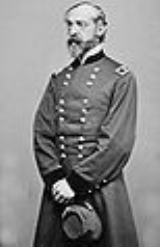
George Meade

 
George Meade

   Email Print
   Bookmark   Link


George Meade


George Gordon Meade (December 31, 1815 – November 6, 1872) was a career United States Army
United States Army

The United States Army is the branch of the United States Armed Forces responsible for Army operations. It is the largest and oldest established branch of the U.S....
 officer and civil engineer involved in coastal construction, including several lighthouse
Lighthouse

A lighthouse is a tower, building, or framework designed to emit light from a system of lamps and lens or, in older times, from a fire and used as an aid to navigation and to Maritime pilot at sea....
s. He fought with distinction in the Seminole War and Mexican-American War. During the American Civil War
American Civil War

The American Civil War , also known as the War Between the States and several Naming the American Civil War, was a civil war in the United States....
 he served as a Union
Union Army

The Union Army was the army that fought for the Union during the American Civil War. It was also known as the Federal Army, the U.S....
 general, rising from command of a brigade to the Army of the Potomac
Army of the Potomac

The Army of the Potomac was the major Union Army in the Eastern Theater of the American Civil War of the American Civil War....
. He is best known for defeating Confederate
Confederate States Army

The Confederate States Army was a military organization whose primary mission was to provide the necessary forces and capabilities to support the National Security and defense of the Confederate States of America during its brief existence from 1861 to 1865....
 General Robert E. Lee
Robert E. Lee

Robert Edward Lee , was a career United States United States Army officer , an engineer, and among the most celebrated generals in American history....
 at the Battle of Gettysburg
Battle of Gettysburg

The Battle of Gettysburg , fought in and around the town of Gettysburg, Pennsylvania, as part of the Gettysburg Campaign, was the battle with the largest number of casualties in the American Civil War and is frequently cited as the war's Turning point of the American Civil War....
 in 1863.

In 1864–65, Meade continued to command the Army of the Potomac through the Overland Campaign
Overland Campaign

The Overland Campaign, also known as Grant's Overland Campaign and the Wilderness Campaign, was a series of battles fought in Virginia during May and June 1864, in the American Civil War....
, the Richmond-Petersburg Campaign, and the Appomattox Campaign
Appomattox Campaign

The Appomattox Campaign was a series of battles fought in Virginia that culminated in the surrender of Confederate States Army General Robert E....
, but he was overshadowed by the direct supervision of the general in chief, Lt. Gen.
Lieutenant General (United States)

In the United States Army, the United States Marine Corps and the United States Air Force, lieutenant general is a 3 star rank general officer rank, with the U.S....
 Ulysses S. Grant
Ulysses S. Grant

Ulysses S. Grant, born Hiram Ulysses Grant , was an United States general and the List of Presidents of the United States President of the United States ....
.

e was born in Cádiz
Cádiz

C?diz is a city and port in southwestern Spain. It is the capital of the province of C?diz, one of eight which make up the Autonomous communities of Spain of Andalusia....
, Spain
Spain

Spain or the Kingdom of Spain , is a country located in Southern Europe on the Iberian Peninsula.The Spanish constitution does not establish any official denomination of the country, even though Espa?a , Estado espa?ol and Naci?n espa?ola are used interchangeably....
, eighth of eleven children of Richard Worsam Meade and Margaret Coats Butler Meade.


Discussion
Ask a question about 'George Meade'
Start a new discussion about 'George Meade'
Answer questions from other users
Full Discussion Forum


Encyclopedia


George Gordon Meade (December 31, 1815 – November 6, 1872) was a career United States Army
United States Army

The United States Army is the branch of the United States Armed Forces responsible for Army operations. It is the largest and oldest established branch of the U.S....
 officer and civil engineer involved in coastal construction, including several lighthouse
Lighthouse

A lighthouse is a tower, building, or framework designed to emit light from a system of lamps and lens or, in older times, from a fire and used as an aid to navigation and to Maritime pilot at sea....
s. He fought with distinction in the Seminole War and Mexican-American War. During the American Civil War
American Civil War

The American Civil War , also known as the War Between the States and several Naming the American Civil War, was a civil war in the United States....
 he served as a Union
Union Army

The Union Army was the army that fought for the Union during the American Civil War. It was also known as the Federal Army, the U.S....
 general, rising from command of a brigade to the Army of the Potomac
Army of the Potomac

The Army of the Potomac was the major Union Army in the Eastern Theater of the American Civil War of the American Civil War....
. He is best known for defeating Confederate
Confederate States Army

The Confederate States Army was a military organization whose primary mission was to provide the necessary forces and capabilities to support the National Security and defense of the Confederate States of America during its brief existence from 1861 to 1865....
 General Robert E. Lee
Robert E. Lee

Robert Edward Lee , was a career United States United States Army officer , an engineer, and among the most celebrated generals in American history....
 at the Battle of Gettysburg
Battle of Gettysburg

The Battle of Gettysburg , fought in and around the town of Gettysburg, Pennsylvania, as part of the Gettysburg Campaign, was the battle with the largest number of casualties in the American Civil War and is frequently cited as the war's Turning point of the American Civil War....
 in 1863.

In 1864–65, Meade continued to command the Army of the Potomac through the Overland Campaign
Overland Campaign

The Overland Campaign, also known as Grant's Overland Campaign and the Wilderness Campaign, was a series of battles fought in Virginia during May and June 1864, in the American Civil War....
, the Richmond-Petersburg Campaign, and the Appomattox Campaign
Appomattox Campaign

The Appomattox Campaign was a series of battles fought in Virginia that culminated in the surrender of Confederate States Army General Robert E....
, but he was overshadowed by the direct supervision of the general in chief, Lt. Gen.
Lieutenant General (United States)

In the United States Army, the United States Marine Corps and the United States Air Force, lieutenant general is a 3 star rank general officer rank, with the U.S....
 Ulysses S. Grant
Ulysses S. Grant

Ulysses S. Grant, born Hiram Ulysses Grant , was an United States general and the List of Presidents of the United States President of the United States ....
.

Early life

Meade was born in Cádiz
Cádiz

C?diz is a city and port in southwestern Spain. It is the capital of the province of C?diz, one of eight which make up the Autonomous communities of Spain of Andalusia....
, Spain
Spain

Spain or the Kingdom of Spain , is a country located in Southern Europe on the Iberian Peninsula.The Spanish constitution does not establish any official denomination of the country, even though Espa?a , Estado espa?ol and Naci?n espa?ola are used interchangeably....
, eighth of eleven children of Richard Worsam Meade and Margaret Coats Butler Meade. His brother, Richard Worsam Meade II
Richard Worsam Meade II

Richard Worsam Meade II was an officer in the United States Navy.Meade was born in Spain in 1807 to Richard Worsam Meade I and his wife Margaret Coats Butler Meade ....
, was a future naval officer. His father, a wealthy Philadelphia merchant serving in Spain as a naval agent for the U.S. government, was ruined financially because of his support of Spain in the Napoleonic Wars
Napoleonic Wars

The Napoleonic Wars were a series of conflicts involving Napoleon I of France First French Empire and changing sets of European allies and opposing coalitions that ran from 1803 to 1815....
 and died in 1828 while Meade was a young teenager. His family returned to the United States six months after his father's death, in precarious financial straits. Young George attended the Mount Hope Institution in Baltimore
Baltimore, Maryland

Baltimore is an independent city and the largest city in the U.S. state of Maryland in the United States. Baltimore is located in central Maryland along the tidal portion of the Patapsco River, an arm of the Chesapeake Bay....
 and entered the United States Military Academy
United States Military Academy

The United States Military Academy at West Point is a four-year coeducational United States Service academies located at West Point, New York, New York....
 (West Point) in 1831, chosen primarily for financial reasons. He graduated 19th in his class of 56 cadets in 1835. For a year, he served with the 3rd U.S. Artillery in Florida
Florida

Florida is a U.S. state located in the Southeastern United States of the United States, bordering Alabama to the northwest and Georgia to the northeast....
, fighting against the Seminole
Seminole

The Seminole are a Native Americans in the United States people originally of Florida, who now reside primarily in that state and Oklahoma. The Seminole nation was formed in the 18th century and was composed of Native Americans from Georgia , Mississippi, and Alabama, most significantly the Creek people, as well as African Americans who escap...
 Indians
Native Americans in the United States

Native Americans in the United States are the Indigenous peoples of the Americas from the regions of North America now encompassed by the continental United States United States, including parts of Alaska and the island state of Hawaii....
, before resigning from the Army, a career he had not intended to pursue, even while attending West Point. He worked as a civil engineer
Civil engineer

A civil engineer is a person who practices civil engineering, one of the many engineering professions. Originally a civil engineer worked on public works projects and was contrasted with the military engineer, who worked on armaments and defenses....
 for the Alabama, Georgia, and Florida Railroad and for the War Department
United States Department of War

The United States Department of War, sometimes also called the War Office, was the department of the United States Federal government of the United States's Federal government of the United States#Executive branch responsible for the operation and maintenance of land Military of the United States from 1789 until September 18, 1947,...
. On December 31, 1840, he married Margaretta Sergeant, daughter of John Sergeant
John Sergeant (politician)

John Sergeant was an American politician who represented Pennsylvania in the United States House of Representatives. He was born in Philadelphia, Pennsylvania to Jonathan Dickinson Sergeant and Margaret Spencer....
, running mate of Henry Clay
Henry Clay

Henry Clay, Sr. was a nineteenth-century United States statesman and orator who represented Kentucky in both the United States House of Representatives and United States Senate....
 in the 1832 presidential election
United States presidential election, 1832

The United States presidential election of 1832 saw incumbent President Andrew Jackson, candidate of the United States Democratic Party, easily win reelection against Henry Clay of Kentucky....
. They had seven children together (John Sergeant Meade, Col. George Meade, Margaret Butler Meade, Spencer Meade, Sarah Wise Meade, Henrietta Meade, and William Meade). Finding steady civilian employment was difficult for the newly married man, so he reentered the army in 1842 as a second lieutenant
Second Lieutenant

Second Lieutenant is the lowest Officer military rank in many armed forces.In British English the rank is pronounced second /l?f't?n?nt/ , while in American English it is pronounced second /lu't?n?nt/ ....
 in the corps of topographical
Topography

Topography is the study of Earth's surface shape and features or those ofplanets, Natural satellite, and asteroids. It is also the description of such surface shapes and features ....
 engineers.

Meade served in the Mexican-American War, assigned to the staffs of Generals Zachary Taylor
Zachary Taylor

Zachary Taylor was an Military of the United States and the List of Presidents of the United States President of the United States.Known as "Old Rough and Ready", Taylor had a 40-year military career in the United States Army, serving in the War of 1812, Black Hawk War, and Seminole Wars before achieving fame leading U.S....
, William J. Worth
William J. Worth

William Jenkins Worth was a United States general during the Mexican-American War....
, and Robert Patterson
Robert Patterson

Robert Patterson was a United States major general during the Mexican-American War and at the beginning of the American Civil War....
, and was brevetted
Brevet (military)

In the U.K. and U.S. military, brevet referred to a warrant authorizing a commissioned officer to hold a higher Military rank temporarily, but usually without receiving the pay of that higher rank....
 to first lieutenant
First Lieutenant

First Lieutenant is a military rank.The rank of Lieutenant has different meanings in different military formations , but the majority of cases it is common for it to be sub-divided into a senior and junior rank....
 for gallant conduct at the Battle of Monterrey
Battle of Monterrey

In the Battle of Monterrey during the Mexican-American War, General Pedro de Ampudia and the Mexico Army of the North was defeated by U.S. forces under the command of Zachary Taylor....
. After that war he was chiefly involved in lighthouse
Lighthouse

A lighthouse is a tower, building, or framework designed to emit light from a system of lamps and lens or, in older times, from a fire and used as an aid to navigation and to Maritime pilot at sea....
 and breakwater construction and coastal surveying in Florida
Florida

Florida is a U.S. state located in the Southeastern United States of the United States, bordering Alabama to the northwest and Georgia to the northeast....
 and New Jersey
New Jersey

New Jersey is a state in the Mid-Atlantic States and Northeastern United States regions of the United States. It is bordered on the north by New York, on the east by the Hudson River and the Atlantic Ocean, on the southwest by Delaware, and on the west by Pennsylvania....
. He designed Barnegat Light
Barnegat Lighthouse

Barnegat Lighthouse, colloquially known as "Old Barney", is located in Barnegat Lighthouse State Park on the northern tip of Long Beach Island, in the borough of Barnegat Light, New Jersey, New Jersey, in the United States....
 on Long Beach Island
Long Beach Island

Long Beach Island is a Bar and summer colony along the Atlantic Ocean coast of Ocean County, New Jersey, New Jersey in the United States. Aligned north-south, the northern portion is generally slightly higher end, low-density residential; whereas the southern portion possesses more economical, higher-density housing and considerable comm...
, Absecon Light
Absecon Light

The Absecon Light is a lighthouse located in the north end of Atlantic City, New Jersey overlooking Absecon Inlet and is the fifth tallest lighthouse in the United States....
 in Atlantic City, Cape May Light in Cape May, Jupiter Inlet Light
Jupiter Inlet Light

The Jupiter Inlet Light is located in Jupiter, Florida, on the north side of the Jupiter Inlet. The site for the lighthouse was chosen in 1853. It is located between Cape Canaveral Light and Hillsboro Inlet Light....
 in Jupiter, Florida
Jupiter, Florida

.Jupiter is a town located in Palm Beach County, Florida. As of the 2000 census, the town had a total population of 39,328. As of 2006, the population had grown to 50,028, according to the University of Florida, Bureau of Economic and Business Research....
, and Sombrero Key Light
Sombrero Key Light

Sombrero Key Light is located near Key Vaca in Marathon, Florida. The lighthouse is located on a mostly submerged Coral reef. The name Sombrero Key goes back to the Spain, and old charts show a small island at the spot, but by the later 19th Century the island had eroded away, with some parts of the reef exposed at low tide....
 in the Florida Keys
Florida Keys

The Florida Keys are an archipelago of about 1700 islands in the southeast United States. They begin at the southeastern tip of the Florida peninsula, about south of Miami, Florida, and extend in a gentle arc south-southwest and then westward to Key West, Florida, the westernmost of the inhabited islands, and on to the uninhabited Dry Tort...
. He also designed a hydraulic lamp that was adopted by the Lighthouse Board for use in American lighthouses. He was promoted to captain in 1856.

In 1857, Meade relieved Lt. Col.
Lieutenant Colonel (United States)

In the United States Army, United States Air Force, and United States Marine Corps, lieutenant colonel is a field officer United States Military Officer military rank just above the rank of Major and just below the rank of Colonel ....
 James Kearney on the Lakes Survey mission of the Great Lakes
Great Lakes

The St. Lawrence River Great Lakes are a chain of fresh water lakes located in eastern North America, on the Canada ? United States border. Consisting of Lakes Lake Superior, Lake Michigan, Lake Huron, Lake Erie, and Lake Ontario, they form the largest group of freshwater lakes on Earth....
. Completion of the survey of Lake Huron
Lake Huron

Lake Huron, bounded on the west by the U.S. state of Michigan, and on the east by the Provinces and territories of Canada of Ontario, Canada, is one of the five Great Lakes of North America....
 and extension of the surveys of Lake Michigan
Lake Michigan

Lake Michigan is one of the five Great Lakes of North America, and the only one located entirely within the United States. The third-largest of the Great Lakes, it is bounded, from west to east, by the U.S....
 down to Grand
Grand Traverse Bay

Grand Traverse Bay is located off Lake Michigan in Northern Michigan. The bay is long, 10 miles wide, and up to deep in spots. It is divided into two arms by the Old Mission Peninsula....
 and Little Traverse Bay
Little Traverse Bay

Little Traverse Bay is a small bay, 170 feet deep, off Lake Michigan in the northern area of the Lower Peninsula of Michigan. Harbor Springs, Michigan and Petoskey, Michigan are on this bay....
s were done under his command. Prior to Captain Meade's command, Great Lakes' water level readings were taken locally with temporary gauges; a uniform plane of reference had not been established. In 1858, based on his recommendation, instrumentation was set in place for the tabulation of records across the basin. In 1860, the first detailed report of Great Lakes was published.. Meade stayed with the Lakes Survey until the 1861 outbreak of the Civil War.

Civil War


Early commands

Meade was promoted from captain to brigadier general
Brigadier general (United States)

A brigadier general in the United States Army, United States Air Force, and United States Marine Corps, is a 1 star rank general officer, with the U.S....
 of volunteers on August 31, 1861, a few months after the start of the Civil War, based on the strong recommendation of Pennsylvania Governor
List of Governors of Pennsylvania

The Governor of the Commonwealth of Pennsylvania is the head of the executive branch of Pennsylvania's government and the commander-in-chief of the U.S....
 Andrew Curtin. He was assigned command of the 2nd Brigade
Brigade

A brigade is a military unit that is typically composed of two to five regiments or battalions, depending on the era and nationality of a given army....
 of the Pennsylvania Reserves
Pennsylvania Reserves

The Pennsylvania Reserves was an infantry division in the Union Army during the American Civil War. Noted for its famous commanders and high casualties, it served in the Eastern Theater of the American Civil War, and fought in many important battles, including Battle of Antietam and Battle of Gettysburg....
, recruited early in the war, which he led competently, initially in the construction of defenses around Washington, D.C.
Washington, D.C.

Washington, D.C. , formally the District of Columbia and commonly referred to as Washington, the District, or simply D.C., is the Capital of the United States, founded on July 16, 1790....
 His brigade joined Maj. Gen.
Major general (United States)

In the United States Army, United States Marine Corps, and United States Air Force, major general is a 2 star rank general officer rank, with the U.S....
 George B. McClellan
George B. McClellan

George Brinton McClellan was a Major general during the American Civil War. He organized the famous Army of the Potomac and served briefly as the general-in-chief of the Union Army....
's Army of the Potomac
Army of the Potomac

The Army of the Potomac was the major Union Army in the Eastern Theater of the American Civil War of the American Civil War....
 for the Peninsula Campaign
Peninsula Campaign

The Peninsula Campaign of the American Civil War was a major Union operation launched in southeastern Virginia from March through July 1862, the first large-scale offensive in the Eastern Theater of the American Civil War....
. At the Battle of Glendale
Battle of Glendale

The Battle of Glendale, also known as the Battle of Frayser's Farm, Frazier's Farm, Nelson's Farm, Charles City Crossroads, New Market Road, or Riddell's Shop, took place on June 30, 1862, in Henrico County, Virginia, as the fifth of the Seven Days Battles of the American Civil War....
, one of the Seven Days Battles
Seven Days Battles

The Seven Days Battles was a series of six major battles over the seven days from June 25 to July 1, 1862, near Richmond, Virginia during the American Civil War....
, Meade was severely wounded in the arm, back, and side. He partially recovered his strength in time for the Northern Virginia Campaign
Northern Virginia Campaign

}|-||}The Northern Virginia Campaign, also known as the Second Bull Run Campaign or Second Manassas Campaign, was a series of battles fought in Virginia during August and September 1862 in the Eastern Theater of the American Civil War of the American Civil War....
 and the Second Battle of Bull Run
Second Battle of Bull Run

The Second Battle of Bull Run, or, as it was called by the Confederate States of America, the Battle of Second Manassas, was fought August 28–30, 1862, as part of the American Civil War....
, in which he led his brigade, now assigned to Maj. Gen. Irvin McDowell
Irvin McDowell

Irvin McDowell was a career United States United States Army, famous for his defeat during the First Battle of Bull Run, the first large-scale battle of the American Civil War....
's corps of the Army of Virginia
Army of Virginia

The Army of Virginia was organized as a major unit of the Union Army and operated briefly and unsuccessfully in 1862 in the American Civil War. It should not be confused with its principal opponent, the Confederate States Army Army of Northern Virginia, commanded by Robert E....
. His brigade made a heroic stand on Henry House Hill to protect the rear of the retreating Union Army. At the start of the Maryland Campaign
Maryland Campaign

The Maryland Campaign, or the Antietam Campaign, of September 1862 is widely considered one of the major Turning Point of the American Civil War of the American Civil War....
 a few days later, he received command of the 3rd Division, I Corps
I Corps (ACW)

I Corps was the designation of three different corps-sized units in the Union Army during the American Civil War. The units served in the following armies:...
, Army of the Potomac, and distinguished himself during the Battle of South Mountain
Battle of South Mountain

The Battle of South Mountain was fought September 14, 1862, as part of the Maryland Campaign of the American Civil War. Three pitched battles were fought for possession of three South Mountain passes: Crampton's Gap, Turner's Gap, and Fox's Gaps....
. When Meade's brigade stormed the heights at South Mountain, Maj. Gen. Joseph Hooker
Joseph Hooker

Joseph Hooker was a career United States Army officer, fought in the Mexican-American War, and was a Major general in the Union Army during the American Civil War....
, his corps commander, was heard to exclaim, "Look at Meade! Why, with troops like those, led in that way, I can win anything!" In the Battle of Antietam
Battle of Antietam

The Battle of Antietam , fought on September 17, 1862, near Sharpsburg, Maryland, and Antietam Creek, as part of the Maryland Campaign, was the first major battle in the American Civil War to take place on Northern United States soil....
, Meade replaced the wounded Hooker in command of I Corps, selected personally by McClellan over other generals his superior in rank. He performed well at Antietam, but was wounded in the thigh.

During the Battle of Fredericksburg
Battle of Fredericksburg

The Battle of Fredericksburg, fought in and around Fredericksburg, Virginia, from December 11 to December 15, 1862, between General Robert E. Lee's Confederate States Army Army of Northern Virginia and the Union Army Army of the Potomac, commanded by Major general Ambrose E....
, Meade's division made the only breakthrough of the Confederate lines, spearheading through a gap in Lt. Gen. Thomas J. "Stonewall" Jackson's
Stonewall Jackson

Thomas Jonathan "Stonewall" Jackson was a Confederate States Army general during the American Civil War, and probably the most well-known Confederate commander after General Robert E....
 corps at the southern end of the battlefield. For this action, Meade was promoted to major general
Major general (United States)

In the United States Army, United States Marine Corps, and United States Air Force, major general is a 2 star rank general officer rank, with the U.S....
 of volunteers, to rank from November 29, 1862. However, his attack was not reinforced, resulting in the loss of much of his division. After the battle, he received command of V Corps
V Corps (ACW)

The V Corps was a unit of the Union Army Army of the Potomac during the American Civil War....
, which he led in the Battle of Chancellorsville
Battle of Chancellorsville

The Battle of Chancellorsville was a major battle of the American Civil War, fought near the village of Spotsylvania Courthouse, Virginia, from April 30 to May 6, 1863....
 the following spring. General Hooker, then commanding the Army of the Potomac, had grand, aggressive plans for the campaign, but was too timid in execution, allowing the Confederates to seize the initiative. Meade's corps was left in reserve for most of the battle, contributing to the Union defeat. Afterwards, Meade argued strongly with Hooker for resuming the attack against Lee, but to no avail.

Army of the Potomac and Gettysburg

Hooker resigned from command of the Army of the Potomac while pursuing Lee in the Gettysburg Campaign
Gettysburg Campaign

File:Meade and Lee.jpgThe Gettysburg Campaign was a series of battles fought in June and July 1863, during the American Civil War. After his victory in the Battle of Chancellorsville, Confederate States Army Full General Robert E....
. In the early morning hours of June 28, 1863, a messenger from President
President of the United States

The President of the United States is the head of state and head of government of the United States and is the highest political official in the United States by influence and recognition....
 Abraham Lincoln
Abraham Lincoln

Abraham Lincoln was the List of Presidents of the United States President of the United States. He successfully led the country through its greatest internal crisis, the American Civil War, preserving the Union and ending slavery....
 arrived to inform Meade of his appointment as Hooker's replacement. Meade was taken by surprise and later wrote to his wife that when the officer entered his tent to wake him, he assumed that Army politics had caught up with him and he was being arrested. He had not actively sought command and was not the president's first choice. John F. Reynolds
John F. Reynolds

John Fulton Reynolds was a career United States Army officer and a General officer in the American Civil War. One of the Union Army's most respected senior commanders, despite having a relatively limited amount of combat experience in the war, he played a key role in committing the Army of the Potomac to the Battle of Gettysburg and was kill...
, one of four major generals who outranked Meade in the Army of the Potomac, had earlier turned down the president's suggestion that he take over. Reynolds later died on the first day of the Battle of Gettysburg
Battle of Gettysburg

The Battle of Gettysburg , fought in and around the town of Gettysburg, Pennsylvania, as part of the Gettysburg Campaign, was the battle with the largest number of casualties in the American Civil War and is frequently cited as the war's Turning point of the American Civil War....
.

Meade assumed command at Prospect Hall
Prospect Hall

Prospect Hall is a historic mansion, built around 1787 on what was known at the time as Red Hill, the highest elevation in Frederick, Maryland, Maryland....
 in Frederick, Maryland
Frederick, Maryland

Frederick is a city in west-central Maryland, United States. It is the county seat of Frederick County, Maryland, the largest county by area in the State of Maryland....
.. Lee's Army of Northern Virginia
Army of Northern Virginia

The Army of Northern Virginia was the primary military force of the Confederate States of America in the Eastern Theater of the American Civil War of the American Civil War....
 was invading Pennsylvania and, as a former corps commander, Meade had little knowledge of the disposition of the rest of his new army. Only three days later he confronted Lee in the Battle of Gettysburg
Battle of Gettysburg

The Battle of Gettysburg , fought in and around the town of Gettysburg, Pennsylvania, as part of the Gettysburg Campaign, was the battle with the largest number of casualties in the American Civil War and is frequently cited as the war's Turning point of the American Civil War....
, July 1 to July 3, 1863, where he won the battle that is considered a turning point
Turning point of the American Civil War

There is widespread disagreement over the turning point of the American Civil War. The idea of a turning point is an event after which most observers would agree that the eventual outcome was inevitable....
 of the war. The battle began almost by accident, as the result of a chance meeting engagement between Confederate infantry and Union cavalry in Gettysburg on July 1. By the end of the first day, two Union infantry corps had been almost destroyed, but had taken up positions on favorable ground. Meade rushed the remainder of his Army to Gettysburg and skillfully deployed his forces for a defensive battle, reacting swiftly to fierce assaults on his line's left, right, and center, culminating in Lee's disastrous assault on the center, known as Pickett's Charge
Pickett's Charge

Pickett's Charge was an infantry assault ordered by Confederate States Army General Robert E. Lee against Major general George G. Meade's Union Army positions on Cemetery Ridge on July 3, 1863, the last day of the Battle of Gettysburg during the American Civil War....
.

During the three days, Meade made excellent use of capable subordinates, such as Maj. Gens. John F. Reynolds
John F. Reynolds

John Fulton Reynolds was a career United States Army officer and a General officer in the American Civil War. One of the Union Army's most respected senior commanders, despite having a relatively limited amount of combat experience in the war, he played a key role in committing the Army of the Potomac to the Battle of Gettysburg and was kill...
 and Winfield S. Hancock, to whom he delegated great responsibilities. Unfortunately for Meade's reputation, he did not skillfully manage the political manipulators he inherited from Hooker. Maj. Gens. Daniel Sickles
Daniel Sickles

Daniel Edgar Sickles was a colorful and controversial American politician, Union Army General officer in the American Civil War, and diplomat....
, III Corps
III Corps (ACW)

There were four formations in the Union Army designated as III Corps during the American Civil War.Three were short-lived:*Army of Virginia:...
 commander, and Daniel Butterfield
Daniel Butterfield

Daniel Adams Butterfield was a New York businessman, a Union army General officer in the American Civil War, and Assistant U.S. Treasurer in New York....
, Meade's chief of staff, caused him difficulty later in the war, questioning his command decisions and courage. Sickles had developed a personal vendetta against Meade because of Sickles's allegiance to Joseph Hooker, whom Meade replaced, and because of violent disagreements at Gettysburg. (Sickles's grossly insubordinate actions as the commander of the III Corps almost lost the battle, and by extension almost the war, for the Union.) Radical Republicans in the U.S. Congress Joint Committee on the Conduct of the War suspected that Meade was a copperhead
Copperheads (politics)

The Copperheads were a vocal group of History of the United States Democratic Party in the Northern United States who opposed the American Civil War, wanting an immediate peace settlement with the Confederate States of America....
 and tried in vain to relieve him from command.

Gettysburg Council of War
Following their severe losses at Gettysburg, General Lee's army retreated back to Virginia
Virginia

The Commonwealth of Virginia is an United States U.S. state on the East Coast of the United States of the Southern United States. The state is known as the "Old Dominion" and sometimes as "Mother of Presidents", because it is the birthplace of Lists of United States Presidents by place of birth#By state....
. Meade was criticized by President Lincoln and others for not aggressively pursuing the Confederates during their retreat. At one point, the Army of Northern Virginia was extremely vulnerable with their backs to the rain-swollen, almost impassable Potomac River
Potomac River

The Potomac River flows into the Chesapeake Bay, located along the mid-Atlantic Ocean coast of the United States. The river is approximately 383 statute miles long, with a Drainage basin of about 14,700 square miles ....
, but they were able to erect strong defensive positions before Meade could organize an effective attack. Lincoln believed that this wasted an opportunity to end the war. Nonetheless, Meade received a promotion to brigadier general in the regular army and the Thanks of Congress
Thanks of Congress

The Thanks of Congress are a series of formal resolutions passed by the United States Congress originally to extend the government's formal thanks for significant victories or impressive actions by United States military commanders and their troops....
, which commended Meade "... and the officers and soldiers of [the Army of the Potomac], for the skill and heroic valor which at Gettysburg repulsed, defeated, and drove back, broken and dispirited, beyond the Rappahannock
Rappahannock River

The Rappahannock River is a river in eastern Virginia in the United States, approximately 184 mi in length. It traverses the entire northern part of the state, from the Blue Ridge Mountains in the west across the Piedmont to Chesapeake Bay south of the Potomac River....
, the veteran army of the rebellion."

For the remainder of the fall campaigning season in 1863, during both the Bristoe Campaign
Bristoe Campaign

The Bristoe Campaign was a series of battles fought in Virginia during October and November 1863, in the American Civil War. Major General#United States George G....
 and the Mine Run Campaign, Meade was outmaneuvered by Lee and withdrew after fighting minor, inconclusive battles, because of his reluctance to attack entrenched positions.

Meade was a competent and outwardly modest man, although correspondence with his wife throughout the war suggests he was disguising his ego and ambition. A London newspaperman described Meade: "He is a very remarkable looking man—tall, spare, of a commanding figure in presence, his manner pleasant and easy but having much dignity. His head is partially bald and is small and compact, but the forehead is high. He has the late Duke of Wellington
Arthur Wellesley, 1st Duke of Wellington

Field Marshal Arthur Wellesley, 1st Duke of Wellington, Order of the Garter, Order of St Patrick, Order of the Bath, Royal Guelphic Order, Privy Council of the United Kingdom, Royal Society , was an Anglo-Irish soldier and statesman, and one of the leading military and political figures of the nineteenth century....
 class of nose, and his eyes, which have a serious and almost sad expression, are rather sunken, or appear so from the prominence of the curve nasal appearance. He has a decidedly patrician and distinguished appearance." Meade's short temper earned him notoriety, and while he was respected by most of his peers, he was not well-loved by his army. Some referred to him as "a damned old goggle-eyed snapping turtle."

Meade and Grant

When Lt. Gen. Ulysses S. Grant
Ulysses S. Grant

Ulysses S. Grant, born Hiram Ulysses Grant , was an United States general and the List of Presidents of the United States President of the United States ....
 was appointed commander of all Union armies in March 1864, Meade offered to resign, but Grant refused and Meade and the Army of the Potomac became subordinate to him. Grant made his headquarters with Meade for the remainder of the war, which caused Meade to chafe at the close supervision he received. Following an incident in June 1864, in which Meade disciplined reporter Edward Cropsey from The Philadelphia Inquirer
The Philadelphia Inquirer

The Philadelphia Inquirer is a morning daily newspaper that serves the Philadelphia, Pennsylvania, Delaware Valley of the United States. The newspaper was founded by John R....
 newspaper for an unfavorable article, all of the press assigned to his army agreed to mention Meade only in conjunction with setbacks. Meade apparently knew nothing of this arrangement, and the reporters giving all of the credit to Grant angered Meade.

Meade and Grant had various differences that caused additional friction between them. Waging a war of attrition in his Overland Campaign
Overland Campaign

The Overland Campaign, also known as Grant's Overland Campaign and the Wilderness Campaign, was a series of battles fought in Virginia during May and June 1864, in the American Civil War....
 against Robert E. Lee, Grant was willing to suffer previously unacceptable losses with the knowledge that the Union Army had replacement soldiers available, whereas the Confederates did not. Meade, despite his aggressive performance in lesser commands in 1862, had become a more cautious general and more concerned about the futility of attacking entrenched positions. Most of the bloody repulses his army suffered in the Overland Campaign were ordered by Grant, although the aggressive maneuvering that eventually cornered Lee in the trenches around Petersburg were Grant's initiative as well. An additional frustration for Meade was the manner in which Grant sometimes gave preferable treatment to subordinates that he brought with him from the Western Theater
Western Theater of the American Civil War

This article presents an overview of major military and naval operations in the Western Theater of the American Civil War....
. A primary example of this was Grant's interference with Meade's direction of Maj. Gen. Philip Sheridan
Philip Sheridan

Philip Henry Sheridan was a career United States Army officer and a Union Army General officer in the American Civil War. His career was noted for his rapid rise to Major general and his close association with Lieutenant general Ulysses S....
's Cavalry Corps. Meade had insisted that Sheridan's troopers perform traditional cavalry functions of reconnaissance, screening, and guarding the Army's trains, but Sheridan went directly to Grant and obtained permission to conduct a strategic raid against the Confederate cavalry and Richmond.

Although Meade generally performed effectively under Grant's supervision in the Overland Campaign
Overland Campaign

The Overland Campaign, also known as Grant's Overland Campaign and the Wilderness Campaign, was a series of battles fought in Virginia during May and June 1864, in the American Civil War....
 and the Richmond-Petersburg Campaign, a few instances of bad judgment marred his legacy. During the Battle of Cold Harbor
Battle of Cold Harbor

The Battle of Cold Harbor, the final battle of Union Army Lieutenant general Ulysses S. Grant's 1864 Overland Campaign during the American Civil War, is remembered as one of History of the United States bloodiest, most lopsided battles....
, Meade inadequately supervised his corps commanders and did not insist they perform reconnaissance before their disastrous frontal assault. Inexplicably, Meade wrote to his wife immediately after the attack and expressed pride that it was he who ordered the attack. During the initial assaults on Petersburg, Meade again failed to coordinate the attacks of his corps before General Lee could reinforce the line, resulting in the ten-month stalemate, the Siege of Petersburg
Siege of Petersburg

The Richmond-Petersburg Campaign was a series of battles around Petersburg, Virginia, fought from June 9, 1864, to March 25, 1865, during the American Civil War....
. He approved the plan of Maj. Gen. Ambrose Burnside
Ambrose Burnside

Ambrose Everett Burnside was an United States soldier, railroad executive, inventor, industrialist, and politician from Rhode Island, serving as governor and a U.S....
 to plant explosives in a mine shaft dug underneath the Confederate line east of Petersburg, but at the last minute he changed Burnside's plan to lead the attack with a well-trained African-American division that was highly drilled just for this action, instructing him to take a politically less risky course and substitute an untrained and poorly led white division. The resulting Battle of the Crater
Battle of the Crater

The Battle of the Crater was a battle of the American Civil War, part of the Siege of Petersburg. It took place on July 30, 1864, between the Confederate States Army Army of Northern Virginia, commanded by General Robert E....
 was one of the great fiascoes of the war. In all of these cases, Grant bears some of the responsibility for approving Meade's plans, but Meade was not performing to the level of competence he displayed at Gettysburg.

After Spotsylvania, Grant requested that Meade be promoted to major general of the regular army. In a telegram to Secretary of War
United States Secretary of War

File:Swearing in of Secretary Dwight Davis.jpgThe Secretary of War was a member of the United States President of the United States United States Cabinet, beginning with George Washington's administration....
 Edwin Stanton on May 13, 1864, Grant stated that "Meade has more than met my most sanguine expectations. He and [William T.] Sherman
William Tecumseh Sherman

William Tecumseh Sherman was an United States soldier, businessman, educator and author. He served as a General officer in the Union Army during the American Civil War , for which he received recognition for his outstanding command of military strategy as well as criticism for the harshness of the "scorched earth" policies that he implemente...
 are the fittest officers for large commands I have come in contact with." Meade felt slighted that his well-deserved promotion was processed after that of Sherman and Philip Sheridan, the latter his subordinate. However, his date of rank meant that he was outranked at the end of the war only by Grant, Halleck
Henry Wager Halleck

Henry Wager Halleck was a United States Army officer, scholar, and lawyer. A noted expert in military studies, he was known by a nickname that became derogatory, "Old Brains." He was an important participant in the admission of California as a state and became a successful lawyer and land developer....
, and Sherman. Although he fought during the Appomattox Campaign
Appomattox Campaign

The Appomattox Campaign was a series of battles fought in Virginia that culminated in the surrender of Confederate States Army General Robert E....
, Grant and Sheridan received most of the credit. He was not present when Robert E. Lee surrendered at Appomattox Court House
Appomattox Court House

File:New Appomattox Court House.jpgFile:Appomattox Court House new and old marker.jpgThe Appomattox Court House is a courthouse in Appomattox, Virginia built in 1892....
.

Command decisions

Meade's decisions in command of the Army of the Potomac have been the focus of controversy. He has been accused of not being aggressive enough in pursuit of Confederate forces, and being reluctant to attack on occasion. His reputation among the public and 19th century historians suffered as a result of his short temper, his bad relationship with the press, his place in the shadow of the victorious Grant, and particularly the damaging fallout from the controversies with Dan Sickles. Recent historical works have portrayed him in a more positive light. They have acknowledged that Meade displayed and acted upon an understanding of the necessary changes in tactics brought about by improvements in weapons technology. His decisions to entrench
Trench warfare

Trench warfare is a form of warfare where both combatants have fortified positions and fighting lines are static. Trench warfare arose when a revolution in fire power was not matched by similar advances in mobility , resulting in a slow and grueling form of defense-oriented warfare in which both sides constructed elaborate and heavily arme...
 when practicable and not launch frontal assaults on fortified positions should have been more carefully studied; they were lessons that could have been used to great effect on the Western Front
Western Front

Western Front was a term used during the World War I and World War II world war to describe the "contested armed frontier" between lands controlled by Germany to the East and the Allies to the West....
 during World War I
World War I

World War I, or the First World War , was a global military conflict which involved the Great powers, organized into two opposing military alliances: the Allies of World War I and the Central Powers....
.

Postbellum career

General Meade was a commissioner of Fairmount Park
Fairmount Park

Fairmount Park is the municipal park system of Philadelphia, Pennsylvania. It consists of 63 parks, with 9,200 acres , all overseen by the Fairmount Park Commission....
 in Pennsylvania
Pennsylvania

The Commonwealth of Pennsylvania , often colloquially referred to as PA by natives and Northeasterners, is a U.S. state located in the Northeastern United States and Mid-Atlantic States regions of the United States....
 from 1866 until his death. He also held various military commands, including the Military Division of the Atlantic, the Department of the East, and the Department of the South. He replaced Maj. Gen. John Pope
John Pope (military officer)

John Pope was a career United States Army officer and Union Army general in the American Civil War. He had a brief but successful career in the Western Theater of the American Civil War, but he is best known for his defeat at the Second Battle of Bull Run in the Eastern Theater of the American Civil War....
 as governor of the Reconstruction Third Military District
Third Military District

The Third Military District existed in the American South during the Reconstruction era of the United States era that followed the American Civil War....
 in Atlanta
Atlanta, Georgia

Atlanta is the Capital and most populous city in Georgia , as well as the 33rd largest city in the United States of America with a population of 519,145....
 on January 10, 1868. He received an honorary doctorate
Doctorate

A doctorate is an academic degree that in most countries represents the highest level of formal study or research in a given field. In some countries it also refers to a class of degrees which qualify the holder to practice in a specific profession ....
 in law
LAW

LAW may refer to:* Anti-tank warfare, e.g. the US Army M72 LAW or the British Army LAW 80*Palestinian Society for the Protection of Human Rights ...
 (LL.D.) from Harvard University
Harvard University

Harvard University is a private university in Cambridge, Massachusetts, Massachusetts, United States, and a member of the Ivy League. Founded in 1636 by the colonial Massachusetts legislature, Harvard is the Colonial Colleges institution of higher learning in the United States....
, and his scientific achievements were recognized by various institutions, including the American Philosophical Society
American Philosophical Society

The American Philosophical Society is a discussion group founded in 1743 by Benjamin Franklin as an offshoot of his earlier club, the Junto....
 and the Philadelphia Academy of Natural Sciences.

In memoriam

Meade died in Philadelphia
Philadelphia, Pennsylvania

Philadelphia is the largest city in Pennsylvania and the List of United States cities by population city in the United States. It is the fifth-largest metropolitan area and fourth-largest urban area by population in the United States, the nation's fourth-largest consumer media market as ranked by the Nielsen Media Research, and the 49th-most...
 from complications of his old wounds, combined with pneumonia
Pneumonia

Pneumonia is an Inflammation illness of the lung. Frequently, it is described as lung parenchyma/alveolus inflammation and abnormal alveolar filling with fluid ....
, and is buried in Laurel Hill Cemetery
Laurel Hill Cemetery

Laurel Hill Cemetery, in Philadelphia, Pennsylvania, is the second major rural cemetery in the United States and one of the few cemeteries in the country designated as a National Historic Landmark....
. There are statues of him throughout Pennsylvania, including a few in Gettysburg National Military Park
Gettysburg Battlefield

The Gettysburg Battlefield was the site of the Battle of Gettysburg, fought July 1–3, 1863, in and around the borough of Gettysburg, Pennsylvania, the county seat of Adams County, Pennsylvania, which had approximately 2,400 residents at the time....
. The United States Army
United States Army

The United States Army is the branch of the United States Armed Forces responsible for Army operations. It is the largest and oldest established branch of the U.S....
's Fort George G. Meade
Fort George G. Meade

Fort George G. Meade, located adjacent to Odenton, Maryland, Maryland, in Anne Arundel County, is an active United States Army installation. The fort, established in 1917, is named for General George Meade, a Union Army general in the American Civil War....
 in Fort Meade, Maryland
Fort Meade, Maryland

Fort Meade is a census-designated place in Anne Arundel County, Maryland, Maryland, United States. The population was 9,882 at the 2000 census....
, is named for him, as are Meade County, Kansas
Meade County, Kansas

Meade County is a U.S. county located in the U.S. state of Kansas. It is named in honor of General George G. Meade. As of 2000, the population was 4,631....
, and Meade County, South Dakota
Meade County, South Dakota

Meade County is a county located in the U.S. state of South Dakota. It was created in 1889 and was named for Fort Meade, which was garrisoned as a United States military post in the area in 1878 and was named for General George Meade....
. The Old Baldy
Old Baldy (horse)

Old Baldy was the horse ridden by Union Army Major General George G. Meade at the Battle of Gettysburg and in many other important battles of the American Civil War....
 Civil War Round Table in Philadelphia is named in honor of Meade's horse during the war.

One-thousand-dollar Treasury notes
Treasury security

Treasury securities are government bond issued by the United States Department of the Treasury through the Bureau of the Public Debt. They are the debt financing instruments of the U.S....
, also called Coin notes, of the Series 1890 and 1891, feature portraits of Meade on the obverse. The 1890 Series note is called the Grand Watermelon Note by collectors, because the large zeroes on the reverse resemble the pattern on a watermelon.

In popular media

In the film Gettysburg
Gettysburg (film)

Gettysburg is a 1993 film that dramatizes the decisive Battle of Gettysburg in the American Civil War. It was directed by Ronald F. Maxwell, who also wrote the screenplay, a close adaptation of Michael Shaara's 1974 novel The Killer Angels, winner of the Pulitzer Prize for fiction in 1975....
, an adaptation of Michael Shaara
Michael Shaara

Michael Shaara was an American writer of science fiction, sports fiction, and historical fiction. He was born to Italian immigrant parents in Jersey City, New Jersey, graduated from Rutgers University in 1951, and served as an airborne infantry officer in the Korean War....
's novel The Killer Angels
The Killer Angels

The Killer Angels is a historical novel by Michael Shaara that was awarded the Pulitzer Prize for Fiction in 1975 in literature. The book tells the story of four days of the Battle of Gettysburg in the American Civil War: June 29, 1863, as the troops of both the United States of America and the Confederate States of America move into bat...
, Meade is portrayed by Richard Anderson
Richard Anderson

Richard Norman Anderson is an American actor in film and television.Anderson was born in Long Branch, New Jersey, the son of Olga and Harry Anderson....
. Other film, television, and video appearances:

  • The Dramatic Life of Abraham Lincoln (1924) — Alfred Allen
  • Virginia City (1940) — Thurston Hall
  • The Blue and the Gray (1982 TV miniseries) — Rory Calhoun
    Rory Calhoun

    Rory Calhoun was an United States television and film actor, screenwriter, and producer best known for his roles in Western ....
  • An American Story (1992 TV) — Brad Johnson
  • Gettysburg: Three Days of Destiny (2004) — Andy Waskie
  • Battlefield Detectives (2004 TV) — Mike Brown
  • No Retreat from Destiny: The Battle That Rescued Washington (2006 video) — Paul Bugelski


Meade is a character in the alternate history
Alternate history (fiction)

Alternate history or alternative history is a Genre of speculative fiction and historical fiction that is set in a world in which history has diverged from the actual history of the world....
 novel Gettysburg, written by Newt Gingrich
Newt Gingrich

Newton "Newt" Leroy Gingrich is an American politician and author, who served as the Speaker of the United States House of Representatives from 1995 to 1999....
 and William Forstchen.

See also


Further reading

  • Cleaves, Freeman, Meade of Gettysburg, University of Oklahoma Press, 1991, ISBN 0-8061-2298-6.
  • Meade, George Gordon (posthumous), The Life and Letters of George Gordon Meade, Major-General United States Army, Charles Scribner's Sons, 1913.
  • Sears, Stephen W., Gettysburg, Houghton Mifflin, 2003, ISBN 0-395-86761-4.


External links

  • from the Cullum biographies
    United States Military Academy

    The United States Military Academy at West Point is a four-year coeducational United States Service academies located at West Point, New York, New York....
  • Retrieved on 2008-08-13