
All Topics  
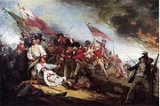
Battle of Bunker Hill

 
Battle of Bunker Hill

   Email Print
   Bookmark   Link


Battle of Bunker Hill


The Battle of Bunker Hill took place on June 17, 1775 on Breed's Hill
Breed's Hill

Breed's Hill is the actual site where the Battle of Bunker Hill took place during the American Revolution, located in the Charlestown, Massachusetts section of Boston, Massachusetts, Massachusetts....
, as part of the Siege of Boston
Siege of Boston

}|-||}The Siege of Boston was the opening phase of the American Revolutionary War, in which New England militiamen?who later became part of the Continental Army?surrounded the town of Boston, Massachusetts, to prevent movement by the British Army garrisoned within....
 during the American Revolutionary War
American Revolutionary War

The American Revolutionary War , also known as the American War of Independence, began as a war between the Kingdom of Great Britain and Thirteen Colonies on the North America, and ended in a global war between several European great powers....
. General
General

A General officer is an Officer of high military rank. The term or equivalent is used by nearly every country in the world. General can be used as a generic term for all grades of general officer, or it can specifically refer to a single rank that is just called general....
 Israel Putnam
Israel Putnam

Israel Putnam was an American army general who fought with distinction at the Battle of Bunker Hill during the American Revolutionary War . Although Putnam never quite attained the national renown of more famous heroes such as Davy Crockett or Daniel Boone, in his own time his reckless courage and fighting spirit were known far beyond Con...
 was in charge of the revolutionary forces, while Major-General William Howe
William Howe, 5th Viscount Howe

William Howe, 5th Viscount Howe, Order of the Bath, Privy Council of Great Britain was a United Kingdom General who was Commander-in-Chief of British forces during the American Revolutionary War, one of the three Howe brothers....
 commanded the British
Kingdom of Great Britain

The Kingdom of Great Britain, also known as the United Kingdom of Great Britain, was a country in North-West Europe, in existence from 1707 to 1801....
 forces. Because most of the fighting did not occur on Bunker Hill itself, the conflict is sometimes more accurately (though less often) called the Battle of Breed's Hill.

On the night of June 16, in response to intelligence that the British were soon to attempt the capture of undefended high ground around Boston, Colonial forces stealthily occupied Bunker Hill and Breed's Hill, constructed an earthen redoubt
Redoubt

A redoubt is a fort or fort system usually consisting of an enclosed defensive emplacement outside a larger fort, usually relying on Earthworks s, though others are constructed of stone or brick....
 on Breed's Hill, and built lightly fortified lines across most of the Charlestown Peninsula.


Discussion
Ask a question about 'Battle of Bunker Hill'
Start a new discussion about 'Battle of Bunker Hill'
Answer questions from other users
Full Discussion Forum


Encyclopedia


The Battle of Bunker Hill took place on June 17, 1775 on Breed's Hill
Breed's Hill

Breed's Hill is the actual site where the Battle of Bunker Hill took place during the American Revolution, located in the Charlestown, Massachusetts section of Boston, Massachusetts, Massachusetts....
, as part of the Siege of Boston
Siege of Boston

}|-||}The Siege of Boston was the opening phase of the American Revolutionary War, in which New England militiamen?who later became part of the Continental Army?surrounded the town of Boston, Massachusetts, to prevent movement by the British Army garrisoned within....
 during the American Revolutionary War
American Revolutionary War

The American Revolutionary War , also known as the American War of Independence, began as a war between the Kingdom of Great Britain and Thirteen Colonies on the North America, and ended in a global war between several European great powers....
. General
General

A General officer is an Officer of high military rank. The term or equivalent is used by nearly every country in the world. General can be used as a generic term for all grades of general officer, or it can specifically refer to a single rank that is just called general....
 Israel Putnam
Israel Putnam

Israel Putnam was an American army general who fought with distinction at the Battle of Bunker Hill during the American Revolutionary War . Although Putnam never quite attained the national renown of more famous heroes such as Davy Crockett or Daniel Boone, in his own time his reckless courage and fighting spirit were known far beyond Con...
 was in charge of the revolutionary forces, while Major-General William Howe
William Howe, 5th Viscount Howe

William Howe, 5th Viscount Howe, Order of the Bath, Privy Council of Great Britain was a United Kingdom General who was Commander-in-Chief of British forces during the American Revolutionary War, one of the three Howe brothers....
 commanded the British
Kingdom of Great Britain

The Kingdom of Great Britain, also known as the United Kingdom of Great Britain, was a country in North-West Europe, in existence from 1707 to 1801....
 forces. Because most of the fighting did not occur on Bunker Hill itself, the conflict is sometimes more accurately (though less often) called the Battle of Breed's Hill.

On the night of June 16, in response to intelligence that the British were soon to attempt the capture of undefended high ground around Boston, Colonial forces stealthily occupied Bunker Hill and Breed's Hill, constructed an earthen redoubt
Redoubt

A redoubt is a fort or fort system usually consisting of an enclosed defensive emplacement outside a larger fort, usually relying on Earthworks s, though others are constructed of stone or brick....
 on Breed's Hill, and built lightly fortified lines across most of the Charlestown Peninsula. In response, the British mounted an attack on those positions the following day. After two assaults on the Colonial lines were repulsed with significant British casualties, the British finally captured the positions on the third assault, after the defenders in the redoubt ran out of ammunition. The Colonial forces retreated over Bunker Hill to Cambridge, suffering their most significant losses on Bunker Hill.

While the result was a victory for the British, they suffered their greatest losses of the entire war: over 800 wounded and 226 killed, including a notably large number of officers. Their immediate objective (the capture of Bunker Hill) was achieved, but did not significantly alter the state of siege. It did, however, demonstrate that relatively inexperienced Colonial forces were willing and able to stand up to well-trained troops in a pitched battle
Pitched battle

A pitched battle is a battle where both sides choose to fight at a chosen location and time and where either side has the option to disengage either before the battle starts, or shortly after the first armed exchanges....
.

Geography

Boston, being on a peninsula, was largely protected from close approach by the expanses of water surrounding it, which were dominated by British warships. In the aftermath of the battles of Lexington and Concord
Battles of Lexington and Concord

The Battles of Lexington and Concord were the first military engagements of the American Revolutionary War. They were fought on April 19, 1775, in Middlesex County, Massachusetts, Province of Massachusetts Bay, within the towns of Lexington, Massachusetts, Concord, Massachusetts, Lincoln, Massachusetts, Arlington, Massachusetts, and Cambridge...
 on April 19, 1775, the Colonial militia, a force of about 15,000 men had surrounded the town, and effectively besieged it. Under the command of Artemas Ward
Artemas Ward

Artemas Ward was an United States Major general in the American Revolutionary War and a United States Congress from Massachusetts. President John Adams described him as "...universally esteemed, beloved and confided in by his army and his country." Ward was much more effective as a political leader than as a soldier....
, they controlled the only land access to Boston itself (the Roxbury Neck), but, lacking a navy, were unable to control or even contest British domination of the waters of the harbor. The British troops, a force of about 6,000 under the command of General Thomas Gage
Thomas Gage

Thomas Gage was a Great Britain general, best known for his role in the early days of the American Revolution.Born to a noble family in England, he entered military service, seeing action in the French and Indian War, where he served alongside a future opponent, George Washington....
, occupied the city, and were able to be resupplied and reinforced by sea.

The Charlestown Peninsula
Peninsula

A peninsula is a piece of Landform that is nearly surrounded by water but connected to mainland via an isthmus. Word origin: Latin paeninsula : paene, almost + insula, island....
, lying to the north of Boston, started from a short, narrow isthmus
Isthmus

File:The Spit Bruny Island.jpg File:IsthmusOfPanama.pngAn isthmus is a narrow strip of land connecting two larger land areas. Of note, the Isthmus of Panama connects the continents of North America and South America , and the Isthmus of Suez in Egypt connects Africa and Asia ....
 (known as the Charlestown Neck) at its northwest, extending about southeastward into Boston Harbor. Bunker Hill, with an elevation of , lay at the northern end of the peninsula. Breed's Hill, at a height of , was more southerly and nearer to Boston. The town of Charlestown
Charlestown, Massachusetts

Charlestown is a part of the city of Boston, Massachusetts, Massachusetts located on a peninsula north of Boston proper. Charlestown was originally a separate town and the first capital of the Massachusetts Bay Colony; it became a city in 1847 and was annexed by Boston on January 5, 1874....
 occupied flats at the southern end of the peninsula. At its closest approach, less than separated the Charlestown Peninsula from the Boston Peninsula, where Copp's Hill
Copp's Hill

Copp's Hill is an elevation in the historic North End, Boston, Massachusetts of Boston, Massachusetts. It is bordered by Hull Street, Charter Street and Snow Hill Street....
 was at about the same height as Breed's Hill. While the British retreat from Concord had ended in Charlestown, General Gage, rather than immediately fortifying the hills on the peninsula, had withdrawn those troops to Boston the day after that battle, turning the entire Charlestown Peninsula into a no man's land
No Man's Land

No Man's Land may refer to the following:...
.

British planning

Throughout May, in response to orders from Gage requesting support, the British received reinforcements, until they reached a strength of about 6,000 men. On May 25, three Generals arrived on HMS Cerberus
HMS Cerberus (1758)

HMS Cerberus was a 28 gun sixth rate frigate of the Royal Navy.She was ordered on 6 May 1757 from the yards of Pleasant Fenn, East Cowes and was laid down on 13 June 1757....
: William Howe
William Howe, 5th Viscount Howe

William Howe, 5th Viscount Howe, Order of the Bath, Privy Council of Great Britain was a United Kingdom General who was Commander-in-Chief of British forces during the American Revolutionary War, one of the three Howe brothers....
, John Burgoyne
John Burgoyne

General John Burgoyne was a Kingdom of Great Britain army officer, politician and dramatist. During the American War of Independence, on October 17, 1777, at the Battle of Saratoga he surrendered his Convention Army....
, and Henry Clinton
Henry Clinton (American War of Independence)

General Sir Henry Clinton Order of the Bath was a Kingdom of Great Britain army officer and politician who is best known for his service as a general during the American Revolutionary War, during most of which he was the British Commander-in-Chief, North America in North America....
. Gage began planning with them to break out of the city, finalizing a plan on June 12.

On June 13, the Massachusetts Provincial Congress
Massachusetts Provincial Congress

The Massachusetts Provincial Congress was a provisional government created in the Province of Massachusetts Bay early in the American Revolution....
 was notified, by express messenger from the Committee of Safety
Committee of Safety

Committee of Safety may refer to:*English Committee of Safety, the parliamentary body in England that oversaw the English Civil War*Committee of Safety , established throughout the Thirteen Colonies at the start of the American Revolution...
 in Exeter, New Hampshire
Exeter, New Hampshire

Exeter is a town in Rockingham County, New Hampshire, New Hampshire, United States. The town's population was 14,058 at the 2000 census. Exeter was the county seat until 1997, when county offices were moved to neighboring Brentwood, New Hampshire....
, that a New Hampshire gentleman "of undoubted veracity" had, while visiting Boston, overheard the British commanders making plans to capture Dorchester and Charlestown. On June 15, the Massachusetts Committee of Safety decided that additional defenses needed to be erected. General Ward directed General Israel Putnam
Israel Putnam

Israel Putnam was an American army general who fought with distinction at the Battle of Bunker Hill during the American Revolutionary War . Although Putnam never quite attained the national renown of more famous heroes such as Davy Crockett or Daniel Boone, in his own time his reckless courage and fighting spirit were known far beyond Con...
 to set up defenses on the Charlestown Peninsula, specifically on Bunker Hill.

Prelude to battle

Lexington Concord Siege of Boston

Fortification of Breed's Hill

On the night of June 16, 1775, Colonial Colonel William Prescott
William Prescott

William Prescott was an American colonel in the American Revolutionary War who commanded the rebel forces in the Battle of Bunker Hill. Prescott became widely attributed for the famous quote, "Do not fire until you see the whites of their eyes," an important instruction to his soldiers in order to conserve ammunition....
 led 1,200 men onto the peninsula in order to set up positions from which artillery fire could be directed into Boston. At first, Putnam, Prescott, and their engineer, Captain Richard Gridley
Richard Gridley

Richard Gridley was born in Boston, Massachusetts. He was the son of Richard Gridley and Rebecca Scarborough. He was a soldier and engineer who served for the British Army during the French and Indian Wars and for the Continental Army during the American Revolutionary War....
, disagreed as to where they should locate their defense. Some work was performed on Bunker Hill, but Breed's Hill was closer to Boston and viewed as being more defensible. Arguably against orders, they decided to build their primary redoubt
Redoubt

A redoubt is a fort or fort system usually consisting of an enclosed defensive emplacement outside a larger fort, usually relying on Earthworks s, though others are constructed of stone or brick....
 there. Prescott and his men, using Gridley's outline, began digging a fortification about square with ditches and earthen walls. They added ditch and dike extensions toward the Charles River
Charles River

The Charles River is a river in Massachusetts, United States. It travels through 22 cities and towns in eastern Massachusetts, from Hopkinton, Massachusetts to Boston, Massachusetts on the Atlantic Ocean....
 on their right and began reinforcing a fence running to their left. The walls of the redoubt were about high, with a wooden platform inside on which men could stand and fire over the walls.

The works on Breed's Hill did not go unnoticed by the British. General Clinton, out on reconnaissance that night, was aware of them, and tried to convince Gage and Howe that they needed to prepare to attack the position at daylight. British sentries were also aware of the activity, but most apparently did not think it cause for alarm. Then, in the early predawn, around 4:00 a.m., a sentry on board HMS Lively
HMS Lively (1754)

HMS Lively was a 20-gun Sixth rate ship of the Royal Navy, launched at Bursledon, Hampshire on 10 August 1756.Lively was commissioned in August 1756 under Captain Francis Wyatt, and after completion sailed for Jamaica on 31 January 1757....
 spotted the new fortification, and notified her captain. Lively opened fire, only temporarily halting the Colonists' work. Aboard his flagship HMS Somerset
HMS Somerset (1748)

HMS Somerset was a 70-gun third rate ship of the line of the Royal Navy, built at Chatham Dockyard to the draught specified by the 1745 Establishment, and launched on 18 July 1748....
, Admiral Samuel Graves
Samuel Graves

Admiral Samuel Graves Royal Navy was a United Kingdom Admiral who is probably best known for his role early in the American Revolutionary War....
 awoke irritated by the gunfire that he had not ordered. He stopped it, only to have General Gage countermand his decision when he was made aware of the situation. He ordered all 128 guns in the harbor, as well as batteries atop Copp's Hill in Boston, to fire on the Colonists' position, which had relatively little effect.

British preparations

When General Gage
Thomas Gage

Thomas Gage was a Great Britain general, best known for his role in the early days of the American Revolution.Born to a noble family in England, he entered military service, seeing action in the French and Indian War, where he served alongside a future opponent, George Washington....
 surveyed the works from Boston with his staff, Loyalist Abijah Willard recognized his brother-in-law Colonel Prescott. "Will he fight?" asked Gage. "[A]s to his men, I cannot answer for them;" replied Willard, "but Colonel Prescott will fight you to the gates of hell." Prescott lived up to Willard's word, but his men were not so resolute. When the Colonists suffered their first casualty, Asa Pollard of Billerica, a young private killed by cannon fire, Prescott gave orders to bury the man quickly and quietly, but a large group of men gave him a solemn funeral instead, with several deserting shortly thereafter.

It took almost six hours for the British to organize an infantry force and to gather up and inspect the men on parade. General Howe was to lead the major assault, drive around the Colonist's left flank
Flanking maneuver

In military tactics, a flanking Maneuver warfare, also called a wiktionary:flank attack, is an attack on the sides of an opposing force....
, and take them from the rear. Brigadier General Robert Pigot on the British left flank would lead the direct assault on the redoubt. Major John Pitcairn
John Pitcairn

John Pitcairn was a Great Britain Royal Marines who was stationed in Boston, Massachusetts at the start of the American Revolutionary War.Pitcairn was born in late December 1722 in Dysart, Scotland, a port town in Fife, Scotland....
 led the flank or reserve force. It took several trips in longboats to transport Howe's forces to the eastern corner of the peninsula, known as Moulton's Point. By 2 p.m., the British were ready to act.

Colonists reinforce their positions

The Colonists, seeing this activity, had also called for reinforcements. Among the reinforcements were Joseph Warren
Joseph Warren

Dr. Joseph Warren was an American doctor and soldier, remembered for playing a leading role in Patriot organizations in Boston, Massachusetts and for his death as a volunteer private soldier while also serving as chief executive of the revolutionary Massachusetts government....
 and Seth Pomeroy
Seth Pomeroy

Seth Pomeroy was an United States gunsmith and soldier from Northampton, Massachusetts. His military service included the French and Indian War and the early stages of the American Revolutionary War....
, who both chose to serve as infantry. Prescott ordered the Connecticut men under Captain Knowlton to defend the left flank, where they used a crude dirt wall as a breastwork, and topped it with fence rails and hay. Troops that arrived to reinforce this flank position included the 1st
1st New Hampshire Regiment

Sorry, no overview for this topic
 and 3rd New Hampshire regiments
3rd New Hampshire Regiment

Sorry, no overview for this topic
 of 200 men, under Colonels John Stark
John Stark

John Stark was a general who served in the American Continental Army during the American Revolutionary War. He became widely known as the "Hero of Bennington" for his exemplary service at the Battle of Bennington in 1777....
 and James Reed
James Reed (soldier)

James Reed was a military officer in the French and Indian War and the American Revolution, rising to the rank of brigadier general in the latter conflict....
. Stark's men took positions along the breastwork to the north end of the Colonists' position. When low tide opened a gap along the Mystic River
Mystic River

The Mystic River is the name of a short river in the Commonwealth of Massachusetts in the United States. Its name derives from the Wampanoag word "muhs-uhtuq", which translates to "big river"....
 to the north, they quickly extended the fence with a short stone wall to the water's edge. Colonel Stark placed a stake about in front of the fence and ordered that no one fire until the regulars
Regular Army

In contemporary use, the term Regular Army refers to the full-time active component of the United States Army, as opposed to the United States Army Reserve or the Army National Guard....
 passed it. Just prior to the action, further reinforcements arrived, including portions of Massachusetts regiments of Colonels Brewer, Nixon
John Nixon (Massachusetts)

John Nixon was an American brigadier general in the Continental Army during the American Revolutionary War.He was born in Framingham, Massachusetts on March 1, 1724 to Christopher and Mary Nixon....
, Woodbridge
Benjamin Ruggles Woodbridge

Benjamin Ruggles Woodbridge of South Hadley, Massachusetts, practiced medicine and law, was a colonel in the Massachusetts militia during the American Revolutionary War, and was a commander at the Battle of Bunker Hill....
, Little, and Major Moore, and Callender's company of artillery.

Assault

Brigadier General Pigot, commanding the 5th, 38th, 43rd, 47th, and 52nd
52nd (Oxfordshire) Regiment of Foot

The 52nd Regiment of Foot was a light infantry regiment of the British Army throughout much of the 18th and 19th centuries. The regiment first saw active service during the American Revolutionary War, and were posted to India during the Anglo-Mysore Wars....
 regiments, as well as Major Pitcairn's Marines, assaulted the redoubt. They expected to simply scare the Americans off the hill. Prescott, in defense, instructed his men to wait until his signal to fire on the attackers. When they did so, it was with devastating effect, and the regulars were forced to retreat.

General Howe led the light infantry companies and grenadiers in the assault on the American left flank. His light infantry were set along the narrow beach, on the far right flank of the Colonial position, with the grenadiers in the middle. They lined up four deep and several hundred across, led by officers in scarlet red jackets. As the regulars closed, John Simpson
John Simpson (soldier)

Major John Simpson was an American Revolutionary War soldier from Deerfield, New Hampshire. He is one of several men traditionally described as having fired the first shot on the American side at the Battle of Bunker Hill....
, a New Hampshire man, prematurely fired, drawing a useless volley of return fire from the regulars. When the regulars finally closed within range, both sides opened fire. The colonists inflicted heavy casualties on the regulars, especially targeting the red-clad officers, using the fence to steady and aim their muskets. With the fence, the colonists had a considerable advantage; they could fire, and use the fence as cover while the regulars were exposed in open ground. Also the fact that the colonists were not firing in volleys meant that there was always a constant stream of fire coming from their position, while the regulars were under orders to fire in unison. With this devastating barrage of musket fire, the regulars retreated in disarray, and the militia held their ground.

The British reserves, gathering just north of Charlestown village, were taking casualties from sniper fire, and set fire to the town. The smoke billowing from Charlestown lent an almost surreal backdrop to the fighting, as the winds were such that the smoke was kept from the field of battle. The regulars reformed on the field and made a second unsuccessful attack against the redoubt and the northern flank, that again resulted in significant British casualties. Meanwhile, in the rear of the colonial forces, confusion reigned. General Putnam tried, with only limited success, to send additional troops from Bunker Hill to Breed's Hill to support the men in the redoubt.

Finally, General Howe ordered a third attack, in which the reserves were also deployed, along with General Clinton and 400 volunteer marines that crossed from Boston after seeing the failed assaults. This assault, concentrated on the redoubt (with only a feint on the Colonial flank), was successful, although it cost the life of Major Pitcairn. The defenders had run out of ammunition, reducing the battle to close combat. The British had the advantage once they entered the redoubt, as their troops were equipped with bayonets on their muskets but most of the Colonists were not. Colonel Prescott, one of the last Colonists to leave the redoubt, parried
PARRY

PARRY is, besides ELIZA, the other famous early chatterbot. PARRY was written in 1972 by psychiatrist Kenneth Colby, then at Stanford University....
 bayonet thrusts with his normally ceremonial sabre
Sabre

The sabre or saber is a kind of backsword that usually but not always has a curved, single-edged blade and a rather large Guard , covering the knuckles of the hand as well as the thumb and forefinger....
. It is in the retreat from the redoubt that Joseph Warren was killed. The retreat of the Colonists was made possible in part by the valiant defense of the New Hampshire forces to the north of the redoubt, led by Col. John Stark
John Stark

John Stark was a general who served in the American Continental Army during the American Revolutionary War. He became widely known as the "Hero of Bennington" for his exemplary service at the Battle of Bennington in 1777....
, which prevented the encirclement of those men. General Putnam attempted to reform the troops on Bunker Hill; however the flight of the Colonial forces was so rapid that artillery pieces and entrenching tools had to be abandoned. The Colonials suffered most of their casualties during the retreat on Bunker Hill. By 5 p.m., the Colonials had retreated over the Charlestown Neck to fortified positions in Cambridge, and the British were in control of the peninsula.

Aftermath

The British had taken the ground but at a great loss; they suffered 1,054 casualties (226 dead and 828 wounded), and a disproportionate number of these were officers; these were the highest casualties suffered by the British in any single encounter during the entire war. General Clinton remarked in his diary that "A few more such victories would have shortly put an end to British dominion in America." The Colonial losses were only about 450, of whom 140, including Dr. Joseph Warren, were killed, and 30 were captured, of whom 20 died later as POWs. Most Colonial losses came during the withdrawal. Major Andrew McClary was the highest ranking Colonial officer to die in the battle. He would later be commemorated by the dedication of Fort McClary
Fort McClary

Fort McClary was a defensive fortification of the United States military located along the southern coast of Maine at Kittery Point, Maine, the seaside district of Kittery, Maine....
 in Kittery, Maine
Kittery, Maine

Kittery is a town in York County, Maine, Maine, United States. The population was 9,543 at the 2000 United States Census. The town declares itself to be the "Gateway to Maine." Home to the Portsmouth Naval Shipyard on Seavey's Island, Kittery includes the seaside district of Kittery Point, Maine and part of the Isles of Shoals....
.

British dead and wounded included 100 commissioned officers, a significant portion of the British officer corps in North America. Much of General Howe's field staff was among the casualties. Major Pitcairn had been killed, and Colonel James Abercrombie
James Abercrombie (Bunker Hill)

Colonel James Abercrombie , sometimes referred to as James Abercrombie, Junior was a British army officer who died of battle wounds as a lieutenant colonel....
 fatally wounded. General Gage, in his report after the battle, reported the following officer casualties (listing lieutenants and above by name):
  • 1 lieutenant colonel killed
  • 2 majors killed, 3 wounded
  • 7 captains killed, 27 wounded
  • 9 lieutenants killed, 32 wounded
  • 15 sergeants killed, 42 wounded
  • 1 drummer killed, 12 wounded


Thomas Gage, who would be recalled to England and replaced by General Howe in October 1775, wrote a report to the British Cabinet, in which he repeated earlier warnings that "a large army must at length be employed to reduce these people" and would require "the hiring of foreign troops."

Analysis

Much has been written in the wake of this battle over how it was conducted. Both sides made strategic and tactical missteps which could have altered the outcome of the battle. While hindsight often gives a biased view, some things seem to be apparent after the battle that might reasonably have been within the reach of the command of the day.

Colonial faults


The British plan of attack for breaking out of Boston had been to first take control of Dorchester Heights
Dorchester Heights

Dorchester Heights is the central area of South Boston. It is the highest area in the neighborhood and commands a view of both Boston Harbor and downtown....
. These hills held a more commanding and threatening position over the Boston peninsula and harbor than those of Charlestown (as demonstrated by the withdrawal of the British after they were fortified by the Colonial army
Fortification of Dorchester Heights

The Fortification of Dorchester Heights was a decisive action early in the American Revolutionary War that precipitated the end of the siege of Boston and the withdrawal of British troops from that city....
 in March 1776). Furthermore, the access to the hills from Roxbury was not nearly as constraining as the Charlestown Neck was for access to Bunker Hill. The Committee of Safety, which was the nominal guiding political force at the time of the battle, was apparently unaware of the military significance of the Dorchester Heights.

The Colonial forces, while nominally under the overall command of General Ward, with General Putnam leading in the field, often acted quite independently. This was evident in the opening page of the drama, when a tactical decision was made that had strategic implications. Colonel Prescott and his staff, apparently in contravention of orders, decided to fortify Breed's Hill rather than Bunker Hill. The fortification of Breed's Hill was more provocative; it would have put offensive artillery closer to Boston. It also exposed the forces there to the possibility of being trapped, as they probably could not properly defend against attempts by the British to land troops and take control of Charlestown Neck. If the British had taken that step, they might have had a victory with many fewer casualties.

While the front lines of the Colonial forces were generally well managed, the scene behind them, especially once the action began, was significantly disorganized, due at least in part to a poor chain of command. Only some of the militias operated directly under Ward's and Putnam's authority, and some also disobeyed orders, staying at Bunker Hill rather than joining in the defense on the third British assault. Several officers would afterward be court-martialed or cashiered. Had Prescott and the forces in the redoubt been reinforced with either more forces, or adequate supplies of ammunition and powder, he was of the opinion that they would have succeeded in throwing back the third assault.

British faults

The British leadership, for their part, was slow to act once the works on Breed's Hill were spotted. It was 2 p.m. when the troops were ready for the assault, roughly eight hours later. This leisurely pace gave the Colonial forces time to reinforce the flanking positions that had been poorly defended. Gage and Howe decided that a frontal assault on the works would be a simple matter, when an encircling move (gaining control of Charlestown Neck), would have given them a more resounding victory. (This move would not have been without risks of its own, as the Colonials could have made holding the Neck expensive with fire from the high ground in Cambridge.) But the British leadership was excessively optimistic, believing that "two regiments were sufficient to beat the strength of the province".

Once in the field, Howe, rather than focusing on the redoubt, opted (twice) to dilute the force attacking the redoubt with a flanking maneuver against the Colonial left. It was only with the third attack, when the flank attack was merely a feint
Feint

Feint is a French term that entered English from the discipline of fencing. Feints are maneuvers designed to distract or mislead, done by giving the impression that a certain maneuver will take place, while in fact another, or even none will....
, and the main force (now also reinforced with additional reserves) was squarely targeted at the redoubt, that the attack succeeded.

Following the taking of the peninsula, the British arguably had a tactical advantage that they could have used to press into Cambridge. General Clinton proposed this to Howe, who declined the idea. Howe was eventually recognized by the Colonial military leaders to be a tentative decision-maker, to his detriment; in the aftermath of the Battle of Long Island
Battle of Long Island

}|-||-||}The Battle of Long Island, also known as the Battle of Brooklyn or the Battle of Brooklyn Heights, fought on August 27, 1776, was the first major battle in the American Revolutionary War following the United States Declaration of Independence, the largest battle of the entire conflict, and the first battle in which...
, he again had tactical advantages that might have delivered Washington's army into his hands; he again refused to act.

"The whites of their eyes"

The famous order, "Don't fire until you see the whites of their eyes" was popularized in stories about the battle of Bunker Hill. However, it is uncertain as to who said it, since various histories attribute it to Putnam, Stark, Prescott or Gridley, and it may have been said first by one, and repeated by the others. It was also not an original statement. The earliest similar quote came from the Battle of Dettingen
Battle of Dettingen

The Battle of Dettingen took place on 27 June 1743 at Karlstein am Main in Bavaria during the War of the Austrian Succession. It was the last time that a British monarch, George II of Great Britain, personally led his troops into battle....
 on 27 June 1743, where Lieutenant-Colonel Sir Andrew Agnew
Sir Andrew Agnew, 5th Baronet

Lt-Gen. Sir Andrew Agnew, 5th Baronet Justice of the Peace , was the son of Sir James Agnew, 4th Baronet and Lady Mary Montgomerie....
 of Lochnaw warned his Regiment, the Royal Scots Fusiliers
Royal Scots Fusiliers

The Royal Scots Fusiliers was a Regiment of the British Army....
, not to fire until they could "see the white's of their e'en." The phrase was also used by Prince Charles of Prussia in 1745, and repeated in 1755 by Frederick the Great, and may have been mentioned in histories the Colonial military leaders were familiar with. Whether or not it was actually said in this battle, it was clear that the Colonial military leadership were regularly reminding their troops to hold their fire until the moment when it would have the greatest effect, especially in situations where their ammunition would be limited.

Colonial Volunteers

New England Pine Flag
A significant number of notable Colonists fought in this battle. Some (as in all battles) fought with distinction. Others were already well-known, or would go on to play important roles in the war, or in the politics of the United States.
  • William Barton
    William Barton (soldier)

    William Barton was an officer in the Continental Army during the American War of Independence who retired with the rank of colonel. He later served as adjutant general of the Rhode Island militia....
    , captured General Richard Prescott
    Richard Prescott

    Richard Prescott was a Great Britain officer , born in England.He was appointed a major of the 33rd Regiment of Foot, on 20 December 1756, transferred to the 72nd Regiment of Foot on 9 May 1758, and on 14 December 1761, Lieutenant-Colonel of the 17th Regiment of Foot, before in May 1762, transferring to the 50th Regiment of Foot, with w...
     in 1777
  • John Brooks
    John Brooks

    John Brooks was Governor of Massachusetts from 1816 to 1823; he was the last significant Federalist Party elected official in office in the United States....
     physician, future Major General, future Governor of Massachusetts
  • Henry Burbeck
    Henry Burbeck

    Henry Burbeck , son of William Burbeck and Jerusha Glover, was born in Boston, Massachusetts. He served in the United States army for more than forty years most notably during the Revolutionary War and the War of 1812 and achieved the rank of Brigadier General....
    , future Brigadier General, also fought in the War of 1812
    War of 1812

    The War of 1812, between the United States of America and the British Empire , was fought from 1812 to 1815.There were several immediate stated causes for the U.S....
  • Henry Dearborn
    Henry Dearborn

    Henry Dearborn was an American physician, statesman and veteran of both the American Revolutionary War and the War of 1812. Born to Simon Dearborn and Sarah Marston in North Hampton, New Hampshire, he spent much of his youth in Epping, New Hampshire, where he attended public schools....
    , physician, Congressman, Secretary of War, Major General and Senior Officer of the United States Army, Minister Plenipotentiary to Portugal
  • William Eustis
    William Eustis

    William Eustis was an early United States statesman.He was born in Cambridge, Massachusetts and studied at the Boston Latin School before he entered Harvard College, from which he graduated in 1772....
    , physician, Congressman, Secretary of War, Governor of Massachusetts, Ambassador to Holland
  • Christian Febiger
    Christian Febiger

    File:Hans Christian Febiger.jpg Hans Christian Febiger was an American Revolutionary War commander, confidante of General George Washington and an original member of the Society of the Cincinnati....
    , Brigadier General (by brevet), Treasurer for the Commonwealth of Pennsylvania
  • Thomas Gardner
    Thomas Gardner

    Col. Thomas Gardner was an United States political figure and soldier.Gardner was born in Cambridge, Massachusetts. In 1755, he married Joanna Sparhawk, a member of one of Brighton's founding families....
    , Colonel, mortally wounded at the Battle of Bunker Hill
  • Thomas Knowlton
    Thomas Knowlton

    Thomas Knowlton was an American Patriot who served in the French and Indian War and acted as a Colonel during the American Revolution. Knowlton is considered America's first Intelligence professional, and his unit, Knowlton's Rangers, made a significant contribution to Intelligence in the American Revolutionary War during the early R...
    , Colonel, went on to lead intelligence and reconnaissance corps under Washington
  • Henry Knox
    Henry Knox

    Henry Knox was an United States bookseller from Boston, Massachusetts who became the chief artillery officer of the Continental Army and later the nation's first United States Secretary of War....
    , Major General, Secretary of War
  • Barzillai Lew
    Barzillai Lew

    Barzillai Lew was an African American soldier and musician who served in the French and Indian War and the American Revolution....
    , an African-American
  • James Otis, famous for popularizing the phrase "Taxation without representation"
  • Salem Poor
    Salem Poor

    Salem Poor was an African American soldier who fought with distinction at the Battle of Bunker Hill.Born into slavery in Andover, Massachusetts, Poor managed to purchase his freedom in 1769 for ?27....
    , an African-American who fought with distinction in the battle
  • Israel Potter
    Israel Potter

    Israel Potter: His Fifty Years of Exile is a novel by Herman Melville published in installments in Putnam's Magazine from July 1854 through March 1855, in book form by George Palmer Putnam in New York in March 1855, and in a pirated edition by George Routledge in London in May 1855....
    , immortalized in a novel by Herman Melville
    Herman Melville

    Herman Melville was an American novelist, short story writer, essayist and poet. His first three books gained much attention, the first becoming a bestseller, but after a fast-blooming literary success in the late 1840s, his popularity declined precipitously in the mid-1850s and never recovered during his lifetime....
  • Peter Salem
    Peter Salem

    Peter Salem was an African American who served as a soldier in the American Revolutionary War. He was born in Framingham, Massachusetts, Massachusetts, a slave of Jeremiah Belknap....
    , aka "Salem Middlesex", an African-American
  • Daniel Shays
    Daniel Shays

    Daniel Shays is mostly known for leading an army of farmers in Shays' Rebellion, which was a revolt against the state government of Massachusetts from 1786-1787, and a key event in the early history of the United States....
    , who would lead an army of farmers in Shays' Rebellion
    Shays' Rebellion

    Shays' Rebellion was an rebellion in Central Massachusetts and Western Massachusetts, from 1786 to 1787. The rebels were led by Daniel Shays and known as Shaysites , were mostly poor farmers angered by crushing debt and taxes....
  • William Stacy
    William Stacy

    William Stacy was an officer of the Continental Army during the American Revolutionary War, and a pioneer to the Ohio Country. Published histories describe Colonel William Stacy's involvement in a variety of events during the American Revolutionary War, such as rallying the Militia on a village common in Massachusetts, participating in the...
    , Colonel, lead settler of the Ohio Country
    Ohio Country

    The Ohio Country was the name used in the 18th century for the regions of North America west of the Appalachian Mountains and in the region of the upper Ohio River south of Lake Erie....
     after independence
  • John Stark
    John Stark

    John Stark was a general who served in the American Continental Army during the American Revolutionary War. He became widely known as the "Hero of Bennington" for his exemplary service at the Battle of Bennington in 1777....
    , General, leader of New Hampshire militia, later known as the "Hero of Bennington" for his role in the Battle of Bennington
    Battle of Bennington

    }|-||}The Battle of Bennington was a battle of the American Revolutionary War, taking place on August 16, 1777, in Walloomsac, New York, about 10 miles away from its namesake Bennington, Vermont....

Commemorations

  • The Bunker Hill Monument
    Bunker Hill Monument

    The Bunker Hill Monument was built to commemorate the Battle of Bunker Hill. The 221 foot granite obelisk was erected between 1827 and 1843 in Charlestown, Massachusetts with granite from Quincy, Massachusetts, conveyed to the site via the first commercial railway in the United States, built specially for that purpose, followed by a trip by...
     is an obelisk
    Obelisk

    An obelisk An Obelisks is a tall, narrow, four-sided, tapering monument which ends in a pyramid like shape at the top. Ancient obelisks were made of a single piece of stone, a monolith; however, most modern obelisks are made of individual stones, and can even have interior spaces....
     that stands 220 feet (67 m) high on Bunker Hill. On June 17, 1825, the fiftieth anniversary of the battle, the cornerstone of the monument was laid by the Marquis de Lafayette
    Gilbert du Motier, marquis de La Fayette

    Marie-Joseph Paul Yves Roch Gilbert du Motier, Marquis de la Fayette was a French military officer born in the province of Auvergne in south central France....
     and an address delivered by Daniel Webster
    Daniel Webster

    Daniel Webster was a leading American statesman during the nation's antebellum. He first rose to regional prominence through his defense of New England shipping interests....
    . There is also a statue of Prescott in the famous pose used to show him calming his "farmers" down. The Leonard P. Zakim Bunker Hill Bridge was specifically designed to evoke this monument.
  • Bunker Hill Day, commemorating the battle, is a legal holiday in Suffolk County, Massachusetts
    Suffolk County, Massachusetts

    Suffolk County is a county of Massachusetts. As of 2000, the population was 689,807. Its county seat is Boston, Massachusetts....
     (which includes the city of Boston) as well as Somerville
    Somerville, Massachusetts

    Somerville is a city in Middlesex County, Massachusetts, Massachusetts, just north of Boston. As of the 2000 census, the city had a total population of 77,478 and was the most densely populated municipality in New England....
     in Middlesex County
    Middlesex County

    Middlesex County may refer to:*Canada**Middlesex County, Ontario*England**Middlesex, England*Jamaica**Middlesex, Jamaica*United States**Middlesex County, Connecticut...
    . State institutions in Massachusetts (such as public institutions of higher education
    Higher education

    Higher education refers to a level of education that is provided by university, vocational university, community colleges, liberal arts colleges, Institute of technology and other collegiate level institutions, such as Vocational school, trade schools and career colleges, that award academic degrees or professional certifications....
    ) also celebrate the holiday.


See also

  • Royal Welch Fusiliers
    Royal Welch Fusiliers

    The Royal Welch Fusiliers were a regiment of the British Army, part of the Prince of Wales' Division. It was founded in 1689 to oppose James II of England and the imminent war with France....
  • New England
    New England

    New England is a region of the United States located in the northeastern corner of the country, bounded by the Atlantic Ocean, Canada and New York State, and consisting of the modern U.S....
  • Breed's Hill
    Breed's Hill

    Breed's Hill is the actual site where the Battle of Bunker Hill took place during the American Revolution, located in the Charlestown, Massachusetts section of Boston, Massachusetts, Massachusetts....


External links


Pages about the battle

  • of the Massachusetts Historical Society
    Massachusetts Historical Society

    The Massachusetts Historical Society is a major historical archive specializing in early United States, Massachusetts, and New England history....

Pages about people in the battle


Other external pages