

Spanish monarchy

Encyclopedia
The Monarchy of Spain, constitutionally referred to as The Crown and commonly referred to as the Spanish monarchy or (historically) Hispanic Monarchy, is a constitution
al institution and an historic office of Spain
. The monarchy comprises a reigning King or Queen of Spain, their family, and the royal household organization
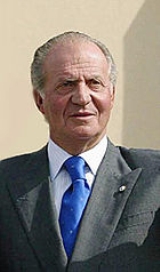
which supports and facilitates the monarch in the exercise of his royal duties and prerogatives. The monarchy is currently represented by King Juan Carlos I, his wife Queen Sofia
, and their children and grandchildren
. Opinion polls routinely reveal that the monarchy remains popular by a wide majority of citizens in contemporary Spain, with as many as 75% of Spanish citizens ranking the monarchy above any other public institution in the country. In 2010, the budget for the Spanish monarchy was 7.4 million euros, one of the lowest public expenditures for the institution of monarchy in Europe.
The Spanish Constitution of 1978
restablished a constitutional monarchy
as the form of government for Spain. The 1978 constitution affirmed the role of the King of Spain as the personification and embodiment of the Spanish State and a symbol of Spain's enduring unity and permanence. Constitutionally, the king is the head-of-state and commander-in-chief
of the Spanish Armed Forces
. The constitution codifies the use of royal styles and titulary, royal prerogatives
, hereditary succession to the crown
, compensation
, and a regency
-guardianship contingency in cases of the monarch's minority
or incapacitation
. According to the constitution, the monarch is also instrumental in promoting Ibero-America
n relations, the "nations of its historical community". In this capacity, the King of Spain serves as the president of the Ibero-American States Organization, representing over 700,000,000 people in twenty-four member nations worldwide. In 2008, Juan Carlos I was considered the most popular leader in all Ibero-America
.
The Spanish monarchy has its roots in the Visigothic Kingdom
founded in Spain
and Aquitainia
in the 5th century, and its Christian
successor states
which fought the Reconquista
following the Umayyad invasion of Hispania in the 8th century. A dynastic marriage between Isabella I of Castile
and Ferdinand II of Aragon
united Spain in the 15th century. The Spanish Empire
became one of the first global powers as Queen Isabella and King Ferdinand funded Christopher Columbus
's exploratory voyage across the Atlantic Ocean. This led to the rediscovery of America by Europeans
, which became the focus of Spanish colonization.
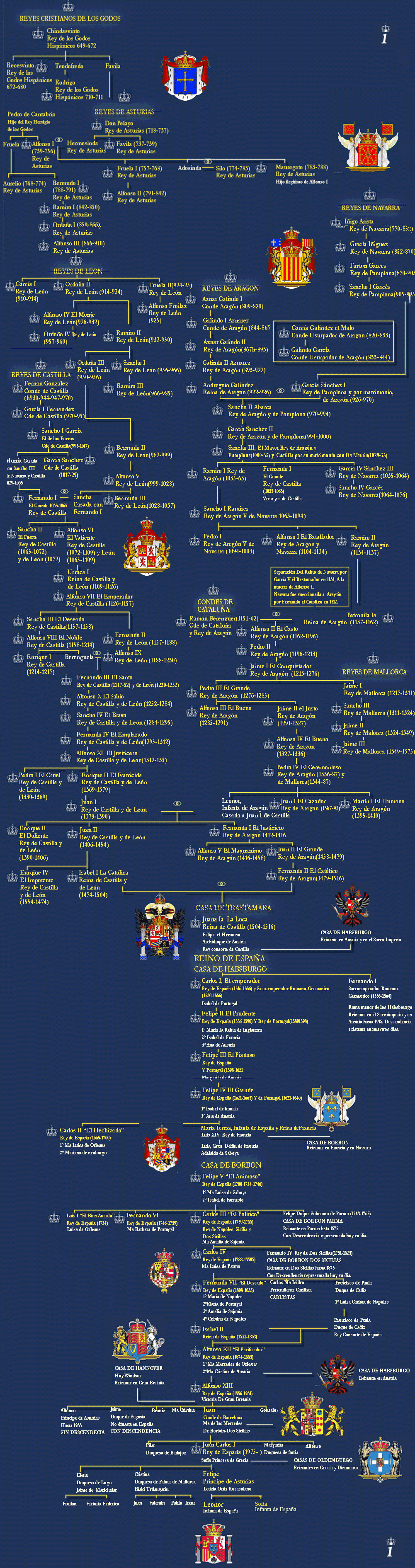 The Spanish monarchy has its roots in the Visigothic Kingdom
and its Christian successor states
of Navarra, Asturias
and Aragon
, which fought the Reconquista or Reconquest of the Iberian peninsula following the Umayyad invasion of Hispania in the 8th century. One of the earliest influential dynasties was the House of Jiménez
which united much of Christian Iberia under its leadership in the 11th century. From Sancho III of Navarre
(r. 1000-1035) until Urraca of León and Castile (r.1106-1125), members of the Jiménez family claimed the historic Visigothic title Imperator totius Hispaniae or Emperor of All Spain
. The Jiménez rulers sought to bring their kingdoms into the European mainstream and often engaged in cross-Pyrenees
alliances and marriages, and became patrons to Cluniac Reforms
(c. 950–c.1130). Uracca's son and heir Alfonso VII of León and Castile, the first of the Spanish branch of the Burgundy Family
, was the last to claim the imperial title of Spain, but divided his empire among his sons. The Castilian Civil War
(1366 to 1369) ended with the death of King Peter (r. 1334-1369) at the hands of his illegitimate half-brother Henry, 1st Count of Trastámara who ruled as Henry II (r. 1369–1379). Henry II became the first of the House of Trastámara to rule over a Spanish kingdom. King Peter's heiress, his granddaughter Catherine of Lancaster
, married Henry III
, reuniting the dynasties in the person of their son, King John II
.
In the 15th century, the marriage between Isabella I of Castile
and Ferdinand II of Aragon
, both members of the House of Trastámara, known as the Catholic Monarchs
, united most of the Iberian peninsula
. In 1492 the Catholic Monarchs conquered the Kingdom of Granada in southern Spain, the last moorish territory in the Iberian peninsula. This date marks the unification of Spain.
In the early 16th century, the Spanish monarchy controlled several territories in Europe under the Habsburg King Charles I
(also Holy Roman Emperor
as Charles V), son of Queen Joanna of Castile
. His reign ushered in the Spanish Golden Age
(1492–1659) a period of great colonial expansion
and trade. In 1700, Charles II
, the last of the Spanish Habsburgs, designated his sister Maria Theresa
's grandson, Philip of France
, Duke of Anjou, as his heir. The possible unification of Spain with France sparked the Spanish War of Succession in the 18th century, culminating in the treaties of Utrecht (1713) and Rastatt (1714)
which preserved the European balance of power
. Philip V was the first member of the House of Bourbon (Spanish: Borbón) to rule Spain, the dynasty that still rules today under Juan Carlos I
.
During the Napoleonic Wars
, the French Emperor Napoleon Bonaparte forced Ferdinand VII to abdicate in 1808 and the Bourbons became a focus of popular resistance against French rule. However, Ferdinand's rejection of the liberal Spanish Constitution of 1812
, his ministerial appointments, particularly the exclusion of liberals, gradually eroded popular support for the Spanish monarchy. With the Pragmatic Sanction of 1830
, Ferdinand set aside the Salic Law, introduced by Philip V, that prohibited women from becoming sovereigns of Spain. Thereby, as had been customary before the arrival of the Bourbons, the King's eldest daughter Isabella
became his heiress presumptive. Opponents of the Pragmatic Sanction argued that it was never officially promulgated, claiming the King's younger brother, Prince Carlos
, the rightful heir to the Crown according to the Salic Law.
Thus began a series of civil wars known as the Carlist Wars
, named after the Carlists, who supported Prince Carlos' claim. Queen Isabella II, whose main support came from centrists and moderates, was beset by Carlisti
forces on the extreme right and radicals on the extreme left. Faced with these challenges, Isabel's rule became increasingly reactionary in her dealings with the polorized Cortes, and her authoritarian rule became increasingly dependent on the army. Isabella II's reliance on the military eroded her popular support from the moderates and centrists until 1868 when she was forced to abdicate. In September 1873 the First Spanish Republic
was founded.
A coup d'état
restored the Borbón dynasty to the throne in 1874. However, in 1931 local and municipal elections produced victories (particularly in urban areas) for candidates favoring an end to the monarchy and the establishment of a republic. Faced with unrest in the cities, King Alfonso XIII
went into exile, but did not abdicate. The ensuing provisional government evolved into the relatively short-lived Second Spanish Republic
. The Spanish Civil War
began in 1936 and ended on 1 April 1939 with the victory of General Francisco Franco
and his coalition of allied organizations commonly referred to as the Nationalists.
General Franco ruled Spain as Regent to the King of Spain. However, without a king on the throne, he ruled through a coalition of allied organizations from the Spanish Civil War including, but not limited to, the fascist
Falange
political party, the supporters of the Borbon royal family, and the Carlists, until his death in 1975. Despite Franco's alliance with the Carlists, Franco appointed Juan Carlos I de Borbón as his successor, who is credited with presiding over Spain's transition from dictatorship to democracy by fully endorsing political reforms.
Impatient with the pace of democratic reforms, the new king, known for his formidable personality, dismissed Carlos Arias Navarro
and appointed the reformer Adolfo Suárez
as President of the Government in 1977.
The next year the king signed into law the new liberal democratic Constitution of Spain
, which was approved by 88% of voters. Juan Carlos' "quick wit and steady nerve" cut short the attempted military coup in 1981
when the king used a specially designed command communications center in the Zarzuela Palace to denounce the coup and command the military's eleven captain-generals to stand down.
Following the events of 1981, Juan Carlos has led a less eventful life, according to author John Hooper. The king does not preside over ceremonies such as the opening of hospitals and bridges as often as monarchs in other nations. Instead, he has worked towards establishing reliable political customs when transitioning one government administration to another, emphasizing constitutional law and protocol, and representing the Spanish State domestically and internationally, all the while maintaining a professionally non-partisan yet independent monarchy.
. Constitutionally the monarch embodies and personifies the unity and permanace of the Spanish State
, and represents the legal personality of the State and by extension fulfills the role of "Father of the Nation
". As a unifying figure for the nation, in 2010 King Juan Carlos worked towards "bridging the gap" between Spain’s rival polarized political parties to develop a unified strategy in response to the country’s on-going late-2000's economic crisis
.
According to the Spanish Constitution voted in referendum
, the sovereignty power emanates from the people, so it's the very same people who give the king the power to reign:
The monarch "arbitrates and moderates the regular functioning of the institutions
" and assumes the highest representation of the Spanish State in international relations.
The monarch exercises the functions expressly conferred on him by the constitution and the laws.
Upon accession to the crown and being proclaimed before the Cortes Generales, the king swears an oath
to faithfully carry out his constitutional duties and to abide by the constitution and laws of the state. Additionally, the constitution gives the king the added responsibility to ensure that the constitution is obeyed. Lastly, the king swears to respect the rights of Spanish citizens and of the self governing communities. The Prince of Asturias, upon reaching the age of majority, in addition to any regent(s) upon assuming the office, swears the same oath as that of the king along with a further oath of loyalty to the monarch.
The oath reads as follows:
The 1978 Constitution, Title II The Crown, Article 62, delineates the powers of the king, while Title IV Government and Administration, Article 99, defines the king's role in government. Title VI Judicial Power, Article 117, Articles 122 through 124, outlines the king's role in the country's independent judiciary. However, by constitutional convention
established by Juan Carlos I, the king exercises his prerogatives having solicited government advice while maintaining a politically non-partisan and independent monarchy. Receiving government advice does not necessarily bind the monarch into executing the advice, except where prescribed by the constitution.
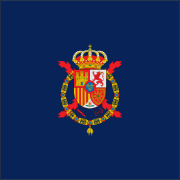
The 1978 constitution confirms the title of the monarch is King of Spain, but that he may also use other titles historically associated with the Crown. The titles used by Alfonso XIII
before his exile in 1931 which, with this provision of the constitution, the king is entitled to use include:
According to the royal decree published in 1987, the king and the queen consort
will formally be addressed as "His Majesty and Her Majesty" (Their Majesties, Spanish: Su Majestad, Su represents His or Her) rather than the traditional "Catholic Majesty" (Su Católica Majestad). A prince consort
of a regnant
Queen of Spain will have the style "His Royal Highness" (Su Alteza Real). Additionally, a widowed and unmarried queen consort, now a queen dowager
, will continue to be addressed as "Her Majesty". A widowed and unmarried prince consort will continue to be addressed as "His Royal Highness". The heir from birth shall hold the title of Prince of Asturias
and the other titles historically associated with the heir apparent. These additional titles include Prince of Viana
, historically associated with the heir apparent to the Kingdom of Navarre
; with the titles Prince of Girona
and Duke of Montblanc
historically associated with the heir apparent for the Crown of Aragon
, among others. Other children of the monarch, and the children of the heir apparent, shall have the title and rank of Infante or Infanta (prince or princess), and styled His or Her Royal Highness (Su Alteza Real). Children of an Infante or Infanta of Spain "shall have the consideration of Spanish Grandee
s", and the address of "Your Excellency". The royal decree further limits the ability of any regent to use or create titles during the minority or incapacitation of a monarch. No further constitutional language prescribes titles or forms of address to the fourth generation, or great grandchildren, of a reigning monarch.
The monarch's position as the "Fount of honour
" within Spain is codified in Article 62 (f); It is incumbent upon the monarch to "[...] confer civil and military positions and award honors and distinctions in conformity of the law". According to the Spanish Ministry of Justice, nobility and grandee titles are created
by the "sovereign grace of the king", and may be passed on to the recipient's heirs, who may not sell the title. Titles may revert back to the Crown when their vacancy is observed. Succession of titles may follow one of several courses listed on the Title of Concession when the title is created. As a general rule, most titles are now inherited by absolute Cognatic Primogeniture (as of 2006), in which the first born inherits all titles regardless of gender. However, a title holder may designate his successor, Succession by Assignment, or disperse his titles among his children – with the eldest getting the highest ranking title, Succession by Distribution.
The king awarded peerages to two of his former prime ministers who have retired from active politics: Adolfo Suárez
, who was created 1st Duke of Suárez
; and Leopoldo Calvo-Sotelo who was created 1st Marquess of la Ría de Ribadeo. The king's third prime minister Felipe González
declined a title, while José María Aznar
's tenure was mired in controversies making a peerage unlikely. All successive politicians remain active within politics.
The king grants military and civil orders and awards of distinction, customarily on the advice of government. The most distinguished order the king may award is the Order of Charles III to "citizens who, with their effort, initiative and work, have brought a distinguished and extraordinary service to the Nation". The Laureate Cross of Saint Ferdinand
is Spain's highest military award for gallantry. Other historic awards and distinctions include the Spanish Order of the Golden Fleece
, the Order of Isabela the Catholic, the Order of Alfonso X, the Order of Marie Louise, the Order of Saint Raimundo de Penafort, the Order of Military Merit, the Order of Naval Merit, the Order of Aerial Merit, the Order of Civil Merit, the Order of Cultural Merit, the Order of Calatrava
, the Order of the Knights of Santiago, the Order of Sant Jordi d'Alfama
, and the Order of Alcántara
, among others.
which evolved in similar constitutional monarchies. The legal concept of sovereign immunity evolved into other aspects of immunity law in similar liberal democracies, such as parliamentary immunity
, judicial immunity
, and qualified immunity
in the United States.
The concept of lèse majesté
(lesa majestad) exists in Spanish jurisprudence
, which is the crime or offense violating the dignity of the head-of-state or the State itself. According to Article 56 of the 1978 Constitution the monarch and the dignity of the Spanish State are one and the same: "The King is Head of State, the symbol of its unity and permanence". Breaching Spain's lèse majesté laws may carry fines and up to two years in prison. The concept is within the same legal sphere as legislation prohibiting flag desecration
in other democratic countries. Additionally, lèse majesté extends to any foreign heads-of-state visiting Spain, and other members of the royal family, and to the Spanish President of the Government
as the king's appointed officer.
The Spanish
satirical magazine El Jueves
was fined for violation of Spain's lèse majesté laws after publishing an issue with a caricature of the Prince
and Princess of Asturias
engaging in sexual intercourse
on their cover in 2007. In 2008, 400 Catalonia separatists burned images of the king and queen in Madrid, and in 2009 two Galician separatists were fined for burning effigies of the king.
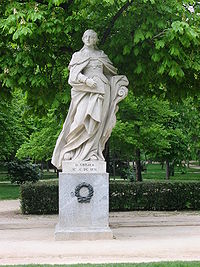 According to Article 57 the Crown of Spain is inherited by the successors of King Juan Carlos I de Borbón through male preference primogeniture
Article 57 is also significant in that it omits entirely the Franconist era designation of Juan Carlos as Franco's successor. While drafting the new constitution, lawyer and liberal congressman Joaquín Satrústegui (1909–1992) insisted that the phrase the legitimate heir of the historic dynasty be included in the text to underscore that the monarchy was an historic institution predating the constitution or the prior regime. Additionally, Satrústegui was "anxious to remove" notions that the constitutional monarchy had any Francoist origins, according to author Charles Powell.
Male preference cognatic primogeniture has been practiced in Spain since the 11th century in the various Visigothic successor states and codified in the Siete Partidas
, with women able to inherit in certain circumstances. However, with the succession of Philip V in 1700, the first of the Spanish Bourbons, women were barred from succession until Ferdinand VII reintroduced the right and designated his eldest daughter Isabella
as his heiress presumptive by 1833.
With the birth of Infanta Leonor of Spain
on 31 October 2005 to the Prince and Princess of Asturias, President Zapatero reaffirmed his government's intention to amend the Spanish constitution by introducing full and equal cognatic primogeniture, also known in French as aînesse intégrale, which is a gender neutral succession law already adopted in Norway, Sweden, the Netherlands, Belgium, and Denmark. Zapatero's proposal was supported by the leader of the main opposition party, the conservative Partido Popular
, making its passage likely. The rights of the current heir apparent Felipe, Prince of Asturias
, would be maintained. With full or equal cognatic primogentiture, the first born would be the heir apparent regardless of gender. Paving the way, in 2006 the king issued a decree reforming the succession to noble titles from male preference primogeniture to absolute and equal cognatic primogeniture. However, as succession to the Crown is codified explicitly in the constitution, its reform mandates an amendment to the constitution, a somewhat more complicated process than issuing a royal decree. Prince Felipe has counseled reformers that there is plenty of time before the constitutional amendment would need to be enacted as he is next in line, and after him his daughters.
If all lines designated by law become extinct, the constitution reserves the right for the Cortes Generales to provide for the succession "in the manner most suitable for Spain". The 1978 constitution disinherits members of the royal family from succession if they marry against the expressed prohibition of the monarch and the Cortes Generales, as well as their descendants. Lastly, Article 57 further provides that "Abdications and renunciations and any doubt in fact or in law that may arise in connection with the succession to the Crown shall be settled by an organic act".
Constitutionally, the current heirs of Juan Carlos I;
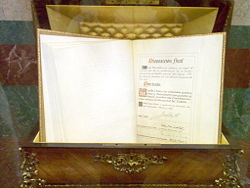
The constitution outlines the regency
of the monarchy and guardianship of the person of the monarch in the event of his minority or incapacitation. The office of Regent(s) and the Guardianship of the monarch (whether the monarch is in his minority or incapacitated), may not necessarily be the same person. In the event of the minority of the monarch, the surviving mother or father, or oldest relative of legal age who is nearest in line to the throne, would immediately assume the office of Regent, who in any case must be Spanish. If a monarch becomes incapacitated, and that incapacitation is recognized by the Cortes Generales, then the Prince of Asturias (the heir apparent), shall immediately become Regent, if he is of age. If the Prince of Asturias is himself a minor, then the Cortes Generals shall appoint a Regency which may be composed of one, three, or five persons. The person of the king in his minority shall fall under the guardianship of the person designated in the will of the deceased monarch, provided that he or she be of age and of Spanish nationality. If no guardian has been appointed in the will, then the father or mother will then assume the guardianship, as long as they remain widowed. Otherwise, the Cortes Generales shall appoint both the Regent(s) and the guardian, who in this case may not be held by the same person, except by the father or mother of direct relation of the king.
 The constitution defines the government's responsibilities. The government consists of the President of the Government and ministers of state
. The government conducts domestic and foreign policy
, civil and military administration, and the defense of the nation
all in the name of the king. Additionally, the government exercises executive authority and statutory regulations. The most direct prerogative the monarch exercises in the formation of Spanish governments is in the nomination and appointment process of the President of the Government
(Presidente del Gobierno de España). Following the General Election
of the Cortes Generales
(Cortes), and other circumstances provided for in the constitution, the king meets with and interviews the political party leaders represented in the Cortes, and then consults with the Speaker of the Congress (who, in this instance, represents the whole of the Cortes Generalas).
Constitutionally, the monarch may nominate anyone he sees fit as his prerogative. However, it remains pragmatic for him to nominate the person most likely to enjoy the confidence of the Cortes and form a government, usually the political leader whose party commands the most seats in the Cortes. For the Crown to nominate the political leader whose party controls the Cortes can be seen as a royal endorsement of the democratic process, a fundamental concept enshrined in the 1978 constitution. By political custom
, the king's nominees have all been from parties who hold the most seats in the Cortes. The king is normally able announce his nominee the day following a General Election.
The king's nominee is presented before the Cortes by the Speaker where the nominee and his political agenda are debated and submitted for a Vote of Confidence (Cuestión de confianza) by the Cortes. A simple majority confirms the nominee and his program. After the nominee is deemed confirmed by the Speaker of the Congress of Deputies, the king appoints him as the new President of the Government in a ceremony performed at the Salón de Audiencias in the la Zarzuela Palace
, the official residence of the king. During the inauguration ceremony, the President of the Government takes an oath of office
over an open Constitution next to the Holy Bible. The oath as taken by President Zapatero on his second term in office on 17 April 2004 was;:
However, if no overall majority was obtained on the first vote of confidence, then the same nominee and program is resubmitted for a second vote within forty-eight hours. Following the second vote, if confidence by the Cortes is still unreached, then the monarch again meets with political leaders and the Speaker, and submits a new nominee for a vote of confidence. If, within two months, no candidate has won the confidence of the Cortes then the king dissolves the Cortes and calls for a new General Election. The king's royal decree is countersigned by the Speaker of the Congress.
In the political life of Spain, the king would already be familiar with the various political leaders in a professional capacity, and perhaps less formally in a more social capacity, facilitating their meeting following a General Election. Conversely, nominating the party leader whose party maintains a plurality and who are already familiar with their party manifesto
facilitates a smoother nomination process. In the event of coalitions
, the political leaders would customarily have met beforehand to hammer out a coalition agreements before their meeting with the king. Once appointed, the President of the Government forms an administration whose ministers are appointed and removed by the king on the president's advice. No minister may take up his appointment until after they give their oath of office to obey the constitution with loyalty to the king.
As early as 1975, Juan Carlos expressed his view that his role in the government of a "crowned democracy" would be for him to counsel and orient an administration's "thrust in action", but for the government to take the initiative without the need for it to involve the king unnecessarily in its decisions. Therefore, Juan Carlos has abstained from presiding over cabinet meetings except under special occasions or circumstances. Generally, the king presides over cabinet meetings once or twice a year (more regularly if needed) to be directly informed by ministers of non-partisan national and international concerns. However, the king does meet weekly with the President of the Government, usually on Tuesday mornings. During the late-2000's economic recession
which gripped the nation, the king discretly used his influence to facilitate a bi-partisan response to the crisis.
Governments and the Cortes sit for a term no longer than four years when the president tenders his resignation to the king and advises the king to dissolve the Cortes, prompting a General Election. It remains within the king's prerogative to dissolve the Cortes if, at the conclusion of the four years, the president has not asked for its dissolution, according to Title II Article 56. The president may call for earlier elections, but no sooner than a year after the prior General Election. Additionally, if the Government loses the confidence of the Cortes, then it must resign. In the event that a president dies or becomes incapacitated while in office, then the government as a whole resigns and the process of royal nomination and appointment takes place. The vice president would take over the day to day operations in the meantime, even while vice president himself may be nominated by the king.
) and promulgation (publication) of the laws with the king, while Title III The Cortes Generals, Chapter 2 Drafting of Bills outlines the method with which bills are passed. According to Article 91, within fifteen days that a bill has been passed by the Cortes Generales, the king shall give his assent and publish
the new law. Article 92 invests the king with the right to call for referendum on the advice of the president and the previous authorization of Congress.
No provision within the constitution invests the king with the ability to veto legislation directly, however no provision prohibits the king from withholding royal assent, effectively a veto. When the media asked King Juan Carlos
if he would endorse the 2005 bill legalizing gay marriages
(the implication implied that he may not endorse the bill), he answered "Soy el Rey de España y no el de Bélgica" ("I am the King of Spain, not of Belgium")– a reference to King Baudouin I of Belgium who had refused to sign the Belgian law legalising abortion
in Belgium.
According to Title VI of the constitution, Justice in Spain "emanates from the people and is administered on behalf of the King by judges and magistrates members of the Judicial Power..." It remains a royal prerogative for the king to appoint the twenty members to the General Council of the Judicial Power of Spain
(Spain's Supreme Court), and then appoint the President of the Supreme Court nominated by the General Council, according to Article 122, Subsection 3, of the constitution. However, by convention the king's nominations have been with the advice of the government of the day.
Additionally, the king appoints the State Public Prosecutor
on the advice of the government, according to Article 124. The king may grant clemency in accordance with the law, however the king may not authorize a general pardon of government ministers who have been found criminally liable or guilty of treason by the Criminal Article of the Supreme Court, according to Articles 62 and 102.
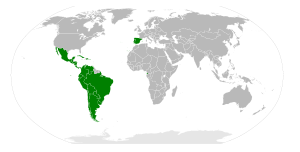 Constitutionally the king accredits Spanish ambassadors to international states and governments, and foreign representatives to Spain are accredited before him. However, the government of the day manages diplomatic policy on behalf of the monarch. Additionally, it remains the responsibility for the monarch to express the state's assent to international commitments and treaties, which must be in conformity with the Spanish constitution.
Juan Carlos followed a foreign policy during the first decade of his kingship coined Reencounter and Reconciliation, which greatly improved Spain's standing on the world stage. The king reconciled long standing historic tensions with the Netherlands and cultivated relationships with France and Germany which led directly to Spain's entry into the European Community and into NATO. Following the tensions between Franco and the Papacy over the reforms of the Second Vatican Council
, Juan Carlos' personal relations with successive popes greatly improved diplomatic relations between the Holy See
and Spain, and with Pope Paul VI
blessing Juan Carlos' democratic reforms. According to historian Charles Powell, it was the king's goal to win Spain's full acceptance by other European powers. The king, a self described Europeanist
, was awarded the prestigious Charlemagne Award in 1982 for his steadfast work towards democracy and for supporting European unity. The constitution gives the monarch special responsibility in promoting Spanish relations with members of its historic community, the nations formerly part of the Spanish Empire
and also relations with Portugal and Brazil. Fulfilling this responsibility, the King of Spain serves as president of the twenty-four member Ibero-American States Organization. With his support of democracy, various elements within Ibero-America political society have sought the king's advice on how to transition from a dictatorship to a democracy. For his efforts, by 2008 the king was voted the most popular leader in all of the Ibero-America
community.
The king is assisted in his diplomatic missions by the Foreign Ministry
, and high-ranking members of the Foreign Ministry are made available to the king when he is abroad representing Spain. The Royal Household coordinates with the Foreign Ministry to ensure successful diplomatic engagements. Additionally, other members of the royal family, most notably the Prince of Asturias, may represent the Spanish State internationally. Though the Spanish monarchy is independent of the government, it is important that royal speeches are compatible with government foreign policy to project a unified diplomatic effort. To achieve balance, Royal Household speechwriter
s confer with the Foreign Ministry to ensure that the official speeches strike the desired diplomatic tone between the king's views and government policy. When necessary and appropriate, the king and his government may focus on two different aspects in a diplomatic engagement. The king may emphasize one aspect, such as the promotion of democracy and historic relations; while the government focuses on the details of strategic planning and bilateral coordination.
The king and members of the royal family have represented Spain in Europe, Latin America, in the United States and in Canada, nations in the Middle East and North Africa, in China, Japan, the Philippines
, Australia, New Zealand and many countries in sub-Sahara Africa. The king and Prince of Asturias have addressed many international organizations which include the United Nations
, the institutions of the European Union
, the Council of Europe
, the Organization of American States
, UNESCO
, the International Labour Organization
, and the Arab League
. Since 2000, Prince Felipe has represented Spain in half of all diplomatic engagements.
However, Title IV of the constitution vests the administration of the armed forces and formulation of national defense policy with the President of the Government, a civilian authority who is nominated and appointed by the king, confirmed by the elected Congress of Deputies and, as such, is representative of the Spanish people.
Royal Decree #1310 of Oct 5, 2007 requires the National Defence Council to report to the monarch, and that the king is to be the Chairman of the Council when he attends its sessions. The National Defence Council is Spain's highest advisory body on security and defense matters and performs the same basic function as the US National Security Council
. King Juan Carlos chaired the first full meeting of the council on Nov 10 2007, at which the newly proposed National Defence Directive was reviewed along with the ongoing peace missions in Afghanistan, Kosovo, Bosnia and Lebanon.
As Commander-in-Chief of the armed forces, the king holds the highest ranking office in the military chain of command. The king's ranks include Captain General of the Army, the Navy and the Air Force. The king is the only officer in the military to hold this 5 Star General rank. The king takes a keen interest in all aspects of military policy as evidenced by "his direct participation in the life of the Spanish Armed Forces". The king's participation in Spanish military life stems from his constitutional duty to "arbitrate and moderate" the regular working of state institutions. Serving in the armed forces is considered an expectation of the heir apparent, and Juan Carlos served in the various branches of the armed forces before he became king. Likewise, Prince Felipe, Prince of Asturias, has served in the armed forces.
The monarch has made his desire for a strong raport with the armed forces clear in speeches to his officer corp:
," Villespin continued. Members of the royal family are routinely voted among the most respected public figures in Spain, and in 2010 as many as 75% of Spanish citizens ranked the monarchy as "above any other public institution in the country", according to Dr Juan Díez-Nicolás, a former president of the CIS and founder of the private consulting firm ASEP (Análisis Sociológicos Económicos y Políticos). The CIS, a non-partisan government funded independent research institution, has been researching public opinion of the monarchy since 1984 and tracks three basic lines of inquiry; what is public confidence in the monarchy, what is the role of the monarchy in a democratic system, and to what degree has the king contributed to the democratic process.
The king is routinely considered one of the top ten most popular figures in Spain, with as many as 80% of Spanish believing Spain's transition to democracy would not have been made possible without the king's personal intervention. Historian and royal biographer Charles Powell told BBC News
in 2008 that "There's a deep-rooted feeling of gratitude for the king's role in the transition to democracy [and] Polls show that he is the individual to whom democratisation is most closely attributed, and the sense of gratitude cuts across class and ideological lines."
Part of the monarchy's appeal may lay in the personal characteristics of Juan Carlos, whose philosophy on his family, on personal integrity
, and on a selfless work ethic
were revealed in intimate private letters of fatherly advice to his son Felipe, Prince of Asturias, between 1984 and 1985, when Felipe was then attending university in Canada. According to Juan Carlos a monarch must not take his position for granted but work for the people's welfare, be kind, attentive and helpful, and "appear animated even when you are tired; kind even when you don't feel like it; attentive even when you are not interested; helpful even when it takes an effort [...] You need to appear natural, but not vulgar; cultivated and aware of problems, but not pedantic or conceited".
The king continued;
"I have had to stand snubs and contempt, incomprehension and annoyances that you, thank God, have not known", reminded the king to his son in one letter. The private letters from father to son remain within the royal household, but were copied and released into the public domain without any approval or foreknowledge, according to a Zarzuela palace official who confirmed the letter's authenticity.
Despite the high approval ratings from the Spanish mainstream
, and in particular the personal popularity enjoyed by the current king and queen, the monarchy has been the focus of acute criticism from the extreme left
and extreme right
of the Spanish political spectrum
, and by regional separatists. As many as 22% of Spanish citizens feel that a republic would be the better form of government for Spain, while separatists and independence supporters in the Basque Country
and Catalonia
routinely protest the monarchy as the living symbol of a united Spain. The extreme left criticize the institution of monarchy as anachronistic
, while the far right criticize King Juan Carlos personally because he has given his royal assent and tacit approval to what they perceive to be a liberal agenda in Spain
and a secularism
of Spanish life
.
, "the royals", are often asked by non-profit charitable, cultural, or religious organizations within Spain or internationally to become their patrons
, a role the Spanish constitution recognizes. Royal patronage conveys a sense of official credibility as the organization is vetted for suitability. A royal presence often greatly raises the profile of the organization and attracts public interest and media coverage that the organization may not have otherwise garnered, aiding in the charitable cause or cultural event. Royals use their considerable celebrity
to assist the organization to raise funds or to affect or promote government policy.
Members of the royal family also pursue charitable and cultural causes of special interest to themselves. Queen Sofía devotes much of her time to the Queen Sofia Foundation (Fundación Reina Sofia). Established in 1977 out of the queen's private funds, the non-profit aims to assist, promote, and develop the spiritual and physical needs of men and women from diverse backgrounds, with a particular focus on progress, welfare, and justice.
Prince Felipe chairs the Prince of Asturias Foundation (Fundación Príncipe de Asturias), which aims to promote "scientific, cultural and humanistic values that form part of mankind's universal heritage." The Prince of Asturias Foundation holds annual awards
ceremonies acknowledging the contributions of individuals, entities, and organizations which make notable achievements in the sciences, humanities, or public affairs. Prince Felipe serves as president of the Codespa Foundation
, which finances specific economic and social development activities in Ibero-America and other countries, and serves as president of the Spanish branch of the Association of European Journalists
, which is composed of achieving communications professionals. Prince Felipe also serves as honorary chair of the Ministry of Culture National Awards Ceremonies.
Infanta Elena, Duchess of Lugo, the king's eldest daughter, is the Director of Cultural and Social Projects of Mapfre Foundation, while Infanta Cristina, Duchess of Palma de Mallorca, the king's youngest daughter, served as the Goodwill Ambassador
to the United Nations
for the 2nd World Assembly on Ageing, and is a member of the Dali Foundation Board of Trustees, president of the International Foundation for Disabled Sailing, and Director of Social Welfare at the La Caixa Foundation in Barcelona
where she lives with her family.
The king, queen, and Infanta Cristina are all members of the Bilderberg Group
, an informal think-tank centered on United States and European relations, and other world issues.
The king gives annual Christmas Eve National Speech
es entitled "Mensaje de S.M. Juan Carlos I" which are broadcast by radio and television through various media outlets. The king usually refers to social or economic challenges facing the nation as well as positive messages of charity, good will, and religious faith. In 2004, the speech was highly related to the 2004 Madrid train bombings; in 2006 he talked about the need to become a united nation against terrorism (in implicit support of Zapatero's anti-terrorist policies), and he mentioned the increasing force of immigrants in Spain and appreciated their contribution to the economy.
 The royal household organization, constitutionally La Casa de Su Majestad el Rey, supports and facilitates the monarch and members of the royal family in fulfilling their constitutionally hereditary responsibilities and obligations. The royal household is funded through yearly budgets drafted by the government of the day in consultation with the monarch, and brought before the Cortes for approval, and then paid directly to the monarch. The royal household coordinates with various government administration ministries, and receives their advice and support where needed, though in no way does the royal household form part of the government administration. Royal household staff serve at the pleasure of the monarch, and does not resign when the Spanish government resigns during election cycles. The royal household is managed by the Head of the Household who inspects and supervises all household operations through various bureaus or offices of the General Secretariat. The Head of the Household is assisted by a Secretary General. The General Secretariat is divided into various departments which includes planning and coordination, the secretariat (bureau) of H.M. the Queen, the secretariat (bureau) of H.R.H. the Prince of Asturias, security services, public relations and the media, protocol, administration, Infrastructure and Services.
The Spanish Armed Forces
are represented by the Head of the Military Chamber, who does not advise the king on matters of national defense, which is the portfolio of the Minister of Defence and President of the Government to advise the king. Rather, the Head of the Military Chamber coordinates royal military operations and ceremonies, and prepares the royal family for any military activities. The Military Chamber is directed by a commander who must be an active lieutenant-general or a general within the Spanish military, and is under the direct orders of the king. The commander maintains an office with a military legal advisor, an auditor, and section heads for staffing, protocol, operations and logistics. The king is assigned personal aides-de-camp
for his assistance, and by extension to the queen and Infantas Doña Elena and Doña Cristina during their official activities. Aides-de-camp are drawn from all of the services, with four from the Army, two from the Navy, two from the Air Force, and one from the Civil Guard. The Prince of Asturias is entitled to personal aides-de-camp assigned to him and the Princess of Asturias, with one drawn each from the army, the navy and the air force.
The Head of the Household, Secretary General, and Head of the Military Chamber are considered senior management staff and are compensated at the level of senior government administration officials. In 2004, the royal household employed 100 staff members.
The royal household's public relations department manages and maintaines an official website on behalf of the royal family known as Casa de S.M. El Rey. The website lists biographical information on members of the immediate royal family, charts their activities, records speeches given at events, and publishes their expected diary of upcoming events, among other information. Additionally, the public relations department publishes the king's diary of his private meetings and the meeting minutes, so long as the other party agrees.
in Madrid
. However, the couple have spent the majority of their time at the modest La Zarzuela Palace, a former hunting lodge on the El Pardo estate on the outskirts of Madrid. The Prince of Asturias and his family reside at the Prince's House (also known as the Pavilion) near the La Zaruela, also on the El Pardo estate. The El Pardo Palace itself has served as the "guest house" for visiting heads of state since the 1980s.
The Oriente Palace and the palaces of the El Pardo estate form part of the "Spanish royal sites
", a term used to denote the set of palaces, monasteries, and convents built under royal patronage throughout history. Royal sites are owned by the state and administered by the Patrimonio Nacional
(National Heritage) on behalf of the government of the day, and made available for the king as the head of state. Whenever a member of the royal family is not in residence, the royal site is made available for public visitations. The royal household coordinates directly with the National Heritage Council and releavent government ministries or other interests in their planning and staging of state events, with royal sites often providing the setting.
The king and his family regularly vacation on Palma de Mallorca
making use of the Marivent Palace there since the 1960s. In 2001 the king, known as a keen yachtman, was given a yacht by the Balearic Islands
and a consortium of local business leaders as part of an effort to further associate the royal family with the islands, and to promote the islands as a tourist destination. The yacht, known as the Fortuna, is also owned by the State and administered by the Patrimonio Nacional.
, domestic staffing
and catering. The budget is administered with professional Public Administration accounting procedures, and is audited by government auditors. All members of the royal family are subject to taxation and annually submit Income Tax and Wealth Tax returns and effect the relevant payments.
Constitution
A constitution is a set of fundamental principles or established precedents according to which a state or other organization is governed. These rules together make up, i.e. constitute, what the entity is...
al institution and an historic office of Spain
Spain
Spain , officially the Kingdom of Spain languages]] under the European Charter for Regional or Minority Languages. In each of these, Spain's official name is as follows:;;;;;;), is a country and member state of the European Union located in southwestern Europe on the Iberian Peninsula...
. The monarchy comprises a reigning King or Queen of Spain, their family, and the royal household organization
Royal Household of Spain
The Royal Household of Spain, officially the La Casa de Su Majestad el Rey , is the constitutional organization which supports the monarch in the exercise of his royal duties and prerogatives. The Royal Household does not form part of the Spanish Government, and remains exclusively under the...
which supports and facilitates the monarch in the exercise of his royal duties and prerogatives. The monarchy is currently represented by King Juan Carlos I, his wife Queen Sofia
Queen Sofía of Spain
Queen Sofía of Spain is the wife of King Juan Carlos I of Spain.-Early life and family:Princess Sophia of Greece and Denmark was born in Psychiko, Athens, Greece on 2 November 1938, the eldest child of the King Paul of Greece and his wife, Queen Frederika , a former princess of Hanover...
, and their children and grandchildren
Spanish Royal Family
The Royal Family of the Kingdom of Spain consists of the current king, Juan Carlos, his spouse, Queen Sofia of Spain and their direct descendants. The Spanish royal family belongs to the House of Borbón...
. Opinion polls routinely reveal that the monarchy remains popular by a wide majority of citizens in contemporary Spain, with as many as 75% of Spanish citizens ranking the monarchy above any other public institution in the country. In 2010, the budget for the Spanish monarchy was 7.4 million euros, one of the lowest public expenditures for the institution of monarchy in Europe.
The Spanish Constitution of 1978
Spanish Constitution of 1978
-Structure of the State:The Constitution recognizes the existence of nationalities and regions . Preliminary Title As a result, Spain is now composed entirely of 17 Autonomous Communities and two autonomous cities with varying degrees of autonomy, to the extent that, even though the Constitution...
restablished a constitutional monarchy
Constitutional monarchy
Constitutional monarchy is a form of government in which a monarch acts as head of state within the parameters of a constitution, whether it be a written, uncodified or blended constitution...
as the form of government for Spain. The 1978 constitution affirmed the role of the King of Spain as the personification and embodiment of the Spanish State and a symbol of Spain's enduring unity and permanence. Constitutionally, the king is the head-of-state and commander-in-chief
Commander-in-Chief
A commander-in-chief is the commander of a nation's military forces or significant element of those forces. In the latter case, the force element may be defined as those forces within a particular region or those forces which are associated by function. As a practical term it refers to the military...
of the Spanish Armed Forces
Spanish Armed Forces
The Spanish Armed Forces are the military forces of the Kingdom of Spain. The Spanish Armed Forces are a modern military force charged with defending the Kingdom's integrity and sovereignty...
. The constitution codifies the use of royal styles and titulary, royal prerogatives
Royal Prerogative
The royal prerogative is a body of customary authority, privilege, and immunity, recognized in common law and, sometimes, in civil law jurisdictions possessing a monarchy as belonging to the sovereign alone. It is the means by which some of the executive powers of government, possessed by and...
, hereditary succession to the crown
Primogeniture
Primogeniture is the right, by law or custom, of the firstborn to inherit the entire estate, to the exclusion of younger siblings . Historically, the term implied male primogeniture, to the exclusion of females...
, compensation
Civil list
-United Kingdom:In the United Kingdom, the Civil List is the name given to the annual grant that covers some expenses associated with the Sovereign performing their official duties, including those for staff salaries, State Visits, public engagements, ceremonial functions and the upkeep of the...
, and a regency
Regent
A regent, from the Latin regens "one who reigns", is a person selected to act as head of state because the ruler is a minor, not present, or debilitated. Currently there are only two ruling Regencies in the world, sovereign Liechtenstein and the Malaysian constitutive state of Terengganu...
-guardianship contingency in cases of the monarch's minority
Minor (law)
In law, a minor is a person under a certain age — the age of majority — which legally demarcates childhood from adulthood; the age depends upon jurisdiction and application, but is typically 18...
or incapacitation
Capacity (law)
The capacity of both natural and legal persons determines whether they may make binding amendments to their rights, duties and obligations, such as getting married or merging, entering into contracts, making gifts, or writing a valid will...
. According to the constitution, the monarch is also instrumental in promoting Ibero-America
Ibero-America
Ibero-America is a term used since the second half of the 19th century to refer collectively to the countries in the Americas that were formerly colonies of Spain or Portugal. Spain and Portugal are themselves included in some definitions, such as that of the Ibero-American Summit and the...
n relations, the "nations of its historical community". In this capacity, the King of Spain serves as the president of the Ibero-American States Organization, representing over 700,000,000 people in twenty-four member nations worldwide. In 2008, Juan Carlos I was considered the most popular leader in all Ibero-America
Ibero-America
Ibero-America is a term used since the second half of the 19th century to refer collectively to the countries in the Americas that were formerly colonies of Spain or Portugal. Spain and Portugal are themselves included in some definitions, such as that of the Ibero-American Summit and the...
.
The Spanish monarchy has its roots in the Visigothic Kingdom
Visigothic Kingdom
The Visigothic Kingdom was a kingdom which occupied southwestern France and the Iberian Peninsula from the 5th to 8th century AD. One of the Germanic successor states to the Western Roman Empire, it was originally created by the settlement of the Visigoths under King Wallia in the province of...
founded in Spain
Spain
Spain , officially the Kingdom of Spain languages]] under the European Charter for Regional or Minority Languages. In each of these, Spain's official name is as follows:;;;;;;), is a country and member state of the European Union located in southwestern Europe on the Iberian Peninsula...
and Aquitainia
Occitania
Occitania , also sometimes lo País d'Òc, "the Oc Country"), is the region in southern Europe where Occitan was historically the main language spoken, and where it is sometimes still used, for the most part as a second language...
in the 5th century, and its Christian
Christian
A Christian is a person who adheres to Christianity, an Abrahamic, monotheistic religion based on the life and teachings of Jesus of Nazareth as recorded in the Canonical gospels and the letters of the New Testament...
successor states
Kingdom of Asturias
The Kingdom of Asturias was a Kingdom in the Iberian peninsula founded in 718 by Visigothic nobles under the leadership of Pelagius of Asturias. It was the first Christian political entity established following the collapse of the Visigothic kingdom after Islamic conquest of Hispania...
which fought the Reconquista
Reconquista
The Reconquista was a period of almost 800 years in the Middle Ages during which several Christian kingdoms succeeded in retaking the Muslim-controlled areas of the Iberian Peninsula broadly known as Al-Andalus...
following the Umayyad invasion of Hispania in the 8th century. A dynastic marriage between Isabella I of Castile
Isabella I of Castile
Isabella I was Queen of Castile and León. She and her husband Ferdinand II of Aragon brought stability to both kingdoms that became the basis for the unification of Spain. Later the two laid the foundations for the political unification of Spain under their grandson, Charles V, Holy Roman Emperor...
and Ferdinand II of Aragon
Ferdinand II of Aragon
Ferdinand the Catholic was King of Aragon , Sicily , Naples , Valencia, Sardinia, and Navarre, Count of Barcelona, jure uxoris King of Castile and then regent of that country also from 1508 to his death, in the name of...
united Spain in the 15th century. The Spanish Empire
Spanish Empire
The Spanish Empire comprised territories and colonies administered directly by Spain in Europe, in America, Africa, Asia and Oceania. It originated during the Age of Exploration and was therefore one of the first global empires. At the time of Habsburgs, Spain reached the peak of its world power....
became one of the first global powers as Queen Isabella and King Ferdinand funded Christopher Columbus
Christopher Columbus
Christopher Columbus was an explorer, colonizer, and navigator, born in the Republic of Genoa, in northwestern Italy. Under the auspices of the Catholic Monarchs of Spain, he completed four voyages across the Atlantic Ocean that led to general European awareness of the American continents in the...
's exploratory voyage across the Atlantic Ocean. This led to the rediscovery of America by Europeans
Voyages of Christopher Columbus
In the early modern period, the voyages of Columbus initiated European exploration and colonization of the American continents, and are thus of great significance in world history. Christopher Columbus was a navigator and an admiral for Castile, a country that later founded modern Spain...
, which became the focus of Spanish colonization.
History
Visigothic Kingdom
The Visigothic Kingdom was a kingdom which occupied southwestern France and the Iberian Peninsula from the 5th to 8th century AD. One of the Germanic successor states to the Western Roman Empire, it was originally created by the settlement of the Visigoths under King Wallia in the province of...
and its Christian successor states
Successor States
In the fictional BattleTech universe, the Successor States are the major military powers of the Inner Sphere, each governed by one of the Great Houses...
of Navarra, Asturias
Kingdom of Asturias
The Kingdom of Asturias was a Kingdom in the Iberian peninsula founded in 718 by Visigothic nobles under the leadership of Pelagius of Asturias. It was the first Christian political entity established following the collapse of the Visigothic kingdom after Islamic conquest of Hispania...
and Aragon
Kingdom of Aragon
The Kingdom of Aragon was a medieval and early modern kingdom in the Iberian Peninsula, corresponding to the modern-day autonomous community of Aragon, in Spain...
, which fought the Reconquista or Reconquest of the Iberian peninsula following the Umayyad invasion of Hispania in the 8th century. One of the earliest influential dynasties was the House of Jiménez
Jiménez dynasty
The Jiménez or Ximenes were an Iberian ruling family from the 10th century to the 13th century. They were the first Europeanisers of Spain and brought her back within the wider European political scene while also giving her the political character and division that persisted until the end of the...
which united much of Christian Iberia under its leadership in the 11th century. From Sancho III of Navarre
Sancho III of Navarre
Sancho III Garcés , called the Great , succeeded as a minor to the Kingdom of Navarre in 1004, and through conquest and political maneuvering increased his power, until at the time of his death in 1035 he controlled the majority of Christian Iberia, bearing the title of rex Hispaniarum...
(r. 1000-1035) until Urraca of León and Castile (r.1106-1125), members of the Jiménez family claimed the historic Visigothic title Imperator totius Hispaniae or Emperor of All Spain
Imperator totius Hispaniae
Imperator totius Hispaniae is a Latin title meaning "Emperor of all Spain". In Spain in the Middle Ages, the title "emperor" was used under a variety of circumstances from the ninth century onwards, but its usage peaked, as a formal and practical title, between 1086 and 1157...
. The Jiménez rulers sought to bring their kingdoms into the European mainstream and often engaged in cross-Pyrenees
Pyrenees
The Pyrenees is a range of mountains in southwest Europe that forms a natural border between France and Spain...
alliances and marriages, and became patrons to Cluniac Reforms
Cluniac Reforms
The Cluniac Reforms were a series of changes within medieval monasticism of West focused on restoring the traditional monastic life, encouraging art, and caring for the poor. The movement is named for the Abbey of Cluny in Burgundy, where it started within the Benedictine order. The reforms were...
(c. 950–c.1130). Uracca's son and heir Alfonso VII of León and Castile, the first of the Spanish branch of the Burgundy Family
Anscarids
The Anscarids or Anscarii or the House of Ivrea were a medieval Frankish dynasty of Burgundian origin which rose to prominence in Italy in the tenth century, even briefly holding the Italian throne. They also ruled the County of Burgundy in the eleventh and twelfth centuries and it was one of their...
, was the last to claim the imperial title of Spain, but divided his empire among his sons. The Castilian Civil War
Castilian Civil War
The Castilian Civil War lasted three years from 1366 to 1369. It became part of the larger conflict then raging between the Kingdom of England and the Kingdom of France: the Hundred Years' War...
(1366 to 1369) ended with the death of King Peter (r. 1334-1369) at the hands of his illegitimate half-brother Henry, 1st Count of Trastámara who ruled as Henry II (r. 1369–1379). Henry II became the first of the House of Trastámara to rule over a Spanish kingdom. King Peter's heiress, his granddaughter Catherine of Lancaster
Catherine of Lancaster
-Coat of arms:The following are Armorials of the House of Lancaster under her father, John of Gaunt.-References:* Anthony Goodman: "Katherine of Lancaster" in Oxford Dictionary of National Biography. Vol. 30 , p. 890-891....
, married Henry III
Henry III of Castile
Henry III KG , sometimes known as Henry the Sufferer or Henry the Infirm , was the son of John I and Eleanor of Aragon, and succeeded him as King of the Castilian Crown in 1390....
, reuniting the dynasties in the person of their son, King John II
John II of Castile
John II was King of Castile from 1406 to 1454.He was the son of Henry III of Castile and his wife Catherine of Lancaster, daughter of John of Gaunt, 1st Duke of Lancaster by Constance of Castile, daughter of King Peter of Castile.-Regency:He succeeded his father on 25 December 1406, at the age of...
.
In the 15th century, the marriage between Isabella I of Castile
Isabella I of Castile
Isabella I was Queen of Castile and León. She and her husband Ferdinand II of Aragon brought stability to both kingdoms that became the basis for the unification of Spain. Later the two laid the foundations for the political unification of Spain under their grandson, Charles V, Holy Roman Emperor...
and Ferdinand II of Aragon
Ferdinand II of Aragon
Ferdinand the Catholic was King of Aragon , Sicily , Naples , Valencia, Sardinia, and Navarre, Count of Barcelona, jure uxoris King of Castile and then regent of that country also from 1508 to his death, in the name of...
, both members of the House of Trastámara, known as the Catholic Monarchs
Catholic Monarchs
The Catholic Monarchs is the collective title used in history for Queen Isabella I of Castile and King Ferdinand II of Aragon. They were both from the House of Trastámara and were second cousins, being both descended from John I of Castile; they were given a papal dispensation to deal with...
, united most of the Iberian peninsula
Iberian Peninsula
The Iberian Peninsula , sometimes called Iberia, is located in the extreme southwest of Europe and includes the modern-day sovereign states of Spain, Portugal and Andorra, as well as the British Overseas Territory of Gibraltar...
. In 1492 the Catholic Monarchs conquered the Kingdom of Granada in southern Spain, the last moorish territory in the Iberian peninsula. This date marks the unification of Spain.
In the early 16th century, the Spanish monarchy controlled several territories in Europe under the Habsburg King Charles I
Charles V, Holy Roman Emperor
Charles V was ruler of the Holy Roman Empire from 1519 and, as Charles I, of the Spanish Empire from 1516 until his voluntary retirement and abdication in favor of his younger brother Ferdinand I and his son Philip II in 1556.As...
(also Holy Roman Emperor
Holy Roman Emperor
The Holy Roman Emperor is a term used by historians to denote a medieval ruler who, as German King, had also received the title of "Emperor of the Romans" from the Pope...
as Charles V), son of Queen Joanna of Castile
Joanna of Castile
Joanna , nicknamed Joanna the Mad , was the first queen regnant to reign over both the Crown of Castile and the Crown of Aragon , a union which evolved into modern Spain...
. His reign ushered in the Spanish Golden Age
Spanish Golden Age
The Spanish Golden Age is a period of flourishing in arts and literature in Spain, coinciding with the political rise and decline of the Spanish Habsburg dynasty. El Siglo de Oro does not imply precise dates and is usually considered to have lasted longer than an actual century...
(1492–1659) a period of great colonial expansion
Spanish Empire
The Spanish Empire comprised territories and colonies administered directly by Spain in Europe, in America, Africa, Asia and Oceania. It originated during the Age of Exploration and was therefore one of the first global empires. At the time of Habsburgs, Spain reached the peak of its world power....
and trade. In 1700, Charles II
Charles II of Spain
Charles II was the last Habsburg King of Spain and the ruler of large parts of Italy, the Spanish territories in the Southern Low Countries, and Spain's overseas Empire, stretching from the Americas to the Spanish East Indies...
, the last of the Spanish Habsburgs, designated his sister Maria Theresa
Maria Theresa of Spain
Maria Theresa of Austria was the daughter of Philip IV, King of Spain and Elizabeth of France. Maria Theresa was Queen of France as wife of King Louis XIV and mother of the Grand Dauphin, an ancestor of the last four Bourbon kings of France.-Early life:Born as Infanta María Teresa of Spain at the...
's grandson, Philip of France
Philip V of Spain
Philip V was King of Spain from 15 November 1700 to 15 January 1724, when he abdicated in favor of his son Louis, and from 6 September 1724, when he assumed the throne again upon his son's death, to his death.Before his reign, Philip occupied an exalted place in the royal family of France as a...
, Duke of Anjou, as his heir. The possible unification of Spain with France sparked the Spanish War of Succession in the 18th century, culminating in the treaties of Utrecht (1713) and Rastatt (1714)
First Congress of Rastatt
At the First Congress of Rastatt, which was opened in November 1713, negotiations were carried on between France and Austria for the purpose of ending the War of the Spanish Succession. These culminated in the Treaty of Rastatt signed on 7 March 1714...
which preserved the European balance of power
Balance of power in international relations
In international relations, a balance of power exists when there is parity or stability between competing forces. The concept describes a state of affairs in the international system and explains the behavior of states in that system...
. Philip V was the first member of the House of Bourbon (Spanish: Borbón) to rule Spain, the dynasty that still rules today under Juan Carlos I
Juan Carlos I of Spain
Juan Carlos I |Italy]]) is the reigning King of Spain.On 22 November 1975, two days after the death of General Francisco Franco, Juan Carlos was designated king according to the law of succession promulgated by Franco. Spain had no monarch for 38 years in 1969 when Franco named Juan Carlos as the...
.
During the Napoleonic Wars
Napoleonic Wars
The Napoleonic Wars were a series of wars declared against Napoleon's French Empire by opposing coalitions that ran from 1803 to 1815. As a continuation of the wars sparked by the French Revolution of 1789, they revolutionised European armies and played out on an unprecedented scale, mainly due to...
, the French Emperor Napoleon Bonaparte forced Ferdinand VII to abdicate in 1808 and the Bourbons became a focus of popular resistance against French rule. However, Ferdinand's rejection of the liberal Spanish Constitution of 1812
Spanish Constitution of 1812
The Spanish Constitution of 1812 was promulgated 19 March 1812 by the Cádiz Cortes, the national legislative assembly of Spain, while in refuge from the Peninsular War...
, his ministerial appointments, particularly the exclusion of liberals, gradually eroded popular support for the Spanish monarchy. With the Pragmatic Sanction of 1830
Pragmatic Sanction of 1830
The Pragmatic Sanction of 1830 , issued March 29, 1830 by King Ferdinand VII of Spain, ratified a Decree of 1789 by Charles IV of Spain, which had replaced the semi-Salic system established by Philip V of Spain with the mixed succession system that predated the Bourbon monarchy .When Philip V,...
, Ferdinand set aside the Salic Law, introduced by Philip V, that prohibited women from becoming sovereigns of Spain. Thereby, as had been customary before the arrival of the Bourbons, the King's eldest daughter Isabella
Isabella II of Spain
Isabella II was the only female monarch of Spain in modern times. She came to the throne as an infant, but her succession was disputed by the Carlists, who refused to recognise a female sovereign, leading to the Carlist Wars. After a troubled reign, she was deposed in the Glorious Revolution of...
became his heiress presumptive. Opponents of the Pragmatic Sanction argued that it was never officially promulgated, claiming the King's younger brother, Prince Carlos
Infante Carlos, Count of Molina
The Infante Carlos of Spain was the second surviving son of King Charles IV of Spain and of his wife, Maria Luisa of Parma. As Carlos V he was the first of the Carlist claimants to the throne of Spain...
, the rightful heir to the Crown according to the Salic Law.
Thus began a series of civil wars known as the Carlist Wars
Carlist Wars
The Carlist Wars in Spain were the last major European civil wars in which contenders fought to establish their claim to a throne. Several times during the period from 1833 to 1876 the Carlists — followers of Infante Carlos and his descendants — rallied to the cry of "God, Country, and King" and...
, named after the Carlists, who supported Prince Carlos' claim. Queen Isabella II, whose main support came from centrists and moderates, was beset by Carlisti
Carlism
Carlism is a traditionalist and legitimist political movement in Spain seeking the establishment of a separate line of the Bourbon family on the Spanish throne. This line descended from Infante Carlos, Count of Molina , and was founded due to dispute over the succession laws and widespread...
forces on the extreme right and radicals on the extreme left. Faced with these challenges, Isabel's rule became increasingly reactionary in her dealings with the polorized Cortes, and her authoritarian rule became increasingly dependent on the army. Isabella II's reliance on the military eroded her popular support from the moderates and centrists until 1868 when she was forced to abdicate. In September 1873 the First Spanish Republic
First Spanish Republic
The First Spanish Republic was the political regime that existed in Spain between the parliamentary proclamation on 11 February 1873 and 29 December 1874 when General Arsenio Martínez-Campos's pronunciamento marked the beginning of the Bourbon Restoration in Spain...
was founded.
A coup d'état
Coup d'état
A coup d'état state, literally: strike/blow of state)—also known as a coup, putsch, and overthrow—is the sudden, extrajudicial deposition of a government, usually by a small group of the existing state establishment—typically the military—to replace the deposed government with another body; either...
restored the Borbón dynasty to the throne in 1874. However, in 1931 local and municipal elections produced victories (particularly in urban areas) for candidates favoring an end to the monarchy and the establishment of a republic. Faced with unrest in the cities, King Alfonso XIII
Alfonso XIII of Spain
Alfonso XIII was King of Spain from 1886 until 1931. His mother, Maria Christina of Austria, was appointed regent during his minority...
went into exile, but did not abdicate. The ensuing provisional government evolved into the relatively short-lived Second Spanish Republic
Second Spanish Republic
The Second Spanish Republic was the government of Spain between April 14 1931, and its destruction by a military rebellion, led by General Francisco Franco....
. The Spanish Civil War
Spanish Civil War
The Spanish Civil WarAlso known as The Crusade among Nationalists, the Fourth Carlist War among Carlists, and The Rebellion or Uprising among Republicans. was a major conflict fought in Spain from 17 July 1936 to 1 April 1939...
began in 1936 and ended on 1 April 1939 with the victory of General Francisco Franco
Francisco Franco
Francisco Franco y Bahamonde was a Spanish general, dictator and head of state of Spain from October 1936 , and de facto regent of the nominally restored Kingdom of Spain from 1947 until his death in November, 1975...
and his coalition of allied organizations commonly referred to as the Nationalists.
General Franco ruled Spain as Regent to the King of Spain. However, without a king on the throne, he ruled through a coalition of allied organizations from the Spanish Civil War including, but not limited to, the fascist
Fascism
Fascism is a radical authoritarian nationalist political ideology. Fascists seek to rejuvenate their nation based on commitment to the national community as an organic entity, in which individuals are bound together in national identity by suprapersonal connections of ancestry, culture, and blood...
Falange
Falange
The Spanish Phalanx of the Assemblies of the National Syndicalist Offensive , known simply as the Falange, is the name assigned to several political movements and parties dating from the 1930s, most particularly the original fascist movement in Spain. The word means phalanx formation in Spanish....
political party, the supporters of the Borbon royal family, and the Carlists, until his death in 1975. Despite Franco's alliance with the Carlists, Franco appointed Juan Carlos I de Borbón as his successor, who is credited with presiding over Spain's transition from dictatorship to democracy by fully endorsing political reforms.
Impatient with the pace of democratic reforms, the new king, known for his formidable personality, dismissed Carlos Arias Navarro
Carlos Arias Navarro
Don Carlos Arias-Navarro, 1st Marquis of Arias-Navarro, Grandee of Spain, born Carlos Arias y Navarro was one of the best known Spanish politicians during the dictatorship of General Francisco Franco....
and appointed the reformer Adolfo Suárez
Adolfo Suárez
Adolfo Suárez y González, 1st Duke of Suárez, Grandee of Spain, KOGF is a Spanish lawyer and politician. Suárez was Spain's first democratically elected prime minister after the dictatorship of Francisco Franco, and the key figure in the country's transition to democracy.-Parents:He is a son of...
as President of the Government in 1977.
The next year the king signed into law the new liberal democratic Constitution of Spain
Spanish Constitution of 1978
-Structure of the State:The Constitution recognizes the existence of nationalities and regions . Preliminary Title As a result, Spain is now composed entirely of 17 Autonomous Communities and two autonomous cities with varying degrees of autonomy, to the extent that, even though the Constitution...
, which was approved by 88% of voters. Juan Carlos' "quick wit and steady nerve" cut short the attempted military coup in 1981
23-F
23-F was an attempted coup d'état in Spain that began on 23 February 1981 and ended on the following day. It is also known as El Tejerazo from the name of its most visible figure, Antonio Tejero, who led the failed coup's most notable event: the bursting into the Spanish Congress of Deputies by a...
when the king used a specially designed command communications center in the Zarzuela Palace to denounce the coup and command the military's eleven captain-generals to stand down.
Following the events of 1981, Juan Carlos has led a less eventful life, according to author John Hooper. The king does not preside over ceremonies such as the opening of hospitals and bridges as often as monarchs in other nations. Instead, he has worked towards establishing reliable political customs when transitioning one government administration to another, emphasizing constitutional law and protocol, and representing the Spanish State domestically and internationally, all the while maintaining a professionally non-partisan yet independent monarchy.
The Crown, constitution, and royal prerogatives
The historic Crown of Spain, (la Corona de España) with its roots in the Visigothic kingdom from the 5th century and subsequent successor states, is recognized in Title II The Crown, Articles 56 through 65 of the Spanish Constitution of 1978Spanish Constitution of 1978
-Structure of the State:The Constitution recognizes the existence of nationalities and regions . Preliminary Title As a result, Spain is now composed entirely of 17 Autonomous Communities and two autonomous cities with varying degrees of autonomy, to the extent that, even though the Constitution...
. Constitutionally the monarch embodies and personifies the unity and permanace of the Spanish State
Spain
Spain , officially the Kingdom of Spain languages]] under the European Charter for Regional or Minority Languages. In each of these, Spain's official name is as follows:;;;;;;), is a country and member state of the European Union located in southwestern Europe on the Iberian Peninsula...
, and represents the legal personality of the State and by extension fulfills the role of "Father of the Nation
Father of the Nation
Father of the Nation is an honorific title given to a man considered the driving force behind the establishment of their country, state or nation...
". As a unifying figure for the nation, in 2010 King Juan Carlos worked towards "bridging the gap" between Spain’s rival polarized political parties to develop a unified strategy in response to the country’s on-going late-2000's economic crisis
2008–2009 Spanish financial crisis
The 2008–2011 Spanish financial crisis is part of the world Late-2000s financial crisis. In Spain, the crisis was generated by long term loans , the building market crash which included the bankruptcy of major companies, and a particularly severe increase in unemployment, which rose to 21.4% in...
.
According to the Spanish Constitution voted in referendum
Spanish constitutional referendum, 1978
A referendum was held in Spain on 6 December 1978 to decide on the adoption of a new constitution. The result was overwhelming support for the new constitution, with more than 88% voting in favour...
, the sovereignty power emanates from the people, so it's the very same people who give the king the power to reign:
The monarch "arbitrates and moderates the regular functioning of the institutions
Reserve power
In a parliamentary or semi-presidential system of government, a reserve power is a power that may be exercised by the head of state without the approval of another branch of the government. Unlike a presidential system of government, the head of state is generally constrained by the cabinet or the...
" and assumes the highest representation of the Spanish State in international relations.
The monarch exercises the functions expressly conferred on him by the constitution and the laws.
Upon accession to the crown and being proclaimed before the Cortes Generales, the king swears an oath
Oath of office
An oath of office is an oath or affirmation a person takes before undertaking the duties of an office, usually a position in government or within a religious body, although such oaths are sometimes required of officers of other organizations...
to faithfully carry out his constitutional duties and to abide by the constitution and laws of the state. Additionally, the constitution gives the king the added responsibility to ensure that the constitution is obeyed. Lastly, the king swears to respect the rights of Spanish citizens and of the self governing communities. The Prince of Asturias, upon reaching the age of majority, in addition to any regent(s) upon assuming the office, swears the same oath as that of the king along with a further oath of loyalty to the monarch.
The oath reads as follows:
The 1978 Constitution, Title II The Crown, Article 62, delineates the powers of the king, while Title IV Government and Administration, Article 99, defines the king's role in government. Title VI Judicial Power, Article 117, Articles 122 through 124, outlines the king's role in the country's independent judiciary. However, by constitutional convention
Constitutional convention (political custom)
A constitutional convention is an informal and uncodified procedural agreement that is followed by the institutions of a state. In some states, notably those Commonwealth of Nations states that follow the Westminster system and whose political systems derive from British constitutional law, most...
established by Juan Carlos I, the king exercises his prerogatives having solicited government advice while maintaining a politically non-partisan and independent monarchy. Receiving government advice does not necessarily bind the monarch into executing the advice, except where prescribed by the constitution.
Styles, titles, and the 'Fount of Honour'
The 1978 constitution confirms the title of the monarch is King of Spain, but that he may also use other titles historically associated with the Crown. The titles used by Alfonso XIII
Alfonso XIII of Spain
Alfonso XIII was King of Spain from 1886 until 1931. His mother, Maria Christina of Austria, was appointed regent during his minority...
before his exile in 1931 which, with this provision of the constitution, the king is entitled to use include:
According to the royal decree published in 1987, the king and the queen consort
Queen consort
A queen consort is the wife of a reigning king. A queen consort usually shares her husband's rank and holds the feminine equivalent of the king's monarchical titles. Historically, queens consort do not share the king regnant's political and military powers. Most queens in history were queens consort...
will formally be addressed as "His Majesty and Her Majesty" (Their Majesties, Spanish: Su Majestad, Su represents His or Her) rather than the traditional "Catholic Majesty" (Su Católica Majestad). A prince consort
Prince consort
A prince consort is the husband of a queen regnant who is not himself a king in his own right.Current examples include the Prince Philip, Duke of Edinburgh , and Prince Henrik of Denmark .In recognition of his status, a prince consort may be given a formal...
of a regnant
Queen regnant
A queen regnant is a female monarch who reigns in her own right, in contrast to a queen consort, who is the wife of a reigning king. An empress regnant is a female monarch who reigns in her own right over an empire....
Queen of Spain will have the style "His Royal Highness" (Su Alteza Real). Additionally, a widowed and unmarried queen consort, now a queen dowager
Queen Dowager
A queen dowager or dowager queen is a title or status generally held by the widow of a deceased king. In the case of the widow of a deceased emperor, the title of empress dowager is used...
, will continue to be addressed as "Her Majesty". A widowed and unmarried prince consort will continue to be addressed as "His Royal Highness". The heir from birth shall hold the title of Prince of Asturias
Prince of Asturias
Prince of Asturias is the historical title given to the heir to the Spanish throne. It was also the title under the earlier Kingdom of Castile. The current Prince of Asturias is Felipe, son of King Juan Carlos of Spain and Queen Sofía...
and the other titles historically associated with the heir apparent. These additional titles include Prince of Viana
Prince of Viana
The Prince of Viana is one of the titles of the heir of the Crown of Spain. Other associated titles originate from the rest of the kingdoms that formed Spain: Prince of Asturias, Prince of Girona, Duke of Montblanc, Count of Cervera and Lord of Balaguer....
, historically associated with the heir apparent to the Kingdom of Navarre
Kingdom of Navarre
The Kingdom of Navarre , originally the Kingdom of Pamplona, was a European kingdom which occupied lands on either side of the Pyrenees alongside the Atlantic Ocean....
; with the titles Prince of Girona
Prince of Girona
The title of Prince of Girona is one of the titles given to the heir apparent to the Crown of Aragon. It originated in 1351 when King Peter IV of Aragon named his successor, to whom he conceded the title of Duke of Girona; the title embraced territories of the counties of Girona, Besalú, Empúries...
and Duke of Montblanc
Duchy of Montblanc
Duke of Montblanc is a Spanish noble title, which has been reserved as one of the titles of the heir apparent prince since the 15th century, pertaining first to the Aragonese and then to the Spanish crown...
historically associated with the heir apparent for the Crown of Aragon
Crown of Aragon
The Crown of Aragon Corona d'Aragón Corona d'Aragó Corona Aragonum controlling a large portion of the present-day eastern Spain and southeastern France, as well as some of the major islands and mainland possessions stretching across the Mediterranean as far as Greece...
, among others. Other children of the monarch, and the children of the heir apparent, shall have the title and rank of Infante or Infanta (prince or princess), and styled His or Her Royal Highness (Su Alteza Real). Children of an Infante or Infanta of Spain "shall have the consideration of Spanish Grandee
Grandee
Grandee is the word used to render in English the Iberic high aristocratic title Grande , used by the Spanish nobility; Portuguese nobility, and Brazilian nobility....
s", and the address of "Your Excellency". The royal decree further limits the ability of any regent to use or create titles during the minority or incapacitation of a monarch. No further constitutional language prescribes titles or forms of address to the fourth generation, or great grandchildren, of a reigning monarch.
The monarch's position as the "Fount of honour
Fount of honour
The fount of honour refers to a nation's head of state, who, by virtue of his or her official position, has the exclusive right of conferring legitimate titles of nobility and orders of chivalry to other persons.- Origin :...
" within Spain is codified in Article 62 (f); It is incumbent upon the monarch to "[...] confer civil and military positions and award honors and distinctions in conformity of the law". According to the Spanish Ministry of Justice, nobility and grandee titles are created
Letters patent
Letters patent are a type of legal instrument in the form of a published written order issued by a monarch or president, generally granting an office, right, monopoly, title, or status to a person or corporation...
by the "sovereign grace of the king", and may be passed on to the recipient's heirs, who may not sell the title. Titles may revert back to the Crown when their vacancy is observed. Succession of titles may follow one of several courses listed on the Title of Concession when the title is created. As a general rule, most titles are now inherited by absolute Cognatic Primogeniture (as of 2006), in which the first born inherits all titles regardless of gender. However, a title holder may designate his successor, Succession by Assignment, or disperse his titles among his children – with the eldest getting the highest ranking title, Succession by Distribution.
The king awarded peerages to two of his former prime ministers who have retired from active politics: Adolfo Suárez
Adolfo Suárez
Adolfo Suárez y González, 1st Duke of Suárez, Grandee of Spain, KOGF is a Spanish lawyer and politician. Suárez was Spain's first democratically elected prime minister after the dictatorship of Francisco Franco, and the key figure in the country's transition to democracy.-Parents:He is a son of...
, who was created 1st Duke of Suárez
Duke of Suárez
Duke of Suárez is a hereditary title in the Spanish nobility. The dukedom was bestowed by King Juan Carlos on Adolfo Suárez in 1981, following his resignation as Spanish Prime Minister, in recognition of his role in the Spanish transition to democracy...
; and Leopoldo Calvo-Sotelo who was created 1st Marquess of la Ría de Ribadeo. The king's third prime minister Felipe González
Felipe González
Felipe González Márquez is a Spanish socialist politician. He was the General Secretary of the Spanish Socialist Workers' Party from 1974 to 1997. To date, he remains the longest-serving Prime Minister of Spain, after having served four successive mandates from 1982 to 1996.-Early life:Felipe was...
declined a title, while José María Aznar
José María Aznar
José María Alfredo Aznar López served as the Prime Minister of Spain from 1996 to 2004. He is on the board of directors of News Corporation.-Early life:...
's tenure was mired in controversies making a peerage unlikely. All successive politicians remain active within politics.
The king grants military and civil orders and awards of distinction, customarily on the advice of government. The most distinguished order the king may award is the Order of Charles III to "citizens who, with their effort, initiative and work, have brought a distinguished and extraordinary service to the Nation". The Laureate Cross of Saint Ferdinand
Laureate Cross of Saint Ferdinand
The Royal and Military Order of Saint Ferdinand , commonly known as Laureate Cross of Saint Ferdinand , is Spain's highest military award for gallantry...
is Spain's highest military award for gallantry. Other historic awards and distinctions include the Spanish Order of the Golden Fleece
Order of the Golden Fleece
The Order of the Golden Fleece is an order of chivalry founded in Bruges by Philip III, Duke of Burgundy in 1430, to celebrate his marriage to the Portuguese princess Infanta Isabella of Portugal, daughter of King John I of Portugal. It evolved as one of the most prestigious orders in Europe...
, the Order of Isabela the Catholic, the Order of Alfonso X, the Order of Marie Louise, the Order of Saint Raimundo de Penafort, the Order of Military Merit, the Order of Naval Merit, the Order of Aerial Merit, the Order of Civil Merit, the Order of Cultural Merit, the Order of Calatrava
Order of Calatrava
The Order of Calatrava was the first military order founded in Castile, but the second to receive papal approval. The papal bull confirming the Order of Calatrava as a Militia was given by Pope Alexander III on September 26, 1164.-Origins and Foundation:...
, the Order of the Knights of Santiago, the Order of Sant Jordi d'Alfama
Order of Sant Jordi d'Alfama
Knights of St. George appear at different historical periods and in different countries as mutually independent bodies having nothing in common but the veneration of Saint George, the patron saint of knighthood.St...
, and the Order of Alcántara
Order of Alcántara
The Order of Alcántara , also called the Knights of St. Julian, was originally a military order of León, founded in 1166 and confirmed by Pope Alexander III in 1177.-Alcántara:...
, among others.
Inviolablity and lèse majesté
The Spanish monarch is personally immune from prosecution for acts committed by government ministers in the king's name. This legal convention mirrors the concept of sovereign immunitySovereign immunity
Sovereign immunity, or crown immunity, is a legal doctrine by which the sovereign or state cannot commit a legal wrong and is immune from civil suit or criminal prosecution....
which evolved in similar constitutional monarchies. The legal concept of sovereign immunity evolved into other aspects of immunity law in similar liberal democracies, such as parliamentary immunity
Parliamentary immunity
Parliamentary immunity, also known as legislative immunity, is a system in which members of the parliament or legislature are granted partial immunity from prosecution. Before prosecuting, it is necessary that the immunity be removed, usually by a superior court of justice or by the parliament itself...
, judicial immunity
Judicial immunity
Judicial Immunity is a form of legal immunity which protects judges and others employed by the judiciary from lawsuits brought against them for official conduct in office, no matter how incompetent, negligent, or malicious such conduct might be, even if this conduct is in violation of statutes.For...
, and qualified immunity
Qualified immunity
Qualified immunity is a doctrine in U.S. federal law that arises in cases brought against state officials under 42 U.S.C Section 1983 and against federal officials under Bivens v. Six Unknown Named Agents, 403 U.S. 388 . Qualified immunity shields government officials from liability for the...
in the United States.
The concept of lèse majesté
Lèse majesté
Lese-majesty is the crime of violating majesty, an offence against the dignity of a reigning sovereign or against a state.This behavior was first classified as a criminal offence against the dignity of the Roman republic in Ancient Rome...
(lesa majestad) exists in Spanish jurisprudence
Jurisprudence
Jurisprudence is the theory and philosophy of law. Scholars of jurisprudence, or legal theorists , hope to obtain a deeper understanding of the nature of law, of legal reasoning, legal systems and of legal institutions...
, which is the crime or offense violating the dignity of the head-of-state or the State itself. According to Article 56 of the 1978 Constitution the monarch and the dignity of the Spanish State are one and the same: "The King is Head of State, the symbol of its unity and permanence". Breaching Spain's lèse majesté laws may carry fines and up to two years in prison. The concept is within the same legal sphere as legislation prohibiting flag desecration
Flag desecration
Flag desecration is a term applied to various acts that intentionally destroy, damage or mutilate a flag in public, most often a national flag. Often, such action is intended to make a political point against a country or its policies...
in other democratic countries. Additionally, lèse majesté extends to any foreign heads-of-state visiting Spain, and other members of the royal family, and to the Spanish President of the Government
Prime Minister of Spain
The President of the Government of Spain , sometimes known in English as the Prime Minister of Spain, is the head of Government of Spain. The current office is established under the Constitution of 1978...
as the king's appointed officer.
The Spanish
Spain
Spain , officially the Kingdom of Spain languages]] under the European Charter for Regional or Minority Languages. In each of these, Spain's official name is as follows:;;;;;;), is a country and member state of the European Union located in southwestern Europe on the Iberian Peninsula...
satirical magazine El Jueves
El Jueves
is a Spanish satirical weekly magazine published in Barcelona. Its complete title is ""...
was fined for violation of Spain's lèse majesté laws after publishing an issue with a caricature of the Prince
Felipe, Prince of Asturias
Felipe, Prince of Asturias de Borbón y de Grecia; born 30 January 1968), is the third child and only son of King Juan Carlos and Queen Sofía of Spain....
and Princess of Asturias
Letizia, Princess of Asturias
Letizia, Princess of Asturias , is the wife of Felipe, Prince of Asturias, the heir apparent to the Spanish throne...
engaging in sexual intercourse
Sexual intercourse
Sexual intercourse, also known as copulation or coitus, commonly refers to the act in which a male's penis enters a female's vagina for the purposes of sexual pleasure or reproduction. The entities may be of opposite sexes, or they may be hermaphroditic, as is the case with snails...
on their cover in 2007. In 2008, 400 Catalonia separatists burned images of the king and queen in Madrid, and in 2009 two Galician separatists were fined for burning effigies of the king.
Succession and regency
Primogeniture
Primogeniture is the right, by law or custom, of the firstborn to inherit the entire estate, to the exclusion of younger siblings . Historically, the term implied male primogeniture, to the exclusion of females...
Article 57 is also significant in that it omits entirely the Franconist era designation of Juan Carlos as Franco's successor. While drafting the new constitution, lawyer and liberal congressman Joaquín Satrústegui (1909–1992) insisted that the phrase the legitimate heir of the historic dynasty be included in the text to underscore that the monarchy was an historic institution predating the constitution or the prior regime. Additionally, Satrústegui was "anxious to remove" notions that the constitutional monarchy had any Francoist origins, according to author Charles Powell.
Male preference cognatic primogeniture has been practiced in Spain since the 11th century in the various Visigothic successor states and codified in the Siete Partidas
Siete Partidas
The Siete Partidas or simply Partidas was a Castilian statutory code first compiled during the reign of Alfonso X of Castile , with the intent of establishing a uniform body of normative rules for the kingdom. The codified and compiled text was originally called the Libro de las Leyes...
, with women able to inherit in certain circumstances. However, with the succession of Philip V in 1700, the first of the Spanish Bourbons, women were barred from succession until Ferdinand VII reintroduced the right and designated his eldest daughter Isabella
Isabella II of Spain
Isabella II was the only female monarch of Spain in modern times. She came to the throne as an infant, but her succession was disputed by the Carlists, who refused to recognise a female sovereign, leading to the Carlist Wars. After a troubled reign, she was deposed in the Glorious Revolution of...
as his heiress presumptive by 1833.
With the birth of Infanta Leonor of Spain
Infanta Leonor of Spain
The Infanta Leonor of Spain is the first child of Felipe, Prince of Asturias, and his wife Letizia. Her father has no sons and she is thus second in the line of succession to the Spanish throne after her father...
on 31 October 2005 to the Prince and Princess of Asturias, President Zapatero reaffirmed his government's intention to amend the Spanish constitution by introducing full and equal cognatic primogeniture, also known in French as aînesse intégrale, which is a gender neutral succession law already adopted in Norway, Sweden, the Netherlands, Belgium, and Denmark. Zapatero's proposal was supported by the leader of the main opposition party, the conservative Partido Popular
Partido Popular
Partido Popular may refer to:* People's Party * People's Party * The original name of the Popular Socialist Party...
, making its passage likely. The rights of the current heir apparent Felipe, Prince of Asturias
Felipe, Prince of Asturias
Felipe, Prince of Asturias de Borbón y de Grecia; born 30 January 1968), is the third child and only son of King Juan Carlos and Queen Sofía of Spain....
, would be maintained. With full or equal cognatic primogentiture, the first born would be the heir apparent regardless of gender. Paving the way, in 2006 the king issued a decree reforming the succession to noble titles from male preference primogeniture to absolute and equal cognatic primogeniture. However, as succession to the Crown is codified explicitly in the constitution, its reform mandates an amendment to the constitution, a somewhat more complicated process than issuing a royal decree. Prince Felipe has counseled reformers that there is plenty of time before the constitutional amendment would need to be enacted as he is next in line, and after him his daughters.
If all lines designated by law become extinct, the constitution reserves the right for the Cortes Generales to provide for the succession "in the manner most suitable for Spain". The 1978 constitution disinherits members of the royal family from succession if they marry against the expressed prohibition of the monarch and the Cortes Generales, as well as their descendants. Lastly, Article 57 further provides that "Abdications and renunciations and any doubt in fact or in law that may arise in connection with the succession to the Crown shall be settled by an organic act".
Constitutionally, the current heirs of Juan Carlos I;
- HRH The Prince of AsturiasFelipe, Prince of AsturiasFelipe, Prince of Asturias de Borbón y de Grecia; born 30 January 1968), is the third child and only son of King Juan Carlos and Queen Sofía of Spain....
, son of King Juan CarlosJuan Carlos I of SpainJuan Carlos I |Italy]]) is the reigning King of Spain.On 22 November 1975, two days after the death of General Francisco Franco, Juan Carlos was designated king according to the law of succession promulgated by Franco. Spain had no monarch for 38 years in 1969 when Franco named Juan Carlos as the...
. - HRH The Infanta LeonorInfanta Leonor of SpainThe Infanta Leonor of Spain is the first child of Felipe, Prince of Asturias, and his wife Letizia. Her father has no sons and she is thus second in the line of succession to the Spanish throne after her father...
, elder daughter of The PrinceFelipe, Prince of AsturiasFelipe, Prince of Asturias de Borbón y de Grecia; born 30 January 1968), is the third child and only son of King Juan Carlos and Queen Sofía of Spain....
and Princess of AsturiasLetizia, Princess of AsturiasLetizia, Princess of Asturias , is the wife of Felipe, Prince of Asturias, the heir apparent to the Spanish throne... - HRH The Infanta SofíaInfanta Sofía of SpainThe Infanta Sofía of Spain is the second child of Felipe, Prince of Asturias and his wife Princess Letizia. As the daughter of the heir-apparent to the throne, she is styled and titled Her Royal Highness, Infanta of Spain...
, younger daughter of The PrinceFelipe, Prince of AsturiasFelipe, Prince of Asturias de Borbón y de Grecia; born 30 January 1968), is the third child and only son of King Juan Carlos and Queen Sofía of Spain....
and Princess of AsturiasLetizia, Princess of AsturiasLetizia, Princess of Asturias , is the wife of Felipe, Prince of Asturias, the heir apparent to the Spanish throne... - HRH The Infanta Elena, Duchess of Lugo, eldest daughter of King Juan Carlos.
- HE Felipe Juan Froilán de Marichalar y de BorbónFelipe Juan Froilán de Marichalar y de BorbónDon Felipe Juan Froilán de Todos los Santos de Marichalar y Borbón , Madrid) is the eldest son of the Duchess of Lugo, Infanta Elena of Spain and Don Jaime de Marichalar...
, son of Infanta Elena. - HE Victoria Federica de Marichalar y de BorbónVictoria Federica de Marichalar y de BorbónDoña Victoria Federica de Todos los Santos de Marichalar y de Borbón is the daughter of the Duchess of Lugo, The Infanta Elena of Spain and Don Jaime de Marichalar...
, daughter of Infanta Elena. - HRH The Infanta Cristina, Duchess of Palma de Mallorca, younger daughter of King Juan Carlos.
- HE Juan Urdangarín y de BorbónJuan Valentín Urdangarín y de BorbónDon Juan Valentín de Todos los Santos Urdangarín y de Borbón , in Basque: Joan Balentín Urdangarin de Borbon, is the eldest son of the Duchess and Duke of Palma de Mallorca, Infanta Cristina of Spain and Iñaki Urdangarín. Juan is eighth in the line of succession to the Spanish Throne, after his...
, eldest son of Infanta Cristina. - HE Pablo Urdangarín y de Borbón, middle son of Infanta Cristina.
- HE Miguel Urdangarín y de BorbónMiguel Urdangarín y de BorbónDon Miguel de Todos los Santos Urdangarín y de Borbón is a member of the Spanish Royal Family, the third son of the Duchess and Duke of Palma de Mallorca, Infanta Cristina of Spain and Iñaki Urdangarín. Miguel is tenth in the line of succession to the Spanish Throne, after his mother and two older...
, youngest son of Infanta Cristina. - HE Irene Urdangarín y de BorbónIrene Urdangarín y de BorbónDoña Irene de Todos los Santos Urdangarín y de Borbón , is the daughter of Infanta Cristina of Spain and Iñaki Urdangarín, the Duchess and Duke of Palma de Mallorca...
, daughter of Infanta Cristina.
The constitution outlines the regency
Regent
A regent, from the Latin regens "one who reigns", is a person selected to act as head of state because the ruler is a minor, not present, or debilitated. Currently there are only two ruling Regencies in the world, sovereign Liechtenstein and the Malaysian constitutive state of Terengganu...
of the monarchy and guardianship of the person of the monarch in the event of his minority or incapacitation. The office of Regent(s) and the Guardianship of the monarch (whether the monarch is in his minority or incapacitated), may not necessarily be the same person. In the event of the minority of the monarch, the surviving mother or father, or oldest relative of legal age who is nearest in line to the throne, would immediately assume the office of Regent, who in any case must be Spanish. If a monarch becomes incapacitated, and that incapacitation is recognized by the Cortes Generales, then the Prince of Asturias (the heir apparent), shall immediately become Regent, if he is of age. If the Prince of Asturias is himself a minor, then the Cortes Generals shall appoint a Regency which may be composed of one, three, or five persons. The person of the king in his minority shall fall under the guardianship of the person designated in the will of the deceased monarch, provided that he or she be of age and of Spanish nationality. If no guardian has been appointed in the will, then the father or mother will then assume the guardianship, as long as they remain widowed. Otherwise, the Cortes Generales shall appoint both the Regent(s) and the guardian, who in this case may not be held by the same person, except by the father or mother of direct relation of the king.
The king, the government, and the Cortes Generales
Council of Ministers of Spain
The Cabinet of Spain is a collegiate body composed of the President of the Government , Vice Presidents when existing and the Ministers, and any other member required by law, and in some cases Secretaries of State...
. The government conducts domestic and foreign policy
Foreign relations of Spain
After the return of democracy following the death of General Franco in 1975, Spain's foreign policy priorities were to break out of the diplomatic isolation of the Franco years and expand diplomatic relations, enter the European Community, and define security relations with NATO, later joining the...
, civil and military administration, and the defense of the nation
Spanish Armed Forces
The Spanish Armed Forces are the military forces of the Kingdom of Spain. The Spanish Armed Forces are a modern military force charged with defending the Kingdom's integrity and sovereignty...
all in the name of the king. Additionally, the government exercises executive authority and statutory regulations. The most direct prerogative the monarch exercises in the formation of Spanish governments is in the nomination and appointment process of the President of the Government
Prime Minister of Spain
The President of the Government of Spain , sometimes known in English as the Prime Minister of Spain, is the head of Government of Spain. The current office is established under the Constitution of 1978...
(Presidente del Gobierno de España). Following the General Election
Elections in Spain
There are four types of elections in Spain: general elections, elections to the legislatures of the autonomous communities, local elections and elections to the European Parliament...
of the Cortes Generales
Cortes Generales
The Cortes Generales is the legislature of Spain. It is a bicameral parliament, composed of the Congress of Deputies and the Senate . The Cortes has power to enact any law and to amend the constitution...
(Cortes), and other circumstances provided for in the constitution, the king meets with and interviews the political party leaders represented in the Cortes, and then consults with the Speaker of the Congress (who, in this instance, represents the whole of the Cortes Generalas).
Constitutionally, the monarch may nominate anyone he sees fit as his prerogative. However, it remains pragmatic for him to nominate the person most likely to enjoy the confidence of the Cortes and form a government, usually the political leader whose party commands the most seats in the Cortes. For the Crown to nominate the political leader whose party controls the Cortes can be seen as a royal endorsement of the democratic process, a fundamental concept enshrined in the 1978 constitution. By political custom
Constitutional convention (political custom)
A constitutional convention is an informal and uncodified procedural agreement that is followed by the institutions of a state. In some states, notably those Commonwealth of Nations states that follow the Westminster system and whose political systems derive from British constitutional law, most...
, the king's nominees have all been from parties who hold the most seats in the Cortes. The king is normally able announce his nominee the day following a General Election.
The king's nominee is presented before the Cortes by the Speaker where the nominee and his political agenda are debated and submitted for a Vote of Confidence (Cuestión de confianza) by the Cortes. A simple majority confirms the nominee and his program. After the nominee is deemed confirmed by the Speaker of the Congress of Deputies, the king appoints him as the new President of the Government in a ceremony performed at the Salón de Audiencias in the la Zarzuela Palace
Palacio de la Zarzuela
Zarzuela Palace is the principal residence of King Juan Carlos of Spain and Queen Sofia and their family. The palace is on the outskirts of Madrid, near the Royal Palace of El Pardo. The complex also houses the official residence of the Prince and Princess of Asturias in a nearby mansion...
, the official residence of the king. During the inauguration ceremony, the President of the Government takes an oath of office
Oath of office
An oath of office is an oath or affirmation a person takes before undertaking the duties of an office, usually a position in government or within a religious body, although such oaths are sometimes required of officers of other organizations...
over an open Constitution next to the Holy Bible. The oath as taken by President Zapatero on his second term in office on 17 April 2004 was;:
However, if no overall majority was obtained on the first vote of confidence, then the same nominee and program is resubmitted for a second vote within forty-eight hours. Following the second vote, if confidence by the Cortes is still unreached, then the monarch again meets with political leaders and the Speaker, and submits a new nominee for a vote of confidence. If, within two months, no candidate has won the confidence of the Cortes then the king dissolves the Cortes and calls for a new General Election. The king's royal decree is countersigned by the Speaker of the Congress.
In the political life of Spain, the king would already be familiar with the various political leaders in a professional capacity, and perhaps less formally in a more social capacity, facilitating their meeting following a General Election. Conversely, nominating the party leader whose party maintains a plurality and who are already familiar with their party manifesto
Manifesto
A manifesto is a public declaration of principles and intentions, often political in nature. Manifestos relating to religious belief are generally referred to as creeds. Manifestos may also be life stance-related.-Etymology:...
facilitates a smoother nomination process. In the event of coalitions
Coalition government
A coalition government is a cabinet of a parliamentary government in which several political parties cooperate. The usual reason given for this arrangement is that no party on its own can achieve a majority in the parliament...
, the political leaders would customarily have met beforehand to hammer out a coalition agreements before their meeting with the king. Once appointed, the President of the Government forms an administration whose ministers are appointed and removed by the king on the president's advice. No minister may take up his appointment until after they give their oath of office to obey the constitution with loyalty to the king.
As early as 1975, Juan Carlos expressed his view that his role in the government of a "crowned democracy" would be for him to counsel and orient an administration's "thrust in action", but for the government to take the initiative without the need for it to involve the king unnecessarily in its decisions. Therefore, Juan Carlos has abstained from presiding over cabinet meetings except under special occasions or circumstances. Generally, the king presides over cabinet meetings once or twice a year (more regularly if needed) to be directly informed by ministers of non-partisan national and international concerns. However, the king does meet weekly with the President of the Government, usually on Tuesday mornings. During the late-2000's economic recession
2008–2009 Spanish financial crisis
The 2008–2011 Spanish financial crisis is part of the world Late-2000s financial crisis. In Spain, the crisis was generated by long term loans , the building market crash which included the bankruptcy of major companies, and a particularly severe increase in unemployment, which rose to 21.4% in...
which gripped the nation, the king discretly used his influence to facilitate a bi-partisan response to the crisis.
Governments and the Cortes sit for a term no longer than four years when the president tenders his resignation to the king and advises the king to dissolve the Cortes, prompting a General Election. It remains within the king's prerogative to dissolve the Cortes if, at the conclusion of the four years, the president has not asked for its dissolution, according to Title II Article 56. The president may call for earlier elections, but no sooner than a year after the prior General Election. Additionally, if the Government loses the confidence of the Cortes, then it must resign. In the event that a president dies or becomes incapacitated while in office, then the government as a whole resigns and the process of royal nomination and appointment takes place. The vice president would take over the day to day operations in the meantime, even while vice president himself may be nominated by the king.
Royal assent, judiciary, and promulgation of the laws
The constitution vests the sanction (Royal AssentRoyal Assent
The granting of royal assent refers to the method by which any constitutional monarch formally approves and promulgates an act of his or her nation's parliament, thus making it a law...
) and promulgation (publication) of the laws with the king, while Title III The Cortes Generals, Chapter 2 Drafting of Bills outlines the method with which bills are passed. According to Article 91, within fifteen days that a bill has been passed by the Cortes Generales, the king shall give his assent and publish
Boletín Oficial del Estado
The Boletín Oficial del Estado , Spanish for Official Bulletin of the State, is the official gazette of the Government of Spain. It publishes the laws of the Cortes Generales and the dispositions of the Autonomous Communities...
the new law. Article 92 invests the king with the right to call for referendum on the advice of the president and the previous authorization of Congress.
No provision within the constitution invests the king with the ability to veto legislation directly, however no provision prohibits the king from withholding royal assent, effectively a veto. When the media asked King Juan Carlos
Juan Carlos I of Spain
Juan Carlos I |Italy]]) is the reigning King of Spain.On 22 November 1975, two days after the death of General Francisco Franco, Juan Carlos was designated king according to the law of succession promulgated by Franco. Spain had no monarch for 38 years in 1969 when Franco named Juan Carlos as the...
if he would endorse the 2005 bill legalizing gay marriages
Same-sex marriage in Spain
Same-sex marriage in Spain has been legal since July 3, 2005. In 2004, the nation's newly elected social democratic government, led by President José Luis Rodríguez Zapatero, began a campaign for its legalization, including the right of adoption by same-sex couples...
(the implication implied that he may not endorse the bill), he answered "Soy el Rey de España y no el de Bélgica" ("I am the King of Spain, not of Belgium")– a reference to King Baudouin I of Belgium who had refused to sign the Belgian law legalising abortion
Abortion
Abortion is defined as the termination of pregnancy by the removal or expulsion from the uterus of a fetus or embryo prior to viability. An abortion can occur spontaneously, in which case it is usually called a miscarriage, or it can be purposely induced...
in Belgium.
According to Title VI of the constitution, Justice in Spain "emanates from the people and is administered on behalf of the King by judges and magistrates members of the Judicial Power..." It remains a royal prerogative for the king to appoint the twenty members to the General Council of the Judicial Power of Spain
General Council of the Judicial Power of Spain
The General Council of the Judiciary is the constitutional body that governs all the Judiciary of Spain, such as courts, and judges, as it is established by the Spanish Constitution of 1978, article 122 and developed by the Organic Law 6/1985 of the Judiciary Power...
(Spain's Supreme Court), and then appoint the President of the Supreme Court nominated by the General Council, according to Article 122, Subsection 3, of the constitution. However, by convention the king's nominations have been with the advice of the government of the day.
Additionally, the king appoints the State Public Prosecutor
Prosecutor
The prosecutor is the chief legal representative of the prosecution in countries with either the common law adversarial system, or the civil law inquisitorial system...
on the advice of the government, according to Article 124. The king may grant clemency in accordance with the law, however the king may not authorize a general pardon of government ministers who have been found criminally liable or guilty of treason by the Criminal Article of the Supreme Court, according to Articles 62 and 102.
The king and international diplomacy
Juan Carlos followed a foreign policy during the first decade of his kingship coined Reencounter and Reconciliation, which greatly improved Spain's standing on the world stage. The king reconciled long standing historic tensions with the Netherlands and cultivated relationships with France and Germany which led directly to Spain's entry into the European Community and into NATO. Following the tensions between Franco and the Papacy over the reforms of the Second Vatican Council
Second Vatican Council
The Second Vatican Council addressed relations between the Roman Catholic Church and the modern world. It was the twenty-first Ecumenical Council of the Catholic Church and the second to be held at St. Peter's Basilica in the Vatican. It opened under Pope John XXIII on 11 October 1962 and closed...
, Juan Carlos' personal relations with successive popes greatly improved diplomatic relations between the Holy See
Holy See
The Holy See is the episcopal jurisdiction of the Catholic Church in Rome, in which its Bishop is commonly known as the Pope. It is the preeminent episcopal see of the Catholic Church, forming the central government of the Church. As such, diplomatically, and in other spheres the Holy See acts and...
and Spain, and with Pope Paul VI
Pope Paul VI
Paul VI , born Giovanni Battista Enrico Antonio Maria Montini , reigned as Pope of the Catholic Church from 21 June 1963 until his death on 6 August 1978. Succeeding Pope John XXIII, who had convened the Second Vatican Council, he decided to continue it...
blessing Juan Carlos' democratic reforms. According to historian Charles Powell, it was the king's goal to win Spain's full acceptance by other European powers. The king, a self described Europeanist
Pan-European identity
Pan-European identity refers to the sense of personal identification with Europe. The most concrete examples of pan-europeanism are the European Union and the older Council of Europe...
, was awarded the prestigious Charlemagne Award in 1982 for his steadfast work towards democracy and for supporting European unity. The constitution gives the monarch special responsibility in promoting Spanish relations with members of its historic community, the nations formerly part of the Spanish Empire
Spanish Empire
The Spanish Empire comprised territories and colonies administered directly by Spain in Europe, in America, Africa, Asia and Oceania. It originated during the Age of Exploration and was therefore one of the first global empires. At the time of Habsburgs, Spain reached the peak of its world power....
and also relations with Portugal and Brazil. Fulfilling this responsibility, the King of Spain serves as president of the twenty-four member Ibero-American States Organization. With his support of democracy, various elements within Ibero-America political society have sought the king's advice on how to transition from a dictatorship to a democracy. For his efforts, by 2008 the king was voted the most popular leader in all of the Ibero-America
Ibero-America
Ibero-America is a term used since the second half of the 19th century to refer collectively to the countries in the Americas that were formerly colonies of Spain or Portugal. Spain and Portugal are themselves included in some definitions, such as that of the Ibero-American Summit and the...
community.
The king is assisted in his diplomatic missions by the Foreign Ministry
Minister of Foreign Affairs (Spain)
The Spanish Ministry for Foreign Affairs and Cooperation is the department of Government of Spain responsible for Spain's foreign relations. The present incumbent of the office is Trinidad Jiménez of the Spanish Socialist Workers' Party ....
, and high-ranking members of the Foreign Ministry are made available to the king when he is abroad representing Spain. The Royal Household coordinates with the Foreign Ministry to ensure successful diplomatic engagements. Additionally, other members of the royal family, most notably the Prince of Asturias, may represent the Spanish State internationally. Though the Spanish monarchy is independent of the government, it is important that royal speeches are compatible with government foreign policy to project a unified diplomatic effort. To achieve balance, Royal Household speechwriter
Speechwriter
A speechwriter is a person who is hired to prepare and write speeches that will be delivered by another person. Speechwriters are used by many senior-level elected officials and executives in the government and private sectors.-Skills and training:...
s confer with the Foreign Ministry to ensure that the official speeches strike the desired diplomatic tone between the king's views and government policy. When necessary and appropriate, the king and his government may focus on two different aspects in a diplomatic engagement. The king may emphasize one aspect, such as the promotion of democracy and historic relations; while the government focuses on the details of strategic planning and bilateral coordination.
The king and members of the royal family have represented Spain in Europe, Latin America, in the United States and in Canada, nations in the Middle East and North Africa, in China, Japan, the Philippines
Philippines
The Philippines , officially known as the Republic of the Philippines , is a country in Southeast Asia in the western Pacific Ocean. To its north across the Luzon Strait lies Taiwan. West across the South China Sea sits Vietnam...
, Australia, New Zealand and many countries in sub-Sahara Africa. The king and Prince of Asturias have addressed many international organizations which include the United Nations
United Nations
The United Nations is an international organization whose stated aims are facilitating cooperation in international law, international security, economic development, social progress, human rights, and achievement of world peace...
, the institutions of the European Union
European Union
The European Union is an economic and political union of 27 independent member states which are located primarily in Europe. The EU traces its origins from the European Coal and Steel Community and the European Economic Community , formed by six countries in 1958...
, the Council of Europe
Council of Europe
The Council of Europe is an international organisation promoting co-operation between all countries of Europe in the areas of legal standards, human rights, democratic development, the rule of law and cultural co-operation...
, the Organization of American States
Organization of American States
The Organization of American States is a regional international organization, headquartered in Washington, D.C., United States...
, UNESCO
UNESCO
The United Nations Educational, Scientific and Cultural Organization is a specialized agency of the United Nations...
, the International Labour Organization
International Labour Organization
The International Labour Organization is a specialized agency of the United Nations that deals with labour issues pertaining to international labour standards. Its headquarters are in Geneva, Switzerland. Its secretariat — the people who are employed by it throughout the world — is known as the...
, and the Arab League
Arab League
The Arab League , officially called the League of Arab States , is a regional organisation of Arab states in North and Northeast Africa, and Southwest Asia . It was formed in Cairo on 22 March 1945 with six members: Egypt, Iraq, Transjordan , Lebanon, Saudi Arabia, and Syria. Yemen joined as a...
. Since 2000, Prince Felipe has represented Spain in half of all diplomatic engagements.
The king as Commander-in-Chief
The role of the Crown in the Spanish armed forces is rooted in tradition and patriotism as demonstrated in the symbols and the history of the military. The role of the Spanish monarch in the chain of command of the forces is established by the constitution of 1978, and other statutory law ( Acts of Parliament, Royal Decrees etc. ).However, Title IV of the constitution vests the administration of the armed forces and formulation of national defense policy with the President of the Government, a civilian authority who is nominated and appointed by the king, confirmed by the elected Congress of Deputies and, as such, is representative of the Spanish people.
Royal Decree #1310 of Oct 5, 2007 requires the National Defence Council to report to the monarch, and that the king is to be the Chairman of the Council when he attends its sessions. The National Defence Council is Spain's highest advisory body on security and defense matters and performs the same basic function as the US National Security Council
National Security Council
A National Security Council is usually an executive branch governmental body responsible for coordinating policy on national security issues and advising chief executives on matters related to national security...
. King Juan Carlos chaired the first full meeting of the council on Nov 10 2007, at which the newly proposed National Defence Directive was reviewed along with the ongoing peace missions in Afghanistan, Kosovo, Bosnia and Lebanon.
As Commander-in-Chief of the armed forces, the king holds the highest ranking office in the military chain of command. The king's ranks include Captain General of the Army, the Navy and the Air Force. The king is the only officer in the military to hold this 5 Star General rank. The king takes a keen interest in all aspects of military policy as evidenced by "his direct participation in the life of the Spanish Armed Forces". The king's participation in Spanish military life stems from his constitutional duty to "arbitrate and moderate" the regular working of state institutions. Serving in the armed forces is considered an expectation of the heir apparent, and Juan Carlos served in the various branches of the armed forces before he became king. Likewise, Prince Felipe, Prince of Asturias, has served in the armed forces.
The monarch has made his desire for a strong raport with the armed forces clear in speeches to his officer corp:
Popularity and criticism
The Spanish monarchy continues to enjoy wide support and popularity by Spanish citizens since its constitutional restoration in 1978, according to Fernando Villespin, president of the Centro de Investigaciones Sociológicas (CIS, English: Sociological Research Center) in 2008. According to Villespin, the king's average approval rating of over 70% through the years consistently out-performs those of elected political leaders, and a similar percentage of respondents consider that the king plays an important role in maintaining Spanish democracy. Public trust in Juan Carlos’ kingship "comes only behind that of the National OmbudsmanOmbudsman
An ombudsman is a person who acts as a trusted intermediary between an organization and some internal or external constituency while representing not only but mostly the broad scope of constituent interests...
," Villespin continued. Members of the royal family are routinely voted among the most respected public figures in Spain, and in 2010 as many as 75% of Spanish citizens ranked the monarchy as "above any other public institution in the country", according to Dr Juan Díez-Nicolás, a former president of the CIS and founder of the private consulting firm ASEP (Análisis Sociológicos Económicos y Políticos). The CIS, a non-partisan government funded independent research institution, has been researching public opinion of the monarchy since 1984 and tracks three basic lines of inquiry; what is public confidence in the monarchy, what is the role of the monarchy in a democratic system, and to what degree has the king contributed to the democratic process.
The king is routinely considered one of the top ten most popular figures in Spain, with as many as 80% of Spanish believing Spain's transition to democracy would not have been made possible without the king's personal intervention. Historian and royal biographer Charles Powell told BBC News
BBC News
BBC News is the department of the British Broadcasting Corporation responsible for the gathering and broadcasting of news and current affairs. The department is the world's largest broadcast news organisation and generates about 120 hours of radio and television output each day, as well as online...
in 2008 that "There's a deep-rooted feeling of gratitude for the king's role in the transition to democracy [and] Polls show that he is the individual to whom democratisation is most closely attributed, and the sense of gratitude cuts across class and ideological lines."
Part of the monarchy's appeal may lay in the personal characteristics of Juan Carlos, whose philosophy on his family, on personal integrity
Integrity
Integrity is a concept of consistency of actions, values, methods, measures, principles, expectations, and outcomes. In ethics, integrity is regarded as the honesty and truthfulness or accuracy of one's actions...
, and on a selfless work ethic
Work ethic
Work ethic is a set of values based on hard work and diligence. It is also a belief in the moral benefit of work and its ability to enhance character. An example would be the Protestant work ethic...
were revealed in intimate private letters of fatherly advice to his son Felipe, Prince of Asturias, between 1984 and 1985, when Felipe was then attending university in Canada. According to Juan Carlos a monarch must not take his position for granted but work for the people's welfare, be kind, attentive and helpful, and "appear animated even when you are tired; kind even when you don't feel like it; attentive even when you are not interested; helpful even when it takes an effort [...] You need to appear natural, but not vulgar; cultivated and aware of problems, but not pedantic or conceited".
The king continued;
"I have had to stand snubs and contempt, incomprehension and annoyances that you, thank God, have not known", reminded the king to his son in one letter. The private letters from father to son remain within the royal household, but were copied and released into the public domain without any approval or foreknowledge, according to a Zarzuela palace official who confirmed the letter's authenticity.
Despite the high approval ratings from the Spanish mainstream
Mainstream
Mainstream is, generally, the common current thought of the majority. However, the mainstream is far from cohesive; rather the concept is often considered a cultural construct....
, and in particular the personal popularity enjoyed by the current king and queen, the monarchy has been the focus of acute criticism from the extreme left
Far left
Far left, also known as the revolutionary left, radical left and extreme left are terms which refer to the highest degree of leftist positions among left-wing politics...
and extreme right
Far right
Far-right, extreme right, hard right, radical right, and ultra-right are terms used to discuss the qualitative or quantitative position a group or person occupies within right-wing politics. Far-right politics may involve anti-immigration and anti-integration stances towards groups that are...
of the Spanish political spectrum
Politics of Spain
The politics of Spain take place in the framework of a parliamentary representative democratic constitutional monarchy, whereby the Monarch is the Head of State and the President of the Government is the head of government in a multi-party system. Executive power is vested in the government...
, and by regional separatists. As many as 22% of Spanish citizens feel that a republic would be the better form of government for Spain, while separatists and independence supporters in the Basque Country
Basque Country (autonomous community)
The Basque Country is an autonomous community of northern Spain. It includes the Basque provinces of Álava, Biscay and Gipuzkoa, also called Historical Territories....
and Catalonia
Catalonia
Catalonia is an autonomous community in northeastern Spain, with the official status of a "nationality" of Spain. Catalonia comprises four provinces: Barcelona, Girona, Lleida, and Tarragona. Its capital and largest city is Barcelona. Catalonia covers an area of 32,114 km² and has an...
routinely protest the monarchy as the living symbol of a united Spain. The extreme left criticize the institution of monarchy as anachronistic
Anachronism
An anachronism—from the Greek ανά and χρόνος — is an inconsistency in some chronological arrangement, especially a chronological misplacing of persons, events, objects, or customs in regard to each other...
, while the far right criticize King Juan Carlos personally because he has given his royal assent and tacit approval to what they perceive to be a liberal agenda in Spain
Spanish society after the democratic transition
After the restoration of democracy in the late 1970s, the changes in everyday Spanish life were as radical as the political transformation. They are famously known as the La Movida...
and a secularism
Secularism
Secularism is the principle of separation between government institutions and the persons mandated to represent the State from religious institutions and religious dignitaries...
of Spanish life
Culture of Spain
The culture of Spain is based on a variety of influences.The Visigothic Kingdom left a sense of a united Christian Hispania that was going to be welded in the Reconquista. Muslim influences were strong during the period of 711 AD to the 15th century, especially linguistically...
.
Charitable, cultural, and religious patronage
Members of the royal familySpanish Royal Family
The Royal Family of the Kingdom of Spain consists of the current king, Juan Carlos, his spouse, Queen Sofia of Spain and their direct descendants. The Spanish royal family belongs to the House of Borbón...
, "the royals", are often asked by non-profit charitable, cultural, or religious organizations within Spain or internationally to become their patrons
Patronage
Patronage is the support, encouragement, privilege, or financial aid that an organization or individual bestows to another. In the history of art, arts patronage refers to the support that kings or popes have provided to musicians, painters, and sculptors...
, a role the Spanish constitution recognizes. Royal patronage conveys a sense of official credibility as the organization is vetted for suitability. A royal presence often greatly raises the profile of the organization and attracts public interest and media coverage that the organization may not have otherwise garnered, aiding in the charitable cause or cultural event. Royals use their considerable celebrity
Celebrity
A celebrity, also referred to as a celeb in popular culture, is a person who has a prominent profile and commands a great degree of public fascination and influence in day-to-day media...
to assist the organization to raise funds or to affect or promote government policy.
Members of the royal family also pursue charitable and cultural causes of special interest to themselves. Queen Sofía devotes much of her time to the Queen Sofia Foundation (Fundación Reina Sofia). Established in 1977 out of the queen's private funds, the non-profit aims to assist, promote, and develop the spiritual and physical needs of men and women from diverse backgrounds, with a particular focus on progress, welfare, and justice.
Prince Felipe chairs the Prince of Asturias Foundation (Fundación Príncipe de Asturias), which aims to promote "scientific, cultural and humanistic values that form part of mankind's universal heritage." The Prince of Asturias Foundation holds annual awards
Prince of Asturias Awards
The Prince of Asturias Awards are a series of annual prizes awarded in Spain by the Prince of Asturias Foundation to individuals, entities or organizations from around the world who make notable achievements in the sciences, humanities, and public affairs....
ceremonies acknowledging the contributions of individuals, entities, and organizations which make notable achievements in the sciences, humanities, or public affairs. Prince Felipe serves as president of the Codespa Foundation
Codespa Foundation
Codespa Foundation is a non-profit organization helping poor people and communities in the developing countries of Asia, Africa and the Americas. Founded in 1985 and based in Spain...
, which finances specific economic and social development activities in Ibero-America and other countries, and serves as president of the Spanish branch of the Association of European Journalists
Association of European Journalists
The Association of European Journalists is an organisation promoting interests of journalists involved in European affairs. It is an NGO in operational relations with UNESCO and enjoys consultative status in the Council of Europe....
, which is composed of achieving communications professionals. Prince Felipe also serves as honorary chair of the Ministry of Culture National Awards Ceremonies.
Infanta Elena, Duchess of Lugo, the king's eldest daughter, is the Director of Cultural and Social Projects of Mapfre Foundation, while Infanta Cristina, Duchess of Palma de Mallorca, the king's youngest daughter, served as the Goodwill Ambassador
Goodwill Ambassador
Goodwill Ambassador is a collective term sometimes used as a substitute honorific title or a title of honor for an Ambassador of Goodwill; but, most appropriately for a generic recognition, it is a job position or description that is usually indicated following the name of the individual recognized...
to the United Nations
United Nations
The United Nations is an international organization whose stated aims are facilitating cooperation in international law, international security, economic development, social progress, human rights, and achievement of world peace...
for the 2nd World Assembly on Ageing, and is a member of the Dali Foundation Board of Trustees, president of the International Foundation for Disabled Sailing, and Director of Social Welfare at the La Caixa Foundation in Barcelona
Barcelona
Barcelona is the second largest city in Spain after Madrid, and the capital of Catalonia, with a population of 1,621,537 within its administrative limits on a land area of...
where she lives with her family.
The king, queen, and Infanta Cristina are all members of the Bilderberg Group
Bilderberg Group
The Bilderberg Group, Bilderberg conference, or Bilderberg Club is an annual, unofficial, invitation-only conference of approximately 120 to 140 guests from North America and Western Europe, most of whom are people of influence. About one-third are from government and politics, and two-thirds from...
, an informal think-tank centered on United States and European relations, and other world issues.
The king gives annual Christmas Eve National Speech
Christmas Eve National Speech
The Christmas Eve National Speech or Discurso Nacional de S.M el Rey is broadcast by King Juan Carlos I to Spain every Christmas since 1975. The speech is aired by all the Spanish TV channels.-Recurrent topics:...
es entitled "Mensaje de S.M. Juan Carlos I" which are broadcast by radio and television through various media outlets. The king usually refers to social or economic challenges facing the nation as well as positive messages of charity, good will, and religious faith. In 2004, the speech was highly related to the 2004 Madrid train bombings; in 2006 he talked about the need to become a united nation against terrorism (in implicit support of Zapatero's anti-terrorist policies), and he mentioned the increasing force of immigrants in Spain and appreciated their contribution to the economy.
House of H.M. the King
The Spanish Armed Forces
Spanish Armed Forces
The Spanish Armed Forces are the military forces of the Kingdom of Spain. The Spanish Armed Forces are a modern military force charged with defending the Kingdom's integrity and sovereignty...
are represented by the Head of the Military Chamber, who does not advise the king on matters of national defense, which is the portfolio of the Minister of Defence and President of the Government to advise the king. Rather, the Head of the Military Chamber coordinates royal military operations and ceremonies, and prepares the royal family for any military activities. The Military Chamber is directed by a commander who must be an active lieutenant-general or a general within the Spanish military, and is under the direct orders of the king. The commander maintains an office with a military legal advisor, an auditor, and section heads for staffing, protocol, operations and logistics. The king is assigned personal aides-de-camp
Aide-de-camp
An aide-de-camp is a personal assistant, secretary, or adjutant to a person of high rank, usually a senior military officer or a head of state...
for his assistance, and by extension to the queen and Infantas Doña Elena and Doña Cristina during their official activities. Aides-de-camp are drawn from all of the services, with four from the Army, two from the Navy, two from the Air Force, and one from the Civil Guard. The Prince of Asturias is entitled to personal aides-de-camp assigned to him and the Princess of Asturias, with one drawn each from the army, the navy and the air force.
The Head of the Household, Secretary General, and Head of the Military Chamber are considered senior management staff and are compensated at the level of senior government administration officials. In 2004, the royal household employed 100 staff members.
The royal household's public relations department manages and maintaines an official website on behalf of the royal family known as Casa de S.M. El Rey. The website lists biographical information on members of the immediate royal family, charts their activities, records speeches given at events, and publishes their expected diary of upcoming events, among other information. Additionally, the public relations department publishes the king's diary of his private meetings and the meeting minutes, so long as the other party agrees.
Residences and royal sites
The king and queen officially reside at the Oriente PalaceRoyal Palace of Madrid
The Palacio Real de Madrid is the official residence of the King of Spain in the city of Madrid, but it is only used for state ceremonies. King Juan Carlos and the Royal Family do not reside in the palace, choosing instead the more modest Palacio de la Zarzuela on the outskirts of Madrid...
in Madrid
Madrid
Madrid is the capital and largest city of Spain. The population of the city is roughly 3.3 million and the entire population of the Madrid metropolitan area is calculated to be 6.271 million. It is the third largest city in the European Union, after London and Berlin, and its metropolitan...
. However, the couple have spent the majority of their time at the modest La Zarzuela Palace, a former hunting lodge on the El Pardo estate on the outskirts of Madrid. The Prince of Asturias and his family reside at the Prince's House (also known as the Pavilion) near the La Zaruela, also on the El Pardo estate. The El Pardo Palace itself has served as the "guest house" for visiting heads of state since the 1980s.
The Oriente Palace and the palaces of the El Pardo estate form part of the "Spanish royal sites
Spanish royal sites
The royal sites are a set of palaces, monasteries, and convents built for and under the patronage of the Spanish monarchy. They are administered by Patrimonio Nacional , a Spanish state agency; most are open to the public, at least in part, except when they are needed for state or official...
", a term used to denote the set of palaces, monasteries, and convents built under royal patronage throughout history. Royal sites are owned by the state and administered by the Patrimonio Nacional
Patrimonio Nacional
The Consejo de Administración del Patrimonio Nacional is a Spanish state agency, under the jurisdiction of the Minister of the Presidency by delegation of the Prime Minister of Spain, that administers the sites owned by the Spanish...
(National Heritage) on behalf of the government of the day, and made available for the king as the head of state. Whenever a member of the royal family is not in residence, the royal site is made available for public visitations. The royal household coordinates directly with the National Heritage Council and releavent government ministries or other interests in their planning and staging of state events, with royal sites often providing the setting.
The king and his family regularly vacation on Palma de Mallorca
Palma de Mallorca
Palma is the major city and port on the island of Majorca and capital city of the autonomous community of the Balearic Islands in Spain. The names Ciutat de Mallorca and Ciutat were used before the War of the Spanish Succession and are still used by people in Majorca. However, the official name...
making use of the Marivent Palace there since the 1960s. In 2001 the king, known as a keen yachtman, was given a yacht by the Balearic Islands
Balearic Islands
The Balearic Islands are an archipelago of Spain in the western Mediterranean Sea, near the eastern coast of the Iberian Peninsula.The four largest islands are: Majorca, Minorca, Ibiza and Formentera. The archipelago forms an autonomous community and a province of Spain with Palma as the capital...
and a consortium of local business leaders as part of an effort to further associate the royal family with the islands, and to promote the islands as a tourist destination. The yacht, known as the Fortuna, is also owned by the State and administered by the Patrimonio Nacional.
Annual budget and taxation
Constitutionally the monarch is entitled to compensation from the annual state budget for the maintenance of his family and household administration, and freely distributes these funds in accordance with the laws. According to the Royal Household, "[T]he purpose of these resources is to ensure that the Head of State may carry out his tasks with the independence which is inherent to his constitutional functions, as well as with due effectiveness and dignity". The annual budget pays the remunerations for senior management staff, management staff and career civil servants, other minor staffing positions, and for general office expenses. The Head of Household, Secretary General, and other management staff salaries must be comparable to other administration ministers within the government, though in no way do they form part of the government or administration. As such, the management staff experience increases, decreases, or freezes to their pay in accordance with the fluctuations of government minister salaries. Additionally, the annual budget pays for the maintenance and expenses of senior members of the royal family who undertake royal duties; which includes grocery, clothing, and toiletries allotments. The budget approved by the Cortes for 2010 was just under 7.4 million euros, a budget only slightly larger than that spent on the Luxembourg monarchy. Not included in the annual budget is the maintenance and upkeep of Spanish royal sites, which are owned by the state and made available to the king as the head-of-state, but administered by Patrimonio Nacional on behalf of the government of the day. Spanish royal sites are open to the public when members of the royal family are not in residence. Maintenance and upkeep includes groundskeepingGroundskeeping
Groundskeeping is the activity of tending an area of land for aesthetic or functional purposes; typically in an institutional setting. It includes mowing grass, trimming hedges, pulling weeds, planting flowers, etc. The U.S. Department of Labor estimated that more than 900,000 workers are employed...
, domestic staffing
Domestic worker
A domestic worker is a man, woman or child who works within the employer's household. Domestic workers perform a variety of household services for an individual or a family, from providing care for children and elderly dependents to cleaning and household maintenance, known as housekeeping...
and catering. The budget is administered with professional Public Administration accounting procedures, and is audited by government auditors. All members of the royal family are subject to taxation and annually submit Income Tax and Wealth Tax returns and effect the relevant payments.
See also
- List of titles and honours of the Spanish Crown
- List of Spanish monarchs
- Royal Consorts of SpainRoyal Consorts of Spain- House of Habsburg :- House of Bourbon :- House of Bonaparte :- House of Bourbon :- House of Savoy :- House of Bourbon :-See also:*List of Spanish monarchs*List of Aragonese consorts...
- Kings of Spain family treeKings of Spain family treeThis is a collection of the family trees of the kingdom of Spain. The former kingdoms of Aragon, Castile and Navarre were independent kingdoms that unified in the 15th century to become the Kingdom of Spain....
- Line of succession to the Spanish throneLine of succession to the Spanish ThroneSpain uses the system of primogeniture. Male children succeed before female, and otherwise in order of age. If descent from male children does not exist , a female and her heirs succeed. Dynasts who marry against the express prohibition of the king or the Cortes are excluded from the succession...
- Politics of SpainPolitics of SpainThe politics of Spain take place in the framework of a parliamentary representative democratic constitutional monarchy, whereby the Monarch is the Head of State and the President of the Government is the head of government in a multi-party system. Executive power is vested in the government...
- CarlismCarlismCarlism is a traditionalist and legitimist political movement in Spain seeking the establishment of a separate line of the Bourbon family on the Spanish throne. This line descended from Infante Carlos, Count of Molina , and was founded due to dispute over the succession laws and widespread...
- Endogamy in the Spanish MonarchyEndogamy in the Spanish monarchy-Kings of Asturias:-Kings of Aragon:-Kings of Castile:-Kingdom of Spain :-See also:*Endogamy in the British monarchy*List of Spanish monarchs*Monarchy of Spain*Endogamy...