

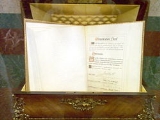
Spanish Constitution of 1978

Encyclopedia
Structure of the State
The Constitution recognizes the existence of nationalities and regions (Preliminary Title).Preliminary Title
- Section 2. The Constitution is based on the indissoluble unity of the Spanish Nation, the common and indivisible homeland of all Spaniards; it recognizes and guarantees the right to self-government of the nationalities and regions of which it is composed and the solidarity among them all.
As a result, Spain is now composed entirely of 17 Autonomous Communities and two autonomous cities with varying degrees of autonomy, to the extent that, even though the Constitution does not formally state that Spain is a federation (nor a unitary state), actual power shows, depending on the issue considered, widely varying grades of decentralization, ranging from the quasi-confederal status of tax management in Navarre and the Basque Country to the total centralization in airport management.
Article 143
- Section 1. In the exercise of the right to self-government recognized in Article 2 of the Constitution, bordering provinces with common historic, cultural and economic characteristics, island territories and provinces with historic regional status may accede to self-government and form Autonomous Communities in conformity with the provisions contained in this Title and in the respective Statutes.
Social rights
_01.jpg)
Social rights
Economic, social and cultural rights are socio-economic human rights, such as the right to education, right to housing, right to adequate standard of living and the right to health. Economic, social and cultural rights are recognised and protected in international and regional human rights...
, including the definition of Spain itself as a "Social and Democratic State, subject to the rule of law" (Sp. Estado social y democrático de derecho) in its preliminary title. However, those rights are not at the same level of protection as the individual rights contained in articles 14 to 28, since those social rights are considered in fact principles and directives of economic policy, but never full rights of the citizens to be claimed before a court or tribunal.
Other constitutional provisions recognize the right to adequate housing, employment
Employment
Employment is a contract between two parties, one being the employer and the other being the employee. An employee may be defined as:- Employee :...
, social welfare provision, health protection
Social security
Social security is primarily a social insurance program providing social protection or protection against socially recognized conditions, including poverty, old age, disability, unemployment and others. Social security may refer to:...
and pensions.
Due to the political strength of the Communist Party of Spain during the Transition, the right to State intervention in private companies in the public interest and the facilitation of access by workers to ownership of the means of production were also enshrined in the Constitution.
Reform
The Constitution has been reformed once (Article 13.2, Title I) to extend to citizens of the European UnionEuropean Union
The European Union is an economic and political union of 27 independent member states which are located primarily in Europe. The EU traces its origins from the European Coal and Steel Community and the European Economic Community , formed by six countries in 1958...
the right to active and passive suffrage (both voting rights and eligibility as candidates) in local elections.
The social democratic
Social democracy
Social democracy is a political ideology of the center-left on the political spectrum. Social democracy is officially a form of evolutionary reformist socialism. It supports class collaboration as the course to achieve socialism...
Spanish Socialist Workers' Party
Spanish Socialist Workers' Party
The Spanish Socialist Workers' Party is a social-democratic political party in Spain. Its political position is Centre-left. The PSOE is the former ruling party of Spain, until beaten in the elections of November 2011 and the second oldest, exceeded only by the Partido Carlista, founded in...
(PSOE) government of José Luis Rodríguez Zapatero
José Luis Rodríguez Zapatero
José Luis Rodríguez Zapatero is a member of the Spanish Socialist Workers' Party . He was elected for two terms as Prime Minister of Spain, in the 2004 and 2008 general elections. On 2 April 2011 he announced he will not stand for re-election in 2012...
has announced its intention to undertake a major reform of the constitution during its tenure:
- Succession in the monarchy would be on the basis of age only, and not gender, thus abandoning the traditional CastilianCrown of CastileThe Crown of Castile was a medieval and modern state in the Iberian Peninsula that formed in 1230 as a result of the third and definitive union of the crowns and parliaments of the kingdoms of Castile and León upon the accession of the then King Ferdinand III of Castile to the vacant Leonese throne...
rules set in the Siete PartidasSiete PartidasThe Siete Partidas or simply Partidas was a Castilian statutory code first compiled during the reign of Alfonso X of Castile , with the intent of establishing a uniform body of normative rules for the kingdom. The codified and compiled text was originally called the Libro de las Leyes...
. While the rights of the current heir Felipe, Prince of AsturiasFelipe, Prince of AsturiasFelipe, Prince of Asturias de Borbón y de Grecia; born 30 January 1968), is the third child and only son of King Juan Carlos and Queen Sofía of Spain....
, would be maintained, the goal was to reform before his children were born. This issue was refreshed when Felipe's wife, Letizia Ortiz, announced her first and second pregnancies, and after the birth of the Infanta Leonor of SpainInfanta Leonor of SpainThe Infanta Leonor of Spain is the first child of Felipe, Prince of Asturias, and his wife Letizia. Her father has no sons and she is thus second in the line of succession to the Spanish throne after her father...
. The Prince, however, has reminded reformers that there is still time to implement this reform since none of his children will be considered heir to the throne until he himself has been crowned king. - an overhaul of the Spanish SenateSpanish SenateThe Senate of Spain is the upper house of Spain's parliament, the . It is made up of 264 members: 208 elected by popular vote, and 56 appointed by the regional legislatures. All senators serve four-year terms, though regional legislatures may recall their appointees at any time.The last election...
would transform it into a chamber of territorial representation - the European ConstitutionTreaty establishing a Constitution for EuropeThe Treaty establishing a Constitution for Europe , , was an unratified international treaty intended to create a consolidated constitution for the European Union...
(should one be approved) would be officially incorporated - the names of the existing autonomous communitiesAutonomous communities of SpainAn autonomous community In other languages of Spain:*Catalan/Valencian .*Galician .*Basque . The second article of the constitution recognizes the rights of "nationalities and regions" to self-government and declares the "indissoluble unity of the Spanish nation".Political power in Spain is...
would be listed
The proposal has been met with scepticism from some quarters (notably in the main opposition party Partido Popular
People's Party (Spain)
The People's Party is a conservative political party in Spain.The People's Party was a re-foundation in 1989 of the People's Alliance , a party led and founded by Manuel Fraga Iribarne, a former Minister of Tourism during Francisco Franco's dictatorship...
, PP) because some of these reforms deal with protected sections of the constitution, which would require supermajorities
Supermajority
A supermajority or a qualified majority is a requirement for a proposal to gain a specified level or type of support which exceeds a simple majority . In some jurisdictions, for example, parliamentary procedure requires that any action that may alter the rights of the minority has a supermajority...
in order to be modified (see below). Furthermore, even an amendment of a non-protected part of the Constitution would require the agreement of the main opposition party or at least some of its representatives, sincec it would require the support of three-fifths of each House
Cortes Generales
The Cortes Generales is the legislature of Spain. It is a bicameral parliament, composed of the Congress of Deputies and the Senate . The Cortes has power to enact any law and to amend the constitution...
, which is 210 votes in the Congress of Deputies
Spanish Congress of Deputies
The Spanish Congress of Deputies is the lower house of the Cortes Generales, Spain's legislative branch. It has 350 members, elected by popular vote on block lists by proportional representation in constituencies matching the Spanish provinces using the D'Hondt method. Deputies serve four-year terms...
and 159 in the Senate
Spanish Senate
The Senate of Spain is the upper house of Spain's parliament, the . It is made up of 264 members: 208 elected by popular vote, and 56 appointed by the regional legislatures. All senators serve four-year terms, though regional legislatures may recall their appointees at any time.The last election...
.
The current version restricts the death penalty to military courts during wartime, but the death penalty has since been removed from the Code of Military Justice and thus lost all relevance. Amnesty International
Amnesty International
Amnesty International is an international non-governmental organisation whose stated mission is "to conduct research and generate action to prevent and end grave abuses of human rights, and to demand justice for those whose rights have been violated."Following a publication of Peter Benenson's...
has still requested an amendment to be made to the Constitution to abolish it firmly and explicitly in all cases.
Protected provisions
Title X of the Constitution establishes that the approval of a new constitution or the approval of any constitutional amendment affecting the Preliminary Title, or Section I of Chapter II of Title I (on Fundamental Rights and Public Liberties) or Title II (on the Crown), the so-called "protected provisions", are subject to a special process that requires (1) that two-thirds of each House approve the amendment, (2) that elections are called immediately thereafter, (3) that two-thirds of each new House approves the amendment, and (4) that the amendment is approved by the people in a referendum.Curiously, Title X does not include itself among the "protected provisions" and, therefore, it would be possible, at least in theory, to first amend Title X using the normal procedure to remove or reduce severity of the special requirements, and then change the formerly protected provisions. Even though such a procedure would not formally violate the law, it could be considered an attack on its spirit.
The reform of the autonomy statutes
The "Statutes of AutonomyStatute of Autonomy
Nominally, a Statute of Autonomy is a law hierarchically located under the constitution of a country, and over any other form of legislation...
" of the different regions are the second most important Spanish legal normatives when it comes to the political structure of the country. Because of that, the reform attempts of some of them have been either rejected or produced considerable controversy.
The plan conducted by the Basque president Juan José Ibarretxe
Juan José Ibarretxe
Juan José Ibarretxe Markuartu is a Basque politician of Spain. A leading member of the Basque Nationalist Party , he was President of Spain's Basque Country autonomous community from January 2, 1999 to May 7, 2009....
(known as Ibarretxe Plan
Ibarretxe Plan
The Political statute of the Community of the Basque Country, more known as Ibarretxe Plan was a proposal by former lehendakari Juan Jose Ibarretxe to radically alter the Statute of Autonomy of the Basque Country proposing a free association of the Basque Country with Spain on an equal footing, and...
) to reform the status of the Basque Country
Basque Country (autonomous community)
The Basque Country is an autonomous community of northern Spain. It includes the Basque provinces of Álava, Biscay and Gipuzkoa, also called Historical Territories....
in the Spanish state was rejected by the Spanish Cortes, on the grounds (among others) that it amounted to an implicit reform of the Constitution.
The People's Party attempted to reject the admission into the Cortes of the 2005 reform of the Autonomy Statute of Catalonia
Statute of Autonomy of Catalonia
The Statute of Autonomy of Catalonia provides Catalonia's basic institutional regulations. It defines the rights and obligations of the citizens of Catalonia , the political institutions of the Catalan nationality, their competences and relations with the rest of Spain, and the financing of the...
on the grounds that it should be dealt with as a constitutional reform rather than a mere statute reform because it allegedly contradicts the spirit of the Constitution in many points, especially the Statute's alleged breaches of the "solidarity between regions" principle enshrined by the Constitution. After failing to assemble the required majority to dismiss the text, the People's Party filed a claim of unconstitutionality against several dozen articles of the text before the Spanish Constitutional Court for them to be struck down.
The amended Autonomy Statute of Catalonia has also been legally contested by the surrounding Autonomous Communities of Aragon, Balearic Islands and the Valencian Community on similar grounds as those of the PP, and others such as disputed cultural heritage
Cultural heritage
Cultural heritage is the legacy of physical artifacts and intangible attributes of a group or society that are inherited from past generations, maintained in the present and bestowed for the benefit of future generations...
. As of January 2008, the Constitutional Court of Spain
Constitutional Court of Spain
thumb|300px|The [[Domenico Scarlatti]] Building located in [[Madrid]], seat of the Constitutional Court of Justice of Spain.The Constitutional Court of Spain is the highest judicial body with the power to determine the constitutionality of acts and statutes of the Spanish Government. It is...
has those alleged breaches and its actual compliance with the Constitution under judicial review
Judicial review
Judicial review is the doctrine under which legislative and executive actions are subject to review by the judiciary. Specific courts with judicial review power must annul the acts of the state when it finds them incompatible with a higher authority...
.
Prominent Spanish politicians, mostly from the People's Party but also from the ruling Socialist Party (PSOE) and other non-nationalist parties, have advocated for the statutory reform process to be more closely compliant with the Constitution, on the grounds that the current wave of reforms threatens the functional destruction of the constitutional system itself. The most cited arguments are the self-appointed unprecedented expansions of the powers of autonomous communities present in recently reformed statutes:
- The amended version of the Catalan Statute prompts the State to allot investments in Catalonia according to Catalonia's own percentage contribution to the total Spanish GDPGross domestic productGross domestic product refers to the market value of all final goods and services produced within a country in a given period. GDP per capita is often considered an indicator of a country's standard of living....
. The Autonomy Statute of Andalusia, a region that contributes less to Spain's GDP than the region of Catalonia contributes, requires it in turn to allocate state investments in proportion to its population (it is the largest Spanish Autonomous Community in terms of population). These requirements are legally binding, as they are enacted as part of Autonomy Statutes, which rank only below the Constitution itself. It is self-evident that, should all autonomous communities be allowed to establish their particular financing models upon the State, the total may add up to more than 100% and that would be inviable. Despite these changes having been proposed and approved by fellow members of the PSOE, former Finance Minister Pedro SolbesPedro SolbesPedro Solbes Mira is a Spanish economist. While independent in the sense of not affiliated to any party, his various ministerial roles in Spain have always been within Socialist Workers' Party cabinets...
disagreed with this new trend of assigning state investment quotas to territories based on any given autonomous community custom requirement and has subsequently compared the task of planning the Spanish national budget to a sudokuSudokuis a logic-based, combinatorial number-placement puzzle. The objective is to fill a 9×9 grid with digits so that each column, each row, and each of the nine 3×3 sub-grids that compose the grid contains all of the digits from 1 to 9...
. - The Valencian statute, whose reform was one of the first to be enacted, includes the so-called Camps clause (named after the Valencian President Francisco CampsFrancisco CampsFrancisco Enrique Camps Ortiz is a Spanish politician belonging to the Partido Popular who served as President of the Generalitat Valenciana, the Valencian regional administration, in the period 2003-2011.-Biography:...
), which makes any powers assumed by other communities in its statutes automatically available to the Valencian Community. - Autonomous communities such as Catalonia, Aragon, Andalusia or Extremadura, have included statutory clauses claiming exclusive powers over any river flowing through their territories. Nearby communities have filed complaints before the Spanish Constitutional Court on the grounds that no Community can exercise exclusive power over rivers that cross more than one Community, not even over the part flowing through its territory because its decisions affect other Communities, both downstream or upstream.
See also
- ConstitutionConstitutionA constitution is a set of fundamental principles or established precedents according to which a state or other organization is governed. These rules together make up, i.e. constitute, what the entity is...
- Constitutional economicsConstitutional economicsConstitutional economics is a research program in economics and constitutionalism that has been described as extending beyond the definition of 'the economic analysis of constitutional law' in explaining the choice "of alternative sets of legal-institutional-constitutional rules that constrain the...
- ConstitutionalismConstitutionalismConstitutionalism has a variety of meanings. Most generally, it is "a complex of ideas, attitudes, and patterns of behavior elaborating the principle that the authority of government derives from and is limited by a body of fundamental law"....
- Rule according to higher lawRule according to higher lawThe rule according to a higher law means that no written law may be enforced by the government unless it conforms with certain unwritten, universal principles of fairness, morality, and justice...
External links
- Constitución española de 1978 at WikisourceWikisourceWikisource is an online digital library of free content textual sources on a wiki, operated by the Wikimedia Foundation. Its aims are to host all forms of free text, in many languages, and translations. Originally conceived as an archive to store useful or important historical texts, it has...
- The Constitution in English. Website of the Government of Spain