

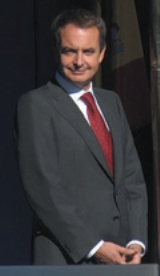
Prime Minister of Spain

Encyclopedia
The President of the Government of Spain
, sometimes known in English as the Prime Minister of Spain, is the head
of Government of Spain. The current office is established under the Constitution of 1978
. The King of Spain nominates a candidate for the presidency who stands before the Congress of Deputies for a Vote of Confidence in a process known as a Congressional Investiture
, effectively an indirect election
of the head of government
by the elected Congressional delegates.
José Luis Rodríguez Zapatero
of the Spanish Socialist Workers Party is the outgoing prime minister, having announced on April 2, 2011 that he would stand down at the completion of his term. Mariano Rajoy Brey, whose People's Party
won the 2011 general election, is the prime minister designate and he will be sworn in on December 20, 2011.
", the usual term for the head of government in a parliamentary system
. However the Spanish for 'prime minister' is primer ministro; thus, for example, the Prime Minister of the United Kingdom
is the Primer Ministro del Reino Unido, not the Presidente del Gobierno.
In Spain the head of the government is often called simply Presidente, meaning 'President'. This sometimes causes confusion since it is the usual term for the head of government in a republic; former governor of Florida Jeb Bush
once mistakenly referred to the "President of the Republic of Spain" . The custom to name the head of government as "President" dates back to the reign of Isabella II of Spain
, when the official title was Presidente del Consejo de Ministros ("President of the Council of Ministers"). Before 1833 the figure was known as Secretario de Estado ("Secretary of State"), a denomination used today for junior ministers.
has been announced by the king, political parties nominate their candidates to stand for the presidency of the government. An outgoing president who is not running in that election remains in office as a caretaker until their successor is sworn in, such as José Luis Rodríguez Zapatero
; this differs from other parliamentary governments whose prime ministers always lead their parties during the election campaign.
Following the general election of the Cortes Generales
(Cortes), and other circumstances provided for in the constitution, the king meets with and interviews the political party leaders represented in the Congress of Deputies, and then consults with the Speaker of the Congress of Deputies (officially, Presidente de Congreso de los Diputados de España, who, in this instance, represents the whole of the Cortes Generales and was himself elected from within the Congress to be the Speaker) before nominating his candidate for the presidency, according to Section 99 of Title IV. Often minor parties form part of a larger major party, and through that membership it can be said that the king fulfills his constitutional mandate of consulting with party representatives with Congressional representation.
Constitutionally, the monarch may nominate anyone he sees fit as his prerogative. However, it remains pragmatic for monarch to nominate a candidate who is most likely to enjoy the confidence of the Congress of Deputies and form a government, usually the political leader whose party commands the most seats in the Congress. For the Crown to nominate the political leader whose party controls the Congress can be seen as a royal endorsement of the democratic process— a fundamental concept enshrined in the 1978 Constitution.
By political custom
established by Juan Carlos I
since the ratification of the 1978 Constitution, the king's nominees have all been from parties who maintain a plurality of seats in the Congress. However, there is no legal requirement for this. It has never happened in the national government, but the largest party could end up not ruling if rival parties gather into a majority, forming a coalition
. This scenario is unlikely as political activity in Spain has effectively coalesced into a two-party system
between the Spanish Socialist Workers' Party
and the People's Party
, with the two major parties adopting some aspects of the minor party platforms in an effort to attract them into a coalition to edge out their rival party.
The monarch is normally to able announce his nominee the day following a general election.
The monarch's order nominating a presidential candidate is countersigned by the Speaker of the Congress, who then presents the nominee before the Congress of Deputies in a process known as a Congressional Investiture
(Investidura parlamentaria). During the Investiture proceedings the nominee presents his political agenda
in an Investiture Speech to be debated and submitted for a Vote of Confidence (Cuestión de confianza) by the Congress, effecting an indirect election
of the head of government. A simple majority confirms the nominee and his program. At the moment of the vote, the confidence is awarded if the candidate receives a majority of votes in the first poll (currently 176 out of 350 MPs), but if the confidence is not awarded, a second vote is scheduled two days later in which a simple majority of votes cast (i.e. more "yes" than "no" votes) is required.
After the nominee is confirmed, the Speaker of the Congress formally reports to the king of the congressional confirmation. The king then appoints the candidate as the new President of the Government. The king's order of appointment is countersigned by the Speaker. During the inauguration ceremony performed by the king, customarily at the Salón de Audiencias in the Zarzuela Palace
, the president elect of the Government takes an oath of office
over an open constitution and next to the Holy Bible. The oath as taken by President Zapatero on his first term in office on 17 April 2004 was;:
In 2008, from the time the king nominated José Luis Rodríguez Zapatero
for a second term as president immediately following the 2008 general election, almost a month passed before Zapatero was able to present his Investiture Speech before the Congress and stand for a Vote of Confidence.
However, if no overall majority was obtained on the first Vote of the Confidence, then the same nominee and program is resubmitted for a second vote within forty-eight hours. Following the second vote, if confidence by the Congress is still unreached, then the monarch again meets with political leaders and the Speaker, and submits a new nominee for a vote of confidence.
If, within two months, no candidate has won the confidence of the Congress then the King dissolves the Cortes and calls for a new general election. The King's royal decree is countersigned by the Speaker of the Congress.
Once appointed, the President of the Government forms his government whose ministers are appointed and removed by the King on the president's advice.
In the political life of Spain, the king would already be familiar with the various political leaders in a professional capacity, and perhaps less formally in a more social capacity, facilitating their meeting following a general election. Conversely, nominating the party leader whose party maintains a plurality and who are already familiar with their party manifesto
facilitates a smoother nomination process. In the event of coalitions
, the political leaders would customarily have met beforehand to hammer out a coalition agreement before their meeting with the King.
Governments and the Cortes sit for a term no longer than four years when the president tenders his resignation to the King and advises the King to dissolve the Cortes, prompting a general election. It remains within the King's prerogative to dissolve the Cortes if, at the conclusion of the four years, the president has not asked for its dissolution, according to Title II Section 56. The president may call for earlier elections, known as a snap election
, but no sooner than a year after the prior general election. Additionally, if the Government loses the confidence of the Cortes, then it must resign.
In the event that a president dies or becomes incapacitated while in office, then the government as a whole resigns and the process of royal nomination and appointment takes place. The vice president would then take over the day to day operations in the meantime, even while the vice president himself may be nominated by the King and stand for a vote of confidence.
. The government conducts domestic and foreign policy
, civil and military administration, and the defense of the nation
all in the name of the king on behalf of the people. Additionally, the government exercises executive authority and statutory regulations.
There is no provision in the Spanish Constitution for explicitly granting any emergency powers to the government, which could be understood as exorcizing the ghost of the recent dictatorship in Spain. However, Title II, Sections 56 of the constitution vests the monarch as the "arbitrator and moderator of the institutions" of government, [The King] arbitrates and moderates the regular functioning of the institutions (arbitra y modera el funcionamiento regular de las instituciones). This provision could be understood as allowing the king or his government ministers to exercise emergency authority in times of national crisis, such as when the king used his authority to back the government of the day and call for the military to abandon the 23-F coup attempt
in 1981.
are created by the Grace of the King, according to the Spanish Ministry of Justice, and are the highest marks of distinction that he may bestow in his capacity as the fons honorum
in Spain. Conventionally, the Title of Concession creating the dignity must be countersigned by a government minister. When a title is created for a former president, the succeeding president customarily countersigns the royal decree. As a reward for national service, the king awarded peerages to two of his former presidents who have since retired from active politics: Adolfo Suárez
was created 1st Duke of Suárez
; and Leopoldo Calvo-Sotelo was created 1st Marquess of la Ría de Ribadeo. The king's third president Felipe González
declined a title, while José María Aznar
's presidency was mired in controversies making a peerage unlikely. All successive politicians remain active within politics. Additional titles of nobility have been created by the king for other government ministers, usually at the advice of the president of the government.
As of 2005, the king has created 40 hereditary titles of nobility.
. For the full list since the predecessor office of Secretary of the Universal Bureau was created (1705), see List of Prime Ministers of Spain.
Spain
Spain , officially the Kingdom of Spain languages]] under the European Charter for Regional or Minority Languages. In each of these, Spain's official name is as follows:;;;;;;), is a country and member state of the European Union located in southwestern Europe on the Iberian Peninsula...
, sometimes known in English as the Prime Minister of Spain, is the head
Head of government
Head of government is the chief officer of the executive branch of a government, often presiding over a cabinet. In a parliamentary system, the head of government is often styled prime minister, chief minister, premier, etc...
of Government of Spain. The current office is established under the Constitution of 1978
Spanish Constitution of 1978
-Structure of the State:The Constitution recognizes the existence of nationalities and regions . Preliminary Title As a result, Spain is now composed entirely of 17 Autonomous Communities and two autonomous cities with varying degrees of autonomy, to the extent that, even though the Constitution...
. The King of Spain nominates a candidate for the presidency who stands before the Congress of Deputies for a Vote of Confidence in a process known as a Congressional Investiture
Investiture
Investiture, from the Latin is a rather general term for the formal installation of an incumbent...
, effectively an indirect election
Indirect election
Indirect election is a process in which voters in an election don't actually choose between candidates for an office but rather elect persons who will then make the choice. It is one of the oldest form of elections and is still used today for many upper houses and presidents...
of the head of government
Head of government
Head of government is the chief officer of the executive branch of a government, often presiding over a cabinet. In a parliamentary system, the head of government is often styled prime minister, chief minister, premier, etc...
by the elected Congressional delegates.
José Luis Rodríguez Zapatero
José Luis Rodríguez Zapatero
José Luis Rodríguez Zapatero is a member of the Spanish Socialist Workers' Party . He was elected for two terms as Prime Minister of Spain, in the 2004 and 2008 general elections. On 2 April 2011 he announced he will not stand for re-election in 2012...
of the Spanish Socialist Workers Party is the outgoing prime minister, having announced on April 2, 2011 that he would stand down at the completion of his term. Mariano Rajoy Brey, whose People's Party
People's Party
The People's Party, Peoples Party, or Popular Party, is any of several political parties claiming to speak for the people.People's Parties in various countries run the gamut from left to right...
won the 2011 general election, is the prime minister designate and he will be sworn in on December 20, 2011.
Official title
The Spanish head of government is known, in Spanish, as the Presidente del Gobierno. Literally translated, the title is "President of the Government" or alternatively "Chairman of the Government", but nevertheless the office-holder is commonly referred to in English as the "prime ministerPrime minister
A prime minister is the most senior minister of cabinet in the executive branch of government in a parliamentary system. In many systems, the prime minister selects and may dismiss other members of the cabinet, and allocates posts to members within the government. In most systems, the prime...
", the usual term for the head of government in a parliamentary system
Parliamentary system
A parliamentary system is a system of government in which the ministers of the executive branch get their democratic legitimacy from the legislature and are accountable to that body, such that the executive and legislative branches are intertwined....
. However the Spanish for 'prime minister' is primer ministro; thus, for example, the Prime Minister of the United Kingdom
Prime Minister of the United Kingdom
The Prime Minister of the United Kingdom of Great Britain and Northern Ireland is the Head of Her Majesty's Government in the United Kingdom. The Prime Minister and Cabinet are collectively accountable for their policies and actions to the Sovereign, to Parliament, to their political party and...
is the Primer Ministro del Reino Unido, not the Presidente del Gobierno.
In Spain the head of the government is often called simply Presidente, meaning 'President'. This sometimes causes confusion since it is the usual term for the head of government in a republic; former governor of Florida Jeb Bush
Jeb Bush
John Ellis "Jeb" Bush is an American politician who served as the 43rd Governor of Florida from 1999 to 2007. He is a prominent member of the Bush family: the second son of former President George H. W. Bush and former First Lady Barbara Bush; the younger brother of former President George W...
once mistakenly referred to the "President of the Republic of Spain" . The custom to name the head of government as "President" dates back to the reign of Isabella II of Spain
Isabella II of Spain
Isabella II was the only female monarch of Spain in modern times. She came to the throne as an infant, but her succession was disputed by the Carlists, who refused to recognise a female sovereign, leading to the Carlist Wars. After a troubled reign, she was deposed in the Glorious Revolution of...
, when the official title was Presidente del Consejo de Ministros ("President of the Council of Ministers"). Before 1833 the figure was known as Secretario de Estado ("Secretary of State"), a denomination used today for junior ministers.
Royal nomination and congressional confirmation
Once a general electionElections in Spain
There are four types of elections in Spain: general elections, elections to the legislatures of the autonomous communities, local elections and elections to the European Parliament...
has been announced by the king, political parties nominate their candidates to stand for the presidency of the government. An outgoing president who is not running in that election remains in office as a caretaker until their successor is sworn in, such as José Luis Rodríguez Zapatero
José Luis Rodríguez Zapatero
José Luis Rodríguez Zapatero is a member of the Spanish Socialist Workers' Party . He was elected for two terms as Prime Minister of Spain, in the 2004 and 2008 general elections. On 2 April 2011 he announced he will not stand for re-election in 2012...
; this differs from other parliamentary governments whose prime ministers always lead their parties during the election campaign.
Following the general election of the Cortes Generales
Cortes Generales
The Cortes Generales is the legislature of Spain. It is a bicameral parliament, composed of the Congress of Deputies and the Senate . The Cortes has power to enact any law and to amend the constitution...
(Cortes), and other circumstances provided for in the constitution, the king meets with and interviews the political party leaders represented in the Congress of Deputies, and then consults with the Speaker of the Congress of Deputies (officially, Presidente de Congreso de los Diputados de España, who, in this instance, represents the whole of the Cortes Generales and was himself elected from within the Congress to be the Speaker) before nominating his candidate for the presidency, according to Section 99 of Title IV. Often minor parties form part of a larger major party, and through that membership it can be said that the king fulfills his constitutional mandate of consulting with party representatives with Congressional representation.
Title IV Government and Administration
Section 99(1) & (2)
- (1) After each renewal of the Congress and the other cases provided for under the Constitution, the King shall, after consultation with the representatives appointed by the political groups with parliamentary representation, and through the Speaker of the Congress, nominate for the Presidency of the Government.
- (2) The candidate nominated in accordance with the provisions of the foregoing subsection shall submit to the Congress the political program of the Government he or she intends to form and shall seek the confidence of the House.
Artículo 99.
- 1. Después de cada renovación del Congreso de los Diputados, y en los demás supuestos constitucionales en que así proceda, el Rey, previa consulta con los representantes designados por los grupos políticos con representación parlamentaria, y a través del Presidente del Congreso, propondrá un candidato a la Presidencia del Gobierno.
- 2. El candidato propuesto conforme a lo previsto en el apartado anterior expondrá ante el Congreso de los Diputados el programa político del Gobierno que pretenda formar y solicitará la confianza de la Cámara.
Constitutionally, the monarch may nominate anyone he sees fit as his prerogative. However, it remains pragmatic for monarch to nominate a candidate who is most likely to enjoy the confidence of the Congress of Deputies and form a government, usually the political leader whose party commands the most seats in the Congress. For the Crown to nominate the political leader whose party controls the Congress can be seen as a royal endorsement of the democratic process— a fundamental concept enshrined in the 1978 Constitution.
By political custom
Constitutional convention (political custom)
A constitutional convention is an informal and uncodified procedural agreement that is followed by the institutions of a state. In some states, notably those Commonwealth of Nations states that follow the Westminster system and whose political systems derive from British constitutional law, most...
established by Juan Carlos I
Juan Carlos I of Spain
Juan Carlos I |Italy]]) is the reigning King of Spain.On 22 November 1975, two days after the death of General Francisco Franco, Juan Carlos was designated king according to the law of succession promulgated by Franco. Spain had no monarch for 38 years in 1969 when Franco named Juan Carlos as the...
since the ratification of the 1978 Constitution, the king's nominees have all been from parties who maintain a plurality of seats in the Congress. However, there is no legal requirement for this. It has never happened in the national government, but the largest party could end up not ruling if rival parties gather into a majority, forming a coalition
Coalition
A coalition is a pact or treaty among individuals or groups, during which they cooperate in joint action, each in their own self-interest, joining forces together for a common cause. This alliance may be temporary or a matter of convenience. A coalition thus differs from a more formal covenant...
. This scenario is unlikely as political activity in Spain has effectively coalesced into a two-party system
Two-party system
A two-party system is a system where two major political parties dominate voting in nearly all elections at every level of government and, as a result, all or nearly all elected offices are members of one of the two major parties...
between the Spanish Socialist Workers' Party
Spanish Socialist Workers' Party
The Spanish Socialist Workers' Party is a social-democratic political party in Spain. Its political position is Centre-left. The PSOE is the former ruling party of Spain, until beaten in the elections of November 2011 and the second oldest, exceeded only by the Partido Carlista, founded in...
and the People's Party
People's Party (Spain)
The People's Party is a conservative political party in Spain.The People's Party was a re-foundation in 1989 of the People's Alliance , a party led and founded by Manuel Fraga Iribarne, a former Minister of Tourism during Francisco Franco's dictatorship...
, with the two major parties adopting some aspects of the minor party platforms in an effort to attract them into a coalition to edge out their rival party.
The monarch is normally to able announce his nominee the day following a general election.
The monarch's order nominating a presidential candidate is countersigned by the Speaker of the Congress, who then presents the nominee before the Congress of Deputies in a process known as a Congressional Investiture
Investiture
Investiture, from the Latin is a rather general term for the formal installation of an incumbent...
(Investidura parlamentaria). During the Investiture proceedings the nominee presents his political agenda
Manifesto
A manifesto is a public declaration of principles and intentions, often political in nature. Manifestos relating to religious belief are generally referred to as creeds. Manifestos may also be life stance-related.-Etymology:...
in an Investiture Speech to be debated and submitted for a Vote of Confidence (Cuestión de confianza) by the Congress, effecting an indirect election
Indirect election
Indirect election is a process in which voters in an election don't actually choose between candidates for an office but rather elect persons who will then make the choice. It is one of the oldest form of elections and is still used today for many upper houses and presidents...
of the head of government. A simple majority confirms the nominee and his program. At the moment of the vote, the confidence is awarded if the candidate receives a majority of votes in the first poll (currently 176 out of 350 MPs), but if the confidence is not awarded, a second vote is scheduled two days later in which a simple majority of votes cast (i.e. more "yes" than "no" votes) is required.
After the nominee is confirmed, the Speaker of the Congress formally reports to the king of the congressional confirmation. The king then appoints the candidate as the new President of the Government. The king's order of appointment is countersigned by the Speaker. During the inauguration ceremony performed by the king, customarily at the Salón de Audiencias in the Zarzuela Palace
Palacio de la Zarzuela
Zarzuela Palace is the principal residence of King Juan Carlos of Spain and Queen Sofia and their family. The palace is on the outskirts of Madrid, near the Royal Palace of El Pardo. The complex also houses the official residence of the Prince and Princess of Asturias in a nearby mansion...
, the president elect of the Government takes an oath of office
Oath of office
An oath of office is an oath or affirmation a person takes before undertaking the duties of an office, usually a position in government or within a religious body, although such oaths are sometimes required of officers of other organizations...
over an open constitution and next to the Holy Bible. The oath as taken by President Zapatero on his first term in office on 17 April 2004 was;:
In 2008, from the time the king nominated José Luis Rodríguez Zapatero
José Luis Rodríguez Zapatero
José Luis Rodríguez Zapatero is a member of the Spanish Socialist Workers' Party . He was elected for two terms as Prime Minister of Spain, in the 2004 and 2008 general elections. On 2 April 2011 he announced he will not stand for re-election in 2012...
for a second term as president immediately following the 2008 general election, almost a month passed before Zapatero was able to present his Investiture Speech before the Congress and stand for a Vote of Confidence.
However, if no overall majority was obtained on the first Vote of the Confidence, then the same nominee and program is resubmitted for a second vote within forty-eight hours. Following the second vote, if confidence by the Congress is still unreached, then the monarch again meets with political leaders and the Speaker, and submits a new nominee for a vote of confidence.
If, within two months, no candidate has won the confidence of the Congress then the King dissolves the Cortes and calls for a new general election. The King's royal decree is countersigned by the Speaker of the Congress.
Once appointed, the President of the Government forms his government whose ministers are appointed and removed by the King on the president's advice.
In the political life of Spain, the king would already be familiar with the various political leaders in a professional capacity, and perhaps less formally in a more social capacity, facilitating their meeting following a general election. Conversely, nominating the party leader whose party maintains a plurality and who are already familiar with their party manifesto
Manifesto
A manifesto is a public declaration of principles and intentions, often political in nature. Manifestos relating to religious belief are generally referred to as creeds. Manifestos may also be life stance-related.-Etymology:...
facilitates a smoother nomination process. In the event of coalitions
Coalition government
A coalition government is a cabinet of a parliamentary government in which several political parties cooperate. The usual reason given for this arrangement is that no party on its own can achieve a majority in the parliament...
, the political leaders would customarily have met beforehand to hammer out a coalition agreement before their meeting with the King.
Governments and the Cortes sit for a term no longer than four years when the president tenders his resignation to the King and advises the King to dissolve the Cortes, prompting a general election. It remains within the King's prerogative to dissolve the Cortes if, at the conclusion of the four years, the president has not asked for its dissolution, according to Title II Section 56. The president may call for earlier elections, known as a snap election
Snap election
A snap election is an election called earlier than expected. Generally it refers to an election in a parliamentary system called when not required , usually to capitalize on a unique electoral opportunity or to decide a pressing issue...
, but no sooner than a year after the prior general election. Additionally, if the Government loses the confidence of the Cortes, then it must resign.
In the event that a president dies or becomes incapacitated while in office, then the government as a whole resigns and the process of royal nomination and appointment takes place. The vice president would then take over the day to day operations in the meantime, even while the vice president himself may be nominated by the King and stand for a vote of confidence.
Constitutional authority
Title IV of the Constitution defines the government and its responsibilities. The government consists of the President of the Government and ministers of stateCouncil of Ministers of Spain
The Cabinet of Spain is a collegiate body composed of the President of the Government , Vice Presidents when existing and the Ministers, and any other member required by law, and in some cases Secretaries of State...
. The government conducts domestic and foreign policy
Foreign relations of Spain
After the return of democracy following the death of General Franco in 1975, Spain's foreign policy priorities were to break out of the diplomatic isolation of the Franco years and expand diplomatic relations, enter the European Community, and define security relations with NATO, later joining the...
, civil and military administration, and the defense of the nation
Spanish Armed Forces
The Spanish Armed Forces are the military forces of the Kingdom of Spain. The Spanish Armed Forces are a modern military force charged with defending the Kingdom's integrity and sovereignty...
all in the name of the king on behalf of the people. Additionally, the government exercises executive authority and statutory regulations.
There is no provision in the Spanish Constitution for explicitly granting any emergency powers to the government, which could be understood as exorcizing the ghost of the recent dictatorship in Spain. However, Title II, Sections 56 of the constitution vests the monarch as the "arbitrator and moderator of the institutions" of government, [The King] arbitrates and moderates the regular functioning of the institutions (arbitra y modera el funcionamiento regular de las instituciones). This provision could be understood as allowing the king or his government ministers to exercise emergency authority in times of national crisis, such as when the king used his authority to back the government of the day and call for the military to abandon the 23-F coup attempt
23-F
23-F was an attempted coup d'état in Spain that began on 23 February 1981 and ended on the following day. It is also known as El Tejerazo from the name of its most visible figure, Antonio Tejero, who led the failed coup's most notable event: the bursting into the Spanish Congress of Deputies by a...
in 1981.
Peerages
Peerages in SpainSpanish nobility
Spanish nobles are persons who possess the legal status of hereditary nobility according to the laws and traditions of the Spanish monarchy. A system of titles and honours of Spain and of the former kingdoms that constitute it comprise the Spanish nobility...
are created by the Grace of the King, according to the Spanish Ministry of Justice, and are the highest marks of distinction that he may bestow in his capacity as the fons honorum
Fount of honour
The fount of honour refers to a nation's head of state, who, by virtue of his or her official position, has the exclusive right of conferring legitimate titles of nobility and orders of chivalry to other persons.- Origin :...
in Spain. Conventionally, the Title of Concession creating the dignity must be countersigned by a government minister. When a title is created for a former president, the succeeding president customarily countersigns the royal decree. As a reward for national service, the king awarded peerages to two of his former presidents who have since retired from active politics: Adolfo Suárez
Adolfo Suárez
Adolfo Suárez y González, 1st Duke of Suárez, Grandee of Spain, KOGF is a Spanish lawyer and politician. Suárez was Spain's first democratically elected prime minister after the dictatorship of Francisco Franco, and the key figure in the country's transition to democracy.-Parents:He is a son of...
was created 1st Duke of Suárez
Duke of Suárez
Duke of Suárez is a hereditary title in the Spanish nobility. The dukedom was bestowed by King Juan Carlos on Adolfo Suárez in 1981, following his resignation as Spanish Prime Minister, in recognition of his role in the Spanish transition to democracy...
; and Leopoldo Calvo-Sotelo was created 1st Marquess of la Ría de Ribadeo. The king's third president Felipe González
Felipe González
Felipe González Márquez is a Spanish socialist politician. He was the General Secretary of the Spanish Socialist Workers' Party from 1974 to 1997. To date, he remains the longest-serving Prime Minister of Spain, after having served four successive mandates from 1982 to 1996.-Early life:Felipe was...
declined a title, while José María Aznar
José María Aznar
José María Alfredo Aznar López served as the Prime Minister of Spain from 1996 to 2004. He is on the board of directors of News Corporation.-Early life:...
's presidency was mired in controversies making a peerage unlikely. All successive politicians remain active within politics. Additional titles of nobility have been created by the king for other government ministers, usually at the advice of the president of the government.
As of 2005, the king has created 40 hereditary titles of nobility.
Recent Spanish Prime Ministers
This is a list of the people who have held the office of President of the Government of Spain since the Spanish transition to democracySpanish transition to democracy
The Spanish transition to democracy was the era when Spain moved from the dictatorship of Francisco Franco to a liberal democratic state. The transition is usually said to have begun with Franco’s death on 20 November 1975, while its completion has been variously said to be marked by the Spanish...
. For the full list since the predecessor office of Secretary of the Universal Bureau was created (1705), see List of Prime Ministers of Spain.
Prime ministers (Presidents of the Government)
Political Party:| Portrait | Name | Term of Office | Political Party | Legislature (Election) |
Head of State (Term) |
|||
|---|---|---|---|---|---|---|---|---|
| Adolfo Suárez González Adolfo Suárez Adolfo Suárez y González, 1st Duke of Suárez, Grandee of Spain, KOGF is a Spanish lawyer and politician. Suárez was Spain's first democratically elected prime minister after the dictatorship of Francisco Franco, and the key figure in the country's transition to democracy.-Parents:He is a son of... |
1 | 5 July 1976 | 29 January 1981 | UCD | Cst. (1977 Spanish general election, 1977 The Spanish general election of 1977 took place on 15 June 1977. It was the first election since the death of Francisco Franco.Voting was on the basis of universal suffrage in a secret ballot. The elections were held using closed list proportional representation in 52 electoral districts... ) |
King Juan Carlos I Juan Carlos I of Spain Juan Carlos I |Italy]]) is the reigning King of Spain.On 22 November 1975, two days after the death of General Francisco Franco, Juan Carlos was designated king according to the law of succession promulgated by Franco. Spain had no monarch for 38 years in 1969 when Franco named Juan Carlos as the... 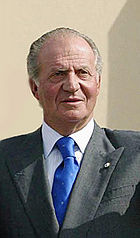 (1975-) |
||
| 2 | I (1979 Spanish general election, 1979 General elections were held in Spain on 1 March 1979.-References:* *... ) |
|||||||
 |
Leopoldo Calvo-Sotelo Bustelo (Acting Acting (law) In law, when someone is said to be acting in a position it can mean one of three things.*The position has not yet been formally created.*The person is only occupying the position temporarily, to ensure continuity.*The person does not have a mandate.... until 25 February 1981) |
29 January 1981 | 1 December 1982 | UCD | ||||
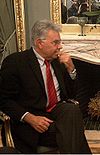 |
Felipe González Márquez Felipe González Felipe González Márquez is a Spanish socialist politician. He was the General Secretary of the Spanish Socialist Workers' Party from 1974 to 1997. To date, he remains the longest-serving Prime Minister of Spain, after having served four successive mandates from 1982 to 1996.-Early life:Felipe was... |
1 | 1 December 1982 | 5 May 1996 | PSOE Spanish Socialist Workers' Party The Spanish Socialist Workers' Party is a social-democratic political party in Spain. Its political position is Centre-left. The PSOE is the former ruling party of Spain, until beaten in the elections of November 2011 and the second oldest, exceeded only by the Partido Carlista, founded in... |
II (1982 Spanish general election, 1982 General elections were held in Spain on 28 October 1982.PSOE and PSC presented two different lists of candidates: with the PSOE contesting most of Spain and the PSC only standing in Catalonia... ) |
||
| 2 | III (1986 Spanish general election, 1986 General elections were held in Spain on 23 June 1986. In this election, the Communist Party of Spain merged with other minor left parties to form the coalition Izquierda Unida; in Catalonia they ran as the Catalan Left Union. Similarly, the People's Alliance merged with two other conservative... ) |
|||||||
| 3 | IV (1989 Spanish general election, 1989 -Results:-External links:**... ) |
|||||||
| 4 | V (1993 Spanish general election, 1993 -Results:-External links:*... ) |
|||||||
 |
José María Aznar López José María Aznar José María Alfredo Aznar López served as the Prime Minister of Spain from 1996 to 2004. He is on the board of directors of News Corporation.-Early life:... |
1 | 5 May 1996 | 17 April 2004 | PP People's Party (Spain) The People's Party is a conservative political party in Spain.The People's Party was a re-foundation in 1989 of the People's Alliance , a party led and founded by Manuel Fraga Iribarne, a former Minister of Tourism during Francisco Franco's dictatorship... |
VI (1996 Spanish general election, 1996 General elections were held in Spain on March 3, 1996. The Prime Minister Felipe González of Spanish Socialist Workers' Party lost the elections to Partido Popular and their leader José María Aznar.... ) |
||
| 2 | VII (2000 Spanish general election, 2000 Legislative elections were held in Spain on 12 March 2000. The incumbent People's Party of Prime Minister José María Aznar was elected to a second term in office, converting its plurality of seats in the Congress of Deputies into a majority, and increasing its lead over the opposition Spanish... ) |
|||||||
| José Luis Rodríguez Zapatero José Luis Rodríguez Zapatero José Luis Rodríguez Zapatero is a member of the Spanish Socialist Workers' Party . He was elected for two terms as Prime Minister of Spain, in the 2004 and 2008 general elections. On 2 April 2011 he announced he will not stand for re-election in 2012... |
1 | 17 April 2004 | 20 or 21 December 2011 | PSOE Spanish Socialist Workers' Party The Spanish Socialist Workers' Party is a social-democratic political party in Spain. Its political position is Centre-left. The PSOE is the former ruling party of Spain, until beaten in the elections of November 2011 and the second oldest, exceeded only by the Partido Carlista, founded in... |
VIII (2004) | |||
| 2 | IX (2008 Spanish general election, 2008 Legislative elections for the Spanish Cortes Generales were held on March 9, 2008. The elections were for 350 seats in the Congress of Deputies, and the 208 directly elected seats in the upper house, the Senate, determining the Prime Minister of Spain... ) |
|||||||
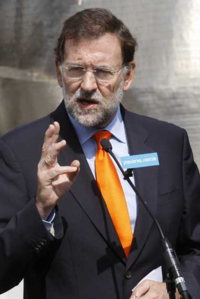 |
Mariano Rajoy Mariano Rajoy Mariano Rajoy Brey is a Spanish People's Party politician and is the Prime Minister-elect since 20 November 2011. He will be sworn into office in mid-December 2011.... |
Designate 20 or 21 December 2011 |
Incumbent | PP People's Party (Spain) The People's Party is a conservative political party in Spain.The People's Party was a re-foundation in 1989 of the People's Alliance , a party led and founded by Manuel Fraga Iribarne, a former Minister of Tourism during Francisco Franco's dictatorship... |
X (2011) | |||