


Maria Theresa of Spain

Encyclopedia
Maria Theresa of Austria (10 September 1638 – 30 July 1683) was the daughter of Philip IV, King of Spain
and Elizabeth of France. Maria Theresa was Queen of France as wife of King Louis XIV
and mother of the Grand Dauphin, an ancestor of the last four Bourbon
kings of France.
, she was the daughter of Philip IV, King of Spain
, and his consort Elisabeth of France, who died when Maria was only six years old. Being a paternal great-great-granddaughter of an Austrian archduke, Maria Theresa was entitled to use the title of Archduchess of Austria. Like many Habsburgs, she was a product of generations of royal intermarriage between cousins.
Unlike France, the kingdom of Spain had no Salic Law
, so it was possible for a female to assume the throne. When Balthasar Charles, Prince of Asturias, son of Maria Teresa's father Philip IV of Spain
and heir to the Spanish throne, died in 1646, Maria Teresa became heiress presumptive to the vast Spanish Empire
until the birth of Philip Prospero, Prince of Asturias
, in 1657. She became heiress presumptive once more during the brief period 1-6 November 1661, between the death of Prince Philip and the birth of Prince Charles, who would later inherit the throne of Spain as Charles II
.
In 1658, as war with France began to wind down, a union between the royal families of Spain and France was proposed as a means to secure peace. Maria Teresa and the French king were double first-cousins: Louis XIV's father was Louis XIII of France
, who was the brother of Maria Theresa's mother, while her father was brother to Anne of Austria
, Louis XIV's mother. Anne of Austria desired an end to hostilities between her native country of Spain and her adopted one, France. However, Spanish procrastination led to a scheme in which France's prime minister, Cardinal Mazarin, pretended to seek a marriage for his master with Margaret Yolande of Savoy. When Philip IV of Spain heard of a meeting at Lyon between the Houses of France and Savoy in November 1658, he reputedly exclaimed of the Franco-Savoyard union that "it cannot be, and will not be". Philip then sent a special envoy to the French court to open negotiations for peace and a royal marriage.
After a marriage by proxy to the French king in Fuenterrabia
, Maria Theresa became known as Marie-Thérèse. Her father, Philip IV, and the entire Spanish court accompanied the bride to the Isle of Pheasants in the Bidassoa, where Louis and his court met her. On 7 June 1660, she left Spain and on 9 June the marriage took place in Saint-Jean-de-Luz
at the recently rebuilte Saint Jean-Baptiste church. After the wedding, Louis wanted to consummate
the marriage as quickly as possible, however the new queen's mother-in-law (and aunt) arranged a private consummation instead of the public one that was the custom.
into Paris. Louis was faithful to his wife for the first year of their marriage, commanding the Grand Maréchal du Logis that "the Queen and himself were never to be set apart, no matter how small the house in which they might be lodging". He enjoyed the legitimate passion that his wife felt for him, however the couple would later have difficulty with compatibility. Marie-Thérèse gained weight with her delight and withdrew into her circle of dwarfs
. Louis's installment of Louise de La Vallière
as his first official mistress pained the queen, for which Louise would later tender a public apology.
Marie-Thérèse was very fortunate to have found a friend at court in her mother-in-law, unlike many princesses in foreign lands. She continued to spend much of her free time playing cards and gambling, as she had no interest in politics or literature. Consequently, she was viewed as not fully playing the part of queen designated to her by her marriage. But more importantly, she became pregnant in early 1661, and a long-awaited son was born on 1 November 1661.
The first time Marie-Thérèse ever saw the Palace of Versailles
was on 25 October 1660. At that time, it was just a small royal residence which had been Louis XIII's hunting lodge not far from Paris. Later, the first building campaign (1664–1668) commenced with The Plaisirs de l’Île enchantée
of 1664, a week-long celebration at the palace of Versailles
ostensibly held in honour of France's two queens, Louis XIV's mother and wife, exposed Louise de La Vallière's role as the king's maîtresse-en-titre
. The celebration of the Plaisirs de l’Île enchantée is often regarded as a prelude to the War of Devolution
, which Louis waged against Spain. The first building campaign witnessed alterations in the château and gardens in order to accommodate the 600 guests invited to the celebration.
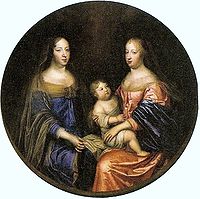 As time passed, Marie-Thérèse also came to tolerate her husband's prolonged infidelity with Françoise-Athénaïs, marquise de Montespan
. The king left her to her own devices, yet reprimanded Madame de Montespan when her behaviour at court too flagrantly disrespected the queen's position.
Later, the governess of Montespan's illegitimate children by the king, Madame de Maintenon
, came to supplant her mistress in the king's affections. At first she resisted the king's advances and encouraged him to bestow more attention on his long-neglected wife, a thoughtfulness which Marie-Thérèse repaid with warmth toward the new favourite. After the queen's death, Mainteon would become the king's second, although officially secret, wife.
Marie-Thérèse played little part in political affairs except for the years 1667, 1672, and 1678, during which she acted as regent
while her husband was away on campaigns on the frontier.
Of her six children, only one survived her, Louis, le Grand Dauphin
, who died in 1711. The younger of Marie-Thérèse's grandsons would eventually inherit her claim to the Spanish throne, becoming King Philip V of Spain
in 1700.
Philip IV of Spain
Philip IV was King of Spain between 1621 and 1665, sovereign of the Spanish Netherlands, and King of Portugal until 1640...
and Elizabeth of France. Maria Theresa was Queen of France as wife of King Louis XIV
Louis XIV of France
Louis XIV , known as Louis the Great or the Sun King , was a Bourbon monarch who ruled as King of France and Navarre. His reign, from 1643 to his death in 1715, began at the age of four and lasted seventy-two years, three months, and eighteen days...
and mother of the Grand Dauphin, an ancestor of the last four Bourbon
House of Bourbon
The House of Bourbon is a European royal house, a branch of the Capetian dynasty . Bourbon kings first ruled Navarre and France in the 16th century. By the 18th century, members of the Bourbon dynasty also held thrones in Spain, Naples, Sicily, and Parma...
kings of France.
Early life
Born as Infanta María Teresa of Spain at the Royal Monastery of El EscorialEl Escorial
The Royal Seat of San Lorenzo de El Escorial is a historical residence of the king of Spain, in the town of San Lorenzo de El Escorial, about 45 kilometres northwest of the capital, Madrid, in Spain. It is one of the Spanish royal sites and functions as a monastery, royal palace, museum, and...
, she was the daughter of Philip IV, King of Spain
Philip IV of Spain
Philip IV was King of Spain between 1621 and 1665, sovereign of the Spanish Netherlands, and King of Portugal until 1640...
, and his consort Elisabeth of France, who died when Maria was only six years old. Being a paternal great-great-granddaughter of an Austrian archduke, Maria Theresa was entitled to use the title of Archduchess of Austria. Like many Habsburgs, she was a product of generations of royal intermarriage between cousins.
Unlike France, the kingdom of Spain had no Salic Law
Salic law
Salic law was a body of traditional law codified for governing the Salian Franks in the early Middle Ages during the reign of King Clovis I in the 6th century...
, so it was possible for a female to assume the throne. When Balthasar Charles, Prince of Asturias, son of Maria Teresa's father Philip IV of Spain
Philip IV of Spain
Philip IV was King of Spain between 1621 and 1665, sovereign of the Spanish Netherlands, and King of Portugal until 1640...
and heir to the Spanish throne, died in 1646, Maria Teresa became heiress presumptive to the vast Spanish Empire
Spanish Empire
The Spanish Empire comprised territories and colonies administered directly by Spain in Europe, in America, Africa, Asia and Oceania. It originated during the Age of Exploration and was therefore one of the first global empires. At the time of Habsburgs, Spain reached the peak of its world power....
until the birth of Philip Prospero, Prince of Asturias
Philip Prospero, Prince of Asturias
Philip Prospero of Spain, Prince of Asturias was the first male child of the marriage between Philip IV of Spain and Mariana of Austria to survive infancy...
, in 1657. She became heiress presumptive once more during the brief period 1-6 November 1661, between the death of Prince Philip and the birth of Prince Charles, who would later inherit the throne of Spain as Charles II
Charles II of Spain
Charles II was the last Habsburg King of Spain and the ruler of large parts of Italy, the Spanish territories in the Southern Low Countries, and Spain's overseas Empire, stretching from the Americas to the Spanish East Indies...
.
In 1658, as war with France began to wind down, a union between the royal families of Spain and France was proposed as a means to secure peace. Maria Teresa and the French king were double first-cousins: Louis XIV's father was Louis XIII of France
Louis XIII of France
Louis XIII was a Bourbon monarch who ruled as King of France and of Navarre from 1610 to 1643.Louis was only eight years old when he succeeded his father. His mother, Marie de Medici, acted as regent during Louis' minority...
, who was the brother of Maria Theresa's mother, while her father was brother to Anne of Austria
Anne of Austria
Anne of Austria was Queen consort of France and Navarre, regent for her son, Louis XIV of France, and a Spanish Infanta by birth...
, Louis XIV's mother. Anne of Austria desired an end to hostilities between her native country of Spain and her adopted one, France. However, Spanish procrastination led to a scheme in which France's prime minister, Cardinal Mazarin, pretended to seek a marriage for his master with Margaret Yolande of Savoy. When Philip IV of Spain heard of a meeting at Lyon between the Houses of France and Savoy in November 1658, he reputedly exclaimed of the Franco-Savoyard union that "it cannot be, and will not be". Philip then sent a special envoy to the French court to open negotiations for peace and a royal marriage.
Marriage
The negotiations for the marriage contract were intense. Eager to prevent a union of the two countries or crowns, especially one in which Spain would be subservient to France, the diplomats sought to include a renunciation clause which would deprive Maria Theresa and her children of any rights to the Spanish succession. This was eventually done but, by the skill of Mazarin and his French diplomats, the renunciation and its validity were made conditional upon the payment of a large dowry. As it turned out, Spain, impoverished and bankrupt after decades of war, was unable to pay such a dowry, and France never received the agreed sum of 500,000 écus.After a marriage by proxy to the French king in Fuenterrabia
Hondarribia
Hondarribia is a town situated on the west shore of Bidasoa river's mouth, in Gipuzkoa, Basque Country, Spain. The border town is sited on a little promontory facing Hendaye over the Txingudi bay. The town holds an ancient old quarter with walls and a castle...
, Maria Theresa became known as Marie-Thérèse. Her father, Philip IV, and the entire Spanish court accompanied the bride to the Isle of Pheasants in the Bidassoa, where Louis and his court met her. On 7 June 1660, she left Spain and on 9 June the marriage took place in Saint-Jean-de-Luz
Saint-Jean-de-Luz
Saint-Jean-de-Luz is a commune in the Pyrénées-Atlantiques department in south-western France.Saint-Jean-de-Luz is part of the province Basque of Labourd and the Basque Eurocity Bayonne - San Sebastian .-Geography:...
at the recently rebuilte Saint Jean-Baptiste church. After the wedding, Louis wanted to consummate
Consummation
Consummation is the initial sexual act made within a marriage.Consummation can also refer to:* Consummation , 1970 recordingSee also:* Consummation of days, event predicted in Daniel Chapter 12, verses 1-4...
the marriage as quickly as possible, however the new queen's mother-in-law (and aunt) arranged a private consummation instead of the public one that was the custom.
Court life
On 26 August 1660, the newlyweds made the traditional Joyeuse EntréeJoyeuse Entree
The Joyeuse Entrée was a famous charter of civic liberties originally granted by Duke John III of Brabant in 1354. John summoned representatives of the cities of the duchy to Leuven to announce the marriage of his oldest daughter and heiress Jeanne of Brabant to Wenceslaus, duke of Luxemburg, and...
into Paris. Louis was faithful to his wife for the first year of their marriage, commanding the Grand Maréchal du Logis that "the Queen and himself were never to be set apart, no matter how small the house in which they might be lodging". He enjoyed the legitimate passion that his wife felt for him, however the couple would later have difficulty with compatibility. Marie-Thérèse gained weight with her delight and withdrew into her circle of dwarfs
Dwarfism
Dwarfism is short stature resulting from a medical condition. It is sometimes defined as an adult height of less than 4 feet 10 inches , although this definition is problematic because short stature in itself is not a disorder....
. Louis's installment of Louise de La Vallière
Louise de La Vallière
Louise de La Vallière was a mistress of Louis XIV of France from 1661 to 1667. She later became the Duchess of La Vallière and Duchess of Vaujours in her own right...
as his first official mistress pained the queen, for which Louise would later tender a public apology.
Marie-Thérèse was very fortunate to have found a friend at court in her mother-in-law, unlike many princesses in foreign lands. She continued to spend much of her free time playing cards and gambling, as she had no interest in politics or literature. Consequently, she was viewed as not fully playing the part of queen designated to her by her marriage. But more importantly, she became pregnant in early 1661, and a long-awaited son was born on 1 November 1661.
The first time Marie-Thérèse ever saw the Palace of Versailles
Palace of Versailles
The Palace of Versailles , or simply Versailles, is a royal château in Versailles in the Île-de-France region of France. In French it is the Château de Versailles....
was on 25 October 1660. At that time, it was just a small royal residence which had been Louis XIII's hunting lodge not far from Paris. Later, the first building campaign (1664–1668) commenced with The Plaisirs de l’Île enchantée
Plaisirs de l’Île enchantée
Plaisirs de l’Île enchantée in English means Pleasures of the Enchanted Island. The Enchanted Island references Louis XIV and his court. This was a party given to start the building campaigns for the Chateau de Versailles in particular to acquaint those involved in its construction, his wife,...
of 1664, a week-long celebration at the palace of Versailles
Palace of Versailles
The Palace of Versailles , or simply Versailles, is a royal château in Versailles in the Île-de-France region of France. In French it is the Château de Versailles....
ostensibly held in honour of France's two queens, Louis XIV's mother and wife, exposed Louise de La Vallière's role as the king's maîtresse-en-titre
Maîtresse-en-titre
The maîtresse-en-titre was the chief mistress of the king of France. It was a semi-official position which came with its own apartments. The title really came into use during the reign of Henry IV and continued until the reign of Louis XV....
. The celebration of the Plaisirs de l’Île enchantée is often regarded as a prelude to the War of Devolution
War of Devolution
The War of Devolution saw Louis XIV's French armies overrun the Habsburg-controlled Spanish Netherlands and the Franche-Comté, but forced to give most of it back by a Triple Alliance of England, Sweden, and the Dutch Republic in the Treaty of Aix-la-Chapelle.-Background:Louis's claims to the...
, which Louis waged against Spain. The first building campaign witnessed alterations in the château and gardens in order to accommodate the 600 guests invited to the celebration.
Françoise-Athénaïs, marquise de Montespan
Françoise Athénaïs de Rochechouart de Mortemart, marquise of Montespan , better known as Madame de Montespan, was the most celebrated maîtresse en titre of King Louis XIV of France, by whom she had seven children....
. The king left her to her own devices, yet reprimanded Madame de Montespan when her behaviour at court too flagrantly disrespected the queen's position.
Later, the governess of Montespan's illegitimate children by the king, Madame de Maintenon
Françoise d'Aubigné, Marquise de Maintenon
Françoise d'Aubigné, Marquise de Maintenon was the second wife of King Louis XIV of France. She was known during her first marriage as Madame Scarron, and subsequently as Madame de Maintenon...
, came to supplant her mistress in the king's affections. At first she resisted the king's advances and encouraged him to bestow more attention on his long-neglected wife, a thoughtfulness which Marie-Thérèse repaid with warmth toward the new favourite. After the queen's death, Mainteon would become the king's second, although officially secret, wife.
Marie-Thérèse played little part in political affairs except for the years 1667, 1672, and 1678, during which she acted as regent
Regent
A regent, from the Latin regens "one who reigns", is a person selected to act as head of state because the ruler is a minor, not present, or debilitated. Currently there are only two ruling Regencies in the world, sovereign Liechtenstein and the Malaysian constitutive state of Terengganu...
while her husband was away on campaigns on the frontier.
Death
During the last week of July 1683, Marie-Thérèse fell ill and, as her illness worsened, her husband ordered for the sacraments to be kept nearby. She died a painful death on 30 July 1683, at Versailles. Upon her death, Louis XIV said: "This is the first trouble which she has given me."Of her six children, only one survived her, Louis, le Grand Dauphin
Louis, Grand Dauphin
Louis of France was the eldest son and heir of Louis XIV, King of France, and his spouse, Maria Theresa of Spain. As the heir apparent to the French throne, he was styled Dauphin...
, who died in 1711. The younger of Marie-Thérèse's grandsons would eventually inherit her claim to the Spanish throne, becoming King Philip V of Spain
Philip V of Spain
Philip V was King of Spain from 15 November 1700 to 15 January 1724, when he abdicated in favor of his son Louis, and from 6 September 1724, when he assumed the throne again upon his son's death, to his death.Before his reign, Philip occupied an exalted place in the royal family of France as a...
in 1700.
Issue
| Name | Birth | Death | Notes |
|---|---|---|---|
| Maria Theresa of Spain with Louis XIV of France Louis XIV of France Louis XIV , known as Louis the Great or the Sun King , was a Bourbon monarch who ruled as King of France and Navarre. His reign, from 1643 to his death in 1715, began at the age of four and lasted seventy-two years, three months, and eighteen days... |
|||
| Louis, le Grand Dauphin Louis, Grand Dauphin Louis of France was the eldest son and heir of Louis XIV, King of France, and his spouse, Maria Theresa of Spain. As the heir apparent to the French throne, he was styled Dauphin... |
1 November 1661 | 14 April 1711 | Dauphin of France from 1661–1711. Father of Louis, Dauphin of France (1682-1712), Philip V of Spain Philip V of Spain Philip V was King of Spain from 15 November 1700 to 15 January 1724, when he abdicated in favor of his son Louis, and from 6 September 1724, when he assumed the throne again upon his son's death, to his death.Before his reign, Philip occupied an exalted place in the royal family of France as a... and Charles, Duke of Berry (1686-1714) |
| Anne-Élisabeth de France Anne-Élisabeth de France Princess Anne Élisabeth of France - the second child and first daughter of Louis XIV of France and his Spanish wife Infanta Maria Teresa of Spain.... |
18 November 1662 | 30 December 1662 | . |
| Marie-Anne de France Marie-Anne de France Marie-Anne de France - the third child and second daughter of Louis XIV of France and his Spanish wife Infanta Maria Teresa of Spain.As a daughter of the king, she was a Fille de France.... |
16 November 1664 | 26 December 1664 (?) | . |
| Marie-Thérèse de France | 1667 | 1672 | . known as Madame Royale Madame Royale Madame Royale was a style customarily used for the eldest living unmarried daughter of a reigning French monarch.It was similar to the style Monsieur, which was typically used by the King's second son... and la Petite Madame |
| Philippe-Charles de France Philippe-Charles de France Philippe-Charles of France, Duke of Anjou was the fifth child and second son of Louis XIV of France, King of France and his wife, the Infanta Maria Teresa of Spain, and as such was a Fils de France... , duc d'Anjou |
1668 | 1671 | |
| Louis-François de France, duc d'Anjou | 14 June 1672 | 4 November 1672 | |
Titles and styles
- 10 September 1638 - 9 June 1660: Her Royal Highness Infanta María Teresa of Spain, Archduchess of Austria
- 9 June 1660 – 30 July 1683: Her Majesty Queen Marie-Thérèse of France