


Palma de Mallorca

Encyclopedia
Palma (ˈpaɫmə, ˈpalma; formerly Palma de Mallorca) is the major city and port on the island of Majorca and capital city of the autonomous community
of the Balearic Islands
in Spain. The names Ciutat de Mallorca (English: City of Majorca) and Ciutat were used before the War of the Spanish Succession
and are still used by people in Majorca. However, the official name was Mallorca, the same as the island. It is situated on the south coast of the island on the Bay of Palma
. As of the 2009 census
, the population of the city of Palma proper was 401,270, and the population of the entire urban area was 517,285, ranking as the twelfth largest urban area of Spain. Almost half of the total population of Majorca live in Palma. The Cabrera Archipelago, though widely separated from Palma proper, is administratively considered part of the municipality. Its airport, Son Sant Joan, serves over 22 million passengers each year. The Marivent Palace was offered by the city to the then Prince Juan Carlos I of Spain
. The royals have since spent their summer holidays in Palma.
camp upon the remains of a Talaiot
ic settlement. The turbulent history of the city saw it the subject of several Vandal sackings during the fall of the Roman Empire, then reconquered by the Byzantine
, then colonised by the Moors
(who called it Medina Mayurqa), and finally established by James I of Aragon
.
by 123 BC; the Romans founded two new cities: Palma on the south of the island, and Pollentia
in the northeast - on the site of a Phoenician settlement. Whilst Pollentia acted as port to Roman cities on the northwestern Mediterranean Sea, Palma was the port used for destinations in Africa, such as Carthage
, and Hispania
, such as Saguntum, Gades, and Carthago Nova. Though no visible remains of this period are seen in present day Palma, archaeological discoveries still occur whenever excavating under the city centre.
and the Muslim conquest is not well known (due to lack of documents), there is clear evidence of Byzantine
presence in the city, as indicated by mosaics found in the oldest parts of the Cathedral, which was in early medieval times a paleo-Christian temple.
in the Balearic Islands occurred at the beginning of the 8th century. During this period, the population developed an economy based on self-sufficiency and piracy, and even showed evidence of a relative hierarchy. The dominant groups took advantage of the Byzantine
withdrawal due to Islamic expansion, to reinforce their domination upon the rest of the population, thus ensuring their power and the gradual abandonment of Imperial structures.
In 707, a Muslim fleet, under the command of Abd Allgaht ibn Musa, son of the governor of Ifriqiya, Musa ibn Nusayr, stopped at the island. It appears that Abd Allah convinced the factional powers of the city to accept a peace treaty. This treaty granted, in exchange for a tax, respect for social, economic and political structures to the communities that subscribed it, as well as the continuity of their religious beliefs..
After 707, the city was inhabited by Christians who were nominally in allegiance to the sovereignty of the Caliphate
of Damascus, yet who, de facto, enjoyed an absolute autonomy. The city, being in Majorca, constituted an enclave between westernChristian and Islamic territories, and this attracted and encouraged increased levels of piracy in the surrounding waters. For wide sectors of the city's population, the sacking of ships (whether Muslim or Christian) which passed through Balearic waters, was the first source of riches during the next fifteen decades. Eventually, the continued piracy in the region lead to retaliation by Al-Andalus
which launched its naval power against the city and the whole of the Islands.
The Islands were defended by the emperor Charlemagne
in 799 from a Saracen pirate incursion.
In 848 (maybe 849), four years after the first Viking
incursions had sacked the whole island, an attack from Córdoba
forced the authorities to ratify the treaty to which the city had submitted in 707. As the city still occupied an eccentric position regarding the commerce network established by the Caliph
in the western Mediterranean, the enclave was not immediately incorporated into Al-Andalus.
While the Caliphate of Córdoba
reinforced its influence upon the Mediterranean, the interest of Al-Andalus for the city increased. The logical consequence of this evolution was the substitution of the submission treaty by the effective incorporation of the islands
to the Islamic state. This incorporation took place in the last years of the Emirate. a squad under the command of Isam al-Jawlani took advantage of the instability caused by several Viking
incursions and disembarked in Majorca, and after destroying any resistance, incorporated Majorca, with Palma as its capital, to the Córdobese dominions.
The incorporation of the city to the Emirate sets the basis for a new social organisation, far more articulated and complex than before. Commerce and manufacture developed in a manner that was unknown previously. This caused a considerable demographic growth, thereby establishing Medina Mayurqa as one of the major ports for trading goods in and out of the Caliphate of Córdoba.
regime, despite its administrative centralisation, mercenary army and struggle to gain wider social support, could neither harmonise the various ethnic groups inside al-Andalus nor dissolve the old tribal bounds which still organised sporadic ethnic in-fighting. During the 11th century, the Caliphate's control waned considerably. Provinces broke free from the central Córdobese administration, and became effectively sovereign states - taifa
s - under the same governors that had been named by the last Umayyad Caliphs. According to their origin, these "taifas" can be grouped under three broad categories: Arabian, Berber
, or Slavic
origin.
Palma was part of the taifa of Dénia
. The founder of this state was a client of the Al-Mansur
family, Muyahid ibn Yusuf ibn Ali, who could take profit from the progressive crumbling of the Caliphate's superstructure to gain control over the province of Dénia
. Subsequently, Muyahid organised a campaign throughout the Balearic Islands
to consolidate this district and incorporated them to its "taifa" in early 1015.
During the following years Palma became the main port from where attacks on Christian vessels and coasts could be launched. Palma was the base from where a campaign against Sardinia
was launched between 1016 and 1017, which caused the intervention of Pisa
ns and Genoese
forces. Later, this intervention set the basis for Italian mercantile penetration of the city.
The Denian dominion lasted until 1087, a period during which the city, as well as the rest of the islands, was relatively peaceful. Their supremacy at sea was still not rivalled by the Italian merchant republics, thus there were few external threats.
conquest of Dénia and the incorporation of this to the Eastern district of the taifa of Zaragoza
meant the destruction of the work of Muyahid. The Islands got unbound from peninsular dominion and for a short time, enjoyed independence, during which Medina Mayurqa was the capital.
The economy during this period depended on both agriculture and piracy. In the latter 11th century, Christian commercial powers took the initiative at sea against the Muslims. After centuries of fighting defensively in the face of Islamic pressure, Italians, Catalans and Occitans took offensive action. Consequently, the benefits of piracy diminished causing severe economic stress on the city.
The clearest proof of the new ruling relation of forces, from 1090, is the Crusade organised by the most important mercantile cities of the Christian states against the Islands. This effort was destined to finally eradicate Muslim piracy mainly based in Palma and surrounding havens. In 1115, Palma was sacked and later abandoned by an expedition commanded by Ramon Berenguer III the Great, count of Barcelona
and Provence
, which comprised Catalans, Pisans and other Italians, and soldiers from Provence, Corsica
, and Sardinia, in a struggle to end Almoravid control.
After this, the Islands became part of the Almoravid Caliphate. The inglobement of all the taifa to a larger state helped to re-establish a balance along the frontier that separated western Christian states from the Muslim world.
by the Almohad
. Almoravid dominions, from 1157 on, were restricted to the Balearic Islands
, with Palma again acting as the capital, governed by Muhammad ibn Ganiya. Massive arrival of al-Andalus refugees contributed to reinforce the positions of the last Almoravid legitimatists, the Banu Ganiya, who, conscious of their weakness in the Western Mediterranean context, started to get closer to the growing powers represented by Italian maritime republics. Genoa and Pisans obtained in this period their first commercial concessions in the city and the rest of the islands.
The Banu Ganiya, taking advantage of the great loss suffered by Abu Yuqub Yusuf in the Battle of Santarém (1184), attacked Ifriqiya, where the Almohad dominion had not been consolidated yet, in the same year. However, this attack was repelled and the Almohad authorities encouraged anti-Almoravid revolts in the Islands. The city was captured by the Almohads in 1203.
 On December 31, 1229, after three months of siege, the city was conquered by James I of Aragon
and was renamed Palma de Mallorca. In addition to being kept as capital of the Kingdom of Majorca, it was given a municipality that comprised the whole island. The governing organ was the University of the City and Kingdom of Majorca.
After the death of James I of Aragon, Palma was joint capital of the Kingdom of Majorca
, together with Perpignan
. His son, James II of Majorca
, championed the construction of statues and monuments in the city: Bellver Castle
, the churches of St. Francesc and St. Domingo, reformed the Palace of Almudaina and began the construction of the Cathedral of Majorca
.
The river that cut through the city gave rise to two distinct areas within the city; "Upper town" and "Lower town", depending upon which side of the river they were situated.
The city's privileged geographical location allowed it to keep extensive commerce with Catalonia
, Valencia, Provence
, the Maghreb
, the Italian republics and the dominions of the Great Turk
, which heralded a golden age for the city.
At the beginning of the 16th century, the Rebellion of the Brotherhoods (a peasant uprising against Charles V
's administration) and the frequent attack of Turkish
and Berber
pirates caused a reduction of commercial activities and a huge inversion in defensive structures. As a consequence, the city entered a period of decadence that would last till the end of the 17th century.
reinforced its prosecution of the Jews, locally named xuetes.
The fall of Barcelona in 1714 meant the end of the Spanish Succession War and the defeat and destruction of the Crown of Aragon
, and this was reflected on the Decretos de Nueva Planta, issued by Phillip V of Spain in 1715. This occupation decree changed the government of the island and separated it from the municipality's government of Palma, which became the official city name. By the end of the 19th century, the name Palma de Mallorca was generalised in written Spanish, although it is still colloquially named Ciutat ("city") in Catalan. In the 18th century Charles III of Spain
removed interdiction of commerce with Spanish colonies in America
and the port and commercial activity of the city grew once again.
At the beginning of the 19th century, Palma became the refuge of many who had exiled themselves from the Napoleonic occupation of Catalonia
and Valencia; during this period freedom flourished, until the absolutist restoration. With the establishing of the contemporary Spanish state administrative organization, Palma became the capital of the new province of Balearic Islands
in the 1833 territorial division of Spain
. The French occupation of Algeria
in the 19th century ended the fear of Maghrebi attacks in Majorca, which favoured the expansion of new maritime lines, and consequently, the economic growth of the city, which suffered a demographic increase, with the birth of new nucleus of population.
The boom in tourism caused Palma to grow significantly, with repercussions on immigration. In 1960, Majorca received 500,000 visitors, in 1997 it received more than 6,739,700. In 2001 more than 19,200,000 people passed through Son Sant Joan airport near Palma, with an additional 1.5 million coming by sea.
In the 21st century, urban redevelopment, by the so-called Pla Mirall (English "Mirror Plan"), attracted important groups of immigrant workers from outside the European Union
, especially from Africa and South America.
Palma is bordered by rocky inlets and marinas on the south side, whilst many of the tourist resorts are positioned towards the east side of the city. The central zone that extends from Palma is generally a flat fertile plain known as Es Pla. There are two uninhabited islands, which are located southeast of Palma and Dragonera which is west of Palma.
, a railway dating back to 1911 which has its Palma Station right next to the park. Just down the street from here a new bus station is under construction.
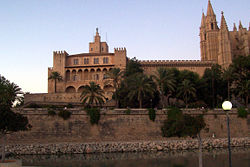
, its vast cathedral originally built on a previous mosque
. Although construction began in 1229, it did not finish until 1601 and local architect Antoni Gaudí
was drafted in during a restoration project in 1901. The Parc de la Mar (Park of the Sea) lies just south overlooked by the great building which sits above it on the city's stone foundations. Between these two are the town walls. Here there is a vast blue and yellow canopy strung over a lower area, shading rows of wooden benches.
(Italy), for example. The majority are private houses, some of which are open to the public as discreet museums or galleries. The tall structures, characteristic window boxes, detailed metal carvings and overhanging eaves of these buildings make a stark contrast with the view of the bay that is obtained by stepping out of the shady alleyways next to the cathedral and onto the old city walls. The Old City is also home to the Ajuntament (or Town Hall), the Convent of the Cathedral and the Banys Àrabs.
past, are accessed via the quiet Ca'n Serra street near the Convent of the Cathedral, and include the lush gardens of Ca'n Fontirroig, home to Sardinian warbler
s, house sparrow
s, cacti
, palm trees, and a wide range of flower
s and fern
s. The small two-roomed brick
building that once housed the bath is in fact of Byzantine
origin, dating back to the 11th century and possibly once part of the home of a Muslim
nobleman. The bath room has a cupola
with five oculi
which let in dazzling light. The twelve column
s holding up the small room were pillaged from an earlier Roman
construction. The floor over the hypocaust
has been worn away by people standing in the centre, mainly to photograph the entrance and the garden beyond it. The whole room is in a rather disreputable condition. The other room is a brick cube with a small model of the baths as they once were in the corner. Unfortunately one of the columns in this model has fallen over.
football league team Real Mallorca with its stadium placed at Palma. Segunda División B
team CD Atlético Baleares
also play in Palma at the 18,000 capacity Estadi Balear.
Because of its island condition all the sea sports have also a big presence in Palma. Maybe the most important event is the Trofeo Ciutat de Palma.
Road cycling
is very popular in Mallorca, with many enthusiasts from northern European countries coming to enjoy the relatively pleasant weather in winter and spring, as well as the opportunity to tackle several fine mountain climbs in the north of the island. An international race for professional cyclists, the Vuelta a Mallorca
, is held in February, the first day of which consists of a circuit race around the streets of Palma.
Palma was the host of the tennis
event Battle of Surfaces
.
Autonomous communities of Spain
An autonomous community In other languages of Spain:*Catalan/Valencian .*Galician .*Basque . The second article of the constitution recognizes the rights of "nationalities and regions" to self-government and declares the "indissoluble unity of the Spanish nation".Political power in Spain is...
of the Balearic Islands
Balearic Islands
The Balearic Islands are an archipelago of Spain in the western Mediterranean Sea, near the eastern coast of the Iberian Peninsula.The four largest islands are: Majorca, Minorca, Ibiza and Formentera. The archipelago forms an autonomous community and a province of Spain with Palma as the capital...
in Spain. The names Ciutat de Mallorca (English: City of Majorca) and Ciutat were used before the War of the Spanish Succession
War of the Spanish Succession
The War of the Spanish Succession was fought among several European powers, including a divided Spain, over the possible unification of the Kingdoms of Spain and France under one Bourbon monarch. As France and Spain were among the most powerful states of Europe, such a unification would have...
and are still used by people in Majorca. However, the official name was Mallorca, the same as the island. It is situated on the south coast of the island on the Bay of Palma
Bay of Palma
The Bay of Palma is a bay located to the south of Palma de Mallorca, Mallorca, Spain. It is in the south-west of the Balearic Island of Mallorca. Palma de Mallorca's harbour is located on the northern shores along with some famous beaches. Bounded to the west by Cape Cala Figuera, the north by...
. As of the 2009 census
Census
A census is the procedure of systematically acquiring and recording information about the members of a given population. It is a regularly occurring and official count of a particular population. The term is used mostly in connection with national population and housing censuses; other common...
, the population of the city of Palma proper was 401,270, and the population of the entire urban area was 517,285, ranking as the twelfth largest urban area of Spain. Almost half of the total population of Majorca live in Palma. The Cabrera Archipelago, though widely separated from Palma proper, is administratively considered part of the municipality. Its airport, Son Sant Joan, serves over 22 million passengers each year. The Marivent Palace was offered by the city to the then Prince Juan Carlos I of Spain
Juan Carlos I of Spain
Juan Carlos I |Italy]]) is the reigning King of Spain.On 22 November 1975, two days after the death of General Francisco Franco, Juan Carlos was designated king according to the law of succession promulgated by Franco. Spain had no monarch for 38 years in 1969 when Franco named Juan Carlos as the...
. The royals have since spent their summer holidays in Palma.
History
Palma was founded as a RomanAncient Rome
Ancient Rome was a thriving civilization that grew on the Italian Peninsula as early as the 8th century BC. Located along the Mediterranean Sea and centered on the city of Rome, it expanded to one of the largest empires in the ancient world....
camp upon the remains of a Talaiot
Talaiot
The talaiots, or talayots, are Bronze Age megaliths on the islands of Minorca and Majorca forming part of the Talaiotic Culture or Talaiotic Period. They date from the late second millennium and early first millennium BC. There are at least 274 of them, in, near, or related to Talaiotic settlements...
ic settlement. The turbulent history of the city saw it the subject of several Vandal sackings during the fall of the Roman Empire, then reconquered by the Byzantine
Byzantine
Byzantine usually refers to the Roman Empire during the Middle Ages.Byzantine may also refer to:* A citizen of the Byzantine Empire, or native Greek during the Middle Ages...
, then colonised by the Moors
Moors
The description Moors has referred to several historic and modern populations of the Maghreb region who are predominately of Berber and Arab descent. They came to conquer and rule the Iberian Peninsula for nearly 800 years. At that time they were Muslim, although earlier the people had followed...
(who called it Medina Mayurqa), and finally established by James I of Aragon
James I of Aragon
James I the Conqueror was the King of Aragon, Count of Barcelona, and Lord of Montpellier from 1213 to 1276...
.
Roman period
After the conquest of Majorca, it was loosely incorporated into the province of TarraconensisHispania Tarraconensis
Hispania Tarraconensis was one of three Roman provinces in Hispania. It encompassed much of the Mediterranean coast of Spain along with the central plateau. Southern Spain, the region now called Andalusia, was the province of Hispania Baetica...
by 123 BC; the Romans founded two new cities: Palma on the south of the island, and Pollentia
Pollença
Pollença is a town and municipality situated in the far north corner of the island of Majorca, near Cap de Formentor and Alcúdia. It lies about 6 km west of its port, Port de Pollença.-History:...
in the northeast - on the site of a Phoenician settlement. Whilst Pollentia acted as port to Roman cities on the northwestern Mediterranean Sea, Palma was the port used for destinations in Africa, such as Carthage
Carthage
Carthage , implying it was a 'new Tyre') is a major urban centre that has existed for nearly 3,000 years on the Gulf of Tunis, developing from a Phoenician colony of the 1st millennium BC...
, and Hispania
Hispania
Another theory holds that the name derives from Ezpanna, the Basque word for "border" or "edge", thus meaning the farthest area or place. Isidore of Sevilla considered Hispania derived from Hispalis....
, such as Saguntum, Gades, and Carthago Nova. Though no visible remains of this period are seen in present day Palma, archaeological discoveries still occur whenever excavating under the city centre.
Byzantine period
Though the period between the fall of the Western Roman EmpireWestern Roman Empire
The Western Roman Empire was the western half of the Roman Empire after its division by Diocletian in 285; the other half of the Roman Empire was the Eastern Roman Empire, commonly referred to today as the Byzantine Empire....
and the Muslim conquest is not well known (due to lack of documents), there is clear evidence of Byzantine
Byzantine Empire
The Byzantine Empire was the Eastern Roman Empire during the periods of Late Antiquity and the Middle Ages, centred on the capital of Constantinople. Known simply as the Roman Empire or Romania to its inhabitants and neighbours, the Empire was the direct continuation of the Ancient Roman State...
presence in the city, as indicated by mosaics found in the oldest parts of the Cathedral, which was in early medieval times a paleo-Christian temple.
Under the Caliphate
The arrival of MoorsMoors
The description Moors has referred to several historic and modern populations of the Maghreb region who are predominately of Berber and Arab descent. They came to conquer and rule the Iberian Peninsula for nearly 800 years. At that time they were Muslim, although earlier the people had followed...
in the Balearic Islands occurred at the beginning of the 8th century. During this period, the population developed an economy based on self-sufficiency and piracy, and even showed evidence of a relative hierarchy. The dominant groups took advantage of the Byzantine
Byzantine Empire
The Byzantine Empire was the Eastern Roman Empire during the periods of Late Antiquity and the Middle Ages, centred on the capital of Constantinople. Known simply as the Roman Empire or Romania to its inhabitants and neighbours, the Empire was the direct continuation of the Ancient Roman State...
withdrawal due to Islamic expansion, to reinforce their domination upon the rest of the population, thus ensuring their power and the gradual abandonment of Imperial structures.
In 707, a Muslim fleet, under the command of Abd Allgaht ibn Musa, son of the governor of Ifriqiya, Musa ibn Nusayr, stopped at the island. It appears that Abd Allah convinced the factional powers of the city to accept a peace treaty. This treaty granted, in exchange for a tax, respect for social, economic and political structures to the communities that subscribed it, as well as the continuity of their religious beliefs..
After 707, the city was inhabited by Christians who were nominally in allegiance to the sovereignty of the Caliphate
Caliphate
The term caliphate, "dominion of a caliph " , refers to the first system of government established in Islam and represented the political unity of the Muslim Ummah...
of Damascus, yet who, de facto, enjoyed an absolute autonomy. The city, being in Majorca, constituted an enclave between westernChristian and Islamic territories, and this attracted and encouraged increased levels of piracy in the surrounding waters. For wide sectors of the city's population, the sacking of ships (whether Muslim or Christian) which passed through Balearic waters, was the first source of riches during the next fifteen decades. Eventually, the continued piracy in the region lead to retaliation by Al-Andalus
Al-Andalus
Al-Andalus was the Arabic name given to a nation and territorial region also commonly referred to as Moorish Iberia. The name describes parts of the Iberian Peninsula and Septimania governed by Muslims , at various times in the period between 711 and 1492, although the territorial boundaries...
which launched its naval power against the city and the whole of the Islands.
The Islands were defended by the emperor Charlemagne
Charlemagne
Charlemagne was King of the Franks from 768 and Emperor of the Romans from 800 to his death in 814. He expanded the Frankish kingdom into an empire that incorporated much of Western and Central Europe. During his reign, he conquered Italy and was crowned by Pope Leo III on 25 December 800...
in 799 from a Saracen pirate incursion.
In 848 (maybe 849), four years after the first Viking
Viking
The term Viking is customarily used to refer to the Norse explorers, warriors, merchants, and pirates who raided, traded, explored and settled in wide areas of Europe, Asia and the North Atlantic islands from the late 8th to the mid-11th century.These Norsemen used their famed longships to...
incursions had sacked the whole island, an attack from Córdoba
Córdoba, Spain
-History:The first trace of human presence in the area are remains of a Neanderthal Man, dating to c. 32,000 BC. In the 8th century BC, during the ancient Tartessos period, a pre-urban settlement existed. The population gradually learned copper and silver metallurgy...
forced the authorities to ratify the treaty to which the city had submitted in 707. As the city still occupied an eccentric position regarding the commerce network established by the Caliph
Caliph
The Caliph is the head of state in a Caliphate, and the title for the ruler of the Islamic Ummah, an Islamic community ruled by the Shari'ah. It is a transcribed version of the Arabic word which means "successor" or "representative"...
in the western Mediterranean, the enclave was not immediately incorporated into Al-Andalus.
While the Caliphate of Córdoba
Caliphate of Córdoba
The Caliphate of Córdoba ruled the Iberian peninsula and part of North Africa, from the city of Córdoba, from 929 to 1031. This period was characterized by remarkable success in trade and culture; many of the masterpieces of Islamic Iberia were constructed in this period, including the famous...
reinforced its influence upon the Mediterranean, the interest of Al-Andalus for the city increased. The logical consequence of this evolution was the substitution of the submission treaty by the effective incorporation of the islands
Balearic Islands
The Balearic Islands are an archipelago of Spain in the western Mediterranean Sea, near the eastern coast of the Iberian Peninsula.The four largest islands are: Majorca, Minorca, Ibiza and Formentera. The archipelago forms an autonomous community and a province of Spain with Palma as the capital...
to the Islamic state. This incorporation took place in the last years of the Emirate. a squad under the command of Isam al-Jawlani took advantage of the instability caused by several Viking
Viking
The term Viking is customarily used to refer to the Norse explorers, warriors, merchants, and pirates who raided, traded, explored and settled in wide areas of Europe, Asia and the North Atlantic islands from the late 8th to the mid-11th century.These Norsemen used their famed longships to...
incursions and disembarked in Majorca, and after destroying any resistance, incorporated Majorca, with Palma as its capital, to the Córdobese dominions.
The incorporation of the city to the Emirate sets the basis for a new social organisation, far more articulated and complex than before. Commerce and manufacture developed in a manner that was unknown previously. This caused a considerable demographic growth, thereby establishing Medina Mayurqa as one of the major ports for trading goods in and out of the Caliphate of Córdoba.
Dénia - Balearic Taifa (1015 - 1087)
The UmayyadUmayyad
The Umayyad Caliphate was the second of the four major Arab caliphates established after the death of Muhammad. It was ruled by the Umayyad dynasty, whose name derives from Umayya ibn Abd Shams, the great-grandfather of the first Umayyad caliph. Although the Umayyad family originally came from the...
regime, despite its administrative centralisation, mercenary army and struggle to gain wider social support, could neither harmonise the various ethnic groups inside al-Andalus nor dissolve the old tribal bounds which still organised sporadic ethnic in-fighting. During the 11th century, the Caliphate's control waned considerably. Provinces broke free from the central Córdobese administration, and became effectively sovereign states - taifa
Taifa
In the history of the Iberian Peninsula, a taifa was an independent Muslim-ruled principality, usually an emirate or petty kingdom, though there was one oligarchy, of which a number formed in the Al-Andalus after the final collapse of the Umayyad Caliphate of Córdoba in 1031.-Rise:The origins of...
s - under the same governors that had been named by the last Umayyad Caliphs. According to their origin, these "taifas" can be grouped under three broad categories: Arabian, Berber
Berber people
Berbers are the indigenous peoples of North Africa west of the Nile Valley. They are continuously distributed from the Atlantic to the Siwa oasis, in Egypt, and from the Mediterranean to the Niger River. Historically they spoke the Berber language or varieties of it, which together form a branch...
, or Slavic
Saqaliba
Saqaliba refers to the Slavs, particularly Slavic slaves and mercenaries in the medieval Arab world, in the Middle East, North Africa, Sicily and Al-Andalus. It is generally thought that the Arabic term is a Byzantine loanword: saqlab, siklab, saqlabi etc. is a corruption of Greek Sklavinoi for...
origin.
Palma was part of the taifa of Dénia
Taifa of Dénia
The taifa of Dénia was a Muslim kingdom in medieval Spain, ruling over part of the Valencian coast and Ibiza. With Dénia as its capital, the taifa included the Balearic Islands and parts of the Spanish mainland.- History :...
. The founder of this state was a client of the Al-Mansur
Al-Mansur Ibn Abi Aamir
Abu Aamir Muhammad Ibn Abdullah Ibn Abi Aamir, Al-Hajib Al-Mansur , better known as Almanzor, was the de facto ruler of Muslim Al-Andalus in the late 10th to early 11th centuries. His rule marked the peak of power for Moorish Iberia.-Origins:He was born Muhammad Ibn Abi Aamir, into a noble Arab...
family, Muyahid ibn Yusuf ibn Ali, who could take profit from the progressive crumbling of the Caliphate's superstructure to gain control over the province of Dénia
Dénia
Dénia is a city in the province of Alicante, Spain, on the Costa Blanca halfway between Alicante and Valencia, the judicial seat of the comarca of Marina Alta...
. Subsequently, Muyahid organised a campaign throughout the Balearic Islands
Balearic Islands
The Balearic Islands are an archipelago of Spain in the western Mediterranean Sea, near the eastern coast of the Iberian Peninsula.The four largest islands are: Majorca, Minorca, Ibiza and Formentera. The archipelago forms an autonomous community and a province of Spain with Palma as the capital...
to consolidate this district and incorporated them to its "taifa" in early 1015.
During the following years Palma became the main port from where attacks on Christian vessels and coasts could be launched. Palma was the base from where a campaign against Sardinia
Sardinia
Sardinia is the second-largest island in the Mediterranean Sea . It is an autonomous region of Italy, and the nearest land masses are the French island of Corsica, the Italian Peninsula, Sicily, Tunisia and the Spanish Balearic Islands.The name Sardinia is from the pre-Roman noun *sard[],...
was launched between 1016 and 1017, which caused the intervention of Pisa
Republic of Pisa
The Republic of Pisa was a de facto independent state centered on the Tuscan city of Pisa during the late tenth and eleventh centuries. It rose to become an economic powerhouse, a commercial center whose merchants dominated Mediterranean and Italian trade for a century before being surpassed and...
ns and Genoese
Republic of Genoa
The Most Serene Republic of Genoa |Ligurian]]: Repúbrica de Zêna) was an independent state from 1005 to 1797 in Liguria on the northwestern Italian coast, as well as Corsica from 1347 to 1768, and numerous other territories throughout the Mediterranean....
forces. Later, this intervention set the basis for Italian mercantile penetration of the city.
The Denian dominion lasted until 1087, a period during which the city, as well as the rest of the islands, was relatively peaceful. Their supremacy at sea was still not rivalled by the Italian merchant republics, thus there were few external threats.
The Balearic Taifa (1087 - 1115) and the Western Mediterranean
The Banu HudBanu Hud
The Banu Hud were an Arab dynasty that ruled the taifa of Zaragoza from 1039-1110. In 1039, under the leadership of Al-Mustain I, Sulayman ibn Hud al-Judhami, the Bani Hud seized control of Zaragoza from a rival clan, the Banu Tujibi...
conquest of Dénia and the incorporation of this to the Eastern district of the taifa of Zaragoza
Taifa of Zaragoza
The taifa of Zaragoza was an independent Muslim state in Moorish Al-Andalus, present day eastern Spain, which was established in 1018 as one of the taifa kingdoms, which emerged in the 11th century following the destruction of the Caliphate of Córdoba in the Moorish Iberian Peninsula.During the...
meant the destruction of the work of Muyahid. The Islands got unbound from peninsular dominion and for a short time, enjoyed independence, during which Medina Mayurqa was the capital.
The economy during this period depended on both agriculture and piracy. In the latter 11th century, Christian commercial powers took the initiative at sea against the Muslims. After centuries of fighting defensively in the face of Islamic pressure, Italians, Catalans and Occitans took offensive action. Consequently, the benefits of piracy diminished causing severe economic stress on the city.
The clearest proof of the new ruling relation of forces, from 1090, is the Crusade organised by the most important mercantile cities of the Christian states against the Islands. This effort was destined to finally eradicate Muslim piracy mainly based in Palma and surrounding havens. In 1115, Palma was sacked and later abandoned by an expedition commanded by Ramon Berenguer III the Great, count of Barcelona
Barcelona
Barcelona is the second largest city in Spain after Madrid, and the capital of Catalonia, with a population of 1,621,537 within its administrative limits on a land area of...
and Provence
Provence
Provence ; Provençal: Provença in classical norm or Prouvènço in Mistralian norm) is a region of south eastern France on the Mediterranean adjacent to Italy. It is part of the administrative région of Provence-Alpes-Côte d'Azur...
, which comprised Catalans, Pisans and other Italians, and soldiers from Provence, Corsica
Corsica
Corsica is an island in the Mediterranean Sea. It is located west of Italy, southeast of the French mainland, and north of the island of Sardinia....
, and Sardinia, in a struggle to end Almoravid control.
After this, the Islands became part of the Almoravid Caliphate. The inglobement of all the taifa to a larger state helped to re-establish a balance along the frontier that separated western Christian states from the Muslim world.
The period of the Banu Ganiya (1157 - 1203)
The situation changed in the mid-12th century, when the Almoravids, were displaced from al-Andalus and western MaghrebMaghreb
The Maghreb is the region of Northwest Africa, west of Egypt. It includes five countries: Morocco, Algeria, Tunisia, Libya, and Mauritania and the disputed territory of Western Sahara...
by the Almohad
Almohad
The Almohad Dynasty , was a Moroccan Berber-Muslim dynasty founded in the 12th century that established a Berber state in Tinmel in the Atlas Mountains in roughly 1120.The movement was started by Ibn Tumart in the Masmuda tribe, followed by Abd al-Mu'min al-Gumi between 1130 and his...
. Almoravid dominions, from 1157 on, were restricted to the Balearic Islands
Balearic Islands
The Balearic Islands are an archipelago of Spain in the western Mediterranean Sea, near the eastern coast of the Iberian Peninsula.The four largest islands are: Majorca, Minorca, Ibiza and Formentera. The archipelago forms an autonomous community and a province of Spain with Palma as the capital...
, with Palma again acting as the capital, governed by Muhammad ibn Ganiya. Massive arrival of al-Andalus refugees contributed to reinforce the positions of the last Almoravid legitimatists, the Banu Ganiya, who, conscious of their weakness in the Western Mediterranean context, started to get closer to the growing powers represented by Italian maritime republics. Genoa and Pisans obtained in this period their first commercial concessions in the city and the rest of the islands.
The Banu Ganiya, taking advantage of the great loss suffered by Abu Yuqub Yusuf in the Battle of Santarém (1184), attacked Ifriqiya, where the Almohad dominion had not been consolidated yet, in the same year. However, this attack was repelled and the Almohad authorities encouraged anti-Almoravid revolts in the Islands. The city was captured by the Almohads in 1203.
Christian conquest and late Middle Age
James I of Aragon
James I the Conqueror was the King of Aragon, Count of Barcelona, and Lord of Montpellier from 1213 to 1276...
and was renamed Palma de Mallorca. In addition to being kept as capital of the Kingdom of Majorca, it was given a municipality that comprised the whole island. The governing organ was the University of the City and Kingdom of Majorca.
After the death of James I of Aragon, Palma was joint capital of the Kingdom of Majorca
Kingdom of Majorca
The Kingdom of Majorca was founded by James I of Aragon, also known as James The Conqueror. After the death of his first-born son Alfonso, a will was written in 1262 which created the kingdom in order to cede it to his son James...
, together with Perpignan
Perpignan
-Sport:Perpignan is a rugby stronghold: their rugby union side, USA Perpignan, is a regular competitor in the Heineken Cup and seven times champion of the Top 14 , while their rugby league side plays in the engage Super League under the name Catalans Dragons.-Culture:Since 2004, every year in the...
. His son, James II of Majorca
James II of Majorca
James II was King of Majorca and Lord of Montpellier from 1276 until his death. He was the second son of James I of Aragon and his wife Violant, daughter of Andrew II of Hungary...
, championed the construction of statues and monuments in the city: Bellver Castle
Bellver Castle
Bellver Castle is a Gothic style castle on a hill 3 km northwest of Palma on the Island of Majorca, Balearic Islands, Spain. It was built in the 14th century for King James II of Majorca, and is one of the few circular castles in Europe...
, the churches of St. Francesc and St. Domingo, reformed the Palace of Almudaina and began the construction of the Cathedral of Majorca
La Seu
The Cathedral of Santa Maria of Palma, more commonly referred to as La Seu, is a Gothic Roman Catholic cathedral located in Palma, Majorca, Spain, built on the site of a pre-existing Arab mosque. It is 121 metres long, 55 metres wide and its nave is 44 metres tall...
.
The river that cut through the city gave rise to two distinct areas within the city; "Upper town" and "Lower town", depending upon which side of the river they were situated.
The city's privileged geographical location allowed it to keep extensive commerce with Catalonia
Catalonia
Catalonia is an autonomous community in northeastern Spain, with the official status of a "nationality" of Spain. Catalonia comprises four provinces: Barcelona, Girona, Lleida, and Tarragona. Its capital and largest city is Barcelona. Catalonia covers an area of 32,114 km² and has an...
, Valencia, Provence
Provence
Provence ; Provençal: Provença in classical norm or Prouvènço in Mistralian norm) is a region of south eastern France on the Mediterranean adjacent to Italy. It is part of the administrative région of Provence-Alpes-Côte d'Azur...
, the Maghreb
Maghreb
The Maghreb is the region of Northwest Africa, west of Egypt. It includes five countries: Morocco, Algeria, Tunisia, Libya, and Mauritania and the disputed territory of Western Sahara...
, the Italian republics and the dominions of the Great Turk
Ottoman Empire
The Ottoman EmpireIt was usually referred to as the "Ottoman Empire", the "Turkish Empire", the "Ottoman Caliphate" or more commonly "Turkey" by its contemporaries...
, which heralded a golden age for the city.
At the beginning of the 16th century, the Rebellion of the Brotherhoods (a peasant uprising against Charles V
Charles V, Holy Roman Emperor
Charles V was ruler of the Holy Roman Empire from 1519 and, as Charles I, of the Spanish Empire from 1516 until his voluntary retirement and abdication in favor of his younger brother Ferdinand I and his son Philip II in 1556.As...
's administration) and the frequent attack of Turkish
Ottoman Empire
The Ottoman EmpireIt was usually referred to as the "Ottoman Empire", the "Turkish Empire", the "Ottoman Caliphate" or more commonly "Turkey" by its contemporaries...
and Berber
Berber people
Berbers are the indigenous peoples of North Africa west of the Nile Valley. They are continuously distributed from the Atlantic to the Siwa oasis, in Egypt, and from the Mediterranean to the Niger River. Historically they spoke the Berber language or varieties of it, which together form a branch...
pirates caused a reduction of commercial activities and a huge inversion in defensive structures. As a consequence, the city entered a period of decadence that would last till the end of the 17th century.
17th to 19th centuries
The 17th century is characterised by the division of the city in two sides or gangs, named Canamunts and Canavalls (from Majorcan Catalan "the ones from the upper/lower side"), with severe social and economical repercussions. During this period the port became a corsairs haven. During the last quarter of the century, the InquisitionInquisition
The Inquisition, Inquisitio Haereticae Pravitatis , was the "fight against heretics" by several institutions within the justice-system of the Roman Catholic Church. It started in the 12th century, with the introduction of torture in the persecution of heresy...
reinforced its prosecution of the Jews, locally named xuetes.
The fall of Barcelona in 1714 meant the end of the Spanish Succession War and the defeat and destruction of the Crown of Aragon
Crown of Aragon
The Crown of Aragon Corona d'Aragón Corona d'Aragó Corona Aragonum controlling a large portion of the present-day eastern Spain and southeastern France, as well as some of the major islands and mainland possessions stretching across the Mediterranean as far as Greece...
, and this was reflected on the Decretos de Nueva Planta, issued by Phillip V of Spain in 1715. This occupation decree changed the government of the island and separated it from the municipality's government of Palma, which became the official city name. By the end of the 19th century, the name Palma de Mallorca was generalised in written Spanish, although it is still colloquially named Ciutat ("city") in Catalan. In the 18th century Charles III of Spain
Charles III of Spain
Charles III was the King of Spain and the Spanish Indies from 1759 to 1788. He was the eldest son of Philip V of Spain and his second wife, the Princess Elisabeth Farnese...
removed interdiction of commerce with Spanish colonies in America
Spanish Empire
The Spanish Empire comprised territories and colonies administered directly by Spain in Europe, in America, Africa, Asia and Oceania. It originated during the Age of Exploration and was therefore one of the first global empires. At the time of Habsburgs, Spain reached the peak of its world power....
and the port and commercial activity of the city grew once again.
At the beginning of the 19th century, Palma became the refuge of many who had exiled themselves from the Napoleonic occupation of Catalonia
Catalonia
Catalonia is an autonomous community in northeastern Spain, with the official status of a "nationality" of Spain. Catalonia comprises four provinces: Barcelona, Girona, Lleida, and Tarragona. Its capital and largest city is Barcelona. Catalonia covers an area of 32,114 km² and has an...
and Valencia; during this period freedom flourished, until the absolutist restoration. With the establishing of the contemporary Spanish state administrative organization, Palma became the capital of the new province of Balearic Islands
Balearic Islands
The Balearic Islands are an archipelago of Spain in the western Mediterranean Sea, near the eastern coast of the Iberian Peninsula.The four largest islands are: Majorca, Minorca, Ibiza and Formentera. The archipelago forms an autonomous community and a province of Spain with Palma as the capital...
in the 1833 territorial division of Spain
1833 territorial division of Spain
The 1833 territorial division of Spain divided Spain into provinces, classified into "historic regions" . on the official web site of the government of the Canary Islands, accessed 2009-12-31...
. The French occupation of Algeria
Algeria
Algeria , officially the People's Democratic Republic of Algeria , also formally referred to as the Democratic and Popular Republic of Algeria, is a country in the Maghreb region of Northwest Africa with Algiers as its capital.In terms of land area, it is the largest country in Africa and the Arab...
in the 19th century ended the fear of Maghrebi attacks in Majorca, which favoured the expansion of new maritime lines, and consequently, the economic growth of the city, which suffered a demographic increase, with the birth of new nucleus of population.
Contemporary age
Since the 1950s, the advent of mass tourism radically changed the face of both the city and island, transforming it into a centre of attraction for visitors and attracting workers from mainland Spain. This contributed to a huge change in the traditions, the sociolinguistic map, urbanisation and acquisitive power.The boom in tourism caused Palma to grow significantly, with repercussions on immigration. In 1960, Majorca received 500,000 visitors, in 1997 it received more than 6,739,700. In 2001 more than 19,200,000 people passed through Son Sant Joan airport near Palma, with an additional 1.5 million coming by sea.
In the 21st century, urban redevelopment, by the so-called Pla Mirall (English "Mirror Plan"), attracted important groups of immigrant workers from outside the European Union
European Union
The European Union is an economic and political union of 27 independent member states which are located primarily in Europe. The EU traces its origins from the European Coal and Steel Community and the European Economic Community , formed by six countries in 1958...
, especially from Africa and South America.
Geography
Palma is the major city and seaport geographically located in the south-west of Majorca. The city lies on the larger coastal Bay of Palma in the western Mediterranean Sea. The land area of the city is about 21.355 km² with an altitude of 13 metres.Palma is bordered by rocky inlets and marinas on the south side, whilst many of the tourist resorts are positioned towards the east side of the city. The central zone that extends from Palma is generally a flat fertile plain known as Es Pla. There are two uninhabited islands, which are located southeast of Palma and Dragonera which is west of Palma.
Climate
Main sights
Plaça d'Espanya
The Plaça d'Espanya is the transport hub of Palma. The Estació Intermodal caters for buses and trains (the latter controlled by TIB). The two old buildings home to the tourist information and several cafés sit either side of the two large escalators which lead into the Estació, which interestingly enough sits underneath a large and popular park. On the lawns are several glass boxes, which let in light and ventilation to the station below ground. There are also train-themed playing structures, each one shaped like a train carriage and named after towns along the line of the Ferrocarril de SóllerFerrocarril de Sóller
The Ferrocarril de Sóller or FS is an interurban railway and the name for the company which operates the electrified gauge tracks running between the towns of Sóller and Palma on the Spanish island of Mallorca...
, a railway dating back to 1911 which has its Palma Station right next to the park. Just down the street from here a new bus station is under construction.
The Cathedral Area
Palma is famous for La SeuLa Seu
The Cathedral of Santa Maria of Palma, more commonly referred to as La Seu, is a Gothic Roman Catholic cathedral located in Palma, Majorca, Spain, built on the site of a pre-existing Arab mosque. It is 121 metres long, 55 metres wide and its nave is 44 metres tall...
, its vast cathedral originally built on a previous mosque
Mosque
A mosque is a place of worship for followers of Islam. The word is likely to have entered the English language through French , from Portuguese , from Spanish , and from Berber , ultimately originating in — . The Arabic word masjid literally means a place of prostration...
. Although construction began in 1229, it did not finish until 1601 and local architect Antoni Gaudí
Antoni Gaudí
Antoni Gaudí i Cornet was a Spanish Catalan architect and figurehead of Catalan Modernism. Gaudí's works reflect his highly individual and distinctive style and are largely concentrated in the Catalan capital of Barcelona, notably his magnum opus, the Sagrada Família.Much of Gaudí's work was...
was drafted in during a restoration project in 1901. The Parc de la Mar (Park of the Sea) lies just south overlooked by the great building which sits above it on the city's stone foundations. Between these two are the town walls. Here there is a vast blue and yellow canopy strung over a lower area, shading rows of wooden benches.
The Old City
The Old City (in the south-east area of Palma behind the Cathedral) is a fascinating maze of streets clearly hinting towards an Arab past. With the exception of a few streets and squares which allow traffic and are more populated with tourists most of the time, the walkways of this city quarter are fairly narrow, quiet streets, surrounded by a diverse range of interesting buildings, the architecture of which can easily be compared with those in streets of cities such as FlorenceFlorence
Florence is the capital city of the Italian region of Tuscany and of the province of Florence. It is the most populous city in Tuscany, with approximately 370,000 inhabitants, expanding to over 1.5 million in the metropolitan area....
(Italy), for example. The majority are private houses, some of which are open to the public as discreet museums or galleries. The tall structures, characteristic window boxes, detailed metal carvings and overhanging eaves of these buildings make a stark contrast with the view of the bay that is obtained by stepping out of the shady alleyways next to the cathedral and onto the old city walls. The Old City is also home to the Ajuntament (or Town Hall), the Convent of the Cathedral and the Banys Àrabs.
Banys Àrabs
The Banys Àrabs, or Arab Baths, one of the few remnants of Palma's MoorishMoors
The description Moors has referred to several historic and modern populations of the Maghreb region who are predominately of Berber and Arab descent. They came to conquer and rule the Iberian Peninsula for nearly 800 years. At that time they were Muslim, although earlier the people had followed...
past, are accessed via the quiet Ca'n Serra street near the Convent of the Cathedral, and include the lush gardens of Ca'n Fontirroig, home to Sardinian warbler
Sardinian Warbler
The Sardinian Warbler, Sylvia melanocephala, is a common and widespread typical warbler from the Mediterranean region.-Description:...
s, house sparrow
House Sparrow
The House Sparrow is a bird of the sparrow family Passeridae, found in most parts of the world. One of about 25 species in the genus Passer, the House Sparrow occurs naturally in most of Europe, the Mediterranean region, and much of Asia...
s, cacti
Cactus
A cactus is a member of the plant family Cactaceae. Their distinctive appearance is a result of adaptations to conserve water in dry and/or hot environments. In most species, the stem has evolved to become photosynthetic and succulent, while the leaves have evolved into spines...
, palm trees, and a wide range of flower
Flower
A flower, sometimes known as a bloom or blossom, is the reproductive structure found in flowering plants . The biological function of a flower is to effect reproduction, usually by providing a mechanism for the union of sperm with eggs...
s and fern
Fern
A fern is any one of a group of about 12,000 species of plants belonging to the botanical group known as Pteridophyta. Unlike mosses, they have xylem and phloem . They have stems, leaves, and roots like other vascular plants...
s. The small two-roomed brick
Brick
A brick is a block of ceramic material used in masonry construction, usually laid using various kinds of mortar. It has been regarded as one of the longest lasting and strongest building materials used throughout history.-History:...
building that once housed the bath is in fact of Byzantine
Byzantine architecture
Byzantine architecture is the architecture of the Byzantine Empire. The empire gradually emerged as a distinct artistic and cultural entity from what is today referred to as the Roman Empire after AD 330, when the Roman Emperor Constantine moved the capital of the Roman Empire east from Rome to...
origin, dating back to the 11th century and possibly once part of the home of a Muslim
Muslim
A Muslim, also spelled Moslem, is an adherent of Islam, a monotheistic, Abrahamic religion based on the Quran, which Muslims consider the verbatim word of God as revealed to prophet Muhammad. "Muslim" is the Arabic term for "submitter" .Muslims believe that God is one and incomparable...
nobleman. The bath room has a cupola
Cupola
In architecture, a cupola is a small, most-often dome-like, structure on top of a building. Often used to provide a lookout or to admit light and air, it usually crowns a larger roof or dome....
with five oculi
Oculus
An Oculus, circular window, or rain-hole is a feature of Classical architecture since the 16th century. They are often denoted by their French name, oeil de boeuf, or "bull's-eye". Such circular or oval windows express the presence of a mezzanine on a building's façade without competing for...
which let in dazzling light. The twelve column
Column
A column or pillar in architecture and structural engineering is a vertical structural element that transmits, through compression, the weight of the structure above to other structural elements below. For the purpose of wind or earthquake engineering, columns may be designed to resist lateral forces...
s holding up the small room were pillaged from an earlier Roman
Roman architecture
Ancient Roman architecture adopted certain aspects of Ancient Greek architecture, creating a new architectural style. The Romans were indebted to their Etruscan neighbors and forefathers who supplied them with a wealth of knowledge essential for future architectural solutions, such as hydraulics...
construction. The floor over the hypocaust
Hypocaust
A hypocaust was an ancient Roman system of underfloor heating, used to heat houses with hot air. The word derives from the Ancient Greek hypo meaning "under" and caust-, meaning "burnt"...
has been worn away by people standing in the centre, mainly to photograph the entrance and the garden beyond it. The whole room is in a rather disreputable condition. The other room is a brick cube with a small model of the baths as they once were in the corner. Unfortunately one of the columns in this model has fallen over.
Rubbish containers
Rather more modern additions to the old parts of the city are the attractive and discreet bronze rubbish collecting bins. They operate under the simple method of putting one's refuse into the cylinder at the top of the machine and turning a handle which then revolves the cylinder, tipping it into the lower area of the bin.Sports
Football is the most important sport on the island, led by the Primera DivisiónLa Liga
The Primera División of the Liga Nacional de Fútbol Profesional , commonly known as La Liga or, for sponsorship reasons, Liga BBVA since 2008, is the top professional association football division of the Spanish football league system...
football league team Real Mallorca with its stadium placed at Palma. Segunda División B
Segunda División B
Segunda División B is the third level of the Spanish football league system. It is administered by the RFEF. The top two levels are La Liga, also referred to as the Primera División, and the Segunda División. Immediately below Segunda División B is the Tercera Division...
team CD Atlético Baleares
CD Atlético Baleares
Club Deportivo Atlético Baleares is a Spanish football team based in Palma, Majorca, in the autonomous community of the Balearic Islands. Founded on 27 May 1942, it currently plays in Segunda División B - Group 3.-History:...
also play in Palma at the 18,000 capacity Estadi Balear.
Because of its island condition all the sea sports have also a big presence in Palma. Maybe the most important event is the Trofeo Ciutat de Palma.
Road cycling
Road cycling
Road cycling is the most widespread form of cycling. It includes recreational, racing, and utility cycling. Road cyclists are generally expected to obey the same rules and laws as other vehicle drivers or riders and may also be vehicular cyclists....
is very popular in Mallorca, with many enthusiasts from northern European countries coming to enjoy the relatively pleasant weather in winter and spring, as well as the opportunity to tackle several fine mountain climbs in the north of the island. An international race for professional cyclists, the Vuelta a Mallorca
Vuelta a Mallorca
The Challenge Vuelta Ciclista a Mallorca is a series of five professional one day road bicycle races held on the Spanish island of Mallorca in early February. The event is used as an early season preparatory event by many of the top teams in readiness for the bigger races later in the season...
, is held in February, the first day of which consists of a circuit race around the streets of Palma.
Palma was the host of the tennis
Tennis
Tennis is a sport usually played between two players or between two teams of two players each . Each player uses a racket that is strung to strike a hollow rubber ball covered with felt over a net into the opponent's court. Tennis is an Olympic sport and is played at all levels of society at all...
event Battle of Surfaces
Battle of Surfaces
The Battle of Surfaces was a men's tennis exhibition match that was held on May 2, 2007, between Roger Federer, then the top-ranked men's player, and Rafael Nadal, then World No. 2. The match was played in the capital city of Nadal's home island, Palma de Mallorca, in front of a home crowd at Palma...
.
Transport
- Palma de Mallorca MetroPalma de Mallorca MetroThe Palma Metro is a metro line in Palma, Spain. It consists of nine stations and was constructed between 2005 and 2007 at cost of 312 million euros.Trains run daily from 06:15 to 23:00....
- Majorca rail networkMajorca rail networkThe Majorca rail network on the Spanish Island of Majorca has three lines to four destinations from the Estació Intermodal/Plaça d'Espanya station in Palma.- TIB :...
- Palma de Mallorca AirportPalma de Mallorca AirportPalma de Mallorca Airport is an airport located east of Palma, Majorca, adjacent to the village of Can Pastilla. Also known as Son Sant Joan Airport or Aeroport de Son Sant Joan, it is the third largest airport in Spain, after Madrid's Barajas Airport and Barcelona Airport...
- The city bus system, which includes a loop line through the historic centre, is run by the EMT (See external link below).
- There is also a bus system run by the TIB. This includes routes to and from the municipalities Calvià and Palma.
See also
- Duchess of Palma de MallorcaDuchess of Palma de MallorcaDuchess of Palma de Mallorca is a noble title granted for life by King Juan Carlos I of Spain for his daughter, Infanta Cristina, on 26 September 1997 by her marriage to Iñaki Urdangarin.- Dukes of Palma de Mallorca :...
- Edwin Lewis SnyderEdwin Lewis SnyderEdwin Lewis Snyder was an architect and pioneer in the use of Spanish Colonial Revival Style architecture, building homes in Northern California for decades from the early to mid-twentieth century. The Snyder-designed , built in 1930, is on the city's historical register; the Roy O. Long Co....
, "Spain's Magic Island", The Architect and Engineer, 110:10, 37-45, August 1932 - List of municipalities in Balearic Islands