

Royal Canadian Air Force

Encyclopedia
The history of the Royal Canadian Air Force begins in 1920, when the air force was created as the Canadian Air Force
(CAF). In 1924 the CAF was renamed the Royal Canadian Air Force
(RCAF) and granted royal sanction by King George V
. The RCAF existed as an independent service until 1968. Prior attempts at forming an air force for Canada were the Canadian Aviation Corps
that was attached to the Canadian Expeditionary Force
, and a two-squadron Canadian Air Force that was attached to the Royal Air Force
.
The modern Royal Canadian Air Force, formerly known as Canadian Forces Air Command, traces its ancestry to the unification of Canada's armed services
in 1968, and is one of three environmental commands of the Canadian Forces
. Over the course of history, the Royal Canadian Air Force has served in the Second World War, the Korean War
, and several United Nations peacekeeping missions and NATO operations. The force has also maintained a presence in Europe through the second half of the 20th century.
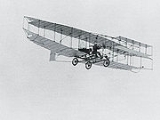
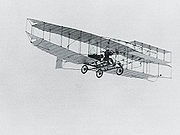 The aviation age came to Canada on 23 February 1909, when Alexander Graham Bell's
Silver Dart
took off from the ice of Bras d'Or Lake
at Baddeck, Nova Scotia
with J.D. McCurdy
at the controls. This 1/2-mile flight was the first "controlled powered flight" (also the first flight of a "heavier than air craft") in Canada and the British Empire
. A longer flight of 20 miles was flown at Bras d'Or Lake on 10 March 1909.
It was hoped that the Department of Militia and Defence would be interested in buying the aircraft. Although the general impression at the time was that aircraft would never amount to much in actual warfare, one official felt otherwise, and the aviators were invited to Camp Petawawa to demonstrate their machine. On 2 August 1909, the Silver Dart made four successful flights; however, on the fourth flight McCurdy wrecked the craft on landing when one wheel struck a rise in the ground. The Silver Dart never flew again. A second aircraft, the Baddeck No.1, was flown a few days later, but was severely damaged on its second landing. Before the accidents, however, the Silver Dart made the first passenger flight aboard a heavier-than-air aircraft in Canada when McCurdy flew with his partner, F.W. Baldwin. After the crashes, the militia department showed no interest in using aircraft for aviation. It was not until the First World War that the Canadian government became interested in military aviation.
, Sam Hughes
, who was organizing the Canadian Expeditionary Force
(CEF), inquired how Canada could assist military aviation. London answered with a request for six experienced pilots immediately, but Hughes was unable to fill the requirement.
 Hughes did authorize the creation of a small aviation unit to accompany the CEF to Britain and on 16 September 1914, the Canadian Aviation Corps
(CAC) was formed with two officers, one mechanic, and $5000 to purchase an aircraft from the Burgess Company
in Massachusetts
, for delivery to Valcartier, near Quebec City
. The Burgess-Dunne biplane
was delivered on 1 October 1914, and was shipped immediately to England. On arrival, the biplane was transported to Salisbury Plain
where the CEF was marshalled for training. The craft never flew. It quickly deteriorated in the damp winter climate. By May 1915, the CAC no longer existed.
During the First World War over 20,000 Canadians volunteered to serve with the Royal Flying Corps
(RFC) and the Royal Naval Air Service
, producing such aces as William Barker
, W.A. "Billy" Bishop
, Naval Pilot Raymond Collishaw
, Roy Brown
, and Wilfrid "Wop" May. In 1917 the RFC opened training airfields in Canada
to recruit and train Canadian airmen. The Canadian government advanced the RFC money to open an aircraft factory in Toronto
, Canadian Aeroplanes, but did not otherwise take part.
.jpg) In 1915, Britain suggested that Canada should consider raising its own air units. However, it was not until spring 1918, that the Canadian government proposed forming a wing of eight squadrons for service with the Canadian Corps
In 1915, Britain suggested that Canada should consider raising its own air units. However, it was not until spring 1918, that the Canadian government proposed forming a wing of eight squadrons for service with the Canadian Corps
in France
. Rather than the proposed eight squadrons, the British Air Ministry
formed two Canadian squadrons (one bomber, one fighter). On 19 September 1918, the Canadian government authorized the creation of the Canadian Air Force (CAF) to take control of these two squadrons under the command of Canada's Lieutenant-Colonel
W.A. Bishop
, the leading ace
of the British Empire and the first Canadian aviator awarded the Victoria Cross
. In June 1919 the British government cut funding to the squadrons, and in February 1920, the Canadian Air Force in Europe was disbanded, never having flown any operations.
There had been some thought that these two European squadrons would be the nucleus of a new Canadian air force Indeed, some members of the CAF believed they were to become members of a new permanent air force. However, on 30 May 1919 the Canadian government decided against a new military air force because it was felt none was needed.
and traffic within its borders. To accomplish this, Canada instituted the Air Board
, whose task was mainly regulatory but it was also responsible for controlling civil aviation
and handling air defence.
One of the Air Board's first responsibilities was managing the operation of over 100 surplus aircraft that been given to Canada by the British Government to help Canada with air defence. Several flying boat
aircraft and other equipment had also been donated to Canada by the Americans who had temporarily established naval air stations on the east coast pending formation of the Royal Canadian Naval Air Service
. The Air Board decided to operate these aircraft in support of civil operations such as forestry
, photographic surveying
, and anti-smuggling patrols. Six air stations were taken over or established by the Air Board in 1920–21 for civil flying operations.
The Air Board's venture into air defence consisted of providing refresher training to former wartime pilots via a small part-time air militia
known as the Canadian Air Force
(CAF) at the old Royal Flying Corps air station, Camp Borden. Political thinking at the time was that to propose a permanent military air service would not be popular with the public, especially during peacetime. This training scheme began in July 1920 and ended in March 1922. The air militia was dissolved.
The CAF was reorganized effective 1 July 1922, and by January 1923 the Air Board was incorporated into the newly-formed Department of National Defence
. The CAF became responsible for all flying operations in Canada, including civil aviation.
The thought that the Canadian Air Force should become "Royal" was first generated when the Australian Air Force
became "Royal" in August 1921. Formal appliation to change the title was made on 5 January 1923, and on 15 February 1923, Canada was notified that His Majesty had granted the title. The Canadian Government, however, did not officially recognize the granting of the new title, Royal Canadian Air Force (RCAF), until 1 April 1924.
The RCAF continued civil tasks such as anti-smuggling patrols, forest fire watches, aerial forest spraying, mail delivery, mercy flights, law enforcement, and surveying/aerial photography, and there was some training. A major undertaking by the RCAF during 1927–28 was the Hudson Strait Expedition whose purpose was to investigate ice movements and navigation conditions in the Hudson Strait
in preparation for the possible creation of a major shipping port on Hudson Bay
at Churchill, Manitoba
.
The new air force was to be organized into a Permanent Force and an auxiliary or Non-permanent Force (Non-Permanent Active Air Force, or NPAAF), but the NPAAF did not become active for another eight years.
The RCAF replaced the Air Board and the CAF as the regulator of Canadian civil aviation. In 1927 the management of aviation in Canada was reorganized so that the RCAF, now considered to be a military body, did not control civil flying. A new government branch, the Civil Government Air Operations (CGAO) Branch, was formed to manage air operations that supported civil departments. However, the RCAF administered the branch, and supplied almost all the aircraft and personnel. The RCAF continued to support the CGAO until the Department of Transport assumed responsibilility for supporting civil departments or until these departments instituted their own flying services.
Budget cuts in the early 1930s affected personnel strength, airfield construction, pilot training, aircraft purchases and operational flying. The "Big Cut" of 1932 was especially devastating to the RCAF. The NPAAF was finally formed in 1932 in response to the budget cuts. Ten auxiliary squadrons were formed between 1932 and 1938. The air force began to rebuild throughout the 1930s, however, and priorities were aimed at increasing the strength of the RCAF as a military organization rather than improving it to better support civil air operations. New aircraft were ordered and new air stations were built. The RCAF expanded or combined its units, and regional commands were implemented.
By the end of the 1930s the RCAF was not a major military force. Aircraft were obsolete, and the RCAF had no experience in military operations. Although new pilots and other personnel had been trained, manpower was still lacking. Many of these problems would be surmounted with the implementation of the British Commonwealth Air Training Plan
(BCATP) during the Second World War.
. Another 4000 died during training or from other causes.
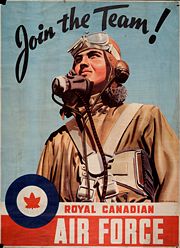 During the war, the RCAF was involved in three areas: the British Commonwealth Air Training Plan (BCATP), home defence, and overseas operations.
countries, Canada's training facilities supplied the majority of aircrew for overseas operational service. Schools included initial training schools, elementary flying training schools, service flying training schools, flying instructor's schools, general reconnaissance schools, operational training units, wireless
schools, bombing and gunnery schools, a flight engineers' school, air navigation schools, air observer schools, radio direction finding (radar
) schools, specialist schools, and a few supplementary schools. The BCATP contributed over 130,000 aircrew to the war effort.
s along the east coast and in Atlantic shipping lanes. After the attack on Pearl Harbor
in 1941, more squadrons were deployed to the west. A Canadian unit was sent to Alaska to assist the Americans in Alaska's defence during the Aleutian Islands Campaign.
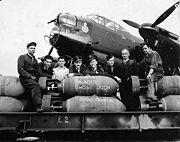
, anti-shipping, anti-submarine, strategic bombing
, transport, and fighter-bomber. RCAF squadrons often included non-RCAF personnel, and RCAF personnel were also members of Royal Air Force
(RAF) squadrons.
The RCAF played key roles in the Battle of Britain, antisubmarine warfare during the Battle of the Atlantic, the bomb
ing campaigns against German
industries (notably with No. 6 Group
, RAF Bomber Command
), and close support of Allied forces during the Battle of Normandy
and subsequent land campaigns in northwest Europe. RCAF squadrons and personnel were also involved with operations in Egypt
, Italy
, Sicily
, Malta
, Ceylon, India
, and Burma.
, mapping and surveying, transportation, search and rescue, and mercy missions. Interest in the Arctic
led to several northern military expeditions supported by the RCAF.
By the end of 1948, the Soviet bloc was perceived as a serious threat to security in Europe. The Cold War
had begun and peacetime activities were no longer a priority for the air force. The Canadian government began preparing to meet this threat. In December 1948 the government decided to increase the number of RCAF establishments, increase the size of and recondition existing air stations, recruit additional personnel, and obtain and produce new (jet) aircraft. Although the RCAF had a jet fighter in 1948, the British de Havilland Vampire
, it would be replaced, beginning in 1951 by the more effective Sabre, built under licence by Canadair
. The new Avro CF-100
Canuck was also built and entered squadron service in April 1953. The RCAF was the first air force to operate jet transportation aircraft with two Comets
entering service in 1953.
In August 1949 Canada joined NATO, and as part of its military commitment, established an Air Division (No. 1 Air Division) in Europe consisting of four wings. The first wing to form, No.1 Fighter Wing, was established at North Luffenham
, England
in 1951, but later moved to Marville
, France
. Other RCAF wings quickly followed, with bases established at Grostenquin
, France; Zweibrücken, West Germany
; and Baden-Soellingen, West Germany. Each of these wings consisted of three fighter squadrons. The backbone of RCAF support to NATO's air forces in Europe in the 1950s were the CF-100 and the Sabre. Until 1958 the RCAF also trained aircrew from other NATO countries under the NATO Air Training Plan
.
In 1950, the RCAF was heavily involved with the transportation of personnel and supplies in support of the Korean War
. The RCAF was not involved with a combat role since no jet fighter squadrons capable of the type of combat required in Korea were yet in service, and capable fighter squadrons that later did become operational, were allocated to NATO duty in Europe. Twenty-two RCAF fighter pilots, however, flew on exchange duty with the USAF
in Korea.
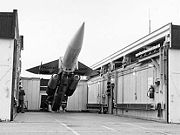 The Soviet
nuclear threat posed by a growing bomber fleet in the early 1950s saw the USAF and RCAF partner to build the Pinetree Line
network of early warning radar stations across Canada at roughly the 50° north parallel of latitude
with additional stations along the east and west coasts. This was expanded in the mid-1950s with the building of the Mid-Canada Line
at roughly the 55° north parallel and finally in the late-1950s and into the early 1960s the DEW Line was built across the Arctic regions of North America
. The nature of the Soviet bomber threat and of other hostile incursions into North American airspace saw an RCAF and USAF partnership in the creation of the North American Air (Aerospace, after 1981) Defence Command (NORAD) which was formed on 1 August 1957.
The Soviet bomber threat posed to North America also saw the RCAF begin the development of Canada's most famous (and infamous) military aircraft, the Avro CF-105 Arrow
fighter-interceptor. The changing nature of the Soviet threat from bombers to ICBMs
in the late 1950s, and pressure from the United States, saw the CF-105 program scrapped in favour of Bomarc nuclear-tipped anti-aircraft missiles.
To improve its abilities, the RCAF began replacing its 1950s-era aircraft with smaller numbers of second-generation aircraft. For instance, for air defence, the CF-101 Voodoo
armed with the AIR-2 Genie
nuclear-armed air-to-air missile
replaced the CF-100, and Sabres were replaced by the CF-104 Starfighter, which served in a strike/reconnaissance role.
Coastal defence and peacekeeping support were also important. Maritime patrol squadrons stationed on Canada's east and west coasts were provided with Lancasters
, and later Neptune, and Argus aircraft to carry on anti-submarine operations. The RCAF's peacekeeping role mainly included the transportation of troops, supplies, and truce observers to troubled areas of the world.
Many RCAF aerobatic or flight demonstration teams existed during this period. These include the Blue Devils
(flying Vampires), the Fireballs (an Air Division team flying Sabres), the Sky Lancers (an Air Division team flying Sabres), the Golden Hawks
(flying Sabres), the Goldilocks (flying Harvards), and the Golden Centennaires
(flying Tutors).
Because of the Cold War and the Korean War, the RCAF grew to a strength of 54,000 personnel (all ranks) by 1954 and reached a 1955 peak of 41 squadrons.
and the Canadian Army to form the unified Canadian Forces
. The purpose of the merger was to reduce costs and increase operating efficiency. The Minister of National Defence, Paul Hellyer
stated on 4 November 1966 that "the amalgamation...will provide the flexibility to enable Canada to meet in the most effective manner the military requirements of the future. It will also establish Canada as an unquestionable leader in the field of military organization." A new National Defence Act
was passed in April 1967. On 1 February 1968 the Canadian Forces Reorganization Act came into effect and the RCAF ceased to exist. The three branches of the Canadian Forces were unified into a single service with the aim of improving Canada's military effectiveness and flexibility.
Aircraft and bases of the RCAF and the air branch of the Royal Canadian Navy
were scattered across several different commands of the newly unified forces. Air Defence Command consisted primarily of former RCAF CF-101 Voodoo
fighter-interceptor aircraft, as well as the radar networks of DEW Line, Mid-Canada Line and Pinetree Line early warning stations. Air Transport Command
was responsible for strategic airlift and refueling aircraft. Its primary role was the transportation of Mobile Command
ground troops to and from distant conflict zones in Europe. The CC-137 Husky
was used in this capacity. Force Mobile Command was composed of former Canadian Army ground forces, as well as the army's tactical helicopters (CH-135 Twin Huey, CH-136 Kiowa, CH-147 Chinook
, CH-113A Voyageur
) and former RCAF CF-104 Starfighter tactical and ground attack aircraft. Maritime Command
took on responsibility for the newly formed Maritime Air Group, which operated aircraft in support of former RCN vessels as well as maritime patrol and reconnaissance missions, including CH-124 Sea King
, CP-107 Argus, and the CP-121 Tracker
, some of which operated from HMCS Bonaventure until that vessel's retirement in the early 1970s. Pilot and aircrew training were taken over by Training Command
, which was responsible for trades training across all other commands in the armed forces.
In 1971, the Snowbirds
aerobatic team, flying the CT-114 Tutor trainer, was formally created to demonstrate the flying skills of Canadian air force personnel. The team continues the flying demonstration tradition of previous Canadian air force aerobatic teams. The Snowbirds were designated a squadron (No. 431 Air Demonstration Squadron) in 1978.
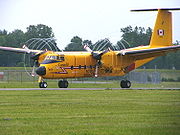 On August 9, 1974, a CC-115 Buffalo
of No. 116 Transport Unit operating on United Nations
duties was shot down by a Syria
n surface-to-air missile
killing all nine CF personnel on board. This represents the largest loss of Canadian Forces personnel in a single day since the Korean War
as well as the most recent Canadian military aircraft to be shot down.
On 2 September 1975, the Canadian Forces reorganization merged the air elements of all commands into a newly formed Air Command (AIRCOM). Air Defence Command and Air Transport Command were eliminated, and Training Command, Maritime Command, and Mobile Command (renamed Force Mobile Command) were realigned to reflect the new structure. AIRCOM closely resembled the old RCAF, as the new command handled all the aviation requirements of Canada's military.
Several bases closed during the 1970s–1990s as aircraft changes took place. As CF-18A/B Hornet
tactical fighter bombers were acquired, CF-104 Starfighter and CF-101 Voodoo
fighter aircraft were retired in the early-mid 1980s, leading to the closing of CFB Chatham
and CFB Baden Soellingen and various bombing ranges. The CF-116 fighter aircraft and Boeing 707
transport/refuelling aircraft were retired. Also, over the years, the stations of the three radar early warning lines were modernized or closed.
In the late 1970s AIRCOM replaced the CP-107 Argus and CP-121 Tracker
with the CP-140 Aurora
/CP-140A Arcturus maritime patrol aircraft. Government cutbacks along with the shift of east coast maritime squadrons and units from CFB Summerside
to CFB Greenwood
led to the closure of CFB Summerside in 1991.
In the early 1990s, AIRCOM transport and utility helicopters in support of army
operations were cut back and consolidated with the purchase of the CH-146 Griffon, replacing the CH-135 Twin Huey, CH-136 Kiowa, and CH-147 Chinook. The CH-137 Husky was replaced by the Airbus
CC-150 Polaris
in 1997.
Search and rescue squadrons received new aircraft when the CH-149 Cormorant replaced the CH-113 Labrador beginning in 2002. The CC-115 Buffalo was replaced in the 2000s with the CC-130 Hercules at CFB Trenton
and CFB Greenwood, but are still used on the west coast. Ship-borne anti-submarine helicopter squadrons are currently operating the CH-124 Sea King.
In 2007 and 2008, four C-17 Globemaster III
s, based at CFB Trenton, were added to improve transportation capabilities. New CC-130J Super Hercules tactical transport aircraft began delivery in early summer 2010. Seventeen will be acquired by April 2012.
On 25 June 2009, 2 Canadian Air Division (2 CAD) was established to be responsible for air force training and doctrine. Units forming 2 CAD unclude: 15 Wing Moose Jaw, 16 Wing Borden and the Canadian Aerospace Warfare Centre located at 8 Wing Trenton
On 16 July 2010, the Canadian government announced that the replacement for the CF-188 (F-18) will be the American F-35. Sixty-five would be ordered; they would be based at CFB Bagotville
and CFB Cold Lake
.
From March to November 2011, six CF-188 Hornet fighter jets, two Boeing CC-177 Globemasters, two CP-140 Auroras, and approximately 250 Canadian Forces personnel were deployed as part of Operation Mobile
, Canada's response to the Libyan uprising. Air Command helped maintain a no-fly zone as part of Operation Odyssey Dawn
. Canadian CF-188s carried out bomb strikes on Libyan military installations.
countries whose militaries use the royal designation.
(VC) is the highest award given to British and Commonwealth
armed forces personnel of any rank in any service, and civilians under military command for bravery in the presence of the enemy. This honour has been granted to two members of the Royal Canadian Air Force since its inception in 1924.
and other markings until 1946, when Canada began using its own insignia identity. The British roundel existed in several versions. During the Second World War the red circle was painted out or reduced in size on some aircraft active in the Pacific theatre
to avoid confusion with the Japanese Hinomaru. Roundels were also modified to be less visible on camouflaged aircraft or to make them more visible.
Canada was the first Commonwealth country to dispense with the RAF system. The maple leaf replaced the British-style inner circle to give it a distinctive Canadian character. Although the maple leaf roundel was approved for use by the RCAF in 1924, it was not until after the war that it began to be used on aircraft. It was, however, used on the ensign beginning in 1941. From 1946–1948 a roundel with a red leaf set inside a blue disk (referred to as the RCAF Type 1 roundel) was used on non-camouflaged aircraft. Several versions of the maple leaf roundel existed from wartime to 1965. Sizes of the leaf and the ring thickness sometimes changed, and some versions of the RCAF roundel included a white or yellow outline, which were specific to certain aircraft.
The realistic-looking "silver maple" style of leaf (referred to as the "RCAF" roundel) was replaced with the eleven-point stylized leaf of the new Canadian flag
in February 1965 (referred to as the "CAF" roundel). A slightly-modified standardized version of this roundel (referred to as the "CAF revision E" roundel) was used by Air Command, and continues to be used by the "new" RCAF. An all-red "unification roundel" was used on a few aircraft from 1967-1968. Like the RCAF roundel, this new roundel sometimes changed - mainly in the size of the leaf and ring thickness, and one version had a white ring, which was used on certain aircraft. The current RCAF also uses a low visibility tactical grey roundel.
, which consisted of red and blue vertical bands separated by a white band. In 1955 the red ensign Canadian Flag
began replacing the fin flash on aircraft based in Europe. On Canada-based aircraft the flag began replacing the flash in 1958. Beginning in 1965 the new Canadian flag was used.
. Until the Second World War the RAF ensign was used by the RCAF; the RCAF ensign with the maple leaf roundel began to be used in 1941. The flag was discontinued when Canada's armed services were unified, but a modified version with the revised roundel and Canadian flag was re-adopted by Air Command 1985. The current RCAF maintains use of this ensign.
and the Royal New Zealand Air Force
. It consists of the Imperial Crown
, an "eagle volant", a circle inscribed with the RCAF's motto per ardua ad astra
(which is usually translated as "Through Adversity to the Stars"), and a scroll inscribed with "Royal Canadian Air Force". The RCAF began using a modified version of the RAF badge in 1924. Once it was learned the badge had never been officially sanctioned, the Chester Herald
prepared an improved design, and in January 1943 the badge was approved by the King.
The original badge disappeared when the services were unified. Air Command adopted a new design consisting of the imperial crown, an eagle "rising to sinister from the Canadian Astral crown" on an azure background, the Crown of Stars, which represents Air Command, and a new motto. The present RCAF maintains use of the badge.
was designed by Kinloch Anderson Ltd. in Edinburgh, Scotland at the request of the RCAF, and is based on the Anderson
tartan. Colors are primarily dark blue, light blue, and maroon. The design was officially endorsed by the Air Council in May 1942. The tartan was used on RCAF pipe band
kilt
s and on other articles of clothing and regalia
. After unification of Canada's armed forces, the tartan continued to be used.
or Junior Technician
, and not distinguishing between aircrew and non-aircrew for Sergeants and above. The rank structure is almost identical to that of the Royal Australian Air Force, once again with the exception of Warrant Officer 2. RCAF Women's Division personnel used a different rank structure. When the age limit for BCATP
aircrew recruits was lowered to seventeen in 1941, the recruits were placed into the temporary rank of "Boy" until they reached their eighteenth birthday and became eligible for flying training. The current RCAF uses the army-style ranks instituted by the Canadian Forces when unification took place in 1968.
This chart compares ranks of the former and current RCAF. Ranks are listed with the most senior rank at the top.
, though some personnel in the 2nd Tactical Air Force and in the Pacific also wore army khaki
battledress with standard RCAF insignia. A khaki-drill uniform was introduced for wear in summer and warm climates.
During the Second World War Canadian airmen and airwomen posted outside Canada wore a Canada nationality shoulder flash, as did Canadians serving with the RAF. This was usually light-blue lettering on curved blue-grey for commissioned officers and Warrant Officer 1, and light-blue lettering curved above an eagle for other ranks, except for warm-weather uniforms, which had red embroidery on khaki-drill. Later in the war all RCAF personnel wore this nationality distinction, which was continued until unification.
After the war, the insignia for Warrant Officer I changed from the Royal coat of arms
to the Canadian coat of arms. Along with the rest of the Commonwealth, insignia using the Imperial Crown changed from the Tudor Crown (King's Crown) to St. Edward's Crown (Queen's Crown) after the accession of Queen Elizabeth II to the Throne of Canada.
After unification, all personnel in the Canadian Forces wore a dark green uniform with only cap and collar badges (a modified version of the former RCAF crest) as distinguishing marks for pilots and aircrew. Use of this uniform continued under Air Command from 1975 until the mid-1980s, when Air Command returned to blue-grey uniforms broadly similar to those of the former RCAF. This uniform continues to be used.
Canadian Air Force (1920–1924)
The Canadian Air Force which was formed in 1920, was one of Canada's early attempts at forming an air force. When the Air Board was formed in 1919 to manage Canadian aviation, one of its responsibilities was air defence; the CAF was formed to meet this responsibility...
(CAF). In 1924 the CAF was renamed the Royal Canadian Air Force
Royal Canadian Air Force
The history of the Royal Canadian Air Force begins in 1920, when the air force was created as the Canadian Air Force . In 1924 the CAF was renamed the Royal Canadian Air Force and granted royal sanction by King George V. The RCAF existed as an independent service until 1968...
(RCAF) and granted royal sanction by King George V
George V of the United Kingdom
George V was King of the United Kingdom and the British Dominions, and Emperor of India, from 6 May 1910 through the First World War until his death in 1936....
. The RCAF existed as an independent service until 1968. Prior attempts at forming an air force for Canada were the Canadian Aviation Corps
Canadian Aviation Corps
Canadian Aviation Corps was an early attempt to create an air force for Canada at the beginning of the First World War. The unit was created in 1914 and was attached to the Canadian Expeditionary Force. The CAC had a maximum strength of three personnel and one aircraft which was delivered but...
that was attached to the Canadian Expeditionary Force
Canadian Expeditionary Force
The Canadian Expeditionary Force was the designation of the field force created by Canada for service overseas in the First World War. Units of the C.E.F. were divided into field formation in France, where they were organized first into separate divisions and later joined together into a single...
, and a two-squadron Canadian Air Force that was attached to the Royal Air Force
Royal Air Force
The Royal Air Force is the aerial warfare service branch of the British Armed Forces. Formed on 1 April 1918, it is the oldest independent air force in the world...
.
The modern Royal Canadian Air Force, formerly known as Canadian Forces Air Command, traces its ancestry to the unification of Canada's armed services
Unification of the Canadian Forces
Unification of the Canadian Forces took place in 1968 when the Royal Canadian Navy, Canadian Army, and Royal Canadian Air Force were merged to form the Canadian Armed Forces....
in 1968, and is one of three environmental commands of the Canadian Forces
Canadian Forces
The Canadian Forces , officially the Canadian Armed Forces , are the unified armed forces of Canada, as constituted by the National Defence Act, which states: "The Canadian Forces are the armed forces of Her Majesty raised by Canada and consist of one Service called the Canadian Armed Forces."...
. Over the course of history, the Royal Canadian Air Force has served in the Second World War, the Korean War
Korean War
The Korean War was a conventional war between South Korea, supported by the United Nations, and North Korea, supported by the People's Republic of China , with military material aid from the Soviet Union...
, and several United Nations peacekeeping missions and NATO operations. The force has also maintained a presence in Europe through the second half of the 20th century.
Formative years
Alexander Graham Bell
Alexander Graham Bell was an eminent scientist, inventor, engineer and innovator who is credited with inventing the first practical telephone....
Silver Dart
AEA Silver Dart
-References:NotesBibliography* Aerial Experimental Association . Aerofiles. . Retrieved: 19 May 2005.* Green, H. Gordon. The Silver Dart: The Authentic Story of the Hon. J.A.D. McCurdy, Canada's First Pilot. Fredericton, New Brunswick: Atlantic Advocate Book, 1959.* Milberry, Larry. Aviation in...
took off from the ice of Bras d'Or Lake
Bras d'Or Lake
Bras d'Or Lake is a large body of salt water dominating the centre of Cape Breton Island in the province of Nova Scotia, Canada. Bras d'Or Lake is sometimes referred to as the Bras d'Or Lakes or the Bras d'Or Lakes system, however its official geographic name is Bras d'Or Lake as it is a singular...
at Baddeck, Nova Scotia
Baddeck, Nova Scotia
Baddeck is a Canadian village in Victoria County, Nova Scotia.It is the county's shire town and is situated on the northern shore of Bras d'Or Lake on Cape Breton Island...
with J.D. McCurdy
John Alexander Douglas McCurdy
John Alexander Douglas McCurdy was a Canadian aviation pioneer and the 19th Lieutenant Governor of Nova Scotia from 1947 to 1952. -Early years:...
at the controls. This 1/2-mile flight was the first "controlled powered flight" (also the first flight of a "heavier than air craft") in Canada and the British Empire
British Empire
The British Empire comprised the dominions, colonies, protectorates, mandates and other territories ruled or administered by the United Kingdom. It originated with the overseas colonies and trading posts established by England in the late 16th and early 17th centuries. At its height, it was the...
. A longer flight of 20 miles was flown at Bras d'Or Lake on 10 March 1909.
It was hoped that the Department of Militia and Defence would be interested in buying the aircraft. Although the general impression at the time was that aircraft would never amount to much in actual warfare, one official felt otherwise, and the aviators were invited to Camp Petawawa to demonstrate their machine. On 2 August 1909, the Silver Dart made four successful flights; however, on the fourth flight McCurdy wrecked the craft on landing when one wheel struck a rise in the ground. The Silver Dart never flew again. A second aircraft, the Baddeck No.1, was flown a few days later, but was severely damaged on its second landing. Before the accidents, however, the Silver Dart made the first passenger flight aboard a heavier-than-air aircraft in Canada when McCurdy flew with his partner, F.W. Baldwin. After the crashes, the militia department showed no interest in using aircraft for aviation. It was not until the First World War that the Canadian government became interested in military aviation.
First World War
At the beginning of the First World War on 4 August 1914, Canada became involved in the conflict by virtue of Britain's declaration. Some European nations were using airplanes for military purposes and Canada's Minister of Militia and DefenceMinister of Militia and Defence (Canada)
The Minister of Militia and Defence was the federal government minister in charge of the volunteer army units in Canada prior to the creation of the Canadian Militia, before the creation of the Canadian Army....
, Sam Hughes
Sam Hughes
For other people of the same name see Sam Hughes Sir Samuel Hughes, KCB, PC was the Canadian Minister of Militia and Defence during World War I...
, who was organizing the Canadian Expeditionary Force
Canadian Expeditionary Force
The Canadian Expeditionary Force was the designation of the field force created by Canada for service overseas in the First World War. Units of the C.E.F. were divided into field formation in France, where they were organized first into separate divisions and later joined together into a single...
(CEF), inquired how Canada could assist military aviation. London answered with a request for six experienced pilots immediately, but Hughes was unable to fill the requirement.
Canadian Aviation Corps
Canadian Aviation Corps was an early attempt to create an air force for Canada at the beginning of the First World War. The unit was created in 1914 and was attached to the Canadian Expeditionary Force. The CAC had a maximum strength of three personnel and one aircraft which was delivered but...
(CAC) was formed with two officers, one mechanic, and $5000 to purchase an aircraft from the Burgess Company
Burgess Company
The Burgess Company was a U.S. airplane manufacturer between 1910 and 1918.-History:The business was incorporated in 1910 as the "Burgess Company and Curtis, Inc." . The company was an offshoot of the W. Starling Burgess Shipyard, of Marblehead, Massachusetts.Burgess was the first licensed aircraft...
in Massachusetts
Massachusetts
The Commonwealth of Massachusetts is a state in the New England region of the northeastern United States of America. It is bordered by Rhode Island and Connecticut to the south, New York to the west, and Vermont and New Hampshire to the north; at its east lies the Atlantic Ocean. As of the 2010...
, for delivery to Valcartier, near Quebec City
Quebec City
Quebec , also Québec, Quebec City or Québec City is the capital of the Canadian province of Quebec and is located within the Capitale-Nationale region. It is the second most populous city in Quebec after Montreal, which is about to the southwest...
. The Burgess-Dunne biplane
Biplane
A biplane is a fixed-wing aircraft with two superimposed main wings. The Wright brothers' Wright Flyer used a biplane design, as did most aircraft in the early years of aviation. While a biplane wing structure has a structural advantage, it produces more drag than a similar monoplane wing...
was delivered on 1 October 1914, and was shipped immediately to England. On arrival, the biplane was transported to Salisbury Plain
Salisbury Plain
Salisbury Plain is a chalk plateau in central southern England covering . It is part of the Southern England Chalk Formation and largely lies within the county of Wiltshire, with a little in Hampshire. The plain is famous for its rich archaeology, including Stonehenge, one of England's best known...
where the CEF was marshalled for training. The craft never flew. It quickly deteriorated in the damp winter climate. By May 1915, the CAC no longer existed.
During the First World War over 20,000 Canadians volunteered to serve with the Royal Flying Corps
Royal Flying Corps
The Royal Flying Corps was the over-land air arm of the British military during most of the First World War. During the early part of the war, the RFC's responsibilities were centred on support of the British Army, via artillery co-operation and photographic reconnaissance...
(RFC) and the Royal Naval Air Service
Royal Naval Air Service
The Royal Naval Air Service or RNAS was the air arm of the Royal Navy until near the end of the First World War, when it merged with the British Army's Royal Flying Corps to form a new service , the Royal Air Force...
, producing such aces as William Barker
William George Barker
William George Barker VC, DSO & Bar, MC & Two Bars was a Canadian First World War fighter ace and Victoria Cross recipient...
, W.A. "Billy" Bishop
Billy Bishop
Air Marshal William Avery "Billy" Bishop VC, CB, DSO & Bar, MC, DFC, ED was a Canadian First World War flying ace, officially credited with 72 victories, making him the top Canadian ace, and according to some sources, the top ace of the British Empire.-Early life:Bishop was born in Owen Sound,...
, Naval Pilot Raymond Collishaw
Raymond Collishaw
Air Vice Marshal Raymond Collishaw CB, DSO & Bar, OBE, DSC, DFC, RAF was a distinguished Canadian fighter pilot, squadron leader, and commanding officer who served in the Royal Naval Air Service and later the Royal Air Force. He was the highest scoring RNAS flying ace and the second highest...
, Roy Brown
Roy Brown (pilot)
Captain Arthur Roy Brown DSC and bar RNAS was a Canadian World War I flying ace. The Royal Air Force officially credited Brown with shooting down Manfred von Richthofen, the "Red Baron", although it is in fact unlikely that Brown fired the bullet that caused his death...
, and Wilfrid "Wop" May. In 1917 the RFC opened training airfields in Canada
Royal Flying Corps Canada
The Royal Flying Corps Canada was a training organization of the British Royal Flying Corps located in Canada during the First World War. It began operating in 1917....
to recruit and train Canadian airmen. The Canadian government advanced the RFC money to open an aircraft factory in Toronto
Toronto
Toronto is the provincial capital of Ontario and the largest city in Canada. It is located in Southern Ontario on the northwestern shore of Lake Ontario. A relatively modern city, Toronto's history dates back to the late-18th century, when its land was first purchased by the British monarchy from...
, Canadian Aeroplanes, but did not otherwise take part.
Canadian Corps
The Canadian Corps was a World War I corps formed from the Canadian Expeditionary Force in September 1915 after the arrival of the 2nd Canadian Division in France. The corps was expanded by the addition of the 3rd Canadian Division in December 1915 and the 4th Canadian Division in August 1916...
in France
France
The French Republic , The French Republic , The French Republic , (commonly known as France , is a unitary semi-presidential republic in Western Europe with several overseas territories and islands located on other continents and in the Indian, Pacific, and Atlantic oceans. Metropolitan France...
. Rather than the proposed eight squadrons, the British Air Ministry
Air Ministry
The Air Ministry was a department of the British Government with the responsibility of managing the affairs of the Royal Air Force, that existed from 1918 to 1964...
formed two Canadian squadrons (one bomber, one fighter). On 19 September 1918, the Canadian government authorized the creation of the Canadian Air Force (CAF) to take control of these two squadrons under the command of Canada's Lieutenant-Colonel
Lieutenant colonel
Lieutenant colonel is a rank of commissioned officer in the armies and most marine forces and some air forces of the world, typically ranking above a major and below a colonel. The rank of lieutenant colonel is often shortened to simply "colonel" in conversation and in unofficial correspondence...
W.A. Bishop
Billy Bishop
Air Marshal William Avery "Billy" Bishop VC, CB, DSO & Bar, MC, DFC, ED was a Canadian First World War flying ace, officially credited with 72 victories, making him the top Canadian ace, and according to some sources, the top ace of the British Empire.-Early life:Bishop was born in Owen Sound,...
, the leading ace
Flying ace
A flying ace or fighter ace is a military aviator credited with shooting down several enemy aircraft during aerial combat. The actual number of aerial victories required to officially qualify as an "ace" has varied, but is usually considered to be five or more...
of the British Empire and the first Canadian aviator awarded the Victoria Cross
Victoria Cross
The Victoria Cross is the highest military decoration awarded for valour "in the face of the enemy" to members of the armed forces of various Commonwealth countries, and previous British Empire territories....
. In June 1919 the British government cut funding to the squadrons, and in February 1920, the Canadian Air Force in Europe was disbanded, never having flown any operations.
There had been some thought that these two European squadrons would be the nucleus of a new Canadian air force Indeed, some members of the CAF believed they were to become members of a new permanent air force. However, on 30 May 1919 the Canadian government decided against a new military air force because it was felt none was needed.
Inter-war years
After the war, Britain committed Canada to the International Convention for Air Navigation, part of the Peace Convention signed by Britain in Paris in 1919. Canada was required to control air navigationAir navigation
The basic principles of air navigation are identical to general navigation, which includes the process of planning, recording, and controlling the movement of a craft from one place to another....
and traffic within its borders. To accomplish this, Canada instituted the Air Board
Air Board (Canada)
The Air Board was Canada's first governing body for aviation that existed from 1919 to 1923. The Canadian government established the Air Board by act of Parliament on June 6, 1919 with the purpose of controlling all flying within Canada...
, whose task was mainly regulatory but it was also responsible for controlling civil aviation
Civil aviation
Civil aviation is one of two major categories of flying, representing all non-military aviation, both private and commercial. Most of the countries in the world are members of the International Civil Aviation Organization and work together to establish common standards and recommended practices...
and handling air defence.
One of the Air Board's first responsibilities was managing the operation of over 100 surplus aircraft that been given to Canada by the British Government to help Canada with air defence. Several flying boat
Flying boat
A flying boat is a fixed-winged seaplane with a hull, allowing it to land on water. It differs from a float plane as it uses a purpose-designed fuselage which can float, granting the aircraft buoyancy. Flying boats may be stabilized by under-wing floats or by wing-like projections from the fuselage...
aircraft and other equipment had also been donated to Canada by the Americans who had temporarily established naval air stations on the east coast pending formation of the Royal Canadian Naval Air Service
Royal Canadian Naval Air Service
The Royal Canadian Naval Air Service was established in 1918 during the First World War in response to the Royal Canadian Navy's recommendation that defensive air patrols be established off Canada's Atlantic coast to protect shipping from German U-boats.Britain warned Canada that an attack by a...
. The Air Board decided to operate these aircraft in support of civil operations such as forestry
Forestry
Forestry is the interdisciplinary profession embracing the science, art, and craft of creating, managing, using, and conserving forests and associated resources in a sustainable manner to meet desired goals, needs, and values for human benefit. Forestry is practiced in plantations and natural stands...
, photographic surveying
Aerial survey
Aerial survey is a geomatics method of collecting information by using aerial photography, LiDAR or from remote sensing imagery using other bands of the electromagnetic spectrum, such as infrared, gamma, or ultraviolet. It can also refer to the chart or map made by analysing a region from the air...
, and anti-smuggling patrols. Six air stations were taken over or established by the Air Board in 1920–21 for civil flying operations.
The Air Board's venture into air defence consisted of providing refresher training to former wartime pilots via a small part-time air militia
Militia
The term militia is commonly used today to refer to a military force composed of ordinary citizens to provide defense, emergency law enforcement, or paramilitary service, in times of emergency without being paid a regular salary or committed to a fixed term of service. It is a polyseme with...
known as the Canadian Air Force
Canadian Air Force (1920–1924)
The Canadian Air Force which was formed in 1920, was one of Canada's early attempts at forming an air force. When the Air Board was formed in 1919 to manage Canadian aviation, one of its responsibilities was air defence; the CAF was formed to meet this responsibility...
(CAF) at the old Royal Flying Corps air station, Camp Borden. Political thinking at the time was that to propose a permanent military air service would not be popular with the public, especially during peacetime. This training scheme began in July 1920 and ended in March 1922. The air militia was dissolved.
The CAF was reorganized effective 1 July 1922, and by January 1923 the Air Board was incorporated into the newly-formed Department of National Defence
Department of National Defence (Canada)
The Department of National Defence , frequently referred to by its acronym DND, is the department within the government of Canada with responsibility for all matters concerning the defence of Canada...
. The CAF became responsible for all flying operations in Canada, including civil aviation.
The thought that the Canadian Air Force should become "Royal" was first generated when the Australian Air Force
Royal Australian Air Force
The Royal Australian Air Force is the air force branch of the Australian Defence Force. The RAAF was formed in March 1921. It continues the traditions of the Australian Flying Corps , which was formed on 22 October 1912. The RAAF has taken part in many of the 20th century's major conflicts...
became "Royal" in August 1921. Formal appliation to change the title was made on 5 January 1923, and on 15 February 1923, Canada was notified that His Majesty had granted the title. The Canadian Government, however, did not officially recognize the granting of the new title, Royal Canadian Air Force (RCAF), until 1 April 1924.
The RCAF continued civil tasks such as anti-smuggling patrols, forest fire watches, aerial forest spraying, mail delivery, mercy flights, law enforcement, and surveying/aerial photography, and there was some training. A major undertaking by the RCAF during 1927–28 was the Hudson Strait Expedition whose purpose was to investigate ice movements and navigation conditions in the Hudson Strait
Hudson Strait
Hudson Strait links the Atlantic Ocean to Hudson Bay in Canada. It lies between Baffin Island and the northern coast of Quebec, its eastern entrance marked by Cape Chidley and Resolution Island. It is long...
in preparation for the possible creation of a major shipping port on Hudson Bay
Hudson Bay
Hudson Bay , sometimes called Hudson's Bay, is a large body of saltwater in northeastern Canada. It drains a very large area, about , that includes parts of Ontario, Quebec, Saskatchewan, Alberta, most of Manitoba, southeastern Nunavut, as well as parts of North Dakota, South Dakota, Minnesota,...
at Churchill, Manitoba
Churchill, Manitoba
Churchill is a town on the shore of Hudson Bay in Manitoba, Canada. It is most famous for the many polar bears that move toward the shore from inland in the autumn, leading to the nickname "Polar Bear Capital of the World" that has helped its growing tourism industry.-History:A variety of nomadic...
.
The new air force was to be organized into a Permanent Force and an auxiliary or Non-permanent Force (Non-Permanent Active Air Force, or NPAAF), but the NPAAF did not become active for another eight years.
The RCAF replaced the Air Board and the CAF as the regulator of Canadian civil aviation. In 1927 the management of aviation in Canada was reorganized so that the RCAF, now considered to be a military body, did not control civil flying. A new government branch, the Civil Government Air Operations (CGAO) Branch, was formed to manage air operations that supported civil departments. However, the RCAF administered the branch, and supplied almost all the aircraft and personnel. The RCAF continued to support the CGAO until the Department of Transport assumed responsibilility for supporting civil departments or until these departments instituted their own flying services.
Budget cuts in the early 1930s affected personnel strength, airfield construction, pilot training, aircraft purchases and operational flying. The "Big Cut" of 1932 was especially devastating to the RCAF. The NPAAF was finally formed in 1932 in response to the budget cuts. Ten auxiliary squadrons were formed between 1932 and 1938. The air force began to rebuild throughout the 1930s, however, and priorities were aimed at increasing the strength of the RCAF as a military organization rather than improving it to better support civil air operations. New aircraft were ordered and new air stations were built. The RCAF expanded or combined its units, and regional commands were implemented.
By the end of the 1930s the RCAF was not a major military force. Aircraft were obsolete, and the RCAF had no experience in military operations. Although new pilots and other personnel had been trained, manpower was still lacking. Many of these problems would be surmounted with the implementation of the British Commonwealth Air Training Plan
British Commonwealth Air Training Plan
The British Commonwealth Air Training Plan , known in some countries as the Empire Air Training Scheme , was a massive, joint military aircrew training program created by the United Kingdom, Canada, Australia and New Zealand, during the Second World War...
(BCATP) during the Second World War.
Second World War
The outbreak of the Second World War saw the RCAF fielding eight of its eleven permanent operational squadrons, but by October 1939 15 squadrons were available (12 for homeland defence, three for overseas service). There were over 20 types of aircraft at this point, over half being for training or transport, and the RCAF started the war with only 29 front-line fighter and bomber aircraft. The RCAF reached peak strength of 215,000 (all ranks) in January 1944. By the end of the war, the RCAF would be the fourth largest allied air force. Approximately 13,000 RCAF personnel were killed while on operations, or died as prisoners of warPrisoner of war
A prisoner of war or enemy prisoner of war is a person, whether civilian or combatant, who is held in custody by an enemy power during or immediately after an armed conflict...
. Another 4000 died during training or from other causes.
British Commonwealth Air Training Plan
In 1939 Canada, Great Britain, Australia and New Zealand agreed to train aircrew for wartime service. The training plan, known as the British Commonwealth Air Training Plan (BCATP), was administered by the Canadian government and commanded by the RCAF. Training airfields and other facilities were located throughout Canada. Although some aircrew training took place in other CommonwealthCommonwealth of Nations
The Commonwealth of Nations, normally referred to as the Commonwealth and formerly known as the British Commonwealth, is an intergovernmental organisation of fifty-four independent member states...
countries, Canada's training facilities supplied the majority of aircrew for overseas operational service. Schools included initial training schools, elementary flying training schools, service flying training schools, flying instructor's schools, general reconnaissance schools, operational training units, wireless
Wireless
Wireless telecommunications is the transfer of information between two or more points that are not physically connected. Distances can be short, such as a few meters for television remote control, or as far as thousands or even millions of kilometers for deep-space radio communications...
schools, bombing and gunnery schools, a flight engineers' school, air navigation schools, air observer schools, radio direction finding (radar
Radar
Radar is an object-detection system which uses radio waves to determine the range, altitude, direction, or speed of objects. It can be used to detect aircraft, ships, spacecraft, guided missiles, motor vehicles, weather formations, and terrain. The radar dish or antenna transmits pulses of radio...
) schools, specialist schools, and a few supplementary schools. The BCATP contributed over 130,000 aircrew to the war effort.
Home defence
Home defence was overseen by two commands of the Home War Establishment: Western Air Command and Eastern Air Command. Located on the west and east coasts of Canada, these commands grew to 37 squadrons, and were responsible for protecting Canada's coasts from enemy attack and for protecting allied shipping. Threats included German U-boatU-boat
U-boat is the anglicized version of the German word U-Boot , itself an abbreviation of Unterseeboot , and refers to military submarines operated by Germany, particularly in World War I and World War II...
s along the east coast and in Atlantic shipping lanes. After the attack on Pearl Harbor
Attack on Pearl Harbor
The attack on Pearl Harbor was a surprise military strike conducted by the Imperial Japanese Navy against the United States naval base at Pearl Harbor, Hawaii, on the morning of December 7, 1941...
in 1941, more squadrons were deployed to the west. A Canadian unit was sent to Alaska to assist the Americans in Alaska's defence during the Aleutian Islands Campaign.
Overseas operations
Forty-eight RCAF squadrons were involved in overseas operational duties in Britain, northwest Europe, North Africa, and Southeast Asia. These squadrons participated in most roles, including fighter, fighter intruder, reconnaissanceReconnaissance
Reconnaissance is the military term for exploring beyond the area occupied by friendly forces to gain information about enemy forces or features of the environment....
, anti-shipping, anti-submarine, strategic bombing
Strategic bombing
Strategic bombing is a military strategy used in a total war with the goal of defeating an enemy nation-state by destroying its economic ability and public will to wage war rather than destroying its land or naval forces...
, transport, and fighter-bomber. RCAF squadrons often included non-RCAF personnel, and RCAF personnel were also members of Royal Air Force
Royal Air Force
The Royal Air Force is the aerial warfare service branch of the British Armed Forces. Formed on 1 April 1918, it is the oldest independent air force in the world...
(RAF) squadrons.
The RCAF played key roles in the Battle of Britain, antisubmarine warfare during the Battle of the Atlantic, the bomb
Bomber
A bomber is a military aircraft designed to attack ground and sea targets, by dropping bombs on them, or – in recent years – by launching cruise missiles at them.-Classifications of bombers:...
ing campaigns against German
Germany
Germany , officially the Federal Republic of Germany , is a federal parliamentary republic in Europe. The country consists of 16 states while the capital and largest city is Berlin. Germany covers an area of 357,021 km2 and has a largely temperate seasonal climate...
industries (notably with No. 6 Group
No. 6 Group RCAF
No. 6 Group RCAF was an organization of Royal Canadian Air Force bomber squadrons which operated from airfields in Yorkshire, England during the Second World War. Although 6 Group was RCAF, it was controlled by the Royal Air Force as part of Bomber Command. No. 6 Group had been previously active...
, RAF Bomber Command
RAF Bomber Command
RAF Bomber Command controlled the RAF's bomber forces from 1936 to 1968. During World War II the command destroyed a significant proportion of Nazi Germany's industries and many German cities, and in the 1960s stood at the peak of its postwar military power with the V bombers and a supplemental...
), and close support of Allied forces during the Battle of Normandy
Operation Overlord
Operation Overlord was the code name for the Battle of Normandy, the operation that launched the invasion of German-occupied western Europe during World War II by Allied forces. The operation commenced on 6 June 1944 with the Normandy landings...
and subsequent land campaigns in northwest Europe. RCAF squadrons and personnel were also involved with operations in Egypt
Egypt
Egypt , officially the Arab Republic of Egypt, Arabic: , is a country mainly in North Africa, with the Sinai Peninsula forming a land bridge in Southwest Asia. Egypt is thus a transcontinental country, and a major power in Africa, the Mediterranean Basin, the Middle East and the Muslim world...
, Italy
Italy
Italy , officially the Italian Republic languages]] under the European Charter for Regional or Minority Languages. In each of these, Italy's official name is as follows:;;;;;;;;), is a unitary parliamentary republic in South-Central Europe. To the north it borders France, Switzerland, Austria and...
, Sicily
Sicily
Sicily is a region of Italy, and is the largest island in the Mediterranean Sea. Along with the surrounding minor islands, it constitutes an autonomous region of Italy, the Regione Autonoma Siciliana Sicily has a rich and unique culture, especially with regard to the arts, music, literature,...
, Malta
Malta
Malta , officially known as the Republic of Malta , is a Southern European country consisting of an archipelago situated in the centre of the Mediterranean, south of Sicily, east of Tunisia and north of Libya, with Gibraltar to the west and Alexandria to the east.Malta covers just over in...
, Ceylon, India
India
India , officially the Republic of India , is a country in South Asia. It is the seventh-largest country by geographical area, the second-most populous country with over 1.2 billion people, and the most populous democracy in the world...
, and Burma.
Cold War era
By spring 1945, the BCATP was discontinued and the RCAF was reduced to 165,000 (all ranks) and by VJ Day on 2 September 1945, it was proposed that the RCAF maintain a peacetime strength of 16,000 (all ranks). By the end of 1947 the RCAF had five squadrons and close to 12,000 personnel (all ranks). Peacetime activities resumed and the RCAF participated in such pursuits as aerial photographyAerial photography
Aerial photography is the taking of photographs of the ground from an elevated position. The term usually refers to images in which the camera is not supported by a ground-based structure. Cameras may be hand held or mounted, and photographs may be taken by a photographer, triggered remotely or...
, mapping and surveying, transportation, search and rescue, and mercy missions. Interest in the Arctic
Arctic
The Arctic is a region located at the northern-most part of the Earth. The Arctic consists of the Arctic Ocean and parts of Canada, Russia, Greenland, the United States, Norway, Sweden, Finland, and Iceland. The Arctic region consists of a vast, ice-covered ocean, surrounded by treeless permafrost...
led to several northern military expeditions supported by the RCAF.
By the end of 1948, the Soviet bloc was perceived as a serious threat to security in Europe. The Cold War
Cold War
The Cold War was the continuing state from roughly 1946 to 1991 of political conflict, military tension, proxy wars, and economic competition between the Communist World—primarily the Soviet Union and its satellite states and allies—and the powers of the Western world, primarily the United States...
had begun and peacetime activities were no longer a priority for the air force. The Canadian government began preparing to meet this threat. In December 1948 the government decided to increase the number of RCAF establishments, increase the size of and recondition existing air stations, recruit additional personnel, and obtain and produce new (jet) aircraft. Although the RCAF had a jet fighter in 1948, the British de Havilland Vampire
De Havilland Vampire
The de Havilland DH.100 Vampire was a British jet-engine fighter commissioned by the Royal Air Force during the Second World War. Following the Gloster Meteor, it was the second jet fighter to enter service with the RAF. Although it arrived too late to see combat during the war, the Vampire served...
, it would be replaced, beginning in 1951 by the more effective Sabre, built under licence by Canadair
Canadair
Canadair Ltd. was a civil and military aircraft manufacturer in Canada. It was a subsidiary of other aircraft manufacturers, then a nationalized corporation until privatized in 1986, and became the core of Bombardier Aerospace....
. The new Avro CF-100
Avro CF-100
The Avro Canada CF-100 Canuck was a Canadian jet interceptor/fighter serving during the Cold War both in NATO bases in Europe and as part of NORAD. The CF-100 was the only Canadian-designed fighter to enter mass production, serving primarily with the RCAF/CAF and in small numbers in Belgium...
Canuck was also built and entered squadron service in April 1953. The RCAF was the first air force to operate jet transportation aircraft with two Comets
De Havilland Comet
The de Havilland DH 106 Comet was the world's first commercial jet airliner to reach production. Developed and manufactured by de Havilland at the Hatfield, Hertfordshire, United Kingdom headquarters, it first flew in 1949 and was a landmark in aeronautical design...
entering service in 1953.
In August 1949 Canada joined NATO, and as part of its military commitment, established an Air Division (No. 1 Air Division) in Europe consisting of four wings. The first wing to form, No.1 Fighter Wing, was established at North Luffenham
RAF North Luffenham
RAF North Luffenham was a Royal Air Force station in Rutland, England, 1940 - 1998. It is near to the villages of Edith Weston and North Luffenham....
, England
England
England is a country that is part of the United Kingdom. It shares land borders with Scotland to the north and Wales to the west; the Irish Sea is to the north west, the Celtic Sea to the south west, with the North Sea to the east and the English Channel to the south separating it from continental...
in 1951, but later moved to Marville
RCAF Station Marville
RCAF Station Marville was a Royal Canadian Air Force station located near Marville in the Meuse department, Lorraine, northeastern France. It was one of four RCAF wings consisting of three fighter squadrons each, established in Europe in the early 1950s to support the goals of NATO in Europe...
, France
France
The French Republic , The French Republic , The French Republic , (commonly known as France , is a unitary semi-presidential republic in Western Europe with several overseas territories and islands located on other continents and in the Indian, Pacific, and Atlantic oceans. Metropolitan France...
. Other RCAF wings quickly followed, with bases established at Grostenquin
RCAF Station Grostenquin
RCAF Station Grostenquin, also known as 2 Wing or 2 Wing, was a Royal Canadian Air Force station located five km north of the town of Grostenquin in the Moselle department, Lorraine, northeastern France. It was one of four RCAF wings, consisting of three fighter squadrons each, established in...
, France; Zweibrücken, West Germany
West Germany
West Germany is the common English, but not official, name for the Federal Republic of Germany or FRG in the period between its creation in May 1949 to German reunification on 3 October 1990....
; and Baden-Soellingen, West Germany. Each of these wings consisted of three fighter squadrons. The backbone of RCAF support to NATO's air forces in Europe in the 1950s were the CF-100 and the Sabre. Until 1958 the RCAF also trained aircrew from other NATO countries under the NATO Air Training Plan
NATO Air Training Plan
The NATO Air Training Plan was an aircrew training program which ran from 1950 - 1958, authorized by NATO, and implemented by the Royal Canadian Air Force...
.
In 1950, the RCAF was heavily involved with the transportation of personnel and supplies in support of the Korean War
Korean War
The Korean War was a conventional war between South Korea, supported by the United Nations, and North Korea, supported by the People's Republic of China , with military material aid from the Soviet Union...
. The RCAF was not involved with a combat role since no jet fighter squadrons capable of the type of combat required in Korea were yet in service, and capable fighter squadrons that later did become operational, were allocated to NATO duty in Europe. Twenty-two RCAF fighter pilots, however, flew on exchange duty with the USAF
United States Air Force
The United States Air Force is the aerial warfare service branch of the United States Armed Forces and one of the American uniformed services. Initially part of the United States Army, the USAF was formed as a separate branch of the military on September 18, 1947 under the National Security Act of...
in Korea.
Soviet Union
The Soviet Union , officially the Union of Soviet Socialist Republics , was a constitutionally socialist state that existed in Eurasia between 1922 and 1991....
nuclear threat posed by a growing bomber fleet in the early 1950s saw the USAF and RCAF partner to build the Pinetree Line
Pinetree Line
The Pinetree Line was a series of radar stations located across the northern United States and southern Canada at about the 50th parallel north, along with a number of other stations located on the Atlantic and Pacific coasts. Run by NORAD , over half were manned by United States Air Force...
network of early warning radar stations across Canada at roughly the 50° north parallel of latitude
Latitude
In geography, the latitude of a location on the Earth is the angular distance of that location south or north of the Equator. The latitude is an angle, and is usually measured in degrees . The equator has a latitude of 0°, the North pole has a latitude of 90° north , and the South pole has a...
with additional stations along the east and west coasts. This was expanded in the mid-1950s with the building of the Mid-Canada Line
Mid-Canada Line
The Mid-Canada Line, also known as the McGill Fence, was a line of radar stations across the "middle" of Canada to provide early warning of a Soviet bomber attack on North America. It was built to supplement the less-advanced Pinetree Line, which was located further south...
at roughly the 55° north parallel and finally in the late-1950s and into the early 1960s the DEW Line was built across the Arctic regions of North America
North America
North America is a continent wholly within the Northern Hemisphere and almost wholly within the Western Hemisphere. It is also considered a northern subcontinent of the Americas...
. The nature of the Soviet bomber threat and of other hostile incursions into North American airspace saw an RCAF and USAF partnership in the creation of the North American Air (Aerospace, after 1981) Defence Command (NORAD) which was formed on 1 August 1957.
The Soviet bomber threat posed to North America also saw the RCAF begin the development of Canada's most famous (and infamous) military aircraft, the Avro CF-105 Arrow
CF-105 Arrow
The Avro Canada CF-105 Arrow was a delta-winged interceptor aircraft, designed and built by Avro Aircraft Limited in Malton, Ontario, Canada, as the culmination of a design study that began in 1953...
fighter-interceptor. The changing nature of the Soviet threat from bombers to ICBMs
Intercontinental ballistic missile
An intercontinental ballistic missile is a ballistic missile with a long range typically designed for nuclear weapons delivery...
in the late 1950s, and pressure from the United States, saw the CF-105 program scrapped in favour of Bomarc nuclear-tipped anti-aircraft missiles.
To improve its abilities, the RCAF began replacing its 1950s-era aircraft with smaller numbers of second-generation aircraft. For instance, for air defence, the CF-101 Voodoo
CF-101 Voodoo
The CF-101 Voodoo was an all-weather interceptor aircraft operated by the Royal Canadian Air Force and Canadian Forces between 1961 and 1984. They were manufactured by the McDonnell Aircraft Corporation of St. Louis, Missouri for the United States Air Force , and later sold to Canada...
armed with the AIR-2 Genie
AIR-2 Genie
The Douglas AIR-2 Genie was an unguided air-to-air rocket with a 1.5kt W25 nuclear warhead. It was deployed by the United States Air Force and Canada during the Cold War...
nuclear-armed air-to-air missile
Air-to-air missile
An air-to-air missile is a missile fired from an aircraft for the purpose of destroying another aircraft. AAMs are typically powered by one or more rocket motors, usually solid fuelled but sometimes liquid fuelled...
replaced the CF-100, and Sabres were replaced by the CF-104 Starfighter, which served in a strike/reconnaissance role.
Coastal defence and peacekeeping support were also important. Maritime patrol squadrons stationed on Canada's east and west coasts were provided with Lancasters
Avro Lancaster
The Avro Lancaster is a British four-engined Second World War heavy bomber made initially by Avro for the Royal Air Force . It first saw active service in 1942, and together with the Handley Page Halifax it was one of the main heavy bombers of the RAF, the RCAF, and squadrons from other...
, and later Neptune, and Argus aircraft to carry on anti-submarine operations. The RCAF's peacekeeping role mainly included the transportation of troops, supplies, and truce observers to troubled areas of the world.
Many RCAF aerobatic or flight demonstration teams existed during this period. These include the Blue Devils
Blue Devils (aerobatic team)
The Blue Devils or the 410 Squadron Aerobatic Team was a Royal Canadian Air Force aerobatic team that flew the de Havilland Vampire jet aircraft from 1949 to 1951. The unit was the RCAF's first postwar aerobatic team, and belonged to the RCAF's first operational jet fighter squadron, No...
(flying Vampires), the Fireballs (an Air Division team flying Sabres), the Sky Lancers (an Air Division team flying Sabres), the Golden Hawks
Golden Hawks
The Golden Hawks were a Canadian military aerobatic flying team established in 1959 to celebrate the 35th anniversary or the Royal Canadian Air Force and the "Golden" 50th anniversary of Canadian flight, which began with the AEA Silver Dart in 1909....
(flying Sabres), the Goldilocks (flying Harvards), and the Golden Centennaires
Golden Centennaires
The Golden Centennaires were a Canadian air force aerobatic flying team that performed in 1967, the Canadian Centennial year. The team was created to celebrate the Canadian Centennial....
(flying Tutors).
Because of the Cold War and the Korean War, the RCAF grew to a strength of 54,000 personnel (all ranks) by 1954 and reached a 1955 peak of 41 squadrons.
Unification and the Air Command years
In 1964 the Canadian government began to reorganize Canada's armed forces with the aim of integrating the RCAF with the Royal Canadian NavyRoyal Canadian Navy
The history of the Royal Canadian Navy goes back to 1910, when the naval force was created as the Naval Service of Canada and renamed a year later by King George V. The Royal Canadian Navy is one of the three environmental commands of the Canadian Forces...
and the Canadian Army to form the unified Canadian Forces
Canadian Forces
The Canadian Forces , officially the Canadian Armed Forces , are the unified armed forces of Canada, as constituted by the National Defence Act, which states: "The Canadian Forces are the armed forces of Her Majesty raised by Canada and consist of one Service called the Canadian Armed Forces."...
. The purpose of the merger was to reduce costs and increase operating efficiency. The Minister of National Defence, Paul Hellyer
Paul Hellyer
Paul Theodore Hellyer, PC is a Canadian engineer, politician, writer and commentator who has had a long and varied career. He is the longest serving current member of the Privy Council, just ahead of Prince Philip.-Early life:...
stated on 4 November 1966 that "the amalgamation...will provide the flexibility to enable Canada to meet in the most effective manner the military requirements of the future. It will also establish Canada as an unquestionable leader in the field of military organization." A new National Defence Act
National Defence Act
The National Defence Act is the primary enabling legislation for organizing and funding Canada's military....
was passed in April 1967. On 1 February 1968 the Canadian Forces Reorganization Act came into effect and the RCAF ceased to exist. The three branches of the Canadian Forces were unified into a single service with the aim of improving Canada's military effectiveness and flexibility.
Aircraft and bases of the RCAF and the air branch of the Royal Canadian Navy
Royal Canadian Navy
The history of the Royal Canadian Navy goes back to 1910, when the naval force was created as the Naval Service of Canada and renamed a year later by King George V. The Royal Canadian Navy is one of the three environmental commands of the Canadian Forces...
were scattered across several different commands of the newly unified forces. Air Defence Command consisted primarily of former RCAF CF-101 Voodoo
CF-101 Voodoo
The CF-101 Voodoo was an all-weather interceptor aircraft operated by the Royal Canadian Air Force and Canadian Forces between 1961 and 1984. They were manufactured by the McDonnell Aircraft Corporation of St. Louis, Missouri for the United States Air Force , and later sold to Canada...
fighter-interceptor aircraft, as well as the radar networks of DEW Line, Mid-Canada Line and Pinetree Line early warning stations. Air Transport Command
Canadian Forces Air Transport Command
Air Transport Command was a command of the Canadian Armed Forces created in 1968 and eliminated in 1975.ATC was responsible to provide air transport forces and to command primary air search and rescue forces for Canada and to support bases and units of other commands as directed. The headquarters...
was responsible for strategic airlift and refueling aircraft. Its primary role was the transportation of Mobile Command
Canadian Forces Land Force Command
The Canadian Army , previously called Land Force Command, is responsible for army operations within the Canadian Forces. The current size of the Army is 19,500 regular soldiers and 16,000 reserve soldiers, for a total of around 35,500 soldiers...
ground troops to and from distant conflict zones in Europe. The CC-137 Husky
CC-137 Husky
|-See also:-Bibliography:* Bowers, Peter M. Boeing Aircraft since 1916. London: Putnam, 1989. ISBN 0-85177-804-6.* Stachiw, Anthony L. Boeing CC137 . St. Catharine's, Ontario, Canada: Vanwell Publishing Ltd., 2004. ISBN 1-55125-079-9....
was used in this capacity. Force Mobile Command was composed of former Canadian Army ground forces, as well as the army's tactical helicopters (CH-135 Twin Huey, CH-136 Kiowa, CH-147 Chinook
CH-47 Chinook
The Boeing CH-47 Chinook is an American twin-engine, tandem rotor heavy-lift helicopter. Its top speed of 170 knots is faster than contemporary utility and attack helicopters of the 1960s...
, CH-113A Voyageur
CH-113 Labrador
|-See also:-External links:* * * *...
) and former RCAF CF-104 Starfighter tactical and ground attack aircraft. Maritime Command
Canadian Forces Maritime Command
The Royal Canadian Navy , is the naval force of Canada. The RCN is one of three environmental commands within the unified Canadian Forces. Operating 33 warships and several auxiliary vessels, the Royal Canadian Navy consists of 8,500 Regular Force and 5,100 Primary Reserve sailors, supported by...
took on responsibility for the newly formed Maritime Air Group, which operated aircraft in support of former RCN vessels as well as maritime patrol and reconnaissance missions, including CH-124 Sea King
CH-124 Sea King
The Sikorsky CH-124 Sea King is a twin-engined anti-submarine warfare helicopter designed for shipboard use. The Canadian variant is based on the US Navy's SH-3 and has been continuously in service with the Royal Canadian Navy and Canadian Forces since 1963.-Design and development:The advent of...
, CP-107 Argus, and the CP-121 Tracker
S-2 Tracker
The Grumman S-2 Tracker was the first purpose-built, single airframe anti-submarine warfare aircraft to enter service with the US Navy. The Tracker was of conventional design with twin engines, a high wing and tricycle undercarriage. The type was exported to a number of navies around the world...
, some of which operated from HMCS Bonaventure until that vessel's retirement in the early 1970s. Pilot and aircrew training were taken over by Training Command
Canadian Forces Training Command
Canadian Forces Training Command was an early component of the Canadian Forces after unifications of the military in 1968.This command was charged with training of pilots for the entire Canadian Forces after unification. It was eliminated in the simplification of the CF structure in 1975 and now...
, which was responsible for trades training across all other commands in the armed forces.
In 1971, the Snowbirds
Snowbirds
Officially known as the Royal Canadian Air Force's 431 Air Demonstration Squadron, the Snowbirds are Canada's military aerobatics or air show flight demonstration team whose purpose is to "demonstrate the skill, professionalism, and teamwork of Canadian Forces personnel". The squadron is based at...
aerobatic team, flying the CT-114 Tutor trainer, was formally created to demonstrate the flying skills of Canadian air force personnel. The team continues the flying demonstration tradition of previous Canadian air force aerobatic teams. The Snowbirds were designated a squadron (No. 431 Air Demonstration Squadron) in 1978.
De Havilland Canada DHC-5 Buffalo
The de Havilland Canada DHC-5 Buffalo is a short takeoff and landing utility transport, a turboprop aircraft developed from the earlier piston-powered DHC-4 Caribou...
of No. 116 Transport Unit operating on United Nations
United Nations
The United Nations is an international organization whose stated aims are facilitating cooperation in international law, international security, economic development, social progress, human rights, and achievement of world peace...
duties was shot down by a Syria
Syria
Syria , officially the Syrian Arab Republic , is a country in Western Asia, bordering Lebanon and the Mediterranean Sea to the West, Turkey to the north, Iraq to the east, Jordan to the south, and Israel to the southwest....
n surface-to-air missile
Surface-to-air missile
A surface-to-air missile or ground-to-air missile is a missile designed to be launched from the ground to destroy aircraft or other missiles...
killing all nine CF personnel on board. This represents the largest loss of Canadian Forces personnel in a single day since the Korean War
Korean War
The Korean War was a conventional war between South Korea, supported by the United Nations, and North Korea, supported by the People's Republic of China , with military material aid from the Soviet Union...
as well as the most recent Canadian military aircraft to be shot down.
On 2 September 1975, the Canadian Forces reorganization merged the air elements of all commands into a newly formed Air Command (AIRCOM). Air Defence Command and Air Transport Command were eliminated, and Training Command, Maritime Command, and Mobile Command (renamed Force Mobile Command) were realigned to reflect the new structure. AIRCOM closely resembled the old RCAF, as the new command handled all the aviation requirements of Canada's military.
Several bases closed during the 1970s–1990s as aircraft changes took place. As CF-18A/B Hornet
CF-18 Hornet
The McDonnell Douglas CF-18 Hornet is a Royal Canadian Air Force fighter aircraft, based on the American McDonnell Douglas F/A-18 Hornet fighter. In 1980, the F/A-18 was selected as the winner of the New Fighter Aircraft competition, and a production order was awarded...
tactical fighter bombers were acquired, CF-104 Starfighter and CF-101 Voodoo
CF-101 Voodoo
The CF-101 Voodoo was an all-weather interceptor aircraft operated by the Royal Canadian Air Force and Canadian Forces between 1961 and 1984. They were manufactured by the McDonnell Aircraft Corporation of St. Louis, Missouri for the United States Air Force , and later sold to Canada...
fighter aircraft were retired in the early-mid 1980s, leading to the closing of CFB Chatham
CFB Chatham
Canadian Forces Base Chatham or CFB Chatham was a Canadian Forces Base located immediately south of the town of Chatham, New Brunswick, Canada. Parts are now operating as Miramichi Municipal Airport since 1974 with a partial runway available .From 1970 until 1985 Chatham had a Base Rescue Flight...
and CFB Baden Soellingen and various bombing ranges. The CF-116 fighter aircraft and Boeing 707
Boeing 707
The Boeing 707 is a four-engine narrow-body commercial passenger jet airliner developed by Boeing in the early 1950s. Its name is most commonly pronounced as "Seven Oh Seven". The first airline to operate the 707 was Pan American World Airways, inaugurating the type's first commercial flight on...
transport/refuelling aircraft were retired. Also, over the years, the stations of the three radar early warning lines were modernized or closed.
In the late 1970s AIRCOM replaced the CP-107 Argus and CP-121 Tracker
S-2 Tracker
The Grumman S-2 Tracker was the first purpose-built, single airframe anti-submarine warfare aircraft to enter service with the US Navy. The Tracker was of conventional design with twin engines, a high wing and tricycle undercarriage. The type was exported to a number of navies around the world...
with the CP-140 Aurora
CP-140 Aurora
The Lockheed CP-140 Aurora is a maritime patrol aircraft operated by the Royal Canadian Air Force. The aircraft is based on the Lockheed P-3 Orion airframe, but mounts the electronics suite of the S-3 Viking...
/CP-140A Arcturus maritime patrol aircraft. Government cutbacks along with the shift of east coast maritime squadrons and units from CFB Summerside
CFB Summerside
Canadian Forces Base Summerside was an air force base located in St. Eleanors, Prince Edward Island, Canada, now part of the city of Summerside.-RCAF Station Summerside:...
to CFB Greenwood
CFB Greenwood
Canadian Forces Base Greenwood , commonly referred to as "14 Wing Greenwood" or CFB Greenwood, is a Canadian Forces Base located in Greenwood, Nova Scotia. It is primarily operated as an air force base by the Royal Canadian Air Force and is one of two bases in the country using the CP-140 Aurora...
led to the closure of CFB Summerside in 1991.
In the early 1990s, AIRCOM transport and utility helicopters in support of army
Canadian Forces Land Force Command
The Canadian Army , previously called Land Force Command, is responsible for army operations within the Canadian Forces. The current size of the Army is 19,500 regular soldiers and 16,000 reserve soldiers, for a total of around 35,500 soldiers...
operations were cut back and consolidated with the purchase of the CH-146 Griffon, replacing the CH-135 Twin Huey, CH-136 Kiowa, and CH-147 Chinook. The CH-137 Husky was replaced by the Airbus
Airbus
Airbus SAS is an aircraft manufacturing subsidiary of EADS, a European aerospace company. Based in Blagnac, France, surburb of Toulouse, and with significant activity across Europe, the company produces around half of the world's jet airliners....
CC-150 Polaris
CC-150 Polaris
-External links:* *...
in 1997.
Search and rescue squadrons received new aircraft when the CH-149 Cormorant replaced the CH-113 Labrador beginning in 2002. The CC-115 Buffalo was replaced in the 2000s with the CC-130 Hercules at CFB Trenton
CFB Trenton
Canadian Forces Base Trenton , is a Canadian Forces base located northeast of Trenton, Ontario. It is operated as an air force base by the Royal Canadian Air Force and is the hub for air transport operations in Canada and abroad...
and CFB Greenwood, but are still used on the west coast. Ship-borne anti-submarine helicopter squadrons are currently operating the CH-124 Sea King.
In 2007 and 2008, four C-17 Globemaster III
C-17 Globemaster III
The Boeing C-17 Globemaster III is a large military transport aircraft. Developed for the United States Air Force from the 1980s to the early 1990s by McDonnell Douglas, the C-17 is used for rapid strategic airlift of troops and cargo to main operating bases or forward operating bases throughout...
s, based at CFB Trenton, were added to improve transportation capabilities. New CC-130J Super Hercules tactical transport aircraft began delivery in early summer 2010. Seventeen will be acquired by April 2012.
On 25 June 2009, 2 Canadian Air Division (2 CAD) was established to be responsible for air force training and doctrine. Units forming 2 CAD unclude: 15 Wing Moose Jaw, 16 Wing Borden and the Canadian Aerospace Warfare Centre located at 8 Wing Trenton
On 16 July 2010, the Canadian government announced that the replacement for the CF-188 (F-18) will be the American F-35. Sixty-five would be ordered; they would be based at CFB Bagotville
CFB Bagotville
Canadian Forces Base Bagotville , commonly referred to as CFB Bagotville, is a Canadian Forces Base located west of Bagotville in the city of Saguenay, Quebec. It is operated as an air force base by the Royal Canadian Air Force and is one of two bases in the country using the CF-18 Hornet...
and CFB Cold Lake
CFB Cold Lake
Canadian Forces Base Cold Lake , commonly referred to as CFB Cold Lake, is a Canadian Forces Base located within the City of Cold Lake, Alberta. It is operated as an air force base by the Royal Canadian Air Force and is one of two bases in the country using the CF-18 Hornet fighter/interceptor...
.
From March to November 2011, six CF-188 Hornet fighter jets, two Boeing CC-177 Globemasters, two CP-140 Auroras, and approximately 250 Canadian Forces personnel were deployed as part of Operation Mobile
Operation Mobile
Operation Mobile was the name given to Canadian Forces activities in the 2011 military intervention in Libya. The United States' counterpart to this was Operation Odyssey Dawn, the French counterpart was Opération Harmattan and the British counterpart was Operation Ellamy...
, Canada's response to the Libyan uprising. Air Command helped maintain a no-fly zone as part of Operation Odyssey Dawn
Operation Odyssey Dawn
Operation Odyssey Dawn was the U.S. code name for the US part of the international military operation in Libya to enforce United Nations Security Council Resolution 1973. during the initial period of 19–31 March 2011, which continued afterwards under NATO command as Operation Unified Protector...
. Canadian CF-188s carried out bomb strikes on Libyan military installations.
Air Command renamed to "Royal Canadian Air Force"
On 16 August 2011, the Canadian government announced that the name "Air Command" was being changed to the air force's original historic name: Royal Canadian Air Force. The change was made to better reflect Canada's military heritage and align Canada with other key CommonwealthCommonwealth of Nations
The Commonwealth of Nations, normally referred to as the Commonwealth and formerly known as the British Commonwealth, is an intergovernmental organisation of fifty-four independent member states...
countries whose militaries use the royal designation.
Victoria Cross recipients
The Victoria CrossVictoria Cross
The Victoria Cross is the highest military decoration awarded for valour "in the face of the enemy" to members of the armed forces of various Commonwealth countries, and previous British Empire territories....
(VC) is the highest award given to British and Commonwealth
Commonwealth of Nations
The Commonwealth of Nations, normally referred to as the Commonwealth and formerly known as the British Commonwealth, is an intergovernmental organisation of fifty-four independent member states...
armed forces personnel of any rank in any service, and civilians under military command for bravery in the presence of the enemy. This honour has been granted to two members of the Royal Canadian Air Force since its inception in 1924.
- Pilot OfficerPilot OfficerPilot officer is the lowest commissioned rank in the Royal Air Force and the air forces of many other Commonwealth countries. It ranks immediately below flying officer...
Andrew Charles MynarskiAndrew Charles MynarskiAndrew Charles Mynarski VC was a Canadian recipient of the Victoria Cross, the highest and most prestigious award for bravery in the face of the enemy that can be awarded to British and Commonwealth forces...
, for valour during action over CambraiCambraiCambrai is a commune in the Nord department in northern France. It is a sub-prefecture of the department.Cambrai is the seat of an archdiocese whose jurisdiction was immense during the Middle Ages. The territory of the Bishopric of Cambrai, roughly coinciding with the shire of Brabant, included...
, France, 12 June 1944. - Flight LieutenantFlight LieutenantFlight lieutenant is a junior commissioned rank in the Royal Air Force and the air forces of many Commonwealth countries. It ranks above flying officer and immediately below squadron leader. The name of the rank is the complete phrase; it is never shortened to "lieutenant"...
David Ernest HornellDavid Ernest HornellDavid Ernest Hornell, VC was a Canadian recipient of the Victoria Cross, the highest and most prestigious award for gallantry in the face of the enemy that can be awarded to British and Commonwealth forces.-Details:...
, for valour during action near the Faroe IslandsFaroe IslandsThe Faroe Islands are an island group situated between the Norwegian Sea and the North Atlantic Ocean, approximately halfway between Scotland and Iceland. The Faroe Islands are a self-governing territory within the Kingdom of Denmark, along with Denmark proper and Greenland...
, 24 June 1944.
Roundels
The RCAF used British roundelsRoyal Air Force roundels
The Royal Air Force roundel is a circular identification mark painted on aircraft to identify them to other aircraft and ground forces. In one form or another, it has been used on British military aircraft from 1915 to the present....
and other markings until 1946, when Canada began using its own insignia identity. The British roundel existed in several versions. During the Second World War the red circle was painted out or reduced in size on some aircraft active in the Pacific theatre
Pacific War
The Pacific War, also sometimes called the Asia-Pacific War refers broadly to the parts of World War II that took place in the Pacific Ocean, its islands, and in East Asia, then called the Far East...
to avoid confusion with the Japanese Hinomaru. Roundels were also modified to be less visible on camouflaged aircraft or to make them more visible.
Canada was the first Commonwealth country to dispense with the RAF system. The maple leaf replaced the British-style inner circle to give it a distinctive Canadian character. Although the maple leaf roundel was approved for use by the RCAF in 1924, it was not until after the war that it began to be used on aircraft. It was, however, used on the ensign beginning in 1941. From 1946–1948 a roundel with a red leaf set inside a blue disk (referred to as the RCAF Type 1 roundel) was used on non-camouflaged aircraft. Several versions of the maple leaf roundel existed from wartime to 1965. Sizes of the leaf and the ring thickness sometimes changed, and some versions of the RCAF roundel included a white or yellow outline, which were specific to certain aircraft.
The realistic-looking "silver maple" style of leaf (referred to as the "RCAF" roundel) was replaced with the eleven-point stylized leaf of the new Canadian flag
Flag of Canada
The national flag of Canada, also known as the Maple Leaf, and , is a red flag with a white square in its centre, featuring a stylized 11-pointed red maple leaf. Its adoption in 1965 marked the first time a national flag had been officially adopted in Canada to replace the Union Flag...
in February 1965 (referred to as the "CAF" roundel). A slightly-modified standardized version of this roundel (referred to as the "CAF revision E" roundel) was used by Air Command, and continues to be used by the "new" RCAF. An all-red "unification roundel" was used on a few aircraft from 1967-1968. Like the RCAF roundel, this new roundel sometimes changed - mainly in the size of the leaf and ring thickness, and one version had a white ring, which was used on certain aircraft. The current RCAF also uses a low visibility tactical grey roundel.
Fin flashes
RCAF aircraft used the British fin flashFin flash
A fin flash is part of the national markings of the military aircraft of a number of countries.In addition to the insignia displayed on the wings and fuselage, usually in the form of roundels, an additional marking known as a fin flash may also be displayed on the fin. A fin flash often takes the...
, which consisted of red and blue vertical bands separated by a white band. In 1955 the red ensign Canadian Flag
Canadian Red Ensign
The Canadian Red Ensign is the former flag of Canada, used by the federal government though it was never adopted as official by the Parliament of Canada. It is a British Red Ensign, featuring the Union Flag in the canton, defaced with the shield of the Coat of Arms of Canada.-History:The Red Ensign...
began replacing the fin flash on aircraft based in Europe. On Canada-based aircraft the flag began replacing the flash in 1958. Beginning in 1965 the new Canadian flag was used.
Ensign
The ensign of the original Royal Canadian Air Force was based on the RAF ensign, a light (sky) blue ensign, but with the Canadian roundelRoundel
A roundel in heraldry is a disc; the term is also commonly used to refer to a type of national insignia used on military aircraft, generally circular in shape and usually comprising concentric rings of different colours.-Heraldry:...
. Until the Second World War the RAF ensign was used by the RCAF; the RCAF ensign with the maple leaf roundel began to be used in 1941. The flag was discontinued when Canada's armed services were unified, but a modified version with the revised roundel and Canadian flag was re-adopted by Air Command 1985. The current RCAF maintains use of this ensign.
Badge
The badge of the original RCAF was similar to that used by the RAF, the Royal Australian Air ForceRoyal Australian Air Force
The Royal Australian Air Force is the air force branch of the Australian Defence Force. The RAAF was formed in March 1921. It continues the traditions of the Australian Flying Corps , which was formed on 22 October 1912. The RAAF has taken part in many of the 20th century's major conflicts...
and the Royal New Zealand Air Force
Royal New Zealand Air Force
The Royal New Zealand Air Force is the air arm of the New Zealand Defence Force...
. It consists of the Imperial Crown
Imperial crown
An Imperial Crown is a crown used for the coronation of emperors.- Imperial Crowns with Mitre :-Legal usage:Throughout the Commonwealth Realms, The Crown is an abstract concept which represents the legal authority for the existence of any government...
, an "eagle volant", a circle inscribed with the RCAF's motto per ardua ad astra
Per ardua ad astra
Per ardua ad astra is the motto of the Royal Air Force and other Commonwealth air forces such as the RAAF, RCAF, and RNZAF. It dates from 1912 and was used by the newly formed Royal Flying Corps.-Origin:The first Commanding Officer of the Royal Flying Corps was Colonel Frederick Sykes...
(which is usually translated as "Through Adversity to the Stars"), and a scroll inscribed with "Royal Canadian Air Force". The RCAF began using a modified version of the RAF badge in 1924. Once it was learned the badge had never been officially sanctioned, the Chester Herald
Chester Herald
Chester Herald of Arms in Ordinary is an officer of arms at the College of Arms in London. The office of Chester Herald dates from the 14th century, and it is reputed that the holder was herald to Edward, Prince of Wales, the Black Prince. In the reign of King Richard II the officer was attached...
prepared an improved design, and in January 1943 the badge was approved by the King.
The original badge disappeared when the services were unified. Air Command adopted a new design consisting of the imperial crown, an eagle "rising to sinister from the Canadian Astral crown" on an azure background, the Crown of Stars, which represents Air Command, and a new motto. The present RCAF maintains use of the badge.
Tartan
The Royal Canadian Air Force TartanTartan
Tartan is a pattern consisting of criss-crossed horizontal and vertical bands in multiple colours. Tartans originated in woven wool, but now they are made in many other materials. Tartan is particularly associated with Scotland. Scottish kilts almost always have tartan patterns...
was designed by Kinloch Anderson Ltd. in Edinburgh, Scotland at the request of the RCAF, and is based on the Anderson
Anderson (surname)
Anderson, Andersson or Andersen is a surname deriving from a patronymic meaning "son of Anders/Andrew"...
tartan. Colors are primarily dark blue, light blue, and maroon. The design was officially endorsed by the Air Council in May 1942. The tartan was used on RCAF pipe band
Pipe band
A pipe band is a musical ensemble consisting of pipers and drummers. The term used by military pipe bands, pipes and drums, is also common....
kilt
Kilt
The kilt is a knee-length garment with pleats at the rear, originating in the traditional dress of men and boys in the Scottish Highlands of the 16th century. Since the 19th century it has become associated with the wider culture of Scotland in general, or with Celtic heritage even more broadly...
s and on other articles of clothing and regalia
Regalia
Regalia is Latin plurale tantum for the privileges and the insignia characteristic of a Sovereign.The word stems from the Latin substantivation of the adjective regalis, 'regal', itself from Rex, 'king'...
. After unification of Canada's armed forces, the tartan continued to be used.
Ranks
The original Royal Canadian Air Force used a rank structure similar to that of the Royal Air Force, with the exceptions, in the enlisted ranks, of the RCAF having the ranks of Warrant Officer 1 and 2, not having the ranks of Senior AircraftmanSenior Aircraftman
Senior Aircraftman , or Senior Aircraftwoman , is a rank in the Royal Air Force, ranking between Leading Aircraftman and Senior Aircraftman Technician and having a NATO rank code of OR-2. The rank, which is non-supervisory, was introduced on 1 January 1951...
or Junior Technician
Junior Technician
Junior Technician is a junior non-commissioned rank in the Royal Air Force and the Pakistan Air Force. In the RAF it ranks equal to Senior Aircraftman Technician , above Senior Aircraftman and below Corporal and has a NATO rank code of OR-2...
, and not distinguishing between aircrew and non-aircrew for Sergeants and above. The rank structure is almost identical to that of the Royal Australian Air Force, once again with the exception of Warrant Officer 2. RCAF Women's Division personnel used a different rank structure. When the age limit for BCATP
British Commonwealth Air Training Plan
The British Commonwealth Air Training Plan , known in some countries as the Empire Air Training Scheme , was a massive, joint military aircrew training program created by the United Kingdom, Canada, Australia and New Zealand, during the Second World War...
aircrew recruits was lowered to seventeen in 1941, the recruits were placed into the temporary rank of "Boy" until they reached their eighteenth birthday and became eligible for flying training. The current RCAF uses the army-style ranks instituted by the Canadian Forces when unification took place in 1968.
This chart compares ranks of the former and current RCAF. Ranks are listed with the most senior rank at the top.
| Royal Canadian Air Force (to 1968) | Air elements of Canadian Forces (1968–1975) Canadian Forces Air Command (1975–2011) Royal Canadian Air Force (from 2011) |
|---|---|
| Air Chief Marshal Air Chief Marshal Air chief marshal is a senior 4-star air-officer rank which originated in and continues to be used by the Royal Air Force... / A/C/M |
General General (Canada) The military rank of General in Canada is typically held by only one officer whose position is Chief of the Defence Staff and the senior uniformed officer of the Canadian Forces. The rank is referred to as 'four-star', despite the use of maple leaves in the insignia. It is the equivalent of the... / Gen |
| Air Marshal Air Marshal Air marshal is a three-star air-officer rank which originated in and continues to be used by the Royal Air Force... / A/M |
Lieutenant General Lieutenant-General (Canada) In the Canadian Forces, the rank of lieutenant-general is an Army or Air Force rank equal to a vice-admiral of the Navy. A lieutenant-general is a general officer, the equivalent of a Naval flag officer. A lieutenant-general is senior to a major general or rear-admiral, and junior to a general or... / LGen |
| Air Vice-Marshal Air Vice-Marshal Air vice-marshal is a two-star air-officer rank which originated in and continues to be used by the Royal Air Force. The rank is also used by the air forces of many countries which have historical British influence and it is sometimes used as the English translation of an equivalent rank in... / A/V/M |
Major General / MGen |
| Air Commodore Air Commodore Air commodore is an air-officer rank which originated in and continues to be used by the Royal Air Force... / A/C |
Brigadier General / BGen |
| Group Captain Group Captain Group captain is a senior commissioned rank in the Royal Air Force and the air forces of many other Commonwealth countries. It ranks above wing commander and immediately below air commodore... / G/C |
Colonel Colonel (Canada) In the Canadian Forces, the rank of colonel is an Army or Air Force rank equal to a captain of the Navy. A colonel is the highest rank of senior officer... / Col |
| Wing Commander Wing Commander (rank) Wing commander is a commissioned rank in the Royal Air Force and the air forces of many other Commonwealth countries... / W/C |
Lieutenant Colonel Lieutenant-Colonel (Canada) In the Canadian Forces, the rank of lieutenant-colonel is an Army or Air Force rank equal to a commander of the Navy. A lieutenant-colonel is the second-highest rank of senior officer... / LCol |
| Squadron Leader Squadron Leader Squadron Leader is a commissioned rank in the Royal Air Force and the air forces of many countries which have historical British influence. It is also sometimes used as the English translation of an equivalent rank in countries which have a non-English air force-specific rank structure. In these... / S/L |
Major Major (Canada) Major is a rank of the Canadian Forces. The rank insignia of a major is two half-inch stripes with a quarter-inch stripe between. Majors fill the positions of Company/Squadron/Battery Commanders, or Deputy Commanders of a Battalion/Regiment; in the Air Force they are typically squadron... / Maj |
| Flight Lieutenant Flight Lieutenant Flight lieutenant is a junior commissioned rank in the Royal Air Force and the air forces of many Commonwealth countries. It ranks above flying officer and immediately below squadron leader. The name of the rank is the complete phrase; it is never shortened to "lieutenant"... / F/L |
Captain / Capt |
| Flying Officer Flying Officer Flying officer is a junior commissioned rank in the Royal Air Force and the air forces of many countries which have historical British influence... / F/O |
Lieutenant / Lt |
| Pilot Officer Pilot Officer Pilot officer is the lowest commissioned rank in the Royal Air Force and the air forces of many other Commonwealth countries. It ranks immediately below flying officer... / P/O |
Second Lieutenant / 2Lt |
| Officer Cadet Officer Cadet Officer cadet is a rank held by military and merchant navy cadets during their training to become commissioned officers and merchant navy officers, respectively. The term officer trainee is used interchangeably in some countries... / OCdt |
Officer Cadet / OCdt |
| Warrant Officer Warrant Officer A warrant officer is an officer in a military organization who is designated an officer by a warrant, as distinguished from a commissioned officer who is designated an officer by a commission, or from non-commissioned officer who is designated an officer by virtue of seniority.The rank was first... , Class 1 / WO1 |
Chief Warrant Officer Chief Warrant Officer Chief warrant officer is a military rank used by the Canadian Forces and the Israel Defence Forces.-Canada:In the Canadian Forces, a chief warrant officer or CWO is the most senior non-commissioned member rank in the Canadian Army and the Royal Canadian Air Force... / CWO |
| Warrant Officer, Class 2 / WO2 | Master Warrant Officer Master Warrant Officer Master warrant officer is a senior military rank in the Canadian Forces, Singapore Armed Forces and the Israel Defense Forces.-Canadian Forces:... / MWO |
| Flight Sergeant Flight Sergeant Flight sergeant is a senior non-commissioned rank in the British Royal Air Force and several other air forces which have adopted all or part of the RAF rank structure... / FS |
Warrant Officer / WO |
| Sergeant Sergeant Sergeant is a rank used in some form by most militaries, police forces, and other uniformed organizations around the world. Its origins are the Latin serviens, "one who serves", through the French term Sergent.... / Sgt |
Sergeant / Sgt |
| No Equivalent | Master Corporal Master Corporal Master Corporal , in the Canadian Forces and the Royal Canadian Army Cadets is an appointment of the rank of Corporal in the Canadian Army and Royal Canadian Airforce... / MCpl |
| Corporal Corporal Corporal is a rank in use in some form by most militaries and by some police forces or other uniformed organizations. It is usually equivalent to NATO Rank Code OR-4.... / Cpl |
Corporal / Cpl |
| Leading Aircraftman Leading Aircraftman Leading aircraftman Leading aircraftman (LAC) Leading aircraftman (LAC) (or leading aircraftwoman (LACW) is a rank in some air forces, between aircraftman and senior aircraftman and having a NATO rank code of OR-2. The rank badge is a horizontal two-bladed propeller.... / LAC |
Private / Pte |
| Leading Airwoman / LAW | No Equivalent |
| Aircraftman Aircraftman Aircraftman , or Aircraftwoman , is the lowest rank in the Royal Air Force and the air forces of several other Commonwealth countries.... / AC 1(2) |
No Equivalent |
| Airwoman / AW 1(2) | No Equivalent |
Uniforms
Uniforms of the original RCAF were nearly identical to the Royal Air Force and other Dominion air forces in cut, colour and insignia. Personnel wore RAF-pattern blue battledressBattledress
Battledress, or fatigues in the general sense, is the type of uniform used as combat uniforms, as opposed to 'display' dress or formal uniform worn at parades and functions. It may be either monochrome or in a camouflage pattern...
, though some personnel in the 2nd Tactical Air Force and in the Pacific also wore army khaki
Khaki (color)
The name of the color khaki coined in British India comes from the Hindustani language , meaning "dusty, dust covered or earth colored." It has been used by many armies around the world for uniforms, including camouflage...
battledress with standard RCAF insignia. A khaki-drill uniform was introduced for wear in summer and warm climates.
During the Second World War Canadian airmen and airwomen posted outside Canada wore a Canada nationality shoulder flash, as did Canadians serving with the RAF. This was usually light-blue lettering on curved blue-grey for commissioned officers and Warrant Officer 1, and light-blue lettering curved above an eagle for other ranks, except for warm-weather uniforms, which had red embroidery on khaki-drill. Later in the war all RCAF personnel wore this nationality distinction, which was continued until unification.
After the war, the insignia for Warrant Officer I changed from the Royal coat of arms
Coat of arms of England
In heraldry, the Royal Arms of England is a coat of arms symbolising England and its monarchs. Its blazon is Gules three lions passant guardant in pale Or armed and langued Azure, meaning three identical gold lions with blue tongues and claws, walking and facing the observer, arranged in a column...
to the Canadian coat of arms. Along with the rest of the Commonwealth, insignia using the Imperial Crown changed from the Tudor Crown (King's Crown) to St. Edward's Crown (Queen's Crown) after the accession of Queen Elizabeth II to the Throne of Canada.
After unification, all personnel in the Canadian Forces wore a dark green uniform with only cap and collar badges (a modified version of the former RCAF crest) as distinguishing marks for pilots and aircrew. Use of this uniform continued under Air Command from 1975 until the mid-1980s, when Air Command returned to blue-grey uniforms broadly similar to those of the former RCAF. This uniform continues to be used.
Commanders
Starting with the Canadian Air Force in 1920, air force commanders have had several titles: Officer Commanding, Director, Senior Air Officer, Chief of the Air Staff, and Commander. The current commander is entitled Chief of the Air Staff, and is Lieutenant-General André Deschamps .Canada's air force in film
- Captains of the CloudsCaptains of the CloudsCaptains of the Clouds is a 1942 Warner Bros. war film in Technicolor, directed by Michael Curtiz and starring James Cagney. It was produced by William Cagney , with Hal B. Wallis as executive producer. The screenplay was written by Arthur T. Horman, Richard Macaulay and Norman Reilly Raine,...
(1942). About Canadian bush pilots in the British Commonwealth Air Training Plan. Stars James CagneyJames CagneyJames Francis Cagney, Jr. was an American actor, first on stage, then in film, where he had his greatest impact. Although he won acclaim and major awards for a wide variety of performances, he is best remembered for playing "tough guys." In 1999, the American Film Institute ranked him eighth...
. - For the MomentFor the Moment (film)For the Moment is a 1993 film written and directed by Aaron Kim Johnston and starring Russell Crowe and Christianne Hirt. The plot revolves around airmen training in rural Manitoba, Canada, with the British Commonwealth Air Training Plan during the Second World War. The main focus of the story is...
(1993). A story about airmen training on a ManitobaManitobaManitoba is a Canadian prairie province with an area of . The province has over 110,000 lakes and has a largely continental climate because of its flat topography. Agriculture, mostly concentrated in the fertile southern and western parts of the province, is vital to the province's economy; other...
British Commonwealth Air Training Plan station and their romantic involvements. Stars Russell CroweRussell CroweRussell Ira Crowe is a New Zealander Australian actor , film producer and musician. He came to international attention for his role as Roman General Maximus Decimus Meridius in the 2000 historical epic film Gladiator, directed by Ridley Scott, for which he won an Academy Award for Best Actor, a...
.
See also
- Air Force Association of CanadaAir Force Association of CanadaThe Air Force Association of Canada is a not-for-profit community service organization of Royal Canadian Air Force veterans and aviation enthusiasts. The AFAC's main goals are to advocate for a well-equipped, professional air force for Canada; interest Canadians in Canadian aerospace issues; and...
- List of Royal Canadian Air Force squadrons
- List of Royal Canadian Air Force stations
- List of aircraft of Canada's air forces
- List of F-104 Starfighter operators
- Royal Canadian Air Force Women's DivisionRoyal Canadian Air Force Women's DivisionThe Royal Canadian Air Force Women's Division was an element of the Royal Canadian Air Force which was active during the Second World War....
- Royal Canadian Air Force PoliceRoyal Canadian Air Force PoliceThe Royal Canadian Air Force Police was responsible for military police functions for the Royal Canadian Air Force .In 1940 the RCAF set up the Guards and Discipline Branch, which later changed its name to the Directorate of Provost and Security Services . The DPSS provided police mainly for guard,...
- No. 6 Group RCAFNo. 6 Group RCAFNo. 6 Group RCAF was an organization of Royal Canadian Air Force bomber squadrons which operated from airfields in Yorkshire, England during the Second World War. Although 6 Group was RCAF, it was controlled by the Royal Air Force as part of Bomber Command. No. 6 Group had been previously active...
- RCAF March Past
- Royal Air Force roundelsRoyal Air Force roundelsThe Royal Air Force roundel is a circular identification mark painted on aircraft to identify them to other aircraft and ground forces. In one form or another, it has been used on British military aircraft from 1915 to the present....
Further reading
- Bashow, David L. No Prouder Place: Canadians and the Bomber Command Experience 1939-1945. St. Catharine's, Ontario, Canada: Vanwell Publishing Limited, 2005. ISBN 1-55125-098-5.
- Blyth, K.K. Cradle Crew: Royal Canadian Air Force, World War II. Sunflower University Press, 1997. ISBN 0897452178.
- Douglas, W.A.B. The Official history of the Royal Canadian Air Force. Toronto, Ontario, University of Toronto and the Department of National Defence, 1980. ISBN 0802025846.
- Dunmore, Spencer and Carter, William. Reap the Whirlwind: The Untold Story of 6 Group, Canada's Bomber Force of World War II. Toronto, Ontario, Canada: McLelland and Stewart Inc., 1991. ISBN 0-7710-2924-1.
- Faryon, Cynthia. Unsung Heroes of the Royal Canadian Air Force: Incredible Tales of Courage and Daring During World War II. Altitude Publishing, 2003. ISBN 1551539772.
- Milberry, Larry. The Royal Canadian Air Force at War 1939-1945. Canav Books, 1990. ISBN 0921022042.
- Pigott, Peter. Flying Canucks: Famous Canadian Aviators. Toronto, Ontario: Hounslow Press, 2004. ISBN 0888821751.
- Shores, Christopher. History of the Royal Canadian Air Force. Royce Publications, 1984. ISBN 0861241606
- Wise, S.F. Canadian Airmen and the First World War: The Official History of the Royal Canadian Air Force, Vol. I. Toronto, Ontario. University of Toronto Press, 1980. ISBN 0802023797.