


Pipe band

Encyclopedia
A pipe band is a musical ensemble consisting of pipers
and drummer
s. The term used by military pipe bands, pipes and drums, is also common.
The most common form of pipe band, the Scottish
pipe band, consists of a section of pipers (playing the Great Highland Bagpipe
), a section of snare drum
mers (often referred to as 'side drummers'), several tenor drummers
and usually one, though occasionally two, bass drummers
. The entire drum section is known collectively as the drum corps. The tenor drummers and bass drummer are referred to collectively as the 'bass section' (or in North America as the 'midsection'). The band follows the direction of the pipe major; when on parade the band may be led by a drum major, who directs the band with a mace. Standard instrumentation for a pipe band involves 6 to 25 pipers, 3 to 10 side drummers, 1 to 6 tenor drummers and 1 bass drummer. Occasionally this instrumentation is augmented to include additional instruments (such as additional percussion instruments or keyboard instruments), but this is typically done only in concert settings.
Pipe bands are a long-standing tradition in other areas with Celtic roots, such as the regions of Galicia and Asturies in Spain
and Brittany
in France
, as well as other regions with Celtic influence in other parts of Europe
. It's also a long-standing tradition in the British Commonwealth of Nations
countries and former British colonies like the United States of America, Canada
, India
, Malaysia, Singapore
, Hong Kong
, Brunei
, Sri Lanka
and Pakistan
. Pipe bands have also been established in countries with few Scottish or Celtic connections like Thailand
, Colombia
, Mexico
, Brazil
, Chile
, Uruguay
and Argentina
.
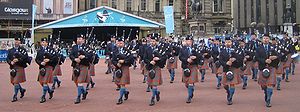 The pipe band began life in the military, but its origins are obscure, and historical records exist mostly in hints gleaned from contemporary regimental records that had no direct interest in pipes.
It is known that pipers served in regiment
s from the earliest times; the Royal Scots have records referring to pipers dating back to the early seventeenth century.
Where pipers were employed as pipers (rather than just happening to be a soldier who also was able to play), they were employed by the officers of the regiments as private pipers.
This situation continued until the 1840s, when Queen Victoria's
enthusiasm for all things Highland
was instrumental in the War Office
's decision that each battalion of the Highland Regiments be allowed five pipers and a Pipe Major, which continues to be all that the British Army
provides funds for to this day. Any additional pipers in the battalion pipe band were and are equipped today by funds from the Officers' Mess Fund of the battalion.
By this time, pipers were already playing together with drummers, probably modelling themselves on the fife
and drum bands which had existed in Switzerland
since the fifteenth century. Drumming is, of course, as ancient as the concept of formed military units, and their original purpose on the battlefield was to signal tactical movements and keep cadence on the march.
By the end of the Crimean War
, pipe bands were established in most of the Scottish Regiments. The first civilian organizations to adopt pipe bands were police
and fire brigade bands; even today, several forces maintain bands that play to a very high standard.
By the time World War I
broke out, the pipe band represented a popular image of Scotland, both internally and externally.
Military pipers were killed and injured in significant numbers in the Great War, before the War Office banned the practice of playing in the trenches in 1915. The ban was often not observed; Canadian piper James Richardson
was awarded the Victoria Cross for playing in action in 1916. Pipes have occasionally played into battle, notably at El Alamein
, Dieppe
, the Normandy
beaches, and the crossing of the Rhine. The Calgary Highlanders
went into action for the first time at Hill 67 in Normandy with company pipers playing; it was the only time the Regiment did so.
Military pipers have also served in both Gulf Wars.
Unlike civilian pipers, however, pipers in British military bands have additional military responsibilities. Nowadays, musicians in British Army
bands are normally required to take on a secondary role in the battlefield as medic
s. However, in most cases the pipes and drums in a Scottish or Irish infantry
regiment
constitute a machine gun
or mortar
platoon
(as the Corps of Drums
does in an English or Welsh infantry regiment). As a result, in addition to being musicians, members of the pipes and drums must also be qualified fighting soldiers. Unlike musicians, who belong to the Corps of Army Music
, the pipers and drummers belong to the regiment in which they serve and are soldiers first and foremost.
The British Army runs its own pipes and drums training facility, the Army School of Bagpipe Music and Highland Drumming
, in Edinburgh
, Scotland
. To be qualified as a Pipe Major
or Drum Major
in the pipes and drums of a regiment of the British Army, candidates must successfully pass a series of courses at the school.
s and reels, and strathspeys
. In recent years there has been a great deal of emphasis placed on new forms, especially the suite
. A good example of a suite for pipe band is Don Thompson's composition Journey to Skye (1987).
In conventional pipe band music, each section of instruments has a different role in the music. Generally speaking, the pipers deliver the melodic and harmonic material, while the side drummers provide a rhythmically interactive accompaniment part. The tenor drummers provide the fundamental rhythmic pulse and the bass drummer anchors the rhythms, providing a strong and steady beat. The roles of each section are broken down further below.
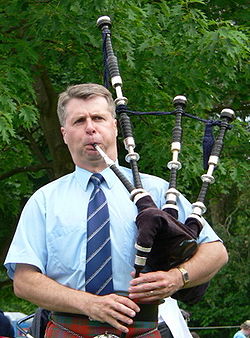 Since the bagpipe is the only pipe band instrument capable of producing distinct, variable pitches, the pipers are responsible for providing all of the melodic material in the music. Generally speaking, all of the pipers play a unison melody on their chanter
s, with their drones providing the harmonic support and filling out the sound. These unison melodies are often quite complex and demanding. It is this complexity that provides much of the musical interest.
When harmony
is written within the pipe section, it is usually a two-part harmony, and is usually scored in a 2:1 ratio (with two thirds of the players on the melody and one third of the players on the harmony part). Because of the limited range of the chanter, the harmonic possibilities are somewhat limited, but well-written harmony in a pipe band setting can be quite effective. Pipe band harmony is sometimes referred to as 'seconds', although this simply refers to a second part and not to the interval
of a second. In fact, intervals of a second are rarely found in pipe band harmony parts, except in passing. Instead, it is the consonant intervals which are stressed, such as perfect fourths and fifths, and even more commonly, parallel thirds and sixths.
In contemporary arrangements, a merge between harmony and melody known as 'counter-melody' has been aired. A counter-melody is similar to a harmony part, but is distinguished because it has a melodic line of its own. Counter-melody can take a completely different thematic approach and can dramatically change the flow and atmosphere of the melodic unison. This technique is relatively new in the pipe band circuit, and in most cases require skill and timing to achieve in full unison.
and the bass section (see below). In the early days of pipe bands, rope tension snare drums were common, but as the technology evolved, so did the music. Pipe band drummers now play on drums with very tight, knitted kevlar
heads, designed for maximum tension to create a very crisp and strident sound. Due to technological innovations and changing aesthetics, this crispness has become an integral part of the pipe band sound. Since today's drum is so facile as a result of its design, players are often able to execute extremely complicated and technically demanding rudimentary patterns.
The pipe band drum corps is responsible for both supporting the piping with a solid rhythmic foundation and sense of pulse, often creating an interesting contrapuntal
line unto itself. The line played by the drum corps (referred to as the 'drum score') is usually based on rudimentary patterns and can often be quite involved, with solo, unison and contrapuntal passages throughout. A popular pattern in many scores is for the lead drummer to play a phrase, and the section to play in response. This technique is known as seconds (sometimes referred to as chips, or forte).
While standard practice in pipe bands is for the pipe section to perform the traditional or standard arrangements of the melodies, including gracenotes
, drum scores are very often composed by the lead drummer of the band. In competition, one of the adjudicators grades a band on how creative their scores are and how well they fit the piping - this aspect of the judging is known as 'ensemble'.
mers and a bass drummer. Their role is to provide rhythmic support to the entire ensemble. In this respect, the bass section allows the drum corps to delegate their timekeeping responsibilities and allows more freedom in the drum scores.
Generally, the bass drum provides a steady pulse, playing on the downbeat and on the strong beats of the bar, and the tenors support that pulse, often adding supporting beats, accents and dynamic interest.
Tenor drums in their modern form are a relatively new addition to the pipe band. While pipe bands of yesteryear would often include tenor drummers, they would usually be "swinging tenors", players who would swing their sticks for elaborate visual effect but who would rarely play. Today's tenor drummers play pitched drums, and careful thought is given as to which pitches to use and at which times. In some cases, five or six tenor drummers have been used, providing a palette of individual pitches for use in a variety of musical situations. The swinging also known as flourishing has developed somewhat into an art form, with drummers playing and swinging in unison or sequential flows.
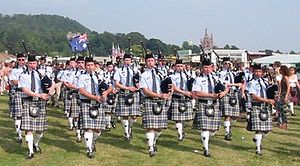 Competition is a primary focus for many pipe bands throughout the world. Every year, mainly in the period from spring to autumn, pipe bands around the world compete against each other at various venues, often at Highland festivals. A typical season for many competing pipe bands might include ten or more of these competitions. Europe (especially the UK and Ireland), North America, Australia, and New Zealand have active competitive pipe band communities, but there are competing bands from throughout the world.
Since 1930, when the Scottish band association (today known as the Royal Scottish Pipe Band Association
) was formed, there has been a World Pipe Band Championship competition, known as 'The Worlds' held annually in Glasgow
during August. For competitive bands, the title of World Champion is highly coveted, and this event is seen as the culmination of a year's worth of preparation, rehearsal and practice.
The entirety of the World Championships takes place on one day in August, on Glasgow Green
. Typically, several hundred bands attend, traveling from all over the world. Bands arrive early and, in most grades, are required to perform in a qualifying round which takes place in the morning. The top bands at the end of the qualifying round play in a second event in the afternoon to determine an aggregate winner.
To win, Grade One bands must perform in two events, a March, Strathspey & Reel event (known as a "set" or "MSR") which consists of three pre-arranged tunes, and a Medley event, which consists of a short selection of music chosen and arranged by the band. The rules for the medley contest are very open, requiring only a minimum and maximum time frame (between 5:30 and 7 minutes) and a minimum of different time signatures that must be played as well as two 3 pace rolls played at the beginning of the tune (also known as an attack).
In addition to performing at 'The Worlds', most internationally competitive bands participate in a season of events that are generally held during Scotland's summer months. While events of this type are usually held at Highland Games
, band competitions in Scotland, Ireland and Northern Ireland are often large enough to be held as events unto themselves. The grading and organization of these events is generally consistent with the World Championships and the events are typically administered by the governing Pipe Band Association.
In the United States, Canada, and Germany, there is also a fifth grade.
In the Novice Juvenile and Juvenile categories, band members must be under the age of eighteen, with the exception of one "adult" player, often an instructor, who may serve as the Pipe Major or Pipe Sergeant. The remaining categories have no age restriction, but are based on proficiency. Grade One is the highest of these categories, and Novice is the lowest. Grading and eligibility are overseen by the National Council and Music Board of the RSPBA
, and bands can be downgraded or upgraded at the annual regrading, which takes place at the end of the competition season. A band can apply for downgrading, but will have to compete in two further contests in their existing grade.
Because of time constraints, the RSPBA uses "A" and "B" designations in Grade 3 and 4, for major competitions. By doing this, bands are grouped based on prior-years' performances, and can receive promotions within their respective grade. It is also important to note that these vary slightly throughout the world. For example, in the Republic of Ireland Grade 4 "B" is known as Grade 5, in North America, many regional associations have implemented Grade Five, an entry-level Grade, intended to help bands familiarize themselves with competition and in Australia and New Zealand there is no Novice grade at all.
In the competitive pipe band community, some bands are starting to find the competitive system musically stifling, although it does demand high standards. Some advocate making the transition to a Breton
model, where competitions are more flexible and with fewer restrictions.
Instead of giving up on the competitive model, a number of bands have instead turned to the concert stage to supplement their competitive activities. Performing in this setting allows a greater degree of musical flexibility and creativity, and encourages the inclusion of additional instruments and performers, to expand the musical possibilities.
, a Breton
cultural phenomenon. Bagads began in the thirties to counter the widespread decay of the living Breton folk tradition.
A modern-day bagad consists of a biniou braz (bagpipe), a bombarde section, a drum corps
, perhaps more accurately described nowadays as a 'large and varied percussion
section' (one band's percussionists lug around a huge metal model elephant
), and any additional musical instruments the band wishes to add.
Common additions are small jazz
orchestra
s, guitar
s, and other forms of biniou
s.
Bagpipes
Bagpipes are a class of musical instrument, aerophones, using enclosed reeds fed from a constant reservoir of air in the form of a bag. Though the Scottish Great Highland Bagpipe and Irish uilleann pipes have the greatest international visibility, bagpipes of many different types come from...
and drummer
Drummer
A drummer is a musician who is capable of playing drums, which includes but is not limited to a drum kit and accessory based hardware which includes an assortment of pedals and standing support mechanisms, marching percussion and/or any musical instrument that is struck within the context of a...
s. The term used by military pipe bands, pipes and drums, is also common.
The most common form of pipe band, the Scottish
Scotland
Scotland is a country that is part of the United Kingdom. Occupying the northern third of the island of Great Britain, it shares a border with England to the south and is bounded by the North Sea to the east, the Atlantic Ocean to the north and west, and the North Channel and Irish Sea to the...
pipe band, consists of a section of pipers (playing the Great Highland Bagpipe
Great Highland Bagpipe
The Great Highland Bagpipe is a type of bagpipe native to Scotland. It has achieved widespread recognition through its usage in the British military and in pipe bands throughout the world. It is closely related to the Great Irish Warpipes....
), a section of snare drum
Snare drum
The snare drum or side drum is a melodic percussion instrument with strands of snares made of curled metal wire, metal cable, plastic cable, or gut cords stretched across the drumhead, typically the bottom. Pipe and tabor and some military snare drums often have a second set of snares on the bottom...
mers (often referred to as 'side drummers'), several tenor drummers
Tenor drum
A tenor drum is a cylindrical drum that is higher pitched than a bass drum.In a symphony orchestra's percussion section, a tenor drum is a low-pitched drum, similar in size to a field snare, but without snares and played with soft mallets or hard sticks. Under various names, the drum has been used...
and usually one, though occasionally two, bass drummers
Bass drum
Bass drums are percussion instruments that can vary in size and are used in several musical genres. Three major types of bass drums can be distinguished. The type usually seen or heard in orchestral, ensemble or concert band music is the orchestral, or concert bass drum . It is the largest drum of...
. The entire drum section is known collectively as the drum corps. The tenor drummers and bass drummer are referred to collectively as the 'bass section' (or in North America as the 'midsection'). The band follows the direction of the pipe major; when on parade the band may be led by a drum major, who directs the band with a mace. Standard instrumentation for a pipe band involves 6 to 25 pipers, 3 to 10 side drummers, 1 to 6 tenor drummers and 1 bass drummer. Occasionally this instrumentation is augmented to include additional instruments (such as additional percussion instruments or keyboard instruments), but this is typically done only in concert settings.
Pipe bands are a long-standing tradition in other areas with Celtic roots, such as the regions of Galicia and Asturies in Spain
Spain
Spain , officially the Kingdom of Spain languages]] under the European Charter for Regional or Minority Languages. In each of these, Spain's official name is as follows:;;;;;;), is a country and member state of the European Union located in southwestern Europe on the Iberian Peninsula...
and Brittany
Brittany
Brittany is a cultural and administrative region in the north-west of France. Previously a kingdom and then a duchy, Brittany was united to the Kingdom of France in 1532 as a province. Brittany has also been referred to as Less, Lesser or Little Britain...
in France
France
The French Republic , The French Republic , The French Republic , (commonly known as France , is a unitary semi-presidential republic in Western Europe with several overseas territories and islands located on other continents and in the Indian, Pacific, and Atlantic oceans. Metropolitan France...
, as well as other regions with Celtic influence in other parts of Europe
Europe
Europe is, by convention, one of the world's seven continents. Comprising the westernmost peninsula of Eurasia, Europe is generally 'divided' from Asia to its east by the watershed divides of the Ural and Caucasus Mountains, the Ural River, the Caspian and Black Seas, and the waterways connecting...
. It's also a long-standing tradition in the British Commonwealth of Nations
Commonwealth of Nations
The Commonwealth of Nations, normally referred to as the Commonwealth and formerly known as the British Commonwealth, is an intergovernmental organisation of fifty-four independent member states...
countries and former British colonies like the United States of America, Canada
Canada
Canada is a North American country consisting of ten provinces and three territories. Located in the northern part of the continent, it extends from the Atlantic Ocean in the east to the Pacific Ocean in the west, and northward into the Arctic Ocean...
, India
India
India , officially the Republic of India , is a country in South Asia. It is the seventh-largest country by geographical area, the second-most populous country with over 1.2 billion people, and the most populous democracy in the world...
, Malaysia, Singapore
Singapore
Singapore , officially the Republic of Singapore, is a Southeast Asian city-state off the southern tip of the Malay Peninsula, north of the equator. An island country made up of 63 islands, it is separated from Malaysia by the Straits of Johor to its north and from Indonesia's Riau Islands by the...
, Hong Kong
Hong Kong
Hong Kong is one of two Special Administrative Regions of the People's Republic of China , the other being Macau. A city-state situated on China's south coast and enclosed by the Pearl River Delta and South China Sea, it is renowned for its expansive skyline and deep natural harbour...
, Brunei
Brunei
Brunei , officially the State of Brunei Darussalam or the Nation of Brunei, the Abode of Peace , is a sovereign state located on the north coast of the island of Borneo, in Southeast Asia...
, Sri Lanka
Sri Lanka
Sri Lanka, officially the Democratic Socialist Republic of Sri Lanka is a country off the southern coast of the Indian subcontinent. Known until 1972 as Ceylon , Sri Lanka is an island surrounded by the Indian Ocean, the Gulf of Mannar and the Palk Strait, and lies in the vicinity of India and the...
and Pakistan
Pakistan
Pakistan , officially the Islamic Republic of Pakistan is a sovereign state in South Asia. It has a coastline along the Arabian Sea and the Gulf of Oman in the south and is bordered by Afghanistan and Iran in the west, India in the east and China in the far northeast. In the north, Tajikistan...
. Pipe bands have also been established in countries with few Scottish or Celtic connections like Thailand
Thailand
Thailand , officially the Kingdom of Thailand , formerly known as Siam , is a country located at the centre of the Indochina peninsula and Southeast Asia. It is bordered to the north by Burma and Laos, to the east by Laos and Cambodia, to the south by the Gulf of Thailand and Malaysia, and to the...
, Colombia
Colombia
Colombia, officially the Republic of Colombia , is a unitary constitutional republic comprising thirty-two departments. The country is located in northwestern South America, bordered to the east by Venezuela and Brazil; to the south by Ecuador and Peru; to the north by the Caribbean Sea; to the...
, Mexico
Mexico
The United Mexican States , commonly known as Mexico , is a federal constitutional republic in North America. It is bordered on the north by the United States; on the south and west by the Pacific Ocean; on the southeast by Guatemala, Belize, and the Caribbean Sea; and on the east by the Gulf of...
, Brazil
Brazil
Brazil , officially the Federative Republic of Brazil , is the largest country in South America. It is the world's fifth largest country, both by geographical area and by population with over 192 million people...
, Chile
Chile
Chile ,officially the Republic of Chile , is a country in South America occupying a long, narrow coastal strip between the Andes mountains to the east and the Pacific Ocean to the west. It borders Peru to the north, Bolivia to the northeast, Argentina to the east, and the Drake Passage in the far...
, Uruguay
Uruguay
Uruguay ,officially the Oriental Republic of Uruguay,sometimes the Eastern Republic of Uruguay; ) is a country in the southeastern part of South America. It is home to some 3.5 million people, of whom 1.8 million live in the capital Montevideo and its metropolitan area...
and Argentina
Argentina
Argentina , officially the Argentine Republic , is the second largest country in South America by land area, after Brazil. It is constituted as a federation of 23 provinces and an autonomous city, Buenos Aires...
.
History
It is known that pipers served in regiment
Regiment
A regiment is a major tactical military unit, composed of variable numbers of batteries, squadrons or battalions, commanded by a colonel or lieutenant colonel...
s from the earliest times; the Royal Scots have records referring to pipers dating back to the early seventeenth century.
Where pipers were employed as pipers (rather than just happening to be a soldier who also was able to play), they were employed by the officers of the regiments as private pipers.
This situation continued until the 1840s, when Queen Victoria's
Victoria of the United Kingdom
Victoria was the monarch of the United Kingdom of Great Britain and Ireland from 20 June 1837 until her death. From 1 May 1876, she used the additional title of Empress of India....
enthusiasm for all things Highland
Scottish Highlands
The Highlands is an historic region of Scotland. The area is sometimes referred to as the "Scottish Highlands". It was culturally distinguishable from the Lowlands from the later Middle Ages into the modern period, when Lowland Scots replaced Scottish Gaelic throughout most of the Lowlands...
was instrumental in the War Office
War Office
The War Office was a department of the British Government, responsible for the administration of the British Army between the 17th century and 1964, when its functions were transferred to the Ministry of Defence...
's decision that each battalion of the Highland Regiments be allowed five pipers and a Pipe Major, which continues to be all that the British Army
British Army
The British Army is the land warfare branch of Her Majesty's Armed Forces in the United Kingdom. It came into being with the unification of the Kingdom of England and Scotland into the Kingdom of Great Britain in 1707. The new British Army incorporated Regiments that had already existed in England...
provides funds for to this day. Any additional pipers in the battalion pipe band were and are equipped today by funds from the Officers' Mess Fund of the battalion.
By this time, pipers were already playing together with drummers, probably modelling themselves on the fife
Fife (musical instrument)
A fife is a small, high-pitched, transverse flute that is similar to the piccolo, but louder and shriller due to its narrower bore. The fife originated in medieval Europe and is often used in military and marching bands. Someone who plays the fife is called a fifer...
and drum bands which had existed in Switzerland
Switzerland
Switzerland name of one of the Swiss cantons. ; ; ; or ), in its full name the Swiss Confederation , is a federal republic consisting of 26 cantons, with Bern as the seat of the federal authorities. The country is situated in Western Europe,Or Central Europe depending on the definition....
since the fifteenth century. Drumming is, of course, as ancient as the concept of formed military units, and their original purpose on the battlefield was to signal tactical movements and keep cadence on the march.
By the end of the Crimean War
Crimean War
The Crimean War was a conflict fought between the Russian Empire and an alliance of the French Empire, the British Empire, the Ottoman Empire, and the Kingdom of Sardinia. The war was part of a long-running contest between the major European powers for influence over territories of the declining...
, pipe bands were established in most of the Scottish Regiments. The first civilian organizations to adopt pipe bands were police
Police
The police is a personification of the state designated to put in practice the enforced law, protect property and reduce civil disorder in civilian matters. Their powers include the legitimized use of force...
and fire brigade bands; even today, several forces maintain bands that play to a very high standard.
By the time World War I
World War I
World War I , which was predominantly called the World War or the Great War from its occurrence until 1939, and the First World War or World War I thereafter, was a major war centred in Europe that began on 28 July 1914 and lasted until 11 November 1918...
broke out, the pipe band represented a popular image of Scotland, both internally and externally.
Military pipers were killed and injured in significant numbers in the Great War, before the War Office banned the practice of playing in the trenches in 1915. The ban was often not observed; Canadian piper James Richardson
James Cleland Richardson
James Cleland Richardson VC was a Canadian recipient of the Victoria Cross, the highest and most prestigious award for gallantry in the face of the enemy that can be awarded to British and Commonwealth forces.He was 20 years old, born in Scotland and a resident of Vancouver, British Columbia,...
was awarded the Victoria Cross for playing in action in 1916. Pipes have occasionally played into battle, notably at El Alamein
El Alamein
El Alamein is a town in the northern Matrouh Governorate of Egypt. Located on the Mediterranean Sea, it lies west of Alexandria and northwest of Cairo. As of 2007, it has a local population of 7,397 inhabitants.- Climate :...
, Dieppe
Dieppe Raid
The Dieppe Raid, also known as the Battle of Dieppe, Operation Rutter or later on Operation Jubilee, during the Second World War, was an Allied attack on the German-occupied port of Dieppe on the northern coast of France on 19 August 1942. The assault began at 5:00 AM and by 10:50 AM the Allied...
, the Normandy
D-Day
D-Day is a term often used in military parlance to denote the day on which a combat attack or operation is to be initiated. "D-Day" often represents a variable, designating the day upon which some significant event will occur or has occurred; see Military designation of days and hours for similar...
beaches, and the crossing of the Rhine. The Calgary Highlanders
The Calgary Highlanders
The Calgary Highlanders is a Canadian Forces Land Force Primary Reserve infantry regiment, headquartered at Mewata Armouries in Calgary, Alberta, Canada...
went into action for the first time at Hill 67 in Normandy with company pipers playing; it was the only time the Regiment did so.
Military pipers have also served in both Gulf Wars.
Military pipes and drums
In military and para-military organizations the term "pipes and drums" is used when referring to an ensemble of Highland bagpipes and drums, but the majority of modern military bands are quite similar to their civilian counterparts in their instrumentation and music. Many of the same standard tunes are found in both the military and civilian pipe band repertoires, and many similarities exist in terms of musical style, historical and musical influences, and dress and deportment.Unlike civilian pipers, however, pipers in British military bands have additional military responsibilities. Nowadays, musicians in British Army
British Army
The British Army is the land warfare branch of Her Majesty's Armed Forces in the United Kingdom. It came into being with the unification of the Kingdom of England and Scotland into the Kingdom of Great Britain in 1707. The new British Army incorporated Regiments that had already existed in England...
bands are normally required to take on a secondary role in the battlefield as medic
Medic
Medic is a general term for a person involved in medicine, especially emergency or first-response medicine, such as an emergency medical technician, paramedic, or a military member trained in battlefield medicine. Also the term is used toward a Nurse in pre-hospital care and/or emergency...
s. However, in most cases the pipes and drums in a Scottish or Irish infantry
Infantry
Infantrymen are soldiers who are specifically trained for the role of fighting on foot to engage the enemy face to face and have historically borne the brunt of the casualties of combat in wars. As the oldest branch of combat arms, they are the backbone of armies...
regiment
Regiment
A regiment is a major tactical military unit, composed of variable numbers of batteries, squadrons or battalions, commanded by a colonel or lieutenant colonel...
constitute a machine gun
Machine gun
A machine gun is a fully automatic mounted or portable firearm, usually designed to fire rounds in quick succession from an ammunition belt or large-capacity magazine, typically at a rate of several hundred rounds per minute....
or mortar
Mortar
Mortar has several meanings:* Mortar , material used in masonry to fill the gaps between blocks and bind them together.* Mortar fires shells at a much lower velocity and higher ballistic arc than other ordnance....
platoon
Platoon
A platoon is a military unit typically composed of two to four sections or squads and containing 16 to 50 soldiers. Platoons are organized into a company, which typically consists of three, four or five platoons. A platoon is typically the smallest military unit led by a commissioned officer—the...
(as the Corps of Drums
Corps of Drums
A Corps of Drums is a type of military band, which originated in European armies in the 16th century. The main instruments of a Corps of Drums are the drum and the flute or fife. Unlike 'full' military marching bands, Corps of Drums exist within an infantry battalion. A Drum major is the leader of...
does in an English or Welsh infantry regiment). As a result, in addition to being musicians, members of the pipes and drums must also be qualified fighting soldiers. Unlike musicians, who belong to the Corps of Army Music
Corps of Army Music
The Corps of Army Music is a corps of the British Army. It was formed in 1994 as an umbrella organisation, centred on the Royal Military School of Music, to oversee the 29 new permanent Military Bands formed following Options for Change, although each band continues to wear the capbadges and Full...
, the pipers and drummers belong to the regiment in which they serve and are soldiers first and foremost.
The British Army runs its own pipes and drums training facility, the Army School of Bagpipe Music and Highland Drumming
Army School of Bagpipe Music and Highland Drumming
The Army School of Bagpipe Music and Highland Drumming is a British Army training establishment that provides instructions of Scottish bagpipe music to military pipers, drummers and pipe bands.-History:...
, in Edinburgh
Edinburgh
Edinburgh is the capital city of Scotland, the second largest city in Scotland, and the eighth most populous in the United Kingdom. The City of Edinburgh Council governs one of Scotland's 32 local government council areas. The council area includes urban Edinburgh and a rural area...
, Scotland
Scotland
Scotland is a country that is part of the United Kingdom. Occupying the northern third of the island of Great Britain, it shares a border with England to the south and is bounded by the North Sea to the east, the Atlantic Ocean to the north and west, and the North Channel and Irish Sea to the...
. To be qualified as a Pipe Major
Pipe Major
The Pipe Major is the director of bagpipe music in a Scottish or Irish pipe band. Like Drum Major, the position of Pipe Major is derived from British Army traditions. During the early twentieth century, the term Sergeant Piper was used for the role in place of "Pipe Major".Civillian and military...
or Drum Major
Drum Major
A drum major is the leader of a marching band, drum and bugle corps, or pipe band, usually positioned at the head of the band or corps. The drum major, who is often dressed in more ornate clothing than the rest of the band or corps, is responsible for providing commands to the ensemble regarding...
in the pipes and drums of a regiment of the British Army, candidates must successfully pass a series of courses at the school.
Music
The music played by pipe bands generally consists of music from the Scottish tradition, the Irish tradition and the Breton tradition, either in the form of traditional folk tunes and dances or music from the Western tradition that has been adapted for pipes. Examples of typical pipe bands forms include marches, slow airs, up-tempo jigJig
The Jig is a form of lively folk dance, as well as the accompanying dance tune, originating in England in the 16th century and today most associated with Irish dance music and Scottish country dance music...
s and reels, and strathspeys
Strathspey (dance)
A strathspey is a type of dance tune in 4/4 time. It is similar to a hornpipe but slower and more stately, and contains many dot-cut 'snaps'. A so-called Scotch snap is a short note before a dotted note, which in traditional playing is generally exaggerated rhythmically for musical expression...
. In recent years there has been a great deal of emphasis placed on new forms, especially the suite
Suite
In music, a suite is an ordered set of instrumental or orchestral pieces normally performed in a concert setting rather than as accompaniment; they may be extracts from an opera, ballet , or incidental music to a play or film , or they may be entirely original movements .In the...
. A good example of a suite for pipe band is Don Thompson's composition Journey to Skye (1987).
In conventional pipe band music, each section of instruments has a different role in the music. Generally speaking, the pipers deliver the melodic and harmonic material, while the side drummers provide a rhythmically interactive accompaniment part. The tenor drummers provide the fundamental rhythmic pulse and the bass drummer anchors the rhythms, providing a strong and steady beat. The roles of each section are broken down further below.
Pipe section
Chanter
The chanter is the part of the bagpipe upon which the player creates the melody. It consists of a number of finger-holes, and in its simpler forms looks similar to a recorder...
s, with their drones providing the harmonic support and filling out the sound. These unison melodies are often quite complex and demanding. It is this complexity that provides much of the musical interest.
When harmony
Harmony
In music, harmony is the use of simultaneous pitches , or chords. The study of harmony involves chords and their construction and chord progressions and the principles of connection that govern them. Harmony is often said to refer to the "vertical" aspect of music, as distinguished from melodic...
is written within the pipe section, it is usually a two-part harmony, and is usually scored in a 2:1 ratio (with two thirds of the players on the melody and one third of the players on the harmony part). Because of the limited range of the chanter, the harmonic possibilities are somewhat limited, but well-written harmony in a pipe band setting can be quite effective. Pipe band harmony is sometimes referred to as 'seconds', although this simply refers to a second part and not to the interval
Interval (music)
In music theory, an interval is a combination of two notes, or the ratio between their frequencies. Two-note combinations are also called dyads...
of a second. In fact, intervals of a second are rarely found in pipe band harmony parts, except in passing. Instead, it is the consonant intervals which are stressed, such as perfect fourths and fifths, and even more commonly, parallel thirds and sixths.
In contemporary arrangements, a merge between harmony and melody known as 'counter-melody' has been aired. A counter-melody is similar to a harmony part, but is distinguished because it has a melodic line of its own. Counter-melody can take a completely different thematic approach and can dramatically change the flow and atmosphere of the melodic unison. This technique is relatively new in the pipe band circuit, and in most cases require skill and timing to achieve in full unison.
Drum corps
The drum corps of a pipe band consists of a section of drummers playing Highland snare drumsMarching percussion
Marching percussion instruments are specially designed to be played while moving. This is achieved by attaching the drum to a special harness worn by the drummer. The drums are designed and tuned for maximum articulation and projection of sound, as marching activities are almost always outdoors or...
and the bass section (see below). In the early days of pipe bands, rope tension snare drums were common, but as the technology evolved, so did the music. Pipe band drummers now play on drums with very tight, knitted kevlar
Kevlar
Kevlar is the registered trademark for a para-aramid synthetic fiber, related to other aramids such as Nomex and Technora. Developed at DuPont in 1965, this high strength material was first commercially used in the early 1970s as a replacement for steel in racing tires...
heads, designed for maximum tension to create a very crisp and strident sound. Due to technological innovations and changing aesthetics, this crispness has become an integral part of the pipe band sound. Since today's drum is so facile as a result of its design, players are often able to execute extremely complicated and technically demanding rudimentary patterns.
The pipe band drum corps is responsible for both supporting the piping with a solid rhythmic foundation and sense of pulse, often creating an interesting contrapuntal
Counterpoint
In music, counterpoint is the relationship between two or more voices that are independent in contour and rhythm and are harmonically interdependent . It has been most commonly identified in classical music, developing strongly during the Renaissance and in much of the common practice period,...
line unto itself. The line played by the drum corps (referred to as the 'drum score') is usually based on rudimentary patterns and can often be quite involved, with solo, unison and contrapuntal passages throughout. A popular pattern in many scores is for the lead drummer to play a phrase, and the section to play in response. This technique is known as seconds (sometimes referred to as chips, or forte).
While standard practice in pipe bands is for the pipe section to perform the traditional or standard arrangements of the melodies, including gracenotes
Grace note
A grace note is a kind of music notation used to denote several kinds of musical ornaments. When occurring by itself, a single grace note normally indicates the intention of either an appoggiatura or an acciaccatura...
, drum scores are very often composed by the lead drummer of the band. In competition, one of the adjudicators grades a band on how creative their scores are and how well they fit the piping - this aspect of the judging is known as 'ensemble'.
Bass section
The bass section (also referred to as a mid section) usually consists of a section of tenor drumTenor drum
A tenor drum is a cylindrical drum that is higher pitched than a bass drum.In a symphony orchestra's percussion section, a tenor drum is a low-pitched drum, similar in size to a field snare, but without snares and played with soft mallets or hard sticks. Under various names, the drum has been used...
mers and a bass drummer. Their role is to provide rhythmic support to the entire ensemble. In this respect, the bass section allows the drum corps to delegate their timekeeping responsibilities and allows more freedom in the drum scores.
Generally, the bass drum provides a steady pulse, playing on the downbeat and on the strong beats of the bar, and the tenors support that pulse, often adding supporting beats, accents and dynamic interest.
Tenor drums in their modern form are a relatively new addition to the pipe band. While pipe bands of yesteryear would often include tenor drummers, they would usually be "swinging tenors", players who would swing their sticks for elaborate visual effect but who would rarely play. Today's tenor drummers play pitched drums, and careful thought is given as to which pitches to use and at which times. In some cases, five or six tenor drummers have been used, providing a palette of individual pitches for use in a variety of musical situations. The swinging also known as flourishing has developed somewhat into an art form, with drummers playing and swinging in unison or sequential flows.
Competition and the World Championships
Since 1930, when the Scottish band association (today known as the Royal Scottish Pipe Band Association
Royal Scottish Pipe Band Association
The Royal Scottish Pipe Band Association was founded in 1930 as a governing body to oversee pipe band competition and to promote and encourage the development of pipe band culture throughout the world....
) was formed, there has been a World Pipe Band Championship competition, known as 'The Worlds' held annually in Glasgow
Glasgow
Glasgow is the largest city in Scotland and third most populous in the United Kingdom. The city is situated on the River Clyde in the country's west central lowlands...
during August. For competitive bands, the title of World Champion is highly coveted, and this event is seen as the culmination of a year's worth of preparation, rehearsal and practice.
The entirety of the World Championships takes place on one day in August, on Glasgow Green
Glasgow Green
Glasgow Green is a park situated in the east end of Glasgow on the north bank of the River Clyde. It is the oldest park in the city dating back to the 15th century.In 1450, King James II granted the land to Bishop William Turnbull and the people of Glasgow...
. Typically, several hundred bands attend, traveling from all over the world. Bands arrive early and, in most grades, are required to perform in a qualifying round which takes place in the morning. The top bands at the end of the qualifying round play in a second event in the afternoon to determine an aggregate winner.
To win, Grade One bands must perform in two events, a March, Strathspey & Reel event (known as a "set" or "MSR") which consists of three pre-arranged tunes, and a Medley event, which consists of a short selection of music chosen and arranged by the band. The rules for the medley contest are very open, requiring only a minimum and maximum time frame (between 5:30 and 7 minutes) and a minimum of different time signatures that must be played as well as two 3 pace rolls played at the beginning of the tune (also known as an attack).
In addition to performing at 'The Worlds', most internationally competitive bands participate in a season of events that are generally held during Scotland's summer months. While events of this type are usually held at Highland Games
Highland games
Highland games are events held throughout the &Highland games are events held throughout the &Highland games are events held throughout the &(-è_çà in Scotland and other countries as a way of celebrating Scottish and Celtic culture and heritage, especially that of the Scottish Highlands. Certain...
, band competitions in Scotland, Ireland and Northern Ireland are often large enough to be held as events unto themselves. The grading and organization of these events is generally consistent with the World Championships and the events are typically administered by the governing Pipe Band Association.
Grading system
Prizes at the World's are awarded in the following eight categories:- Grade One
- Grade Two
- Grade Three "A"
- Grade Three "B"
- Juvenile
- Grade Four "A"
- Grade Four "B"
- Novice Juvenile
In the United States, Canada, and Germany, there is also a fifth grade.
In the Novice Juvenile and Juvenile categories, band members must be under the age of eighteen, with the exception of one "adult" player, often an instructor, who may serve as the Pipe Major or Pipe Sergeant. The remaining categories have no age restriction, but are based on proficiency. Grade One is the highest of these categories, and Novice is the lowest. Grading and eligibility are overseen by the National Council and Music Board of the RSPBA
Royal Scottish Pipe Band Association
The Royal Scottish Pipe Band Association was founded in 1930 as a governing body to oversee pipe band competition and to promote and encourage the development of pipe band culture throughout the world....
, and bands can be downgraded or upgraded at the annual regrading, which takes place at the end of the competition season. A band can apply for downgrading, but will have to compete in two further contests in their existing grade.
Because of time constraints, the RSPBA uses "A" and "B" designations in Grade 3 and 4, for major competitions. By doing this, bands are grouped based on prior-years' performances, and can receive promotions within their respective grade. It is also important to note that these vary slightly throughout the world. For example, in the Republic of Ireland Grade 4 "B" is known as Grade 5, in North America, many regional associations have implemented Grade Five, an entry-level Grade, intended to help bands familiarize themselves with competition and in Australia and New Zealand there is no Novice grade at all.
Noncompetitive piping
The future for pipe bands is unclear. Currently, there are many pipe bands which perform in parades and other public events as a primary activity. These bands are sometimes referred to as "street bands". Some military bands fall into this category as well, playing for regimental functions in lieu of, or supplemented by, competitions and/or concerts.In the competitive pipe band community, some bands are starting to find the competitive system musically stifling, although it does demand high standards. Some advocate making the transition to a Breton
Brittany
Brittany is a cultural and administrative region in the north-west of France. Previously a kingdom and then a duchy, Brittany was united to the Kingdom of France in 1532 as a province. Brittany has also been referred to as Less, Lesser or Little Britain...
model, where competitions are more flexible and with fewer restrictions.
Instead of giving up on the competitive model, a number of bands have instead turned to the concert stage to supplement their competitive activities. Performing in this setting allows a greater degree of musical flexibility and creativity, and encourages the inclusion of additional instruments and performers, to expand the musical possibilities.
Bagad
A lesser-known type of pipe band that has already expanded the pipe band genre is the bagadBagad
A bagad is a Breton band, composed of bagpipes , bombards and drums . The pipe band tradition in Brittany was inspired by the Scottish example and has developed since the mid-20th century...
, a Breton
Brittany
Brittany is a cultural and administrative region in the north-west of France. Previously a kingdom and then a duchy, Brittany was united to the Kingdom of France in 1532 as a province. Brittany has also been referred to as Less, Lesser or Little Britain...
cultural phenomenon. Bagads began in the thirties to counter the widespread decay of the living Breton folk tradition.
A modern-day bagad consists of a biniou braz (bagpipe), a bombarde section, a drum corps
Drum and bugle corps (classic)
Classic drum and bugle corps are North American musical ensembles that descended from military bugle and drum units returning from World War I and succeeding wars. Traditionally, drum and bugle corps served as signaling units as early as before the American Civil War, with these signaling units...
, perhaps more accurately described nowadays as a 'large and varied percussion
Percussion instrument
A percussion instrument is any object which produces a sound when hit with an implement or when it is shaken, rubbed, scraped, or otherwise acted upon in a way that sets the object into vibration...
section' (one band's percussionists lug around a huge metal model elephant
Elephant
Elephants are large land mammals in two extant genera of the family Elephantidae: Elephas and Loxodonta, with the third genus Mammuthus extinct...
), and any additional musical instruments the band wishes to add.
Common additions are small jazz
Jazz
Jazz is a musical style that originated at the beginning of the 20th century in African American communities in the Southern United States. It was born out of a mix of African and European music traditions. From its early development until the present, jazz has incorporated music from 19th and 20th...
orchestra
Orchestra
An orchestra is a sizable instrumental ensemble that contains sections of string, brass, woodwind, and percussion instruments. The term orchestra derives from the Greek ορχήστρα, the name for the area in front of an ancient Greek stage reserved for the Greek chorus...
s, guitar
Guitar
The guitar is a plucked string instrument, usually played with fingers or a pick. The guitar consists of a body with a rigid neck to which the strings, generally six in number, are attached. Guitars are traditionally constructed of various woods and strung with animal gut or, more recently, with...
s, and other forms of biniou
Biniou
Binioù means bagpipe in the Breton language.There are two bagpipes called binioù in Brittany: the traditional binioù kozh and the binioù bras , which was brought into Brittany from Scotland in the late 19th century...
s.
See also
- CanntaireachdCanntaireachdCanntaireachd is the ancient Scottish Highland method of noting classical pipe music or Ceòl Mòr by a combination of definite syllables, by which means the various tunes could be more easily recollected by the learner, and could be more easily transmitted orally...
- Great Highland BagpipeGreat Highland BagpipeThe Great Highland Bagpipe is a type of bagpipe native to Scotland. It has achieved widespread recognition through its usage in the British military and in pipe bands throughout the world. It is closely related to the Great Irish Warpipes....
- List of bagpipers
- List of pipe band associations
- List of pipe bands
- Types of bagpipesTypes of bagpipes-France:*Musette de cour: A French open ended smallpipe, believed by some to be an ancestor of the Northumbrian smallpipes, used for classical compositions in 'folk' style in the 18th Century French court...
- Royal Scottish Pipe Band AssociationRoyal Scottish Pipe Band AssociationThe Royal Scottish Pipe Band Association was founded in 1930 as a governing body to oversee pipe band competition and to promote and encourage the development of pipe band culture throughout the world....