

CF-105 Arrow

Unanswered Questions

Encyclopedia
The Avro Canada CF-105 Arrow was a delta-winged interceptor aircraft
Interceptor aircraft
An interceptor aircraft is a type of fighter aircraft designed specifically to prevent missions of enemy aircraft, particularly bombers and reconnaissance aircraft. Interceptors generally rely on high speed and powerful armament in order to complete their mission as quickly as possible and set up...
, designed and built by Avro Aircraft Limited (Canada)
Avro Canada
Commonly known as Avro Canada, this company started in 1945 as an aircraft plant and became within thirteen years the third-largest company in Canada, one of the largest 100 companies in the world, and directly employing over 50,000...
in Malton
Malton, Ontario
Malton is a neighbourhood in the northeastern part of the city of Mississauga, Ontario, Canada, located to the northwest of Toronto. The neighbourhood has a population of approximately 36,400 as of 2002....
, Ontario
Ontario
Ontario is a province of Canada, located in east-central Canada. It is Canada's most populous province and second largest in total area. It is home to the nation's most populous city, Toronto, and the nation's capital, Ottawa....
, Canada, as the culmination of a design study that began in 1953. Considered to be both an advanced technical and aerodynamic achievement for the Canadian aviation industry, the CF-105 held the promise of Mach
Mach number
Mach number is the speed of an object moving through air, or any other fluid substance, divided by the speed of sound as it is in that substance for its particular physical conditions, including those of temperature and pressure...
2 speeds at altitudes exceeding 50,000 ft (15,000 m), and was intended to serve as the Royal Canadian Air Force
Royal Canadian Air Force
The history of the Royal Canadian Air Force begins in 1920, when the air force was created as the Canadian Air Force . In 1924 the CAF was renamed the Royal Canadian Air Force and granted royal sanction by King George V. The RCAF existed as an independent service until 1968...
's (RCAF) primary interceptor in the 1960s and beyond.
Not long after the 1958 start of its flight test program, the development of the Arrow (including its Orenda Iroquois jet engines) was abruptly and controversially halted before the project review had taken place, sparking a long and bitter political debate.
The controversy engendered by the cancellation and subsequent destruction of the aircraft in production, remains a topic for debate among historians, political observers and industry pundits. "This action effectively put Avro out of business and its highly skilled engineering and production personnel scattered... The incident was a traumatic one... and to this day, many mourn the loss of the Arrow."
Background
In the post-Second World WarWorld War II
World War II, or the Second World War , was a global conflict lasting from 1939 to 1945, involving most of the world's nations—including all of the great powers—eventually forming two opposing military alliances: the Allies and the Axis...
period, the Soviet Union
Soviet Union
The Soviet Union , officially the Union of Soviet Socialist Republics , was a constitutionally socialist state that existed in Eurasia between 1922 and 1991....
began developing a capable fleet of long-range bombers with the ability to deliver nuclear weapons across North America and Europe. The main threat was principally from high-speed, high-altitude bombing runs launched from the Soviet Union travelling over the Arctic
Arctic
The Arctic is a region located at the northern-most part of the Earth. The Arctic consists of the Arctic Ocean and parts of Canada, Russia, Greenland, the United States, Norway, Sweden, Finland, and Iceland. The Arctic region consists of a vast, ice-covered ocean, surrounded by treeless permafrost...
against military bases, built-up and industrial centres in Canada and the United States. To counter this threat, Western countries strenuously engaged in the development of interceptors that could engage and destroy these bombers before they reached their targets.
A. V. Roe Canada Limited
Avro Canada
Commonly known as Avro Canada, this company started in 1945 as an aircraft plant and became within thirteen years the third-largest company in Canada, one of the largest 100 companies in the world, and directly employing over 50,000...
had been set up as a subsidiary of the Hawker Siddeley Group in 1945, initially handling repair and maintenance work for aircraft at Malton, Ontario Airport, today known as Pearson International Airport. The next year the company began the design of Canada's first jet fighter for the RCAF, the Avro CF-100
Avro CF-100
The Avro Canada CF-100 Canuck was a Canadian jet interceptor/fighter serving during the Cold War both in NATO bases in Europe and as part of NORAD. The CF-100 was the only Canadian-designed fighter to enter mass production, serving primarily with the RCAF/CAF and in small numbers in Belgium...
Canuck all-weather interceptor. The Canuck underwent a lengthy and troubled prototype stage before entering service seven years later in 1953, nevertheless it went on to become one of the most enduring aircraft of its class, serving in a variety of roles until 1981.
Recognizing that the delays that impacted the development and deployment of the CF-100 could also impact its successor, and the fact that the Soviets were working on newer jet-powered bombers that would render the CF-100 ineffective, the RCAF began looking for a supersonic, missile-armed replacement for the Canuck even before it had entered service. In March 1952, the RCAF's Final Report of the All-Weather Interceptor Requirements Team was submitted to Avro Canada.
Higher speeds
Avro engineering had been considering supersonic issues for some time at this point. Supersonic flight works in a very different fashion and presents a number of new problems. One of the most critical, and surprising, was the sudden onset of a new form of dragDrag (physics)
In fluid dynamics, drag refers to forces which act on a solid object in the direction of the relative fluid flow velocity...
, known in the West as wave drag
Wave drag
In aeronautics, wave drag is a component of the drag on aircraft, blade tips and projectiles moving at transonic and supersonic speeds, due to the presence of shock waves. Wave drag is independent of viscous effects.- Overview :...
. Wave drag was so powerful, engines of the era could not provide enough power to overcome it, leading to the concept of a "sound barrier
Sound barrier
The sound barrier, in aerodynamics, is the point at which an aircraft moves from transonic to supersonic speed. The term, which occasionally has other meanings, came into use during World War II, when a number of aircraft started to encounter the effects of compressibility, a collection of several...
".
German research during the Second World War had shown the onset of wave drag was greatly reduced by using airfoils that varied in curvature as slowly as possible. This suggested the use of thinner airfoils with much longer chord
Chord (aircraft)
In aeronautics, chord refers to the imaginary straight line joining the trailing edge and the center of curvature of the leading edge of the cross-section of an airfoil...
than what designers would have used on subsonic aircraft. These designs were impractical because they left little internal room in the wing for armament or fuel. However, they also discovered it was possible to "trick" the airflow into the same behaviour if a conventional thicker airfoil was used, swept rearward at a sharp angle, creating a swept-wing. This provided many of the advantages of a thinner airfoil while also retaining the internal space needed for strength and fuel storage. Another advantage was that the wings were clear of the supersonic shock wave generated by the nose of the aircraft.
Almost every fighter project in the postwar era immediately applied the concept, which started appearing on production fighters in the late 1940s. Avro engineers had previously explored swept-wing and tail modifications to the CF-100 known as the CF-103
Avro Canada CF-103
|-See also:-References:NotesCitationsBibliography* Campagna, Palmiro. Requiem for a Giant: A.V. Roe Canada and the Avro Arrow. Toronto: Dundurn Press, 2003. ISBN 1-5500-2438-8....
, which had proceeded to wooden mock-up stage, and offered improved transonic performance with supersonic abilities in a dive. However, the basic CF-100 continued to improve through this period, and the advantages were eroded.
Delta wings
An innovative aspect of the design was the use of a delta-wing. The delta-wing had many of the same advantages of the swept wing in terms of transonic and supersonic performance, but offered much more internal room and overall surface area. This provided more room for fuel, an important consideration given the inefficient early jet engines of the era, and the large wing area provided ample lift at high altitudes. The delta-wing enabled slower landings than swept wings in certain conditions.The disadvantages of the design were increased drag at lower speeds and altitudes, and especially higher drag while maneuvering. For the interceptor role these were minor concerns, as the aircraft would be spending most of its time flying in straight lines at high altitudes and speeds, mitigating these disadvantages.
Further proposals based on the delta wing resulted in two versions of the design known as C104: the single engine C104/4 and twin-engined C104/2. The designs were otherwise similar, using a low-mounted delta-wing; the primary advantages of the C104/2 were a larger overall size which offered a much larger internal weapons bay, at the time a cutting-edge feature in a fighter, and gave twin-engine reliability. The proposals were submitted to the RCAF in June 1952.
AIR 7-3 and C105
Intensive discussions between Avro and the RCAF examined a wide range of alternative sizes and configurations for a supersonic interceptor, culminating in RCAF "Specification AIR 7-3" in April 1953. AIR 7-3 called specifically for crew of two, twin engines, with a range of ) for a normal low-speed mission, and for a high-speed interception mission. It also specified operation from a runway; a Mach 1.5 cruising speed at an altitude of ; and manoeuvrability for 2 gG-force
The g-force associated with an object is its acceleration relative to free-fall. This acceleration experienced by an object is due to the vector sum of non-gravitational forces acting on an object free to move. The accelerations that are not produced by gravity are termed proper accelerations, and...
turns with no loss of speed or altitude at Mach 1.5 and . The specification required five minutes from starting the aircraft's engines to reaching altitude and Mach 1.5. It was also to have turn-around time on the ground of less than . An RCAF team led by Ray Foottit visited U.S. aircraft producers and surveyed British and French manufacturers before concluding that no existing or planned aircraft could fulfill these requirements.
Avro submitted their modified C105 design in May 1953, essentially a two-man version of the C104/2. A change to a "shoulder-mounted" wing allowed rapid access to the aircraft's internals, weapons bay, and engines. The new design also allowed the wing to be built as a single structure sitting on the upper fuselage, simplifying construction and improving strength. The wing design required a long main landing gear that still had to fit within the thin delta wing, presenting an engineering challenge. Five different wing sizes were outlined in the report, ranging between ; the sized version was eventually selected. The engines considered for the aircraft were the Curtiss Wright J-67
Curtiss-Wright
The Curtiss-Wright Corporation was the largest aircraft manufacturer in the United States at the end of World War II, but has evolved to largely become a component manufacturer, specializing in actuators, aircraft controls, valves, and metalworking....
, the Bristol Olympus OL-3 or the Orenda TR.9 engines.
Armament was stored in a large internal bay located in a "belly" position, taking up over one third of the aircraft fuselage. A wide variety of weapons could be deployed from this bay, such as the Hughes Falcon guided missile, the CARDE
Cardè
Cardè is a comune in the Province of Cuneo in the Italian region Piedmont, located about 40 km southwest of Turin and about 40 km north of Cuneo. As of 31 December 2004, it had a population of 1,077 and an area of 19.3 km²....
Velvet Glove
Velvet Glove
The Velvet Glove was a short-range semi-active radar homing air-to-air missile designed by CARDE and produced by Canadair starting in 1953...
air to air missile, or four general-purpose 1,000 lb bombs. The Velvet Glove
Velvet Glove
The Velvet Glove was a short-range semi-active radar homing air-to-air missile designed by CARDE and produced by Canadair starting in 1953...
radar-guided missile had been under development with the RCAF for some time, but was proven unsuitable for supersonic speeds and lacked development potential, consequently further work on that project was cancelled in 1956.
In July 1953, the proposal was accepted and Avro was given the go-ahead to start a full design study under the project name: "CF-105". In December, CA$27 million was provided to start flight modelling. At first, the project was limited in scope, but the introduction of the Soviet Myasishchev M-4
Myasishchev M-4
The Myasishchev M-4 Molot , USAF/DoD reporting name "Type 37", NATO reporting name 'Bison'.) is a four-engined strategic bomber designed by Vladimir Myasishchev and manufactured by the Soviet Union in the 1950s to provide a bomber capable of attacking targets in North America...
Bison jet bomber
Bomber
A bomber is a military aircraft designed to attack ground and sea targets, by dropping bombs on them, or – in recent years – by launching cruise missiles at them.-Classifications of bombers:...
and the Soviet Union's testing of a hydrogen bomb dramatically changed Cold War
Cold War
The Cold War was the continuing state from roughly 1946 to 1991 of political conflict, military tension, proxy wars, and economic competition between the Communist World—primarily the Soviet Union and its satellite states and allies—and the powers of the Western world, primarily the United States...
priorities. In March 1955, the contract was upgraded to CA$260 million for five Arrow Mk.1 flight-test aircraft, to be followed by 35 Arrow Mk. 2s with production engines and fire-control system
Fire-control system
A fire-control system is a number of components working together, usually a gun data computer, a director, and radar, which is designed to assist a weapon system in hitting its target. It performs the same task as a human gunner firing a weapon, but attempts to do so faster and more...
s.
Production
In order to meet the timetable set by the RCAF, Avro decided that Arrow program would adopt the Cook-Craigie planCook-Craigie plan
The Cook-Craigie plan is an approach to the development process of civil and military aircraft that can dramatically reduce the time needed to bring a new design into service. In the late 1940s, USAF Major Generals Laurence C. Craigie, Deputy Chief of Staff for Development, and Orval R...
; effectively eliminating the prototype phase, the first test airframes were constructed on production jigs. Any changes would be incorporated into the jigs while testing continued, with full production starting when the test program was complete. As Jim Floyd noted at the time, this was a risky approach, however: "...it was decided to take the technical risks involved to save time on the programme... I will not pretend that this philosophy of production type build from the outset did not cause us a lot of problems in Engineering. However, it did achieve its objective."
In order to mitigate risks, a massive testing program was started. By mid-1954, the first production drawings were issued and wind tunnel work began, along with extensive computer simulation studies carried out both in Canada and the United States utilizing sophisticated computer programs. In a related program, nine instrumented free-flight models were mounted on solid fuel Nike
Project Nike
Project Nike was a U.S. Army project, proposed in May 1945 by Bell Laboratories, to develop a line-of-sight anti-aircraft missile system. The project delivered the United States' first operational anti-aircraft missile system, the Nike Ajax, in 1953...
rocket boosters and launched from Point Petre over Lake Ontario while two additional models were launched from the NACA facility at Wallops Island
Wallops Island
Wallops Island is a island off the east coast of Virginia, part of the barrier islands that stretch along the eastern seaboard of the United States of America.It is located in Accomack County, Virginia...
, Virginia, over the Atlantic Ocean. These models were for aerodynamic drag and stability testing, flown to a maximum speed of Mach 1.7+ before intentionally crashing into the water.
Experiments showed the need for only a small number of design changes, mainly involving the wing profile and positioning. To improve high-alpha
Angle of attack
Angle of attack is a term used in fluid dynamics to describe the angle between a reference line on a lifting body and the vector representing the relative motion between the lifting body and the fluid through which it is moving...
performance, the leading edge of the wing was drooped, especially on outer sections, a dog-tooth was introduced to control spanwise flow, and the entire wing given a slight negative camber
Camber (aerodynamics)
Camber, in aeronautics and aeronautical engineering, is the asymmetry between the top and the bottom surfaces of an aerofoil. An aerofoil that is not cambered is called a symmetric aerofoil...
which helped control trim drag and pitch-up. The area rule
Area rule
The Whitcomb area rule, also called the transonic area rule, is a design technique used to reduce an aircraft's drag at transonic and supersonic speeds, particularly between Mach 0.75 and 1.2....
principle, made public in 1952, was also applied to the design. This resulted in several changes including the addition of a tailcone, sharpening the radar nose profile, thinning the intake lips, and reducing the cross-sectional area of the fuselage below the canopy.
The aircraft used a measure of magnesium
Magnesium
Magnesium is a chemical element with the symbol Mg, atomic number 12, and common oxidation number +2. It is an alkaline earth metal and the eighth most abundant element in the Earth's crust and ninth in the known universe as a whole...
and titanium
Titanium
Titanium is a chemical element with the symbol Ti and atomic number 22. It has a low density and is a strong, lustrous, corrosion-resistant transition metal with a silver color....
in the fuselage, the latter limited largely to the area around the engines and to fasteners. Titanium was still expensive and not widely used because it was difficult to machine. The construction of the airframe itself was fairly conventional, however, with a semi-monocoque
Monocoque
Monocoque is a construction technique that supports structural load by using an object's external skin, as opposed to using an internal frame or truss that is then covered with a non-load-bearing skin or coachwork...
frame and multi-spar wing.
The Arrow's thin wing required aviation's first hydraulic system to supply enough force to the control surfaces, while using small actuators and piping. A rudimentary fly-by-wire
Fly-by-wire
Fly-by-wire is a system that replaces the conventional manual flight controls of an aircraft with an electronic interface. The movements of flight controls are converted to electronic signals transmitted by wires , and flight control computers determine how to move the actuators at each control...
system was employed, in which the pilot's input was detected by a series of pressure-sensitive transducers in the stick, and their signal was sent to an electronic control servo that operated the valves in the hydraulic system to move the various flight controls. This resulted in a lack of control feel; because the control stick input was not mechanically connected to the hydraulic system, the variations in back-pressure from the flight control surfaces that would normally be felt by the pilot could no longer be transmitted back into the stick. To re-create a sense of feel, the same electronic control box rapidly responded to the hydraulic back-pressure fluctuations and triggered actuators in the stick, making it move slightly; this system, called "artificial feel", was also a first.
In 1954, the RB.106 program was cancelled, necessitating the use of the backup J67 engine instead. In 1955, this engine was also cancelled, leaving the design with no engine. At this point, the Pratt & Whitney J75 was selected for the initial test-flight models, while the new TR 13 engine was developed at Orenda for the production Mk 2s.
After evaluating the engineering mock-ups and the full-scale wooden mock-up in February 1956, the RCAF demanded additional changes, selecting the advanced RCA-Victor Astra fire-control system firing the equally advanced United States Navy
United States Navy
The United States Navy is the naval warfare service branch of the United States Armed Forces and one of the seven uniformed services of the United States. The U.S. Navy is the largest in the world; its battle fleet tonnage is greater than that of the next 13 largest navies combined. The U.S...
Sparrow II in place of the MX-1179 and Falcon combination. Avro vocally objected on the grounds that neither of these were even in testing at that point, whereas both the MX-1179 and Falcon were almost ready for production and would have been nearly as effective for "a very large saving in cost". The Astra proved to be problematic as the system ran into a lengthy period of delays, and when the USN cancelled the Sparrow II in 1956, Canadair
Canadair
Canadair Ltd. was a civil and military aircraft manufacturer in Canada. It was a subsidiary of other aircraft manufacturers, then a nationalized corporation until privatized in 1986, and became the core of Bombardier Aerospace....
was quickly brought in to continue the Sparrow program in Canada, although they expressed grave concerns about the project as well and the move added yet more expense.
Rollout and flight testing
Go-ahead on the production was given in 1955. The rollout of the first CF-105, marked as RL-201, took place 4 October 1957. The company had planned to capitalize on the event, inviting more than guests to the occasion. Unfortunately for Avro, the media and public attention for the Arrow rollout was dwarfed by the launch of Sputnik the same day.The J75 engine was slightly heavier than the PS-13, and therefore required ballast to be placed in the nose to return the centre of gravity to the correct position. In addition, the Astra fire-control system was not ready, and it too, was replaced by ballast. The otherwise unused weapons bay was loaded with test equipment.
RL-201 first flew on 25 March 1958 with Chief Development Test Pilot S/L Janusz Żurakowski
Janusz Zurakowski
Janusz Żurakowski was a renowned Polish fighter and test pilot, who, at various times, lived and worked in Poland, the United Kingdom, and Canada.-Early life:...
at the controls. Four more J75-powered Mk 1s were delivered in the next 18 months. The test flights, limited to "proof-of-concept" and assessing flight characteristics, revealed no serious design faults. The CF-105 demonstrated excellent handling throughout the flight envelope, a large part due to the natural qualities of the delta-wing, but responsibility can also be attributed to the Arrow's stability augmentation system. The aircraft went supersonic on its third flight and, on the seventh, broke at , while climbing and accelerating. A top speed of Mach 1.98 was achieved, however this was not at the limits of its performance.
Although no major problems were encountered during the initial testing phase, some minor issues with the landing gear and flight control system had to be rectified. The former problem was partly due to the tandem main landing gear being very narrow, in order to fit into the wings; the leg shortened in length and rotated as it was stowed. During one landing incident the chain mechanism (used to shorten the gear) in the Mark 1 gear jammed, resulting in incomplete rotation. In a second incident with Arrow 202 on 11 November 1958, the flight control system commanded elevon
Elevon
Elevons are aircraft control surfaces that combine the functions of the elevator and the aileron , hence the name. They are frequently used on tailless aircraft such as flying wings. An elevon that is not part of the main wing, but instead is a separate tail surface, is a stabilator...
s full down at landing; the resulting reduction in weight on the gears reduced the effective tire friction, ultimately resulting in brake lockup and subsequent gear collapse. A photograph taken of the incident proved inadvertent flight control activation had caused the accident. The only occasion when a test flight was diverted occurred on 2 February 1959, when a TCA Viscount crash-landed in Toronto, necessitating a landing at CFB Trenton.
The stability augmentation system also required much fine-tuning. Although the CF-105 was not the first aircraft to use such a system, it was one of the first of its kind, and was consequently problematic. By February 1959, the five aircraft had completed the majority of the company test program and were progressing to the RCAF acceptance trials.
Political issues
From 1953 onwards, some senior Canadian military officials at the Chief of Staffs began to question the program.It was not until June 1957, however, when the governing LiberalsLiberal Party of Canada
The Liberal Party of Canada , colloquially known as the Grits, is the oldest federally registered party in Canada. In the conventional political spectrum, the party sits between the centre and the centre-left. Historically the Liberal Party has positioned itself to the left of the Conservative...
lost the federal election and a Progressive Conservative
Progressive Conservative Party of Canada
The Progressive Conservative Party of Canada was a Canadian political party with a centre-right stance on economic issues and, after the 1970s, a centrist stance on social issues....
government under John Diefenbaker
John Diefenbaker
John George Diefenbaker, PC, CH, QC was the 13th Prime Minister of Canada, serving from June 21, 1957, to April 22, 1963...
took power, that the aircraft's fate began to noticeably change. Diefenbaker, from the Canadian west, had campaigned on a platform of reining in what the Conservatives claimed was "rampant Liberal spending." The Arrow was not the only major industrial project targeted during the campaign, others such as the "million dollar monster" postal sorting computer from Ferranti Canada were singled out for additional political scorn. A criticism that had been voiced in the 1950s in the media was that Avro Canada as a company had little interest in competing with its products on the market, and instead had come to rely solely upon the availability of government financing for its activities. Nonetheless, by 1958, the parent company had become Canada's third largest business enterprise and had primary interests in rolling stock, steel and coal, electronics and aviation with 39 different companies under the A. V. Roe Canada banner.
In August 1957, the Diefenbaker government signed the NORAD (North American Air Defense) Agreement with the United States, making Canada a partner with American command and control. The USAF was in the process of completely automating their air defence system with the SAGE
Semi Automatic Ground Environment
The Semi-Automatic Ground Environment was an automated control system for tracking and intercepting enemy bomber aircraft used by NORAD from the late 1950s into the 1980s...
project, and offered Canada the opportunity to share this sensitive information for the air defence of North America. One aspect of the SAGE system was the BOMARC nuclear-tipped anti-aircraft missile. This led to studies on basing BOMARCs in Canada in order to push the line further north, however the deployment was evaluated as being extremely costly.
Defence against ballistic missiles was also becoming a priority. The existence of Sputnik had also raised the spectre of attack from space, and, as the year progressed, word of a "missile gap" began spreading. An American brief of the meeting with Pearkes reported Pearkes "stated that the problem of developing a defence against missiles while at the same time completing and rounding out defence measures against manned bombers posed a serious problem for Canada from the point of view of expense". It is also said Canada could afford the Arrow or Bomarc/SAGE, but not both.
By 11 August 1958, Pearkes requested cancellation of the Arrow, but the Cabinet Defence Committee (CDC) refused. He tabled it again in September, and recommended installation of the Bomarc missile system. The latter was accepted but, again, the CDC refused to cancel the entire Arrow program. The CDC wanted to wait until a major review in 31 March 1959, however, the Sparrow/Astra system was cancelled in September 1958. Efforts to continue the program through cost-sharing with other countries were then explored.
Foreign interest
Canada tried to sell the Arrow aircraft to the U.S. and Britain, but had no takers. The aircraft industry in both countries was considered a national interest and the purchase of foreign designs was rare; and in this era the Arrow was far from the only heavy high-speed interceptor to end in cancellation.From 1955 onwards, the UK had shown considerable interest in the Arrow; in April 1956, the UK's Air Council recommended a purchase of 144 Arrows for the RAF
Royal Air Force
The Royal Air Force is the aerial warfare service branch of the British Armed Forces. Formed on 1 April 1918, it is the oldest independent air force in the world...
to serve alongside the Saunders-Roe SR.177 mixed power interceptor, instead of the "thin-wing" Gloster Javelin
Gloster Javelin
The Gloster Javelin was an "all-weather" interceptor aircraft that served with Britain's Royal Air Force in the late 1950s and most of the 1960s...
then under study. The CF-105 would serve as a stopgap until the UK's F.155
Operational Requirement F.155
Operational Requirement F.155 was a specification issued by the British Ministry of Supply for an interceptor aircraft to defend the United Kingdom from high-flying supersonic bombers....
project came to fruition; however with the F.155 due in 1963 and the Arrow not likely to reach the RAF before 1962, there was little point in proceeding. The infamous 1957 Defence White Paper
1957 Defence White Paper
The 1957 White Paper on Defence was a British white paper setting forth the perceived future of the British military. It had profound effects on all aspects of the defence industry but probably the most affected was the British aircraft industry...
, described as "the biggest change in military policy ever made in normal times", led to the cancellation of almost all British manned fighter aircraft then in development, and completely curtailed any likelihood of a purchase. In January 1959, the UK's final answer was no; and introduced an offer to sell Canada the English Electric Lightning
English Electric Lightning
The English Electric Lightning is a supersonic jet fighter aircraft of the Cold War era, noted for its great speed and unpainted natural metal exterior finish. It is the only all-British Mach 2 fighter aircraft. The aircraft was renowned for its capabilities as an interceptor; Royal Air Force ...
instead.
Acting on media speculation that the Iroquois engine program was also in jeopardy of being cancelled, the French government whose original intention was to place a major order for 300 Iroquois engines for the Dassault Mirage IV
Dassault Mirage IV
The Dassault Mirage IV was a French jet-propelled supersonic strategic bomber and deep-reconnaissance aircraft. For many years it was a vital part of the nuclear triad of the Force de Frappe, France's nuclear deterrent striking force.-Development:...
bomber, chose to end negotiations in October 1958 and opted for the indigenous SNECMA Atar
SNECMA Atar
The SNECMA Atar is a French axial-flow turbojet engine built by Snecma. It was derived from the German World War II BMW 003 design, but extensively developed though a progression of more powerful models. The name is derived from its original design group, Atelier Technique Aéronautique Rickenbach...
engine.
The US Air Force had already developed three aircraft with performance intended to be broadly similar to the Arrow, originally as part of their "1954 Interceptor
1954 interceptor
The 1954 interceptor, formally WS-201A, was a US Air Force project to develop a dedicated interceptor aircraft that would enter service in 1954. Several aircraft were developed as part of the project, leading to the F-102 Delta Dagger, F-106 Delta Dart, XF-103 Thunderwarrior and, indirectly, the...
" project—the McDonnell F-101B Voodoo, Convair F-102 Delta Dagger and Convair F-106 Delta Dart. Additionally two more advanced interceptors, the Republic XF-103
Republic XF-103
The Republic XF-103 was an American project to develop a high speed interceptor aircraft capable of destroying Soviet bombers. Despite a prolonged development, it never progressed past the mock-up stage.-Development:...
and North American XF-108
XF-108 Rapier
The North American XF-108 Rapier was a proposed long-range, high-speed interceptor aircraft designed by North American Aviation. Initiated to defend the United States from supersonic Soviet bombers, the program, initially called NA-257, was cancelled in 1959 due to a shortage of funds and the...
, were under development, although both would ultimately be cancelled in the early design and mock-up phases. The U.S. decision to cancel many of their own interceptors, along with a firm rejection of an offer to procure Arrows for their own use, added weight for the justification of cancelling the Arrow. In 1958, Avro Aircraft Limited President and General Manager Fred Smye
Frederick Thomas Smye, Jr.
Frederick Thomas "Fred" Smye was a Canadian businessman. He was the president of Avro Aircraft Limited .He was born in Hamilton, Ontario, the son of Frederick Thomas Smye and Maude Givern, and was educated at Trinity College in Port Hope. In 1939, he married Dorothy Jean Carswell...
elicited a promise from the USAF to "supply, free, the fire control system and missiles and if they would allow the free use of their flight test centre at... Edwards AFB".
Cancellation
The Arrow's cancellation was announced on 20 February 1959. The day became known as "Black Friday" in the Canadian aviation industry.The decision to terminate the program immediately put 14,528 Avro employees out of work, as well as nearly 15,000 other employees in the Avro "supply chain" of outside suppliers. Declassified records show Avro management was caught unprepared by the suddenness of the announcement by the government; while executives were aware that the program was in jeopardy, they expected it to continue until the March review. It was widely believed that during this lead-up to the review, the first Arrow Mk 2, RL-206, would be prepared for an attempt at both world speed and altitude records.
An attempt was made to provide the completed Arrows to the National Research Council of Canada
National Research Council of Canada
The National Research Council is an agency of the Government of Canada which conducts scientific research and development.- History :...
as high-speed test aircraft. The NRC refused, noting that without sufficient spare parts and maintenance, as well as qualified pilots, the NRC could make no use of them. A similar project initiated by the Royal Aircraft Establishment
Royal Aircraft Establishment
The Royal Aircraft Establishment , was a British research establishment, known by several different names during its history, that eventually came under the aegis of the UK Ministry of Defence , before finally losing its identity in mergers with other institutions.The first site was at Farnborough...
(Boscombe Down) had resulted in Avro Vice-President (Engineering) Jim Floyd's preparing a transatlantic ferry operation. This proposal, like others from the United States, was never realized.
Aftermath
Within two months of the project cancellation, all aircraft, engines, production tooling and technical data were ordered scrapped. Officially, the reason given for the destruction order from Cabinet and the Chiefs of Staff was to destroy classified and "secret" materials utilized in the Arrow/Iroquois programs. The action has been attributed to Royal Canadian Mounted PoliceRoyal Canadian Mounted Police
The Royal Canadian Mounted Police , literally ‘Royal Gendarmerie of Canada’; colloquially known as The Mounties, and internally as ‘The Force’) is the national police force of Canada, and one of the most recognized of its kind in the world. It is unique in the world as a national, federal,...
fears that a Soviet "mole" had infiltrated Avro, later confirmed to some degree in the Mitrokhin archives
Mitrokhin Archive
The Mitrokhin Archive is a collection of notes made secretly by KGB Major Vasili Mitrokhin during his thirty years as a KGB archivist in the foreign intelligence service and the First Chief Directorate...
.
Rumours had circulated that Air Marshal W.A. Curtis, a First World War
World War I
World War I , which was predominantly called the World War or the Great War from its occurrence until 1939, and the First World War or World War I thereafter, was a major war centred in Europe that began on 28 July 1914 and lasted until 11 November 1918...
ace who headed Avro, had ignored Diefenbaker and spirited one of the Arrows away to be saved for posterity. These rumours were given life in a 1968 interview, when Curtis was asked point-blank if the rumour was true. He replied: "I don't want to answer that." He proceeded to question the wisdom of printing the story of a missing Arrow, and wondered whether it would be safe to reveal the existence of a surviving airframe only nine years later. "If it is in existence it may have to wait another 10 years. Politically it may cause a lot of trouble." The fanciful legend endures that one of the prototypes remains intact somewhere.
Jim Chamberlin
James A. "Jim" Chamberlin was a Canadian aerodynamicist who contributed to the design of the Canadian Avro Arrow; and NASA's Gemini spacecraft and the Apollo program...
led a team of 25 engineers to NASA's Space Task Group
Space Task Group
The Space Task Group was a working group of NASA engineers created in 1958, tasked with superintending America's manned spaceflight programs. It was headed by Robert Gilruth andbased at the Langley Research Center in Hampton, Virginia. After President John F...
to become lead engineers, program managers, and heads of engineering in NASA
NASA
The National Aeronautics and Space Administration is the agency of the United States government that is responsible for the nation's civilian space program and for aeronautics and aerospace research...
's manned space programs—Projects Mercury
Project Mercury
In January 1960 NASA awarded Western Electric Company a contract for the Mercury tracking network. The value of the contract was over $33 million. Also in January, McDonnell delivered the first production-type Mercury spacecraft, less than a year after award of the formal contract. On February 12,...
, Gemini
Project Gemini
Project Gemini was the second human spaceflight program of NASA, the civilian space agency of the United States government. Project Gemini was conducted between projects Mercury and Apollo, with ten manned flights occurring in 1965 and 1966....
and Apollo
Project Apollo
The Apollo program was the spaceflight effort carried out by the United States' National Aeronautics and Space Administration , that landed the first humans on Earth's Moon. Conceived during the Presidency of Dwight D. Eisenhower, Apollo began in earnest after President John F...
. The Space Task Group team would eventually grow to 32 Avro engineers and technicians, and become emblematic of what many Canadians viewed as a "brain drain
Brain drain
Human capital flight, more commonly referred to as "brain drain", is the large-scale emigration of a large group of individuals with technical skills or knowledge. The reasons usually include two aspects which respectively come from countries and individuals...
" to the U.S. Many other engineers, including Jim Floyd, found work abroad in either the UK or the United States. Work undertaken by both Avro Canada and Floyd benefited supersonic research at Hawker Siddeley, Avro Aircraft's UK parent, and contributed to programs such as the HSA.1000 supersonic transport design studies were ultimately influential in the design of the Concorde
Concorde
Aérospatiale-BAC Concorde was a turbojet-powered supersonic passenger airliner, a supersonic transport . It was a product of an Anglo-French government treaty, combining the manufacturing efforts of Aérospatiale and the British Aircraft Corporation...
.
CF-101 Voodoo
The CF-101 Voodoo was an all-weather interceptor aircraft operated by the Royal Canadian Air Force and Canadian Forces between 1961 and 1984. They were manufactured by the McDonnell Aircraft Corporation of St. Louis, Missouri for the United States Air Force , and later sold to Canada...
aircraft, one of the American designs the RCAF originally rejected, to serve in the role originally intended for the Avro Arrow. The controversy surrounding this acquisition, and Canada's acquiring nuclear weapons for the Voodoos and Bomarcs eventually contributed to the collapse of the Diefenbaker government in 1963.
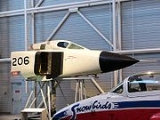
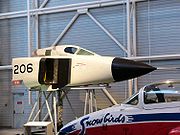
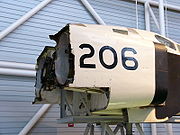
Although nearly everything connected to the CF-105 and Orenda Iroquois programs was destroyed, the cockpit and nose gear of RL-206, the first Mk 2 Arrow, and two outer panels of RL-203's wings were saved and are on display at the Canada Aviation and Space Museum in Ottawa, alongside an Iroquois engine.
With specifications comparable to then-current offerings from American and Soviet design bureaus, at the time of its cancellation, the Arrow was considered by one aviation industry observer to be one of the most advanced aircraft in the world. The Avro Arrow's cancellation eventually led to the end of Avro Aircraft Limited (Canada) and its President and General Manager, Crawford Gordon Jr.
Crawford Gordon
Crawford Gordon Jr. was a leader of wartime defense production in Canada under Minister of Munitions and Supply C.D. Howe during the Second World War. He was perhaps one of the greatest industrialists and business minds in Canadian history.-Early years:Gordon was born in Winnipeg in 1914. He was...
, who was fired shortly afterward. In 1962, the Hawker Siddeley Group formally dissolved A.V. Roe Canada and transferred all A.V. Roe Canada assets to its newly-formed subsidiary, Hawker Siddeley Canada
Hawker Siddeley Canada
Hawker Siddeley Canada was the Canadian unit of the Hawker Siddeley Group of the United Kingdom and manufactured railcars, subway cars, streetcars, aircraft engines and ships from the 1960s to 1980s.-History:...
.
The nosecone section of Avro Arrow RL-206, currently on display at the Canada Aviation and Space Museum in Ottawa, was smuggled out of the Avro Aircraft plant in Malton by members of the RCAF Flying Personnel Medical Establishment, a detachment of RCAF Station Downsview on Avenue Road in Toronto, where it resided for many years and was employed in high-altitude work. The Commanding Officer of the Flying Personnel Medical Establishment, Wing Commander Roy Stubbs, provides this prologue to the former aircraft:
"One day after a change of government, the new RCAF Chief of the Air Staff came to inspect our facilities and programs and after lunch, I asked if he would like to see something special. I showed him a piece of the Arrow; cockpit section and engine nacelles and a few other bits. I asked him what we should do with it and he said to keep it hidden until the climate in Ottawa was right, and then he would arrange to have it placed in the National Aeronautical Museum in Ottawa. Eventually this was done and at least a bit of history was saved."
Mark 1
The Arrow Mark 1 was the initial version powered by two Pratt & Whitney J75 turbojet engines that produced 23500 pound-forces (104.5 kN) of thrust each. The Mk 1 was used for development and flight testing. Five were completed.Mark 2
The Mk 2 version was to be fitted with the Iroquois engine and would be evaluated by RCAF acceptance pilots as well as Avro test pilots. The Astra/Sparrow fire control system had been terminated by the government in September 1958 with all aircraft to employ the Hughes/Falcon combination. At the time of cancellation of the entire program, the first Arrow Mk 2, RL-206, was ready for taxi trials; Avro expected it to break the world speed record, but it never flew.Top speed would have been limited by atmospheric frictional heating, but according to project engineer James Floyd, "[t]he aluminum alloy structure which we favoured was good for speeds greater than a Mach number of 2."
Other designs
Avro Canada had a wide range of advanced Arrow variants under development at the time of project cancellation. Frequent mention is made of an Arrow that could have been capable of Mach 3, similar to the Mikoyan-Gurevich MiG-25Mikoyan-Gurevich MiG-25
The Mikoyan-Gurevich MiG-25 is a supersonic interceptor and reconnaissance aircraft that was among the fastest military aircraft to enter service. Designed by the Soviet Union's Mikoyan-Gurevich bureau the first prototype flew in 1964 with entry into service in 1970...
. This was not the production version, but one of the design studies, and would have been a greatly modified version of the Arrow Mk 2, featuring revised engine inlets and extensive use of stainless steel
Stainless steel
In metallurgy, stainless steel, also known as inox steel or inox from French "inoxydable", is defined as a steel alloy with a minimum of 10.5 or 11% chromium content by mass....
or titanium
Titanium
Titanium is a chemical element with the symbol Ti and atomic number 22. It has a low density and is a strong, lustrous, corrosion-resistant transition metal with a silver color....
to withstand airframe heating.
Avro Arrow replicas
A replica Arrow built by Allan Jackson was used in The ArrowThe Arrow
The Arrow is a four-hour miniseries produced for CBC Television in 1996, starring Dan Aykroyd as Crawford Gordon, experienced wartime production leader during World War II and president of A. V. Roe Canada during its attempt to produce the Avro Arrow supersonic jet interceptor. The film also stars...
, a Canadian Broadcasting Corporation
Canadian Broadcasting Corporation
The Canadian Broadcasting Corporation, commonly known as CBC and officially as CBC/Radio-Canada, is a Canadian crown corporation that serves as the national public radio and television broadcaster...
(CBC) production. He began building a full-scale replica of the Arrow in 1989, and was approached by the producers of the Arrow miniseries in 1996, then about 70% complete, who made an offer to complete the construction if the replica could be used for the production. It was used on the miniseries
Miniseries
A miniseries , in a serial storytelling medium, is a television show production which tells a story in a limited number of episodes. The exact number is open to interpretation; however, they are usually limited to fewer than a whole season. The term "miniseries" is generally a North American term...
and several public appearances at air shows. The replica was later donated to the Reynolds-Alberta Museum
Reynolds-Alberta Museum
The Reynolds-Alberta Museum, in Wetaskiwin, Alberta, Canada, one of 18 provincially owned and operated historic sites and museums, honours the "spirit of the machine"...
in his home town of Wetaskiwin, Alberta
Wetaskiwin, Alberta
Wetaskiwin is a small city in the province of Alberta, Canada. The city is located south of the provincial capital of Edmonton. The city name comes from the Cree word wītaskīwin-ispatinaw , meaning "the hills where peace was made"....
. While in a temporary outdoor collection, it was damaged in a wind storm in 2009. It has since been repaired, but is no longer on public display.
Composite material
Composite materials, often shortened to composites or called composition materials, are engineered or naturally occurring materials made from two or more constituent materials with significantly different physical or chemical properties which remain separate and distinct at the macroscopic or...
s under Canadian Recreational Aircraft legislation, construction involved five years of volunteer labour and half-million dollars in materials and parts. The scale model has been successfully flown on a number of occasions.
The Canadian Air and Space Museum
Canadian Air and Space Museum
The Canadian Air and Space Museum is an aviation museum featuring artifacts, exhibits and stories illustrating a century of Canadian aviation heritage and achievements...
, located at the former CFB Downsview
CFB Downsview
Canadian Forces Base Downsview is a former Canadian Forces base in Toronto, Ontario. The airfield is currently operated as Toronto/Downsview Airport.-RCAF Station Downsview:...
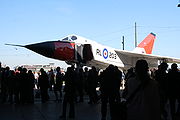
, features a full-size replica Arrow built by volunteers with assistance from local aerospace firms. With a metal structure, the replica features many authentic-looking components including landing gear constructed by Messier-Dowty
Messier-Dowty
Messier-Dowty is a company involved in the design, development, manufacture and customer support of all types of aircraft landing gear. The company projects are divided into two business units: Airbus & European Programs and Boeing & North American Programs....
, the original Arrow primary landing gear sub-contractor. Painted in the colours of Arrow 25203, the Arrow replica was rolled out for a media event on 28 September 2006 and was on public display on 8–9 October 2006 to commemorate the original aircraft's rollout in 1957.
Operators
 Canada
- Royal Canadian Air ForceRoyal Canadian Air ForceThe history of the Royal Canadian Air Force begins in 1920, when the air force was created as the Canadian Air Force . In 1924 the CAF was renamed the Royal Canadian Air Force and granted royal sanction by King George V. The RCAF existed as an independent service until 1968...
– Arrow was cancelled before entering service.
Specifications (Arrow Mk 1)
Notable appearances in media
In 1997, the CBC broadcast their two-part miniseries, The Arrow. The production used a combination of archival film, remote-control flying models and computer animation for the static, ground and flying sequences. Although highly acclaimed, receiving praise from film historian and former Avro employee Elwy Yost and winner of numerous awards including the GeminiGemini Award
The Gemini Awards are annual television broadcasting industry awards in Canada.First awarded in 1986, the Geminis celebrate the achievements of TV members of the Academy of Canadian Cinema & Television. Essentially, it presents awards for the best television productions in Canada. Awards are...
that year, the miniseries was also criticized for its "docu-drama" style and departing from a strict factual account. The continued rebroadcasts and accompanying DVD releases have served to re-animate the controversy over the Arrow's cancellation and introduce the story to a new generation.
See also
External links
- Aerospace Heritage Foundation of Canada
- Arrow Digital Archives
- Avro Arrow Historica Minute
- Avro Arrow Home Page, the longest running Avro Arrow page
- Canada Aviation and Space Museum, remains of the RL-206 Avro Arrow and other components on display
- Canadian Air and Space Museum, home of an Avro Arrow replica
- CBC Digital Archives: The Avro Arrow, Canada's Broken Dream
- "The Great Arrow Debate" editorial on canavbooks.com