

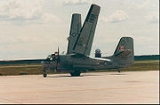
S-2 Tracker

Encyclopedia
The Grumman S-2 Tracker (previously S2F prior to 1962) was the first purpose-built, single airframe anti-submarine warfare
(ASW) aircraft
to enter service with the US Navy. The Tracker was of conventional design with twin engines, a high wing and tricycle undercarriage. The type was exported to a number of navies around the world. Introduced in 1952 the Tracker saw service in the USN until the mid-1970s with a few aircraft remaining in service with other air arms into the 21st century.
with twin Wright Cyclone
R-1820 nine cylinder radial engine
s, a yoke type arrestor hook and a crew of four. Both the two prototypes XS2F-1 and 15 production aircraft, S2F-1 were ordered at the same time, on 30 June 1950. The first flight was conducted on 4 December 1952, and production aircraft entered service with VS-26, in February 1954.
Follow-on versions included the WF Tracer and TF Trader, which became the Grumman E-1 Tracer and Grumman C-1 Trader in the tri-service designation standardization of 1962. The S-2 carried the nickname "Stoof" (S-two-F) throughout its military career; and the E-1 Tracer variant with the large overhead radome was colloquially called the "stoof with a roof.".
Grumman produced 1,185 Trackers. Another 99 aircraft carrying the CS2F designation were manufactured in Canada
under license by de Havilland Canada
. U.S.-built versions of the Tracker were sold to various nations, including Australia
, Japan
, Turkey
and Taiwan
.
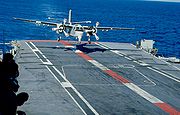
,_january_1963,_s-2_tracker_on_cat.jpg) The Tracker was eventually superseded for U.S. military use by the Lockheed S-3 Viking, the last USN Tracker squadron (VS-37 with S-2G models) was disestablished in 1976. The last Navy S-2 was withdrawn from service on 29 August 1976. A number live on as firefighting aircraft
The Tracker was eventually superseded for U.S. military use by the Lockheed S-3 Viking, the last USN Tracker squadron (VS-37 with S-2G models) was disestablished in 1976. The last Navy S-2 was withdrawn from service on 29 August 1976. A number live on as firefighting aircraft
, however. Trackers continued to provide excellent service with the naval forces of other countries for years after the U.S. discontinued them. For example, the Royal Australian Navy continued to use Trackers as front line ASW assets until the mid 1980s.
 The Argentine Naval Aviation
received seven S-2A in 1962, six S-2E in 1978 and three S-2G in 1990s. They were used from both aircraft carriers, the ARA Independencia and the ARA 25 de Mayo
and used in the COD
(US-2A conversions ), Maritime Patrol and ASW roles. They were extensively used in the 1982 Falklands War
, first from the 25 de Mayo, from where they detected the British Task Force and then from the mainland when the carrier returned to port after the sinking of the ARA General Belgrano
cruiser. In the 1990s, six remaining airframes where refurbished by Israel Aerospace Industries with turboprop
engines as S-2T Turbo Trackers. As of 2010, with the retirement of Argentina's only aircraft carrier, the Trackers are annually deployed on board Brazilian Navy
NAe São Paulo during joint exercises ARAEX and TEMPEREX and with US Navy's aircraft carriers during Gringo-Gaucho
maneuvers.
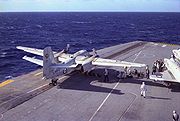 Between 1967 and 1984 the Royal Australian Navy
operated two Squadrons of S-2E and S-2G variants, based at NAS
Nowra (HMAS Albatross
). These were VS-816
front line squadron, which embarked in the Majestic class aircraft carrier
, as part of the 21st Carrier Air Group whenever that ship was deployed; and VC-851
training squadron.
During approximately 17 years of operation of the Tracker, the RAN lost only one S-2 during aircraft operations due to an accident at sea on 10 February 1975. However, on 4 December 1976 a deliberately lit fire in a hangar at Nowra destroyed or badly damaged a large proportion of the RAN's complement of Trackers. These were subsequently replaced with ex-USN aircraft. The replacement aircraft were all S-2Gs, including the original aircraft modified by the USN to that status. This saw the introduction of AQA-7 acoustic gear into RAN service and all RAN operational Trackers were subsequently modified to this standard.
. Both S-2A and S-2E were used (respectively as P-16A and P-16E) at the end of its service in Brazilian Air Force, one S-2T was used as a possible upgrade, but due the high costs it was canceled.
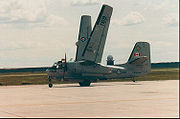 In 1954, de Havilland Canada
entered into a contract to build Trackers under license to replace the outmoded TBM-3E Avengers
being used by the Royal Canadian Navy
. A total of 99 Canadian-built Trackers would enter service starting in 1956. From 1957 onwards, these aircraft operated from the newly-deployed aircraft carrier HMCS Bonaventure and various shore bases. All the Canadian Trackers were built to the earlier "A" model airframe design with a length of 42 feet (12.80 m) (c.f. 43' 6" for later model Trackers) in order to fit in the Bonnies hangar. In 1960, 17 active duty CS2F-1 aircraft were transferred to the Royal Netherlands Navy
. In 1964, a pair of CS2F-1 aircraft were stripped of armament and ASW electronics, converted to transports, and subsequently used for carrier onboard delivery
. The CS2F-1, -2, and -3 were redesignated as the CP-121 Mk.1, Mk. 2, and Mk. 3 respectively following the unification of Canadian forces
in 1968.
After Bonaventure was decommissioned in 1970, all remaining Canadian Trackers were transferred to shore bases. This limited their usefulness for ASW patrols, and between 1974 and 1981, all but 20 were gradually placed in storage and the remainder were stripped of their ASW gear. The remaining active-duty Trackers served until 1990 doing fisheries protection and maritime patrol duties. A handful of Trackers were kept in flying condition until the late 1990s but were no longer used for active service.
A single Grumman-built S2F-1, serial number X-500, was sold to the RCN before Canadian production commenced. It was initially used for quality control purposes during Canadian production, and was later given a new RCN serial number, upgraded to CS2F-1 standards, and used to train RCN ground and maintenance personnel. This aircraft was placed in storage in 1972 and was undergoing restoration in March 2008.
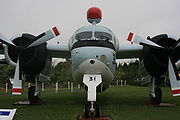 The Japan Maritime Self-Defense Force
received 50 S2F-1 in 1957 from US, and operated until 1984. After being received, six S2F-1 were reconfigured into four S2F-U and two S2F-C variants. The S2F-1 is nicknamed Aotaka(あおたか, Blue Hawk).
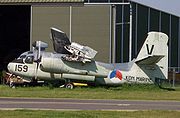 The Royal Netherlands Navy
, (Netherlands Naval Aviation Service) received in 1960 17 CS2F-1 aircraft formerly used by the Royal Canadian Navy
. These aircraft were operated from land bases as well as from the light carrier Karel Doorman
until a fire in 1968 took that ship out of Dutch service.
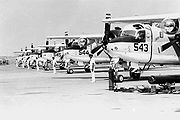 The Peruvian Navy
operated with S-2E and S-2G from 1975 until 1989, they were assigned to Naval Aviation Squadron N°12 (Escuadron Aeronaval N°12). A total of 12 S-2Es were bought from the US Navy in 1975 and 4 S-2G in 1983.
The conversion involved: two Garrett/Honeywell TPE-331-15AW turboprop engines, each rated at 1,227 kW (1,645 shp), with four-blade propellers. The upgrade also included new mission equipment of AN/AQS-92F digital sonobuoy processor, A/NARR-84 99-channel sonobuoy receiver, Litton AN/APS-504 radar, AN/ASQ-504 MAD and AN/AAS-40 FLIR. The new turboprop engines resulted in a payload increase of 500 kg. Usually carries depth charges, Mk. 44, and Mk 46 lightweight ASW homing torpedoes.
received a number of S-2A Trackers under the MAP program and operated them from the Cengiz Topel Naval Air Base starting in the 1960s. These were later retired and replaced with S-2Es, which remained in service until 1994. Turkish Trackers were retired after a series of accidents caused by the advanced age and fatigue of the airframes.
, British Columbia
, Canada
took possession of retired U.S. and Canadian Trackers and converted them into Firecats, with a retardant tank replacing the torpedo bay. The Firecats were made in two variants, a piston engine Firecat and a turboprop-powered Turbo Firecat.
YS2F-1
S2F-1
S2F-1T
S2F-1U
S2F-1S
S2F-1S1
S2F-2
S2F-2P
S2F-2U
S2F-3
S2F-3S
YS-2A
S-2A
TS-2A
US-2A
S-2B
US-2B
S-2C
RS-2C
US-2C
S-2D
YAS-2D/AS-2D
ES-2D
US-2S
S-2E
S-2F
US-2F
S-2G
CS2F-1
CS2F-2
CS2F-3
CP-121
Military S-2T Turbo Tracker For Argentina
Military S-2T Turbo Tracker For Taiwan
S-2T Turbo Tracker
S-2AT
S-2ET
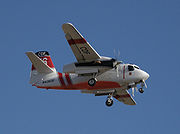
Marsh S-2F3AT Turbo Tracker
Conair Firecat
or Turbo Firecat
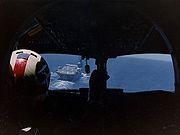

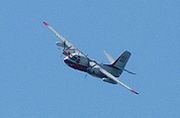 Many retired Trackers were sold to private owners for fire-fighting duties. Some were rebuilt and re-engined with turboprop engines.
:
:
:
:

Anti-submarine warfare
Anti-submarine warfare is a branch of naval warfare that uses surface warships, aircraft, or other submarines to find, track and deter, damage or destroy enemy submarines....
(ASW) aircraft
Aircraft
An aircraft is a vehicle that is able to fly by gaining support from the air, or, in general, the atmosphere of a planet. An aircraft counters the force of gravity by using either static lift or by using the dynamic lift of an airfoil, or in a few cases the downward thrust from jet engines.Although...
to enter service with the US Navy. The Tracker was of conventional design with twin engines, a high wing and tricycle undercarriage. The type was exported to a number of navies around the world. Introduced in 1952 the Tracker saw service in the USN until the mid-1970s with a few aircraft remaining in service with other air arms into the 21st century.
Design and development
Intended as a replacement for its predecessor, Grumman's AF-2 Guardian which was the first purpose-built aircraft system for ASW, using two airframes, one with the detection gear, and the other with the weapon systems, the Tracker combined both functions in one aircraft. Grumman's design (model G-89) was for a large high-wing monoplaneMonoplane
A monoplane is a fixed-wing aircraft with one main set of wing surfaces, in contrast to a biplane or triplane. Since the late 1930s it has been the most common form for a fixed wing aircraft.-Types of monoplane:...
with twin Wright Cyclone
Wright Cyclone
Wright Cyclone was the name given to a family of air-cooled radial piston engines designed by Curtiss-Wright and used in numerous American aircraft in the 1930s and 1940s.-Background:...
R-1820 nine cylinder radial engine
Radial engine
The radial engine is a reciprocating type internal combustion engine configuration in which the cylinders point outward from a central crankshaft like the spokes on a wheel...
s, a yoke type arrestor hook and a crew of four. Both the two prototypes XS2F-1 and 15 production aircraft, S2F-1 were ordered at the same time, on 30 June 1950. The first flight was conducted on 4 December 1952, and production aircraft entered service with VS-26, in February 1954.
Follow-on versions included the WF Tracer and TF Trader, which became the Grumman E-1 Tracer and Grumman C-1 Trader in the tri-service designation standardization of 1962. The S-2 carried the nickname "Stoof" (S-two-F) throughout its military career; and the E-1 Tracer variant with the large overhead radome was colloquially called the "stoof with a roof.".
Grumman produced 1,185 Trackers. Another 99 aircraft carrying the CS2F designation were manufactured in Canada
Canada
Canada is a North American country consisting of ten provinces and three territories. Located in the northern part of the continent, it extends from the Atlantic Ocean in the east to the Pacific Ocean in the west, and northward into the Arctic Ocean...
under license by de Havilland Canada
De Havilland Canada
The de Havilland Aircraft of Canada Ltd. company was an aircraft manufacturer with facilities based in what is now the Downsview area of Toronto, Ontario, Canada...
. U.S.-built versions of the Tracker were sold to various nations, including Australia
Australia
Australia , officially the Commonwealth of Australia, is a country in the Southern Hemisphere comprising the mainland of the Australian continent, the island of Tasmania, and numerous smaller islands in the Indian and Pacific Oceans. It is the world's sixth-largest country by total area...
, Japan
Japan
Japan is an island nation in East Asia. Located in the Pacific Ocean, it lies to the east of the Sea of Japan, China, North Korea, South Korea and Russia, stretching from the Sea of Okhotsk in the north to the East China Sea and Taiwan in the south...
, Turkey
Turkey
Turkey , known officially as the Republic of Turkey , is a Eurasian country located in Western Asia and in East Thrace in Southeastern Europe...
and Taiwan
Republic of China
The Republic of China , commonly known as Taiwan , is a unitary sovereign state located in East Asia. Originally based in mainland China, the Republic of China currently governs the island of Taiwan , which forms over 99% of its current territory, as well as Penghu, Kinmen, Matsu and other minor...
.
Sensors and armament
The Tracker carried an internal torpedo bay capable of carrying two light weight torpedoes or one nuclear depth charge. There were six underwing hard points for rocket pods and conventional depth charges or up to four additional torpedoes. A ventrally mounted retractable radome and a Magnetic Anomaly Detector (MAD) mounted on an extendable rear mounted boom were also fitted. Early model Trackers had an Electronic Surveillance Measures (ESM) pod mounted dorsally just aft of the front seat overhead hatches and were also fitted with a smoke particle detector or sniffer. Later S-2s had the sniffer removed and had the ESM antennae moved to four rounded extensions on the wingtips. The engine nacelles carried JEZEBEL sonobouys in the rear (16 in early marks, 32 in the S-2E/G). Early Trackers also carried 60 explosive charges dispensed ventrally from the rear of the fuselage used for active sonar (JULIE) with the AN/AQA-3 and later AQA-4 detection sets, whereas the introduction of active sonobouys and AN/AQA-7 with the S2-G conversion saw these removed. Smoke dispensers were mounted on the port ventral surface of the nacelles in groups of three each.Operational history
Aerial firefighting
Aerial firefighting is the use of aircraft and other aerial resources to combat wildfires. The types of aircraft used include fixed-wing aircraft and helicopters. Smokejumpers and rappellers are also classified as aerial firefighters, delivered to the fire by parachute from a variety of fixed-wing...
, however. Trackers continued to provide excellent service with the naval forces of other countries for years after the U.S. discontinued them. For example, the Royal Australian Navy continued to use Trackers as front line ASW assets until the mid 1980s.
Argentina
Argentine Naval Aviation
The Argentine Naval Aviation is the naval aviation branch of the Argentine Navy and one of its four operational commands...
received seven S-2A in 1962, six S-2E in 1978 and three S-2G in 1990s. They were used from both aircraft carriers, the ARA Independencia and the ARA 25 de Mayo
ARA Veinticinco de Mayo (V-2)
The ARA Veinticinco de Mayo was an aircraft carrier in the Argentine Navy from 1969 to 1997. The English translation of the name is the Twenty-fifth of May, which is the date of Argentina's May Revolution in 1810....
and used in the COD
Carrier onboard delivery
Carrier Onboard Delivery is a military term used to describe type of aircraft which are able to ferry personnel, mail, and high-priority cargo on and off a naval ship .-History:...
(US-2A conversions ), Maritime Patrol and ASW roles. They were extensively used in the 1982 Falklands War
Falklands War
The Falklands War , also called the Falklands Conflict or Falklands Crisis, was fought in 1982 between Argentina and the United Kingdom over the disputed Falkland Islands and South Georgia and the South Sandwich Islands...
, first from the 25 de Mayo, from where they detected the British Task Force and then from the mainland when the carrier returned to port after the sinking of the ARA General Belgrano
ARA General Belgrano
The ARA General Belgrano was an Argentine Navy light cruiser in service from 1951 until 1982. Formerly the , she saw action in the Pacific theater of World War II before being sold to Argentina. After almost 31 years of service, she was sunk during the Falklands War by the Royal Navy submarine ...
cruiser. In the 1990s, six remaining airframes where refurbished by Israel Aerospace Industries with turboprop
Turboprop
A turboprop engine is a type of turbine engine which drives an aircraft propeller using a reduction gear.The gas turbine is designed specifically for this application, with almost all of its output being used to drive the propeller...
engines as S-2T Turbo Trackers. As of 2010, with the retirement of Argentina's only aircraft carrier, the Trackers are annually deployed on board Brazilian Navy
Brazilian Navy
The Brazilian Navy is a branch of the Brazilian Armed Forces responsible for conducting naval operations. It is the largest navy in Latin America...
NAe São Paulo during joint exercises ARAEX and TEMPEREX and with US Navy's aircraft carriers during Gringo-Gaucho
Gringo-Gaucho
Gringo-Gaucho are a set of maneuvers performed between the Argentine Naval Aviation and United States Navy's aircraft carriers. The US Navy refers to them as Southern Seas in their last edition.-History:...
maneuvers.
Australia
Royal Australian Navy
The Royal Australian Navy is the naval branch of the Australian Defence Force. Following the Federation of Australia in 1901, the ships and resources of the separate colonial navies were integrated into a national force: the Commonwealth Naval Forces...
operated two Squadrons of S-2E and S-2G variants, based at NAS
Naval Air Station
A Naval Air Station is a military airbase, and consists of a permanent land-based operations locations for the military aviation division of the relevant branch of their Navy...
Nowra (HMAS Albatross
HMAS Albatross (air station)
HMAS Albatross, also known as Naval Air Station Nowra , is an airfield operated by the Royal Australian Navy , in support of the RAN's aviation branch, the Fleet Air Arm...
). These were VS-816
816 Squadron RAN
816 Squadron is a Royal Australian Navy Fleet Air Arm squadron that started out as a Royal Navy unit 816 Naval Air Squadron.-Current roles:816 is currently active as a helicopter squadron equipped with S-70B-2 Seahawk helicopters...
front line squadron, which embarked in the Majestic class aircraft carrier
Aircraft carrier
An aircraft carrier is a warship designed with a primary mission of deploying and recovering aircraft, acting as a seagoing airbase. Aircraft carriers thus allow a naval force to project air power worldwide without having to depend on local bases for staging aircraft operations...
, as part of the 21st Carrier Air Group whenever that ship was deployed; and VC-851
851 Squadron RAN
-History:851 Squadron was formed at HMAS Albatross as a land-based training and fleet support squadron on 3 August 1954. While the squadron was disbanded on 13 January 1958 it was re-formed as a training and transport unit on 2 September 1968...
training squadron.
During approximately 17 years of operation of the Tracker, the RAN lost only one S-2 during aircraft operations due to an accident at sea on 10 February 1975. However, on 4 December 1976 a deliberately lit fire in a hangar at Nowra destroyed or badly damaged a large proportion of the RAN's complement of Trackers. These were subsequently replaced with ex-USN aircraft. The replacement aircraft were all S-2Gs, including the original aircraft modified by the USN to that status. This saw the introduction of AQA-7 acoustic gear into RAN service and all RAN operational Trackers were subsequently modified to this standard.
Brazil
The Brazilian Air Force used Trackers. They operated from the aircraft carrier NAeL Minas GeraisNAeL Minas Gerais
NAeL Minas Gerais was a operated by the Marinha do Brasil from 1960 until 2001. The ship was laid down for the Royal Navy during World War II as , but was completed only shortly before the war's end, and did not see service...
. Both S-2A and S-2E were used (respectively as P-16A and P-16E) at the end of its service in Brazilian Air Force, one S-2T was used as a possible upgrade, but due the high costs it was canceled.
Canada
De Havilland Canada
The de Havilland Aircraft of Canada Ltd. company was an aircraft manufacturer with facilities based in what is now the Downsview area of Toronto, Ontario, Canada...
entered into a contract to build Trackers under license to replace the outmoded TBM-3E Avengers
TBF Avenger
The Grumman TBF Avenger was a torpedo bomber developed initially for the United States Navy and Marine Corps, and eventually used by several air or naval arms around the world....
being used by the Royal Canadian Navy
Royal Canadian Navy
The history of the Royal Canadian Navy goes back to 1910, when the naval force was created as the Naval Service of Canada and renamed a year later by King George V. The Royal Canadian Navy is one of the three environmental commands of the Canadian Forces...
. A total of 99 Canadian-built Trackers would enter service starting in 1956. From 1957 onwards, these aircraft operated from the newly-deployed aircraft carrier HMCS Bonaventure and various shore bases. All the Canadian Trackers were built to the earlier "A" model airframe design with a length of 42 feet (12.80 m) (c.f. 43' 6" for later model Trackers) in order to fit in the Bonnies hangar. In 1960, 17 active duty CS2F-1 aircraft were transferred to the Royal Netherlands Navy
Royal Netherlands Navy
The Koninklijke Marine is the navy of the Netherlands. In the mid-17th century the Dutch Navy was the most powerful navy in the world and it played an active role in the wars of the Dutch Republic and later those of the Batavian Republic and the Kingdom of the Netherlands...
. In 1964, a pair of CS2F-1 aircraft were stripped of armament and ASW electronics, converted to transports, and subsequently used for carrier onboard delivery
Carrier onboard delivery
Carrier Onboard Delivery is a military term used to describe type of aircraft which are able to ferry personnel, mail, and high-priority cargo on and off a naval ship .-History:...
. The CS2F-1, -2, and -3 were redesignated as the CP-121 Mk.1, Mk. 2, and Mk. 3 respectively following the unification of Canadian forces
Canadian Forces
The Canadian Forces , officially the Canadian Armed Forces , are the unified armed forces of Canada, as constituted by the National Defence Act, which states: "The Canadian Forces are the armed forces of Her Majesty raised by Canada and consist of one Service called the Canadian Armed Forces."...
in 1968.
After Bonaventure was decommissioned in 1970, all remaining Canadian Trackers were transferred to shore bases. This limited their usefulness for ASW patrols, and between 1974 and 1981, all but 20 were gradually placed in storage and the remainder were stripped of their ASW gear. The remaining active-duty Trackers served until 1990 doing fisheries protection and maritime patrol duties. A handful of Trackers were kept in flying condition until the late 1990s but were no longer used for active service.
A single Grumman-built S2F-1, serial number X-500, was sold to the RCN before Canadian production commenced. It was initially used for quality control purposes during Canadian production, and was later given a new RCN serial number, upgraded to CS2F-1 standards, and used to train RCN ground and maintenance personnel. This aircraft was placed in storage in 1972 and was undergoing restoration in March 2008.
Japan
Japan Maritime Self-Defense Force
The , or JMSDF, is the naval branch of the Japan Self-Defense Forces, tasked with the naval defense of Japan. It was formed following the dissolution of the Imperial Japanese Navy after World War II....
received 50 S2F-1 in 1957 from US, and operated until 1984. After being received, six S2F-1 were reconfigured into four S2F-U and two S2F-C variants. The S2F-1 is nicknamed Aotaka(あおたか, Blue Hawk).
Netherlands
Royal Netherlands Navy
The Koninklijke Marine is the navy of the Netherlands. In the mid-17th century the Dutch Navy was the most powerful navy in the world and it played an active role in the wars of the Dutch Republic and later those of the Batavian Republic and the Kingdom of the Netherlands...
, (Netherlands Naval Aviation Service) received in 1960 17 CS2F-1 aircraft formerly used by the Royal Canadian Navy
Royal Canadian Navy
The history of the Royal Canadian Navy goes back to 1910, when the naval force was created as the Naval Service of Canada and renamed a year later by King George V. The Royal Canadian Navy is one of the three environmental commands of the Canadian Forces...
. These aircraft were operated from land bases as well as from the light carrier Karel Doorman
HNLMS Karel Doorman (R81)
HNLMS Karel Doorman was a Colossus-class aircraft carrier of the Royal Netherlands Navy. The ship was the British HMS Venerable before she was sold in 1948 to the Netherlands as a light attack carrier. In 1960 she was involved in the decolonization conflict in Western New Guinea with Indonesia...
until a fire in 1968 took that ship out of Dutch service.
Peru
Peruvian Navy
The Peruvian Navy is the branch of the Peruvian Armed Forces tasked with surveillance, patrol and defense on lakes, rivers and the Pacific Ocean up to 200 nautical miles from the Peruvian littoral...
operated with S-2E and S-2G from 1975 until 1989, they were assigned to Naval Aviation Squadron N°12 (Escuadron Aeronaval N°12). A total of 12 S-2Es were bought from the US Navy in 1975 and 4 S-2G in 1983.
Taiwan
Grumman received a contract for the conversion of 32 S-2T Trackers (from 25 S-2Es and 7 S-2Gs) in service with the Republic of China Air Force in late 1980s. Only 27 were ultimately converted due to a shortage of parts supplied by Grumman resulting in the use of remaining conversion kits as spare parts. The 27 S-2Ts were transferred to the ROC Navy Aviation Command on 1 July 1999 and while the ROCN continues to operate the type, less than half of the fleet is in operational condition, will be replaced by 12 rebuilt P-3C from US Navy.The conversion involved: two Garrett/Honeywell TPE-331-15AW turboprop engines, each rated at 1,227 kW (1,645 shp), with four-blade propellers. The upgrade also included new mission equipment of AN/AQS-92F digital sonobuoy processor, A/NARR-84 99-channel sonobuoy receiver, Litton AN/APS-504 radar, AN/ASQ-504 MAD and AN/AAS-40 FLIR. The new turboprop engines resulted in a payload increase of 500 kg. Usually carries depth charges, Mk. 44, and Mk 46 lightweight ASW homing torpedoes.
Turkey
The Turkish NavyTurkish Navy
The Turkish Navy is the naval warfare service branch of the Turkish Armed Forces.- Ottoman fleet after Mudros :Following the demise of the Ottoman Empire in the aftermath of World War I, on November 3, 1918, the fleet commander of the Ottoman Navy, Liva Amiral Arif Pasha, ordered all flags to be...
received a number of S-2A Trackers under the MAP program and operated them from the Cengiz Topel Naval Air Base starting in the 1960s. These were later retired and replaced with S-2Es, which remained in service until 1994. Turkish Trackers were retired after a series of accidents caused by the advanced age and fatigue of the airframes.
Uruguay
The Uruguayan Navy received the first three S-2A Trackers on 10 April 1965 at the Capitan Curbelo Navy Base. On 15 September 1982, one S-2G arrived. On 2 February 1983, another two S-2Gs arrived. By September 2004, the remaining Uruguayan Trackers were not in flight condition.Civilian use
In the late 1980s and early '90s Conair Aviation of AbbotsfordAbbotsford, British Columbia
Abbotsford is a Canadian city located in the Lower Mainland of British Columbia, adjacent to Greater Vancouver. It is the fifth largest municipality in British Columbia, home to 123,864 people . Its Census Metropolitan Area, which includes the District of Mission, is the 23rd largest in Canada,...
, British Columbia
British Columbia
British Columbia is the westernmost of Canada's provinces and is known for its natural beauty, as reflected in its Latin motto, Splendor sine occasu . Its name was chosen by Queen Victoria in 1858...
, Canada
Canada
Canada is a North American country consisting of ten provinces and three territories. Located in the northern part of the continent, it extends from the Atlantic Ocean in the east to the Pacific Ocean in the west, and northward into the Arctic Ocean...
took possession of retired U.S. and Canadian Trackers and converted them into Firecats, with a retardant tank replacing the torpedo bay. The Firecats were made in two variants, a piston engine Firecat and a turboprop-powered Turbo Firecat.
Variants
XS2F-1- Two prototype anti-submarine warfare aircraft powered by 1,450 hp R-1820-76WA engines.
YS2F-1
- Designation of the first 15 production aircraft used for development, redesignated YS-2A in 1962.
S2F-1
- Initial production variant with two 1,525 hp R-1820-82WA engines, re-designated S-2A in 1962, 740 built.
S2F-1T
- Trainer conversion of S2F-1, redesignated TS-2A in 1962.
S2F-1U
- Utility conversion of S2F-1, redesignated US-2A in 1962.
S2F-1S
- S2F-1 conversion with Julie/Jezebel detection equipment, redesignated S-2B in 1962. Survivors converted to US-2B after removal of ASW gear.
S2F-1S1
- S2F-1S fitted with updated Julie/Jezebel equipment, redesignated S-2F in 1962.
S2F-2
- As S2F-1 with asymmetrical (port-side) extension of bomb bay, slightly enlarged tail surfaces, 77 built, most redesignated S-2C in 1962.
S2F-2P
- Photo reconnaissance conversion of S2F-2, redesignated RS-2C in 1962.
S2F-2U
- Utility conversion of S2F-2/S-2C, redesignated US-2C in 1962. Some were used as target tugs.
S2F-3
- Enlarged forward fuselage, enlarged tail surfaces, additional fuel capacity, and enlarged engine nacelles bays for 32 sonobouoys, redesignated S-2D in 1962, 100 built.
S2F-3S
- As S2F-3 but with Julie/Jezebel equipment, redesignated S-2E in 1962, 252 built.
YS-2A
- YS2F-1 redesignated in 1962.
S-2A
- S2F-1 redesignated in 1962.
TS-2A
- S2F-1T training version redesignated in 1962 and 207 conversion from S-2A.
US-2A
- S-2A converted as light transports/target tugs, 51 conversions.
S-2B
- S2F-1S redesignated in 1962.
US-2B
- Utility and target tug conversions of S-2A and S-2B; most S-2Bs were converted and 66 S-2As.
S-2C
- S2F-2 redesignated in 1962.
RS-2C
- S2F-2P photo-reconnaissance version redesignated in 1962.
US-2C
- S2F-2U utility version redesignated in 1962.
S-2D
- S2F-3 redesignated in 1962.
YAS-2D/AS-2D
- Proposed self-contained night attack aircraft to be developed under Operation Shed Light; none produced.
ES-2D
- Electronic trainer conversion of the S-2D.
US-2S
- Utility conversion of the S-2D.
S-2E
- S2F-3S redesignated in 1962.
S-2F
- S2F-1S1 redesignated in 1962.
US-2F
- Transport conversion of S-2F.
S-2G
- S-2E conversions with updated electronics (primarily AN/AQA-7 DIFAR sonobuoy processor and AN/ARR-75 sonobuoy receiver)
CS2F-1
- Initial production run of anti-submarine warfare aircraft for CanadaCanadaCanada is a North American country consisting of ten provinces and three territories. Located in the northern part of the continent, it extends from the Atlantic Ocean in the east to the Pacific Ocean in the west, and northward into the Arctic Ocean...
based on S2F-1. A total of 42 built by De Havilland CanadaDe Havilland CanadaThe de Havilland Aircraft of Canada Ltd. company was an aircraft manufacturer with facilities based in what is now the Downsview area of Toronto, Ontario, Canada...
.
CS2F-2
- Improved version of CS2F-1 with Litton IndustriesLitton IndustriesNamed after inventor Charles Litton, Sr., Litton Industries was a large defense contractor in the United States, bought by the Northrop Grumman Corporation in 2001.-History:...
tactical navigation equipment. A total of 57 were built by De Havilland Canada.
CS2F-3
- New designation given to 43 CS2F-2 aircraft upgraded with additional electronics.
CP-121
- New designation given to all CS2F-1, -2, and -3 aircraft following unification of Canadian militaryCanadian ForcesThe Canadian Forces , officially the Canadian Armed Forces , are the unified armed forces of Canada, as constituted by the National Defence Act, which states: "The Canadian Forces are the armed forces of Her Majesty raised by Canada and consist of one Service called the Canadian Armed Forces."...
in 1968.
Military S-2T Turbo Tracker For Argentina
- 6 upgraded S-2E turboprop engines conversion by IAI in 1990s for the Argentine Navy.
Military S-2T Turbo Tracker For Taiwan
- 27 out of 32 upgraded S-2E and S-2G turboprop engines conversion by Northrop Grumman in 1990s for then Taiwan/ROC Air Force, now operates by Taiwan/ROC Navy aviation.
S-2T Turbo Tracker
- Civil conversion
S-2AT
- Civil firefighter conversion.
S-2ET
- Civil conversion.
Marsh S-2F3AT Turbo Tracker
- Turboprop conversion, powered by two Garrett TPE331 engines; A total of 22 are operated by the CDFCalifornia Department of Forestry and Fire ProtectionThe California Department of Forestry and Fire Protection is the State of California's agency responsible for fire protection in State Responsibility Areas of California as well as the administration of the state's private and public forests. It is often referred to as The California Department of...
.
Conair Firecat
Conair Firecat
-References:* -External links:*...
or Turbo Firecat
- Civil conversion as a single-seat firefighting aircraft.
- For the crew trainer/transport version based on the Tracker refer to Grumman C-1 Trader
- For the Airborne Early Warning version based on the Trader refer to Grumman E-1 Tracer
Military operators
- Argentine Naval AviationArgentine Naval AviationThe Argentine Naval Aviation is the naval aviation branch of the Argentine Navy and one of its four operational commands...
- Royal Australian NavyRoyal Australian NavyThe Royal Australian Navy is the naval branch of the Australian Defence Force. Following the Federation of Australia in 1901, the ships and resources of the separate colonial navies were integrated into a national force: the Commonwealth Naval Forces...
- Brazilian Air ForceBrazilian Air ForceThe Brazilian Air Force is the air branch of the Brazilian Armed Forces and one of the three national uniformed services. The FAB was formed when the Army and Navy air branch were merged into a single military force initially called "National Air Forces"...
- Royal Canadian NavyRoyal Canadian NavyThe history of the Royal Canadian Navy goes back to 1910, when the naval force was created as the Naval Service of Canada and renamed a year later by King George V. The Royal Canadian Navy is one of the three environmental commands of the Canadian Forces...
- Canadian ForcesCanadian ForcesThe Canadian Forces , officially the Canadian Armed Forces , are the unified armed forces of Canada, as constituted by the National Defence Act, which states: "The Canadian Forces are the armed forces of Her Majesty raised by Canada and consist of one Service called the Canadian Armed Forces."...
- Italian Air ForceItalian Air ForceThe Italian Air Force has gone under different names in different periods:*Regia Aeronautica , from 1923 to June 1946*Aeronautica Nazionale Repubblicana, the air force of Italian Social Republic during World War II...
- Japan Maritime Self-Defense ForceJapan Maritime Self-Defense ForceThe , or JMSDF, is the naval branch of the Japan Self-Defense Forces, tasked with the naval defense of Japan. It was formed following the dissolution of the Imperial Japanese Navy after World War II....
- Republic of Korea NavyRepublic of Korea NavyThe Republic of Korea Navy or the ROK Navy is the branch of the South Korean armed forces responsible for conducting naval operations and amphibious landing operations. The ROK Navy includes the Republic of Korea Marine Corps, which is a quasi-autonomous organization...
- Royal Netherlands NavyRoyal Netherlands NavyThe Koninklijke Marine is the navy of the Netherlands. In the mid-17th century the Dutch Navy was the most powerful navy in the world and it played an active role in the wars of the Dutch Republic and later those of the Batavian Republic and the Kingdom of the Netherlands...
- Peruvian NavyPeruvian NavyThe Peruvian Navy is the branch of the Peruvian Armed Forces tasked with surveillance, patrol and defense on lakes, rivers and the Pacific Ocean up to 200 nautical miles from the Peruvian littoral...
- Republic of China NavyRepublic of China NavyThe Republic of China Navy is the maritime branch of the Armed forces of the Republic of China . The ROC Navy's primary mission is to defend ROC territories and the sea lanes that surround Taiwan against a blockade, attack, or possible invasion by forces of the People's Republic of China...
Taiwan currently operates 26 S-2T, not all operational (upgrade from S-2E and S-2G, will be replaced by 12 rebuilt P-3C Orions from US Navy).
- Air Division of the Royal Thai NavyRoyal Thai NavyThe Royal Thai Navy is the navy of Thailand and part of the Royal Thai Armed Forces, it was established in the late 19th century. Admiral Prince Abhakara Kiartiwongse is "The Father of Royal Thai Navy". Similar to the organizational structure of the United States, the Royal Thai Navy includes the...
- Turkish Navy Aerial WingTurkish NavyThe Turkish Navy is the naval warfare service branch of the Turkish Armed Forces.- Ottoman fleet after Mudros :Following the demise of the Ottoman Empire in the aftermath of World War I, on November 3, 1918, the fleet commander of the Ottoman Navy, Liva Amiral Arif Pasha, ordered all flags to be...
- United States NavyUnited States NavyThe United States Navy is the naval warfare service branch of the United States Armed Forces and one of the seven uniformed services of the United States. The U.S. Navy is the largest in the world; its battle fleet tonnage is greater than that of the next 13 largest navies combined. The U.S...
operated their Trackers between 1954 and 1976. - United States Marine CorpsUnited States Marine CorpsThe United States Marine Corps is a branch of the United States Armed Forces responsible for providing power projection from the sea, using the mobility of the United States Navy to deliver combined-arms task forces rapidly. It is one of seven uniformed services of the United States...
operated some Trackers.
- Uruguayan Navy
- Venezuelan NavyNavy of VenezuelaThe navy of Venezuela is officially called the Bolivarian National Armada of Venezuela .It serves the purpose of defending the naval sovereignty of the country, including inland, fluvial security, it also serves to prevent illegal activities in the Venezuelan borders and contributes with...
Civil operators
:
- Conair Group Inc. received TS-2A/Conair Firecat (G-89).
- Saskatchewan Environment received TS-2A/Conair Firecat (G-89).
- Ontario Ministry of Natural Resources 7 CS2F-1; ex-Canadian ForcesCanadian ForcesThe Canadian Forces , officially the Canadian Armed Forces , are the unified armed forces of Canada, as constituted by the National Defence Act, which states: "The Canadian Forces are the armed forces of Her Majesty raised by Canada and consist of one Service called the Canadian Armed Forces."...
and later sold to Conair
:
- Sécurité CivileSécurité CivileOperating for the French Ministry of the Interior, the Direction de la Défense de la Sécurité Civile is a French Government civil defence agency, employing some 2,500 civilian and military personnel over 60 sites...
received US-2A/Conair Turbo Firecat (G-89).
:
- KLM - Royal Dutch Airlines operated S-2 Tracker (G-89/G-121/S2F) - ex-Dutch Navy Tracker was used by KLM to train their mechanics.
:
- California Department of Forestry & Fire Protection received S-2F3AT Turbo Tracker (G-121)
- Hemet Valley Flying Service received TS-2A(FF) Tracker (G-89)
- Marsh AviationMarsh AviationMarsh Aviation is an aircraft engineering, design, maintenance and re-manufacturing company, situated on East Falcon Drive, at Falcon Field in Mesa, Arizona. The company often works as a sub-contractor to well-known brand-name aerospace companies, discreetly designing and manufacturing components...
received S-2A(FF) Tracker (G-89) - Sis-Q Flying Service received TS-2A Tracker (G-89/S2F-1T)
- Aero UnionAero UnionFor the Mexico City based cargo Airline see AeroUnionAero Union Corporation is an aircraft operation & maintenance company based in Chico, California, United States...
, in addition to being an operator, Aero Union developed the prototype S-2 tankers for the State of California in 1973.
Aircraft on display
- CS2F Tracker, (Conair Firecat conversion) at the Canadian Bushplane Heritage CentreCanadian Bushplane Heritage CentreCanadian Bushplane Heritage Centre , located on the north bank of the St. Marys River in Sault Ste. Marie, Ontario, Canada, is dedicated to preserving the history of bush flying and forest protection in Canada...
- CP-121 Tracker Canadian Air and Space MuseumCanadian Air and Space MuseumThe Canadian Air and Space Museum is an aviation museum featuring artifacts, exhibits and stories illustrating a century of Canadian aviation heritage and achievements...
, TorontoTorontoToronto is the provincial capital of Ontario and the largest city in Canada. It is located in Southern Ontario on the northwestern shore of Lake Ontario. A relatively modern city, Toronto's history dates back to the late-18th century, when its land was first purchased by the British monarchy from...
, OntarioOntarioOntario is a province of Canada, located in east-central Canada. It is Canada's most populous province and second largest in total area. It is home to the nation's most populous city, Toronto, and the nation's capital, Ottawa....
, CanadaCanadaCanada is a North American country consisting of ten provinces and three territories. Located in the northern part of the continent, it extends from the Atlantic Ocean in the east to the Pacific Ocean in the west, and northward into the Arctic Ocean...
. - CP-121 Tracker Shearwater Aviation MuseumShearwater Aviation MuseumThe museum is located at CFB Shearwater in Shearwater Nova Scotia. The museum acquires, conserves, organizes, researches and interprets to CF personnel and the public at large for their study, education and enjoyment, artifacts and documents which exemplify the history of Canadian Maritime Military...
, Halifax, Nova Scotia, Canada. - S2-E Tracker, s/n 151627, on the flight deck of the at the Patriot's PointPatriot's PointPatriots Point Naval & Maritime Museum is located in Mount Pleasant, South Carolina, at the mouth of the Cooper River on the Charleston Harbor, across from Charleston.-Museum ships and exhibits:...
Naval and Maritime Museum in Charleston, SC. - CP-121 Tracker, s/n 121176, Atlantic Canada Aviation MuseumAtlantic Canada Aviation MuseumThe Atlantic Canada Aviation Museum is a Canadian aerospace museum located in the Halifax Regional Municipality in the province of Nova Scotia.It is the only museum devoted to preserving all aspects of Atlantic Canada's aviation heritage.-History:...
- S2F-1, s/n 136431, on display at Cavanaugh Flight MuseumCavanaugh Flight MuseumThe Cavanaugh Flight Museum is an aviation museum in Addison, Texas, with a non-profit 501 status for aviation educational.- Mission :The Museum promotes aviation education, research and American aviation heritage...
, Addison, TexasAddison, TexasAddison is a city in Dallas County, Texas . The population was 14,166 at the 2000 census, and 15,737 according to a 2009 estimate. Addison is a northern suburb of Dallas...
. - CS2F-2 Tracker, RCN s/n 1577 (construction number 76), on display at Canadian Warplane Heritage MuseumCanadian Warplane Heritage MuseumThe Canadian Warplane Heritage Museum is a Canadian aviation museum located at the John C. Munro Hamilton International Airport near Hamilton, Ontario. The museum has 36 military jets, propeller-driven aircraft and helicopters on display....
in Hamilton, Ontario, Canada - S2 Tracker, on the restoration area of the hangar bay at the Museum in Alameda, CA.
- One S2A Tracker and one S2E Tracker, on display at the Brazilian Air ForceBrazilian Air ForceThe Brazilian Air Force is the air branch of the Brazilian Armed Forces and one of the three national uniformed services. The FAB was formed when the Army and Navy air branch were merged into a single military force initially called "National Air Forces"...
Aerospace MuseumMuseu AeroespacialMuseu Aeroespacial is a national aviation museum located 25 km west of Rio de Janeiro, Brazil.-History:The Museu Aeroespacial was inaugurated on 18 October 1976 at the installations of the old Escola de Aeronáutica , at Afonsos Air Force Base - the "Cradle of Military...
, Rio de JaneiroRio de JaneiroRio de Janeiro , commonly referred to simply as Rio, is the capital city of the State of Rio de Janeiro, the second largest city of Brazil, and the third largest metropolitan area and agglomeration in South America, boasting approximately 6.3 million people within the city proper, making it the 6th...
, BrazilBrazilBrazil , officially the Federative Republic of Brazil , is the largest country in South America. It is the world's fifth largest country, both by geographical area and by population with over 192 million people...
. - S-2 Tracker, on display at the War Memorial of Korea, SeoulSeoulSeoul , officially the Seoul Special City, is the capital and largest metropolis of South Korea. A megacity with a population of over 10 million, it is the largest city proper in the OECD developed world...
, Republic of Korea - A S2F-1 is displayed in Kanoya Air Base, Kanoya, KagoshimaKanoya, Kagoshimais a city located in Kagoshima, Japan.South of Sakurajima and north of Cape Sata, Kanoya is an agricultural community on the Osumi Peninsula. It is famous for black beef, black pork and the Kanoya Rose Garden. Kanoya's most recent major architectural development was Rina City...
. - US-2A Tracker c/n 173 Argentine Naval AviationArgentine Naval AviationThe Argentine Naval Aviation is the naval aviation branch of the Argentine Navy and one of its four operational commands...
0510/6-G-52 at Naval Aviation Museum, Bahía BlancaBahía BlancaBahía Blanca is a city located in the south-west of the province of Buenos Aires, Argentina, by the Atlantic Ocean, and seat of government of Bahía Blanca Partido. It has a population of 274,509 inhabitants according to the... - S-2A Tracker 133160 C/N 131 Queensland Air Museum, Caloundra, QueenslandQueenslandQueensland is a state of Australia, occupying the north-eastern section of the mainland continent. It is bordered by the Northern Territory, South Australia and New South Wales to the west, south-west and south respectively. To the east, Queensland is bordered by the Coral Sea and Pacific Ocean...
, AustraliaAustraliaAustralia , officially the Commonwealth of Australia, is a country in the Southern Hemisphere comprising the mainland of the Australian continent, the island of Tasmania, and numerous smaller islands in the Indian and Pacific Oceans. It is the world's sixth-largest country by total area...
Specifications (S-2F)
See also
External links
- Photographs of a Graveyard of S-2 Trackers
- Manual: (1956) AN 01-85SAA-1 Flight Handbook Navy Model S2F-1, -2 Aircraft
- The S-2 Tracker Museum
- Another site with good detail
- S-2 Tracker at Patuxent River Naval Air Museum
- Memorias del Tiempo de Vuelo
- The Grumman Tracker, Trader, & Tracer
- CS2F Trackers at Shearwater Aviation Museum
- Taiwan Air Power S-2T