
All Topics  
Air navigation


   Email Print
   Bookmark   Link


Air navigation


The principles of air navigation are the same for all aircraft
Aircraft

An aircraft is a vehicle which is able to flight by being supported by the air, or in general, the atmosphere, of a planet. Examples include balloons, airplanes and helicopters....
, big or small
Small

Small can refer to:* Something of low size* Lower case is the small form of a letter* SMALL, an ALGOL-like programming language* Pawn , a C-like language formerly known as Small...
. Air navigation involves successfully piloting an aircraft from place to place without getting lost, breaking the laws applying to aircraft, or endangering the safety of those on board or on the ground
Ground

Ground may refer to:* The surface of the Earth* Soil, a mixture of clay, sand and organic matter present on the surface of the Earth and serving as substrate for plants growth and micro-organisms development...
.

Air navigation differs from the navigation of surface craft in several ways: Aircraft travel at relatively high speeds, leaving less time to calculate their position en route.


Discussion
Ask a question about 'Air navigation'
Start a new discussion about 'Air navigation'
Answer questions from other users
Full Discussion Forum


Encyclopedia


The principles of air navigation are the same for all aircraft
Aircraft

An aircraft is a vehicle which is able to flight by being supported by the air, or in general, the atmosphere, of a planet. Examples include balloons, airplanes and helicopters....
, big or small
Small

Small can refer to:* Something of low size* Lower case is the small form of a letter* SMALL, an ALGOL-like programming language* Pawn , a C-like language formerly known as Small...
. Air navigation involves successfully piloting an aircraft from place to place without getting lost, breaking the laws applying to aircraft, or endangering the safety of those on board or on the ground
Ground

Ground may refer to:* The surface of the Earth* Soil, a mixture of clay, sand and organic matter present on the surface of the Earth and serving as substrate for plants growth and micro-organisms development...
.

Air navigation differs from the navigation of surface craft in several ways: Aircraft travel at relatively high speeds, leaving less time to calculate their position en route. Aircraft normally cannot stop in mid-air to ascertain their position at leisure. Aircraft are safety-limited by the amount of fuel they can carry; a surface vehicle can usually get lost, run out of fuel, then simply await rescue. There is no in-flight rescue for most aircraft. And collisions with obstructions are usually fatal. Therefore, constant awareness of position is critical for aircraft pilots.

The techniques used for navigation
Navigation

Navigation is the process of reading, and controlling the movement of a craft or vehicle from one place to another. It is also the term of art used for the specialized knowledge used by navigators to perform navigation tasks....
 in the air will depend on whether the aircraft is flying under the visual flight rules
Visual flight rules

Visual flight rules are a set of aviation regulations with which a aviator may operate an aircraft, in a specific airspace, with meteorological conditions better than Basic VFR Weather Minimums....
 (VFR) or the instrument flight rules
Instrument flight rules

Instrument flight rules are a set of regulations and procedures for flying aircraft whereby navigation and obstacle clearance is maintained with reference to aircraft instruments only, while separation from other aircraft is provided by Air Traffic Control....
 (IFR). In the latter case, the pilot
Aviator

An aviator is a person who flies aircraft for pleasure or as a profession.The feminine word aviatrix is sometimes used and is the correct term to refer to all women pilots....
 will navigate exclusively using instruments
Flight instruments

Most aircraft are equipped with a standard set of flight instruments which give the pilot information about the aircraft's attitude, airspeed, and altitude....
 and radio navigation aid
Radio navigation aid

Radio navigational aids, much like hearing aids, are small devices that allow other technological devices to receive signals which help with navigation....
s such as beacons, or as directed under radar
Radar

Radar is a system that uses electromagnetic radiation waves to identify the range, altitude, direction, or speed of both moving and fixed objects such as aircraft, ships, motor vehicles, weather formations, and terrain....
 control by air traffic control
Air traffic control

Air traffic control is a service provided by ground-based Air traffic controller who direct aircraft on the ground and in the air. The primary purpose of ATC systems worldwide is to separate aircraft to prevent collisions, to organize and expedite the flow of traffic, and to provide information and other support for pilots when able....
. In the VFR case, a pilot will largely navigate using dead reckoning
Dead reckoning

Dead reckoning is the process of estimating one's current position based upon a previously determined position, or Fix , and advancing that position based upon known or estimated speeds over elapsed time, and course....
 combined with visual observations (known as pilotage
Pilotage

Pilotage is the use of fixed visual references on the ground or sea by means of sight or radar to guide oneself to a destination, sometimes with the help of a map or nautical chart....
), with reference to appropriate maps. This may be supplemented using radio navigation aids.

Route planning


The first step in navigation is deciding where one wishes to go. A private pilot planning a flight under VFR will usually use an aeronautical chart
Aeronautical chart

An aeronautical chart is a map designed to assist in navigation of aircraft, much as nautical charts do for watercraft, or a map for drivers. Using these charts and other tools aviators are able to determine their position, safe altitude, best route to a destination, navigation aids along the way, alternative landing areas in case of an in-fl...
 of the area which is published specifically for the use of pilots. This map will depict controlled airspace
Controlled airspace

Controlled airspace is an aviation term used to describe airspace in which traffic levels are such that it has been determined that air traffic control must provide some form of separation between aircraft....
, radio navigation aids and airfields prominently, as well as hazards to flying such as mountains, tall radio masts, etc. It also includes sufficient ground detail - towns, roads, wooded areas - to aid visual navigation. In the UK
United Kingdom

The United Kingdom of Great Britain and Northern Ireland, commonly known as the United Kingdom , the UK or Britain,is a sovereign state located off the northwestern coast of continental Europe....
, the CAA
Civil Aviation Authority

This is a list of national and supra-national civil aviation authorities.See also* National Transportation Safety Board External links...
 publishes a series of maps covering the whole of the UK at various scales, updated annually. The information is also updated in the notices to airmen
NOTAM

NOTAM or NoTAM is the quasi-acronym for a "Notice To Airmen". NOTAMs are created and transmitted by government agencies under guidelines specified by Annex 15: Aeronautical Information Services of the Convention on International Civil Aviation....
, or NOTAMs.

The pilot will choose a route, taking care to avoid controlled airspace
Controlled airspace

Controlled airspace is an aviation term used to describe airspace in which traffic levels are such that it has been determined that air traffic control must provide some form of separation between aircraft....
 that is not permitted for the flight, restricted areas, danger areas and so on. The chosen route is plotted on the map, and the lines drawn are called the track. The aim of all subsequent navigation is to follow the chosen track as accurately as possible. Occasionally, the pilot may elect on one leg to follow a clearly visible feature on the ground such as a railway track, river, highway, or coast.

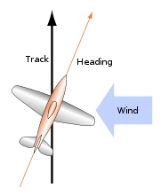
When an aircraft is in flight, it is moving relative to the body of air through which it is flying; therefore maintaining an accurate ground track is not as easy as it might appear, unless there is no wind at all — a very rare occurrence. The pilot must adjust heading to compensate for the wind
Wind triangle

The wind triangle is a graphical representation of the relationship between aircraft motion and wind. It is used extensively in dead reckoning navigation....
, in order to follow the ground track. Initially the pilot will calculate headings to fly for each leg of the trip prior to departure, using the forecast wind directions and speeds supplied by the meteorological authorities for the purpose. These figures are generally accurate and updated several times per day, but the unpredictable nature of the weather means that the pilot must be prepared to make further adjustments in flight. A general aviation (GA) pilot will often make use of either the E6B
E6B

The E6B Flight Computer, also known as the Jeppesen CR-1 Student Computer, Dalton Computer, Pooleys CRP-1, 1-W, 3, 6 and 6M in the UK, or simply the "whiz wheel", is a form of circular slide rule used in aviation....
 flight computer - a type of slide rule
Slide rule

The slide rule, also known colloquially as a slipstick, is a mechanical analog computer. The slide rule is used primarily for multiplication and division , and also for "scientific" functions such as Nth roots, logarithms and trigonometry, but does not generally perform addition or subtraction....
 - or a purpose-designed electronic navigational computer to calculate initial headings.

The primary instrument of navigation is the magnetic compass
Compass

A compass, magnetic compass or mariner's compass is a navigational instrument for determining direction relative to the earth's magnetic poles....
. The needle or card aligns itself to magnetic north, which does not coincide with true north
True north

True north is the direction along the earth's surface towards the geographic North Pole.True north usually differs from magnetic north pole and grid north ....
, so the pilot must also allow for this, called the magnetic variation (or declination). The variation that applies locally is also shown on the flight map. Once the pilot has calculated the actual headings required, the next step is to calculate the flight times for each leg. This is necessary to perform accurate dead reckoning
Dead reckoning

Dead reckoning is the process of estimating one's current position based upon a previously determined position, or Fix , and advancing that position based upon known or estimated speeds over elapsed time, and course....
. The pilot also needs to take into account the slower initial airspeed during climb to calculate the time to top of climb. It is also helpful to calculate the top of descent, or the point at which the pilot would plan to commence the descent for landing.

The flight time will depend on both the desired cruising speed of the aircraft, and the wind - a tailwind will shorten flight times, a headwind will increase them. The E6B has scales to help pilots compute these easily.

The point of no return
Point of no return

The point of no return is the point beyond which someone, or some group of people, must continue on their current course of action, either because turning back is physically impossible, or because to do so would be prohibitively expensive or dangerous....
, sometimes referred to as the ETP (Equal time Point), is the point on a flight at which a plane has just enough fuel, plus any mandatory reserve, to return to the airfield from which it departed. Beyond this point that option is closed, and the plane must proceed to some other destination. Alternatively, with respect to a large region without airfields, e.g. an ocean, it can mean the point before which it is closer to turn around and after which it is closer to continue.

The aircraft that is flying across the Ocean for example, would be required to calculate ETPs for one engine inoperative, depressurization, and a normal ETP; all of which could actually be different points along the route. For example, in one engine inoperative and depressurization situations the aircraft would be forced to lower operational altitudes, which would affect its fuel consumption, cruise speed and ground speed. Each situation therefore would have a different ETP.

Commercial aircraft are not allowed to operate along a route that is out of range of a suitable place to land if an emergency such as an engine failure occurs. The ETP calculations serve as a planning strategy, so flight crews always have an 'out' in a emergency event, allowing a safe diversion to their chosen alternate.

The final stage is to note which areas the route will pass through or over, and to make a note of all of the things to be done - which ATC units to contact, the appropriate frequencies, visual reporting points, and so on. It is also important to note which pressure setting regions will be entered, so that the pilot can ask for the QNH
QNH

QNH is a Q code. It is a pressure setting used by Aviator, air traffic control and low frequency weather beacons to refer to the barometric altimeter setting which will cause the altimeter to read altitude above mean sea level within a certain defined region....
 (air pressure) of those regions. Finally, the pilot should have in mind some alternative plans in case the route cannot be flown for some reason - unexpected weather conditions being the most common. At times the pilot may be required to file a flight plan for an alternate destination and to carry adequate fuel for this. The more work a pilot can do on the ground prior to departure, the easier it will be in the air.

IFR planning

In many respects this is similar to VFR flight planning
Flight planning

Flight planning is the process of producing a flight plan to describe a proposed aircraft flight. It involves two Life-critical system aspects: fuel calculation, to ensure that the aircraft can safely reach the destination, and compliance with air traffic control requirements, to minimise the risk of mid-air collision....
 except that the task is generally made simpler by the use of special charts that show IFR routes from beacon to beacon with the lowest safe altitude
Lowest safe altitude

The lowest safe altitude is a term used in aviation and in particular in air navigation. It is an altitude that is at least 1,000 feet above any obstacle or terrain within a defined safety buffer region around a particular route that a pilot might fly....
 (LSALT), bearings (in both directions) and distance marked for each route. IFR pilots may fly on other routes but they then have to do all of these calculations themselves with the LSALT calculation being the most difficult. The pilot then needs to look at the weather and minimum specifications for landing at the destination airport and the alternate requirements. The pilot must also comply with all the rules including their legal ability to use a particular instrument approach depending on how recently they last performed one.

In flight

Once in flight, the pilot must take pains to stick to plan, otherwise getting lost is all too easy. This is especially true if flying in the dark or over featureless terrain. This means that the pilot must stick to the calculated headings, heights and speeds as accurately as possible, unless flying under visual flight rules
Visual flight rules

Visual flight rules are a set of aviation regulations with which a aviator may operate an aircraft, in a specific airspace, with meteorological conditions better than Basic VFR Weather Minimums....
. The visual pilot must regularly compare the ground with the map, (pilotage
Pilotage

Pilotage is the use of fixed visual references on the ground or sea by means of sight or radar to guide oneself to a destination, sometimes with the help of a map or nautical chart....
) to ensure that the track is being followed although adjustments are generally calculated and planned. Usually, the pilot will fly for some time as planned to a point where features on the ground are easily recognised. If the wind is different from that expected, the pilot must adjust heading accordingly, but this is not done by guesswork, but by mental calculation - often using the 1 in 60 rule
1 in 60 rule

The 1 in 60 rule is used in air navigation, and states that if a pilot has travelled sixty miles then an error in track of one mile is approximately a 1? error....
. For example a two degree error at the halfway stage can be corrected by adjusting heading by four degrees the other way to arrive in position at the end of the leg. This is also a point to reassess the estimated time for the leg. A good pilot will become adept at applying a variety of techniques to stay on track.

While the compass is the primary instrument used to determine one's heading, pilots will usually refer instead to the direction indicator (DI), a gyroscopically
Gyroscope

A gyroscope is a device for measuring or maintaining orientation , based on the principles of angular momentum. The device is a spinning wheel or disk whose axle is free to take any orientation....
 driven device which is much more stable than a compass. The compass reading will be used to correct for any drift (precession
Precession

Precession refers to a change in the direction of the axis of a rotation object. In physics, there are two types of precession, torque-free and torque-induced, the latter being discussed here in more detail....
) of the DI periodically. The compass itself will only show a steady reading when the aircraft has been in straight and level flight long enough to allow it to settle.

Should the pilot be unable to complete a leg - for example bad weather arises, or the visibility falls below the minima permitted by the pilot's license, the pilot must divert to another route. Since this is an unplanned leg, the pilot must be able to mentally calculate suitable headings to give the desired new track. Using the E6B
E6B

The E6B Flight Computer, also known as the Jeppesen CR-1 Student Computer, Dalton Computer, Pooleys CRP-1, 1-W, 3, 6 and 6M in the UK, or simply the "whiz wheel", is a form of circular slide rule used in aviation....
 in flight is usually impractical, so mental techniques to give rough and ready results are used. The wind is usually allowed for by assuming that sine
Siné

Maurice Sinet, known as Sin? is a France cartoonist.As a young man he studied drawing and graphic arts, earning his life as a cabaret singer....
 A = A, for angles less than 60° (when expressed in terms of a fraction of 60° - e.g. 30° is 1/2 of 60°, and sine 30° = 0.5), which is adequately accurate. A method for computing this mentally is the clock code
Clock code

The clock code is a method of mentally computing the sine of an angle between zero and sixty degree . Aviators sometimes need to do this to estimate the heading correction due to the wind, and sailors may find it useful to do the same thing to allow for the current due to the tides....
. However the pilot must be extra vigilant when flying diversions to maintain awareness of position.

Some diversions can be temporary - for example to skirt around a local storm cloud. In such cases, the pilot can turn 60 degrees away his desired heading for a given period of time. Once clear of the storm, he can then turn back in the opposite direction 120 degrees, and fly this heading for the same length of time. This is a 'wind-star' maneuver and, with no winds aloft, will place him back on his original track with his trip tme increased by the length of one diversion leg.

Navigation aids

Good pilots use all means available to help navigate. Many GA aircraft are fitted with a variety of navigation aids, such as Automatic direction finder (ADF), inertial navigation, compass
Compass

A compass, magnetic compass or mariner's compass is a navigational instrument for determining direction relative to the earth's magnetic poles....
es, radar navigation
Radar navigation

Marine radar systems can provide very useful navigation information in a variety of situations. When the vessel is within radar range of land or special radar aids to navigation, the navigator can take distances and angular bearings to charted objects and use these to establish arcs of position and lines of position on a chart....
, VHF omnidirectional range
VHF omnidirectional range

VOR, short for VHF Omni-directional Radio Range, is a type of radio navigation system for aircraft. A VOR ground station broadcasts a VHF radio composite signal including the station's identifier in morse code , and data that allows the airborne receiving equipment to derive a Bearing #Types of bearings from the station to the aircraft...
 (VOR) and GNSS
Global Navigation Satellite System

Global Navigation Satellite System is the standard generic term for satellite navigation systems that provide autonomous geo-spatial positioning with global coverage....
.

ADF uses non-directional beacon
Non-directional beacon

A Non-directional beacon is a radio transmitter at a known location, used as an aviation or marine navigational aid. As the name implies, the signal transmitted does not include inherent directional information, in contrast to other navigational aids such as VHF omnidirectional range and TACAN....
s (NDBs)
on the ground to drive a display which shows the direction of the beacon from the aircraft. The pilot may use this bearing to draw a line on the map to show the bearing from the beacon. By using a second beacon, two lines may be drawn to locate the aircraft at the intersection of the lines. This is called a cross-cut. Alternatively, if the track takes the flight directly overhead a beacon, the pilot can use the ADF instrument to maintain heading relative to the beacon, though "following the needle" is bad practice, especially in the presence of a strong cross wind - the pilot's actual track will spiral in towards the beacon, not what was intended. NDBs also can give erroneous readings because they use very long wavelength
Wavelength

In physics, wavelength is the distance between repeating units of a propagating wave of a given frequency. It is commonly designated by the Greek language letter lambda ....
s, which are easily bent and reflected by ground features and the atmosphere. NDBs continue to be used as a common form of navigation in some countries with relatively few navigational aids.

VOR
VHF omnidirectional range

VOR, short for VHF Omni-directional Radio Range, is a type of radio navigation system for aircraft. A VOR ground station broadcasts a VHF radio composite signal including the station's identifier in morse code , and data that allows the airborne receiving equipment to derive a Bearing #Types of bearings from the station to the aircraft...
 is a more sophisticated system, and is still the primary air navigation system established for aircraft flying under IFR in those countries with many navigational aids. In this system, a beacon emits a specially modulated signal which consists of two sine wave
Sine wave

The sine wave or sinusoid is a function that occurs often in mathematics, physics, signal processing, hearing , electrical engineering, and many other fields....
s which are out of phase
Phase (waves)

The phase of an oscillation or wave is the fraction of a complete cycle corresponding to an offset in the displacement from a specified reference point at time t = 0....
. The phase difference corresponds to the actual bearing relative to true north that the receiver is from the station. The upshot is that the receiver can determine with certainty the exact bearing from the station. Again, a cross-cut is used to pinpoint the location. Many VOR stations also have additional equipment called DME (distance measuring equipment
Distance Measuring Equipment

Distance measuring equipment is a transponder-based radio navigation technology that measures distance by timing the propagation delay of Very high frequency or Ultra high frequency radio signals....
) which will allow a suitable receiver to determine the exact distance from the station. Together with the bearing, this allows an exact position to be determined from a single beacon alone. For convenience, some VOR stations also transmit local weather information which the pilot can listen in to, perhaps generated by an Automated Surface Observing System.

Prior to the advent of GNSS
Global Navigation Satellite System

Global Navigation Satellite System is the standard generic term for satellite navigation systems that provide autonomous geo-spatial positioning with global coverage....
, Celestial Navigation
Celestial navigation

Celestial navigation, also known as astronavigation, is a position fixing technique that was devised to help sailors cross the featureless oceans without having to rely on dead reckoning to enable them to strike land....
 was also used by trained navigators on military bombers and transport aircraft in the event of all electronic navigational aids being turned off in time of war. Originally navigators used an astrodome and regular sextant
Sextant

:For the history and development of the sextant see Reflecting instrument#The sextantA sextant is an measuring instrument generally used to measure the altitude of a astronomical object above the horizon....
 but the more streamlined periscopic sextant was used from the 1940s to the 1990s. From the 1970s airliners used inertial navigation system
Inertial navigation system

An Inertial Navigation System is a navigation aid that uses a computer and motion sensors to continuously calculate via dead reckoning the position, orientation, and velocity of a moving object without the need for external references....
s, especially on inter-continential routes, until the shooting down of Korean Air Lines Flight 007 in 1983 prompted the US government to make GPS available for civilian use.

Finally, an aircraft may be supervised from the ground using surveillance information from e.g. radar
Radar

Radar is a system that uses electromagnetic radiation waves to identify the range, altitude, direction, or speed of both moving and fixed objects such as aircraft, ships, motor vehicles, weather formations, and terrain....
 or multilateration
Multilateration

Multilateration, also known as hyperbolic positioning, is the process of locating an object by accurately computing the time difference of arrival of a signal emitted from the object to three or more receivers....
. ATC
Air traffic control

Air traffic control is a service provided by ground-based Air traffic controller who direct aircraft on the ground and in the air. The primary purpose of ATC systems worldwide is to separate aircraft to prevent collisions, to organize and expedite the flow of traffic, and to provide information and other support for pilots when able....
 can then feed back information to the pilot to help establish position, or can actually tell the pilot the position of the aircraft, depending on the level of ATC service the pilot is receiving.

The use of GNSS
Global Navigation Satellite System

Global Navigation Satellite System is the standard generic term for satellite navigation systems that provide autonomous geo-spatial positioning with global coverage....
 in aircraft is becoming increasingly common. GNSS
Global Navigation Satellite System

Global Navigation Satellite System is the standard generic term for satellite navigation systems that provide autonomous geo-spatial positioning with global coverage....
 provides very precise aircraft position, altitude, heading and ground speed information. GNSS
Global Navigation Satellite System

Global Navigation Satellite System is the standard generic term for satellite navigation systems that provide autonomous geo-spatial positioning with global coverage....
 makes navigation precision once reserved to large RNAV-equipped aircraft available to the GA
General aviation

General aviation is one of two categories of civil aviation. It refers to all flights other than military aviation and scheduled air transport flights, both private aviation and commercial aviation....
 pilot. Recently, more and more airports include GNSS
Global Navigation Satellite System

Global Navigation Satellite System is the standard generic term for satellite navigation systems that provide autonomous geo-spatial positioning with global coverage....
 instrument approaches. GNSS
Global Navigation Satellite System

Global Navigation Satellite System is the standard generic term for satellite navigation systems that provide autonomous geo-spatial positioning with global coverage....
 approaches consist of either overlays to existing non-precision approaches or stand-alone GNSS
Global Navigation Satellite System

Global Navigation Satellite System is the standard generic term for satellite navigation systems that provide autonomous geo-spatial positioning with global coverage....
 non-precision approaches.

See also

  • ADS-B
  • Aeronautical chart
    Aeronautical chart

    An aeronautical chart is a map designed to assist in navigation of aircraft, much as nautical charts do for watercraft, or a map for drivers. Using these charts and other tools aviators are able to determine their position, safe altitude, best route to a destination, navigation aids along the way, alternative landing areas in case of an in-fl...
  • Aircraft
    Aircraft

    An aircraft is a vehicle which is able to flight by being supported by the air, or in general, the atmosphere, of a planet. Examples include balloons, airplanes and helicopters....
  • Air safety
    Air safety

    Air safety is a term encompassing the theory, investigation and categorization of Aviation accidents and incidents, and the prevention of such failures through regulation, education and training....
  • RAIM
    RAIM

    RAIM is the abbreviation for Receiver Autonomous Integrity Monitoring, a technology developed to assess the integrity of Global Positioning System signals in a GPS receiver system....
  • Great-circle distance
    Great-circle distance

    The great-circle distance is the shortest distance between any two Point s on the surface of a sphere measured along a path on the surface of the sphere ....
  • ETOPS/LROPS
    ETOPS/LROPS

    ETOPS is an acronym for Extended-range Twin-engine Operational Performance Standards, an International Civil Aviation Organization rule permitting twin-engined commercial air transporters to fly routes that, at some points, are farther than a distance of 60 minutes' flying time from an emergency or diversion airport with one engine ino...
  • Flight instruments
    Flight instruments

    Most aircraft are equipped with a standard set of flight instruments which give the pilot information about the aircraft's attitude, airspeed, and altitude....
  • Flight management system
    Flight management system

    Flight Management System A flight management system is a fundamental part of a modern aircraft in that it controls the navigation. The flight management system is the avionics that holds the flight plan, and allows the pilot to modify as required in flight....
  • Flight planning
    Flight planning

    Flight planning is the process of producing a flight plan to describe a proposed aircraft flight. It involves two Life-critical system aspects: fuel calculation, to ensure that the aircraft can safely reach the destination, and compliance with air traffic control requirements, to minimise the risk of mid-air collision....
  • Instrument Landing System
    Instrument Landing System

    The Instrument Landing System is a ground-based instrument approach system that provides precision guidance to an aircraft approaching a runway, using a combination of radio signals and, in many cases, high-intensity lighting arrays to enable a safe landing during Instrument meteorological conditions, such as low Flight ceiling or reduced...
  • Air traffic obstacle
    Air traffic obstacle

    An Air traffic obstacle is a tall structure which can endanger air traffic. Air traffic obstacles have to be marked in most cases with red and white colored markings and with aircraft warning lights at night....
  • NavTool
    NavTool

    NavTool is a software system which is aimed at the organizations focused on the creation and design of airspace structure and navigation routes management, along with AIP producers and it was developed by BWise Solutions Ltd, Romania, which is also the copyright holder of this program....
     Software
  • Radio navigation
    Radio navigation

    Radio navigation or radionavigation is the application of radio frequencies to determining a position on the Earth. Like radiolocation, it is a type of radiodetermination....
  • SIGI
    Sigi

    In the V?lsung cycle, Sigi is the ancestor of the V?lsung lineage.In the V?lsunga saga , he is said to be the Sons of Odin....
  • Spherical trigonometry
    Spherical trigonometry

    Spherical trigonometry is a part of spherical geometry that deals with polygons on the sphere and explains how to find relations between the involved angles....
  • transatlantic flight
    Transatlantic flight

    Transatlantic flight is the flight of an aircraft, whether fixed-wing aircraft, balloon or other device, which involves crossing the Atlantic Ocean — with a starting point in North America or South America and ending in Europe or Africa, or vice versa....
  • Wind triangle
    Wind triangle

    The wind triangle is a graphical representation of the relationship between aircraft motion and wind. It is used extensively in dead reckoning navigation....


External links