

Canadian Forces Land Force Command

Encyclopedia
Army
An army An army An army (from Latin arma "arms, weapons" via Old French armée, "armed" (feminine), in the broadest sense, is the land-based military of a nation or state. It may also include other branches of the military such as the air force via means of aviation corps...
operations within the Canadian Forces
Canadian Forces
The Canadian Forces , officially the Canadian Armed Forces , are the unified armed forces of Canada, as constituted by the National Defence Act, which states: "The Canadian Forces are the armed forces of Her Majesty raised by Canada and consist of one Service called the Canadian Armed Forces."...
. The current size of the Army is 19,500 regular soldiers and 16,000 reserve soldiers, for a total of around 35,500 soldiers. It maintains regular forces units at bases across Canada
Canada
Canada is a North American country consisting of ten provinces and three territories. Located in the northern part of the continent, it extends from the Atlantic Ocean in the east to the Pacific Ocean in the west, and northward into the Arctic Ocean...
and is also responsible for the largest component of the Primary Reserve
Canadian Forces Primary Reserve
The Primary Reserve is a reserve force of the Canadian Forces. It is the largest of the four sub-components of the CF reserves; those being the Primary Reserve, the Supplementary Reserve, the Canadian Rangers, and the Cadet Organizations Administration and Training Service .The reserve force is...
, the Army Reserve. The Chief of the Land Staff is Lieutenant-General
Lieutenant-General (Canada)
In the Canadian Forces, the rank of lieutenant-general is an Army or Air Force rank equal to a vice-admiral of the Navy. A lieutenant-general is a general officer, the equivalent of a Naval flag officer. A lieutenant-general is senior to a major general or rear-admiral, and junior to a general or...
Peter Devlin
Peter Devlin
Lieutenant General Peter John Devlin CMM, MSC, CD is the Chief of the Land Staff in the Canadian Forces.-Military career:Educated at the University of Western Ontario, Devlin was commissioned into The Royal Canadian Regiment, having joined the Canadian Forces in 1978. Devlin served in an...
.
The Canadian Army is a descendant of the Land Force Command which was the name of Canada's land forces from 1997 until 2011; however, the term "Canadian Army" was officially used beginning in 1940. At the time of unification all army units were placed under Mobile Command (MC), later changed to Force Mobile Command (FMC) in 1975 when tactical air units were assigned to newly created Air Command
Canadian Forces Air Command
The Royal Canadian Air Force , formerly Canadian Forces Air Command, is one of three environmental commands of the Canadian Forces...
. The name was changed from FMC to Land Force Command in a 1997 reorganization of the Canadian Forces. In August 2011, the Land Force Command was renamed to the pre-1968 title, the Canadian Army. The Canadian Army as such only existed under that name from November 1940 to February 1968. However, the term has been traditionally applied to the ground forces of Canada's military from Confederation in 1867 to the present.
History
Following unification of the three armed services in 1968, Mobile Command became in effect the "Canadian Army" though the term "army" did not find favour until the 1980s when it became once again unofficially used to refer to Canada's land forces, both Regular and Reserve. The early organization of Mobile Command included tactical ground attack fixed and rotary wing aircraft, in addition to ground forces, and was akin to the integrated warfare approach of the United States Marine CorpsUnited States Marine Corps
The United States Marine Corps is a branch of the United States Armed Forces responsible for providing power projection from the sea, using the mobility of the United States Navy to deliver combined-arms task forces rapidly. It is one of seven uniformed services of the United States...
. In a 1975 reorganization of the Canadian Forces, Air Command
Canadian Forces Air Command
The Royal Canadian Air Force , formerly Canadian Forces Air Command, is one of three environmental commands of the Canadian Forces...
was created and all air assets were reassigned to that organization. Mobile Command was renamed Force Mobile Command and became an exclusive ground force. In 1997, Force Mobile Command was renamed Land Force Command. On 16 August 2011, Land Force Command was officially redesignated the Canadian Army.
Structure
The Canadian Army is not an independent service; rather it is the land component of Canada's integrated defence forces known as the Canadian ForcesCanadian Forces
The Canadian Forces , officially the Canadian Armed Forces , are the unified armed forces of Canada, as constituted by the National Defence Act, which states: "The Canadian Forces are the armed forces of Her Majesty raised by Canada and consist of one Service called the Canadian Armed Forces."...
; as such its proper name is the Canadian Army (Army).
Army Headquarters are located at NDHQ
Department of National Defence Headquarters (Canada)
The Major-General George R. Pearkes Building is the principal location of Canada's National Defence Headquarters and is located in Ottawa, Ontario....
in Ottawa
Ottawa
Ottawa is the capital of Canada, the second largest city in the Province of Ontario, and the fourth largest city in the country. The city is located on the south bank of the Ottawa River in the eastern portion of Southern Ontario...
and is subdivided into four regional command areas:
- Land Force Atlantic AreaLand Force Atlantic AreaLand Force Atlantic Area is responsible for Canadian Army operations in the Canadian provinces of New Brunswick, Newfoundland and Labrador, Nova Scotia, and Prince Edward Island. LFAA is headquartered at Canadian Forces Base Halifax on the Atlantic coast...
- Land Force Quebec AreaLand Force Quebec AreaLand Force Quebec Area is responsible for all Canadian army operations and administration in the region within the province of Quebec. LFQA is headquartered in Montreal.- Regular Force :* Land Force Quebec Area Training Centre - Courcelette...
- Land Force Central AreaLand Force Central AreaLand Force Central Area is responsible for the administration of the Canadian Army in the province of Ontario, from the Quebec border to the northern Lakehead region...
- Land Force Western AreaLand Force Western AreaLand Force Western Area is one of four operational commands of the Canadian Army. LFWA is responsible for all Canadian Army administration and operations in western Canada from the Pacific Ocean to Thunder Bay, Ontario...
Each area is responsible for the regular army and militia forces located within its geographical purview - all except the Atlantic Area has a regular army mechanized brigade
Brigade
A brigade is a major tactical military formation that is typically composed of two to five battalions, plus supporting elements depending on the era and nationality of a given army and could be perceived as an enlarged/reinforced regiment...
group under its command, together with between two and three militia brigades.
Each mechanized brigade group contains 3 infantry battalion
Battalion
A battalion is a military unit of around 300–1,200 soldiers usually consisting of between two and seven companies and typically commanded by either a Lieutenant Colonel or a Colonel...
s, an armoured regiment
Regiment
A regiment is a major tactical military unit, composed of variable numbers of batteries, squadrons or battalions, commanded by a colonel or lieutenant colonel...
, an artillery regiment, and a combat engineer regiment. Each brigade group also contains a service support battalion, signals squadron and military police platoon
Platoon
A platoon is a military unit typically composed of two to four sections or squads and containing 16 to 50 soldiers. Platoons are organized into a company, which typically consists of three, four or five platoons. A platoon is typically the smallest military unit led by a commissioned officer—the...
.
In addition to the four regional command areas, the Land Force Doctrine and Training System
Land Force Doctrine and Training System
Land Force Doctrine and Training System is a formation of the Canadian Army headquartered at McNaughton Barracks, CFB Kingston, Ontario. LFDTS is the organization that is responsible for delivering Army training and developing Army doctrine...
, commanded by a Major-General and headquartered at McNaughton Barracks, CFB Kingston
CFB Kingston
Canadian Forces Base Kingston is a Canadian Forces Base located in Kingston, Ontario, Canada.CFB Kingston is home to the Communications and Electronics Branch of the Canadian Forces. The base also hosts the Canadian Forces School of Communications and Electronics...
, Ontario, is responsible for the supervision, integration and delivery of the Land Force training and the long-range planning of the Land Force training and doctrine development, including simulation and digitization. It includes a number of schools and training organizations, such as the Combat Training Centre at CFB Gagetown, NB, and the Canadian Manoeuvre Training Centre at CFB Wainwright, AB.
Leadership
The senior appointment within Canadian Land Forces was entitled Chief of the General StaffChief of the General Staff (Canada)
The Chief of the General Staff was the most senior member of the Canadian Army from 1904 until 1964 when the appointment became Commander, Mobile Command with the unification of Canada's military forces. The position was renamed Chief of the Land Staff in 1993....
until 1964 when the appointment became Commander, Mobile Command
Commander, Mobile Command
The Commander, Mobile Command was the head of the Canadian Forces Mobile Command, the former name for Canadian Forces Land Force Command. The appointment was entitled Chief of the General Staff until 1964 when the appointment became Commander, Mobile Command with the unification of Canada's...
with the unification of Canada's military forces. The position was renamed Chief of the Land Staff
Chief of the Land Staff
The Chief of the Land Staff is the commander and institutional head of the Canadian Army. The Chief of the Land is based at National Defence Headquarters in Ottawa, Ontario.-History of the post:...
in 1993.
Officers are selected in several ways:
- The Regular Officer Training Plan, where candidates are educated at the Royal Military College of CanadaRoyal Military College of CanadaThe Royal Military College of Canada, RMC, or RMCC , is the military academy of the Canadian Forces, and is a degree-granting university. RMC was established in 1876. RMC is the only federal institution in Canada with degree granting powers...
(RMC) or at civilian Canadian universities. - Direct Entry officer Plan, for those who already hold a university degree or technology diploma.
- Continuing Education Officer Training Plan, addresses shortages in certain officer occupations, and is intended to attract candidates who are otherwise qualified for service as officers, but who lack a degree. Candidates complete their degrees while serving in the Army.
- University Training Plan (Non-Commissioned Members), designed to develop selected serving non-commissioned members for service as career officers in the Regular Force. Normally, candidates selected for this plan will attend RMC or a civilian university in Canada.
- Commissioning From the Ranks Plan, provides officers to augment the number of officers commissioned through other plans and applies exclusively to those who have acquired some military experience and possess the necessary qualities that make them suitable for employment as officers.
- Special Requirements Commissioning Plan, is designed to meet the needs of the officer occupations. It allows the Canadian Forces to profit from the skills and experience of senior non-commissioned members and may provide an opportunity for career advancement for selected deserving Chief Warrant Officers.
- Subsidized special education, which includes the Medical Officer Training Plan or Dental Officer Training Plan.
In addition there were other commissioning plans such as the Officer Candidate Training Plan and Officer Candidate Training Plan (Men) for commissioning serving members which are no longer in effect.
Occupational training for Canadian Army officers takes place at one of the schools of the Combat Training Centre for Army-controlled occupations (Armour, Artillery, Infantry, Electrical and Mechanical Engineers, etc.) or at a Canadian Forces school, such as the Canadian Forces School of Administration and Logistics or the Defence Public Affairs Learning Centre for officers from career fields controlled outside the Army.
Regular force
Canadian infantry and armoured regimental traditions are strongly rooted in the traditions and history of the British ArmyBritish Army
The British Army is the land warfare branch of Her Majesty's Armed Forces in the United Kingdom. It came into being with the unification of the Kingdom of England and Scotland into the Kingdom of Great Britain in 1707. The new British Army incorporated Regiments that had already existed in England...
. Many regiments were patterned after regiments of the British Army, and a system of official "alliances", or affiliations, was created to perpetuate a sense of shared history. Other regiments developed independently, resulting in a mixture of both colourful and historically familiar names. Other traditions such as battle honour
Battle honour
A battle honour is an award of a right by a government or sovereign to a military unit to emblazon the name of a battle or operation on its flags , uniforms or other accessories where ornamentation is possible....
s and colours
Colours, standards and guidons
In military organizations, the practice of carrying colours, standards or Guidons, both to act as a rallying point for troops and to mark the location of the commander, is thought to have originated in Ancient Egypt some 5,000 years ago...
have been maintained by Canadian regiments as well. Approximately two-thirds of the Regular Force is composed of anglophone
English Canadian
An English Canadian is a Canadian of English ancestry; it is used primarily in contrast with French Canadian. Canada is an officially bilingual state, with English and French official language communities. Immigrant cultural groups ostensibly integrate into one or both of these communities, but...
units, while one third is francophone
Francophone
The adjective francophone means French-speaking, typically as primary language, whether referring to individuals, groups, or places. Often, the word is used as a noun to describe a natively French-speaking person....
.
Between 1953 and 1971, the regular Canadian infantry consisted of seven regiments, each of two battalions (except the Royal 22e Régiment, which had three, the Canadian Guards which had four battalions between 1953 and 1957 and the Canadian Airborne Regiment, which was divided into three "commandos"). The three present regular infantry regiments were augmented by three further regiments each of two battalions:
- The Canadian Guards
- The Queen's Own Rifles of CanadaThe Queen's Own Rifles of CanadaThe Queen's Own Rifles of Canada is a militia regiment within the Canadian Forces, based in Toronto, Ontario. The regiment is part of Land Force Central Area's 32 Canadian Brigade Group. It is the only Primary Reserve regiment in Canada to have a parachute role. The regiment consists of the reserve...
- The Black Watch (Royal Highland Regiment) of CanadaThe Black Watch (Royal Highland Regiment) of CanadaThe Black Watch of Canada is a reserve infantry regiment in 34 Brigade Group, Land Force Quebec Area. The regiment is located on rue de Bleury in Montreal, Quebec, Canada, and is currently commanded by Lieutenant Colonel Bruno Plourde...
Following the unification of the Canadian Forces in 1968, the Regular Force battalions of the QOR and the Black Watch were dissolved (their Militia battalions remained in Toronto and Montreal, respectively), the Regular regiment of The Fort Garry Horse
The Fort Garry Horse
The Fort Garry Horse is a Canadian Army Reserve Armoured Regiment based in Winnipeg, Manitoba. It is currently part of Land Force Western Area's 38 Canadian Brigade Group.- History :...
was disbanded and the Canadian Guards were reduced to nil strength.
The 1st Battalion of the Canadian Guards was disbanded on 1 October 1968. On 6 July 1970, the 2nd Battalion The Canadian Guards was reduced to nil strength and transferred to the Supplementary Order of Battle
Supplementary Order of Battle
In Canada, a regiment is placed on the Supplementary Order of Battle when the need for the regiments existence is no longer relevant. When placed on the Supplementary Order of Battle, a regiment is considered "virtually disbanded", and will only be reformed should the need be dire...
, with the unit's soldiers and officers becoming the 3rd Battalion, The Royal Canadian Regiment.
On 1 July 1970, the 1st and 2nd Battalions of The Black Watch (Royal Highland Regiment) of Canada were reduced to nil strength and transferred to the Supplementary Order of Battle, and the Reserve Force battalion automatically relinquished its numerical designation.
On 15 September 1968, the 2nd Battalion the Queen's Own Rifles of Canada was reduced to nil strength and transferred to the Supplementary Order of Battle, while when the 1st Battalion was reduced to nil strength and transferred to the Supplementary Order of Battle on 27 April 1970, with the unit's officers and soldiers forming the 3rd Battalion, Princess Patricia's Canadian Light Infantry. The Reserve Force battalion automatically relinquished its numerical designation at that time.
The Canadian Airborne Regiment was disbanded in 1995.
The Regular Force regiment of the 8th Canadian Hussars (Princess Louise's)
8th Canadian Hussars (Princess Louise's)
The 8th Canadian Hussars is one of the longest serving armoured regiments in the Canadian Army. A Squadron being Regular Force served in CFB Gagetown and B, C and HQ Squadrons served in Sussex, Moncton and Sackville...
, formed in 1957, was converted to a mixed Regular and Reserve “Total Force” unit with the close-out of 4 Canadian Mechanized Brigade Group
4 Canadian Mechanized Brigade Group
4 Canadian Mechanized Brigade Group was a formation of the Canadian Army, then Mobile Command of the unified Canadian Forces. The formation served as the main forward deployed land element of Canada's armed forces, and was stationed in West Germany from 1957 until it was disbanded in...
at Lahr
Lahr
Lahr is a city in western Baden-Württemberg, Germany, approximately 38 km north of Freiburg in Breisgau and 100 km south of Karlsruhe...
, Germany in 1994, before reverting to a Reserve regiment in 1997.
The regular forces currently consist of the following regiments:
Infantry
Regular Force infantry regiments and battalions of the Canadian Army are:- The Royal Canadian RegimentThe Royal Canadian RegimentThe Royal Canadian Regiment is an infantry regiment of the Canadian Forces. The regiment consists of four battalions, three in the Regular Force and one in the Primary Reserve...
- 1st Battalion (CFB PetawawaCFB PetawawaCanadian Forces Base Petawawa, commonly referred to as CFB Petawawa, or simply "Pet", is a Canadian Forces Base located in Petawawa, Ontario. It is operated as an army base by Canadian Forces Land Force Command.-Base facts:...
) – mechanized infantry - 2nd Battalion (CFB GagetownCFB GagetownCanadian Forces Base Gagetown, referred to as CFB Gagetown is a large Canadian Forces Base located in southwestern New Brunswick.- Construction of the base :...
) – mechanized infantry - 3rd Battalion3 Royal Canadian Regiment3rd Battalion, The Royal Canadian Regiment is a regular force light infantry battalion of the Canadian Forces. As of 2011, 3 RCR was designated Canada's first airmobile battalion...
(CFB PetawawaCFB PetawawaCanadian Forces Base Petawawa, commonly referred to as CFB Petawawa, or simply "Pet", is a Canadian Forces Base located in Petawawa, Ontario. It is operated as an army base by Canadian Forces Land Force Command.-Base facts:...
) – light infantry and parachute company
- 1st Battalion (CFB Petawawa
- Princess Patricia's Canadian Light InfantryPrincess Patricia's Canadian Light InfantryPrincess Patricia's Canadian Light Infantry is one of the three regular force infantry regiments of the Canadian Army. The regiment is composed of four battalions including a primary reserve battalion, for a total of 2,000 soldiers...
- 1st Battalion (CFB EdmontonCFB EdmontonCFB Edmonton is a Canadian Forces base located in Edmonton, Alberta, Canada. It is also known as Edmonton Garrison or "Steele Barracks".-History:...
) – mechanized infantry - 2nd Battalion (CFB ShiloCFB ShiloCanadian Forces Base Shilo is an Operations and Training base of the Canadian Forces, located east of Brandon, Manitoba. During the 1990s, Canadian Forces Base Shilo was also designated as an Area Support Unit, which acts as a local base of operations for south-west Manitoba in times of military...
) – mechanized infantry - 3rd Battalion (CFB EdmontonCFB EdmontonCFB Edmonton is a Canadian Forces base located in Edmonton, Alberta, Canada. It is also known as Edmonton Garrison or "Steele Barracks".-History:...
) – light infantry and parachute company
- 1st Battalion (CFB Edmonton
- Royal 22e RégimentRoyal 22e RégimentThe Royal 22nd Regiment is an infantry regiment and the most famous francophone organization of the Canadian Forces. The regiment comprises three Regular Force battalions, two Primary Reserve battalions, and a band, making it the largest regiment in the Canadian Army...
- 1er Bataillon (CFB ValcartierCFB ValcartierCanadian Forces Base Valcartier is a Canadian Forces Base located in the municipality of Saint-Gabriel-de-Valcartier, approximately north of Quebec City...
) – mechanized infantry - 2e Bataillon (Quebec CityQuebec CityQuebec , also Québec, Quebec City or Québec City is the capital of the Canadian province of Quebec and is located within the Capitale-Nationale region. It is the second most populous city in Quebec after Montreal, which is about to the southwest...
) – mechanized infantry - 3e Bataillon (CFB ValcartierCFB ValcartierCanadian Forces Base Valcartier is a Canadian Forces Base located in the municipality of Saint-Gabriel-de-Valcartier, approximately north of Quebec City...
) – light infantry and parachute company
- 1er Bataillon (CFB Valcartier
Artillery
Canada's regular field artillery has traditionally been called the Royal Canadian Horse ArtilleryRoyal Canadian Horse Artillery
The Royal Canadian Horse Artillery is the name given to the regular field artillery units of the Canadian Army. RCHA units are the senior units of the Canadian land field force, with a history dating back to the birth of Canada as a nation...
. Canada currently has four Regular Force regiments:
- 1st Regiment, Royal Canadian Horse Artillery (CFB ShiloCFB ShiloCanadian Forces Base Shilo is an Operations and Training base of the Canadian Forces, located east of Brandon, Manitoba. During the 1990s, Canadian Forces Base Shilo was also designated as an Area Support Unit, which acts as a local base of operations for south-west Manitoba in times of military...
) - 2nd Regiment, Royal Canadian Horse Artillery (CFB PetawawaCFB PetawawaCanadian Forces Base Petawawa, commonly referred to as CFB Petawawa, or simply "Pet", is a Canadian Forces Base located in Petawawa, Ontario. It is operated as an army base by Canadian Forces Land Force Command.-Base facts:...
) - 5e Régiment d'artillerie légère du Canada (CFB ValcartierCFB ValcartierCanadian Forces Base Valcartier is a Canadian Forces Base located in the municipality of Saint-Gabriel-de-Valcartier, approximately north of Quebec City...
) - 4th Air Defence Regiment, Royal Canadian Artillery (CFB GagetownCFB GagetownCanadian Forces Base Gagetown, referred to as CFB Gagetown is a large Canadian Forces Base located in southwestern New Brunswick.- Construction of the base :...
)
Armour
Regular Force units include:- The Royal Canadian Dragoons – CFB PetawawaCFB PetawawaCanadian Forces Base Petawawa, commonly referred to as CFB Petawawa, or simply "Pet", is a Canadian Forces Base located in Petawawa, Ontario. It is operated as an army base by Canadian Forces Land Force Command.-Base facts:...
, OntarioOntarioOntario is a province of Canada, located in east-central Canada. It is Canada's most populous province and second largest in total area. It is home to the nation's most populous city, Toronto, and the nation's capital, Ottawa.... - Lord Strathcona's Horse (Royal Canadians)Lord Strathcona's Horse (Royal Canadians)Lord Strathcona's Horse is a regular armoured regiment of the Canadian Forces. Currently based in Edmonton, Alberta, the regiment is part of Land Force Western Area's 1 Canadian Mechanized Brigade Group...
– CFB EdmontonCFB EdmontonCFB Edmonton is a Canadian Forces base located in Edmonton, Alberta, Canada. It is also known as Edmonton Garrison or "Steele Barracks".-History:...
, AlbertaAlbertaAlberta is a province of Canada. It had an estimated population of 3.7 million in 2010 making it the most populous of Canada's three prairie provinces... - 12e Régiment blindé du Canada12e Régiment blindé du CanadaThe 12e Régiment blindé du Canada is a Canadian Forces armoured regiment based in CFB Valcartier, on the outskirts of Quebec City...
– CFB ValcartierCFB ValcartierCanadian Forces Base Valcartier is a Canadian Forces Base located in the municipality of Saint-Gabriel-de-Valcartier, approximately north of Quebec City...
and Trois-RivièresTrois-RivièresTrois-Rivières means three rivers in French and may refer to:in Canada*Trois-Rivières, the largest city in the Mauricie region of Quebec, Canada*Circuit Trois-Rivières, a racetrack in Trois-Rivières, Quebec...
, QuebecQuebecQuebec or is a province in east-central Canada. It is the only Canadian province with a predominantly French-speaking population and the only one whose sole official language is French at the provincial level....
Combat engineers
- 1 Combat Engineer Regiment – CFB EdmontonCFB EdmontonCFB Edmonton is a Canadian Forces base located in Edmonton, Alberta, Canada. It is also known as Edmonton Garrison or "Steele Barracks".-History:...
, AlbertaAlbertaAlberta is a province of Canada. It had an estimated population of 3.7 million in 2010 making it the most populous of Canada's three prairie provinces... - 2 Combat Engineer Regiment2 Combat Engineer Regiment2 Combat Engineer Regiment is a regiment of the Canadian Military Engineers. It is located at CFB Petawawa, and is part of 2 Canadian Mechanized Brigade Group...
– CFB PetawawaCFB PetawawaCanadian Forces Base Petawawa, commonly referred to as CFB Petawawa, or simply "Pet", is a Canadian Forces Base located in Petawawa, Ontario. It is operated as an army base by Canadian Forces Land Force Command.-Base facts:...
, OntarioOntarioOntario is a province of Canada, located in east-central Canada. It is Canada's most populous province and second largest in total area. It is home to the nation's most populous city, Toronto, and the nation's capital, Ottawa.... - 4 Engineer Support Regiment4 Engineer Support Regiment4 Engineer Support Regiment is a regiment of the Canadian Military Engineers located at CFB Gagetown, New Brunswick. It is tasked to provide general engineer support to the whole of the Canadian Forces....
– CFB GagetownCFB GagetownCanadian Forces Base Gagetown, referred to as CFB Gagetown is a large Canadian Forces Base located in southwestern New Brunswick.- Construction of the base :...
, New BrunswickNew BrunswickNew Brunswick is one of Canada's three Maritime provinces and is the only province in the federation that is constitutionally bilingual . The provincial capital is Fredericton and Saint John is the most populous city. Greater Moncton is the largest Census Metropolitan Area... - 5e Régiment du genie de combat5 Combat Engineer Regiment5 Combat Engineer Regiment is a regular force regiment of the Canadian Military Engineers commanded by a lieutenant-colonel...
– CFB ValcartierCFB ValcartierCanadian Forces Base Valcartier is a Canadian Forces Base located in the municipality of Saint-Gabriel-de-Valcartier, approximately north of Quebec City...
, QuebecQuebecQuebec or is a province in east-central Canada. It is the only Canadian province with a predominantly French-speaking population and the only one whose sole official language is French at the provincial level....
Electronic warfare
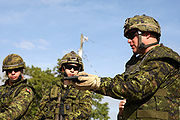
- 21 Electronic Warfare Regiment – CFB KingstonCFB KingstonCanadian Forces Base Kingston is a Canadian Forces Base located in Kingston, Ontario, Canada.CFB Kingston is home to the Communications and Electronics Branch of the Canadian Forces. The base also hosts the Canadian Forces School of Communications and Electronics...
, Ontario- 2 Electronic Warfare Squadron (Regular)
- 772 Electronic Warfare Squadron (Reserve)
Reserve force units
- Land Force Atlantic AreaLand Force Atlantic AreaLand Force Atlantic Area is responsible for Canadian Army operations in the Canadian provinces of New Brunswick, Newfoundland and Labrador, Nova Scotia, and Prince Edward Island. LFAA is headquartered at Canadian Forces Base Halifax on the Atlantic coast...
- 36 Canadian Brigade Group36 Canadian Brigade Group36 Canadian Brigade Group is a reserve component brigade of the Canadian Army, which supervises Militia units in Land Forces Atlantic Area.-Brigade units:...
- 36 Canadian Brigade Group Headquarters
- 36 Canadian Brigade Group (NS) Band (music)
- The Halifax Rifles (RCAC)The Halifax Rifles (RCAC)The Halifax Rifles is a Canadian Army regiment that served between the years of 1860 and 1965 before being placed on the Supplementary Order of Battle, which meant that they were reduced to nil strength. The regiment was reactivated on May 10, 2009, as a reserve force unit performing the role of...
(armoured) (Halifax, Nova Scotia) - The Prince Edward Island Regiment (RCAC)The Prince Edward Island Regiment (RCAC)The Prince Edward Island Regiment is a Primary Reserve armoured reconnaissance regiment of the Canadian Forces, Land Force Atlantic Area, 36 Canadian Brigade Group. The regiment is based in Charlottetown and Summerside.-Perpetuations:...
(armoured) (Charlottetown, Prince Edward Island) - 1st (Halifax-Dartmouth) Field Artillery Regiment, RCA (artillery) (Halifax, Nova Scotia)
- 84th Independent Field Battery, RCA (artillery) (Yarmouth, Nova Scotia)
- 45 Engineer Squadron (combat engineer) (Sydney, Nova Scotia)
- The Princess Louise FusiliersThe Princess Louise FusiliersThe Princess Louise Fusiliers is a Primary Reserve infantry regiment of the Canadian Forces.-History:Based in Halifax, Nova Scotia, this infantry regiment traces its local roots as a Halifax unit of Militia back to June 18, 1798 when Sir Edward Cornwalis formed a local Militia under his own command...
(light infantry) (Halifax, Nova Scotia) - The West Nova Scotia RegimentThe West Nova Scotia RegimentThe West Nova Scotia Regiment is a Primary Reserve infantry regiment of the Canadian Forces, twenty fourth in the order of precedence. It has seen active service in both the Great War and World War II...
(light infantry) (Aldershot, Nova Scotia) - The Nova Scotia HighlandersThe Nova Scotia HighlandersThe Nova Scotia Highlanders is a reserve infantry regiment of the Canadian Forces.- Creation :The regiment was formed in 1954 by the amalgamation of The North Nova Scotia Highlanders, The Cape Breton Highlanders, and The Pictou Highlanders....
(light infantry) (Truro, Nova Scotia) - The Cape Breton Highlanders (light infantry) (Sydney, Nova Scotia)
- 36 Service Battalion (service and support) (Halifax and Sydney, Nova Scotia)
- 37 Canadian Brigade Group
- 37 Canadian Brigade Group Headquarters
- 8th Canadian Hussars (Princess Louise's)8th Canadian Hussars (Princess Louise's)The 8th Canadian Hussars is one of the longest serving armoured regiments in the Canadian Army. A Squadron being Regular Force served in CFB Gagetown and B, C and HQ Squadrons served in Sussex, Moncton and Sackville...
(armoured) (Moncton, New Brunswick) - 3rd Field Artillery Regiment, RCA (artillery) (Saint John, New Brunswick)
- 56 Engineer Squadron (combat engineer) (St. John's, Newfoundland)
- 1st Battalion, The Royal New Brunswick Regiment (Carleton and York) (light infantry) (Fredericton, New Brunswick)
- 2nd Battalion, The Royal New Brunswick Regiment (North Shore) (light infantry) (Bathurst, New Brunswick)
- 1st Battalion, Royal Newfoundland Regiment (light infantry) (Corner Brook, Newfoundland)
- 37 Service Battalion (service and support) (St John, New Brunswick and St. John's, Newfoundland)
- 72 Communications Group - Halifax, Nova-Scotia
- 721 Communication Regiment (Charlottetown, Prince Edward Island)
- 722 Communication Squadron (Saint John, New Brunswick)
- 723 Communication Squadron (Halifax, Nova Scotia)
- 724 Communication Squadron - active unit (Oromocto, New Brunswick)
- 725 Communication Squadron (Glace Bay, Nova-Scotia)
- 728 Communication Squadron (St. John's, Newfoundland)
- 5 Canadian Ranger Patrol Group (Gander, Newfoundland)
- 3 Intelligence Company (Halifax, Nova Scotia)
- 36 Canadian Brigade Group
- Land Force Quebec AreaLand Force Quebec AreaLand Force Quebec Area is responsible for all Canadian army operations and administration in the region within the province of Quebec. LFQA is headquartered in Montreal.- Regular Force :* Land Force Quebec Area Training Centre - Courcelette...
- 34 Canadian Brigade Group34 Canadian Brigade Group34 Canadian Brigade Group is part of Land Force Quebec Area, under Land Force Command of the Canadian Forces. It is headquartered in Montreal, Quebec.-Brigade Units:...
- 34 Canadian Brigade Group Headquarters (Montreal)
- The Royal Canadian Hussars (Montreal)The Royal Canadian Hussars (Montreal)The Royal Canadian Hussars is a Primary Reserve armoured regiment of the Canadian Forces. The unit is based in Montreal.-Lineage:...
(Armoured) (Montreal) - Le Régiment de Hull (RCAC)Le Régiment de Hull (RCAC)Le Régiment de Hull is a Primary Reserve armoured reconnaissance regiment of the Canadian Forces. The regiment is based in Hull, Quebec near Ottawa...
(Armoured) (Hull) - 4e Bataillon, Royal 22e RégimentRoyal 22e RégimentThe Royal 22nd Regiment is an infantry regiment and the most famous francophone organization of the Canadian Forces. The regiment comprises three Regular Force battalions, two Primary Reserve battalions, and a band, making it the largest regiment in the Canadian Army...
(Light Infantry) (Laval) - 6e Bataillon, Royal 22e RégimentRoyal 22e RégimentThe Royal 22nd Regiment is an infantry regiment and the most famous francophone organization of the Canadian Forces. The regiment comprises three Regular Force battalions, two Primary Reserve battalions, and a band, making it the largest regiment in the Canadian Army...
(Light Infantry) (Saint-Hyacinthe) - Le Régiment de MaisonneuveLe Régiment de MaisonneuveLe Régiment de Maisonneuve is a Primary Reserve infantry regiment of the Canadian Forces.The regiment is Canada's twenty-sixth most senior reserve infantry regiment, and comprises one battalion serving as part of the Land Force Reserve.-History:...
(Light Infantry) (Montreal) - Les Fusiliers Mont-RoyalLes Fusiliers Mont-RoyalLes Fusiliers Mont-Royal is one of the oldest surviving units of the historical regiments of the Canadian army. It celebrated its regimental centenary in 1969. The unit was created on November 5, 1869...
(Light Infantry) (Montreal) - The Black Watch (Royal Highland Regiment) of CanadaThe Black Watch (Royal Highland Regiment) of CanadaThe Black Watch of Canada is a reserve infantry regiment in 34 Brigade Group, Land Force Quebec Area. The regiment is located on rue de Bleury in Montreal, Quebec, Canada, and is currently commanded by Lieutenant Colonel Bruno Plourde...
(Light Infantry) (Montreal) - The Canadian Grenadier GuardsThe Canadian Grenadier GuardsThe Canadian Grenadier Guards is the second most senior and oldest infantry regiment in the Reserve Force of the Canadian Forces. Located in Montreal, its primary role is the provision of combat-ready troops in support of Canadian regular infantry...
(Light Infantry) (Westmount) - The Canadian Grenadier GuardsThe Canadian Grenadier GuardsThe Canadian Grenadier Guards is the second most senior and oldest infantry regiment in the Reserve Force of the Canadian Forces. Located in Montreal, its primary role is the provision of combat-ready troops in support of Canadian regular infantry...
(Light Infantry) (Montreal) - The Royal Montreal RegimentThe Royal Montreal RegimentThe Royal Montreal Regiment is a Primary Reserve Infantry regiment of the Canadian Forces based in Westmount, Montréal, Québec.-History:The Royal Montreal Regiment traces its origins to the creation of the 14th Battalion of the Canadian Expeditionary Force on August 27, 1914...
(Light Infantry) (Westmount) - 2nd Field Artillery Regiment, RCA2nd Field Artillery Regiment, RCAThe 2nd Field Regiment, Royal Canadian Artillery is a Royal Canadian Artillery reserve regiment. It is located in Montreal and shares its headquarters with The Royal Canadian Hussars at the Côte-des-Neiges Armory....
(Artillery) (Montreal) - 34 Combat Engineer Regiment (Combat Engineer) (Westmount)
- 34 Service Battalion (Service and Support) (Saint-Hubert)
- 34th Signals Regiment (Montréal) Signals (Support) (Montreal)
- 35 Canadian Brigade Group
- 35 Canadian Brigade Group Headquarters
- Sherbrooke HussarsSherbrooke HussarsThe Sherbrooke Hussars is a Primary Reserve armoured regiment of the Canadian Forces.-Sherbrooke Regiment:The Sherbrooke Regiment was initially formed in 1866 as the Sherbrooke Battalion of Infantry, becoming the 53rd Battalion in 1867. The regiment provided volunteers for the 12th Battalion,...
(Armoured) (Sherbrooke) - 12e Régiment blindé du Canada12e Régiment blindé du CanadaThe 12e Régiment blindé du Canada is a Canadian Forces armoured regiment based in CFB Valcartier, on the outskirts of Quebec City...
(Militia) (armoured) (Trois-Rivières) - Le Régiment de la ChaudièreLe Régiment de la ChaudièreThe Régiment de la Chaudière is a Primary Reserve infantry regiment of the Canadian Forces.-Insignia:The regimental insignia consists of two crossed machine guns, surmounted by a beaver supporting a fleur-de-lys...
(Light Infantry) (Lévis) - Le Régiment du SaguenayLe Régiment du SaguenayLe Régiment du Saguenay is a Primary Reserve infantry regiment of the Canadian Forces.-References:* *...
(Light Infantry) (Chicoutimi) - Les Fusiliers de SherbrookeLes Fusiliers de SherbrookeLes Fusiliers de Sherbrooke is a Primary Reserve infantry regiment of the Canadian Forces. It is based in Sherbrooke, Quebec, with a sub-unit in Granby.-Armourial description:...
(Light Infantry) (Sherbrooke) - Les Fusiliers du Saint-Laurent (Light Infantry) (Rimouski)
- Les Voltigeurs de QuébecLes Voltigeurs de QuébecLes Voltigeurs de Québec is a Primary Reserve infantry regiment of the Canadian Forces. The name of the regiment commemorates another older French-Canadian militia light infantry unit, the Canadian Voltigeurs...
(Light Infantry) (Quebec City) - 6e Régiment d'artillerie de Campagne, ARC (Artillery) (Lévis)
- 62e Régiment d'artillerie de campagne, ARC (Artillery) (Shawinigan)
- 35 Combat Engineer Regiment (Combat Engineer) (Quebec City)
- 35 (Quebec) Service Battalion (Service and Support) (Quebec City)
- 71e Communications Group (Montreal)
- 712 Communication Squadron - Montreal
- 713 Communication Regiment - Beaport
- 714 Communication Squadron - Sherbrooke
- 2 Canadian Ranger Patrol Group - Richelain
- 4 Intelligence Company - Montreal
- 34 Canadian Brigade Group
- Land Force Central AreaLand Force Central AreaLand Force Central Area is responsible for the administration of the Canadian Army in the province of Ontario, from the Quebec border to the northern Lakehead region...
- 31 Canadian Brigade Group31 Canadian Brigade Group31 Canadian Brigade Group is part of Land Force Central Area, under Land Force Command of the Canadian Forces. It encompasses the southwestern portion of Ontario, and is headquartered in London, Ontario. The 31 CBG area of responsibility stretches from St. Catharines to Windsor. The Brigade has...
- 31 Canadian Brigade Group Headquarters (London, Ontario)
- 1st Hussars1st HussarsThe 1st Hussars is an armoured Primary Reserve regiment of the Canadian Forces, currently based in London, Ontario and Sarnia, Ontario.-Foundation and organisation:...
(Armoured) (London, Ontario) - The Windsor RegimentThe Windsor Regiment (RCAC)The Windsor Regiment is a Primary Reserve armoured regiment of the Canadian Forces. The regiment, which was founded in 1936 as The Essex Regiment , is based in Windsor, Ontario. During World War II, the regiment was designated as the reconnaissance regiment for the 7th Canadian Infantry Division...
(Armoured) (Windsor, Ontario) - The Royal Hamilton Light Infantry (Wentworth Regiment)The Royal Hamilton Light Infantry (Wentworth Regiment)The Royal Hamilton Light Infantry is a Primary Reserve unit of the Canadian Forces based at John W. Foote VC Armouries in Hamilton, Ontario....
(Light Infantry) (Hamilton, Ontario) - The Lincoln and Welland RegimentThe Lincoln and Welland RegimentThe Lincoln and Welland Regiment is a Primary Reserve infantry regiment of the Canadian Forces based in St Catharines and Welland, Ontario.The Regimental Colonel-in-Chief is The Countess of Wessex and...
(Light Infantry) (St. Catharines and Welland, Ontario) - 4th Battalion, The Royal Canadian RegimentThe Royal Canadian RegimentThe Royal Canadian Regiment is an infantry regiment of the Canadian Forces. The regiment consists of four battalions, three in the Regular Force and one in the Primary Reserve...
(Light Infantry) (London and Stratford, Ontario) - The Royal Highland Fusiliers of CanadaThe Royal Highland Fusiliers of CanadaThe Royal Highland Fusiliers of Canada is a Primary Reserve infantry regiment of the Canadian Forces. Prince Andrew, as a member of the Canadian Royal Family, acts as Colonel-in-Chief. Previously, this post was held by Princess Margaret, Countess of Snowdon....
(Light Infantry) (Cambridge and Kitchener, Ontario) - The Essex and Kent ScottishThe Essex and Kent ScottishThe Essex and Kent Scottish is a Primary Reserve infantry regiment of the Canadian Forces.The regiment was formed in 1954 by the amalgamation of The Essex Scottish Regiment and The Kent Regiment....
(Light Infantry) (Windsor and Chatham, Ontario) - The Argyll and Sutherland Highlanders of Canada (Princess Louise's)The Argyll and Sutherland Highlanders of Canada (Princess Louise's)The Argyll and Sutherland Highlanders of Canada , or A & SH of C, is a Primary Reserve Highland infantry regiment of the Canadian Forces, based at John W...
(Light Infantry) (Hamilton, Ontario) - 11th Field Artillery Regiment, RCA (Artillery) (Guelph and Hamilton, Ontario)
- 56th Field Artillery Regiment, RCA (Artillery) (Brantford,St. Catharines and Simcoe Ontario)
- 31 Combat Engineer Regiment (The Elgins)31 Combat Engineer Regiment (The Elgins)31 Combat Engineer Regiment , is currently a combat engineer regiment of the Canadian Forces, supporting 31 Canadian Brigade Group. It consists of two squadrons: 48 Engineer Squadron in Waterloo, Ontario, and 7 Engineer Squadron in St. Thomas, Ontario. The Elgins existed before the Confederation of...
(Combat Engineer) (St. Thomas and Waterloo, Ontario) - 31 Service Battalion (Service and Support) (Windsor, London and Hamilton, Ontario)
- 32 Canadian Brigade Group32 Canadian Brigade Group32 Canadian Brigade Group is part of Land Force Central Area, under the Canadian Army. It is centered around the Greater Toronto Area, as well as Grey and Simcoe Counties...
- 32 Canadian Brigade Group Headquarters (Toronto)
- The Governor General's Horse GuardsThe Governor General's Horse GuardsThe Governor General's Horse Guards is an armoured reconnaissance regiment in the Primary Reserve of the Canadian Army, part of Land Force Central Area's 32 Canadian Brigade Group. Based in Toronto, it is the most senior reserve regiment in Canada, and the only Household Cavalry regiment of...
(Armoured) (Toronto) - The Queen's York Rangers (1st American Regiment) RCACThe Queen's York Rangers (1st American Regiment) (RCAC)The Queen's York Rangers R.C.A.C. is a Canadian Forces Primary Reserve regiment based in Toronto and Aurora. The regiment is part of Land Force Central Area's 32 Canadian Brigade Group. The regiment consists of two reconnaissance squadrons, A Sqn in Aurora and B Sqn in Toronto, and a Headquarters...
(Armoured) (Toronto and Aurora, Ontario) - The Queen's Own Rifles of CanadaThe Queen's Own Rifles of CanadaThe Queen's Own Rifles of Canada is a militia regiment within the Canadian Forces, based in Toronto, Ontario. The regiment is part of Land Force Central Area's 32 Canadian Brigade Group. It is the only Primary Reserve regiment in Canada to have a parachute role. The regiment consists of the reserve...
(Light Infantry) (Toronto (Downtown and Scarborough), Ontario) - The Royal Regiment of CanadaThe Royal Regiment of CanadaThe Royal Regiment of Canada is the largest army regiment in the Canadian Forces Primary Reserve. It is an infantry unit based in Toronto, Ontario, part of Land Force Central Area's 32 Canadian Brigade Group....
(Light Infantry) (Toronto, Ontario) - The Grey and Simcoe ForestersThe Grey and Simcoe ForestersThe Grey and Simcoe Foresters is a Primary Reserve infantry regiment of the Canadian Forces. It is part of Land Force Central Area's 32 Canadian Brigade Group...
(Light Infantry (Owen Sound and Barrie, Ontario) - The Lorne Scots (Peel, Dufferin and Halton Regiment)The Lorne Scots (Peel, Dufferin and Halton Regiment)The Lorne Scots is a Primary Reserve infantry regiment of the Canadian Army. It is part of Land Force Central Area's 32 Canadian Brigade Group.The sub-units of the Lorne Scots are situated in the following armouries:...
(Light Infantry) (Brampton, Oakville and Georgetown, Ontario) - 48th Highlanders of Canada48th Highlanders of CanadaThe 48th Highlanders of Canada is a Canadian Forces Primary Reserve infantry regiment based in Toronto, parading out of Moss Park Armoury. The regiment is part of Land Force Central Area's 32 Canadian Brigade Group....
(Light Infantry) (Toronto, Ontario) - The Toronto Scottish Regiment (Queen Elizabeth the Queen Mother's Own)The Toronto Scottish Regiment (Queen Elizabeth The Queen Mother's Own)The Toronto Scottish Regiment is a Primary Reserve infantry regiment of the Canadian Forces. It is part of Land Force Central Area's 32 Canadian Brigade Group.-History:...
(Light Infantry) (Toronto, Ontario) - 7th Toronto Regiment, RCA7th Toronto Regiment, RCAThe 7th Toronto Regiment, Royal Canadian Artillery is a militia regiment of Land Force Central Area's 32 Canadian Brigade Group,...
(Artillery) (Toronto, Ontario) - 32 Combat Engineer Regiment32 Combat Engineer Regiment32 Combat Engineer Regiment is the Primary Reserve unit of the Canadian Military Engineers in Toronto, Ontario, Canada. It is assigned to 32 Canadian Brigade Group, part of Land Force Central Area....
(Combat Engineer) (Toronto, Ontario) - 32 (Toronto) Service Battalion (Service and Support) (Toronto, Ontario)
- 33 Canadian Brigade Group33 Canadian Brigade Group33 Canadian Brigade Group commanded by Col Duane Waite, is part of Land Forces Central Area of the Canadian Forces. It encompasses the eastern and northern portions of Ontario.- Brigade Units :...
- 33 Canadian Brigade Group Headquarters (Ottawa, Ontario)
- The Ontario Regiment (RCAC)The Ontario Regiment (RCAC)The Ontario Regiment is a Primary Reserve armoured reconnaissance regiment of the Canadian Forces Land Force Command. The unit is based in downtown Oshawa, Ontario...
(Armoured) (Oshawa, Ontario) - Governor General's Foot GuardsGovernor General's Foot GuardsThe Governor General's Foot Guards is one of three Household regiments in the Primary Reserve of the Canadian Army, along with The Governor General's Horse Guards and the Canadian Grenadier Guards. The GGFG is the most senior militia infantry regiment in Canada."Civitas et Princeps Cura Nostra" is...
(Light Infantry) (Ottawa, Ontario) - The Princess of Wales' Own RegimentThe Princess of Wales' Own RegimentThe Princess of Wales' Own Regiment is a Primary Reserve infantry regiment of the Canadian Forces.The regiment was created on 16 January 1863 as the 14th Battalion Volunteer Militia Rifles of Canada from the amalgamation of Kingston, Ontario’s seven independent rifle companies...
(Light Infantry) (Kingston, Ontario) - The Hastings and Prince Edward RegimentThe Hastings and Prince Edward RegimentThe Hastings and Prince Edward Regiment is a Primary Reserve infantry regiment of the Canadian Forces. The regiment is headquartered in Belleville, Ontario, with companies in Peterborough and Cobourg....
(Light Infantry) (Belleville, Peterborough and Cobourg, Ontario) - The Brockville RiflesThe Brockville RiflesThe Brockville Rifles is a Primary Reserve Infantry Regiment of the Canadian Forces. It is fifteenth in the order of precedence.The motto of the regiment is Semper Paratus meaning 'Always Ready'.-History:...
(Light Infantry) (Brockville, Ontario) - Stormont, Dundas and Glengarry Highlanders (Light Infantry) (Cornwall, Ontario)
- The Cameron Highlanders of OttawaThe Cameron Highlanders of OttawaThe Cameron Highlanders of Ottawa is a Primary Reserve infantry regiment of the Canadian Forces.-History:The 1st Volunteer Militia Rifle Company of Ottawa was formed on April 3, 1856. At that time, the bulk of Canada's militia existed as small, independent companies scattered throughout the provinces...
(Light Infantry) (Ottawa, Ontario) - The Algonquin RegimentThe Algonquin RegimentThe Algonquin Regiment is a Primary Reserve infantry regiment of the Canadian Forces comprising two companies. A Coy is located in North Bay, Ontario and B Coy is located in Timmins.-Early period:...
(Light Infantry) (North Bay and Timmins, Ontario) - 2nd Battalion, Irish Regiment of Canada (Light Infantry) (Sudbury, Ontario)
- 30th Field Artillery Regiment, RCA (Artillery) (Ottawa, Ontario)
- 49th (Sault Ste. Marie) Field Artillery Regiment, RCA (Artillery) (Sault Ste Marie, Ontario)
- 1st Air Defence Regiment (Lanark & Renfrew Scottish), RCA (Air Defence Artillery) (Pembroke, Ontario)
- 33 Combat Engineer Regiment33 Combat Engineer Regiment33 Combat Engineer Regiment is the Primary Reserve unit of the Canadian Military Engineers in Ottawa, Ontario, Canada. It is assigned to 33 Canadian Brigade Group, part of Land Force Central Area....
(Combat Engineer) (Ottawa, Ontario) - 33 Service Battalion (Service and Support) (North Bay, Ottawa and Sault Ste. Marie Ontario)
- 2 Operational Support Group (Toronto, Ontario)
- 700 Communication Squadron (Borden, Ontario)
- 705 Communication Squadron (Hamilton, Ontario)
- 709 Communication Regiment (Toronto, Ontario)
- 763 communication Regiment (Ottawa, Ontario)
- 772 Electronic Warfare Squadron (Kingston, Ontario)
- 3 Canadian Ranger Patrol Group (Borden, Ontario)
- 2 Intelligence Company (Toronto, Ontario)
- 2 Intelligence Platoon (Ottawa, Ontario)
- 31 Canadian Brigade Group
- Land Force Western AreaLand Force Western AreaLand Force Western Area is one of four operational commands of the Canadian Army. LFWA is responsible for all Canadian Army administration and operations in western Canada from the Pacific Ocean to Thunder Bay, Ontario...
- 38 Canadian Brigade Group38 Canadian Brigade Group38 Canadian Brigade Group is composed of all Canadian Forces' Primary Reserve Army units in Manitoba, Saskatchewan and Western Ontario East to Thunder Bay. 38 CBG is part of Land Force Western Area. Geographically, 38 CBG is Canada's largest brigade group.-Brigade Units:-External links:* official...
- 38 Canadian Brigade Group Headquarters (Winnipeg, Manitoba)
- The Saskatchewan Dragoons (Armoured) (Moose Jaw, Saskatchewan)
- The Fort Garry HorseThe Fort Garry HorseThe Fort Garry Horse is a Canadian Army Reserve Armoured Regiment based in Winnipeg, Manitoba. It is currently part of Land Force Western Area's 38 Canadian Brigade Group.- History :...
(Armoured) (Winnipeg, Manitoba) - The Royal Regina RiflesThe Royal Regina RiflesThe Royal Regina Rifles is a Primary Reserve infantry regiment of the Canadian Forces. Prior to 1982 the regiment was known as The Regina Rifle Regiment...
(Light Infantry) (Regina, Saskatchewan) - The North Saskatchewan Regiment (Light Infantry) (Saskatoon, Saskatchewan)
- The Royal Winnipeg RiflesThe Royal Winnipeg RiflesThe Royal Winnipeg Rifles are a Primary Reserve one-battalion infantry regiment of the Canadian Forces. Nicknamed the "Little Black Devils", they are based at Minto Armouries in Winnipeg, Manitoba...
(Light Infantry) (Winnipeg, Manitoba) - The Lake Superior Scottish Regiment (Light Infantry) (Thunder Bay, Ontario)
- The Queen's Own Cameron Highlanders of CanadaThe Queen's Own Cameron Highlanders of CanadaThe Queen's Own Cameron Highlanders of Canada is a Primary Reserve infantry regiment of the Canadian Forces.-Formation:As early as 1905 the local Scottish community in Winnipeg, led by the St Andrew's Society, began lobbying the government to raise a Highland regiment...
(Light Infantry) (Winnipeg) - 10th Field Artillery Regiment, RCA (Artillery) (Regina, Saskatchewan)
- 26th Field Artillery Regiment, RCA (Artillery) (Brandon, Manitoba)
- 116th Independent Field Battery (Artillery) (Kenora, Ontario)
- 38 Service Battalion (Service and Support) (Regina, Saskatchewan, Winnipeg, Manitoba and Thunder Bay, Ontario)
- 39 Canadian Brigade Group39 Canadian Brigade GroupThe 39 Canadian Brigade Group is part of Land Force Western Area of the Canadian Army. It is composed of Canadian Forces Primary Reserve units which are based in British Columbia. No. 39 CBG is headquartered in Vancouver, British Columbia, at the Jericho Garrison on West 4th Avenue...
- 39 Canadian Brigade Group Headquarters (Vancouver, British Columbia)
- The British Columbia Regiment (Duke of Connaught's Own) (Armoured) (Vancouver, British Columbia)
- The British Columbia DragoonsThe British Columbia DragoonsThe British Columbia Dragoons is a Primary Reserve armoured reconnaissance regiment of the Canadian Forces. It is based in Kelowna, Vernon and Penticton, British Columbia...
(Armoured) (Kelowna, British Columbia) - The Rocky Mountain RangersThe Rocky Mountain RangersThe Rocky Mountain Rangers is a Primary Reserve infantry regiment of the Canadian Forces. The regimental headquarters are located at JR Vicars Armoury in Kamloops, British Columbia...
(Light Infantry) (Kamloops, British Columbia) - The Royal Westminster RegimentThe Royal Westminster RegimentThe Royal Westminster Regiment is an infantry regiment of the Canadian Forces Primary Reserve. It is based in New Westminster, British Columbia at The Armouries, located at the corner of 6th and Queens....
(Light Infantry) (New Westminster, British Columbia) - The Seaforth Highlanders of CanadaThe Seaforth Highlanders of CanadaThe Seaforth Highlanders of Canada is a light infantry regiment of the Canadian Forces Primary Reserve based in Vancouver, British Columbia. The regiment is subordinate to 39 Canadian Brigade Group, Land Forces Western Area...
(Light Infantry) (Vancouver, British Columbia) - The Canadian Scottish Regiment (Princess Mary's)The Canadian Scottish Regiment (Princess Mary's)The Canadian Scottish Regiment is a Primary Reserve infantry regiment of the Canadian Forces based on Vancouver Island British Columbia.The regiment is located in Victoria, Nanaimo, and Courtenay, British Columbia...
(Light Infantry) (Victoria, British Columbia) - 5th (British Columbia) Field Regiment, RCA (Artillery) (Victoria, British Columbia)
- 15th Field Regiment, RCA (Artillery) (Vancouver, British Columbia)
- 39 Combat Engineer Regiment (Combat Engineer) (Vancouver, British Columbia)
- 39 Service Battalion (Service and Support) (Victoria and Vancouver, British Columbia)
- 41 Canadian Brigade Group41 Canadian Brigade Group41 Canadian Brigade Group is a brigade group that is part of Land Forces Western Area of the Canadian Army. It is a reserve formation and is headquartered in Calgary, Alberta, at the former location of CFB Calgary....
- 41 Canadian Brigade Group Headquarters (Calgary, Alberta)
- The South Alberta Light HorseThe South Alberta Light HorseThe South Alberta Light Horse, or SALH, is an armoured reconnaissance unit of the Canadian Forces Army Reserve based in Medicine Hat and Edmonton, Alberta...
(Armoured) (Edmonton and Medicine Hat, Alberta) - The King's Own Calgary Regiment (RCAC)The King's Own Calgary Regiment (RCAC)The King's Own Calgary Regiment , or KOCR, is an armoured unit of the Canadian Forces Primary Reserve based at the Mewata Armoury in Calgary, Alberta....
(Armoured) (Calgary, Alberta) - The Loyal Edmonton Regiment (4th Battalion, Princess Patricia's Canadian Light Infantry)The Loyal Edmonton Regiment (4th Battalion, Princess Patricia's Canadian Light Infantry)The Loyal Edmonton Regiment , or LER, is a Primary Reserve infantry unit of the Canadian Forces based in Edmonton, Alberta. The LER is part of Land Force Western Area's 41 Canadian Brigade Group...
(Light Infantry) (Edmonton, Alberta and Yellowknife, N.W.T.) - The Calgary HighlandersThe Calgary HighlandersThe Calgary Highlanders is a Canadian Forces Land Force Primary Reserve infantry regiment, headquartered at Mewata Armouries in Calgary, Alberta, Canada...
(Light Infantry) (Calgary, Alberta) - 20th Field Regiment, Royal Canadian Artillery20th Field Regiment, Royal Canadian ArtilleryThe 20th Field Artillery Regiment, RCA, is a Canadian Forces Primary Reserve artillery regiment of the 41 Canadian Brigade Group, composed of two batteries, the 61st Field Battery, RCA, based in Edmonton and 78th Field Battery, RCA, based in Red Deer, Alberta....
(Artillery) (Edmonton and Red Deer, Alberta) - 20th Independent Field Battery, RCA (Artillery) (Lethbridge, Alberta)
- 41 Combat Engineer Regiment (Combat Engineer) (Edmonton, Alberta)
- 41 Service Battalion (Service and Support) (Calgary and Edmonton, Alberta)
- 73 Communications Group
- 731 Communication Squadron - Active Unit (CFB Shilo)
- 734 Communication Squadron (Regina, Saskatchewan)
- 735 Communication Regiment (Winnipeg, Manitoba)
- 736 Communication Squadron (Thunder Bay, Ontario)
- 737 Communication Squadron (Saskatoon, Saskatchewan)
- 742 Communication Squadron - Active Unit (CFB Edmonton)
- 745 Communication Squadron (Edmonton, Alberta)
- 746 Communication Squadron (Calgary, Alberta)
- 749 Communication Squadron (Red Deer, Alberta)
- 74 Communications Group
- 741 Communication Squadron (Victoria, British Columbia)
- 744 Communication Regiment (Vancouver, British Columbia)
- 748 Communication Squadron (Nanaimo, British Columbia)
- 4 Canadian Ranger Patrol Group (Victoria, British Columbia)
- 6 Intelligence Company (Edmonton, Alberta, Vancouver, British Columbia and Winnipeg, Manitoba)
- 38 Canadian Brigade Group
Army bases and training centres
| Commander-in-Chief |
|---|
Officers
 Canada Canada
Canada
Canada is a North American country consisting of ten provinces and three territories. Located in the northern part of the continent, it extends from the Atlantic Ocean in the east to the Pacific Ocean in the west, and northward into the Arctic Ocean...
General (Canada)
The military rank of General in Canada is typically held by only one officer whose position is Chief of the Defence Staff and the senior uniformed officer of the Canadian Forces. The rank is referred to as 'four-star', despite the use of maple leaves in the insignia. It is the equivalent of the...
Colonel (Canada)
In the Canadian Forces, the rank of colonel is an Army or Air Force rank equal to a captain of the Navy. A colonel is the highest rank of senior officer...
Lieutenant-Colonel (Canada)
In the Canadian Forces, the rank of lieutenant-colonel is an Army or Air Force rank equal to a commander of the Navy. A lieutenant-colonel is the second-highest rank of senior officer...
Major (Canada)
Major is a rank of the Canadian Forces. The rank insignia of a major is two half-inch stripes with a quarter-inch stripe between. Majors fill the positions of Company/Squadron/Battery Commanders, or Deputy Commanders of a Battalion/Regiment; in the Air Force they are typically squadron...
Lieutenant (Canada)
Lieutenant is a rank of the Canadian Forces. As with the rank of Captain , the naval rank is superior to the Land/Air rank.A naval Lieutenant is equivalent to ranks with a NATO code of OF-2, whereas land/air Lieutenants are equivalent to ranks with a NATO code of OF-1.The rank insignia of a naval...
Non-Commissioned
Canada
Warrant
Officer
Chief Warrant Officer
Chief warrant officer is a military rank used by the Canadian Forces and the Israel Defence Forces.-Canada:In the Canadian Forces, a chief warrant officer or CWO is the most senior non-commissioned member rank in the Canadian Army and the Royal Canadian Air Force...
Warrant
Officer
Master Warrant Officer
Master warrant officer is a senior military rank in the Canadian Forces, Singapore Armed Forces and the Israel Defense Forces.-Canadian Forces:...
Officer
Warrant Officer
A warrant officer is an officer in a military organization who is designated an officer by a warrant, as distinguished from a commissioned officer who is designated an officer by a commission, or from non-commissioned officer who is designated an officer by virtue of seniority.The rank was first...
Sergeant
Sergeant is a rank used in some form by most militaries, police forces, and other uniformed organizations around the world. Its origins are the Latin serviens, "one who serves", through the French term Sergent....
Corporal
Master Corporal
Master Corporal , in the Canadian Forces and the Royal Canadian Army Cadets is an appointment of the rank of Corporal in the Canadian Army and Royal Canadian Airforce...
Corporal
Corporal is a rank in use in some form by most militaries and by some police forces or other uniformed organizations. It is usually equivalent to NATO Rank Code OR-4....
Private (rank)
A Private is a soldier of the lowest military rank .In modern military parlance, 'Private' is shortened to 'Pte' in the United Kingdom and other Commonwealth countries and to 'Pvt.' in the United States.Notably both Sir Fitzroy MacLean and Enoch Powell are examples of, rare, rapid career...
Recruit
Private (rank)
A Private is a soldier of the lowest military rank .In modern military parlance, 'Private' is shortened to 'Pte' in the United Kingdom and other Commonwealth countries and to 'Pvt.' in the United States.Notably both Sir Fitzroy MacLean and Enoch Powell are examples of, rare, rapid career...
chef
maître
chef
Recrue