


British Commonwealth Air Training Plan

Encyclopedia
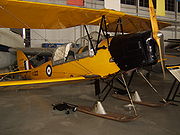
Aircrew
Aircrew are the personnel who operate an aircraft while in flight. The composition of the crew depends on the type of aircraft as well as the purpose of the flight.-Civilian:*Aviator** Pilot-in-command** First officer** Second officer** Third officer...
training program created by the United Kingdom
United Kingdom
The United Kingdom of Great Britain and Northern IrelandIn the United Kingdom and Dependencies, other languages have been officially recognised as legitimate autochthonous languages under the European Charter for Regional or Minority Languages...
, Canada
Canada
Canada is a North American country consisting of ten provinces and three territories. Located in the northern part of the continent, it extends from the Atlantic Ocean in the east to the Pacific Ocean in the west, and northward into the Arctic Ocean...
, Australia
Australia
Australia , officially the Commonwealth of Australia, is a country in the Southern Hemisphere comprising the mainland of the Australian continent, the island of Tasmania, and numerous smaller islands in the Indian and Pacific Oceans. It is the world's sixth-largest country by total area...
and New Zealand
New Zealand
New Zealand is an island country in the south-western Pacific Ocean comprising two main landmasses and numerous smaller islands. The country is situated some east of Australia across the Tasman Sea, and roughly south of the Pacific island nations of New Caledonia, Fiji, and Tonga...
, during the Second World War
World War II
World War II, or the Second World War , was a global conflict lasting from 1939 to 1945, involving most of the world's nations—including all of the great powers—eventually forming two opposing military alliances: the Allies and the Axis...
. BCATP/EATS remains the single largest aviation training program in history and was responsible for training nearly half the pilot
Aviator
An aviator is a person who flies an aircraft. The first recorded use of the term was in 1887, as a variation of 'aviation', from the Latin avis , coined in 1863 by G. de la Landelle in Aviation Ou Navigation Aérienne...
s, navigator
Flight officer
The title flight officer was a military rank used by the United States Armed Forces where it was an air force warrant officer rank. It was also an air force rank in several Commonwealth nations where it was used for female officers and was equivalent to the rank of flight lieutenant...
s, bomb aimers, air gunner
Air gunner
An air gunner a.k.a. aerial gunner is a member of an air force aircrew who operates flexible-mount or turret-mounted machine guns or autocannons in an aircraft...
s, wireless operator
Radio
Radio is the transmission of signals through free space by modulation of electromagnetic waves with frequencies below those of visible light. Electromagnetic radiation travels by means of oscillating electromagnetic fields that pass through the air and the vacuum of space...
s and flight engineer
Flight engineer
Flight engineers work in three types of aircraft: fixed-wing , rotary wing , and space flight .As airplanes became even larger requiring more engines and complex systems to operate, the workload on the two pilots became excessive during certain critical parts of the flight regime, notably takeoffs...
s who served with the Royal Air Force
Royal Air Force
The Royal Air Force is the aerial warfare service branch of the British Armed Forces. Formed on 1 April 1918, it is the oldest independent air force in the world...
(RAF), Royal Australian Air Force
Royal Australian Air Force
The Royal Australian Air Force is the air force branch of the Australian Defence Force. The RAAF was formed in March 1921. It continues the traditions of the Australian Flying Corps , which was formed on 22 October 1912. The RAAF has taken part in many of the 20th century's major conflicts...
(RAAF), Royal Canadian Air Force (RCAF) and Royal New Zealand Air Force
Royal New Zealand Air Force
The Royal New Zealand Air Force is the air arm of the New Zealand Defence Force...
(RNZAF) during the war.
Under a parallel agreement, the Joint Air Training Scheme, South Africa
South Africa
The Republic of South Africa is a country in southern Africa. Located at the southern tip of Africa, it is divided into nine provinces, with of coastline on the Atlantic and Indian oceans...
trained 33,347 aircrew for the South African Air Force
South African Air Force
The South African Air Force is the air force of South Africa, with headquarters in Pretoria. It is the world's second oldest independent air force, and its motto is Per Aspera Ad Astra...
and other Allied
Allies of World War II
The Allies of World War II were the countries that opposed the Axis powers during the Second World War . Former Axis states contributing to the Allied victory are not considered Allied states...
air forces. This number was exceeded only by Canada, which trained 131,500 personnel.
Southern Rhodesia
Southern Rhodesia
Southern Rhodesia was the name of the British colony situated north of the Limpopo River and the Union of South Africa. From its independence in 1965 until its extinction in 1980, it was known as Rhodesia...
at the time was a British Crown Colony
Crown colony
A Crown colony, also known in the 17th century as royal colony, was a type of colonial administration of the English and later British Empire....
(rather than a Dominion
Dominion
A dominion, often Dominion, refers to one of a group of autonomous polities that were nominally under British sovereignty, constituting the British Empire and British Commonwealth, beginning in the latter part of the 19th century. They have included Canada, Australia, New Zealand, Newfoundland,...
) and was not involved in the negotiation or signing of the BCATP; the Southern Rhodesia Air Force was subsumed by the RAF in 1940. However, Rhodesia provided significant EATS facilities and contributed personnel to British units.
Students from many other countries attended schools under these plans, including Argentina
Argentina
Argentina , officially the Argentine Republic , is the second largest country in South America by land area, after Brazil. It is constituted as a federation of 23 provinces and an autonomous city, Buenos Aires...
, Belgium
Belgium
Belgium , officially the Kingdom of Belgium, is a federal state in Western Europe. It is a founding member of the European Union and hosts the EU's headquarters, and those of several other major international organisations such as NATO.Belgium is also a member of, or affiliated to, many...
, Ceylon, Czechoslovakia
Czechoslovakia
Czechoslovakia or Czecho-Slovakia was a sovereign state in Central Europe which existed from October 1918, when it declared its independence from the Austro-Hungarian Empire, until 1992...
, Denmark
Denmark
Denmark is a Scandinavian country in Northern Europe. The countries of Denmark and Greenland, as well as the Faroe Islands, constitute the Kingdom of Denmark . It is the southernmost of the Nordic countries, southwest of Sweden and south of Norway, and bordered to the south by Germany. Denmark...
, Finland
Finland
Finland , officially the Republic of Finland, is a Nordic country situated in the Fennoscandian region of Northern Europe. It is bordered by Sweden in the west, Norway in the north and Russia in the east, while Estonia lies to its south across the Gulf of Finland.Around 5.4 million people reside...
, Fiji
Fiji
Fiji , officially the Republic of Fiji , is an island nation in Melanesia in the South Pacific Ocean about northeast of New Zealand's North Island...
, France
France
The French Republic , The French Republic , The French Republic , (commonly known as France , is a unitary semi-presidential republic in Western Europe with several overseas territories and islands located on other continents and in the Indian, Pacific, and Atlantic oceans. Metropolitan France...
, Greece
Greece
Greece , officially the Hellenic Republic , and historically Hellas or the Republic of Greece in English, is a country in southeastern Europe....
, the Netherlands
Netherlands
The Netherlands is a constituent country of the Kingdom of the Netherlands, located mainly in North-West Europe and with several islands in the Caribbean. Mainland Netherlands borders the North Sea to the north and west, Belgium to the south, and Germany to the east, and shares maritime borders...
, Norway
Norway
Norway , officially the Kingdom of Norway, is a Nordic unitary constitutional monarchy whose territory comprises the western portion of the Scandinavian Peninsula, Jan Mayen, and the Arctic archipelago of Svalbard and Bouvet Island. Norway has a total area of and a population of about 4.9 million...
, Poland
Poland
Poland , officially the Republic of Poland , is a country in Central Europe bordered by Germany to the west; the Czech Republic and Slovakia to the south; Ukraine, Belarus and Lithuania to the east; and the Baltic Sea and Kaliningrad Oblast, a Russian exclave, to the north...
and the United States
United States
The United States of America is a federal constitutional republic comprising fifty states and a federal district...
.
Background
The United KingdomUnited Kingdom
The United Kingdom of Great Britain and Northern IrelandIn the United Kingdom and Dependencies, other languages have been officially recognised as legitimate autochthonous languages under the European Charter for Regional or Minority Languages...
was considered an unsuitable location for air training, due to the possibility of enemy attack, the strain caused by wartime traffic at airfields and the unpredictable climate, so the plan called for the facilities in the Dominion
Dominion
A dominion, often Dominion, refers to one of a group of autonomous polities that were nominally under British sovereignty, constituting the British Empire and British Commonwealth, beginning in the latter part of the 19th century. They have included Canada, Australia, New Zealand, Newfoundland,...
s to train British and each others' aircrews.
Negotiations regarding joint training, between the four governments concerned, took place in Ottawa
Ottawa
Ottawa is the capital of Canada, the second largest city in the Province of Ontario, and the fourth largest city in the country. The city is located on the south bank of the Ottawa River in the eastern portion of Southern Ontario...
during the first few months of the war. On 17 December 1939, they signed the Air Training Agreement – often referred to as the "Riverdale Agreement", after the UK representative at the negotiations, Lord Riverdale
Arthur Balfour, 1st Baron Riverdale
Arthur Balfour, 1st Baron Riverdale GBE , known as Sir Arthur Balfour, 1st Baronet, from 1929 to 1935, was a British steel manufacturer.Balfour was the son of Herbert Balfour...
.
The British Commonwealth Air Training Plan was viewed as an incredibly ambitious programme. The 1939 agreement stated that the training was to be similar to that of the RAF: three Initial Training Schools, thirteen Elementary Flying Training Schools, sixteen Service Flying Training Schools, ten Air Observer Schools, ten Bombing and Gunnery Schools, two Air Navigation Schools and four Wireless Schools were to be created.
The agreement called for the training of nearly 50,000 aircrew each year, for as long as necessary: 22,000 aircrew from Great Britain, 13,000 from Canada, 11,000 from Australia and 3,300 from New Zealand. Under the agreement, air crews received elementary training in various Commonwealth countries before travelling to Canada for advanced courses. Training costs were to be divided between the four governments.
Article XV of the agreement stipulated that graduates belonging to Dominion air forces, where they were assigned to service with the RAF, should be placed in new squadrons identified with the RAAF, RCAF and RNZAF. These units later became known as "Article XV squadrons
Article XV squadrons
Article XV squadrons were Australian, Canadian, and New Zealand air force squadrons formed from graduates of the British Commonwealth Air Training Plan , during World War II....
". Articles XVI and XVII stipulated that the UK government would be wholly responsible for the pay and entitlements of graduates, once they were placed with RAF or Article XV units. Some pre-war/regular RAAF and RCAF squadrons also served under RAF operational control, while New Zealand and Rhodesian personnel were frequently assigned to RAF squadrons with the honorific
Honorific
An honorific is a word or expression with connotations conveying esteem or respect when used in addressing or referring to a person. Sometimes, the term is used not quite correctly to refer to an honorary title...
s of "(NEW ZEALAND)" and "(RHODESIA)" in their names. However, in practice — and technically in contravention of Article XV — most personnel from other Commonwealth countries, while they were under RAF operational control, were assigned to British units.
Countries involved
Australia
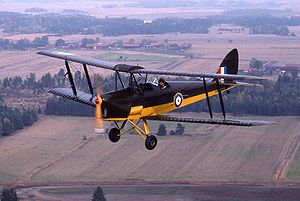
Prior to the inception of the Empire Air Training Scheme (as it was commonly known in Australia), the RAAF trained only about 50 pilots per year. Under the Air Training Agreement, Australia undertook to provide 28,000 aircrew over three years, representing 36% of the total number trained by the BCATP. By 1945, more than 37,500 Australian aircrew had completed training; a majority of these, over 27,300, graduated from schools in Australia.During 1940, Royal Australian Air Force (RAAF) schools were established across Australia to support EATS in Initial Training, Elementary Flying Training, Service Flying Training, Air Navigation, Air Observer, Bombing and Gunnery and Wireless Air Gunnery. The first flying course started on 29 April 1940. Keith Chisholm
Keith Bruce Chisholm
Flight Lieutenant Keith Bruce Chisholm M.C, D.F.M was a distinguished Australian pilot who served in 452 squadron during World War II. He was recognized for his exploits with the Polish and French resistance, after being shot down over France, in October 1941.-Early career:Chisholm was born in...
(who later became an ace
Flying ace
A flying ace or fighter ace is a military aviator credited with shooting down several enemy aircraft during aerial combat. The actual number of aerial victories required to officially qualify as an "ace" has varied, but is usually considered to be five or more...
and served with No. 452 Squadron RAAF
No. 452 Squadron RAAF
No. 452 Squadron is a Royal Australian Air Force air traffic control unit. It was originally formed in 1941 fighter unit formed in accordance with Article XV of the Empire Air Training Scheme during World War II, in England. The squadron flew Supermarine Spitfires for the entire war, initially over...
over Europe and the Pacific) was the first Australian to be trained under EATS.
During mid-1940, some RAAF trainees received advanced training at RAF facilities in Southern Rhodesia
Southern Rhodesia
Southern Rhodesia was the name of the British colony situated north of the Limpopo River and the Union of South Africa. From its independence in 1965 until its extinction in 1980, it was known as Rhodesia...
. The first contingent to receive advanced training in Canada embarked on 14 November 1940. For a period afterwards, most RAAF aircrews received advanced training in Canada.
In January 1942, Clive Caldwell
Clive Caldwell
Group Captain Clive Robertson Caldwell DSO, DFC & Bar was the leading Australian air ace of World War II. He is officially credited with shooting down 28.5 enemy aircraft in over 300 operational sorties. In addition to his official score, he has been ascribed six probables and 15 damaged...
– the highest-scoring Australian ace of the war – became the first BCATP/EATS graduate to command a RAF squadron (112 Sqn
No. 112 Squadron RAF
No. 112 Squadron was a squadron of the Royal Air Force. It served in both the First World War and Second World War and was active for three periods during the Cold War. It is nicknamed "The Shark Squadron", an allusion to the fact that it was the first unit from any air force to use the famous...
).
Following the outbreak of the Pacific War
Pacific War
The Pacific War, also sometimes called the Asia-Pacific War refers broadly to the parts of World War II that took place in the Pacific Ocean, its islands, and in East Asia, then called the Far East...
, a majority of RAAF aircrews completed their training in Australia and served with RAAF units in the South West Pacific Theatre
South West Pacific theatre of World War II
The South West Pacific Theatre, technically the South West Pacific Area, between 1942 and 1945, was one of two designated area commands and war theatres enumerated by the Combined Chiefs of Staff of World War II in the Pacific region....
. In addition, an increasing number of Australian personnel were transferred from Europe and the Mediterranean to RAF squadrons in the South East Asian Theatre
South-East Asian theatre of World War II
The South-East Asian Theatre of World War II was the name given to the campaigns of the Pacific War in Burma , Ceylon, India, Thailand, Indochina, Malaya and Singapore. Conflict in the theatre began when the Empire of Japan invaded Thailand and Malaya from bases located in Indochina on December 8,...
. Some Article XV squadrons were also transferred to RAAF or RAF formations involved in the Pacific War. Nevertheless, a significant proportion of RAAF personnel remained in Europe and RAAF Article XV squadrons continued to be formed there.
By early 1944, the flow of RAAF replacement personnel to Europe had begun to outstrip demand and – following a request by the UK government – was wound back significantly. Australian involvement was effectively terminated in October 1944, although it was not formally suspended until 31 March 1945.
Canada
Canada was chosen as the primary location for "The Plan" due to ideal weather and open spaces for large-scale flying training, ample supplies of fuel, wide open spaces suitable for flight and navigation training, industrial facilities for the production of trainer aircraft, parts and supplies, the lack of any threat from LuftwaffeLuftwaffe
Luftwaffe is a generic German term for an air force. It is also the official name for two of the four historic German air forces, the Wehrmacht air arm founded in 1935 and disbanded in 1946; and the current Bundeswehr air arm founded in 1956....
and Japan
Empire of Japan
The Empire of Japan is the name of the state of Japan that existed from the Meiji Restoration on 3 January 1868 to the enactment of the post-World War II Constitution of...
ese fighter aircraft
Fighter aircraft
A fighter aircraft is a military aircraft designed primarily for air-to-air combat with other aircraft, as opposed to a bomber, which is designed primarily to attack ground targets...
and its relative proximity to both the European
European Theatre of World War II
The European Theatre of World War II was a huge area of heavy fighting across Europe from Germany's invasion of Poland on September 1, 1939 until the end of the war with the German unconditional surrender on May 8, 1945...
and Pacific theatre
Pacific War
The Pacific War, also sometimes called the Asia-Pacific War refers broadly to the parts of World War II that took place in the Pacific Ocean, its islands, and in East Asia, then called the Far East...
s.
The government agreed in December 1939 to join the British Commonwealth Air Training Plan, operate its bases in Canada, and pick up a large proportion of the costs. Events turned the scheme into a huge operation, one that cost Canada $1.6 billion of a total cost of $2.2 billion, and employed 104,000 Canadians in airbases across the land.
The W.L.M. King government saw involvement in the BCATP as a means of keeping Canadians at home, but more importantly, it erased demands for a large expeditionary force and buried the politically divisive issue of overseas conscription. Negotiating the agreement and agreeing upon aspects of involvement was notably difficult. Canada agreed to accept most of the costs of the plan but in return insisted British pronouncement that air training would be Canada's primary war effort. Yet another negotiation point was the British expectation that the RAF would absorb Canadian air training graduates without restrictions, as in World War One, and distribute them across the RAF. W.L.M. King demanded that Canadian airmen be identified as member of the RCAF with distinct uniforms and shoulder badges.
The RCAF would run the plan in Canada, but to satisfy RAF concerns, Robert Leckie
Robert Leckie (aviator)
Air Marshal Robert Leckie CB, DSO, DSC, DFC, CD was a Canadian aviation pioneer and Chief of the Air Staff of the Royal Canadian Air Force from 1944 to 1947.- First World War service :...
, a senior RAF commander (at the time in charge of RAF squadrons in Malta
Malta
Malta , officially known as the Republic of Malta , is a Southern European country consisting of an archipelago situated in the centre of the Mediterranean, south of Sicily, east of Tunisia and north of Libya, with Gibraltar to the west and Alexandria to the east.Malta covers just over in...
) and a Canadian, was posted to Ottawa as Director of Training. From 1940 he directed BCATP training.
At its height of the British Commonwealth Air Training Plan, 131,533 Allied pilots and aircrew were trained in Canada, 72,835 of which were Canadian. At the plan's high point in late 1943, an organization of over 100,000 administrative personnel operated 107 schools and 184 other supporting units at 231 locations all across Canada.
Infrastructure development including erecting "some 8,300 buildings of which 700 were hangars or of hangar-type construction." Fuel storage totalling more than 26 million USgals (98,420.7 m³) was installed along with 300 miles of water mains and a similar length of sewer mains laid, involving 2,000,000 cubic yards of excavation. A total of 100 sewage treatment and disposal plants and 120 water pumping stations were completed; and more than 2,000 miles of main power lines and 535 miles of underground electrical cable placed, servicing a total connected electrical power load of over 80,700 horsepower.
In late 1944, the Air Ministry announced the winding-up of the plan, since the Commonwealth air forces had long had a surplus of air crews. At the conclusion of the war, over 167,000 students, including over 50,000 pilots, trained in Canada under the program from May 1940 to March 1945. While the majority of those who successfully completed the program went on to serve in the RAF, over half (72,835) of the 131,553 graduates were Canadians.
New Zealand
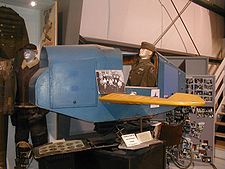
During the war, the RNZAF contributed 2,743 fully trained pilots to serve with the RAF in Europe, the Middle East, and Far East. Another 1,521 pilots who completed their training in New Zealand were retained in country; either as instructors, staff pilots, or manning operational squadrons formed during the latter half of the war. In 1940, before the British Commonwealth Air Training Plan was fully developed, New Zealand also trained 183 observers and 395 air gunners for the RAF. From 1943 onwards, the training of wireless operator/air gunners, and navigators was carried on in New Zealand for Pacific operations. In addition, some 2,910 pilots were trained to elementary standards and sent to Canada to continue their training. More than 2,700 wireless operator/air-gunners, 1,800 navigators, and 500 bombardiers passed through the Initial Training Wing before proceeding to Canada. Of the 131,000 trainees who graduated in Canada under the Commonwealth Air Training Plan, New Zealanders formed 5.3%.South Africa
South African Air Force
The South African Air Force is the air force of South Africa, with headquarters in Pretoria. It is the world's second oldest independent air force, and its motto is Per Aspera Ad Astra...
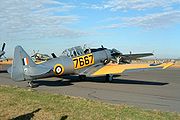
(SAAF) expansion plans, the start of the Second World War in 1939 caught the SAAF unprepared. New flying schools had been established at Pretoria
Pretoria
Pretoria is a city located in the northern part of Gauteng Province, South Africa. It is one of the country's three capital cities, serving as the executive and de facto national capital; the others are Cape Town, the legislative capital, and Bloemfontein, the judicial capital.Pretoria is...
, Germiston, Bloemfontein
Bloemfontein
Bloemfontein is the capital city of the Free State Province of South Africa; and, as the judicial capital of the nation, one of South Africa's three national capitals – the other two being Cape Town, the legislative capital, and Pretoria, the administrative capital.Bloemfontein is popularly and...
and Baragwanath, while a training command under Lieutenant Colonel
Lieutenant colonel
Lieutenant colonel is a rank of commissioned officer in the armies and most marine forces and some air forces of the world, typically ranking above a major and below a colonel. The rank of lieutenant colonel is often shortened to simply "colonel" in conversation and in unofficial correspondence...
W.T.B. Tasker would oversee the SAAF’s overall training programme. With the establishment of the Joint Air Training Scheme (JATS) 38 South African–based air schools would be employed to train Royal Air Force, SAAF and other allied air and ground crews. Aircraft and other equipment required for the training was provided to South Africa free of charge by the United Kingdom. Under this scheme, the SAAF, by September 1941, increased the total number of military aircraft to 1,709 while the personnel strength had grown to 31,204, including 956 pilots. During its five year existence, the JATS was ultimately to turn out a total of 33,347 aircrew, including 12,221 SAAF personnel.
Southern Rhodesia
On the outbreak of war in September 1939, the Government of Southern RhodesiaSouthern Rhodesia
Southern Rhodesia was the name of the British colony situated north of the Limpopo River and the Union of South Africa. From its independence in 1965 until its extinction in 1980, it was known as Rhodesia...
made an offer to the British Air Ministry to run a flying school and train personnel to man three squadrons (44
No. 44 Squadron RAF
No. 44 Squadron of the Royal Air Force is no longer operational. For most of its history it served as a heavy bomber squadron.-History:...
, 237
No. 237 Squadron RAF
No. 237 Squadron was a Royal Air Force aircraft squadron. During the Second World War the unit was formed from No. 1 Squadron Southern Rhodesian Air Force for operations in North Africa.-History:...
and 266
No. 266 Squadron RAF
-World War I:The squadron was formed from No's 437 and 438 Flights at Mudros, Greece on 27 September 1918 to carry out anti-submarine patrols in that area, flying Short 184s and 320s along with Felixtowe F.3s. In February 1919 it was transferred to the Caucasus on HMS Engadine. It operated from...
(Rhodesia) Squadrons), which was duly accepted. The Rhodesian Air Training Group (RATG), operating 1940–1945, was set up as part of the overall Commonwealth Air Training Plan. In January 1940 the Government announced the creation of a Department of Air, completely separate from that of Defence and appointed Ernest Lucas Guest
Ernest Lucas Guest
Sir Ernest Lucas Guest KBE, CMG, CVO, LLD was a Rhodesian statesman, lawyer and soldier. His grandfather moved from Kidderminster, England to South Africa, where he was born in Grahamstown. At the outbreak of the Second Boer War, although he was underage, he enlisted and saw active service...
as Minister of Air.MacDonald 1947, p. 33. Guest inaugurated and administered what became the second largest Empire Air Training Scheme, beginning with the establishment of three units at Salisbury, Bulawayo and Gwelo, each consisting of a preliminary and an advanced training school.
Rhodesia was the last of the Commonwealth countries to enter the Empire Air Training Scheme and the first to turn out fully qualified pilots. No. 25 Elementary Flying Training School at Belvedere, Salisbury
Harare
Harare before 1982 known as Salisbury) is the largest city and capital of Zimbabwe. It has an estimated population of 1,600,000, with 2,800,000 in its metropolitan area . Administratively, Harare is an independent city equivalent to a province. It is Zimbabwe's largest city and its...
opened on 24 May 1940. The original programme of an initial training wing and six schools was increased to 10 flying training schools and bombing, navigation and gunnery school and a school for the training of flying instructors as well as additional schools for bomb aimers, navigators and air gunners, including stations at Cranbourne (Salisbury), Norton, Gwelo and Heany (near Bulawayo). To relieve congestion at the air stations, six relief landing grounds for landing and takeoff instruction and two air firing and bombing ranges were established. Two aircraft and engine repair and overhaul depots were set up as well as the Central Maintenance Unit to deal with bulk stores for the whole group.
The trainees came mainly from Great Britain but also from Australia, Canada, South Africa, New Zealand, USA, Yugoslavia, Greece, France, Poland, Czechoslovakia, Kenya, Uganda, Tanganyika, Fiji and Malta. There were also pupils from the Royal Hellenic Air Force in training. Over 7,600 pilots and 2,300 navigators were trained by the RATG during the war.
United States
By mid-1940, Canadian flying instructors were primarily employed in the BCATP and in order to increase the numbers of flying instructors, the RCAF began a campaign to recruit American pilots.Air Marshall W.A. ("Billy") BishopBilly Bishop
Air Marshal William Avery "Billy" Bishop VC, CB, DSO & Bar, MC, DFC, ED was a Canadian First World War flying ace, officially credited with 72 victories, making him the top Canadian ace, and according to some sources, the top ace of the British Empire.-Early life:Bishop was born in Owen Sound,...
was instrumental in setting up a clandestine recruiting organization in the United States. In response to the campaign, Americans began crossing the border, appearing at the nearest recruiting centres "in such members that they caused some embarrassment to Canadian authorities. Occasionally they were followed by worried parents who, sometimes successfully and sometimes not, pleaded with them to forget about foreign wars and go back to school." President Roosevelt when confronted with this mass exodus, ordered that Americans going to Canada to join the RCAF or RAF, would be granted exemption by the US draft board. Prior to Pearl Harbor
Pearl Harbor
Pearl Harbor, known to Hawaiians as Puuloa, is a lagoon harbor on the island of Oahu, Hawaii, west of Honolulu. Much of the harbor and surrounding lands is a United States Navy deep-water naval base. It is also the headquarters of the U.S. Pacific Fleet...
, training centres were made available for the RAF; by war's end, 16,000 RAF aircrew were trained in the United States. After Pearl Harbor, 1,759 American members of the RCAF transferred to the armed forces of the United States, another 2,000 transferred later on, and about 5,000 completed their service with the RCAF.
Canada
The British Commonwealth Air Training Plan illustrated that the Commonwealth still had some military meaning during the Second World War and was one of Canada's major contributions to the early war effort. The BCATP was an impressive and uniting national achievement. Canada became, during the Second World War, one of the great air training centres contributing more than 130,000 trained aircrew to the Allied Cause. The federal government paid three quarters of the total bill, an amount in excess of two and a quarter billion dollars.On the third anniversary of the British Commonwealth Air Training Plan, in a message ghost written by Lester B. Pearson, serving at the Canadian legation in Washington, US president Franklin D. Roosevelt
Franklin D. Roosevelt
Franklin Delano Roosevelt , also known by his initials, FDR, was the 32nd President of the United States and a central figure in world events during the mid-20th century, leading the United States during a time of worldwide economic crisis and world war...
enthused that the BCATP had transformed Canada into the "aerodrome of democracy", a play on his earlier description of the United States
United States
The United States of America is a federal constitutional republic comprising fifty states and a federal district...
as "the Arsenal of Democracy."
Various aircraft, transport and training artifacts may be seen at the Commonwealth Air Training Plan Museum
Commonwealth Air Training Plan Museum
The Commonwealth Air Training Plan Museum is an aviation museum located at Brandon Municipal Airport, Brandon, Manitoba. It is dedicated to the memory of the airmen from the British Commonwealth Air Training Plan, who trained at World War II air stations across Canada...
, located in Brandon, Manitoba
Brandon, Manitoba
Brandon is the second largest city in Manitoba, Canada, and is located in the southwestern area of the province. Brandon is the largest city in the Westman region of Manitoba. The city is located along the Assiniboine River. Spruce Woods Provincial Park and CFB Shilo are a relatively short distance...
.
As Canada was the main participant, the legacy of the plan there included a strong postwar aviation sector and many new or improved airports across the country, the majority of which are still in use. The classic BCATP airport consisted of three runways, each typically 2,500 ft (760 m) in length, arranged in a triangle
Class A airfield
Class A airfields were military installations originally built for the Royal Air Force in the Second World War. Several were transferred to the U.S...
so that aircraft could always land (more-or-less) into the wind — that was critically important at a time when most light training aircraft (such as the North American Harvard
T-6 Texan
The North American Aviation T-6 Texan was a single-engine advanced trainer aircraft used to train pilots of the United States Army Air Forces, United States Navy, Royal Air Force and other air forces of the British Commonwealth during World War II and into the 1950s...
) were taildraggers
Conventional landing gear
thumb|The [[Piper PA-18|Piper Super Cub]] is a popular taildragger aircraft.thumb|right|A [[Cessna 150]] converted to taildragger configuration by installation of an after-market modification kit....
, which are difficult to land in strong cross-winds.
That triangular runway outline is perfectly preserved at Gananoque Airport
Gananoque Airport
Gananoque Airport, , is located northwest of the town of Gananoque, Ontario, Canada, in Canada's busy Quebec City-Windsor Corridor. It is currently a major centre for skydiving, as well as one of the three Canadian airports serving the Thousand Islands .-History:The Gananoque Airport...
, but is still easily visible under later runway extensions at most Canadian BCATP airports, such as Kingston/Norman Rogers Airport
Kingston/Norman Rogers Airport
Kingston Airport or Kingston/Norman Rogers Airport, , is an airport located west of the core of Kingston, Ontario, Canada.The airport is named after former MP Norman McLeod Rogers , Minister of Labour and then National Defence in Prime Minister William Lyon Mackenzie King's cabinet...
, Boundary Bay Airport
Boundary Bay Airport
Boundary Bay Airport is located beside Boundary Bay and east of Ladner in Delta, British Columbia, Canada, south of Vancouver and close to the U.S. border. The airport, which opened 11 July 1983, serves mostly general aviation and includes facilities for aircraft maintenance, flight training,...
and Pendelton, Ontario airport. Later modifications have often resulted in one runway being lengthened to handle larger aircraft such as jets, and in less-used runways being closed or converted to taxiways.
The BCATP provided an enormous and continuing economic boost, particularly in the Western provinces that were still recovering from the decade long depression.The final report of the BCATP Supervisory Board calculated that “more than 3,750 members of the RAF, RAAF, RNZAF and Allied nationals under RAF quotas married Canadian girls,” many of whom remained in Canada to raise families.
Elizabeth II of the United Kingdom
Elizabeth II is the constitutional monarch of 16 sovereign states known as the Commonwealth realms: the United Kingdom, Canada, Australia, New Zealand, Jamaica, Barbados, the Bahamas, Grenada, Papua New Guinea, the Solomon Islands, Tuvalu, Saint Lucia, Saint Vincent and the Grenadines, Belize,...
unveiled The Ottawa Memorial
The Ottawa Memorial
The Ottawa Memorial is a monument in Ottawa, Ontario, that "commemorates by name almost 800 men and women who lost their lives while serving or training with the Air Forces of the Commonwealth in Canada, the West Indies and the United States and who have no known grave...
, a monument erected to "(commemorate) by name, some 800 men and women who lost their lives while serving or training with the Air Forces of the Commonwealth in Canada, the West Indies and the United States
United States
The United States of America is a federal constitutional republic comprising fifty states and a federal district...
and who have no known grave
War grave
A war grave is a burial place for soldiers or civilians who died during military campaigns or operations. The term does not only apply to graves: ships sunk during wartime are often considered to be war graves, as are military aircraft that crash into water...
."
The Commonwealth Air Training Plan (CATP) Museum is a non-profit, charitable organization in Brandon, Manitoba
Brandon, Manitoba
Brandon is the second largest city in Manitoba, Canada, and is located in the southwestern area of the province. Brandon is the largest city in the Westman region of Manitoba. The city is located along the Assiniboine River. Spruce Woods Provincial Park and CFB Shilo are a relatively short distance...
, founded and operated by volunteers. The museum is dedicated to the preservation of the history of the British Commonwealth Air Training Plan and serves as a unique memorial to those airmen who trained and served, and especially those who died, while serving their country in the air war of 1939–1945. This is the only museum in the world dedicated solely to this goal, located in Manitoba where so much of the training was carried out. The collection includes 14 aircraft on display with the museum's Auster, Harvard, Cornell and Stinson HW-75 airworthy.
The Commonwealth Air Training Plan may also be regarded as the precursor of post-war international air training schemes in Canada, many of them involving personnel from other NATO powers. These include the NATO Air Training Plan
NATO Air Training Plan
The NATO Air Training Plan was an aircrew training program which ran from 1950 - 1958, authorized by NATO, and implemented by the Royal Canadian Air Force...
(1950–1957) that graduated 4,600 pilots and navigators from 10 countries. Later bilateral arrangements with individual NATO powers (1959–1983), the Military Training Assistance Plan, which has trained aircrews from developing countries since 1964 and NATO Flying Training in Canada
NATO Flying Training in Canada
NATO Flight Training in Canada is a military flight training program for NATO and allied air forces provided by the Canadian Forces.Located at 15 Wing, CFB Moose Jaw in Moose Jaw, Saskatchewan and 4 Wing, CFB Cold Lake, Alberta, the program is delivered as a cooperative operation between a...
(NFTC), since 1998, a partnership of the Canadian Forces, Bombardier Aerospace Corporation and participating air forces. In 2005, the Canadian Department of National Defence awarded a 22-year, $1.77-billion contract to an Allied Wings
Allied Wings
Allied Wings Limited Partnership operates the Canada Wings Aviation Training Centre located in Southport, Manitoba.The 22 year contract was announced on 30 March 2005 by the Minister of National Defence and will provide flying training support at 3 Canadian Forces Flying Training School.Through the...
team led by Kelowna Flightcraft Ltd. of Kelowna, British Columbia, to provide flying training and support services to the Canadian Forces and international allies. These services are provided out of the Canada Wings Aviation Training Centre
Allied Wings
Allied Wings Limited Partnership operates the Canada Wings Aviation Training Centre located in Southport, Manitoba.The 22 year contract was announced on 30 March 2005 by the Minister of National Defence and will provide flying training support at 3 Canadian Forces Flying Training School.Through the...
in the Southport Aerospace Centre
Portage La Prairie/Southport Airport
Portage la Prairie/Southport Airport, , is located adjacent to Portage la Prairie, Manitoba, Canada. It is the Southport Aerospace Centre, a commercial-industrial centre.. It is now commercially operated. It was formerly Canadian Forces Base Portage la Prairie....
near Portage la Prairie, Manitoba
Manitoba
Manitoba is a Canadian prairie province with an area of . The province has over 110,000 lakes and has a largely continental climate because of its flat topography. Agriculture, mostly concentrated in the fertile southern and western parts of the province, is vital to the province's economy; other...
.
South Africa
The South African Air Force Memorial at Swartkop, Tshwane includes a memorial to the Royal Air ForceRoyal Air Force
The Royal Air Force is the aerial warfare service branch of the British Armed Forces. Formed on 1 April 1918, it is the oldest independent air force in the world...
members who died is South Africa
South Africa
The Republic of South Africa is a country in southern Africa. Located at the southern tip of Africa, it is divided into nine provinces, with of coastline on the Atlantic and Indian oceans...
during the Joint Air Training Scheme.
The Port Elizabeth branch of the South African Air Force Museum
South African Air Force Museum
The South African Air Force Museum houses, exhibits and restores material related to the history of the South African Air Force. The Museum is divided into three locations, AFB Swartkop outside Pretoria, AFB Ysterplaat in Cape Town and at the Port Elizabeth airport.-AFB Swartkop:Swartkop is the...
is still housed in the original 42-Air School Air Gunnery Training Centre used during the Joint Air Training Scheme.
Australia
The "Scheme" cost Australia about £100,000,000 for her commitments. In addition to the Empire Air Training Scheme, wartime demands had led to training for home requirements. The RAAF built air training and ground training schools, airfields and specialized schools that served the country well in wartime as well as postwar. All the service flying training schools were disbanded, except Uranquinty. The Uranquinty Base continued to provide refresher courses for qualified pilots and even briefly became a migrant centre in the late 1940s until it reopened as No 1 Basic Flying Training School between 1951 and 1959 when it finally closed. The Wireless Air Gunners' School at Ballarat remained as the RAAF Radio School until 1961.A memorial was dedicated to 5 Service Flying Training School RAAF, within the Empire Air Training Scheme at Uranquinty, 19 September 1999.
EATS pilot training schools at Evans Head, New South Wales
Evans Head, New South Wales
Evans Head is a town in the Northern Rivers region of New South Wales, Australia in Richmond Valley Shire. At the 2006 census, Evans Head had a population of 2,631 people. It is 726 kilometres north of Sydney, and 11 kilometres east off the Pacific Highway from Woodburn...
, Cunderdin, Western Australia
Cunderdin, Western Australia
Cunderdin is a town located in the Wheatbelt region of Western Australia 156 km east of Perth, on Great Eastern Highway.- History :The first European visitor to the area was Charles Cooke Hunt, who explored the area in 1864 and recorded the name Cunderdin, from the Aboriginal name of a nearby...
, Point Cook, Victoria
RAAF Williams
RAAF Williams comprises the two bases of Point Cook and Laverton. Both establishments previously existed as separate RAAF Bases until 1999 when they were amalgamated to form RAAF Williams...
, Essendon, Victoria
Essendon Airport
Essendon Airport is located at Essendon, in Melbourne's northern suburbs, Victoria, Australia. It is located next to the Tullamarine Freeway on , from the Melbourne Central Business District and from Melbourne Airport.-History:...
and Laverton, Victoria are on state or national heritage lists. Wireless operator/air gunners' schools at Maryborough, Queensland
Maryborough, Queensland
Maryborough is a city located on the Mary River in South East Queensland, Australia, approximately north of the state capital, Brisbane. The city is serviced by the Bruce Highway, and has a population of approximately 22,000 . It is closely tied to its neighbour city Hervey Bay which is...
, and Ballarat, Victoria
Ballarat, Victoria
Ballarat is a city in the state of Victoria, Australia, approximately west-north-west of the state capital Melbourne situated on the lower plains of the Great Dividing Range and the Yarrowee River catchment. It is the largest inland centre and third most populous city in the state and the fifth...
, are currently recommended for state heritage listing.
See also
- Article XV squadronsArticle XV squadronsArticle XV squadrons were Australian, Canadian, and New Zealand air force squadrons formed from graduates of the British Commonwealth Air Training Plan , during World War II....
- List of British Commonwealth Air Training Plan facilities in Australia
- List of British Commonwealth Air Training Plan facilities in Canada
- List of British Commonwealth Air Training Plan facilities in South Africa
- List of British Commonwealth Air Training Plan facilities in Southern Rhodesia
- :Category:Airports of the British Commonwealth Air Training Plan
External links
- BCATP Air Station Researchers Network
- "Thematic Study: WWII Aerodromes and associated structures in New South Wales
- Commonwealth Air Training Plan Museum
- Veterans Affairs Canada – Commonwealth Air Training Plan
- Photographs of BCATP memorial, Middleton, Nova Scotia
- Photographs of BCATP memorial, Kingston, Nova Scotia
- BCATP School Listing and Photos
- "Wings for an Empire" (Time magazine, 13 November 1939)