
All Topics  
Turtle

 
Turtle

   Email Print
   Bookmark   Link


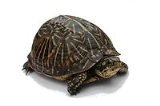
Turtle


Turtles are reptile
Reptile

Reptiles, or members of the class Reptilia, are air-breathing, cold-blooded vertebrates that have skin covered in scale as opposed to hair or feathers....
s of the order
Order (biology)

In Biological classification used in biology, the order is a taxonomic rank between class and family . The superorder is a rank between class and order....
 Testudines (the crown group
Crown group

A crown group is the smallest monophyletic group, or "clade", to contain the last common ancestor of all members, and all of that ancestor's descendants....
 of the superorder Chelonia), most of whose body is shielded by a special bony
Bone

Bones are rigid organ that form part of the endoskeleton of vertebrates. They function to move, support, and protect the various organs of the body, produce red blood cell and white blood cells and store minerals....
 or cartilaginous
Cartilage

Cartilage is a type of dense connective tissue. It is composed of specialized cells called chondrocyte that produce a large amount of extracellular matrix composed of collagen fibers, abundant ground substance rich in proteoglycan, and elastin fibers....
 shell developed from their rib
Rib

In vertebrate anatomy, ribs are the long curved bones which form the ribcage. In most vertebrates, ribs surround the chest and protect the lungs, heart, and other internal Organ s of the thorax....
s. "Turtle" may either refer to the Testudines as a whole, or to particular Testudines which make up a form taxon
Form taxon

Form taxon is a biological term with two uses:In general taxonomy, it is a kind of wastebasket taxon, either a taxon that is not a natural group but united by shared plesiomorphies, or a presumably artificial group of organisms whose true relationships are not known, being obscured by ecomorphological similarity....
 that is not monophyletic — see also sea turtle
Sea turtle

Sea turtles are turtles found in all the world's oceans except the Arctic Ocean. There are seven living species of sea turtles: Flatback Sea Turtle, Green Sea Turtle, Hawksbill turtle, Kemp's Ridley, leatherback sea turtle, Loggerhead Sea Turtle and Olive Ridley Sea Turtle....
, terrapin
Terrapin

A terrapin is a chelonian living in freshwater or brackish water. The name strictly belongs to the diamondback terrapin Malaclemys terrapin, but in British English the name is widely applied to other freshwater turtles such as red-eared sliders, Trachemys scripta elegans....
, tortoise
Tortoise

Tortoises or land turtles are land-dwelling reptiles of the family of Testudinidae, order Turtle. Like their marine cousins, the sea turtles, tortoises are shielded from predators by a shell....
, and the discussion below.

The order Testudines includes both extant (living) and extinct
Extinction

In biology and ecology, extinction is the death of every member of a species or group of taxon. The moment of extinction is generally considered to be the death of the last individual of that species ....
 species.


Discussion
Ask a question about 'Turtle'
Start a new discussion about 'Turtle'
Answer questions from other users
Full Discussion Forum


Encyclopedia


Turtles are reptile
Reptile

Reptiles, or members of the class Reptilia, are air-breathing, cold-blooded vertebrates that have skin covered in scale as opposed to hair or feathers....
s of the order
Order (biology)

In Biological classification used in biology, the order is a taxonomic rank between class and family . The superorder is a rank between class and order....
 Testudines (the crown group
Crown group

A crown group is the smallest monophyletic group, or "clade", to contain the last common ancestor of all members, and all of that ancestor's descendants....
 of the superorder Chelonia), most of whose body is shielded by a special bony
Bone

Bones are rigid organ that form part of the endoskeleton of vertebrates. They function to move, support, and protect the various organs of the body, produce red blood cell and white blood cells and store minerals....
 or cartilaginous
Cartilage

Cartilage is a type of dense connective tissue. It is composed of specialized cells called chondrocyte that produce a large amount of extracellular matrix composed of collagen fibers, abundant ground substance rich in proteoglycan, and elastin fibers....
 shell developed from their rib
Rib

In vertebrate anatomy, ribs are the long curved bones which form the ribcage. In most vertebrates, ribs surround the chest and protect the lungs, heart, and other internal Organ s of the thorax....
s. "Turtle" may either refer to the Testudines as a whole, or to particular Testudines which make up a form taxon
Form taxon

Form taxon is a biological term with two uses:In general taxonomy, it is a kind of wastebasket taxon, either a taxon that is not a natural group but united by shared plesiomorphies, or a presumably artificial group of organisms whose true relationships are not known, being obscured by ecomorphological similarity....
 that is not monophyletic — see also sea turtle
Sea turtle

Sea turtles are turtles found in all the world's oceans except the Arctic Ocean. There are seven living species of sea turtles: Flatback Sea Turtle, Green Sea Turtle, Hawksbill turtle, Kemp's Ridley, leatherback sea turtle, Loggerhead Sea Turtle and Olive Ridley Sea Turtle....
, terrapin
Terrapin

A terrapin is a chelonian living in freshwater or brackish water. The name strictly belongs to the diamondback terrapin Malaclemys terrapin, but in British English the name is widely applied to other freshwater turtles such as red-eared sliders, Trachemys scripta elegans....
, tortoise
Tortoise

Tortoises or land turtles are land-dwelling reptiles of the family of Testudinidae, order Turtle. Like their marine cousins, the sea turtles, tortoises are shielded from predators by a shell....
, and the discussion below.

The order Testudines includes both extant (living) and extinct
Extinction

In biology and ecology, extinction is the death of every member of a species or group of taxon. The moment of extinction is generally considered to be the death of the last individual of that species ....
 species. The earliest known turtles date from 215 million
Million

One million , or one thousand 1000 , is the natural number following 999,999 and preceding 1,000,001. The name is derived from Italian, where mille was 1,000, and 1,000,000 became milione, "a large thousand"....
 years ago, making turtles one of the oldest reptile groups and a more ancient group than lizard
Lizard

Lizards are a large and widespread group of squamate reptiles, with nearly 5,000 species, ranging across all continents except Antarctica as well as most oceanic island chains....
s and snake
Snake

Snakes are elongate legless carnivore reptiles of the suborder Serpentes that can be distinguished from legless lizards by their lack of eyelids and external ears....
s. About 300 species
Species

In biology, a species is one of the basic units of biological classification and a taxonomic rank. A species is often defined as a group of organisms capable of interbreeding and producing fertile offspring....
 are alive today, and some are highly endangered
Endangered species

An endangered species is a population of an organism which is at risk of becoming extinct because it is either few in numbers, or threatened by changing environmental or predation parameters....
.

Like other reptiles, turtles are ectotherm
Ectotherm

File:Basking turtles.JPGEctothermic refers to organisms that control body temperature through external means. As a result, organisms are dependent on environmental heat sources and have relatively low metabolic rates....
s — varying their internal temperature according to the ambient environment, commonly called cold-blooded
Cold-blooded

Cold-blooded is a loose layman's term that may refer to:* ectothermic organisms* poikilothermic organismsCold-blooded could also refer to:...
. Like other amniote
Amniote

The amniotes are a group of tetrapod vertebrates that have a terrestrially adapted egg. They include the Synapsida and Sauropsida . Amniote embryos, whether laid as eggs or carried by the female, are protected and aided by several extensive membranes....
s (reptiles, dinosaurs, birds, and mammals), they breathe air and do not lay eggs underwater, although many species live in or around water. The largest turtles are aquatic.

Anatomy and morphology

The largest chelonian is the great leatherback sea turtle, which reaches a shell length of 200 cm
Centimetre

A centimetre is a Units of measurement of length in the metric system, equal to one hundredth of a metre, which is the current International System of Units SI base unit of length....
 (80 inch
Inch

An inch is the name of a Units of measurement of length in a number of different systems, including Imperial units, and United States customary units....
es) and can reach a weight of over 900 kg
Kilogram

The kilogram or kilogrammeThe spelling kilogram is used by the International Committee for Weights and Measures and the U.S....
 (2,000 lb
Pound (mass)

The pound or pound-mass is a Units of measurement of massused in the Imperial unit, United States customary units and other systems of measurement....
, or 1 short ton). Freshwater turtles are generally smaller, but with the largest species, the Asian softshell turtle Pelochelys cantorii, a few individuals have been reported up to 200 cm or 80 in (Das, 1991). This dwarfs even the better-known Alligator Snapping Turtle
Alligator Snapping Turtle

The Alligator Snapping Turtle is one of the largest freshwater turtles in the world. It is a larger and slightly less aggressive relative of the Common Snapping Turtle....
, the largest chelonian in North America, which attains a shell length of up to 80 cm (31½ in) and a weight of about 60 kg (170 lb).

Giant tortoises of the genera Geochelone
Geochelone

Geochelone is a genus of tortoises.Geochelone Tortoises, which are also known as geoclelone tortoises or typical tortoises, can be found in Africa, Americas, Asia, and several Oceania islands....
, Meiolania
Meiolania

Meiolania is an extinct genus of Cryptodira turtle from the Oligocene to Holocene, with the last relic populations at New Caledonia which survived until 2000 years ago....
, and others were relatively widely distributed around the world into prehistoric times, and are known to have existed in North and South America, Australia, and Africa. They became extinct at the same time as the appearance of man, and it is assumed that humans hunted them for food. The only surviving giant tortoise
Giant tortoise

Giant tortoises are characteristic reptiles of certain tropical islands. They occur in such places as Madagascar, the Seychelles, Mauritius, R?union, the Gal?pagos Islands, Sulawesi, Timor, Flores and Java , often reaching enormous size — they can weigh as much as 300 kg and can grow to be 1.3 m long....
s are on the Seychelles
Seychelles

Seychelles , officially the Republic of Seychelles , is an archipelago Country of 115 islands in the Indian Ocean, some east of mainland Africa, northeast of the island of Madagascar....
 and Galápagos Islands
Galápagos Islands

Gal?pagos Islands are an archipelago of Island#Volcanic islands distributed around the equator in the Pacific Ocean, 972 km west of continental Ecuador....
 and can grow to over 130 cm (50 in) in length, and weigh about 300 kg (670 lb).

The largest ever chelonian was Archelon ischyros
Archelon

Archelon is a genus of extinct sea turtle, the largest that has ever been documented. The first specimen of Archelon was collected from the Pierre Shale of South Dakota by Dr....
, a Late Cretaceous
Cretaceous

The Cretaceous , usually abbreviated K for its German translation Kreide, is a geologic period from circa to million years ago . In the geologic timescale, the Cretaceous follows on the Jurassic period and is followed by the Paleogene period....
 sea turtle known to have been up to 4.6 m (15 ft) long.

The smallest turtle is the Speckled Padloper Tortoise
Speckled Padloper Tortoise

The Speckled padloper tortoise is the world's smallest tortoise. Found in western South Africa, the males measure 6-8 cm , while females measure up to almost 10 cm ....
 of South Africa. It measures no more than 8 cm (3 in) in length and weighs about 140 g
Gram

The gram , ; symbol g, is a Physical unit of mass.Originally defined as "the absolute weight of a volume of pure water equal to the cube of the hundredth part of a metre, and at the temperature of melting ice" , a gram is now defined as one one-thousandth of the SI base unit, the kilogram, or Scientific notation kg, which itself is...
 (5 oz
Ounce

This article is about the unit of mass. For the unit of force, see Pound-force. For the unit of volume, see Fluid ounce. For all other uses, see Ounce ....
). Two other species of small turtles are the American mud turtle
Mud turtle

Mud turtle is the common name given to two genus of aquatic turtles: Kinosternon, mud turtles found in North America and South America, and Pelusios, mud turtles found in Africa....
s and musk turtle
Sternotherus

Sternotherus is a genus of aquatic turtle known commonly as the musk turtle. They are found throughout the United States and Mexico. They are very similar to the American mud turtles, but tend to have a more domed carapace, with a distinctive keel down the center of it....
s that live in an area that ranges from Canada
Canada

Canada is a country occupying most of northern North America, extending from the Atlantic Ocean in the east to the Pacific Ocean in the west and northward into the Arctic Ocean....
 to South America
South America

South America is the southern continent of the Americas, situated entirely in the Western Hemisphere and mostly in the Southern Hemisphere, with a relatively small portion in the Northern Hemisphere....
. The shell length of many species in this group is less than 13 cm (5 in) in length.

Neck folding

Turtles are broken down into two groups, according to how they evolved a solution to the problem of withdrawing their neck into their shell (something the ancestral Proganochelys
Proganochelys

Proganochelys quenstedtii is the second oldest turtle species discovered to date, known only from fossils found in Germany and Thailand in strata from the late Triassic, dating to approximately 210 million years ago....
 could not do): the Cryptodira
Cryptodira

Cryptodira is the taxonomic suborder of Testudines that includes most living tortoises and turtles. Cryptodira differ from Pleurodira in that they lower their neck and pull the head straight back into the shell, instead of folding the neck sideways along the body under the shell's margin....
, which can draw their neck in while contracting it under their spine; and the Pleurodira
Pleurodira

Pleurodira are a group of southern-hemisphere turtles. They are called side-necked turtles, because in order to hide their heads in their shells, they must fold their neck to the side, instead of withdrawing it directly under their spine as in Cryptodira....
, which contract their neck to the side.

Head

Snapping Turtle 3 Md
Most turtles that spend most of their life on land have their eyes looking down at objects in front of them. Some aquatic turtles, such as snapping turtles and soft-shelled turtles, have eyes closer to the top of the head. These species of turtles can hide from predators in shallow water where they lie entirely submerged except for their eyes and nostrils. Sea turtles possess glands near their eyes that produce salty tears that rid their body of excess salt
Salt

A salt, in chemistry, is defined as the product formed from the neutralisation reaction of acids and base . Salts are ionic compounds composed of cations and anions so that the product is electrically electric charge ....
 taken in from the water they drink.

Turtles are thought to have exceptional night vision due to the unusually large number of rod cell
Rod cell

Rod cells, or rods, are photoreceptor cells in the retina of the eye that can function in less intense light than can the other type of photoreceptor, cone cells....
s in their retinas. Turtles have color vision with a wealth of cone subtypes with sensitivities ranging from the near Ultraviolet (UV A) to Red. Some land turtles have very poor pursuit movement abilities, which are normally reserved for predators that hunt quick moving prey, but carnivorous turtles are able to move their heads quickly to snap.

Turtles have a rigid beak. Turtles use their jaw
Jaw

The jaw is either of the two opposable structures forming, or near the entrance to the mouth.The term jaws is also broadly applied to the whole of the structures constituting the vault of the mouth and serving to open and close it and is part of the body plan of most animals....
s to cut and chew food. Instead of teeth, the upper and lower jaws of the turtle are covered by horny ridges. Carnivorous turtles usually have knife-sharp ridges for slicing through their prey. Herbivorous turtles have serrated-edged ridges that help them cut through tough plants. Turtles use their tongues to swallow food, but they cannot, unlike most reptiles, stick out their tongues to catch food.

Shell

The upper shell of the turtle is called the carapace
Carapace

A carapace is a Dorsum section of the exoskeleton or shell in a number of animal groups, including arthropods such as crustaceans and arachnids as well as vertebrates such as chelonians, order Testudines, turtles and tortoises....
. The lower shell that encases the belly is called the plastron
Plastron

The plastron is the nearly flat part of the shell structure of a turtle or tortoise, what one would call the belly, similar in composition to the carapace; with an external layer of horny material divided into plates called scutes and an underlying layer of interlocking bones....
. The carapace and plastron are joined together on the turtle's sides by bony structures called bridges. The inner layer of a turtle's shell is made up of about 60 bones that includes portions of the backbone and the ribs, meaning the turtle cannot crawl out of its shell. In most turtles, the outer layer of the shell is covered by horny scales called scute
Scute

A scute or scutum is a chitinous, or bony external plate or scale, as on the shell of a turtle, the skin of crocodiles, or the feet of some birds....
s that are part of its outer skin, or epidermis
Epidermis (skin)

The epidermis is the outermost layer of the skin, composed of terminally differentiated stratified squamous epithelium, acting as the body's major barrier against an inhospitable environment....
. Scutes are made up of a fibrous protein
Protein

Proteins are organic compounds made of amino acids arranged in a linear chain and joined together by peptide bonds between the carboxyl and amino groups of adjacent amino acid Residue ....
 called keratin
Keratin

Keratins are a family of fibrous protein; tough and insoluble, they form the hard but mineral structures found in reptiles, birds, amphibians and mammals....
 that also makes up the scales of other reptiles. These scutes overlap the seams between the shell bones and add strength to the shell. Some turtles do not have horny scutes. For example, the leatherback sea turtle and the soft-shelled turtles have shells covered with leathery skin instead.

The rigid shell means that turtles cannot breathe as other reptiles do, by changing the volume of their chest cavity via expansion and contraction of the ribs. Instead, turtles breathe in two ways. First, they employ buccal pumping
Buccal pumping

Buccal pumping is a method of respiration using the throat muscles. Animals using this method will typically move the floor of the mouth or throat in a rhythmic manner that is externally apparent....
, pulling air into their mouth then pushing it into the lungs via oscillations of the floor of the throat. Secondly, by contracting the abdominal muscles that cover the posterior opening of the shell, the internal volume of the shell increases, drawing air into the lungs, allowing these muscles to function in much the same way as the mammalian diaphragm.

The shape of the shell gives helpful clues to how the turtle lives. Most tortoises have a large dome-shaped shell that makes it difficult for predators to crush the shell between their jaws. One of the few exceptions is the African pancake tortoise
Pancake tortoise

The Pancake Tortoise, or Malacochersus tornieri, is a flat-shelled tortoise most commonly found in Tanzania and Kenya. Its name is derived from the shape of its animal shell, which is shaped like a pancake....
 which has a flat, flexible shell that allows it to hide in rock crevices. Most aquatic turtles have flat, streamlined shells which aid in swimming and diving. American snapping turtle
Chelydridae

There are two extant species of the Family Chelydridae: Chelydra serpentina, the Common Snapping Turtle, and its larger relative Macrochelys temminckii, the Alligator Snapping Turtle ....
s and musk turtles
Sternotherus

Sternotherus is a genus of aquatic turtle known commonly as the musk turtle. They are found throughout the United States and Mexico. They are very similar to the American mud turtles, but tend to have a more domed carapace, with a distinctive keel down the center of it....
 have small, cross-shaped plastrons that give them more efficient leg movement for walking along the bottom of ponds and streams. The color of a turtle's shell may vary. Shells are commonly colored brown, black, or olive green. In some species, shells may have red, orange, yellow, or grey markings and these markings are often spots, lines, or irregular blotches. One of the most colorful turtles is the eastern Painted Turtle
Painted Turtle

The Painted Turtle is a reptile that is common in southern Canada, the United States, and northern Mexico and is related to other water turtles such as Trachemys and Pseudemys....
 which includes a yellow plastron and a black or olive shell with red markings around the rim.

Tortoises, being land-based, have rather heavy shells. In contrast, aquatic and soft-shelled turtles have lighter shells that help them avoid sinking in water and swim faster with more agility. These lighter shells have large spaces called fontanelle
Fontanelle

A fontanelle is an human anatomy feature on an infant's skull. Fontanelles are soft spots on a baby's head which, during birth, enable the bony plates of the skull to flex, allowing the child's head to pass through the birth canal....
s between the shell bones. The shell of a leatherback turtle is extremely light because they lack scutes and contain many fontanelles.

Skin and molting

As mentioned above, the outer layer of the shell is part of the skin, each scute (or plate) on the shell corresponding to a single modified scale. The remainder of the skin is composed of skin with much smaller scales, similar to the skin of other reptiles. Turtles and terrapins do not molt their skins all in one go, as snakes do, but continuously, in small pieces. When kept in aquaria, small sheets of dead skin can be seen in the water (often appearing to be a thin piece of plastic) having been sloughed off when the animal deliberately rubs itself against a piece of wood or stone. Tortoises also shed skin, but a lot of dead skin is allowed to accumulate into thick knobs and plates that provide protection to parts of the body outside the shell.

By counting the rings formed by the stack of smaller, older scutes on top of the larger, newer ones, it is possible to estimate the age of a turtle, if you know how many scutes are produced in a year. This method is not very accurate, partly because growth rate is not constant, but also because some of the scutes eventually fall away from the shell.

Limbs

Terrestrial tortoises have short, sturdy feet. Tortoises are famous for moving slowly, in part because of their heavy, cumbersome shell, which restricts stride length.

The amphibious turtles normally have limbs similar to those of tortoises except that the feet are webbed and often have long claw
Claw

A claw is a curved, pointed appendage, found at the end of a toe or finger in most mammals, birds, and some reptiles. Somewhat similar fine hooked structures are found in arthropods such as beetles and spiders, at the end of the leg or Arthropod leg for gripping a surface as the creature walks....
s. These turtles swim using all four feet in a way similar to the dog paddle, with the feet on the left and right side of the body alternately providing thrust. Large turtles tend to swim less than smaller ones, and the very big species, such as alligator snapping turtles, hardly swim at all, preferring to simply walk along the bottom of the river or lake. As well as webbed feet, turtles also have very long claws, used to help them clamber onto riverbanks and floating logs, upon which they like to bask
Cold-blooded

Cold-blooded is a loose layman's term that may refer to:* ectothermic organisms* poikilothermic organismsCold-blooded could also refer to:...
. Male turtles tend to have particularly long claws, and these appear to be used to stimulate the female while mating. While most turtles have webbed feet, some, such as the Pig-nosed Turtle, have true flippers, with the digits being fused into paddles and the claws being relatively small. These species swim in the same way as sea turtles (see below).

Sea turtles are almost entirely aquatic and have flippers
Flipper (anatomy)

A flipper is typically flat Limb evolved for movement through water. Various creatures have evolved flippers, for example most fish , as well as certain mammals , reptiles , and birds ....
 instead of feet. Sea turtles fly
Flight

Flight is the process by which an object moves either through the air, or movement beyond earth's atmosphere , by aerodynamically generating Lift , propulsion or Lighter than air using buoyancy, or by simple ballistic movement....
 through the water, using the up-and-down motion of the front flippers to generate thrust; the back feet are not used for propulsion but may be used as rudder
Rudder

A rudder is a device used to steer a ship, boat, submarine, hovercraft, or other conveyance that moves through a fluid . On an aircraft the rudder is used primarily to counter adverse yaw and p-factor and is not the primary control used to turn the airplane....
s for steering. Compared with freshwater turtles, sea turtles have very limited mobility on land, and apart from the dash from the nest to the sea as hatchlings, male sea turtles normally never leave the sea. Females must come back onto land to lay eggs. They move very slowly and laboriously, dragging themselves forwards with their flippers.

Ecology and life history

Although many turtles spend large amounts of their lives underwater, all turtles and tortoises breathe air, and must surface at regular intervals to refill their lungs. They can also spend much of their lives on dry land. Aquatic respiration in Australian freshwater turtles is currently being studied. Some species have large cloaca
Cloaca

In zoological anatomy, a cloaca is the posterior opening that serves as the only such opening for the alimentary tract and urinary tract of certain animal species....
l cavities that are lined with many finger-like projections. These projections, called papillae, have a rich blood supply, and increase the surface area of the cloaca. The turtles can take up dissolved oxygen
Oxygen

Oxygen no O2 produced; 2) O2 produced, but absorbed in oceans & seabed rock; 3) O2 starts to gas out of the oceans, but is absorbed by land surfaces and formation of ozone layer; 4-5) O2 sinks filled and the gas accumulates]]...
 from the water using these papillae, in much the same way that fish use gill
Gill

A gill is an anatomical structure found in many aquatic ecosystem organisms. It is a respiration organ whose function is the extraction of oxygen from water and the excretion of carbon dioxide....
s to respire.

Turtles lay eggs
Egg (biology)

In most birds and reptiles, an egg is the zygote, resulting from fertilization of the ovum. To enable incubation the egg is usually kept within a favourable temperature range as it nourishes and protects the growing embryo....
, like other reptiles, which are slightly soft and leathery. The eggs of the largest species are spherical, while the eggs of the rest are elongated. Their albumen is white and contains a different protein than bird eggs, such that it will not coagulate when cooked. Turtle eggs prepared to eat consist mainly of yolk. In some species, temperature determines whether an egg develops into a male or a female: a higher temperature causes a female, a lower temperature causes a male. Large numbers of eggs are deposited in holes dug into mud or sand. They are then covered and left to incubate by themselves. When the turtles hatch, they squirm their way to the surface and head toward the water. There are no known species in which the mother cares for the young.

Sea turtles lay their eggs on dry, sandy beaches. Immature sea turtles are not cared for by the adults. Turtles can take many years to reach breeding age, and in many cases breed every few years rather than annually.

Researchers have recently discovered a turtle’s organs do not gradually break down or become less efficient over time, unlike most other animals. It was found that the liver, lungs, and kidneys of a centenarian turtle are virtually indistinguishable from those of its immature counterpart. This has inspired genetic researchers to begin examining the turtle genome for longevity genes.

Taxonomy and evolution

Haeckel Chelonia
The first proto-turtles are believed to have existed in the early Triassic
Triassic

The Triassic is a geologic period that extends from about 251 to 199 annum . As the first period of the Mesozoic Era, the Triassic follows the Permian and is followed by the Jurassic....
 Period of the Mesozoic
Mesozoic

The Mesozoic Era is one of three Geologic time scale of the Phanerozoic eon . The division of time into eras dates back to Giovanni Arduino, in the 18th century, although his original name for the era now called the 'Mesozoic' was 'Secondary' ....
 era, about 220 million years ago, and their shell, which has remained a remarkably stable body plan
Body plan

A body plan, or bauplan, is essentially the blueprint for the way the body of an organism is laid out. An organism's symmetry , its number of body segments and number of Limb are all aspects of its body plan....
, is thought to have evolved from bony extensions of their backbones and broad ribs that expanded and grew together to form a complete shell that offered protection at every stage of its evolution, even when the bony component of the shell was not complete. This is supported by fossils of the freshwater Odontochelys semitestacea, the "half-shelled turtle with teeth", have been found near Guangling in south-west China, which displays a complete bony plastron and an incomplete carapace, similar to an early stage of turtle embryonic development. Prior to this discovery, the earliest fossil turtles were terrestrial and had a complete shell, offering no clue to the evolution of this remarkable anatomical feature. By the late Jurassic
Jurassic

The Jurassic is a geologic period that extends from about annum to  Ma, that is, from the end of the Triassic to the beginning of the Cretaceous....
, turtles had radiated widely, and their fossil history becomes easier to read.

Their exact ancestry is disputed. It was believed that they are the only surviving branch of the ancient clade
Clade

A clade is a term used in modern alpha taxonomy, the scientific classification of living and fossil organisms, to describe a monophyletic group, defined as a group consisting of a single common ancestor and all its descendants.The term "monophyletic group" is used in this article in the conventional sense of "an a...
 Anapsid
Anapsid

An anapsid is an amniote whose skull does not have temporal fenestra near the Temple s.While "anapsid reptiles" or "anapsida" are traditionally spoken of as if they were a coherent group, it has been suggested that several groups of reptiles that had anapsid skulls may be only distantly related: scientists still debate the exact relationshi...
a, which includes groups such as procolophonid
Procolophonid

The Procolophonids - family Procolophonidae - are a group of small reptiles. Skulls have been discovered, roughly 5 cm in diameter.They were shaped like stocky lizards, with broad-cheeked skulls....
s, millerettid
Millerettid

The milleretids is an extinct group of anapsids that lived in South Africa during the Upper Permian. They were small insectivores and probably resembled modern lizards in appearance and lifestyle....
s, protorothyrids
Protorothyrididae

Protorothyrididae was a clade of small, lizard-like reptiles, possibly the ancestors of turtles and tortoises. Their skulls did not have fenestra, as is also true of modern turtles and tortoises....
, and pareiasaur
Pareiasaur

The Pareiasaurs - family Pareiasauridae - are a group of medium-sized to large herbivore anapsid reptiles that flourished during the Permian period....
s. All anapsid skulls lack a temporal opening, while all other extant amniote
Amniote

The amniotes are a group of tetrapod vertebrates that have a terrestrially adapted egg. They include the Synapsida and Sauropsida . Amniote embryos, whether laid as eggs or carried by the female, are protected and aided by several extensive membranes....
s have temporal openings (although in mammal
Mammal

Mammals are a class of vertebrate animals whose name is derived from their distinctive feature, mammary glands, with which they feed their young....
s the hole has become the zygomatic arch
Zygomatic arch

The zygomatic arch is formed by the zygomatic process of temporal bone and the temporal process of the zygomatic bone , the two being united by an oblique suture; the tendon of the Temporalis passes medial to the arch to gain insertion into the coronoid process of the mandible....
). The millerettids, protorothyrids, and pareiasaurs became extinct in the late Permian
Permian

The PermianThe term "Permian" was introduced into geology in 1841 by Sir Roderick Murchison, president of the Geological Society of London, who identified typical strata in extensive Russian explorations undertaken with Edouard de Verneuil; Murchison asserted in 1841 that he named his "Permian system" after the ancient kingdom...
 period, and the procolophonoids during the Triassic.

However, it was recently suggested that the anapsid-like turtle skull may be due to reversion
Reversion

selfref|For the Wikipedia editing process, see...
 rather than to anapsid descent. More recent morphological phylogenetic
Phylogenetics

In biology, phylogenetics is the study of evolutionary relatedness among various groups of organisms , which is discovered through molecular sequencing data and morphological data matrices....
 studies with this in mind placed turtles firmly within diapsid
Diapsid

Diapsids are a group of reptiles that developed two holes in each side of their skulls, about 300 million years ago during the late Carboniferous period....
s, slightly closer to Squamata
Squamata

Squamata, or the scaled reptiles, is the largest recent order of reptiles, including lizards and snakes. Members of the order are distinguished by their skins, which bear horny scale or shields....
 than to Archosaur
Archosaur

Archosaurs are a group of diapsid reptiles represented by modern birds and crocodilians. This group also includes extinct non-avian dinosaurs, pterosaurs and relatives of crocodiles....
ia. All molecular
Molecule

In chemistry, a molecule is defined as a sufficiently stable, electric charge neutral group of at least two atoms in a definite arrangement held together by very strong chemical bonds....
 studies have strongly upheld the placement of turtles within diapsid
Diapsid

Diapsids are a group of reptiles that developed two holes in each side of their skulls, about 300 million years ago during the late Carboniferous period....
s, though some place turtles closer to Archosauria than Squamata
Squamata

Squamata, or the scaled reptiles, is the largest recent order of reptiles, including lizards and snakes. Members of the order are distinguished by their skins, which bear horny scale or shields....
. Reanalysis of prior phylogenies suggests that they classified turtles as anapsids both because they assumed this classification (most of them studying what sort of anapsid turtles are) and because they did not sample fossil and extant taxa broadly enough for constructing the cladogram
Cladistics

Cladistics is the hierarchical classification of species based on evolutionary ancestry. Cladistics is distinguished from other taxonomic systems because it focuses on evolution rather than similarities between species, and because it places heavy emphasis on objective, quantitative analysis....
. As of 2003, the consensus is that Testudines diverged from other diapsids between 200 and 279 million years ago.

The earliest known fully-shelled turtle is the late-Triassic Proganochelys
Proganochelys

Proganochelys quenstedtii is the second oldest turtle species discovered to date, known only from fossils found in Germany and Thailand in strata from the late Triassic, dating to approximately 210 million years ago....
, though this species already had many advanced turtle traits, and thus probably had many millions of years of preceding turtle evolution and species in its ancestry. It did lack the ability to pull its head into its shell (and it had a long neck), and had a long, spiked tail ending in a club, implying an ancestry occupying a similar niche to the ankylosaurs (though only through parallel evolution
Parallel evolution

Parallel evolution is the independent evolution of similar traits, starting from a similar ancestral condition due to similar environments or other evolutionary pressures....
).

Turtles are divided into three suborder
Order (biology)

In Biological classification used in biology, the order is a taxonomic rank between class and family . The superorder is a rank between class and order....
s, one of which, the Paracryptodira
Paracryptodira

The Paracryptodira are an extinct infraorder of the Testudines, an order of reptiles which includes tortoises, turtles and terrapins. Initially treated as suborder sister taxon to the Cryptodira, they are now known to be a very primitive lineage inside the Cryptodira according to the most common use of the latter taxon....
, is extinct
Extinction

In biology and ecology, extinction is the death of every member of a species or group of taxon. The moment of extinction is generally considered to be the death of the last individual of that species ....
. The two extant suborders are the Cryptodira
Cryptodira

Cryptodira is the taxonomic suborder of Testudines that includes most living tortoises and turtles. Cryptodira differ from Pleurodira in that they lower their neck and pull the head straight back into the shell, instead of folding the neck sideways along the body under the shell's margin....
 and the Pleurodira
Pleurodira

Pleurodira are a group of southern-hemisphere turtles. They are called side-necked turtles, because in order to hide their heads in their shells, they must fold their neck to the side, instead of withdrawing it directly under their spine as in Cryptodira....
. The Cryptodira is the larger of the two groups and includes all the marine turtles, the terrestrial tortoises, and many of the freshwater turtles. The Pleurodira are sometimes known as the side-necked turtles, a reference to the way they withdraw their heads into their shells. This smaller group consists primarily of various freshwater turtles.

Basal and incertae sedis
Incertae sedis

Incertae sedis , abbreviation "inc. sed.", is a term used to define a taxonomy group where its broader relationships are unknown or undefined....
 chelonians

  • Genus †Australochelys (Chelonia incertae sedis)
  • Genus †Murrhardtia (Chelonia incertae sedis)
  • Genus †Palaeochersis (Chelonia incertae sedis)
  • Genus †Chinlechelys (Proganochelydia or basal Testudines)
  • Genus †Chelycarapookus (Testudines incertae sedis)
  • Genus †Chitracephalus (Testudines incertae sedis)
  • Genus †Neusticemys (Testudines incertae sedis)
  • Genus †Scutemys (Testudines incertae sedis)


Suborder †Proganochelydia

  • Genus †Odontochelys
    Odontochelys

    Odontochelys semitestacea is the oldest known turtle to have been discovered. It is the only known species in the genus Odontochelys and the family Odontochelyidae....
     (tentatively placed here)
  • Genus †Proganochelys
    Proganochelys

    Proganochelys quenstedtii is the second oldest turtle species discovered to date, known only from fossils found in Germany and Thailand in strata from the late Triassic, dating to approximately 210 million years ago....


Suborder Cryptodira
Cryptodira

Cryptodira is the taxonomic suborder of Testudines that includes most living tortoises and turtles. Cryptodira differ from Pleurodira in that they lower their neck and pull the head straight back into the shell, instead of folding the neck sideways along the body under the shell's margin....

Basal genera
  • Genus †Kayentachelys
  • Genus †Indochelys
Infraorder †Paracryptodira
Paracryptodira

The Paracryptodira are an extinct infraorder of the Testudines, an order of reptiles which includes tortoises, turtles and terrapins. Initially treated as suborder sister taxon to the Cryptodira, they are now known to be a very primitive lineage inside the Cryptodira according to the most common use of the latter taxon....
  • Basal and incertae sedis
    • Family †Kallokibotiidae
    • Family †Mongolochelyidae
    • Family †Pleurosternidae
    • Family †Solemydidae
  • Superfamily †Baenoidea
    • Family †Baenidae
    • Family †Macrobaenidae
    • Family †Neurankylidae
Infraorder Eucryptodira
  • Basal and incertae sedis
    • "Sinemys" wuerhoensis
    • Genus †Chubutemys (Meiolaniidae?)
    • Genus †Hangaiemys (Macrobaenidae?)
    • Genus †Judithemys
    • Genus †Osteopygis
    • Genus †Planetochelys
    • Family Chelydridae
      Chelydridae

      There are two extant species of the Family Chelydridae: Chelydra serpentina, the Common Snapping Turtle, and its larger relative Macrochelys temminckii, the Alligator Snapping Turtle ....
       (snapping turtles)
    • Family †Eurysternidae
    • Family †Macrobaenidae
    • Family †Meiolaniidae
      Meiolaniidae

      Meiolaniidae is an extinct family of large, possibly herbivorous turtles with heavily armored heads and tails. They are best known from the last surviving genus, Meiolania, which lived in the rainforests of Australia from the Oligocene until the Pleistocene, and relic populations that lived on Lord Howe Island and New Caledonia until 200...
       (horned turtles)
    • Family †Plesiochelyidae
    • Family †Sinemydidae
    • Family †Xinjiangchelyidae
  • Superfamily Chelonioidea (sea turtles)
    • Family †Protostegidae
      Protostegidae

      Protostegidae is a family of extinct sea turtle that lived during the Mesozoic Era. The family includes some of the largest sea turtles that ever existed....
    • Family Thalassemyidae
    • Family †Toxochelyidae** Family Cheloniidae (green sea turtles and relatives)
    • Family Dermochelyidae (leatherback turtles)
  • Superfamily Testudinoidea
    Testudinoidea

    Testudinoidea is a Family within the taxinomic suborder Cryptodira of Testudines. It includes the families of Pond Turtles/Box and Water Turtles , Asian River Turtles, Leaf and Roofed Turtles, Asian Box Turtles and Tortoises ....
    • Family †Haichemydidae
    • Family †Lindholmemydidae
    • Family †Sinochelyidae
    • Family Platysternidae (big-headed turtle)
    • Family Emydidae
      Emydidae

      The Emydidae are the largest and most diverse family of Testudines.The family Emydidae includes more than 40 species in 12 genera. Members are distributed throughout North America, northern South America, Europe, northwestern Africa, and Asia....
       (pond
      Pond turtle

      Pond turtle can refer to several Family of turtles:* Clemmys* EmydidaeSome particular species are:* European pond turtle * Giant Asian Pond Turtle ...
      , box
      Box turtle

      The box turtle or box tortoise is one of several species of turtle. It can refer to either those of the genus Cuora or Pyxidea, which are the Asian box turtles, or more commonly to species of the genus Terrapene, the North American box turtles....
       and water turtles)
    • Family Geoemydidae
      Geoemydidae

      Geoemydidae is the largest and most diverse Family in the order Testudines with about 75 species. It includes the Eurasian pond and river turtles and Neotropical wood turtles....
       (Asian river turtles, Asian leaf turtle
      Asian Leaf Turtle

      The Asian Leaf Turtle Cyclemys dentata is a species of turtle found in Southeast Asia. They are also common in the pet trade....
      s, Asian box turtles and roofed turtles)
    • Family Testudinidae (tortoises)
  • Superfamily Trionychoidea
    Trionychoidea

    Trionychoidea is a superfamily of turtles which encompasses the species that are commonly referred to as softshelled turtles as well as some others....
    • Family †Adocidae
    • Family Carettochelyidae (pignose turtles)
    • Family Dermatemydidae (river turtles)
    • Family Kinosternidae
      Kinosternidae

      Kinosternidae is a family of mostly small turtles that includes the mud turtle and musk turtles. The family Kinosternidae contains 25 species within 4 genus, but taxonomy reclassification is an ongoing process so many sources vary on the exact numbers of species and subspecies....
       (mud turtles)
    • Family Trionychidae
      Trionychidae

      Trionychidae is a taxonomy family which comprises a number of turtle genus commonly known as soft-shell turtles. It consists of some of the world's largest fresh water turtles, though many can adapt to living in highly brackish areas....
       (softshell turtles)

Suborder Pleurodira
Pleurodira

Pleurodira are a group of southern-hemisphere turtles. They are called side-necked turtles, because in order to hide their heads in their shells, they must fold their neck to the side, instead of withdrawing it directly under their spine as in Cryptodira....

  • Basal and incertae sedis
    • Family †Araripemydidae
    • Family †Proterochersidae
    • Family Chelidae
      Chelidae

      The Chelidae are a family of freshwater reptiles commonly known as the Austro-American Side-necked Turtles or Snake-necked Turtles. Members are distributed in Australia, New Guinea, and South America....
       (Austro-American sideneck turtles)
  • Superfamily Pelomedusoidea
    • Family †Bothremydidae
      Bothremydidae

      Bothremydidae is an extinct family of side-necked turtle. They belong to sub-order Pleurodira and order Testudines. Bothremydidae lived in fresh water and were amphibious. They were actively mobile omnivores....
    • Family Pelomedusidae
      Pelomedusidae

      Pelomedusidae is a family of freshwater turtles, native to eastern and southern Africa. They range in size from to in shell length, and are generally roundish in shape....
       (African sideneck turtles)
    • Family Podocnemididae
      Podocnemididae

      Podocnemididae is a family of turtles native to Madagascar and northern South America. They are side-necked turtles , which means they do not retract their heads backwards, but hide it sideways....
       (Madagascan big-headed and American sideneck river turtles)


Turtle, tortoise, or terrapin?


As pets

Turtles, particularly small terrestrial and freshwater turtles, are commonly kept as pets. Among the most popular are Russian Tortoise
Russian Tortoise

The Russian Tortoise, Horsfield's Tortoise or Central Asian Tortoise is a species of tortoise that is a popular pet. It is named after the American naturalist Thomas Horsfield....
s, Spur-thighed Tortoises, and Red-eared slider
Red-eared slider

The Red-Eared Slider , known commonly in the UK as the Red-Eared Terrapin, is a semi-aquatic turtle belonging to the family Emydidae. It is a native of the southern United States, but has become common in various areas of the world due to the pet trade....
s (or terrapin
Terrapin

A terrapin is a chelonian living in freshwater or brackish water. The name strictly belongs to the diamondback terrapin Malaclemys terrapin, but in British English the name is widely applied to other freshwater turtles such as red-eared sliders, Trachemys scripta elegans....
).

In the United States
United States

The United States of America is a Federal government constitutional republic comprising U.S. state and a federal district. The country is situated mostly in central North America, where its Contiguous United States and Washington, D.C., the Capital districts and territories, lie between the Pacific Ocean and Atlantic Oceans, Borders of the U...
, due to the ease of contracting salmonella
Salmonella

Salmonella is a genus of rod-shaped Gram-negative enterobacteriaceae that causes typhoid fever, paratyphoid fever, and the foodborne illness salmonellosis....
 through casual contact with turtles, the U.S. Food and Drug Administration (FDA) established a regulation in 1975 to discontinue the sale of turtles under 4 inches. It is illegal in every state in the U.S. for anyone to sell any turtles under 4 inches long. Many stores and flea markets still sell small turtles due to a loophole in the FDA regulation which allows turtles under 4 inches to be sold for educational purposes.

Some states have other laws and regulations regarding possession of Red-eared Sliders (abbreviated as RES) as pets because they are looked upon as invasive species
Invasive species

Invasive species is a phrase with several definitions. The first definition expresses the phrase in terms of non-indigenous species that adversely affect the habitats they invade economically, environmentally or ecologically....
 or pests where they are not native but have been introduced through the pet trade. As of July 1, 2007 it is illegal in Florida to sell any wild type RES. Unusual color varieties such as albino and pastel RES, which are derived from captive breeding, are still allowed for sale.

As food

The flesh of turtles was, and still is, considered a delicacy in a number of cultures. Turtle soup
Turtle soup

Turtle soup is a soup made from the flesh of the turtle, often the green turtle or, especially in the United States, the Common Snapping Turtle, in which case it is commonly referred to as snapper soup ....
 has been a prized dish in Anglo-American cuisine, and still remains so in some parts of the Far East.

Guilinggao
Guilinggao

Guil?nggao is a Chinese medicine that is made with the powdered shell from the critically Endangered species Cuora trifasciata and China roots ....
 jelly was a Chinese medicine preparation containing powdered shell of a certain turtle species; these days, though, it is typically made with only herbal ingredients.

Harvesting wild turtles is legal in Florida, and a single seafood company in Fort Lauderdale was reported (2008) as buying about 5,000 pounds of softshell turtles a week. The harvesters (hunters) are paid about $2 a pound; some manage to catch as many as 30-40 turtles (500 pounds) on a good day. Some of the catch gets to the local restaurants, while most of it is exported to the Far East; Florida Fish and Wildlife Conservation Commission
Florida Fish and Wildlife Conservation Commission

The Florida Fish and Wildlife Conservation Commission is a Florida government Government agency charged with managing the state's fish and wildlife resources, Regulatory agency Florida's fisheries and wildlife, and enforcing related laws....
 estimates (2008) that around 3,000 pounds of softshell turtles are exported each week via Tampa International Airport
Tampa International Airport

Tampa International Airport is a public airport located six miles west of the central business district of Tampa, Florida, in Hillsborough County, Florida, United States....
.

In culture


See Cultural depictions of turtles and tortoises
Cultural depictions of turtles and tortoises

Turtles and tortoises are frequently depicted in popular culture as easygoing, patient, and wise creatures, Chelydridae aside. Due to their long lifespan, slow movement, sturdiness, and wrinkled appearance, they are an emblem of longevity and stability in many cultures around the world....


See also


Further reading

  • Iskandar, DT (2000). Turtles and Crocodiles of Insular Southeast Asia and New Guinea. ITB, Bandung.
  • Pritchard, Pether C H (1979). Encyclopedia of Turtles. T.F.H. Publications.


External links

  • Collection and display of the weights/sizes of captive turtles
  • John M. Legler & Arthur Georges, (taxonomy, maps)