
All Topics  
Amphisbaenia

 
Amphisbaenia

   Email Print
   Bookmark   Link


Amphisbaenia


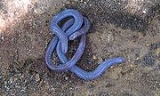
The Amphisbaenia are a suborder of usually legless squamates closely related to lizard
Lizard

Lizards are a large and widespread group of squamate reptiles, with nearly 5,000 species, ranging across all continents except Antarctica as well as most oceanic island chains....
s and snake
Snake

Snakes are elongate legless carnivore reptiles of the suborder Serpentes that can be distinguished from legless lizards by their lack of eyelids and external ears....
s. As many species possess a pink body coloration and scales arranged in rings, they have a superficial resemblance to earthworms. They are very poorly understood, due to their burrowing lifestyle and general rarity. Most species are found in Africa
Africa

Africa is the world's second-largest and second most-populous continent, after Asia. At about 30.2 million km? including adjacent islands, it covers 6% of the Earth's total surface area and 20.4% of the total land area....
 and South America
South America

South America is the southern continent of the Americas, situated entirely in the Western Hemisphere and mostly in the Southern Hemisphere, with a relatively small portion in the Northern Hemisphere....
, with a few in other parts of the world. Little is known of them outside of their anatomy, and even that is difficult to study due to the mechanics of dissecting something so small.


Discussion
Ask a question about 'Amphisbaenia'
Start a new discussion about 'Amphisbaenia'
Answer questions from other users
Full Discussion Forum


Recent Posts


Encyclopedia


The Amphisbaenia are a suborder of usually legless squamates closely related to lizard
Lizard

Lizards are a large and widespread group of squamate reptiles, with nearly 5,000 species, ranging across all continents except Antarctica as well as most oceanic island chains....
s and snake
Snake

Snakes are elongate legless carnivore reptiles of the suborder Serpentes that can be distinguished from legless lizards by their lack of eyelids and external ears....
s. As many species possess a pink body coloration and scales arranged in rings, they have a superficial resemblance to earthworms. They are very poorly understood, due to their burrowing lifestyle and general rarity. Most species are found in Africa
Africa

Africa is the world's second-largest and second most-populous continent, after Asia. At about 30.2 million km? including adjacent islands, it covers 6% of the Earth's total surface area and 20.4% of the total land area....
 and South America
South America

South America is the southern continent of the Americas, situated entirely in the Western Hemisphere and mostly in the Southern Hemisphere, with a relatively small portion in the Northern Hemisphere....
, with a few in other parts of the world. Little is known of them outside of their anatomy, and even that is difficult to study due to the mechanics of dissecting something so small. Most species are less than long.

Description


Amphisbaenia 1
Despite a superficial resemblance to some primitive snakes, amphisbaenians have many unique features that distinguish them from other reptiles. Internally, their right lung is reduced in size to fit their narrow bodies, whereas in snakes, it is always the left lung. Their skeletal structure and skin are also different from those of other squamates.

The head is stout, not set off from the neck, and either rounded, sloped, or sloped with a ridge down the middle. Most of the skull is solid bone, and they have a distinctive single median tooth in the upper jaw. They have no outer ears, and the eyes are deeply recessed and covered with skin and scales. The body is elongated, and the tail truncates in a manner that vaguely resembles the head. Their name is derived from Amphisbaena
Amphisbaena

Amphisbaena , Amphisbaina, Amphisbene, Amphisboena, Amphisbona, Amphista, Amphivena, or Anphivena , a Greek language word, from amphis, meaning "both ways", and bainein, meaning "to go", also called the Mother of Ants, is a mythological, ant-eating Serpent with a head at each end....
, a mythical serpent with a head at each end. The four species of ajolote
Bipedidae

Bipedidae, are a Family of amphisbaenians. They are found only in Mexico. Ajolotes are carnivorous, burrowing reptiles, but unlike other species of amphisbaenian, they possess two stubby forelimbs placed far forward on the body....
 are unusual in having a pair of forelimbs, but all limbless species have some remnants of the pelvic and pectoral girdles embedded within the body musculature.

The skin of amphisbaenians is only loosely attached to the body, and they move using an accordion-like motion, in which the skin moves and the body seemingly just drags along behind it. Uniquely, they are also able to perform this motion in reverse just as effectively.

Amphisbaenians are carnivorous, able to tear chunks out of larger prey with their powerful, interlocking, teeth. Like lizards, some species are able to shed their tail (autotomy
Autotomy

Autotomy or self amputation is the act whereby an animal severs one or more of its own appendages, usually as a self preservation mechanism designed to elude a predation's grasp....
). Most species lay eggs, although at least some are known to be viviparous.

The white worm lizard (Amphisbaena alba) is often found in association with leaf cutter ants. It is thought this reptile forages in the ant's deep galleries where the insects deposit their waste. The larvae of certain large beetles live in these galleries and it is these the reptile preys on.

Families

Order: Squamata
  • Suborder: AMPHISBAENIA
    • Family: Amphisbaenidae
      Amphisbaenidae

      The Amphisbaenidae are a family of amphisbaenians, commonly known as worm lizards. They are found in North and South America, some Caribbean islands, and in sub-Saharan Africa....
       - Gray, 1865 -- Amphisbaenids, tropical worm lizards
    • Family: Bipedidae
      Bipedidae

      Bipedidae, are a Family of amphisbaenians. They are found only in Mexico. Ajolotes are carnivorous, burrowing reptiles, but unlike other species of amphisbaenian, they possess two stubby forelimbs placed far forward on the body....
       - Taylor, 1951 -- Ajolotes
    • Family: Rhineuridae
      Rhineuridae

      The Rhineuridae are a monotypic Family of Amphisbaenidae containing the monotypic genus, Rhineura, which contains for the species R. floridana....
       - Vanzolini, 1951 -- North American worm lizards
    • Family: Trogonophidae
      Trogonophidae

      The Trogonophidae,, are a family of Amphisbaenians. Trogonophids are found in North Africa, the Horn of Africa, the Arabian Peninsula, and western Iran....
       - Gray, 1865 -- Palearctic worm lizards