


Snake venom

Encyclopedia
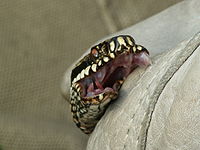
Snake venom is highly modified saliva that is produced by special glands of certain species of snakes. The glands which secrete the zootoxin are a modification of the parotid salivary gland
of other vertebrates, and are usually situated on each side of the head below and behind the eye, encapsulated in a muscular sheath. The glands have large alveoli in which venom
is stored before being conveyed by a duct to the base of channeled or tubular fang
s, through which it is ejected.
Snake venom is a combination of many different proteins, peptides and enzymes. Many of these proteins are toxic to humans and other animals.
Snake venoms are generally not dangerous when ingested, and are therefore not technically poison
s.
Snake toxins vary greatly in their functions. Two major classifications of toxins found in snake venoms include neurotoxin
s (those that attack the nervous system) and cytotoxins (those that attack cells). They can be further subdivided and the followings are major examples:
A) An exchange of ions (charged atoms) across the nerve cell membrane sends a depolarising current towards the end of the nerve cell (cell terminus).
B) When the depolarising current arrives at the nerve cell terminus, the neurotransmitter acetylcholine
(ACh), which is held in vesicles, is released into the space between the two nerves (synapse). It moves across the synapse to the postsynaptic receptors.
C) If ACh remains at the receptor, the nerve stays stimulated, causing incontrollable muscle contractions. This condition is called tetany. An enzyme called acetylcholinesterase destroys the ACh so tetany does not occur.
Fasciculins:
These toxins attack cholinergic neurons (those that use ACh as a transmitter) by destroying acetylcholinesterase (AChE). ACh therefore cannot be broken down and stays in the receptor. This causes tetany, which can lead to death. The toxins have been called fasciculins since after injection into mice, they cause severe, generalized and long-lasting (5-7 h) fasciculations.
Snake example: found mostly in venom of Mamba
s and some rattlesnake
s
Dendrotoxin
s:
Dendrotoxins inhibit neurotransmissions by blocking the exchange of + and – ions across the neuronal membrane > no nerve impulse. So they paralyse the nerves.
Snake example: Mamba
s
α-neurotoxins:
This is a large group of toxins, with over 100 postsynaptic neurotoxins having been identified and sequenced.
α-neurotoxins also attack cholinergic neurons. They mimic the shape of the acetylcholine molecule and therefore fit into the receptors → they block the ACh flow → feeling of numbness and paralysis.
Snake examples:
- King Cobra
(known as hannahtoxin containing α-neurotoxins)
- Sea snake (known as erabutoxin)
- Many-banded krait (known as α-Bungarotoxin)
- Cobras (known as cobratoxin
),
s:
Phospholipase is an enzyme that transforms the phospholipid molecule into a lysophospholipid (soap) > the new molecule attracts and binds fat and ruptures cell membranes.
Snake example: Japanese Habu
Cardiotoxins:
Cardiotoxins are components that are specifically toxic to the heart. They bind to particular sites on the surface of muscle cells and cause depolarisation > the toxin prevents muscle contraction. These toxins may cause the heart to beat irregularly or stop beating, causing death.
Snake example: King Cobra
and some members of Naja
genus
Haemotoxins:
The toxin causes haemolysis, or destruction of red blood cells (erythrocytes).
Snake example: most Vipers
and the many members of Naja
genus
Snake cytotoxin
List of snake venom toxins
Evolution
The presence of enzymes in snake venom was once believed to be an adaptation to assist digestion. However, studies of the western diamondback rattlesnake, a snake with highly proteolytic venom, show that venom has no impact on the time required for food to pass through the gut
. More research is needed to determine the selective pressures resulting in evolution of venom and venom delivery mechanisms.
s, which have the most highly developed venom delivery apparatus, the venom gland is very large and is surrounded by the masseter or temporal muscle, which consists of two bands, the superior arising from behind the eye, the inferior extending from the gland to the mandible. A duct carries venom from the gland to the fang. In vipers and elapids, this groove is completely closed, forming a hypodermic needle-like tube. In other species, the grooves are not covered, or only partially covered. From the anterior extremity of the gland, the duct passes below the eye and above the maxillary bone, to the basal orifice of the venom fang, which is ensheathed in a thick fold of mucous membrane
. By means of the movable maxillary bone hinged to the prefrontal bone and connected with the tranverse bone which is pushed forward by muscles set in action by the opening of the mouth, the fang is erected and the venom discharged through the distal orifice. When the snake bites, the jaws close and the muscles surrounding the gland contract, causing venom to be ejected via the fangs.
s have enlarged, grooved teeth situated at the posterior extremity of the maxilla
, where a small posterior portion of the upper labial or salivary gland produces venom.
 Several genera, including Calliophis, Atractaspis and Causus
, are remarkable for having exceptionally long venom glands, extending along each side of the body, in some cases extending posterially as far as the heart. Instead of the muscles of the temporal region serving to press out the venom into the duct, this action is performed by those of the side of the body.
There is considerable variability in biting behavior among snakes. When biting, viperid snakes often strike quickly, discharging venom as the fangs penetrate the skin, and then immediately release. Alternatively, as in the case of a feeding response, some viperids (e.g. Lachesis) will bite and hold. A proteroglyph or opisthoglyph, may close its jaws and bite or chew firmly for a considerable time.
and Hemachatus, when irritated or threatened, may eject streams or a spray of venom a distance of 4 to 8 feet. These snakes' fangs have been modified for the purposes of spitting: inside the fangs, the channel makes a ninety degree bend to the lower front of the fang. Spitters may spit repeatedly and still be able to deliver a fatal bite.
Spitting is a defensive reaction only. The snakes tend to aim for the eyes of a perceived threat. A direct hit can cause temporary shock and blindness through severe inflammation
of the cornea
and conjunctiva
. Usually there are no serious results if the venom is washed away immediately with plenty of water, blindness can become permanent if left untreated. Brief contact with the skin is not immediately dangerous, but open wounds may be vectors for envenomation.
Some Effects
There are four distinct types of venom that act on the body differently.
It is noteworthy that the size of the venom fangs is in no relation to the virulence of the venom. The comparatively innocent Indo-Malay Lachesis
alluded to above have enormous fangs, whilst the smallest fangs are found in the Hydrophids which possess very potent venom.
, Dendroaspis
, Elaps, Pseudechis
, Notechis
, Acanthophis
) is mainly on the nervous system
, respiratory paralysis
being quickly produced by bringing the venom into contact with the central nervous mechanism which controls respiration; the pain and local swelling which follow a bite are not usually severe.
The bite of all the proteroglyphous elapids, even of the smallest and gentlest, such as the Elaps or coral snakes, is, so far as known, deadly to humans.
, Echis
, Lachesis
, Crotalus
) acts more on the vascular system, bringing about coagulation of the blood and clotting of the pulmonary arteries; its action on the nervous system is not great, no individual group of nerve-cells appears to be picked out, and the effect upon respiration is not so direct; the influence upon the circulation explains the great depression which is a symptom of viperine envenomation. The pain of the wound is severe, and is speedily followed by swelling and discoloration. The symptoms produced by the bite of the European vipers are thus described by the best authorities on snake venom (Martin and Lamb):
The Viperidae differ much among themselves in the toxicity of their venom. Some, such as the Indian Daboia russelli and Echis carinatus; the American vipers Crotalus
, Lachesis muta
and Bothrops lanceolatus
; and the Africa
n Causus, Bitis, and Cerastes, cause fatal results unless a remedy is speedily applied. On the other hand, the Indian and Malay Lachesis seldom cause the death of humans, their bite in some instances being no worse than the sting of a hornet. The bite of the larger European vipers may be very dangerous, and followed by fatal results, especially in children, at least in the hotter parts of the Continent; whilst the small Vipera ursinii
, which hardly ever bites unless roughly handled, does not seem to be possessed of a very virulent venom, and, although very common in some parts of Austria
-Hungary
, is not known to have ever caused a serious accident.
Boomslang and vine snake venom are toxic to blood cells and thin the blood (hemotoxic, hemorrhagic). Early symptoms include headaches, nausea, diarrhea, lethargy, mental disorientation, bruising and bleeding at the site and all body openings. Exsanguination
is the main cause of death from such a bite.
The Groen Boomslang
's venom is the most potent of all rear-fanged snakes in the world based on LD50
. Although its venom may be more potent that some vipers and elapids, it causes fewer fatalities owing to various factors(for example,the fangs effectiveness is not high compared with many other snakes;the venom dose delivered is low; and it is generally less aggressive in comparison to other venomous snakes such as cobra
s and mamba
s).
Symptoms of a bite from these snakes are nausea and internal bleeding, and one could die from a brain hemorrhage and respiratory collapse.
of Tropidonotus and Zamenis have shown that even aglyphous snakes are not entirely devoid of venom, and point to the conclusion that the physiological difference between so-called harmless and venomous snakes is only one of degree, just as there are various steps in the transformation of an ordinary parotid gland into a venom gland or of a solid tooth into a tubular or grooved fang.
n Coronella getula and the Brazil
ian Rhacidelus brazili, are proof against the venom of the crotalines which frequent the same districts, and which they are able to overpower and feed upon. The Tropical Rat Snake, Spilotes variabilis, is the enemy of the Fer-de-lance in St. Lucia, and it is said that in their encounters the Cribo is invariably the victor. Repeated experiments have shown the European Common Snake, Tropidonotus natrix, not to be affected by the bite of Vipera berus
and Vipera aspis
, this being due to the presence, in the blood of the harmless snake, of toxic principles secreted by the parotid and labial glands, and analogous to those of the venom of these vipers. Several North American species of Rat snakes as well as King snakes have proven to be immune or highly resistant to the venom of Rattle snake species.
, the Mongoose
, the Honey Badger, the Secretary Bird
and a few other bird
s feeding on snakes, are known to be immune to an ordinary dose of snake venom; whether the pig
may be considered so is still uncertain, although it is well known that, owing to its subcutaneous layer of fat, it is often bitten without ill effect. The garden dormouse
(Eliomys quercinus) has recently been added to the list of animals refractory to viper venom. Some populations of California Ground Squirrel
are at least partially immune to Rattlesnake
venom as adults.
device for DNA delivery (1). If successful, some of the over 100,000 people that die each year from snakebite in the Eastern Hemisphere will be saved. (1,2)
Studies
The subject of snake venoms is one which has always attracted much attention and which has made great progress within the last quarter of a century. Plants used to treat snakebites in Trinidad and Tobago are made into tinctures with alcohol or olive oil and kept in rum flasks called 'snake bottles'. Snakes bottles contain several different plants and/ or insects. The plants used include the vine called monkey ladder (Bauhinia cumanensis or Bauhinia excisa, Fabaceae) is pounded and put on the bite. Alternatively a tincture is made with a piece of the vine and kept in a snake bottle. Other plants used include: mat root (Aristolochia rugosa), cat's claw (Pithocellobium unguis-cati), tobacco (Nicotiana tabacum
), snake bush (Barleria lupulina), obie seed (Cola nitida), and wild gri gri root (Acrocomia ierensis). Some snake bottles also contain the caterpillars (Battus polydamus, Papilionidae) that eat tree leaves (Aristolochia trilobata). Emergency snake medicines are obtained by chewing a three-inch piece of the root of bois canôt (Cecropia peltata
) and administering this chewed-root solution to the bitten(usually hunting dogs). This is a common native plant of Latin America and the Caribbean which makes it appropriate as an emergency remedy. Another native plant used is mardi gras (Renealmia alpinia)(berries), which are crushed together with the juice of wild cane (Costus scaber) and given to the bitten. Quick fixes have included applying chewed tobacco from cigarettes, cigars or pipes as well. Making cuts around the puncture or sucking out the venom has also been helpful.
The studies to which we allude have not only conduced to a method of treatment against snake-bites, but have thrown a new light on the great problem of immunity.
They have shown that the antitoxic sera do not act as chemical antidote
s in destroying the venom, but as physiological antidotes; that, in addition to the venom glands, snakes possess other glands supplying their blood with substances antagonistic to the venom, such as also exist in various animals refractory to snake venom, the hedgehog
and the mongoose
for instance.
Thus, a Europe
an in Australia
who had become immune to the venom of the deadly Australian Tiger Snake, Notechis scutatus, manipulating these snakes with impunity, and was under the impression that his immunity extended also to other species, when bitten by a Denisonia superba, an allied elapine, died the following day.
In India
, the serum prepared with the venom of Naja tripudians has been found to be without effect on the venom of the two species of kraits of the genus Bungarus
, and the Old World vipers Daboia russelli and Echis carinatus
, and the pit viper Trimeresurus popeiorum
. Daboia russelli serum is without effect on colubrine venoms, or those of Echis
and Trimeresurus
.
In Brazil
, serum prepared with the venom of the New World pit viper Lachesis lanceolatus is without action on Crotalus
venom.
Antivenom snakebite treatment must be matched as the type of envenomation that has occurred.
In the Americas, polyvalent antivenoms are available that are effective against the bites of most pit vipers.
These are not effective against coral snake
envenomation, which requires a specific antivenom to their neurotoxic venom.
The situation is even more complex in countries like India, with its rich mix of vipers (family Viperidae
) and highly neurotoxic cobra
s and kraits of the family Elapidae
.
This article is based on the 1913 book The Snakes of Europe, by G. A. Boulenger, which is now in the public domain
in the United States (and possibly elsewhere) because of its age. Because of its age, the text in this article should not necessarily be viewed as reflecting the current knowledge of snake venom.
External links - Calculated orientations of snake venome toxins in the lipid bilayer - Calculated orientations of snake venom phospholipases A2 and myotoxins in the lipid bilayer
Parotid gland
The paired parotid glands are the largest of the salivary glands. They are each found wrapped around the mandibular ramus, and secrete saliva through Stensen's ducts into the oral cavity, to facilitate mastication and swallowing and to begin the digestion of starches.-Location:The parotid glands...
of other vertebrates, and are usually situated on each side of the head below and behind the eye, encapsulated in a muscular sheath. The glands have large alveoli in which venom
Venom
Venom is the general term referring to any variety of toxins used by certain types of animals that inject it into their victims by the means of a bite or a sting...
is stored before being conveyed by a duct to the base of channeled or tubular fang
Fang
Fang is a mammal's canine tooth.Fang may also refer to:* A snake's poison-injecting tooth: see snake venom* Fang people, in Central Africa* Fang language, spoken by Fang people...
s, through which it is ejected.
Snake venom is a combination of many different proteins, peptides and enzymes. Many of these proteins are toxic to humans and other animals.
Snake venoms are generally not dangerous when ingested, and are therefore not technically poison
Poison
In the context of biology, poisons are substances that can cause disturbances to organisms, usually by chemical reaction or other activity on the molecular scale, when a sufficient quantity is absorbed by an organism....
s.
Chemistry
Snake venom consists of proteins, enzymes, substances with cytotoxic effects, neurotoxins, coagulants and anti-coagulants.- PhosphodiesterasePhosphodiesteraseA phosphodiesterase is any enzyme that breaks a phosphodiester bond. Usually, people speaking of phosphodiesterase are referring to cyclic nucleotide phosphodiesterases, which have great clinical significance and are described below...
s interfere with the prey's cardiac system, mainly to lower the blood pressureBlood pressureBlood pressure is the pressure exerted by circulating blood upon the walls of blood vessels, and is one of the principal vital signs. When used without further specification, "blood pressure" usually refers to the arterial pressure of the systemic circulation. During each heartbeat, BP varies...
. - Phospholipase A2Phospholipase A2Phospholipases A2 are enzymes that release fatty acids from the second carbon group of glycerol. This particular phospholipase specifically recognizes the sn-2 acyl bond of phospholipids and catalytically hydrolyzes the bond releasing arachidonic acid and lysophospholipids...
causes hemolysisHemolysisHemolysis —from the Greek meaning "blood" and meaning a "loosing", "setting free" or "releasing"—is the rupturing of erythrocytes and the release of their contents into surrounding fluid...
by lysing the phospholipidPhospholipidPhospholipids are a class of lipids that are a major component of all cell membranes as they can form lipid bilayers. Most phospholipids contain a diglyceride, a phosphate group, and a simple organic molecule such as choline; one exception to this rule is sphingomyelin, which is derived from...
cell membranes of red blood cells. - Some snake venoms inhibit cholinesteraseCholinesteraseIn biochemistry, cholinesterase is a family of enzymes that catalyze the hydrolysis of the neurotransmitter acetylcholine into choline and acetic acid, a reaction necessary to allow a cholinergic neuron to return to its resting state after activation.-Types:...
to make the prey lose muscle control. - HyaluronidaseHyaluronidaseThe hyaluronidases are a family of enzymes that degrade hyaluronic acid.In humans, there are six associated genes, including HYAL1, HYAL2, HYAL3, and PH-20/SPAM1.-Use as a drug:...
increases tissue permeability to accelerate absorption of other enzymes into tissues. - Amino acid oxidaseOxidaseAn oxidase is any enzyme that catalyzes an oxidation-reduction reaction involving molecular oxygen as the electron acceptor. In these reactions, oxygen is reduced to water or hydrogen peroxide ....
s and proteaseProteaseA protease is any enzyme that conducts proteolysis, that is, begins protein catabolism by hydrolysis of the peptide bonds that link amino acids together in the polypeptide chain forming the protein....
s are used for digestion. Amino acid oxidase also triggers some other enzymes and is responsible for the yellow color of the venom of some species. - Snake venom often contains ATPaseATPaseATPases are a class of enzymes that catalyze the decomposition of adenosine triphosphate into adenosine diphosphate and a free phosphate ion. This dephosphorylation reaction releases energy, which the enzyme harnesses to drive other chemical reactions that would not otherwise occur...
, an enzymeEnzymeEnzymes are proteins that catalyze chemical reactions. In enzymatic reactions, the molecules at the beginning of the process, called substrates, are converted into different molecules, called products. Almost all chemical reactions in a biological cell need enzymes in order to occur at rates...
which catalyzes the hydrolysisHydrolysisHydrolysis is a chemical reaction during which molecules of water are split into hydrogen cations and hydroxide anions in the process of a chemical mechanism. It is the type of reaction that is used to break down certain polymers, especially those made by condensation polymerization...
of ATPAdenosine triphosphateAdenosine-5'-triphosphate is a multifunctional nucleoside triphosphate used in cells as a coenzyme. It is often called the "molecular unit of currency" of intracellular energy transfer. ATP transports chemical energy within cells for metabolism...
to ADPAdenosine diphosphateAdenosine diphosphate, abbreviated ADP, is a nucleoside diphosphate. It is an ester of pyrophosphoric acid with the nucleoside adenosine. ADP consists of the pyrophosphate group, the pentose sugar ribose, and the nucleobase adenine....
and a free phosphatePhosphateA phosphate, an inorganic chemical, is a salt of phosphoric acid. In organic chemistry, a phosphate, or organophosphate, is an ester of phosphoric acid. Organic phosphates are important in biochemistry and biogeochemistry or ecology. Inorganic phosphates are mined to obtain phosphorus for use in...
ionIonAn ion is an atom or molecule in which the total number of electrons is not equal to the total number of protons, giving it a net positive or negative electrical charge. The name was given by physicist Michael Faraday for the substances that allow a current to pass between electrodes in a...
, or to AMPAdenosine monophosphateAdenosine monophosphate , also known as 5'-adenylic acid, is a nucleotide that is used as a monomer in RNA. It is an ester of phosphoric acid and the nucleoside adenosine. AMP consists of a phosphate group, the sugar ribose, and the nucleobase adenine...
and diphosphate.
Snake toxins vary greatly in their functions. Two major classifications of toxins found in snake venoms include neurotoxin
Neurotoxin
A neurotoxin is a toxin that acts specifically on nerve cells , usually by interacting with membrane proteins such as ion channels. Some sources are more general, and define the effect of neurotoxins as occurring at nerve tissue...
s (those that attack the nervous system) and cytotoxins (those that attack cells). They can be further subdivided and the followings are major examples:
- Neurotoxins
- Fasciculins
- Dendrotoxins
- α-neurotoxins
- Cytotoxins
- Phospholipases
- Cardiotoxins
- Haemotoxins
Neurotoxins
The beginning of a new impulse:A) An exchange of ions (charged atoms) across the nerve cell membrane sends a depolarising current towards the end of the nerve cell (cell terminus).
B) When the depolarising current arrives at the nerve cell terminus, the neurotransmitter acetylcholine
Acetylcholine
The chemical compound acetylcholine is a neurotransmitter in both the peripheral nervous system and central nervous system in many organisms including humans...
(ACh), which is held in vesicles, is released into the space between the two nerves (synapse). It moves across the synapse to the postsynaptic receptors.
C) If ACh remains at the receptor, the nerve stays stimulated, causing incontrollable muscle contractions. This condition is called tetany. An enzyme called acetylcholinesterase destroys the ACh so tetany does not occur.
Fasciculins:
These toxins attack cholinergic neurons (those that use ACh as a transmitter) by destroying acetylcholinesterase (AChE). ACh therefore cannot be broken down and stays in the receptor. This causes tetany, which can lead to death. The toxins have been called fasciculins since after injection into mice, they cause severe, generalized and long-lasting (5-7 h) fasciculations.
Snake example: found mostly in venom of Mamba
Mamba
Mambas, of the genus Dendroaspis , are a group of highly venomous, fast-moving land-dwelling snakes of Africa. They belong to the family of Elapidae which includes cobras, coral snakes, taipans, brown snakes, tiger snakes, death adders, kraits and, debatably, sea snakes...
s and some rattlesnake
Rattlesnake
Rattlesnakes are a group of venomous snakes of the genera Crotalus and Sistrurus of the subfamily Crotalinae . There are 32 known species of rattlesnake, with between 65-70 subspecies, all native to the Americas, ranging from southern Alberta and southern British Columbia in Canada to Central...
s
Dendrotoxin
Dendrotoxin
Dendrotoxins are a class of neurotoxins produced by mamba snakes that block particular subtypes of voltage-gated potassium channels in neurons, thereby enhancing the release of acetylcholine at neuromuscular junctions...
s:
Dendrotoxins inhibit neurotransmissions by blocking the exchange of + and – ions across the neuronal membrane > no nerve impulse. So they paralyse the nerves.
Snake example: Mamba
Mamba
Mambas, of the genus Dendroaspis , are a group of highly venomous, fast-moving land-dwelling snakes of Africa. They belong to the family of Elapidae which includes cobras, coral snakes, taipans, brown snakes, tiger snakes, death adders, kraits and, debatably, sea snakes...
s
α-neurotoxins:
This is a large group of toxins, with over 100 postsynaptic neurotoxins having been identified and sequenced.
α-neurotoxins also attack cholinergic neurons. They mimic the shape of the acetylcholine molecule and therefore fit into the receptors → they block the ACh flow → feeling of numbness and paralysis.
Snake examples:
- King Cobra
King Cobra
The king cobra is the world's longest venomous snake, with a length up to 5.6 m . This species, which preys chiefly on other snakes, is found predominantly in forests from India through Southeast Asia to the Philippines and Indonesia...
(known as hannahtoxin containing α-neurotoxins)
- Sea snake (known as erabutoxin)
- Many-banded krait (known as α-Bungarotoxin)
- Cobras (known as cobratoxin
Cobratoxin
α-Cobratoxin is a substance of the venom of certain Naja cobras. It is a muscle-type nicotinic acetylcholine receptor antagonist, which causes paralysis by preventing the binding of acetylcholine to the nAChR.-Source:...
),
Cytotoxins
PhospholipasePhospholipase
A phospholipase is an enzyme that hydrolyzes phospholipids into fatty acids and other lipophilic substances. There are four major classes, termed A, B, C and D, distinguished by the type of reaction which they catalyze:*Phospholipase A...
s:
Phospholipase is an enzyme that transforms the phospholipid molecule into a lysophospholipid (soap) > the new molecule attracts and binds fat and ruptures cell membranes.
Snake example: Japanese Habu
Cardiotoxins:
Cardiotoxins are components that are specifically toxic to the heart. They bind to particular sites on the surface of muscle cells and cause depolarisation > the toxin prevents muscle contraction. These toxins may cause the heart to beat irregularly or stop beating, causing death.
Snake example: King Cobra
King Cobra
The king cobra is the world's longest venomous snake, with a length up to 5.6 m . This species, which preys chiefly on other snakes, is found predominantly in forests from India through Southeast Asia to the Philippines and Indonesia...
and some members of Naja
Naja
Naja is a genus of venomous elapid snakes. Although there are several other genera that share the common name, Naja are the most recognized and most widespread group of snakes commonly known as cobras. The genus Naja consists of 20 to 22 species, but has undergone several taxonomic revisions in...
genus
Haemotoxins:
The toxin causes haemolysis, or destruction of red blood cells (erythrocytes).
Snake example: most Vipers
Viperidae
The Viperidae are a family of venomous snakes found all over the world, except in Antarctica, Australia, Ireland, Madagascar, Hawaii, various other isolated islands, and above the Arctic Circle. All have relatively long, hinged fangs that permit deep penetration and injection of venom. Four...
and the many members of Naja
Naja
Naja is a genus of venomous elapid snakes. Although there are several other genera that share the common name, Naja are the most recognized and most widespread group of snakes commonly known as cobras. The genus Naja consists of 20 to 22 species, but has undergone several taxonomic revisions in...
genus
Snake cytotoxin
List of snake venom toxins
- PiscivorinPiscivorinPiscivorin is a component of snake venom secreted by the Eastern Cottonmouth . It is a member of the cysteine-rich secretory protein family, which blocks voltage-dependent calcium channels.- Etymology :...
from the Eastern Cottonmouth
- TriflinTriflinTriflin is a cysteine-rich secretory protein , which is excreted by the venom gland of the Habu snake . Triflin reduces high potassium-induced smooth muscle contraction, suggesting a blocking effect on L-type calcium channels.- Source :Triflin is a toxin derived from snake venom...
from the Habu snake
- OphaninOphaninOphanin is a toxin found in the venom of the King Cobra , which lives throughout South East Asia. This toxin belongs to the cysteine-rich secretory protein family...
from the King Cobra
- LatiseminLatiseminLatisemin is a cysteine-rich secretory protein that can be isolated from the venom of the Black-banded sea krait, a sea snake indigineous to the warmer waters of the western Pacific Ocean...
from the Erabu snake
- AblominAblominAblomin is a toxin present in the venom of the Japanese Mamushi snake, which blocks L-type voltage-gated calcium channels.- Etymology :The protein ablomin is a component of the venom of the Japanese Mamushi snake, Gloydius blomhoffi...
from the Mamushi snake
Evolution Piscivorin
Piscivorin is a component of snake venom secreted by the Eastern Cottonmouth . It is a member of the cysteine-rich secretory protein family, which blocks voltage-dependent calcium channels.- Etymology :...
from the Eastern Cottonmouth
Triflin
Triflin is a cysteine-rich secretory protein , which is excreted by the venom gland of the Habu snake . Triflin reduces high potassium-induced smooth muscle contraction, suggesting a blocking effect on L-type calcium channels.- Source :Triflin is a toxin derived from snake venom...
from the Habu snake
Ophanin
Ophanin is a toxin found in the venom of the King Cobra , which lives throughout South East Asia. This toxin belongs to the cysteine-rich secretory protein family...
from the King Cobra
Latisemin
Latisemin is a cysteine-rich secretory protein that can be isolated from the venom of the Black-banded sea krait, a sea snake indigineous to the warmer waters of the western Pacific Ocean...
from the Erabu snake
Ablomin
Ablomin is a toxin present in the venom of the Japanese Mamushi snake, which blocks L-type voltage-gated calcium channels.- Etymology :The protein ablomin is a component of the venom of the Japanese Mamushi snake, Gloydius blomhoffi...
from the Mamushi snake
The presence of enzymes in snake venom was once believed to be an adaptation to assist digestion. However, studies of the western diamondback rattlesnake, a snake with highly proteolytic venom, show that venom has no impact on the time required for food to pass through the gut
Gut (zoology)
In zoology, the gut, also known as the alimentary canal or alimentary tract, is a tube by which bilaterian animals transfer food to the digestion organs. In large bilaterians the gut generally also has an exit, the anus, by which the animal disposes of solid wastes...
. More research is needed to determine the selective pressures resulting in evolution of venom and venom delivery mechanisms.
Vipers
In the viperViperidae
The Viperidae are a family of venomous snakes found all over the world, except in Antarctica, Australia, Ireland, Madagascar, Hawaii, various other isolated islands, and above the Arctic Circle. All have relatively long, hinged fangs that permit deep penetration and injection of venom. Four...
s, which have the most highly developed venom delivery apparatus, the venom gland is very large and is surrounded by the masseter or temporal muscle, which consists of two bands, the superior arising from behind the eye, the inferior extending from the gland to the mandible. A duct carries venom from the gland to the fang. In vipers and elapids, this groove is completely closed, forming a hypodermic needle-like tube. In other species, the grooves are not covered, or only partially covered. From the anterior extremity of the gland, the duct passes below the eye and above the maxillary bone, to the basal orifice of the venom fang, which is ensheathed in a thick fold of mucous membrane
Mucous membrane
The mucous membranes are linings of mostly endodermal origin, covered in epithelium, which are involved in absorption and secretion. They line cavities that are exposed to the external environment and internal organs...
. By means of the movable maxillary bone hinged to the prefrontal bone and connected with the tranverse bone which is pushed forward by muscles set in action by the opening of the mouth, the fang is erected and the venom discharged through the distal orifice. When the snake bites, the jaws close and the muscles surrounding the gland contract, causing venom to be ejected via the fangs.
Elapids
In the proteroglyphous elapids, the fangs are tubular, but are short and do not possess the mobility seen in vipers.Colubrids
opisthoglyphous colubridColubrid
A colubrid is a member of the snake family Colubridae. This broad classification of snakes includes about two-thirds of all snake species on earth. The earliest species of the snake family date back to the Oligocene epoch. With 304 genera and 1,938 species, Colubridae is the largest snake family...
s have enlarged, grooved teeth situated at the posterior extremity of the maxilla
Maxilla
The maxilla is a fusion of two bones along the palatal fissure that form the upper jaw. This is similar to the mandible , which is also a fusion of two halves at the mental symphysis. Sometimes The maxilla (plural: maxillae) is a fusion of two bones along the palatal fissure that form the upper...
, where a small posterior portion of the upper labial or salivary gland produces venom.
Mechanics of biting
Causinae
The Causinae are a monotypic subfamily of venomous vipers found only in subsaharan Africa. It was created for the genus Causus; a group considered to be among the most primitive members of the family Viperidae based on head scalation, oviparity, venom apparatus and the fact that they have round...
, are remarkable for having exceptionally long venom glands, extending along each side of the body, in some cases extending posterially as far as the heart. Instead of the muscles of the temporal region serving to press out the venom into the duct, this action is performed by those of the side of the body.
There is considerable variability in biting behavior among snakes. When biting, viperid snakes often strike quickly, discharging venom as the fangs penetrate the skin, and then immediately release. Alternatively, as in the case of a feeding response, some viperids (e.g. Lachesis) will bite and hold. A proteroglyph or opisthoglyph, may close its jaws and bite or chew firmly for a considerable time.
Mechanics of spitting
Spitting cobras of the genera NajaNaja
Naja is a genus of venomous elapid snakes. Although there are several other genera that share the common name, Naja are the most recognized and most widespread group of snakes commonly known as cobras. The genus Naja consists of 20 to 22 species, but has undergone several taxonomic revisions in...
and Hemachatus, when irritated or threatened, may eject streams or a spray of venom a distance of 4 to 8 feet. These snakes' fangs have been modified for the purposes of spitting: inside the fangs, the channel makes a ninety degree bend to the lower front of the fang. Spitters may spit repeatedly and still be able to deliver a fatal bite.
Spitting is a defensive reaction only. The snakes tend to aim for the eyes of a perceived threat. A direct hit can cause temporary shock and blindness through severe inflammation
Inflammation
Inflammation is part of the complex biological response of vascular tissues to harmful stimuli, such as pathogens, damaged cells, or irritants. Inflammation is a protective attempt by the organism to remove the injurious stimuli and to initiate the healing process...
of the cornea
Cornea
The cornea is the transparent front part of the eye that covers the iris, pupil, and anterior chamber. Together with the lens, the cornea refracts light, with the cornea accounting for approximately two-thirds of the eye's total optical power. In humans, the refractive power of the cornea is...
and conjunctiva
Conjunctiva
The conjunctiva covers the sclera and lines the inside of the eyelids. It is composed of rare stratified columnar epithelium.-Function:...
. Usually there are no serious results if the venom is washed away immediately with plenty of water, blindness can become permanent if left untreated. Brief contact with the skin is not immediately dangerous, but open wounds may be vectors for envenomation.
Some Effects
There are four distinct types of venom that act on the body differently.
- Proteolytic venom dismantles the molecular structure of the area surrounding and including the bite.
- Hemotoxic venoms act on the heart and cardiovascular system.
- Neurotoxic venom acts on the nervous system and brain.
- Cytotoxic venom has a localized action at the site of the bite.
It is noteworthy that the size of the venom fangs is in no relation to the virulence of the venom. The comparatively innocent Indo-Malay Lachesis
Lachesis (genus)
Lachesis is a genus of venomous pitvipers found in remote forested areas of Central and South America. The generic name refers to one of the Three Fates in Greek mythology who determined the length of the thread of life...
alluded to above have enormous fangs, whilst the smallest fangs are found in the Hydrophids which possess very potent venom.
Proteroglyphous snakes
The effect of the venom of proteroglyphous snakes(Hydrophids, BungarusBungarus
Bungarus, commonly referred to as kraits , is a genus of venomous elapid snakes found in South and South-East Asia. There are 12 species and 5 subspecies recognized.- Distribution :...
, Dendroaspis
Mamba
Mambas, of the genus Dendroaspis , are a group of highly venomous, fast-moving land-dwelling snakes of Africa. They belong to the family of Elapidae which includes cobras, coral snakes, taipans, brown snakes, tiger snakes, death adders, kraits and, debatably, sea snakes...
, Elaps, Pseudechis
Pseudechis
The genus Pseudechis contains the group of elapids commonly referred to as the Black Snakes. These snakes are found in every Australian state with the exception of Tasmania and some species are found in Papua New Guinea....
, Notechis
Notechis
Tiger snakes are a type of venomous serpent found in southern regions of Australia, including its coastal islands and Tasmania. These snakes are highly variable in their colour, often banded like those on a tiger, and forms in their regional occurrences...
, Acanthophis
Acanthophis
Acanthophis is a genus of elapid snakes. Commonly called death adders, they are native to Australia, New Guinea and nearby islands, and are among the most venomous snakes in the world...
) is mainly on the nervous system
Nervous system
The nervous system is an organ system containing a network of specialized cells called neurons that coordinate the actions of an animal and transmit signals between different parts of its body. In most animals the nervous system consists of two parts, central and peripheral. The central nervous...
, respiratory paralysis
Paralysis
Paralysis is loss of muscle function for one or more muscles. Paralysis can be accompanied by a loss of feeling in the affected area if there is sensory damage as well as motor. A study conducted by the Christopher & Dana Reeve Foundation, suggests that about 1 in 50 people have been diagnosed...
being quickly produced by bringing the venom into contact with the central nervous mechanism which controls respiration; the pain and local swelling which follow a bite are not usually severe.
The bite of all the proteroglyphous elapids, even of the smallest and gentlest, such as the Elaps or coral snakes, is, so far as known, deadly to humans.
Vipers
Viper venom (DaboiaDaboia
Daboia is a monotypic genus of venomous Old World viper. The single species, D. russelii, is found in Asia throughout the Indian subcontinent, much of Southeast Asia, southern China and Taiwan...
, Echis
Echis
Echis is a genus of venomous vipers found in the dry regions of Africa, the Middle East, Pakistan, India and Sri Lanka. They have a characteristic threat display, rubbing sections of their body together to produce a "sizzling" warning sound...
, Lachesis
Lachesis (genus)
Lachesis is a genus of venomous pitvipers found in remote forested areas of Central and South America. The generic name refers to one of the Three Fates in Greek mythology who determined the length of the thread of life...
, Crotalus
Crotalus
Crotalus is a genus of venomous pit vipers found only in the Americas from southern Canada to northern Argentina. The name is derived from the Greek word krotalon, which means "rattle" or "castanet", and refers to the rattle on the end of the tail which makes this group so distinctive...
) acts more on the vascular system, bringing about coagulation of the blood and clotting of the pulmonary arteries; its action on the nervous system is not great, no individual group of nerve-cells appears to be picked out, and the effect upon respiration is not so direct; the influence upon the circulation explains the great depression which is a symptom of viperine envenomation. The pain of the wound is severe, and is speedily followed by swelling and discoloration. The symptoms produced by the bite of the European vipers are thus described by the best authorities on snake venom (Martin and Lamb):
The bite is immediately followed by local pain of a burning character; the limb soon swells and becomes discoloured, and within one to three hours great prostration, accompanied by vomiting, and often diarrhoea, sets in. Cold, clammy perspiration is usual. The pulse becomes extremely feeble, and slight dyspnoea and restlessness may be seen. In severe cases, which occur mostly in children, the pulse may become imperceptible and the extremities cold; the patient may pass into comaComaIn medicine, a coma is a state of unconsciousness, lasting more than 6 hours in which a person cannot be awakened, fails to respond normally to painful stimuli, light or sound, lacks a normal sleep-wake cycle and does not initiate voluntary actions. A person in a state of coma is described as...
. In from twelve to twenty-four hours these severe constitutional symptoms usually pass off; but in the meantime the swelling and discoloration have spread enormously. The limb becomes phlegmonous, and occasionally suppurates. Within a few days recovery usually occurs somewhat suddenly, but deathDeathDeath is the permanent termination of the biological functions that sustain a living organism. Phenomena which commonly bring about death include old age, predation, malnutrition, disease, and accidents or trauma resulting in terminal injury....
may result from the severe depression or from the secondary effects of suppuration. That cases of death, in adults as well as in children, are not infrequent in some parts of the Continent is mentioned in the last chapter of this Introduction.
The Viperidae differ much among themselves in the toxicity of their venom. Some, such as the Indian Daboia russelli and Echis carinatus; the American vipers Crotalus
Crotalus
Crotalus is a genus of venomous pit vipers found only in the Americas from southern Canada to northern Argentina. The name is derived from the Greek word krotalon, which means "rattle" or "castanet", and refers to the rattle on the end of the tail which makes this group so distinctive...
, Lachesis muta
Lachesis muta
Lachesis muta is a venomous pitviper species found in South America. Two subspecies are currently recognized, including the nominate subspecies described here.-Description:...
and Bothrops lanceolatus
Bothrops lanceolatus
Bothrops lanceolatus is a venomous pitviper species generally considered endemic to the island of Martinique. No one has satisfactorily explained why it has flourished there and is unknown on nearly all other Caribbean islands. Some reserve the name fer-de-lance for this species, while others apply...
; and the Africa
Africa
Africa is the world's second largest and second most populous continent, after Asia. At about 30.2 million km² including adjacent islands, it covers 6% of the Earth's total surface area and 20.4% of the total land area...
n Causus, Bitis, and Cerastes, cause fatal results unless a remedy is speedily applied. On the other hand, the Indian and Malay Lachesis seldom cause the death of humans, their bite in some instances being no worse than the sting of a hornet. The bite of the larger European vipers may be very dangerous, and followed by fatal results, especially in children, at least in the hotter parts of the Continent; whilst the small Vipera ursinii
Vipera ursinii
Vipera ursinii is a venomous viper and a very widespread species, found from southeastern France all the way to China . No subspecies are currently recognized...
, which hardly ever bites unless roughly handled, does not seem to be possessed of a very virulent venom, and, although very common in some parts of Austria
Austria
Austria , officially the Republic of Austria , is a landlocked country of roughly 8.4 million people in Central Europe. It is bordered by the Czech Republic and Germany to the north, Slovakia and Hungary to the east, Slovenia and Italy to the south, and Switzerland and Liechtenstein to the...
-Hungary
Hungary
Hungary , officially the Republic of Hungary , is a landlocked country in Central Europe. It is situated in the Carpathian Basin and is bordered by Slovakia to the north, Ukraine and Romania to the east, Serbia and Croatia to the south, Slovenia to the southwest and Austria to the west. The...
, is not known to have ever caused a serious accident.
Opisthoglyphous colubrids
Biologists had long known that some snakes had rear fangs, 'inferior' venom injection mechanisms that might immobilize prey; although a few fatalities were on record, until 1957 the possibility that such snakes were deadly to humans seemed at most remote. The deaths of two prominent herpetologists from African colubrid bites changed that assessment, and recent events reveal that several other species of rear-fanged snakes have venoms that are potentially lethal to large vertebrates.Boomslang and vine snake venom are toxic to blood cells and thin the blood (hemotoxic, hemorrhagic). Early symptoms include headaches, nausea, diarrhea, lethargy, mental disorientation, bruising and bleeding at the site and all body openings. Exsanguination
Exsanguination
Exsanguination is the fatal process of hypovolemia , to a degree sufficient enough to cause death. One does not have to lose literally all of one's blood to cause death...
is the main cause of death from such a bite.
The Groen Boomslang
Boomslang
The boomslang is a large venomous colubrid snake.-Taxonomy & etymology:It is currently the only species in its genus, although several species and subspecies have been described in the past...
's venom is the most potent of all rear-fanged snakes in the world based on LD50
LD50
In toxicology, the median lethal dose, LD50 , LC50 or LCt50 of a toxin, radiation, or pathogen is the dose required to kill half the members of a tested population after a specified test duration...
. Although its venom may be more potent that some vipers and elapids, it causes fewer fatalities owing to various factors(for example,the fangs effectiveness is not high compared with many other snakes;the venom dose delivered is low; and it is generally less aggressive in comparison to other venomous snakes such as cobra
Cobra
Cobra is a venomous snake belonging to the family Elapidae. However, not all snakes commonly referred to as cobras are of the same genus, or even of the same family. The name is short for cobra capo or capa Snake, which is Portuguese for "snake with hood", or "hood-snake"...
s and mamba
Mamba
Mambas, of the genus Dendroaspis , are a group of highly venomous, fast-moving land-dwelling snakes of Africa. They belong to the family of Elapidae which includes cobras, coral snakes, taipans, brown snakes, tiger snakes, death adders, kraits and, debatably, sea snakes...
s).
Symptoms of a bite from these snakes are nausea and internal bleeding, and one could die from a brain hemorrhage and respiratory collapse.
Aglyphous snakes
Experiments made with the secretion of the parotid glandParotid gland
The paired parotid glands are the largest of the salivary glands. They are each found wrapped around the mandibular ramus, and secrete saliva through Stensen's ducts into the oral cavity, to facilitate mastication and swallowing and to begin the digestion of starches.-Location:The parotid glands...
of Tropidonotus and Zamenis have shown that even aglyphous snakes are not entirely devoid of venom, and point to the conclusion that the physiological difference between so-called harmless and venomous snakes is only one of degree, just as there are various steps in the transformation of an ordinary parotid gland into a venom gland or of a solid tooth into a tubular or grooved fang.
Among snakes
The question whether individual snakes are immune to their own venom is not yet definitely settled, though there is a known example of a cobra which self-envenomated, resulting in a large abscess requiring surgical intervention but showing none of the other effects that would have proven rapidly lethal in prey species or humans. Furthermore, certain harmless species, such as the North AmericaNorth America
North America is a continent wholly within the Northern Hemisphere and almost wholly within the Western Hemisphere. It is also considered a northern subcontinent of the Americas...
n Coronella getula and the Brazil
Brazil
Brazil , officially the Federative Republic of Brazil , is the largest country in South America. It is the world's fifth largest country, both by geographical area and by population with over 192 million people...
ian Rhacidelus brazili, are proof against the venom of the crotalines which frequent the same districts, and which they are able to overpower and feed upon. The Tropical Rat Snake, Spilotes variabilis, is the enemy of the Fer-de-lance in St. Lucia, and it is said that in their encounters the Cribo is invariably the victor. Repeated experiments have shown the European Common Snake, Tropidonotus natrix, not to be affected by the bite of Vipera berus
Vipera berus
Vipera berus, the common European adder or common European viper, is a venomous viper species that is extremely widespread and can be found throughout most of Western Europe and all the way to Far East Asia. Known by a host of common names including Common adder and Common viper, adders have been...
and Vipera aspis
Vipera aspis
Vipera aspis is a venomous viper species found in southwestern Europe. Bites from this species can be more severe than from the European adder, V. berus; not only can they be very painful, but about 4% of all untreated bites are fatal...
, this being due to the presence, in the blood of the harmless snake, of toxic principles secreted by the parotid and labial glands, and analogous to those of the venom of these vipers. Several North American species of Rat snakes as well as King snakes have proven to be immune or highly resistant to the venom of Rattle snake species.
Among other animals
The HedgehogHedgehog
A hedgehog is any of the spiny mammals of the subfamily Erinaceinae and the order Erinaceomorpha. There are 17 species of hedgehog in five genera, found through parts of Europe, Asia, Africa, and New Zealand . There are no hedgehogs native to Australia, and no living species native to the Americas...
, the Mongoose
Mongoose
Mongoose are a family of 33 living species of small carnivorans from southern Eurasia and mainland Africa. Four additional species from Madagascar in the subfamily Galidiinae, which were previously classified in this family, are also referred to as "mongooses" or "mongoose-like"...
, the Honey Badger, the Secretary Bird
Secretary Bird
The Secretarybird or Secretary Bird is a large, mostly terrestrial bird of prey. Endemic to Africa, it is usually found in the open grasslands and savannah of the sub-Sahara...
and a few other bird
Bird
Birds are feathered, winged, bipedal, endothermic , egg-laying, vertebrate animals. Around 10,000 living species and 188 families makes them the most speciose class of tetrapod vertebrates. They inhabit ecosystems across the globe, from the Arctic to the Antarctic. Extant birds range in size from...
s feeding on snakes, are known to be immune to an ordinary dose of snake venom; whether the pig
Pig
A pig is any of the animals in the genus Sus, within the Suidae family of even-toed ungulates. Pigs include the domestic pig, its ancestor the wild boar, and several other wild relatives...
may be considered so is still uncertain, although it is well known that, owing to its subcutaneous layer of fat, it is often bitten without ill effect. The garden dormouse
Garden dormouse
The garden dormouse is a rodent in the dormouse family.- Features :Garden dormice are typically in length, with the tail adding an additional . They weigh . The coat is gray or brown, with a white underside...
(Eliomys quercinus) has recently been added to the list of animals refractory to viper venom. Some populations of California Ground Squirrel
California Ground Squirrel
The California ground squirrel , is a common and easily observed ground squirrel of the western United States and the Baja California peninsula; it is common in Oregon and California and its range has relatively recently extended into Washington and northwestern Nevada...
are at least partially immune to Rattlesnake
Rattlesnake
Rattlesnakes are a group of venomous snakes of the genera Crotalus and Sistrurus of the subfamily Crotalinae . There are 32 known species of rattlesnake, with between 65-70 subspecies, all native to the Americas, ranging from southern Alberta and southern British Columbia in Canada to Central...
venom as adults.
Among Humans
The acquisition of human immunity against snake venom is one of the oldest forms of vaccinology known to date (about AD 60, Psylli Tribe). Since then many humans have attempted to inoculate themselves with snake venom in order to achieve immunity. Charles Tanner and Herschel Flowers studied with dried snake venom and achieved strong immunity (1). Joel La Rocque self injected Eastern diamondback venom and developed a high IgG neutralizing antibody for several rattlesnake species. Harold Mierkey has done so for years. Tim Friede has studied twice with a self-directed vaccine experiment using pure venom and achieved very high IgG neutralizing antibodies with mamba and cobra venom (1). The present goal is to develop a DNA-based vaccine for the Eastern Hemisphere using the genes that encode the venom with an electroporationElectroporation
Electroporation, or electropermeabilization, is a significant increase in the electrical conductivity and permeability of the cell plasma membrane caused by an externally applied electrical field...
device for DNA delivery (1). If successful, some of the over 100,000 people that die each year from snakebite in the Eastern Hemisphere will be saved. (1,2)
Studies
The subject of snake venoms is one which has always attracted much attention and which has made great progress within the last quarter of a century. Plants used to treat snakebites in Trinidad and Tobago are made into tinctures with alcohol or olive oil and kept in rum flasks called 'snake bottles'. Snakes bottles contain several different plants and/ or insects. The plants used include the vine called monkey ladder (Bauhinia cumanensis or Bauhinia excisa, Fabaceae) is pounded and put on the bite. Alternatively a tincture is made with a piece of the vine and kept in a snake bottle. Other plants used include: mat root (Aristolochia rugosa), cat's claw (Pithocellobium unguis-cati), tobacco (Nicotiana tabacum
Nicotiana tabacum
Nicotiana tabacum, or cultivated tobacco, is a perennial herbaceous plant. It is found only in cultivation, where it is the most commonly grown of all plants in the Nicotiana genus, and its leaves are commercially grown in many countries to be processed into tobacco. It grows to heights between 1...
), snake bush (Barleria lupulina), obie seed (Cola nitida), and wild gri gri root (Acrocomia ierensis). Some snake bottles also contain the caterpillars (Battus polydamus, Papilionidae) that eat tree leaves (Aristolochia trilobata). Emergency snake medicines are obtained by chewing a three-inch piece of the root of bois canôt (Cecropia peltata
Cecropia peltata
Cecropia peltata is a plant in the Cecropia genus. Common names include pumpwood and trumpet tree. It is listed as one of the world's 100 worst invasive species....
) and administering this chewed-root solution to the bitten(usually hunting dogs). This is a common native plant of Latin America and the Caribbean which makes it appropriate as an emergency remedy. Another native plant used is mardi gras (Renealmia alpinia)(berries), which are crushed together with the juice of wild cane (Costus scaber) and given to the bitten. Quick fixes have included applying chewed tobacco from cigarettes, cigars or pipes as well. Making cuts around the puncture or sucking out the venom has also been helpful.
Serotherapy
Especially noteworthy is progress regarding the defensive reaction by which the blood may be rendered proof against their effect, by processes similar to vaccination—antipoisonous serotherapy.The studies to which we allude have not only conduced to a method of treatment against snake-bites, but have thrown a new light on the great problem of immunity.
They have shown that the antitoxic sera do not act as chemical antidote
Antidote
An antidote is a substance which can counteract a form of poisoning. The term ultimately derives from the Greek αντιδιδοναι antididonai, "given against"....
s in destroying the venom, but as physiological antidotes; that, in addition to the venom glands, snakes possess other glands supplying their blood with substances antagonistic to the venom, such as also exist in various animals refractory to snake venom, the hedgehog
Hedgehog
A hedgehog is any of the spiny mammals of the subfamily Erinaceinae and the order Erinaceomorpha. There are 17 species of hedgehog in five genera, found through parts of Europe, Asia, Africa, and New Zealand . There are no hedgehogs native to Australia, and no living species native to the Americas...
and the mongoose
Mongoose
Mongoose are a family of 33 living species of small carnivorans from southern Eurasia and mainland Africa. Four additional species from Madagascar in the subfamily Galidiinae, which were previously classified in this family, are also referred to as "mongooses" or "mongoose-like"...
for instance.
Regional venom specificity
Unfortunately, the specificity of the different snake venoms is such that, even when the physiological action appears identical, serum injections or graduated direct inoculations confer immunity towards one species or a few allied species only.Thus, a Europe
Europe
Europe is, by convention, one of the world's seven continents. Comprising the westernmost peninsula of Eurasia, Europe is generally 'divided' from Asia to its east by the watershed divides of the Ural and Caucasus Mountains, the Ural River, the Caspian and Black Seas, and the waterways connecting...
an in Australia
Australia
Australia , officially the Commonwealth of Australia, is a country in the Southern Hemisphere comprising the mainland of the Australian continent, the island of Tasmania, and numerous smaller islands in the Indian and Pacific Oceans. It is the world's sixth-largest country by total area...
who had become immune to the venom of the deadly Australian Tiger Snake, Notechis scutatus, manipulating these snakes with impunity, and was under the impression that his immunity extended also to other species, when bitten by a Denisonia superba, an allied elapine, died the following day.
In India
India
India , officially the Republic of India , is a country in South Asia. It is the seventh-largest country by geographical area, the second-most populous country with over 1.2 billion people, and the most populous democracy in the world...
, the serum prepared with the venom of Naja tripudians has been found to be without effect on the venom of the two species of kraits of the genus Bungarus
Bungarus
Bungarus, commonly referred to as kraits , is a genus of venomous elapid snakes found in South and South-East Asia. There are 12 species and 5 subspecies recognized.- Distribution :...
, and the Old World vipers Daboia russelli and Echis carinatus
Echis carinatus
Echis carinatus is a venomous viper species found in parts of the Middle East and Central Asia, and especially the Indian subcontinent. It is the smallest member of the Big Four snakes...
, and the pit viper Trimeresurus popeiorum
Trimeresurus popeiorum
Trimeresurus popeorum is a venomous pitviper species found in northern India, Southeast Asia and parts of Indonesia. Three subspecies are currently recognized, including the nominate subspecies described here.-Description:...
. Daboia russelli serum is without effect on colubrine venoms, or those of Echis
Echis
Echis is a genus of venomous vipers found in the dry regions of Africa, the Middle East, Pakistan, India and Sri Lanka. They have a characteristic threat display, rubbing sections of their body together to produce a "sizzling" warning sound...
and Trimeresurus
Trimeresurus
Trimeresurus is a genus of venomous pitvipers found in Asia from Pakistan, through India, China, throughout Southeast Asia and the Pacific Islands. Currently 35 species are recognized...
.
In Brazil
Brazil
Brazil , officially the Federative Republic of Brazil , is the largest country in South America. It is the world's fifth largest country, both by geographical area and by population with over 192 million people...
, serum prepared with the venom of the New World pit viper Lachesis lanceolatus is without action on Crotalus
Crotalus
Crotalus is a genus of venomous pit vipers found only in the Americas from southern Canada to northern Argentina. The name is derived from the Greek word krotalon, which means "rattle" or "castanet", and refers to the rattle on the end of the tail which makes this group so distinctive...
venom.
Antivenom snakebite treatment must be matched as the type of envenomation that has occurred.
In the Americas, polyvalent antivenoms are available that are effective against the bites of most pit vipers.
These are not effective against coral snake
Coral snake
The coral snakes are a large group of elapid snakes that can be subdivided into two distinct groups, Old World coral snakes and New World coral snakes...
envenomation, which requires a specific antivenom to their neurotoxic venom.
The situation is even more complex in countries like India, with its rich mix of vipers (family Viperidae
Viperidae
The Viperidae are a family of venomous snakes found all over the world, except in Antarctica, Australia, Ireland, Madagascar, Hawaii, various other isolated islands, and above the Arctic Circle. All have relatively long, hinged fangs that permit deep penetration and injection of venom. Four...
) and highly neurotoxic cobra
Cobra
Cobra is a venomous snake belonging to the family Elapidae. However, not all snakes commonly referred to as cobras are of the same genus, or even of the same family. The name is short for cobra capo or capa Snake, which is Portuguese for "snake with hood", or "hood-snake"...
s and kraits of the family Elapidae
Elapidae
Elapidae is a family of venomous snakes found in tropical and subtropical regions around the world, terrestrially in Asia, Australia, Africa, North America and South America and aquatically in the Pacific and Indian Oceans...
.
This article is based on the 1913 book The Snakes of Europe, by G. A. Boulenger, which is now in the public domain
Public domain
Works are in the public domain if the intellectual property rights have expired, if the intellectual property rights are forfeited, or if they are not covered by intellectual property rights at all...
in the United States (and possibly elsewhere) because of its age. Because of its age, the text in this article should not necessarily be viewed as reflecting the current knowledge of snake venom.
External links - Calculated orientations of snake venome toxins in the lipid bilayer - Calculated orientations of snake venom phospholipases A2 and myotoxins in the lipid bilayer
- LD50's for most toxic venoms.
- Australian Venom Research Unit - a general source of information for venomous creatures in Australasia
- biomedcentral.com - Medicinal and ethnoveterinary remedies of hunters in Trinidad
- reptilis.net - How venom works
- snakevenom.net - Drying and storage of snake venom
- Natural Toxins Research Center at Texas A&M University-Kingsville - For nearly four decades, our mission has been to provide global research, training & resources that will lead to the discovery of medically important toxins found in snake venoms. We also provide snake venoms, venom fractions, cDNA and tissue for biomedical research.