
All Topics  
Thoracic diaphragm


   Email Print
   Bookmark   Link


Thoracic diaphragm


For other types of diaphragm, see Diaphragm
Diaphragm

Diaphragm may refer to any of the following:Anatomy* Thoracic diaphragm, a tissue of muscle separating the thorax and abdomen of mammals...
.


In the anatomy
Anatomy

Anatomy is a branch of biology that is the consideration of the body plan. It is a general term that includes human anatomy, animal anatomy and plant anatomy ....
 of mammal
Mammal

Mammals are a class of vertebrate animals whose name is derived from their distinctive feature, mammary glands, with which they feed their young....
s, the thoracic diaphragm is a sheet of muscle
MUSCLE

MUSCLE is public domain, multiple sequence alignment software for protein and nucleotide sequences.MUSCLE is integrated into UGENE bioinformatics tool as a plugin....
 extending across the bottom of the ribcage. The diaphragm separates the thoracic cavity
Thoracic cavity

The thoracic cavity is the body cavity of the human body that is protected by the thoracic wall ....
 from the abdominal cavity
Abdominal cavity

The abdominal cavity is the body cavity of the human body that holds the bulk of the viscus and which is located below the thoracic cavity, and above the pelvic cavity....
 and performs an important function in respiration
Respiration (physiology)

In animal physiology, respiration is the transport of Oxygen from the outside air to the cells within Tissue s and the transport of carbon dioxide in the opposite direction....
. A diaphragm
Diaphragm

Diaphragm may refer to any of the following:Anatomy* Thoracic diaphragm, a tissue of muscle separating the thorax and abdomen of mammals...
 in anatomy can refer to other flat structures such as the urogenital diaphragm
Urogenital diaphragm

Older texts have asserted the existence of an "urogenital diaphragm", which was described as a layer of the pelvis that separates the deep perineal sac from the upper pelvis, lying between the inferior fascia of the urogenital diaphragm and superior fascia of the urogenital diaphragm....
 or pelvic diaphragm, but "the diaphragm" generally refers to the thoracic diaphragm.


Discussion
Ask a question about 'Thoracic diaphragm'
Start a new discussion about 'Thoracic diaphragm'
Answer questions from other users
Full Discussion Forum


Encyclopedia


For other types of diaphragm, see Diaphragm
Diaphragm

Diaphragm may refer to any of the following:Anatomy* Thoracic diaphragm, a tissue of muscle separating the thorax and abdomen of mammals...
.


In the anatomy
Anatomy

Anatomy is a branch of biology that is the consideration of the body plan. It is a general term that includes human anatomy, animal anatomy and plant anatomy ....
 of mammal
Mammal

Mammals are a class of vertebrate animals whose name is derived from their distinctive feature, mammary glands, with which they feed their young....
s, the thoracic diaphragm is a sheet of muscle
MUSCLE

MUSCLE is public domain, multiple sequence alignment software for protein and nucleotide sequences.MUSCLE is integrated into UGENE bioinformatics tool as a plugin....
 extending across the bottom of the ribcage. The diaphragm separates the thoracic cavity
Thoracic cavity

The thoracic cavity is the body cavity of the human body that is protected by the thoracic wall ....
 from the abdominal cavity
Abdominal cavity

The abdominal cavity is the body cavity of the human body that holds the bulk of the viscus and which is located below the thoracic cavity, and above the pelvic cavity....
 and performs an important function in respiration
Respiration (physiology)

In animal physiology, respiration is the transport of Oxygen from the outside air to the cells within Tissue s and the transport of carbon dioxide in the opposite direction....
. A diaphragm
Diaphragm

Diaphragm may refer to any of the following:Anatomy* Thoracic diaphragm, a tissue of muscle separating the thorax and abdomen of mammals...
 in anatomy can refer to other flat structures such as the urogenital diaphragm
Urogenital diaphragm

Older texts have asserted the existence of an "urogenital diaphragm", which was described as a layer of the pelvis that separates the deep perineal sac from the upper pelvis, lying between the inferior fascia of the urogenital diaphragm and superior fascia of the urogenital diaphragm....
 or pelvic diaphragm, but "the diaphragm" generally refers to the thoracic diaphragm. Other vertebrates such as amphibian
Amphibian

Amphibians , such as frogs, toads, salamanders, newts and caecilians, are cold-blooded animals that metamorphose from a juvenile, water-breathing form to an adult, air-breathing form....
s and reptile
Reptile

Reptiles, or members of the class Reptilia, are air-breathing, cold-blooded vertebrates that have skin covered in scale as opposed to hair or feathers....
s have diaphragms or diaphragm-like structures, but important details of the anatomy vary, such as the position of lungs in the abdominal cavity.

Function

The diaphragm is crucial for breathing and respiration
Respiration (physiology)

In animal physiology, respiration is the transport of Oxygen from the outside air to the cells within Tissue s and the transport of carbon dioxide in the opposite direction....
. During inhalation, the diaphragm contracts, thus enlarging the thoracic cavity (the external intercostal muscles
Intercostal muscle

Intercostal muscles are several groups of muscles that run between the ribs, and help form and move the chest wall.There are three principal layers;...
 also participate in this enlargement). This reduces intra-thoracic pressure: In other words, enlarging the cavity creates suction that draws air into the lung
Lung

The lung is the essential respiration organ in air-breathing animals, including most tetrapods, a few fish and a few snails. In mammals and the more complex life forms, the two lungs are located in the chest on either side of the heart....
s. When the diaphragm relaxes, air is exhaled by elastic recoil of the lung and the tissues lining the thoracic cavity in conjunction with the abdominal muscles, which act as an antagonist
Antagonist (muscle)

An antagonist is a classification used to describe a muscle that acts in opposition to the specific movement generated by the Agonist and is responsible for returning a limb to its initial position....
 paired with the diaphragm's contraction.

The diaphragm is also involved in non-respiratory functions, helping to expel vomit, feces
Feces

Feces, faeces, or f?ces is a waste product from an animal's gastrointestinal tract expelled through the anus during defecation....
, and urine
Urine

Urine is a liquid waste product of the body secreted by the kidneys by a process of filtration from blood called urination and excreted through the urethra....
 from the body by increasing intra-abdominal pressure, and preventing acid reflux by exerting pressure on the esophagus
Esophagus

The esophagus or oesophagus , sometimes known as the gullet, is an Organ in vertebrates which consists of a Muscle tube through which food passes from the pharynx to the stomach....
 as it passes through the esophageal hiatus
Esophageal hiatus

In human anatomy, the esophageal hiatus is a hole in the diaphragm through which the esophagus passes. It is located in the right crus of the diaphragm....
.

In veterinary anatomy, the diaphragm is not necessarily crucial; a cow, for instance, can survive fairly asymptomatically with diaphragmatic paralysis as long as no massive aerobic metabolic demands are made of her.

Anatomy

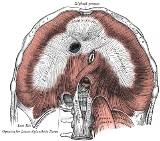
The Diaphragm is a dome-shaped musculofibrous septum that separates the thoracic from the abdominal cavity, its convex upper surface forming the floor of the former, and its concave under surface the roof of the latter. Its peripheral part consists of muscular fibers that take origin from the circumference of the thoracic outlet and converge to be inserted into a central tendon.

The muscular fibers may be grouped according to their origins into three parts:

Part Origin >- | sternal two fleshy slips from the back of the xiphoid process
Xiphoid process

The xiphoid Process , also known as the xiphisternum is a small Cartilage extension to the lower part of the sternum which is usually Ossification in the adult human....
. |- | costal
the inner surfaces of the cartilages and adjacent portions of the lower six ribs on either side, interdigitating with the Transversus abdominis. |- | lumbar aponeurotic arches, named the lumbocostal arches, and from the lumbar vertebrae
Lumbar vertebrae

The lumbar vertebrae are the largest segments of the movable part of the vertebral column, and are characterized by the absence of the foramen transversarium within the transverse process, and by the absence of facets on the sides of the body....
 by two pillars or crura.


There are two lumbocostal arches, a medial
Medial arcuate ligament

The medial arcuate ligament is tendinous fascia that arches over the psoas major muscle as it passes through the diaphragm ....
 and a lateral
Lateral arcuate ligament

The lateral arcuate ligament is a ligament under the diaphragm that arches across the upper part of the quadratus lumborum....
, on either side.

Innervation

The diaphragm is innervated by the phrenic nerve
Phrenic nerve

The phrenic nerve arises from the third, fourth, and fifth cervical spinal nerves in humans....
. It's a branch of C3
Cervical spinal nerve 3

The cervical spinal nerve 3 is a spinal nerve of the cervical segment..It originates from the spinal column from above the cervical vertebra 3 ....
,C4
Cervical spinal nerve 4

The cervical spinal nerve 4 is a spinal nerve of the cervical segment..It originates from the spinal column from above the cervical vertebra 4 ....
,and C5
Cervical spinal nerve 5

The cervical spinal nerve 5 is a spinal nerve of the cervical segment..It originates from the spinal column from above the cervical vertebra 5 ....
.
  • you can remember that by "3, 4, 5 keeps the diaphragm alive"


Crura and central tendon

At their origins the crura
Crus of diaphragm

The crura of the diaphragm are tendon structures that extend inferiorly from the diaphragm to attach to the vertebral column....
 are tendinous in structure, and blend with the anterior longitudinal ligament
Anterior longitudinal ligament

The anterior longitudinal ligament is a ligament that runs down the anterior surface of the Vertebral column. It traverses all of the vertebral bodies and intervertebral discs....
 of the vertebral column
Vertebral column

In human anatomy, the vertebral column is a column of 24 vertebrae, the sacrum, intervertebral discs, and the coccyx situated in the dorsum aspect of the torso, separated by spinal discs....
.

The central tendon of the diaphragm is a thin but strong aponeurosis situated near the center of the vault formed by the muscle, but somewhat closer to the front than to the back of the thorax
Thorax

The thorax is a division of an animal's body that lies between the head and the abdomen.In mammals, the thorax is the region of the body formed by the sternum, the thoracic vertebrae and the ribs....
, so that the posterior muscular fibers are the longer.

Openings in the Diaphragm

Gray391
The diaphragm is pierced by a series of apertures to permit of the passage of structures between the thorax and abdomen. Three large openings — the aortic
Aorta

The aorta is the largest artery in the human body, originating from the left ventricle of the heart and bringing oxygenated blood to all parts of the body in the systemic circulation....
, the esophageal, and the vena cava
Inferior vena cava

The inferior vena cava is the large vein that carries de-oxygenated blood from the lower half of the body into the right atrium of the heart....
 — and a series of smaller ones are described.

opening level structures >- | caval opening
Caval opening

The caval opening is a hiatus in the diaphragm of humans through which passes the inferior vena cava, the wall of which is adherent to the margins of the opening, and some branches of the right phrenic nerve....
 
T8 inferior vena cava
Inferior vena cava

The inferior vena cava is the large vein that carries de-oxygenated blood from the lower half of the body into the right atrium of the heart....
, and some branches of the right phrenic nerve
Phrenic nerve

The phrenic nerve arises from the third, fourth, and fifth cervical spinal nerves in humans....
|- | esophageal hiatus
Esophageal hiatus

In human anatomy, the esophageal hiatus is a hole in the diaphragm through which the esophagus passes. It is located in the right crus of the diaphragm....
 
T10 esophagus
Esophagus

The esophagus or oesophagus , sometimes known as the gullet, is an Organ in vertebrates which consists of a Muscle tube through which food passes from the pharynx to the stomach....
, the anterior and posterior vagal trunks, and some small esophageal arteries
Esophageal arteries

The esophageal arteries four or five in number, arise from the front of the aorta, and pass obliquely downward to the esophagus, forming a chain of anastomoses along that tube, anastomosing with the esophageal branches of the inferior thyroid arteries above, and with ascending branches from the left inferior phrenic and left gastric arteries...
|- | aortic hiatus
Aortic hiatus

The aortic hiatus is a hole in the human diaphragm . It is the lowest and most posterior of the large apertures.It is located approximately at the level of the twelfth thoracic vertebra ....
 
T12 the aorta
Aorta

The aorta is the largest artery in the human body, originating from the left ventricle of the heart and bringing oxygenated blood to all parts of the body in the systemic circulation....
, the azygos vein
Azygos vein

The azygos vein is a vein running up the right side of the thoracic vertebral column. It can also provide an alternate path for blood to the superior vena cava....
, and the thoracic duct
Thoracic duct

In human anatomy, the thoracic duct is an important part of the lymphatic system—it is the largest lymphatic vessel in the body. It is also known under various other names including the alimentary duct, chyliferous duct, duct of Pecquet, the left lymphatic duct and Van Hoorne's canal....
|- | two lesser aperture of right crus
greater and lesser right splanchnic nerves |- | three lesser aperture of left crus greater and lesser left splanchnic nerves and the hemiazygos vein
Hemiazygos vein

The hemiazygos vein is a vein running superiorly in the lower thoracic region, just to the left side of the vertebral column....
|- | behind the diaphragm, under the medial lumbocostal arches
sympathetic trunk
Sympathetic trunk

The sympathetic trunks are a paired bundle of nerve fibers that run from the base of the skull to the coccyx....
|- | areolar tissue between the sternal and costal parts (see also foramina of Morgagni
Foramina of Morgagni

The foramina of Morgagni are small zones lying between the costal and sternum attachments of the thoracic diaphragm.Also known as sternocostal hiatus or triangle...
)
the superior epigastric branch of the internal mammary artery and some lymphatics from the abdominal wall and convex surface of the liver
Liver

The liver is a vital organ present in vertebrates and some other animals; it has a wide range of functions, a few of which are detoxification, protein synthesis, and production of biochemicals necessary for digestion....
|- | areolar tissue between the fibers springing from the medial and lateral lumbocostal arches
This interval is less constant; when this interval exists, the upper and back part of the kidney
Kidney

The kidneys are Organ that have numerous biological roles. Their primary role is to maintain the homeostasis balance of bodily fluids by filtering and secreting Metabolomics#Metabolitess and minerals from the blood and excreting them, along with water , as urine....
 is separated from the pleura by areolar tissue only.


You can remember some of them by this Mnemonic
Mnemonic

A mnemonic device is a memory aid. Commonly met mnemonics are often verbal, something such as a very short poem or a special word used to help a person remember something, particularly lists, but may be visual, kinesthetic or auditory....
  • Aortic hiatus
    Aortic hiatus

    The aortic hiatus is a hole in the human diaphragm . It is the lowest and most posterior of the large apertures.It is located approximately at the level of the twelfth thoracic vertebra ....
     = 12 letters = T12
  • Oesophagus = 10 letters = T10
  • Vena cava = 8 letters = T8


Comparative anatomy and evolution

The existence of some membrane separating the pharynx from the stomach can be traced widely among the chordate
Chordate

Chordates are a group of animals that includes the vertebrates, together with several closely related invertebrates. They are united by having, at some time in their life cycle, a notochord, a hollow dorsal nerve cord, pharyngeal slits, an endostyle, and a post-anal tail....
s. Thus amphioxus possesses an atrium
Atrium

Atrium may refer to:*Atrium , a large open space within a building*Pulmonary alveolus, microscopic air sacs in lungs*Atrium , an anatomical structure of the heart...
 by which water exits the pharynx, which has been argued (and disputed) to be homologous to structures in ascidians and hagfish
Hagfish

Hagfish are marine craniates of the class Myxini, also known as Hyperotreti. Myxini is the only class in the clade Craniata that does not also belong to the phylum Vertebrata....
es. The urochordate epicardium separates digestive organs from the pharynx and heart, but the anus returns to the upper compartment to discharge wastes through an outgoing siphon.

Thus the diaphragm emerges in the context of a body plan that separated an upper feeding compartment from a lower digestive tract, but the point at which it originates is a matter of definition. Structures in fish, amphibians, reptiles, and birds have been called diaphragms, but it has been argued that these structures are not homologous. For instance, the alligator diaphragmaticus muscle does not insert on the esophagus
Esophagus

The esophagus or oesophagus , sometimes known as the gullet, is an Organ in vertebrates which consists of a Muscle tube through which food passes from the pharynx to the stomach....
 and does not affect pressure of the lower esophageal sphincter. The lungs are located in the abdominal compartment of amphibians and reptiles, so that contraction of the diaphragm expels air from the lungs rather than drawing it into them. In birds and mammals, lungs are located above the diaphragm. The presence of an exceptionally well-preserved fossil of Sinosauropteryx
Sinosauropteryx

Sinosauropteryx is the first and most primitive genus of dinosaur found with the fossilized impressions of feathers. It lived in China during the early Cretaceous period and may have been a close relative of Compsognathus....
, with lungs located beneath the diaphragm as in crocodiles, has been used to argue that dinosaurs could not have sustained an active warm-blooded physiology, or that birds could not have evolved from dinosaurs. An explanation for this state of affairs is that, when lungs originated beneath the diaphragm, but as the demands for respiration increased in warm-blooded birds and mammals, natural selection came to favor the parallel evolution
Parallel evolution

Parallel evolution is the independent evolution of similar traits, starting from a similar ancestral condition due to similar environments or other evolutionary pressures....
 of the herniation of the lungs from the abdominal cavity in both lineages.. However, birds do not have diaphragms. They do not breathe in the same way as mammals, and do not rely on creating a negative pressure in the thoracic cavity, at least not to the same extent. They rely on a rocking motion of the keel of the sternum to create local areas of reduced pressure to supply thin, membranous airsacs cranially and caudally to the fixed-volume, non-expansive lungs. A complicated system of valves and air sacs cycles air constantly over the absorption surfaces of the lungs so allowing maximal efficiency of gaseous exchange. Thus, birds do not have the reciprocal tidal breathing flow of mammals. On careful dissection, around eight air sacs can be clearly seen. They extend quite far caudally into the abdomen.

Variations

The sternal portion of the muscle is sometimes wanting and more rarely defects occur in the lateral part of the central tendon
Central tendon

The central tendon of the Thoracic diaphragm is a thin but strong aponeurosis situated near the center of the vault formed by the muscle, but somewhat closer to the front than to the back of the thorax, so that the posterior muscular fibers are longer....
 or adjoining muscle fibers.

CONTENTS · INDEX · ILLUSTRATIONS · BIBLIOGRAPHIC RECORD

The American Heritage® Dictionary of the English Language: Fourth Edition. 2000.

rayah

SYLLABICATION: ra·yah PRONUNCIATION: räy, r VARIANT FORMS: also ra·ya NOUN: A Christian subject under an Ottoman ruler. ETYMOLOGY: Turkish râya, from Arabic ra‘yah, subject, flock, from ra‘, to pasture, feed. See rcy in Appendix II.

The American Heritage® Dictionary of the English Language, Fourth Edition. Copyright © 2000 by Houghton Mifflin Company. Published by the Houghton Mifflin Company. All rights reserved.

Ray, Satyajit Rayburn, Samuel Taliaferro

Pathology


The right crus of the diaphragm is part of the lower esophageal sphincter (LES), which separates the thoracic and abdominal parts of the esophagus. A hiatal hernia, in which the abdominal esophagus or even the fundus of the stomach rises up through the esophageal hiatus into the thoracic cavity, can result from a tear or weakness in the diaphragm. Both general weakness of the LES and hiatal hernia can cause "acid reflex," also known as gastroesophageal reflex disease (GERD).

If the diaphragm is struck, or otherwise spasm
Spasm

A spasm is a sudden, involuntary contraction of a muscle, a group of muscles, or a hollow Organ , or a similarly sudden contraction of an orifice....
s, breathing will become difficult. This is called "having the wind knocked out of you."

A hiccup
Hiccup

A hiccup or hiccough , is the spasmodic contraction of the Diaphragm that repeats several times per minute. In humans, the abrupt rush of air into the lungs causes the epiglottis to close, creating the "hic" noise....
 occurs when the diaphragm contracts periodically without voluntary control.

Diaphragmatic injuries result from either blunt or penetrating trauma.

Gas under the diaphragm may be pneumoperitoneum
Pneumoperitoneum

Pneumoperitoneum is air or gas in the abdominal cavity. It is often seen on X-ray, but small amounts are often missed, and CT is nowadays regarded as a criterion standard in the assessment of a pneumoperitoneum....
. CONTENTS · INDEX · ILLUSTRATIONS · BIBLIOGRAPHIC RECORD

The American Heritage® Dictionary of the English Language: Fourth Edition. 2000. rayah

SYLLABICATION: ra·yah PRONUNCIATION: räy, r VARIANT FORMS: also ra·ya NOUN: A Christian subject under an Ottoman ruler. ETYMOLOGY: Turkish râya, from Arabic ra‘yah, subject, flock, from ra‘, to pasture, feed. See rcy in Appendix II.

The American Heritage® Dictionary of the English Language, Fourth Edition. Copyright © 2000 by Houghton Mifflin Company. Published by the Houghton Mifflin Company. All rights reserved.

CONTENTS · INDEX · ILLUSTRATIONS · BIBLIOGRAPHIC RECORD

Additional images


CONTENTS · INDEX · ILLUSTRATIONS · BIBLIOGRAPHIC RECORD

rayah

SYLLABICATION: ra·yah PRONUNCIATION: räy, r VARIANT FORMS: also ra·ya NOUN: A Christian subject under an Ottoman ruler. ETYMOLOGY: Turkish râya, from Arabic ra‘yah, subject, flock, from ra‘, to pasture, feed. See rcy in Appendix II.

The American Heritage® Dictionary of the English Language, Fourth Edition. Copyright © 2000 by Houghton Mifflin Company. Published by the Houghton Mifflin Company. All rights reserved.

CONTENTS · INDEX · ILLUSTRATIONS · BIBLIOGRAPHIC RECORD

See also

  • Midriff
    Midriff

    In the human body, the midriff is the section of the body between the chest and the waist, i.e. the Diaphragm area. Its main outside anatomical feature is the navel....


External links