

Gharial

Encyclopedia
The gharial (Hindi
: घऱियाल, Marathi
: सुसर Susar), also called Indian gavial or gavial, is the only surviving member of the once well-represented family
Gavialidae
, a long-established group of crocodilians with long, slender snouts. The gharial is listed as a critically endangered species by IUCN.
The gharial is one of the three crocodilians found in India
, apart from the Mugger crocodile
and the Saltwater crocodile
. It is one of the longest of all living crocodilians.
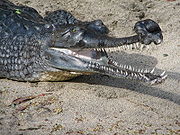 The average size of mature gharials is 3.5 to 4.5 m (11.5 to 14.8 ft). The maximum recorded size is 6.25 m (20.5 ft). Hatchlings approximate 37 cm (14.6 in). Young gharials can reach a length of 1 m (3.3 ft) in eighteen months.
Their average body weight is 159 kilogram. Males attain a body length of 3 to 6 m (9.8 to 19.7 ft), while females are smaller and reach a body length of 2.7 to 3.75 m (8.9 to 12.3 ft).
The three largest examples reported were a 6.5 m (21.3 ft) gharial killed in the Gogra
River of Faizabad
in August 1920; a 6.3 m (20.7 ft) individual shot in the Cheko River of Jalpaiguri
in 1934; and a giant of 7 m (23 ft), which was shot in the Kosi
River of northern Bihar
in January 1924.
Gharials are exceeded in size only by the Saltwater Crocodile
. Male individuals of up to 6 metres (19.7 ft) were commonly encountered in the past, but such large individuals are unknown today. Their well-developed laterally flattened tail and webbed rear feet provide tremendous maneuverability in their deepwater habitat. On land, however, an adult gharial can only push itself forward and slide on its belly. Its elongated, narrow snout becomes proportionally shorter and thicker as an animal ages. The bulbous growth on the tip of a male’s snout renders gharials the only visibly sexually dimorphic
crocodilian. This growth is present in mature individuals and called ghara after the Indian word meaning “pot”. Males utilize the structure to modify and amplify “hisses” snorted through the underlying nostrils. The resultant sound can be heard for nearly a kilometer on a still day. The ghara is thought to play an important role in gharial reproduction by identifying mature males to females and as an instrument in courtship auditory communication.
The Nepali
word घड़ा ghaṛā means earthenware pot, pitcher, watervessel.
The leg musculature of the gharial does not enable it to raise its body off the ground to achieve the high-walk gait on land, but can only push its body forward across the ground ('belly-sliding'), although it can do this with some speed when required. However, when in water, the gharial is the most nimble and quick of all the crocodilians in the world. The jaws are lined with many interlocking, razor-sharp teeth — 27 to 29 upper and 25 or 26 lower teeth on each side. These teeth are not received into interdental pits; the first, second, and third mandibular teeth fit into notches in the upper jaw. The front teeth are the largest. The snout is narrow and long, with a dilation at the end and its nasal bones are comparatively short and are widely separated from the pre-maxillaries. The nasal opening of a gharial is smaller than the supra-temporal fossae. The lower anterior margin of orbit (jugal) is raised and its mandibular
symphysis
is extremely long, extending to the 23rd or 24th tooth. A dorsal shield is formed from four longitudinal series of juxtaposed, keeled, and bony scute
s. The length of the snout is 3.5 (in adults) to 5.5 times (in young) the breadth of the snout's base. Nuchal and dorsal scutes form a single continuous shield composed of 21 or 22 transverse series. Gharials have an outer row of soft, smooth, or feebly keeled scutes in addition to the bony dorsal scutes. They also have two small post-occipital scutes. The outer toes are two-thirds webbed, while the middle toe is only one-third webbed. They have a strong crest on the outer edge of the forearm, leg, and foot. Typically, adult gharials have a dark olive color tone while young ones are pale olive, with dark brown spots or cross-bands.
 Gharials once thrived in all the major river systems of the Indian subcontinent
, spanning the rivers of its northern part from the Indus
in Pakistan
across the Gangetic floodplain to the Irrawaddy
in Myanmar
. Today their distribution is limited to only 2% of their former range:
They are extinct in Pakistan
's Indus River
, in the Brahmaputra of Bhutan
and Bangladesh
and in the Irrawaddy River in Myanmar
. They are sympatric with the Mugger crocodile
(Crocodylus palustris) and formerly used to be with the Saltwater Crocodile
(Crocodylus porosus) in the delta of Irrawaddy.
There have been some small-scale projects to breed and rehabilitate gharials, like in Nepal's Chitwan National Park.
s and also since jewelry has been found in their stomachs. However, the gharial may have swallowed this jewelry while scavenging corpses or as gastrolith
s used to aid digestion or buoyancy management.
.jpg) Since 2007, the species is listed as Critically Endangered
Since 2007, the species is listed as Critically Endangered
on the Red List of Threatened Species issued by IUCN, and protected by CITES Appendix I.
Conservation programs have been undertaken in India and Nepal, based on the establishment of protected areas and restocking these with animals born in captivity, but nowhere has restocking re-established viable populations.
In the 1970s the gharial came to the brink of extinction and even now remains on the critically endangered list. The conservation efforts of the environmentalists in cooperation with several governments has led to some reduction in the threat of extinction. Some hope lies with the conservation and management programs in place since 2004. Full protection was granted in the 1970s in the hope of reducing poaching
losses, although these measures were slow to be implemented at first. Now there are 9 protected areas for this species in India, which are linked to both captive breeding and 'ranching' operations, where eggs collected from the wild are raised in captivity to reduce mortality due to natural predators. Since 1981, more than 3000 young gharial have been released into the wild. The wild population in India is estimated at around 1500 animals — with perhaps between one and two hundred animals in the remainder of its range. The release of captive gharials was not as successful as expected. Recently, more than 100 gharials died in India in the Chambal River from an unknown cause with gout
-like symptoms. This recent death toll is expected to have decreased the number of breeding pairs to less than 400. Tests of the carcasses conducted at the IVRI suggest the possibility of poisoning by metal pollutants.
, during a visit with Romulus Whitaker
at the Madras Crocodile Bank
, announced the formation of a National Tri-State Chambal Sanctuary Management and Coordination Committee for gharial conservation on 1600 km² (617.8 sq mi) of the National Chambal Sanctuary along the Chambal River
in Madhya Pradesh
, Rajasthan
and Uttar Pradesh
. The Committee will comprise representatives of three states' Water Resources Ministries, states' Departments of Irrigation and Power, Wildlife Institute of India
, Madras Crocodile Bank Trust
, the Gharial Conservation Alliance, Development Alternatives, Ashoka Trust for Research in Ecology and the Environment, Worldwide Fund for Nature and the Divisional Forest officers of the three states. The Committee will plan strategies for protection of gharials and their habitat. This will involve further research on the species and its ecology and socio-economic evaluation of dependent riparian communities. Funding for this new initiative will be mobilized as a sub-scheme of the ‘Integrated Development of Wildlife Habitats’ in the amount of 50 to 80 million Indian Rupee
s (USD 1 million to 1.7 million) each year for five years. This project has long been advocated by Rom Whitaker.
, and in the Gharial Breeding Centre in Nepal's Chitwan National Park, where they are generally grown for two to three years and average about one meter, when released. They are also kept at the Honolulu Zoo
on Oahu
, the Cleveland Metroparks Zoo
, the Fort Worth Zoo
in Texas, the San Diego Zoo
in San Diego, the La Ferme aux Crocodiles in France
and at the Prague Zoo
in the Czech Republic
.
. The most distinctive feature of the group is the very long, narrow snout, which is an adaptation to a diet of small fish. Although gharials have sacrificed the great mechanical strength of the robust skull and jaw that most crocodiles and alligators have, and in consequence cannot prey on large creatures, the reduced weight and water resistance of their lighter skull and very narrow jaw gives gharials the ability to catch rapidly moving fish, using a side-to-side snapping motion.
The earliest gharial may have been related to the modern types: some died out at the same time as the dinosaur
s (at the end of the Cretaceous), others survived until the early Eocene
. The modern forms appeared at much the same time, evolving in the estuaries and coastal waters of Africa, but crossing the Atlantic
to reach South America
as well. At their peak, the Gavialoidea were numerous and diverse; they occupied much of Asia and America up until the Pliocene
. One species, Rhamphosuchus crassidens
of India, is believed to have grown to an enormous 15 metres (~50 feet) or more.
According to molecular genetic
studies the gharial and the false gharial
(Tomistoma) are close relatives, which would support to place them in the same family.
Hindi
Standard Hindi, or more precisely Modern Standard Hindi, also known as Manak Hindi , High Hindi, Nagari Hindi, and Literary Hindi, is a standardized and sanskritized register of the Hindustani language derived from the Khariboli dialect of Delhi...
: घऱियाल, Marathi
Marathi language
Marathi is an Indo-Aryan language spoken by the Marathi people of western and central India. It is the official language of the state of Maharashtra. There are over 68 million fluent speakers worldwide. Marathi has the fourth largest number of native speakers in India and is the fifteenth most...
: सुसर Susar), also called Indian gavial or gavial, is the only surviving member of the once well-represented family
Family (biology)
In biological classification, family is* a taxonomic rank. Other well-known ranks are life, domain, kingdom, phylum, class, order, genus, and species, with family fitting between order and genus. As for the other well-known ranks, there is the option of an immediately lower rank, indicated by the...
Gavialidae
Gavialidae
Gavialidae is a family of reptiles within the order Crocodilia. Gavialidae consists of only one surviving species, the gharial , which is native to India. Many extinct species are also known...
, a long-established group of crocodilians with long, slender snouts. The gharial is listed as a critically endangered species by IUCN.
The gharial is one of the three crocodilians found in India
India
India , officially the Republic of India , is a country in South Asia. It is the seventh-largest country by geographical area, the second-most populous country with over 1.2 billion people, and the most populous democracy in the world...
, apart from the Mugger crocodile
Mugger Crocodile
The mugger crocodile , also called the Indian, Indus, Persian, or marsh crocodile, is found throughout the Indian subcontinent and the surrounding countries...
and the Saltwater crocodile
Saltwater Crocodile
The saltwater crocodile, also known as estuarine or Indo-Pacific crocodile, is the largest of all living reptiles...
. It is one of the longest of all living crocodilians.
Characteristics
Their average body weight is 159 kilogram. Males attain a body length of 3 to 6 m (9.8 to 19.7 ft), while females are smaller and reach a body length of 2.7 to 3.75 m (8.9 to 12.3 ft).
The three largest examples reported were a 6.5 m (21.3 ft) gharial killed in the Gogra
Ghaghara River
Karnali or Ghaghara is a perennial trans-boundary river originating on the Tibetan Plateau near Lake Mansarovar. It cuts through the Himalayas in Nepal and joins the Sarda River at Brahmaghat in India. Together they form the Ghaghra River, a major left bank tributary of the Ganges. With a length of...
River of Faizabad
Faizabad
City of Faizabad , previous capital of Awadh, is the headquarters of Faizabad District and a municipal board in the state of Uttar Pradesh, India, situated on the banks of river Ghaghra . Faizabad has a twin city of Ayodhya, which is considered to be the birthplace of Rama...
in August 1920; a 6.3 m (20.7 ft) individual shot in the Cheko River of Jalpaiguri
Jalpaiguri District
Jalpaiguri district is the largest district of North Bengal, covering an area 6,245 km2. It is situated between 26° 16' and 27° 0' North latitudes and 88° 4' and 89° 53' East longitudes...
in 1934; and a giant of 7 m (23 ft), which was shot in the Kosi
Koshi River
The Kosi River or Koshi —also Saptakoshi for its seven Himalayan tributaries—is a trans-boundary river flowing through Nepal and India. Some of the rivers of the Koshi system, such as the Arun, the Sun Kosi and the Bhote Koshi, originate in the Tibet Autonomous Region of China...
River of northern Bihar
Bihar
Bihar is a state in eastern India. It is the 12th largest state in terms of geographical size at and 3rd largest by population. Almost 58% of Biharis are below the age of 25, which is the highest proportion in India....
in January 1924.
Gharials are exceeded in size only by the Saltwater Crocodile
Saltwater Crocodile
The saltwater crocodile, also known as estuarine or Indo-Pacific crocodile, is the largest of all living reptiles...
. Male individuals of up to 6 metres (19.7 ft) were commonly encountered in the past, but such large individuals are unknown today. Their well-developed laterally flattened tail and webbed rear feet provide tremendous maneuverability in their deepwater habitat. On land, however, an adult gharial can only push itself forward and slide on its belly. Its elongated, narrow snout becomes proportionally shorter and thicker as an animal ages. The bulbous growth on the tip of a male’s snout renders gharials the only visibly sexually dimorphic
Sexual dimorphism
Sexual dimorphism is a phenotypic difference between males and females of the same species. Examples of such differences include differences in morphology, ornamentation, and behavior.-Examples:-Ornamentation / coloration:...
crocodilian. This growth is present in mature individuals and called ghara after the Indian word meaning “pot”. Males utilize the structure to modify and amplify “hisses” snorted through the underlying nostrils. The resultant sound can be heard for nearly a kilometer on a still day. The ghara is thought to play an important role in gharial reproduction by identifying mature males to females and as an instrument in courtship auditory communication.
The Nepali
Nepali language
Nepali or Nepalese is a language in the Indo-Aryan branch of the Indo-European language family.It is the official language and de facto lingua franca of Nepal and is also spoken in Bhutan, parts of India and parts of Myanmar...
word घड़ा ghaṛā means earthenware pot, pitcher, watervessel.
The leg musculature of the gharial does not enable it to raise its body off the ground to achieve the high-walk gait on land, but can only push its body forward across the ground ('belly-sliding'), although it can do this with some speed when required. However, when in water, the gharial is the most nimble and quick of all the crocodilians in the world. The jaws are lined with many interlocking, razor-sharp teeth — 27 to 29 upper and 25 or 26 lower teeth on each side. These teeth are not received into interdental pits; the first, second, and third mandibular teeth fit into notches in the upper jaw. The front teeth are the largest. The snout is narrow and long, with a dilation at the end and its nasal bones are comparatively short and are widely separated from the pre-maxillaries. The nasal opening of a gharial is smaller than the supra-temporal fossae. The lower anterior margin of orbit (jugal) is raised and its mandibular
Mandibular
Mandibular may refer to:* Mandible, the lower jaw bone* Mandibular canal* Mandibular nerve...
symphysis
Symphysis
A symphysis is a fibrocartilaginous fusion between two bones. It is a type of cartilaginous joint, specifically a secondary cartilaginous joint.1.A symphysis is an amphiarthrosis, a slightly movable joint.2.A growing together of parts or structures...
is extremely long, extending to the 23rd or 24th tooth. A dorsal shield is formed from four longitudinal series of juxtaposed, keeled, and bony scute
Scute
A scute or scutum is a bony external plate or scale, as on the shell of a turtle, the skin of crocodilians, the feet of some birds or the anterior portion of the mesonotum in insects.-Properties:...
s. The length of the snout is 3.5 (in adults) to 5.5 times (in young) the breadth of the snout's base. Nuchal and dorsal scutes form a single continuous shield composed of 21 or 22 transverse series. Gharials have an outer row of soft, smooth, or feebly keeled scutes in addition to the bony dorsal scutes. They also have two small post-occipital scutes. The outer toes are two-thirds webbed, while the middle toe is only one-third webbed. They have a strong crest on the outer edge of the forearm, leg, and foot. Typically, adult gharials have a dark olive color tone while young ones are pale olive, with dark brown spots or cross-bands.
Distribution and habitat
Indian subcontinent
The Indian subcontinent, also Indian Subcontinent, Indo-Pak Subcontinent or South Asian Subcontinent is a region of the Asian continent on the Indian tectonic plate from the Hindu Kush or Hindu Koh, Himalayas and including the Kuen Lun and Karakoram ranges, forming a land mass which extends...
, spanning the rivers of its northern part from the Indus
Indus River
The Indus River is a major river which flows through Pakistan. It also has courses through China and India.Originating in the Tibetan plateau of western China in the vicinity of Lake Mansarovar in Tibet Autonomous Region, the river runs a course through the Ladakh district of Jammu and Kashmir and...
in Pakistan
Pakistan
Pakistan , officially the Islamic Republic of Pakistan is a sovereign state in South Asia. It has a coastline along the Arabian Sea and the Gulf of Oman in the south and is bordered by Afghanistan and Iran in the west, India in the east and China in the far northeast. In the north, Tajikistan...
across the Gangetic floodplain to the Irrawaddy
Irrawaddy
Irrawaddy may refer to:*Irrawaddy River, the main river of Burma*Irrawaddy Delta, a rice growing region of the country*Ayeyarwady Region, an administrative division of Burma*The Irrawaddy, a Burmese news publication based in Chiang Mai, Thailand...
in Myanmar
Myanmar
Burma , officially the Republic of the Union of Myanmar , is a country in Southeast Asia. Burma is bordered by China on the northeast, Laos on the east, Thailand on the southeast, Bangladesh on the west, India on the northwest, the Bay of Bengal to the southwest, and the Andaman Sea on the south....
. Today their distribution is limited to only 2% of their former range:
- In IndiaIndiaIndia , officially the Republic of India , is a country in South Asia. It is the seventh-largest country by geographical area, the second-most populous country with over 1.2 billion people, and the most populous democracy in the world...
, small populations are present and increasing in the rivers of the National Chambal Sanctuary, Katarniaghat Wildlife SanctuaryKatarniaghat Wildlife SanctuaryKatarniaghat Wildlife Sanctuary is a part of the Dudhwa Tiger Reserve, and is located in Uttar Pradesh near the India-Nepal border, in the Terai area of Bahraich district...
, Son River Sanctuary and the rainforestRainforestRainforests are forests characterized by high rainfall, with definitions based on a minimum normal annual rainfall of 1750-2000 mm...
biomeBiomeBiomes are climatically and geographically defined as similar climatic conditions on the Earth, such as communities of plants, animals, and soil organisms, and are often referred to as ecosystems. Some parts of the earth have more or less the same kind of abiotic and biotic factors spread over a...
of MahanadiMahanadi RiverThe Mahanadi in East Central India. It drains an area of around 141,600 km2 and has a total course of 858 km. The river flows through the states of Chhattisgarh and Orissa.-Source:...
in Satkosia Gorge Sanctuary, OrissaOrissaOrissa , officially Odisha since Nov 2011, is a state of India, located on the east coast of India, by the Bay of Bengal. It is the modern name of the ancient nation of Kalinga, which was invaded by the Maurya Emperor Ashoka in 261 BC. The modern state of Orissa was established on 1 April...
, where they apparently do not breed; - In NepalNepalNepal , officially the Federal Democratic Republic of Nepal, is a landlocked sovereign state located in South Asia. It is located in the Himalayas and bordered to the north by the People's Republic of China, and to the south, east, and west by the Republic of India...
, small populations are present and slowly recovering in tributaries of the Ganges, such as the Narayani-Rapti river system in Chitwan National Park and the Karnali-Babai river system in Bardia National Park.
They are extinct in Pakistan
Pakistan
Pakistan , officially the Islamic Republic of Pakistan is a sovereign state in South Asia. It has a coastline along the Arabian Sea and the Gulf of Oman in the south and is bordered by Afghanistan and Iran in the west, India in the east and China in the far northeast. In the north, Tajikistan...
's Indus River
Indus River
The Indus River is a major river which flows through Pakistan. It also has courses through China and India.Originating in the Tibetan plateau of western China in the vicinity of Lake Mansarovar in Tibet Autonomous Region, the river runs a course through the Ladakh district of Jammu and Kashmir and...
, in the Brahmaputra of Bhutan
Bhutan
Bhutan , officially the Kingdom of Bhutan, is a landlocked state in South Asia, located at the eastern end of the Himalayas and bordered to the south, east and west by the Republic of India and to the north by the People's Republic of China...
and Bangladesh
Bangladesh
Bangladesh , officially the People's Republic of Bangladesh is a sovereign state located in South Asia. It is bordered by India on all sides except for a small border with Burma to the far southeast and by the Bay of Bengal to the south...
and in the Irrawaddy River in Myanmar
Myanmar
Burma , officially the Republic of the Union of Myanmar , is a country in Southeast Asia. Burma is bordered by China on the northeast, Laos on the east, Thailand on the southeast, Bangladesh on the west, India on the northwest, the Bay of Bengal to the southwest, and the Andaman Sea on the south....
. They are sympatric with the Mugger crocodile
Mugger Crocodile
The mugger crocodile , also called the Indian, Indus, Persian, or marsh crocodile, is found throughout the Indian subcontinent and the surrounding countries...
(Crocodylus palustris) and formerly used to be with the Saltwater Crocodile
Saltwater Crocodile
The saltwater crocodile, also known as estuarine or Indo-Pacific crocodile, is the largest of all living reptiles...
(Crocodylus porosus) in the delta of Irrawaddy.
There have been some small-scale projects to breed and rehabilitate gharials, like in Nepal's Chitwan National Park.
Ecology and behavior
Gharials are arguably the most thoroughly aquatic of the extant crocodilians, and adults apparently do not have the ability to walk in a semi-upright stance as other crocodilians do. They are typically residents of flowing rivers with deep pools that have high sand banks and good fish stocks. Exposed sand banks are used for nesting.Diet
Young gharials eat insects, larvae, and small frogs. Mature adults feed almost solely on fish, although some individuals have been known to scavenge dead animals. Their snout morphology is ideally suited for preying on fish. Their long, narrow snouts offer very little resistance to water in swiping motions to snap up fish in the water. Their numerous needle-like teeth are ideal for holding on to struggling, slippery fish. Gharials will often use their body to corral fish against the bank where they can be more easily snapped up.Reproduction
The mating season is during November through December and well into January. The nesting and laying of eggs takes place in the dry season of March, April, and May. This is because during the dry season the rivers shrink a bit and the sandy river banks are available for nesting. Between 30 and 50 eggs are deposited into the hole that the female digs up before it is covered over carefully. After about 90 days, the juveniles emerge, although there is no record of the female assisting the juveniles into the water after they hatch (probably because their jaws are not suited for carrying the young due to the needle like teeth). However, the mother does protect the young in the water for a few days until they learn to fend for themselves.Gharials and humans
The gharial is not a man-eater and tends to be very shy when confronting humans. Despite its immense size, its thin and fragile jaws make it physically incapable of consuming a large animal, especially a human being. The myth that gharials eat humans may come partly from their similar appearance to crocodileCrocodile
A crocodile is any species belonging to the family Crocodylidae . The term can also be used more loosely to include all extant members of the order Crocodilia: i.e...
s and also since jewelry has been found in their stomachs. However, the gharial may have swallowed this jewelry while scavenging corpses or as gastrolith
Gastrolith
A gastrolith, also called a stomach stone or gizzard stones, is a rock held inside a gastrointestinal tract. Gastroliths are retained in the muscular gizzard and used to grind food in animals lacking suitable grinding teeth. The grain size depends upon the size of the animal and the gastrolith's...
s used to aid digestion or buoyancy management.
Threats
According to IUCN, there has been a population decline of 96–98% over a three-generation period since 1946, and the once widespread population of an estimated 5,000 to 10,000 individuals has been reduced to a very small number of widely spaced subpopulations of fewer than 235 individuals in 2006. The drastic decline in the gharial population can be attributed to a variety of causes including over-hunting for skins and trophies, egg collection for consumption, killing for indigenous medicine, and killing by fishermen. Hunting is no longer considered to be a significant threat. However, the wild population of gharials has undergone a drastic decline of about 58% within nine years between 1997 and 2006 due to- the increasing intensity of fishing and the use of gill nets, which is rapidly killing many of the scarce adults and many subadults — a threat prevalent throughout most of the present gharial habitat, even in protected areas;
- the excessive, irreversible loss of riverine habitat caused by the construction of dams, barrages, irrigation canals, siltationSiltationSiltation is the pollution of water by fine particulate terrestrial clastic material, with a particle size dominated by silt or clay. It refers both to the increased concentration of suspended sediments, and to the increased accumulation of fine sediments on bottoms where they are undesirable...
, changes in river course, artificial embankmentEmbankmentEmbankment may refer to:* A levee or dike, an artificial bank raised above the immediately surrounding land to redirect or prevent flooding by a river, lake or sea...
s, sand-mining, riparian agriculture, and domestic and feral livestock, which have combined to cause an extreme limitation to gharial range.
Conservation
Critically Endangered
Critically Endangered is the highest risk category assigned by the IUCN Red List for wild species. Critically Endangered means that a species' numbers have decreased, or will decrease, by 80% within three generations....
on the Red List of Threatened Species issued by IUCN, and protected by CITES Appendix I.
Conservation programs have been undertaken in India and Nepal, based on the establishment of protected areas and restocking these with animals born in captivity, but nowhere has restocking re-established viable populations.
In the 1970s the gharial came to the brink of extinction and even now remains on the critically endangered list. The conservation efforts of the environmentalists in cooperation with several governments has led to some reduction in the threat of extinction. Some hope lies with the conservation and management programs in place since 2004. Full protection was granted in the 1970s in the hope of reducing poaching
Poaching
Poaching is the illegal taking of wild plants or animals contrary to local and international conservation and wildlife management laws. Violations of hunting laws and regulations are normally punishable by law and, collectively, such violations are known as poaching.It may be illegal and in...
losses, although these measures were slow to be implemented at first. Now there are 9 protected areas for this species in India, which are linked to both captive breeding and 'ranching' operations, where eggs collected from the wild are raised in captivity to reduce mortality due to natural predators. Since 1981, more than 3000 young gharial have been released into the wild. The wild population in India is estimated at around 1500 animals — with perhaps between one and two hundred animals in the remainder of its range. The release of captive gharials was not as successful as expected. Recently, more than 100 gharials died in India in the Chambal River from an unknown cause with gout
Gout
Gout is a medical condition usually characterized by recurrent attacks of acute inflammatory arthritis—a red, tender, hot, swollen joint. The metatarsal-phalangeal joint at the base of the big toe is the most commonly affected . However, it may also present as tophi, kidney stones, or urate...
-like symptoms. This recent death toll is expected to have decreased the number of breeding pairs to less than 400. Tests of the carcasses conducted at the IVRI suggest the possibility of poisoning by metal pollutants.
In situ initiatives
On December 27, 2010, the then Indian Minister for Environment and Forests, Jairam RameshJairam Ramesh
Jairam Ramesh born April 9, 1954, is an Indian economist and an influential politician of the Congress Party in the United Progressive Alliance ruling coalition of center-left political parties heading the Government of India. He is a Member of Parliament representing Andhra Pradesh state in the...
, during a visit with Romulus Whitaker
Romulus Whitaker
Romulus Earl Whitaker is a herpetologist, wildlife conservationist and founder of the Madras Snake Park, The Andaman and Nicobar Environment Trust , and the Madras Crocodile Bank Trust....
at the Madras Crocodile Bank
Madras Crocodile Bank Trust
The Madras Crocodile Bank Trust and Centre for Herpetology is a reptile zoo and herpetology research station, located south of the city of Chennai, in state of Tamil Nadu, India. The centre is both a registered trust and a recognized zoo under the Wildlife Act, 1972 and is India's leading...
, announced the formation of a National Tri-State Chambal Sanctuary Management and Coordination Committee for gharial conservation on 1600 km² (617.8 sq mi) of the National Chambal Sanctuary along the Chambal River
Chambal River
The Chambal River is a tributary of the Yamuna River in central India, and forms part of the greater Gangetic drainage system. The river flows north-northeast through Madhya Pradesh, running for a time through Rajasthan, then forming the boundary between Rajasthan and Madhya Pradesh before turning...
in Madhya Pradesh
Madhya Pradesh
Madhya Pradesh , often called the Heart of India, is a state in central India. Its capital is Bhopal and Indore is the largest city....
, Rajasthan
Rajasthan
Rājasthān the land of Rajasthanis, , is the largest state of the Republic of India by area. It is located in the northwest of India. It encompasses most of the area of the large, inhospitable Great Indian Desert , which has an edge paralleling the Sutlej-Indus river valley along its border with...
and Uttar Pradesh
Uttar Pradesh
Uttar Pradesh abbreviation U.P. , is a state located in the northern part of India. With a population of over 200 million people, it is India's most populous state, as well as the world's most populous sub-national entity...
. The Committee will comprise representatives of three states' Water Resources Ministries, states' Departments of Irrigation and Power, Wildlife Institute of India
Wildlife Institute of India
The Wildlife Institute of India is a autonomous institution under the Ministry of Environment and Forests, Government of India.WII carries out wildlife research in areas of study like Biodiversity, Endangered Species, Wildlife Policy, Wildlife Management, Wildlife Forensics, Spatial Modeling,...
, Madras Crocodile Bank Trust
Madras Crocodile Bank Trust
The Madras Crocodile Bank Trust and Centre for Herpetology is a reptile zoo and herpetology research station, located south of the city of Chennai, in state of Tamil Nadu, India. The centre is both a registered trust and a recognized zoo under the Wildlife Act, 1972 and is India's leading...
, the Gharial Conservation Alliance, Development Alternatives, Ashoka Trust for Research in Ecology and the Environment, Worldwide Fund for Nature and the Divisional Forest officers of the three states. The Committee will plan strategies for protection of gharials and their habitat. This will involve further research on the species and its ecology and socio-economic evaluation of dependent riparian communities. Funding for this new initiative will be mobilized as a sub-scheme of the ‘Integrated Development of Wildlife Habitats’ in the amount of 50 to 80 million Indian Rupee
Indian rupee
The Indian rupee is the official currency of the Republic of India. The issuance of the currency is controlled by the Reserve Bank of India....
s (USD 1 million to 1.7 million) each year for five years. This project has long been advocated by Rom Whitaker.
In captivity
Gharials are bred in captivity in the National Chambal Sanctuary in Uttar PradeshUttar Pradesh
Uttar Pradesh abbreviation U.P. , is a state located in the northern part of India. With a population of over 200 million people, it is India's most populous state, as well as the world's most populous sub-national entity...
, and in the Gharial Breeding Centre in Nepal's Chitwan National Park, where they are generally grown for two to three years and average about one meter, when released. They are also kept at the Honolulu Zoo
Honolulu Zoo
The Honolulu Zoo is a zoo located in Queen Kapiolani Park in Honolulu, Hawaii, USA. It is the only zoo in the United States to be established by grants made by a sovereign monarch, and is built on part of the royal Queen Kapiolani Park. The Honolulu Zoo now features over 1,230 animals in...
on Oahu
Oahu
Oahu or Oahu , known as "The Gathering Place", is the third largest of the Hawaiian Islands and most populous of the islands in the U.S. state of Hawaii. The state capital Honolulu is located on the southeast coast...
, the Cleveland Metroparks Zoo
Cleveland Metroparks Zoo
The Cleveland Metroparks Zoo is a zoo in Cleveland, Ohio. The zoo is divided into several areas: the RainForest, the African Savanna, Northern Trek, the Australian Adventure, and the Primates, Cats, and Aquatics House. The Metroparks Zoo has one of the largest collections of primates in North...
, the Fort Worth Zoo
Fort Worth Zoo
The Fort Worth Zoo is a zoo in Fort Worth, Texas, USA. Founded in 1909 with one lion, two bear cubs, an alligator, a coyote, a peacock and a few rabbits, the Zoo now is home to 5000 native and exotic animals; has been named as a top zoo in the nation by Family Life magazine, the Los Angeles Times...
in Texas, the San Diego Zoo
San Diego Zoo
The San Diego Zoo in Balboa Park, San Diego, California, is one of the most progressive zoos in the world, with over 4,000 animals of more than 800 species...
in San Diego, the La Ferme aux Crocodiles in France
France
The French Republic , The French Republic , The French Republic , (commonly known as France , is a unitary semi-presidential republic in Western Europe with several overseas territories and islands located on other continents and in the Indian, Pacific, and Atlantic oceans. Metropolitan France...
and at the Prague Zoo
Prague Zoo
Prague Zoo is a zoo in Prague, Czech Republic. It was opened in 1931 with the goal to "advance the study of zoology, protect wildlife, and educate the public" in the district of Troja in the north of Prague. The zoo occupies 45 hectares and houses about 4,400 animals that represent 670 species...
in the Czech Republic
Czech Republic
The Czech Republic is a landlocked country in Central Europe. The country is bordered by Poland to the northeast, Slovakia to the east, Austria to the south, and Germany to the west and northwest....
.
Ancestry
The fossil history of the Gavialoidea is quite well known, with the earliest examples diverging from the other crocodilians in the late CretaceousCretaceous
The Cretaceous , derived from the Latin "creta" , usually abbreviated K for its German translation Kreide , is a geologic period and system from circa to million years ago. In the geologic timescale, the Cretaceous follows the Jurassic period and is followed by the Paleogene period of the...
. The most distinctive feature of the group is the very long, narrow snout, which is an adaptation to a diet of small fish. Although gharials have sacrificed the great mechanical strength of the robust skull and jaw that most crocodiles and alligators have, and in consequence cannot prey on large creatures, the reduced weight and water resistance of their lighter skull and very narrow jaw gives gharials the ability to catch rapidly moving fish, using a side-to-side snapping motion.
The earliest gharial may have been related to the modern types: some died out at the same time as the dinosaur
Dinosaur
Dinosaurs are a diverse group of animals of the clade and superorder Dinosauria. They were the dominant terrestrial vertebrates for over 160 million years, from the late Triassic period until the end of the Cretaceous , when the Cretaceous–Paleogene extinction event led to the extinction of...
s (at the end of the Cretaceous), others survived until the early Eocene
Eocene
The Eocene Epoch, lasting from about 56 to 34 million years ago , is a major division of the geologic timescale and the second epoch of the Paleogene Period in the Cenozoic Era. The Eocene spans the time from the end of the Palaeocene Epoch to the beginning of the Oligocene Epoch. The start of the...
. The modern forms appeared at much the same time, evolving in the estuaries and coastal waters of Africa, but crossing the Atlantic
Atlantic Ocean
The Atlantic Ocean is the second-largest of the world's oceanic divisions. With a total area of about , it covers approximately 20% of the Earth's surface and about 26% of its water surface area...
to reach South America
South America
South America is a continent situated in the Western Hemisphere, mostly in the Southern Hemisphere, with a relatively small portion in the Northern Hemisphere. The continent is also considered a subcontinent of the Americas. It is bordered on the west by the Pacific Ocean and on the north and east...
as well. At their peak, the Gavialoidea were numerous and diverse; they occupied much of Asia and America up until the Pliocene
Pliocene
The Pliocene Epoch is the period in the geologic timescale that extends from 5.332 million to 2.588 million years before present. It is the second and youngest epoch of the Neogene Period in the Cenozoic Era. The Pliocene follows the Miocene Epoch and is followed by the Pleistocene Epoch...
. One species, Rhamphosuchus crassidens
Rhamphosuchus
Rhamphosuchus is an extinct relative of the modern false gharial. It inhabited what is now the Indian sub-continent in the Miocene...
of India, is believed to have grown to an enormous 15 metres (~50 feet) or more.
Taxonomy
The gharial and its extinct relatives are grouped together by taxonomists in several different ways:- If the three surviving groups of crocodilians are regarded as separate families, then the gharial becomes one of two members of the Gavialidae, which is related to the families Crocodylidae (crocodiles) and AlligatoridaeAlligatoridaeAlligatoridae is a family of crocodylians that includes alligators and caimans.- True alligators :Alligators proper occur in the fluvial deposits of the age of the Upper Chalk in Europe, where they did not die out until the Pliocene age. The true alligators are now restricted to two species, A...
(alligators and caymans). - Alternatively, the three groups are all classed together as the family Crocodylidae, but belong to the subfamiliesFamily (biology)In biological classification, family is* a taxonomic rank. Other well-known ranks are life, domain, kingdom, phylum, class, order, genus, and species, with family fitting between order and genus. As for the other well-known ranks, there is the option of an immediately lower rank, indicated by the...
Gavialinae, Crocodylinae, and AlligatorinaeAlligatorinaeAlligatorinae are one of two subfamilies of the family Alligatoridae.-Taxonomy:* Subfamily Alligatorinae** Genus Chrysochampsa ** Genus Hassiacosuchus ** Genus Navajosuchus ** Genus Ceratosuchus...
. - Finally, palaentologists tend to speak of the broad lineage of gharial-like creatures over time using the term Gavialoidea.
According to molecular genetic
Molecular genetics
Molecular genetics is the field of biology and genetics that studies the structure and function of genes at a molecular level. The field studies how the genes are transferred from generation to generation. Molecular genetics employs the methods of genetics and molecular biology...
studies the gharial and the false gharial
False gharial
The false gharial , also known as the Malayan gharial, false gavial, or Tomistoma is a freshwater crocodile of the Crocodylidae family with a very thin and elongated snout...
(Tomistoma) are close relatives, which would support to place them in the same family.
Classification
- Order CrocodiliaCrocodiliaCrocodilia is an order of large reptiles that appeared about 84 million years ago in the late Cretaceous Period . They are the closest living relatives of birds, as the two groups are the only known survivors of the Archosauria...
- Superfamily Gavialoidea
-
-
- Genus †EothoracosaurusEothoracosaurusEothoracosaurus is an extinct genus of gavialoid crocodilian. It was one of the earliest and most basal gavialoids known. Fossils are present from the Ripley Formation in Mississippi, and date back to the early Maastrichtian stage of the Late Cretaceous...
- Genus †ThoracosaurusThoracosaurusThoracosaurus is an extinct genus of gavialoid crocodilian which existed during the Late Cretaceous and early Paleocene. It contains the species Thoracosaurus neocesariensis in North America and Thoracosaurus macrorhynchus in Europe. A number of species have been referred to this genus, but most...
- Genus †EosuchusEosuchusEosuchus is an extinct genus of gavialoid crocodilian. It is among the most basal of all gavialoids, lying crownward of all other known members of the superfamily, including earlier members such as Thoracosaurus and Eothoracosaurus. Fossils have been found from France as well as eastern North...
- Genus †ArgochampsaArgochampsaArgochampsa is an extinct genus of gavialoid crocodilian, related to modern gharials. It lived in the Paleocene of Morocco. Described by Hua and Jouve in 2004, the type species is A. krebsi, with the species named for the late professor B. Krebs...
- Genus †Eothoracosaurus
-
- Family GavialidaeGavialidaeGavialidae is a family of reptiles within the order Crocodilia. Gavialidae consists of only one surviving species, the gharial , which is native to India. Many extinct species are also known...
- Subfamily Gavialinae
- †Gavialis curvirostris
- †Gavialis breviceps
- †Gavialis bengawanicus
- †Gavialis lewisi
- Subfamily Gavialinae
-
- Subfamily Tomistominae
- Genus Tomistoma
- Tomistoma schlegelii, false gharialFalse gharialThe false gharial , also known as the Malayan gharial, false gavial, or Tomistoma is a freshwater crocodile of the Crocodylidae family with a very thin and elongated snout...
or Malayan gharial - †Tomistoma lusitanica
- †Tomistoma cairense
- Tomistoma schlegelii, false gharial
- Genus †EogavialisEogavialisEogavialis is an extinct gavialoid. It superficially resembles Tomistoma schlegelii, the extant false gharial, and consequently material from the genus was originally referred to Tomistoma...
- †Eogavialis africanus
- †Eogavialis andrewsi
- Genus †KentisuchusKentisuchusKentisuchus is an extinct genus of tomistomine . It is considered one of the most basal members of the subfamily. Fossils have been found from England that date back to the early Eocene...
- Genus †GavialosuchusGavialosuchusGavialosuchus is an extinct tomistomine from the late Oligocene and Miocene of eastern North America and early Miocene of Europe. Three species have been named: the type species G. eggenburgensis from the early Miocene of Austria; G. americanus, from the late Miocene to early Pliocene of Florida;...
- Genus †ParatomistomaParatomistomaParatomistoma is an extinct genus of tomistomine crocodilian. It is based on CGM 42188, a partial posterior skull and lower jaw discovered at Wadi Hitan, Egypt, in Middle Eocene-age rocks of the Gehannam Formation. The skull is unfused but considered morphologically mature...
- Genus †Thecachampsa
- Genus †RhamphosuchusRhamphosuchusRhamphosuchus is an extinct relative of the modern false gharial. It inhabited what is now the Indian sub-continent in the Miocene...
- Genus †ToyotamaphimeiaToyotamaphimeiaToyotamaphimeia is an extinct genus of tomistomine from the Pleistocene of Japan closely related to the false gharial, which lived 400.000 years ago. This relationship is reflected in the fact that it was originally described as a member of the same genus, Tomistoma....
- Genus Tomistoma
- Subfamily †Gryposuchinae
- Genus †AktiogavialisAktiogavialisAktiogavialis is an extinct genus of crocodylian from the Oligocene Epoch some thirty million years ago. Only one species in the genus, Aktiogavialis puertoricensis, has been described so far....
- Genus †GryposuchusGryposuchusGryposuchus is an extinct genus of gavialoid crocodilian. It is the type genus of the subfamily Gryposuchinae. Fossils have been found from Argentina, Colombia, Venezuela, Brazil and the Peruvian Amazon. The genus existed during the early and middle Miocene epoch. One recently described species, G...
- Genus †IkanogavialisIkanogavialisIkanogavialis is an extinct genus of gryposuchine gavialoid crocodilian. Fossils have been found from the Urumaco Formation of Venezuela. The strata from which remains are found are late Miocene in age, rather than Pliocene as was once thought....
- Genus †Siquisiquesuchus
- Genus †PiscogavialisPiscogavialisPiscogavialis is an extinct genus of gryposuchine gavialid crocodylian. The only species yet known is P. jugaliperforatus. Fossils of Piscogavialis have been found from the Mio-Pliocene Pisco Formation of the Sacaco Basin in southern Peru...
- Genus †HesperogavialisHesperogavialisHesperogavialis is an extinct genus of gryposuchine gavialid. Fossils have been found from Venezuela and Brazil that date back to the late Miocene and Pliocene...
- Genus †Aktiogavialis
- Superfamily Gavialoidea
Vernacular names
Common names include Indian gharial, Indian gavial, Fish-eating crocodile, Gavial del Ganges, Gavial du Gange, Long-nosed crocodile, Bahsoolia, Chimpta, Lamthora, Mecho Kumhir, Naka, Nakar, Shormon, Thantia, Thondre, Garial.Appearances in popular culture
- In the PlayStation 2PlayStation 2The PlayStation 2 is a sixth-generation video game console manufactured by Sony as part of the PlayStation series. Its development was announced in March 1999 and it was first released on March 4, 2000, in Japan...
video game, Metal Gear Solid 3: Snake EaterMetal Gear Solid 3: Snake Eateris an award-winning stealth action video game directed by Hideo Kojima. Snake Eater was developed by Konami Computer Entertainment Japan and published by Konami for the PlayStation 2, and was released on November 17, 2004 in North America; December 16, 2004 in Japan; March 4, 2005 in Europe; and on...
, one of the more noted animals that Naked Snake can consume for his survival is the Indian Gavial. - The Ravnica: City of GuildsRavnica: City of GuildsThis article is about the Magic: The Gathering set known as Ravnica: City of Guilds. For an article about the plane and the guilds mentioned below, see Ravnica ....
expansion of the Magic: The GatheringMagic: The GatheringMagic: The Gathering , also known as Magic, is the first collectible trading card game created by mathematics professor Richard Garfield and introduced in 1993 by Wizards of the Coast. Magic continues to thrive, with approximately twelve million players as of 2011...
trading card game features a "Crocodile" creature called Grayscaled Gharial, and the Shards of AlaraShards of AlaraShards of Alara is an expansion set from the trading card game Magic: The Gathering. It is the 47th limited-edition expansion set for Magic and was released on October 3, 2008. On Magic Online Shards was released on October 20, 2008....
expansion includes the creature Algae Gharial. - In EsperantoEsperantois the most widely spoken constructed international auxiliary language. Its name derives from Doktoro Esperanto , the pseudonym under which L. L. Zamenhof published the first book detailing Esperanto, the Unua Libro, in 1887...
, the verb gaviali ("to gharial") means to speak Esperanto in a situation where another language would be more appropriate.
External links
- Gharial Conservation Alliance
- WWF info about gharials
- Arkive images and video
- Informal article with photos
- Photo of a large specimen in the wild
- Teeth and feeding
- Photos from Fort Worth Zoo
- Folk tale about gharial
- Gavialis gangeticus – description with photographs in Czech languageCzech languageCzech is a West Slavic language with about 12 million native speakers; it is the majority language in the Czech Republic and spoken by Czechs worldwide. The language was known as Bohemian in English until the late 19th century...
- 500 gharial babies BBC footage