

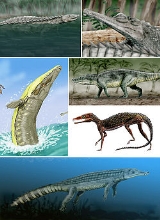
Crurotarsi

Encyclopedia
The Crurotarsi are a group of archosauriformes
, represented today by the crocodiles, alligators, and gharial
s (and possibly bird
s) and including many extinct forms. The name Crurotarsi was erected as a node-based clade by Paul Sereno
and A.B. Arcucci in 1990 to supplant the old term Pseudosuchia
, but with a different definition. Crurotarsi include, by most published definitions, all descendants of the common ancestor of modern crocodile
s, ornithosuchid
s, aetosaur
s, and phytosaurs. According to two studies published in 2011, this definition would also include all other true archosaurs as well, due to the possibly very primitive position of the phytosaurs. A more restrictive group defined as all archosaurs closer to crocodiles than to birds (matching the traditional content of Crurotarsi) is the Pseudosuchia.
ia. The skull is often massively built, especially in contrast to ornithodires; the snout is narrow and tends to be elongated, the neck is short and strong, and the limb posture ranges from a typical reptilian sprawl to an erect stance like that of dinosaur
s or mammal
s (although crurotarsans achieve this in a different way). The body is often protected by two or more rows of armored plates. Many crurotarsans reached lengths of three meters or more.
(early Triassic
); by the Ladinian
(late Middle Triassic) they dominated the terrestrial carnivore
niches. Their heyday was the Late Triassic, during which time their ranks included erect-limbed rauisuchia
ns, the crocodile-like phytosaur
s, herbivorous
armored aetosaur
s, the large predatory poposaurs
, the small agile crocodilians Sphenosuchia
, and a few other assorted groups.
At the end Triassic extinction
, all of the large crurotarsans died out. A study published in "Proceedings of the National Academy of Sciences of the United States of America" in 2010 postulates that there is significant evidence that volcanic eruptions changed the climate, causing a mass extinction that wiped out the dinosaurs' main competitors. Furthermore, this allowed the dinosaur
s to succeed them as the dominant terrestrial carnivores and herbivores. Only the Sphenosuchia
and the Protosuchia
(Crocodylomorpha
) survived.
As the Mesozoic
progressed, the Protosuchia gave rise to more typically crocodile-like forms. While dinosaurs were the dominant animals on land, the crocodiles flourished in rivers, swamps, and the oceans, with far greater diversity than they have today.
With the end Cretaceous extinction
the dinosaurs became extinct, with the exception of the birds, while the crurotarsan crocodilians continued with little change.
Today, the crocodile
s, alligators
, and gavials
continue as the surviving representatives of this lineage.
, Prestosuchus
, Suchia, and all descendants of their common ancestor." The groups in this definition are considered crocodile-line archosaurs, as opposed to the bird-line archosaurs. Ornithosuchids were once considered bird-line archosaurs (as implied by their name, which means "bird crocodiles" in Greek
) but were later recognized as crocodile-line archosaurs. This reclassification may have inspired Sereno's Crurotarsi, a node-based clade defined by the inclusion of ornithosuchids and other early archosaurs.
Two names were proposed for crocodile-line archosaurs before Crurotarsi was erected. The first, Pseudosuchia, was established as a stem-based clade in 1985. It includes crocodiles and all archosaurs more closely related to crocodiles than to birds. The second, Crocodylotarsi, was named in 1988, possibly as a replacement for Pseudosuchia. The name Pseudosuchia, meaning "false crocodiles", has been used for over a century, and traditionally included aetosaurs. As a clade, Pseudosuchia includes the group Eusuchia
, or "true crocodiles". Crocodylotarsi may have been named to remove confusion, but as a stem-based clade it is synonymous with Pseudosuchia. Because Pseudosuchia was named first, it has precedence. Crurotarsi traditionally contains the same archosaurs as Pseudosuchia, but as a node-based clade it is not synonymous.
It is possible that crocodile-line archosaurs could one day be found that are outside Crurotarsi, not being descendants of the most recent common ancestor of phytosaurs, ornithosuchids, and suchians. These animals would still be pseudosuchians because they are more closely related to crocodiles than to birds. Brochu (1997) hypothesized that there could be non-crurotarsan pseudosuchians from the Late Permian, or that a newly discovered bird-line archosaur from the Late Permian could imply a ghost lineage
of pseudosuchians into the Permian. Currently, all known archosaurs are Triassic or younger. Crurotarsans must have first appeared in the Triassic because the group is defined by taxa that are Triassic or younger. Under its current definition, Crurotarsi cannot include Permian archosaurs unless Permian phytosaurs, ornithosuchids, or suchians are discovered.
The scope of Crurotarsi has recently been changed by the phylogenetic placement of phytosaurs. In 2011, Sterling J. Nesbitt found phytosaurs to be the sister taxon of Archosauria, and therefore not crocodile-line archosaurs. Because phytosaurs are included in the definition of Crurotarsi, crurotarsans are not solely crocodile-line archosaurs but also bird-line archosaurs and phytosaurs. Under this phylogeny, Crurotarsi includes phytosaurs, crocodiles, pterosaurs, dinosaurs, and birds, while Pseudosuchia still contains only crocodile-line archosaurs. Below is a cladogram
modified from Nesbitt (2011) showing the new changes:
Below is a cladogram after Nesbitt & Norell (2006) and Nesbitt (2007) with Crurotarsi in its traditional sense encompassing just crocodile-line archosaurs:
Cladogram after Brusatte, Benton, Desojo and Langer (2010)
Archosauriformes
Archosauriformes is a clade of diapsid reptiles that developed from archosauromorph ancestors some time in the Late Permian...
, represented today by the crocodiles, alligators, and gharial
Gharial
The gharial , , also called Indian gavial or gavial, is the only surviving member of the once well-represented family Gavialidae, a long-established group of crocodilians with long, slender snouts...
s (and possibly bird
Bird
Birds are feathered, winged, bipedal, endothermic , egg-laying, vertebrate animals. Around 10,000 living species and 188 families makes them the most speciose class of tetrapod vertebrates. They inhabit ecosystems across the globe, from the Arctic to the Antarctic. Extant birds range in size from...
s) and including many extinct forms. The name Crurotarsi was erected as a node-based clade by Paul Sereno
Paul Sereno
Paul Callistus Sereno is an American paleontologist from the University of Chicago who discovered several new dinosaur species on several continents. He has conducted excavations at sites as varied as Inner Mongolia, Argentina, Morocco, and Niger...
and A.B. Arcucci in 1990 to supplant the old term Pseudosuchia
Pseudosuchia
Pseudosuchia is the name originally given to a group of prehistoric reptiles from the Triassic period. The name has been variously interpreted, and it is still sometimes, if infrequently, used in scientific literature today. A more commonly used name, Crurotarsi, is often substituted for...
, but with a different definition. Crurotarsi include, by most published definitions, all descendants of the common ancestor of modern crocodile
Crocodile
A crocodile is any species belonging to the family Crocodylidae . The term can also be used more loosely to include all extant members of the order Crocodilia: i.e...
s, ornithosuchid
Ornithosuchidae
Ornithosuchidae is an extinct family of reptiles from the Triassic period that were distantly related to crocodilians. They are classified as crurotarsan archosaurs. Ornithosuchids were quadrupedal and facultatively bipedal, meaning they had the ability to walk on two legs for short periods of time...
s, aetosaur
Aetosaur
Aetosaurs are an extinct order of heavily armoured, medium- to large-sized Late Triassic herbivorous archosaurs. They have small heads, upturned snouts, erect limbs, and a body covered by plate-like scutes. All aetosaurs belong to the family Stagonolepididae...
s, and phytosaurs. According to two studies published in 2011, this definition would also include all other true archosaurs as well, due to the possibly very primitive position of the phytosaurs. A more restrictive group defined as all archosaurs closer to crocodiles than to birds (matching the traditional content of Crurotarsi) is the Pseudosuchia.
Description
Crurotarsi is one of the two primary daughter clades of the ArchosaurArchosaur
Archosaurs are a group of diapsid amniotes whose living representatives consist of modern birds and crocodilians. This group also includes all extinct non-avian dinosaurs, many extinct crocodilian relatives, and pterosaurs. Archosauria, the archosaur clade, is a crown group that includes the most...
ia. The skull is often massively built, especially in contrast to ornithodires; the snout is narrow and tends to be elongated, the neck is short and strong, and the limb posture ranges from a typical reptilian sprawl to an erect stance like that of dinosaur
Dinosaur
Dinosaurs are a diverse group of animals of the clade and superorder Dinosauria. They were the dominant terrestrial vertebrates for over 160 million years, from the late Triassic period until the end of the Cretaceous , when the Cretaceous–Paleogene extinction event led to the extinction of...
s or mammal
Mammal
Mammals are members of a class of air-breathing vertebrate animals characterised by the possession of endothermy, hair, three middle ear bones, and mammary glands functional in mothers with young...
s (although crurotarsans achieve this in a different way). The body is often protected by two or more rows of armored plates. Many crurotarsans reached lengths of three meters or more.
Evolution
Crurotarsans appeared during the late OlenekianOlenekian
In the geologic timescale, the Olenekian is an age in the Early Triassic epoch or a stage in the Lower Triassic series. It spans the time between 249.7 ± 0.7 Ma and 245 ± 0.7 Ma . The Olenekian follows the Induan and is followed by the Anisian.The Olenekian saw the deposition of a large part of the...
(early Triassic
Triassic
The Triassic is a geologic period and system that extends from about 250 to 200 Mya . As the first period of the Mesozoic Era, the Triassic follows the Permian and is followed by the Jurassic. Both the start and end of the Triassic are marked by major extinction events...
); by the Ladinian
Ladinian
The Ladinian is a stage and age in the Middle Triassic series or epoch. It spans the time between 237 ± 2 Ma and 228 ± 2 Ma...
(late Middle Triassic) they dominated the terrestrial carnivore
Carnivore
A carnivore meaning 'meat eater' is an organism that derives its energy and nutrient requirements from a diet consisting mainly or exclusively of animal tissue, whether through predation or scavenging...
niches. Their heyday was the Late Triassic, during which time their ranks included erect-limbed rauisuchia
Rauisuchia
Rauisuchia is a group of predatory and mostly large Triassic archosaurs. As a clade, Rauisuchia includes these Triassic forms and all crocodylomorphs, which are descendants of Triassic rauisuchians. The group in its traditional sense is paraphyletic, because it does not include crocodylomorph...
ns, the crocodile-like phytosaur
Phytosaur
Phytosaurs are an extinct group of large semi-aquatic Late Triassic archosaurs. Phytosaurs belong to the family Phytosauridae and the order Phytosauria. They were long-snouted and heavily armoured, bearing a remarkable resemblance to modern crocodiles in size, appearance, and lifestyle, an example...
s, herbivorous
Herbivore
Herbivores are organisms that are anatomically and physiologically adapted to eat plant-based foods. Herbivory is a form of consumption in which an organism principally eats autotrophs such as plants, algae and photosynthesizing bacteria. More generally, organisms that feed on autotrophs in...
armored aetosaur
Aetosaur
Aetosaurs are an extinct order of heavily armoured, medium- to large-sized Late Triassic herbivorous archosaurs. They have small heads, upturned snouts, erect limbs, and a body covered by plate-like scutes. All aetosaurs belong to the family Stagonolepididae...
s, the large predatory poposaurs
Poposauridae
The Poposauridae are a family of large carnivorous archosaurs which lived alongside dinosaurs during the Late Triassic. They are known from fossil remains from North and South America...
, the small agile crocodilians Sphenosuchia
Sphenosuchia
Sphenosuchia is a suborder of basal crocodylomorphs that first appeared in the Triassic and occurred into the Late Jurassic. Most were small, gracile animals with an erect limb posture. They are now thought to be ancestral to crocodyliforms, which include all living crocodilians.-Stratigraphic...
, and a few other assorted groups.
At the end Triassic extinction
Triassic-Jurassic extinction event
The Triassic–Jurassic extinction event marks the boundary between the Triassic and Jurassic periods, , and is one of the major extinction events of the Phanerozoic eon, profoundly affecting life on land and in the oceans. In the seas a whole class and twenty percent of all marine families...
, all of the large crurotarsans died out. A study published in "Proceedings of the National Academy of Sciences of the United States of America" in 2010 postulates that there is significant evidence that volcanic eruptions changed the climate, causing a mass extinction that wiped out the dinosaurs' main competitors. Furthermore, this allowed the dinosaur
Dinosaur
Dinosaurs are a diverse group of animals of the clade and superorder Dinosauria. They were the dominant terrestrial vertebrates for over 160 million years, from the late Triassic period until the end of the Cretaceous , when the Cretaceous–Paleogene extinction event led to the extinction of...
s to succeed them as the dominant terrestrial carnivores and herbivores. Only the Sphenosuchia
Sphenosuchia
Sphenosuchia is a suborder of basal crocodylomorphs that first appeared in the Triassic and occurred into the Late Jurassic. Most were small, gracile animals with an erect limb posture. They are now thought to be ancestral to crocodyliforms, which include all living crocodilians.-Stratigraphic...
and the Protosuchia
Protosuchia
Protosuchia is a group of extinct Mesozoic crocodyliforms. They were small in size and terrestrial. In phylogenetic terms, Protosuchia is considered an informal group because it is a grade of basal crocodyliforms, not a true clade....
(Crocodylomorpha
Crocodylomorpha
The Crocodylomorpha are an important group of archosaurs that include the crocodilians and their extinct relatives.During Mesozoic and early Tertiary times the Crocodylomorpha were far more diverse than they are now. Triassic forms were small, lightly built, active terrestrial animals. These were...
) survived.
As the Mesozoic
Mesozoic
The Mesozoic era is an interval of geological time from about 250 million years ago to about 65 million years ago. It is often referred to as the age of reptiles because reptiles, namely dinosaurs, were the dominant terrestrial and marine vertebrates of the time...
progressed, the Protosuchia gave rise to more typically crocodile-like forms. While dinosaurs were the dominant animals on land, the crocodiles flourished in rivers, swamps, and the oceans, with far greater diversity than they have today.
With the end Cretaceous extinction
Cretaceous-Tertiary extinction event
The Cretaceous–Paleogene extinction event, formerly named and still commonly referred to as the Cretaceous-Tertiary extinction event, occurred approximately 65.5 million years ago at the end of the Maastrichtian age of the Cretaceous period. It was a large-scale mass extinction of animal and plant...
the dinosaurs became extinct, with the exception of the birds, while the crurotarsan crocodilians continued with little change.
Today, the crocodile
Crocodile
A crocodile is any species belonging to the family Crocodylidae . The term can also be used more loosely to include all extant members of the order Crocodilia: i.e...
s, alligators
Alligatoridae
Alligatoridae is a family of crocodylians that includes alligators and caimans.- True alligators :Alligators proper occur in the fluvial deposits of the age of the Upper Chalk in Europe, where they did not die out until the Pliocene age. The true alligators are now restricted to two species, A...
, and gavials
Gavialidae
Gavialidae is a family of reptiles within the order Crocodilia. Gavialidae consists of only one surviving species, the gharial , which is native to India. Many extinct species are also known...
continue as the surviving representatives of this lineage.
Phylogeny
Paul Sereno and A.B. Arcucci named Crurotarsi in 1990, defining it as "Parasuchia [phytosaurs], OrnithosuchidaeOrnithosuchidae
Ornithosuchidae is an extinct family of reptiles from the Triassic period that were distantly related to crocodilians. They are classified as crurotarsan archosaurs. Ornithosuchids were quadrupedal and facultatively bipedal, meaning they had the ability to walk on two legs for short periods of time...
, Prestosuchus
Prestosuchus
Prestosuchus is an extinct genus of a group of rauisuchians called prestosuchids. Friedrich von Huene named the genus in honor of Vicentino Prestes de Almeida....
, Suchia, and all descendants of their common ancestor." The groups in this definition are considered crocodile-line archosaurs, as opposed to the bird-line archosaurs. Ornithosuchids were once considered bird-line archosaurs (as implied by their name, which means "bird crocodiles" in Greek
Greek language
Greek is an independent branch of the Indo-European family of languages. Native to the southern Balkans, it has the longest documented history of any Indo-European language, spanning 34 centuries of written records. Its writing system has been the Greek alphabet for the majority of its history;...
) but were later recognized as crocodile-line archosaurs. This reclassification may have inspired Sereno's Crurotarsi, a node-based clade defined by the inclusion of ornithosuchids and other early archosaurs.
Two names were proposed for crocodile-line archosaurs before Crurotarsi was erected. The first, Pseudosuchia, was established as a stem-based clade in 1985. It includes crocodiles and all archosaurs more closely related to crocodiles than to birds. The second, Crocodylotarsi, was named in 1988, possibly as a replacement for Pseudosuchia. The name Pseudosuchia, meaning "false crocodiles", has been used for over a century, and traditionally included aetosaurs. As a clade, Pseudosuchia includes the group Eusuchia
Eusuchia
Eusuchia is a clade of crocodylomorphs that first appears in the Early Cretaceous with Hylaeochampsa. All living crocodilian species are eusuchians, as are many extinct forms.-Description:...
, or "true crocodiles". Crocodylotarsi may have been named to remove confusion, but as a stem-based clade it is synonymous with Pseudosuchia. Because Pseudosuchia was named first, it has precedence. Crurotarsi traditionally contains the same archosaurs as Pseudosuchia, but as a node-based clade it is not synonymous.
It is possible that crocodile-line archosaurs could one day be found that are outside Crurotarsi, not being descendants of the most recent common ancestor of phytosaurs, ornithosuchids, and suchians. These animals would still be pseudosuchians because they are more closely related to crocodiles than to birds. Brochu (1997) hypothesized that there could be non-crurotarsan pseudosuchians from the Late Permian, or that a newly discovered bird-line archosaur from the Late Permian could imply a ghost lineage
Ghost lineage
A ghost lineage is a phylogenetic lineage that is inferred to exist but has no fossil record....
of pseudosuchians into the Permian. Currently, all known archosaurs are Triassic or younger. Crurotarsans must have first appeared in the Triassic because the group is defined by taxa that are Triassic or younger. Under its current definition, Crurotarsi cannot include Permian archosaurs unless Permian phytosaurs, ornithosuchids, or suchians are discovered.
The scope of Crurotarsi has recently been changed by the phylogenetic placement of phytosaurs. In 2011, Sterling J. Nesbitt found phytosaurs to be the sister taxon of Archosauria, and therefore not crocodile-line archosaurs. Because phytosaurs are included in the definition of Crurotarsi, crurotarsans are not solely crocodile-line archosaurs but also bird-line archosaurs and phytosaurs. Under this phylogeny, Crurotarsi includes phytosaurs, crocodiles, pterosaurs, dinosaurs, and birds, while Pseudosuchia still contains only crocodile-line archosaurs. Below is a cladogram
Cladogram
A cladogram is a diagram used in cladistics which shows ancestral relations between organisms, to represent the evolutionary tree of life. Although traditionally such cladograms were generated largely on the basis of morphological characters, DNA and RNA sequencing data and computational...
modified from Nesbitt (2011) showing the new changes:
Below is a cladogram after Nesbitt & Norell (2006) and Nesbitt (2007) with Crurotarsi in its traditional sense encompassing just crocodile-line archosaurs:
Cladogram after Brusatte, Benton, Desojo and Langer (2010)