

Dicynodont

Encyclopedia
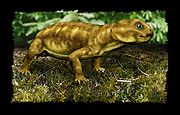
Dicynodontia is a taxon
of anomodont
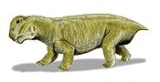
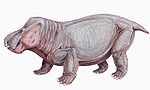
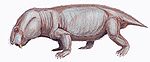
therapsids or mammal-like reptiles. Dicynodonts were small to large herbivorous
animals with two tusks, hence their name, which means 'two dog tooth'. They are also the most successful and diverse of the non-mammalian therapsids, with over 70 genera
known, varying from rat- to ox-sized.
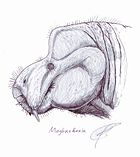
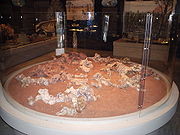 The dicynodont skull is highly specialised; light but strong, with the synapsid temporal openings at the rear of the skull are greatly enlarged, to accommodate larger jaw muscles. The front of the skull
and the lower jaw are generally narrow and, in all but a number of primitive forms, toothless. Instead, the front of the mouth is equipped with a horny beak, as in turtles and ceratopsia
n dinosaur
s. Food was processed through retraction of the lower jaw when the mouth closed, producing a powerful shearing action (Crompton and Hotton 1967), which would have enabled dicynodonts to cope with tough plant material. Many genera also have a pair of tusks, which it is thought may have been an example of sexual dimorphism
(Colbert 1969 p.137)
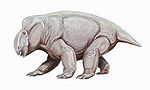
The body is short, strong and barrel-shaped, with strong limbs. In large genera (such as Dinodontosaurus
) the hindlimbs were held erect, but the forelimbs bent at the elbow. Both the pectoral girdle and the ilium
are large and strong. The tail is short.
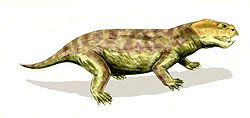 Dicynodonts first appear during Middle Permian, and underwent a rapid evolutionary radiation
, becoming the most successful and abundant land vertebrates of the Late Permian. During this time they included a large variety of ecotypes, including large, medium-sized, and small herbivores and short-limbed mole-like burrowers.
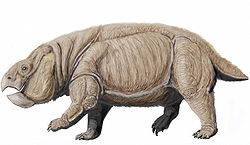 Only two families survived the end Permian extinction, one of which, the Lystrosauridae
, were the most common and widespread herbivores of the Induan
(earliest Triassic
). These medium-sized animals evolved into and were replaced by the Kannemeyeridae, stocky, pig- to ox-sized animals that were the most abundant herbivores worldwide from the Olenekian
to the Ladinian
age. By the Carnian
they had been supplanted by traversodont
cynodonts and rhynchosaur
reptiles. During the Norian
(middle of the Late Triassic), perhaps due to increasing aridity, they drastically declined, and the role of large herbivore was taken over by sauropodomorph dinosaurs.
With the decline and extinction of the kannemeyerids, there were to be no more dominant large synapsid herbivores until the middle Paleocene
epoch (60 Ma) when mammal
s, descendants of cynodont
s, began to diversify after the extinction of the dinosaurs.
It used to be thought that dicynodonts died out completely before the end of the Triassic. Recently however, evidence has come to light showing the dicynodonts survived into the Cretaceous
in southern Gondwana
(now Queensland
) (Thulborn and Turner, 2003). Recent studies give that this fossil belongs to crocodylomorph like Baurusuchus
.
. It was erected as a family of the order Anomodontia and included the genera Dicynodon
and Ptychognathus. Other families of Anomodontia included Gnathodontia, which included Rhynchosaurus
(now known to be an archosauromorph) and Cryptodontia, which included Oudenodon
. Cryptodonts were distinguished from dicynodonts from their absence of tusks. Although it lacks tusks, Oudenodon is now classified as a dicynodont, and the name Cryptodontia is no longer used. Thomas Henry Huxley revised Owen's Dicynodontia as an order that included Dicynodon and Oudenodon. Dicynodontia was later ranked as a suborder or infraorder with the larger group Anomodontia, which is classified as an order. The ranking of Dicynodontia has varied in recent studies, with Ivakhnenko (2008) considering it a suborder, Ivanchnenko (2008) considering it an infraorder, and Kurkin (2010) considering it an order.
Many higher taxa, including infraorders and families, have been erected as a means of classifying the large number of dicynodont species. Cluver and King (1983) recognized several main groups within Dicynodontia, including Diictodontia, Endothiodontia, Eodicynodontia, Kingoriamorpha, Pristerodontia, and Venjukoviamorpha. Many families have been proposed, including Cistecephalidae, Diictodontidae, Dicynodontidae, Emydopidae, Endothiodontidae, Kannemeyeriidae
, Kingoriidae, Lystrosauridae
, Myosauridae, Oudenodontidae, Pristerodontidae, and Robertiidae. However, with the rise of phylogenetics, most of these taxa are no longer considered valid. Kammerer and Angielczyk (2009) suggested that the problematic taxonomy and nomenclature of Dicynodontia and other groups results from the large number of conflicting studies and the tendency for invalid names to be mistakenly established.
Unknown placement:
modified from Angielczyk and Rubidge (2010) showing the phylogenetic relationships of Dicynodontia:
Taxon
|thumb|270px|[[African elephants]] form a widely-accepted taxon, the [[genus]] LoxodontaA taxon is a group of organisms, which a taxonomist adjudges to be a unit. Usually a taxon is given a name and a rank, although neither is a requirement...
of anomodont
Anomodont
The Anomodontia were a major group of therapsids, an extinct group of animals commonly known as "mammal-like reptiles." They were mostly toothless herbivores. During the Middle Permian they were very diverse, including groups like the Venyukovioidea, the Dromasauria, the Dicynodontia, and early...
therapsids or mammal-like reptiles. Dicynodonts were small to large herbivorous
Herbivore
Herbivores are organisms that are anatomically and physiologically adapted to eat plant-based foods. Herbivory is a form of consumption in which an organism principally eats autotrophs such as plants, algae and photosynthesizing bacteria. More generally, organisms that feed on autotrophs in...
animals with two tusks, hence their name, which means 'two dog tooth'. They are also the most successful and diverse of the non-mammalian therapsids, with over 70 genera
Genus
In biology, a genus is a low-level taxonomic rank used in the biological classification of living and fossil organisms, which is an example of definition by genus and differentia...
known, varying from rat- to ox-sized.
Characteristics
Skull
The skull is a bony structure in the head of many animals that supports the structures of the face and forms a cavity for the brain.The skull is composed of two parts: the cranium and the mandible. A skull without a mandible is only a cranium. Animals that have skulls are called craniates...
and the lower jaw are generally narrow and, in all but a number of primitive forms, toothless. Instead, the front of the mouth is equipped with a horny beak, as in turtles and ceratopsia
Ceratopsia
Ceratopsia or Ceratopia is a group of herbivorous, beaked dinosaurs which thrived in what are now North America, Europe, and Asia, during the Cretaceous Period, although ancestral forms lived earlier, in the Jurassic. The earliest known ceratopsian, Yinlong downsi, lived between 161.2 and 155.7...
n dinosaur
Dinosaur
Dinosaurs are a diverse group of animals of the clade and superorder Dinosauria. They were the dominant terrestrial vertebrates for over 160 million years, from the late Triassic period until the end of the Cretaceous , when the Cretaceous–Paleogene extinction event led to the extinction of...
s. Food was processed through retraction of the lower jaw when the mouth closed, producing a powerful shearing action (Crompton and Hotton 1967), which would have enabled dicynodonts to cope with tough plant material. Many genera also have a pair of tusks, which it is thought may have been an example of sexual dimorphism
Sexual dimorphism
Sexual dimorphism is a phenotypic difference between males and females of the same species. Examples of such differences include differences in morphology, ornamentation, and behavior.-Examples:-Ornamentation / coloration:...
(Colbert 1969 p.137)
The body is short, strong and barrel-shaped, with strong limbs. In large genera (such as Dinodontosaurus
Dinodontosaurus
Dinodontosaurus is a genus of dicynodont therapsid. It was one of the largest herbivores of the Triassic and had a beak corneum...
) the hindlimbs were held erect, but the forelimbs bent at the elbow. Both the pectoral girdle and the ilium
Ilium (bone)
The ilium is the uppermost and largest bone of the pelvis, and appears in most vertebrates including mammals and birds, but not bony fish. All reptiles have an ilium except snakes, although some snake species have a tiny bone which is considered to be an ilium.The name comes from the Latin ,...
are large and strong. The tail is short.
Evolutionary history
Evolutionary radiation
An evolutionary radiation is an increase in taxonomic diversity or morphological disparity, due to adaptive change or the opening of ecospace. Radiations may affect one clade or many, and be rapid or gradual; where they are rapid, and driven by a single lineage's adaptation to their environment,...
, becoming the most successful and abundant land vertebrates of the Late Permian. During this time they included a large variety of ecotypes, including large, medium-sized, and small herbivores and short-limbed mole-like burrowers.
Lystrosaurus
Lystrosaurus was a genus of Late Permian and Early Triassic Period dicynodont therapsids, which lived around 250 million years ago in what is now Antarctica, India, and South Africa...
, were the most common and widespread herbivores of the Induan
Induan
The Induan is, in the geologic timescale, the first age of the Early Triassic epoch or the lowest stage of the Lower Triassic series. It spans the time between 251 ± 0.4 Ma and 249.7 ± 0.7 Ma...
(earliest Triassic
Triassic
The Triassic is a geologic period and system that extends from about 250 to 200 Mya . As the first period of the Mesozoic Era, the Triassic follows the Permian and is followed by the Jurassic. Both the start and end of the Triassic are marked by major extinction events...
). These medium-sized animals evolved into and were replaced by the Kannemeyeridae, stocky, pig- to ox-sized animals that were the most abundant herbivores worldwide from the Olenekian
Olenekian
In the geologic timescale, the Olenekian is an age in the Early Triassic epoch or a stage in the Lower Triassic series. It spans the time between 249.7 ± 0.7 Ma and 245 ± 0.7 Ma . The Olenekian follows the Induan and is followed by the Anisian.The Olenekian saw the deposition of a large part of the...
to the Ladinian
Ladinian
The Ladinian is a stage and age in the Middle Triassic series or epoch. It spans the time between 237 ± 2 Ma and 228 ± 2 Ma...
age. By the Carnian
Carnian
The Carnian is the lowermost stage of the Upper Triassic series . It lasted from about 228.7 till 216.5 million years ago . The Carnian is preceded by the Ladinian and is followed by the Norian...
they had been supplanted by traversodont
Traversodontidae
Traversodontidae is a family of herbivorous cynodonts. Traversodonts were primarily Gondwanan, with many species known from Africa and South America. Recently, traversodonts have also been found from Europe and eastern North America. Traversodonts first appeared in the Middle Triassic, diversified...
cynodonts and rhynchosaur
Rhynchosaur
Rhynchosaurs were a group of Triassic diapsid reptiles related to the archosaurs.-Description:Rhynchosaurs were herbivores, and at times abundant , with stocky bodies and a powerful beak...
reptiles. During the Norian
Norian
The Norian is a division of the Triassic geological period. It has the rank of an age or stage . The Norian lasted from 216.5 ± 2.0 to 203.6 ± 1.5 million years ago. It was preceded by the Carnian and succeeded by the Rhaetian.-Stratigraphic definitions:The Norian was named after the Noric Alps in...
(middle of the Late Triassic), perhaps due to increasing aridity, they drastically declined, and the role of large herbivore was taken over by sauropodomorph dinosaurs.
With the decline and extinction of the kannemeyerids, there were to be no more dominant large synapsid herbivores until the middle Paleocene
Paleocene
The Paleocene or Palaeocene, the "early recent", is a geologic epoch that lasted from about . It is the first epoch of the Palaeogene Period in the modern Cenozoic Era...
epoch (60 Ma) when mammal
Mammal
Mammals are members of a class of air-breathing vertebrate animals characterised by the possession of endothermy, hair, three middle ear bones, and mammary glands functional in mothers with young...
s, descendants of cynodont
Cynodont
Cynodontia or cynodonts are a taxon of therapsids which first appeared in the Late Permian and were eventually distributed throughout all seven continents by the Early Triassic . This clade includes modern mammals and their extinct close relatives. They were one of the most diverse groups of...
s, began to diversify after the extinction of the dinosaurs.
It used to be thought that dicynodonts died out completely before the end of the Triassic. Recently however, evidence has come to light showing the dicynodonts survived into the Cretaceous
Cretaceous
The Cretaceous , derived from the Latin "creta" , usually abbreviated K for its German translation Kreide , is a geologic period and system from circa to million years ago. In the geologic timescale, the Cretaceous follows the Jurassic period and is followed by the Paleogene period of the...
in southern Gondwana
Gondwana
In paleogeography, Gondwana , originally Gondwanaland, was the southernmost of two supercontinents that later became parts of the Pangaea supercontinent. It existed from approximately 510 to 180 million years ago . Gondwana is believed to have sutured between ca. 570 and 510 Mya,...
(now Queensland
Queensland
Queensland is a state of Australia, occupying the north-eastern section of the mainland continent. It is bordered by the Northern Territory, South Australia and New South Wales to the west, south-west and south respectively. To the east, Queensland is bordered by the Coral Sea and Pacific Ocean...
) (Thulborn and Turner, 2003). Recent studies give that this fossil belongs to crocodylomorph like Baurusuchus
Baurusuchus
Baurusuchus is an extinct genus of baurusuchid mesoeucrocodylian from the Late Cretaceous of Brazil. It was a terrestrial predator and scavenger, about 3.5 to 4 meters long. Baurusuchus lived during the Turonian to Santonian stages of the Late Cretaceous Period, in Adamantina Formation, Brazil...
.
Taxonomy
Dicynodontia was originally named by English paleontologist Richard OwenRichard Owen
Sir Richard Owen, FRS KCB was an English biologist, comparative anatomist and palaeontologist.Owen is probably best remembered today for coining the word Dinosauria and for his outspoken opposition to Charles Darwin's theory of evolution by natural selection...
. It was erected as a family of the order Anomodontia and included the genera Dicynodon
Dicynodon
Dicynodon is a type of dicynodont therapsid that flourished during the Permian period between 251 and 299 million years ago. Like all dicynodonts, it was herbivorous. This animal was toothless, except for prominent tusks, hence the name...
and Ptychognathus. Other families of Anomodontia included Gnathodontia, which included Rhynchosaurus
Rhynchosaurus
Rhynchosaurus is a genus of rhynchosaur that lived during the Middle Triassic Period. It lived in Europe. It was related to the archosaurs, but not within that group. The species of Rhynchosaurus are R. articeps and R. brodiei. Michael Benton had named a third species, R...
(now known to be an archosauromorph) and Cryptodontia, which included Oudenodon
Oudenodon
Oudenodon is an extinct genus of dicynodont. It was common throughout southern Africa during the Late Permian. Several species of Oudenodon are known. Both O. bainii, the type species, and O. grandis are known from South Africa. Specimens of O. luangwensis have been found from Zambia. One species,...
. Cryptodonts were distinguished from dicynodonts from their absence of tusks. Although it lacks tusks, Oudenodon is now classified as a dicynodont, and the name Cryptodontia is no longer used. Thomas Henry Huxley revised Owen's Dicynodontia as an order that included Dicynodon and Oudenodon. Dicynodontia was later ranked as a suborder or infraorder with the larger group Anomodontia, which is classified as an order. The ranking of Dicynodontia has varied in recent studies, with Ivakhnenko (2008) considering it a suborder, Ivanchnenko (2008) considering it an infraorder, and Kurkin (2010) considering it an order.
Many higher taxa, including infraorders and families, have been erected as a means of classifying the large number of dicynodont species. Cluver and King (1983) recognized several main groups within Dicynodontia, including Diictodontia, Endothiodontia, Eodicynodontia, Kingoriamorpha, Pristerodontia, and Venjukoviamorpha. Many families have been proposed, including Cistecephalidae, Diictodontidae, Dicynodontidae, Emydopidae, Endothiodontidae, Kannemeyeriidae
Kannemeyeriidae
Kannemeyeriidae is a family of large, stocky, beaked and sometimes tusked dicynodonts. They were the dominant large terrestrial herbivores through most of the Triassic period...
, Kingoriidae, Lystrosauridae
Lystrosauridae
Lystrosauridae was a family of Synapsids from the Permian and Triassic time periods.-Distribution:-Triassic Distribution:In the Triassic period, Lystrosaurids lived in Antarctica and China.-Relatives:...
, Myosauridae, Oudenodontidae, Pristerodontidae, and Robertiidae. However, with the rise of phylogenetics, most of these taxa are no longer considered valid. Kammerer and Angielczyk (2009) suggested that the problematic taxonomy and nomenclature of Dicynodontia and other groups results from the large number of conflicting studies and the tendency for invalid names to be mistakenly established.
- Infraorder Dicynodontia
- Genus AngonisaurusAngonisaurusAngonisaurus is an extinct genus of non-mammalian synapsid.-References:*...
- Genus ColobodectesColobodectesColobodectes is an extinct genus of non-mammalian synapsid.-References:*...
- Superfamily Eodicynodontoidea
- Family Eodicynodontidae
- Superfamily Kingorioidea
- Family Kingoriidae
- Genus Kingoria
- Genus KombuisiaKombuisiaKombuisia is a genus of dicynodont from Early to Middle Triassic of South Africa and Antarctica. Two species was described for the genus: Kombuisia frerensis and Kombuisia antarctica....
- Family Kingoriidae
- Clade DiictodontiaDiictodontiaThe Diictodontia were a group of herbivorus Dicynodonts from the Permian of South Africa. This infraorder was composed of three different families; Diictodontidae , Emydopidae, and Robertiidae....
- Superfamily Emydopoidea
- Family Cistecephalidae
- Family Emydopidae
- Genus MyosauroidesMyosauroidesMyosauroides is an extinct genus of non-mammalian synapsid.-References:*...
- Genus MyosaurusMyosaurusMyosaurus is an extinct genus of dicynodont....
- Genus PalemydopsPalemydopsPalemydops is an extinct genus of non-mammalian synapsid.-References:*...
- Genus Myosauroides
- Superfamily Robertoidea
- Family Diictodontidae
- Genus AnomodonAnomodonAnomodon is an extinct genus of non-mammalian synapsid.-References:*...
- Genus DiictodonDiictodonDiictodon was a genus of therapsid, roughly 45 cm long. It belonged to the sub-group Dicynodontia. These mammal-like synapsids lived during the Late Permian period, approximately 255 million years ago. Fossils have been found in Africa and Asia...
- Genus Anomodon
- Family Robertiidae
- Genus RobertiaRobertiaRobertia was a small, primitive dicynodont, and among the earlier members of this group. The type species R. broomiana was named in 1981...
- Genus Robertia
- Family Diictodontidae
- Superfamily Emydopoidea
- Clade PristerodontiaPristerodontiaPristerodontia is a group of dicynodont therapsids that includes cryptodontids, geikiids, lystrosaurids, kannemeyeriids, and other related forms. Pristerodontians were one of the few groups of dicynodonts to survive the Permian-Triassic extinction event, diversifying in the Triassic....
- Genus DinanomodonDinanomodonDinanomodon is a genus of dicynodont from Late Permian of South Africa....
- Genus OdontocyclopsOdontocyclopsOdontocyclops is an extinct genus of non-mammalian synapsid.-References:*...
- Genus PropelanomodonPropelanomodonPropelanomodon is an extinct genus of non-mammalian synapsid.-References:*...
- Family Aulacocephalodontidae
- Family Dicynodontidae
- Genus DicynodonDicynodonDicynodon is a type of dicynodont therapsid that flourished during the Permian period between 251 and 299 million years ago. Like all dicynodonts, it was herbivorous. This animal was toothless, except for prominent tusks, hence the name...
- Genus Dicynodon
- Family LystrosauridaeLystrosauridaeLystrosauridae was a family of Synapsids from the Permian and Triassic time periods.-Distribution:-Triassic Distribution:In the Triassic period, Lystrosaurids lived in Antarctica and China.-Relatives:...
- Genus KwazulusaurusKwazulusaurusKwazulusaurus is an extinct genus of non-mammalian synapsid.-References:*...
- Genus LystrosaurusLystrosaurusLystrosaurus was a genus of Late Permian and Early Triassic Period dicynodont therapsids, which lived around 250 million years ago in what is now Antarctica, India, and South Africa...
- Genus Kwazulusaurus
- Family Oudenodontidae
- Family Pristerodontidae
- Genus Dinanomodon
- Superfamily Kannemeyeriiformes
- Family KannemeyeriidaeKannemeyeriidaeKannemeyeriidae is a family of large, stocky, beaked and sometimes tusked dicynodonts. They were the dominant large terrestrial herbivores through most of the Triassic period...
- Genus DinodontosaurusDinodontosaurusDinodontosaurus is a genus of dicynodont therapsid. It was one of the largest herbivores of the Triassic and had a beak corneum...
- Genus DolichuranusDolichuranusDolichuranus is an extinct genus of dicynodont therapsid from the Middle Triassic of Africa....
- Genus IschigualastiaIschigualastiaIschigualastia was a dicynodont that lived during the Carnian age of the Late Triassic Period. From the Ischigualasto Formation of Argentina, it was a member of the family Kannemeyeridae....
- Genus KannemeyeriaKannemeyeriaKannemeyeria was a large dicynodont of the family Kannemeyeriidae, one of the first representatives of the family, and hence one of the first large herbivores of the Triassic...
- Genus PlaceriasPlaceriasPlacerias was a dicynodont that lived during the late Carnian age of the Triassic Period...
- Genus RabidosaurusRabidosaurusRabidosaurus is an extinct genus of dicynodont of the family Kannemeyeriidae....
- Genus SinokannemeyeriaSinokannemeyeriaSinokannemeyeria was a large , long snouted, Chinese dicynodont with downward-pointing tusks that grew from bulbous projections on its upper jaw. The muscle attachment sites on the back of the skull were quite small, which suggestd that Sinokannemeyeria did not have powerful skull muscles for...
- Genus Dinodontosaurus
- Family Shansiodontidae
- Family Stahleckeriidae
- Family Kannemeyeriidae
- Genus Angonisaurus
Unknown placement:
- Genus MoghreberiaMoghreberiaMoghreberia is an extinct genus of dicynodont....
- Genus WadiasaurusWadiasaurusWadiasaurus is an extinct genus of dicynodont, the remains of which were found in Yerrapalli Formation, India....
Phylogeny
Below is a cladogramCladogram
A cladogram is a diagram used in cladistics which shows ancestral relations between organisms, to represent the evolutionary tree of life. Although traditionally such cladograms were generated largely on the basis of morphological characters, DNA and RNA sequencing data and computational...
modified from Angielczyk and Rubidge (2010) showing the phylogenetic relationships of Dicynodontia: