
All Topics  
Ichthyosaur

 
Ichthyosaur

   Email Print
   Bookmark   Link


Ichthyosaur


Ichthyosaurs (Greek
Ancient Greek

Ancient Greek is the historical stage in the development of the Greek language spanning across the Archaic Greece , Classical Greece , and Hellenistic civilization periods of ancient Greece and the classical antiquity....
 for 'fish lizard' - ?????/ichthys meaning 'fish' and sa????/sauros meaning 'lizard') were giant marine reptile
Reptile

Reptiles, or members of the class Reptilia, are air-breathing, cold-blooded vertebrates that have skin covered in scale as opposed to hair or feathers....
s that resembled fish and dolphins. Ichthyosaurs thrived during much of the Mesozoic
Mesozoic

The Mesozoic Era is one of three Geologic time scale of the Phanerozoic eon . The division of time into eras dates back to Giovanni Arduino, in the 18th century, although his original name for the era now called the 'Mesozoic' was 'Secondary' ....
 era; based on fossil
Fossil

Fossils are the preserved remains or trace fossil of animals, plants, and other organisms from the remote past. The totality of fossils, both discovered and undiscovered, and their placement in fossiliferous Rock formations and sedimentary rock layers is known as the fossil record....
 evidence, they first appeared approximately 245 million years ago (mya
Mya (unit)

In astronomy, geology, and paleontology, mya or "m.y.a." is an abbreviation for "million years ago". Like the related unit bya, mya is traditionally written in lower case....
) and disappeared about 90 million years ago, about 25 million years before the dinosaur
Dinosaur

Dinosaurs were the dominant vertebrate animals of Landform ecosystems for over 160 million years, from the late Triassic Period until the end of the Cretaceous Period , when most of them became extinct in the Cretaceous?Tertiary extinction event....
s became extinct.


Discussion
Ask a question about 'Ichthyosaur'
Start a new discussion about 'Ichthyosaur'
Answer questions from other users
Full Discussion Forum


Recent Posts


Encyclopedia


Ichthyosaurs (Greek
Ancient Greek

Ancient Greek is the historical stage in the development of the Greek language spanning across the Archaic Greece , Classical Greece , and Hellenistic civilization periods of ancient Greece and the classical antiquity....
 for 'fish lizard' - ?????/ichthys meaning 'fish' and sa????/sauros meaning 'lizard') were giant marine reptile
Reptile

Reptiles, or members of the class Reptilia, are air-breathing, cold-blooded vertebrates that have skin covered in scale as opposed to hair or feathers....
s that resembled fish and dolphins. Ichthyosaurs thrived during much of the Mesozoic
Mesozoic

The Mesozoic Era is one of three Geologic time scale of the Phanerozoic eon . The division of time into eras dates back to Giovanni Arduino, in the 18th century, although his original name for the era now called the 'Mesozoic' was 'Secondary' ....
 era; based on fossil
Fossil

Fossils are the preserved remains or trace fossil of animals, plants, and other organisms from the remote past. The totality of fossils, both discovered and undiscovered, and their placement in fossiliferous Rock formations and sedimentary rock layers is known as the fossil record....
 evidence, they first appeared approximately 245 million years ago (mya
Mya (unit)

In astronomy, geology, and paleontology, mya or "m.y.a." is an abbreviation for "million years ago". Like the related unit bya, mya is traditionally written in lower case....
) and disappeared about 90 million years ago, about 25 million years before the dinosaur
Dinosaur

Dinosaurs were the dominant vertebrate animals of Landform ecosystems for over 160 million years, from the late Triassic Period until the end of the Cretaceous Period , when most of them became extinct in the Cretaceous?Tertiary extinction event....
s became extinct. During the middle Triassic
Triassic

The Triassic is a geologic period that extends from about 251 to 199 annum . As the first period of the Mesozoic Era, the Triassic follows the Permian and is followed by the Jurassic....
 Period
Geologic time scale

File:Geologic clock.jpgThe geologic time scale is a chronology schema relating stratigraphy to time that is used by geologys and other earth sciences scientists to describe the timing and relationships between events that have occurred during the history of the Earth....
, ichthyosaurs evolved from as-yet unidentified land reptiles that moved back into the water, in a development parallel to that of modern-day dolphin
Dolphin

File:Bottlenose_Dolphin_KSC04pd0178.jpgDolphins are marine mammals that are closely related to whales and porpoises. There are almost forty species of dolphin in seventeen genus....
s and whale
Whale

Whales are marine mammals of order Cetacea which are neither dolphinsmembers, in other words, of the families Oceanic dolphin or River dolphinnor porpoises....
s. They were particularly abundant in the Jurassic
Jurassic

The Jurassic is a geologic period that extends from about annum to  Ma, that is, from the end of the Triassic to the beginning of the Cretaceous....
 Period, until they were replaced as the top aquatic predators by plesiosaur
Plesiosaur

Plesiosaurs were carnivore aquatic reptiles. After their discovery, they were somewhat fancifully said to have resembled , although they had no shell....
s in the Cretaceous
Cretaceous

The Cretaceous , usually abbreviated K for its German translation Kreide, is a geologic period from circa to million years ago . In the geologic timescale, the Cretaceous follows on the Jurassic period and is followed by the Paleogene period....
 Period. They belong to the order known as Ichthyosauria or Ichthyopterygia ('fish flippers' - a designation introduced by Sir Richard Owen
Richard Owen

Sir Richard Owen Order of the Bath was an English people biologist, comparative anatomy and paleontology.Owen is probably best remembered today for coining the word Dinosauria and for his outspoken opposition to Charles Darwin's theory of evolution by natural selection....
 in 1840, although the term is now used more for the parent clade
Clade

A clade is a term used in modern alpha taxonomy, the scientific classification of living and fossil organisms, to describe a monophyletic group, defined as a group consisting of a single common ancestor and all its descendants.The term "monophyletic group" is used in this article in the conventional sense of "an a...
 of the Ichthyosauria).

Description

Ichthyosaurs averaged two to four metres in length (although a few were smaller, and some species grew much larger), with a porpoise
Porpoise

Porpoises are small cetaceans of the family Phocoenidae; they are related to whales and dolphins. They are distinct from dolphins, although the word "porpoise" has been used to refer to any small dolphin, especially by sailors and fishermen....
-like head and a long, toothed snout. Built for speed, like modern tuna
Tuna

Tuna are several species of ocean-dwelling fish in the family Scombridae, mostly in the genus Thunnus. Tunas are fast swimmers?they have been clocked at 70 km/h ?and include several species that are warm-blooded....
, some ichthyosaurs appear also to have been deep divers, like some modern whales (Motani, 2000). It has been estimated that ichthyosaurs could swim at speeds up to 40 km/h (25 mph). Similar to modern cetacea
Cetacea

The order Cetacea includes whales, dolphins, and porpoises. Cetus is Latin and is used in biological names to mean "whale"; its original meaning, "large sea animal", was more general....
ns such as whales and dolphins, they were air-breathing and also were viviparous
Vivipary

A viviparous animal is an animal employing vivipary: the embryo develops inside the body of the mother, as opposed to outside in an Egg ....
 (some adult fossils have even been found containing fetus
Fetus

A fetus is a developing mammal or other viviparous vertebrate, after the embryonic stage and before childbirth. The plural is fetuses, or sometimes feti....
es). Although they were reptiles and descended from egg-laying ancestors, viviparity is not as unexpected as it first appears. All air-breathing marine creatures must either come ashore to lay eggs
Egg (biology)

In most birds and reptiles, an egg is the zygote, resulting from fertilization of the ovum. To enable incubation the egg is usually kept within a favourable temperature range as it nourishes and protects the growing embryo....
, like turtle
Turtle

Turtles are reptiles of the Order Testudines , most of whose body is shielded by a special bone or cartilage animal shell developed from their ribs....
s and some sea snake
Sea snake

Sea snakes, or seasnakes, are venomous snake Elapidae snakes that inhabit marine environments for most or all of their lives. Though they evolved from terrestrial ancestors, most are extensively adapted to a fully aquatic life and are unable to even move on land, except for the genus Laticauda, which retain ancestral characteristics...
s, or else give birth to live young in surface waters, like whales and dolphins. Given their streamlined bodies, heavily adapted for fast swimming, it would have been difficult for ichthyosaurs to scramble successfully onto land to lay eggs.
Ichthyosaur   Project Gutenberg Etext 16033
According to weight estimates by Ryosuke Motani a 2.4 meter (8 ft) Stenopterygius
Stenopterygius

Stenopterygius is an extinct genus of ichthyosaur from the Early to Middle Jurassic from Europe . Maximum length was 4 m....
 weighed around 163 to 168 kg (360 to 370 lb), whilst a 4.0 meter (13 ft) Ophthalmosaurus icenicus
Ophthalmosaurus

Ophthalmosaurus was an ichthyosaur of the Middle Jurassic to Late Jurassic period , named for its extremely large eyes. It had a graceful 6 meter long dolphin-shaped body, and its almost toothless jaw was well adapted for catching squid....
 weighed 930 to 950 kg (about a ton).

Although ichthyosaurs looked like fish, they were not. Biologist Stephen Jay Gould
Stephen Jay Gould

Stephen Jay Gould was a prominent American Paleontology, Evolution, and History of science. He was also one of the most influential and widely read writers of popular science of his generation....
 said the ichthyosaur was his favorite example of convergent evolution
Convergent evolution

Convergent evolution describes the acquisition of the same biological trait in unrelated lineages.The wing is a classic example of convergent evolution in action....
, where similarities of structure are analogous
Analogy (biology)

Two structures in biology are said to be analogous if they perform the same or similar function by a similar mechanism but evolved separately....
 not homologous
Homology (biology)

In evolutionary biology, homology refers to any similarity between characteristics that is due to their common descent. The word homologous derives from the ancient Greek ??????e??, 'to agree'....
, for this group:

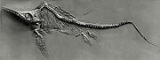
Ichthyosaur Drawing
Ichthyosaur Fossil
Ichthyosaur Paddle 1
converged so strongly on fishes that it actually evolved a dorsal fin
Dorsal fin

A wikt:dorsal fin is a fin located on the backs of some fish, whales, dolphins, and porpoises, as well as the ichthyosaurs. Its main purpose is to stabilize the animal against rolling and assist in sudden turns....
 and tail in just the right place and with just the right hydrological design. These structures are all the more remarkable because they evolved from nothing — the ancestral terrestrial reptile had no hump on its back or blade on its tail to serve as a precursor.
In fact the earliest reconstructions of ichthyosaurs omitted the dorsal fin, which had no hard skeletal structure, until finely-preserved specimens recovered in the 1890s from the Holzmaden
Holzmaden

Holzmaden is a town in Baden-W?rttemberg, Germany that lies between Stuttgart and Ulm.The ground in and around the city contains rich layers of well preserved fossils of the Jurassic period....
 lagerstätte
Lagerstätte

File:Greenww.jpgA Lagerst?tte is a Sedimentation deposit that exhibits extraordinary Fossils richness or completeness. Palaeontologists distinguish two kinds....
n in Germany
Germany

Germany , officially the Federal Republic of Germany , is a country in Central Europe. It is bordered to the north by the North Sea, Denmark, and the Baltic Sea; to the east by Poland and the Czech Republic; to the south by Austria and Switzerland; and to the west by France, Luxembourg, Belgium, and the Netherlands....
 revealed traces of the fin. Unique conditions permitted the preservation of soft tissue impressions.

Ichthyosaurs had fin-like limbs, which were possibly used for stabilisation and directional control, rather than propulsion, which would have come from the large shark-like tail. The tail was bi-lobed, with the lower lobe being supported by the caudal vertebral column, which was "kinked" ventrally to follow the contours of the ventral lobe.

Apart from the obvious similarities to fish, the ichthyosaurs also shared parallel developmental features with dolphin
Dolphin

File:Bottlenose_Dolphin_KSC04pd0178.jpgDolphins are marine mammals that are closely related to whales and porpoises. There are almost forty species of dolphin in seventeen genus....
s. This gave them a broadly similar appearance, possibly implied similar activity, and presumably placed them broadly in a similar ecological niche.

For their food, many of the fish-shaped ichthyosaurs relied heavily on ancient cephalopod
Cephalopod

The cephalopods are the mollusc class Cephalopoda characterized by bilateral symmetry, a prominent head, and a modification of the mollusk foot, a muscular hydrostat, into the form of cephalopod arms or tentacles....
 kin of squid
Squid

Squid are marine cephalopods of the order Teuthida, which comprises around 300 species. Like all other cephalopods, squid have a distinct head, Symmetry #Bilateral_symmetry, a mantle , and cephalopod arms....
s called belemnite
Belemnoidea

Belemnites are an extinct group of marine cephalopod, very similar in many ways to the modern squid and closely related to the modern cuttlefish....
s. Some early ichthyosaurs had teeth adapted for crushing shellfish
Shellfish

Shellfish is a culinary and fisheries term for exoskeleton bearing aquatic invertebrate used as food, including various species of Molluscas, crustaceans, and echinoderms....
. They also most likely fed on fish, and a few of the larger species had heavy jaws and teeth that indicated they fed on smaller reptiles. Ichthyosaurs ranged so widely in size, and survived for so long, that they are likely to have had a wide range of prey. Typical ichthyosaurs have very large eyes, protected within a bony ring
Sclerotic ring

Sclerotic rings are rings of bone found in the eyes of several groups of vertebrate animals, except for mammals and crocodilians. They can be made up of single bones or small bones together....
, suggesting that they may have hunted at night.

History of discoveries

Ichthyosaur Mounted Skeleton
The genus had first been described in 1699 from fossil fragments discovered in Wales
Wales

native_name = Cymru|conventional_long_name = Wales|common_name = Wales|image_flag = Flag of Wales 2.svg|national_motto = ...
.

The first fossil
Fossil

Fossils are the preserved remains or trace fossil of animals, plants, and other organisms from the remote past. The totality of fossils, both discovered and undiscovered, and their placement in fossiliferous Rock formations and sedimentary rock layers is known as the fossil record....
 vertebra
Vertebra

A vertebra is an individual bone in the flexible column that defines vertebrate animals. The vertebral column encases and protects the spinal cord, which runs from the base of the cranium down the dorsal side of the animal until reaching the pelvis....
e were published twice in 1708 as tangible mementos of the Universal Deluge. The first complete ichthyosaur fossil was found in 1811 by Mary Anning
Mary Anning

Mary Anning was an early British fossil collector and paleontology....
 in Lyme Regis
Lyme Regis

Lyme Regis is a coastal town in West Dorset, England, situated 25 miles west of Dorchester, Dorset and east of Exeter. The town lies in Lyme Bay, on the English Channel coast at the Dorset-Devon border....
, along what is now called the Jurassic Coast
Jurassic Coast

The Jurassic Coast is a World Heritage Site on the English Channel coast of southern England. The site stretches from Orcombe Point near Exmouth, Devon in East Devon to Old Harry Rocks near Swanage in East Dorset, a distance of ....
. She subsequently discovered three separate species.

In 1905, the Saurian Expedition
Saurian Expedition of 1905

The Saurian Expedition of 1905 was a noted paleontology research mission in northern Nevada in the United States. The expedition recovered many of the finest specimens of ichthyosaur ever found....
 led by John C. Merriam
John C. Merriam

John Campbell Merriam was an United States paleontologist. The first vertebrate paleontologist on the West Coast of the United States, he is best known for his taxonomy of vertebrate fossils at the La Brea Tar Pits in Los Angeles, California, particularly with the genus Smilodon, more commonly known as the sabertooth cat....
 of the University of California
University of California

The University of California is a public university system in the U.S. state of California. Under the California Master Plan for Higher Education, the University of California is a part of the state's three-tier public higher education system, which also includes the California State University system and the California Community Colleges s...
 and financed by Annie Alexander
Annie Montague Alexander

Annie Montague Alexander was an United States philanthropist and paleontology collector. She is best known as the benefactress of the University of California Museum of Paleontology , Museum of Vertebrate Zoology , and the financier of university museum collections as well as a series of important paleontological expeditions to the western U...
, found 25 specimens in central Nevada
Nevada

Nevada is a U.S. state located in the Western United States of the United States of America. The capital is Carson City and the largest city is Las Vegas, Nevada....
, which during the Triassic was under a shallow ocean. Several of the specimens are now in the collection of the University of California
University of California

The University of California is a public university system in the U.S. state of California. Under the California Master Plan for Higher Education, the University of California is a part of the state's three-tier public higher education system, which also includes the California State University system and the California Community Colleges s...
 Museum of Paleontology. Other specimens are embedded in the rock and visible at Berlin-Ichthyosaur State Park
Berlin-Ichthyosaur State Park

The environment of Nevada comprises diverse biotas, climates, and geologies. Environmental regulations and the environmental movement have aimed to respond to environmental threats....
 in Nye County
Nye County, Nevada

Nye County is a county located in the U.S. state of Nevada. As of the United States Census 2000, the population was 32,485. As of 2007, the population was estimated to be 46,308....
. In 1977, the Triassic ichthyosaur Shonisaurus became the State Fossil of Nevada. Nevada is the only state to possess a complete skeleton, 55 ft (17 m) of this extinct marine reptile. In 1992, Canadian ichthyologist Dr. Elizabeth Nicholls (Curator of Marine Reptiles at the Royal Tyrrell Museum) uncovered the largest fossil specimen ever, a 23m (75 ft)long example.

Evolutionary history

The earliest ichthyosaurs
Ichthyopterygia

Ichthyopterygia was a designation introduced by Sir Richard Owen in 1840 to designate the Jurassic Ichthyosaurs that were known at the time, but the term is now used more often for both true Ichthyosauria and their more primitive early and middle Triassic ancestors ....
, looking more like finned lizards than the familiar fish or dolphin forms, are known from the Early and Early-Middle (Olenekian
Olenekian

The Olenekian is a faunal stage of the Early Triassic epoch . It spans the time between 249.7 ? 0.7 annum and 245 ? 0.7 Ma . The Olenekian is divided into the Smithian and the Spathian age....
 and Anisian
Anisian

In the geologic timescale, the Anisian is the geologic age of the Middle Triassic geologic epoch and lasted from 245 million years ago until 237 million years ago, approximately....
) Triassic
Triassic

The Triassic is a geologic period that extends from about 251 to 199 annum . As the first period of the Mesozoic Era, the Triassic follows the Permian and is followed by the Jurassic....
 strata of Canada
Canada

Canada is a country occupying most of northern North America, extending from the Atlantic Ocean in the east to the Pacific Ocean in the west and northward into the Arctic Ocean....
, China
China

China is a Culture of China, an ancient civilization, and, depending on perspective, a national or multinational entity extending over a large area in East Asia....
, Japan
Japan

Japan is an island country in East Asia. Located in the Pacific Ocean, it lies to the east of the Sea of Japan, People's Republic of China, North Korea, South Korea and Russia, stretching from the Sea of Okhotsk in the north to the East China Sea and Taiwan in the south....
, and Spitsbergen
Spitsbergen

Spitsbergen is a Norway island, the largest island of the Svalbard archipelago in the Arctic Ocean. The island of Spitsbergen covers approximately 39,044 km? ....
 in Norway
Norway

Norway , officially the Kingdom of Norway, is a constitutional monarchy in Northern Europe that occupies the western portion of the Scandinavian Peninsula....
. These primitive forms included the genera Chaohusaurus
Chaohusaurus

Chaohusaurus geishanensis was an ichthyosaur, an extinct fish-like marine reptile, from the Early Triassic of Chaohu, China. It has also been called Anhuisaurus and Chensaurus....
, Grippia
Grippia

Grippia is a genus of ichthyosaur, an extinct group of reptiles that resembled dolphins. Fossils have been found along the coasts of Greenland, China, Japan, and Canada; of Early Triassic age....
, and Utatsusaurus
Utatsusaurus

Utatsusaurus is the earliest-known form of an ichthyopterygian , which lived in the early Triassic period . Unlike the more advanced ichthyosaurs, Utatsusaurus has no dorsal fin and has a broad skull that tapers slowly toward the snout....
. These very early proto-ichthyosaurs, which are now classified as Ichthyopterygia
Ichthyopterygia

Ichthyopterygia was a designation introduced by Sir Richard Owen in 1840 to designate the Jurassic Ichthyosaurs that were known at the time, but the term is now used more often for both true Ichthyosauria and their more primitive early and middle Triassic ancestors ....
 rather than as ichthyosaurs proper (Motani 1997, Motani et al. 1998), quickly gave rise to true ichthyosaurs sometime in the latest Early Triassic or earliest Middle Triassic. These later diversified into a variety of forms, including the sea serpent
Sea serpent

A sea serpent or sea dragon is a mythological sea monster either wholly or partly serpentine.Sightings of sea serpents have been reported for hundreds of years, and continue to be claimed today....
 like Cymbospondylus
Cymbospondylus

Cymbospondylus was a basal early ichthyosaur that lived in the middle of the Triassic period . It was one of the largest ichthyosaurs, and fossils range from 6 m up to 10 m long....
, which reached 10 meters, and smaller more typical forms like Mixosaurus
Mixosaurus

Mixosaurus is an extinct genus of ichthyosaur. It was about 1 meter long. Fossils of Mixosaurus, which means "Mixed Lizard" have been found all over the world - China, Timor, Indonesia, Italy, Spitsbergen, Svalbard, Canada, Alaska, and Nevada....
. By the Late Triassic
Late Triassic

The Late Triassic is in the geologic timescale the third and final of three epoch s of the Triassic geological timescale. The corresponding series is known as the Upper Triassic....
, ichthyosaurs consisted of both classic Shastasauria and more advanced, "dolphin"-like Euichthyosauria (Californosaurus
Californosaurus

Californosaurus perrini was an ichthyosaur, an extinct fish-like marine reptile, from the Lower Hosselkus Limestone of California. It has also been known as Shastasaurus perrini and Delphinosaurus perrini....
, Teretocnemus) and Parvipelvia (Hudsonelpidia, Macgowania). Experts disagree over whether these represent an evolutionary continuum, with the less specialised shastosaurs a paraphyletic
Paraphyly

In phylogenetics, a group of organisms is said to be paraphyletic if the group contains its most recent common ancestor Common descent but does not contain all the descendants of that ancestor....
 grade that was evolving into the more advanced forms (Maisch and Matzke 2000), or whether the two were separate clade
Clade

A clade is a term used in modern alpha taxonomy, the scientific classification of living and fossil organisms, to describe a monophyletic group, defined as a group consisting of a single common ancestor and all its descendants.The term "monophyletic group" is used in this article in the conventional sense of "an a...
s that evolved from a common ancestor earlier on (Nicholls and Manabe 2001).

During the Carnian
Carnian

The Carnian is the lowermost stage of the Upper Triassic series . Its boundaries are not characterized by major extinctions or biotic turnovers, but a climatic event occurred during the Carnian and seems to be associated with important extinctions or biotic radiations....
 and Norian
Norian

The Norian Stage was a portion of the Triassic geological period. It dates from 216.5 ? 2.0 to 203.6 ? 1.5 Mya . It was preceded by the Carnian Stage and succeeded by the Rhaetian Stage....
, shastosaurs reached huge sizes. Shonisaurus popularis, known from a number of specimens from the Carnian of Nevada, was 15 meters long. Norian shonisaurs are known from both sides of the Pacific. Himalayasaurus tibetensis and Tibetosaurus (probably a synonym) have been found in Tibet
Tibet

Tibet is a Tibetan Plateau in Asia, north of the Himalayas, and the home to the indigenous Tibetan people and its related ethnic groups. With an average elevation of 4,900 metres , it is the highest region on Earth and has in recent decades increasingly been referred to as the "Roof of the World"....
. These large (10 to 15 meters long) ichthyosaurs probably belong to the same genus as Shonisaurus (Motani et al, 1999; Lucas, 2001, pp.117-119). While the gigantic Shonisaurus sikanniensis, whose remains were found in the Pardonet formation of British Columbia by Elizabeth Nicholls, reached as much as 21 meters in length - the largest marine reptile known to date.

These giants (along with their smaller cousins) seemed to have disappeared at the end of the Norian. Rhaetian
Rhaetian

PaleogeographyAt this stage, Pangaea began to break-up, though the Atlantic Ocean was not yet formed....
 (latest Triassic) ichthyosaurs are known from England, and these are very similar to those of the Early Jurassic
Early Jurassic

The Early Jurassic epoch is the earliest of three epochs of the Jurassic period. The Early Jurassic starts immediately after the Triassic-Jurassic extinction event and ends at the start of the Middle Jurassic ....
. Like the dinosaurs, the ichthyosaurs and their contemporaries the plesiosaurs survived the end-Triassic extinction event, and immediately diversified to fill the vacant ecological niches of the earliest Jurassic.

The Early Jurassic, like the Late Triassic, was the heyday of the ichthyosaurs, which are represented by four families and a variety of species, ranging from one to ten meters in length. Genera include Eurhinosaurus
Eurhinosaurus

Eurhinosaurus is an extinct genus of ichthyosaur from the Early Jurassic of Europe . It was a large genus, exceeding 6 m in length....
, Ichthyosaurus
Ichthyosaurus

Ichthyosaurus is an extinct genus of ichthyosaur from the Early Jurassic of Europe . It is among the best known ichthyosaur genera, with the Order Ichthyosauria being named after it....
, Leptonectes
Leptonectes

Leptonectes is a genus of ichthyosaur that lived in the Late Triassic to Early Jurassic . Fossils have been found in Belgium, England, Germany and Switzerland. ...
, Stenopterygius
Stenopterygius

Stenopterygius is an extinct genus of ichthyosaur from the Early to Middle Jurassic from Europe . Maximum length was 4 m....
, and the large predator Temnodontosaurus
Temnodontosaurus

Temnodontosaurus was an ichthyosaur from the Early Jurassic, some 198 and 185 million years ago , in Europe . It was a large genus, exceeded 12 meters in length....
, along with the persistently primitive Suevoleviathan, which was little changed from its Norian ancestors. All these animals were streamlined, dolphin-like forms, although the more primitive animals were perhaps more elongated than the advanced and compact Stenopterygius
Stenopterygius

Stenopterygius is an extinct genus of ichthyosaur from the Early to Middle Jurassic from Europe . Maximum length was 4 m....
 and Ichthyosaurus
Ichthyosaurus

Ichthyosaurus is an extinct genus of ichthyosaur from the Early Jurassic of Europe . It is among the best known ichthyosaur genera, with the Order Ichthyosauria being named after it....
.

Ichthyosaurs were still common in the Middle Jurassic
Middle Jurassic

The Middle Jurassic, called the Dogger in the European system of classification, is the second epoch of the Jurassic Period . It lasted from 176-161 million years ago....
, but had now decreased in diversity. All belonged to the single clade Ophthalmosauria. Represented by the 4 meter long Ophthalmosaurus
Ophthalmosaurus

Ophthalmosaurus was an ichthyosaur of the Middle Jurassic to Late Jurassic period , named for its extremely large eyes. It had a graceful 6 meter long dolphin-shaped body, and its almost toothless jaw was well adapted for catching squid....
 and related genera, they were very similar to Ichthyosaurus, and had attained a perfect "tear-drop" streamlined form. The eyes of Ophthalmosaurus were huge, and it is likely that these animals hunted in dim and deep water (Motani 2000).

Ichthyosaurs seemed to decrease in diversity even further with the Cretaceous
Cretaceous

The Cretaceous , usually abbreviated K for its German translation Kreide, is a geologic period from circa to million years ago . In the geologic timescale, the Cretaceous follows on the Jurassic period and is followed by the Paleogene period....
. Only three genera are known, Caypullisaurus
Caypullisaurus

Caypullisaurus was a large ichthyosaur from the Late Jurassic - Early Cretaceous of Argentina. It is a member of the family Ophthalmosauridae, and closely related to Platypterygius and Brachypterygius....
, Maiaspondylus, and Platypterygius
Platypterygius

Platypterygius was an ichthyosaur, an extinct group of reptiles that resembled dolphins, of the family Ophthalmosauridae. It is most closely related to the genus Caypullisaurus and Brachypterygius....
, although they had a worldwide distribution. This last ichthyosaur genus became extinct during the Cenomanian-Turonian
Anoxic event

Oceanic anoxic events or anoxic events occur when the Earth's oceans become completely depleted of oxygen below the surface levels. Although anoxic events have not happened for millions of years, the geological record shows that they happened many times in the past....
 extinction event early in the Late Cretaceous (as did the pliosaur
Pliosaur

The Pliosaurs were Marine reptiles from the Jurassic and Cretaceous Period . They originally included members of the family Pliosauridae, of the Order Plesiosauria, but several other genera and families are now also included; the number and details of which vary according to the classification used....
s). Interestingly, less hydrodynamically efficient animals like mosasaur
Mosasaur

Mosasaurs were serpentine marine reptiles. The first fossil remains were discovered in a limestone quarry at Maastricht on the Meuse in 1778. These ferocious marine predators are now considered to be the closest relatives of snakes, due to cladistic analysis of symptomatic similarities in jaw and skull anatomies....
s and long-necked plesiosaur
Plesiosaur

Plesiosaurs were carnivore aquatic reptiles. After their discovery, they were somewhat fancifully said to have resembled , although they had no shell....
s flourished. It could be that the ichthyosaurian over-specialisation was a contributing factor to their extinction, possibly being unable to 'keep up' with the fast swimming and highly evasive new teleostei
Teleostei

Teleostei is one of three infraclasses in class Actinopterygii, the ray-finned fishes. This diverse group, which arose in the Triassic period, includes 20,000 extant species in about 40 orders; most living fishes are members of this group....
 fish, which had become dominant at this time, against which the sit-and-wait ambush strategies of the mosasaurs proved superior (Lingham-Soliar 1999).

Taxonomy of species

  • Superorder Ichthyopterygia
    Ichthyopterygia

    Ichthyopterygia was a designation introduced by Sir Richard Owen in 1840 to designate the Jurassic Ichthyosaurs that were known at the time, but the term is now used more often for both true Ichthyosauria and their more primitive early and middle Triassic ancestors ....
    • Family Grippidae
      • Chaohusaurus
        Chaohusaurus

        Chaohusaurus geishanensis was an ichthyosaur, an extinct fish-like marine reptile, from the Early Triassic of Chaohu, China. It has also been called Anhuisaurus and Chensaurus....
      • Grippia
        Grippia

        Grippia is a genus of ichthyosaur, an extinct group of reptiles that resembled dolphins. Fossils have been found along the coasts of Greenland, China, Japan, and Canada; of Early Triassic age....
    • Family Utatsusauridae
      • Utatsusaurus
        Utatsusaurus

        Utatsusaurus is the earliest-known form of an ichthyopterygian , which lived in the early Triassic period . Unlike the more advanced ichthyosaurs, Utatsusaurus has no dorsal fin and has a broad skull that tapers slowly toward the snout....
    • Order ICHTHYOSAURIA
    • Cymbospondylus
      Cymbospondylus

      Cymbospondylus was a basal early ichthyosaur that lived in the middle of the Triassic period . It was one of the largest ichthyosaurs, and fossils range from 6 m up to 10 m long....
    • Family Mixosauridae
      • Mixosaurus
        Mixosaurus

        Mixosaurus is an extinct genus of ichthyosaur. It was about 1 meter long. Fossils of Mixosaurus, which means "Mixed Lizard" have been found all over the world - China, Timor, Indonesia, Italy, Spitsbergen, Svalbard, Canada, Alaska, and Nevada....
    • Suborder Merriamosauriformes
      • Guanlingsaurus
    • (unranked) Merriamosauria
    • Infraorder Shastasaur
      Shastasaur

      The shastasaurs were an early group of ichthyosaurs, living 230-210 million years ago, in the Triassic period. They had big heads with a long snout....
      ia
      • Family Shastasaur
        Shastasaur

        The shastasaurs were an early group of ichthyosaurs, living 230-210 million years ago, in the Triassic period. They had big heads with a long snout....
        idae
        • Shastasaurus
          Shastasaurus

          Shastasaurus is a genus of ichthyosaur from the Late Triassic of California and Mexico....
        • Shonisaurus
        • Himalayasaurus
        • Tibetosaurus
    • Infraorder Ichthyosaur
      Ichthyosaur

      Ichthyosaurs were giant marine reptiles that resembled fish and dolphins. Ichthyosaurs thrived during much of the Mesozoic era; based on fossil evidence, they first appeared approximately 245 million years ago and disappeared about 90 million years ago, about 25 million years before the dinosaurs became extinct....
      ia
      (=Euichthyosauruia)
      • Family Ichthyosauridae
        • Ichthyosaurus
          Ichthyosaurus

          Ichthyosaurus is an extinct genus of ichthyosaur from the Early Jurassic of Europe . It is among the best known ichthyosaur genera, with the Order Ichthyosauria being named after it....
      • Family Leptopterygiidae
        Leptopterygiidae

        Leptopterygiidae is a family containing three kinds of ichthyosaurs. They were all small to medium sized creatures, most noted for their very long, swordfish-like snouts, which could have been used like a weapon, slashing through schools of fish....
        • Leptonectes
          Leptonectes

          Leptonectes is a genus of ichthyosaur that lived in the Late Triassic to Early Jurassic . Fossils have been found in Belgium, England, Germany and Switzerland. ...
        • Eurhinosaurus
          Eurhinosaurus

          Eurhinosaurus is an extinct genus of ichthyosaur from the Early Jurassic of Europe . It was a large genus, exceeding 6 m in length....
        • Excalibosaurus
          Excalibosaurus

          Excalibosaurus is a monotypic genus of marine biology prehistoric fish-like reptiles that lived during the Sinemurian stage of the Early Jurassic period in what is now England....
      • Family Temnodontosauridae
        Temnodontosauridae

        Temnodontosauridae is a small family of ichthyosaur. It contains the Temnodontosaurus, a predator that can grow up to 30 feet long and weigh 8 tons....
        • Temnodontosaurus
          Temnodontosaurus

          Temnodontosaurus was an ichthyosaur from the Early Jurassic, some 198 and 185 million years ago , in Europe . It was a large genus, exceeded 12 meters in length....
      • Family Ophthalmosauridae
        Ophthalmosauridae

        Ophthalmosauridae were a family of ichthyosaurs that lived from the Jurassic to the Cretaceous period.Within Ophthalmosauridae there are two lineages, one including Aegirosaurus and Ophthalmosaurus, and the other including Brachypterygius, Caypullisaurus and Platypterygius....
        • Aegirosaurus
          Aegirosaurus

          Aegirosaurus is an extinct genus of ichthyosaur, a fish-like marine reptile, from the Tithonian of Bavaria, Germany. Its remains were discovered in the Solnhofen limestone formations, the same formations that have yielded numerous well-known fossils, such as Archaeopteryx, Compsognathus and Pterodactylus....
        • Brachypterygius
          Brachypterygius

          Brachypterygius is a genus of ichthyosaur that lived in the Late Jurassic. Fossils have been found in England and European Russia.Efimov VM....
        • Caypullisaurus
          Caypullisaurus

          Caypullisaurus was a large ichthyosaur from the Late Jurassic - Early Cretaceous of Argentina. It is a member of the family Ophthalmosauridae, and closely related to Platypterygius and Brachypterygius....
        • Nannopterygius
          Nannopterygius

          Nannopterygius is a genus of Ophthalmosauridae ichthyosaur that lived in the Late Jurassic . Fossils have been found in England and Germany....
        • Ophthalmosaurus
          Ophthalmosaurus

          Ophthalmosaurus was an ichthyosaur of the Middle Jurassic to Late Jurassic period , named for its extremely large eyes. It had a graceful 6 meter long dolphin-shaped body, and its almost toothless jaw was well adapted for catching squid....
        • Platypterygius
          Platypterygius

          Platypterygius was an ichthyosaur, an extinct group of reptiles that resembled dolphins, of the family Ophthalmosauridae. It is most closely related to the genus Caypullisaurus and Brachypterygius....
      • Family Stenopterygiidae
        Stenopterygiidae

        Stenopterygidae are a family of the Ichthyosauria, a group of extinct marine reptiles that superficially resemble fish. They are distinguished from other ichthyosaurs by the arrangement of the flipper bones and by the broad attachment of the fins to the body....
        • Stenopterygius
          Stenopterygius

          Stenopterygius is an extinct genus of ichthyosaur from the Early to Middle Jurassic from Europe . Maximum length was 4 m....
        • ?Chacaicosaurus
          Chacaicosaurus

          Chacaicosaurus is a genus of ichthyosaur that lived in the Middle Jurassic . Fossils have been found in Argentina.References...
      • Family Teretocnemidae
        Teretocnemidae

        Teretocnemidae were a group of ichthyosaurs that lived from the Late Jurassic period....
        • Californosaurus
          Californosaurus

          Californosaurus perrini was an ichthyosaur, an extinct fish-like marine reptile, from the Lower Hosselkus Limestone of California. It has also been known as Shastasaurus perrini and Delphinosaurus perrini....
        • Qianichthyosaurus
        • Teretocnemus
      • Family Suevoleviathanidae
        • Suevoleviathan
    • Infraorder Parvipelvia
      • Hudsonelpidia
      • Macgowania


Phylogeny

The following cladogram
Cladistics

Cladistics is the hierarchical classification of species based on evolutionary ancestry. Cladistics is distinguished from other taxonomic systems because it focuses on evolution rather than similarities between species, and because it places heavy emphasis on objective, quantitative analysis....
 is based on "Ryosuke Motani Ichthyosaur Page":

In popular culture

  • Ichthyosaurus is one of the prehistoric creatures mentioned in Jules Verne
    Jules Verne

    Jules Gabriel Verne was a France author who helped pioneer the science fiction genre. He is best known for his novels Journey to the Center of the Earth , From the Earth to the Moon , Twenty Thousand Leagues Under the Sea , and Around the World in Eighty Days ....
    's book Journey to the Center of the Earth
    Journey to the Center of the Earth

    A Journey to the Centre of the Earth , also translated as A Journey to the Interior of the Earth, is a classic 1864 science fiction novel by Jules Verne....
    , in which it fights with a Plesiosaurus
    Plesiosaurus

    Plesiosaurus was a large , marine sauropterygian reptile that lived during the early part of the Jurassic Period, and is known by nearly complete skeletons from the Lias of England and Germany....
    . However, in the book it is described as being much, much larger than it was in reality.


  • The large aquatic monster from the video game Half-Life is named Ichthyosaur, although it bears no resemblance to the prehistoric creature.


  • The They Might Be Giants
    They Might Be Giants

    They Might Be Giants is a Grammy Award-winning Music of the United States alternative rock band which began as a duo of John Flansburgh and John Linnell, and currently also includes Marty Beller, Dan Miller , and Danny Weinkauf....
     song "Nine Bowls of Soup" is about an ichthyosaur carrying too much soup.


External links

  • (Mikko's Phylogeny Archive)