

Araeoscelidia

Encyclopedia
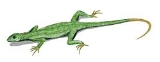
Araeoscelidia or Araeoscelida is a clade
of extinct diapsid
reptiles superficially resembling lizards, extending from the Late Carboniferous
to the Early Permian
.
The group contains the genera
Araeoscelis
, Petrolacosaurus
, the possibly aquatic Spinoaequalis
, and less well-known genera such as Kadaliosaurus and Zarcasaurus.
This clade is considered to be the sister group to all (currently known) later diapsids.
condition. In Araeoscelis
, only the upper temporal opening remains, thus resulting in a derived euryapsid condition.
(Williston, 1910; Vaughn, 1955; Reisz et al., 1984), Petrolacosaurus
(Lane, 1945; Peabody, 1952; Reisz, 1981) and Spinoaequalis
(deBraga & Reisz, 1995; deBraga & Rieppel, 1997), known from virtually complete skeletons. Zarcasaurus (Brinkman et al., 1984), Aphelosaurus (Gervais, 1859; Thévenin, 1910; Falconnet & Steyer, 2007) and Kadaliosaurus (Credner, 1889) belong to this clade, but are known only from post-cranial remains and a mandible fragment for Zarcasaurus.
The genus Dictybolos has been included in Araeoscelidia by Olson (1970), but this inclusion has been criticized e.g. by Evans (1988), especially since Olson also included distantly related groups such as protorosaurs
and mesosaur
s.
New specimens have been discovered in Oklahoma, United States (May & Hall, 2002; Swanson & Carlson, 2002) but so far lack a scientific description.
from the Early Permian of Oklahoma (Reisz et al., 2011).
Clade
A clade is a group consisting of a species and all its descendants. In the terms of biological systematics, a clade is a single "branch" on the "tree of life". The idea that such a "natural group" of organisms should be grouped together and given a taxonomic name is central to biological...
of extinct diapsid
Diapsid
Diapsids are a group of reptiles that developed two holes in each side of their skulls, about 300 million years ago during the late Carboniferous period. Living diapsids are extremely diverse, and include all crocodiles, lizards, snakes, and tuatara...
reptiles superficially resembling lizards, extending from the Late Carboniferous
Carboniferous
The Carboniferous is a geologic period and system that extends from the end of the Devonian Period, about 359.2 ± 2.5 Mya , to the beginning of the Permian Period, about 299.0 ± 0.8 Mya . The name is derived from the Latin word for coal, carbo. Carboniferous means "coal-bearing"...
to the Early Permian
Permian
The PermianThe term "Permian" was introduced into geology in 1841 by Sir Sir R. I. Murchison, president of the Geological Society of London, who identified typical strata in extensive Russian explorations undertaken with Edouard de Verneuil; Murchison asserted in 1841 that he named his "Permian...
.
The group contains the genera
Genus
In biology, a genus is a low-level taxonomic rank used in the biological classification of living and fossil organisms, which is an example of definition by genus and differentia...
Araeoscelis
Araeoscelis
Araeoscelis is an extinct genus of reptile, and one of the earliest diapsids. Fossils have been found in the United States, dating from the early Permian period.Araeoscelis was around long, and superficially resembled a modern lizard...
, Petrolacosaurus
Petrolacosaurus
Petrolacosaurus was a small, long, reptile, and the earliest diapsid known. It lived during the late Carboniferous period, the Joggins strata where it was found are dated to 302 million years old....
, the possibly aquatic Spinoaequalis
Spinoaequalis
Spinoaequalis is an extinct genus of diapsid reptile.The 30 cm long creature, known from fossils found in Kansas, USA, was one of the first diapsids, along with Petrolacosaurus. It was also the first reptile to return to the water, evolving shortly after Hylonomus, the oldest confirmed reptile...
, and less well-known genera such as Kadaliosaurus and Zarcasaurus.
This clade is considered to be the sister group to all (currently known) later diapsids.
Description
Araeoscelidans were small animals (less than one meter in length) looking somewhat like lizards, though they are only distantly related to true lizards. They differ from other, earlier sauropsids by their slender limbs, their elongated tail, and of course by the presence of two temporal openings, the feature defining the diapsidDiapsid
Diapsids are a group of reptiles that developed two holes in each side of their skulls, about 300 million years ago during the late Carboniferous period. Living diapsids are extremely diverse, and include all crocodiles, lizards, snakes, and tuatara...
condition. In Araeoscelis
Araeoscelis
Araeoscelis is an extinct genus of reptile, and one of the earliest diapsids. Fossils have been found in the United States, dating from the early Permian period.Araeoscelis was around long, and superficially resembled a modern lizard...
, only the upper temporal opening remains, thus resulting in a derived euryapsid condition.
Genera
Araeoscelida includes well-known genera such as AraeoscelisAraeoscelis
Araeoscelis is an extinct genus of reptile, and one of the earliest diapsids. Fossils have been found in the United States, dating from the early Permian period.Araeoscelis was around long, and superficially resembled a modern lizard...
(Williston, 1910; Vaughn, 1955; Reisz et al., 1984), Petrolacosaurus
Petrolacosaurus
Petrolacosaurus was a small, long, reptile, and the earliest diapsid known. It lived during the late Carboniferous period, the Joggins strata where it was found are dated to 302 million years old....
(Lane, 1945; Peabody, 1952; Reisz, 1981) and Spinoaequalis
Spinoaequalis
Spinoaequalis is an extinct genus of diapsid reptile.The 30 cm long creature, known from fossils found in Kansas, USA, was one of the first diapsids, along with Petrolacosaurus. It was also the first reptile to return to the water, evolving shortly after Hylonomus, the oldest confirmed reptile...
(deBraga & Reisz, 1995; deBraga & Rieppel, 1997), known from virtually complete skeletons. Zarcasaurus (Brinkman et al., 1984), Aphelosaurus (Gervais, 1859; Thévenin, 1910; Falconnet & Steyer, 2007) and Kadaliosaurus (Credner, 1889) belong to this clade, but are known only from post-cranial remains and a mandible fragment for Zarcasaurus.
The genus Dictybolos has been included in Araeoscelidia by Olson (1970), but this inclusion has been criticized e.g. by Evans (1988), especially since Olson also included distantly related groups such as protorosaurs
Protorosaurus
Protorosaurus , a lizard-like reptile of the order Prolacertiformes, is the earliest known archosauromorph. It lived during the Late Permian period in Germany. In 1914, a new ceratopsian dinosaur found by Lawrence Lambe was again given the name Protorosaurus...
and mesosaur
Mesosaur
Mesosaurs were a group of small aquatic reptiles that lived during the early Permian period, roughly 299 to 270 million years ago. Mesosaurs were the first aquatic reptiles, having apparently returned to an aquatic lifestyle from more terrestrial ancestors...
s.
New specimens have been discovered in Oklahoma, United States (May & Hall, 2002; Swanson & Carlson, 2002) but so far lack a scientific description.
Phylogeny
Phylogenetic relationships after deBraga and Reisz (1995) and Falconnet and Steyer (2007).Stratigraphic and geographic distribution
Araeoscelida are known from the Late Carboniferous in the United States (Petrolacosaurus, Spinoaequalis) to the Early Permian in France (Aphelosaurus), Germany (Kadaliasaurus) and the United States (Dictybolos, Zarcasaurus, Araeoscelis). Apart from araeoscelidans, only one other diapsid is known before the Late Permian: OrovenatorOrovenator
Orovenator is an extinct genus of diapsid from Lower Permian deposits of Oklahoma, USA. It is known from two partial skulls from the Richards Spur locality in Oklahoma...
from the Early Permian of Oklahoma (Reisz et al., 2011).