

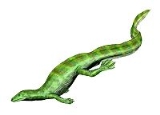
Younginiformes

Encyclopedia
Younginiformes is a replacement name for the taxon Eosuchia
, proposed by Alfred Romer in 1947.
The Eosuchia having become rather a dustbin for many probably distantly-related primitive diapsid reptiles ranging from the late Carboniferous
to the Eocene
, Romer proposed that this be replaced by Younginiformes, to include the Younginidae and a very few similar families, ranging from the Permian
to the Triassic
.
Younginiformes (including Acerosodontosaurus
, Hovasaurus
, Kenyasaurus, Tangasaurus, Thadeosaurus
, Youngina
, et alia sensu Currie and other researchers in the 1980s) is probably not a clade
. It appears to represent a grade of South African Permo-Triassic diapsids that are not more closely related to each other as a whole than they are to other reptiles.
Eosuchia
Eosuchians are an extinct order of diapsid reptiles. Depending on which taxa are included the order may have ranged from the late Carboniferous to the Eocene but the consensus is that eosuchians are confined to the Permian and Triassic....
, proposed by Alfred Romer in 1947.
The Eosuchia having become rather a dustbin for many probably distantly-related primitive diapsid reptiles ranging from the late Carboniferous
Carboniferous
The Carboniferous is a geologic period and system that extends from the end of the Devonian Period, about 359.2 ± 2.5 Mya , to the beginning of the Permian Period, about 299.0 ± 0.8 Mya . The name is derived from the Latin word for coal, carbo. Carboniferous means "coal-bearing"...
to the Eocene
Eocene
The Eocene Epoch, lasting from about 56 to 34 million years ago , is a major division of the geologic timescale and the second epoch of the Paleogene Period in the Cenozoic Era. The Eocene spans the time from the end of the Palaeocene Epoch to the beginning of the Oligocene Epoch. The start of the...
, Romer proposed that this be replaced by Younginiformes, to include the Younginidae and a very few similar families, ranging from the Permian
Permian
The PermianThe term "Permian" was introduced into geology in 1841 by Sir Sir R. I. Murchison, president of the Geological Society of London, who identified typical strata in extensive Russian explorations undertaken with Edouard de Verneuil; Murchison asserted in 1841 that he named his "Permian...
to the Triassic
Triassic
The Triassic is a geologic period and system that extends from about 250 to 200 Mya . As the first period of the Mesozoic Era, the Triassic follows the Permian and is followed by the Jurassic. Both the start and end of the Triassic are marked by major extinction events...
.
Younginiformes (including Acerosodontosaurus
Acerosodontosaurus
Acerosodontosaurus is an extinct genus of diapsid reptile....
, Hovasaurus
Hovasaurus
Hovasaurus is an extinct genus of diapsid reptile belonging to the Order Eosuchia. It lived in what is now Madagascar during the Late Permian....
, Kenyasaurus, Tangasaurus, Thadeosaurus
Thadeosaurus
Thadeosaurus is an extinct genus of diapsid reptile belonging to the Order Eosuchia. Fossils have been found in Madagascar, and date to the late Permian period....
, Youngina
Youngina
Youngina is an extinct genus of diapsid reptile from the Late Permian Beaufort Group of the Karoo Red Beds of South Africa. This, and a few related forms, make up the family Younginidae, within the Order Eosuchia...
, et alia sensu Currie and other researchers in the 1980s) is probably not a clade
Clade
A clade is a group consisting of a species and all its descendants. In the terms of biological systematics, a clade is a single "branch" on the "tree of life". The idea that such a "natural group" of organisms should be grouped together and given a taxonomic name is central to biological...
. It appears to represent a grade of South African Permo-Triassic diapsids that are not more closely related to each other as a whole than they are to other reptiles.