

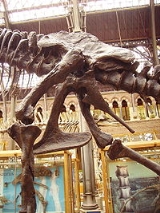
Saurischia

Encyclopedia
Saurischia is one of the two orders
, or basic divisions, of dinosaur
s. In 1888, Harry Seeley
classified dinosaurs into two orders, based on their hip structure. Saurischians ('lizard-hipped') are distinguished from the ornithischia
ns ('bird-hipped') by retaining the ancestral configuration of bones in the hip.
All carnivorous dinosaurs (the theropods) are saurischians, as are one of the two primary lineages of herbivorous dinosaurs, the sauropodomorphs. At the end of the Cretaceous
Period, all non-avian
saurischians became extinct. This is referred to as the Cretaceous-Tertiary extinction event
. Avians (modern birds
), as direct descendants of one group of theropod dinosaurs, are considered to be a sub-clade
of saurischian dinosaurs in phylogenetic classification
.
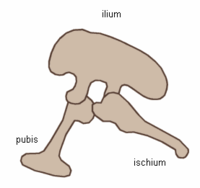
ns by their three-pronged pelvic structure, with the pubis
pointed forward. The ornithischians' pelvis
is arranged with the pubis rotated backward, parallel
with the ischium, often also with a forward-pointing process, giving a four-pronged structure.
The ornithischian hip structure is superficially similar to that of bird
s, which led Seeley to name them "bird-hipped dinosaurs," though he did not propose any specific relationship with birds. He termed saurischians "lizard-hipped" dinosaurs because they retained the ancestral hip anatomy
also found in modern lizard
s.
However, as later study revealed, the hip structure possessed by modern birds actually evolved independently from the "lizard-hipped" saurischians (specifically, a sub-group of saurischians called the Maniraptora
) in the Jurassic Period. In this example of convergent evolution
, birds developed hips oriented similar to the earlier ornithischian hip anatomy, in both cases possibly as an adaptation to a herbivorous or omnivorous diet.
 In his paper naming the two groups, Seeley reviewed previous classification schemes put forth by other paleontologists to divide up the traditional Order Dinosauria. He preferred one that had been put forward by Othniel Charles Marsh
in 1878, which divided dinosaurs into four Orders: Sauropoda
, Theropoda
, Ornithopoda, and Stegosauria
(these names are still used today in much the same way to refer to suborders or clade
s within Saurischia and Ornithischia).
Seeley, however, wanted to formulate a classification that would take into account a single primary difference between major dinosaurian groups based on a characteristic that also differentiated them from other reptiles. He found this in the configuration of the hip bones, and found that all four of Marsh's orders could be divided neatly into two major groups based on this feature. He placed the Stegosauria and Ornithopoda in the Ornithischia, and the Theropoda and Sauropoda in the Saurischia. Furthermore, Seeley used this major difference in the hip bones, along with many other noted differences between the two groups, to argue that "dinosaurs" were not a natural grouping at all, but rather two distinct orders that had arisen independently from more primitive archosaur
s. This concept that "dinosaur" was an outdated term for two distinct orders lasted many decades in the scientific and popular literature, and it was not until the 1960s that scientists began to again consider the possibility that saurischians and ornithischians were more closely related to each other than they were to other archosaurs.
Although his concept of a polyphyletic Dinosauria is no longer accepted by most paleontologists, Seeley's basic division of the two dinosaurian groups has stood the test of time, and has been supported by modern cladistic analysis of relationships among dinosaurs. One alternate hypothesis challenging Seeley's classification was proposed by Robert T. Bakker
in his 1986 book The Dinosaur Heresies
. Bakker's classification separated the theropods into their own group and placed the two groups of herbivorous dinosaurs (the sauropodomorphs and ornithischians) together in a separate group he named the Phytodinosauria ('plant dinosaurs'). The Phytodinosauria hypothesis was based partly on the supposed link between ornithischians and prosauropods, and the idea that the former had evolved directly from the later, possibly by way of an enigmatic family that seemed to possess characters of both groups, the segnosaurs. However, it was later found that segnosaurs were actually an unusual type of herbivorous theropod saurischians closely related to birds, and the Phytodinosauria hypothesis fell out of favor.
Additionally, the genera Teyuwasu
and Agnosphitys
may represent early saurischians, or more primitive non-dinosaurs.
is adapted from Weishampel et al., 2004.
Order (biology)
In scientific classification used in biology, the order is# a taxonomic rank used in the classification of organisms. Other well-known ranks are life, domain, kingdom, phylum, class, family, genus, and species, with order fitting in between class and family...
, or basic divisions, of dinosaur
Dinosaur
Dinosaurs are a diverse group of animals of the clade and superorder Dinosauria. They were the dominant terrestrial vertebrates for over 160 million years, from the late Triassic period until the end of the Cretaceous , when the Cretaceous–Paleogene extinction event led to the extinction of...
s. In 1888, Harry Seeley
Harry Seeley
Harry Govier Seeley was a British paleontologist.-Career:Seeley was born in London, the son of Richard Hovill Seeley, goldsmith, and his second wife Mary Govier. He attended classes at the Royal School of Mines, Kensington before becoming an assistant to Adam Sedgwick at the Woodwardian Museum,...
classified dinosaurs into two orders, based on their hip structure. Saurischians ('lizard-hipped') are distinguished from the ornithischia
Ornithischia
Ornithischia or Predentata is an extinct order of beaked, herbivorous dinosaurs. The name ornithischia is derived from the Greek ornitheos meaning 'of a bird' and ischion meaning 'hip joint'...
ns ('bird-hipped') by retaining the ancestral configuration of bones in the hip.
All carnivorous dinosaurs (the theropods) are saurischians, as are one of the two primary lineages of herbivorous dinosaurs, the sauropodomorphs. At the end of the Cretaceous
Cretaceous
The Cretaceous , derived from the Latin "creta" , usually abbreviated K for its German translation Kreide , is a geologic period and system from circa to million years ago. In the geologic timescale, the Cretaceous follows the Jurassic period and is followed by the Paleogene period of the...
Period, all non-avian
Bird
Birds are feathered, winged, bipedal, endothermic , egg-laying, vertebrate animals. Around 10,000 living species and 188 families makes them the most speciose class of tetrapod vertebrates. They inhabit ecosystems across the globe, from the Arctic to the Antarctic. Extant birds range in size from...
saurischians became extinct. This is referred to as the Cretaceous-Tertiary extinction event
Cretaceous-Tertiary extinction event
The Cretaceous–Paleogene extinction event, formerly named and still commonly referred to as the Cretaceous-Tertiary extinction event, occurred approximately 65.5 million years ago at the end of the Maastrichtian age of the Cretaceous period. It was a large-scale mass extinction of animal and plant...
. Avians (modern birds
Modern birds
Modern birds are the most recent common ancestor of all living birds and all its descendants.Modern birds are characterised by feathers, a beak with no teeth , the laying of hard-shelled eggs, a high metabolic rate, a four-chambered heart, and a lightweight but strong skeleton...
), as direct descendants of one group of theropod dinosaurs, are considered to be a sub-clade
Clade
A clade is a group consisting of a species and all its descendants. In the terms of biological systematics, a clade is a single "branch" on the "tree of life". The idea that such a "natural group" of organisms should be grouped together and given a taxonomic name is central to biological...
of saurischian dinosaurs in phylogenetic classification
Phylogenetic nomenclature
Phylogenetic nomenclature or phylogenetic taxonomy is an alternative to rank-based nomenclature, applying definitions from cladistics . Its two defining features are the use of phylogenetic definitions of biological taxon names, and the lack of obligatory ranks...
.
Description
Saurischians are distinguished from ornithischiaOrnithischia
Ornithischia or Predentata is an extinct order of beaked, herbivorous dinosaurs. The name ornithischia is derived from the Greek ornitheos meaning 'of a bird' and ischion meaning 'hip joint'...
ns by their three-pronged pelvic structure, with the pubis
Pubis (bone)
In vertebrates, the pubic bone is the ventral and anterior of the three principal bones composing either half of the pelvis.It is covered by a layer of fat, which is covered by the mons pubis....
pointed forward. The ornithischians' pelvis
Pelvis
In human anatomy, the pelvis is the lower part of the trunk, between the abdomen and the lower limbs .The pelvis includes several structures:...
is arranged with the pubis rotated backward, parallel
Parallel (geometry)
Parallelism is a term in geometry and in everyday life that refers to a property in Euclidean space of two or more lines or planes, or a combination of these. The assumed existence and properties of parallel lines are the basis of Euclid's parallel postulate. Two lines in a plane that do not...
with the ischium, often also with a forward-pointing process, giving a four-pronged structure.
The ornithischian hip structure is superficially similar to that of bird
Bird
Birds are feathered, winged, bipedal, endothermic , egg-laying, vertebrate animals. Around 10,000 living species and 188 families makes them the most speciose class of tetrapod vertebrates. They inhabit ecosystems across the globe, from the Arctic to the Antarctic. Extant birds range in size from...
s, which led Seeley to name them "bird-hipped dinosaurs," though he did not propose any specific relationship with birds. He termed saurischians "lizard-hipped" dinosaurs because they retained the ancestral hip anatomy
Anatomy
Anatomy is a branch of biology and medicine that is the consideration of the structure of living things. It is a general term that includes human anatomy, animal anatomy , and plant anatomy...
also found in modern lizard
Lizard
Lizards are a widespread group of squamate reptiles, with nearly 3800 species, ranging across all continents except Antarctica as well as most oceanic island chains...
s.
However, as later study revealed, the hip structure possessed by modern birds actually evolved independently from the "lizard-hipped" saurischians (specifically, a sub-group of saurischians called the Maniraptora
Maniraptora
Maniraptora is a clade of coelurosaurian dinosaurs which includes the birds and the dinosaurs that were more closely related to them than to Ornithomimus velox. It contains the major subgroups Avialae, Deinonychosauria, Oviraptorosauria and Therizinosauria. Ornitholestes and the Alvarezsauroidea...
) in the Jurassic Period. In this example of convergent evolution
Convergent evolution
Convergent evolution describes the acquisition of the same biological trait in unrelated lineages.The wing is a classic example of convergent evolution in action. Although their last common ancestor did not have wings, both birds and bats do, and are capable of powered flight. The wings are...
, birds developed hips oriented similar to the earlier ornithischian hip anatomy, in both cases possibly as an adaptation to a herbivorous or omnivorous diet.
Classification
Othniel Charles Marsh
Othniel Charles Marsh was an American paleontologist. Marsh was one of the preeminent scientists in the field; the discovery or description of dozens of news species and theories on the origins of birds are among his legacies.Born into a modest family, Marsh was able to afford higher education...
in 1878, which divided dinosaurs into four Orders: Sauropoda
Sauropoda
Sauropoda , or the sauropods , are an infraorder of saurischian dinosaurs. They had long necks, long tails, small heads , and thick, pillar-like legs. They are notable for the enormous sizes attained by some species, and the group includes the largest animals to have ever lived on land...
, Theropoda
Theropoda
Theropoda is both a suborder of bipedal saurischian dinosaurs, and a clade consisting of that suborder and its descendants . Dinosaurs belonging to the suborder theropoda were primarily carnivorous, although a number of theropod groups evolved herbivory, omnivory, and insectivory...
, Ornithopoda, and Stegosauria
Stegosauria
Known colloquially as stegosaurs, the Stegosauria are a group of herbivorous dinosaurs of the Jurassic and Early Cretaceous Periods, being found mostly in the Northern Hemisphere, predominantly in what is now North America and China....
(these names are still used today in much the same way to refer to suborders or clade
Clade
A clade is a group consisting of a species and all its descendants. In the terms of biological systematics, a clade is a single "branch" on the "tree of life". The idea that such a "natural group" of organisms should be grouped together and given a taxonomic name is central to biological...
s within Saurischia and Ornithischia).
Seeley, however, wanted to formulate a classification that would take into account a single primary difference between major dinosaurian groups based on a characteristic that also differentiated them from other reptiles. He found this in the configuration of the hip bones, and found that all four of Marsh's orders could be divided neatly into two major groups based on this feature. He placed the Stegosauria and Ornithopoda in the Ornithischia, and the Theropoda and Sauropoda in the Saurischia. Furthermore, Seeley used this major difference in the hip bones, along with many other noted differences between the two groups, to argue that "dinosaurs" were not a natural grouping at all, but rather two distinct orders that had arisen independently from more primitive archosaur
Archosaur
Archosaurs are a group of diapsid amniotes whose living representatives consist of modern birds and crocodilians. This group also includes all extinct non-avian dinosaurs, many extinct crocodilian relatives, and pterosaurs. Archosauria, the archosaur clade, is a crown group that includes the most...
s. This concept that "dinosaur" was an outdated term for two distinct orders lasted many decades in the scientific and popular literature, and it was not until the 1960s that scientists began to again consider the possibility that saurischians and ornithischians were more closely related to each other than they were to other archosaurs.
Although his concept of a polyphyletic Dinosauria is no longer accepted by most paleontologists, Seeley's basic division of the two dinosaurian groups has stood the test of time, and has been supported by modern cladistic analysis of relationships among dinosaurs. One alternate hypothesis challenging Seeley's classification was proposed by Robert T. Bakker
Robert T. Bakker
Robert T. Bakker is an American paleontologist who helped reshape modern theories about dinosaurs, particularly by adding support to the theory that some dinosaurs were endothermic...
in his 1986 book The Dinosaur Heresies
The Dinosaur Heresies
The Dinosaur Heresies: New Theories Unlocking the Mystery of the Dinosaurs and Their Extinction was a 1986 book published by Robert T. Bakker, a prominent paleontologist....
. Bakker's classification separated the theropods into their own group and placed the two groups of herbivorous dinosaurs (the sauropodomorphs and ornithischians) together in a separate group he named the Phytodinosauria ('plant dinosaurs'). The Phytodinosauria hypothesis was based partly on the supposed link between ornithischians and prosauropods, and the idea that the former had evolved directly from the later, possibly by way of an enigmatic family that seemed to possess characters of both groups, the segnosaurs. However, it was later found that segnosaurs were actually an unusual type of herbivorous theropod saurischians closely related to birds, and the Phytodinosauria hypothesis fell out of favor.
Taxonomy
- Order Saurischia
- Infraorder †Herrerasauria
- Suborder †SauropodomorphaSauropodomorphaSauropodomorpha is an extinct clade of long-necked, herbivorous, saurischian dinosaurs which includes the sauropods and their ancestral relatives. Sauropods generally grew to very large sizes, had long necks and tails, were quadrupedal, and became the largest animals to ever walk the Earth. The...
- †GuaibasauridaeGuaibasauridaeGuaibasauridae is a family of primitive saurischian dinosaurs, known from fossil remains of late Triassic period formations in Brazil and Argentina....
- Infraorder †Prosauropoda
- Infraorder †SauropodaSauropodaSauropoda , or the sauropods , are an infraorder of saurischian dinosaurs. They had long necks, long tails, small heads , and thick, pillar-like legs. They are notable for the enormous sizes attained by some species, and the group includes the largest animals to have ever lived on land...
- †Guaibasauridae
- Suborder TheropodaTheropodaTheropoda is both a suborder of bipedal saurischian dinosaurs, and a clade consisting of that suborder and its descendants . Dinosaurs belonging to the suborder theropoda were primarily carnivorous, although a number of theropod groups evolved herbivory, omnivory, and insectivory...
- †EoraptorEoraptorEoraptor was one of the world's earliest dinosaurs. It was a two-legged saurischian, close to the ancestry of theropods and sauropodomorphs. It lived ca. 231.4 million years ago, in what is now the northwestern region of Argentina...
- †TawaTawa (dinosaur)Tawa is a genus of theropod dinosaur from the Late Triassic period. It is estimated to have been 2 m long...
- Infraorder †CarnosauriaCarnosauriaCarnosauria is a group of large predatory dinosaurs that lived during the Jurassic and Cretaceous periods. While it originally contained a wide assortment of giant theropods that were not closely related, the group has since been defined to encompass only the allosaurs and their closest kin...
- Infraorder †CeratosauriaCeratosauriaCeratosaurs are members of a group of theropod dinosaurs defined as all theropods sharing a more recent common ancestry with Ceratosaurus than with birds. There is presently no universally agreed upon listing of species or diagnostic characters of Ceratosauria, though they were less derived...
- Infraorder †DeinonychosauriaDeinonychosauriaThe Deinonychosauria were a clade of coelurosaurian theropod dinosaurs from the Late Jurassic and Cretaceous periods. These omnivores and carnivores are known for their switchblade-like second toe claws and for displaying numerous bird-like characteristics. The clade has been divided into two...
- Infraorder †OrnithomimosauriaOrnithomimosauriaThe Ornithomimosauria, ornithomimosaurs or ostrich dinosaurs were theropod dinosaurs which bore a superficial resemblance to modern ostriches. They were fast, omnivorous or herbivorous dinosaurs from the Cretaceous Period of Laurasia...
- Infraorder †OviraptorosauriaOviraptorosauriaOviraptorosaurs are a group of feathered maniraptoran dinosaurs from the Cretaceous Period of what are now Asia and North America. They are distinct for their characteristically short, beaked, parrot - like skulls, with or without bony crests atop the head...
- †Eoraptor
- Suborder †Sauropodomorpha
- Infraorder †Herrerasauria
Additionally, the genera Teyuwasu
Teyuwasu
Teyuwasu is a dubious genus of dinosaur from the Late Triassic. Named by Edio-Ernst Kischlat in 1999, little is currently known about this genus; the type species, T. barbarenai, was named from leg bones discovered in geopark of paleorrota, Brazil. The specific name honors Dr. Mário Costa...
and Agnosphitys
Agnosphitys
Agnosphitys is a disputed genus of dinosaur. It contains only one species, the type species A. cromhallensis. Its remains include an ilium, maxilla, astragalus and humerus, which date variously from the Norian and Rhaetian stages of the Late Triassic...
may represent early saurischians, or more primitive non-dinosaurs.
Phylogeny
The following cladogramCladogram
A cladogram is a diagram used in cladistics which shows ancestral relations between organisms, to represent the evolutionary tree of life. Although traditionally such cladograms were generated largely on the basis of morphological characters, DNA and RNA sequencing data and computational...
is adapted from Weishampel et al., 2004.