
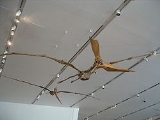
All Topics  
Pterosaur

 
Pterosaur

   Email Print
   Bookmark   Link


Pterosaur


Pterosaurs (from the Greek
Greek language

Greek is an Indo-European languages native to the southern Balkan peninsula, the language of the Greek people. It forms an independent branch within Indo-European....
 pte??sa????, pterosauros, meaning "winged lizard", often referred to as pterodactyls, from the Greek pte??d??t????, pterodaktulos, meaning "winged finger" ) were flying reptile
Reptile

Reptiles, or members of the class Reptilia, are air-breathing, cold-blooded vertebrates that have skin covered in scale as opposed to hair or feathers....
s of the clade
Clade

A clade is a term used in modern alpha taxonomy, the scientific classification of living and fossil organisms, to describe a monophyletic group, defined as a group consisting of a single common ancestor and all its descendants.The term "monophyletic group" is used in this article in the conventional sense of "an a...
 or order
Order (biology)

In Biological classification used in biology, the order is a taxonomic rank between class and family . The superorder is a rank between class and order....
 Pterosauria. They existed from the late Triassic
Triassic

The Triassic is a geologic period that extends from about 251 to 199 annum . As the first period of the Mesozoic Era, the Triassic follows the Permian and is followed by the Jurassic....
 to the end of the Cretaceous
Cretaceous

The Cretaceous , usually abbreviated K for its German translation Kreide, is a geologic period from circa to million years ago . In the geologic timescale, the Cretaceous follows on the Jurassic period and is followed by the Paleogene period....
 Period (220 to 65.5 million years ago). Pterosaurs are the earliest vertebrate
Vertebrate

Vertebrates are members of the subphylum Vertebrata, chordates with Vertebras or Vertebral columns. The grouping sometimes includes the hagfish, which have no vertebrae, but are genetically quite closely related to lampreys, which do have vertebrae....
s known to have evolved powered flight.


Discussion
Ask a question about 'Pterosaur'
Start a new discussion about 'Pterosaur'
Answer questions from other users
Full Discussion Forum


Encyclopedia


Pterosaurs (from the Greek
Greek language

Greek is an Indo-European languages native to the southern Balkan peninsula, the language of the Greek people. It forms an independent branch within Indo-European....
 pte??sa????, pterosauros, meaning "winged lizard", often referred to as pterodactyls, from the Greek pte??d??t????, pterodaktulos, meaning "winged finger" ) were flying reptile
Reptile

Reptiles, or members of the class Reptilia, are air-breathing, cold-blooded vertebrates that have skin covered in scale as opposed to hair or feathers....
s of the clade
Clade

A clade is a term used in modern alpha taxonomy, the scientific classification of living and fossil organisms, to describe a monophyletic group, defined as a group consisting of a single common ancestor and all its descendants.The term "monophyletic group" is used in this article in the conventional sense of "an a...
 or order
Order (biology)

In Biological classification used in biology, the order is a taxonomic rank between class and family . The superorder is a rank between class and order....
 Pterosauria. They existed from the late Triassic
Triassic

The Triassic is a geologic period that extends from about 251 to 199 annum . As the first period of the Mesozoic Era, the Triassic follows the Permian and is followed by the Jurassic....
 to the end of the Cretaceous
Cretaceous

The Cretaceous , usually abbreviated K for its German translation Kreide, is a geologic period from circa to million years ago . In the geologic timescale, the Cretaceous follows on the Jurassic period and is followed by the Paleogene period....
 Period (220 to 65.5 million years ago). Pterosaurs are the earliest vertebrate
Vertebrate

Vertebrates are members of the subphylum Vertebrata, chordates with Vertebras or Vertebral columns. The grouping sometimes includes the hagfish, which have no vertebrae, but are genetically quite closely related to lampreys, which do have vertebrae....
s known to have evolved powered flight. Their wings were formed by a membrane of skin, muscle, and other tissues stretching from the legs to a dramatically lengthened fourth finger. Early species had long, fully-toothed jaws and long tails, while later forms had a highly reduced tail, and some lacked teeth. Pterosaurs spanned a wide range of adult sizes, from the very small Nemicolopterus
Nemicolopterus

Nemicolopterus is a genus of Pterodactyloidea pterosaur, described in 2008. The type species and only known species is N. crypticus. It lived in the Jehol Biota 120 million years ago....
 to the largest known flying creatures of all time, including Quetzalcoatlus
Quetzalcoatlus

Quetzalcoatlus was a pterodactyloid pterosaur known from the Late Cretaceous of North America , and one of the largest known flying animals of all time....
 and Hatzegopteryx
Hatzegopteryx

Hatzegopteryx is a genus of Azhdarchidae pterosaur, known from incomplete remains found in Transylvania. The skull fragments, left humerus, and other fossilized remains indicate a huge animal with a wingspan of 12 meters or more....
.

Pterosaurs are sometimes referred to in the popular media as dinosaur
Dinosaur

Dinosaurs were the dominant vertebrate animals of Landform ecosystems for over 160 million years, from the late Triassic Period until the end of the Cretaceous Period , when most of them became extinct in the Cretaceous?Tertiary extinction event....
s, but this is incorrect. The term "dinosaur" is properly restricted to a certain group of terrestrial
Terrestrial animal

Terrestrial animals are animals that live predominantly or entirely on land, as compared with aquatic animals, which live predominantly or entirely in the water , or amphibians, which rely on a combination of aquatic and terrestrial habitats ....
 reptile
Reptile

Reptiles, or members of the class Reptilia, are air-breathing, cold-blooded vertebrates that have skin covered in scale as opposed to hair or feathers....
s with a unique upright stance (superorder Dinosauria), and therefore excludes the pterosaurs, as well as the various groups of extinct aquatic reptiles, such as ichthyosaur
Ichthyosaur

Ichthyosaurs were giant marine reptiles that resembled fish and dolphins. Ichthyosaurs thrived during much of the Mesozoic era; based on fossil evidence, they first appeared approximately 245 million years ago and disappeared about 90 million years ago, about 25 million years before the dinosaurs became extinct....
s, plesiosaur
Plesiosaur

Plesiosaurs were carnivore aquatic reptiles. After their discovery, they were somewhat fancifully said to have resembled , although they had no shell....
s, and mosasaur
Mosasaur

Mosasaurs were serpentine marine reptiles. The first fossil remains were discovered in a limestone quarry at Maastricht on the Meuse in 1778. These ferocious marine predators are now considered to be the closest relatives of snakes, due to cladistic analysis of symptomatic similarities in jaw and skull anatomies....
s.

History of discovery

The first pterosaur fossil
Fossil

Fossils are the preserved remains or trace fossil of animals, plants, and other organisms from the remote past. The totality of fossils, both discovered and undiscovered, and their placement in fossiliferous Rock formations and sedimentary rock layers is known as the fossil record....
 was described by the Italian
Italian people

The Italian people are a Southern European ethnic group located primarily in Italy and, by virtue of a wide-ranging Italian diaspora, throughout Western Europe, the Americas and Australia....
 naturalist Cosimo Collini in 1784. Collini misinterpreted his specimen as a seagoing creature that used its long front limbs as paddles. A few scientists continued to support the aquatic interpretation even until 1830, when the German zoologist Johann Georg Wagler
Johann Georg Wagler

Johann Georg Wagler was a Germany herpetologist.Wagler was assistant to Johann Baptist von Spix, and became Director of the Zoological Museum at the University of Munich after Spix's death in 1826....
 suggested that Pterodactylus used its wings as flippers. Georges Cuvier
Georges Cuvier

Baron Georges L?opold Chr?tien Fr?d?ric Dagobert Cuvier was a France natural history and zoology. He was the elder brother of Fr?d?ric Cuvier , also a naturalist....
 first suggested that pterosaurs were flying creatures in 1801, and coined the name "Ptero-dactyle" 1809 for a specimen recovered in Germany; however, due to the standardization of scientific names, the official name for this species became Pterodactylus
Pterodactylus

Pterodactylus is a genus of pterosaur that lived during the late Jurassic Period . It was a carnivore and probably preyed upon fish and other small animals....
, though the name "pterodactyl" continued to be popularly applied to all members of this first specimen's order.

Since the first pterosaur fossil
Fossil

Fossils are the preserved remains or trace fossil of animals, plants, and other organisms from the remote past. The totality of fossils, both discovered and undiscovered, and their placement in fossiliferous Rock formations and sedimentary rock layers is known as the fossil record....
 was discovered in the Late Jurassic
Late Jurassic

The Late Jurassic Epoch of the Jurassic Period is the unit of geologic time scale from 161.2 ? 4.0 to 145.5 ? 4.0 million years ago, which is preserved in Upper Jurassic stratum....
 Solnhofen limestone
Solnhofen limestone

The Solnhofen limestone is a Jurassic lagerst?tte that preserves a rare assemblage of fossilized organisms, some of which, such as sea jellies, don't ordinarily fossilize at all....
 in 1784, twenty-nine kinds of pterosaurs have been found in those deposits alone. A famous early UK find was an example of Dimorphodon
Dimorphodon

Dimorphodon was a genus of medium-sized pterosaur from the Early Jurassic Period . It was named by Palaeontology Richard Owen in 1859. Dimorphodon means "two-form tooth" , referring to the fact that it had two distinct types of teeth in its jaws - which is comparatively rare among reptiles....
 by Mary Anning
Mary Anning

Mary Anning was an early British fossil collector and paleontology....
, at Lyme Regis
Lyme Regis

Lyme Regis is a coastal town in West Dorset, England, situated 25 miles west of Dorchester, Dorset and east of Exeter. The town lies in Lyme Bay, on the English Channel coast at the Dorset-Devon border....
 in 1828. The name Pterosauria was coined by Johann Jakob Kaup
Johann Jakob Kaup

Johann Jakob Kaup was a Germany naturalist.He was born at Darmstadt. After studying at G?ttingen and Heidelberg he spent two years at Leiden, where his attention was specially devoted to the amphibians and fishes....
 in 1834, though the name Ornithosauria (or "bird lizards", Bonaparte, 1838) was sometimes used in the early literature.
Anhanguera Santanae Skull
Most pterosaur fossils are poorly preserved. Their bone
Bone

Bones are rigid organ that form part of the endoskeleton of vertebrates. They function to move, support, and protect the various organs of the body, produce red blood cell and white blood cells and store minerals....
s were hollow and, when sediment
Sediment

Sediment is any particulate matter that can be sediment transport by fluid dynamics, and which eventually is deposited.Sediments are most often transported by water transported by wind and glaciers....
s piled on top of them, the bones were flattened. The best preserved fossils have come from the Araripe Plateau, Brazil
Brazil

Brazil , officially the Federative Republic of Brazil , is a country in South America. It is the List of countries and outlying territories by total area country by geographical area, occupying nearly half of South America, the List of countries by population country, and the fourth most populous democracy in the world....
. For some reason, when the bones were deposited, the sediments encapsulated the bones, rather than crushing them. This created three-dimensional fossils for paleontologists to study. The first find in the Araripe Plateau was made in 1974.

Most paleontologists now believe that pterosaurs were adapted for active flight
Flight

Flight is the process by which an object moves either through the air, or movement beyond earth's atmosphere , by aerodynamically generating Lift , propulsion or Lighter than air using buoyancy, or by simple ballistic movement....
, not just gliding
Gliding

Gliding refers to the descending flight of heavier-than-air craft, principally gliders s, hang gliders and paragliders. Technically, gliders, hang-gliders and paragliders are just different styles of glider used to pursue gliding and soaring for recreation, in the same way that sailboats and windsurfers share the lake and the wind....
 as was earlier believed. Pterosaur fossils have been found on every continent except Antarctica
Antarctica

Antarctica is Earth's southernmost continent, overlying the South Pole. It is situated in the Antarctica of the southern hemisphere, almost entirely south of the Antarctic Circle, and is surrounded by the Southern Ocean....
. At least 60 genera
Genus

A genus is a low-level taxonomic rank used in the classification of living and fossil organisms. The taxonomic ranks are domain , kingdom , phylum, class , order , family , genus, and species....
 of pterosaurs have been found to date, ranging from the size of a small bird to wingspans in excess of 10 meters (33 feet).

Description

The anatomy of pterosaurs was highly modified from their reptilian ancestors for the demands of flight. Pterosaur bone
Skeleton

In biology, a skeleton is a rigid framework that provides protection and structure in many types of animal, particularly those of the phylum Chordata and of the superphylum Ecdysozoa....
s were hollow and air filled, like the bones of bird
Bird

Birds are wing, Bipedalismal, endothermic , vertebrate animals that lay egg . There are around 10,000 living species, making them the most numerous tetrapod vertebrates....
s. They had a keeled breastbone that was developed for the attachment of flight muscle
MUSCLE

MUSCLE is public domain, multiple sequence alignment software for protein and nucleotide sequences.MUSCLE is integrated into UGENE bioinformatics tool as a plugin....
s and an enlarged brain
Brain

The brain is the center of the nervous system in all vertebrate, and most invertebrate, animals. Some primitive animals such as cnidarian and echinoderm have a decentralized nervous system without a brain, while sponges lack any nervous system at all....
 that shows specialised features associated with flight. In some later pterosaurs, the backbone over the shoulders fused into a structure known as a notarium
Notarium

Notarium is a term used for the fused vertebra of the shoulder in birds and some pterosaurs. The structure helps brace the thorax against the forces generated by the wings....
, which served to stiffen the torso during flight, and provide a stable support for the scapula
Scapula

In anatomy, the scapula, omo, or shoulder blade, is the bone that connects the humerus with the clavicle .The scapula forms the posterior part of the shoulder girdle....
 (shoulder blade).

Wings

Pterosaur wings were formed by membranes of skin and other tissues. The primary membranes attached to the extremely long fourth finger
Finger

A finger is a type of digit , an organ of manipulation and sensation found in the hands of humans and other primates.Normally humans have five digits, termed phalanges, on each hand ....
 of each arm
Arm

In anatomy, an arm is one of the upper limbs of an animal. The term arm can also be used for analogous structures, such as one of the paired upper limbs of a four-legged animal, or the cephalopod arm....
 and extended along the sides of the body to the legs.

While historically thought of s simple, leathery structures composed of skin, research has since shown that the wing membranes of pterosaurs were actually highly complex and dynamic structures suited to an active style of flight. First, the wings were strengthened by closely spaced fibers called actinofibrils. The wing membranes also contained a thin layer of muscle, fibrous tissue, and a unique, complex circulatory system of looping blood vessels.

As evidenced by hollow cavities in the wing bones of larger species and soft tissue preserved in at least one specimen, some pterosaurs extended their system of respiratory air sacs (see Paleobiology section below) into the wing membrane itself.

Parts of the pterosaur wing
The pterosaur wing membrane is divided into three basic units. The first, called the propatagium ("first membrane"), was the forward-most part of the wing and attached between the wrist and shoulder, creating the "leading edge" during flight. This membrane may have incorporated the first three fingers of the hand, as evidenced in some specimens. The brachiopatagium ("arm membrane") was the primary component of the wing, stretching from the highly elongated fourth finger of the hand to the hind limbs (though where exactly on the hind limbs it anchored is controversial and may have varied between species, see below). Finally, at least some pterosaur groups had a membrane that stretched between the legs, possibly connecting to or incorporating the tail, called the uropatagium.

A bone unique to pterosaurs, known as the pteroid, connected to the wrist and helped to support a forward membrane (the propatagium) between the wrist and shoulder. Evidence of webbing between the three free fingers of the pterosaur forelimb suggests that this forward membrane may have been more extensive than the simple pteoid to shoulde connection traditionally depicted in life restorations. The position of the pteroid bone itself has been controversial. Some scientists, notably David Unwin, have argued that the pteroid pointed forward, extending the forward membrane. However, this view was strongly refuted in a 2007 paper by Chris Bennett, who showed that the pteroid did not articulate as previously thought and could not have pointed forward, but rather inward toward the body as traditionally though.

There has been considerable argument among paleontologists about whether the main wing membranes (brachiopatagia) attached to the hind limbs, and if so, where. Fossils of the rhamphorhynchoid Sordes
Sordes

Sordes was a small pterosaur that lived in the late Jurassic Period of the Mesozoic era. Sordes lived in the in the area of Kazakhstan....
, the anurognathid
Anurognathid

Anurognathids were a group of small pterosaurs, mostly tailess, that lived worldwide during the Jurassic Period. Some examples are Anurognathus and Batrachognathus....
 Jeholopterus
Jeholopterus

Jeholopterus was a small anurognathid pterosaur from the Daohugou Beds of northeastern China , preserved with hair and skin impressions, and named after its place of discovery, Jehol in China....
, and a pterodactyloid from the Santana Formation
Santana Formation

The Santana Formation is a geologic Lagerst?tten in northeastern Brazil's Araripe Basin where the states of Pernambuco, Piau? and Cear? come together....
 seem to demonstrate that the wing membrane did attach to the hindlimbs, at least in some species. However, modern bat
Bat

Bats are mammals in the order Chiroptera. The forelimbs of all bats are developed as wings, making them the only mammals naturally capable of sustained flight ....
s and flying squirrel
Flying squirrel

The flying squirrels, scientifically known as Pteromyini or Petauristini, are a tribe of squirrels . There are 43 species in this tribe, the largest of which is the woolly flying squirrel ....
s show considerable variation in the extent of their wing membranes and it is possible that, like these groups, different species of pterosaur had different wing designs. Indeed, analysis of pterosaur limb proportions shows that there was considerable variation, possibly reflecting a variety of wing-plans. Many if not all pterosaurs also had webbed feet, and although these have been considered to be evidence of swimming, they may have had an aerodynamic function. Webbed feet are also seen in some gliding animals such as colugo
Colugo

Colugos are arboreal gliding mammals found in South-east Asia. There are just four extant taxon species, which make up the entire family Cynocephalidae and order Dermoptera....
s, the "flying lemurs".

Skull, teeth & crests

Most pterosaur skulls had elongated, beak-like jaws. Some advanced forms were toothless (such as the pteranodonts
Pteranodontidae

Pteranodontidae is a Family of large pterosaurs of the Cretaceous Period of North America. Many pteranodontids had a distinctive, elongated crest jutting from the rear of the head ....
 and azhdarchids
Azhdarchidae

Azhdarchidae is a Family of pterosaurs known primarily from the late Cretaceous Period, and which included some of the largest known flying animals of all time....
, though most sported a full compliment of needle-like teeth. In some cases, actual keratin
Keratin

Keratins are a family of fibrous protein; tough and insoluble, they form the hard but mineral structures found in reptiles, birds, amphibians and mammals....
ous beak tissue has been preserved, though in toothed forms, the beak is small and restricted to the jaw tips and does not involve the teeth.

Unlike most archosaur
Archosaur

Archosaurs are a group of diapsid reptiles represented by modern birds and crocodilians. This group also includes extinct non-avian dinosaurs, pterosaurs and relatives of crocodiles....
s, which have several openings in the skull in front of the eyes, in pterosaurs the antorbital opening
Antorbital fenestra

An antorbital fenestra is an opening in the skull, in front of the eye sockets. This skull formation first appeared in archosaurs during the Triassic Period....
 and the nasal opening was merged into a single large opening, called the nasoantorbial fenestra. This likely evolved as a weight-saving feature to lighten the skull for flight.

Pterosaurs are well known for their often elaborate crests. The first and perhaps best known of these is the distinctive backward-pointing crest of some Pteranodon
Pteranodon

Pteranodon , from the Late Cretaceous of North America , was one of the largest pterosaur genera, with a wingspan of up to ....
 species, though a few pterosaurs, such as the tapejarids
Tapejaridae

Tapejaridae are a Family of pterodactyloid pterosaurs from the early Cretaceous Period . Members are currently known from Brazil and China, where the most primitive genera are found, indicating that the family has an Asian origin....
 and Nyctosaurus
Nyctosaurus

Nyctosaurus is a genus of pterodactyloid pterosaur notable for its extraordinarily large cranial crest, otherwise known only in the distantly related Tapejaridae....
 sported incredibly large crests that often incorporated keratinous or other soft tissue extensions of the bony crest base.

Since the 1990s, new discoveries and more thorough study of old specimens have shown that crests are far more widespread among pterosaurs than previously thought, due mainly to the fact that they were frequently extended by or composed completely of keratin, which does not fossilize as often as bone. In the cases of pterosaurs like Pterorhynchus
Pterorhynchus

Pterorhynchus was a genus of Rhamphorhynchidae rhamphorhynchoid pterosaur from the Late Jurassic-age Daohugou Formation of Inner Mongolia, People's Republic of China....
 and Pterodactylus
Pterodactylus

Pterodactylus is a genus of pterosaur that lived during the late Jurassic Period . It was a carnivore and probably preyed upon fish and other small animals....
, the true extent of these crests has only been uncovered using ultra violet photography. The discovery of Pterorynchus and Austriadactylus
Austriadactylus

Austriadactylus was an unusual genus of rhamphorhynchoid pterosaur. The fossil remains, consisting of skull, lower jaw, some vertebrae, parts of the limbs and pelvic girdle, and the tail, were unearthed in Late Triassic rocks of Austria....
, both crested "rhamphorchynchoids
Rhamphorhynchoidea

The Rhamphorhynchoidea forms one of the two suborders of pterosaurs and represent a grade of primitive members of this group of flying reptiles....
", showed that even primitive pterosaurs had crests (previously, crests were thought to be restricted to the more advanced pterodactyloids
Pterodactyloidea

Pterodactyloidea forms one of the two suborders of pterosaurs , and contains the most advanced members of this group of flying reptiles. They appeared during the middle Jurassic Period, and differ from the basal rhamphorhynchoidea by their short tails and long wing metacarpals ....
).

Hair

Pterosaurs were unique among reptiles in that at least some of them were covered with hair
Hair

Hair is a protein filament that epidermal growth from hair follicle deep within the dermis. The fine, soft hair found on many nonhuman mammals is typically called fur; wool is the characteristically curly hair found on sheep and goats....
, similar to but not homologous
Homology (biology)

In evolutionary biology, homology refers to any similarity between characteristics that is due to their common descent. The word homologous derives from the ancient Greek ??????e??, 'to agree'....
 with mammal
Mammal

Mammals are a class of vertebrate animals whose name is derived from their distinctive feature, mammary glands, with which they feed their young....
ian hair. Pterosaur "hair" is not true hair as seen in mammals, but a unique structure that developed a similar appearance through convergent evolution
Convergent evolution

Convergent evolution describes the acquisition of the same biological trait in unrelated lineages.The wing is a classic example of convergent evolution in action....
. Although in some cases fibers in the wing membrane have been mistaken for hair, some fossils such as those of Sordes pilosus
Sordes

Sordes was a small pterosaur that lived in the late Jurassic Period of the Mesozoic era. Sordes lived in the in the area of Kazakhstan....
 (the "hairy demon") do show the unmistakable imprints of hair on the head and body, not unlike modern-day bats, another example of convergent evolution. The presence of hair (and the demands of flight) imply that pterosaurs were endotherm
Endotherm

Endotherm may refer to:*warm-blooded organism*endothermic processSee also*ectotherm...
ic (warm-blooded).

Paleobiology


Flight

The mechanics of pterosaur flight are not completely understood or modeled at this time, but it is almost certain that this group of animals was capable of powered flight in at least as wide a range of conditions as modern birds. Pterosaurs display many extreme morphological changes required for flight - lightweight bones, stiffened torsos, and modification of the forelimbs into large, dedicated flight surfaces. It is unlikely that all the highly flight-specialized skeletal features observed in pterosaur fossils were developed and maintained for hundreds of millions of years if the animals did not fly. Skeletal specializations displayed by the pterosaurs would put them at an enormous disadvantage to terrestrial tetrapods if they were not used for the exploitation of an airborne lifestyle and ecological niches.

The study of pterosaur biomechanics and modeling of flight is a field still in development. Direct comparisons with the most successful vertebrate flyers of today, the birds, leaves gaps in our ability to reproduce their flight mechanics and models. However, pterosaurs certainly were successful flyers, based on their skeletal evidence and the distribution of their fossils in size, shape, geography, and evolutionary longevity.

Every group of animals that has developed the ability of true flight has done it different ways. Some insects (those with wing muscles attached directly to the wings) fly differently from other insects (whose wing muscles attach indirectly to the wings), which fly differently from birds, which fly differently from bats, which fly differently from pterosaurs. The flight dynamics of all the preceding groups, with the probable exception of pterosaurs, have been extensively studied and modeled and copied. And because all the flight mechanisms are different, the models are different, and while each may be valid in their specific case, they are not inter-applicable. This is clearly the case of the current state of the field in pterosaur flight. Pterosaurs flew using their forelimbs, which are modified by hypertrophy of the fourth finger into a long spar supporting a membrane of tissue which was the flight surface. The wings were probably flapped in a manner grossly similar to that seen in birds (a group which displays many different flapping strategies among and within different species and different situations). One of the chief arguments against active pterosaur flight has been their relatively shallow sternum keel, which is the anchor point for the pectoralis muscles, the main flapping muscle. However, pterosaurs display other skeletal features that may have made this less problematic than a direct comparison to birds may indicate. The pterosaur group is notable for a unique bone, called the pteroid, in the forearm, which may have supported a flight structure not reproduced in other flying animals. Recent wind tunnel tests on model pterosaur wings with the pteroid bone in an extended antero-ventral orientation supporting a large, highly cambered propatagium show that such a configuration enables the wing to develop up to 30% more lift, even at very high angles of attack. This anatomical feature, based on the pteroid bone - the bone unique to the pterosaur clade - may have enabled pterosaurs to be active, powered flyers in spite of the lack of other features associated with strong fliers. While the orientation of the pteroid is disputed, it should be noted that it, or some other combination of features must have efficiently enabled flight for the group, supporting even the evolution of giant forms, like the famous Quetzalcoatlus, to a size unmatched by modern birds.

Katsufumi Sato, a Japanese scientist, did calculations using current birds and decided that it is impossible for a pterosaur to stay aloft. In the book Posture, Locomotion, and Paleoecology of Pterosaurs it is theorized that they were able to fly due to the oxygen-rich, dense atmosphere of the Late Cretaceous
Late Cretaceous

Late Cretaceous refers to the second half of the Cretaceous Period , named after the famous white chalk cliffs of southern England, which date from this time....
 period. However, one must note both Katsufumi and the authors of Posture, Locomotion, and Paleoecology of Pterosaurs based their research on the now outdated theories of pterosaurs being seabird-like, and the size limit doesn't apply to terrestrial pterosaurs like azhdarchids
Azhdarchidae

Azhdarchidae is a Family of pterosaurs known primarily from the late Cretaceous Period, and which included some of the largest known flying animals of all time....
 and tapejarids
Tapejaridae

Tapejaridae are a Family of pterodactyloid pterosaurs from the early Cretaceous Period . Members are currently known from Brazil and China, where the most primitive genera are found, indicating that the family has an Asian origin....
  Furtheremore, Darren Naish
Darren Naish

Darren Naish is a vertebrate paleontologist and science writer. He obtained a geology degree at the University of Southampton and later studied vertebrate palaeontology under British palaeontologist David Martill at the University of Portsmouth, where he obtained both an M....
 concluded that atmospheric differences between the present and the Mesozoic weren't needed for the giant size of pterosaurs:

Air sacs and respiration

A 2009 study showed that pterosaurs had a lung-air sac system and a precisely controlled skeletal breathing pump, which supports a flow-through pulmonary ventilation model in pterosaurs, analogous to that of birds.

Nervous system

A study of pterosaur brain
Brain

The brain is the center of the nervous system in all vertebrate, and most invertebrate, animals. Some primitive animals such as cnidarian and echinoderm have a decentralized nervous system without a brain, while sponges lack any nervous system at all....
 cavities using X-rays revealed that the animals (Rhamphorhynchus muensteri and Anhanguera
Anhanguera (pterosaur)

Anhanguera is a genus of pterodactyloid pterosaur known from the Lower-Cretaceous Santana Formation of Brazil. The discovery of this pterosaur helped to end some of the debates about whether pterosaurs walked on two legs or four....
 santanae
) had massive flocculi. The flocculus
Flocculus

The flocculus is a small lobe of the cerebellum at the posterior border of the middle cerebellar peduncle anterior to the biventer lobule.It is associated with the nodulus of the vermis; together, these two structures compose the vestibular part of the cerebellum....
 is a brain region that integrates signals from joints, muscles, skin and balance organs.

The pterosaurs' flocculi occupied 7.5% of the animals' total brain mass, more than in any other vertebrate. Birds have unusually large flocculi compared with other animals, but these only occupy between 1 and 2% of total brain mass.

The flocculus sends out neural signals that produce small, automatic movements in the eye muscles. These keep the image on an animal's retina steady. Pterosaurs may have had such a large flocculus because of their large wing size, which would mean that there was a great deal more sensory information to process.

Ground movement

Pterosaur's hip sockets are oriented facing slightly upwards, and the head of the femur
Femur

The femur, or thigh bone, is the most proximal bone of the leg in vertebrates capable of walking or jumping, such as most land mammals, birds, many reptiles such as lizards, and amphibians such as frogs....
 (thigh bone) is only moderately inward facing, suggesting that pterosaurs had a semi-erect stance. It would have been possible to lift the thigh into a horizontal position during flight as gliding lizards do.

There was considerable debate whether pterosaurs ambulated as quadruped
Quadruped

Quadrupedalism is a form of Terrestrial locomotion in animals using four limbs or leg . An animal or machine that usually moves in a quadrupedal manner is known as a quadruped, meaning "four feet" ....
s or as biped
Biped

Bipedalism is a form of terrestrial locomotion where an organism Motion by means of its two rear limbs, or legs. An animal or machine that usually moves in a bipedal manner is known as a biped , meaning "two feet" ....
s. In the 1980s, paleontologist Kevin Padian
Kevin Padian

Kevin Padian is a Professor of Integrative Biology at the University of California, Berkeley, Curator of Paleontology, University of California Museum of Paleontology and President of the National Center for Science Education....
 suggested that smaller pterosaurs with longer hindlimbs such as Dimorphodon
Dimorphodon

Dimorphodon was a genus of medium-sized pterosaur from the Early Jurassic Period . It was named by Palaeontology Richard Owen in 1859. Dimorphodon means "two-form tooth" , referring to the fact that it had two distinct types of teeth in its jaws - which is comparatively rare among reptiles....
 might have walked or even run bipedally, in addition to flying, like road runner
Geococcyx

The roadrunners are two species of bird in the genus Geococcyx of the cuckoo family, Cuculidae, native to North America and Central America....
s. However, a large number of pterosaur trackway
Fossil trackway

A fossil trackway is a type of fossil impression, a trackway made by a once life organism, usually by its feet. The majority of known fossil trackways are made by fossil dinosauria, or tetrapods, or bipeds....
s were later found with a distinctive four-toed hind foot and three-toed front foot; these are the unmistakable prints of pterosaurs walking on all fours.

Unlike most vertebrates, which walk on their toes with ankles held off the ground (digitigrade
Digitigrade

A digitigrade is an animal that stands or walks on its digits, or toes. Digitigrades include walking birds , cats, dogs, and most other mammals, but not humans, bears, and a few others ....
), fossil footprints show that pterosaurs stood with the entire foot in contact with the ground (plantigrade
Plantigrade

In mammals, plantigrade locomotion means walking with the podials and metatarsals flat on the ground.Primates are examples of plantigrade species; in humans, the podials and metatarsals constitute the sole of the foot....
), in a manner similar to human
Human

A human being, also human or man, is a member of a species of bipedalism primates in the family Hominidae . Mitochondrial DNA evidence indicates that modern humans originated in east Africa about 200,000 years ago....
s and bear
Bear

Bears are mammals of the family Ursidae. Bears are classified as caniforms, or doglike carnivorans, with the pinnipeds being their closest living relatives....
s. Footprints from azhdarchids
Azhdarchidae

Azhdarchidae is a Family of pterosaurs known primarily from the late Cretaceous Period, and which included some of the largest known flying animals of all time....
 show that at least some pterosaurs walked with an erect, rather than sprawling, posture. Though traditionally depicted as ungainly and awkward when on the ground, the anatomy of at least some pterosaurs (particularly pterodactyloids) suggests that they were competent walkers and runners. The forelimb bones of azhdarchids
Azhdarchidae

Azhdarchidae is a Family of pterosaurs known primarily from the late Cretaceous Period, and which included some of the largest known flying animals of all time....
 and ornithocheirids were unusually long compared to other pterosaurs, and in azhdarchids, the bones of the arm and hand (metacarpals) were particularly elongated, and azhdarchid front limbs as a whole were proportioned similarly to fast-running ungulate
Ungulate

Ungulates are several groups of mammals, most of which use the tips of their toes, usually hoofed, to sustain their whole body weight while moving....
 mammals. Their hind limbs, on the other hand, were not built for speed, but they were long compared with most pterosaurs, and allowed for a long stride length. While azhdarchid pterosaurs probably could not run, they would have been relatively fast and energy efficient.

The relative size of the hands and feet in pterosaurs (by comparison with modern animals such as birds) may indicate what type of lifestyle pterosaurs led on the ground. Azhdarchid pterosaurs had relatively small feet compared to their body size and leg length, with foot length only about 25%-30% the length of the lower leg. This suggests that azhdarchids were better adapted to walking on dry, relatively solid ground. Pteranodon
Pteranodon

Pteranodon , from the Late Cretaceous of North America , was one of the largest pterosaur genera, with a wingspan of up to ....
 had slightly larger feet (47% the length of the tibia
Tibia

The tibia, shinbone, or shankbone is the larger and stronger of the two bones in the leg below the knee in vertebrates and connects the knee with the ankle bones....
), while filter-feeding pterosaurs like the ctenochasmatoids
Ctenochasmatoidea

Ctenochasmatoidea is a group of pterosaurs within the suborder Pterodactyloidea....
 had very large feet (69% of tibial length in Pterodactylus
Pterodactylus

Pterodactylus is a genus of pterosaur that lived during the late Jurassic Period . It was a carnivore and probably preyed upon fish and other small animals....
, 84% in Pterodaustro
Pterodaustro

Pterodaustro was a Cretaceous pterosaur from South America, living 140 million years ago. Pterodaustro had a wingspan of 133 centimeters , and possessed about 1,000 tall, narrow bristle like teeth, which presumably were used in filter-feeding, much like modern flamingos....
), adapted to walking in soft muddy soil, similar to modern wading birds.

Predation

Pterosaurs are known to have been eaten by spinosaurids
Spinosauridae

Spinosauridae is a family of unusual theropod dinosaurs. Members of this group were large, bipedal predators with elongated, crocodile-like skulls, sporting conical teeth with no or only very tiny serrations....
. In the 1 July 2004 edition of Nature
Nature (journal)

Nature is a prominent scientific journal, first published on 4 November 1869. Although most scientific journals are now highly specialized, Nature is one of the few journals, along with other weekly journals such as Science and Proceedings of the National Academy of Sciences, that still publishes original research articles ac...
, paleontologist Eric Buffetaut discusses an early Cretaceous fossil of three cervical vertebra
Vertebra

A vertebra is an individual bone in the flexible column that defines vertebrate animals. The vertebral column encases and protects the spinal cord, which runs from the base of the cranium down the dorsal side of the animal until reaching the pelvis....
e of a pterosaur with the broken tooth of a spinosaur embedded in it. The vertebrae are known not to have been eaten and exposed to digestion, as the joints still articulated.

Reproduction

Very little is known about pterosaur reproduction. A single pterosaur egg has been found in the quarries of Liaoning, the same place that yielded the famous 'feathered' dinosaurs. The egg was squashed flat with no signs of cracking, so evidently the eggs had leathery shells, as in modern lizards. The embryo's wing membranes were well developed, suggesting pterosaurs were ready to fly soon after birth. This is corroborated by very young animals found in the Solnhofen limestone beds. It is not known whether pterosaurs practiced parental care, but their comparatively early flight capabilities suggest the young only dependent on their parents for a short period of times while the wings grew long enough to fly. It's possible they even used stored yolk products for nourishment during this time, as in modern reptiles, rather than depend on parents for food.

A study of pterosaur eggshell structure and chemistry published in 2007 indicated that it is likely pterosaurs buried their eggs, like modern crocodile
Crocodile

A crocodile is any species belonging to the family Crocodylidae . The term can also be used more loosely to include all members of the order Crocodilia: i.e....
 and turtle
Turtle

Turtles are reptiles of the Order Testudines , most of whose body is shielded by a special bone or cartilage animal shell developed from their ribs....
s. Egg-burying would have been beneficial to the early evolution of pterosaurs, as it allows for more weight-reducing adaptations, but this method of reproduction also would have put limits on the variety of environments pterosaurs could live in, and may have disadvantaged them when they began to face ecological competition from bird
Bird

Birds are wing, Bipedalismal, endothermic , vertebrate animals that lay egg . There are around 10,000 living species, making them the most numerous tetrapod vertebrates....
s. The alternative would be for the mother to retain the egg within the body until just prior to hatching, as some lizards do, but which archosaurs are incapable of doing.

Evolution and extinction


Origins

Because pterosaur anatomy
Anatomy

Anatomy is a branch of biology that is the consideration of the body plan. It is a general term that includes human anatomy, animal anatomy and plant anatomy ....
 has been so heavily modified for flight, and immediate "missing link" predecessors have not so far been described, the ancestry of pterosaurs is not well understood. Several hypotheses have been advanced, with the most common in recent years being links to ornithodirans like Scleromochlus
Scleromochlus

Scleromochlus is an extinct genus of small ornithodiran from the Late Triassic period. A lightly-built cursorial animal, its phylogeny position within Ornithodira has been debated; as different analyses have found it to be either the basal -most ornithodiran or the sister-taxon to Pterosauria....
, an ancestry among the archosauriforms
Archosauriformes

Archosauriformes are a clade of diapsid reptiles that developed from Archosauromorpha ancestors some time in the Late Permian . These reptiles, which include members of the Family Proterosuchidae and more advanced forms, were originally superficially crocodile-like predatory semi-aquatic animals about 1.5 meters long, with a sprawling elbow...
 like Euparkeria
Euparkeria

Euparkeria , meaning "Parker's good animal", named in honor of W.K. Parker, was a small African reptile of the early Triassic period between 248-245 million years ago, close to the ancestry of the archosaurs....
 (a more traditional view), or related to prolacertiformes
Prolacertiformes

Prolacertiformes were an order of archosauromorpha reptiles that lived during the Permian and Triassic Periods. Many species seem to have been adapted for an arboreal lifestyle, including the "delta-winged glider" Sharovipteryx, while others, such as Tanystropheus, had extremely long, stiffened necks , and may have been at least part...
 like Sharovipteryx
Sharovipteryx

Sharovipteryx , was among the earliest gliding reptiles, from the early Triassic period. It was approximately eight inches long, with an extremely long tail, and weighed about 7.5 grams....
.

They were thought to have evolved flight from some manner other than the 'tree-down' route possibly taken by birds, because pterosaurs demonstrated no adaptations useful for tree living. Most scenarios have pterosaurs evolving from long-legged, ground-running ancestors like Scleromochlus
Scleromochlus

Scleromochlus is an extinct genus of small ornithodiran from the Late Triassic period. A lightly-built cursorial animal, its phylogeny position within Ornithodira has been debated; as different analyses have found it to be either the basal -most ornithodiran or the sister-taxon to Pterosauria....
 or Sharovipteryx
Sharovipteryx

Sharovipteryx , was among the earliest gliding reptiles, from the early Triassic period. It was approximately eight inches long, with an extremely long tail, and weighed about 7.5 grams....
, both of which had webs of skin from long hind legs to their bodies or tails. This suggested a 'ground-up' evolution of flight or even a route that evolved by gliding from cliff-tops.

However, new (2008) findings suggest that the earliest pterosaurs were small, tree dwelling, insectivorous organisms.

Phylogeny and classification


Classification of pterosaurs has historically been difficult, because there were many gaps in the fossil record. Many new discoveries are now filling in these gaps and giving us a better picture of the evolution of pterosaurs. Traditionally, they are organized into two suborders:

  • Rhamphorhynchoidea
    Rhamphorhynchoidea

    The Rhamphorhynchoidea forms one of the two suborders of pterosaurs and represent a grade of primitive members of this group of flying reptiles....
     (Plieninger, 1901): A group of early, basal ("primitive") pterosaurs, many of which had long tails and short metacarpal bones in the wing. They were small, and their fingers were still adapted to climbing . They appeared in the Late Triassic period, and lasted until the late Jurassic. Rhamphorhynchoidea is a paraphyletic group (since the pterodactyloids evolved directly from them and not from a common ancestor), so with the increasing use of cladistics
    Cladistics

    Cladistics is the hierarchical classification of species based on evolutionary ancestry. Cladistics is distinguished from other taxonomic systems because it focuses on evolution rather than similarities between species, and because it places heavy emphasis on objective, quantitative analysis....
     it has fallen out of favor in most technical literature.


  • Pterodactyloidea
    Pterodactyloidea

    Pterodactyloidea forms one of the two suborders of pterosaurs , and contains the most advanced members of this group of flying reptiles. They appeared during the middle Jurassic Period, and differ from the basal rhamphorhynchoidea by their short tails and long wing metacarpals ....
     (Plieninger, 1901): The more derived ("advanced") pterosaurs, with short tails and long wing metacarpals. They appeared in the middle Jurassic
    Jurassic

    The Jurassic is a geologic period that extends from about annum to  Ma, that is, from the end of the Triassic to the beginning of the Cretaceous....
     period, and lasted until the Cretaceous-Tertiary extinction event
    Cretaceous-Tertiary extinction event

    The Cretaceous?Tertiary extinction event, which occurred approximately , was a large-scale Extinction event of animal and plant species in a geologically short period of time....
     wiped them out at the end of the Cretaceous
    Cretaceous

    The Cretaceous , usually abbreviated K for its German translation Kreide, is a geologic period from circa to million years ago . In the geologic timescale, the Cretaceous follows on the Jurassic period and is followed by the Paleogene period....
    .


Listing of families and superfamilies within Pterosauria, after Unwin 2006.
Zhenjiangopterus Jconway
* ORDER PTEROSAURIA (extinct)
    • Suborder Rhamphorhynchoidea
      Rhamphorhynchoidea

      The Rhamphorhynchoidea forms one of the two suborders of pterosaurs and represent a grade of primitive members of this group of flying reptiles....
       *
      • Family Dimorphodontidae
      • Family Anurognathidae
      • Family Campylognathoididae
      • Family Rhamphorhynchidae
    • Suborder Pterodactyloidea
      Pterodactyloidea

      Pterodactyloidea forms one of the two suborders of pterosaurs , and contains the most advanced members of this group of flying reptiles. They appeared during the middle Jurassic Period, and differ from the basal rhamphorhynchoidea by their short tails and long wing metacarpals ....
      • Superfamily Ornithocheiroidea
        Ornithocheiroidea

        Ornithocheiroidea is a group of pterosaurs within the suborder Pterodactyloidea....
        • Family Istiodactylidae
          Istiodactylidae

          Istiodactylidae is a small Family of pterosaurs. This family was named in 2001 after the type genus Istiodactylus was discovered not to be a member of the genus Ornithodesmus....
        • Family Ornithocheiridae
        • Family Pteranodontidae
          Pteranodontidae

          Pteranodontidae is a Family of large pterosaurs of the Cretaceous Period of North America. Many pteranodontids had a distinctive, elongated crest jutting from the rear of the head ....
        • Family Nyctosauridae
      • Superfamily Ctenochasmatoidea
        Ctenochasmatoidea

        Ctenochasmatoidea is a group of pterosaurs within the suborder Pterodactyloidea....
        • Family Gallodactylidae
          Cycnorhamphus

          Cycnorhamphus is a genus of ctenochasmatoidea pterodactyloidea pterosaur from the Late Jurassic of France and Germany. Two species are currently recognized as valid....
        • Family Pterodactylidae
          Pterodactylus

          Pterodactylus is a genus of pterosaur that lived during the late Jurassic Period . It was a carnivore and probably preyed upon fish and other small animals....
        • Family Ctenochasmatidae
      • Superfamily Dsungaripteroidea
        Dsungaripteroidea

        Dsungaripteroidea is a group of pterosaurs within the suborder Pterodactyloidea....
        • Family Germanodactylidae
          Germanodactylus

          Germanodactylus is a genus of dsungaripteroidea pterodactyloidea pterosaur from Late Jurassic-age rocks of Germany, including the Solnhofen limestone....
        • Family Dsungaripteridae
      • Superfamily Azhdarchoidea
        Azhdarchoidea

        Azhdarchoidea is a group of pterosaurs within the suborder Pterodactyloidea....
        • Family Lonchodectidae
        • Family Tapejaridae
          Tapejaridae

          Tapejaridae are a Family of pterodactyloid pterosaurs from the early Cretaceous Period . Members are currently known from Brazil and China, where the most primitive genera are found, indicating that the family has an Asian origin....
        • Family Azhdarchidae
          Azhdarchidae

          Azhdarchidae is a Family of pterosaurs known primarily from the late Cretaceous Period, and which included some of the largest known flying animals of all time....


The precise relationships between pterosaurs is still unsettled. However, several newer studies are beginning to make things clearer. Cladogram simplified after Unwin.

Extinction


It is often thought that competition with early bird
Bird

Birds are wing, Bipedalismal, endothermic , vertebrate animals that lay egg . There are around 10,000 living species, making them the most numerous tetrapod vertebrates....
 species may have resulted in the extinction of many of the pterosaurs. By the end of the Cretaceous, only large species of pterosaurs are known. The smaller species seem to have become extinct, their niche filled by birds,; however, pterosaur decline (if actually present) seems unrelated to bird diversity . At the end of the Cretaceous period, the great extinction which wiped out all non-avian dinosaurs plus most avian dinosaurs as well, and many other animals, seemed to also take the pterosaurs. Alternatively, most pterosaurs may have been specialised for an ocean-going lifestyle. Consequently, when the K-T mass-extinction severely affected marine life that most pterosaurs fed on, they went extinct. However, forms like azhdarchids
Azhdarchidae

Azhdarchidae is a Family of pterosaurs known primarily from the late Cretaceous Period, and which included some of the largest known flying animals of all time....
 and istiodactylids
Istiodactylus

Istiodactylus was a medium sized pterosaur from the Early Cretaceous period.Discovered on the Isle of Wight, Istiodactylus latidens was originally placed in the genus Ornithodesmus by H.G....
 weren't marine in habits.

Well-known genera

Examples of pterosaur genera
Genus

A genus is a low-level taxonomic rank used in the classification of living and fossil organisms. The taxonomic ranks are domain , kingdom , phylum, class , order , family , genus, and species....
 include:
  • Dsungaripterus
    Dsungaripterus

    Dsungaripterus was a genus of pterosaur with an average wingspan of 3 metres . It lived during the Early Cretaceous, ranging from China, where the first fossils were found in the Junngar Basin, to Africa, where more remains have been found....
     had a wingspan of 3 metres (10 ft), an unusual bony crest running along its snout, and long, narrow, curved jaw
    Jaw

    The jaw is either of the two opposable structures forming, or near the entrance to the mouth.The term jaws is also broadly applied to the whole of the structures constituting the vault of the mouth and serving to open and close it and is part of the body plan of most animals....
    s with a pointed tip. It lived during the early Cretaceous period.
  • Pteranodon
    Pteranodon

    Pteranodon , from the Late Cretaceous of North America , was one of the largest pterosaur genera, with a wingspan of up to ....
     was 1.8 metres (six feet) long, with a wingspan of 7.5 m (25 ft), and lived during the late Cretaceous period.
  • Pterodactylus
    Pterodactylus

    Pterodactylus is a genus of pterosaur that lived during the late Jurassic Period . It was a carnivore and probably preyed upon fish and other small animals....
     had a wingspan of 50 to 75 centimeters (20 to 30 inch
    Inch

    An inch is the name of a Units of measurement of length in a number of different systems, including Imperial units, and United States customary units....
    es), and lived during the late Jurassic on lake
    Lake

    A lake is a terrain feature , a body of liquid on the surface of a world that is localized to the bottom of basin and moves slowly if it moves at all....
     shores.
  • Pterodaustro
    Pterodaustro

    Pterodaustro was a Cretaceous pterosaur from South America, living 140 million years ago. Pterodaustro had a wingspan of 133 centimeters , and possessed about 1,000 tall, narrow bristle like teeth, which presumably were used in filter-feeding, much like modern flamingos....
     was a Cretaceous pterosaur from South America
    South America

    South America is the southern continent of the Americas, situated entirely in the Western Hemisphere and mostly in the Southern Hemisphere, with a relatively small portion in the Northern Hemisphere....
     with a wingspan around 1.33 metres and with over 500 tall, narrow teeth, which were presumably used in filter-feeding, much like modern flamingo
    Flamingo

    Flamingos or flamingoes are wikt:gregarious wading birds in the genus Phoenicopterus and family Phoenicopteridae. They are found in both the Western Hemisphere and in the Eastern Hemisphere, but are more numerous in the latter....
    s. Also like flamingos, this pterosaur's diet may have resulted in the animal having a pink
    Pink

    Pink is a pale red color; the use of the word for the color was first recorded in the late 17th century, describing the flowers of Dianthus, flowering plants in the genus Dianthus. Pink itself is a combination of red and white....
     hue. It was South America's first pterosaur find.
  • Quetzalcoatlus
    Quetzalcoatlus

    Quetzalcoatlus was a pterodactyloid pterosaur known from the Late Cretaceous of North America , and one of the largest known flying animals of all time....
     had a wingspan of 10-11 metres (33-36 feet), and was among the largest flying animals ever. It lived during the late Cretaceous period.
  • Rhamphorhynchus
    Rhamphorhynchus (animal)

    Rhamphorhynchus , "beak snout", is a genus of long-tailed pterosaurs in the Jurassic period. Less specialized than contemporary, short-tailed pterodactyloid pterosaurs such as Pterodactylus, it had a long tail, stiffened with ligaments, which ended in a characteristic diamond-shaped vane....
     was a Jurassic pterosaur with a vane at the end of its tail, which may have acted to stabilise the tail in flight.


Pterosaurs in popular culture

Pterosaurs are a staple of popular culture. While the generic term "pterodactyl" is often used to describe these creatures, the animal depicted is frequently a Pteranodon
Pteranodon

Pteranodon , from the Late Cretaceous of North America , was one of the largest pterosaur genera, with a wingspan of up to ....
 or some other specific species of pterosaur, or a fictionalized hybrid of several species. Many children's toys and cartoons feature "pterodactyls" with Pteranodon-like crests and long, Rhamphorhynchus
Rhamphorhynchus (animal)

Rhamphorhynchus , "beak snout", is a genus of long-tailed pterosaurs in the Jurassic period. Less specialized than contemporary, short-tailed pterodactyloid pterosaurs such as Pterodactylus, it had a long tail, stiffened with ligaments, which ended in a characteristic diamond-shaped vane....
-like tails and teeth, a combination that never existed in nature. However, at least one type of pterosaur did have at least the Pteranodon-like crest and teeth--for example, the Ludodactylus
Ludodactylus

Ludodactylus was a genus of ornithocheiridae pterodactyloid pterosaur from the Aptian-age Lower Cretaceous Crato Formation of Cear?, Brazil....
, a name that means "toy finger" for its resemblance to old, inaccurate children's toys. Notable examples of older fictional works featuring pterosaurs include Arthur Conan Doyle
Arthur Conan Doyle

Sir Arthur Ignatius Conan Doyle, Deputy Lieutenant was a Scotland author most noted for his stories about the Detective fiction Sherlock Holmes, which are generally considered a major innovation in the field of crime fiction, and for the adventures of Professor Challenger....
's book The Lost World
The Lost World (Arthur Conan Doyle)

The Lost World is a novel released in 1912 in literature by Arthur Conan Doyle concerning an expedition to a plateau in Venezuela where prehistoric animals still survive....
 and the 1933 film King Kong
King Kong (1933 film)

King Kong is a landmark black-and-white monster film about a gigantic gorilla named "King Kong" and how he is captured from a remote lost prehistoric island and brought to civilization against his will....
. Rodan
Rodan

is a kaiju, introduced in Rodan , a 1956 release from Toho, the company responsible for the Godzilla series. Like Godzilla and Anguirus, it is designed after a type of prehistoric reptile ....
 from the Godzilla
Godzilla

is a kaiju from the Godzilla series of science fiction films. He was first seen in the 1954 in film film Godzilla and has appeared in 28 films to date, all of which were produced by Toho As one of the most iconic characters in film history, Godzilla has also appeared in numerous Godzilla , Godzilla video games, novels and Godzilla in popula...
 series is a mutant pterosaur.

Living pterosaur hoax

It was reported in an article in The Illustrated London News (February 9, 1856, page 166) that, in 1856, workmen laboring in a tunnel for a railway line, between Saint-Dizier
Saint-Dizier

Saint-Dizier is a Communes of France in the Haute-Marne Departments of France in northeastern France.It has a population of 31,000 and is a Subprefectures in France of the department....
 and Nancy
Nancy

Nancy is a city in the Meurthe-et-Moselle Departments of France in northeastern France.The city is the capital of the department. The metropolitan area of Nancy had a population of 410,509 inhabitants at the 1999 census, 103,602 of whom lived in the city of Nancy proper ....
, in France
France

France , officially the French Republic , is a country whose Metropolitan France is located in Western Europe and that also comprises various Overseas departments and territories of France....
, were cutting through Jurassic limestone when a large creature stumbled out from inside it. It fluttered its wings, made a croaking noise and dropped dead. According to the workers, the creature had a wingspan, four legs joined by a membrane, black leathery skin, talons for feet and a toothed mouth. A local student of paleontology identified the animal as a pterodactyl. The report had the animal turn to dust, as soon as it had died.

This incredible hoax was stimulated in part by contemporary Franco-Prussian palaeontological rivalry. The Solnhofen limestone
Solnhofen limestone

The Solnhofen limestone is a Jurassic lagerst?tte that preserves a rare assemblage of fossilized organisms, some of which, such as sea jellies, don't ordinarily fossilize at all....
 from Bavaria
Bavaria

Bavaria , with an area of and almost 12.5 million inhabitants, is a region located in the southeast of Germany and is the largest States of Germany of Germany by area....
 (in which Archaeopteryx
Archaeopteryx

Archaeopteryx, sometimes referred to by its German name Urvogel , is the earliest and most primitive bird known. The name is from the Ancient Greek archaios meaning 'ancient' and pteryx meaning 'feather' or 'wing'; ....
 would later be discovered) was producing many prized fossils, each of which was proudly announced by German paleontologists. The tunnel in question was through limestone of similar age to the Solnhofen Limestone, so it presented an opportunity for a shocking story.

External links

  • , by Raymond Thaddeus C. Ancog.
  • , by Paul Pursglove.
  • , by Alexander W. A. Kellner. (technical)


See also

  • List of pterosaurs
    List of pterosaurs

    This list of pterosaurs is a comprehensive listing of all Genus that have ever been included in the order Pterosauria, excluding purely vernacular terms....
  • Mary Anning
    Mary Anning

    Mary Anning was an early British fossil collector and paleontology....
  • Wyvern
    Wyvern

    A wyvern or wivern is a Legendary creature winged reptile creature with two legs often found in mediaeval heraldry. The word is derived from Middle English wyvere, from Old North French wivre "viper"....
  • Flying and gliding animals
    Flying and gliding animals

    A number of animals have evolution aerial locomotion, either by powered flight or by gliding . Flying and gliding animals have evolved separately many times, without any single ancestor....