
All Topics  
Sauropterygia


   Email Print
   Bookmark   Link


Sauropterygia


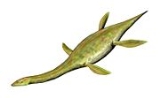
Sauropterygia ("lizard
Lizard

Lizards are a large and widespread group of squamate reptiles, with nearly 5,000 species, ranging across all continents except Antarctica as well as most oceanic island chains....
 flipper
Flipper

Flipper may refer to:In entertainment:*Film and television series featuring the intelligent bottlenose dolphin named Flipper:**Flipper , directed by James B....
s") is a group of very successful aquatic reptile
Reptile

Reptiles, or members of the class Reptilia, are air-breathing, cold-blooded vertebrates that have skin covered in scale as opposed to hair or feathers....
s that flourished during the Age of the Dinosaurs
Mesozoic

The Mesozoic Era is one of three Geologic time scale of the Phanerozoic eon . The division of time into eras dates back to Giovanni Arduino, in the 18th century, although his original name for the era now called the 'Mesozoic' was 'Secondary' ....
 before they became extinct. They are united by a radical adaptation of their shoulder
Shoulder

In human anatomy, the shoulder joint comprises the part of the body where the humerus attaches to the scapula. The shoulder refers to the group of structures in the region of the joint....
, designed to support powerful flipper strokes. Some later sauropterygians like the pliosaur
Pliosaur

The Pliosaurs were Marine reptiles from the Jurassic and Cretaceous Period . They originally included members of the family Pliosauridae, of the Order Plesiosauria, but several other genera and families are now also included; the number and details of which vary according to the classification used....
s developed a similar mechanism in their pelvis
Pelvis

The pelvis or pelvic girdle is the irregular bone structure located at the base of the spine . In the adult human, it is formed by the sacrum and the coccyx, the caudal part of the axial skeleton, and a pair of hip bones, part of the appendicular skeleton or human leg....
.

earliest sauropterygians appeared about 245 million years ago (Ma), at the start of the Triassic
Triassic

The Triassic is a geologic period that extends from about 251 to 199 annum . As the first period of the Mesozoic Era, the Triassic follows the Permian and is followed by the Jurassic....
 period.


Discussion
Ask a question about 'Sauropterygia'
Start a new discussion about 'Sauropterygia'
Answer questions from other users
Full Discussion Forum


Encyclopedia


Sauropterygia ("lizard
Lizard

Lizards are a large and widespread group of squamate reptiles, with nearly 5,000 species, ranging across all continents except Antarctica as well as most oceanic island chains....
 flipper
Flipper

Flipper may refer to:In entertainment:*Film and television series featuring the intelligent bottlenose dolphin named Flipper:**Flipper , directed by James B....
s") is a group of very successful aquatic reptile
Reptile

Reptiles, or members of the class Reptilia, are air-breathing, cold-blooded vertebrates that have skin covered in scale as opposed to hair or feathers....
s that flourished during the Age of the Dinosaurs
Mesozoic

The Mesozoic Era is one of three Geologic time scale of the Phanerozoic eon . The division of time into eras dates back to Giovanni Arduino, in the 18th century, although his original name for the era now called the 'Mesozoic' was 'Secondary' ....
 before they became extinct. They are united by a radical adaptation of their shoulder
Shoulder

In human anatomy, the shoulder joint comprises the part of the body where the humerus attaches to the scapula. The shoulder refers to the group of structures in the region of the joint....
, designed to support powerful flipper strokes. Some later sauropterygians like the pliosaur
Pliosaur

The Pliosaurs were Marine reptiles from the Jurassic and Cretaceous Period . They originally included members of the family Pliosauridae, of the Order Plesiosauria, but several other genera and families are now also included; the number and details of which vary according to the classification used....
s developed a similar mechanism in their pelvis
Pelvis

The pelvis or pelvic girdle is the irregular bone structure located at the base of the spine . In the adult human, it is formed by the sacrum and the coccyx, the caudal part of the axial skeleton, and a pair of hip bones, part of the appendicular skeleton or human leg....
.

Origins and evolution

The earliest sauropterygians appeared about 245 million years ago (Ma), at the start of the Triassic
Triassic

The Triassic is a geologic period that extends from about 251 to 199 annum . As the first period of the Mesozoic Era, the Triassic follows the Permian and is followed by the Jurassic....
 period. Early examples were small (around 60 cm), semi-aquatic lizard-like animals with long limbs (pachypleurosaur
Pachypleurosaur

Pachypleurosaurs were primitive sauropterygian reptiles that vaguely resembled aquatic lizards, and were limited to the Triassic period. They were elongate animals, ranging in size from 20 cm to about a meter in length, with small heads, long necks, paddle-like limbs, and long deep tails....
s), but they quickly grew to be several meters long and spread into shallow waters (nothosaur
Nothosaur

Nothosaurs were Triassic marine sauropterygian reptiles that may have lived like pinniped of today, catching food in water but coming ashore on rocks and beaches....
s). The Triassic-Jurassic extinction event
Triassic-Jurassic extinction event

The Triassic?Jurassic extinction event marks the boundary between the Triassic and Jurassic periods, , and is one of the major extinction events of the Phanerozoic eon, profoundly affecting life on land and in the oceans....
 wiped them all out except for the plesiosaur
Plesiosaur

Plesiosaurs were carnivore aquatic reptiles. After their discovery, they were somewhat fancifully said to have resembled , although they had no shell....
s. During the Early Jurassic
Early Jurassic

The Early Jurassic epoch is the earliest of three epochs of the Jurassic period. The Early Jurassic starts immediately after the Triassic-Jurassic extinction event and ends at the start of the Middle Jurassic ....
 these diversified quickly into both long-necked small-headed plesiosaurs proper, and short-necked large-headed pliosaur
Pliosaur

The Pliosaurs were Marine reptiles from the Jurassic and Cretaceous Period . They originally included members of the family Pliosauridae, of the Order Plesiosauria, but several other genera and families are now also included; the number and details of which vary according to the classification used....
s. Originally it was thought that Plesiosaurs and Pliosaurs were two distinct superfamilies that followed separate evolutionary paths. It now seems that these were simply morphotypes in that both types evolved a number of times, with some pliosaurs evolving from plesiosaur ancestors, and vice-versa.

Size and ecology

Each morphotype filled a specific ecological role. The large pliosaurs, like the Jurassic
Jurassic

The Jurassic is a geologic period that extends from about annum to  Ma, that is, from the end of the Triassic to the beginning of the Cretaceous....
 Rhomaleosaurus
Rhomaleosaurus

Rhomaleosaurus is an extinct genus of sauropterygian reptile belonging to the pliosaur superfamily. It was about long and lived in the Early Jurassic Period....
, Liopleurodon
Liopleurodon

'Liopleurodon' is a genus of large, Carnivore marine reptile belonging to the Pliosauroidea, a clade of short-necked plesiosaurs. Two species of Liopleurodon lived during the Callovian stage of the Middle Jurassic Period , while the third, L....
 and Pliosaurus
Pliosaurus

Pliosaurus is a genus of extinct marine reptiles, from the Mesozoic era. It is included in the family Pliosauridae. It was a large predatory reptile and its diet would have included fishes, squids and other marine reptiles....
, and the Cretaceous
Cretaceous

The Cretaceous , usually abbreviated K for its German translation Kreide, is a geologic period from circa to million years ago . In the geologic timescale, the Cretaceous follows on the Jurassic period and is followed by the Paleogene period....
 Kronosaurus
Kronosaurus

Kronosaurus is an extinct genus of short-necked pliosaur. It was among the largest pliosaurs, and is appropriately named after the leader of the Titan , Cronus....
 and Brachauchenius
Brachauchenius

Brachauchenius is an extinct genus of pliosaur that lived in America during the Cretaceous.The type species, Brachauchenius lucasi, lived in the Western Inland Sea of North America around 93.5-89.3 million years ago, during the Turonian stage of the Cretaceous....
, were the superpredators of the Mesozoic seas, around 7 to 12 meters in length, and filled a similar ecological role to that of killer whales today. The long-necked plesiosaurs, meanwhile, included both those with medium-long necks, like the 3 to 5 meter-long Plesiosauridae and the Cryptoclididae
Cryptoclididae

Cryptoclididae is a family of medium size plesiosaurs from the Middle Jurassic to the Late Cretaceous....
, and the Jurassic and Cretaceous Elasmosauridae
Elasmosauridae

Elasmosauridae was the family of plesiosaurs. They had the longest necks of the plesiosaurs and survived from the Early Jurassic to the end of the Cretaceous....
, which evolved progressively longer and more flexible necks, so that by the middle and late Cretaceous the entire animal was over 13 meters in length (e.g. Elasmosaurus
Elasmosaurus

Elasmosaurus Greek language e?as???/elasmos = thin plate + sa????/sauros = lizard) is a genus of plesiosaur with an extremely long neck that lived in the Late Cretaceous....
), although as most of this was the neck, the actual body size was much smaller than that of the larger pliosaurs. These long-necked forms undoubtedly fed on fish, which they probably snared in their tooth-lined jaws with rapid lunges of the neck and head.

Extinction

The sauropterygians thrived throughout the Mesozoic
Mesozoic

The Mesozoic Era is one of three Geologic time scale of the Phanerozoic eon . The division of time into eras dates back to Giovanni Arduino, in the 18th century, although his original name for the era now called the 'Mesozoic' was 'Secondary' ....
. However, despite their success they became extinct along with the non-avian dinosaurs
Dinosaur

Dinosaurs were the dominant vertebrate animals of Landform ecosystems for over 160 million years, from the late Triassic Period until the end of the Cretaceous Period , when most of them became extinct in the Cretaceous?Tertiary extinction event....
, pterosaurs
Pterosaur

Pterosaurs were flying reptiles of the clade or Order Pterosauria. They existed from the late Triassic to the end of the Cretaceous Period . Pterosaurs are the earliest vertebrates known to have evolved powered flight....
 and mosasaurs
Mosasaur

Mosasaurs were serpentine marine reptiles. The first fossil remains were discovered in a limestone quarry at Maastricht on the Meuse in 1778. These ferocious marine predators are now considered to be the closest relatives of snakes, due to cladistic analysis of symptomatic similarities in jaw and skull anatomies....
 during the end Cretaceous mass extinction.

Taxonomy

Classification
Scientific classification

Biological classification or scientific classification in biology, is a method by which biologists group and categorize species of organisms....
 is difficult because the demands of the aquatic environment caused the same characteristics to evolve multiple times, illustrating convergent evolution
Convergent evolution

Convergent evolution describes the acquisition of the same biological trait in unrelated lineages.The wing is a classic example of convergent evolution in action....
. While sauropterygians are considered diapsid
Diapsid

Diapsids are a group of reptiles that developed two holes in each side of their skulls, about 300 million years ago during the late Carboniferous period....
s, they are also sometimes classified with turtle
Turtle

Turtles are reptiles of the Order Testudines , most of whose body is shielded by a special bone or cartilage animal shell developed from their ribs....
s. The bulky-bodied, mollusc-eating placodont
Placodont

Placodonts were a group of marine reptiles that lived during the Triassic period, becoming extinct at the end of the period. It is believed that they were related to the Sauropterygia, the group that includes Plesiosaurs....
s may also be sauropterygians. In addition to the modifications of the shoulder, the group is also united by several modifications in their skull
Skull

The skull is a bone structure found in the head of many animals. The skull supports the structures of the face and protects the head against injury....
s.

  • Class Reptilia (alternatively Sauropsida
    Sauropsida

    Sauropsida is a group of amniotes that includes reptiles, dinosaurs, and birds. Among amniotes, sauropsida is distinguished from theropsida , also called synapsids....
    )
    • Infraclass Lepidosauromorpha
      Lepidosauromorpha

      Lepidosauromorpha is a group of reptiles comprising all diapsids closer to lizards than to archosaurs . The only living sub-group is the Lepidosauria: extant lizards, snakes, and tuatara....
       (lizard
      Lizard

      Lizards are a large and widespread group of squamate reptiles, with nearly 5,000 species, ranging across all continents except Antarctica as well as most oceanic island chains....
      s and relatives)
      • SUPERORDER SAUROPTERYGIA
        • Order Thalattosauriformes
          • Suborder Thalattosauria
        • Order Placodontia
          Placodont

          Placodonts were a group of marine reptiles that lived during the Triassic period, becoming extinct at the end of the period. It is believed that they were related to the Sauropterygia, the group that includes Plesiosaurs....
        • (unranked) Eusauropterygia
          • Order Nothosauroidea
            Nothosaur

            Nothosaurs were Triassic marine sauropterygian reptiles that may have lived like pinniped of today, catching food in water but coming ashore on rocks and beaches....
            • Suborder Pachypleurosauria
              Pachypleurosaur

              Pachypleurosaurs were primitive sauropterygian reptiles that vaguely resembled aquatic lizards, and were limited to the Triassic period. They were elongate animals, ranging in size from 20 cm to about a meter in length, with small heads, long necks, paddle-like limbs, and long deep tails....
            • Suborder Nothosauria
              Nothosaur

              Nothosaurs were Triassic marine sauropterygian reptiles that may have lived like pinniped of today, catching food in water but coming ashore on rocks and beaches....
          • (unranked) Pistosauroidea
            • Corosaurus
            • Chinchenia
              Chinchenia

              is an extinct genus of plesiosaur.See also* List of plesiosaursReferences...
            • Kwangsisaurus
            • Cymatosaurus
              Cymatosaurus

              is an extinct genus of plesiosaur.See also* List of plesiosaursReferences...
            • Family Pistosauridae
            • Order Plesiosauria
              Plesiosauria

              Plesiosauria are an Order of Mesozoic marine reptiles. They first appeared in the middle Triassic Period and became especially common during the Jurassic Period, thriving until the Cretaceous-Tertiary extinction event at the end of the Cretaceous Period....
              • Suborder Plesiosauroidea
                Plesiosaur

                Plesiosaurs were carnivore aquatic reptiles. After their discovery, they were somewhat fancifully said to have resembled , although they had no shell....
                 (long-necked plesiosaurs)
              • Suborder Pliosauroidea
                Pliosaur

                The Pliosaurs were Marine reptiles from the Jurassic and Cretaceous Period . They originally included members of the family Pliosauridae, of the Order Plesiosauria, but several other genera and families are now also included; the number and details of which vary according to the classification used....
                 (short-necked plesiosaurs)


External links

  • . Palaeos. July 15, 2003. Retrieved January 19, 2004.
  • . Adam Stuart Smith. The Plesiosaur Directory. Retrieved April 17, 2006.
  • - lists every species and synonyms. Retrieved February 26, 2006