

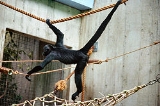
Spider monkey

Encyclopedia
Spider monkeys of the genus
Ateles are New World monkey
s in the subfamily Atelinae
, family Atelidae
. Like other atelines, they are found in tropical forests of Central and South America, from southern Mexico
to Brazil
. The genus contains seven species, all of which are under threat; the Black-headed Spider Monkey
and Brown Spider Monkey
are critically endangered.
The disproportionately long limbs and long prehensile tail
makes them one of the largest New World monkeys and gives rise to their common name. Spider monkeys live in the upper layers of the rainforest and forage
in the high canopy, from 25 to 30 m (82 to 98.4 ft). They primarily eat fruits, but will also occasionally consume leaves, flowers, and insects. Due to their large size, spider monkeys require large tracts of moist evergreen forests and prefer undisturbed primary rainforest. They are social animals and live in bands of up to 35 individuals but will split up to forage during the day.
Recent meta-analyses
on primate cognition studies indicated that spider monkeys are the most intelligent New World monkey
s. They can produce a wide range of sounds and will 'bark' when threatened, other vocalisations include a whinny similar to a horse and prolonged screams.
They are an important food source due to their large size and are widely hunted by local human populations; they are also threatened by habitat destruction
due to logging and land clearing. Spider monkeys are susceptible to malaria and are used in laboratory studies of the disease. The population trend for spider monkeys is decreasing; the IUCN Red List
lists one species as vulnerable
, four species as endangered
and two species as critically endangered.
; one theory is that spider monkeys are most closely related to the woolly spider monkeys (Bractyteles), and most likely split from the woolly monkeys (Lagothrix and Oreonax) in the South American lowland forest, to evolve their unique locomotory system. This theory is not supported by fossil evidence. Other theories include Brachyteles, Lagothrix and Ateles in a non-resolved trichotomy
, and two clades, one composed of Ateles and Lagothrix and the other of Alouatta and Brachyteles. More recent molecular evidence suggests that Atelinae split in the middle to late Miocene
(13 Ma), separating spider monkeys from the woolly spider monkeys and the woolly monkeys.
s, the largest spider monkey, have an average weight of 10.8 kg (23.8 lb) for males and 9.66 kg (21.3 lb) for females. Disproportionately long, spindly limbs inspired the spider monkey's common name
. Their deftly prehensile tail
s, which may be up to 89 cm (35 in) long, have very flexible, hairless tips and skin grooves similar to fingerprint
s. This adaptation to the spider monkey's strictly arboreal lifestyle serves as a fifth hand. When the monkey walks, its arms practically drag on the ground. Unlike many monkeys, they do not use their arms for balance when walking, instead relying on their tail. The hands are long, narrow and hook like, and have reduced thumbs. The fingers are elongated and recurved.
The hair is coarse, ranging in color from ruddy gold to brown and black; the hands and feet are usually black. Heads are small with hairless faces. The nostril
s are very far apart, which is a distinguishing feature of spider monkeys.
Spider monkeys are highly agile, and they are said to be second only to the gibbon
s in this respect.
.jpg) Spider monkeys form loose groups of 15 to 25 animals. During the day, groups break up into subgroups of 2 to 8 animals. This social structure ('fission-fusion
Spider monkeys form loose groups of 15 to 25 animals. During the day, groups break up into subgroups of 2 to 8 animals. This social structure ('fission-fusion
') is found in only two other types of primate
s, chimpanzee
s and Homo sapiens. The size of subgroups and the degree to which they avoid each other during the day depends on food competition and the risk of predation. The average subgroup size is less than four animals. Also less common in primates, females rather than males disperse at puberty
to join new groups. Males tend to stick together for their whole life. Hence males in a group are more likely to be related and have closer bonds than females. The strongest social bonds are formed between females and their young offspring.
Spider monkeys communicate their intentions and observations using postures and stances, such as postures of sexual receptivity and of attack. When a spider monkey sees a human approaching, it barks loudly similar to a dog. When a monkey is approached, it climbs to the end of the branch it is on and shakes it vigorously to scare away the possible threat. It shakes the branches with its feet, hands, or a combination while hanging from its tail. It may also scratch its limbs or body with various parts of its hands and feet. Seated monkeys may sway and make noise. Males and occasionally adult females growl menacingly at the approach of a human. If the pursuer continues to advance, the monkeys often break off live or dead tree limb weighing up to 4 kg and drop them towards the intruder. They do not actually throw the branches, but twist to cause the branch to fall closer to the threat. The natives of the area know very well of this risk. The monkeys also defecate and urinate toward the intruder.
Spider monkeys are diurnal
and spend the night sleeping in carefully selected tree
s. Groups are thought to be directed by a lead female who is responsible for planning an efficient feeding route each day. Grooming
is not as important to social interaction, owing perhaps to a lack of thumbs.
Spider monkeys have been observed avoiding the upper canopy of the trees for locomotion. One researcher speculated that this was because the thin branches at the tops of trees do not support the monkeys as well.
At 107 grams, the spider monkey brain
is twice the size of a howler monkey
brain of equivalent body size; this is thought to be a result of the spider monkeys' complex social system and their frugivorous diet, which consists primarily of ripe fruit from a wide variety (over 150 species) of plants. This requires the monkeys to remember when and where fruit can be found. The slow development may also play a role: the monkeys may live 20 years or more, and females give birth once every 3 to 4 years.
s and nut
s. They can live for long periods on only one or two kinds of fruits and nuts. They eat the fruits of many big forest trees, and because they swallow fruits whole, the seed
s are eventually excreted and fertilized
by the feces
. Studies show the diet of spider monkeys changes their reproductive, social, and physical behavioral patterns. Most feeding happens from dawn to 10 am. Afterward, the adults rest while the young play. Through the rest of the day they may feed infrequently until around 10 pm. If food is low they may eat insects, bark
and honey
.
Spider monkeys have a unique way of getting food: a lead female is generally responsible for finding food sources. If she cannot find enough food for the group, it splits into smaller groups that forage separately. The traveling groups have four to nine animals. Each group is closely associated with its territory. If the group is big, it spreads out.
period ranges from 226 to 232 days. Each female bears only one offspring on average, every 3 to 4 years.
Until six to ten months, infants rely completely on their mother. Males are not involved in raising the offspring.
A mother carries her infant around her belly for the first month after birth. After this she carries it on her lower back. The infant wraps its tail around its mother’s and tightly grabs her midsection. Mothers are very protective of their young and are generally attentive mothers. They have been seen grabbing their young and putting them on their backs for protection and to help them navigate from tree to tree. They help the more independent young to cross by pulling branches closer together. Mothers also groom their young.
Genus
In biology, a genus is a low-level taxonomic rank used in the biological classification of living and fossil organisms, which is an example of definition by genus and differentia...
Ateles are New World monkey
New World monkey
New World monkeys are the five families of primates that are found in Central and South America: Callitrichidae, Cebidae, Aotidae, Pitheciidae, and Atelidae. The five families are ranked together as the Platyrrhini parvorder and the Ceboidea superfamily, which are essentially synonymous since...
s in the subfamily Atelinae
Atelinae
Atelinae is a subfamily of New World monkeys in the family Atelidae, and includes the various spider and woolly monkeys. The primary distinguishing feature of the atelines is their long prehensile tail which can support their entire body weight....
, family Atelidae
Atelidae
Atelidae is one of the five families of New World monkeys now recognised. It was formerly included in the family Cebidae. Atelids are generally larger monkeys; the family includes the howler, spider, woolly and woolly spider monkeys...
. Like other atelines, they are found in tropical forests of Central and South America, from southern Mexico
Mexico
The United Mexican States , commonly known as Mexico , is a federal constitutional republic in North America. It is bordered on the north by the United States; on the south and west by the Pacific Ocean; on the southeast by Guatemala, Belize, and the Caribbean Sea; and on the east by the Gulf of...
to Brazil
Brazil
Brazil , officially the Federative Republic of Brazil , is the largest country in South America. It is the world's fifth largest country, both by geographical area and by population with over 192 million people...
. The genus contains seven species, all of which are under threat; the Black-headed Spider Monkey
Black-headed Spider Monkey
The Black-headed spider monkey, Ateles fusciceps, is a species of spider monkey, a type of New World monkey, from Central and South America. It is found in Colombia, Nicaragua and Panama. Although primatologists such as Colin Groves follow Kellogg and Goldman in treating A...
and Brown Spider Monkey
Brown Spider Monkey
The brown spider monkey or variegated spider monkey is a critically endangered species of spider monkey, a type of New World monkey, from northern Colombia and north-western Venezuela. Its taxonomic history has been confusing, and in the past it has been treated as a subspecies of either the...
are critically endangered.
The disproportionately long limbs and long prehensile tail
Prehensile tail
A prehensile tail is the tail of an animal that has adapted to be able to grasp and/or hold objects. Fully prehensile tails can be used to hold and manipulate objects, and in particular to aid arboreal creatures in finding and eating food in the trees...
makes them one of the largest New World monkeys and gives rise to their common name. Spider monkeys live in the upper layers of the rainforest and forage
Forage
Forage is plant material eaten by grazing livestock.Historically the term forage has meant only plants eaten by the animals directly as pasture, crop residue, or immature cereal crops, but it is also used more loosely to include similar plants cut for fodder and carried to the animals, especially...
in the high canopy, from 25 to 30 m (82 to 98.4 ft). They primarily eat fruits, but will also occasionally consume leaves, flowers, and insects. Due to their large size, spider monkeys require large tracts of moist evergreen forests and prefer undisturbed primary rainforest. They are social animals and live in bands of up to 35 individuals but will split up to forage during the day.
Recent meta-analyses
Meta-analysis
In statistics, a meta-analysis combines the results of several studies that address a set of related research hypotheses. In its simplest form, this is normally by identification of a common measure of effect size, for which a weighted average might be the output of a meta-analyses. Here the...
on primate cognition studies indicated that spider monkeys are the most intelligent New World monkey
New World monkey
New World monkeys are the five families of primates that are found in Central and South America: Callitrichidae, Cebidae, Aotidae, Pitheciidae, and Atelidae. The five families are ranked together as the Platyrrhini parvorder and the Ceboidea superfamily, which are essentially synonymous since...
s. They can produce a wide range of sounds and will 'bark' when threatened, other vocalisations include a whinny similar to a horse and prolonged screams.
They are an important food source due to their large size and are widely hunted by local human populations; they are also threatened by habitat destruction
Habitat destruction
Habitat destruction is the process in which natural habitat is rendered functionally unable to support the species present. In this process, the organisms that previously used the site are displaced or destroyed, reducing biodiversity. Habitat destruction by human activity mainly for the purpose of...
due to logging and land clearing. Spider monkeys are susceptible to malaria and are used in laboratory studies of the disease. The population trend for spider monkeys is decreasing; the IUCN Red List
IUCN Red List
The IUCN Red List of Threatened Species , founded in 1963, is the world's most comprehensive inventory of the global conservation status of biological species. The International Union for Conservation of Nature is the world's main authority on the conservation status of species...
lists one species as vulnerable
Vulnerable species
On 30 January 2010, the IUCN Red List of Threatened Species identified 9694 Vulnerable species, subspecies and varieties, stocks and sub-populations.-References:...
, four species as endangered
Endangered species
An endangered species is a population of organisms which is at risk of becoming extinct because it is either few in numbers, or threatened by changing environmental or predation parameters...
and two species as critically endangered.
Evolutionary history
There are many theories about the evolution of the atelinesAtelinae
Atelinae is a subfamily of New World monkeys in the family Atelidae, and includes the various spider and woolly monkeys. The primary distinguishing feature of the atelines is their long prehensile tail which can support their entire body weight....
; one theory is that spider monkeys are most closely related to the woolly spider monkeys (Bractyteles), and most likely split from the woolly monkeys (Lagothrix and Oreonax) in the South American lowland forest, to evolve their unique locomotory system. This theory is not supported by fossil evidence. Other theories include Brachyteles, Lagothrix and Ateles in a non-resolved trichotomy
Speciation
Speciation is the evolutionary process by which new biological species arise. The biologist Orator F. Cook seems to have been the first to coin the term 'speciation' for the splitting of lineages or 'cladogenesis,' as opposed to 'anagenesis' or 'phyletic evolution' occurring within lineages...
, and two clades, one composed of Ateles and Lagothrix and the other of Alouatta and Brachyteles. More recent molecular evidence suggests that Atelinae split in the middle to late Miocene
Miocene
The Miocene is a geological epoch of the Neogene Period and extends from about . The Miocene was named by Sir Charles Lyell. Its name comes from the Greek words and and means "less recent" because it has 18% fewer modern sea invertebrates than the Pliocene. The Miocene follows the Oligocene...
(13 Ma), separating spider monkeys from the woolly spider monkeys and the woolly monkeys.
Taxonomic classification
The genus contains seven species, and seven subspecies.- Family AtelidaeAtelidaeAtelidae is one of the five families of New World monkeys now recognised. It was formerly included in the family Cebidae. Atelids are generally larger monkeys; the family includes the howler, spider, woolly and woolly spider monkeys...
- Subfamily AlouattinaeHowler monkeyHowler monkeys are among the largest of the New World monkeys. Fifteen species are currently recognised. Previously classified in the family Cebidae, they are now placed in the family Atelidae. These monkeys are native to South and Central American forests...
: howler monkeys - Subfamily AtelinaeAtelinaeAtelinae is a subfamily of New World monkeys in the family Atelidae, and includes the various spider and woolly monkeys. The primary distinguishing feature of the atelines is their long prehensile tail which can support their entire body weight....
- Genus Ateles: spider monkeys
- Red-faced Spider MonkeyRed-faced Spider MonkeyThe red-faced spider monkey, Guiana spider monkey, or red-faced black spider monkey, Ateles paniscus, is a species of spider monkey found in the rain forests in northern South America....
, Ateles paniscus - White-fronted Spider MonkeyWhite-fronted Spider MonkeyThe white-fronted spider monkey , also known as the long-haired or white-bellied spider monkey, is an endangered species of spider monkey, a type of New World monkey. It is found in the north-western Amazon in Colombia, Ecuador, Venezuela, Peru and Brazil, ranging as far south as the lower Ucayali...
, Ateles belzebuth - Peruvian Spider MonkeyPeruvian Spider MonkeyThe Peruvian spider monkey is a species of spider monkey that lives not only in Peru, but also in Brazil and Bolivia. At two feet long, they are relatively large among species of monkey, and their strong, prehensile tails can be up to three feet long. Unlike many species of monkey, they have...
, Ateles chamek - Brown Spider MonkeyBrown Spider MonkeyThe brown spider monkey or variegated spider monkey is a critically endangered species of spider monkey, a type of New World monkey, from northern Colombia and north-western Venezuela. Its taxonomic history has been confusing, and in the past it has been treated as a subspecies of either the...
, Ateles hybridus - White-cheeked Spider MonkeyWhite-cheeked Spider MonkeyThe white-cheeked spider monkey, Ateles marginatus, is a species of spider monkey, a type of New World monkey, endemic to Brazil.There are many different varieties of spider monkeys that make their home in the upper levels of the rain forest...
, Ateles marginatus - Black-headed Spider MonkeyBlack-headed Spider MonkeyThe Black-headed spider monkey, Ateles fusciceps, is a species of spider monkey, a type of New World monkey, from Central and South America. It is found in Colombia, Nicaragua and Panama. Although primatologists such as Colin Groves follow Kellogg and Goldman in treating A...
, Ateles fusciceps- Brown-headed Spider MonkeyBrown-headed Spider MonkeyThe Brown-headed spider monkey , is a subspecies of the Black-headed spider monkey, a type of New World monkey, found in Ecuador. Its type locality is at 1500 m in the Hacienda Chinipamba, Imbabura Province in North-West Ecuador...
, Ateles fusciceps fusciceps - Colombian Spider MonkeyColombian Spider MonkeyThe Colombian spider monkey , is a subspecies of the Black-headed spider monkey, a type of New World monkey, found in Colombia and Panama...
, Ateles fusciceps rufiventris
- Brown-headed Spider Monkey
- Geoffroy's Spider MonkeyGeoffroy's Spider MonkeyGeoffroy's spider monkey, Ateles geoffroyi, also known as black-handed spider monkey, is a species of spider monkey, a type of New World monkey, from Central America, parts of Mexico and possibly a small portion of Colombia. There are at least five subspecies. Some primatologists classify the...
, Ateles geoffroyi- Yucatan Spider MonkeyYucatan Spider MonkeyThe Yucatan spider monkey , is a subspecies of Geoffroy's spider monkey, a type of New World monkey, from Mexico, Guatemala and Belize. It has paler fur than the Mexican Spider Monkey....
, Ateles geoffroyi yucatanensis - Mexican Spider MonkeyMexican Spider MonkeyThe Mexican spider monkey , is a subspecies of Geoffroy's spider monkey, a type of New World monkey, from Mexico and Central America, native to Mexico, Guatemala, Honduras, Nicaragua and El Salvador....
, Ateles geoffroyi vellerosus - Nicaraguan Spider Monkey, Ateles geoffroyi geoffroyi
- Ornate Spider MonkeyOrnate Spider MonkeyThe ornate spider monkey , is a subspecies of Geoffroy's spider monkey, a type of New World monkey, from Central America, native to Costa Rica and Panama...
, Ateles geoffroyi ornatus - Hooded Spider MonkeyHooded Spider MonkeyThe hooded spider monkey , is a subspecies of Geoffroy's spider monkey, a type of New World monkey, from Central America, native to Panama. It also might be found in a small portion of Colombia adjacent to Panama. In western Colombia and northeast Panama it is replaced by the Black-headed spider...
, Ateles geoffroyi grisescens
- Yucatan Spider Monkey
- Red-faced Spider Monkey
- Genus Brachyteles: woolly spider monkeys
- Genus Lagothrix: woolly monkeys
- Genus OreonaxYellow-tailed Woolly MonkeyThe yellow-tailed woolly monkey is a New World monkey endemic to Peru. It is a rare primate species found only in the Peruvian Andes, in the departments of Amazonas and San Martin as well as bordering areas of La Libertad, Huanuco and Loreto...
: the Yellow-tailed Woolly Monkey
- Genus Ateles: spider monkeys
- Subfamily Alouattinae
Anatomy and physiology
Spider monkeys are among the largest New World monkeys; Black-headed Spider MonkeyBlack-headed Spider Monkey
The Black-headed spider monkey, Ateles fusciceps, is a species of spider monkey, a type of New World monkey, from Central and South America. It is found in Colombia, Nicaragua and Panama. Although primatologists such as Colin Groves follow Kellogg and Goldman in treating A...
s, the largest spider monkey, have an average weight of 10.8 kg (23.8 lb) for males and 9.66 kg (21.3 lb) for females. Disproportionately long, spindly limbs inspired the spider monkey's common name
Common name
A common name of a taxon or organism is a name in general use within a community; it is often contrasted with the scientific name for the same organism...
. Their deftly prehensile tail
Prehensile tail
A prehensile tail is the tail of an animal that has adapted to be able to grasp and/or hold objects. Fully prehensile tails can be used to hold and manipulate objects, and in particular to aid arboreal creatures in finding and eating food in the trees...
s, which may be up to 89 cm (35 in) long, have very flexible, hairless tips and skin grooves similar to fingerprint
Fingerprint
A fingerprint in its narrow sense is an impression left by the friction ridges of a human finger. In a wider use of the term, fingerprints are the traces of an impression from the friction ridges of any part of a human hand. A print from the foot can also leave an impression of friction ridges...
s. This adaptation to the spider monkey's strictly arboreal lifestyle serves as a fifth hand. When the monkey walks, its arms practically drag on the ground. Unlike many monkeys, they do not use their arms for balance when walking, instead relying on their tail. The hands are long, narrow and hook like, and have reduced thumbs. The fingers are elongated and recurved.
The hair is coarse, ranging in color from ruddy gold to brown and black; the hands and feet are usually black. Heads are small with hairless faces. The nostril
Nostril
A nostril is one of the two channels of the nose, from the point where they bifurcate to the external opening. In birds and mammals, they contain branched bones or cartilages called turbinates, whose function is to warm air on inhalation and remove moisture on exhalation...
s are very far apart, which is a distinguishing feature of spider monkeys.
Spider monkeys are highly agile, and they are said to be second only to the gibbon
Gibbon
Gibbons are apes in the family Hylobatidae . The family is divided into four genera based on their diploid chromosome number: Hylobates , Hoolock , Nomascus , and Symphalangus . The extinct Bunopithecus sericus is a gibbon or gibbon-like ape which, until recently, was thought to be closely related...
s in this respect.
Behavior
Fission-fusion society
In primatology, a fission-fusion society is one in which the social group, e.g. bonobo collectives of 100-strong, sleep in one locality together, but forage in small groups going off in different directions during the day. This form of social organization occurs in several other species of...
') is found in only two other types of primate
Primate
A primate is a mammal of the order Primates , which contains prosimians and simians. Primates arose from ancestors that lived in the trees of tropical forests; many primate characteristics represent adaptations to life in this challenging three-dimensional environment...
s, chimpanzee
Chimpanzee
Chimpanzee, sometimes colloquially chimp, is the common name for the two extant species of ape in the genus Pan. The Congo River forms the boundary between the native habitat of the two species:...
s and Homo sapiens. The size of subgroups and the degree to which they avoid each other during the day depends on food competition and the risk of predation. The average subgroup size is less than four animals. Also less common in primates, females rather than males disperse at puberty
Puberty
Puberty is the process of physical changes by which a child's body matures into an adult body capable of reproduction, as initiated by hormonal signals from the brain to the gonads; the ovaries in a girl, the testes in a boy...
to join new groups. Males tend to stick together for their whole life. Hence males in a group are more likely to be related and have closer bonds than females. The strongest social bonds are formed between females and their young offspring.
Spider monkeys communicate their intentions and observations using postures and stances, such as postures of sexual receptivity and of attack. When a spider monkey sees a human approaching, it barks loudly similar to a dog. When a monkey is approached, it climbs to the end of the branch it is on and shakes it vigorously to scare away the possible threat. It shakes the branches with its feet, hands, or a combination while hanging from its tail. It may also scratch its limbs or body with various parts of its hands and feet. Seated monkeys may sway and make noise. Males and occasionally adult females growl menacingly at the approach of a human. If the pursuer continues to advance, the monkeys often break off live or dead tree limb weighing up to 4 kg and drop them towards the intruder. They do not actually throw the branches, but twist to cause the branch to fall closer to the threat. The natives of the area know very well of this risk. The monkeys also defecate and urinate toward the intruder.
Spider monkeys are diurnal
Diurnal animal
Diurnality is a plant or animal behavior characterized by activity during the day and sleeping at night.-In animals:Animals that are not diurnal might be nocturnal or crepuscular . Many animal species are diurnal, including many mammals, insects, reptiles and birds...
and spend the night sleeping in carefully selected tree
Tree
A tree is a perennial woody plant. It is most often defined as a woody plant that has many secondary branches supported clear of the ground on a single main stem or trunk with clear apical dominance. A minimum height specification at maturity is cited by some authors, varying from 3 m to...
s. Groups are thought to be directed by a lead female who is responsible for planning an efficient feeding route each day. Grooming
Personal grooming
Personal grooming is the art of cleaning, grooming, and maintaining parts of the body. It is a species-typical behavior that is controlled by neural circuits in the brain.- In humans :...
is not as important to social interaction, owing perhaps to a lack of thumbs.
Spider monkeys have been observed avoiding the upper canopy of the trees for locomotion. One researcher speculated that this was because the thin branches at the tops of trees do not support the monkeys as well.
At 107 grams, the spider monkey brain
Brain
The brain is the center of the nervous system in all vertebrate and most invertebrate animals—only a few primitive invertebrates such as sponges, jellyfish, sea squirts and starfishes do not have one. It is located in the head, usually close to primary sensory apparatus such as vision, hearing,...
is twice the size of a howler monkey
Howler monkey
Howler monkeys are among the largest of the New World monkeys. Fifteen species are currently recognised. Previously classified in the family Cebidae, they are now placed in the family Atelidae. These monkeys are native to South and Central American forests...
brain of equivalent body size; this is thought to be a result of the spider monkeys' complex social system and their frugivorous diet, which consists primarily of ripe fruit from a wide variety (over 150 species) of plants. This requires the monkeys to remember when and where fruit can be found. The slow development may also play a role: the monkeys may live 20 years or more, and females give birth once every 3 to 4 years.
Feeding
The diet of spider monkeys consists of about 90% fruitFruit
In broad terms, a fruit is a structure of a plant that contains its seeds.The term has different meanings dependent on context. In non-technical usage, such as food preparation, fruit normally means the fleshy seed-associated structures of certain plants that are sweet and edible in the raw state,...
s and nut
Nut (fruit)
A nut is a hard-shelled fruit of some plants having an indehiscent seed. While a wide variety of dried seeds and fruits are called nuts in English, only a certain number of them are considered by biologists to be true nuts...
s. They can live for long periods on only one or two kinds of fruits and nuts. They eat the fruits of many big forest trees, and because they swallow fruits whole, the seed
Seed
A seed is a small embryonic plant enclosed in a covering called the seed coat, usually with some stored food. It is the product of the ripened ovule of gymnosperm and angiosperm plants which occurs after fertilization and some growth within the mother plant...
s are eventually excreted and fertilized
Fertilizer
Fertilizer is any organic or inorganic material of natural or synthetic origin that is added to a soil to supply one or more plant nutrients essential to the growth of plants. A recent assessment found that about 40 to 60% of crop yields are attributable to commercial fertilizer use...
by the feces
Feces
Feces, faeces, or fæces is a waste product from an animal's digestive tract expelled through the anus or cloaca during defecation.-Etymology:...
. Studies show the diet of spider monkeys changes their reproductive, social, and physical behavioral patterns. Most feeding happens from dawn to 10 am. Afterward, the adults rest while the young play. Through the rest of the day they may feed infrequently until around 10 pm. If food is low they may eat insects, bark
Bark
Bark is the outermost layers of stems and roots of woody plants. Plants with bark include trees, woody vines and shrubs. Bark refers to all the tissues outside of the vascular cambium and is a nontechnical term. It overlays the wood and consists of the inner bark and the outer bark. The inner...
and honey
Honey
Honey is a sweet food made by bees using nectar from flowers. The variety produced by honey bees is the one most commonly referred to and is the type of honey collected by beekeepers and consumed by humans...
.
Spider monkeys have a unique way of getting food: a lead female is generally responsible for finding food sources. If she cannot find enough food for the group, it splits into smaller groups that forage separately. The traveling groups have four to nine animals. Each group is closely associated with its territory. If the group is big, it spreads out.
Reproduction
The female chooses a male from her group with whom to mate. Both males and females sniff their mates to check their readiness for copulation. This process is known as “anogenital sniffing”. The gestationGestation
Gestation is the carrying of an embryo or fetus inside a female viviparous animal. Mammals during pregnancy can have one or more gestations at the same time ....
period ranges from 226 to 232 days. Each female bears only one offspring on average, every 3 to 4 years.
Until six to ten months, infants rely completely on their mother. Males are not involved in raising the offspring.
A mother carries her infant around her belly for the first month after birth. After this she carries it on her lower back. The infant wraps its tail around its mother’s and tightly grabs her midsection. Mothers are very protective of their young and are generally attentive mothers. They have been seen grabbing their young and putting them on their backs for protection and to help them navigate from tree to tree. They help the more independent young to cross by pulling branches closer together. Mothers also groom their young.