
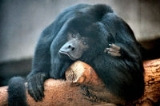
Howler monkeys are among the largest of the
New World monkeyNew World monkeys are the five families of primates that are found in Central and South America: Callitrichidae, Cebidae, Aotidae, Pitheciidae, and Atelidae. The five families are ranked together as the Platyrrhini parvorder and the Ceboidea superfamily, which are essentially synonymous since...
s. Fifteen
speciesIn biology, a species is one of the basic units of biological classification and a taxonomic rank. A species is often defined as a group of organisms capable of interbreeding and producing fertile offspring. While in many cases this definition is adequate, more precise or differing measures are...
are currently recognised. Previously classified in the
familyIn biological classification, family is* a taxonomic rank. Other well-known ranks are life, domain, kingdom, phylum, class, order, genus, and species, with family fitting between order and genus. As for the other well-known ranks, there is the option of an immediately lower rank, indicated by the...
CebidaeThe Cebidae is one of the five families of New World monkeys now recognised. It includes the capuchin monkeys and squirrel monkeys. These species are found throughout tropical and subtropical South and Central America.-Characteristics:...
, they are now placed in the family
AtelidaeAtelidae is one of the five families of New World monkeys now recognised. It was formerly included in the family Cebidae. Atelids are generally larger monkeys; the family includes the howler, spider, woolly and woolly spider monkeys...
. These monkeys are native to
SouthSouth America is a continent situated in the Western Hemisphere, mostly in the Southern Hemisphere, with a relatively small portion in the Northern Hemisphere. The continent is also considered a subcontinent of the Americas. It is bordered on the west by the Pacific Ocean and on the north and east...
and
Central AmericaCentral America is the central geographic region of the Americas. It is the southernmost, isthmian portion of the North American continent, which connects with South America on the southeast. When considered part of the unified continental model, it is considered a subcontinent...
n forests. Threats to howler monkeys include human predation, habitat destruction and being captured for
captivityAnimals that live under human care are in captivity. Captivity can be used as a generalizing term to describe the keeping of either domesticated animals or wild animals. This may include for example farms, private homes and zoos...
as pets or zoo animals.
Classification
- Family Atelidae
Atelidae is one of the five families of New World monkeys now recognised. It was formerly included in the family Cebidae. Atelids are generally larger monkeys; the family includes the howler, spider, woolly and woolly spider monkeys...
- Subfamily Niggroma
- A. palliata group
- Coiba Island Howler
The Coiba Island howler is a species of howler monkey, a type of New World monkey, endemic to Panama. Although the Coiba Island howler is generally recognized as a separate species, mitochondrial DNA testing is inconclusive as to whether it is actually a subspecies of the mantled howler...
, Alouatta coibensis
- Alouatta coibensis coibensis
Alouatta coibensis coibensis is a subspecies of the Coiba Island howler, A. coibensis. This subspecies lives only on Coiba Island and Jicaron, off the Pacific coast of Panama. A. c. coibensis is smaller than other Central American howler monkeys and has duller pelage than the Azuero howler,...
- Azuero Howler, Alouatta coibensis trabeata
- Mantled Howler
The mantled howler , or golden-mantled howling monkey, is a species of howler monkey, a type of New World monkey, from Central and South America. It is one of the monkey species most often seen and heard in the wild in Central America...
, Alouatta palliata
- Ecuadorian Mantled Howler, Alouatta palliata aequatorialis
- Golden-mantled Howler, Alouatta palliata palliata
- Mexican Howler Monkey
The Mexican howler is a subspecies of the mantled howler, A. palliata. Its range includes southeastern Mexico and Guatemala. The Mexican howler is sympatric with the Guatemalan black howler, A. pigra, in Tabasco, Mexico. The Mexican howler differs from the golden-mantled howler, A...
, Alouatta palliata mexicana
- Guatemalan Black Howler
The Guatemalan black howler, or Yucatan black howler, is a species of howler monkey, a type of New World monkey, from Central America. It is found in Belize, Guatemala and Mexico, in and near the Yucatan Peninsula. It lives in evergreen, semi-deciduous and lowland rain forests...
, Alouatta pigra
- A. seniculus group
- Ursine Howler
The Ursine howler is a species of howler monkey native to Venezuela, and possibly Colombia. It is sometimes considered a subspecies of the Venezuelan red howler and classified as Alouatta seniculus arctoidea....
, Alouatta arctoidea
- Red-handed Howler
The red-handed howler is a vulnerable species of howler monkey, a type of New World monkey. It is endemic to Brazil, where found in the south-eastern Amazon and disjunctly in Atlantic Forest between Rio Grande do Norte and Sergipe....
, Alouatta belzebul
- Spix's Red-handed Howler
Spix's red-handed howler is a vulnerable species of howler monkey native to the south-eastern Amazon in Brazil. Major threats include deforestation and hunting...
, Alouatta discolor
- Brown Howler
The Brown howler , also known as Brown howling monkey, is a species of howler monkey, a type of New World monkey, that lives in forests in south-eastern Brazil and far north-eastern Argentina . It lives in groups of 2 to 11 individuals...
, Alouatta guariba
- Northern Brown Howler
The Northern brown howler is the type subspecies of the brown howler, native to Brazil. It is listed as critically endangered, with fewer than 250 individuals restricted to vicinity of the Jequitinhonha River....
, Alouatta guariba guariba
- Southern Brown Howler
The Southern brown howler is a monkey subspecies of brown howler native to coastal Argentina and Brazil....
, Alouatta guariba clamitans
- Juruá Red Howler
The Juruá red howler is a species of howler monkey, native to Peru, Brazil and possibly Colombia....
, Alouatta juara
- Guyanan Red Howler
The Guyanan red howler is a species of howler monkey, a type of New World monkey, native to Suriname, Guyana, Trinidad, French Guiana and Brazil....
, Alouatta macconnelli
- Amazon Black Howler
The Amazon black howler is a species of howler monkey, a type of New World monkey, endemic to the south-central Amazon in Brazil. Until 2001, most authorities included it as a subspecies of the red-handed howler, though its distinction had already been pointed out much earlier...
, Alouatta nigerrima
- Purus Red Howler
The Purus red howler is a species of howler monkey native to Brazil and Peru....
, Alouatta puruensis
- Bolivian Red Howler
The Bolivian red howler is a species of howler monkey, a type of New World monkey, endemic to Bolivia.-External links:* *...
, Alouatta sara
- Venezuelan Red Howler
The Venezuelan red howler is a South American species of howler monkey, a type of New World monkey. It is found in the western Amazon Basin in Venezuela, Colombia, Ecuador, Peru, Bolivia and Brazil...
, Alouatta seniculus
- Maranhão Red-handed Howler
The Maranhão red-handed howler is an endangered species of howler monkey that is endemic to forests in the northeast Brazilian states of Ceará, Maranhão and Piauí. It was previously thought to be a subspecies of the Red-handed Howler, but unlike that species the Maranhão Red-handed Howler is...
, Alouatta ululata
- A. caraya group
- Black Howler
The Black howler is a species of howler monkey, a large New World monkey, from northeast Argentina, east Bolivia, east and south Brazil and Paraguay. Together with the brown howler, it is the southernmost member of the Alouatta genus. Only the adult male is black; adult females and juveniles of...
, Alouatta caraya
- Subfamily Atelinae
Atelinae is a subfamily of New World monkeys in the family Atelidae, and includes the various spider and woolly monkeys. The primary distinguishing feature of the atelines is their long prehensile tail which can support their entire body weight....
Anatomy and physiology
Howler monkeys have a short snout, and wide-set, round nostrils. They range in size from 56 to 92 cm, excluding their tail which can be equally as long. Like many New World monkeys, they have
prehensile tailA prehensile tail is the tail of an animal that has adapted to be able to grasp and/or hold objects. Fully prehensile tails can be used to hold and manipulate objects, and in particular to aid arboreal creatures in finding and eating food in the trees...
s. Unlike other New World monkeys, both male and female howler monkeys have
trichromatTrichromacy or trichromaticism is the condition of possessing three independent channels for conveying color information, derived from the three different cone types...
ic color vision. This has
evolved independentlyThe evolution of color vision in primates is unique compared to most eutherian mammals. A remote vertebrate ancestor of primates possessed tetrachromacy, but nocturnal, warm-blooded, mammalian ancestors lost two of four cones in the retina at the time of dinosaurs...
from other New World monkeys due to
gene duplicationGene duplication is any duplication of a region of DNA that contains a gene; it may occur as an error in homologous recombination, a retrotransposition event, or duplication of an entire chromosome.The second copy of the gene is often free from selective pressure — that is, mutations of it have no...
. They have a lifespan of 15 to 20 years. Howler species are dimorphic and can also be dichromatic (i.e. Alouatta caraya). Males are, on average, 1.5 to 2 kg heavier than females.
The hyoid of Alouatta is
pneumatizedSkeletal pneumaticity is the presence of air spaces within bones. Skeletal pneumaticity exists only in synapsids and archosaurs. It is generally produced during development by excavation of bone by pneumatic diverticula from an air-filled space such as the lungs or nasal cavity...
-- one of the few cases of postcranial pneumaticity outside
SaurischiaSaurischia meaning 'lizard' and ischion meaning 'hip joint') is one of the two orders, or basic divisions, of dinosaurs. In 1888, Harry Seeley classified dinosaurs into two orders, based on their hip structure...
.
Locomotion
Howler monkeys generally move quadrupedally on the tops of branches, usually grasping a branch with at least two hands or one hand and the tail at all times. They have strong
prehensile tailA prehensile tail is the tail of an animal that has adapted to be able to grasp and/or hold objects. Fully prehensile tails can be used to hold and manipulate objects, and in particular to aid arboreal creatures in finding and eating food in the trees...
s which are able to support the monkey's entire body weight. However, fully adult howler monkeys do not often rely on their tail for full body support whereas juveniles do so more frequently.
Social systems
Most howler monkey species live in groups of 10 to 15 animals, with one to three adults males and multiple females. Mantled howlers monkeys (Alouatta palliata) are an exception, commonly living in groups of 15 to 20 individuals with more than three adult males. Unlike most New World monkeys, in which one sex remains in natal groups, juveniles of both sexes emigrate from their natal groups, such that howler monkeys could spend the majority of their adult lives in association with non-kin.
Physical fighting among group members is infrequent and generally of short duration. However, serious injuries can result. Both males and females may fight with each other but physical aggression is even more rare between sexes. Group size varies by species and by location, with an approximate male to female ratio of a male to four females.
Communication
As their name suggests, vocal
communicationAnimal communication is any behavior on the part of one animal that has an effect on the current or future behaviour of another animal. The study of animal communication, is sometimes called Zoosemiotics has played an important part in the...
forms an important part of their
social behaviorIn physics, physiology and sociology, social behavior is behavior directed towards society, or taking place between, members of the same species. Behavior such as predation which involves members of different species is not social...
. They have an enlarged basihyal or
hyoid boneThe hyoid bone is a horseshoe-shaped bone situated in the anterior midline of the neck between the chin and the thyroid cartilage. At rest, it lies at the level of the base of the mandible in the front and the third cervical vertebra behind.Unlike other bones, the hyoid is only distantly...
which helps them make their loud vocalizations. Group males generally call at dawn and dusk as well as interspersed times throughout the day. The main vocals consist of loud, deep guttural growls or "howls." Howler monkeys are widely considered to be the loudest land animal. According to Guinness Book of World Records, their vocalizations can be heard clearly for 20 miles (32.2 km). It is hypothesized that the function of howling relates to intergroup spacing and territory protection, as well as possibly mate-guarding.
Diet and feeding
These large and slow moving monkeys are the only
folivoreIn zoology, a folivore is a herbivore that specializes in eating leaves. Mature leaves contain a high proportion of hard-to-digest cellulose, less energy than other types of foods, and often toxic compounds. For this reason folivorous animals tend to have long digestive tracts and slow metabolisms....
s of the New World monkeys. Howlers eat mainly top canopy
leavesA leaf is an organ of a vascular plant, as defined in botanical terms, and in particular in plant morphology. Foliage is a mass noun that refers to leaves as a feature of plants....
, together with
fruitIn broad terms, a fruit is a structure of a plant that contains its seeds.The term has different meanings dependent on context. In non-technical usage, such as food preparation, fruit normally means the fleshy seed-associated structures of certain plants that are sweet and edible in the raw state,...
, buds,
flowerA flower, sometimes known as a bloom or blossom, is the reproductive structure found in flowering plants . The biological function of a flower is to effect reproduction, usually by providing a mechanism for the union of sperm with eggs...
s, and
nutA nut is a hard-shelled fruit of some plants having an indehiscent seed. While a wide variety of dried seeds and fruits are called nuts in English, only a certain number of them are considered by biologists to be true nuts...
s. They need to be careful not to eat too much of certain species of mature leaf in one sitting, as some of the leaves they eat contain
toxinA toxin is a poisonous substance produced within living cells or organisms; man-made substances created by artificial processes are thus excluded...
s that can poison the monkey. Howler monkeys are also known to occasionally raid birds nests and chicken coops and consume the eggs.
Relationship with humans
While seldom aggressive, howler monkeys do not take well to captivity and are of surly disposition, and hence are the only monkey in their forests not made a
petA pet is a household animal kept for companionship and a person's enjoyment, as opposed to wild animals or to livestock, laboratory animals, working animals or sport animals, which are kept for economic or productive reasons. The most popular pets are noted for their loyal or playful...
by the
Native AmericanThe indigenous peoples of the Americas are the pre-Columbian inhabitants of North and South America, their descendants and other ethnic groups who are identified with those peoples. Indigenous peoples are known in Canada as Aboriginal peoples, and in the United States as Native Americans...
s . However, the
Black HowlerThe Black howler is a species of howler monkey, a large New World monkey, from northeast Argentina, east Bolivia, east and south Brazil and Paraguay. Together with the brown howler, it is the southernmost member of the Alouatta genus. Only the adult male is black; adult females and juveniles of...
(
Alouatta caraya) is a relatively common pet monkey in contemporary
ArgentinaArgentina , officially the Argentine Republic , is the second largest country in South America by land area, after Brazil. It is constituted as a federation of 23 provinces and an autonomous city, Buenos Aires...
due to its gentle nature, in comparison to the
capuchin monkeyThe capuchins are New World monkeys of the genus Cebus. The range of capuchin monkeys includes Central America and South America as far south as northern Argentina...
's aggressive tendencies, in spite of its lesser intelligence as well as the liabilities meant by the size of its droppings and the males' loud vocalisation.
Alexander von HumboldtFriedrich Wilhelm Heinrich Alexander Freiherr von Humboldt was a German naturalist and explorer, and the younger brother of the Prussian minister, philosopher and linguist Wilhelm von Humboldt...
said about howler monkeys that "their eyes, voice, and gait are indicative of melancholy", while
John Lloyd StephensJohn Lloyd Stephens was an American explorer, writer, and diplomat. Stephens was a pivotal figure in the rediscovery of Maya civilization throughout Middle America and in the planning of the Panama railroad....
described those at the Maya ruins of
CopánCopán is an archaeological site of the Maya civilization located in the Copán Department of western Honduras, not far from the border with Guatemala. It was the capital city of a major Classic period kingdom from the 5th to 9th centuries AD...
as "grave and solemn as if officiating as the guardians of consecrated ground". To the Mayas of the Classic Period, they were the divine patrons of the artisans, especially scribes and sculptors. Copán in particular is famous for its representations of
Howler Monkey GodsThe howler monkey god was a major deity of the arts - including music - and a patron of the artisans among the Classic Mayas, especially of the scribes and sculptors. As such, his sphere of influence overlapped with that of the Tonsured Maize God...
. Two howler monkey brothers play a role in the 16th century myth of the
Maya Hero TwinsThe Maya Hero Twins are the central figures of a narrative included within the colonial Quiché document called Popol Vuh, and constituting the oldest Maya myth to have been preserved in its entirety. Called Hunahpu and Xbalanque in Quiché, the Twins have also been identified in the art of the...
included in the
Popol VuhPopol Vuh is a corpus of mytho-historical narratives of the Post Classic Quiché kingdom in Guatemala's western highlands. The title translates as "Book of the Community," "Book of Counsel," or more literally as "Book of the People."...
.
External links