
All Topics  
Thumb


   Email Print
   Bookmark   Link


Thumb


The thumb is the lateral
Human anatomical terms

Human anatomical terms make up a distinct Scientific classification to describe areas of the body, to provide orientation when describing parts of human anatomy, and to distinguish different movements of the body....
-most digit
Finger

A finger is a type of digit , an organ of manipulation and sensation found in the hands of humans and other primates.Normally humans have five digits, termed phalanges, on each hand ....
 of the hand. The English adjective for thumb is pollical.

thumb consists of three bones:

movements are controlled by eight muscles (each with "pollicis" in the name):


The extensor pollicis longus tendon and extensor pollicis brevis tendon form what is known as the anatomical snuff box
Anatomical snuff box

The anatomical snuffbox, or radial fossa, , is a triangular deepening on the Anatomical position#Relative_directions, Dorsum aspect of the hand - at the level of the carpal bones, specifically, the scaphoid and trapezium bones forming the floor....
 (an indentation on the lateral aspect of the thumb at its base) The radial artery can be palpated anteriorly at the wrist(not in the snuffbox) In the hand, the abductor pollicis brevis, adductor pollicis, flexor pollicis brevis, and opponens pollicis form the thenar eminence
Thenar eminence

The thenar eminence is the body of muscle on the palm of the human hand just beneath the thumb. The skin overlying this region is the area stimulated when trying to elicit a palmomental reflex....
.
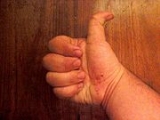
thumb when extended (as in a "thumbs-up
Thumbs Up

A thumbs up or thumbs down is a common gesture represented by a closed fist held with the thumb extended upward or downward in approval or disapproval respectively....
") can extend backwards toward the nail and outwards, a recessive
Dominance relationship

In genetics, dominance describes the effects of the different versions of a particular gene on the phenotype of an organism. Many animals and plants have diploid in their genome, one inherited from each parent....
 congenital condition
Mendelian inheritance

Mendelian inheritance is a set of primary tenets relating to the transmission of heredity characteristics from parent organisms to their children; it underlies much of genetics....
 known as "hitchhiker's thumb", whereas for other people it will extend straight out with little backward bending.


Discussion
Ask a question about 'Thumb'
Start a new discussion about 'Thumb'
Answer questions from other users
Full Discussion Forum


Encyclopedia


The thumb is the lateral
Human anatomical terms

Human anatomical terms make up a distinct Scientific classification to describe areas of the body, to provide orientation when describing parts of human anatomy, and to distinguish different movements of the body....
-most digit
Finger

A finger is a type of digit , an organ of manipulation and sensation found in the hands of humans and other primates.Normally humans have five digits, termed phalanges, on each hand ....
 of the hand. The English adjective for thumb is pollical.

Anatomy


Bones

The thumb consists of three bones:
  • Distal phalanx
    Phalanx bones

    The name Phalanx is commonly given to the bones that form fingers and toes. In primates such as humans and monkeys, the thumb and big toe have two phalanges, while the other fingers and toes consist of three....
     (of the first digit)
  • Proximal phalanx (of the first digit)
  • First metacarpal


Muscles

Gray422
Its movements are controlled by eight muscles (each with "pollicis" in the name):

Name Location Nerve >- | extensor pollicis longus forearm posterior interosseous nerve
Posterior interosseous nerve

The posterior interosseous nerve is a nerve in the foream. It is the continuation of the deep branch of the radial nerve, after this has crossed the supinator muscle....
|- | abductor pollicis longus
forearm posterior interosseous nerve
Posterior interosseous nerve

The posterior interosseous nerve is a nerve in the foream. It is the continuation of the deep branch of the radial nerve, after this has crossed the supinator muscle....
|- | flexor pollicis longus
forearm anterior interosseous nerve
Anterior interosseous nerve

The anterior interosseous nerve is a branch of the median nerve that supplies the deep muscles on the front of the forearm, except the ulnar half of the flexor digitorum profundus....
|- | extensor pollicis brevis
forearm posterior interosseous nerve
Posterior interosseous nerve

The posterior interosseous nerve is a nerve in the foream. It is the continuation of the deep branch of the radial nerve, after this has crossed the supinator muscle....
|- | abductor pollicis brevis
hand median nerve
Median nerve

The median nerve is a nerve that runs down the arm and forearm. It is one of the five main nerves originating from the brachial plexus.The median nerve is formed from parts of the medial and lateral cords of the brachial plexus, and continues down the arm to enter the forearm with the brachial artery....
|- | flexor pollicis brevis
hand median nerve
Median nerve

The median nerve is a nerve that runs down the arm and forearm. It is one of the five main nerves originating from the brachial plexus.The median nerve is formed from parts of the medial and lateral cords of the brachial plexus, and continues down the arm to enter the forearm with the brachial artery....
|- | opponens pollicis
hand median nerve
Median nerve

The median nerve is a nerve that runs down the arm and forearm. It is one of the five main nerves originating from the brachial plexus.The median nerve is formed from parts of the medial and lateral cords of the brachial plexus, and continues down the arm to enter the forearm with the brachial artery....
|- | adductor pollicis
hand ulnar nerve
Ulnar nerve

In human anatomy, the ulnar nerve is a nerve which runs near the ulna bone. The ulnar nerve is the largest unprotected nerve in the human body , and the only unprotected nerve that does not serve a purely sensory function ....
 (deep branch)


The extensor pollicis longus tendon and extensor pollicis brevis tendon form what is known as the anatomical snuff box
Anatomical snuff box

The anatomical snuffbox, or radial fossa, , is a triangular deepening on the Anatomical position#Relative_directions, Dorsum aspect of the hand - at the level of the carpal bones, specifically, the scaphoid and trapezium bones forming the floor....
 (an indentation on the lateral aspect of the thumb at its base) The radial artery can be palpated anteriorly at the wrist(not in the snuffbox) In the hand, the abductor pollicis brevis, adductor pollicis, flexor pollicis brevis, and opponens pollicis form the thenar eminence
Thenar eminence

The thenar eminence is the body of muscle on the palm of the human hand just beneath the thumb. The skin overlying this region is the area stimulated when trying to elicit a palmomental reflex....
.

Hitchhiker's thumb

The thumb when extended (as in a "thumbs-up
Thumbs Up

A thumbs up or thumbs down is a common gesture represented by a closed fist held with the thumb extended upward or downward in approval or disapproval respectively....
") can extend backwards toward the nail and outwards, a recessive
Dominance relationship

In genetics, dominance describes the effects of the different versions of a particular gene on the phenotype of an organism. Many animals and plants have diploid in their genome, one inherited from each parent....
 congenital condition
Mendelian inheritance

Mendelian inheritance is a set of primary tenets relating to the transmission of heredity characteristics from parent organisms to their children; it underlies much of genetics....
 known as "hitchhiker's thumb", whereas for other people it will extend straight out with little backward bending. Having either condition appears to have no effect on the thumb's function. While most people have either "hitchhiker's thumb" on both thumbs or neither, in some people, the condition only presents itself on one thumb.

As one of five digits, and as companion to four fingers


The English word "finger" has two senses, even in the context of appendages of a single typical human hand:

  1. The four digits, not including the thumb.
  2. Any of the five digits.


Linguistically, it appears that the original sense was the broader of these two: penkwe-ros (also rendered as penqrós) was, in the inferred Proto-Indo-European
Proto-Indo-European language

The Proto-Indo-European language is the unattested, linguistic reconstruction common ancestor of the Indo-European languages, spoken by the Proto-Indo-Europeans....
 language, a suffixed form of penkwe (or penqe), which has given rise to many Indo-European
Indo-European languages

The Indo-European languages are a Language family of several hundred related languages and dialects, including most major languages of Europe, the Iranian plateau , Central Asia and the Indian subcontinent ....
-family words (tens of them defined in English dictionaries) that involve or flow from concepts of fiveness.

The thumb shares the following with each of the (other) four fingers:
  • Having a skeleton of phalanges, joined by hinge-like joints that provide flexion toward the palm of the hand
  • Having a "back" surface that features hair and a nail, and a hairless palm-of-the-hand side with fingerprint
    Fingerprint

    A fingerprint is an impression of the friction ridges of all part of the finger. A friction ridge is a raised portion of the epidermis on the palmar or digits or plantar skin, consisting of one or more connected ridge units of friction ridge skin....
     ridges instead


The thumb contrasts with each of the (other) four by being the only finger that:
  • Is opposable
  • Has two phalanges rather than three
  • Has its inmost phalanx so close to the wrist
  • Has much greater breadth and stubby proportions
  • Is attached to such a mobile metacarpus
    Metacarpus

    The metacarpus is the intermediate part of the hand skeleton that is located between the phalanges distally and the carpus which forms the connection to the forearm....
     (which produces most of the opposability)


Grips


Typical interdigital grips include the tips of thumb and second finger (forefinger/index finger
Index finger

The index finger, also referred to as, pointer finger, forefinger, trigger finger, digitus secundus, or digitus II, is the second finger of a human hand....
) holding a pill or other small item, or thumb and sides of second and third fingers holding a pen or pencil.

Origin of the human thumb


The evolution of the opposable or prehensile thumb is usually associated with Homo habilis
Homo habilis

Homo habilis is a species of the genus Homo , which lived from approximately 2.5 million to at least 1.6 million years ago at the beginning of the Pleistocene....
, the forerunner of Homo sapiens. This, however, is the suggested result of evolution from Homo erectus
Homo Erectus

Homo Erectus is a 2007 comedy film about cavemen that was written and directed by Adam Rifkin, and starring Giuseppe Andrews, Gary Busey, David Carradine, Ron Jeremy, Ali Larter, Hayes MacArthur, Adam Rifkin, and Talia Shire....
 (around 1 mya
Mya (unit)

In astronomy, geology, and paleontology, mya or "m.y.a." is an abbreviation for "million years ago". Like the related unit bya, mya is traditionally written in lower case....
) via a series of intermediate anthropoid
Simian

The simians are the "higher primates" familiar to most people: the monkeys and the apes, including humans. Simians tend to be larger than the "lower primates" or prosimians....
 stages, and is therefore a much more complicated link.

The most important factors leading to the habile hand (and its thumb) are:
  • the freeing of the hands from their walking requirements—still so crucial for ape
    Ape

    An ape is any member of the Hominoidea superfamily of primates. In less scientific language, it has various meanings, although it often excludes humans....
    s today, as they have hands for feet, which in its turn was one of the consequences of the gradual pithecanthropoid and anthropoid adoption of the erect bipedal walking
    Walking

    Walking is the main form of animal locomotion on Earth, distinguished from running and crawling . When carried out in shallow waters, it is usually described as wading and when performed over a steeply rising object or an obstacle it becomes scrambling or climbing....
     gait, and
  • the simultaneous development of a larger anthropoid brain
    Brain

    The brain is the center of the nervous system in all vertebrate, and most invertebrate, animals. Some primitive animals such as cnidarian and echinoderm have a decentralized nervous system without a brain, while sponges lack any nervous system at all....
     in the later stages.


It is possible though that a more likely scenario may be that the specialized, precision gripping hand (equipped with opposable thumb) of Homo habilis
Homo habilis

Homo habilis is a species of the genus Homo , which lived from approximately 2.5 million to at least 1.6 million years ago at the beginning of the Pleistocene....
 preceded walking, with the specialized adaptation of the spine, pelvis and lower extremities preceding a more advanced hand. And, it is logical that a conservative, highly functional adaptation be followed by a series of more complex ones that complement it. With Homo habilis
Homo habilis

Homo habilis is a species of the genus Homo , which lived from approximately 2.5 million to at least 1.6 million years ago at the beginning of the Pleistocene....
 an advanced grasping-capable hand was accompanied by facultative bipedalism, possibly implying, assuming a co-opted evolutionary relationship exists, that the latter resulted from the former as obligate bipedalism was yet to follow. Walking may have been a byproduct of busy hands and not vice versa.

Importance


The thumb, unlike other fingers, is opposable, in that it is the only digit on the human hand which is able to oppose or turn back against the other four fingers, and thus enables the hand to refine its grip to hold objects which it would be unable to do otherwise. The opposable thumb has helped the human species develop more accurate fine motor skill
Fine motor skill

Fine motor skills can be defined as coordination of small muscle movements which occur e.g., in the fingers, usually in coordination with the eyes....
s. It is also thought to have directly led to the development of tools, not just in humans or their evolutionary ancestors, but other primates as well. The opposable thumb ensured that important human functions such as writing were possible. The thumb, in conjunction with the other fingers make humans and other species with similar hands some of the most dexterous in the world.

Other animals with apposable thumbs


Many animals also have some kind of apposable thumb or toe.
  • Most primate
    Primate

    A primate is a member of the biological order Primates , the group that contains lemurs, the Aye-aye, Lorisidaes, galagos, tarsiers, monkeys, and apes, with the last category including humans....
    s
    • Ape
      Ape

      An ape is any member of the Hominoidea superfamily of primates. In less scientific language, it has various meanings, although it often excludes humans....
      s, including the great apes (Bonobo
      Bonobo

      The Bonobo , which, until recently, usually was called the Pygmy Chimpanzee and less often, the Dwarf or Gracile Chimpanzee, is a great ape and one of the two species making up the genus, chimpanzee....
      , Chimpanzee
      Chimpanzee

      Chimpanzee, sometimes colloquially known as a chimp, is the common name for the two Extant taxon species of ape in the genus Pan where the Congo River forms the boundary between the native habitat of the two species:...
      , Gorilla
      Gorilla

      Gorillas are the largest of the living primates. They are ground-dwelling herbivores that inhabit the forests of Africa. Gorillas are divided into two species and either four or five subspecies....
      , Orangutan
      Orangutan

      The orangutans are a species of Hominidae. Known for their intelligence, they live in trees and they are the largest living arboreal animal. They have longer arms than other great apes, and their hair is reddish-brown, instead of the brown or black hair typical of other great apes....
      ) and the gibbon
      Gibbon

      Gibbons are the small apes in the family Hylobatidae. The family is divided into four genus based on their diploid chromosome number: Hylobates , Hoolock , Nomascus , and Symphalangus ....
      s—apposable thumbs on both hands and feet.
    • Old World Monkeys, with some exceptions, such as the genera Piliocolobus and Colobus.
    • Some Cebids (New World primates
      New World monkey

      New World monkeys are the four families of primates that are found in Central America and South America: Cebidae, Aotidae, Pitheciidae and Atelidae....
       of Central and South America).
    • Tarsier
      Tarsier

      Tarsiers are prosimian primates of the genus Tarsius, a Monotype genus in the family Tarsiidae, which is itself the lone extant family within the infraorder Tarsiiformes....
      s
    • Many strepsirrhine primates, such as lemur
      Lemur

      Lemurs make up the infraorder Lemuriformes and are members of a group of primates known as prosimians. The term "lemur" is derived from the Latin word lemures, meaning "spirits of the night" or "ghosts"....
      s, loris
      Loris

      Loris is the common name for the strepsirrhine primates of the subfamily Lorinae in family Lorisidae. Loris is one genus in this subfamily and represents the slender lorises, while Nycticebus is the genus for the slow lorises....
      es, and the Aye-aye
      Aye-aye

      The Aye-aye is a strepsirrhine native to Madagascar that combines rodent-like teeth with a long, thin middle finger to fill the same ecological niche as a woodpecker....
      .
  • Giant Panda
    Giant Panda

    The Giant Panda is a mammal classified in the bear family , native to central-western and southwestern China. The Giant Panda was previously thought to be a member of the Procyonidae family....
    s – five clawed fingers plus an extra-long sesamoid bone
    Sesamoid bone

    In anatomy, a sesamoid bone is a bone embedded within a tendon. They usually resemble sesame seed, hence the name.Sesamoid bones are typically found in locations where a tendon passes over a joint, such as the hand, knee, and foot....
     that, though not really a finger (as the human thumb is), works like an apposable thumb.
  • Most phalangerid marsupial
    Marsupial

    Marsupials are an infraclass of mammals, characterized by a distinctive Pouch , in which females carry their young through early infancy....
    s (a family of possum
    Possum

    A possum is any of about 64 small to medium-sized arboreal marsupial species native to Australia, New Guinea, and Sulawesi . The name derives from their resemblance to the opossums of the Americas....
    s) – an apposable toe
    Toe

    Toes are the Digit s of the foot of an animal. Many animal species such as cats walk on their toes, and are described as being digitigrade....
     on each foot, plus two opposable digits on each hand
  • Koala
    Koala

    The Koala is a wikt:thickset arboreal marsupial herbivory native to Australia, and the only Extant taxon representative of the family Phascolarctidae....
    s – similar to phalangerids, though they are in a different order.
  • Opossums – apposable "thumbs" on the rear feet.
  • Troodon
    Troodon

    Troodon is a genus of relatively small, bird-like dinosaur from the Late Cretaceous Period . Discovered in 1855, it was among the first dinosaurs found in North America....
    , a birdlike dinosaur – partially apposable thumbs.
  • Bambiraptor
    Bambiraptor

    Bambiraptor is a 75 million year old Origin of birds dinosaur discovered by scientists at the University of Kansas, Yale University, and the University of New Orleans....
    , a small, predatory dinosaur – it could touch the outer two of its three digits together in an apposable grip.
  • Phyllomedusa
    Phyllomedusa

    Phyllomedusa is a genus of Hylidae from Central America and South America. It ranges from Costa Rica southward to Argentina. It has around thirty species....
    , a genus of frogs native to South America.


Most bird
Bird

Birds are wing, Bipedalismal, endothermic , vertebrate animals that lay egg . There are around 10,000 living species, making them the most numerous tetrapod vertebrates....
s have at least one apposable digit on the foot, in various configurations
Dactyly

In biology, dactyly is the arrangement of wikt:digit on the hands, Foot, or sometimes wings of a tetrapod animal. It comes from the Greek word da?t???? = "finger"....
, but these are seldom called "thumbs".