
All Topics  
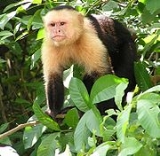
Capuchin monkey

 
Capuchin Monkey

   Email Print
   Bookmark   Link


Capuchin monkey


The capuchins (pronounced /k?'p(j)ut??n/) are the group of New World monkey
New World monkey

New World monkeys are the four families of primates that are found in Central America and South America: Cebidae, Aotidae, Pitheciidae and Atelidae....
s classified as genus Cebus. The range of the capuchin monkeys includes Central America
Central America

Central America is a central geography region of the Americas. It is the southernmost, isthmus portion of the North American continent, which connects with South America on the southeast....
 and South America
South America

South America is the southern continent of the Americas, situated entirely in the Western Hemisphere and mostly in the Southern Hemisphere, with a relatively small portion in the Northern Hemisphere....
 as far south to northern Argentina
Argentina

Argentina, officially the Argentine Republic , is a country in South America, constituted as a federation of 23 provinces and an autonomous city....
. Cebus is the only genus in subfamily Cebinae.

word capuchin derives from a group of friar
Friar

A friar is a member of one of the mendicant orders....
s named the Order of Friars Minor Capuchin
Order of Friars Minor Capuchin

File:Rapperswil - Kapuzinerkloster.jpgThe Order of Friars Minor Capuchin is an order of friars in the Catholic Church, among the chief offshoots of the Franciscans....
, an offshoot from the Franciscan
Franciscan

The term Franciscan is commonly used to refer to members of Catholic religious orders that follow a body of regulations known as "The rule of St....
s, who wore brown robes with large hoods covering their heads.


Discussion
Ask a question about 'Capuchin monkey'
Start a new discussion about 'Capuchin monkey'
Answer questions from other users
Full Discussion Forum


Recent Posts


Encyclopedia


The capuchins (pronounced /k?'p(j)ut??n/) are the group of New World monkey
New World monkey

New World monkeys are the four families of primates that are found in Central America and South America: Cebidae, Aotidae, Pitheciidae and Atelidae....
s classified as genus Cebus. The range of the capuchin monkeys includes Central America
Central America

Central America is a central geography region of the Americas. It is the southernmost, isthmus portion of the North American continent, which connects with South America on the southeast....
 and South America
South America

South America is the southern continent of the Americas, situated entirely in the Western Hemisphere and mostly in the Southern Hemisphere, with a relatively small portion in the Northern Hemisphere....
 as far south to northern Argentina
Argentina

Argentina, officially the Argentine Republic , is a country in South America, constituted as a federation of 23 provinces and an autonomous city....
. Cebus is the only genus in subfamily Cebinae.

Etymology

The word capuchin derives from a group of friar
Friar

A friar is a member of one of the mendicant orders....
s named the Order of Friars Minor Capuchin
Order of Friars Minor Capuchin

File:Rapperswil - Kapuzinerkloster.jpgThe Order of Friars Minor Capuchin is an order of friars in the Catholic Church, among the chief offshoots of the Franciscans....
, an offshoot from the Franciscan
Franciscan

The term Franciscan is commonly used to refer to members of Catholic religious orders that follow a body of regulations known as "The rule of St....
s, who wore brown robes with large hoods covering their heads. When explorers reached the Americas
Americas

The Americas are the region of the Western hemisphere that consists of the continents of North America and South America with their associated islands and regions....
 in the 15th century they found small monkeys who resembled these monks and named them capuchins. When the scientists described a specimen (thought to be a Golden-bellied Capuchin
Golden-bellied Capuchin

The Golden-bellied Capuchin , also known as the Yellow-breasted or Buffy-headed Capuchin, is one of several species of New World monkeys....
) they noted that: "his muzzle of a tanned color,... with the lighter color around his eyes that melts into the white at the front, his cheeks..., give him the looks that involuntarily reminds us of the appearance that historically in our country represents ignorance, laziness, and sensuality."

Classification

The species-level taxonomy
Taxonomy

Taxonomy is the practice and science of classification. The word comes from the Greek language ', taxis and ', nomos .Taxonomies, or taxonomic schemes, are composed of taxonomic units known as taxa , or kinds of things that are arranged frequently in a hierarchical structure....
 of this genus remains highly controversial, and alternative treatments than the one listed below have been suggested.

  • Genus Cebus
    • C. capucinus group
      • White-faced or White-headed Capuchin
        White-headed Capuchin

        The White-headed Capuchin , also known as the White-faced Capuchin or White-throated Capuchin, is a medium-sized New World monkey of the family Cebidae, subfamily Cebinae....
        ,
        Cebus capucinus
      • White-fronted Capuchin
        White-fronted Capuchin

        The White-fronted Capuchin is a New World monkey primate, endemism to seven different countries in South America: Bolivia, Brazil, Colombia, Venezuela, Ecuador, Peru, and Trinidad....
        ,
        Cebus albifrons
        • Cebus albifrons albifrons
        • Cebus albifrons unicolor
        • Shock-headed Capuchin, Cebus albifrons cuscinus
        • Trinidad White-fronted Capuchin, Cebus albifrons trinitatis
        • Ecuadorian Capuchin, Cebus albifrons aequatorialis
        • Varied Capuchin, Cebus albifrons versicolor
      • Weeper Capuchin
        Weeper Capuchin

        The Weeper Capuchin is a capuchin monkey from South America. It is found in northern Brazil, Guyana, French Guiana, Suriname, Venezuela and possibly northern Colombia....
        ,
        Cebus olivaceus
      • Kaapori Capuchin
        Kaapori Capuchin

        The Kaapori Capuchin is a capuchin monkey endemic to Brazil. This species is found in the Brazilian states of Par? and Maranh?o. Formerly considered a subspecies of the Weeper Capuchin , it was recently elevated to species status....
        ,
        Cebus kaapori
    • C. apella group
      • Black-capped, Brown or Tufted Capuchin
        Tufted Capuchin

        The Tufted Capuchin , also known as Brown Capuchin or Black-capped Capuchin is a New World monkey primate from South America. As traditionally defined, it is one of the most widespread primates in the Neotropics, but it has recently been recommended considering the Black-striped Capuchin, Black Capuchin and Golden-bellied Capuchin...
        ,
        Cebus apella
        • Guiana Brown Capuchin, Cebus apella apella
        • Cebus apella fatuellus
        • Margarita Island Capuchin, Cebus apella margaritae
        • Large-headed Capuchin
          Large-headed Capuchin

          The Large-headed Capuchin is a subspecies of the Tufted Capuchin from South America. It is found in Brazil, Colombia, Ecuador and Peru....
          ,
          Cebus apella macrocephalus
        • Cebus apella peruanus
        • Cebus apella tocantinus
      • Black-striped Capuchin
        Black-striped Capuchin

        The Black-striped Capuchin, Cebus libidinosus, also known as the Beared Capuchin, is a capuchin monkey from South America. It was the first non-ape primate where tool usage was documented in the wild, as individuals have been seen cracking Nut by placing them on a stone "anvil" while hitting them with another large stone....
        ,
        Cebus libidinosus
        • Cebus libidinosus libidinosus
        • Cebus libidinosus pallidus
        • Cebus libidinosus paraguayanus
        • Cebus libidinosus juruanus
      • Black Capuchin
        Black Capuchin

        The Black Capuchin, Cebus nigritus, also known as the Black-horned Capuchin, is a capuchin monkey from the Atlantic Forest in south-eastern Brazil and far north-eastern Argentina....
        ,
        Cebus nigritus
        • Cebus nigritus nigritus
        • Crested Capuchin or Robust Tufted Capuchin, Cebus nigritus robustus
        • Cebus nigritus cucullatus
      • Golden-bellied Capuchin
        Golden-bellied Capuchin

        The Golden-bellied Capuchin , also known as the Yellow-breasted or Buffy-headed Capuchin, is one of several species of New World monkeys....
        ,
        Cebus xanthosternos
      • Blond Capuchin
        Blond Capuchin

        The Blond Capuchin is a claimed new capuchin monkey species that was discovered in early 2006 by researchers from the Federal University in Pernambuco, near Recife, northeastern Brazil....
        ,
        Cebus queirozi*


*New species.

Physical characteristics

Capuchins generally resemble the friars of their namesake. Their body, arms, legs and tail are all darkly (black or brown) colored, while the face, throat and chest are white colored, and their heads have a black cap. They reach a length of 30 to 56 centimeters (12–22 in), with tails that are just as long as the body. They weigh up to 6 kilograms (13 lb 3 oz), with brains of mass 35–40 g.

Behaviour

Like most New World monkeys, capuchins are diurnal
Diurnal animal

Scientific term refered to as an animal behavior, diurnality indicates an animal that is active during the daytime and rests during the night. Animals that are not diurnal might be Nocturnality or crepuscular .  Many animal species are diurnal, including many mammals, insects and birds....
 and arboreal
Arboreal

Arboreal is a word meaning "related to or resembling trees". Its meaning comes from the Latin arbor, meaning tree.In biology, an arboreal animal is one which inhabits or spends large amounts of time in trees or Shrubes....
. With the exception of a midday nap, they spend their entire day searching for food. At night they sleep in the trees, wedged between branches. They are undemanding regarding their habitat and can thus be found in many differing areas. Potential predators include jaguar
Jaguar

The jaguar, Panthera onca, is a New World Felidae and one of four "big cats" in the Panthera genus, along with the tiger, lion, and leopard of the Old World....
s, cougars, jaguarundi
Jaguarundi

The jaguarundi is a medium-sized wild felidae that ranges from southern Texas in the United States south to South America. The average length is 65 cm with 45 cm of tail and a weight of about 6 kg ....
s, coyote
Coyote

The coyote , also known as the prairie wolf, is a species of canid found throughout North America and Central America, ranging from Panama in the south, north through Mexico, the United States, and Canada....
s, tayra
Tayra

The tayra , also known as the Tolomuco or Perico ligero in Central America, is an omnivore animal from the weasel family Mustelidae....
s, snake
Snake

Snakes are elongate legless carnivore reptiles of the suborder Serpentes that can be distinguished from legless lizards by their lack of eyelids and external ears....
s, crocodile
Crocodile

A crocodile is any species belonging to the family Crocodylidae . The term can also be used more loosely to include all members of the order Crocodilia: i.e....
s and raptors
Bird of prey

Birds of prey are birds that hunt for food primarily on the wing, using their keen senses, especially vision. Their claws and beaks tend to be relatively large, powerful and adapted for tearing and/or piercing flesh....
, although there has only been one published observation of a predator taking a capuchin in the wild. The main predator of the Tufted Capuchin
Tufted Capuchin

The Tufted Capuchin , also known as Brown Capuchin or Black-capped Capuchin is a New World monkey primate from South America. As traditionally defined, it is one of the most widespread primates in the Neotropics, but it has recently been recommended considering the Black-striped Capuchin, Black Capuchin and Golden-bellied Capuchin...
 is the Harpy Eagle, which has been seen bringing several capuchins back to its nest.

The diet of the capuchins is more varied than other monkeys in the family Cebidae
Cebidae

The Cebidae form one of the four family of New World monkeys now recognised. It includes the marmosets, tamarins, capuchin monkeys and squirrel monkeys....
. They are omnivore
Omnivore

Omnivores are species that eating both plants and animals as their primary food source. They are opportunistic, general feeders not specifically adapted to eat and digest either meat or plant material exclusively....
s, eating not only fruits, nuts, seeds and buds, but also insects, spiders, bird eggs and small vertebrates. Capuchins living near water will also eat crabs and shellfish by cracking their shells with stones.

Social structure

Capuchins live together in groups of 6 to 40 members. These groups consist of related females and their offspring, as well as several males. Usually groups are dominated by a single male, who has primary rights to mate with the females of the group, though the White-headed Capuchin
White-headed Capuchin

The White-headed Capuchin , also known as the White-faced Capuchin or White-throated Capuchin, is a medium-sized New World monkey of the family Cebidae, subfamily Cebinae....
 groups are led by both an alpha male and an alpha female. Mutual grooming as well as vocalization serves as communication and stabilization of the group dynamics. These primate
Primate

A primate is a member of the biological order Primates , the group that contains lemurs, the Aye-aye, Lorisidaes, galagos, tarsiers, monkeys, and apes, with the last category including humans....
s are territorial animals, distinctly marking a central area of their territory with urine and defending it against intruders, though outer zones of these areas may overlap.

Females bear young every two years following a 160 to 180 day gestation. The young cling to their mother's chest until they are larger, when they move to her back. Adult male capuchins rarely take part in caring for the young. Within four years for females and eight years for males, juveniles become fully mature. In captivity, individuals have reached an age of 45 years, although life expectancy in nature is only 15 to 25 years.

Intelligence

Capuchins are considered the most intelligent New World monkeys and are often used in laboratories. The Tufted Capuchin
Tufted Capuchin

The Tufted Capuchin , also known as Brown Capuchin or Black-capped Capuchin is a New World monkey primate from South America. As traditionally defined, it is one of the most widespread primates in the Neotropics, but it has recently been recommended considering the Black-striped Capuchin, Black Capuchin and Golden-bellied Capuchin...
 is especially noted for its long-term tool usage, one of the few examples of primate tool use other than by ape
Ape

An ape is any member of the Hominoidea superfamily of primates. In less scientific language, it has various meanings, although it often excludes humans....
s. Upon seeing macaw
Macaw

For the China special administrative region, see Macau. Macaws are small to large, often colourful the Americas parrots. Of the many different Psittacidae genus, six are classified as macaws: Ara, Anodorhynchus, Cyanopsitta, Primolius, Orthopsittaca, and Diopsittaca....
s eating palm nuts, cracking them open with their beaks, these capuchins will select a few of the ripest fruits, nip off the tip of the fruit and drink down the juice, then seemingly discard the rest of the fruit with the nut inside. When these discarded fruits have hardened and become slightly brittle, the capuchins will gather them up again and take them to a large flat boulder where they have previously gathered a few river stones from up to a mile away. They will then use these stones, some of them weighing as much as the monkeys, to crack open the fruit to get to the nut inside. Young capuchins will watch this process to learn from the older, more experienced adults.

During the mosquito season, they crush up millipedes and rub the remains on their backs. This acts as a natural insect repellent
Insect repellent

An insect repellent is a substance applied to skin, clothing, or other surfaces which discourages insects from landing or climbing on that surface....
.

Self-awareness

When presented with a reflection, capuchin monkeys react in a way that indicates an intermediate state between seeing the mirror as another individual and recognizing the image as self.

Most animals react to seeing their reflection as if encountering another individual they don't recognize. An experiment with capuchins shows that they react to a reflection as a strange phenomenon, but not as if seeing a strange capuchin.

In the experiment, capuchins were presented with three different scenarios:
  1. Seeing an unfamiliar, same-sex monkey on the other side of a clear barrier
  2. Seeing a familiar, same-sex monkey on the other side of a clear barrier
  3. A mirror showing a reflection of the monkey


With scenario 1, females appeared anxious and avoided eye-contact. Males made threatening gestures. In scenario 2, there was little reaction by either males or females.

When presented with a reflection, females gazed into their own eyes and made friendly gestures such as lip-smacking and swaying. Males made more eye contact than with strangers or familiar monkeys but reacted with signs of confusion or distress, such as squealing, curling up on the floor or trying to escape from the test room.

Theory of mind

The question of whether capuchin monkeys have a theory of mind—whether they can understand what another creature may know or think—has been neither proven nor disproven conclusively. If confronted with a
knower-guesser scenario, where one trainer can be observed to know the location of food and another trainer merely guesses the location of food, capuchin monkeys can learn to rely on the knower. This has, however, been refuted as conclusive evidence for a theory of mind as the monkeys may have learned to discriminate knower and guesser by other means. Non-human great apes have not been proven to develop a theory of mind either; human children commonly develop a theory of mind around the ages 3 and 4.

Relationship with humans

Easily recognized as the "organ grinder
Organ grinder

File:Austrian BarrelOrgan.jpgThe organ grinder was a musical novelty busking of the 19th century and the early part of the 20th century, and refers to the operator of a street organ....
" or "greyhound jockey
Greyhound jockey

Greyhound jockeys or monkey jockeys are capuchin monkeys trained to ride racing dogs for sport over a 5/16 mile course.Monkey Greyhound racing began as a fad in Palm Beach, Florida, America in 1930....
" monkeys, capuchins are sometimes kept as exotic pets
Exotic pet

An exotic pet is a rare or unusual animal kept as a pet, or an animal kept as a pet which is not commonly thought of as a pet.The definition is an evolving one; some rodents, reptiles, and amphibians have become firmly enough established in the world of animal fancy to no longer be considered exotic....
. Sometimes they plunder fields and crops and are seen as troublesome by nearby human populations. In some regions they have become rare due to the destruction of their habitat.

They are also used as service animals, sometimes being called "nature's butlers." Some organizations have been training capuchin monkeys to assist quadriplegics
Quadriplegia

Quadriplegia, also known as tetraplegia, is a symptom in which a human experiences paralysis affecting all four limbs, although not necessarily total paralysis or loss of function....
 as monkey helper
Monkey helper

A monkey helper is a type of assistance animal, similar to an assistance dog, that is specially trained to help quadriplegics, other people with severe spinal cord injuries or mobility-impairments, or vertically challenged individuals....
s in a manner similar to mobility assistance dog
Mobility assistance dog

A mobility assistance dog is a service dog trained to assist a physically disabled person. Among other tasks, they are commonly trained to pick up objects, open and close doors, and operate light switches....
s. After being socialized in a human home as infants, the monkeys undergo extensive training before being placed with a quadriplegic. Around the house, the monkeys help out by doing tasks including microwaving food, washing the quadriplegic's face, and opening drink bottles. They do not always do well in these situations as they often have their teeth removed when they are young for safety purposes.

External links