

Planetary habitability

Encyclopedia
Planet
A planet is a celestial body orbiting a star or stellar remnant that is massive enough to be rounded by its own gravity, is not massive enough to cause thermonuclear fusion, and has cleared its neighbouring region of planetesimals.The term planet is ancient, with ties to history, science,...
's or a natural satellite
Natural satellite
A natural satellite or moon is a celestial body that orbits a planet or smaller body, which is called its primary. The two terms are used synonymously for non-artificial satellites of planets, of dwarf planets, and of minor planets....
's potential to sustain life
Life
Life is a characteristic that distinguishes objects that have signaling and self-sustaining processes from those that do not, either because such functions have ceased , or else because they lack such functions and are classified as inanimate...
. Life may develop directly
Abiogenesis
Abiogenesis or biopoesis is the study of how biological life arises from inorganic matter through natural processes, and the method by which life on Earth arose...
on a planet or satellite or be transferred to it from another body, a theoretical process known as panspermia. As the existence of life beyond Earth
Extraterrestrial life
Extraterrestrial life is defined as life that does not originate from Earth...
is currently uncertain, planetary habitability is largely an extrapolation
Extrapolation
In mathematics, extrapolation is the process of constructing new data points. It is similar to the process of interpolation, which constructs new points between known points, but the results of extrapolations are often less meaningful, and are subject to greater uncertainty. It may also mean...
of conditions on Earth and the characteristics of the Sun
Sun
The Sun is the star at the center of the Solar System. It is almost perfectly spherical and consists of hot plasma interwoven with magnetic fields...
and solar system
Solar System
The Solar System consists of the Sun and the astronomical objects gravitationally bound in orbit around it, all of which formed from the collapse of a giant molecular cloud approximately 4.6 billion years ago. The vast majority of the system's mass is in the Sun...
which appear favorable to life's flourishing—in particular those factors that have sustained complex, multicellular
Multicellular organism
Multicellular organisms are organisms that consist of more than one cell, in contrast to single-celled organisms. Most life that can be seen with the the naked eye is multicellular, as are all animals and land plants.-Evolutionary history:Multicellularity has evolved independently dozens of times...
organisms and not just simpler, unicellular
Microorganism
A microorganism or microbe is a microscopic organism that comprises either a single cell , cell clusters, or no cell at all...
creatures. Research and theory in this regard is a component of planetary science
Planetary science
Planetary science is the scientific study of planets , moons, and planetary systems, in particular those of the Solar System and the processes that form them. It studies objects ranging in size from micrometeoroids to gas giants, aiming to determine their composition, dynamics, formation,...
and the emerging discipline of astrobiology
Astrobiology
Astrobiology is the study of the origin, evolution, distribution, and future of life in the universe. This interdisciplinary field encompasses the search for habitable environments in our Solar System and habitable planets outside our Solar System, the search for evidence of prebiotic chemistry,...
.
An absolute requirement for life is an energy source
Energy
In physics, energy is an indirectly observed quantity. It is often understood as the ability a physical system has to do work on other physical systems...
, and the notion of planetary habitability implies that many other geophysical
Geophysics
Geophysics is the physics of the Earth and its environment in space; also the study of the Earth using quantitative physical methods. The term geophysics sometimes refers only to the geological applications: Earth's shape; its gravitational and magnetic fields; its internal structure and...
, geochemical
Geochemistry
The field of geochemistry involves study of the chemical composition of the Earth and other planets, chemical processes and reactions that govern the composition of rocks, water, and soils, and the cycles of matter and energy that transport the Earth's chemical components in time and space, and...
, and astrophysical
Astrophysics
Astrophysics is the branch of astronomy that deals with the physics of the universe, including the physical properties of celestial objects, as well as their interactions and behavior...
criteria must be met before an astronomical body can support life. In its astrobiology roadmap, NASA
NASA
The National Aeronautics and Space Administration is the agency of the United States government that is responsible for the nation's civilian space program and for aeronautics and aerospace research...
has defined the principal habitability criteria as "extended regions of liquid water, conditions favorable for the assembly of complex organic molecules, and energy sources to sustain metabolism
Metabolism
Metabolism is the set of chemical reactions that happen in the cells of living organisms to sustain life. These processes allow organisms to grow and reproduce, maintain their structures, and respond to their environments. Metabolism is usually divided into two categories...
."
In determining the habitability potential of a body, studies focus on its bulk composition, orbit
Orbit
In physics, an orbit is the gravitationally curved path of an object around a point in space, for example the orbit of a planet around the center of a star system, such as the Solar System...
al properties, atmosphere
Atmosphere
An atmosphere is a layer of gases that may surround a material body of sufficient mass, and that is held in place by the gravity of the body. An atmosphere may be retained for a longer duration, if the gravity is high and the atmosphere's temperature is low...
, and potential chemical interactions. Stellar characteristics of importance include mass
Solar mass
The solar mass , , is a standard unit of mass in astronomy, used to indicate the masses of other stars and galaxies...
and luminosity
Luminosity
Luminosity is a measurement of brightness.-In photometry and color imaging:In photometry, luminosity is sometimes incorrectly used to refer to luminance, which is the density of luminous intensity in a given direction. The SI unit for luminance is candela per square metre.The luminosity function...
, stable variability, and high metallicity
Metallicity
In astronomy and physical cosmology, the metallicity of an object is the proportion of its matter made up of chemical elements other than hydrogen and helium...
. Rocky, terrestrial
Terrestrial planet
A terrestrial planet, telluric planet or rocky planet is a planet that is composed primarily of silicate rocks or metals. Within the Solar System, the terrestrial planets are the inner planets closest to the Sun...
-type planets and moons with the potential for Earth-like chemistry
Carbon-based life
Carbon forms the backbone of biology for all of life on Earth. Complex molecules are made up of carbon bonded with other elements, especially oxygen, hydrogen and nitrogen, and carbon is able to bond with all of these because of its four valence electrons. Carbon is abundant on earth...
are a primary focus of astrobiological research, although more speculative habitability theories occasionally examine alternative biochemistries
Alternative biochemistry
Hypothetical types of biochemistry are forms of biochemistry speculated to be scientifically viable but not proven to exist at this time. While the kinds of living beings we know on earth commonly use carbon for basic structural and metabolic functions, water as a solvent and DNA or RNA to define...
and other types of astronomical bodies.
The idea that planets beyond Earth
Earth
Earth is the third planet from the Sun, and the densest and fifth-largest of the eight planets in the Solar System. It is also the largest of the Solar System's four terrestrial planets...
might host life is an ancient one, though historically it was framed by philosophy
Philosophy
Philosophy is the study of general and fundamental problems, such as those connected with existence, knowledge, values, reason, mind, and language. Philosophy is distinguished from other ways of addressing such problems by its critical, generally systematic approach and its reliance on rational...
as much as physical science
Physical science
Physical science is an encompassing term for the branches of natural science and science that study non-living systems, in contrast to the life sciences...
.a The late 20th century saw two breakthroughs in the field. The observation and robotic spacecraft
Robotic spacecraft
A robotic spacecraft is a spacecraft with no humans on board, that is usually under telerobotic control. A robotic spacecraft designed to make scientific research measurements is often called a space probe. Many space missions are more suited to telerobotic rather than crewed operation, due to...
exploration
Space exploration
Space exploration is the use of space technology to explore outer space. Physical exploration of space is conducted both by human spaceflights and by robotic spacecraft....
of other planets and moons within the solar system has provided critical information on defining habitability criteria and allowed for substantial geophysical comparisons between the Earth and other bodies. The discovery of extrasolar planet
Extrasolar planet
An extrasolar planet, or exoplanet, is a planet outside the Solar System. A total of such planets have been identified as of . It is now known that a substantial fraction of stars have planets, including perhaps half of all Sun-like stars...
s, beginning in the early 1990s and accelerating thereafter, has provided further information for the study of possible extraterrestrial life. These findings confirm that the Sun is not unique among star
Star
A star is a massive, luminous sphere of plasma held together by gravity. At the end of its lifetime, a star can also contain a proportion of degenerate matter. The nearest star to Earth is the Sun, which is the source of most of the energy on Earth...
s in hosting planets and expands the habitability research horizon beyond our own solar system.
In 1964 Stephen H. Dole estimated the number of habitable planets in our Galaxy to be about 600 million.
Suitable star systems
An understanding of planetary habitability begins with starStar
A star is a massive, luminous sphere of plasma held together by gravity. At the end of its lifetime, a star can also contain a proportion of degenerate matter. The nearest star to Earth is the Sun, which is the source of most of the energy on Earth...
s. While bodies that are generally Earth-like may be plentiful, it is just as important that their larger system be agreeable to life. Under the auspices of SETI
SETI
The search for extraterrestrial intelligence is the collective name for a number of activities people undertake to search for intelligent extraterrestrial life. Some of the most well known projects are run by the SETI Institute. SETI projects use scientific methods to search for intelligent life...
's Project Phoenix
Project Phoenix (SETI)
Project Phoenix is a SETI project: a search for extraterrestrial intelligence by analyzing patterns in radio signals. It is run by the independently funded SETI Institute of Mountain View, California, USA....
, scientists Margaret Turnbull
Margaret Turnbull
Margaret Carol Turnbull is an American astronomer. She received her PhD in Astronomy from the University of Arizona in 2004. Turnbull is an authority on "Habstars," solar twins and planetary habitability....
and Jill Tarter
Jill Tarter
Jill Cornell Tarter is an American astronomer and the current director of the Center for SETI Research, holding the Bernard M. Oliver Chair for SETI at the SETI Institute.-Education:...
developed the "HabCat
HabCat
The Catalog of Nearby Habitable Systems is a catalogue of star systems which conceivably have habitable planets. The list was developed by scientists Jill Tarter and Margaret Turnbull under the auspices of Project Phoenix, a part of SETI....
" (or Catalogue of Habitable Stellar Systems) in 2002. The catalogue was formed by winnowing the nearly 120,000 stars of the larger Hipparcos Catalogue into a core group of 17,000 "HabStars," and the selection criteria that were used provide a good starting point for understanding which astrophysical factors are necessary to habitable planets.
Spectral class
The spectral class of a star indicates its photospheric temperaturePhotosphere
The photosphere of an astronomical object is the region from which externally received light originates. The term itself is derived from Ancient Greek roots, φῶς, φωτός/phos, photos meaning "light" and σφαῖρα/sphaira meaning "sphere", in reference to the fact that it is a spheric surface perceived...
, which (for main-sequence stars) correlates to overall mass. The appropriate spectral range for "HabStars" is presently considered to be "early F" or "G", to "mid-K". This corresponds to temperatures of a little more than 7,000 K
Kelvin
The kelvin is a unit of measurement for temperature. It is one of the seven base units in the International System of Units and is assigned the unit symbol K. The Kelvin scale is an absolute, thermodynamic temperature scale using as its null point absolute zero, the temperature at which all...
down to a little more than 4,000 K; the Sun, a G2 star, is well within these bounds. "Middle-class" stars of this sort have a number of characteristics considered important to planetary habitability:
- They live at least a few billion years, allowing life a chance to evolve. More luminousLuminosityLuminosity is a measurement of brightness.-In photometry and color imaging:In photometry, luminosity is sometimes incorrectly used to refer to luminance, which is the density of luminous intensity in a given direction. The SI unit for luminance is candela per square metre.The luminosity function...
main-sequence stars of the "O," "B," and "A" classes usually live less than a billion years and in exceptional cases less than 10 million.b - They emit enough high-frequency ultraviolet radiation to trigger important atmospheric dynamics such as ozoneOzoneOzone , or trioxygen, is a triatomic molecule, consisting of three oxygen atoms. It is an allotrope of oxygen that is much less stable than the diatomic allotrope...
formation, but not so much that ionisation destroys incipient life. - Liquid water may exist on the surface of planets orbiting them at a distance that does not induce tidal lock (see next section and 3.2). K Spectrum stars may be able to support life for long periods, far longer than our sunSunThe Sun is the star at the center of the Solar System. It is almost perfectly spherical and consists of hot plasma interwoven with magnetic fields...
.
This spectral range probably accounts for between 5% and 10% of stars in the local Milky Way galaxy. Whether fainter late K and M class red dwarf
Red dwarf
According to the Hertzsprung-Russell diagram, a red dwarf star is a small and relatively cool star, of the main sequence, either late K or M spectral type....
stars are also suitable hosts for habitable planets is perhaps the most important open question in the entire field of planetary habitability given their ubiquity (habitability of red dwarf systems
Habitability of red dwarf systems
Determining the habitability of red dwarf systems could help reveal the likelihood of extraterrestrial life, as red dwarfs make up most stars in the Milky Way Galaxy...
). Gliese 581 c
Gliese 581 c
Gliese 581 c or Gl 581 c is a planet orbiting the red dwarf star Gliese 581. It is the second planet discovered in the system and the third in order from the star. With a mass at least 5.6 times that of the Earth, it is classified as a super-Earth...
, a "super-Earth
Super-Earth
A super-Earth is an extrasolar planet with a mass higher than Earth's, but substantially below the mass of the Solar System's gas giants. The term super-Earth refers only to the mass of the planet, and does not imply anything about the surface conditions or habitability...
," has been found orbiting in the "habitable zone
Habitable zone
In astronomy and astrobiology, a habitable zone is an umbrella term for regions that are considered favourable to life. The concept is inferred from the empirical study of conditions favourable for Life on Earth...
" of a red dwarf
Red dwarf
According to the Hertzsprung-Russell diagram, a red dwarf star is a small and relatively cool star, of the main sequence, either late K or M spectral type....
and may possess liquid water. Alternately, a greenhouse effect may render it too hot to support life, while its neighbor, Gliese 581 d
Gliese 581 d
Gliese 581 d or Gl 581 d is an extrasolar planet orbiting the star Gliese 581 approximately 20 light-years away in the constellation of Libra. It is the third planet discovered in the system and the fifth in order from the star....
, may in fact be a more likely candidate for habitability. In September 2010, the discovery was announced of another planet, Gliese 581 g
Gliese 581 g
Gliese 581 g , also Gl 581 g or GJ 581 g, is a hypothesized extrasolar planet proven nonexistent by the Geneva Team, orbiting the red dwarf star Gliese 581, 20.5 light-years from Earth in the constellation of Libra. It is the sixth planet discovered in the Gliese 581 planetary system and the fourth...
, in an orbit between these two planets. However, reviews of the discovery have placed the existence of this planet in doubt, and it is currently listed as "unconfirmed".
A stable habitable zone
The habitable zone (HZ)(Planetary Habitability Index) is a theoretical shell surrounding a star in which any planet present would have liquid waterWater
Water is a chemical substance with the chemical formula H2O. A water molecule contains one oxygen and two hydrogen atoms connected by covalent bonds. Water is a liquid at ambient conditions, but it often co-exists on Earth with its solid state, ice, and gaseous state . Water also exists in a...
on its surface. After an energy source, liquid water is considered the most important ingredient for life, considering how integral it is to all life-systems on Earth. This may reflect the bias of humanity's water-dependent biology, however, and if life is discovered in the absence of water (for example, in a liquid-ammonia
Ammonia
Ammonia is a compound of nitrogen and hydrogen with the formula . It is a colourless gas with a characteristic pungent odour. Ammonia contributes significantly to the nutritional needs of terrestrial organisms by serving as a precursor to food and fertilizers. Ammonia, either directly or...
solution), the notion of an HZ may have to be greatly expanded or else discarded altogether as too restricting.c
A "stable" HZ denotes two factors. First, the range of an HZ should not vary greatly over time. All stars increase in luminosity as they age and a given HZ naturally migrates outwards, but if this happens too quickly (for example, with a super-massive star), planets may only have a brief window inside the HZ and a correspondingly weaker chance to develop life. Calculating an HZ range and its long-term movement is never straightforward, given that negative feedback loops
Feedback
Feedback describes the situation when output from an event or phenomenon in the past will influence an occurrence or occurrences of the same Feedback describes the situation when output from (or information about the result of) an event or phenomenon in the past will influence an occurrence or...
such as the carbon cycle
Carbon cycle
The carbon cycle is the biogeochemical cycle by which carbon is exchanged among the biosphere, pedosphere, geosphere, hydrosphere, and atmosphere of the Earth...
will tend to offset the increases in luminosity. Assumptions made about atmospheric conditions and geology thus have as great an impact on a putative HZ range as does Solar evolution; the proposed parameters of the Sun's HZ, for example, have fluctuated greatly.
Secondly, no large-mass body such as a gas giant
Gas giant
A gas giant is a large planet that is not primarily composed of rock or other solid matter. There are four gas giants in the Solar System: Jupiter, Saturn, Uranus, and Neptune...
should be present in or relatively close to the HZ, thus disrupting the formation of Earth-like bodies. The mass of the asteroid belt, for example, appears to have been unable to accrete into a planet due to orbital resonances with Jupiter; if the giant had appeared in the region that is now between the orbits of Venus
Venus
Venus is the second planet from the Sun, orbiting it every 224.7 Earth days. The planet is named after Venus, the Roman goddess of love and beauty. After the Moon, it is the brightest natural object in the night sky, reaching an apparent magnitude of −4.6, bright enough to cast shadows...
and Mars
Mars
Mars is the fourth planet from the Sun in the Solar System. The planet is named after the Roman god of war, Mars. It is often described as the "Red Planet", as the iron oxide prevalent on its surface gives it a reddish appearance...
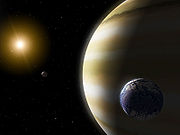
, Earth would almost certainly not have developed its present form. This is somewhat ameliorated by suggestions that a gas giant inside the HZ might have habitable moons under the right conditions.
In the Solar System, the inner planets are terrestrial
Terrestrial planet
A terrestrial planet, telluric planet or rocky planet is a planet that is composed primarily of silicate rocks or metals. Within the Solar System, the terrestrial planets are the inner planets closest to the Sun...
, the outer ones gas giant
Gas giant
A gas giant is a large planet that is not primarily composed of rock or other solid matter. There are four gas giants in the Solar System: Jupiter, Saturn, Uranus, and Neptune...
s, but discoveries of extrasolar planet
Extrasolar planet
An extrasolar planet, or exoplanet, is a planet outside the Solar System. A total of such planets have been identified as of . It is now known that a substantial fraction of stars have planets, including perhaps half of all Sun-like stars...
s suggest this arrangement may not be at all common: numerous Jupiter-sized bodies have been found in close orbit about their primary, disrupting potential HZs. However, present data for extrasolar planets is likely to be skewed towards these types (large planets in close orbits) because they are far easier to identify; thus, it remains to be seen which type of planetary system is the norm, or indeed if there is one.
Low stellar variation
Changes in luminosityLuminosity
Luminosity is a measurement of brightness.-In photometry and color imaging:In photometry, luminosity is sometimes incorrectly used to refer to luminance, which is the density of luminous intensity in a given direction. The SI unit for luminance is candela per square metre.The luminosity function...
are common to all stars, but the severity of such fluctuations covers a broad range. Most stars are relatively stable, but a significant minority of variable stars often experience sudden and intense increases in luminosity and consequently the amount of energy radiated toward bodies in orbit. These are considered poor candidates for hosting life-bearing planets as their unpredictability and energy output changes would negatively impact organism
Organism
In biology, an organism is any contiguous living system . In at least some form, all organisms are capable of response to stimuli, reproduction, growth and development, and maintenance of homoeostasis as a stable whole.An organism may either be unicellular or, as in the case of humans, comprise...
s. Particularly, living things adapted to a specific temperature
Temperature
Temperature is a physical property of matter that quantitatively expresses the common notions of hot and cold. Objects of low temperature are cold, while various degrees of higher temperatures are referred to as warm or hot...
range would probably be unable to survive too great a temperature deviation. Further, upswings in luminosity are generally accompanied by massive doses of gamma ray
Gamma ray
Gamma radiation, also known as gamma rays or hyphenated as gamma-rays and denoted as γ, is electromagnetic radiation of high frequency . Gamma rays are usually naturally produced on Earth by decay of high energy states in atomic nuclei...
and X-ray
X-ray
X-radiation is a form of electromagnetic radiation. X-rays have a wavelength in the range of 0.01 to 10 nanometers, corresponding to frequencies in the range 30 petahertz to 30 exahertz and energies in the range 120 eV to 120 keV. They are shorter in wavelength than UV rays and longer than gamma...
radiation which might prove lethal. Atmospheres do mitigate such effects, but atmosphere retention might not occur on planets orbiting variables, because the high-frequency energy buffeting these bodies would continually strip them of their protective covering.
The Sun, as in much else, is benign in terms of this danger: the variation between solar max and minimum is roughly 0.1% over its 11-year solar cycle
Solar cycle
The solar cycle, or the solar magnetic activity cycle, is a periodic change in the amount of irradiation from the Sun that is experienced on Earth. It has a period of about 11 years, and is one component of solar variation, the other being aperiodic fluctuations. Solar variation causes changes in...
. There is strong (though not undisputed) evidence that even minor changes in the Sun's luminosity have had significant effects on the Earth's climate well within the historical era; the Little Ice Age
Little Ice Age
The Little Ice Age was a period of cooling that occurred after the Medieval Warm Period . While not a true ice age, the term was introduced into the scientific literature by François E. Matthes in 1939...
of the mid-second millennium, for instance, may have been caused by a relatively long-term decline in the Sun's luminosity. Thus, a star does not have to be a true variable for differences in luminosity to affect habitability. Of known "solar analog
Solar analog
Solar-type, solar analog, and solar twin stars are those stars that are particularly similar to the Sun. The classification is a hierarchy with solar twin being most like the Sun followed by solar analog and then solar-type...
s," the one that most closely resembles the Sun is considered to be 18 Scorpii
18 Scorpii
18 Scorpii is a star located some 45.3 light years from Earth at the northern edge of the Scorpius constellation.18 Scorpii has many physical properties in common with the Sun. Cayrel de Strobel included it in her review of the stars most similar to the Sun, and Porto de Mello & da Silva ...
; unfortunately for the prospects of life existing in its proximity, the only significant difference between the two bodies is the amplitude of the solar cycle, which appears to be much greater for 18 Scorpii.
High metallicity
While the bulk of material in any star is hydrogenHydrogen
Hydrogen is the chemical element with atomic number 1. It is represented by the symbol H. With an average atomic weight of , hydrogen is the lightest and most abundant chemical element, constituting roughly 75% of the Universe's chemical elemental mass. Stars in the main sequence are mainly...
and helium
Helium
Helium is the chemical element with atomic number 2 and an atomic weight of 4.002602, which is represented by the symbol He. It is a colorless, odorless, tasteless, non-toxic, inert, monatomic gas that heads the noble gas group in the periodic table...
, there is a great variation in the amount of heavier elements (metals) stars contain. A high proportion of metals in a star correlates to the amount of heavy material initially available in protoplanetary disk
Protoplanetary disk
A protoplanetary disk is a rotating circumstellar disk of dense gas surrounding a young newly formed star, a T Tauri star, or Herbig Ae/Be star...
s. A low amount of metal significantly decreases the probability that planets will have formed around that star, under the solar nebula
Solar nebula
In cosmogony, the nebular hypothesis is the most widely accepted model explaining the formation and evolution of the Solar System. There is evidence that it was first proposed in 1734 by Emanuel Swedenborg. Originally applied only to our own Solar System, this method of planetary system formation...
theory of planetary system
Planetary system
A planetary system consists of the various non-stellar objects orbiting a star such as planets, dwarf planets , asteroids, meteoroids, comets, and cosmic dust...
s formation. Any planets that did form around a metal-poor star would probably be low in mass, and thus unfavorable for life. Spectroscopic
Spectroscopy
Spectroscopy is the study of the interaction between matter and radiated energy. Historically, spectroscopy originated through the study of visible light dispersed according to its wavelength, e.g., by a prism. Later the concept was expanded greatly to comprise any interaction with radiative...
studies of systems where exoplanets have been found to date confirm the relationship between high metal content and planet formation: "stars with planets, or at least with planets similar to the ones we are finding today, are clearly more metal rich than stars without planetary companions." High metallicity also places a requirement for youth on hab-stars: stars formed early in the universe
Universe
The Universe is commonly defined as the totality of everything that exists, including all matter and energy, the planets, stars, galaxies, and the contents of intergalactic space. Definitions and usage vary and similar terms include the cosmos, the world and nature...
's history have low metal content and a correspondingly lesser likelihood of having planetary companions.
Planetary characteristics
Terrestrial planet
A terrestrial planet, telluric planet or rocky planet is a planet that is composed primarily of silicate rocks or metals. Within the Solar System, the terrestrial planets are the inner planets closest to the Sun...
. Such planets, roughly within one order of magnitude of Earth mass, are primarily composed of silicate
Silicate
A silicate is a compound containing a silicon bearing anion. The great majority of silicates are oxides, but hexafluorosilicate and other anions are also included. This article focuses mainly on the Si-O anions. Silicates comprise the majority of the earth's crust, as well as the other...
rocks and have not accreted the gaseous outer layers of hydrogen
Hydrogen
Hydrogen is the chemical element with atomic number 1. It is represented by the symbol H. With an average atomic weight of , hydrogen is the lightest and most abundant chemical element, constituting roughly 75% of the Universe's chemical elemental mass. Stars in the main sequence are mainly...
and helium
Helium
Helium is the chemical element with atomic number 2 and an atomic weight of 4.002602, which is represented by the symbol He. It is a colorless, odorless, tasteless, non-toxic, inert, monatomic gas that heads the noble gas group in the periodic table...
found on gas giants
Gas Giants
Gas Giants were a pop rock band from Tempe, Arizona, formed as a successor project to the Gin Blossoms. The group was known as The Pharaohs when they formed in 1997, but changed their name after their label, A&M Records, merged with Universal Records and the band changed hands, re-signing with...
. That life could evolve in the cloud tops of giant planets has not been decisively ruled out,d though it is considered unlikely given that they have no surface and their gravity is enormous. The natural satellites of giant planets, meanwhile, remain perfectly valid candidates for hosting life.
In February 2011 the Kepler Space Observatory Mission team released a list of 1235 extrasolar planet candidates, including 54 that may be in the habitable zone. Six of the candidates in this zone are smaller than twice the size of Earth. A more recent study found that one of these candidates (KOI 326.01) is in fact much larger and hotter than first reported. Based on the findings, the Kepler Team has estimated "at least 50 billion planets in the Milky Way" of which "at least 500 million" are in the habitable zone.
In analyzing which environments are likely to support life, a distinction is usually made between simple, unicellular organisms such as bacteria
Bacteria
Bacteria are a large domain of prokaryotic microorganisms. Typically a few micrometres in length, bacteria have a wide range of shapes, ranging from spheres to rods and spirals...
and archaea
Archaea
The Archaea are a group of single-celled microorganisms. A single individual or species from this domain is called an archaeon...
and complex metazoans (animals). Unicellularity necessarily precedes multicellularity in any hypothetical tree of life and where single-celled organisms do emerge there is no assurance that this will lead to greater complexity.e The planetary characteristics listed below are considered crucial for life generally, but in every case habitability impediments should be considered greater for multicellular organisms such as plants and animals versus unicellular life.
Mass
Molecule
A molecule is an electrically neutral group of at least two atoms held together by covalent chemical bonds. Molecules are distinguished from ions by their electrical charge...
s are more likely to reach escape velocity
Escape velocity
In physics, escape velocity is the speed at which the kinetic energy plus the gravitational potential energy of an object is zero gravitational potential energy is negative since gravity is an attractive force and the potential is defined to be zero at infinity...
and be lost to space when buffeted by solar wind
Solar wind
The solar wind is a stream of charged particles ejected from the upper atmosphere of the Sun. It mostly consists of electrons and protons with energies usually between 1.5 and 10 keV. The stream of particles varies in temperature and speed over time...
or stirred by collision. Planets without a thick atmosphere lack the matter necessary for primal biochemistry
Biochemistry
Biochemistry, sometimes called biological chemistry, is the study of chemical processes in living organisms, including, but not limited to, living matter. Biochemistry governs all living organisms and living processes...
, have little insulation and poor heat transfer
Heat transfer
Heat transfer is a discipline of thermal engineering that concerns the exchange of thermal energy from one physical system to another. Heat transfer is classified into various mechanisms, such as heat conduction, convection, thermal radiation, and phase-change transfer...
across their surfaces (for example, Mars
Mars
Mars is the fourth planet from the Sun in the Solar System. The planet is named after the Roman god of war, Mars. It is often described as the "Red Planet", as the iron oxide prevalent on its surface gives it a reddish appearance...
, with its thin atmosphere, is colder than the Earth would be if it were at a similar distance from the sun), and provide less protection against meteoroid
Meteoroid
A meteoroid is a sand- to boulder-sized particle of debris in the Solar System. The visible path of a meteoroid that enters Earth's atmosphere is called a meteor, or colloquially a shooting star or falling star. If a meteoroid reaches the ground and survives impact, then it is called a meteorite...
s and high-frequency radiation
Radiation
In physics, radiation is a process in which energetic particles or energetic waves travel through a medium or space. There are two distinct types of radiation; ionizing and non-ionizing...
. Further, where an atmosphere is less than 0.006 Earth atmospheres, water cannot exist in liquid form as the required atmospheric pressure
Atmospheric pressure
Atmospheric pressure is the force per unit area exerted into a surface by the weight of air above that surface in the atmosphere of Earth . In most circumstances atmospheric pressure is closely approximated by the hydrostatic pressure caused by the weight of air above the measurement point...
, 4.56 mm Hg
Torr
The torr is a non-SI unit of pressure with the ratio of 760 to 1 standard atmosphere, chosen to be roughly equal to the fluid pressure exerted by a millimetre of mercury, i.e., a pressure of 1 torr is approximately equal to 1 mmHg...
(608 Pa) (0.18 inch Hg
Inch of mercury
Inches of mercury, ' is a unit of measurement for pressure. It is still widely used for barometric pressure in weather reports, refrigeration and aviation in the United States, but is seldom used elsewhere....
), does not occur. The temperature range at which water is liquid is smaller at low pressures generally.
Secondly, smaller planets have smaller diameter
Diameter
In geometry, a diameter of a circle is any straight line segment that passes through the center of the circle and whose endpoints are on the circle. The diameters are the longest chords of the circle...
s and thus higher surface-to-volume ratios than their larger cousins. Such bodies tend to lose the energy left over from their formation quickly and end up geologically
Geology
Geology is the science comprising the study of solid Earth, the rocks of which it is composed, and the processes by which it evolves. Geology gives insight into the history of the Earth, as it provides the primary evidence for plate tectonics, the evolutionary history of life, and past climates...
dead, lacking the volcano
Volcano
2. Bedrock3. Conduit 4. Base5. Sill6. Dike7. Layers of ash emitted by the volcano8. Flank| 9. Layers of lava emitted by the volcano10. Throat11. Parasitic cone12. Lava flow13. Vent14. Crater15...
es, earthquake
Earthquake
An earthquake is the result of a sudden release of energy in the Earth's crust that creates seismic waves. The seismicity, seismism or seismic activity of an area refers to the frequency, type and size of earthquakes experienced over a period of time...
s and tectonic activity
Plate tectonics
Plate tectonics is a scientific theory that describes the large scale motions of Earth's lithosphere...
which supply the surface with life-sustaining material and the atmosphere with temperature moderators like carbon dioxide
Carbon dioxide
Carbon dioxide is a naturally occurring chemical compound composed of two oxygen atoms covalently bonded to a single carbon atom...
. Plate tectonics appear particularly crucial, at least on Earth: not only does the process recycle important chemicals and minerals, it also fosters bio-diversity through continent creation and increased environmental complexity and helps create the convective cells necessary to generate Earth's magnetic field
Earth's magnetic field
Earth's magnetic field is the magnetic field that extends from the Earth's inner core to where it meets the solar wind, a stream of energetic particles emanating from the Sun...
.
"Low mass" is partly a relative label; the Earth is considered low mass when compared to the Solar System's gas giant
Gas giant
A gas giant is a large planet that is not primarily composed of rock or other solid matter. There are four gas giants in the Solar System: Jupiter, Saturn, Uranus, and Neptune...
s, but it is the largest, by diameter and mass, and densest of all terrestrial bodies.f It is large enough to retain an atmosphere through gravity alone and large enough that its molten core remains a heat engine, driving the diverse geology of the surface (the decay of radioactive elements within a planet's core is the other significant component of planetary heating). Mars, by contrast, is nearly (or perhaps totally) geologically dead and has lost much of its atmosphere. Thus, it would be fair to infer that the lower mass limit for habitability lies somewhere between that of Mars and Earth or Venus; 0.3 Earth masses has been offered as a rough dividing line for habitable planets. However, a 2008 study by the Harvard-Smithsonian Center for Astrophysics suggests that the dividing line may be higher. Earth may in fact lie on the lower boundary of habitability, since if it were any smaller, plate tectonics would be impossible. Venus, which has 85 percent Earth's mass, shows no signs of tectonic activity. Conversely, "super-Earth
Super-Earth
A super-Earth is an extrasolar planet with a mass higher than Earth's, but substantially below the mass of the Solar System's gas giants. The term super-Earth refers only to the mass of the planet, and does not imply anything about the surface conditions or habitability...
s", terrestrial planets with higher masses than Earth, would have higher levels of plate tectonics and thus be firmly placed in the habitable range. Exceptional circumstances do offer exceptional cases: Jupiter
Jupiter
Jupiter is the fifth planet from the Sun and the largest planet within the Solar System. It is a gas giant with mass one-thousandth that of the Sun but is two and a half times the mass of all the other planets in our Solar System combined. Jupiter is classified as a gas giant along with Saturn,...
's moon Io
Io (moon)
Io ) is the innermost of the four Galilean moons of the planet Jupiter and, with a diameter of , the fourth-largest moon in the Solar System. It was named after the mythological character of Io, a priestess of Hera who became one of the lovers of Zeus....
(which is smaller than any of the terrestrial planets) is volcanically dynamic because of the gravitational stresses induced by its orbit, and its neighbor Europa
Europa (moon)
Europa Slightly smaller than Earth's Moon, Europa is primarily made of silicate rock and probably has an iron core. It has a tenuous atmosphere composed primarily of oxygen. Its surface is composed of ice and is one of the smoothest in the Solar System. This surface is striated by cracks and...
may have a liquid ocean underneath a frozen shell also due to power generated from orbiting a gas giant. Saturn
Saturn
Saturn is the sixth planet from the Sun and the second largest planet in the Solar System, after Jupiter. Saturn is named after the Roman god Saturn, equated to the Greek Cronus , the Babylonian Ninurta and the Hindu Shani. Saturn's astronomical symbol represents the Roman god's sickle.Saturn,...
's Titan
Titan (moon)
Titan , or Saturn VI, is the largest moon of Saturn, the only natural satellite known to have a dense atmosphere, and the only object other than Earth for which clear evidence of stable bodies of surface liquid has been found....
, meanwhile, has an outside chance of harbouring life, as it has retained a thick atmosphere and bio-chemical reactions are possible in the liquid methane on its surface. These satellites are exceptions, but they prove that mass as a habitability criterion cannot be considered definitive.
Finally, a larger planet is likely to have a large iron core. This allows for a magnetic field
Magnetic field
A magnetic field is a mathematical description of the magnetic influence of electric currents and magnetic materials. The magnetic field at any given point is specified by both a direction and a magnitude ; as such it is a vector field.Technically, a magnetic field is a pseudo vector;...
to protect
Magnetosphere
A magnetosphere is formed when a stream of charged particles, such as the solar wind, interacts with and is deflected by the intrinsic magnetic field of a planet or similar body. Earth is surrounded by a magnetosphere, as are the other planets with intrinsic magnetic fields: Mercury, Jupiter,...
the planet from stellar wind
Stellar wind
A stellar wind is a flow of neutral or charged gas ejected from the upper atmosphere of a star. It is distinguished from the bipolar outflows characteristic of young stars by being less collimated, although stellar winds are not generally spherically symmetric.Different types of stars have...
and cosmic radiation, which otherwise would tend to strip away planetary atmosphere and to bombard living things with ionized particles. Mass is not the only criterion for producing a magnetic field—as the planet must also rotate fast enough to produce a dynamo
Dynamo
- Engineering :* Dynamo, a magnetic device originally used as an electric generator* Dynamo theory, a theory relating to magnetic fields of celestial bodies* Solar dynamo, the physical process that generates the Sun's magnetic field- Software :...
effect within its core—but it is a significant component of the process.
Orbit and rotation
As with other criteria, stability is the critical consideration in determining the effect of orbital and rotational characteristics on planetary habitability. Orbital eccentricityOrbital eccentricity
The orbital eccentricity of an astronomical body is the amount by which its orbit deviates from a perfect circle, where 0 is perfectly circular, and 1.0 is a parabola, and no longer a closed orbit...
is the difference between a planet's farthest and closest approach to its parent star divided by the sum of said distances. It is a ratio describing the shape of the elliptical orbit. The greater the eccentricity the greater the temperature fluctuation on a planet's surface. Although they are adaptive, living organisms can only stand so much variation, particularly if the fluctuations overlap both the freezing point
Freezing Point
Freezing Point is a news journal in the People's Republic of China which has been the subject of controversy over its criticism of Communist Party officials and the sympathetic ear it lent to a Chinese historian who had criticized official history textbooks...
and boiling point
Boiling point
The boiling point of an element or a substance is the temperature at which the vapor pressure of the liquid equals the environmental pressure surrounding the liquid....
of the planet's main biotic solvent (e.g., water on Earth). If, for example, Earth's oceans were alternately boiling and freezing solid, it is difficult to imagine life as we know it having evolved. The more complex the organism, the greater the temperature sensitivity. The Earth's orbit is almost wholly circular, with an eccentricity of less than 0.02; other planets in our solar system (with the exception of Mercury
Mercury (planet)
Mercury is the innermost and smallest planet in the Solar System, orbiting the Sun once every 87.969 Earth days. The orbit of Mercury has the highest eccentricity of all the Solar System planets, and it has the smallest axial tilt. It completes three rotations about its axis for every two orbits...
) have eccentricities that are similarly benign.
Data collected on the orbital eccentricities of extrasolar planets has surprised most researchers: 90% have an orbital eccentricity greater than that found within the solar system, and the average is fully 0.25.
A planet's movement around its rotational axis
Rotation
A rotation is a circular movement of an object around a center of rotation. A three-dimensional object rotates always around an imaginary line called a rotation axis. If the axis is within the body, and passes through its center of mass the body is said to rotate upon itself, or spin. A rotation...
must also meet certain criteria if life is to have the opportunity to evolve. A first assumption is that the planet should have moderate season
Season
A season is a division of the year, marked by changes in weather, ecology, and hours of daylight.Seasons result from the yearly revolution of the Earth around the Sun and the tilt of the Earth's axis relative to the plane of revolution...
s. If there is little or no axial tilt
Axial tilt
In astronomy, axial tilt is the angle between an object's rotational axis, and a line perpendicular to its orbital plane...
(or obliquity) relative to the perpendicular of the ecliptic
Ecliptic
The ecliptic is the plane of the earth's orbit around the sun. In more accurate terms, it is the intersection of the celestial sphere with the ecliptic plane, which is the geometric plane containing the mean orbit of the Earth around the Sun...
, seasons will not occur and a main stimulant to biospheric dynamism will disappear. The planet would also be colder than it would be with a significant tilt: when the greatest intensity of radiation is always within a few degrees of the equator, warm weather cannot move poleward and a planet's climate becomes dominated by colder polar weather systems.
If a planet is radically tilted, meanwhile, seasons will be extreme and make it more difficult for a biosphere
Biosphere
The biosphere is the global sum of all ecosystems. It can also be called the zone of life on Earth, a closed and self-regulating system...
to achieve homeostasis
Homeostasis
Homeostasis is the property of a system that regulates its internal environment and tends to maintain a stable, constant condition of properties like temperature or pH...
. Although during the Quaternary
Quaternary
The Quaternary Period is the most recent of the three periods of the Cenozoic Era in the geologic time scale of the ICS. It follows the Neogene Period, spanning 2.588 ± 0.005 million years ago to the present...
higher axial tilt of the Earth coincides with reduced polar ice
Glacier
A glacier is a large persistent body of ice that forms where the accumulation of snow exceeds its ablation over many years, often centuries. At least 0.1 km² in area and 50 m thick, but often much larger, a glacier slowly deforms and flows due to stresses induced by its weight...
, warmer temperatures and less seasonal variation, scientists do not know whether this trend would continue indefinitely with further increases in axial tilt (see Snowball Earth
Snowball Earth
The Snowball Earth hypothesis posits that the Earth's surface became entirely or nearly entirely frozen at least once, some time earlier than 650 Ma . Proponents of the hypothesis argue that it best explains sedimentary deposits generally regarded as of glacial origin at tropical...
).
The exact effects of these changes can only be computer modelled at present, and studies have shown that even extreme tilts of up to 85 degrees do not absolutely preclude life "provided it does not occupy continental surfaces plagued seasonally by the highest temperature." Not only the mean axial tilt, but also its variation over time must be considered. The Earth's tilt varies between 21.5 and 24.5 degrees over 41,000 years. A more drastic variation, or a much shorter periodicity, would induce climatic effects such as variations in seasonal severity.
Other orbital considerations include:
- The planet should rotate relatively quickly so that the day-night cycle is not overlong. If a day takes years, the temperature differential between the day and night side will be pronounced, and problems similar to those noted with extreme orbital eccentricity will come to the fore.
- The planet should also rotate quickly enough so that a magnetic dynamo may be started in its iron core to produce a magnetic field.
- Change in the direction of the axis rotation (precessionPrecessionPrecession is a change in the orientation of the rotation axis of a rotating body. It can be defined as a change in direction of the rotation axis in which the second Euler angle is constant...
) should not be pronounced. In itself, precession need not affect habitability as it changes the direction of the tilt, not its degree. However, precession tends to accentuate variations caused by other orbital deviations; see Milankovitch cyclesMilankovitch cyclesMilankovitch theory describes the collective effects of changes in the Earth's movements upon its climate, named after Serbian civil engineer and mathematician Milutin Milanković, who worked on it during First World War internment...
. Precession on Earth occurs over a 26,000 year cycle.
The Earth's Moon
Moon
The Moon is Earth's only known natural satellite,There are a number of near-Earth asteroids including 3753 Cruithne that are co-orbital with Earth: their orbits bring them close to Earth for periods of time but then alter in the long term . These are quasi-satellites and not true moons. For more...
appears to play a crucial role in moderating the Earth's climate by stabilising the axial tilt. It has been suggested that a chaotic tilt may be a "deal-breaker" in terms of habitability— i.e. a satellite the size of the moon is not only helpful but required to produce stability. This position remains controversial.g
Geochemistry
It is generally assumed that any extraterrestrial life that might exist will be based on the same fundamental biochemistryBiochemistry
Biochemistry, sometimes called biological chemistry, is the study of chemical processes in living organisms, including, but not limited to, living matter. Biochemistry governs all living organisms and living processes...
as found on Earth, as the four elements most vital for life, carbon
Carbon
Carbon is the chemical element with symbol C and atomic number 6. As a member of group 14 on the periodic table, it is nonmetallic and tetravalent—making four electrons available to form covalent chemical bonds...
, hydrogen
Hydrogen
Hydrogen is the chemical element with atomic number 1. It is represented by the symbol H. With an average atomic weight of , hydrogen is the lightest and most abundant chemical element, constituting roughly 75% of the Universe's chemical elemental mass. Stars in the main sequence are mainly...
, oxygen
Oxygen
Oxygen is the element with atomic number 8 and represented by the symbol O. Its name derives from the Greek roots ὀξύς and -γενής , because at the time of naming, it was mistakenly thought that all acids required oxygen in their composition...
, and nitrogen
Nitrogen
Nitrogen is a chemical element that has the symbol N, atomic number of 7 and atomic mass 14.00674 u. Elemental nitrogen is a colorless, odorless, tasteless, and mostly inert diatomic gas at standard conditions, constituting 78.08% by volume of Earth's atmosphere...
, are also the most common chemically reactive elements in the universe. Indeed, simple biogenic compounds, such as amino acid
Amino acid
Amino acids are molecules containing an amine group, a carboxylic acid group and a side-chain that varies between different amino acids. The key elements of an amino acid are carbon, hydrogen, oxygen, and nitrogen...
s, have been found in meteorite
Meteorite
A meteorite is a natural object originating in outer space that survives impact with the Earth's surface. Meteorites can be big or small. Most meteorites derive from small astronomical objects called meteoroids, but they are also sometimes produced by impacts of asteroids...
s and in the interstellar medium
Interstellar medium
In astronomy, the interstellar medium is the matter that exists in the space between the star systems in a galaxy. This matter includes gas in ionic, atomic, and molecular form, dust, and cosmic rays. It fills interstellar space and blends smoothly into the surrounding intergalactic space...
. These four elements together comprise over 96% of Earth's collective biomass
Biomass
Biomass, as a renewable energy source, is biological material from living, or recently living organisms. As an energy source, biomass can either be used directly, or converted into other energy products such as biofuel....
. Carbon has an unparalleled ability to bond with itself and to form a massive array of intricate and varied structures, making it an ideal material for the complex mechanisms that form living cells
Cell (biology)
The cell is the basic structural and functional unit of all known living organisms. It is the smallest unit of life that is classified as a living thing, and is often called the building block of life. The Alberts text discusses how the "cellular building blocks" move to shape developing embryos....
. Hydrogen and oxygen, in the form of water, compose the solvent in which biological processes take place and in which the first reactions occurred that led to life's emergence. The energy released in the formation of powerful covalent bond
Covalent bond
A covalent bond is a form of chemical bonding that is characterized by the sharing of pairs of electrons between atoms. The stable balance of attractive and repulsive forces between atoms when they share electrons is known as covalent bonding....
s between carbon and oxygen, available by oxidizing organic compounds, is the fuel of all complex life-forms. These four elements together make up amino acids, which in turn are the building blocks of protein
Protein
Proteins are biochemical compounds consisting of one or more polypeptides typically folded into a globular or fibrous form, facilitating a biological function. A polypeptide is a single linear polymer chain of amino acids bonded together by peptide bonds between the carboxyl and amino groups of...
s, the substance of living tissue. In addition, neither sulfur
Sulfur
Sulfur or sulphur is the chemical element with atomic number 16. In the periodic table it is represented by the symbol S. It is an abundant, multivalent non-metal. Under normal conditions, sulfur atoms form cyclic octatomic molecules with chemical formula S8. Elemental sulfur is a bright yellow...
, required for the building of proteins, nor phosphorus
Phosphorus
Phosphorus is the chemical element that has the symbol P and atomic number 15. A multivalent nonmetal of the nitrogen group, phosphorus as a mineral is almost always present in its maximally oxidized state, as inorganic phosphate rocks...
, needed for the formation of DNA
DNA
Deoxyribonucleic acid is a nucleic acid that contains the genetic instructions used in the development and functioning of all known living organisms . The DNA segments that carry this genetic information are called genes, but other DNA sequences have structural purposes, or are involved in...
, RNA
RNA
Ribonucleic acid , or RNA, is one of the three major macromolecules that are essential for all known forms of life....
, and the adenosine phosphates essential to metabolism
Metabolism
Metabolism is the set of chemical reactions that happen in the cells of living organisms to sustain life. These processes allow organisms to grow and reproduce, maintain their structures, and respond to their environments. Metabolism is usually divided into two categories...
, are rare.
Relative abundance in space does not always mirror differentiated abundance within planets; of the four life elements, for instance, only oxygen
Oxygen
Oxygen is the element with atomic number 8 and represented by the symbol O. Its name derives from the Greek roots ὀξύς and -γενής , because at the time of naming, it was mistakenly thought that all acids required oxygen in their composition...
is present in any abundance in the Earth's crust
Crust (geology)
In geology, the crust is the outermost solid shell of a rocky planet or natural satellite, which is chemically distinct from the underlying mantle...
. This can be partly explained by the fact that many of these elements, such as hydrogen
Hydrogen
Hydrogen is the chemical element with atomic number 1. It is represented by the symbol H. With an average atomic weight of , hydrogen is the lightest and most abundant chemical element, constituting roughly 75% of the Universe's chemical elemental mass. Stars in the main sequence are mainly...
and nitrogen
Nitrogen
Nitrogen is a chemical element that has the symbol N, atomic number of 7 and atomic mass 14.00674 u. Elemental nitrogen is a colorless, odorless, tasteless, and mostly inert diatomic gas at standard conditions, constituting 78.08% by volume of Earth's atmosphere...
, along with their simplest and most common compounds, such as carbon dioxide
Carbon dioxide
Carbon dioxide is a naturally occurring chemical compound composed of two oxygen atoms covalently bonded to a single carbon atom...
, carbon monoxide
Carbon monoxide
Carbon monoxide , also called carbonous oxide, is a colorless, odorless, and tasteless gas that is slightly lighter than air. It is highly toxic to humans and animals in higher quantities, although it is also produced in normal animal metabolism in low quantities, and is thought to have some normal...
, methane
Methane
Methane is a chemical compound with the chemical formula . It is the simplest alkane, the principal component of natural gas, and probably the most abundant organic compound on earth. The relative abundance of methane makes it an attractive fuel...
, ammonia
Ammonia
Ammonia is a compound of nitrogen and hydrogen with the formula . It is a colourless gas with a characteristic pungent odour. Ammonia contributes significantly to the nutritional needs of terrestrial organisms by serving as a precursor to food and fertilizers. Ammonia, either directly or...
, and water
Water
Water is a chemical substance with the chemical formula H2O. A water molecule contains one oxygen and two hydrogen atoms connected by covalent bonds. Water is a liquid at ambient conditions, but it often co-exists on Earth with its solid state, ice, and gaseous state . Water also exists in a...
, are gaseous at warm temperatures. In the hot region close to the Sun, these volatile compounds could not have played a significant role in the planets' geological formation. Instead, they were trapped as gases underneath the newly formed crusts, which were largely made of rocky, involatile compounds such as silica (a compound of silicon
Silicon
Silicon is a chemical element with the symbol Si and atomic number 14. A tetravalent metalloid, it is less reactive than its chemical analog carbon, the nonmetal directly above it in the periodic table, but more reactive than germanium, the metalloid directly below it in the table...
and oxygen, accounting for oxygen's relative abundance). Outgassing
Outgassing
Outgassing is the release of a gas that was dissolved, trapped, frozen or absorbed in some material. As an example, research has shown how the concentration of carbon dioxide in the Earth's atmosphere has sometimes been linked to ocean outgassing...
of volatile compounds through the first volcanoes would have contributed to the formation of the planets' atmospheres. The Miller-Urey experiment
Miller-Urey experiment
The Miller and Urey experiment was an experiment that simulated hypothetical conditions thought at the time to be present on the early Earth, and tested for the occurrence of chemical origins of life. Specifically, the experiment tested Alexander Oparin's and J. B. S...
showed that, with the application of energy, amino acid
Amino acid
Amino acids are molecules containing an amine group, a carboxylic acid group and a side-chain that varies between different amino acids. The key elements of an amino acid are carbon, hydrogen, oxygen, and nitrogen...
s can form from the synthesis of the simple compounds within a primordial atmosphere.
Even so, volcanic
Volcanism
Volcanism is the phenomenon connected with volcanoes and volcanic activity. It includes all phenomena resulting from and causing magma within the crust or mantle of a planet to rise through the crust and form volcanic rocks on the surface....
outgassing could not have accounted for the amount of water in Earth's oceans. The vast majority of the water —and arguably carbon— necessary for life must have come from the outer solar system, away from the Sun's heat, where it could remain solid. Comet
Comet
A comet is an icy small Solar System body that, when close enough to the Sun, displays a visible coma and sometimes also a tail. These phenomena are both due to the effects of solar radiation and the solar wind upon the nucleus of the comet...
s impacting with the Earth in the Solar system's early years would have deposited vast amounts of water, along with the other volatile compounds life requires (including amino acids) onto the early Earth, providing a kick-start to the origin of life.
Thus, while there is reason to suspect that the four "life elements" ought to be readily available elsewhere, a habitable system probably also requires a supply of long-term orbiting bodies to seed inner planets. Without comets there is a possibility that life as we know it would not exist on Earth.
Microenvironments and extremophiles
Natural selection
Natural selection is the nonrandom process by which biologic traits become either more or less common in a population as a function of differential reproduction of their bearers. It is a key mechanism of evolution....
, and genetic drift
Genetic drift
Genetic drift or allelic drift is the change in the frequency of a gene variant in a population due to random sampling.The alleles in the offspring are a sample of those in the parents, and chance has a role in determining whether a given individual survives and reproduces...
, operate in micro-organisms that act on and respond to changing micro-environments." Extremophile
Extremophile
An extremophile is an organism that thrives in physically or geochemically extreme conditions that are detrimental to most life on Earth. In contrast, organisms that live in more moderate environments may be termed mesophiles or neutrophiles...
s are Earth organisms that live in niche environments under severe conditions generally considered inimical to life. Usually (although not always) unicellular, extremophiles include acutely alkaliphilic
Alkaliphile
Alkaliphiles are microbes classified as extremophiles that thrive in alkaline environments with a pH of 9 to 11 such as playa lakes and carbonate-rich soils...
and acidophilic
Acidophile (organisms)
Acidophilic organisms are those that thrive under highly acidic conditions . These organisms can be found in different branches of the tree of life, including Archaea, Bacteria, and Eukaryotes...
organisms and others that can survive water temperatures above 100 °C in hydrothermal vents.
The discovery of life in extreme conditions has complicated definitions of habitability, but also generated much excitement amongst researchers in greatly broadening the known range of conditions under which life can persist. For example, a planet that might otherwise be unable to support an atmosphere given the solar conditions in its vicinity, might be able to do so within a deep shadowed rift or volcanic cave. Similarly, craterous terrain might offer a refuge for primitive life. The Lawn Hill crater
Lawn Hill crater
Lawn Hill ‘crater’ refers to an impact structure the eroded remnant of a former impact crater, situated approximately 220 km north-north-west of Mount Isa in northwestern Queensland, Australia. The site is marked by an 18 km diameter ring of limestone hills...
has been studied as an astrobiological analog, with researchers suggesting rapid sediment infill created a protected microenvironment for microbial organisms; similar conditions may have occurred over the geological history of Mars
Mars
Mars is the fourth planet from the Sun in the Solar System. The planet is named after the Roman god of war, Mars. It is often described as the "Red Planet", as the iron oxide prevalent on its surface gives it a reddish appearance...
.
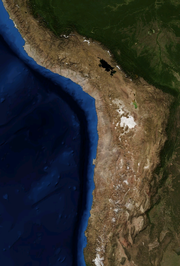
Earth environments that cannot support life are still instructive to astrobiologists in defining the limits of what organisms can endure. The heart of the Atacama desert
Atacama Desert
The Atacama Desert is a plateau in South America, covering a strip of land on the Pacific coast, west of the Andes mountains. It is, according to NASA, National Geographic and many other publications, the driest desert in the world...
, generally considered the driest place on Earth, appears unable to support life, but it has been subject to study by NASA for that reason: it provides a Mars analog and the moisture gradients along its edges are ideal for studying the boundary between sterility and habitability. The Atacama was the subject of study in 2003 that partly replicated experiments from the Viking landings on Mars in the 1970s; no DNA
DNA
Deoxyribonucleic acid is a nucleic acid that contains the genetic instructions used in the development and functioning of all known living organisms . The DNA segments that carry this genetic information are called genes, but other DNA sequences have structural purposes, or are involved in...
could be recovered from two soil samples, and incubation experiments were also negative for biosignature
Biosignature
A biosignature is any substance -such as an element, isotope, or molecule - or phenomenon that provides scientific evidence of past or present life. Measurable attributes of life include its complex physical and chemical structures and also its utilization of free energy and the production of...
s.
On 26 November 2011, NASA launched the Mars Science Laboratory
Mars Science Laboratory
The Mars Science Laboratory is a National Aeronautics and Space Administration mission with the aim to land and operate a rover named Curiosity on the surface of Mars. The MSL was launched November 26, 2011, at 10:02 EST and is scheduled to land on Mars at Gale Crater between August 6 and 20, 2012...
(MSL) rover which will search for past or present life on Mars
Mars
Mars is the fourth planet from the Sun in the Solar System. The planet is named after the Roman god of war, Mars. It is often described as the "Red Planet", as the iron oxide prevalent on its surface gives it a reddish appearance...
using a variety of scientific instruments. The MSL is scheduled to land on Mars at Gale Crater
Gale (crater)
Gale is a crater on Mars, near the border of the lowlands of Elysium Planitia at . It is 154 km in diameter and believed to be about 3.5 to 3.8 billion years old...
in August 2012.
Alternative star systems
In determining the feasibility of extraterrestrial life, astronomers had long focused their attention on stars like our own Sun. However, they have begun to explore the possibility that life might form in systems very unlike our own.Binary systems
Typical estimates often suggest that 50% or more of all stellar systems are binary systemsBinary star
A binary star is a star system consisting of two stars orbiting around their common center of mass. The brighter star is called the primary and the other is its companion star, comes, or secondary...
. This may be partly sample bias, as massive and bright stars tend to be in binaries and these are most easily observed and catalogued; a more precise analysis has suggested that the more common fainter stars are usually singular, and that up to two thirds of all stellar systems are therefore solitary.
The separation between stars in a binary may range from less than one astronomical unit
Astronomical unit
An astronomical unit is a unit of length equal to about or approximately the mean Earth–Sun distance....
(AU, the average Earth-Sun distance) to several hundred. In latter instances, the gravitational effects will be negligible on a planet orbiting an otherwise suitable star and habitability potential will not be disrupted unless the orbit is highly eccentric (see Nemesis
Nemesis (star)
Nemesis is a hypothetical hard-to-detect red dwarf star, white dwarf star or brown dwarf, originally postulated in 1984 to be orbiting the Sun at a distance of about 95,000 AU , somewhat beyond the Oort cloud, to explain a perceived cycle of mass extinctions in the geological record, which seem to...
, for example). However, where the separation is significantly less, a stable orbit may be impossible. If a planet’s distance to its primary exceeds about one fifth of the closest approach of the other star, orbital stability is not guaranteed. Whether planets might form in binaries at all had long been unclear, given that gravitational forces might interfere with planet formation. Theoretical work by Alan Boss
Alan Boss
Alan P. Boss is a United States astrophysicist and NASA scientist.-Life and career:Educated at the University of South Florida and the University of California, Santa Barbara, Boss is a prominent scientist in stellar and planetary system formation and the study of extrasolar planets who has made...
at the Carnegie Institution has shown that gas giants can form around stars in binary systems much as they do around solitary stars.
One study of Alpha Centauri
Alpha Centauri
Alpha Centauri is the brightest star in the southern constellation of Centaurus...
, the nearest star system to the Sun, suggested that binaries need not be discounted in the search for habitable planets. Centauri A and B have an 11 AU distance at closest approach (23 AU mean), and both should have stable habitable zones. A study of long-term orbital stability for simulated planets within the system shows that planets within approximately three AU of either star may remain stable (i.e. the semi-major axis
Semi-major axis
The major axis of an ellipse is its longest diameter, a line that runs through the centre and both foci, its ends being at the widest points of the shape...
deviating by less than 5%). The HZ for Centauri A is conservatively estimated at 1.2 to 1.3 AU and Centauri B at 0.73 to 0.74—well within the stable region in both cases.
Red dwarf systems
Red dwarf
According to the Hertzsprung-Russell diagram, a red dwarf star is a small and relatively cool star, of the main sequence, either late K or M spectral type....
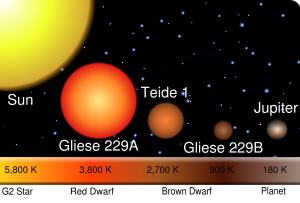
stars could help determine how common life in the universe might be, as red dwarfs make up between 70 to 90% of all the stars in the galaxy. Brown dwarf
Brown dwarf
Brown dwarfs are sub-stellar objects which are too low in mass to sustain hydrogen-1 fusion reactions in their cores, which is characteristic of stars on the main sequence. Brown dwarfs have fully convective surfaces and interiors, with no chemical differentiation by depth...
s are probably more numerous than red dwarfs. However, they are not generally classified as stars, and could never support life as we understand it, since what little heat they emit quickly disappears.
Astronomers for many years ruled out red dwarfs as potential abodes for life. Their small size (from 0.1 to 0.6 solar masses) means that their nuclear reaction
Nuclear reaction
In nuclear physics and nuclear chemistry, a nuclear reaction is semantically considered to be the process in which two nuclei, or else a nucleus of an atom and a subatomic particle from outside the atom, collide to produce products different from the initial particles...
s proceed exceptionally slowly, and they emit very little light (from 3% of that produced by the Sun to as little as 0.01%). Any planet in orbit around a red dwarf would have to huddle very close to its parent star to attain Earth-like surface temperatures; from 0.3 AU (just inside the orbit of Mercury
Mercury (planet)
Mercury is the innermost and smallest planet in the Solar System, orbiting the Sun once every 87.969 Earth days. The orbit of Mercury has the highest eccentricity of all the Solar System planets, and it has the smallest axial tilt. It completes three rotations about its axis for every two orbits...
) for a star like Lacaille 8760, to as little as 0.032 AU for a star like Proxima Centauri
Proxima Centauri
Proxima Centauri is a red dwarf star about 4.2 light-years distant in the constellation of Centaurus. It was discovered in 1915 by Robert Innes, the Director of the Union Observatory in South Africa, and is the nearest known star to the Sun, although it is too faint to be seen with the naked eye...
(such a world would have a year lasting just 6.3 days). At those distances, the star's gravity would cause tidal lock. One side of the planet would eternally face the star, while the other would always face away from it. The only way potential life could avoid either an inferno or a deep freeze would be if the planet had an atmosphere thick enough to transfer the star's heat from the day side to the night side. It was long assumed that such a thick atmosphere would prevent sunlight
Sunlight
Sunlight, in the broad sense, is the total frequency spectrum of electromagnetic radiation given off by the Sun. On Earth, sunlight is filtered through the Earth's atmosphere, and solar radiation is obvious as daylight when the Sun is above the horizon.When the direct solar radiation is not blocked...
from reaching the surface in the first place, preventing photosynthesis
Photosynthesis
Photosynthesis is a chemical process that converts carbon dioxide into organic compounds, especially sugars, using the energy from sunlight. Photosynthesis occurs in plants, algae, and many species of bacteria, but not in archaea. Photosynthetic organisms are called photoautotrophs, since they can...
.
This pessimism has been tempered by research. Studies by Robert Haberle and Manoj Joshi of NASA
NASA
The National Aeronautics and Space Administration is the agency of the United States government that is responsible for the nation's civilian space program and for aeronautics and aerospace research...
's Ames Research Center in California have shown that a planet's atmosphere (assuming it included greenhouse gases CO2
Carbon dioxide
Carbon dioxide is a naturally occurring chemical compound composed of two oxygen atoms covalently bonded to a single carbon atom...
and H2O) need only be 100 mbs, or 10% of Earth's atmosphere
Earth's atmosphere
The atmosphere of Earth is a layer of gases surrounding the planet Earth that is retained by Earth's gravity. The atmosphere protects life on Earth by absorbing ultraviolet solar radiation, warming the surface through heat retention , and reducing temperature extremes between day and night...
, for the star's heat to be effectively carried to the night side. This is well within the levels required for photosynthesis, though water would still remain frozen on the dark side in some of their models. Martin Heath of Greenwich Community College
Greenwich Community College
Greenwich Community College is a post-secondary educational institution located in Greenwich, South East of Greater London, England.The Quad at Greenwich College's Plumstead Centre features a tropical fish pond and a cannon which dates back to when the College was a training provider for the Royal...
, has shown that seawater, too, could be effectively circulated without freezing solid if the ocean basins were deep enough to allow free flow beneath the night side's ice cap. Further research—including a consideration of the amount of photosynthetically active radiation—suggested that tidally locked planets in red dwarf systems might at least be habitable for higher plants.
Size is not the only factor in making red dwarfs potentially unsuitable for life, however. On a red dwarf planet, photosynthesis on the night side would be impossible, since it would never see the sun. On the day side, because the sun does not rise or set, areas in the shadows of mountains would remain so forever. Photosynthesis
Photosynthesis
Photosynthesis is a chemical process that converts carbon dioxide into organic compounds, especially sugars, using the energy from sunlight. Photosynthesis occurs in plants, algae, and many species of bacteria, but not in archaea. Photosynthetic organisms are called photoautotrophs, since they can...
as we understand it would be complicated by the fact that a red dwarf produces most of its radiation in the infrared
Infrared
Infrared light is electromagnetic radiation with a wavelength longer than that of visible light, measured from the nominal edge of visible red light at 0.74 micrometres , and extending conventionally to 300 µm...
, and on the Earth the process depends on visible light. There are potential positives to this scenario. Numerous terrestrial ecosystems rely on chemosynthesis
Chemosynthesis
In biochemistry, chemosynthesis is the biological conversion of one or more carbon molecules and nutrients into organic matter using the oxidation of inorganic molecules or methane as a source of energy, rather than sunlight, as in photosynthesis...
rather than photosynthesis, for instance, which would be possible in a red dwarf system. A static primary star position removes the need for plants to steer leaves toward the sun, deal with changing shade/sun patterns, or change from photosynthesis to stored energy during night. Because of the lack of a day-night cycle, including the weak light of morning and evening, far more energy would be available at a given radiation level.
Red dwarfs are far more variable and violent than their more stable, larger cousins. Often they are covered in starspot
Starspot
Starspots are equivalent to sunspots but located on other stars. Spots the size of sunspots are very hard to detect since they are too small to cause fluctuations in brightness...
s that can dim their emitted light by up to 40% for months at a time, while at other times they emit gigantic flares that can double their brightness in a matter of minutes. Such variation would be very damaging for life, as it would not only destroy any complex organic molecules that could possibly form biological precursors, but also because it would blow off sizeable portions of the planet's atmosphere. For a planet around a red dwarf star to support life, it would require a rapidly rotating magnetic field to protect it from the flares. However, a tidally locked planet rotates only very slowly, and so cannot produce a geodynamo at its core. However, the violent flaring period of a red dwarf's life cycle is estimated to only last roughly the first 1.2 billion years of its existence. If a planet forms far away from a red dwarf so as to avoid tidal locking
Tidal locking
Tidal locking occurs when the gravitational gradient makes one side of an astronomical body always face another; for example, the same side of the Earth's Moon always faces the Earth. A tidally locked body takes just as long to rotate around its own axis as it does to revolve around its partner...
, and then migrates into the star's habitable zone after this turbulent initial period, it is possible that life may have a chance to develop.
There is, however, one major advantage that red dwarfs have over other stars as abodes for life: they live a long time. It took 4.5 billion years before humanity appeared on Earth, and life as we know it will see suitable conditions for at most 1 billion years more. Red dwarfs, by contrast, could live for trillions of years because their nuclear reactions are far slower than those of larger stars, meaning that life would have longer to evolve and survive. Further, while the odds of finding a planet in the habitable zone around any specific red dwarf are slim, the total amount of habitable zone around all red dwarfs combined is equal to the total amount around Sun-like stars given their ubiquity.
Massive stars
Recent research suggests that very large stars, greater than ~100 solar masses, could have planetary systems consisting of hundreds of Mercury-sized planets within the habitable zone. Such systems could also contain brown dwarfs and low-mass stars (~0.1-0.3 solar masses).The galactic neighborhood
Along with the characteristics of planets and their star systems, the wider galactic environment may also impact habitability. Scientists considered the possibility that particular areas of galaxies (galactic habitable zones) are better suited to life than others; the solar system in which we live, in the Orion Spur, on the Milky Way galaxy's edge is considered to be in a life-favorable spot:- It is not in a globular clusterGlobular clusterA globular cluster is a spherical collection of stars that orbits a galactic core as a satellite. Globular clusters are very tightly bound by gravity, which gives them their spherical shapes and relatively high stellar densities toward their centers. The name of this category of star cluster is...
where immense star densities are inimical to life, given excessive radiation and gravitational disturbance. Globular clusters are also primarily composed of older, probably metal-poor, stars. - It is not near an active gamma rayGamma rayGamma radiation, also known as gamma rays or hyphenated as gamma-rays and denoted as γ, is electromagnetic radiation of high frequency . Gamma rays are usually naturally produced on Earth by decay of high energy states in atomic nuclei...
source. - It is not near the galactic center where once again star densities increase the likelihood of ionizing radiation (e.g., from magnetars and supernovae). A supermassive black holeSupermassive black holeA supermassive black hole is the largest type of black hole in a galaxy, in the order of hundreds of thousands to billions of solar masses. Most, and possibly all galaxies, including the Milky Way, are believed to contain supermassive black holes at their centers.Supermassive black holes have...
is also believed to lie at the middle of the galaxy which might prove a danger to any nearby bodies. - The circular orbit of the Sun around the galactic center keeps it out of the way of the galaxy's spiral arms where once more intense radiation and gravitation may lead to disruption.
Thus, relative loneliness is ultimately what a life-bearing system needs. If the Sun were crowded amongst other systems, the chance of being fatally close to dangerous radiation sources would increase significantly. Further, close neighbours might disrupt the stability of various orbiting bodies such as Oort cloud
Oort cloud
The Oort cloud , or the Öpik–Oort cloud , is a hypothesized spherical cloud of comets which may lie roughly 50,000 AU, or nearly a light-year, from the Sun. This places the cloud at nearly a quarter of the distance to Proxima Centauri, the nearest star to the Sun...
and Kuiper Belt
Kuiper belt
The Kuiper belt , sometimes called the Edgeworth–Kuiper belt, is a region of the Solar System beyond the planets extending from the orbit of Neptune to approximately 50 AU from the Sun. It is similar to the asteroid belt, although it is far larger—20 times as wide and 20 to 200 times as massive...
objects, which can bring catastrophe if knocked into the inner solar system.
While stellar crowding proves disadvantageous to habitability, so too does extreme isolation. A star as metal-rich as the Sun would probably not have formed in the very outermost regions of the Milky Way given a decline in the relative abundance of metals and a general lack of star formation. Thus, a "suburban" location, such as our Solar System enjoys, is preferable to a Galaxy's center or farthest reaches.
Alternative biochemistries
While most investigations of extraterrestrial life start with the assumption that advanced life-forms must have similar requirements for life as on Earth, the hypothesis of other types of biochemistry suggests the possibility of lifeforms evolving around a different metabolic mechanism. In Evolving the AlienEvolving the Alien
Evolving the Alien: The Science of Extraterrestrial Life is a book about xenobiology by biologist Jack Cohen and mathematician Ian Stewart.In this book Cohen and Stewart argue that any investigation of extraterrestrial life is too restrictive and unimaginative...
, biologist
Biologist
A biologist is a scientist devoted to and producing results in biology through the study of life. Typically biologists study organisms and their relationship to their environment. Biologists involved in basic research attempt to discover underlying mechanisms that govern how organisms work...
Jack Cohen
Jack Cohen (scientist)
Jack Cohen, FIBiol is a British reproductive biologist also known for his popular science books and involvement with science fiction.-Life:...
and mathematician
Mathematician
A mathematician is a person whose primary area of study is the field of mathematics. Mathematicians are concerned with quantity, structure, space, and change....
Ian Stewart
Ian Stewart (mathematician)
Ian Nicholas Stewart FRS is a professor of mathematics at the University of Warwick, England, and a widely known popular-science and science-fiction writer. He is the first recipient of the , awarded jointly by the LMS and the IMA for his work on promoting mathematics.-Biography:Stewart was born...
argue astrobiology
Astrobiology
Astrobiology is the study of the origin, evolution, distribution, and future of life in the universe. This interdisciplinary field encompasses the search for habitable environments in our Solar System and habitable planets outside our Solar System, the search for evidence of prebiotic chemistry,...
, based on the Rare Earth hypothesis
Rare Earth hypothesis
In planetary astronomy and astrobiology, the Rare Earth hypothesis argues that the emergence of complex multicellular life on Earth required an improbable combination of astrophysical and geological events and circumstances...
, is restrictive and unimaginative. They suggest that Earth-like planets
Earth analog
An Earth analog is a theoretical other planet with conditions similar to Earth....
may be very rare, but non-carbon-based complex life could possibly emerge in other environments. The most frequently mentioned alternative to carbon is silicon-based life, while ammonia is sometimes suggested as an alternative solvent to water.
More speculative ideas have focused on bodies altogether different than Earth-like planets. Astronomer Frank Drake
Frank Drake
Frank Donald Drake PhD is an American astronomer and astrophysicist. He is most notable as one of the pioneers in the search for extraterrestrial intelligence, including the founding of SETI, mounting the first observational attempts at detecting extraterrestrial communications in 1961 in Project...
, a well-known proponent of the search for extraterrestrial life, imagined life on a neutron star
Neutron star
A neutron star is a type of stellar remnant that can result from the gravitational collapse of a massive star during a Type II, Type Ib or Type Ic supernova event. Such stars are composed almost entirely of neutrons, which are subatomic particles without electrical charge and with a slightly larger...
: submicroscopic "nuclear molecules" combining to form creatures with a life cycle millions of times quicker than Earth life. Called "imaginative and tongue-in-cheek," the idea gave rise to science fiction depictions. Carl Sagan
Carl Sagan
Carl Edward Sagan was an American astronomer, astrophysicist, cosmologist, author, science popularizer and science communicator in astronomy and natural sciences. He published more than 600 scientific papers and articles and was author, co-author or editor of more than 20 books...
, another optimist with regards to extraterrestrial life, considered the possibility of organisms that are always airborne within the high atmosphere of Jupiter in a 1976 paper. Cohen and Stewart also envisioned life in both a solar environment and in the atmosphere of a gas giant.
"Good Jupiters"
"Good Jupiters" are gas giant planets, like the solar system's JupiterJupiter
Jupiter is the fifth planet from the Sun and the largest planet within the Solar System. It is a gas giant with mass one-thousandth that of the Sun but is two and a half times the mass of all the other planets in our Solar System combined. Jupiter is classified as a gas giant along with Saturn,...
, that orbit their stars in circular orbits far enough away from the habitable zone to not disturb it but close enough to "protect" terrestrial planets in closer orbit in two critical ways. First, they help to stabilize the orbits, and thereby the climates, of the inner planets. Second, they keep the inner solar system relatively free of comets and asteroids that could cause devastating impacts. Jupiter orbits the Sun at about five times the distance between the Earth and the Sun. This is the rough distance we should expect to find good Jupiters elsewhere. Jupiter's "caretaker" role was dramatically illustrated in 1994 when Comet Shoemaker-Levy 9
Comet Shoemaker-Levy 9
Comet Shoemaker–Levy 9 was a comet that broke apart and collided with Jupiter in July 1994, providing the first direct observation of an extraterrestrial collision of solar system objects. This generated a large amount of coverage in the popular media, and the comet was closely observed by...
impacted the giant; had Jovian gravity not captured the comet, it may well have entered the inner solar system.
However, the story is not quite so clear cut. Recent research has shown that Jupiter's role in determining the rate at which objects hit the Earth is, at the very least, significantly more complicated than once thought. Whilst for the long-period comets (which contribute only a small fraction of the impact risk to the Earth) it is true that Jupiter acts as a shield, it actually seems to increase the rate at which asteroids and short-period comets are flung towards our planet. Were Jupiter absent, it seems likely that the Earth would actually experience significantly fewer impacts from potentially hazardous objects. By extension, it is becoming clear that the presence of Jupiter-like planets is no longer required as a pre-requisite for planetary habitability - indeed, our first searches for life beyond our Solar system might be better directed to systems where no such planet has formed, since in those systems, less material will be directed to impact on the potentially inhabited planets.
The role of Jupiter in the early history of our Solar system is somewhat better established, and the source of significantly less debate. Early in the Solar System's history, Jupiter is accepted as having played an important role in the hydration of our planet: it increased the eccentricity of asteroid belt
Asteroid belt
The asteroid belt is the region of the Solar System located roughly between the orbits of the planets Mars and Jupiter. It is occupied by numerous irregularly shaped bodies called asteroids or minor planets...
orbits and enabled many to cross Earth's orbit and supply the planet with important volatiles. Before Earth reached half its present mass, icy bodies from the Jupiter–Saturn region and small bodies from the primordial asteroid belt supplied water to the Earth due to the gravitational scattering of Jupiter and, to a lesser extent, Saturn
Saturn
Saturn is the sixth planet from the Sun and the second largest planet in the Solar System, after Jupiter. Saturn is named after the Roman god Saturn, equated to the Greek Cronus , the Babylonian Ninurta and the Hindu Shani. Saturn's astronomical symbol represents the Roman god's sickle.Saturn,...
. Thus, while the gas giants are now helpful protectors, they were once suppliers of critical habitability material.
In contrast, Jupiter-sized bodies that orbit too close to the habitable zone but not in it (as in 47 Ursae Majoris
47 Ursae Majoris
47 Ursae Majoris is a solar analog, yellow dwarf star approximately 46 light-years away from Earth in the constellation of Ursa Major. , it has been confirmed that three Jupiter-like extrasolar planets orbit the star...
), or have a highly elliptical orbit that crosses the habitable zone (like 16 Cygni B
16 Cygni
16 Cygni or 16 Cyg is a triple star system approximately 70 light-years away from Earth in the constellation of Cygnus. It consists of two Sun-like yellow dwarf stars, 16 Cygni A and 16 Cygni B, together with a red dwarf, 16 Cygni C...
) make it very difficult for an Earthlike planet to exist in the system. See the discussion of a stable habitable zone above.
Life's impact on habitability
A supplement to the factors that support life's emergence is the notion that life itself, once formed, becomes a habitability factor in its own right. An important Earth example was the production of oxygen by ancient cyanobacteria, and eventually photosynthesizing plants, leading to a radical change in the composition of Earth’s atmosphere. This oxygen would prove fundamental to the respiration of later animal species.This interaction between life and subsequent habitability has been explored in various ways. The Gaia hypothesis
Gaia hypothesis
The Gaia hypothesis, also known as Gaia theory or Gaia principle, proposes that all organisms and their inorganic surroundings on Earth are closely integrated to form a single and self-regulating complex system, maintaining the conditions for life on the planet.The scientific investigation of the...
, a class of scientific models of the geo-biosphere pioneered by Sir James Lovelock
James Lovelock
James Lovelock, CH, CBE, FRS is an independent scientist, environmentalist and futurologist who lives in Devon, England. He is best known for proposing the Gaia hypothesis, which postulates that the biosphere is a self-regulating entity with the capacity to keep our planet healthy by controlling...
in 1975, argues that life as a whole fosters and maintains suitable conditions for itself by helping to create a planetary environment suitable for its continuity; at its most dramatic, Gaia suggests that planetary systems behave similarly to a kind of organism. The most successful life forms change the composition of the atmosphere
Atmosphere
An atmosphere is a layer of gases that may surround a material body of sufficient mass, and that is held in place by the gravity of the body. An atmosphere may be retained for a longer duration, if the gravity is high and the atmosphere's temperature is low...
, water
Hydrosphere
A hydrosphere in physical geography describes the combined mass of water found on, under, and over the surface of a planet....
, and soil
Soil
Soil is a natural body consisting of layers of mineral constituents of variable thicknesses, which differ from the parent materials in their morphological, physical, chemical, and mineralogical characteristics...
in ways that make their continued existence more certain—a controversial extension of the accepted laws of ecology
Ecology
Ecology is the scientific study of the relations that living organisms have with respect to each other and their natural environment. Variables of interest to ecologists include the composition, distribution, amount , number, and changing states of organisms within and among ecosystems...
.
Similarly, David Grinspoon
David Grinspoon
David H. Grinspoon is an American astrobiologist. He is the current curator of Astrobiology at the Denver Museum of Nature and Science. He has published numerous works, such as Lonely Planets: The Natural Philosophy of Alien Life, which won the 2004 PEN literary award for nonfiction.Currently, he...
has suggested a "Living Worlds hypothesis" in which our understanding of what constitutes habitability cannot be separated from life already extant on a planet. Planets that are geologically and meteorologically alive are much more likely to be biologically alive as well and "a planet and its life will co-evolve."
In their 2004 book The Privileged Planet
The Privileged Planet
The Privileged Planet: How Our Place in the Cosmos is Designed for Discovery is a book by Guillermo Gonzalez and Jay Richards which claims scientific evidence for intelligent design...
, astronomer Guillermo Gonzalez
Guillermo Gonzalez (astronomer)
Guillermo Gonzalez is an astrophysicist, proponent of intelligent design, and a professor at Grove City College, a Christian school, in Grove City, Pennsylvania...
and philosopher Jay Richards
Jay Richards
Jay Wesley Richards is an American analytic philosopher and advocate of Intelligent Design. He is the Director of Acton Media and a Research Fellow at the Acton Institute, and Program Director of the Discovery Institute's Center for Science and Culture , which has as its primary role the advocacy...
explore the possible link between the habitability of a planet and its suitability for observing the rest of the universe. The book was criticized as an example of intelligent design
Intelligent design
Intelligent design is the proposition that "certain features of the universe and of living things are best explained by an intelligent cause, not an undirected process such as natural selection." It is a form of creationism and a contemporary adaptation of the traditional teleological argument for...
and for its lack of scientific credibility.
Humans have had a non-trivial impact on Earth's environment.
Further reading
- Abstracts from the Astrobiology Science Conference 2004.
- Cohen, Jack and Ian Stewart. Evolving the Alien: The Science of Extraterrestrial Life, Ebury Press, 2002. ISBN 0-09-187927-2
- Fogg, Martyn J.Martyn J. Fogg-Biography:After becoming a dental surgeon, Fogg earned a degree in physics and geology and a master's degree in astrophysics, and is working on a Ph.D. in planetary science. Fogg lives in London.-Contributions to Planetary Engineering:...
, ed. "Terraforming" (entire special issue) Journal of the British Interplanetary Society, April 1991 - Fogg, Martyn J. Terraforming: Engineering Planetary Environments, SAE International, 1995. ISBN 1-56091-609-5
- Gonzalez, Guillermo and Richards, Jay W. The Privileged Planet, Regnery, 2004. ISBN 0-89526-065-4
- Grinspoon, David. Lonely Planets: The Natural Philosophy of Alien Life, HarperCollins, 2004.
- Lovelock, James. Gaia: A New Look at Life on Earth. ISBN 0-19-286218-9
- Schmidt, Stanley and Robert Zubrin, eds. Islands in the Sky, Wiley, 1996. ISBN 0-471-13561-5
- Ward, Peter and Donald Brownlee. Rare Earth: Why Complex Life is Uncommon in the Universe, Springer, 2000. ISBN 0-387-98701-0
- Webb, Stephen If The Universe Is Teeming With Aliens ... Where Is Everybody? Fifty Solutions to the Fermi Paradox and the Problem of Extraterrestrial Life New York: January 2002 Springer-Verlag ISBN 978-0-387-95501-8