

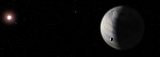
Gliese 581 d

Encyclopedia
Gliese 581 d or Gl 581 d is an extrasolar planet
orbit
ing the star
Gliese 581
approximately 20 light-year
s away in the constellation
of Libra
. It is the third planet discovered in the system and the fifth in order from the star.
Because of its mass, at least 5.6 times that of Earth, the planet is classified as a super-Earth
. Originally believed to be outside the habitable zone, in late April 2009 new observations made by the original discovery team concluded that the planet is on the outskirts of the habitable zone
where liquid water may exist. In May 2011 researchers in France
released a study of a three-dimensional climate simulation concluding that it is plausible that the planet has a stable atmosphere and liquid water on the surface, concurring that it is the first discovered terrestrial-mass exoplanet in the habitable zone, followed by HD 85512 b
several months later.
of the Geneva Observatory used the HARPS instrument on the European Southern Observatory
3.6 meter telescope
in La Silla, Chile
to discover the planet in 2007. Udry's team employed the radial velocity
technique, in which the mass
of a planet
is determined based on the small perturbations it induces in its parent star’s orbit
via gravity.
show that the system becomes unstable if the masses of the planets exceed 1.6 – 2 times the minimum values. Using earlier minimum mass values for Gliese 581 d, this implies an upper mass limit for Gliese 581 d of 13.8 Earth masses.
of its star. However, in 2009 the original discovery team revised its original estimate of the planet's orbital parameters, finding that it orbits closer to its star than originally believed. They concluded that the planet is within the habitable zone where liquid water could exist, corroborated in 2011 by a climate simulation study. According to Stéphane Udry
, "It could be covered by a 'large and deep ocean'; it is the first serious ocean planet
candidate."
On average, the light that Gliese 581 d receives from its star has about 30% of the intensity of sunlight on Earth. By comparison, sunlight on Mars has about 40% of the intensity of that on Earth. That might seem to suggest that Gliese 581 d is too cold to support liquid water and hence is inhospitable to life. However, an atmospheric greenhouse effect can significantly raise planetary temperatures. For example, Earth's own mean temperature would be about −18°C without any greenhouse gases, ranging from around 100°C on the day side to −150°C at night, much like that found on the moon
. If the atmosphere of Gliese 581 d produces a sufficiently large greenhouse effect
, and the planet's geophysics stabilizes the CO2 levels (as Earth's does via plate tectonics), then the surface temperature
might permit a liquid water cycle, conceivably allowing the planet to support life. In recent years, discoveries have led scientists to believe that Gliese 581d may be tidally locked, which means that it has permanent day and night side.
Gliese 581 d is probably too massive to be made only of rocky material, but it is speculated that it is an icy planet that has migrated closer to the star.
Calculations by Barnes et al. suggest, however, that tidal heating
is too low to keep plate tectonics
active on the planet, unless radiogenic heating is somewhat higher than expected.
Bebo
beamed A Message From Earth
, a high-power transmission at Gliese 581, using the RT-70 radio telescope
belonging to the National Space Agency of Ukraine
. This transmission is due to arrive in the Gliese 581 system's vicinity by the year 2029; the earliest possible arrival for a response, should there be one, would be in 2049.
As part of the 2009 National Science Week
celebrations in Australia, Cosmos Magazine launched a website called Hello From Earth
to collect messages for transmission to Gliese 581d. The maximum length of the messages was 160 characters, and they were restricted to the English language
. In total, 25,880 messages were collected from 195 countries around the world. The messages were transmitted from the DSS-43 70 m radio telescope at the Canberra Deep Space Communication Complex
at Tidbinbilla, Australia
on the 28th of August, 2009.
Extrasolar planet
An extrasolar planet, or exoplanet, is a planet outside the Solar System. A total of such planets have been identified as of . It is now known that a substantial fraction of stars have planets, including perhaps half of all Sun-like stars...
orbit
Orbit
In physics, an orbit is the gravitationally curved path of an object around a point in space, for example the orbit of a planet around the center of a star system, such as the Solar System...
ing the star
Star
A star is a massive, luminous sphere of plasma held together by gravity. At the end of its lifetime, a star can also contain a proportion of degenerate matter. The nearest star to Earth is the Sun, which is the source of most of the energy on Earth...
Gliese 581
Gliese 581
Gliese 581 is a red dwarf star with spectral type M3V, located 20.3 light years away from Earth in the constellation Libra. Its estimated mass is about a third of that of the Sun, and it is the 89th closest known star system to the Sun. Observations suggest that the star has at least six planets:...
approximately 20 light-year
Light-year
A light-year, also light year or lightyear is a unit of length, equal to just under 10 trillion kilometres...
s away in the constellation
Constellation
In modern astronomy, a constellation is an internationally defined area of the celestial sphere. These areas are grouped around asterisms, patterns formed by prominent stars within apparent proximity to one another on Earth's night sky....
of Libra
Libra (constellation)
Libra is a constellation of the zodiac. Its name is Latin for weighing scales, and its symbol is . It is fairly faint, with no first magnitude stars, and lies between Virgo to the west and Scorpius to the east.-Notable features:]...
. It is the third planet discovered in the system and the fifth in order from the star.
Because of its mass, at least 5.6 times that of Earth, the planet is classified as a super-Earth
Super-Earth
A super-Earth is an extrasolar planet with a mass higher than Earth's, but substantially below the mass of the Solar System's gas giants. The term super-Earth refers only to the mass of the planet, and does not imply anything about the surface conditions or habitability...
. Originally believed to be outside the habitable zone, in late April 2009 new observations made by the original discovery team concluded that the planet is on the outskirts of the habitable zone
Habitable zone
In astronomy and astrobiology, a habitable zone is an umbrella term for regions that are considered favourable to life. The concept is inferred from the empirical study of conditions favourable for Life on Earth...
where liquid water may exist. In May 2011 researchers in France
France
The French Republic , The French Republic , The French Republic , (commonly known as France , is a unitary semi-presidential republic in Western Europe with several overseas territories and islands located on other continents and in the Indian, Pacific, and Atlantic oceans. Metropolitan France...
released a study of a three-dimensional climate simulation concluding that it is plausible that the planet has a stable atmosphere and liquid water on the surface, concurring that it is the first discovered terrestrial-mass exoplanet in the habitable zone, followed by HD 85512 b
HD 85512 b
HD 85512 b is an extrasolar planet orbiting the K-type star Gliese 370 approximately 36 light-years away in the constellation of Vela ....
several months later.
Discovery
A team of astronomers led by Stéphane UdryStéphane Udry
Stéphane Udry is an astronomer at the University of Geneva in Switzerland, whose current work is primarily the search for extra-solar planets. He and his team, in 2007, discovered a possibly terrestrial planet in the habitable zone of the red dwarf star Gliese 581, approximately 20 light years...
of the Geneva Observatory used the HARPS instrument on the European Southern Observatory
European Southern Observatory
The European Southern Observatory is an intergovernmental research organisation for astronomy, supported by fifteen countries...
3.6 meter telescope
Telescope
A telescope is an instrument that aids in the observation of remote objects by collecting electromagnetic radiation . The first known practical telescopes were invented in the Netherlands at the beginning of the 1600s , using glass lenses...
in La Silla, Chile
Chile
Chile ,officially the Republic of Chile , is a country in South America occupying a long, narrow coastal strip between the Andes mountains to the east and the Pacific Ocean to the west. It borders Peru to the north, Bolivia to the northeast, Argentina to the east, and the Drake Passage in the far...
to discover the planet in 2007. Udry's team employed the radial velocity
Radial velocity
Radial velocity is the velocity of an object in the direction of the line of sight . In astronomy, radial velocity most commonly refers to the spectroscopic radial velocity...
technique, in which the mass
Mass
Mass can be defined as a quantitive measure of the resistance an object has to change in its velocity.In physics, mass commonly refers to any of the following three properties of matter, which have been shown experimentally to be equivalent:...
of a planet
Planet
A planet is a celestial body orbiting a star or stellar remnant that is massive enough to be rounded by its own gravity, is not massive enough to cause thermonuclear fusion, and has cleared its neighbouring region of planetesimals.The term planet is ancient, with ties to history, science,...
is determined based on the small perturbations it induces in its parent star’s orbit
Orbit
In physics, an orbit is the gravitationally curved path of an object around a point in space, for example the orbit of a planet around the center of a star system, such as the Solar System...
via gravity.
Physical characteristics
The motion of the parent star indicates a minimum mass for Gliese 581 d of 5.6 Earth masses (earlier analyses gave higher values). Dynamical simulations of the Gliese 581 system assuming that the orbits of the three planets are coplanarCoplanarity
In geometry, a set of points in space is coplanar if all the points lie in the same geometric plane. For example, three distinct points are always coplanar; but a fourth point or more added in space can exist in another plane, incoplanarly....
show that the system becomes unstable if the masses of the planets exceed 1.6 – 2 times the minimum values. Using earlier minimum mass values for Gliese 581 d, this implies an upper mass limit for Gliese 581 d of 13.8 Earth masses.
Climate and habitability
It was originally thought that Gliese 581 d orbits outside the habitable zoneHabitable zone
In astronomy and astrobiology, a habitable zone is an umbrella term for regions that are considered favourable to life. The concept is inferred from the empirical study of conditions favourable for Life on Earth...
of its star. However, in 2009 the original discovery team revised its original estimate of the planet's orbital parameters, finding that it orbits closer to its star than originally believed. They concluded that the planet is within the habitable zone where liquid water could exist, corroborated in 2011 by a climate simulation study. According to Stéphane Udry
Stéphane Udry
Stéphane Udry is an astronomer at the University of Geneva in Switzerland, whose current work is primarily the search for extra-solar planets. He and his team, in 2007, discovered a possibly terrestrial planet in the habitable zone of the red dwarf star Gliese 581, approximately 20 light years...
, "It could be covered by a 'large and deep ocean'; it is the first serious ocean planet
Ocean planet
An ocean planet is a hypothetical type of planet whose surface is completely covered with an ocean of water.Planetary objects that form in the outer solar system begin as a comet-like mixture of roughly half water and half rock by mass...
candidate."
On average, the light that Gliese 581 d receives from its star has about 30% of the intensity of sunlight on Earth. By comparison, sunlight on Mars has about 40% of the intensity of that on Earth. That might seem to suggest that Gliese 581 d is too cold to support liquid water and hence is inhospitable to life. However, an atmospheric greenhouse effect can significantly raise planetary temperatures. For example, Earth's own mean temperature would be about −18°C without any greenhouse gases, ranging from around 100°C on the day side to −150°C at night, much like that found on the moon
Moon
The Moon is Earth's only known natural satellite,There are a number of near-Earth asteroids including 3753 Cruithne that are co-orbital with Earth: their orbits bring them close to Earth for periods of time but then alter in the long term . These are quasi-satellites and not true moons. For more...
. If the atmosphere of Gliese 581 d produces a sufficiently large greenhouse effect
Greenhouse effect
The greenhouse effect is a process by which thermal radiation from a planetary surface is absorbed by atmospheric greenhouse gases, and is re-radiated in all directions. Since part of this re-radiation is back towards the surface, energy is transferred to the surface and the lower atmosphere...
, and the planet's geophysics stabilizes the CO2 levels (as Earth's does via plate tectonics), then the surface temperature
Temperature
Temperature is a physical property of matter that quantitatively expresses the common notions of hot and cold. Objects of low temperature are cold, while various degrees of higher temperatures are referred to as warm or hot...
might permit a liquid water cycle, conceivably allowing the planet to support life. In recent years, discoveries have led scientists to believe that Gliese 581d may be tidally locked, which means that it has permanent day and night side.
Gliese 581 d is probably too massive to be made only of rocky material, but it is speculated that it is an icy planet that has migrated closer to the star.
Calculations by Barnes et al. suggest, however, that tidal heating
Tidal heating
Tidal heating occurs through the tidal friction processes: orbital and rotational energy are dissipated as heat in the crust of the moons and planets involved. Io, a moon of Jupiter, is the most volcanically active body in the solar system, with no impact craters surviving on its surface...
is too low to keep plate tectonics
Plate tectonics
Plate tectonics is a scientific theory that describes the large scale motions of Earth's lithosphere...
active on the planet, unless radiogenic heating is somewhat higher than expected.
Messages from Earth
In October 2008, members of the networking websiteSocial network service
A social networking service is an online service, platform, or site that focuses on building and reflecting of social networks or social relations among people, who, for example, share interests and/or activities. A social network service consists of a representation of each user , his/her social...
Bebo
Bebo
Bebo is a social networking website launched in July 2005. It is currently owned and operated by Criterion Capital Partners after taking over from AOL in June 2010....
beamed A Message From Earth
A Message From Earth
A Message from Earth is a high-powered digital radio signal that was sent on 9 October 2008 towards Gliese 581 c, a large terrestrial extrasolar planet orbiting the red dwarf star Gliese 581. The signal is a digital time capsule containing 501 messages that were selected through a competition on...
, a high-power transmission at Gliese 581, using the RT-70 radio telescope
Radio telescope
A radio telescope is a form of directional radio antenna used in radio astronomy. The same types of antennas are also used in tracking and collecting data from satellites and space probes...
belonging to the National Space Agency of Ukraine
National Space Agency of Ukraine
The State Space Agency of Ukraine is the Ukrainian government agency responsible for space policy and programs....
. This transmission is due to arrive in the Gliese 581 system's vicinity by the year 2029; the earliest possible arrival for a response, should there be one, would be in 2049.
As part of the 2009 National Science Week
National Science Week
National Science Week refers to series of science-related events for the general public which are held in a specific countries during a designated week of the year...
celebrations in Australia, Cosmos Magazine launched a website called Hello From Earth
Hello From Earth
HELLO FROM EARTH is an Interstellar Radio Message . It was sent from the 70-meter dish at NASA Deep Space Station 43 , at midday on Friday 28 August 2009...
to collect messages for transmission to Gliese 581d. The maximum length of the messages was 160 characters, and they were restricted to the English language
English language
English is a West Germanic language that arose in the Anglo-Saxon kingdoms of England and spread into what was to become south-east Scotland under the influence of the Anglian medieval kingdom of Northumbria...
. In total, 25,880 messages were collected from 195 countries around the world. The messages were transmitted from the DSS-43 70 m radio telescope at the Canberra Deep Space Communication Complex
Canberra Deep Space Communication Complex
The Canberra Deep Space Communication Complex is a ground station that is located in Australia at Tidbinbilla in the Paddys River valley, about half an hour's drive out of Canberra in the Australian Capital Territory. The complex is part of the Deep Space Network run by NASA's Jet Propulsion...
at Tidbinbilla, Australia
Australia
Australia , officially the Commonwealth of Australia, is a country in the Southern Hemisphere comprising the mainland of the Australian continent, the island of Tasmania, and numerous smaller islands in the Indian and Pacific Oceans. It is the world's sixth-largest country by total area...
on the 28th of August, 2009.