
All Topics  
Oort cloud

 
Oort Cloud

   Email Print
   Bookmark   Link


Oort cloud


The Oort cloud ( ort, alternatively the Öpik-Oort Cloud ) is a hypothetical spherical cloud of comet
Comet

A comet is a Small Solar System body that orbits the Sun and, when close enough to the Sun, exhibits a visible coma or a tail?both primarily from the effects of solar radiation upon the Comet nucleus....
s which may lie roughly 50 000 AU
Astronomical unit

An astronomical unit is a unit of length based on the mean distance from the Earth to the Sun. The precise value of the AU is currently accepted as 149,597,870,691 Plus-minus sign 6 metres ....
, or nearly a light-year
Light-year

A light-year or light year is a Units of measurement of length, equal to just under ten orders_of_magnitude_%28numbers%29#1012 kilometres....
, from the Sun
Sun

The Sun , a G V star, is the star at the center of the Solar System. The Earth and other matter orbit the Sun, which by itself accounts for about 98.6% of the Solar System's mass....
. This places the cloud at nearly a quarter of the distance to Proxima Centauri
Proxima Centauri

Proxima Centauri is a red dwarf star approximately 4.2 light-years distant in the constellation of Centaurus. It was discovered in 1915 by Robert Innes, the Director of the Union Observatory in South Africa....
, the nearest star
Star

A star is a massive, luminous ball of Plasma that is held together by its own gravity. The nearest star to Earth is the Sun, which is the source of most of the energy on Earth....
 to the Sun.


Discussion
Ask a question about 'Oort cloud'
Start a new discussion about 'Oort cloud'
Answer questions from other users
Full Discussion Forum


Recent Posts


Encyclopedia


Kuiper Oort
The Oort cloud ( ort, alternatively the Öpik-Oort Cloud ) is a hypothetical spherical cloud of comet
Comet

A comet is a Small Solar System body that orbits the Sun and, when close enough to the Sun, exhibits a visible coma or a tail?both primarily from the effects of solar radiation upon the Comet nucleus....
s which may lie roughly 50 000 AU
Astronomical unit

An astronomical unit is a unit of length based on the mean distance from the Earth to the Sun. The precise value of the AU is currently accepted as 149,597,870,691 Plus-minus sign 6 metres ....
, or nearly a light-year
Light-year

A light-year or light year is a Units of measurement of length, equal to just under ten orders_of_magnitude_%28numbers%29#1012 kilometres....
, from the Sun
Sun

The Sun , a G V star, is the star at the center of the Solar System. The Earth and other matter orbit the Sun, which by itself accounts for about 98.6% of the Solar System's mass....
. This places the cloud at nearly a quarter of the distance to Proxima Centauri
Proxima Centauri

Proxima Centauri is a red dwarf star approximately 4.2 light-years distant in the constellation of Centaurus. It was discovered in 1915 by Robert Innes, the Director of the Union Observatory in South Africa....
, the nearest star
Star

A star is a massive, luminous ball of Plasma that is held together by its own gravity. The nearest star to Earth is the Sun, which is the source of most of the energy on Earth....
 to the Sun. The Kuiper belt
Kuiper belt

The Kuiper belt , sometimes called the Edgeworth-Kuiper belt, is a region of the Solar System beyond the planets extending from the orbit of Neptune to approximately 55 Astronomical unit from the Sun....
 and scattered disc
Scattered disc

The scattered disc is a distant region of the Solar System that is sparsely populated by icy minor planets known as scattered disc objects ; a subset of the broader family of trans-Neptunian objects ....
, the other two known reservoirs of trans-Neptunian object
Trans-Neptunian object

A trans-Neptunian object is any object in the solar system that orbits the sun at a greater distance on average than Neptune . The Kuiper belt, scattered disk, and Oort cloud are three divisions of this volume of space....
s, are less than one thousandth the Oort cloud's distance. The outer extent of the Oort cloud defines the gravitational boundary of our Solar System
Solar System

The Solar System consists of the Sun and those Astronomical object bound to it by gravity: the eight planets and five dwarf planets, their 173 known Natural satellite, and billions of Small Solar System body....
.

The Oort cloud is thought to comprise two separate regions: a spherical outer Oort cloud and a disc-shaped inner Oort cloud, or Hills cloud
Hills cloud

The Hills Cloud, also called the Inner Oort Cloud and Inner Cloud is, in astronomy, a vast hypothetical spherical body interior to the Oort Cloud, whose outer border would be located at around 2 to 3 Astronomical Units from the Sun, and whose inner border, less well defined, is hypothetically located at AU, well beyond planet a...
. Objects in the Oort cloud are largely composed of ices
Volatiles

In planetary science, volatiles, are that group of elements and compounds with low boiling points that are associated with a planet's or moon's crust and/or atmosphere....
, such as water
Water

Water is a common chemical substance that is essential for the survival of all known forms of life. In typical usage, water refers only to its liquid form or States of matter, but the substance also has a solid state, ice, and a gaseous state, water vapor or steam....
, ammonia
Ammonia

Ammonia is a chemical compound with the chemical formula nitrogenhydrogen. It is normally encountered as a gas with a characteristic pungent odor....
, and methane
Methane

Methane is a chemical compound with the molecular formula . It is the simplest alkane, and the principal component of natural gas. Methane's bond angles are 109.5 degrees....
. Astronomers believe that the matter comprising the Oort cloud formed closer to the Sun and was scattered far out into space by the gravitational effects
Gravitation

Gravitation is a natural phenomenon that gives weight to objects. In everyday life, attraction due to gravity is the result of the presence of relatively large bodies, such as the Earth and the Moon....
 of the giant planets
Gas giant

A gas giant is a large planet that is not primarily composed of Rock or other solid matter. There are four gas giants in our Solar System: Jupiter, Saturn, Uranus, and Neptune....
 early in the Solar System's evolution.

Although no confirmed direct observations of the Oort cloud have been made, astronomers believe that it is the source of all long-period and Halley-type comet
Comet

A comet is a Small Solar System body that orbits the Sun and, when close enough to the Sun, exhibits a visible coma or a tail?both primarily from the effects of solar radiation upon the Comet nucleus....
s entering the inner Solar System and many of the Centaurs
Centaur (planetoid)

The centaurs are an unstable orbital class of minor planets named after the mythological race of centaurs. The name was chosen because they behave as half asteroid and half comet....
 and Jupiter
Jupiter

Jupiter is the fifth planet from the Sun and the Solar system by size planet within the Solar System. It is two and a half times as massive as all of the other planets in our Solar System combined....
-family comets as well. The outer Oort cloud is only loosely bound to the Solar System, and thus is easily affected by the gravitational pull both of passing stars and of the Milky Way
Milky Way

The Milky Way, sometimes called simply the Galaxy, is the galaxy in which the Solar System is located. It is a barred spiral galaxy that is part of the Local Group of galaxies....
 galaxy itself. These forces occasionally dislodge comets from their orbits within the cloud and send them towards the inner Solar System. Based on their orbits, most of the short-period comets may come from the scattered disc, but some may still have originated from the Oort Cloud. Although the Kuiper belt and the farther scattered disc have been observed and mapped, only four currently known trans-Neptunian objects—90377 Sedna
90377 Sedna

90377 Sedna is a trans-Neptunian object and a likely dwarf planet, discovered by Michael E. Brown , Chad Trujillo and David L. Rabinowitz on November 14, 2003....
, 2000 CR105
2000 CR105

, also written as ' 2000 CR105', is currently the fourth most distant known object in the solar system after Eris , 90377 Sedna, and 2004 XR190....
, 2006 SQ372
2006 SQ372

is a small trans-Neptunian object discovered through the Sloan Digital Sky Survey by Andrew Becker , Nathan Kaib and coworkers on images first taken on September 27, 2006 ....
 and 2008 KV42
2008 KV42

, nicknamed Drac , is a trans-Neptunian object orbiting the Sun backwards and almost perpendicular to the ecliptic: it has a 104 degree inclination....
—are considered possible members of the inner Oort cloud.

Hypothesis


In 1932, Estonia
Estonia

Estonia , officially the Republic of Estonia is a country in the Baltic region of Northern Europe. It is bordered to the north by Finland across the Gulf of Finland, to the west by Sweden across the Baltic Sea, to the south by Latvia , and to the east by the Russia ....
n astronomer Ernst Öpik
Ernst Öpik

Ernst Julius ?pik was a notable Estonian astronomer and astrophysicist, who spent the last part of his career at the Armagh Observatory in Northern Ireland....
 postulated that long-period comets originated in an orbit
ORBit

ORBit is a Common Object Request Broker Architecture 2.4 compliant Object Request Broker . It features mature C , C++ and Python bindings, and less developed bindings for Perl, Lisp , Pascal , Ruby , and Tcl....
ing cloud at the outermost edge of the Solar System. In 1950, the idea was independently revived by Dutch
Netherlands

The Netherlands is a country that is part of the Kingdom of the Netherlands. It is a parliamentary democratic constitutional monarchy. The Netherlands is located in North-West Europe, and bordered by the North Sea to the north and west, Belgium to the south, and Germany to the east....
 astronomer Jan Hendrik Oort
Jan Oort

Jan Hendrik Oort was a Netherlands astronomer. He stimulated radio astronomy. The Oort cloud of comets bears his name.Oort was born in Franeker, Friesland and studied in Groningen with Jacobus Cornelius Kapteyn....
 as a means to resolve a paradox: over the course of the Solar System's existence, the orbits of comets are unstable; eventually, dynamics dictate that a comet must either collide with the Sun or a planet
Planet

A planet , as 2006 definition of planet by the International Astronomical Union , is a celestial body orbiting a star or Stellar evolution#Stellar remnants that is massive enough to be rounded by its own gravity, is not massive enough to cause thermonuclear fusion, and has cleared the neighbourhood of planetesimals....
, or else be ejected from the Solar System by planetary perturbations
Perturbation (astronomy)

Perturbation is a term used in astronomy to describe alterations to an object's orbit caused by gravity interactions with bodies external to the system formed by the object and its parent body ....
. Moreover, their volatile
Volatiles

In planetary science, volatiles, are that group of elements and compounds with low boiling points that are associated with a planet's or moon's crust and/or atmosphere....
 composition means that as they repeatedly approach the Sun, radiation
Electromagnetic radiation

Electromagnetic radiation takes the form of wave propagation waves in a vacuum or in matter. EM radiation has an electric field and magnetic field component which oscillate in phase perpendicular to each other and to the direction of energy Wave propagation....
 gradually boils off the volatiles until the comet splits or develops an insulating crust that prevents further outgassing
Outgassing

Outgassing is the slow release of a gas that was trapped, freezing, Absorption or adsorbed in some material....
. Thus, reasoned Oort, a comet could not have formed on its current orbit, and must have been held in an outer reservoir for almost all of its existence.

There are two main classes of comet: short-period comets (also called ecliptic
Ecliptic

The ecliptic is the apparent path that the Sun traces out in the sky during the year. As it appears to move in the sky in relation to the stars, the apparent path aligns with the planets throughout the course of the year....
 comets) and long-period comets (also called nearly isotropic
Isotropy

Isotropy is uniformity in all directions. Precise definitions depend on the subject area. The word is made up from Greek iso and tropos ....
 comets). Ecliptic comets have relatively short orbits, below 10 AU, and follow the ecliptic plane, the same plane in which the planets lie. Nearly isotropic comets have very long orbits, on the order of thousands of AU, and appear from every corner of the sky. Oort noted that there was a peak in numbers of nearly isotropic comets with aphelia
Apsis

In celestial mechanics, an apsis, plural apsides is the point of greatest or least distance of the elliptical orbit of an object from its center of attraction, which is generally the center of mass of the system....
—their farthest distance from the Sun—of roughly 20 000 AU, which suggested a reservoir at that distance with a spherical, isotropic distribution. Those relatively rare comets with orbits of about 10 000 AU have probably gone through one or more orbits through the Solar System and have had their orbits drawn inward by the gravity of the planets.

Structure and composition

The Oort cloud is thought to occupy a vast space from somewhere between 2000 and 5000 AU to as far as 50 000 AU from the Sun. Some estimates place the outer edge at between 100 000 and 200 000 AU. The region can be subdivided into a spherical outer Oort cloud (20 000–50 000 AU), and a doughnut-shaped inner Oort cloud (2 000–20 000 AU). The outer cloud is only weakly bound to the Sun and supplies the long-period (and possibly Halley-type) comets to inside the orbit of Neptune
NEPTUNE

=Overview=The project, along with sister project, VENUS, offers a unique approach to ocean science. Traditionally, ocean scientists have relied on infrequent ship cruises or space-based satellites to carry out their research....
. The inner Oort cloud is also known as the Hills Cloud
Hills cloud

The Hills Cloud, also called the Inner Oort Cloud and Inner Cloud is, in astronomy, a vast hypothetical spherical body interior to the Oort Cloud, whose outer border would be located at around 2 to 3 Astronomical Units from the Sun, and whose inner border, less well defined, is hypothetically located at AU, well beyond planet a...
, named after J. G. Hills, who proposed its existence in 1981. Models predict that the inner cloud should have tens or hundreds of times as many cometary nuclei as the outer halo; it is seen as a possible source of new comet
Comet

A comet is a Small Solar System body that orbits the Sun and, when close enough to the Sun, exhibits a visible coma or a tail?both primarily from the effects of solar radiation upon the Comet nucleus....
s to resupply the relatively tenuous outer cloud as the latter's numbers are gradually depleted. The Hills cloud explains the continued existence of the Oort cloud after billions of years.

The outer Oort cloud is believed to contain several trillion individual comet nuclei larger than approximately 1.3 km (about 500 billion with absolute magnitude
Absolute magnitude

In astronomy, absolute magnitude measures a celestial object's intrinsic brightness. To derive the absolute magnitude from the observed apparent magnitude of a celestial object its value is corrected for distance to the observer....
s brighter than 10.9), with neighboring comets typically tens of millions of kilometres apart. Its total mass is not known with certainty, but, assuming that Halley's comet is a suitable prototype for all comets within the outer Oort cloud, the estimated combined mass is 3x1025 kilograms, or roughly five times the mass of the Earth. Earlier it was thought to be more massive (up to 380 Earth masses), but improved knowledge of the size distribution of long-period comets has led to much lower estimates. The mass of the inner Oort cloud is not currently known.

If analyses of comets are representative of the whole, the vast majority of Oort cloud objects consist of various ices such as water, methane
Methane

Methane is a chemical compound with the molecular formula . It is the simplest alkane, and the principal component of natural gas. Methane's bond angles are 109.5 degrees....
, ethane
Ethane

Ethane is a chemical compound with chemical formula C2H6. It is the only two-carbon alkane, that is, an aliphatic hydrocarbon....
, carbon monoxide
Carbon monoxide

Carbon monoxide, with the chemical formula CO, is a colorless and odorless, tasteless, yet highly toxic gas. Its molecules consist of one carbon atom covalent bond to one oxygen atom....
 and hydrogen cyanide
Hydrogen cyanide

Hydrogen cyanide is a chemical compound with chemical formula HCN. A solution of hydrogen cyanide in water is called hydrocyanic acid. Hydrogen cyanide is a colorless, extremely poisonous, and highly volatility liquid that boiling slightly above room temperature at 26 Celsius ....
. However, the discovery of the object 1996 PW, an asteroid in an orbit more typical of a long-period comet, suggests that the cloud may also be home to rocky objects. Analysis of the carbon
Carbon

Carbon is a chemical element with chemical symbol C and atomic number 6. As a member of group 14 on the periodic table, it is nonmetallic and tetravalence?making four electrons available to form covalent bond chemical bonds....
 and nitrogen
Nitrogen

Nitrogen is a chemical element that has the symbol N and atomic number 7 and atomic mass 14.00674?. Elemental nitrogen is a colorless, odorless, tasteless and mostly inert diatomic gas at standard conditions, constituting 78% by volume of Earth's atmosphere....
 isotope
Isotope

Isotopes are any of the different types of atoms of the same chemical element, each having a different atomic mass . Isotopes of an element have atomic nucleus with the same number of protons but different numbers of neutron....
 ratios in both the Oort cloud and Jupiter-family comets shows little difference between the two, despite their vastly separate regions of origin. This suggests that both originated from the original protosolar cloud, a conclusion also supported by studies of granular size in Oort cloud comets and by the recent impact study of Jupiter-family comet Tempel 1.

Origin

The Oort cloud is thought to be a remnant of the original protoplanetary disc that formed around the Sun
Formation and evolution of the Solar System

The formation and wikt:evolution of the Solar System is estimated to have begun 4.6 1000000000 years ago with the gravitational collapse of a small part of a giant molecular cloud....
 approximately 4.6 billion years ago. The most widely accepted hypothesis is that the Oort cloud's objects initially coalesced much closer to the Sun
Sun

The Sun , a G V star, is the star at the center of the Solar System. The Earth and other matter orbit the Sun, which by itself accounts for about 98.6% of the Solar System's mass....
 as part of the same process that formed the planet
Planet

A planet , as 2006 definition of planet by the International Astronomical Union , is a celestial body orbiting a star or Stellar evolution#Stellar remnants that is massive enough to be rounded by its own gravity, is not massive enough to cause thermonuclear fusion, and has cleared the neighbourhood of planetesimals....
s and asteroid
Asteroid

Asteroids, sometimes called minor planets or planetoids, are small Solar System bodies in orbit around the Sun, smaller than planets but larger than meteoroids....
s, but that gravitational interaction with young gas giant planets such as Jupiter ejected the objects into extremely long elliptic
Elliptic orbit

In astrodynamics or celestial mechanics an elliptic orbit is a Kepler orbit with the eccentricity greater than 0 and less than 1. In a gravitational two-body problem with the eccentricity in this range both bodies follow Similarity elliptic orbits with the same orbital period around their common barycenter....
 or parabolic orbits. Simulations of the evolution of the Oort cloud from the beginnings of the Solar System to the present suggest that the cloud's mass peaked around 800 million years after formation, as the pace of accretion and collision slowed and depletion began to overtake supply.

Models by Julio Ángel Fernández
Julio Ángel Fernández

Dr. Julio ?ngel Fern?ndez Alves is a Uruguayan astronomer and member of the department of astronomy at the Universidad de la Rep?blica in Montevideo....
 suggest that the scattered disc
Scattered disc

The scattered disc is a distant region of the Solar System that is sparsely populated by icy minor planets known as scattered disc objects ; a subset of the broader family of trans-Neptunian objects ....
, which is the main source for periodic comets in the Solar System, might also be the primary source for Oort cloud objects. According to the models, about half of the objects scattered travel outward towards the Oort cloud, while a quarter are shifted inward to Jupiter's orbit, and a quarter are ejected on hyperbolic orbits. The scattered disc might still be supplying the Oort cloud with material. A third of the scattered disc's population is likely to end up in the Oort cloud after 2.5 billion years.

Computer models suggest that collisions of cometary debris during the formation period play a far greater role than was previously thought. According to these models, the number of collisions early in the Solar System's history was so great that most comets were destroyed before they reached the Oort cloud. Therefore, the current cumulative mass of the Oort cloud is far less than was once suspected. The estimated mass of the cloud is only a small part of the 50–100 Earth masses of ejected material.

Gravitational interaction with nearby stars and galactic tide
Galactic tide

A galactic tide is a tidal force subjected on objects by the gravitational field of a galaxy such as the Milky Way. Particular areas of interest concerning galactic tides include Interacting galaxy, the disruption of dwarf galaxy or satellite galaxy, and the Milky Way's tidal effect on the hypothesized Oort Cloud of our own solar system....
s modified cometary orbits to make them more circular. This explains the nearly spherical shape of the outer Oort cloud. On the other hand, the Hills cloud, which is bound more strongly to the Sun, has yet to acquire a spherical shape. Recent studies have shown that the formation of the Oort cloud is broadly compatible with the hypothesis that the Solar System
Solar System

The Solar System consists of the Sun and those Astronomical object bound to it by gravity: the eight planets and five dwarf planets, their 173 known Natural satellite, and billions of Small Solar System body....
 formed as part of an embedded cluster
Star cluster

Star clusters or star clouds are groups of stars which are gravity bound. Two types of star clusters can be distinguished: globular clusters are tight groups of hundreds of thousands of very old stars, while open clusters generally contain less than a few hundred members, and are often very young....
 of 200–400 stars. These early stars likely played a role in the cloud's formation, since the number of close stellar passages within the cluster was much higher than today, leading to far more frequent perturbations.

Comets

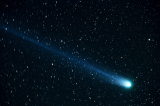
Comet Hale Bopp
Comet
Comet

A comet is a Small Solar System body that orbits the Sun and, when close enough to the Sun, exhibits a visible coma or a tail?both primarily from the effects of solar radiation upon the Comet nucleus....
s are believed to have two separate points of origin in the Solar System. Short-period comets (those with orbits of up to 200 years) are generally accepted to have emerged from the Kuiper belt
Kuiper belt

The Kuiper belt , sometimes called the Edgeworth-Kuiper belt, is a region of the Solar System beyond the planets extending from the orbit of Neptune to approximately 55 Astronomical unit from the Sun....
 or scattered disc, two linked flat discs of icy debris beginning at Pluto's orbit at 38 AU and jointly extending out beyond 100 AU from the Sun. Long-period comets, such as comet Hale-Bopp
Comet Hale-Bopp

Comet Hale-Bopp was arguably the most widely observed comet of the twentieth century, and one of the brightest seen for many decades. It was visible to the naked eye for a record 18 months, twice as long as the previous record holder, the Great Comet of 1811....
, whose orbits last for thousands of years, are thought to originate in the Oort cloud. The orbits within the Kuiper belt are relatively stable, and so very few comets are believed to originate there. The scattered disc, however, is dynamically active, and is far more likely to be the place of origin for comets. Comets pass from the scattered disc into the realm of the outer planets, becoming what are known as centaurs
Centaur (planetoid)

The centaurs are an unstable orbital class of minor planets named after the mythological race of centaurs. The name was chosen because they behave as half asteroid and half comet....
. These centaurs are then sent farther inward to become the short-period comets.

There are two main varieties of short-period comet: Jupiter-family comets (those with semi-major axes of less than 5 AU) and Halley-family comets. Halley-family comets, named for their prototype, Halley's Comet, are unusual in that while they are short-period comets, their ultimate origin lies in the Oort cloud, not in the scattered disc. Based on their orbits, it is believed they were long-period comets that were captured by the gravity of the giant planets and sent into the inner Solar System. This process may have also created the present orbits of a significant fraction of the Jupiter-family comets, although the majority of such comets are thought to have originated in the scattered disc.

Oort noted that the number of returning comets was far less than his model predicted, and this issue, known as "cometary fading", has yet to be resolved. No known dynamical process can explain this undercount of observed comets. Hypotheses for this discrepancy include the destruction of comets due to tidal stresses, impact or heating; the loss of all volatiles
Volatiles

In planetary science, volatiles, are that group of elements and compounds with low boiling points that are associated with a planet's or moon's crust and/or atmosphere....
, rendering some comets invisible, or the formation of a non-volatile crust on the surface. Dynamical studies of Oort cloud comets have shown that their occurrence in the outer planet region is several times higher than in the inner planet region. This discrepancy may be due to the gravitational attraction of Jupiter
Jupiter

Jupiter is the fifth planet from the Sun and the Solar system by size planet within the Solar System. It is two and a half times as massive as all of the other planets in our Solar System combined....
, which acts as a kind of barrier, trapping incoming comets and causing them to collide with it, just as it did with Comet Shoemaker-Levy 9
Comet Shoemaker-Levy 9

Comet Shoemaker-Levy 9 was a comet that collided with Jupiter in 1994, providing the first direct observation of an extraterrestrial collision of solar system objects....
 in 1994.

Tidal effects


Most of the comets seen close to the Sun are believed to have reached their current positions through gravitational distortion of the Oort cloud by the tidal force
Tidal force

The tidal force is a secondary effect of the force of gravity and is responsible for the tides. It arises because the gravitational force exerted on one body by a second body is not constant across its diameter....
 exerted by the Milky Way
Milky Way

The Milky Way, sometimes called simply the Galaxy, is the galaxy in which the Solar System is located. It is a barred spiral galaxy that is part of the Local Group of galaxies....
 galaxy. Just as the Moon
Moon

The Moon is Earth's only natural satellite and the List of natural satellites by diameter satellite in the Solar System. The average centre-to-centre distance from the Earth to the Moon is km, about thirty times the diameter of the Earth....
's tidal force bends and deforms the Earth's oceans, causing the tides to rise and fall, so the galactic tide also bends and distorts the orbits of bodies in the outer Solar System, pulling them towards the galactic centre. In the charted regions of the Solar System, these effects are negligible compared to the gravity of the Sun. At the outer reaches of the system, however, the Sun's gravity is weaker and the gradient of the Milky Way's gravitational field plays a far more noticeable role. Because of this gradient, galactic tides can deform an otherwise spherical Oort cloud, stretching the cloud in the direction of the galactic centre and compressing it along the other two axes. These small galactic perturbations may be enough to dislodge members of the Oort cloud from their orbits, sending them towards the Sun. The point at which the Sun's gravity concedes its influence to the galactic tide is called the tidal truncation radius. It lies at a radius of 100,000 to 200,000 AU, and marks the outer boundary of the Oort cloud.

Some scholars theorise that the galactic tide may have contributed to the formation of the Oort cloud by increasing the perihelia—closest distances to the Sun—of planetesimal
Planetesimal

Planetesimals are solid objects thought to exist in protoplanetary disks and in debris disks.A widely accepted theory of planet formation, the so-called planetesimal hypothesis of Viktor Safronov, states that planets form out of dust grains that collide and stick to form larger and larger bodies....
s with large aphelia. The effects of the galactic tide are quite complex, and depend heavily on the behaviour of individual objects within a planetary system. Cumulatively, however, the effect can be quite significant: up to 90% of all comets originating from the Oort cloud may be the result of the galactic tide. Statistical models of the observed orbits of long-period comets argue that the galactic tide is the principal means by which their orbits are perturbed toward the inner Solar System.

Star perturbations and stellar companion hypotheses

Besides the galactic tide, the main trigger for sending comets into the inner Solar System is believed to be interaction between the Sun's Oort cloud and the gravitational fields of near-by stars or giant molecular clouds. The orbit of the Sun through the plane of the Milky Way sometimes brings it in relatively close proximity to other stellar systems. For example, during the next 10 million years the known star with the greatest possibility of perturbing the Oort cloud is Gliese 710
Gliese 710

Gliese 710 is a red dwarf star in the constellation Serpens Cauda, with visual magnitude 9.66 and a mass of 0.4–0.6 solar masses.It is about 63.0 light years from Earth, but is notable because its proper motion, distance, and radial velocity indicate that it will approach within 1.1 light years from Earth within 1.4 million years,...
. This process also serves to scatter the objects out of the ecliptic plane, potentially also explaining the cloud's spherical distribution.

In 1984, Physicist
Physics

Physics is the natural science which examines basic concepts such as energy, force, and spacetime and all that derives from these, such as mass, charge, matter and its Motion ....
 Richard A. Muller
Richard A. Muller

Richard A. Muller of San Francisco, California, United States, is a physicist who works at the University of California, Berkeley and Lawrence Berkeley National Laboratory....
 postulated that the Sun
Sun

The Sun , a G V star, is the star at the center of the Solar System. The Earth and other matter orbit the Sun, which by itself accounts for about 98.6% of the Solar System's mass....
 has a heretofore undetected companion, either a brown dwarf
Brown dwarf

Brown dwarfs are sub-star objects with a mass below that necessary to maintain hydrogen-burning nuclear fusion reactions in their cores, as do stars on the main sequence, but which have fully convective surfaces and interiors, with no chemical differentiation by depth....
 or gaseous giant planet, in an elliptical orbit within the Oort cloud. This object, known as Nemesis
Nemesis (star)

Nemesis is a hypothetical astronomical objects red dwarf star or brown dwarf, orbiting the Sun at a distance of about 50,000 to 100,000 astronomical unit, somewhat beyond the Oort cloud....
, is hypothesized to pass through a portion of the Oort cloud approximately every 26 million years, bombarding the inner Solar System with comets. However, no direct evidence of Nemesis has been found.

A somewhat similar hypothesis was advanced by astronomer John J. Matese of the University of Louisiana
University of Louisiana at Lafayette

The University of Louisiana at Lafayette, or UL Lafayette, is a coeducational public research university located in Lafayette, Louisiana, Louisiana, in the heart of Acadiana....
 in 2002. He contends that more comets are arriving in the inner Solar System from a particular region of the Oort cloud than can be explained by the galactic tide or stellar perturbations alone, and that the most likely cause is a Jupiter
Jupiter

Jupiter is the fifth planet from the Sun and the Solar system by size planet within the Solar System. It is two and a half times as massive as all of the other planets in our Solar System combined....
-mass object in a distant orbit.

Oort cloud objects (OCOs)

Sedna Nasa
Apart from long-period comets, only four known objects have orbits which suggest that they may belong to the Oort Cloud: 90377 Sedna
90377 Sedna

90377 Sedna is a trans-Neptunian object and a likely dwarf planet, discovered by Michael E. Brown , Chad Trujillo and David L. Rabinowitz on November 14, 2003....
, 2000 CR105, 2006 SQ372
2006 SQ372

is a small trans-Neptunian object discovered through the Sloan Digital Sky Survey by Andrew Becker , Nathan Kaib and coworkers on images first taken on September 27, 2006 ....
 and 2008 KV42
2008 KV42

, nicknamed Drac , is a trans-Neptunian object orbiting the Sun backwards and almost perpendicular to the ecliptic: it has a 104 degree inclination....
. The first two, unlike scattered disc objects, have perihelia outside the gravitational reach of Neptune, and thus their orbits cannot be explained by perturbations
Perturbation (astronomy)

Perturbation is a term used in astronomy to describe alterations to an object's orbit caused by gravity interactions with bodies external to the system formed by the object and its parent body ....
 from the gas giant
Gas giant

A gas giant is a large planet that is not primarily composed of Rock or other solid matter. There are four gas giants in our Solar System: Jupiter, Saturn, Uranus, and Neptune....
 planets. If they formed in their current locations, their orbits must originally have been circular; otherwise accretion
Accretion (astrophysics)

In astrophysics, the term accretion is used for at least two distinct processes.The first and most common is the growth of a massive object by gravity attracting more matter, typically gaseous matter in an accretion disc....
 (the coalescence of smaller bodies into larger ones) would not have been possible because the large relative velocities between planetesimals would have been too disruptive. Their present-day elliptical orbits can be explained by a number of hypotheses:

  1. These objects could have had their orbits and perihelion
    Apsis

    In celestial mechanics, an apsis, plural apsides is the point of greatest or least distance of the elliptical orbit of an object from its center of attraction, which is generally the center of mass of the system....
     distances "lifted" by the passage of a nearby star when the Sun was still embedded in its birth star cluster.
  2. Their orbits could have been disrupted by an as-yet-unknown planet-sized body within the Oort cloud.
  3. They could have been scattered by Neptune during a period of particularly high eccentricity or by the gravity of a far larger primordial trans-Neptunian disc.
  4. They could have been captured from around smaller passing stars.


Of these, the stellar disruption and “lift” hypothesis appears to agree most closely with observations. Some astronomers prefer to refer to Sedna and 2000 CR105 as belonging to the "extended scattered disc
Scattered disc

The scattered disc is a distant region of the Solar System that is sparsely populated by icy minor planets known as scattered disc objects ; a subset of the broader family of trans-Neptunian objects ....
" rather than to the inner Oort cloud.

See also

  • List of trans-Neptunian objects
    List of trans-Neptunian objects

    This is a partial list of Astronomical naming conventions#Minor planets trans-Neptunian objects , in order of discovery date. Certain notable TNOs that have yet to be numbered are also included....
  • List of plutoid candidates
    List of plutoid candidates

    At present, the International Astronomical Union classifies four objects as plutoids: , , , and ; dozens of others are thought likely to be plutoids. The qualifying feature is that plutoids must "have sufficient mass for their self-gravity to overcome rigid body forces so that they assume a hydrostatic equilibrium ." Except for Pluto, observations...


External links

  • by