
All Topics  
Asteroid belt


   Email Print
   Bookmark   Link


Asteroid belt


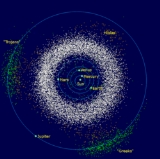
The asteroid belt is the region of the Solar System
Solar System

The Solar System consists of the Sun and those Astronomical object bound to it by gravity: the eight planets and five dwarf planets, their 173 known Natural satellite, and billions of Small Solar System body....
 located roughly between the orbits of the planet
Planet

A planet , as 2006 definition of planet by the International Astronomical Union , is a celestial body orbiting a star or Stellar evolution#Stellar remnants that is massive enough to be rounded by its own gravity, is not massive enough to cause thermonuclear fusion, and has cleared the neighbourhood of planetesimals....
s Mars
MARS

In cryptography, MARS is a block cipher that was IBM's submission to the Advanced Encryption Standard process. MARS was selected as an AES finalist in August 1999, after the AES2 conference in March 1999, where it was voted as the fifth and last finalist algorithm....
 and Jupiter
Jupiter

Jupiter is the fifth planet from the Sun and the Solar system by size planet within the Solar System. It is two and a half times as massive as all of the other planets in our Solar System combined....
. It is occupied by numerous irregularly shaped bodies called asteroid
Asteroid

Asteroids, sometimes called minor planets or planetoids, are small Solar System bodies in orbit around the Sun, smaller than planets but larger than meteoroids....
s or minor planet
Minor planet

An asteroid group or minor planet group is a population of minor planets that have a share broadly similar orbits. Members are generally unrelated to each other, unlike in an asteroid family, which often results from the break-up of a single asteroid....
s. The asteroid belt region is also termed the main belt to distinguish it from other concentrations of minor planets within the Solar System, such as the Kuiper belt
Kuiper belt

The Kuiper belt , sometimes called the Edgeworth-Kuiper belt, is a region of the Solar System beyond the planets extending from the orbit of Neptune to approximately 55 Astronomical unit from the Sun....
 and scattered disc
Scattered disc

The scattered disc is a distant region of the Solar System that is sparsely populated by icy minor planets known as scattered disc objects ; a subset of the broader family of trans-Neptunian objects ....
.

More than half the mass of the main belt is contained in the four largest objects: Ceres, 4 Vesta
4 Vesta

4 Vesta is the second most massive object in the asteroid belt, with a mean diameter of about 530 km and an estimated mass of 9% of the mass of the entire asteroid belt....
, 2 Pallas
2 Pallas

'2 Pallas' is one of the largest asteroids and is located in the main asteroid belt. It was the second asteroid to be discovered, by astronomy Heinrich Wilhelm Matth?us Olbers on March 28, 1802....
, and 10 Hygiea
10 Hygiea

'10 Hygiea' is an asteroid located in the main asteroid belt. With somewhat oblong diameters of 350?500 km, and a mass estimated to be 2.9% of the total mass of the belt, it is the List_of_noteworthy_asteroids by volume and mass....
.


Discussion
Ask a question about 'Asteroid belt'
Start a new discussion about 'Asteroid belt'
Answer questions from other users
Full Discussion Forum


Recent Posts


Encyclopedia


Innersolarsystem En
The asteroid belt is the region of the Solar System
Solar System

The Solar System consists of the Sun and those Astronomical object bound to it by gravity: the eight planets and five dwarf planets, their 173 known Natural satellite, and billions of Small Solar System body....
 located roughly between the orbits of the planet
Planet

A planet , as 2006 definition of planet by the International Astronomical Union , is a celestial body orbiting a star or Stellar evolution#Stellar remnants that is massive enough to be rounded by its own gravity, is not massive enough to cause thermonuclear fusion, and has cleared the neighbourhood of planetesimals....
s Mars
MARS

In cryptography, MARS is a block cipher that was IBM's submission to the Advanced Encryption Standard process. MARS was selected as an AES finalist in August 1999, after the AES2 conference in March 1999, where it was voted as the fifth and last finalist algorithm....
 and Jupiter
Jupiter

Jupiter is the fifth planet from the Sun and the Solar system by size planet within the Solar System. It is two and a half times as massive as all of the other planets in our Solar System combined....
. It is occupied by numerous irregularly shaped bodies called asteroid
Asteroid

Asteroids, sometimes called minor planets or planetoids, are small Solar System bodies in orbit around the Sun, smaller than planets but larger than meteoroids....
s or minor planet
Minor planet

An asteroid group or minor planet group is a population of minor planets that have a share broadly similar orbits. Members are generally unrelated to each other, unlike in an asteroid family, which often results from the break-up of a single asteroid....
s. The asteroid belt region is also termed the main belt to distinguish it from other concentrations of minor planets within the Solar System, such as the Kuiper belt
Kuiper belt

The Kuiper belt , sometimes called the Edgeworth-Kuiper belt, is a region of the Solar System beyond the planets extending from the orbit of Neptune to approximately 55 Astronomical unit from the Sun....
 and scattered disc
Scattered disc

The scattered disc is a distant region of the Solar System that is sparsely populated by icy minor planets known as scattered disc objects ; a subset of the broader family of trans-Neptunian objects ....
.

More than half the mass of the main belt is contained in the four largest objects: Ceres, 4 Vesta
4 Vesta

4 Vesta is the second most massive object in the asteroid belt, with a mean diameter of about 530 km and an estimated mass of 9% of the mass of the entire asteroid belt....
, 2 Pallas
2 Pallas

'2 Pallas' is one of the largest asteroids and is located in the main asteroid belt. It was the second asteroid to be discovered, by astronomy Heinrich Wilhelm Matth?us Olbers on March 28, 1802....
, and 10 Hygiea
10 Hygiea

'10 Hygiea' is an asteroid located in the main asteroid belt. With somewhat oblong diameters of 350?500 km, and a mass estimated to be 2.9% of the total mass of the belt, it is the List_of_noteworthy_asteroids by volume and mass....
. All of these have mean diameters of more than 400 km, while Ceres, the main belt's only dwarf planet
Dwarf planet

A dwarf planet, as defined by the International Astronomical Union , is a celestial body orbiting the Sun that is massive enough to be rounded by its own gravity but has not Clearing the neighbourhood of planetesimals and is not a natural satellite....
, is about 950 km in diameter. The remaining bodies range down to the size of a dust particle. The asteroid material is so thinly distributed that multiple unmanned spacecraft have traversed it without incident. Nonetheless, collisions between large asteroids do occur, and these can form an asteroid family
Asteroid family

An asteroid family is a population of asteroids that share similar orbital elements, such as semimajor axis, eccentricity , and orbital inclination....
 whose members have similar orbital characteristics and compositions. Collisions also produce a fine dust that forms a major component of the zodiacal light
Zodiacal light

The zodiacal light is a faint, roughly triangular, whitish glow seen in the night sky which appears to extend up from the vicinity of the sun along the ecliptic or zodiac....
. Individual asteroids within the main belt are categorized by their spectra
Spectrum

A spectrum is a condition that is not limited to a specific set of values but can vary infinitely within a Continuum . The word saw its first scientific use within the field of optics to describe the rainbow of colors in visible light when separated using a triangular prism ; it has since been applied by analogy to many fields other than op...
, with most falling into three basic groups: carbon
Carbon

Carbon is a chemical element with chemical symbol C and atomic number 6. As a member of group 14 on the periodic table, it is nonmetallic and tetravalence?making four electrons available to form covalent bond chemical bonds....
aceous (C-type
C-type asteroid

C-type asteroids are carbonaceous asteroids. They are the most common variety forming around 75% of known asteroids, and an even higher percentage in the outer part of the belt beyond 2.7 astronomical unit, which is dominated by this asteroid type....
), silicate
Silicate

A silicate is a compound containing an anion in which one or more central silicon atoms are surrounded by electronegative ligands. This definition is broad enough to include species such as hexafluorosilicate , [SiF6]2-, but the silicate species that are encountered most often consist of silicon with oxygen as the ligand...
 (S-type
S-type asteroid

S-type asteroids are of a silicaceous composition, hence the name. Approximately 17% of asteroids are of this type, making it the second most common after the C-type asteroid....
), and metal
Metal

In chemistry, a metal is a chemical element whose atoms readily lose electrons to form positive ions , and form metallic bonds between other metal atoms and ionic bonds between nonmetal atoms....
-rich (M-type
M-type asteroid

M-type asteroids are asteroids of unknown composition; they are moderately bright . Some, but not all, are made of nickel-iron, either pure or mixed with small amounts of stone....
).

The asteroid belt formed from the primordial solar nebula
Solar nebula

In cosmogony, the nebular hypothesis is the most widely accepted model explaining the formation and evolution of the Solar System. It was first proposed in 1734 by Emanuel Swedenborg....
 as a group of planetesimal
Planetesimal

Planetesimals are solid objects thought to exist in protoplanetary disks and in debris disks.A widely accepted theory of planet formation, the so-called planetesimal hypothesis of Viktor Safronov, states that planets form out of dust grains that collide and stick to form larger and larger bodies....
s, the smaller precursors of the planets. Between Mars and Jupiter, however, gravitational perturbations from the giant planet imbued the planetesimals with too much orbital energy for them to accrete
Accretion (astrophysics)

In astrophysics, the term accretion is used for at least two distinct processes.The first and most common is the growth of a massive object by gravity attracting more matter, typically gaseous matter in an accretion disc....
 into a planet. Collisions became too violent, and instead of sticking together, the planetesimals shattered. As a result, most of the main belt's mass has been lost since the formation of the Solar System. Some fragments can eventually find their way into the inner Solar System, leading to meteorite impacts with the inner planets. Asteroid orbits continue to be appreciably perturbed
Perturbation (astronomy)

Perturbation is a term used in astronomy to describe alterations to an object's orbit caused by gravity interactions with bodies external to the system formed by the object and its parent body ....
 whenever their period of revolution about the Sun forms an orbital resonance
Orbital resonance

In celestial mechanics, an orbital resonance occurs when two orbiting bodies exert a regular, periodic gravitational influence on each other, usually due to their orbital periods being related by a ratio of two small integers....
 with Jupiter. At these orbital distances, a Kirkwood gap
Kirkwood gap

File:Kirkwood Gaps.svgKirkwood gaps are gaps or dips in the distribution of main belt asteroids with semi-major axis , as seen in the :Image:Kirkwood Gaps.png....
 occurs as they are swept into other orbits.

History of observation

Giuseppe Piazzi
In an anonymous footnote to his 1766 translation of Charles Bonnet
Charles Bonnet

Charles Bonnet , Switzerland natural history and philosophical writer, was born at Geneva, of a France family driven into Switzerland by the religious persecution in the 16th century....
's Contemplation de la Nature, the astronomer Johann Daniel Titius
Johann Daniel Titius

Johann Daniel Titius was a Germany astronomer and a professor at Wittenberg.Titius was born in Chojnice, Royal Prussia, and died in Wittenberg....
 von Wittenburg
Wittenburg

Wittenburg is a town in the district Ludwigslust in Mecklenburg-Western Pomerania, Germany. Population 5570, area 46.25 square kilometer. Wittenburg should not be confused with the much bigger Wittenberg....
 noted an apparent pattern in the layout of the planets. If one began a numerical sequence at 0, then included 3, 6, 12, 24, 48, etc., doubling each time, and added four to each number and divided by 10, this produced a remarkably close approximation to the orbits of the known planets as measured in astronomical units. This pattern, now known as the Titius-Bode Law
Titius-Bode law

The Titius?Bode law is a hypothesis that the bodies in some orbital systems, including the Sun's, orbit at semi-major axis in an exponential function of planetary sequence....
, predicted the semi-major axes of the six planets of the time (Mercury, Venus, Earth, Mars, Jupiter and Saturn) provided one allowed for a "gap" between the orbits of Mars and Jupiter. In his footnote Titius declared, "But should the Lord Architect have left that space empty? Not at all". In 1768, the astronomer Johann Elert Bode
Johann Elert Bode

Johann Elert Bode was a Germany astronomer known for his reformulation and popularization of the Titius-Bode law. Bode determined the orbit of Uranus and suggested the planet's name....
 made note of Titius's relationship in his Anleitung zur Kenntniss des gestirnten Himmels but did not credit Titius, which led many to refer to it as "Bode's law". When William Herschel
William Herschel

Sir Frederick William Herschel, Fellow of the Royal Society Royal Guelphic Order was a German-born British astronomer and composer who became famous for discovering Uranus....
 discovered Uranus
Uranus

Uranus is the seventh planet from the Sun and the third-largest and fourth most massive planet in the Solar System. It is named after the ancient Greek deity of the sky Uranus the father of Kronos and grandfather of Zeus ....
 in 1781, the planet's position matched the law almost perfectly; leading astronomers to conclude that there had to be a planet between the orbits of Mars and Jupiter.

In 1800, astronomer Baron Franz Xaver von Zach
Franz Xaver von Zach

Baron Franz Xaver von Zach was a Hungarian astronomer born at Pest .He served for some time in the Austrian army, and afterwards lived in London from 1783 to 1786 as tutor in the house of the Saxony minister, Heinrich von Br?hl....
 recruited 24 of his fellows into an informal club he dubbed the "Lilienthal Society". Determined to bring the Solar System to order, the group became known as the "Himmelspolitzei", or Celestial Police. Notable members included Herschel, British astronomer Royal Nevil Maskelyne
Nevil Maskelyne

The Reverend Dr Nevil Maskelyne Fellow of the Royal Society was the fifth England Astronomer Royal. He held the office from 1765 to 1811....
, Charles Messier
Charles Messier

Charles Messier was a France astronomy most notable for publishing an astronomical catalog consisting of deep sky objects such as nebulae and star clusters that came to be known as the 103 "Messier objects"....
, and Heinrich Olbers. Each of the 24 astronomers was assigned a 15° region of the zodiac
Zodiac

Zodiac denotes an annual cycle of twelve stations along the ecliptic, the apparent path of the Sun across the heavens through the constellations that divide the ecliptic into twelve equal zones of celestial longitude....
 in which to search for the missing planet.

Only a few months later, a non-member of the Celestial Police confirmed their expectations. On January 1, 1801, Giuseppe Piazzi
Giuseppe Piazzi

'Giuseppe Piazzi' was an Italy Theatines monk, mathematician, and astronomer. He was born in Ponte in Valtellina, and died in Naples. He established an observatory at Palermo, now the Osservatorio Astronomico di Palermo ? Giuseppe S....
, Chair of Astronomy at the University of Palermo
University of Palermo

The University of Palermo is a university located in Palermo, Italy, and founded in 1806. It is organized in 12 Faculties....
, Sicily
Sicily

Sicily is an Autonomous regions with special statute of Italy. Of all the regions of Italy, Sicily covers the largest land area at 25,708 km? and currently has just over five million inhabitants....
, found a tiny moving object in the exact location predicted by the Titius-Bode Law. He dubbed it Ceres, after the Roman goddess
Ceres (mythology)

| Image = Ceres_statue.jpg| Caption = This statue depicting Ceres holding wheat is on display at the Louvre in Paris, France.| Name = Ceres| God_of = Goddess of growing plants and motherly love...
 of the harvest and patron of Sicily. Piazzi initially believed it a comet, but its lack of a coma
Coma (cometary)

In astronomy, a coma is the nebulous envelope around the Comet nucleus of a comet. It is formed when the comet passes close to the Sun on its highly ellipse orbit; as the comet warms, parts of it Sublimation_%28chemistry%29....
 suggested it was a planet. Fifteen months later, Olbers discovered a second object in the same region, Pallas
2 Pallas

'2 Pallas' is one of the largest asteroids and is located in the main asteroid belt. It was the second asteroid to be discovered, by astronomy Heinrich Wilhelm Matth?us Olbers on March 28, 1802....
. Unlike the other known planets, the objects remained points of light even under the highest telescope magnifications, rather than resolving into discs. Apart from their rapid movement, they were indistinguishable from star
Star

A star is a massive, luminous ball of Plasma that is held together by its own gravity. The nearest star to Earth is the Sun, which is the source of most of the energy on Earth....
s. Accordingly, in 1802 William Herschel suggested they be placed into a separate category, named asteroids, after the Greek
Ancient greek language

#REDIRECT Ancient Greek...
 asteroeides, meaning "star-like". Upon completing a series of observations of Ceres and Pallas, he concluded,

Neither the appellation of planets, nor that of comets, can with any propriety of language be given to these two stars ... [They] resemble small stars so much as hardly to be distinguished from them. From this, their asteroidal appearance, if I take my name, and call them Asteroids; reserving for myself however the liberty of changing that name, if another, more expressive of their nature, should occur.


Despite Herschel's reservations, for several decades it remained common practice to refer to these objects as planets. By 1807, further investigation revealed two new objects in the region: 3 Juno
3 Juno

Juno , formal designation 3 Juno in the Minor Planet Center catalogue system, was the third asteroid to be discovered and is one of the larger main belt asteroids, being one of the two largest stony asteroids, along with 15 Eunomia....
 and 4 Vesta. The Napoleonic wars
Napoleonic Wars

The Napoleonic Wars were a series of conflicts involving Napoleon I of France First French Empire and changing sets of European allies and opposing coalitions that ran from 1803 to 1815....
 brought this first period of discovery to a close, and it was not until 1845 that another object (5 Astraea
5 Astraea

5 Astraea is a large main belt asteroid. Its surface is highly reflective and its composition is probably a mixture of nickel-iron with magnesium- and iron-silicates....
) was discovered. Shortly thereafter new objects were found at an accelerating rate, and counting them among the planets became increasingly cumbersome. Eventually, they were dropped from the planet list as first suggested by Alexander von Humboldt
Alexander von Humboldt

was a German people natural scientist and List of explorers, and the younger brother of the Prussian minister, philosopher, and linguistics, Wilhelm von Humboldt ....
 in the early 1850s, and William Herschel's choice of nomenclature, asteroids, gradually came into common use.

The discovery of Neptune
NEPTUNE

=Overview=The project, along with sister project, VENUS, offers a unique approach to ocean science. Traditionally, ocean scientists have relied on infrequent ship cruises or space-based satellites to carry out their research....
 in 1846 led to the discrediting of the Titius-Bode Law in the eyes of scientists, as its orbit was nowhere near the predicted position. To date, there is no scientific explanation for the law, and the consensus among astronomers is that it is a coincidence.

The expression "asteroid belt" comes into use in the very early 1850s, although it is hard to pinpoint who coined the term. The first English use seems to be in the 1850 translation (by E. C. Otté) of Alexander von Humboldt's Cosmos: A Sketch of a Physical Description of the Universe, Vol. I, Harper & Brothers, New York (NY), 1850, p. 44: "[...] and the regular appearance, about the 13th of November and the 11th of August, of shooting stars, which probably form part of a belt of asteroids intersecting the Earth's orbit and moving with planetary velocity" (emphasis added). Other early appearances are in Robert James Mann's A Guide to the Knowledge of the Heavens, Jarrold, 1852, p. 171 and 1853, p. 216: "The orbits of the asteroids are placed in a wide belt of space, extending between the extremes of [...]" (emphasis added). The American astronomer Benjamin Peirce
Benjamin Peirce

Benjamin Peirce, April 4, 1809 ? October 6, 1880) was an United States mathematician who taught at Harvard University for forty years. He made contributions to celestial mechanics, number theory, algebra, and the philosophy of mathematics....
 seems to have adopted that terminology and to have been one of its promoters. One hundred asteroids had been located by mid-1868, and in 1891 the introduction of astrophotography
Astrophotography

Astrophotography is a specialized type of photography that entails making photographs of astronomical objects in the sky such as the Moon, Sun, planets, stars, and deep sky objects such as star clusters and galaxies....
 by Max Wolf
Max Wolf

Maximilian Franz Joseph Cornelius Wolf was a German astronomer, a pioneer of astrophotography.He was born in Heidelberg, Germany. In 1888 he was awarded a Ph.D....
 accelerated the rate of discovery still further. A total of 1000 asteroids had been found by 1923, 10 000 by 1951, and 100 000 by 1982. Modern asteroid survey systems now use automated means to locate new minor planets in ever-increasing quantities.

Origin

Main Belt I Vs A

Formation

In 1802, shortly after discovering Pallas, Heinrich Olbers suggested to William Herschel
William Herschel

Sir Frederick William Herschel, Fellow of the Royal Society Royal Guelphic Order was a German-born British astronomer and composer who became famous for discovering Uranus....
 that Ceres and Pallas were fragments of a much larger planet
Phaeton (hypothetical planet)

Phaeton is the name of a hypothetical planet posited to once have existed between the orbits of Mars and Jupiter whose destruction supposedly led to the formation of asteroid belt....
 that once occupied the Mars-Jupiter region, this planet having suffered an internal explosion or a cometary impact many million years before. Over time however, this hypothesis has fallen from favor. The large amount of energy that would have been required to destroy a planet, combined with the belt's low combined mass, which is only a small fraction of the mass of the Earth's Moon
Moon

The Moon is Earth's only natural satellite and the List of natural satellites by diameter satellite in the Solar System. The average centre-to-centre distance from the Earth to the Moon is km, about thirty times the diameter of the Earth....
, do not support the hypothesis. Further, the significant chemical differences between the asteroids are difficult to explain if they come from the same planet. Today, most scientists accept that, rather than fragmenting from a progenitor planet, the asteroids never formed a planet at all.

In general in the Solar System, planetary formation is thought to have occurred via a process comparable to the long-standing nebular hypothesis: a cloud of interstellar dust and gas collapsed under the influence of gravity to form a rotating disk of material that then further condensed to form the Sun and planets. During the first few million years of the Solar System's history, an accretion
Accretion (astrophysics)

In astrophysics, the term accretion is used for at least two distinct processes.The first and most common is the growth of a massive object by gravity attracting more matter, typically gaseous matter in an accretion disc....
 process of sticky collisions caused the clumping of small particles, which gradually increased in size. Once the clumps reached sufficient mass, they could draw in other bodies through gravitational attraction and become planetesimal
Planetesimal

Planetesimals are solid objects thought to exist in protoplanetary disks and in debris disks.A widely accepted theory of planet formation, the so-called planetesimal hypothesis of Viktor Safronov, states that planets form out of dust grains that collide and stick to form larger and larger bodies....
s. This gravitational accretion led to the formation of the rocky planets and the gas giant
Gas giant

A gas giant is a large planet that is not primarily composed of Rock or other solid matter. There are four gas giants in our Solar System: Jupiter, Saturn, Uranus, and Neptune....
s.

Planetesimals within the region which would become the asteroid belt were too strongly perturbed
Perturbation (astronomy)

Perturbation is a term used in astronomy to describe alterations to an object's orbit caused by gravity interactions with bodies external to the system formed by the object and its parent body ....
 by Jupiter's gravity to form a planet. Instead they continued to orbit the Sun as before, while occasionally colliding. In regions where the average velocity of the collisions was too high, the shattering of planetesimals tended to dominate over accretion, preventing the formation of planet-sized bodies. Orbital resonance
Orbital resonance

In celestial mechanics, an orbital resonance occurs when two orbiting bodies exert a regular, periodic gravitational influence on each other, usually due to their orbital periods being related by a ratio of two small integers....
s occurred where the orbital period of an object in the belt formed an integer fraction of the orbital period of Jupiter, perturbing the object into a different orbit; the region lying between the orbits of Mars and Jupiter contains many such orbital resonances. As Jupiter migrated inward following its formation, these resonances would have swept across the asteroid belt, dynamically exciting the region's population and increasing their velocities relative to each other.

During the early history of the Solar System, the asteroids melted to some degree, allowing elements within them to be partially or completely differentiated by mass. Some of the progenitor bodies may even have undergone periods of explosive volcanism and formed magma
Magma

Magma is molten Rock that is found beneath the surface of the Earth, and may also exist on other terrestrial planets. Besides molten rock, magma may also contain suspended crystals and gas bubbles....
 oceans. However, because of the relatively small size of the bodies, the period of melting was necessarily brief (compared to the much larger planets), and had generally ended about 4.5 billion years ago, in the first tens of millions years of formation. In August 2007, a study of zircon
Zircon

Zircon is a mineral belonging to the group of Silicate minerals. Its chemical name is zirconium silicate and its corresponding chemical formula is ZirconiumSiliconOxygen4....
 crystals in an Antarctic meteorite believed to have originated from 4 Vesta
4 Vesta

4 Vesta is the second most massive object in the asteroid belt, with a mean diameter of about 530 km and an estimated mass of 9% of the mass of the entire asteroid belt....
 suggested that it, and by extension the rest of the asteroid belt, had formed rather quickly, within ten million years of the Solar System origin.

Evolution

The asteroids are not samples of the primordial Solar System. They have undergone considerable evolution since their formation, including internal heating (in the first few tens of millions of years), surface melting from impacts, space weathering
Space weathering

Space weathering is a blanket term used for a number of processes that act on any body exposed to the harsh space environment. Airless bodies incur many weathering processes:...
 from radiation, and bombardment by micrometeorites. While some scientists refer to the asteroids as residual planetesimals, other scientists consider them distinct.

The current asteroid belt is believed to contain only a small fraction of the mass of the primordial belt. Computer simulations suggest that the original asteroid belt may have contained mass equivalent to the Earth. Primarily because of gravitational perturbations, most of the material was ejected from the belt within about a million years of formation, leaving behind less than 0.1% of the original mass. Since their formation, the size distribution of the asteroid belt has remained relatively stable: there has been no significant increase or decrease in the typical dimensions of the main belt asteroids.

The 4:1 orbital resonance
Orbital resonance

In celestial mechanics, an orbital resonance occurs when two orbiting bodies exert a regular, periodic gravitational influence on each other, usually due to their orbital periods being related by a ratio of two small integers....
 with Jupiter, at a radius 2.06 AU
Astronomical unit

An astronomical unit is a unit of length based on the mean distance from the Earth to the Sun. The precise value of the AU is currently accepted as 149,597,870,691 Plus-minus sign 6 metres ....
, can be considered the inner boundary of the main belt. Perturbations by Jupiter send bodies straying there into unstable orbits. Most bodies formed inside the radius of this gap were swept up by Mars
MARS

In cryptography, MARS is a block cipher that was IBM's submission to the Advanced Encryption Standard process. MARS was selected as an AES finalist in August 1999, after the AES2 conference in March 1999, where it was voted as the fifth and last finalist algorithm....
 (which has an aphelion at 1.67 AU) or ejected by its gravitational perturbations in the early history of the Solar System. The Hungaria asteroids lie closer to the Sun than the 4:1 resonance, but are protected from disruption by their high inclination.

When the main belt was first being formed, the temperatures at a distance of 2.7 AU from the Sun formed a "snow line" below the condensation point of water. Planetesimals formed beyond this radius were able to accumulate ice. In 2006 it was announced that a population of comet
Main-belt comet

Main-belt comets are bodies orbiting within the asteroid belt which show cometary activity during a part of their orbit....
s had been discovered within the asteroid belt beyond the snow line, which may have provided a source of water for Earth's oceans. According to some models, there was insufficient outgassing
Outgassing

Outgassing is the slow release of a gas that was trapped, freezing, Absorption or adsorbed in some material....
 of water during the Earth's formative period to form the oceans, necessitating an external source such as a cometary bombardment.

Characteristics

951 Gaspra
Contrary to popular imagery, the asteroid belt is mostly empty. The asteroids are spread over such a large volume that it would be highly improbable to reach an asteroid without aiming carefully. Nonetheless, hundreds of thousands of asteroids are currently known, and the total number ranges in the millions or more, depending on the lower size cutoff. Over 200 asteroids are known to be larger than 100 km, while a survey in the infrared wavelengths shows that the main belt has 700 000 to 1.7 million asteroids with a diameter of 1 km or more. The apparent magnitude
Apparent magnitude

The apparent magnitude of a celestial body is a measurement of its brightness as seen by an observer on Earth, normalized to the value it would have in the absence of the Earth's atmosphere....
s of most of the known asteroids are 11–19, with the median at about 16.

The total mass of the asteroid belt is estimated to be 3.0×10²¹–3.6×10²¹ kilograms, which is just 4% of the Earth's Moon
Moon

The Moon is Earth's only natural satellite and the List of natural satellites by diameter satellite in the Solar System. The average centre-to-centre distance from the Earth to the Moon is km, about thirty times the diameter of the Earth....
. Its four largest objects, 1 Ceres
1 Ceres

Ceres , Minor planet names 1 Ceres, is the smallest identified dwarf planet in the Solar System and the only one in the asteroid belt. It was discovered on January 1, 1801, by Giuseppe Piazzi, and is named after the Roman mythology Ceres — the goddess of growing plants, the harvest, and motherly love....
, 4 Vesta
4 Vesta

4 Vesta is the second most massive object in the asteroid belt, with a mean diameter of about 530 km and an estimated mass of 9% of the mass of the entire asteroid belt....
, 2 Pallas
2 Pallas

'2 Pallas' is one of the largest asteroids and is located in the main asteroid belt. It was the second asteroid to be discovered, by astronomy Heinrich Wilhelm Matth?us Olbers on March 28, 1802....
 and 10 Hygiea
10 Hygiea

'10 Hygiea' is an asteroid located in the main asteroid belt. With somewhat oblong diameters of 350?500 km, and a mass estimated to be 2.9% of the total mass of the belt, it is the List_of_noteworthy_asteroids by volume and mass....
, account for half of the belt's total mass, with almost one-third accounted for by Ceres alone. Ceres's orbital distance, 2.8 AU, is also the location of the asteroid belt's center of mass
Center of mass

The center of mass of a system of wiktionary:Particles is a specific point at which, for many purposes, the system's mass behaves as if it were concentrated....
.

Composition

The current belt consists primarily of three categories of asteroids: C-type or carbonaceous asteroids, S-type or silicate asteroids, and M-type or metallic asteroids.

Carbonaceous asteroids, as their name suggests, are carbon-rich and dominate the belt's outer regions. Together they comprise over 75% of the visible asteroids. They are more red in hue than the other asteroids and have a very low albedo
Albedo

The albedo of an object is the extent to which it diffusely reflects light from the Sun. It is therefore a more specific form of the term reflectivity....
. Their surface composition is similar to carbonaceous chondrite
Carbonaceous chondrite

Carbonaceous chondrites or C chondrites are a class of chondrite meteorites comprising at least 8 known groups and many ungrouped meteorites....
 meteorite
Meteorite

A meteorite is a natural object originating in outer space that survives an impact with the Earth's surface. While in space it is called a meteoroid....
s. Chemically, their spectra match the primordial composition of the early Solar System, with only the lighter elements and volatiles
Volatiles

In planetary science, volatiles, are that group of elements and compounds with low boiling points that are associated with a planet's or moon's crust and/or atmosphere....
 removed.

S-type
S-type asteroid

S-type asteroids are of a silicaceous composition, hence the name. Approximately 17% of asteroids are of this type, making it the second most common after the C-type asteroid....
 or silicate
Silicate

A silicate is a compound containing an anion in which one or more central silicon atoms are surrounded by electronegative ligands. This definition is broad enough to include species such as hexafluorosilicate , [SiF6]2-, but the silicate species that are encountered most often consist of silicon with oxygen as the ligand...
-rich asteroids are more common toward the inner region of the belt, within 2.5 AU of the Sun. The spectra of their surfaces reveal the presence of silicates and some metal, but no significant carbonaceous compounds. This indicates that their materials have been significantly modified from their primordial composition, probably via melting and reformation. They have a relatively high albedo, and form about 17% of the total asteroid population.

M-type
M-type asteroid

M-type asteroids are asteroids of unknown composition; they are moderately bright . Some, but not all, are made of nickel-iron, either pure or mixed with small amounts of stone....
 (metal
Metal

In chemistry, a metal is a chemical element whose atoms readily lose electrons to form positive ions , and form metallic bonds between other metal atoms and ionic bonds between nonmetal atoms....
-rich) asteroids form about 10% of the total population; their spectra resemble that of iron-nickel. Some are believed to have formed from the metallic cores of differentiated progenitor bodies that were disrupted through collision. However, there are also some silicate compounds that can produce a similar appearance. For example, the large M-type asteroid 22 Kalliope
22 Kalliope

'22 Kalliope' is a large main belt asteroid of the M-type asteroid, discovered by John Russell Hind on November 16, 1852. It is named after Calliope, the Greek mythology Muse of epic poetry....
 does not appear to be primarily composed of metal. Within the main belt, the number distribution of M-type asteroids peaks at a semi-major axis of about 2.7 AU. It is not yet clear whether all M-types are compositionally similar, or whether it is a label for several varieties which do not fit neatly into the main C and S classes.

One mystery of the asteroid belt is the relative rarity of V-type
V-type asteroid

The spectra of the V-type asteroids or Vestoids are similar to that of 4 Vesta, by far the largest asteroid in this class .A large proportion have orbital elements similar to those of 4 Vesta, either close enough to be part of the Vesta family, or having similar eccentricity and inclinations but with a semi-major axis lying between a...
, or basaltic asteroids. Theories of asteroid formation predict that objects the size of Vesta or larger should form crusts and mantles, which would be composed mainly of basaltic rock, resulting in more than half of all asteroids being composed either of basalt or olivine
Olivine

The mineral olivine is a magnesium iron Silicate minerals with the formula 2siliconoxygen4. It is one of the most common minerals on Earth, and has also been identified in meteorites and on the Moon, Mars, and comet Wild 2....
. Observations, however, suggest that 99 percent of the predicted basaltic material is missing. Until 2001, most basaltic bodies discovered in the asteroid belt were believed to originate from the asteroid Vesta (hence their name V-type). However, the discovery of the asteroid 1459 Magnya
1459 Magnya

1459 Magnya is a Main-belt Asteroid discovered on November 04, 1937 by Grigory Neujmin at Simeiz Observatory. ...
 revealed a slightly different chemical composition from the other basaltic asteroids discovered until then, suggesting a different origin. This hypothesis was reinforced by the further discovery in 2007 of two asteroids in the outer belt, 7472 Kumakiri
7472 Kumakiri

7472 Kumakiri is an asteroid belt asteroid, discovered February 1992 by Makio Akiyama and Toshimasa Furuta....
 and (10537) 1991 RY16, with differing basaltic composition that could not have originated from Vesta. These latter two are the only V-type asteroids discovered in the outer belt to date.

The temperature of the asteroid belt varies with the distance from the Sun. For dust particles within the belt, typical temperatures range from 200 K (-73 °C) at 2.2 AU down to 165 K (-108 °C) at 3.2 AU However, due to rotation, the surface temperature of an asteroid can vary considerably as the sides are alternately exposed to solar radiation and then to the stellar background.

Orbits and rotations

Main Belt E Vs A
Most asteroids within the main belt have orbital eccentricities of less than 0.4, and an inclination of less than 30°. The orbital distribution of the asteroids reaches a maximum at an eccentricity of around 0.07 and an inclination below 4°. Thus while a typical asteroid has a relatively circular orbit and lies near the plane of the ecliptic
Ecliptic

The ecliptic is the apparent path that the Sun traces out in the sky during the year. As it appears to move in the sky in relation to the stars, the apparent path aligns with the planets throughout the course of the year....
, some asteroid orbits can be highly eccentric or travel well outside the ecliptic plane.

Sometimes, the term main belt is used to refer only to the more compact "core" region where the greatest concentration of bodies is found. This lies between the strong 4:1 and 2:1 Kirkwood gap
Kirkwood gap

File:Kirkwood Gaps.svgKirkwood gaps are gaps or dips in the distribution of main belt asteroids with semi-major axis , as seen in the :Image:Kirkwood Gaps.png....
s at 2.06 and 3.27 AU
Astronomical unit

An astronomical unit is a unit of length based on the mean distance from the Earth to the Sun. The precise value of the AU is currently accepted as 149,597,870,691 Plus-minus sign 6 metres ....
, and at orbital eccentricities less than roughly 0.33, along with orbital inclination
Inclination

Inclination in general is the angle between a reference plane and another plane or Axis_of_rotation of direction. The axial tilt is expressed as the angle made by the planet's axis and a line drawn through the planet's center perpendicular to the orbital plane....
s below about 20°. This "core" region contains approximately 93.4% of all numbered minor planets within the Solar System.

Measurements of the rotation periods of large asteroids in the main belt show that there is a lower limit. No asteroid with a diameter larger than 100 metres has a period of rotation of less than 2.2 hours. For asteroids rotating faster than approximately this rate, the centrifugal force at the surface is greater than the gravitational force, so any loose surface material would be flung out. However, a solid object should be able to rotate much more rapidly. This suggests that the majority of asteroids with a diameter over 100 metres are actually rubble pile
Rubble pile

In astronomy, rubble pile is the informal name for an asteroid that is not a monolith, consisting instead of numerous pieces of rock that have coalesced under the influence of gravity....
s formed through accumulation of debris after collisions between asteroids.

Kirkwood gaps
The semi-major axis
Semi-major axis

In geometry, the semi-major axis is used to describe the dimensions of ellipses and hyperbolae....
 of an asteroid is used to describe the dimensions of its orbit around the Sun, and its value determines the minor planet's orbital period
Orbital period

The orbital Periodicity is the time taken for a given object to make one complete orbit about another object.When mentioned without further qualification in astronomy this refers to the sidereal period of an astronomical object, which is calculated with respect to the stars....
. In 1866, Daniel Kirkwood
Daniel Kirkwood

Daniel Kirkwood was an USA astronomer.Born in Harford County, Maryland, he graduated in mathematics from the York County Academy in York, Pennsylvania in 1838....
 announced the discovery of gaps in the distances of these bodies' orbits from the Sun
Sun

The Sun , a G V star, is the star at the center of the Solar System. The Earth and other matter orbit the Sun, which by itself accounts for about 98.6% of the Solar System's mass....
. They were located at positions where their period of revolution about the Sun was an integer fraction of Jupiter's orbital period. Kirkwood proposed that the gravitational perturbations of the planet led to the removal of asteroids from these orbits.

When the mean orbital period of an asteroid is an integer fraction of the orbital period of Jupiter, a mean-motion resonance with the gas giant is created that is sufficient to perturb an asteroid to new orbital elements. In effect, asteroids that become located in the gap orbits (either primordially because of the migration of Jupiter's orbit, or due to prior perturbations or collisions) are gradually nudged into different, random orbits with a larger or smaller semi-major axis.

The gaps are not seen in a simple snapshot of the locations of the asteroids at any one time because asteroid orbits are elliptical, and many asteroids still cross through the radii corresponding to the gaps. The actual spatial density of asteroids in these gaps does not differ significantly from the neighboring regions.

The main gaps occur at the 3:1, 5:2, 7:3, and 2:1 mean-motion resonances with Jupiter. An asteroid in the 3:1 Kirkwood gap would orbit the Sun three times for each Jovian orbit, for instance. Weaker resonances occur at other semi-major axis values, with fewer asteroids found than nearby. (For example, an 8:3 resonance for asteroids with a semi-major axis of 2.71 AU.) The main or core population of the asteroid belt is sometimes divided into three zones, based on the most prominent Kirkwood gaps. Zone I lies between the 4:1 resonance (2.06 AU) and 3:1 resonance (2.5 AU) Kirkwood gaps. Zone II continues from the end of Zone I out to the 5:2 resonance gap (2.82 AU). Zone III extends from the outer edge of Zone II to the 2:1 resonance gap (3.28 AU).

The main belt may also be divided into the inner and outer belts, with the inner belt formed by asteroids orbiting nearer to Mars than the 3:1 Kirkwood gap (2.5 AU), and the outer belt formed by those asteroids closer to Jupiter's orbit. (Some authors subdivide the inner and outer belts at the 2:1 resonance gap (3.3 AU), while others suggest inner, middle, and outer belts.)

Collisions

The high population of the main belt makes for a very active environment, where collisions between asteroids occur frequently (on astronomical time scales). Collisions between main belt bodies with a mean radius of 10 km are expected to occur about once every 10 million years. A collision may fragment an asteroid into numerous smaller pieces (leading to the formation of a new asteroid family
Asteroid family

An asteroid family is a population of asteroids that share similar orbital elements, such as semimajor axis, eccentricity , and orbital inclination....
). Conversely, collisions that occur at low relative speeds may also join two asteroids together. After more than 4 billion years of such processes, the members of the asteroid belt now bear little resemblance to the original population.

In addition to the asteroid bodies, the main belt also contains bands of dust with particle radii of up to a few hundred micrometre
Micrometre

A micrometre or micron is one Micro- of a metre, or equivalently one thousandth of a millimetre. It is also commonly known as a micron....
s. This fine material is produced, at least in part, from collisions between asteroids, and by the impact of micrometeorites upon the asteroids. Due to Poynting-Robertson drag
Poynting-Robertson effect

The Poynting-Robertson effect, also known as Poynting-Robertson drag, named after John Henry Poynting and Howard Percy Robertson, is a process by which solar radiation causes a dust grain in the solar system to slowly spiral inward....
, the pressure of solar radiation causes this dust to slowly spiral inward toward the Sun
Sun

The Sun , a G V star, is the star at the center of the Solar System. The Earth and other matter orbit the Sun, which by itself accounts for about 98.6% of the Solar System's mass....
.

The combination of this fine asteroid dust, as well as ejected cometary material, produces the zodiacal light
Zodiacal light

The zodiacal light is a faint, roughly triangular, whitish glow seen in the night sky which appears to extend up from the vicinity of the sun along the ecliptic or zodiac....
. This faint auroral glow can be viewed at night extending from the direction of the Sun
Sun

The Sun , a G V star, is the star at the center of the Solar System. The Earth and other matter orbit the Sun, which by itself accounts for about 98.6% of the Solar System's mass....
 along the plane of the ecliptic
Ecliptic

The ecliptic is the apparent path that the Sun traces out in the sky during the year. As it appears to move in the sky in relation to the stars, the apparent path aligns with the planets throughout the course of the year....
. Particles that produce the visible zodiacal light average about 40 µm in radius. The typical lifetimes of such particles are on the order of 700 000 years. Thus, in order to maintain the bands of dust, new particles must be steadily produced within the asteroid belt.

Meteorites

Some of the debris from collisions can form meteoroid
Meteoroid

A meteoroid is a small sand to boulder sized particle of debris in the Solar System. The visible path of a meteoroid that enters Earth Earth's atmosphere is called a meteor, or commonly a "shooting star" or "falling star"....
s that enter the Earth's atmosphere. More than 99.8 percent of the 30 000 meteorites found on Earth to date are believed to have originated in the asteroid belt. A September 2007 study by a joint US-Czech team has suggested that a large-body collision undergone by the asteroid 298 Baptistina
298 Baptistina

298 Baptistina is a Asteroid belt asteroid which was discovered by Auguste Charlois on September 9, 1890 in Nice.A 2007 study argued that 298 Baptistina may be the largest remnant of a 170 km parent asteroid that was destroyed in a collision with a smaller body some 160 million years ago, producing the Baptistina family of asteroids....
 sent a number of fragments into the inner solar system. The impacts of these fragments are believed to have created both the Tycho crater on the Moon and the Chicxulub
Chicxulub, Yucatán

Chicxulub is a town, and surrounding municipality of the same name, in the Mexico States of Mexico of Yucat?n.At the census of 2005, the town had a population of 5,052 people....
 crater in Mexico, the remnant of the massive impact which triggered the extinction of the dinosaurs 65 million years ago.

Largest asteroids

See also: Largest asteroids
Ceres Optimized
Although their location in the asteroid belt excludes them from planet status, the four largest objects, Ceres, Vesta
4 Vesta

4 Vesta is the second most massive object in the asteroid belt, with a mean diameter of about 530 km and an estimated mass of 9% of the mass of the entire asteroid belt....
, Pallas
2 Pallas

'2 Pallas' is one of the largest asteroids and is located in the main asteroid belt. It was the second asteroid to be discovered, by astronomy Heinrich Wilhelm Matth?us Olbers on March 28, 1802....
, and Hygiea
10 Hygiea

'10 Hygiea' is an asteroid located in the main asteroid belt. With somewhat oblong diameters of 350?500 km, and a mass estimated to be 2.9% of the total mass of the belt, it is the List_of_noteworthy_asteroids by volume and mass....
, hover on the edge of hydrostatic equilibrium
Hydrostatic equilibrium

Hydrostatic equilibrium occurs when compression due to gravity is balanced by a pressure gradient which creates a pressure gradient force in the opposite direction....
, the boundary that separates objects from planethood. They share many characteristics common to planets, but also show qualities more akin to rock-like asteroids.

Ceres is the only object in the belt large enough for its gravity to force it into a roughly round shape, and so, according to the IAU's 2006 resolution on the definition of a planet, it is now considered a dwarf planet
Dwarf planet

A dwarf planet, as defined by the International Astronomical Union , is a celestial body orbiting the Sun that is massive enough to be rounded by its own gravity but has not Clearing the neighbourhood of planetesimals and is not a natural satellite....
. The other three may also eventually be reclassified as well. Ceres has a much higher absolute magnitude than the other asteroids, of around 3.32, and may possess a surface layer of ice. Like the planets, Ceres is differentiated: it has a crust, a mantle and a core. Vesta, too, has a differentiated interior, though it formed inside the Solar System's "snow line", and so is devoid of water; its composition is mainly of basaltic rock such as olivine. Pallas is unusual in that, like Uranus
Uranus

Uranus is the seventh planet from the Sun and the third-largest and fourth most massive planet in the Solar System. It is named after the ancient Greek deity of the sky Uranus the father of Kronos and grandfather of Zeus ....
, it rotates on its side, with one pole facing the Sun and the other facing away. Its composition is similar to that of Ceres: high in carbon and silicon. Hygiea is a carbonaceous asteroid and, unlike the other largest asteroids, lies relatively close to the ecliptic plane.

Families and groups

Asteroid Proper Elements I Vs E
In 1918, the Japanese astronomer Kiyotsugu Hirayama
Kiyotsugu Hirayama

was a Japanese astronomer, best known for his discovery that many asteroid orbits were more similar to one another than chance would allow, leading to the concept of :Category:Asteroid groups and families, now called Hirayama families in his honour....
 noticed that the orbits of some of the asteroids had similar parameters, forming families or groups.

Approximately one third of the asteroids in the main belt are members of an asteroid family. These share similar orbital elements, such as semi-major axis, eccentricity, and orbital inclination as well as similar spectral features, all of which indicate a common origin in the breakup of a larger body. Graphical displays of these elements, for members of the main belt, show concentrations indicating the presence of an asteroid family. There are about 20–30 associations that are almost certainly asteroid families. Additional groupings have been found that are less certain. Asteroid families can be confirmed when the members display common spectral features. Smaller associations of asteroids are called groups or clusters.

Some of the most prominent families in the main belt (in order of increasing semi-major axes) are the Flora
Flora family

The Flora asteroid family is a large grouping of S-type asteroid asteroids in the inner main belt, whose origin and properties are relatively poorly understood at present....
, Eunoma
Eunomia family

The Eunomia asteroid family is a large grouping of S-type asteroid asteroids named after the Greek goddess Eunomia . It is the most prominent family in the intermediate main belt....
, Koronis
Koronis family

The Koronis family is a family of asteroids in the Asteroid belt between Mars and Jupiter. They are thought to have have been formed at least two billion years ago in a catastrophic collision between two larger bodies....
, Eos
Eos family

The Eos family is a prominent asteroid family of Asteroid belt asteroids that is believed to have formed as a result of an ancient catastrophic collision....
, and Themis
Themis family

The Themis Asteroid Family is a Hirayama family of asteroids found in the outer portion of the main asteroid belt, between the orbits of Mars and Jupiter....
 families. The Flora family, one of the largest with more than 800 known members, may have formed from a collision less than a billion years ago. The largest asteroid to be a true member of a family (as opposed to an interloper in the case of Ceres with the Gefion family
Gefion family

The Gefion asteroid family is a grouping of S-type asteroid asteroids in the intermediate main belt....
) is 4 Vesta. The Vesta family
Vesta family

The Vesta asteroid family is a large and prominent grouping of mostly V-type asteroid asteroids in inner main belt in the vicinity of 4 Vesta. Approximately 6% of main belt asteroids belong to this family....
 is believed to have formed as the result of a crater-forming impact on Vesta. Likewise, the HED meteorite
HED meteorite

The HED meteorites are a grouping of achondrite meteorite types, the:* Howardites* Eucrites* Diogenites* Dunite* Olivine Diogenites...
s may also have originated from Vesta as a result of this collision.

Three prominent bands of dust have been found within the main belt. These have similar orbital inclinations as the Eos, Koronis, and Themis asteroid families, and so are possibly associated with those groupings.

Periphery

Skirting the inner edge of the belt (ranging between 1.78 and 2.0 AU, with a mean semi-major axis of 1.9 AU) is the Hungaria family
Hungaria family

The Hungaria asteroids are a group of asteroids in the main belt that orbit the Sun between 1.78 and 2.00 astronomical unit. The asteroids typically have a low Orbital eccentricity and an inclination of 16 to 34 degrees....
 of minor planets. They are named after the main member, 434 Hungaria
434 Hungaria

434 Hungaria is a relatively small inner Asteroid belt asteroid. It is classified as an E-type asteroid asteroid. It is the namesake for Hungaria asteroids which orbit the sun on the inside of the 1:4 Kirkwood gap, standing out of the core of the main belt....
; the group contains at least 52 named asteroids. The Hungaria group is separated from the main body by the 4:1 Kirkwood gap and their orbits have a high inclination. Some members belong to the Mars-crossing category of asteroids, and gravitational perturbations by Mars are likely a factor in reducing the total population of this group.

Another high-inclination group in the inner part of the main belt is the Phocaea family
Phocaea family

The Phocaea asteroids are a group of asteroids that orbit the sun between 2.25 and 2.5 astronomical unit. Asteroids in this group have orbits with Orbital eccentricity greater than 0.1 and inclinations between 18 and 32....
. These are composed primarily of S-type asteroids, where as the neighboring Hungaria family includes some E-types
E-type asteroid

E-type asteroids are asteroids thought to have enstatite achondrite surfaces. They form a large proportion of asteroids inward of the main belt known as Hungaria asteroids, but rapidly become very rare as the main belt proper is entered....
. The Phocaea family orbit between 2.25 and 2.5 AU from the Sun.

Skirting the outer edge of the main belt is the Cybele group
65 Cybele

'65 Cybele' is one of the largest asteroids in the main belt. It gives its name to the Cybele asteroids which orbit outward from the Sun from the 2:1 orbital resonance with Jupiter....
, orbiting between 3.3 and 3.5 AU. These have a 7:4 orbital resonance with Jupiter. The Hilda family
Hilda family

The Hilda family of asteroids consists of asteroids with a semi-major axis between 3.7 AU and 4.2 AU, an eccentricity greater than 0.07, and an inclination less than 20?....
 orbit between 3.5 and 4.2 AU, and have relatively circular orbits and a stable 3:2 orbital resonance with Jupiter. There are few asteroids beyond 4.2 AU, until Jupiter's orbit. Here the two families of Trojan asteroid
Trojan asteroid

The Jupiter Trojans, commonly called Trojans or Trojan asteroids, are a large group of objects that share the orbit of the planet Jupiter around the Sun....
s can be found, which are approximately as numerous as the asteroids of the main belt.

New families

Some asteroid families have formed recently, in astronomical terms. The Karin Cluster
Karin Cluster

The Karin Cluster is a group of at least 90 asteroids in the Koronis family in the main belt. What makes them special is that scientists have used the orbits of 13 members to calculate backwards until they were all found to share the same orbit ? that of the parent body from which they all originated....
 apparently formed about 5.7 million years ago from a collision with a 16 km radius progenitor asteroid. The Veritas family
490 Veritas

490 Veritas is a large asteroid, which may have been involved in one of the more massive asteroid-asteroid collisions of the past 100 million years....
 formed about 8.3 million years ago; evidence includes interplanetary dust recovered from ocean
Ocean

An ocean is a major body of Seawater, and a principal component of the hydrosphere. Approximately 71% of the Earth's surface is covered by ocean, a World Ocean that is customarily divided into several principal oceans and smaller seas....
 sediment.

In the more distant past, the Datura cluster
1270 Datura

1270 Datura is a S-type asteroid Main-belt Asteroid discovered on December 17, 1930 by George Van Biesbroeck at Yerkes Observatory. This asteroid is believed to result from the collisional destruction of a larger parent body approximately 450,000 years ago....
 appears to have formed about 450 million years ago from a collision with a main belt asteroid. The age estimate is based on the probability of the members having their current orbits, rather than from any physical evidence. However, this cluster may have been a source for some zodiacal dust material. Other recent cluster formations, such as the Iannini cluster
4652 Iannini

4652 Iannini is a Main-belt Asteroid discovered on , by at .References External links ...
(circa 1–5 million years ago), may have provided additional sources of this asteroid dust.

Exploration

Dawn Flight Configuration 2
The first spacecraft to traverse the asteroid belt was Pioneer 10
Pioneer 10

was the first spacecraft to travel through the asteroid belt, which it entered on July 15, 1972, and to make direct observations of Jupiter , which it passed by on December 3, 1973....
, which entered the region on July 16, 1972. At the time there was some concern that the debris in the belt would pose a hazard to the spacecraft, but it has since been safely traversed by 9 Earth-based craft without incident. Pioneer 11
Pioneer 11

Pioneer 11 was the second mission of the Pioneer program to investigate Jupiter and the outer solar system and the first to explore Saturn and its main rings....
, Voyagers 1 and 2
Voyager program

The Voyager program is a series of U.S. unmanned space missions that consists of a pair of unmanned scientific Space probes, Voyager 1 and Voyager 2....
 and Ulysses
Ulysses probe

Ulysses is a Robotic spacecraft space probe designed to study the Sun at all latitudes. The spacecraft, named for the Latin translation of "Odysseus" after Dante Alighieri's Divine_Comedy#Inferno, was launched October 6, 1990 from the Space Shuttle Space Shuttle Discovery as a joint venture of NASA and the European Space Agency....
 passed through the belt without imaging any asteroids. Galileo imaged the asteroid 951 Gaspra
951 Gaspra

951 Gaspra is an S-type asteroid asteroid that orbits very close to the inner edge of the main asteroid belt. Gaspra was the first asteroid ever to be closely approached when it was visited by the Galileo spacecraft spacecraft, which flew by on its way to Jupiter on October 29, 1991....
 in 1991 and 243 Ida
243 Ida

243 Ida is a member of the Koronis family of Asteroid belt. It was discovered on 29 September 1884 by Johann Palisa and named after a nymph from Greek mythology....
 in 1993, NEAR
NEAR Shoemaker

The Near Earth Asteroid Rendezvous - Shoemaker , renamed after its launch in honor of planetary scientist Eugene M. Shoemaker, is a Robotic spacecraft space probe designed to study the near-Earth asteroid asteroid 433 Eros from close orbit over a period of a year....
 imaged 253 Mathilde
253 Mathilde

253 Mathilde is a Asteroid belt asteroid that was discovered by Johann Palisa in 1885. It has a relatively ellipse orbit that requires more than four years to circle the Sun....
 in 1997, Cassini imaged 2685 Masursky
2685 Masursky

The asteroid 2685 Masursky is a asteroid belt asteroid. It was discovered by Edward L. G. Bowell in 1981. It was named after Harold Masursky , a planetary geologist at the U.S....
 in 2000, Stardust
Stardust (spacecraft)

Stardust is an United States interplanetary mission of the NASA Jet Propulsion Laboratory, whose primary purpose was to investigate the makeup of the comet Comet Wild 2 and its coma ....
 imaged 5535 Annefrank
5535 Annefrank

5535 Annefrank is an inner asteroid belt asteroid, and member of the Augusta family. It was discovered by Karl Reinmuth in 1942. It is named after Anne Frank, the Dutch-Jewish diarist who died in a concentration camp ....
 in 2002, New Horizons
New Horizons

New Horizons is a NASA robotic spacecraft mission currently en route to the dwarf planet Pluto. It is expected to be the first spacecraft to fly by and study Pluto and its moons, Charon , Nix , and Hydra ....
 imaged 132524 APL in 2006, and Rosetta
Rosetta (spacecraft)

Rosetta is a European Space Agency-led robotic spacecraft mission launched in 2004, intended to study the comet 67P/Churyumov-Gerasimenko. Rosetta consists of two main elements: the Rosetta space probe and the Philae lander....
 imaged 2867 Šteins
2867 Šteins

2867 ?teins is a small asteroid belt asteroid that was discovered in 1969 by Nikolai Stepanovich Chernykh. It is named after Karlis ?teins, a Latvian and Soviet Union astronomer....
 in 2008. Due to the low density of materials within the belt, the odds of a probe running into an asteroid are now estimated at less than one in a billion.

All spacecraft images of belt asteroids to date have come from brief flyby opportunities by probes headed for other targets. Only the NEAR and Hayabusa
Hayabusa

is an unmanned space mission led by the Japan Aerospace Exploration Agency to Sample return mission from a small near-Earth asteroid named 25143 Itokawa to Earth for further analysis....
 missions have studied asteroids for a protracted period in orbit and at the surface and these were near-Earth asteroids. However, the Dawn Mission
Dawn Mission

Dawn, launched on September 27, 2007, is a robotic spacecraft being sent by NASA on a space exploration mission to the two most massive members of the asteroid belt: the asteroid 4 Vesta and the dwarf planet Ceres ....
 has been dispatched to explore Vesta
4 Vesta

4 Vesta is the second most massive object in the asteroid belt, with a mean diameter of about 530 km and an estimated mass of 9% of the mass of the entire asteroid belt....
 and Ceres in the main belt. If the probe is still operational after examining these two large bodies, an extended mission is possible that could allow additional exploration.

See also

  • Asteroids in astrology
    Asteroids in astrology

    Asteroids are used in astrology in a similar way to the planets. Asteroids are planetoids that orbit the Sun between Mars and Jupiter, and are not to be confused with Centaur or Trans-Neptunian Objects....
  • Asteroids in fiction
    Asteroids in fiction

    Asteroids and asteroid belts are a staple of science fiction stories.Asteroids play several potential roles in science fiction: as places which human beings might colonize; as resources for extracting minerals; as a hazard encountered by spaceships traveling between two other points; and as a threat to life on Earth due to potential i...
  • Asteroid mining
    Asteroid mining

    Raw resources and minerals could be Mining from an asteroid in space using a variety of methods. Even a relatively small asteroid with a diameter of 1 km can contain billions of metric tons of raw materials....
  • Centaur
    Centaur (planetoid)

    The centaurs are an unstable orbital class of minor planets named after the mythological race of centaurs. The name was chosen because they behave as half asteroid and half comet....
  • Ceres
    CERES

    CERES may refer to:* CERES Community Environment Park , a community environmental park in Melbourne, Australia.* Clouds and the Earth's Radiant Energy System, an on-going NASA meteorological experiment....
  • Colonization of the asteroids
    Colonization of the asteroids

    The asteroids or, more properly, the minor planets, have long been suggested as possible sites for human colonization. Asteroids_in_fiction#Colonization is popular in science fiction....
  • Debris disk
    Debris disk

    A debris disk is a ring-shaped circumstellar disk of dust and debris in orbit around a star. Debris disks have been found around both evolved and young stars, as well as at least one debris disk in orbit around a neutron star....
  • Trojan asteroid
    Trojan asteroid

    The Jupiter Trojans, commonly called Trojans or Trojan asteroids, are a large group of objects that share the orbit of the planet Jupiter around the Sun....
  • Vesta
    Vesta

    Vesta may refer to:* Vesta , a goddess in Roman mythology* 4 Vesta, an asteroid named after the Roman deity* Vesta family, a group of asteroids that includes 4 Vesta...


Further reading


External links


  • at


  • Plots of and at Asteroid Dynamic Site