


Space exploration

Encyclopedia
Space technology
Space technology is technology that is related to entering, and retrieving objects or life forms from space."Every day" technologies such as weather forecasting, remote sensing, GPS systems, satellite television, and some long distance communications systems critically rely on space infrastructure...
to explore outer space
Outer space
Outer space is the void that exists between celestial bodies, including the Earth. It is not completely empty, but consists of a hard vacuum containing a low density of particles: predominantly a plasma of hydrogen and helium, as well as electromagnetic radiation, magnetic fields, and neutrinos....
. Physical exploration
Exploration
Exploration is the act of searching or traveling around a terrain for the purpose of discovery of resources or information. Exploration occurs in all non-sessile animal species, including humans...
of space is conducted both by human spaceflight
Human spaceflight
Human spaceflight is spaceflight with humans on the spacecraft. When a spacecraft is manned, it can be piloted directly, as opposed to machine or robotic space probes and remotely-controlled satellites....
s and by robotic spacecraft
Robotic spacecraft
A robotic spacecraft is a spacecraft with no humans on board, that is usually under telerobotic control. A robotic spacecraft designed to make scientific research measurements is often called a space probe. Many space missions are more suited to telerobotic rather than crewed operation, due to...
.
While the observation of objects in space, known as astronomy
Astronomy
Astronomy is a natural science that deals with the study of celestial objects and phenomena that originate outside the atmosphere of Earth...
, predates reliable recorded history
Recorded history
Recorded history is the period in history of the world after prehistory. It has been written down using language, or recorded using other means of communication. It starts around the 4th millennium BC, with the invention of writing.-Historical accounts:...
, it was the development of large and relatively efficient rocket
Rocket
A rocket is a missile, spacecraft, aircraft or other vehicle which obtains thrust from a rocket engine. In all rockets, the exhaust is formed entirely from propellants carried within the rocket before use. Rocket engines work by action and reaction...
s during the early 20th century that allowed physical space exploration to become a reality. Common rationales for exploring space include advancing scientific research, uniting different nations, ensuring the future survival of humanity and developing military and strategic advantages against other countries. Various criticisms of space exploration are sometimes made.
Space exploration has often been used as a proxy competition for geopolitical rivalries such as the Cold War
Cold War
The Cold War was the continuing state from roughly 1946 to 1991 of political conflict, military tension, proxy wars, and economic competition between the Communist World—primarily the Soviet Union and its satellite states and allies—and the powers of the Western world, primarily the United States...
. The early era of space exploration was driven by a "Space Race
Space Race
The Space Race was a mid-to-late 20th century competition between the Soviet Union and the United States for supremacy in space exploration. Between 1957 and 1975, Cold War rivalry between the two nations focused on attaining firsts in space exploration, which were seen as necessary for national...
" between the Soviet Union
Soviet Union
The Soviet Union , officially the Union of Soviet Socialist Republics , was a constitutionally socialist state that existed in Eurasia between 1922 and 1991....
and the United States
United States
The United States of America is a federal constitutional republic comprising fifty states and a federal district...
, the launch of the first man-made object to orbit the Earth
Earth
Earth is the third planet from the Sun, and the densest and fifth-largest of the eight planets in the Solar System. It is also the largest of the Solar System's four terrestrial planets...
, the USSR's Sputnik 1
Sputnik 1
Sputnik 1 ) was the first artificial satellite to be put into Earth's orbit. It was launched into an elliptical low Earth orbit by the Soviet Union on 4 October 1957. The unanticipated announcement of Sputnik 1s success precipitated the Sputnik crisis in the United States and ignited the Space...
, on October 4, 1957, and the first Moon
Moon
The Moon is Earth's only known natural satellite,There are a number of near-Earth asteroids including 3753 Cruithne that are co-orbital with Earth: their orbits bring them close to Earth for periods of time but then alter in the long term . These are quasi-satellites and not true moons. For more...
landing by the American Apollo 11
Apollo 11
In early 1969, Bill Anders accepted a job with the National Space Council effective in August 1969 and announced his retirement as an astronaut. At that point Ken Mattingly was moved from the support crew into parallel training with Anders as backup Command Module Pilot in case Apollo 11 was...
craft on July 20, 1969 are often taken as the boundaries for this initial period. The Soviet space program
Soviet space program
The Soviet space program is the rocketry and space exploration programs conducted by the former Union of Soviet Socialist Republics from the 1930s until its dissolution in 1991...
achieved many of the first milestones, including the first living being in orbit in 1957, the first human spaceflight
Human spaceflight
Human spaceflight is spaceflight with humans on the spacecraft. When a spacecraft is manned, it can be piloted directly, as opposed to machine or robotic space probes and remotely-controlled satellites....
(Yuri Gagarin
Yuri Gagarin
Yuri Alekseyevich Gagarin was a Soviet pilot and cosmonaut. He was the first human to journey into outer space, when his Vostok spacecraft completed an orbit of the Earth on April 12, 1961....
aboard Vostok 1
Vostok 1
Vostok 1 was the first spaceflight in the Vostok program and the first human spaceflight in history. The Vostok 3KA spacecraft was launched on April 12, 1961. The flight took Yuri Gagarin, a cosmonaut from the Soviet Union, into space. The flight marked the first time that a human entered outer...
) in 1961, the first spacewalk (by Aleksei Leonov
Aleksei Leonov
Alexey Arkhipovich Leonov is a retired Soviet/Russian cosmonaut and Air Force Major General who, on 18 March 1965, became the first human to conduct a space walk.-Biography:...
) in 1965, the first automatic landing
Luna 9
Luna 9 was an unmanned space mission of the Soviet Union's Luna program. On February 3, 1966 the Luna 9 spacecraft was the first spacecraft to achieve a soft landing on any planetary body other than Earth and to transmit photographic data to Earth.The automatic lunar station that achieved the...
on another celestial body in 1966, and the launch of the first space station
Space station
A space station is a spacecraft capable of supporting a crew which is designed to remain in space for an extended period of time, and to which other spacecraft can dock. A space station is distinguished from other spacecraft used for human spaceflight by its lack of major propulsion or landing...
(Salyut 1
Salyut 1
Salyut 1 was the first space station of any kind, launched by the USSR on April 19, 1971. It was launched unmanned using a Proton-K rocket. Its first crew came later in Soyuz 10, but was unable to dock completely; its second crew launched in Soyuz 11 and remained on board for 23 days...
) in 1971.
After the first 20 years of exploration, focus shifted from one-off flights to renewable hardware, such as the Space Shuttle program
Space Shuttle program
NASA's Space Shuttle program, officially called Space Transportation System , was the United States government's manned launch vehicle program from 1981 to 2011...
, and from competition to cooperation as with the International Space Station
International Space Station
The International Space Station is a habitable, artificial satellite in low Earth orbit. The ISS follows the Salyut, Almaz, Cosmos, Skylab, and Mir space stations, as the 11th space station launched, not including the Genesis I and II prototypes...
(ISS).
With the substantial completion of the ISS following STS-133
STS-133
STS-133 was the 133rd mission in NASA's Space Shuttle program; during the mission, Space Shuttle Discovery docked with the International Space Station. It was Discoverys 39th and final mission. The mission launched on 24 February 2011, and landed on 9 March 2011...
in March 2011, plans for space exploration by the USA remain in flux. Constellation, a Bush Administration program for a return to the Moon by 2020 was judged inadequately funded and unrealistic by an expert review panel
Review of United States Human Space Flight Plans Committee
The Review of United States Human Space Flight Plans Committee was a group reviewing the human spaceflight plans of the United States...
reporting in 2009. The Obama Administration proposed a revision of Constellation in 2010 to focus on the development of the capability for crewed missions beyond low earth orbit
Low Earth orbit
A low Earth orbit is generally defined as an orbit within the locus extending from the Earth’s surface up to an altitude of 2,000 km...
(LEO), envisioning extending the operation of the ISS
ISS
The ISS is the International Space Station.ISS may also refer to:* I See Stars, an American electronic rock band* ISS A/S, a Danish service company* Idea Star Singer, a Malayalam music reality show by Asianet TV...
beyond 2020, transferring the development of launch vehicles for human crews from NASA to the private sector, and developing technology to enable missions to beyond LEO, such as Earth/Moon L1
Lagrangian point
The Lagrangian points are the five positions in an orbital configuration where a small object affected only by gravity can theoretically be stationary relative to two larger objects...
, the Moon, Earth/Sun L2
Lagrangian point
The Lagrangian points are the five positions in an orbital configuration where a small object affected only by gravity can theoretically be stationary relative to two larger objects...
, near-earth asteroids, and Phobos
Phobos (moon)
Phobos is the larger and closer of the two natural satellites of Mars. Both moons were discovered in 1877. With a mean radius of , Phobos is 7.24 times as massive as Deimos...
or Mars orbit. As of March 2011, the US Senate and House of Representatives are still working towards a compromise NASA funding bill, which will probably terminate Constellation and fund development of a heavy lift launch vehicle
Heavy Lift Launch Vehicle
A Heavy Lift Launch Vehicle, or HLLV, is a launch vehicle capable of lifting more mass into Low Earth Orbit than Medium Lift or Mid-Heavy Lift Launch Vehicles.There is no universally accepted capability requirements for heavy-lift launch vehicles....
(HLLV).
In the 2000s, the People's Republic of China
People's Republic of China
China , officially the People's Republic of China , is the most populous country in the world, with over 1.3 billion citizens. Located in East Asia, the country covers approximately 9.6 million square kilometres...
initiated a successful manned spaceflight program
Chinese space program
The space program of the People's Republic of China is directed by the China National Space Administration . Its technological roots can be traced back to the late 1950s, when the People's Republic began a rudimentary ballistic missile program in response to perceived American threats...
, while the European Union
European Union
The European Union is an economic and political union of 27 independent member states which are located primarily in Europe. The EU traces its origins from the European Coal and Steel Community and the European Economic Community , formed by six countries in 1958...
, Japan
Japan
Japan is an island nation in East Asia. Located in the Pacific Ocean, it lies to the east of the Sea of Japan, China, North Korea, South Korea and Russia, stretching from the Sea of Okhotsk in the north to the East China Sea and Taiwan in the south...
, and India
India
India , officially the Republic of India , is a country in South Asia. It is the seventh-largest country by geographical area, the second-most populous country with over 1.2 billion people, and the most populous democracy in the world...
have also planned future manned space missions. China, Russia, Japan, and India have advocated manned missions to the Moon during the 21st century, while the European Union has advocated manned missions to both the Moon and Mars
Aurora Programme
The Aurora programme is a human spaceflight programme of the European Space Agency established in 2001 with the primary objectives of creating, and then implementing, a European long-term plan for exploration of the Solar System using robotic spacecraft and human spaceflight...
during the 21st century. From the 1990s onwards, private interests began promoting space tourism
Space tourism
Space Tourism is space travel for recreational, leisure or business purposes. A number of startup companies have sprung up in recent years, hoping to create a space tourism industry...
and then private space exploration of the Moon (see Google Lunar X Prize
Google Lunar X Prize
The Google Lunar X PRIZE, abbreviated GLXP, sometimes referred to as Moon 2.0, is a space competition organized by the X Prize Foundation, and sponsored by Google. It was announced at the Wired Nextfest on 13 September 2007...
).
History of exploration in the 20th Century

World War II
World War II, or the Second World War , was a global conflict lasting from 1939 to 1945, involving most of the world's nations—including all of the great powers—eventually forming two opposing military alliances: the Allies and the Axis...
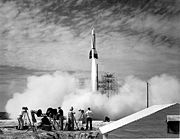
while testing the V2 rocket which became the first human-made object in space on October 3, 1942 with the launching of V-4. After the war, the U.S. used German scientists
Operation Paperclip
Operation Paperclip was the Office of Strategic Services program used to recruit the scientists of Nazi Germany for employment by the United States in the aftermath of World War II...
and their captured rockets in programs for both military and civilian research. The first scientific exploration from space was the cosmic radiation experiment launched by the U.S. on a V2 rocket on May 10, 1946. The first images of Earth taken from space followed the same year while the first animal experiment
Animals in space
Animals in space originally only served to test the survivability of spaceflight, before manned space missions were attempted. Later, animals were also flown to investigate various biological processes and the effects microgravity and space flight might have on them...
saw fruit flies lifted into space in 1947, both also on modified V2s launched by Americans. Starting in 1947, the Soviets, also with the help of German teams, launched sub-orbital V2 rockets and their own variant, the R-1
R-1 (missile)
The R-1 rocket was a copy of the German V-2 rocket manufactured by the Soviet Union. Even though it was a copy, it was manufactured using Soviet industrial plants and gave the Soviets valuable experience which later enabled the USSR to construct its own much more capable rockets.In 1945 the...
, including radiation and animal experiments on some flights. These suborbital
Sub-orbital spaceflight
A sub-orbital space flight is a spaceflight in which the spacecraft reaches space, but its trajectory intersects the atmosphere or surface of the gravitating body from which it was launched, so that it does not complete one orbital revolution....
experiments only allowed a very short time in space which limited their usefulness.
First flights
Soviet Union
The Soviet Union , officially the Union of Soviet Socialist Republics , was a constitutionally socialist state that existed in Eurasia between 1922 and 1991....
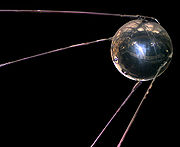
unmanned Sputnik 1 ("Satellite 1")
Sputnik 1
Sputnik 1 ) was the first artificial satellite to be put into Earth's orbit. It was launched into an elliptical low Earth orbit by the Soviet Union on 4 October 1957. The unanticipated announcement of Sputnik 1s success precipitated the Sputnik crisis in the United States and ignited the Space...
mission on October 4, 1957. The satellite weighed about 83 kg (184 pounds), and is believed to have orbited Earth at a height of about 250 km (155.3 mi). It had two radio transmitters (20 and 40 MHz), which emitted "beeps" that could be heard by radios around the globe. Analysis of the radio signals was used to gather information about the electron density of the ionosphere, while temperature and pressure data was encoded in the duration of radio beeps. The results indicated that the satellite was not punctured by a meteoroid
Meteoroid
A meteoroid is a sand- to boulder-sized particle of debris in the Solar System. The visible path of a meteoroid that enters Earth's atmosphere is called a meteor, or colloquially a shooting star or falling star. If a meteoroid reaches the ground and survives impact, then it is called a meteorite...
. Sputnik 1 was launched by an R-7
R-7 Semyorka
The R-7 was a Soviet missile developed during the Cold War, and the world's first intercontinental ballistic missile. The R-7 made 28 launches between 1957 and 1961, but was never deployed operationally. A derivative, the R-7A, was deployed from 1960 to 1968...
rocket. It burned up upon re-entry on January 3, 1958.
This success led to an escalation of the American space program, which unsuccessfully attempted to launch a Vanguard satellite
Vanguard TV3
Vanguard TV3 was the first attempt of the United States to launch a satellite into orbit around the Earth. It was a small satellite designed to test the launch capabilities of the three-stage Vanguard rocket and study the effects of the environment on a satellite and its systems in Earth orbit...
into orbit two months later. On January 31, 1958, the U.S. successfully orbited Explorer 1 on a Juno rocket. In the meantime, the Soviet dog Laika
Laika
Laika was a Soviet space dog that became the first animal to orbit the Earth – as well as the first animal to die in orbit.As little was known about the impact of spaceflight on living creatures at the time of Laika's mission, and the technology to de-orbit had not yet been developed, there...
became the first animal in orbit on November 3, 1957.
First human flights
The first successful human spaceflight was Vostok 1
Vostok 1
Vostok 1 was the first spaceflight in the Vostok program and the first human spaceflight in history. The Vostok 3KA spacecraft was launched on April 12, 1961. The flight took Yuri Gagarin, a cosmonaut from the Soviet Union, into space. The flight marked the first time that a human entered outer...
("East 1"), carrying 27 year old Russian cosmonaut Yuri Gagarin
Yuri Gagarin
Yuri Alekseyevich Gagarin was a Soviet pilot and cosmonaut. He was the first human to journey into outer space, when his Vostok spacecraft completed an orbit of the Earth on April 12, 1961....
on April 12, 1961. The spacecraft completed one orbit around the globe, lasting about 1 hour and 48 minutes. Gagarin's flight resonated around the world; it was a demonstration of the advanced Soviet space program
Soviet space program
The Soviet space program is the rocketry and space exploration programs conducted by the former Union of Soviet Socialist Republics from the 1930s until its dissolution in 1991...
and it opened an entirely new era in space exploration: human spaceflight
Human spaceflight
Human spaceflight is spaceflight with humans on the spacecraft. When a spacecraft is manned, it can be piloted directly, as opposed to machine or robotic space probes and remotely-controlled satellites....
.
Vostok 1
Vostok 1 was the first spaceflight in the Vostok program and the first human spaceflight in history. The Vostok 3KA spacecraft was launched on April 12, 1961. The flight took Yuri Gagarin, a cosmonaut from the Soviet Union, into space. The flight marked the first time that a human entered outer...
with Alan Shepard
Alan Shepard
Alan Bartlett Shepard, Jr. was an American naval aviator, test pilot, flag officer, and NASA astronaut who in 1961 became the second person, and the first American, in space. This Mercury flight was designed to enter space, but not to achieve orbit...
's suborbital flight in Mercury-Redstone 3
Mercury-Redstone 3
Mercury-Redstone 3 was the first manned space mission of the United States. Astronaut Alan Shepard piloted a 15-minute Project Mercury suborbital flight in the Freedom 7 spacecraft on May 5, 1961 to become the first American in space, three weeks after the Soviet cosmonaut Yuri Gagarin had carried...
. Orbital flight was achieved by the United States when John Glenn
John Glenn
John Herschel Glenn, Jr. is a former United States Marine Corps pilot, astronaut, and United States senator who was the first American to orbit the Earth and the third American in space. Glenn was a Marine Corps fighter pilot before joining NASA's Mercury program as a member of NASA's original...
's Mercury-Atlas 6
Mercury-Atlas 6
Mercury-Atlas 6 was a human spaceflight mission conducted by NASA, the space agency of the United States. As part of Project Mercury, MA-6 was the successful first attempt by NASA to place an astronaut into orbit. The MA-6 mission was launched February 20, 1962. It made three orbits of the Earth,...
orbited the Earth on February 20, 1962.
Valentina Tereshkova
Valentina Tereshkova
Valentina Vladimirovna Tereshkova is a retired Soviet cosmonaut, and was the first woman in space. She was selected out of more than four hundred applicants, and then out of five finalists, to pilot Vostok 6 on the 16 June, 1963, becoming both the first woman and the first civilian to fly in...
, the first woman in space, orbited the Earth 48 times aboard Vostok 6
Vostok 6
-Backup crew:-Reserve crew:Vostok VI-Mission parameters:*Mass: *Apogee: *Perigee: *Inclination: 64.9°*Period: 87.8 minutes9090...
on June 16, 1963.
China first launched a person into space 42 years after the launch of Vostok 1, on October 15, 2003, with the flight of Yang Liwei
Yang Liwei
Yáng Lìwěi is a Chinese major general and military pilot and a CNSA astronaut. He was the first man sent into space by the Chinese space program and his mission, Shenzhou 5, made China the third country to independently send people into space.-Background:...
aboard the Shenzhou 5
Shenzhou 5
Shenzhou 5 — was the first human spaceflight mission of the People's Republic of China , launched on October 15, 2003. The Shenzhou spacecraft was launched on a Long March 2F launch vehicle. There had been four previous flights of unmanned Shenzhou missions since 1999...
(Spaceboat 5) spacecraft.
First planetary explorations
The first artificial object to reach another celestial body was Luna 2
Luna 2
Luna 2 was the second of the Soviet Union's Luna programme spacecraft launched to the Moon. It was the first spacecraft to reach the surface of the Moon...
in 1959. The first automatic landing on another celestial body was performed by Luna 9
Luna 9
Luna 9 was an unmanned space mission of the Soviet Union's Luna program. On February 3, 1966 the Luna 9 spacecraft was the first spacecraft to achieve a soft landing on any planetary body other than Earth and to transmit photographic data to Earth.The automatic lunar station that achieved the...
in 1966. Luna 10
Luna 10
Luna 10 was a Luna program, robotic spacecraft mission, also called Lunik 10.The Luna 10 spacecraft was launched towards the Moon from an Earth orbiting platform on March 31, 1966. It was the first artificial satellite of the Moon...
became the first artificial satellite of another celestial body.
The first manned landing on another celestial body was performed by Apollo 11
Apollo 11
In early 1969, Bill Anders accepted a job with the National Space Council effective in August 1969 and announced his retirement as an astronaut. At that point Ken Mattingly was moved from the support crew into parallel training with Anders as backup Command Module Pilot in case Apollo 11 was...
in its lunar landing on July 20, 1969.
The first successful interplanetary flyby was the 1962 Mariner 2
Mariner 2
Mariner 2 , an American space probe to Venus, was the first space probe to conduct a successful planetary encounter . The first successful spacecraft in the NASA Mariner program, it was a simplified version of the Block I spacecraft of the Ranger program and an exact copy of Mariner 1...
flyby of Venus
Venus
Venus is the second planet from the Sun, orbiting it every 224.7 Earth days. The planet is named after Venus, the Roman goddess of love and beauty. After the Moon, it is the brightest natural object in the night sky, reaching an apparent magnitude of −4.6, bright enough to cast shadows...
(closest approach 34,773 kilometers). Flybys for the other planets were first achieved in 1965 for Mars
Mars
Mars is the fourth planet from the Sun in the Solar System. The planet is named after the Roman god of war, Mars. It is often described as the "Red Planet", as the iron oxide prevalent on its surface gives it a reddish appearance...
by Mariner 4
Mariner 4
Mariner 4 was the fourth in a series of spacecraft, launched on November 28, 1964, intended for planetary exploration in a flyby mode and performed the first successful flyby of the planet Mars, returning the first pictures of the Martian surface...
, 1973 for Jupiter
Jupiter
Jupiter is the fifth planet from the Sun and the largest planet within the Solar System. It is a gas giant with mass one-thousandth that of the Sun but is two and a half times the mass of all the other planets in our Solar System combined. Jupiter is classified as a gas giant along with Saturn,...
by Pioneer 10
Pioneer 10
Pioneer 10 is a 258-kilogram robotic space probe that completed the first interplanetary mission to Jupiter, and became the first spacecraft to achieve escape velocity from the Solar System. The project was managed by the NASA Ames Research Center and the contract for the construction of the...
, 1974 for Mercury
Mercury (planet)
Mercury is the innermost and smallest planet in the Solar System, orbiting the Sun once every 87.969 Earth days. The orbit of Mercury has the highest eccentricity of all the Solar System planets, and it has the smallest axial tilt. It completes three rotations about its axis for every two orbits...
by Mariner 10
Mariner 10
Mariner 10 was an American robotic space probe launched by NASA on November 3, 1973, to fly by the planets Mercury and Venus. It was launched approximately two years after Mariner 9 and was the last spacecraft in the Mariner program...
, 1979 for Saturn
Saturn
Saturn is the sixth planet from the Sun and the second largest planet in the Solar System, after Jupiter. Saturn is named after the Roman god Saturn, equated to the Greek Cronus , the Babylonian Ninurta and the Hindu Shani. Saturn's astronomical symbol represents the Roman god's sickle.Saturn,...
by Pioneer 11
Pioneer 11
Pioneer 11 is a 259-kilogram robotic space probe launched by NASA on April 6, 1973 to study the asteroid belt, the environment around Jupiter and Saturn, solar wind, cosmic rays, and eventually the far reaches of the solar system and heliosphere...
, 1986 for Uranus
Uranus
Uranus is the seventh planet from the Sun. It has the third-largest planetary radius and fourth-largest planetary mass in the Solar System. It is named after the ancient Greek deity of the sky Uranus , the father of Cronus and grandfather of Zeus...
by Voyager 2
Voyager 2
The Voyager 2 spacecraft is a 722-kilogram space probe launched by NASA on August 20, 1977 to study the outer Solar System and eventually interstellar space...
, and 1989 for Neptune
Neptune
Neptune is the eighth and farthest planet from the Sun in the Solar System. Named for the Roman god of the sea, it is the fourth-largest planet by diameter and the third largest by mass. Neptune is 17 times the mass of Earth and is slightly more massive than its near-twin Uranus, which is 15 times...
by Voyager 2.
The first interplanetary surface mission to return at least limited surface data from another planet was the 1970 landing of Venera 7
Venera 7
The Venera 7 was a Soviet spacecraft, part of the Venera series of probes to Venus. When it landed on the Venusian surface, it became the first man-made spacecraft to successfully land on another planet and to transmit data from there back to Earth.*Launch date/time: 1970 August 17 at 05:38...
on Venus which returned data to earth for 23 minutes. In 1971 the Mars 3
Mars 3
The Mars 3 was an unmanned space probe of the Mars program, a series of unmanned Mars landers and orbiters launched by the Soviet Union in the early 1970s....
mission achieved the first soft landing on Mars returning data for almost 20 seconds. Later much longer duration surface missions were achieved, including over 6 years of Mars surface operation by Viking 1
Viking 1
Viking 1 was the first of two spacecraft sent to Mars as part of NASA's Viking program. It was the first spacecraft to successfully land on Mars and perform its mission, and until May 19, 2010 held the record for the second longest Mars surface mission of 6 years and 116 days .- Mission :Following...
from 1975 to 1982 and over 2 hours of transmission from the surface of Venus by Venera 13
Venera 13
Venera 13 was a probe in the Soviet Venera program for the exploration of Venus.Venera 13 and 14 were identical spacecraft built to take advantage of the 1981 Venus launch opportunity and launched 5 days apart, Venera 13 on 1981-10-30 at 06:04:00 UTC and Venera 14 on 1981-11-04 at 05:31:00 UTC,...
in 1982 (the longest ever Soviet planetary surface mission).
Key people in early space exploration
The dream of stepping into the outer reaches of the Earth's atmosphere was driven by the fiction of Jules Verne
Jules Verne
Jules Gabriel Verne was a French author who pioneered the science fiction genre. He is best known for his novels Twenty Thousand Leagues Under the Sea , A Journey to the Center of the Earth , and Around the World in Eighty Days...
and H.G.Wells, and rocket technology was developed to try and realise this vision. The German V2
V-2 rocket
The V-2 rocket , technical name Aggregat-4 , was a ballistic missile that was developed at the beginning of the Second World War in Germany, specifically targeted at London and later Antwerp. The liquid-propellant rocket was the world's first long-range combat-ballistic missile and first known...
was the first rocket to travel into space, overcoming the problems of thrust and material failure. During the final days of World War II this technology was obtained by both the Americans and Soviets as were its designers. The initial driving force for further development of the technology was a weapons race for intercontinental ballistic missiles (ICBMs) to be used as long-range carriers for fast nuclear weapon
Nuclear weapon
A nuclear weapon is an explosive device that derives its destructive force from nuclear reactions, either fission or a combination of fission and fusion. Both reactions release vast quantities of energy from relatively small amounts of matter. The first fission bomb test released the same amount...
delivery, but in 1961 when USSR launched the first man into space, the U.S. declared itself to be in a "Space Race
Space Race
The Space Race was a mid-to-late 20th century competition between the Soviet Union and the United States for supremacy in space exploration. Between 1957 and 1975, Cold War rivalry between the two nations focused on attaining firsts in space exploration, which were seen as necessary for national...
" with Russia.
- Konstantin TsiolkovskyKonstantin TsiolkovskyKonstantin Eduardovich Tsiolkovsky was an Imperial Russian and Soviet rocket scientist and pioneer of the astronautic theory. Along with his followers the German Hermann Oberth and the American Robert H. Goddard, he is considered to be one of the founding fathers of rocketry and astronautics...
, Robert Goddard, Hermann OberthHermann OberthHermann Julius Oberth was an Austro-Hungarian-born German physicist and engineer. He is considered one of the founding fathers of rocketry and astronautics.- Early life :...
, and Reinhold TilingReinhold TilingReinhold Tiling was a German engineer, pilot and a rocket pioneer.-Biography:Tiling was born in Absberg, Kingdom of Bavaria, as the son of a pastor. Shortly after he began the study of mechanical engineering and electro-technology he found himself in war service at the beginning of the First World...
laid the groundwork of rocketry in the early years of the 20th century. - Wernher von BraunWernher von BraunWernher Magnus Maximilian, Freiherr von Braun was a German rocket scientist, aerospace engineer, space architect, and one of the leading figures in the development of rocket technology in Nazi Germany during World War II and in the United States after that.A former member of the Nazi party,...
was the lead rocket engineer for Nazi Germany's World War II V-2 rocketV-2 rocketThe V-2 rocket , technical name Aggregat-4 , was a ballistic missile that was developed at the beginning of the Second World War in Germany, specifically targeted at London and later Antwerp. The liquid-propellant rocket was the world's first long-range combat-ballistic missile and first known...
project. In the last days of the war he led a caravan of workers in the German rocket program to the American lines, where they surrendered and were brought to the USA to work on U.S. rocket development ("Operation PaperclipOperation PaperclipOperation Paperclip was the Office of Strategic Services program used to recruit the scientists of Nazi Germany for employment by the United States in the aftermath of World War II...
"). He acquired American citizenship and led the team that developed and launched Explorer 1, the first American satellite. Von Braun later led the team at NASANASAThe National Aeronautics and Space Administration is the agency of the United States government that is responsible for the nation's civilian space program and for aeronautics and aerospace research...
's Marshall Space Flight CenterMarshall Space Flight CenterThe George C. Marshall Space Flight Center is the U.S. government's civilian rocketry and spacecraft propulsion research center. The largest center of NASA, MSFC's first mission was developing the Saturn launch vehicles for the Apollo moon program...
which developed the Saturn VSaturn VThe Saturn V was an American human-rated expendable rocket used by NASA's Apollo and Skylab programs from 1967 until 1973. A multistage liquid-fueled launch vehicle, NASA launched 13 Saturn Vs from the Kennedy Space Center, Florida with no loss of crew or payload...
moon rocket. - Initially the race for space was often led by Sergei Korolyov, whose legacy includes both the R7R-7 SemyorkaThe R-7 was a Soviet missile developed during the Cold War, and the world's first intercontinental ballistic missile. The R-7 made 28 launches between 1957 and 1961, but was never deployed operationally. A derivative, the R-7A, was deployed from 1960 to 1968...
and SoyuzSoyuz spacecraftSoyuz , Union) is a series of spacecraft initially designed for the Soviet space programme by the Korolyov Design Bureau in the 1960s, and still in service today...
—which remain in service to this day. Korolev was the mastermind behind the first satellite, first man (and first woman) in orbit and first spacewalk. Until his death his identity was a closely guarded state secret; not even his mother knew that he was responsible for creating the Russian space program. - Kerim KerimovKerim KerimovLieutenant-General Kerim Aliyevich Kerimov was an Azerbaijani-Soviet/Russian aerospace engineer and a renowned rocket scientist, one of the founders of the Soviet space industry, and for many years a central figure in the Soviet space program. Despite his prominent role, his identity was kept a...
was one of the founders of the Soviet space programSoviet space programThe Soviet space program is the rocketry and space exploration programs conducted by the former Union of Soviet Socialist Republics from the 1930s until its dissolution in 1991...
and was one of the lead architects behind the first human spaceflightHuman spaceflightHuman spaceflight is spaceflight with humans on the spacecraft. When a spacecraft is manned, it can be piloted directly, as opposed to machine or robotic space probes and remotely-controlled satellites....
(Vostok 1Vostok 1Vostok 1 was the first spaceflight in the Vostok program and the first human spaceflight in history. The Vostok 3KA spacecraft was launched on April 12, 1961. The flight took Yuri Gagarin, a cosmonaut from the Soviet Union, into space. The flight marked the first time that a human entered outer...
) alongside Sergey Korolyov. After Korolyov's death in 1966, Kerimov became the lead scientist of the Soviet space program and was responsible for the launch of the first space stationSpace stationA space station is a spacecraft capable of supporting a crew which is designed to remain in space for an extended period of time, and to which other spacecraft can dock. A space station is distinguished from other spacecraft used for human spaceflight by its lack of major propulsion or landing...
s from 1971 to 1991, including the SalyutSalyutThe Salyut program was the first space station program undertaken by the Soviet Union, which consisted of a series of nine space stations launched over a period of eleven years from 1971 to 1982...
and MirMirMir was a space station operated in low Earth orbit from 1986 to 2001, at first by the Soviet Union and then by Russia. Assembled in orbit from 1986 to 1996, Mir was the first modular space station and had a greater mass than that of any previous spacecraft, holding the record for the...
series, and their precursors in 1967, the Cosmos 186 and Cosmos 188.
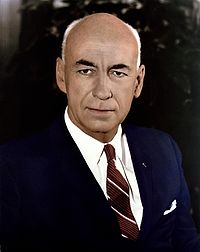
- Valentin GlushkoValentin GlushkoValentin Petrovich Glushko or Valentyn Petrovych Hlushko was a Soviet engineer, and the principal Soviet designer of rocket engines during the Soviet/American Space Race.-Biography:...
held the role of Chief Engine Designer for USSR. Glushko designed many of the engines used on the early Soviet rockets, but was constantly at odds with Korolyov. - Vasily MishinVasily MishinVasily Pavlovich Mishin was a Soviet engineer and a prominent rocketry pioneer....
was Chief Designer working under Sergey Korolyov and one of first Soviets to inspect the captured German V2 design. Following the death of Sergei Korolev, Mishin was held responsible for the Soviet failure to be first country to place a man on the moon. - Bob Gilruth was the NASANASAThe National Aeronautics and Space Administration is the agency of the United States government that is responsible for the nation's civilian space program and for aeronautics and aerospace research...
head of the Space Task Force and director of 25 manned space flights. Gilruth was the person who suggested to John F. KennedyJohn F. KennedyJohn Fitzgerald "Jack" Kennedy , often referred to by his initials JFK, was the 35th President of the United States, serving from 1961 until his assassination in 1963....
that the Americans take the bold step of reaching the Moon in an attempt to reclaim space superiority from the Soviets. - Christopher C. Kraft, Jr.Christopher C. Kraft, Jr.Christopher Columbus Kraft, Jr. is a retired NASA engineer and manager who was instrumental in establishing the agency's Mission Control operation...
was NASA's first flight directorFlight controllerFlight controllers are personnel who aid in the operations of a space flight, working in Mission Control Centers such as NASA's Mission Control Center, or ESA's Operations Center. Flight controllers sit at computer consoles and use telemetry to monitor in real time various technical aspects of a...
, who oversaw development of Mission Control and associated technologies and procedures. - Maxime FagetMaxime FagetMaxime "Max" A. Faget was the designer of the Mercury capsule, and contributed to the later Gemini and Apollo spacecraft as well as the Space Shuttle.- Life :...
was the designer of the MercuryProject MercuryIn January 1960 NASA awarded Western Electric Company a contract for the Mercury tracking network. The value of the contract was over $33 million. Also in January, McDonnell delivered the first production-type Mercury spacecraft, less than a year after award of the formal contract. On February 12,...
capsule; he played a key role in designing the GeminiProject GeminiProject Gemini was the second human spaceflight program of NASA, the civilian space agency of the United States government. Project Gemini was conducted between projects Mercury and Apollo, with ten manned flights occurring in 1965 and 1966....
and ApolloProject ApolloThe Apollo program was the spaceflight effort carried out by the United States' National Aeronautics and Space Administration , that landed the first humans on Earth's Moon. Conceived during the Presidency of Dwight D. Eisenhower, Apollo began in earnest after President John F...
spacecraft, and contributed to the design of the Space ShuttleSpace ShuttleThe Space Shuttle was a manned orbital rocket and spacecraft system operated by NASA on 135 missions from 1981 to 2011. The system combined rocket launch, orbital spacecraft, and re-entry spaceplane with modular add-ons...
.
The Sun
While the SunSun
The Sun is the star at the center of the Solar System. It is almost perfectly spherical and consists of hot plasma interwoven with magnetic fields...
will probably not be physically explored in the close future, one of the reasons for going into space includes knowing more about the Sun. Once above the atmosphere in particular and the Earth's magnetic field, this gives access to the Solar wind and infrared and ultraviolet radiations that cannot reach the surface of the Earth. The Sun generates most space weather
Space weather
Space weather is the concept of changing environmental conditions in near-Earth space or thespace from the Sun's atmosphere to the Earth's atmosphere. It is distinct from the concept ofweather within the Earth's planetary atmosphere...
, which can affect power generation and transmission systems on Earth and interfere with, and even damage, satellites and space probes.

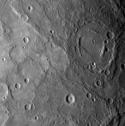
Mercury
MercuryMercury (planet)
Mercury is the innermost and smallest planet in the Solar System, orbiting the Sun once every 87.969 Earth days. The orbit of Mercury has the highest eccentricity of all the Solar System planets, and it has the smallest axial tilt. It completes three rotations about its axis for every two orbits...
remains the least explored of the inner planets
Terrestrial planet
A terrestrial planet, telluric planet or rocky planet is a planet that is composed primarily of silicate rocks or metals. Within the Solar System, the terrestrial planets are the inner planets closest to the Sun...
. As of May 2011, the Mariner 10
Mariner 10
Mariner 10 was an American robotic space probe launched by NASA on November 3, 1973, to fly by the planets Mercury and Venus. It was launched approximately two years after Mariner 9 and was the last spacecraft in the Mariner program...
and MESSENGER
MESSENGER
The MErcury Surface, Space ENvironment, GEochemistry and Ranging space probe is a robotic NASA spacecraft in orbit around the planet Mercury. The spacecraft was launched aboard a Delta II rocket in August 2004 to study the chemical composition, geology, and magnetic field of Mercury...
missions have been the only missions that have made close observations of Mercury. MESSENGER
MESSENGER
The MErcury Surface, Space ENvironment, GEochemistry and Ranging space probe is a robotic NASA spacecraft in orbit around the planet Mercury. The spacecraft was launched aboard a Delta II rocket in August 2004 to study the chemical composition, geology, and magnetic field of Mercury...
entered orbit around Mercury in March, 2011, to further investigate the observations made by Mariner 10 in 1975 (Munsell, 2006b). A third mission to Mercury, scheduled to arrive in 2020, BepiColombo
BepiColombo
BepiColombo is a joint mission of the European Space Agency and the Japan Aerospace Exploration Agency to the planet Mercury, due to launch in 2014. The mission is still in the planning stages so changes to the current description are likely over the next few years...
is to include two probes
Space probe
A robotic spacecraft is a spacecraft with no humans on board, that is usually under telerobotic control. A robotic spacecraft designed to make scientific research measurements is often called a space probe. Many space missions are more suited to telerobotic rather than crewed operation, due to...
. BepiColombo is a joint mission between Japan and the European Space Agency
European Space Agency
The European Space Agency , established in 1975, is an intergovernmental organisation dedicated to the exploration of space, currently with 18 member states...
. MESSENGER and BepiColombo are intended to gather complementary data to help scientists understand many of the mysteries discovered by Mariner 10's flybys
Gravitational slingshot
In orbital mechanics and aerospace engineering, a gravitational slingshot, gravity assist maneuver, or swing-by is the use of the relative movement and gravity of a planet or other celestial body to alter the path and speed of a spacecraft, typically in order to save propellant, time, and expense...
.
Flights to other planets within the Solar System are accomplished at a cost in energy
Energy
In physics, energy is an indirectly observed quantity. It is often understood as the ability a physical system has to do work on other physical systems...
, which is described by the net change in velocity of the spacecraft, or delta-v
Delta-v
In astrodynamics a Δv or delta-v is a scalar which takes units of speed. It is a measure of the amount of "effort" that is needed to change from one trajectory to another by making an orbital maneuver....
. Due to the relatively high delta-v to reach Mercury and its proximity to the Sun, it is difficult to explore and orbits around it are rather unstable.
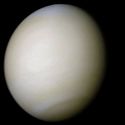
Venus
VenusVenus
Venus is the second planet from the Sun, orbiting it every 224.7 Earth days. The planet is named after Venus, the Roman goddess of love and beauty. After the Moon, it is the brightest natural object in the night sky, reaching an apparent magnitude of −4.6, bright enough to cast shadows...
was the first target of interplanetary flyby and lander missions and, despite one of the most hostile surface environments in the solar system, has had more landers sent to it (nearly all from the Soviet Union) than any other planet in the solar system. The first successful Venus flyby was the American Mariner 2
Mariner 2
Mariner 2 , an American space probe to Venus, was the first space probe to conduct a successful planetary encounter . The first successful spacecraft in the NASA Mariner program, it was a simplified version of the Block I spacecraft of the Ranger program and an exact copy of Mariner 1...
spacecraft, which flew past Venus in 1962. Mariner 2 has been followed by several other flybys by multiple space agencies often as part of missions using a Venus flyby to provide a gravitational assist en route to other celestial bodies. In 1967 Venera 4
Venera 4
Venera 4 ) was a probe in the Soviet Venera program for the exploration of Venus. Venera-4 was the first successful probe to perform in-place analysis of the environment of another planet. It was also the first probe to land on another planet...
became the first probe to enter and directly examine the atmosphere of Venus. In 1970 Venera 7
Venera 7
The Venera 7 was a Soviet spacecraft, part of the Venera series of probes to Venus. When it landed on the Venusian surface, it became the first man-made spacecraft to successfully land on another planet and to transmit data from there back to Earth.*Launch date/time: 1970 August 17 at 05:38...
became the first successful lander to reach the surface of Venus and by 1985 it had been followed by eight additional successful Soviet Venus landers which provided images and other direct surface data. Starting in 1975 with the Soviet orbiter Venera 9
Venera 9
Venera 9 was a USSR unmanned space mission to Venus. It consisted of an orbiter and a lander. It was launched on June 8, 1975 02:38:00 UTC and weighed 4,936 kg...
some ten successful orbiter missions have been sent to Venus, including later missions which were able to map the surface of Venus using radar
Radar
Radar is an object-detection system which uses radio waves to determine the range, altitude, direction, or speed of objects. It can be used to detect aircraft, ships, spacecraft, guided missiles, motor vehicles, weather formations, and terrain. The radar dish or antenna transmits pulses of radio...
to pierce the obscuring atmosphere.
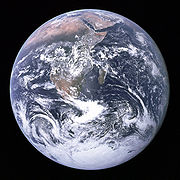
Earth
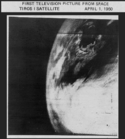
Space exploration has been used as a tool to understand the Earth as a celestial object in its own right. Orbital missions can provide data for the Earth that can be difficult or impossible to obtain from a purely ground-based point of reference.For example, the existence of the Van Allen belts was unknown until their discovery by the United States' first artificial satellite, Explorer 1. These belts contain radiation trapped by the Earth's magnetic fields, which currently renders construction of habitable space stations above 1000 km impractical.
Following this early unexpected discovery, a large number of Earth observation satellites have been deployed specifically to explore the Earth from a space based perspective. These satellites have significantly contributed to the understanding of a variety of earth based phenomena. For instance, the hole in the ozone layer
Ozone depletion
Ozone depletion describes two distinct but related phenomena observed since the late 1970s: a steady decline of about 4% per decade in the total volume of ozone in Earth's stratosphere , and a much larger springtime decrease in stratospheric ozone over Earth's polar regions. The latter phenomenon...
was found by an artificial satellite that was exploring Earth's atmosphere, and satellites have allowed for the discovery of archeological sites or geological formations that were difficult or impossible to otherwise identify.
Earth's Moon
Earth's MoonMoon
The Moon is Earth's only known natural satellite,There are a number of near-Earth asteroids including 3753 Cruithne that are co-orbital with Earth: their orbits bring them close to Earth for periods of time but then alter in the long term . These are quasi-satellites and not true moons. For more...
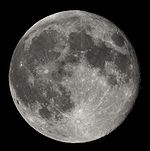
was the first celestial body to be the object of space exploration. It holds the distinctions of being the first remote celestial object to be flown by, orbited, and landed upon by spacecraft, and the only remote celestial object ever to be visited by humans.
In 1959 the Soviets obtained the first images of the far side of the Moon
Far side of the Moon
The far side of the Moon is the lunar hemisphere that is permanently turned away, and is not visible from the surface of the Earth. The far hemisphere was first photographed by the Soviet Luna 3 probe in 1959, and was first directly observed by human eyes when the Apollo 8 mission orbited the Moon...
, never previously visible to humans. The U.S. exploration of the Moon began with the Ranger 4
Ranger 4
Ranger 4 was a spacecraft of the Ranger program designed to transmit pictures of the lunar surface to Earth stations during a period of 10 minutes of flight prior to crashing upon the Moon, to rough-land a seismometer capsule on the Moon, to collect gamma-ray data in flight, to study radar...
impactor in 1962. Starting in 1966 the Soviets successfully deployed a number of landers
Lander (spacecraft)
A lander is a spacecraft which descends toward and comes to rest on the surface of an astronomical body. For bodies with atmospheres, the landing is called atmospheric reentry and the lander descends as a re-entry vehicle...
to the Moon which were able to obtain data directly from the Moon's surface; just four months later, Surveyor 1
Surveyor 1
Surveyor 1 was the first lunar soft-lander in the unmanned Surveyor program of the National Aeronautics and Space Administration . This lunar soft-lander gathered data about the lunar surface that would be needed for the manned Apollo Moon landings that began in 1969...
marked the debut of a successful series of U.S. landers. The Soviet unmanned missions culminated in the Lunokhod program
Lunokhod programme
Lunokhod was a series of Soviet robotic lunar rovers designed to land on the Moon between 1969 and 1977. The 1969 Lunokhod 1A was destroyed during launch, the 1970 Lunokhod 1 and the 1973 Lunokhod 2 landed on the moon and the 1977 Lunokhod was never launched...
in the early '70s which included the first unmanned rovers and also successfully returned lunar soil samples to the Earth for study. This marked the first (and to date the only) automated return of extraterrestrial soil samples to the Earth. Unmanned exploration of the Moon continues with various nations periodically deploying lunar orbiters, and in 2008 the Indian Moon Impact Probe
Moon Impact Probe
The Moon Impact Probe developed by the Indian Space Research Organisation , India's national space agency, was a lunar probe that was released by ISRO's Chandrayaan-1 lunar remote sensing orbiter which in turn was launched, on 22 October 2008, aboard a modified version of ISRO's Polar Satellite...
.
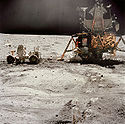
Manned exploration of the Moon began in 1968 with the Apollo 8
Apollo 8
Apollo 8, the second manned mission in the American Apollo space program, was the first human spaceflight to leave Earth orbit; the first to be captured by and escape from the gravitational field of another celestial body; and the first crewed voyage to return to Earth from another celestial...
mission that successfully orbited the Moon, the first time any extraterrestrial object was orbited by humans. In 1969 the Apollo 11
Apollo 11
In early 1969, Bill Anders accepted a job with the National Space Council effective in August 1969 and announced his retirement as an astronaut. At that point Ken Mattingly was moved from the support crew into parallel training with Anders as backup Command Module Pilot in case Apollo 11 was...
mission marked the first time humans set foot upon another world. Manned exploration of the Moon did not continue for long, however. The Apollo 17
Apollo 17
Apollo 17 was the eleventh and final manned mission in the American Apollo space program. Launched at 12:33 a.m. EST on December 7, 1972, with a three-member crew consisting of Commander Eugene Cernan, Command Module Pilot Ronald Evans, and Lunar Module Pilot Harrison Schmitt, Apollo 17 remains the...
mission in 1972 marked the most recent human visit to another world, and there is no further planned human exploration of an extraterrestrial body, though robotic missions are still pursued vigorously.
Mars
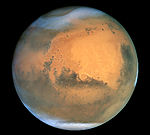
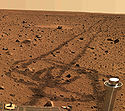
The exploration of MarsMars
Mars is the fourth planet from the Sun in the Solar System. The planet is named after the Roman god of war, Mars. It is often described as the "Red Planet", as the iron oxide prevalent on its surface gives it a reddish appearance...
has been an important part of the space exploration programs of the Soviet Union (later Russia), the United States, Europe, and Japan. Dozens of robotic spacecraft
Robotic spacecraft
A robotic spacecraft is a spacecraft with no humans on board, that is usually under telerobotic control. A robotic spacecraft designed to make scientific research measurements is often called a space probe. Many space missions are more suited to telerobotic rather than crewed operation, due to...
, including orbiter
Orbiter
An orbiter is a space probe that orbits a planet.-Asteroids:*NEAR Shoemaker...
s, lander
Lander (spacecraft)
A lander is a spacecraft which descends toward and comes to rest on the surface of an astronomical body. For bodies with atmospheres, the landing is called atmospheric reentry and the lander descends as a re-entry vehicle...
s, and rover
Rover (space exploration)
A rover is a space exploration vehicle designed to move across the surface of a planet or other astronomical body. Some rovers have been designed to transport members of a human spaceflight crew; others have been partially or fully autonomous robots...
s, have been launched toward Mars since the 1960s. These missions were aimed at gathering data about current conditions and answering questions about the history of Mars. The questions raised by the scientific community are expected to not only give a better appreciation of the red planet but also yield further insight into the past, and possible future, of Earth.
The exploration of Mars has come at a considerable financial cost with roughly two-thirds of all spacecraft destined for Mars failing before completing their missions, with some failing before they even began. Such a high failure rate can be attributed to the complexity and large number of variables involved in an interplanetary journey, and has led researchers to jokingly speak of The Great Galactic Ghoul which subsists on a diet of Mars probes. This phenomenon is also informally known as the Mars Curse.
Phobos
The Russian space mission Phobos-GruntPhobos-Grunt
Fobos-Grunt or Phobos-Grunt was an attempted Russian sample return mission to Phobos, one of the moons of Mars. It was launched on 9 November 2011 at 02:16 local time from the Baikonur Cosmodrome, but subsequent rocket burns intended to set the craft on a course for Mars failed, leaving it...
, Scheduled to launch in 2011, will begin exploration of the Phobos
Phobos (moon)
Phobos is the larger and closer of the two natural satellites of Mars. Both moons were discovered in 1877. With a mean radius of , Phobos is 7.24 times as massive as Deimos...
and Martian circumterrestrial orbit, and study whether the moons of Mars, or at least Phobos, could be a "trans-shipment point" for spaceships travelling to Mars.
Asteroids and comets
Until the advent of space travelSpaceflight
Spaceflight is the act of travelling into or through outer space. Spaceflight can occur with spacecraft which may, or may not, have humans on board. Examples of human spaceflight include the Russian Soyuz program, the U.S. Space shuttle program, as well as the ongoing International Space Station...
, objects in the asteroid belt
Asteroid belt
The asteroid belt is the region of the Solar System located roughly between the orbits of the planets Mars and Jupiter. It is occupied by numerous irregularly shaped bodies called asteroids or minor planets...
were merely pinpricks of light in even the largest telescopes, their shapes and terrain remaining a mystery.
Several asteroids have now been visited by probes, the first of which was Galileo, which flew past two: 951 Gaspra
951 Gaspra
951 Gaspra is an S-type asteroid that orbits very close to the inner edge of the asteroid belt. Gaspra was the first asteroid ever to be closely approached when it was visited by the Galileo spacecraft, which flew by on its way to Jupiter on 29 October 1991.-Characteristics:Apart from a multitude...
in 1991, followed by 243 Ida
243 Ida
243 Ida is an asteroid in the Koronis family of the asteroid belt. It was discovered on 29 September 1884 by Johann Palisa and named after a nymph from Greek mythology. Later telescopic observations categorized Ida as an S-type asteroid, the most numerous type in the inner asteroid belt. On 28...
in 1993. Both of these lay near enough to Galileo's planned trajectory to Jupiter that they could be visited at acceptable cost. The first landing on an asteroid was performed by the NEAR Shoemaker
NEAR Shoemaker
The Near Earth Asteroid Rendezvous - Shoemaker , renamed after its 1996 launch in honor of planetary scientist Eugene M. Shoemaker, was a robotic space probe designed by the Johns Hopkins University Applied Physics Laboratory for NASA to study the near-Earth asteroid Eros from close orbit over a...
probe in 2000, following an orbital survey of the object. The dwarf planet Ceres and the asteroid 4 Vesta
4 Vesta
Vesta, formally designated 4 Vesta, is one of the largest asteroids, with a mean diameter of about . It was discovered by Heinrich Wilhelm Olbers on March 29, 1807, and is named after the Roman virgin goddess of home and hearth, Vesta....
, two of the three largest asteroids, are targets of NASA's Dawn mission, launched in 2007.
While many comets have been closely studied from Earth sometimes with centuries-worth of observations, only a few comets have been closely visited. In 1985, the International Cometary Explorer
International Cometary Explorer
The International Cometary Explorer spacecraft was originally known as International Sun/Earth Explorer 3 satellite, launched August 12, 1978. It was part of the ISEE international cooperative program between NASA and ESRO/ESA to study the interaction between the Earth's magnetic field and the...
conducted the first comet fly-by (21P/Giacobini-Zinner
21P/Giacobini-Zinner
Comet Giacobini–Zinner is a periodic comet in our solar system.It was discovered by Michel Giacobini from , who observed the comet in the constellation of Aquarius on December 20, 1900...
) before joining the Halley Armada
Halley Armada
The Halley Armada is the generally accepted and popularly used name of five space probes sent to examine Halley's Comet during its 1986 sojourn through the inner solar system, connected with apparition "1P/1982 U1"...
studying the famous comet. The Deep Impact probe smashed into 9P/Tempel
9P/Tempel
Tempel 1 , is a periodic comet discovered by Wilhelm Tempel in 1867. It currently completes an orbit of the Sun every 5.5 years. Tempel 1 was the target of the Deep Impact space mission, which photographed a deliberate high-speed impact upon the comet in 2005...
to learn more about its structure and composition while the Stardust mission
Stardust (spacecraft)
Stardust is a 300-kilogram robotic space probe launched by NASA on February 7, 1999 to study the asteroid 5535 Annefrank and collect samples from the coma of comet Wild 2. The primary mission was completed January 15, 2006, when the sample return capsule returned to Earth...
returned samples of another comet's tail. The Philae lander
Philae lander
Philae is the lander that accompanies the Rosetta spacecraft. It is designed to land on Comet 67P/Churyumov-Gerasimenko shortly after arrival...
will attempt to land on a comet in 2014.
Hayabusa
Hayabusa
was an unmanned spacecraft developed by the Japan Aerospace Exploration Agency to return a sample of material from a small near-Earth asteroid named 25143 Itokawa to Earth for further analysis....
was an unmanned spacecraft
Robotic spacecraft
A robotic spacecraft is a spacecraft with no humans on board, that is usually under telerobotic control. A robotic spacecraft designed to make scientific research measurements is often called a space probe. Many space missions are more suited to telerobotic rather than crewed operation, due to...
developed by the Japan Aerospace Exploration Agency
Japan Aerospace Exploration Agency
The , or JAXA, is Japan's national aerospace agency. Through the merger of three previously independent organizations, JAXA was formed on October 1, 2003, as an Independent Administrative Institution administered by the Ministry of Education, Culture, Sports, Science and Technology and the...
to return a sample of material
Sample return mission
A sample return mission is a spacecraft mission with the goal of returning tangible samples from an extraterrestrial location to Earth for analysis. Sample return missions may bring back merely atoms and molecules or a deposit of complex compounds such as dirt and rocks...
from a small near-Earth asteroid named 25143 Itokawa
25143 Itokawa
25143 Itokawa is an Apollo and Mars-crosser asteroid. It was the first asteroid to be the target of a sample return mission, the Japanese space probe Hayabusa.-Discovery and naming:...
to Earth for further analysis. Hayabusa was launched on 9 May 2003 and rendezvoused with Itokawa in mid-September 2005. After arriving at Itokawa, Hayabusa studied the asteroid's shape, spin, topography, colour, composition, density, and history. In November 2005, it landed on the asteroid to collect samples. The spacecraft returned to Earth on 13 June 2010.
Jupiter
Jupiter
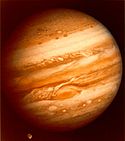
Jupiter is the fifth planet from the Sun and the largest planet within the Solar System. It is a gas giant with mass one-thousandth that of the Sun but is two and a half times the mass of all the other planets in our Solar System combined. Jupiter is classified as a gas giant along with Saturn,...
has consisted solely of a number of automated NASA spacecraft visiting the planet since 1973. A large majority of the missions have been "flybys", in which detailed observations are taken without the probe landing or entering orbit; the Galileo
Galileo spacecraft
Galileo was an unmanned spacecraft sent by NASA to study the planet Jupiter and its moons. Named after the astronomer and Renaissance pioneer Galileo Galilei, it was launched on October 18, 1989 by the Space Shuttle Atlantis on the STS-34 mission...
spacecraft is the only one to have orbited the planet. As Jupiter is believed to have only a relatively small rocky core and no real solid surface, a landing mission is nearly impossible.
Reaching Jupiter from Earth requires a delta-v of 9.2 km/s, which is comparable to the 9.7 km/s delta-v needed to reach low Earth orbit. Fortunately, gravity assists
Gravitational slingshot
In orbital mechanics and aerospace engineering, a gravitational slingshot, gravity assist maneuver, or swing-by is the use of the relative movement and gravity of a planet or other celestial body to alter the path and speed of a spacecraft, typically in order to save propellant, time, and expense...
through planetary flybys can be used to reduce the energy required at launch to reach Jupiter, albeit at the cost of a significantly longer flight duration.
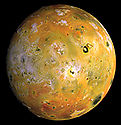
Jupiter has over 60 known moons, many of which have relatively little known information about them.
_large.jpg)

Saturn
SaturnSaturn
Saturn is the sixth planet from the Sun and the second largest planet in the Solar System, after Jupiter. Saturn is named after the Roman god Saturn, equated to the Greek Cronus , the Babylonian Ninurta and the Hindu Shani. Saturn's astronomical symbol represents the Roman god's sickle.Saturn,...
has been explored only through unmanned spacecraft launched by NASA, including one mission (Cassini–Huygens) planned and executed in cooperation with other space agencies. These missions consist of flybys in 1979 by Pioneer 11
Pioneer 11
Pioneer 11 is a 259-kilogram robotic space probe launched by NASA on April 6, 1973 to study the asteroid belt, the environment around Jupiter and Saturn, solar wind, cosmic rays, and eventually the far reaches of the solar system and heliosphere...
, in 1980 by Voyager 1
Voyager 1
The Voyager 1 spacecraft is a 722-kilogram space probe launched by NASA in 1977, to study the outer Solar System and eventually interstellar space. Operating for as of today , the spacecraft receives routine commands and transmits data back to the Deep Space Network. At a distance of as of...
, in 1982 by Voyager 2
Voyager 2
The Voyager 2 spacecraft is a 722-kilogram space probe launched by NASA on August 20, 1977 to study the outer Solar System and eventually interstellar space...
and an orbital mission by the Cassini spacecraft which entered orbit in 2004 and is expected to continue its mission well into 2010.
Saturn has at least 62 satellites, although the exact number is debatable since Saturn's rings are made up of vast numbers of independently orbiting objects of varying sizes. The largest of the moons is Titan
Titan (moon)
Titan , or Saturn VI, is the largest moon of Saturn, the only natural satellite known to have a dense atmosphere, and the only object other than Earth for which clear evidence of stable bodies of surface liquid has been found....
. Titan holds the distinction of being the only moon in the solar system with an atmosphere denser and thicker than that of the Earth. As a result of the deployment from the Cassini spacecraft of the Huygens probe and its successful landing on Titan, Titan also holds the distinction of being the only moon (apart from Earth's own Moon) to be successfully explored with a lander.
Uranus
The exploration of UranusUranus
Uranus is the seventh planet from the Sun. It has the third-largest planetary radius and fourth-largest planetary mass in the Solar System. It is named after the ancient Greek deity of the sky Uranus , the father of Cronus and grandfather of Zeus...
has been entirely through the Voyager 2
Voyager 2
The Voyager 2 spacecraft is a 722-kilogram space probe launched by NASA on August 20, 1977 to study the outer Solar System and eventually interstellar space...
spacecraft, with no other visits currently planned. Given its axial tilt
Axial tilt
In astronomy, axial tilt is the angle between an object's rotational axis, and a line perpendicular to its orbital plane...
of 97.77°, with its polar regions exposed to sunlight or darkness for long periods, scientists were not sure what to expect at Uranus. The closest approach to Uranus
Uranus
Uranus is the seventh planet from the Sun. It has the third-largest planetary radius and fourth-largest planetary mass in the Solar System. It is named after the ancient Greek deity of the sky Uranus , the father of Cronus and grandfather of Zeus...
occurred on January 24, 1986. Voyager 2 studied the planet's unique atmosphere and magnetosphere
Magnetosphere
A magnetosphere is formed when a stream of charged particles, such as the solar wind, interacts with and is deflected by the intrinsic magnetic field of a planet or similar body. Earth is surrounded by a magnetosphere, as are the other planets with intrinsic magnetic fields: Mercury, Jupiter,...
. Voyager 2 also examined its ring system
Rings of Uranus
The planet Uranus has a system of rings intermediate in complexity between the more extensive set around Saturn and the simpler systems around Jupiter and Neptune. The rings of Uranus were discovered on March 10, 1977, by James L. Elliot, Edward W. Dunham, and Douglas J. Mink...
and the moons of Uranus including all five of the previously known moons, while discovering an additional ten previously unknown moons.
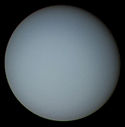
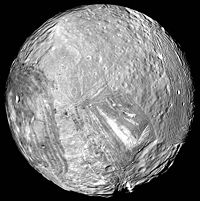
Images of Uranus proved to have a very uniform appearance, with no evidence of the dramatic storms or atmospheric banding evident on Jupiter and Saturn. Great effort was required to even identify a few clouds in the images of the planet. The magnetosphere of Uranus, however, proved to be completely unique and proved to be profoundly affected by the planet's unusual axial tilt. In contrast to the bland appearance of Uranus itself, striking images were obtained of the moons of Uranus, including evidence that Miranda
Miranda (moon)
-External links:* at * at The Nine8 Planets* at Views of the Solar System* * from the...
had been unusually geologically active.
.jpg)
Neptune
The exploration of Neptune began with the August 25, 1989 Voyager 2Voyager 2
The Voyager 2 spacecraft is a 722-kilogram space probe launched by NASA on August 20, 1977 to study the outer Solar System and eventually interstellar space...
flyby, the sole visit to the system as of 2009. The possibility of a Neptune Orbiter
Neptune Orbiter
Neptune Orbiter was a proposed NASA unmanned planetary spacecraft to explore the planet Neptune. It was envisioned that it would be launched sometime around 2016 and take 8 to 12 years to reach the planet; however, no longer lists any possible launch date. The Neptune Orbiter was designed to...
has been discussed, but no other missions have been given serious thought.
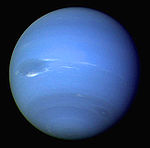
Although the extremely uniform appearance of Uranus during Voyager 2's visit in 1986 had led to expectations that Neptune would also have few visible atmospheric phenomena, Voyager 2 found that Neptune had obvious banding, visible clouds, auroras
Aurora (astronomy)
An aurora is a natural light display in the sky particularly in the high latitude regions, caused by the collision of energetic charged particles with atoms in the high altitude atmosphere...
, and even a conspicuous anticyclone storm system rivaled in size only by Jupiter's small Spot. Neptune also proved to have the fastest winds of any planet in the solar system, measured as high as 2,100 km/h. Voyager 2 also examined Neptune's ring and moon system. It discovered 900 complete rings and additional partial ring "arcs" around Neptune. In addition to examining Neptune's three previously known moons, Voyager 2 also discovered five previously unknown moons, one of which, Proteus
Proteus (moon)
Proteus , also known as Neptune VIII, is the second largest Neptunian moon, and Neptune's largest inner satellite. Discovered by Voyager 2 spacecraft in 1989, it is named after Proteus, the shape-changing sea god of Greek mythology...
, proved to be the last largest moon in the system. Data from Voyager further reinforced the view that Neptune's largest moon, Triton
Triton (moon)
Triton is the largest moon of the planet Neptune, discovered on October 10, 1846, by English astronomer William Lassell. It is the only large moon in the Solar System with a retrograde orbit, which is an orbit in the opposite direction to its planet's rotation. At 2,700 km in diameter, it is...
, is a captured Kuiper belt
Kuiper belt
The Kuiper belt , sometimes called the Edgeworth–Kuiper belt, is a region of the Solar System beyond the planets extending from the orbit of Neptune to approximately 50 AU from the Sun. It is similar to the asteroid belt, although it is far larger—20 times as wide and 20 to 200 times as massive...
object.
Pluto
Dwarf planet
A dwarf planet, as defined by the International Astronomical Union , is a celestial body orbiting the Sun that is massive enough to be spherical as a result of its own gravity but has not cleared its neighboring region of planetesimals and is not a satellite...
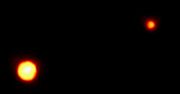
Pluto (considered a planet until the IAU redefinition of "planet" in October 2006) presents significant challenges for spacecraft because of its great distance from Earth (requiring high velocity for reasonable trip times) and small mass (making capture into orbit very difficult at present). Voyager 1
Voyager 1
The Voyager 1 spacecraft is a 722-kilogram space probe launched by NASA in 1977, to study the outer Solar System and eventually interstellar space. Operating for as of today , the spacecraft receives routine commands and transmits data back to the Deep Space Network. At a distance of as of...
could have visited Pluto, but controllers opted instead for a close flyby of Saturn's moon Titan, resulting in a trajectory incompatible with a Pluto flyby. Voyager 2
Voyager 2
The Voyager 2 spacecraft is a 722-kilogram space probe launched by NASA on August 20, 1977 to study the outer Solar System and eventually interstellar space...
never had a plausible trajectory for reaching Pluto.
Pluto continues to be of great interest, despite its reclassification as the lead and nearest member of a new and growing class of distant icy bodies of intermediate size, in mass between the remaining eight planets and the small rocky objects historically termed asteroids (and also the first member of the important subclass, defined by orbit and known as "Plutino
Plutino
In astronomy, a plutino is a trans-Neptunian object in 2:3 mean motion resonance with Neptune. For every 2 orbits that a plutino makes, Neptune orbits 3 times. Plutinos are named after Pluto, which follows an orbit trapped in the same resonance, with the Italian diminutive suffix -ino...
s"). After an intense political battle, a mission to Pluto dubbed New Horizons
New Horizons
New Horizons is a NASA robotic spacecraft mission currently en route to the dwarf planet Pluto. It is expected to be the first spacecraft to fly by and study Pluto and its moons, Charon, Nix, Hydra and S/2011 P 1. Its estimated arrival date at the Pluto-Charon system is July 14th, 2015...
was granted funding from the US government in 2003. New Horizons was launched successfully on January 19, 2006. In early 2007 the craft made use of a gravity assist from Jupiter
Jupiter
Jupiter is the fifth planet from the Sun and the largest planet within the Solar System. It is a gas giant with mass one-thousandth that of the Sun but is two and a half times the mass of all the other planets in our Solar System combined. Jupiter is classified as a gas giant along with Saturn,...
. Its closest approach to Pluto will be on July 14, 2015; scientific observations of Pluto will begin five months prior to closest approach and will continue for at least a month after the encounter.
Future of space exploration
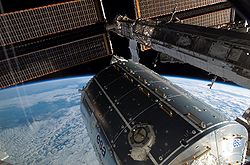
The NASA Authorization Act of 2010
NASA Authorization Act of 2010
The NASA Authorization Act of 2010 is a U.S. law which authorizes NASA appropriations for fiscal years 2011–2013 with the same top-line budget values as requested by President of the United States Barack Obama...
provides objectives for American space exploration. NASA proposes to move forward with the development of the Space Launch System
Space Launch System
The Space Launch System, or SLS, is a Space Shuttle-derived heavy launch vehicle being designed by NASA, following the cancellation of the Constellation Program, to replace the retired Space Shuttle. The NASA Authorization Act of 2010 envisions the transformation of the Ares I and Ares V vehicle...
(SLS), which will be designed to carry the Orion Multi-Purpose Crew Vehicle, as well as important cargo, equipment, and science experiments to Earth's orbit and destinations beyond. Additionally, the SLS will serve as a back up for commercial and international partner transportation services to the International Space Station. The SLS rocket will incorporate technological investments from the Space Shuttle program and the Constellation program in order to take advantage of proven hardware and reduce development and operations costs. The first developmental flight is targeted for the end of 2017.
Rationales
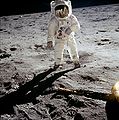
NASA
The National Aeronautics and Space Administration is the agency of the United States government that is responsible for the nation's civilian space program and for aeronautics and aerospace research...
and Roscosmos, is one of the reasons supporters cite to justify government expenses. Economic analyses of the NASA programs often showed ongoing economic benefits (such as NASA spin-offs), generating many times the revenue of the cost of the program.
Another claim is that space exploration is a necessity to mankind and that staying on Earth will lead to extinction
Human extinction
Human extinction is the end of the human species. Various scenarios have been discussed in science, popular culture, and religion . The scope of this article is existential risks. Humans are very widespread on the Earth, and live in communities which are capable of some kind of basic survival in...
. Some of the reasons are lack of natural resources, comets, nuclear war, and worldwide epidemic. Stephen Hawking
Stephen Hawking
Stephen William Hawking, CH, CBE, FRS, FRSA is an English theoretical physicist and cosmologist, whose scientific books and public appearances have made him an academic celebrity...
, renowned British theoretical physicist, said that "I don't think the human race will survive the next thousand years, unless we spread into space. There are too many accidents that can befall life on a single planet. But I'm an optimist. We will reach out to the stars."
NASA has produced a series of public service announcement videos supporting the concept of space exploration.
Overall, the public remains largely supportive of both manned and unmanned space exploration. According to an Associated Press
Associated Press
The Associated Press is an American news agency. The AP is a cooperative owned by its contributing newspapers, radio and television stations in the United States, which both contribute stories to the AP and use material written by its staff journalists...
Poll conducted in July 2003, 71% of U.S. citizens agreed with the statement that the space program is "a good investment", compared to 21% who did not.
Arthur C. Clarke
Arthur C. Clarke
Sir Arthur Charles Clarke, CBE, FRAS was a British science fiction author, inventor, and futurist, famous for his short stories and novels, among them 2001: A Space Odyssey, and as a host and commentator in the British television series Mysterious World. For many years, Robert A. Heinlein,...
(1950) presented a summary of motivations for the human exploration of space in his non-fiction semi-technical monograph Interplanetary Flight. He argued that humanity's choice is essentially between expansion off the Earth into space, versus cultural (and eventually biological) stagnation and death.
Opposition
Critics such as the late physicistPhysicist
A physicist is a scientist who studies or practices physics. Physicists study a wide range of physical phenomena in many branches of physics spanning all length scales: from sub-atomic particles of which all ordinary matter is made to the behavior of the material Universe as a whole...
and Nobel prize
Nobel Prize
The Nobel Prizes are annual international awards bestowed by Scandinavian committees in recognition of cultural and scientific advances. The will of the Swedish chemist Alfred Nobel, the inventor of dynamite, established the prizes in 1895...
winner Richard Feynman
Richard Feynman
Richard Phillips Feynman was an American physicist known for his work in the path integral formulation of quantum mechanics, the theory of quantum electrodynamics and the physics of the superfluidity of supercooled liquid helium, as well as in particle physics...
have contended that human space travel (as distinguished from space exploration in general, such as robotic missions) has never achieved any major scientific breakthroughs.
Related topics
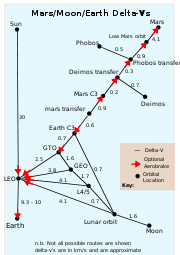
Spaceflight
Spaceflight is the use of space technologySpace technology
Space technology is technology that is related to entering, and retrieving objects or life forms from space."Every day" technologies such as weather forecasting, remote sensing, GPS systems, satellite television, and some long distance communications systems critically rely on space infrastructure...
to achieve the flight of spacecraft
Spacecraft
A spacecraft or spaceship is a craft or machine designed for spaceflight. Spacecraft are used for a variety of purposes, including communications, earth observation, meteorology, navigation, planetary exploration and transportation of humans and cargo....
into and through outer space.
Spaceflight is used in space exploration, and also in commercial activities like space tourism
Space tourism
Space Tourism is space travel for recreational, leisure or business purposes. A number of startup companies have sprung up in recent years, hoping to create a space tourism industry...
and satellite telecommunications. Additional non-commercial uses of spaceflight include space observatories
Space observatory
A space observatory is any instrument in outer space which is used for observation of distant planets, galaxies, and other outer space objects...
, reconnaissance satellites and other earth observation satellite
Earth observation satellite
Earth observation satellites are satellites specifically designed to observe Earth from orbit, similar to reconnaissance satellites but intended for non-military uses such as environmental monitoring, meteorology, map making etc....
s.
A spaceflight typically begins with a rocket launch
Rocket launch
A rocket launch is the takeoff phase of the flight of a rocket. Launches for orbital spaceflights, or launches into interplanetary space, are usually from a fixed location on the ground, but may also be from a floating platform such as the San Marco platform, or the Sea Launch launch...
, which provides the initial thrust to overcome the force of gravity and propels the spacecraft from the surface of the Earth. Once in space, the motion of a spacecraft—both when unpropelled and when under propulsion—is covered by the area of study called astrodynamics
Astrodynamics
Orbital mechanics or astrodynamics is the application of ballistics and celestial mechanics to the practical problems concerning the motion of rockets and other spacecraft. The motion of these objects is usually calculated from Newton's laws of motion and Newton's law of universal gravitation. It...
. Some spacecraft remain in space indefinitely, some disintegrate during atmospheric reentry
Atmospheric reentry
Atmospheric entry is the movement of human-made or natural objects as they enter the atmosphere of a celestial body from outer space—in the case of Earth from an altitude above the Kármán Line,...
, and others reach a planetary or lunar surface for landing or impact.
Satellites
Satellites are used for a large number of purposes. Common types include military (spy) and civilian Earth observation satellites, communication satellites, navigation satellites, weather satellites, and research satellites. Space stationSpace station
A space station is a spacecraft capable of supporting a crew which is designed to remain in space for an extended period of time, and to which other spacecraft can dock. A space station is distinguished from other spacecraft used for human spaceflight by its lack of major propulsion or landing...
s and human spacecraft
Spacecraft
A spacecraft or spaceship is a craft or machine designed for spaceflight. Spacecraft are used for a variety of purposes, including communications, earth observation, meteorology, navigation, planetary exploration and transportation of humans and cargo....
in orbit are also satellites.
Commercialization of space
Current examples of the commercial use of space include satellite navigation systems, satellite televisionSatellite television
Satellite television is television programming delivered by the means of communications satellite and received by an outdoor antenna, usually a parabolic mirror generally referred to as a satellite dish, and as far as household usage is concerned, a satellite receiver either in the form of an...
and satellite radio
Satellite radio
Satellite radio is an analogue or digital radio signal that is relayed through one or more satellites and thus can be received in a much wider geographical area than terrestrial FM radio stations...
. Space tourism
Space tourism
Space Tourism is space travel for recreational, leisure or business purposes. A number of startup companies have sprung up in recent years, hoping to create a space tourism industry...
is the recent phenomenon of space travel
Human spaceflight
Human spaceflight is spaceflight with humans on the spacecraft. When a spacecraft is manned, it can be piloted directly, as opposed to machine or robotic space probes and remotely-controlled satellites....
by individuals for the purpose of personal pleasure.
Militarization of space
While military activities have taken place in space and space is an operating location for many military spacecraft (such as imaging & communications satellites) or a temporary transit medium for weapons (such as ballistic missiles), permanent placement of large-scale operational weapons in space has never been conducted.Astrobiology
Astrobiology is the interdisciplinary study of life in the universe, combining aspects of astronomyAstronomy
Astronomy is a natural science that deals with the study of celestial objects and phenomena that originate outside the atmosphere of Earth...
, biology
Biology
Biology is a natural science concerned with the study of life and living organisms, including their structure, function, growth, origin, evolution, distribution, and taxonomy. Biology is a vast subject containing many subdivisions, topics, and disciplines...
and geology
Geology
Geology is the science comprising the study of solid Earth, the rocks of which it is composed, and the processes by which it evolves. Geology gives insight into the history of the Earth, as it provides the primary evidence for plate tectonics, the evolutionary history of life, and past climates...
. It is focused primarily on the study of the origin, distribution and evolution
Evolution
Evolution is any change across successive generations in the heritable characteristics of biological populations. Evolutionary processes give rise to diversity at every level of biological organisation, including species, individual organisms and molecules such as DNA and proteins.Life on Earth...
of life. It is also known as exobiology (from Greek: έξω, exo, "outside"). The term "Xenobiology" has been used as well, but this is technically incorrect because its terminology means "biology of the foreigners". Astrobiologists must also consider the possibility of life that is chemically entirely distinct from any life found on earth. In the Solar System some of the prime locations for current or past astrobiology are on Enceladus, Europa, Mars, and Titan.

Space colonization
Space colonization, also called space settlement and space humanization, would be the permanent autonomous (self-sufficient) human habitationSpace habitat
A space habitat is a space station intended as a permanent settlement rather than as a simple waystation or other specialized facility...
of locations outside Earth, especially of natural satellites or planets such as the Moon
Colonization of the Moon
The colonization of the Moon is the proposed establishment of permanent human communities on the Moon. Advocates of space exploration have seen settlement of the Moon as a logical step in the expansion of humanity beyond the Earth. Recent indication that water might be present in noteworthy...
or Mars
Colonization of Mars
The colonization of Mars by humans is the focus of speculation and serious study because the surface conditions and availability of water on Mars make it arguably the most hospitable planet in the solar system other than Earth...
, using significant amounts of in-situ resource utilization
In-Situ Resource Utilization
In space exploration, in-situ resource utilization describes the proposed use of resources found or manufactured on other astronomical objects to further the goals of a space mission....
.
To date, the longest human occupation of space is the International Space Station
International Space Station
The International Space Station is a habitable, artificial satellite in low Earth orbit. The ISS follows the Salyut, Almaz, Cosmos, Skylab, and Mir space stations, as the 11th space station launched, not including the Genesis I and II prototypes...
which has been in continuous use for . Valeri Polyakov's record single spaceflight of almost 438 days aboard the Mir
Mir
Mir was a space station operated in low Earth orbit from 1986 to 2001, at first by the Soviet Union and then by Russia. Assembled in orbit from 1986 to 1996, Mir was the first modular space station and had a greater mass than that of any previous spacecraft, holding the record for the...
space station has not been surpassed. Long-term stays in space reveal issues with bone and muscle loss in low gravity, immune system suppression, and radiation exposure.
Many past and current concepts for the continued exploration and colonization of space focus on a return to the Moon as a "stepping stone" to the other planets, especially Mars. At the end of 2006 NASA announced they were planning to build a permanent Moon base with continual presence by 2024.
See also
- Discovery and exploration of the Solar SystemDiscovery and exploration of the Solar SystemFor many thousands of years, civilizations, with a few notable exceptions, did not recognize the existence of the Solar System. It was believed the Earth to be stationary at the centre of the universe and categorically different from the divine or ethereal objects that moved through the sky...
External links
- Chronology of space exploration, astrobiology, exoplanets and news
- Space related news
- Nasa's website on human space travel
- "America's Space Program: Exploring a New Frontier", a National Park Service Teaching with Historic Places (TwHP) lesson plan
- The Soviet-Russian Spaceflight's History Photoarchive
- The 21 Greatest Space Photos Ever – slideshow by Life Magazine
- "From Stargazers to Starships", Home page of extensive educational web site and course covering spaceflight, astronomy and related physics, by David P. Stern