
In Depth
See Also

Precession

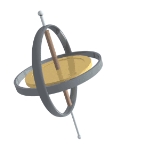
Precession refers to a change in the direction of the axis of a rotating object. In physics, there are two types of precession, torque-free and torque-induced, the latter being discussed here in more detail. In certain contexts, "precession" may refer to the precession that the Earth experiences, the effects of this type of precession on astronomical observation, or to the precession of orbital objects.

Discussions

  Discussion Features

   Ask a question about 'Precession'

   Start a new discussion about 'Precession'

   Answer questions about 'Precession'

   'Precession' discussion forum


Encyclopedia

Precession refers to a change in the direction of the axis of a rotating object. In physics, there are two types of precession, torque-free and torque-induced, the latter being discussed here in more detail. In certain contexts, "precession" may refer to the precession that the Earth experiences, the effects of this type of precession on astronomical observation, or to the precession of orbital objects.

Torque-free precession


Only moving objects can be in torque-free precession. For example, when a plate is thrown, the plate may have some rotation around an axis that is not its axis of symmetry. When the object is not perfectly solid, internal vortices Vortex

A vortex is a spinning, often turbulent [i], flow with closed streamline [i]s. ... 

 will tend to damp torque-free precession.

Torque-induced precession


Torque-induced precession is the phenomenon by which the axis Rotation

Rotation is the movement of an object in a circular motion.... 

 of a spinning object "wobbles" when a torque Torque

In physics [i], torque can informally be thought of as "rotational force". ... 

 is applied to it. The phenomenon is commonly seen in a spinning toy top Top

A top, or spinning top, is a children's toy [i] that can be spun on an axis, balancing on a point. ... 

, but all rotating objects can undergo precession. If the speed of the rotation and the magnitude of the torque are constant the axis will describe a cone, its movement at any instant being at right angles to the direction of the torque. In the case of a toy top, if the axis is not perfectly vertical the torque is applied by the force of gravity Gravitation

In physics [i], gravitation or gravity is the tendency of objects with mass [i] to accelerate [i] ... 

 trying to tip it over. A rolling wheel will tend to remain upright due to precession. When the wheel tilts to one side, the particles at the top are pushed to one side and the particles at the bottom are pushed the other way. However, since the wheel is rotating, these particles eventually switch places and cancel one another out. Precession or gyroscopic considerations have an effect on bicycle Bicycle

A bicycle, or bike, can be defined generally as a pedal-driven [i] human-powered vehicle [i]... 

 performance at high speed. Precession is also the mechanism behind gyrocompass Gyrocompass

The following description refers to the gyrocompasses used on ship [i]s.
... 

es.

This concept is easier to understand by examining the effects of inertia, which is often stated by the phrase "A body in motion tends to stay in motion." In this case the "motion" of a rotating body is in its rotation. If an external force pushes upon the rotating body, the body will resist the force by pushing back against it, but the reaction is delayed.

Gyroscopic precession also plays a large role in the flight controls on helicopters. Since the driving force behind helicopters is the rotor disk , gyroscopic precession comes into play. If the rotor disk is to be tilted forward , its counter-clockwise movement requires that the downward net force on the blade be applied roughly 90 degrees before, or when the blade is to the right of the pilot. To ensure the pilot's inputs are correct, the aircraft has corrective linkages which tilt the swashplate to the right when the pilots push the "cyclic stick" forward, or to the left when the stick is pulled to the back.

The physics of precession


Precession is the resultant of the angular velocity Angular velocity

In physics [i] angular velocity is the speed [i] at which something rotates together with the direction ... 

 of rotation and the angular velocity produced by the torque. It is an angular velocity about a line which makes an angle with the permanent rotation axis, and this angle lies in a plane at right angles to the plane of the couple producing the torque. The permanent axis must turn towards this line, since the body cannot continue to rotate about any line which is not a principal axis of maximum moment of inertia; that is, the permanent axis turns in a direction at right angles to that in which the torque might be expected to turn it. If the rotating body is symmetrical and its motion unconstrained, and if the torque on the spin axis is at right angles to that axis, the axis of precession will be perpendicular to both the spin axis and torque axis. Under these circumstances the period of precession is given by:

In which Is is the moment of inertia, Ts is the period of spin about the spin axis, and Q is the torque. In general the problem is more complicated than this, however.

For a layman’s explanation of Precession: we will have to imagine the wheel of a gyroscope as a group of particles that are being forced to move in circle. Remember the particles want to move in a straight line. In order for the particles to move in a curved line there must be a force. This force is provided by the structure of the wheel holding the particles within the wheel.

Now let’s see what happens to our accelerating particles when a torque is applied to the spinning wheel. Assume the axis of rotation created by the torque is through the center of the wheel at 90 degrees to the primary rotation of the wheel. Let’s look at a particle that is on this axis of rotation. Since the particle is on the axis of rotation there is no direct motion applied to the particle at the instant of the applied torque. But let’s look at what will need to happen at the next moment in time. The particle is now going to be forced to curve again. This time in the direction of the curve so as to accommodate the tilt of the wheel. Now we have a particle that is already moving and it wants to keep moving in a straight line. So the particle will exert a force on the wheel. If you look at a particle on the other side of the wheel you will see that the force of the second particle is in the opposite direction of the first particle. That pair of unmatched forces is what causes the precession torque that is 90 degrees to the applied torque.

Precession of the equinoxes


The Earth goes through one complete precession cycle in a period of approximately 25,800 years, during which the positions of star Star

A star is a massive, compact body of plasma [i] in outer space [i] that is held together by its ... 

s as measured in the equatorial coordinate system Equatorial coordinate system

The equatorial coordinate system is probably the most widely used celestial coordinate system [i], whose ... 

 will slowly change; the change is actually due to the change of the coordinates. Over this cycle the Earth's north axial pole moves from where it is now, within 1° of Polaris Polaris

Polaris is the brightest star in the constellation [i] Ursa Minor [i].... 

, in a circle around the ecliptic pole, with an angular radius of about 23.5 degrees . The shift is 1 degree in 180 years, where the angle is taken from the observer, not from the center of the circle.

The precession of the equinoxes was discovered in antiquity by the Greek astronomer Hipparchus, and was later explained by Newtonian physics Classical mechanics

Classical mechanics is used to describe the motion of macroscopic objects, from projectiles [i] to parts ... 

. The Earth has a nonspherical shape, being oblate spheroid Oblate

An oblate spheroid [i] is a rotationally symmetric [i] ellipsoid [i] having a polar ... 

, bulging outward at the equator. The gravitational tidal force Tidal force

[i] and is responsible for the [[tide]... 

s of the Moon Moon

The Moon is Earth [i]'s only natural satellite [i]. ... 

 and Sun Sun

|+ The Sun   |+
|-
... 

 apply torque as they attempt to pull the equatorial bulge Equatorial bulge

An equatorial bulge is a planetological [i] term which describes a bulge which a plan ... 

 into the plane of the ecliptic Ecliptic

The ecliptic is the apparent path the Sun traces out along the sky — independent of Earth's rotati... 

. The portion of the precession due to the combined action of the Sun and the Moon is called lunisolar precession.

Precession of planetary orbits


The revolution of a planet in its orbit around the Sun Sun

|+ The Sun   |+
|-
... 

 is also a form of rotary motion. So the axis of a planet's orbital plane will also precess over time.

The major axis of each planet's elliptical orbit also precesses within its orbital plane, in response to perturbations in the form of the changing gravitational forces exerted by other planets. This is called perihelion precession or apsidal precession . Discrepancies between the observed perihelion precession rate of the planet Mercury and that predicted by classical mechanics Classical mechanics

Classical mechanics is used to describe the motion of macroscopic objects, from projectiles [i] to parts ... 

 were prominent among the forms of experimental evidence leading to the acceptance of Einstein Albert Einstein

Albert Einstein was a German [i]-born theoretical physicist [i]. ... 

's Theory of Relativity Theory of relativity

The theory of relativity, or simply relativity, refers specifically to two theories: Albert Einstein [i] ... 

, which predicted the anomalies accurately.

It is generally understood that the gravitational pulls of the Sun and the Moon cause the precession of the Earth's orbit which operate on cycles of 23,000 and 19,000 years.
These periodic changes of the orbital parameters, as well as that of the inclination Inclination

Inclination in general is the angle [i] between a reference plane [i] and another plane or axis [i] ... 

 of the Earth's axis on its orbit, are an important part of the astronomical theory Milankovitch cycles

Milankovitch cycles are the collective effect of changes in the Earth [i]'s movements upon its climate, ... 

 of ice age Ice age

An ice age is a period of long-term downturn in the temperature [i] of Earth [i]'s climate [i], resultin ... 

s. For precession of the lunar orbit see lunar precession.

An analogous phenomenon to apsidal precession is nodal precession , which affects the orientation of the orbital plane.

Precession is also an important consideration in the dynamics of atom Atom

In chemistry [i] and physics [i], an atom is the smallest possible particle of a chemical element [i] t ... 

s and molecule Molecule

In chemistry, a molecule is an aggregate of two or more atom [i]s in a definite arrangement held togethe ... 

s.

See also


  • Discovery of precession
  • Geometric precession
  • Larmor precession
  • Polar motion
  • Thomas precession
  • Astrological age Astrological age

    An astrological age is a time period in astrology [i] which is believed to cause major changes in the Earth [i] ... 


External links


Notes


References


  1. "Moon and Spica", StarDate July 14, 2005, University of Texas McDonald Observatory,


Categories: