
All Topics  
Atacama Desert


   Email Print
   Bookmark   Link


Atacama Desert


Atacama redirects here; for the political-administrative region of Chile
Chile

Chile, officially the Republic of Chile , is a country in South America occupying a long and narrow coastal strip wedged between the Andes mountains and the Pacific Ocean....
, see
Atacama Region
Atacama Region

The III Atacama Region is one of Chile's 15 first order administrative divisions. Its capital is Copiap?. It comprises three provinces, Cha?aral Province, Copiap? Province and Huasco Province....
.
The Atacama Desert
Atacama Desert

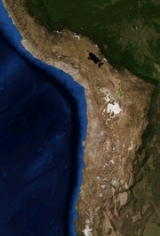
The Atacama Desert is a virtually rainless plateau in South America, covering a 966 km strip of land on the Pacific Ocean coast of South America, west of the Andes mountains....
 is a virtually rainless plateau
Plateau

In geology and earth science, a plateau, also called a high plateau or tableland, is an area of highland , usually consisting of relatively flat terrain....
 in South America
South America

South America is the southern continent of the Americas, situated entirely in the Western Hemisphere and mostly in the Southern Hemisphere, with a relatively small portion in the Northern Hemisphere....
, covering a 966 km (600 mi) strip of land on the Pacific
Pacific Ocean

The Pacific Ocean is the largest of the Earth's oceanic divisions. Its name is derived from the Latin name Mare Pacificum, "peaceful sea", bestowed upon it by the Portugal explorer Ferdinand Magellan....
 coast of South America
South America

South America is the southern continent of the Americas, situated entirely in the Western Hemisphere and mostly in the Southern Hemisphere, with a relatively small portion in the Northern Hemisphere....
, west of the Andes
Andes

The Andes form the world's longest exposed mountain range. They lie as a continuous chain of highland along the western coast of South America. The range is over 7,000 km long, 200-700 km wide , and of an average height of about 4,000 m ....
 mountains.


Discussion
Ask a question about 'Atacama Desert'
Start a new discussion about 'Atacama Desert'
Answer questions from other users
Full Discussion Forum


Encyclopedia


Atacama redirects here; for the political-administrative region of Chile
Chile

Chile, officially the Republic of Chile , is a country in South America occupying a long and narrow coastal strip wedged between the Andes mountains and the Pacific Ocean....
, see
Atacama Region
Atacama Region

The III Atacama Region is one of Chile's 15 first order administrative divisions. Its capital is Copiap?. It comprises three provinces, Cha?aral Province, Copiap? Province and Huasco Province....
.
Atacama1
Valle De La Luna San Pedro Chile
The Atacama Desert
Atacama Desert

The Atacama Desert is a virtually rainless plateau in South America, covering a 966 km strip of land on the Pacific Ocean coast of South America, west of the Andes mountains....
 is a virtually rainless plateau
Plateau

In geology and earth science, a plateau, also called a high plateau or tableland, is an area of highland , usually consisting of relatively flat terrain....
 in South America
South America

South America is the southern continent of the Americas, situated entirely in the Western Hemisphere and mostly in the Southern Hemisphere, with a relatively small portion in the Northern Hemisphere....
, covering a 966 km (600 mi) strip of land on the Pacific
Pacific Ocean

The Pacific Ocean is the largest of the Earth's oceanic divisions. Its name is derived from the Latin name Mare Pacificum, "peaceful sea", bestowed upon it by the Portugal explorer Ferdinand Magellan....
 coast of South America
South America

South America is the southern continent of the Americas, situated entirely in the Western Hemisphere and mostly in the Southern Hemisphere, with a relatively small portion in the Northern Hemisphere....
, west of the Andes
Andes

The Andes form the world's longest exposed mountain range. They lie as a continuous chain of highland along the western coast of South America. The range is over 7,000 km long, 200-700 km wide , and of an average height of about 4,000 m ....
 mountains. The Atacama is, according to NASA
NASA

The National Aeronautics and Space Administration is an agency of the Federal government of the United States, responsible for the nation's public list of space agencies....
, National Geographic and many other publications, the driest desert
Désert

?D?sert? is ?milie Simon's debut single, released in October 2002. The song was a huge success both critically and commercially in her homeland....
 in the world. The rain shadow
Rain shadow

For the Australian television series see Rain Shadow .A rain shadow or rainshadow, or more accurately, precipitation shadow, is a dry region of land that is leeward of a mountain range or other geographic feature, with respect to prevailing wind direction....
 on the leeward side of the Chilean Coast Range
Chilean Coast Range

The Chilean Coast Range is a mountain range that runs southward parallel with the Andes, from the Morro de Arica to the Taitao Peninsula where it ends together with the Nazca Plate....
 and the Andes keeps this over 20 million-year-old desert 50 times drier than California's
California

California is a U.S. state on the West Coast of the United States of the United States, along the Pacific Ocean. It is bordered by Oregon to the north, Nevada to the east, Arizona to the southeast, and to the south the Mexico state of Baja California....
 Death Valley
Death Valley

Death Valley is a desert located in the southwestern United States. It is the lowest, driest, and hottest location in North America. Badwater, a depression located within Death Valley, is the specific location of the lowest elevation in North America at 85.5 meter below sea level....
. The Atacama occupies 181,300 square kilometers (70,000 mi²) in northern Chile
Chile

Chile, officially the Republic of Chile , is a country in South America occupying a long and narrow coastal strip wedged between the Andes mountains and the Pacific Ocean....
, composed mostly of salt
Salt

A salt, in chemistry, is defined as the product formed from the neutralisation reaction of acids and base . Salts are ionic compounds composed of cations and anions so that the product is electrically electric charge ....
 basins (salares), sand
Sand

Sand is a naturally occurring granular material composed of finely divided rock and mineral particles.As the term is used by geologists, sand particles range in diameter from 0.0625 to 2 millimeters....
, and lava
Lava

Lava is molten Rock expelled by a volcano during an eruption. When first expelled from a volcanic vent, it is a liquid at temperatures from 700 ?C to 1,200 ?C ....
 flows.

Setting

The Atacama Desert ecoregion
Ecoregion

An ecoregion , sometimes called a bioregion, is an ecology and geographically defined area smaller than a "realm" or "ecozone". Ecoregions cover relatively large areas of land or water, and contain characteristic, geographically distinct assemblages of natural community and species....
, as defined by the Worldwide Fund for Nature (WWF), extends from a few kilometers south of the Chile-Peru border to about 30° south latitude
Latitude

Latitude, usually denoted symbolically by the Greek letter phi gives the location of a place on Earth north or south of the equator. Lines of Latitude are the horizontal lines shown running east-to-west on maps ....
. To the north lies the Sechura Desert
Sechura Desert

The Sechura desert, also known as the Peruvian Desert or the Peru-Chile Desert, is a large stretch of desert extending north from the Atacama Desert along the northwestern South American coast....
 ecoregion, which is located predominantly in Peru
Peru

Peru , officially the Republic of Peru , is a country in western South America. It is bordered on the north by Ecuador and Colombia, on the east by Brazil, on the southeast by Bolivia, on the south by Chile, and on the west by the Pacific Ocean....
 with a small portion lying in Chile, whilst to the south is the Chilean Matorral
Chilean Matorral

The Chilean Matorral is a terrestrial ecoregion of central Chile, located on the west coast of South America. It is a Mediterranean forests, woodlands, and scrub ecoregion, part of the Neotropic ecozone....
 ecoregion. To the east lies the less arid Central Andean dry puna
Central Andean dry puna

The Central Andean dry puna is an ecoregion located in the Andean High plateau, in South America. It is a part of the Puna grassland....
 ecoregion. The drier portion of this ecoregion is located south of the Loa River
Loa River

The Loa River is a U-shaped river in Chile's northern Antofagasta Region. It is the country's longest river and the main watercourse in the Atacama Desert....
 and west of the Cordillera Domeyko
Cordillera Domeyko

The Cordillera Domeyko is a mountain range of the Andes located in northern Chile, west of Salar de Atacama. It runs north-south for approximately 600 km, parallel to the main chain....
. To the north of the mentioned river lies the Pampa del Tamarugal
Pampa del Tamarugal

Pampa del Tamarugal is a vast plain encompassing a significant portion of the Norte Grande, Chile, Chile, and originally named for the Prosopis tamarugo trees that used to cover its surface....
.

Driest desert

See also: Climate of Chile
Climate of Chile

The climate of Chile comprises a wide range of weather conditions across a large geographic scale, extending across 38 degrees in latitude, making generalisations difficult....
The Atacama is one of the driest places on Earth
Earth

Earth is the third planet from the Sun. Earth is the largest of the terrestrial planets in the Solar System in diameter, mass and density. It is also referred to as the World and Wiktionary:Terra.Note that by International Astronomical Union convention, the term "Terra" is used for naming extensive land masses, rather...
, and is virtually sterile because it is blocked from moisture on both sides by the Andes mountains and by the Chilean Coast Range
Chilean Coast Range

The Chilean Coast Range is a mountain range that runs southward parallel with the Andes, from the Morro de Arica to the Taitao Peninsula where it ends together with the Nazca Plate....
. The cold Humboldt Current
Humboldt Current

The Humboldt Current is a cold, low-salinity ocean current that flows north-westward along the west coast of South America from the southern tip of Chile to northern Peru....
 and the anticyclone
Anticyclone

In meteorology, an anticyclone is a weather meteorological phenomenon in which there is a descending movement of the air and a high pressure area over the part of the planet's surface affected by it....
 of the Pacific are essential to keep the dry climate of the Atacama. The average rainfall in the Chilean region of Antofagasta is just 1 mm per year. Some weather stations in the Atacama have never received rain. Evidence suggests that the Atacama may not have had any significant rainfall from 1570 to 1971. It is so arid that mountains that reach as high as 6,885 metres (22,590 feet) are completely free of glacier
Glacier

A glacier is a large, slow-moving mass of ice, formed from compacted layers of snow, that slowly deforms and flows in response to gravity and high pressure....
s and, in the southern part from 25°S to 27°S, may have been glacier-free throughout the Quaternary
Quaternary

The Quaternary Period is the Geologic Time Scale period after the Neogene Period, spanning 1.805 +/- 0.005 million years ago to the present. The Quaternary includes two geologic epochs: the Pleistocene and the Holocene epoch ....
, though permafrost
Permafrost

In geology, permafrost or permafrost soil is soil at or below the freezing point of water for two or more years. Ice is not always present, as may be in the case of nonporous bedrock, but it frequently occurs and it may be in amounts exceeding the potential hydraulic saturation of the ground material....
 extends down to an altitude of 4,400 metres and is continuous above 5,600 metres. Studies by a group of British scientists have suggested that some river beds have been dry for 120,000 years.

Some locations in the Atacama do receive a marine fog
Fog

Fog is a cloud bank that is in contact with the ground. A cloud may be considered partly fog; for example, the part of a cloud that is suspended in the air above the ground is not considered fog, whereas the part of the cloud that comes in contact with higher ground is considered fog....
 known locally as the Camanchaca, providing sufficient moisture for hypolithic algae
Algae

Algae are a large and diverse group of simple, typically autotrophic organisms, ranging from unicellular to multicellular forms. The largest and most complex marine forms are called seaweeds....
, lichen
Lichen

Lichens are composite organisms consisting of a symbiosis association of a fungus with a Photosynthesis partner , usually either a green algae or Cyanobacteria ....
s and even some cacti
Cactus

A cactus is any member of the spine plant family Cactaceae, native to the Americas. They are often used as ornamental plants, but some are also Crop plants....
. But in the region that is in the "fog shadow" of the high coastal crest-line, which averages 3,000 m height for about 100 km south of Antofagasta, the soil has been compared to that of Mars. Due to its otherworldly appearance, the Atacama has been used as a location for filming Mars scenes, most notably in the television series Space Odyssey: Voyage to the Planets
Space Odyssey: Voyage To The Planets

Space Odyssey: Voyage To The Planets is a fictional story of a manned voyage through the solar system presented in the form of a docudrama....
.
Chile Atacama
In 2003, a team of researchers published a report in Science magazine
Science (journal)

Science is the academic journal of the American Association for the Advancement of Science and is considered one of the world's most prestigious scientific journals....
 titled "Mars-like Soils in the Atacama Desert, Chile, and the Dry Limit of Microbial Life" in which they duplicated the tests used by the Viking 1
Viking 1

Viking 1 was the first of two spacecraft sent to Mars as part of NASA's Viking program, and holds the record for the longest Mars surface mission of 6 years and 116 days ....
 and Viking 2
Viking 2

The Viking 2 mission was part of the Viking program to Mars , and consisted of an orbiter and a lander essentially identical to that of the Viking 1 mission....
 Mars landers to detect life, and were unable to detect any signs in Atacama Desert soil. The region may be unique on Earth in this regard and is being used by NASA
NASA

The National Aeronautics and Space Administration is an agency of the Federal government of the United States, responsible for the nation's public list of space agencies....
 to test instruments for future Mars missions. In 2008, the Phoenix Mars Lander detected perchlorate
Perchlorate

Perchlorates are the salt derived from perchloric acid . They occur both naturally and through manufacturing. They have been used as a medicine for more than 50 years to treat thyroid gland disorders....
s on the surface of Mars at the same site where water was first discovered. Perchlorates are also found in the Atacama and associated nitrate deposits have contained organics, leading to speculation that signs of life on Mars are not incompatible with perchlorates. Alonso de Ercilla
Alonso de Ercilla

Alonso de Ercilla y Z??iga , was a Spanish people nobleman, soldier and epic poet. While in Chile he fought against the Mapuche, and there he began the epic poem La Araucana, considered the greatest Spanish historical poem....
 described the desert in La Araucana
La Araucana

La Araucana is an epic poem in Spanish language about the Spanish conquest of Chile, by Alonso de Ercilla; it is also known in English as The Araucaniad....
, published in 1569: "Towards Atacama, near the deserted coast, you see a land without men, where there is not a bird, not a beast, nor a tree, nor any vegetation" (quoted Braudel 1984 p 388). The Atacama is also a testing site for the NASA
NASA

The National Aeronautics and Space Administration is an agency of the Federal government of the United States, responsible for the nation's public list of space agencies....
 funded Earth-Mars Cave Detection Program.

Human occupation

The Atacama is sparsely populated. In an oasis
Oasis

In geography, an oasis or cienega is an isolated area of vegetation in a desert, typically surrounding a spring or similar water source. Oases also provide habitat for animals and even humans if the area is big enough....
, in the middle of the desert, at about 2000 meters elevation, lies the village of San Pedro de Atacama
San Pedro de Atacama

San Pedro de Atacama is a Chilean town and Communes of Chile in El Loa Province, Antofagasta Region. It is located east of Antofagasta, some 100 km southeast of Calama and the Chuquicamata copper mine, overlooking the Licancabur volcano....
. Its church was built by the Spanish
Spain

Spain or the Kingdom of Spain , is a country located in Southern Europe on the Iberian Peninsula.The Spanish constitution does not establish any official denomination of the country, even though Espa?a , Estado espa?ol and Naci?n espa?ola are used interchangeably....
 in 1577. In pre-Hispanic times, before the Inca
Inca

The Inca civilization began as a tribe in the Cuzco area, where the legendary first Sapa Inca, Manco Capac founded the Kingdom of Cuzco around 1200....
 empire, the extremely arid interior was inhabited mainly by the Atacameño
Atacameño

The Atacame?os were a Indigenous peoples of the Americas people who inhabited the Andes portion of the Atacama Desert. Their language is known as Kunza....
 tribe. The tribe is noted for the construction of fortified towns called pucara(s), one of which can be seen a few kilometers from San Pedro de Atacama.

During the 16th, 17th and 18th centuries under the Spanish Empire
Spanish Empire

The Spanish Empire was one of the largest empires in world history, and one of the first global empires. It included territories and colonies ruled by Spain in Europe, the Americas, Africa, Asia and Oceania between the 15th and late 19th centuries....
, towns grew along the coast as shipping ports for silver
Silver

Silver is a chemical element with the chemical symbol Ag and atomic number 47. A soft, white, lustrous transition metal, it has the highest electrical conductivity of any element and the highest thermal conductivity of any metal....
 produced in Potosí
Potosi

Potos? or Potosi may refer to:*Bolivia** Potos?, a city, an important mining spot during the Spanish conquest*** Potosi , a German Flying P-Liner sailing ship named after this place...
 and other mines.

During the 19th century the desert came under control of Bolivia, Chile and Peru and soon became a zone of conflict due to unclear borders and the discovery of nitrate
Nitrate

In inorganic chemistry, a nitrate is a salt of nitric acid with an ion composed of one nitrogen and three oxygen atoms . In organic chemistry the esters of nitric acid and various alcohols are called nitrates....
 there. After the War of the Pacific
War of the Pacific

The War of the Pacific, occurring from 1879-1883, was a conflict between Chile and the joint forces of Bolivia and Peru. Also known as the "Sodium nitrate War", the war arose from disputes over the control of territory that contained substantial mineral-rich deposits....
, in which Chile annexed most of the desert, cities along the coast developed into international ports, and many Chilean workers migrated there.

The Escondida Mine and Chuquicamata
Chuquicamata

Chuquicamata, or "Chuqui" as it is more familiarly known, is a large open-pit mining copper mining in the north of Chile, 215 km northeast of Antofagasta and 1,240 km north of the capital, Santiago, Chile....
 are also located within the Atacama Desert.

The Pan-American Highway
Pan-American Highway

The Pan-American Highway is a network of roads nearly 48,000 kilometres in total length. Except for an 87 kilometre rainforest gap, called the Dari?n Gap, the road links the mainland nations of the Americas in a connected highway system....
 runs through the Atacama in a north-south trajectory.

Astronomical observatories

Because of its high altitude, nearly non-existent cloud cover, and lack of light pollution and radio interference from the very widely spaced cities, the desert is one of the best places in the world to conduct astronomical observations. The European Southern Observatory
European Southern Observatory

The European Southern Observatory , is an intergovernmental research organization for astronomy, composed and supported by fourteen countries from Europe....
 operates two major observatories
Observatory

An observatory is a location used for observing terrestrial and/or celestial events. Astronomy, climatology/meteorology, geology, oceanography and volcanology are examples of disciplines for which observatories have been constructed....
 in the Atacama:
  • The La Silla Observatory
    La Silla Observatory

    La Silla Observatory is an astronomical observatory in Chile with eighteen telescopes. Nine of these telescopes were built by the European Southern Observatory organisation, and several of the others are partly maintained by ESO....
  • The Paranal Observatory
    Paranal Observatory

    Paranal Observatory is an astronomical observatory located on Cerro Paranal at 2,635 mts. altitude and operated by the European Southern Observatory....
    , which includes the Very Large Telescope
    Very Large Telescope

    The Very Large Telescope is a system of four separate optical telescopes organized in an array formation, built and operated by the European Southern Observatory at the Paranal Observatory on Cerro Paranal, a 2,635 m high mountain in the Atacama desert in northern Chile....
    .


A new radio astronomy
Radio astronomy

Radio astronomy is a subfield of astronomy that studies Astronomical object at radio frequency. The initial detection of radio waves from an astronomical object was made in the 1930s, but subsequent advances have identified a number of different sources of radio emission....
 observatory, called ALMA
Alma

Alma may refer to:...
, is being built in the Atacama by astronomers from Europe
Europe

Europe is, conventionally, one of the world's seven continents. Comprising the westernmost peninsula of Eurasia, Europe is generally divided from Asia to its east by the water divide of the Ural Mountains, the Ural , the Caspian Sea, and by the Caucasus Mountains to the southeast....
, Japan
Japan

Japan is an island country in East Asia. Located in the Pacific Ocean, it lies to the east of the Sea of Japan, People's Republic of China, North Korea, South Korea and Russia, stretching from the Sea of Okhotsk in the north to the East China Sea and Taiwan in the south....
, and North America
North America

North America is the northern continent of the Americas, situated in the Earth's northern hemisphere and almost totally in the western hemisphere....
. Another radio astronomy observatory, ACT
Atacama Cosmology Telescope

The Atacama Cosmology Telescope is a six-metre telescope on Cerro Toco in the Atacama Desert in the north of Chile, near the Llano de Chajnantor Observatory....
, is being built on Cerro Toco in the Atacama Desert.

Abandoned nitrate mining towns


The desert has rich deposits of copper
Copper

Copper is a chemical element with the symbol Cu and atomic number 29.It is a ductile metal with very high thermal and electrical conductivity....
 and other mineral
Mineral

A mineral is a naturally occurring solid formed through Geology processes that has a characteristic chemical composition, a highly ordered atomic structure, and specific physical properties....
s, and the world's largest natural supply of sodium nitrate
Sodium nitrate

Sodium nitrate is the chemical compound with the chemical formula NaNO3. This salts, also known as "Chile saltpeter" or "Peru saltpeter" , is a white solid which is very soluble in water....
, which was mined on a large scale until the early 1940s. The Atacama border dispute
Atacama border dispute

The Atacama border dispute was a border dispute between Chile and Bolivia in the 1800s that ended in Chilean annexation of all of the Antofagasta Region and the Tarapaca Region of Bolivia's ally Peru through the Peace Treaty after the War of the Pacific ....
 over these resources between Chile and Bolivia began in the 1800s.

Now the desert is littered with approximately 170 abandoned nitrate (or "saltpeter") mining towns, almost all of which were shut down decades after the invention of synthetic nitrate in Germany
Germany

Germany , officially the Federal Republic of Germany , is a country in Central Europe. It is bordered to the north by the North Sea, Denmark, and the Baltic Sea; to the east by Poland and the Czech Republic; to the south by Austria and Switzerland; and to the west by France, Luxembourg, Belgium, and the Netherlands....
 at the turn of the 20th century (see Haber Process
Haber process

The Haber process, also called the Haber?Bosch process, is the nitrogen fixation reaction of nitrogen and hydrogen, over an enriched iron Catalysis, to produce ammonia....
). The towns include Chacabuco
Chacabuco

Chacabuco is one of the many abandoned nitrate or "saltpeter" towns in the Atacama Desert of northern Chile. Other nitrate towns of the Atacama Desert include Humberstone and Santa Laura Saltpeter Works....
, Humberstone, Santa Laura
Humberstone and Santa Laura Saltpeter Works

Humberstone and Santa Laura Saltpeter Works are two former Potassium nitrate refineries located in northern Chile. They were declared a UNESCO World Heritage Site in 2005....
, Pedro de Valdivia, Puelma, Maria Elena and Oficina Anita.

One of the best examples of an abandoned mining town is that of Baquedano, which was home to one of the most technologically advanced train stations during the nitrate "white gold" boom of the early 20th century. While it is now almost completely abandoned, the remains of the station are untouched and seldom visited by outsiders. Only a few kilometers from Baquedano, on the Pan-American highway, is one of many makeshift cemeteries housing the remains of indigenous miners who were persuaded to work for the German mining operations. Many of the graves belong to children under the age of five, poisoned by the pollution kicked up during the mining process.

Protected areas

  • Pan de Azúcar National Park
    Pan de Azúcar National Park

    Pan de Az?car National Park is a national park of Chile. The park straddles the border between the Antofagasta Region and the Atacama Region. Its name, Parque Nacional Pan de Az?car, means "sugar loaf"....
  • Pampa del Tamarugal National Reserve
    Pampa del Tamarugal National Reserve

    Pampa del Tamarugal National Reserve is a nature reserve of Chile located in the Pampa del Tamarugal, some 70 Km. east of Iquique. The reserve consists of three separate sectors: Zapiga, Bosque Nativo de La Tirana, and Pintados....
  • La Chimba National Reserve


Legends

  • Alicanto
    Alicanto

    The Alicanto is a mythological bird of the desert of Atacama, pertaining to Chilean mythology....
  • Yastay
  • Atacama Giant
    Atacama Giant

    The Atacama Giant is a large anthropomorphic geoglyph in the Atacama Desert, Chile.Located at "Cerro Unitas", this is the largest prehistoric anthropomorphic figure in the world with a height of 86 meters and represents a deity for the local inhabitants from 1000 to 1400 AD....


Use in fiction

The 2008
2008 in film

The year '2008 in film' saw many new films released worldwide, including several major mainstream sequels such as Rambo , The Chronicles of Narnia: Prince Caspian, Harold & Kumar Escape from Guantanamo Bay, Indiana Jones and the Kingdom of the Crystal Skull, Hellboy II: The Golden Army, The Dark Knight , The X-Files: I...
 James Bond
James Bond

James Bond 007 is a fictional character created in 1953 by writer Ian Fleming, who featured him in twelve novels and two short story collections....
 film Quantum of Solace starring Daniel Craig
Daniel Craig

Daniel Wroughton Craig is an England actor. His early film roles included The Power of One, A Kid in King Arthur's Court and the television episodes Sharpe's Eagle and The Young Indiana Jones Chronicles: Daredevils of the Desert....
 had several scenes filmed in the desert, including a plane chase and the film's climax. Director Marc Forster
Marc Forster

Marc Forster is a Germany-Swiss filmmaker and screenwriter, known for films such as Monster's Ball, Stranger than Fiction , and Quantum of Solace....
 chose the desert to represent Bond's rigid emotions and vengefulness in the climax.

See also

  • Norte Grande, Chile
    Norte Grande, Chile

    The Norte Grande is one of the five natural regions on which CORFO divided continental Chile in 1950. It borders Peru to the north, the Pacific Ocean to the west, the Altiplano, Bolivia and Argentina to the east, and the Copiap? River to the south, beyond which lies the Norte Chico, Chile natural region....
  • Atacama Crossing
  • Atacama border dispute
    Atacama border dispute

    The Atacama border dispute was a border dispute between Chile and Bolivia in the 1800s that ended in Chilean annexation of all of the Antofagasta Region and the Tarapaca Region of Bolivia's ally Peru through the Peace Treaty after the War of the Pacific ....
  • Salar de Atacama
    Salar de Atacama

    Salar de Atacama is the largest salt flat in Chile. It is located south of San Pedro de Atacama, is surrounded by mountains and has no drainage outlets....
  • List of deserts by area
    List of deserts by area

    This is a list of deserts in the world ordered by area. It includes all deserts with an area greater than 50 000 km? ....


External links

  • - incredible images of Atacama landscapes, flora and fauna