
All Topics  
Heat transfer


   Email Print
   Bookmark   Link


Heat transfer


Heat transfer is the transition of thermal energy
Thermal energy

Thermal energy is a form of energy that manifests itself as an increase of temperature. It is also the sum of sensible heat and latent heat....
 or simply heat
Heat

In physics and thermodynamics, heat is any transfer of energy from one body or thermodynamic system to another due to a difference in temperature....
 from a hotter object to a cooler object ("object" in this sense designating a complex collection of particles which is capable of storing energy in many different ways). When an object or fluid is at a different temperature
Temperature

In physics, temperature is a physical property of a Physical system that underlies the common notions of hot and cold; something that feels hotter generally has the greater temperature....
 than its surroundings
Thermodynamic system

In thermodynamics, a thermodynamic system, originally called a working substance, is defined as that part of the universe that is under consideration....
 or another object, transfer of thermal energy, also known as heat transfer, or heat exchange, occurs in such a way that the body and the surroundings reach thermal equilibrium.


Discussion
Ask a question about 'Heat transfer'
Start a new discussion about 'Heat transfer'
Answer questions from other users
Full Discussion Forum


Encyclopedia


Heat transfer is the transition of thermal energy
Thermal energy

Thermal energy is a form of energy that manifests itself as an increase of temperature. It is also the sum of sensible heat and latent heat....
 or simply heat
Heat

In physics and thermodynamics, heat is any transfer of energy from one body or thermodynamic system to another due to a difference in temperature....
 from a hotter object to a cooler object ("object" in this sense designating a complex collection of particles which is capable of storing energy in many different ways). When an object or fluid is at a different temperature
Temperature

In physics, temperature is a physical property of a Physical system that underlies the common notions of hot and cold; something that feels hotter generally has the greater temperature....
 than its surroundings
Thermodynamic system

In thermodynamics, a thermodynamic system, originally called a working substance, is defined as that part of the universe that is under consideration....
 or another object, transfer of thermal energy, also known as heat transfer, or heat exchange, occurs in such a way that the body and the surroundings reach thermal equilibrium. Heat transfer always occurs from a higher-temperature object to a cooler temperature one, a result of the second law of thermodynamics
Second law of thermodynamics

The second law of thermodynamics is an expression of the universal law of increasing entropy, stating that the entropy of an isolated system which is not in Thermodynamic equilibrium will tend to increase over time, approaching a maximum value at equilibrium....
. Where there is a temperature difference between objects in proximity, heat transfer between them can never be stopped; it can only be slow Conduction is the transfer of heat by direct contact of particles of matter. The transfer of energy could be primarily by elastic impact as in fluids or by free electron diffusion as predominant in metals or phonon vibration
Phonon

In physics, a phonon is a quantum mode of vibration occurring in a rigid crystal structure, such as the atomic lattice of a solid. The study of phonons is an important part of solid state physics, because phonons play a major role in many of the physical properties of solids, including a material's thermal conductivity and electrical conduc...
 as predominant in insulators. In other words, heat is transferred by conduction when adjacent atoms vibrate against one another, or as electrons move from atom to atom. Conduction is greater in solids, where atoms are in constant contact. In liquids (except liquid metals) and gases, the molecules are usually further apart, giving a lower chance of molecules colliding and passing on thermal energy.

Heat conduction is directly analogous to diffusion of particles into a fluid, in the situation where there are no fluid currents. This type of heat diffusion differs from mass diffusion in behaviour, only in as much as it can occur in solids, whereas mass diffusion is mostly limited to fluids.

Metals (eg. copper, platinum, gold, iron, etc.) are usually the best conductors
Heat conduction

Heat conduction or thermal conduction is the spontaneous heat transfer through matter, from a region of higher temperature to a region of lower temperature, and acts to equalize temperature differences....
 of thermal energy. This is due to the way that metals are chemically bonded: metallic bond
Metallic bond

Metallic bonding is the electromagnetic interaction between delocalized electrons, called conduction electrons, and the metallic nuclei within metals....
s (as opposed to covalent or ionic bonds) have free-moving electrons which are able to transfer of thermal energy rapidly through the metal.

As density
Density

The density of a material is defined as its mass per unit volume. The symbol of density is ....
 decreases so does conduction. Therefore, fluids (and especially gases) are less conductive. This is due to the large distance between atoms in a gas: fewer collisions between atoms means less conduction. Conductivity of gases increases with temperature. Conductivity increases with increasing pressure from vacuum up to a critical point that the density of the gas is such that that molecules of the gas may be expected to collide with each other before they transfer heat from one surface to another. After this point in density, conductivity increases only slightly with increasing pressure and density.

To quantify the ease with which a particular medium conducts, engineers employ the thermal conductivity, also known as the conductivity constant or conduction coefficient, k. In thermal conductivity
Thermal conductivity

In physics, thermal conductivity, , is the List of materials properties of a material that indicates its ability to conduct heat. It appears primarily in Heat conduction#Fourier's law for heat conduction....
 k is defined as "the quantity of heat, Q, transmitted in time (t) through a thickness (L), in a direction normal to a surface of area (A), due to a temperature difference (?T) [...]." Thermal conductivity is a material property
Physical property

A physical property is any aspect of an object or substance that can be measurement or perception without changing its Identity . Physical properties can be Intensive and extensive properties....
 that is primarily dependent on the medium's phase
List of phases of matter

This is a list of the different state of matter, including the more exotic. States of matter are generally distinguished by pressure and temperature conditions, transitioning to other phases as these conditions change to favor their existence; for example, freezing transitions to melting with an increase in temperature....
, temperature, density, and molecular bonding.

A heat pipe
Heat pipe

A heat pipe is a heat transfer mechanism that can transport large quantities of heat with a very small difference in temperature between the hotter and colder interfaces....
 is a passive device that is constructed in such a way that it acts as though it has extremely high thermal conductivity.

Transient Conduction vs. steady state conduction. Steady state conduction is the form of conduction which happens when the temperature difference is constant, so that an equlibration time, the spatial distribution of temperatures in an object does not change (for example, a bar may be cold at one end and hot at the other, but the gradient of temperatures along the bar do not change with time). There also exist situations wherein the temperature drop or raise occurs more drastically, such as when a hot copper ball is dropped into oil at a low temperature, and the interest is in analysing the spatial change of temperature in the object over time. This mode of heat conduction can be referred to as unsteady mode of conduction or transient conduction. Analysis of these systems is more complex and (except for simple shapes) calls in for the application of approximation theories.

Lumped System Analysis. A common approximation in transient conduction, which may be used whenever heat conduction within an object is much faster than heat conduction across the boundary of the object, is Lumped system analysis. This is a method of approximation that suitably reduces one aspect of the transient conduction system (that within the object) to an equivalent steady state system (that is, it is assumed that the temperature within the object is completely uniform, although its value may be changing in time). In this method, a term known as the Biot number
Biot number

The Biot number is a dimensionless number used in unsteady-state heat transfer calculations. It is named after the French physicist Jean Baptiste Biot , and relates the heat transfer resistance inside and at the surface of a body....
 is calculated, which is defined as the ratio of resistance to heat transfer across the object's boundary with a uniform bath of different temperature, to the conductive heat resistance within the object. When the thermal resistance to heat transferred into the object is less than the resistance to heat being diffused completely within the object, the Biot number is small, and the approximation of spacially uniform temperature within the object can be used. As this is a mode of approximation, the Biot number must be less than 0.1 for accurate approximation and heat transfer analysis. Even if the Biot number is not less than 0.1, analysis can be continued, but the accuracy of the result reduces. This mode of analysis has been applied to forensic sciences to analyse the time of death of humans. Also it can be applied to HVAC
HVAC

HVAC is an initialism or acronym that stands for "heating, Ventilation , and air conditioning". HVAC is sometimes referred to as climate control and is particularly important in the design of medium to large industrial and office buildings such as skyscrapers and in marine environments such as aquariums, where humidity and tem...
 (heating, ventilating and air-conditioning, or building climate control), to ensure more nearly instantaneous effects of a change in comfort level setting.

Convection

Convection is transfer of heat by movement of a heated fluid. Unlike the case of pure conduction, now currents in fluids are additionally involved in convection. This movement occurs into a fluid
Fluid

A fluid is defined as a substance that continually deforms under an applied shear stress. All liquids and all gases are fluids. Fluids are a subset of the Phase and include liquids, gas, Plasma physics and, to some extent, plasticity ....
 or within a fluid, and cannot happen in solids. In solids, molecules keep their relative position to such an extent that bulk movement or flow is prohibited, and therefore convection does not occur.

In natural convection (sometimes known as free convection) a fluid surrounding a heat source receives heat, becomes less dense and rises. The surrounding, cooler fluid then moves to replace it. This cooler fluid is then heated and the process continues, forming a convection current. The driving force for natural convection is buoyancy
Buoyancy

In physics, buoyancy is the upward force that keeps things afloat. The net upward buoyancy force is equal to the magnitude of the weight of fluid displaced by the body....
, a result of differences in fluid density when gravity or any type of acceleration is present in the system. By definition, natural convection does not occur in systems in "zero-g," or in free-fall, or generally following inertial paths (such as a spacecraft in orbit).

Forced convection, by contrast, occurs when pumps, fans or other means are used to propel the fluid and create an artificially induced convection current. Forced heat convection is sometimes referred to as heat advection, or sometimes simply advection
Advection

Advection, in mechanical and chemical engineering, is a transport mechanism of a substance or a conserved property with a moving fluid. The fluid motion in advection is described mathematically as a vector field, and the material transported is typically described as a scalar concentration of substance, which is contained in the fluid....
 for short. But advection is a more general process, and in heat advection, the substance being "advected" in the fluid field is simply heat (rather than mass, which is the other natural component in such situations, as mass transfer and heat transfer share generally the same equations).

In some heat transfer systems, both natural and forced convection contribute significantly to the rate of heat transfer.

To calculate the rate of convection between an object and the surrounding fluids, engineers employ the heat transfer coefficient, h. Unlike the thermal conductivity, the heat transfer coefficient is not a material property
Physical property

A physical property is any aspect of an object or substance that can be measurement or perception without changing its Identity . Physical properties can be Intensive and extensive properties....
. The heat transfer coefficient depends upon the geometry, fluid, temperature, velocity, and other characteristics of the system in which convection occurs. Therefore, the heat transfer coefficient must be derived or found experimentally for every system analyzed. Formulae and correlations are available in many references to calculate heat transfer coefficients for typical configurations and fluids.

It should be noted that convection does not occur in a perfect vacuum due to the lack of media to transmit heat. This mode of heat transfer does not occur in space where there is no atmosphere in the surroundings of the system to be analyzed. It only occurs where gases are present.

Radiation

Radiation is the transfer of heat energy through empty space. All objects with a temperature above absolute zero radiate energy at a rate equal to their emissivity
Emissivity

The emissivity of a material is the ratio of energy Radiation by a particular material to energy radiated by a black body at the same temperature....
 multiplied by the rate at which energy would radiate from them if they were a black body
Black body

In physics, a black body is an Physical body that absorbs all electromagnetic radiation that falls on it. No electromagnetic radiation passes through it and none is Reflection ....
. No medium is necessary for radiation to occur; radiation works even in and through a perfect vacuum
Vacuum

A vacuum is a volume of space that is essentially empty of matter, such that its gaseous pressure is much less than atmospheric pressure. The word comes from the Latin term for "empty," but in reality, no volume of space can ever be perfectly empty....
. The energy from the Sun travels through the vacuum of space before warming the earth. Also, the only way that energy can leave earth is by being radiated to space.

Both reflectivity and emissivity of all bodies is wavelength dependent. The temperature determines the wavelength distribution of the electromagnetic radiation as limited in intensity
Intensity (heat transfer)

In the field of heat transfer, intensity of radiation is a measure of the distribution of radiant heat flux per unit area and solid angle, in a particular direction, defined according to...
 by Planck’s law of black-body radiation. For any body the reflectivity depends on the wavelength distribution of incoming electromagnetic radiation and therefore the temperature of the source of the radiation. The emissivity depends on the wave length distribution and therefore the temperature of the body itself. For example, fresh snow, which is highly reflective to visible light, (reflectivity about 0.90) appears white due to reflecting sunlight with a peak energy wavelength of about 0.5 micrometres. Its emissivity, however, at a temperature of about -5C, peak energy wavelength of about 12 micrometres, is 0.99.

Gases absorb
Absorption spectrum

A material's absorption spectrum shows the fraction of incident electromagnetic radiation absorption by the material over a range of frequencies....
 and emit
Emission spectrum

The emission spectrum of an Chemical element or Chemical compound is the relative intensity of electromagnetic radiation of each frequency Emission by atoms or molecules of that element or compound when they are excited....
 energy in characteristic wavelength patterns that are different for each gas.

Visible light is simply another form of electromagnetic radiation with a shorter wavelength (and therefore a higher frequency) than infrared radiation. The difference between visible light and the radiation from objects at conventional temperatures is a factor of about 20 in frequency and wavelength; the two kinds of emission are simply different "colours" of electromagnetic radiation.

Clothing and building surfaces, and radiative transfer

Lighter colours and also whites and metallic substances absorb less illuminating light, and thus heat up less; but otherwise colour makes little difference as regards heat transfer between an object at everyday temperatures and its surroundings, since the dominant emitted wavelengths are nowhere near the visible spectrum, but rather in the far infrared. Emissivities at those wavelengths have little to do with visual emissivities (visible colours); in the far infrared, most objects have high emissivities. Thus, except in sunlight, the colour of clothing makes little difference as regards warmth; likewise, paint colour of houses makes little difference to warmth except when the painted part is sunlit. The main exception to this is shiny metal surfaces, which have low emissivities both in the visible wavelengths and in the far infrared. Such surfaces can be used to reduce heat transfer in both directions; an example of this is the multi-layer insulation
Multi-layer insulation

Multi-layer insulation, or MLI, is thermal insulation composed of multiple layers of thin sheets often used in spacecraft. It is mainly intended to reduce losses by thermal radiation....
 used to insulate spacecraft. Low-emissivity
Low-emissivity

Low-emissivity coatings are microscopically thin, virtually invisible, metal or metallic oxide layers deposited on a window or skylight glazing surface primarily to reduce the U-factor by suppressing radiative heat flow....
 windows in houses are a more complicated technology, since they must have low emissivity at thermal wavelengths while remaining transparent to visible light.

Newton's law of cooling


A related principle, Newton's law of cooling, states that the rate of heat loss of a body is proportional to the difference in temperatures between the body and its surroundings, or environment. The law is

Thermal energy in Joules

Heat transfer coefficient

The heat transfer coefficient, in thermodynamics and in mechanical engineering and chemical engineering, is used in calculating the heat transfer, typically by convection or phase change between a fluid and a solid:...


Surface area of the heat being transferred

Temperature of the object's surface Temperature of the environment

This form of heat loss principle is sometimes not very precise; an accurate formulation may require analysis of heat flow, based on the (transient) heat transfer equation in a nonhomogeneous, or else poorly conductive, medium. The following simplification may be applied so long as it is permitted by the Biot number
Biot number

The Biot number is a dimensionless number used in unsteady-state heat transfer calculations. It is named after the French physicist Jean Baptiste Biot , and relates the heat transfer resistance inside and at the surface of a body....
, which relates surface conductance to interior thermal conductivity in a body. If this ratio permits, it shows that the body has relatively high internal conductivity, such that (to good approximation) the entire body is at same uniform temperature as it is cooled from the outside, by the environment. If this is the case, then it is easy to derive from these conditions the behavior of exponential decay
Exponential decay

A quantity is said to be subject to exponential decay if it decreases at a rate proportional to its value. Symbolically, this can be expressed as the following differential equation, where N is the quantity and ? is a negative and non-negative numbers called the decay constant....
 of temperature of a body. In such cases, the entire body is treated as lumped capacitance heat reservoir, with total heat content which is proportional to simple total heat capacity Q=mcT, and the temperature of the body. If T(t) is the temperature of such a body at time t, and Tenv is the temperature of the environment around the body, then

where
r is a positive constant characteristic of the system, which must be in units of 1/time, and is therefore sometimes expressed in terms of a time constant
Time constant

In physics and engineering, the time constant usually denoted by the Greek language letter , , characterizes the frequency response of a first-order, LTI system theory system....
: r = 1/t0.


The solution of this differential equation, by standard methods of integration and substitution of boundary conditions, gives:


Here, T(t) is the temperature at time t, and T(0) is the initial temperature at zero time, or t = 0.

If:

is defined as : where is the initial temperature difference at time 0,


then the Newtonian solution is written as:


Uses: For example, simplified climate model
Climate model

Climate models use quantitative methods to simulate the interactions of the Earth's atmosphere, oceans, land surface, and ice. They are used for a variety of purposes from study of the dynamics of the weather and climate system to projections of future climate....
s may use Newtonian cooling instead of a full (and computationally expensive) radiation code to maintain atmospheric temperatures.:> heat of vaporisation

One dimensional Application, Using Thermal Circuits

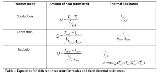
A very useful concept used in heat transfer applications is the representation of thermal transfer by what is known as thermal circuits. A thermal circuit is the representation of the resistance to heat flow as though it were an electric resistor. The heat transferred is analogous to the current and the thermal resistance is analogous to the electric resistor. The value of the thermal resistance for the different modes of heat transfer are calculated as the denominators of the developed equations. The thermal resistances of the different modes of heat transfer are used in analyzing combined modes of heat transfer. The equations describing the three heat transfer modes and their thermal resistances, as discussed previously are summarized in the table below:
In cases where there is heat transfer through different media (for example through a composite), the equivalent resistance is the sum of the resistances of the components that make up the composite. Likely, in cases where there are different heat transfer modes, the total resistance is the sum of the resistances of the different modes. Using the thermal circuit concept, the amount of heat transferred through any medium is the quotient of the temperature change and the total thermal resistance of the medium. As an example, consider a composite wall of cross- sectional area A. The composite is made of an L1 long cement plaster with a thermal coefficient k1 and L2 long paper faced fiber glass, with thermal coefficient k2. The left surface of the wall is at Ti and exposed to air with a convective coefficient of hi. The Right surface of the wall is at To and exposed to air with convective coefficient ho.
Using the thermal resistance concept heat flow through the composite is as follows:


Insulation and radiant barriers

Thermal insulators
Thermal insulation

The term thermal insulation can refer to materials used to reduce the rate of heat transfer, or the methods and processes used to reduce heat transfer....
 are materials specifically designed to reduce the flow of heat by limiting conduction, convection, or both. Radiant barrier
Radiant barrier

Radiant barriers or reflective barriers inhibit heat transfer by thermal radiation. Thermal energy may also be transferred via conduction or convection, however, radiant barriers do not necessarily protect against heat transfer via conduction or convection....
s are materials which reflect
Reflection

Reflection or reflexion may refer to:...
 radiation and therefore reduce the flow of heat from radiation sources. Good insulators are not necessarily good radiant barriers, and vice versa. Metal, for instance, is an excellent reflector and poor insulator.

The effectiveness of an insulator is indicated by its R- (resistance) value. The R-value
R-value (insulation)

The R value or R-value is a measure of thermal resistance used in the building and construction industry. The bigger the number, the better the building insulation's effectiveness....
of a material is the inverse
Inverse

Inverse or inversion may refer to:* Inverse , a program for solving inverse and optimization problems* Inversion * Inversion , the reversal of the order of a foot's elements...
 of the conduction coefficient (k) multiplied by the thickness (d) of the insulator. The units of resistance value are in SI units: (K·m²/W)

Rigid fiberglass, a common insulation material, has an R-value of 4 per inch, while poured concrete, a poor insulator, has an R-value of 0.08 per inch.

The effectiveness of a radiant barrier is indicated by its reflectivity, which is the fraction of radiation reflected. A material with a high reflectivity (at a given wavelength) has a low emissivity (at that same wavelength), and vice versa (at any specific wavelength, reflectivity = 1 - emissivity). An ideal radiant barrier would have a reflectivity of 1 and would therefore reflect 100% of incoming radiation. Vacuum bottles (Dewars) are 'silvered' to approach this. In space vacuum, satellites use multi-layer insulation
Multi-layer insulation

Multi-layer insulation, or MLI, is thermal insulation composed of multiple layers of thin sheets often used in spacecraft. It is mainly intended to reduce losses by thermal radiation....
 which consists of many layers of aluminized (shiny) mylar to greatly reduce radiation heat transfer and control satellite temperature.

Heat exchangers

A heat exchanger is a device built for efficient heat transfer from one fluid to another, whether the fluids are separated by a solid wall so that they never mix, or the fluids are directly contacted. Heat exchangers are widely used in refrigeration
Refrigeration

Refrigeration is the process of removing heat from an enclosed space, or from a substance, and moving it to a place where it is unobjectionable....
, air conditioning
Air conditioning

An air conditioner is an appliance, system, or Mechanism designed to extract heat from an area via a refrigeration cycle. In construction, a complete system of heating, Ventilation , and air conditioning is referred to as "HVAC." Its purpose, in a building or an automobile, is to provide comfort during either hot or cold...
, space heating
Space heating

Space heating is the heating of a space, usually enclosed, such as a house or room. A space heater keeps the air and surroundings at a comfortable temperature for people or animals, or even plants in a greenhouse....
, power production, and chemical processing. One common example of a heat exchanger is the radiator in a car, in which the hot radiator fluid is cooled by the flow of air over the radiator surface.

Common types of heat exchanger flows include parallel flow, counter flow, and cross flow. In parallel flow, both fluids move in the same direction while transferring heat; in counter flow, the fluids move in opposite directions and in cross flow the fluids move at right angle
Right angle

In geometry and trigonometry, a right angle is an angle of 90 degree s, corresponding to a quarter turn . It can be defined; as the angle such that twice that angle amounts to a half turn, or 180?....
s to each other. The common constructions for heat exchanger include shell and tube, double pipe, extruded finned pipe, spiral fin pipe, u-tube, and stacked plate. More information on heat exchanger flows and arrangements can be found in the heat exchanger
Heat exchanger

A heat exchanger is a device built for efficient heat transfer from one medium to another, whether the media are separated by a solid wall so that they never mix, or the media are in direct contact....
 article.

When engineers calculate the theoretical heat transfer in a heat exchanger, they must contend with the fact that the driving temperature difference between the two fluids varies with position. To account for this in simple systems, the log mean temperature difference
Log mean temperature difference

The log mean temperature difference is used to determine the temperature driving force for heat transfer in flow systems . The LMTD is a logarithmic average of the temperature difference between the hot and cold streams at each end of the exchanger....
 (LMTD) is often used as an 'average' temperature. In more complex systems, direct knowledge of the LMTD is not available and the number of transfer units
NTU method

The Number of Transfer Units Method is used to calculate the rate of heat transfer in heat exchangers when there is insufficient information to calculate the Log-Mean Temperature Difference ....
 (NTU) method can be used instead.

Boiling heat transfer

Heat transfer in boiling fluids is complex but of considerable technical importance. It is characterised by an s-shaped curve relating heat flux to surface temperature difference (see say Kay & Nedderman 'Fluid Mechanics & Transfer Processes', CUP, 1985, p529).

At low driving temperatures, no boiling occurs and the heat transfer rate is controlled by the usual single-phase mechanisms. As the surface temperature is increased, local boiling occurs and vapour bubbles nucleate, grow into the surrounding cooler fluid, and collapse. This is sub-cooled nucleate boiling and is a very efficient heat transfer mechanism. At high bubble generation rates the bubbles begin to interfere and the heat flux no longer increases rapidly with surface temperature (this is the departure from nucleate boiling DNB
DNB

DNB is short for:* Dun & Bradstreet The business information company* Drum and bass, an electronic music style* The Dictionary of National Biography, notable figures from British history...
). At higher temperatures still, a maximum in the heat flux is reached (the critical heat flux
Critical heat flux

Critical heat flux describes the thermal limit of a phenomenon where a phase change occurs during heating , which suddenly decreases the efficiency of heat transfer, thus causing localised overheating of the heating surface....
). The regime of falling heat transfer which follows is not easy to study but is believed to be characterised by alternate periods of nucleate and film boiling. Nukleate boiling slowing the heat transfer due to gas phase creation on the heater surface, as mentioned, gas phase thermal conductivity is much lower than liquid phase thermal conductivity, so the outcome is a kind of "gas thermal barrier".

At higher temperatures still, the hydrodynamically quieter regime of film boiling is reached. Heat fluxes across the stable vapour layers are low, but rise slowly with temperature. Any contact between fluid and the surface which may be seen probably leads to the extremely rapid nucleation of a fresh vapour layer ('spontaneous nucleation
Nucleation

Nucleation is the onset of a crystal in a small region. The phase transition can be the formation of a bubble or of a crystal from a liquid. Creation of liquid droplets in saturated vapor or the creation of gaseous bubbles in a saturated liquid is also characterized by nucleation ....
').

Condensation heat transfer

Condensation
Condensation

Condensation is the change of the physical state of aggregation of matter from gaseous phase into liquid phase. When the transition happens from the gaseous phase into the solid phase directly, bypassing the liquid phase the change is called Deposition , which is the opposite of sublimation....
 occurs when a vapor is cooled and changes its phase to a liquid. Condensation heat transfer, like boiling, is of great significance in industry. During condensation, the latent heat of vaporization must be released. The amount of the heat is the same as that absorbed during vaporization at the same fluid pressure.

There are several modes of condensation:
  • Homogeneous condensation (as during a formation of fog).
  • Condensation in direct contact with subcooled liquid.
  • Condensation on direct contact with a cooling wall of a heat exchanger-this is the most common mode used in industry:
    • Filmwise condensation (when a liquid film is formed on the subcooled surface, usually occurs when the liquid wets the surface).
    • Dropwise condensation (when liquid drops are formed on the subcooled surface, usually occurs when the liquid does not wet the surface). Dropwise condensation is difficult to sustain reliably; therefore, industrial equipment is normally designed to operate in filmwise condensation mode.


Heat transfer in education

Heat transfer is typically studied as part of a general chemical engineering
Chemical engineering

Chemical engineering is the branch of engineering that deals with the application of physical science , with mathematics, to the process of converting raw materials or chemicals into more useful or valuable forms....
 or mechanical engineering
Mechanical engineering

Mechanical Engineering is an engineering discipline that involves the application of physics#branches of physics for analysis, design, manufacturing, and maintenance of machine....
 curriculum. Typically, thermodynamics
Thermodynamics

In physics, thermodynamics is the study of the conversion of heat energy into different forms of energy ; different energy conversions into heat energy; and its relation to macroscopic variables such as temperature, pressure, and volume....
 is a prerequisite to undertaking a course in heat transfer, as the laws of thermodynamics are essential in understanding the mechanism of heat transfer. Other courses related to heat transfer include energy conversion
Energy conversion

In physics, the term energy describes the amount of work which may potentially be done by forces within a system. Changes in energy in systems can only be accomplished by adding or subtracting energy from them, as energy is a quantity which is conserved....
, thermofluids
Thermofluids

Thermofluids is a branch of knowledge which deals with the energy content in and transport by fluids. "Thermo" meaning heat, and fluids refers to liquids, gases and vapors....
 and mass transfer
Mass transfer

Mass transfer is the transfer of mass from high concentration to low concentration. The phrase is commonly used in engineering for physical processes that involve molecule and convection transport of atoms and molecules within systems....
.

Heat transfer methodologies are used in the following disciplines, among others:
  • Automotive engineering
    Automotive engineering

    Modern automotive engineering is a branch of vehicle engineering, incorporating elements of Mechanical engineering, Electrical engineering, Electronic engineering, Software engineering and safety engineering as applied to the design, manufacture and operation of motorcycles, automobiles, buses and trucks and their respective engineering subsy...
  • Thermal management of electronic devices and systems
    Thermal management of electronic devices and systems

    Heat generated by electronic devices and circuitry must be dissipated to improve reliability and prevent premature failure. Techniques for heat dissipation can include Thermal management of electronic devices and systems#Heat sinks and fan s for air cooling, and other forms of computer cooling such as Water cooling....
  • HVAC
    HVAC

    HVAC is an initialism or acronym that stands for "heating, Ventilation , and air conditioning". HVAC is sometimes referred to as climate control and is particularly important in the design of medium to large industrial and office buildings such as skyscrapers and in marine environments such as aquariums, where humidity and tem...
  • Insulation
    Thermal insulation

    The term thermal insulation can refer to materials used to reduce the rate of heat transfer, or the methods and processes used to reduce heat transfer....
  • Materials processing
    Materials processing

    Articles on Materials processing include:* process a set of transformations of input elements into products* industrial process, a procedure involving chemical or mechanical steps to aid in the manufacture of an item or items...
  • Power plant engineering


See also

  • Heat
    Heat

    In physics and thermodynamics, heat is any transfer of energy from one body or thermodynamic system to another due to a difference in temperature....
  • Laser-heated pedestal growth
    Laser-heated pedestal growth

    Laser-heated pedestal growth is a crystal growth technique. Among all the modern techniques for growing crystals from a melt , it has become one of the most powerful for materials research....
  • Thermal contact conductance
    Thermal contact conductance

    In physics, thermal contact conductance is the study of heat conduction between solid bodies in contact. The thermal contact conductance coefficient, , is a property indicating the thermal conductivity, or ability to conduct heat, between two bodies in contact....
  • Thermal insulation
    Thermal insulation

    The term thermal insulation can refer to materials used to reduce the rate of heat transfer, or the methods and processes used to reduce heat transfer....
  • Thermal physics
    Thermal physics

    Thermal physics is the combined study of thermodynamics, statistical mechanics, and kinetic theory. This umbrella-subject is typically designed for physics students and functions to provide a general introduction to each of three core heat-related subjects....
  • Thermal science
    Thermal science

    Thermal science is the combined study of thermodynamics, fluid mechanics, and heat transfer. This umbrella-subject is typically designed for non-engineering students and functions to provide a general introduction to each of three core heat-related subjects....
  • LMTD
  • NTU Method
    NTU method

    The Number of Transfer Units Method is used to calculate the rate of heat transfer in heat exchangers when there is insufficient information to calculate the Log-Mean Temperature Difference ....


Other fundamental engineering topics

  • Analysis of resistive circuits
    Analysis of resistive circuits

    A network, in the context of electronics, is a collection of interconnected components. Network analysis is the process of finding the voltages across, and the currents through, every component in the network....
  • Dynamics
    Dynamics (mechanics)

    In physics the term dynamics customarily refers to the time evolution of physical processes. These processes may be microscopic as in particle physics, kinetic theory, and chemical reactions, or macroscopic as in the predictions of statistical mechanics and nonequilibrium thermodynamics....
    • Thermodynamics
      Thermodynamics

      In physics, thermodynamics is the study of the conversion of heat energy into different forms of energy ; different energy conversions into heat energy; and its relation to macroscopic variables such as temperature, pressure, and volume....
    • Fluid dynamics
      Fluid dynamics

      In physics, fluid dynamics is the sub-discipline of fluid mechanics dealing with fluid flow — the natural science of fluids in motion....
  • Engineering economics
    Engineering economics

    Engineering economics, previously known as engineering economy, is a subset of economics for application to engineering projects. Engineers seek solutions to problems, and the economic viability of each potential solution is normally considered along with the technical aspects....
  • Materials science
    Materials science

    Materials science or materials engineering is an interdisciplinary field involving the properties of matter and its applications to various areas of science and engineering....
    • Strength of materials
      Strength of materials

      In materials science, the strength of a material refers to the material's ability to withstand an applied stress without failure. Yield strength refers to the point on the engineering stress-strain curve beyond which the material begins deformation that cannot be reversed upon removal of the loading....
  • Statics
    Statics

    Statics is the branch of mechanics concerned with the analysis of loads on physical systems in static equilibrium, that is, in a state where the relative positions of subsystems do not vary over time, or where components and structures are at a constant velocity....


Related journals

  • Heat Transfer Engineering
  • Experimental Heat Transfer
  • International Journal of Heat and Mass Transfer
  • ASME Journal of Heat Transfer
  • Numerical Heat Transfer Part A
  • Numerical Heat Transfer Part B
  • Nanoscale and Microscale Thermophysical Engineering
  • Journal of Enhanced Heat Transfer


External links

  • Modes of heat transfer (conduction, convection, radiation) within or between media are explained, together with calculations and other issues such as heat transfer barriers - Spirax Sarco
  • - Overview
  • - Downloadable textbook (free)
  • - Overview
  • - Overview
  • - a practical example of how heat transfer is used to heat buildings without burning fossil fuels.