
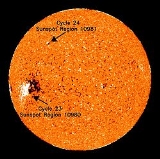
The
solar cycle, or the
solar magnetic activity cycle, is a periodic change in the amount of
irradiationIrradiation is the process by which an object is exposed to radiation. The exposure can originate from various sources, including natural sources. Most frequently the term refers to ionizing radiation, and to a level of radiation that will serve a specific purpose, rather than radiation exposure to...
from the
SunThe Sun is the star at the center of the Solar System. It is almost perfectly spherical and consists of hot plasma interwoven with magnetic fields...
that is experienced on Earth. It has a period of about 11 years, and is one component of
solar variationSolar variation is the change in the amount of radiation emitted by the Sun and in its spectral distribution over years to millennia. These variations have periodic components, the main one being the approximately 11-year solar cycle . The changes also have aperiodic fluctuations...
, the other being aperiodic fluctuations. Solar variation causes changes in
space weatherSpace weather is the concept of changing environmental conditions in near-Earth space or thespace from the Sun's atmosphere to the Earth's atmosphere. It is distinct from the concept ofweather within the Earth's planetary atmosphere...
and to some degree
weatherWeather is the state of the atmosphere, to the degree that it is hot or cold, wet or dry, calm or stormy, clear or cloudy. Most weather phenomena occur in the troposphere, just below the stratosphere. Weather refers, generally, to day-to-day temperature and precipitation activity, whereas climate...
and
climateClimate encompasses the statistics of temperature, humidity, atmospheric pressure, wind, rainfall, atmospheric particle count and other meteorological elemental measurements in a given region over long periods...
on Earth. The cycle is observed by counting the frequency and placement of
sunspotSunspots are temporary phenomena on the photosphere of the Sun that appear visibly as dark spots compared to surrounding regions. They are caused by intense magnetic activity, which inhibits convection by an effect comparable to the eddy current brake, forming areas of reduced surface temperature....
s visible on the Sun. Powered by a hydromagnetic dynamo process, driven by the inductive action of internal solar flows, the solar cycle:
- Structures the Sun's atmosphere
An atmosphere is a layer of gases that may surround a material body of sufficient mass, and that is held in place by the gravity of the body. An atmosphere may be retained for a longer duration, if the gravity is high and the atmosphere's temperature is low...
, its coronaA corona is a type of plasma "atmosphere" of the Sun or other celestial body, extending millions of kilometers into space, most easily seen during a total solar eclipse, but also observable in a coronagraph...
and the windThe solar wind is a stream of charged particles ejected from the upper atmosphere of the Sun. It mostly consists of electrons and protons with energies usually between 1.5 and 10 keV. The stream of particles varies in temperature and speed over time...
;
- Modulates the solar irradiance
Sunlight, in the broad sense, is the total frequency spectrum of electromagnetic radiation given off by the Sun. On Earth, sunlight is filtered through the Earth's atmosphere, and solar radiation is obvious as daylight when the Sun is above the horizon.When the direct solar radiation is not blocked...
;
- Modulates the flux of short-wavelength solar radiation, from ultraviolet to X-ray;
- Modulates the occurrence frequency of solar flare
A solar flare is a sudden brightening observed over the Sun surface or the solar limb, which is interpreted as a large energy release of up to 6 × 1025 joules of energy . The flare ejects clouds of electrons, ions, and atoms through the corona into space. These clouds typically reach Earth a day...
s, coronal mass ejectionA coronal mass ejection is a massive burst of solar wind, other light isotope plasma, and magnetic fields rising above the solar corona or being released into space....
s, and other geoeffective solar eruptive phenomena;
- Indirectly modulates the flux of high-energy galactic cosmic ray
Galactic cosmic rays are cosmic rays that have their origin inside our Galaxy. GCRs are high-energy charged particles, and are usually protons, electrons, and fully ionized nuclei of light elements...
s entering the solar system.
History
The solar cycle was discovered in 1843 by Samuel Heinrich Schwabe, who after 17 years of observations noticed a periodic variation in the average number of sunspots seen from year to year on the solar disk.
Rudolf WolfJohann Rudolf Wolf was a Swiss astronomer and mathematician best known for his research on sunspots.Wolf was born in Fällanden, near Zurich. He studied at the universities of Zurich, Vienna, and Berlin. Encke was one of his teachers. Wolf became professor of astronomy at the University of Bern in...
compiled and studied these and other observations, reconstructing the cycle back to 1745, eventually pushing these reconstructions to the earliest observations of sunspots by Galileo and contemporaries in the early seventeenth century. Starting with Wolf, solar astronomers have found it useful to define a standard sunspot number index, which continues to be used today.
Until recently it was thought that there were 28 cycles in the 309 years between 1699 and 2008, giving an average length of 11.04 years, but recent research has showed that the longest of these (1784–99) seems actually to have been two cycles, so that the average length is only around 10.66 years. Cycles as short as 9 years and as long as 14 years have been observed. Significant variations in amplitude also occur.
Solar maximumSolar maximum or solar max is the period of greatest solar activity in the solar cycle of the sun. During solar maximum, sunspots appear....
and
solar minimumSolar minimum is the period of least solar activity in the solar cycle of the sun. During this time, sunspot and solar flare activity diminishes, and often does not occur for days at a time...
refer respectively to epochs of maximum and minimum sunspot counts. Individual sunspot cycles are partitioned from one minimum to the next.
Following the numbering scheme established by Wolf, the 1755–1766 cycle is traditionally numbered "1". The period between 1645 and 1715, a time during which very few sunspots were observed, is a real feature, as opposed to an artifact due to missing data, and coincides with the
Little Ice AgeThe Little Ice Age was a period of cooling that occurred after the Medieval Warm Period . While not a true ice age, the term was introduced into the scientific literature by François E. Matthes in 1939...
. This epoch is now known as the
Maunder minimumThe Maunder Minimum is the name used for the period roughly spanning 1645 to 1715 when sunspots became exceedingly rare, as noted by solar observers of the time....
, after
Edward Walter MaunderEdward Walter Maunder was an English astronomer best remembered for his study of sunspots and the solar magnetic cycle that led to his identification of the period from 1645 to 1715 that is now known as the Maunder Minimum....
, who extensively researched this peculiar event, first noted by
Gustav SpörerFriederich Wilhelm Gustav Spörer was a German astronomer.He is noted for his studies of sunspots and sunspot cycles. In this regard he is often mentioned together with Edward Maunder. Spörer was the first to note a prolonged period of low sunspot activity from 1645 to 1715...
. In the second half of the nineteenth century it was also noted (independently) by Richard Carrington and by Spörer that as the cycle progresses, sunspots appear first at mid-latitudes, and then closer and closer to the equator until solar minimum is reached. This pattern is best visualized in the form of the so-called butterfly diagram, first constructed by the husband-wife team of E. Walter and
Annie MaunderAnnie Scott Dill Maunder, née Russell was an Irish astronomer and mathematician.She was born in Strabane, County Tyrone, Ireland to William Andrew Russell and Hessy Nesbitt Dill. Her father was the minister of the Presbyterian Church in Strabane until 1882.Annie received her secondary education at...
in the early twentieth century (see graph below). Images of the Sun are divided into latitudinal strips, and the monthly-averaged fractional surface of sunspots calculated. This is plotted vertically as a color-coded bar, and the process is repeated month after month to produce this time-latitude diagram.
The physical basis of the solar cycle was elucidated in the early twentieth century by
George Ellery HaleGeorge Ellery Hale was an American solar astronomer.-Biography:Hale was born in Chicago, Illinois. He was educated at MIT, at the Observatory of Harvard College, , and at Berlin . As an undergraduate at MIT, he is known for inventing the spectroheliograph, with which he made his discovery of...
and collaborators, who in 1908 showed that sunspots were strongly magnetized (this was the first detection of magnetic fields outside the Earth), and in 1919 went on to show that the magnetic polarity of sunspot pairs:
- Is always the same in a given solar hemisphere throughout a given sunspot cycle;
- Is opposite across hemispheres throughout a cycle;
- Reverses itself in both hemispheres from one sunspot cycle to the next.
Hale's observations revealed that the solar cycle is a magnetic cycle with an average duration of 22 years. However, because very nearly all manifestations of the solar cycle are insensitive to magnetic polarity, it remains common usage to speak of the "11-year solar cycle".
Half a century later, the father-and-son team of Harold Babcock and Horace Babcock showed that the solar surface is magnetized even outside of sunspots; that this weaker magnetic field is to first order a dipole; and that this dipole also undergoes polarity reversals with the same period as the sunspot cycle (see graph below). These various observations established that the solar cycle is a spatiotemporal magnetic process unfolding over the Sun as a whole.
Phenomena, measurement, and causes
Spots from multiple cycles can co-exist for some time and since it was discovered the sun reverses magnetic polarity one solar half cycle to the next, spots from different cycles can be told apart. However it takes some months before a definite decision to be made on the true date of solar minimum, which is announced by the relevant expert authorities.
One of the main authorities is SIDC (the Solar Influences Data Analysis Center) which is located in
BelgiumBelgium , officially the Kingdom of Belgium, is a federal state in Western Europe. It is a founding member of the European Union and hosts the EU's headquarters, and those of several other major international organisations such as NATO.Belgium is also a member of, or affiliated to, many...
, and works with agencies such as
NASAThe National Aeronautics and Space Administration is the agency of the United States government that is responsible for the nation's civilian space program and for aeronautics and aerospace research...
and ESA.
The most important information today comes from
SOHOThe Solar and Heliospheric Observatory is a spacecraft built by a European industrial consortium led by Matra Marconi Space that was launched on a Lockheed Martin Atlas IIAS launch vehicle on December 2, 1995 to study the Sun, and has discovered over 2100 comets. It began normal operations in May...
(a project of international cooperation between ESA and NASA), such as the MDI
magnetogramThe term magnetogram has two meanings, used separately in the contexts of magnetic fields of the Sun and the Earth.In the context of the magnetic field of the Sun, the term magnetogram refers to a pictorial representation of the spatial variations in strength of the solar magnetic field...
, where the solar "surface"
magnetic fieldA magnetic field is a mathematical description of the magnetic influence of electric currents and magnetic materials. The magnetic field at any given point is specified by both a direction and a magnitude ; as such it is a vector field.Technically, a magnetic field is a pseudo vector;...
can be seen.
The basic causes of the
solar variabilitySolar variation is the change in the amount of radiation emitted by the Sun and in its spectral distribution over years to millennia. These variations have periodic components, the main one being the approximately 11-year solar cycle . The changes also have aperiodic fluctuations...
and solar cycles are still under debate, with some researchers suggesting a link with the
tidal forceThe tidal force is a secondary effect of the force of gravity and is responsible for the tides. It arises because the gravitational force per unit mass exerted on one body by a second body is not constant across its diameter, the side nearest to the second being more attracted by it than the side...
s due to the
gas giantA gas giant is a large planet that is not primarily composed of rock or other solid matter. There are four gas giants in the Solar System: Jupiter, Saturn, Uranus, and Neptune...
s
JupiterJupiter is the fifth planet from the Sun and the largest planet within the Solar System. It is a gas giant with mass one-thousandth that of the Sun but is two and a half times the mass of all the other planets in our Solar System combined. Jupiter is classified as a gas giant along with Saturn,...
and
SaturnSaturn is the sixth planet from the Sun and the second largest planet in the Solar System, after Jupiter. Saturn is named after the Roman god Saturn, equated to the Greek Cronus , the Babylonian Ninurta and the Hindu Shani. Saturn's astronomical symbol represents the Roman god's sickle.Saturn,...
, or due to the solar inertial motion. Another cause of sun spots can be
solar jet streamHelioseismology is the study of the propagation of wave oscillations, particularly acoustic pressure waves, in the Sun. Unlike seismic waves on Earth, solar waves have practically no shear component . Solar pressure waves are believed to be generated by the turbulence in the convection zone near...
"torsional oscillation".
Effects of the solar cycle
The Sun's
magnetic fieldA magnetic field is a mathematical description of the magnetic influence of electric currents and magnetic materials. The magnetic field at any given point is specified by both a direction and a magnitude ; as such it is a vector field.Technically, a magnetic field is a pseudo vector;...
structures its atmosphere and outer layers all the way through the
coronaA corona is a type of plasma "atmosphere" of the Sun or other celestial body, extending millions of kilometers into space, most easily seen during a total solar eclipse, but also observable in a coronagraph...
and into the
solar windThe solar wind is a stream of charged particles ejected from the upper atmosphere of the Sun. It mostly consists of electrons and protons with energies usually between 1.5 and 10 keV. The stream of particles varies in temperature and speed over time...
. Its spatiotemporal variations lead to a host of phenomena collectively known as solar activity. All of solar activity is strongly modulated by the solar magnetic cycle, since the latter serves as the energy source and dynamical engine for the former.
Surface magnetism
Sunspots may exist anywhere from a few days to a few months, but they eventually decay, and this releases magnetic flux in the solar photosphere. This magnetic field is dispersed and churned by turbulent convection, and solar large-scale flows. These transport mechanisms lead to the accumulation of the magnetized decay products at high solar latitudes, eventually reversing the polarity of the polar fields (notice how the blue and yellow fields reverse in the graph above).
The dipolar component of the solar magnetic field is observed to reverse polarity around the time of solar maximum, and reaches peak strength at the time of solar minimum. Sunspots, on the other hand, are produced from a strong toroidal (longitudinally-directed) magnetic field within the solar interior. Physically, the solar cycle can be thought of as a regenerative loop where the
toroidalThe earliest use of these terms cited by the Oxford English Dictionary is by Walter M. Elsasser in the context of the generation of the Earth's magnetic field by currents in the core, with "toroidal" being parallel to lines of latitude and "poloidal" being in the direction of the magnetic field...
component produces a
poloidalThe earliest use of these terms cited by the Oxford English Dictionary is by Walter M. Elsasser in the context of the generation of the Earth's magnetic field by currents in the core, with "toroidal" being parallel to lines of latitude and "poloidal" being in the direction of the magnetic field...
field, which later produces a new toroidal component of sign such as to reverse the polarity of the original toroidal field, which then produces a new poloidal component of reversed polarity, and so on.
Solar irradiance
The total solar irradiance (TSI) is the amount of solar radiative energy incident on the Earth's upper atmosphere. TSI variations were undetectable until satellite observations began in late 1978. The major finding of satellite observations is that TSI varies in phase with the solar magnetic activity cycle with an amplitude of about 0.1% and an average value of about 1366 W/m
2. Variations about the average up to −0.3% are caused by large sunspot groups and of +0.05% by large faculae and bright network on a week to 10 day timescale. (see TSI variation graphics.) The sunspot cycle variation of 0.1% has small but detectable effects on the Earth's climate. TSI variations over the several decades of continuous satellite observation show small but detectable trends.
TSI is higher at solar maximum, even though sunspots are darker (cooler) than the average photosphere. This is caused by magnetized structures other than sunspots during solar maxima, such as faculae and active elements of the "bright" network, that are brighter (hotter) than the average photosphere. They collectively overcompensate for the irradiance deficit associated with the cooler but less numerous sunspots. The primary driver of TSI changes on solar rotational and sunspot cycle timescales is the varying photospheric coverage of these radiatively active solar magnetic structures.
Short-wavelength radiation
With a temperature of 5870
kelvinThe kelvin is a unit of measurement for temperature. It is one of the seven base units in the International System of Units and is assigned the unit symbol K. The Kelvin scale is an absolute, thermodynamic temperature scale using as its null point absolute zero, the temperature at which all...
s, the
photosphereThe photosphere of an astronomical object is the region from which externally received light originates. The term itself is derived from Ancient Greek roots, φῶς, φωτός/phos, photos meaning "light" and σφαῖρα/sphaira meaning "sphere", in reference to the fact that it is a spheric surface perceived...
of the Sun emits a very small proportion of radiation in the
extreme ultravioletExtreme Ultraviolet radiation is high-energy ultraviolet radiation, generally defined to be electromagnetic radiation in the part of the electromagnetic spectrum spanning wavelengths from 120 nm down to 10 nm, and therefore having photons with energies from 10 eV up to 124 eV...
(EUV) and above. However, hotter upper layers of the Sun's atmosphere (
chromosphereThe chromosphere is a thin layer of the Sun's atmosphere just above the photosphere, roughly 2,000 kilometers deep....
and
coronaA corona is a type of plasma "atmosphere" of the Sun or other celestial body, extending millions of kilometers into space, most easily seen during a total solar eclipse, but also observable in a coronagraph...
) emit more short-wavelength radiation. Since the upper atmosphere is not homogeneous and contains significant magnetic structure, the solar
UVUltraviolet light is electromagnetic radiation with a wavelength shorter than that of visible light, but longer than X-rays, in the range 10 nm to 400 nm, and energies from 3 eV to 124 eV...
,
EUVExtreme Ultraviolet radiation is high-energy ultraviolet radiation, generally defined to be electromagnetic radiation in the part of the electromagnetic spectrum spanning wavelengths from 120 nm down to 10 nm, and therefore having photons with energies from 10 eV up to 124 eV...
and X-ray flux varies markedly in the course of the solar cycle.
The photo montage to the left illustrates this variation for soft X-ray, as observed by the Japanese satellite
YohkohYohkoh , known before launch as Solar-A, was a Solar observatory spacecraft of the Institute of Space and Astronautical Science with United States and United Kingdom collaboration...
from after August 30, 1991, at the peak of cycle 22, to September 6, 2001, at the peak of cycle 23. Similar cycle-related variations are observed in the flux of solar UV or EUV radiation, as observed, for example, by the
SOHOThe Solar and Heliospheric Observatory is a spacecraft built by a European industrial consortium led by Matra Marconi Space that was launched on a Lockheed Martin Atlas IIAS launch vehicle on December 2, 1995 to study the Sun, and has discovered over 2100 comets. It began normal operations in May...
or
TRACETRACE was a NASA space telescope designed to investigate the connections between fine-scale magnetic fields and the associated plasma structures on the Sun by providing high resolution images and observation of the solar photosphere and transition region to the corona...
satellites.
Even though it only accounts for a minuscule fraction of total solar radiation, the impact of solar UV, EUV and X-ray radiation on the Earth's upper atmosphere is profound. Solar UV flux is a major driver of
stratospheric chemistryThe stratosphere is the second major layer of Earth's atmosphere, just above the troposphere, and below the mesosphere. It is stratified in temperature, with warmer layers higher up and cooler layers farther down. This is in contrast to the troposphere near the Earth's surface, which is cooler...
, and increases in ionizing radiation significantly affect
ionosphereThe ionosphere is a part of the upper atmosphere, comprising portions of the mesosphere, thermosphere and exosphere, distinguished because it is ionized by solar radiation. It plays an important part in atmospheric electricity and forms the inner edge of the magnetosphere...
-influenced temperature and electrical conductivity.
Solar radio flux
Emission from the Sun at centimetric (radio) wavelength is due primarily to coronal plasma trapped in the magnetic fields overlying active regions. The F10.7 index is a measure of the solar radio flux per unit frequency at a wavelength of 10.7 cm, near the peak of the observed solar radio emission. F10.7 is often expressed in SFU or solar flux units. It represents a measure of diffuse, nonradiative heating of the coronal plasma trapped by magnetic fields over active regions, and is an excellent indicator of overall solar activity levels. The solar F10.7 cm record extends back to 1947, and is the longest direct record of solar activity available, other than sunspot-related quantities.
Sunspot activity has a major effect on long distance radio communications particularly on the
shortwaveShortwave radio refers to the upper MF and all of the HF portion of the radio spectrum, between 1,800–30,000 kHz. Shortwave radio received its name because the wavelengths in this band are shorter than 200 m which marked the original upper limit of the medium frequency band first used...
bands although medium wave and low VHF frequencies are also affected. High levels of sunspot activity lead to improved signal propagation on higher frequency bands, although they also increase the levels of solar noise and ionospheric disturbances. These effects are caused by impact of the increased level of solar radiation on the
ionosphereThe ionosphere is a part of the upper atmosphere, comprising portions of the mesosphere, thermosphere and exosphere, distinguished because it is ionized by solar radiation. It plays an important part in atmospheric electricity and forms the inner edge of the magnetosphere...
.
It has been proposed that 10.7 cm solar flux can interfere with point-to-point terrestrial communications.
Geoeffective eruptive phenomena
The solar magnetic field structures the corona, giving it its characteristic shape visible at times of solar eclipses. Complex coronal magnetic field structures evolve in response to fluid motions at the solar surface, and emergence of magnetic flux produced by dynamo action in the solar interior. For reasons not yet understood in detail, sometimes these structures lose stability, leading to coronal mass ejections into interplanetary space, or flares, caused by sudden localized release of magnetic energy driving copious emission of ultraviolet and X-ray radiation as well as energetic particles. These eruptive phenomena can have a significant impact on Earth's upper atmosphere and space environment, and are the primary drivers of what is now called space weather.
The occurrence frequency of coronal mass ejections and flares is strongly modulated by the solar activity cycle. Flares of any given size are some 50 times more frequent at solar maximum than at minimum. Large coronal mass ejections occur on average a few times a day at solar maximum, down to one every few days at solar minimum. The size of these events themselves does not depend sensitively on the phase of the solar cycle. A good recent case in point are the three large X-class flares having occurred in December 2006, very near solar minimum; one of these (an X9.0 flare on Dec 5) stands as one of the brightest on record.
Cosmic ray flux
The outward expansion of solar ejecta into interplanetary space provides overdensities of plasma that are efficient at scattering high-energy cosmic rays entering the solar system from elsewhere in the galaxy. Since the frequency of solar eruptive events is strongly modulated by the solar cycle, the degree of cosmic ray scattering in the outer solar system varies in step. As a consequence, the cosmic ray flux in the inner solar system is anticorrelated with the overall level of solar
activity. This anticorrelation is clearly detected in cosmic ray flux measurements at the Earth's surface.
Some high-energy cosmic rays entering Earth's atmosphere collide hard enough with molecular atmospheric constituents to cause occasionally nuclear
spallation reactionsCosmic ray spallation is a form of naturally occurring nuclear fission and nucleosynthesis. It refers to the formation of elements from the impact of cosmic rays on an object. Cosmic rays are highly energetic charged particles from outside of Earth ranging from protons, alpha particles, and nuclei...
. Some of the fission products include radionuclides such as
14C and
10Be, which settle down on Earth's surface. Their concentration can
be measured in ice cores, allowing a reconstruction of
solar activity levels into the distant past. Such reconstructions indicate that the overall level of solar activity since the middle of the twentieth century stands amongst the highest of the past 10,000 years, and that Maunder minimum-like epochs of suppressed activity, of varying durations have occurred repeatedly over that time span.
Terrestial organisms
The impact of Solar cycle on living organisms has been investigated (see
chronobiologyChronobiology is a field of biology that examines periodic phenomena in living organisms and their adaptation to solar- and lunar-related rhythms. These cycles are known as biological rhythms. Chronobiology comes from the ancient Greek χρόνος , and biology, which pertains to the study, or science,...
).
Some researchers claim to have found connections with human health.
The amount of
UVBUltraviolet light is electromagnetic radiation with a wavelength shorter than that of visible light, but longer than X-rays, in the range 10 nm to 400 nm, and energies from 3 eV to 124 eV...
light at 300 nm reaching the Earth varies by as much as 400% over the solar cycle due to variations in the protective
ozone layerThe ozone layer is a layer in Earth's atmosphere which contains relatively high concentrations of ozone . This layer absorbs 97–99% of the Sun's high frequency ultraviolet light, which is potentially damaging to the life forms on Earth...
. In the stratosphere, ozone is
continuously regeneratedThe ozone-oxygen cycle is the process by which ozone is continually regenerated in Earth's stratosphere, all the while converting ultraviolet radiation into heat. In 1930 Sydney Chapman resolved the chemistry involved. The process is commonly called the Chapman cycle by atmospheric scientists.Most...
by the
splittingPhotodissociation, photolysis, or photodecomposition is a chemical reaction in which a chemical compound is broken down by photons. It is defined as the interaction of one or more photons with one target molecule....
of O
2 molecules by ultraviolet light. During a solar minimum, the decrease in ultraviolet light received from the Sun leads to a decrease in the concentration of ozone, allowing increased UVB to penetrate to the Earth's surface.
Radio communication
Skywave modes of radio communication operate by bending (refracting) radio waves (
electromagnetic radiationElectromagnetic radiation is a form of energy that exhibits wave-like behavior as it travels through space...
) through the
IonosphereThe ionosphere is a part of the upper atmosphere, comprising portions of the mesosphere, thermosphere and exosphere, distinguished because it is ionized by solar radiation. It plays an important part in atmospheric electricity and forms the inner edge of the magnetosphere...
. During the "peaks" of the solar cycle, the ionosphere becomes increasingly ionized by
solar photonsSolar photonics is a science on the boundary between photonics/optical communication and solar energy. Basically the idea is to distribute solar energy though optical fibres or other photonic guides...
and cosmic rays. This affects the path (
propagationRadio propagation is the behavior of radio waves when they are transmitted, or propagated from one point on the Earth to another, or into various parts of the atmosphere...
) of the radio wave in complex ways which can both facilitate or hinder local and long distance communications.
Forecasting of skywave modes is of considerable interest to commercial
marineMarine is an umbrella term. As an adjective it is usually applicable to things relating to the sea or ocean, such as marine biology, marine ecology and marine geology...
and
aircraftAn aircraft is a vehicle that is able to fly by gaining support from the air, or, in general, the atmosphere of a planet. An aircraft counters the force of gravity by using either static lift or by using the dynamic lift of an airfoil, or in a few cases the downward thrust from jet engines.Although...
communications, amateur radio operators, and
shortwaveShortwave radio refers to the upper MF and all of the HF portion of the radio spectrum, between 1,800–30,000 kHz. Shortwave radio received its name because the wavelengths in this band are shorter than 200 m which marked the original upper limit of the medium frequency band first used...
broadcastersBroadcasting is the distribution of audio and video content to a dispersed audience via any audio visual medium. Receiving parties may include the general public or a relatively large subset of thereof...
. These users utilize frequencies within the
High FrequencyHigh frequency radio frequencies are between 3 and 30 MHz. Also known as the decameter band or decameter wave as the wavelengths range from one to ten decameters . Frequencies immediately below HF are denoted Medium-frequency , and the next higher frequencies are known as Very high frequency...
or 'HF' radio spectrum which are most affected by these solar and ionospheric variances. Changes in solar output affect the
maximum usable frequencyMaximum usable frequency describes, in radio transmission, using reflection from the regular ionized layers of the ionosphere, the upper frequency limit that can be used for transmission between two points at a specified time, independent of transmitter power...
, a limit on the highest
frequencyFrequency is the number of occurrences of a repeating event per unit time. It is also referred to as temporal frequency.The period is the duration of one cycle in a repeating event, so the period is the reciprocal of the frequency...
usable for communications.
Terrestrial climate
Data collected from older U.S. and European spacecraft previously showed that the
solar luminosity is about 0.07 percent brighter in years of peak sunspot activity than when spots were rare. Variations of this magnitude are thought to be too small to have contributed appreciably to the accelerated
global warmingGlobal warming refers to the rising average temperature of Earth's atmosphere and oceans and its projected continuation. In the last 100 years, Earth's average surface temperature increased by about with about two thirds of the increase occurring over just the last three decades...
observed since the mid-1970s.
On the other hand, an analysis of data from NASA's Solar Radiation and Climate Experiment challenged the idea that decreasing solar activity cools the Earth, and vice versa. Solar activity seems to work the opposite way around: less visible light reaches the Earth's surface during the Solar maxima than during the minima. This is caused by redistribution of the Solar energy during the maxima from the visible light, which actually heats the surface and the
troposphereThe troposphere is the lowest portion of Earth's atmosphere. It contains approximately 80% of the atmosphere's mass and 99% of its water vapor and aerosols....
, to the ultraviolet light, which is absorbed high above the ground in the
stratosphereThe stratosphere is the second major layer of Earth's atmosphere, just above the troposphere, and below the mesosphere. It is stratified in temperature, with warmer layers higher up and cooler layers farther down. This is in contrast to the troposphere near the Earth's surface, which is cooler...
. The research also found that the Sun may have caused as much warming as carbon dioxide over three years.
Recent research suggests that there may also be regional climate impacts due to the solar cycle. Measurements from the Spectral Irradiance Monitor on NASA's Solar Radiation and Climate Experiment show that solar UV output is more variable over the course of the solar cycle than scientists had previously thought. Climate models taking this information into account suggest these changes may result in, for example, colder winters in the US and southern Europe and warmer winters in Canada and northern Europe during solar minima.
Recent research at CERN's
CLOUDCosmics Leaving Outdoor Droplets or the CLOUD is an experimental facility being run at CERN by Jasper Kirkby to investigate the microphysics between galactic cosmic rays and aerosols under controlled conditions...
facility examines links between cosmic rays and
cloud condensation nucleiCloud condensation nuclei or CCNs are small particles typically 0.2 µm, or 1/100 th the size of a cloud droplet ) about which cloud droplets coalesce. Water requires a non-gaseous surface to make the transition from a vapour to a liquid. In the atmosphere, this surface presents itself as tiny...
. Dr. Jasper Kirby, an experimental particle physicist currently with CERN and a team leader at
CLOUDCosmics Leaving Outdoor Droplets or the CLOUD is an experimental facility being run at CERN by Jasper Kirkby to investigate the microphysics between galactic cosmic rays and aerosols under controlled conditions...
said, "At the moment, it [the experiment] actually says nothing about a possible cosmic-ray effect on clouds and climate, but it's a very important first step." During periods of high solar activity (during a solar maxima), the Sun's magnetic field shields the planet from cosmic rays. During periods of low solar activity (during solar minima), more cosmic rays reach Earth, potentially creating ultra-small aerosol particles which are precursors to
cloud condensation nucleiCloud condensation nuclei or CCNs are small particles typically 0.2 µm, or 1/100 th the size of a cloud droplet ) about which cloud droplets coalesce. Water requires a non-gaseous surface to make the transition from a vapour to a liquid. In the atmosphere, this surface presents itself as tiny...
.
More broadly, links have been found between solar cycles, global climate and events like El Nino, and a study indicates that heat caused by El Nino has a temporal correlation with
civil warA civil war is a war between organized groups within the same nation state or republic, or, less commonly, between two countries created from a formerly-united nation state....
s. In other research, Daniel J. Hancock and Douglas N. Yarger found "statistically significant relationships between the double [~21 year] sunspot cycle and the 'January thaw' phenomenon along the East Coast and between the double sunspot cycle and 'drought' (June temperature and precipitation) in the Midwest."
Historically, the most well-documented connection between solar activity and climate change is the Maunder Minimum, during which cold weather prevailed in Europe. Research had suggested that a new 90-year Maunder minimum would result in a reduction of global average temperatures of about 0.3°C, which would not be enough to offset the ongoing and forecasted average global temperature increase due to
global warmingGlobal warming refers to the rising average temperature of Earth's atmosphere and oceans and its projected continuation. In the last 100 years, Earth's average surface temperature increased by about with about two thirds of the increase occurring over just the last three decades...
.
Forecast of solar activity
In view of the problems in space flight occurring during high solar activity prediction of the latter becomes more and more important, A particular method that relies on several consecutive cycles was established by Wolfgang Gleißberg.
External links