

Photosphere

Encyclopedia
The photosphere of an astronomical object
is the region from which externally received light originates. The term itself is derived from Ancient Greek
roots, φῶς, φωτός/phos, photos meaning "light" and σφαῖρα/sphaira meaning "sphere", in reference to the fact that it is a spheric surface perceived to emit light. It extends into a star's surface until the gas becomes opaque, equivalent to an optical depth
of approximately 2/3.
In other words, a photosphere is the deepest region of a luminous object, usually a star, that is transparent to photons of certain wavelengths.
in a plane parallel geometry and the Eddington approximation, the effective temperature of the sun can be shown to occur at an optical depth of 2/3. This indicates the surface of a star is not at the top of the atmosphere where the optical depth is defined as zero: Stars are observed at a depth inside the atmosphere. Stars, excepting neutron star
s, have no solid surface. Therefore, the photosphere is typically used to describe the Sun's
or another star
's visual surface.
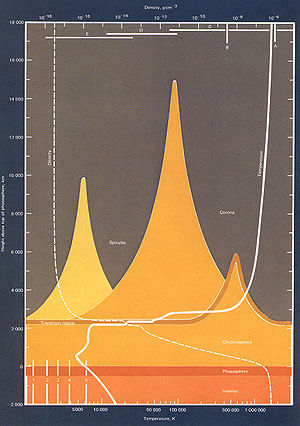 The Sun's photosphere has a temperature between 4500 and 6000 K
(with an effective temperature of 5800 K) and a density
of about 2 kg
/m3; other stars may have hotter or cooler photospheres. The Sun's photosphere is composed of convection cell
s called granules
—cells of gas each approximately 1000 kilometers in diameter with hot rising gas in the center and cooler gas falling in the narrow spaces between them. Each granule has a lifespan of only about eight minutes, resulting in a continually shifting "boiling" pattern. Grouping the typical granules are super granules up to 30,000 kilometers in diameter with lifespans of up to 24 hours. These details are too fine to see on other stars.
(typically observed by filtered light, for example H-alpha
) lies just between the photosphere and the much hotter but more tenuous corona
. Other "surface features" on the photosphere are solar flare
s and sunspot
s.
Astronomical object
Astronomical objects or celestial objects are naturally occurring physical entities, associations or structures that current science has demonstrated to exist in the observable universe. The term astronomical object is sometimes used interchangeably with astronomical body...
is the region from which externally received light originates. The term itself is derived from Ancient Greek
Ancient Greek
Ancient Greek is the stage of the Greek language in the periods spanning the times c. 9th–6th centuries BC, , c. 5th–4th centuries BC , and the c. 3rd century BC – 6th century AD of ancient Greece and the ancient world; being predated in the 2nd millennium BC by Mycenaean Greek...
roots, φῶς, φωτός/phos, photos meaning "light" and σφαῖρα/sphaira meaning "sphere", in reference to the fact that it is a spheric surface perceived to emit light. It extends into a star's surface until the gas becomes opaque, equivalent to an optical depth
Optical depth
Optical depth, or optical thickness, is a measure of transparency. Optical depth is defined by the negative logarithm of the fraction of radiation that is not scattered or absorbed on a path...
of approximately 2/3.
In other words, a photosphere is the deepest region of a luminous object, usually a star, that is transparent to photons of certain wavelengths.
Effective temperature
The surface of a star is defined to have a temperature given by the effective temperature in the Stefan–Boltzmann law. By using a simple model for stellar atmospheres, assuming local thermal equilibriumThermal equilibrium
Thermal equilibrium is a theoretical physical concept, used especially in theoretical texts, that means that all temperatures of interest are unchanging in time and uniform in space...
in a plane parallel geometry and the Eddington approximation, the effective temperature of the sun can be shown to occur at an optical depth of 2/3. This indicates the surface of a star is not at the top of the atmosphere where the optical depth is defined as zero: Stars are observed at a depth inside the atmosphere. Stars, excepting neutron star
Neutron star
A neutron star is a type of stellar remnant that can result from the gravitational collapse of a massive star during a Type II, Type Ib or Type Ic supernova event. Such stars are composed almost entirely of neutrons, which are subatomic particles without electrical charge and with a slightly larger...
s, have no solid surface. Therefore, the photosphere is typically used to describe the Sun's
Sun
The Sun is the star at the center of the Solar System. It is almost perfectly spherical and consists of hot plasma interwoven with magnetic fields...
or another star
Star
A star is a massive, luminous sphere of plasma held together by gravity. At the end of its lifetime, a star can also contain a proportion of degenerate matter. The nearest star to Earth is the Sun, which is the source of most of the energy on Earth...
's visual surface.
The Sun
Kelvin
The kelvin is a unit of measurement for temperature. It is one of the seven base units in the International System of Units and is assigned the unit symbol K. The Kelvin scale is an absolute, thermodynamic temperature scale using as its null point absolute zero, the temperature at which all...
(with an effective temperature of 5800 K) and a density
Density
The mass density or density of a material is defined as its mass per unit volume. The symbol most often used for density is ρ . In some cases , density is also defined as its weight per unit volume; although, this quantity is more properly called specific weight...
of about 2 kg
Kilogram
The kilogram or kilogramme , also known as the kilo, is the base unit of mass in the International System of Units and is defined as being equal to the mass of the International Prototype Kilogram , which is almost exactly equal to the mass of one liter of water...
/m3; other stars may have hotter or cooler photospheres. The Sun's photosphere is composed of convection cell
Convection cell
A convection cell is a phenomenon of fluid dynamics that occurs in situations where there are density differences within a body of liquid or gas. The convection usually requires a gravitational field but in microgravity experiments, thermal convection has been observed without gravitational effects...
s called granules
Granule (solar physics)
Granules on the photosphere of the Sun are caused by convection currents of plasma within the Sun's convective zone. The grainy appearance of the solar photosphere is produced by the tops of these convective cells and is called granulation.The rising part of the granules is located in the center...
—cells of gas each approximately 1000 kilometers in diameter with hot rising gas in the center and cooler gas falling in the narrow spaces between them. Each granule has a lifespan of only about eight minutes, resulting in a continually shifting "boiling" pattern. Grouping the typical granules are super granules up to 30,000 kilometers in diameter with lifespans of up to 24 hours. These details are too fine to see on other stars.
Other layers
The Sun's visible atmosphere has other layers above the photosphere: the 2,000 kilometer-deep chromosphereChromosphere
The chromosphere is a thin layer of the Sun's atmosphere just above the photosphere, roughly 2,000 kilometers deep....
(typically observed by filtered light, for example H-alpha
H-alpha
H-alpha is a specific red visible spectral line created by hydrogen with a wavelength of 656.28 nm, which occurs when a hydrogen electron falls from its third to second lowest energy level...
) lies just between the photosphere and the much hotter but more tenuous corona
Corona
A corona is a type of plasma "atmosphere" of the Sun or other celestial body, extending millions of kilometers into space, most easily seen during a total solar eclipse, but also observable in a coronagraph...
. Other "surface features" on the photosphere are solar flare
Solar flare
A solar flare is a sudden brightening observed over the Sun surface or the solar limb, which is interpreted as a large energy release of up to 6 × 1025 joules of energy . The flare ejects clouds of electrons, ions, and atoms through the corona into space. These clouds typically reach Earth a day...
s and sunspot
Sunspot
Sunspots are temporary phenomena on the photosphere of the Sun that appear visibly as dark spots compared to surrounding regions. They are caused by intense magnetic activity, which inhibits convection by an effect comparable to the eddy current brake, forming areas of reduced surface temperature....
s.
External links
- Animated explanation of the Photosphere (University of Glamorgan).
- Animated explanation of the temperature of the Photosphere (University of Glamorgan).