

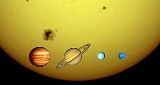
Gas giant

Encyclopedia

Jupiter
Jupiter is the fifth planet from the Sun and the largest planet within the Solar System. It is a gas giant with mass one-thousandth that of the Sun but is two and a half times the mass of all the other planets in our Solar System combined. Jupiter is classified as a gas giant along with Saturn,...
, or giant planet) is a large planet
Planet
A planet is a celestial body orbiting a star or stellar remnant that is massive enough to be rounded by its own gravity, is not massive enough to cause thermonuclear fusion, and has cleared its neighbouring region of planetesimals.The term planet is ancient, with ties to history, science,...
that is not primarily composed of rock
Rock (geology)
In geology, rock or stone is a naturally occurring solid aggregate of minerals and/or mineraloids.The Earth's outer solid layer, the lithosphere, is made of rock. In general rocks are of three types, namely, igneous, sedimentary, and metamorphic...
or other solid
Solid
Solid is one of the three classical states of matter . It is characterized by structural rigidity and resistance to changes of shape or volume. Unlike a liquid, a solid object does not flow to take on the shape of its container, nor does it expand to fill the entire volume available to it like a...
matter. There are four gas giants in the Solar System
Solar System
The Solar System consists of the Sun and the astronomical objects gravitationally bound in orbit around it, all of which formed from the collapse of a giant molecular cloud approximately 4.6 billion years ago. The vast majority of the system's mass is in the Sun...
: Jupiter
Jupiter
Jupiter is the fifth planet from the Sun and the largest planet within the Solar System. It is a gas giant with mass one-thousandth that of the Sun but is two and a half times the mass of all the other planets in our Solar System combined. Jupiter is classified as a gas giant along with Saturn,...
, Saturn
Saturn
Saturn is the sixth planet from the Sun and the second largest planet in the Solar System, after Jupiter. Saturn is named after the Roman god Saturn, equated to the Greek Cronus , the Babylonian Ninurta and the Hindu Shani. Saturn's astronomical symbol represents the Roman god's sickle.Saturn,...
, Uranus
Uranus
Uranus is the seventh planet from the Sun. It has the third-largest planetary radius and fourth-largest planetary mass in the Solar System. It is named after the ancient Greek deity of the sky Uranus , the father of Cronus and grandfather of Zeus...
, and Neptune
Neptune
Neptune is the eighth and farthest planet from the Sun in the Solar System. Named for the Roman god of the sea, it is the fourth-largest planet by diameter and the third largest by mass. Neptune is 17 times the mass of Earth and is slightly more massive than its near-twin Uranus, which is 15 times...
. Many extrasolar
Extrasolar planet
An extrasolar planet, or exoplanet, is a planet outside the Solar System. A total of such planets have been identified as of . It is now known that a substantial fraction of stars have planets, including perhaps half of all Sun-like stars...
gas giants have been identified orbiting other star
Star
A star is a massive, luminous sphere of plasma held together by gravity. At the end of its lifetime, a star can also contain a proportion of degenerate matter. The nearest star to Earth is the Sun, which is the source of most of the energy on Earth...
s.
Planets above 10 Earth mass
Earth mass
Earth mass is the unit of mass equal to that of the Earth. 1 M⊕ = 5.9722 × 1024 kg. Earth mass is often used to describe masses of rocky terrestrial planets....
es are termed giant planets. Lower-mass gassy planets are sometimes called "gas dwarfs".
Objects large enough to start deuterium fusion
Nuclear fusion
Nuclear fusion is the process by which two or more atomic nuclei join together, or "fuse", to form a single heavier nucleus. This is usually accompanied by the release or absorption of large quantities of energy...
(above 13 Jupiter mass
Jupiter mass
Jupiter mass , is the unit of mass equal to the total mass of the planet Jupiter . Jupiter mass is used to describe masses of the gas giants, such as the outer planets and extrasolar planets. It is also used in describing brown dwarfs....
es for solar composition) are called brown dwarf
Brown dwarf
Brown dwarfs are sub-stellar objects which are too low in mass to sustain hydrogen-1 fusion reactions in their cores, which is characteristic of stars on the main sequence. Brown dwarfs have fully convective surfaces and interiors, with no chemical differentiation by depth...
s and these occupy the mass range between that of large gas giant planets and the lowest mass star
Star
A star is a massive, luminous sphere of plasma held together by gravity. At the end of its lifetime, a star can also contain a proportion of degenerate matter. The nearest star to Earth is the Sun, which is the source of most of the energy on Earth...
s. The 13 Jupiter mass (MJ) cutoff is a rule of thumb rather than something of precise physical significance. Larger objects will burn most of their deuterium and smaller ones will burn only a little, and the value is somewhere in between. The amount of deuterium burnt also depends not only on mass but on the composition of the planet, especially on the amount of helium
Helium
Helium is the chemical element with atomic number 2 and an atomic weight of 4.002602, which is represented by the symbol He. It is a colorless, odorless, tasteless, non-toxic, inert, monatomic gas that heads the noble gas group in the periodic table...
and deuterium
Deuterium
Deuterium, also called heavy hydrogen, is one of two stable isotopes of hydrogen. It has a natural abundance in Earth's oceans of about one atom in of hydrogen . Deuterium accounts for approximately 0.0156% of all naturally occurring hydrogen in Earth's oceans, while the most common isotope ...
present. The Extrasolar Planets Encyclopaedia
Extrasolar Planets Encyclopaedia
The Extrasolar Planets Encyclopedia is an astronomy website, founded in Paris, France at the Meudon Observatory by Jean Schneider in February 1995, which maintains a database of all the currently known and candidate extrasolar planets, with individual "note" pages for each planet and a full list...
includes objects up to 25 Jupiter masses, and the Exoplanet Data Explorer
Exoplanet Data Explorer
The Exoplanet Data Explorer / Exoplanet Orbit Database lists extrasolar planets up to 24 Jupiter masses."We have retained the generous upper mass limit of 24 Jupiter masses in our definition of a “planet”, for the same reasons as in the Catalog: at the moment, any mass limit is arbitrary and will...
up to 24 Jupiter masses.
Description
Planet
A planet is a celestial body orbiting a star or stellar remnant that is massive enough to be rounded by its own gravity, is not massive enough to cause thermonuclear fusion, and has cleared its neighbouring region of planetesimals.The term planet is ancient, with ties to history, science,...
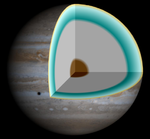
with a thick atmosphere and a dense molten core. The "traditional" gas giants, Jupiter
Jupiter
Jupiter is the fifth planet from the Sun and the largest planet within the Solar System. It is a gas giant with mass one-thousandth that of the Sun but is two and a half times the mass of all the other planets in our Solar System combined. Jupiter is classified as a gas giant along with Saturn,...
and Saturn
Saturn
Saturn is the sixth planet from the Sun and the second largest planet in the Solar System, after Jupiter. Saturn is named after the Roman god Saturn, equated to the Greek Cronus , the Babylonian Ninurta and the Hindu Shani. Saturn's astronomical symbol represents the Roman god's sickle.Saturn,...
, are composed primarily of hydrogen
Hydrogen
Hydrogen is the chemical element with atomic number 1. It is represented by the symbol H. With an average atomic weight of , hydrogen is the lightest and most abundant chemical element, constituting roughly 75% of the Universe's chemical elemental mass. Stars in the main sequence are mainly...
and helium
Helium
Helium is the chemical element with atomic number 2 and an atomic weight of 4.002602, which is represented by the symbol He. It is a colorless, odorless, tasteless, non-toxic, inert, monatomic gas that heads the noble gas group in the periodic table...
. Uranus
Uranus
Uranus is the seventh planet from the Sun. It has the third-largest planetary radius and fourth-largest planetary mass in the Solar System. It is named after the ancient Greek deity of the sky Uranus , the father of Cronus and grandfather of Zeus...
and Neptune
Neptune
Neptune is the eighth and farthest planet from the Sun in the Solar System. Named for the Roman god of the sea, it is the fourth-largest planet by diameter and the third largest by mass. Neptune is 17 times the mass of Earth and is slightly more massive than its near-twin Uranus, which is 15 times...
are sometimes called ice giants, as they are mostly composed of water
Water
Water is a chemical substance with the chemical formula H2O. A water molecule contains one oxygen and two hydrogen atoms connected by covalent bonds. Water is a liquid at ambient conditions, but it often co-exists on Earth with its solid state, ice, and gaseous state . Water also exists in a...
, ammonia
Ammonia
Ammonia is a compound of nitrogen and hydrogen with the formula . It is a colourless gas with a characteristic pungent odour. Ammonia contributes significantly to the nutritional needs of terrestrial organisms by serving as a precursor to food and fertilizers. Ammonia, either directly or...
, and methane
Methane
Methane is a chemical compound with the chemical formula . It is the simplest alkane, the principal component of natural gas, and probably the most abundant organic compound on earth. The relative abundance of methane makes it an attractive fuel...
molten ices. Among extrasolar planets, Hot Jupiters are gas giants that orbit very close to their stars and thus have a very high surface temperature. Hot Jupiters are currently the most common form of extrasolar planet known, perhaps due to the relative ease of detecting them.
Gas giants are commonly said to lack solid surfaces, but it is closer to the truth to say that they lack surfaces altogether since the gases that make them up simply become thinner and thinner with increasing distance from the planets' centers, eventually becoming indistinguishable from the interplanetary medium. Therefore landing on a gas giant may or may not be possible, depending on the size and composition of its core.
Belt-zone circulation
The bands seen in the Jovian atmosphereAtmosphere
An atmosphere is a layer of gases that may surround a material body of sufficient mass, and that is held in place by the gravity of the body. An atmosphere may be retained for a longer duration, if the gravity is high and the atmosphere's temperature is low...
are due to counter-circulating streams of material called zones and belts, encircling the planet parallel to its equator. The zones are the lighter bands, and are at higher altitudes in the atmosphere. They have an internal updraft, and are high-pressure regions. The belts are the darker bands. They are lower in the atmosphere, and have an internal downdraft. They are low-pressure regions. These structures are somewhat analogous to high- and low-pressure cells in Earth's atmosphere, but they have a very different structure—latitudinal bands that circle the entire planet, as opposed to small confined cells of pressure. This appears to be a result of the rapid rotation and underlying symmetry of the planet. There are no oceans or landmasses to cause local heating, and the rotation speed is much faster than it is on Earth.
There are smaller structures as well: spots of different sizes and colors. On Jupiter, the most noticeable of these features is the Great Red Spot, which has been present for at least 300 years. These structures are huge storms. Some such spots are thunderheads as well.
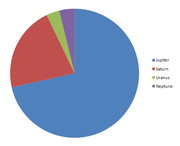
Jupiter and Saturn
JupiterJupiter
Jupiter is the fifth planet from the Sun and the largest planet within the Solar System. It is a gas giant with mass one-thousandth that of the Sun but is two and a half times the mass of all the other planets in our Solar System combined. Jupiter is classified as a gas giant along with Saturn,...
and Saturn
Saturn
Saturn is the sixth planet from the Sun and the second largest planet in the Solar System, after Jupiter. Saturn is named after the Roman god Saturn, equated to the Greek Cronus , the Babylonian Ninurta and the Hindu Shani. Saturn's astronomical symbol represents the Roman god's sickle.Saturn,...
consist mostly of hydrogen and helium, with heavier elements making up between 3 and 13 percent of the mass. Their structures are thought to consist of an outer layer of molecular hydrogen, surrounding a layer of liquid metallic hydrogen
Metallic hydrogen
Metallic hydrogen is a state of hydrogen which results when it is sufficiently compressed and undergoes a phase transition; it is an example of degenerate matter. Solid metallic hydrogen is predicted to consist of a crystal lattice of hydrogen nuclei , with a spacing which is significantly smaller...
, with a probable molten core with a rocky composition. The outermost portion of the hydrogen atmosphere is characterized by many layers of visible clouds that are mostly composed of water and ammonia. The metallic hydrogen layer makes up the bulk of each planet, and is described as "metallic" because the great pressure turns hydrogen into an electrical conductor. The core is thought to consist of heavier elements at such high temperatures (20,000 K) and pressures that their properties are poorly understood.
Uranus and Neptune
UranusUranus
Uranus is the seventh planet from the Sun. It has the third-largest planetary radius and fourth-largest planetary mass in the Solar System. It is named after the ancient Greek deity of the sky Uranus , the father of Cronus and grandfather of Zeus...
and Neptune
Neptune
Neptune is the eighth and farthest planet from the Sun in the Solar System. Named for the Roman god of the sea, it is the fourth-largest planet by diameter and the third largest by mass. Neptune is 17 times the mass of Earth and is slightly more massive than its near-twin Uranus, which is 15 times...
have distinctly different interior compositions from Jupiter and Saturn. Models of their interior begin with a hydrogen-rich atmosphere that extends from the cloud-tops down to about 85% of Neptune's radius and 80% of Uranus'. Below this point is predominantly "icy", composed of water, methane and ammonia. There is also some rock and gas but various proportions of ice/rock/gas could mimic pure ice so the exact proportions are unknown.
Very hazy atmosphere layers with a small amount of methane gives them aquamarine colors such as baby blue and ultramarine colors respectively. Both have magnetic fields that are sharply inclined to their axes of rotation.
Unlike the other gas giants, Uranus has an extreme tilt that causes its seasons to be severely pronounced.
Extrasolar gas giants
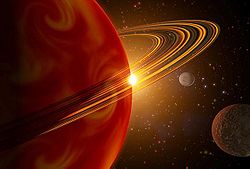
Because of the limited techniques currently available
Methods of detecting extrasolar planets
Any planet is an extremely faint light source compared to its parent star. In addition to the intrinsic difficulty of detecting such a faint light source, the light from the parent star causes a glare that washes it out...
to detect extrasolar planet
Extrasolar planet
An extrasolar planet, or exoplanet, is a planet outside the Solar System. A total of such planets have been identified as of . It is now known that a substantial fraction of stars have planets, including perhaps half of all Sun-like stars...
s, many of those found to date have been of a size associated, in our solar system, with gas giants. Because these large planets are inferred to share more in common with Jupiter than with the other gas giant planets, some have claimed that "jovian planet" is a more accurate term for them. Many of the extrasolar planets are much closer to their parent stars and hence much hotter than gas giants in the solar system, making it possible that some of those planets are a type not observed in our solar system. Considering the relative abundances of the elements in the universe
Abundance of the chemical elements
The abundance of a chemical element measures how relatively common the element is, or how much of the element is present in a given environment by comparison to all other elements...
(approximately 98% hydrogen and helium) it would be surprising to find a predominantly rocky planet more massive than Jupiter. On the other hand, previous models of planetary system formation suggested that gas giants would be inhibited from forming as close to their stars as have many of the new planets that have been observed.
Cold gas giants
A cold hydrogen-rich gas giant more massive than Jupiter but less than about , will be just slightly larger in volume than Jupiter. For masses above , degenerate pressure will cause the planet to shrink. Kelvin–Helmholtz heating can cause a gas giant, such as Jupiter, to radiate more energy than it receives from its host star.Smaller gas planets
]Although the words "gas" and "giant" are often combined, hydrogen planets need not be as large as the familiar gas giants from our solar system. However, smaller gas planets and planets closer to their star will lose atmospheric mass more quickly via hydrodynamic escape
Hydrodynamic escape
Hydrodynamic escape refers to a thermal atmospheric escape mechanism that can lead to the escape of heavier atoms of a planetary atmosphere through numerous collisions with lighter atoms....
than larger planets or planets farther out.
The smallest known extrasolar planet that is likely a "gas planet" is Kepler-11f
Kepler-11f
Kepler-11f is an exoplanet discovered in the orbit of the sunlike star Kepler-11 by NASA's Kepler spacecraft, which searches for planets that transit their host stars. Kepler-11f is the sixth planet from its star, orbiting one fourth of the distance of the Earth from the Sun every 47 days...
, at about 2.3 Earth masses.
Terminology
The term gas giant was coined in 1952 by the science fiction writer James BlishJames Blish
James Benjamin Blish was an American author of fantasy and science fiction. Blish also wrote literary criticism of science fiction using the pen-name William Atheling, Jr.-Biography:...
. Arguably it is something of a misnomer, since throughout most of the volume of these planets all the components (other than solid materials in the core) are above the critical point and therefore there is no distinction between liquids and gases. Fluid planet would be a more accurate term. Jupiter is an exceptional case, having metallic hydrogen
Metallic hydrogen
Metallic hydrogen is a state of hydrogen which results when it is sufficiently compressed and undergoes a phase transition; it is an example of degenerate matter. Solid metallic hydrogen is predicted to consist of a crystal lattice of hydrogen nuclei , with a spacing which is significantly smaller...
near the center, but much of its volume is hydrogen, helium and traces of other gases above their critical points. The observable atmospheres of any of these planets (at less than unit optical depth
Optical depth
Optical depth, or optical thickness, is a measure of transparency. Optical depth is defined by the negative logarithm of the fraction of radiation that is not scattered or absorbed on a path...
) are quite thin compared to the planetary radii, only extending perhaps one percent of the way to the center. Thus the observable portions are gaseous (in contrast to Mars
Mars
Mars is the fourth planet from the Sun in the Solar System. The planet is named after the Roman god of war, Mars. It is often described as the "Red Planet", as the iron oxide prevalent on its surface gives it a reddish appearance...
and Earth, which have gaseous atmospheres through which the crust may be seen).
The rather misleading term has caught on because planetary scientists typically use "rock", "gas", and "ice" as shorthands for classes of elements and compounds commonly found as planetary constituents, irrespective of what phase the matter may appear in. In the outer solar system, hydrogen and helium are referred to as "gases"; water, methane, and ammonia as "ices"; and silicates and metals as "rock." When deep planetary interiors are considered, it may not be far off to say that, by "ice" astronomers mean oxygen
Oxygen
Oxygen is the element with atomic number 8 and represented by the symbol O. Its name derives from the Greek roots ὀξύς and -γενής , because at the time of naming, it was mistakenly thought that all acids required oxygen in their composition...
and carbon
Carbon
Carbon is the chemical element with symbol C and atomic number 6. As a member of group 14 on the periodic table, it is nonmetallic and tetravalent—making four electrons available to form covalent chemical bonds...
, by "rock" they mean silicon
Silicon
Silicon is a chemical element with the symbol Si and atomic number 14. A tetravalent metalloid, it is less reactive than its chemical analog carbon, the nonmetal directly above it in the periodic table, but more reactive than germanium, the metalloid directly below it in the table...
, and by "gas" they mean hydrogen and helium.
The alternative term jovian planet refers to the Roman god Jupiter
Jupiter (mythology)
In ancient Roman religion and myth, Jupiter or Jove is the king of the gods, and the god of the sky and thunder. He is the equivalent of Zeus in the Greek pantheon....
—the genitive form of which is Jovis, hence Jovian—and was intended to indicate that all of these planets were similar to Jupiter. However, the many ways in which Uranus and Neptune differ from Jupiter and Saturn have led some to use the term only for the inner two.
With this terminology in mind, some astronomers are starting to refer to Uranus and Neptune as "ice giants" to indicate the apparent predominance of the "ices" (in liquid form) in their interior composition.
See also
- Tyche (hypothetical planet)Tyche (hypothetical planet)Tyche is the nickname given to a hypothetical gas giant planet located in the Solar System's Oort cloud, first proposed in 1999 by astronomer John Matese of the University of Louisiana at Lafayette. Matese and his colleague Daniel Whitmire argue that evidence of Tyche's existence can be seen in a...
- Chthonian planetChthonian planetA chthonian planet is a hypothetical class of celestial objects resulting from the stripping away of a gas giant's hydrogen and helium atmosphere and outer layers, which is called hydrodynamic escape. Such atmospheric stripping is a likely result of proximity to a star...
- Hot JupiterHot JupiterHot Jupiters are a class of extrasolar planet whose mass is close to or exceeds that of Jupiter...
- Planetary systemPlanetary systemA planetary system consists of the various non-stellar objects orbiting a star such as planets, dwarf planets , asteroids, meteoroids, comets, and cosmic dust...
- Solar SystemSolar SystemThe Solar System consists of the Sun and the astronomical objects gravitationally bound in orbit around it, all of which formed from the collapse of a giant molecular cloud approximately 4.6 billion years ago. The vast majority of the system's mass is in the Sun...
- Sudarsky extrasolar planet classification
- Terrestrial planetTerrestrial planetA terrestrial planet, telluric planet or rocky planet is a planet that is composed primarily of silicate rocks or metals. Within the Solar System, the terrestrial planets are the inner planets closest to the Sun...
External links
- SPACE.com: Q&A: The IAU's Proposed Planet Definition 16 August 2006 2:00 am ET
- BBC News: Q&A New planets proposal Wednesday, 16 August 2006, 13:36 GMT 14:36 UK
- Gas Giants in Science Fiction: List