

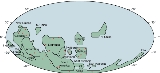
Snowball Earth

Encyclopedia
The Snowball Earth hypothesis
posits that the Earth
's surface became entirely or nearly entirely frozen at least once, some time earlier than 650 Ma (million years ago). Proponents of the hypothesis argue that it best explains sedimentary
deposits generally regarded as of glacial origin at tropical
paleolatitudes, and other otherwise enigmatic features in the geological
record. Opponents of the hypothesis contest the implications of the geological evidence for global glaciation, the geophysical feasibility of an ice
- or slush
-covered ocean, and the difficulty of escaping an all-frozen condition. There are a number of unanswered questions, including whether the Earth was a full snowball, or a "slushball" with a thin equatorial band of open (or seasonally open) water.
The geological time frames under consideration come before the sudden multiplication of life forms on Earth known as the Cambrian explosion
, and the most recent snowball episode may have triggered the evolution of multi-cellular life on Earth. Another, much earlier and longer, snowball episode, the Huronian glaciation, which occurred 2400 to 2100 Ma may have been triggered by the oxygen catastrophe
.
(1882–1958), an Australian geologist and Antarctic explorer, spent much of his career studying the Neoproterozoic
stratigraphy of South Australia where he identified thick and extensive glacial sediments and late in his career speculated on the possibility of global glaciation.
Mawson's ideas of global glaciation, however, were based on the mistaken assumption that the geographic position of Australia, and that of other continents where low-latitude glacial deposits are found, has remained constant through time. With the advancement of the continental drift
hypothesis, and eventually plate tectonic theory, came an easier explanation for the glaciogenic sediments—they were deposited at a point in time when the continents were at higher latitudes.
In 1964, the idea of global-scale glaciation reemerged when W. Brian Harland
published a paper in which he presented palaeomagnetic data showing that glacial till
ites in Svalbard
and Greenland
were deposited at tropical latitudes. From this palaeomagnetic data, and the sedimentological evidence that the glacial sediments interrupt successions of rocks commonly associated with tropical to temperate latitudes, he argued for an ice age that was so extreme that it resulted in the deposition of marine glacial rocks in the tropics.
In the 1960s, Mikhail Budyko
, a Russian climatologist, developed a simple energy-balance climate model to investigate the effect of ice cover on global climate
. Using this model, Budyko found that if ice sheets advanced far enough out of the polar regions, a feedback loop ensued where the increased reflectiveness (albedo
) of the ice led to further cooling and the formation of more ice, until the entire Earth was covered in ice and stabilized in a new ice-covered equilibrium. While Budyko's model showed that this ice-albedo stability could happen, he concluded that it had never happened, because his model offered no way to escape from such a scenario.
The term "Snowball Earth" was coined by Joseph Kirschvink, a professor of geobiology at the California Institute of Technology
, in a short paper published in 1992 within a lengthy volume concerning the biology of the Proterozoic
eon. The major contributions from this work were: (1) the recognition that the presence of banded iron formation
s is consistent with such a glacial episode and (2) the introduction of a mechanism with which to escape from an ice-covered Earth—the accumulation of from volcanic outgassing leading to an ultra-greenhouse effect.
Interest in the Snowball Earth increased dramatically after Paul F. Hoffman
, professor of geology at Harvard University
, and coauthors applied Kirschvink's ideas to a succession of Neoproterozoic sediments in Namibia
, elaborated upon the hypothesis by incorporating such observations as the occurrence of cap carbonate
s, and published their results in the journal Science in 1998.
Currently, aspects of the hypothesis remain controversial and it is being debated under the auspices of the International Geoscience Programme (IGCP) Project 512: Neoproterozoic Ice Ages.
In March 2010, the journal Science
published an article "Calibrating the Cryogenian
" which concluded that "Ice was therefore grounded below sea level at very low paleolatitudes, which implies that the Sturtian glaciation was global in extent". A popular account of this conclusion was published in Science Daily
.
would result in the ice rapidly advancing to the equator (further modelling shows that ice can in fact get as close as 25° or closer to the equator without initiating total glaciation). Therefore, the presence of glacial deposits seemingly within the tropics appeared to point to global ice cover.
Critical to an assessment of the validity of the theory, therefore, is an understanding of the reliability and significance of the evidence that led to the belief that ice ever reached the tropics. This evidence must prove two things:
During a period of global glaciation, it must also be demonstrated that glaciers were active at different global locations at the same time, and that no other deposits of the same age are in existence.
This last point is very difficult to prove. Before the Ediacaran
, the biostratigraphic markers usually used to correlate rocks are absent; therefore there is no way to prove that rocks in different places across the globe were deposited at the same time. The best that can be done is to estimate the age of the rocks using radiometric methods, which are rarely accurate to better than a million years or so.
The first two points are often the source of contention on a case-to-case basis. Many glacial features can also be created by non-glacial means, and estimating the latitude of landmasses even as little as can be riddled with difficulties.
Since tectonic plates move in time, ascertaining their position at a given point in history is not easy. In addition to considerations of how the recognisable landmasses could have fit together, the latitude at which a rock was deposited can be constrained by palaeomagnetism.
When sedimentary rock
s form, magnetic minerals within them tend to align themselves with the Earth's magnetic field. Through the precise measurement of this palaeomagnetism, it is possible to estimate the latitude
(but not the longitude
) where the rock matrix was deposited. Paleomagnetic measurements have indicated that some sediments of glacial origin in the Neoproterozoic
rock record were deposited within 10 degrees of the equator, although the accuracy of this reconstruction is in question.
This palaeomagnetic location of apparently glacial sediments (such as dropstone
s) has been taken to suggest that glaciers extended to sea-level in the tropical latitudes.
It is not clear whether this can be taken to imply a global glaciation, or the existence of localised, possibly land-locked, glacial regimes. Others have even suggested that most data do not constrain any glacial deposits to within 25° of the equator.
Skeptics suggest that the palaeomagnetic data could be corrupted if the Earth's magnetic field was substantially different from today's. Depending on the rate of cooling of the Earth's core, it is possible that during the Proterozoic, its magnetic field
did not approximate a dipolar
distribution, with a North and South pole roughly aligning with the planet's axis as they do today. Instead, a hotter core may have circulated more vigorously and given rise to 4, 8 or more poles. Paleomagnetic data would then have to be re-interpreted as particles could align pointing to a 'West Pole' rather than the North Pole. Alternatively, the Earth's dipolar field could have oriented such that the poles were close to the equator. This hypothesis has been posited to explain the extraordinarily rapid motion of the magnetic poles implied by the Ediacaran palaeomagnetic record; the alleged motion of the north pole would occur around the same time as the Gaskiers glaciation.
Another weakness of reliance on palaeomagnetic data is the difficulty in determining whether the magnetic signal recorded is original, or whether it has been reset by later activity. For example, a mountain-building releases hot water as a by-product of metamorphic reactions; this water can circulate to rocks thousands of kilometers away and reset their magnetic signature. This makes the authenticity of rocks older than a few million years difficult to determine without painstaking mineralogical observations.
There is currently only one deposit, the Elatina deposit of Australia, that was indubitably deposited at low latitudes; its depositional date is well constrained, and the signal is demonstrably original.
sediments had been interpreted as having a glacial origin, including some apparently at tropical latitudes at the time of their deposition. However, it is worth remembering that many sedimentary features traditionally associated with glaciers can also be formed by other means. Thus the glacial origin of many of the key occurrences for Snowball Earth has been contested.
As of 2007, there was only one "very reliable" – still challenged – datum point identifying tropical tillites, which makes statements of equatorial ice cover somewhat presumptuous. However evidence of sea-level glaciation in the tropics during the Sturtian is accumulating.
Evidence of possible glacial origin of sediment includes:
s such as seen in Antarctica today could be responsible for these sequences.
Further, sedimentary features that could only form in open water, for example wave-formed ripples
, far-traveled ice-rafted debris and indicators of photosynthetic activity, can be found throughout sediments dating from the Snowball Earth periods. While these may represent 'oases' of meltwater
on a completely frozen Earth, computer modelling suggests that large areas of the ocean must have remained ice free arguing that a "hard" snowball is not plausible in terms of energy balance and general circulation models.
s of carbon in sea water: carbon-12
(12C) and the rare carbon-13
(13C), which makes up about 1.109 percent of carbon atoms.
Biochemical processes, of which photosynthesis
is one, tend to preferentially incorporate the lighter 12C isotope. Thus ocean-dwelling photosynthesizers, both protist
s and algae
, tend to be very slightly depleted in 13C, relative to the abundance found in the primary volcanic sources of the Earth's carbon. Therefore, an ocean with photosynthetic life will have a higher 12C/13C ratio within organic remains, and a lower ratio in corresponding ocean water. The organic component of the lithified sediments will forever remain very slightly, but measurably, depleted in 13C.
During the proposed episode of Snowball Earth, there are rapid and extreme negative excursions in the ratio of 13C to 12C. This is consistent with a deep freeze that killed off most or nearly all photosynthetic life – although other mechanisms, such as clathrate release
, can also cause such perturbations. Close analysis of the timing of 13C 'spikes' in deposits across the globe allows the recognition of four, possibly five, glacial events in the late Neoproterozoic.
.jpg) Banded iron formations (BIF) are sedimentary rocks of layered iron oxide
Banded iron formations (BIF) are sedimentary rocks of layered iron oxide
and iron-poor chert
. In the presence of oxygen, iron
naturally rusts and becomes insoluble in water. The banded iron formations are commonly very old and their deposition is often related to the oxidation of the Earth's atmosphere during the Paleoproterozoic
era, when dissolved iron in the ocean came in contact with photosynthetically produced oxygen and precipitated out as iron oxide.
The bands were produced at the tipping point
between an anoxic
and an oxygenated ocean. Since today's atmosphere is oxygen
rich (nearly 21 percent by volume) and in contact with the oceans, it is not possible to accumulate enough iron oxide to deposit a banded formation. The only extensive iron formations that were deposited after the Paleoproterozoic (after 1.8 billion years ago) are associated with Cryogenian
glacial deposits.
For such iron-rich rocks to be deposited there would have to be anoxia in the ocean, so that much dissolved iron (as ferrous oxide) could accumulate before it met an oxidant that would precipitate it as ferric
oxide. For the ocean to become anoxic it must have limited gas exchange with the oxygenated atmosphere. Proponents of the hypothesis argue that the reappearance of BIF in the sedimentary record is a result of limited oxygen levels in an ocean sealed by sea ice, while opponents suggest that the rarity of the BIF deposits may indicate that they formed in inland seas.
Being isolated from the oceans, such lakes may have been stagnant and anoxic at depth, much like today's Black Sea
; a sufficient input of iron could provide the necessary conditions for BIF formation. A further difficulty in suggesting that BIFs marked the end of the glaciation is that they are found interbedded with glacial sediments. BIFs are also strikingly absent during the Marinoan glaciation.
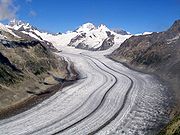
 Around the top of Neoproterozoic
glacial deposits there is commonly a sharp transition into a chemically precipitated sedimentary limestone
or dolostone
metres to tens of metres thick. These cap carbonates sometimes occur in sedimentary successions that have no other carbonate rocks, suggesting that their deposition is result of a profound aberration in ocean chemistry.
These cap carbonates have unusual chemical composition, as well as strange sedimentary structures that are often interpreted as large ripples.
The formation of such sedimentary rocks could be caused by a large influx of positively charged ions, as would be produced by rapid weathering during the extreme greenhouse following a Snowball Earth event. The isotopic signature of the cap carbonates is near −5 ‰, consistent with the value of the mantle — such a low value is usually/could be taken to signify an absence of life, since photosynthesis usually acts to raise the value; alternatively the release of methane deposits could have lowered it from a higher value, and counterbalance the effects of photosynthesis.
The precise mechanism involved in the formation of cap carbonates is not clear, but the most cited explanation suggests that at the melting of a Snowball Earth, water would dissolve the abundant from the atmosphere
to form carbonic acid
, which would fall as acid rain
. This would weather exposed silicate
and carbonate
rock
(including readily attacked glacial debris), releasing large amounts of calcium
, which when washed into the ocean would form distinctively textured layers of carbonate sedimentary rock. Such an abiotic "cap carbonate
" sediment can be found on top of the glacial till that gave rise to the Snowball Earth hypothesis.
However, there are some problems with the designation of a glacial origin to cap carbonates. Firstly, the high carbon dioxide concentration in the atmosphere would cause the oceans to become acidic, and dissolve any carbonates contained within — starkly at odds with the deposition of cap carbonates. Further, the thickness of some cap carbonates is far above what could reasonably be produced in the relatively quick deglaciations. The cause is further weakened by the lack of cap carbonates above many sequences of clear glacial origin at a similar time and the occurrence of similar carbonates within the sequences of proposed glacial origin. An alternative mechanism, which may have produced the Doushantuo cap carbonate at least, is the rapid, widespread release of methane. This accounts for incredibly low — as low as −48 ‰ — values — as well as unusual sedimentary features which appear to have been formed by the flow of gas through the sediments.
suggest that the pH
of the oceans dropped dramatically before and after the Marinoan glaciation.
This may indicate a build up of carbon dioxide
in the atmosphere, some of which would dissolve into the oceans to form carbonic acid
. Although the boron variations may be evidence of extreme climate change, they need not imply a global glaciation.
, which primarily resides in the Earth's core. The only significant source of the element at the surface is cosmic particles that reach Earth. During a Snowball Earth, iridium would accumulate on the ice sheets, and when the ice melted the resulting layer of sediment would be rich in iridium. An iridium anomaly
has been discovered at the base of the cap carbonate formations, and has been used to suggest that the glacial episode lasted for at least 3 million years, but this does not necessarily imply a global extent to the glaciation; indeed, a similar anomaly could be explained by the impact of a large meteorite
.
cycles than to a completely frozen Earth.
What's more, glacial sediments of the Portaskaig
formation in Scotland clearly show interbedded cycles of glacial and shallow marine sediments. The significance of these deposits is highly reliant upon their dating. Glacial sediments are difficult to date, and the closest dated bed to the Portaskaig group is 8 km stratigraphically above the beds of interest. Its dating to 600 Ma means the beds can be tentatively correlated to the Sturtian glaciation, but they may represent the advance or retreat of a Snowball Earth.
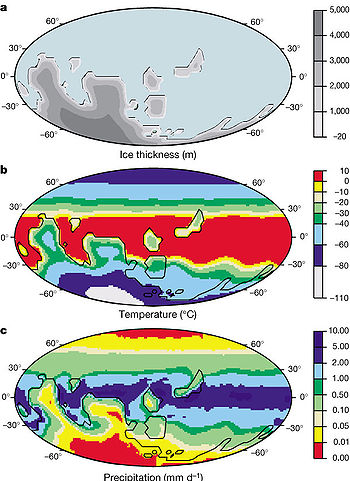 The initiation of a Snowball Earth event would involve some initial cooling mechanism, which would result in an increase in the Earth's coverage of snow and ice. The increase in Earth's coverage of snow and ice would in turn increase the Earth's albedo
, which would result in positive feedback
for cooling. If enough snow and ice accumulates, runaway cooling would result. This positive feedback is facilitated by an equatorial continental distribution, which would allow ice to accumulate in the regions closer to the equator, where solar radiation is most direct.
Many possible triggering mechanisms could account for the beginning of a Snowball Earth, such as the eruption of a Supervolcano
, a reduction in the atmospheric concentration of Greenhouse gas
es such as methane
and/or carbon dioxide
, changes in Solar energy output
, or perturbations of the Earth's orbit
. Regardless of the trigger, initial cooling results in an increase in the area of the Earth's surface covered by ice and snow, and the additional ice and snow reflects more solar energy back to space, further cooling the Earth and further increasing the area of the Earth's surface covered by ice and snow. This positive feedback loop could eventually produce a frozen equator
as cold as modern-day Antarctica.
Global warming
associated with large accumulations of carbon dioxide in the atmosphere over millions of years, emitted primarily by volcanic activity, is the proposed trigger for melting a Snowball Earth. Due to positive feedback for melting, the eventual melting of the snow and ice covering most of the Earth's surface would require as few as 1,000 years.
, allowing for a continued hydrologic cycle.
This theory appeals to scientists who observe certain features of the sedimentary record that can only be formed under open water, or rapidly moving ice (which would require somewhere ice-free to move to). Recent research observed geochemical cyclicity in clastic rocks
, showing that the "Snowball" periods were punctuated by warm spells, similar to ice age
cycles in recent Earth history. Attempts to construct computer models of a Snowball Earth have also struggled to accommodate global ice cover without fundamental changes in the laws and constants which govern the planet.
A less extreme snowball earth hypothesis involves continually evolving continental configurations and changes in ocean circulation. Synthesised evidence has produced models indicating a “slushball Earth”, where the stratigraphic record does not permit postulating complete global glaciations. Kirschivink's original hypothesis had recognised that warm tropical puddles would be expected to exist in a snowball earth.
The Snowball Earth hypothesis does not explain the alternation of glacial and interglacial events, nor the oscillation of glacial sheet margins; hence the slushball Earth model appears to be a better fit than the Snowball Earth model.
Firstly, tropical continents are more reflective than open ocean, and so absorb less of the sun's heat: most absorption of solar energy on Earth today occurs in tropical oceans.
Further, tropical continents are subject to more rainfall, which leads to increased river discharge — and erosion.
When exposed to air, silicate
rocks undergo weathering reactions which remove carbon dioxide from the atmosphere. These reactions proceed in the general form: Rock-forming mineral + CO2 + H2O → cations + bicarbonate + SiO2. An example of such a reaction is the weathering of wollastonite
:
The released calcium
cations react with the dissolved bicarbonate
in the ocean to form calcium carbonate
as a chemically precipitated sedimentary rock
. This transfers carbon dioxide
, a greenhouse gas, from the air into the geosphere
, and, in steady-state on geologic time scales, offsets the carbon dioxide emitted from volcano
es into the atmosphere.
A paucity of suitable sediments for analysis makes precise continental distribution during the Neoproterozoic difficult to establish. Some reconstructions point towards polar continents — which have been a feature of all other major glaciations, providing a point upon which ice can nucleate. Changes in ocean circulation patterns may then have provided the trigger of Snowball Earth.
Additional factors that may have contributed to the onset of the Neoproterozoic Snowball include the introduction of atmospheric free oxygen, which may have reached sufficient quantities to react with methane
in the atmosphere, oxidizing it to carbon dioxide, a much weaker greenhouse gas, and a younger — thus fainter — sun, which would have emitted 6 percent less radiation in the Neoproterozoic.
Normally, as the Earth gets colder due to natural climatic fluctuations and changes in incoming solar radiation, the cooling slows these weathering reactions. As a result, less carbon dioxide is removed from the atmosphere and the Earth warms as this greenhouse gas accumulates — this 'negative feedback
' process limits the magnitude of cooling. During the Cryogenian
period, however, the Earth's continents were all at tropical
latitudes, which made this moderating process less effective, as high weathering rates continued on land even as the Earth cooled. This let ice advance beyond the polar regions. Once ice advanced to within 30° of the equator, a positive feedback could ensue such that the increased reflectiveness (albedo
) of the ice led to further cooling and the formation of more ice, until the whole Earth is ice covered.
Polar continents, due to low rates of evaporation
, are too dry to allow substantial carbon deposition — restricting the amount of atmospheric carbon dioxide that can be removed from the Carbon cycle
. A gradual rise of the proportion of the isotope
carbon-13 relative to carbon-12 in sediments pre-dating "global" glaciation indicates that draw-down before Snowball Earths was a slow and continuous process.
The start of Snowball Earths are always marked by a sharp downturn in the δ13C value of sediments, a hallmark that may be attributed to a crash in biological productivity as a result of the cold temperatures and ice-covered oceans.
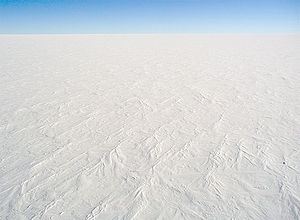 Global temperature fell so low that the equator was as cold as modern-day Antarctica. This low temperature was maintained by the reflective ice, its high albedo
resulting in most incoming solar energy being reflected into space. A lack of heat-retaining clouds, caused by water vapor freezing out of the atmosphere, amplified this effect.
levels necessary to unfreeze the Earth have been estimated as being 350 times what they are today, about 13% of the atmosphere. Since the Earth was almost completely covered with ice, carbon dioxide could not be withdrawn from the atmosphere by release of alkaline metal ions weathering out of siliceous rock
s. Over 4 to 30 million years, enough and methane
, mainly emitted by volcano
es, would accumulate to finally cause enough greenhouse effect to make surface ice melt in the tropics until a band of permanently ice-free land and water developed; this would be darker than the ice, and thus absorb more energy from the sun — initiating a "positive feedback
".
On the continents, the melting of glaciers would release massive amounts of glacial deposit, which would erode and weather. The resulting sediments supplied to the ocean would be high in nutrients such as phosphorus
, which combined with the abundance of would trigger a cyanobacteria population explosion, which would cause a relatively rapid reoxygenation of the atmosphere, which may have contributed to the rise of the Ediacaran biota and the subsequent Cambrian explosion
— a higher oxygen concentration allowing large multicellular lifeforms to develop. This positive feedback
loop would melt the ice in geological short order, perhaps less than 1,000 years; replenishment of atmospheric oxygen and depletion of the levels would take further millennia
.
Destabilization of substantial deposits of methane hydrates locked up in low-latitude permafrost
may also have acted as a trigger and/or strong positive feedback for deglaciation and warming.
It is possible that carbon dioxide levels fell enough for Earth to freeze again; this cycle may have repeated until the continents had drifted
to more polar latitudes.
More recent evidence suggests that with colder oceanic temperatures, the resulting higher ability of the oceans to dissolve gases led to the carbon content of sea water being more quickly oxidized to carbon dioxide. This leads directly to an increase of atmospheric carbon dioxide, enhanced greenhouse warming of the surface of the Earth, and the prevention of a total snowball state.
glaciations — and shows both glacial and ice-free deposition.
There have been difficulties in recreating a Snowball Earth with global climate model
s. Simple GCMs with mixed-layer oceans can be made to freeze to the equator; a more sophisticated model with a full dynamic ocean (though only a primitive sea ice model) failed to form sea ice to the equator. In addition, the levels of necessary to melt a global ice cover have been calculated to be 130,000 ppm, which is considered by some to be unreasonably large.
Strontium isotopic data have been found to be at odds with proposed Snowball Earth models of silicate weathering shutdown during glaciation and rapid rates immediately post-glaciation. Therefore, methane release from permafrost during marine transgression was proposed to be the source of the large measured carbon excursion in the time immediately after glaciation.
, forming the proto-Pacific ocean; then the splitting of the continent Baltica
from Laurentia
, forming the proto-Atlantic — coincided with the glaciated periods.
The associated tectonic uplift would form high plateaus, just as the East African rift
is responsible for high topography; this high ground could then host glaciers.
Banded iron formations have been taken as unavoidable evidence for global ice cover, since they require dissolved iron ions and anoxic waters to form; however, the limited extent of the Neoproterozoic banded iron deposits means that they may not have formed in frozen oceans, but instead in inland seas. Such seas can experience a wide range of chemistries; high rates of evaporation could concentrate iron ions, and a periodic lack of circulation could allow anoxic bottom water to form.
Continental rifting, with associated subsidence, tends to produce such landlocked water bodies. This rifting, and associated subsidence, would produce the space for the fast deposition of sediments, negating the need for an immense and rapid melting to raise the global sea levels.
was quite high, in the vicinity of 60°, which would place the Earth's land in high "latitudes", although supporting evidence is scarce. A less extreme possibility would be that it was merely the Earth's magnetic pole
that wandered to this inclination, as the magnetic readings which suggested ice-filled continents depends on the magnetic and rotational poles being relatively similar. In either of these two situations, the freeze would be limited to relatively small areas, as is the case today; severe changes to the Earth's climate are not necessary.
This theory, created to explain palaeomagnetic data, suggests that the Earth's axis of rotation shifted one or more times during the general timeframe attributed to Snowball Earth. This could feasibly produce the same distribution of glacial deposits without requiring any of them to have been deposited at equatorial latitude. While the physics behind the proposition is sound, the removal of one flawed data point from the original study rendered the application of the concept in these circumstances unwarranted.
Several alternative explanations for the evidence have been proposed.
Detractors argue that this kind of glaciation would have made life extinct entirely. However, microfossils such as stromatolite
s and oncolite
s prove that in shallow marine environments at least life did not suffer any perturbation. Instead life developed a trophic complexity and survived the cold period unscathed. Proponents counter that it may have been possible for life to survive in these ways:
However, organisms and ecosystems, as far as it can be determined by the fossil record, do not appear to have undergone the significant change that would be expected by a mass extinction
. With the advent of more precise dating, a phytoplankton extinction event which had been associated with Snowball Earth was shown to precede glaciations by 16 million years. Even if life were to cling on in all the ecological refuges listed above, a whole-Earth glaciation would result in a biota with a noticeably different diversity and composition. This change in diversity and composition has not yet been observed– in fact, the organisms which should be most susceptible to climatic variation emerge unscathed from the Snowball Earth.
on Earth. While many refugia have been postulated, global ice cover would certainly have ravaged ecosystem
s dependent on sunlight. Geochemical evidence from rocks associated with low-latitude glacial deposits have been interpreted to show a crash in oceanic life during the glacials.
The melting of the ice may have presented many new opportunities for diversification, and may indeed have driven the rapid evolution which took place at the end of the Cryogenian
period.
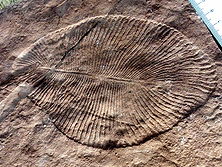 The Neoproterozoic
was a time of remarkable diversification of multicellular organisms, including animals. Organism size and complexity increased considerably after the end of the Snowball glaciations. This development of multicellular organisms may have been the result of increased evolutionary pressures resulting from multiple icehouse-hothouse
cycles; in this sense, Snowball Earth episodes may have "pumped" evolution. Alternatively, fluctuating nutrient levels and rising oxygen may have played a part. Interestingly, another major glacial episode may have ended just a few million years before the Cambrian explosion
.
Mechanistically, the impact of Snowball Earth (in particular the later glaciations) on complex life is likely to have occurred through the process of kin selection
. Organ-scale differentiation, in particular the terminal (irreversible) differentiation present in animals, requires the individual cell (and the genes contained within it) to "sacrifice" their ability to reproduce, so that the colony is not disrupted. From the short-term perspective of the gene, more offspring will be gained by causing the cell in which it is contained to ignore any signals received from the colony, and to reproduce at the maximum rate, regardless of the implications for the wider group. Today, this incentive explains the formation of tumours in animals and plants.
Such costly, "altruistic" differentiation can be adaptive (maximise the number of surviving offspring) to individual genes if the consequence of altruism (terminal cellular differentiation) benefits other copies of such genes. (Note that "altruism" refers only to the reproductive cost of the trait, and implies no sentience or foresight.) Because relatives share genes, genes causing altruism (such as organ scale differentiation) can spread if it occurs between relatives, see kin selection
.
It has been argued that because Snowball Earth would undoubtedly have decimated the population size of any given species, the extremely small populations that resulted would all have been descended from a small number of individuals (see founder effect
), and consequently the average relatedness between any two individuals (in this case individual cells) would have been exceptionally high as a result of glaciations. Altruism is known to increase from rarity when relatedness (R) exceeds the ratio of the cost (C) to the altruist (in this case, the cell giving up its own reproduction by differentiating), to the benefit (B) to the recipient of altruism (the germ line of the colony, that reproduces as a result of the differentiation), i.e. R > C/B (see Hamilton's rule). The evolutionary pressure of the high relatedness in the context of a post-glaciation population boom may have been sufficient to overcome the reproductive cost of forming a complex animal, for the first time in Earth's history.
There is also a rival hypothesis which has been gaining currency in recent years that early Snowball Earths did not so much affect the evolution of life on Earth but were caused by the evolution of life. The idea is that Earth's carbon-based life forms affect the global carbon cycle and so major evolutionary events alter the carbon cycle, redistributing carbon within various reservoirs within the biosphere system and in the process temporarily lowering the atmospheric (greenhouse) carbon reservoir until the revised biosphere system settled into a new state. The Snowball I episode (of the Huronian glaciation 2.4 to 2.1 billion years) and Snowball II (of the Precambrian's Cryogenian between 580 – 850 MYA and which itself had a number of distinct episodes) are respectively thought to be caused by the evolution of aerobic photosynthesis and then the rise of more advanced multicellular life and life's colonization of the land.
glaciations, and probably not global in extent. Emerging evidence suggests that the Earth underwent a number of glaciations during the Neoproterozoic, which would stand strongly at odds with the Snowball hypothesis.
of Canada, though the palaeomagnetic evidence that suggests ice sheets at low latitudes is contested. The glacial sediments of the Makganyene formation of South Africa are slightly younger than the Huronian glacial deposits (~2.25 billion years old) and were deposited at tropical latitudes. It has been proposed that rise of free oxygen that occurred during this part of the Paleoproterozoic
removed methane in the atmosphere through oxidation. As the Sun
was notably weaker at the time, the Earth's climate may have relied on methane, a powerful greenhouse gas, to maintain surface temperatures above freezing.
In the absence of this methane greenhouse, temperatures plunged and a snowball event could have occurred.
strata in tropical continents areas such as India and South America led to speculation that the Karoo Ice Age
glaciation reached into the tropics. However, a continental reconstruction shows that ice was in fact constrained to the polar parts of the supercontinent
Gondwana
.
in Seattle, will lead a small team of U.S. researchers to Antarctica for the 2009-10 and 2010-11 summer field seasons to add more data in support of the Snowball Earth hypothesis. A project funded by the National Science Foundation
, the project will study different ice types found in Antarctica that may have existed during the previous Snowball Earth events, specifically to learn more about their albedo
, or reflectivity, information important in understanding the processes involved in the exteme glaciation. The team will spend time on the sea ice
in McMurdo Sound
and in Garwood Valley in the McMurdo Dry Valleys
the first season. The second season will be spent in the Transantarctic Mountains
.
Hypothesis
A hypothesis is a proposed explanation for a phenomenon. The term derives from the Greek, ὑποτιθέναι – hypotithenai meaning "to put under" or "to suppose". For a hypothesis to be put forward as a scientific hypothesis, the scientific method requires that one can test it...
posits that the Earth
Earth
Earth is the third planet from the Sun, and the densest and fifth-largest of the eight planets in the Solar System. It is also the largest of the Solar System's four terrestrial planets...
's surface became entirely or nearly entirely frozen at least once, some time earlier than 650 Ma (million years ago). Proponents of the hypothesis argue that it best explains sedimentary
Sedimentary rock
Sedimentary rock are types of rock that are formed by the deposition of material at the Earth's surface and within bodies of water. Sedimentation is the collective name for processes that cause mineral and/or organic particles to settle and accumulate or minerals to precipitate from a solution....
deposits generally regarded as of glacial origin at tropical
Tropics
The tropics is a region of the Earth surrounding the Equator. It is limited in latitude by the Tropic of Cancer in the northern hemisphere at approximately N and the Tropic of Capricorn in the southern hemisphere at S; these latitudes correspond to the axial tilt of the Earth...
paleolatitudes, and other otherwise enigmatic features in the geological
Geology
Geology is the science comprising the study of solid Earth, the rocks of which it is composed, and the processes by which it evolves. Geology gives insight into the history of the Earth, as it provides the primary evidence for plate tectonics, the evolutionary history of life, and past climates...
record. Opponents of the hypothesis contest the implications of the geological evidence for global glaciation, the geophysical feasibility of an ice
Ice
Ice is water frozen into the solid state. Usually ice is the phase known as ice Ih, which is the most abundant of the varying solid phases on the Earth's surface. It can appear transparent or opaque bluish-white color, depending on the presence of impurities or air inclusions...
- or slush
Slush
Slush can mean any of the following:* Slush — a slurry mixture of liquid and solid forms of water.* Slush — a pejorative and slang combination of the likewise derogatory terms slut and lush...
-covered ocean, and the difficulty of escaping an all-frozen condition. There are a number of unanswered questions, including whether the Earth was a full snowball, or a "slushball" with a thin equatorial band of open (or seasonally open) water.
The geological time frames under consideration come before the sudden multiplication of life forms on Earth known as the Cambrian explosion
Cambrian explosion
The Cambrian explosion or Cambrian radiation was the relatively rapid appearance, around , of most major phyla, as demonstrated in the fossil record, accompanied by major diversification of other organisms, including animals, phytoplankton, and calcimicrobes...
, and the most recent snowball episode may have triggered the evolution of multi-cellular life on Earth. Another, much earlier and longer, snowball episode, the Huronian glaciation, which occurred 2400 to 2100 Ma may have been triggered by the oxygen catastrophe
Oxygen Catastrophe
The Great Oxygenation Event , also called the Oxygen Catastrophe or Oxygen Crisis or Great Oxidation, was the biologically induced appearance of free oxygen in Earth's atmosphere. This major environmental change happened around 2.4 billion years ago.Photosynthesis was producing oxygen both before...
.
History
Douglas MawsonDouglas Mawson
Sir Douglas Mawson, OBE, FRS, FAA was an Australian geologist, Antarctic explorer and Academic. Along with Roald Amundsen, Robert Falcon Scott, and Ernest Shackleton, Mawson was a key expedition leader during the Heroic Age of Antarctic Exploration.-Early work:He was appointed geologist to an...
(1882–1958), an Australian geologist and Antarctic explorer, spent much of his career studying the Neoproterozoic
Neoproterozoic
The Neoproterozoic Era is the unit of geologic time from 1,000 to 542.0 ± 1.0 million years ago. The terminal Era of the formal Proterozoic Eon , it is further subdivided into the Tonian, Cryogenian, and Ediacaran Periods...
stratigraphy of South Australia where he identified thick and extensive glacial sediments and late in his career speculated on the possibility of global glaciation.
Mawson's ideas of global glaciation, however, were based on the mistaken assumption that the geographic position of Australia, and that of other continents where low-latitude glacial deposits are found, has remained constant through time. With the advancement of the continental drift
Continental drift
Continental drift is the movement of the Earth's continents relative to each other. The hypothesis that continents 'drift' was first put forward by Abraham Ortelius in 1596 and was fully developed by Alfred Wegener in 1912...
hypothesis, and eventually plate tectonic theory, came an easier explanation for the glaciogenic sediments—they were deposited at a point in time when the continents were at higher latitudes.
In 1964, the idea of global-scale glaciation reemerged when W. Brian Harland
W. Brian Harland
W. Brian Harland was a geologist at the University of Cambridge Department of Earth Sciences, England. In 1968, he was honoured with the Royal Geographical Society Gold Medal for Arctic exploration and research.- Personal background :...
published a paper in which he presented palaeomagnetic data showing that glacial till
Till
thumb|right|Closeup of glacial till. Note that the larger grains in the till are completely surrounded by the matrix of finer material , and this characteristic, known as matrix support, is diagnostic of till....
ites in Svalbard
Svalbard
Svalbard is an archipelago in the Arctic, constituting the northernmost part of Norway. It is located north of mainland Europe, midway between mainland Norway and the North Pole. The group of islands range from 74° to 81° north latitude , and from 10° to 35° east longitude. Spitsbergen is the...
and Greenland
Greenland
Greenland is an autonomous country within the Kingdom of Denmark, located between the Arctic and Atlantic Oceans, east of the Canadian Arctic Archipelago. Though physiographically a part of the continent of North America, Greenland has been politically and culturally associated with Europe for...
were deposited at tropical latitudes. From this palaeomagnetic data, and the sedimentological evidence that the glacial sediments interrupt successions of rocks commonly associated with tropical to temperate latitudes, he argued for an ice age that was so extreme that it resulted in the deposition of marine glacial rocks in the tropics.
In the 1960s, Mikhail Budyko
Mikhail Budyko
Mikhail Ivanovich Budyko was a Russian climatologist and one of the founders of physical climatology. He pioneered studies on global climate and calculated temperature of Earth considering simple physical model of equilibrium in which the incoming solar radiation absorbed by the Earth's system is...
, a Russian climatologist, developed a simple energy-balance climate model to investigate the effect of ice cover on global climate
Climate
Climate encompasses the statistics of temperature, humidity, atmospheric pressure, wind, rainfall, atmospheric particle count and other meteorological elemental measurements in a given region over long periods...
. Using this model, Budyko found that if ice sheets advanced far enough out of the polar regions, a feedback loop ensued where the increased reflectiveness (albedo
Albedo
Albedo , or reflection coefficient, is the diffuse reflectivity or reflecting power of a surface. It is defined as the ratio of reflected radiation from the surface to incident radiation upon it...
) of the ice led to further cooling and the formation of more ice, until the entire Earth was covered in ice and stabilized in a new ice-covered equilibrium. While Budyko's model showed that this ice-albedo stability could happen, he concluded that it had never happened, because his model offered no way to escape from such a scenario.
The term "Snowball Earth" was coined by Joseph Kirschvink, a professor of geobiology at the California Institute of Technology
California Institute of Technology
The California Institute of Technology is a private research university located in Pasadena, California, United States. Caltech has six academic divisions with strong emphases on science and engineering...
, in a short paper published in 1992 within a lengthy volume concerning the biology of the Proterozoic
Proterozoic
The Proterozoic is a geological eon representing a period before the first abundant complex life on Earth. The name Proterozoic comes from the Greek "earlier life"...
eon. The major contributions from this work were: (1) the recognition that the presence of banded iron formation
Banded iron formation
Banded iron formations are distinctive units of sedimentary rock that are almost always of Precambrian age. A typical BIF consists of repeated, thin layers of iron oxides, either magnetite or hematite , alternating with bands of iron-poor shale and chert...
s is consistent with such a glacial episode and (2) the introduction of a mechanism with which to escape from an ice-covered Earth—the accumulation of from volcanic outgassing leading to an ultra-greenhouse effect.
Interest in the Snowball Earth increased dramatically after Paul F. Hoffman
Paul F. Hoffman
Paul Felix Hoffman is a Canadian geologist and former Sturgis Hooper Professor of Geology at Harvard University. He specializes in the Precambrian era and is widely known for the theory of the Snowball Earth about phenomena that occurred in the Neoproterozoic era, co-published with Daniel P....
, professor of geology at Harvard University
Harvard University
Harvard University is a private Ivy League university located in Cambridge, Massachusetts, United States, established in 1636 by the Massachusetts legislature. Harvard is the oldest institution of higher learning in the United States and the first corporation chartered in the country...
, and coauthors applied Kirschvink's ideas to a succession of Neoproterozoic sediments in Namibia
Namibia
Namibia, officially the Republic of Namibia , is a country in southern Africa whose western border is the Atlantic Ocean. It shares land borders with Angola and Zambia to the north, Botswana to the east and South Africa to the south and east. It gained independence from South Africa on 21 March...
, elaborated upon the hypothesis by incorporating such observations as the occurrence of cap carbonate
Cap carbonate
Cap carbonates are layers of distinctively textured carbonate rocks which typically form the uppermost layer of sedimentary sequences reflecting major glaciations in the geological record....
s, and published their results in the journal Science in 1998.
Currently, aspects of the hypothesis remain controversial and it is being debated under the auspices of the International Geoscience Programme (IGCP) Project 512: Neoproterozoic Ice Ages.
In March 2010, the journal Science
Science (journal)
Science is the academic journal of the American Association for the Advancement of Science and is one of the world's top scientific journals....
published an article "Calibrating the Cryogenian
Cryogenian
The Cryogenian is a geologic period that lasted from . It forms the second geologic period of the Neoproterozoic Era, preceded by the Tonian Period and followed by the Ediacaran...
" which concluded that "Ice was therefore grounded below sea level at very low paleolatitudes, which implies that the Sturtian glaciation was global in extent". A popular account of this conclusion was published in Science Daily
Science Daily
Science Daily is a news website for topical science articles. It features articles on a wide variety of science topics including: astronomy, exoplanets, computer science, nanotechnology, medicine, psychology, sociology, anthropology, biology, geology, climate, space, physics, mathematics,...
.
Evidence
The Snowball Earth hypothesis was originally devised to explain the apparent presence of glaciers at tropical latitudes. Modeling suggested that once glaciers spread to within 30° of the equator, an ice-albedo feedbackIce-albedo feedback
Ice-albedo feedback is a positive feedback climate process where a change in the area of snow-covered land, ice caps, glaciers or sea ice alters the albedo. This change in albedo acts to reinforce the initial alteration in ice area...
would result in the ice rapidly advancing to the equator (further modelling shows that ice can in fact get as close as 25° or closer to the equator without initiating total glaciation). Therefore, the presence of glacial deposits seemingly within the tropics appeared to point to global ice cover.
Critical to an assessment of the validity of the theory, therefore, is an understanding of the reliability and significance of the evidence that led to the belief that ice ever reached the tropics. This evidence must prove two things:
- that a bed contains sedimentary structures that could have been created only by glacial activity;
- that the bed lay within the tropics when it was deposited.
During a period of global glaciation, it must also be demonstrated that glaciers were active at different global locations at the same time, and that no other deposits of the same age are in existence.
This last point is very difficult to prove. Before the Ediacaran
Ediacaran
The Ediacaran Period , named after the Ediacara Hills of South Australia, is the last geological period of the Neoproterozoic Era and of the Proterozoic Eon, immediately preceding the Cambrian Period, the first period of the Paleozoic Era and of the Phanerozoic Eon...
, the biostratigraphic markers usually used to correlate rocks are absent; therefore there is no way to prove that rocks in different places across the globe were deposited at the same time. The best that can be done is to estimate the age of the rocks using radiometric methods, which are rarely accurate to better than a million years or so.
The first two points are often the source of contention on a case-to-case basis. Many glacial features can also be created by non-glacial means, and estimating the latitude of landmasses even as little as can be riddled with difficulties.
Palaeomagnetism
The Snowball Earth hypothesis was first posited in order to explain what were then considered to be glacial deposits near the equator.Since tectonic plates move in time, ascertaining their position at a given point in history is not easy. In addition to considerations of how the recognisable landmasses could have fit together, the latitude at which a rock was deposited can be constrained by palaeomagnetism.
When sedimentary rock
Sedimentary rock
Sedimentary rock are types of rock that are formed by the deposition of material at the Earth's surface and within bodies of water. Sedimentation is the collective name for processes that cause mineral and/or organic particles to settle and accumulate or minerals to precipitate from a solution....
s form, magnetic minerals within them tend to align themselves with the Earth's magnetic field. Through the precise measurement of this palaeomagnetism, it is possible to estimate the latitude
Latitude
In geography, the latitude of a location on the Earth is the angular distance of that location south or north of the Equator. The latitude is an angle, and is usually measured in degrees . The equator has a latitude of 0°, the North pole has a latitude of 90° north , and the South pole has a...
(but not the longitude
Longitude
Longitude is a geographic coordinate that specifies the east-west position of a point on the Earth's surface. It is an angular measurement, usually expressed in degrees, minutes and seconds, and denoted by the Greek letter lambda ....
) where the rock matrix was deposited. Paleomagnetic measurements have indicated that some sediments of glacial origin in the Neoproterozoic
Neoproterozoic
The Neoproterozoic Era is the unit of geologic time from 1,000 to 542.0 ± 1.0 million years ago. The terminal Era of the formal Proterozoic Eon , it is further subdivided into the Tonian, Cryogenian, and Ediacaran Periods...
rock record were deposited within 10 degrees of the equator, although the accuracy of this reconstruction is in question.
This palaeomagnetic location of apparently glacial sediments (such as dropstone
Dropstone
Dropstones are isolated fragments of rock found within finer-grained water-deposited sedimentary rocks. They range in size from small pebbles to boulders...
s) has been taken to suggest that glaciers extended to sea-level in the tropical latitudes.
It is not clear whether this can be taken to imply a global glaciation, or the existence of localised, possibly land-locked, glacial regimes. Others have even suggested that most data do not constrain any glacial deposits to within 25° of the equator.
Skeptics suggest that the palaeomagnetic data could be corrupted if the Earth's magnetic field was substantially different from today's. Depending on the rate of cooling of the Earth's core, it is possible that during the Proterozoic, its magnetic field
Magnetic field
A magnetic field is a mathematical description of the magnetic influence of electric currents and magnetic materials. The magnetic field at any given point is specified by both a direction and a magnitude ; as such it is a vector field.Technically, a magnetic field is a pseudo vector;...
did not approximate a dipolar
Dipole
In physics, there are several kinds of dipoles:*An electric dipole is a separation of positive and negative charges. The simplest example of this is a pair of electric charges of equal magnitude but opposite sign, separated by some distance. A permanent electric dipole is called an electret.*A...
distribution, with a North and South pole roughly aligning with the planet's axis as they do today. Instead, a hotter core may have circulated more vigorously and given rise to 4, 8 or more poles. Paleomagnetic data would then have to be re-interpreted as particles could align pointing to a 'West Pole' rather than the North Pole. Alternatively, the Earth's dipolar field could have oriented such that the poles were close to the equator. This hypothesis has been posited to explain the extraordinarily rapid motion of the magnetic poles implied by the Ediacaran palaeomagnetic record; the alleged motion of the north pole would occur around the same time as the Gaskiers glaciation.
Another weakness of reliance on palaeomagnetic data is the difficulty in determining whether the magnetic signal recorded is original, or whether it has been reset by later activity. For example, a mountain-building releases hot water as a by-product of metamorphic reactions; this water can circulate to rocks thousands of kilometers away and reset their magnetic signature. This makes the authenticity of rocks older than a few million years difficult to determine without painstaking mineralogical observations.
There is currently only one deposit, the Elatina deposit of Australia, that was indubitably deposited at low latitudes; its depositional date is well constrained, and the signal is demonstrably original.
Low latitude glacial deposits
Sedimentary rocks that are deposited by glaciers have distinctive features that enable their identification. Long before the advent of the Snowball Earth hypothesis many NeoproterozoicNeoproterozoic
The Neoproterozoic Era is the unit of geologic time from 1,000 to 542.0 ± 1.0 million years ago. The terminal Era of the formal Proterozoic Eon , it is further subdivided into the Tonian, Cryogenian, and Ediacaran Periods...
sediments had been interpreted as having a glacial origin, including some apparently at tropical latitudes at the time of their deposition. However, it is worth remembering that many sedimentary features traditionally associated with glaciers can also be formed by other means. Thus the glacial origin of many of the key occurrences for Snowball Earth has been contested.
As of 2007, there was only one "very reliable" – still challenged – datum point identifying tropical tillites, which makes statements of equatorial ice cover somewhat presumptuous. However evidence of sea-level glaciation in the tropics during the Sturtian is accumulating.
Evidence of possible glacial origin of sediment includes:
- Dropstones (stones dropped into marine sediments), which can be deposited by glaciers or other phenomena.
- Varves (annual sediment layers in periglacial lakes), which can form at higher temperatures.
- Glacial striations (formed by embedded rocks scraped against bedrock): similar striations are from time to time formed by mudflowMudflowA mudslide is the most rapid and fluid type of downhill mass wasting. It is a rapid movement of a large mass of mud formed from loose soil and water. Similar terms are mudflow, mud stream, debris flow A mudslide is the most rapid (up to 80 km/h, or 50 mph) and fluid type of downhill mass...
s or tectonic movements. - DiamictiteDiamictiteDiamictite : through and µεικτός : mixed) is a poorly or non-sorted conglomerate or breccia with a wide range of clasts, up to 25% of them gravel sized...
s (poorly sorted conglomerates). Originally described as glacial tillTillthumb|right|Closeup of glacial till. Note that the larger grains in the till are completely surrounded by the matrix of finer material , and this characteristic, known as matrix support, is diagnostic of till....
, most were in fact formed by debris flowDebris flowA debris flow is a fast moving, liquefied landslide of unconsolidated, saturated debris that looks like flowing concrete. It is differentiated from a mudflow in terms of the viscosity and textural properties of the flow. Flows can carry material ranging in size from clay to boulders, and may...
s.
Open-water deposits
It appears that some deposits formed during the Snowball period could only have been formed in the presence of an active hydrological cycle. Bands of glacial deposits up to hundreds of meters thick, separated by small (meters) bands of non-glacial sediments, demonstrate that glaciers were melting and re-forming repeatedly; solid oceans would not permit this scale of deposition. It is considered possible that ice streamIce stream
An ice stream is a region of an ice sheet that moves significantly faster than the surrounding ice. Ice streams are a type of glacier. They are significant features of the Antarctic where they account for 10% of the volume of the ice...
s such as seen in Antarctica today could be responsible for these sequences.
Further, sedimentary features that could only form in open water, for example wave-formed ripples
Wave-formed ripples
In sedimentology, wave-formed ripples or wave-formed ripple marks are a feature of sediments and dunes. These ripple marks are often characterised by symmetric cross sections and long relatively straight crests, which may commonly bifurcate...
, far-traveled ice-rafted debris and indicators of photosynthetic activity, can be found throughout sediments dating from the Snowball Earth periods. While these may represent 'oases' of meltwater
Meltwater
Meltwater is the water released by the melting of snow or ice, including glacial ice and ice shelfs over oceans. Meltwater is often found in the ablation zone of glaciers, where the rate of snow cover is reducing...
on a completely frozen Earth, computer modelling suggests that large areas of the ocean must have remained ice free arguing that a "hard" snowball is not plausible in terms of energy balance and general circulation models.
Carbon isotope ratios
There are two stable isotopeIsotope
Isotopes are variants of atoms of a particular chemical element, which have differing numbers of neutrons. Atoms of a particular element by definition must contain the same number of protons but may have a distinct number of neutrons which differs from atom to atom, without changing the designation...
s of carbon in sea water: carbon-12
Carbon-12
Carbon-12 is the more abundant of the two stable isotopes of the element carbon, accounting for 98.89% of carbon; it contains 6 protons, 6 neutrons, and 6 electrons....
(12C) and the rare carbon-13
Carbon-13
Carbon-13 is a natural, stable isotope of carbon and one of the environmental isotopes. It makes up about 1.1% of all natural carbon on Earth.- Detection by mass spectrometry :...
(13C), which makes up about 1.109 percent of carbon atoms.
Biochemical processes, of which photosynthesis
Photosynthesis
Photosynthesis is a chemical process that converts carbon dioxide into organic compounds, especially sugars, using the energy from sunlight. Photosynthesis occurs in plants, algae, and many species of bacteria, but not in archaea. Photosynthetic organisms are called photoautotrophs, since they can...
is one, tend to preferentially incorporate the lighter 12C isotope. Thus ocean-dwelling photosynthesizers, both protist
Protist
Protists are a diverse group of eukaryotic microorganisms. Historically, protists were treated as the kingdom Protista, which includes mostly unicellular organisms that do not fit into the other kingdoms, but this group is contested in modern taxonomy...
s and algae
Algae
Algae are a large and diverse group of simple, typically autotrophic organisms, ranging from unicellular to multicellular forms, such as the giant kelps that grow to 65 meters in length. They are photosynthetic like plants, and "simple" because their tissues are not organized into the many...
, tend to be very slightly depleted in 13C, relative to the abundance found in the primary volcanic sources of the Earth's carbon. Therefore, an ocean with photosynthetic life will have a higher 12C/13C ratio within organic remains, and a lower ratio in corresponding ocean water. The organic component of the lithified sediments will forever remain very slightly, but measurably, depleted in 13C.
During the proposed episode of Snowball Earth, there are rapid and extreme negative excursions in the ratio of 13C to 12C. This is consistent with a deep freeze that killed off most or nearly all photosynthetic life – although other mechanisms, such as clathrate release
Clathrate compound
A clathrate, clathrate compound or cage compound is a chemical substance consisting of a lattice of one type of molecule trapping and containing a second type of molecule...
, can also cause such perturbations. Close analysis of the timing of 13C 'spikes' in deposits across the globe allows the recognition of four, possibly five, glacial events in the late Neoproterozoic.
Banded iron formations
Iron oxide
Iron oxides are chemical compounds composed of iron and oxygen. All together, there are sixteen known iron oxides and oxyhydroxides.Iron oxides and oxide-hydroxides are widespread in nature, play an important role in many geological and biological processes, and are widely utilized by humans, e.g.,...
and iron-poor chert
Chert
Chert is a fine-grained silica-rich microcrystalline, cryptocrystalline or microfibrous sedimentary rock that may contain small fossils. It varies greatly in color , but most often manifests as gray, brown, grayish brown and light green to rusty red; its color is an expression of trace elements...
. In the presence of oxygen, iron
Iron
Iron is a chemical element with the symbol Fe and atomic number 26. It is a metal in the first transition series. It is the most common element forming the planet Earth as a whole, forming much of Earth's outer and inner core. It is the fourth most common element in the Earth's crust...
naturally rusts and becomes insoluble in water. The banded iron formations are commonly very old and their deposition is often related to the oxidation of the Earth's atmosphere during the Paleoproterozoic
Paleoproterozoic
The Paleoproterozoic is the first of the three sub-divisions of the Proterozoic occurring between . This is when the continents first stabilized...
era, when dissolved iron in the ocean came in contact with photosynthetically produced oxygen and precipitated out as iron oxide.
The bands were produced at the tipping point
Tipping point (climatology)
A climate tipping point is a point when global climate changes from one stable state to another stable state, in a similar manner to a wine glass tipping over. After the tipping point has been passed, a transition to a new state occurs...
between an anoxic
Hypoxia (environmental)
Hypoxia, or oxygen depletion, is a phenomenon that occurs in aquatic environments as dissolved oxygen becomes reduced in concentration to a point where it becomes detrimental to aquatic organisms living in the system...
and an oxygenated ocean. Since today's atmosphere is oxygen
Oxygen
Oxygen is the element with atomic number 8 and represented by the symbol O. Its name derives from the Greek roots ὀξύς and -γενής , because at the time of naming, it was mistakenly thought that all acids required oxygen in their composition...
rich (nearly 21 percent by volume) and in contact with the oceans, it is not possible to accumulate enough iron oxide to deposit a banded formation. The only extensive iron formations that were deposited after the Paleoproterozoic (after 1.8 billion years ago) are associated with Cryogenian
Cryogenian
The Cryogenian is a geologic period that lasted from . It forms the second geologic period of the Neoproterozoic Era, preceded by the Tonian Period and followed by the Ediacaran...
glacial deposits.
For such iron-rich rocks to be deposited there would have to be anoxia in the ocean, so that much dissolved iron (as ferrous oxide) could accumulate before it met an oxidant that would precipitate it as ferric
Ferric
Ferric refers to iron-containing materials or compounds. In chemistry the term is reserved for iron with an oxidation number of +3, also denoted iron or Fe3+. On the other hand, ferrous refers to iron with oxidation number of +2, denoted iron or Fe2+...
oxide. For the ocean to become anoxic it must have limited gas exchange with the oxygenated atmosphere. Proponents of the hypothesis argue that the reappearance of BIF in the sedimentary record is a result of limited oxygen levels in an ocean sealed by sea ice, while opponents suggest that the rarity of the BIF deposits may indicate that they formed in inland seas.
Being isolated from the oceans, such lakes may have been stagnant and anoxic at depth, much like today's Black Sea
Black Sea
The Black Sea is bounded by Europe, Anatolia and the Caucasus and is ultimately connected to the Atlantic Ocean via the Mediterranean and the Aegean seas and various straits. The Bosphorus strait connects it to the Sea of Marmara, and the strait of the Dardanelles connects that sea to the Aegean...
; a sufficient input of iron could provide the necessary conditions for BIF formation. A further difficulty in suggesting that BIFs marked the end of the glaciation is that they are found interbedded with glacial sediments. BIFs are also strikingly absent during the Marinoan glaciation.
Cap carbonate rocks
Neoproterozoic
The Neoproterozoic Era is the unit of geologic time from 1,000 to 542.0 ± 1.0 million years ago. The terminal Era of the formal Proterozoic Eon , it is further subdivided into the Tonian, Cryogenian, and Ediacaran Periods...
glacial deposits there is commonly a sharp transition into a chemically precipitated sedimentary limestone
Limestone
Limestone is a sedimentary rock composed largely of the minerals calcite and aragonite, which are different crystal forms of calcium carbonate . Many limestones are composed from skeletal fragments of marine organisms such as coral or foraminifera....
or dolostone
Dolostone
Dolostone or dolomite rock is a sedimentary carbonate rock that contains a high percentage of the mineral dolomite. In old U.S.G.S. publications it was referred to as magnesian limestone. Most dolostone formed as a magnesium replacement of limestone or lime mud prior to lithification. It is...
metres to tens of metres thick. These cap carbonates sometimes occur in sedimentary successions that have no other carbonate rocks, suggesting that their deposition is result of a profound aberration in ocean chemistry.
These cap carbonates have unusual chemical composition, as well as strange sedimentary structures that are often interpreted as large ripples.
The formation of such sedimentary rocks could be caused by a large influx of positively charged ions, as would be produced by rapid weathering during the extreme greenhouse following a Snowball Earth event. The isotopic signature of the cap carbonates is near −5 ‰, consistent with the value of the mantle — such a low value is usually/could be taken to signify an absence of life, since photosynthesis usually acts to raise the value; alternatively the release of methane deposits could have lowered it from a higher value, and counterbalance the effects of photosynthesis.
The precise mechanism involved in the formation of cap carbonates is not clear, but the most cited explanation suggests that at the melting of a Snowball Earth, water would dissolve the abundant from the atmosphere
Atmosphere
An atmosphere is a layer of gases that may surround a material body of sufficient mass, and that is held in place by the gravity of the body. An atmosphere may be retained for a longer duration, if the gravity is high and the atmosphere's temperature is low...
to form carbonic acid
Carbonic acid
Carbonic acid is the inorganic compound with the formula H2CO3 . It is also a name sometimes given to solutions of carbon dioxide in water, because such solutions contain small amounts of H2CO3. Carbonic acid forms two kinds of salts, the carbonates and the bicarbonates...
, which would fall as acid rain
Acid rain
Acid rain is a rain or any other form of precipitation that is unusually acidic, meaning that it possesses elevated levels of hydrogen ions . It can have harmful effects on plants, aquatic animals, and infrastructure. Acid rain is caused by emissions of carbon dioxide, sulfur dioxide and nitrogen...
. This would weather exposed silicate
Silicate
A silicate is a compound containing a silicon bearing anion. The great majority of silicates are oxides, but hexafluorosilicate and other anions are also included. This article focuses mainly on the Si-O anions. Silicates comprise the majority of the earth's crust, as well as the other...
and carbonate
Carbonate
In chemistry, a carbonate is a salt of carbonic acid, characterized by the presence of the carbonate ion, . The name may also mean an ester of carbonic acid, an organic compound containing the carbonate group C2....
rock
Rock (geology)
In geology, rock or stone is a naturally occurring solid aggregate of minerals and/or mineraloids.The Earth's outer solid layer, the lithosphere, is made of rock. In general rocks are of three types, namely, igneous, sedimentary, and metamorphic...
(including readily attacked glacial debris), releasing large amounts of calcium
Calcium
Calcium is the chemical element with the symbol Ca and atomic number 20. It has an atomic mass of 40.078 amu. Calcium is a soft gray alkaline earth metal, and is the fifth-most-abundant element by mass in the Earth's crust...
, which when washed into the ocean would form distinctively textured layers of carbonate sedimentary rock. Such an abiotic "cap carbonate
Cap carbonate
Cap carbonates are layers of distinctively textured carbonate rocks which typically form the uppermost layer of sedimentary sequences reflecting major glaciations in the geological record....
" sediment can be found on top of the glacial till that gave rise to the Snowball Earth hypothesis.
However, there are some problems with the designation of a glacial origin to cap carbonates. Firstly, the high carbon dioxide concentration in the atmosphere would cause the oceans to become acidic, and dissolve any carbonates contained within — starkly at odds with the deposition of cap carbonates. Further, the thickness of some cap carbonates is far above what could reasonably be produced in the relatively quick deglaciations. The cause is further weakened by the lack of cap carbonates above many sequences of clear glacial origin at a similar time and the occurrence of similar carbonates within the sequences of proposed glacial origin. An alternative mechanism, which may have produced the Doushantuo cap carbonate at least, is the rapid, widespread release of methane. This accounts for incredibly low — as low as −48 ‰ — values — as well as unusual sedimentary features which appear to have been formed by the flow of gas through the sediments.
Changing acidity
Isotopes of the element boronBoron
Boron is the chemical element with atomic number 5 and the chemical symbol B. Boron is a metalloid. Because boron is not produced by stellar nucleosynthesis, it is a low-abundance element in both the solar system and the Earth's crust. However, boron is concentrated on Earth by the...
suggest that the pH
PH
In chemistry, pH is a measure of the acidity or basicity of an aqueous solution. Pure water is said to be neutral, with a pH close to 7.0 at . Solutions with a pH less than 7 are said to be acidic and solutions with a pH greater than 7 are basic or alkaline...
of the oceans dropped dramatically before and after the Marinoan glaciation.
This may indicate a build up of carbon dioxide
Carbon dioxide
Carbon dioxide is a naturally occurring chemical compound composed of two oxygen atoms covalently bonded to a single carbon atom...
in the atmosphere, some of which would dissolve into the oceans to form carbonic acid
Carbonic acid
Carbonic acid is the inorganic compound with the formula H2CO3 . It is also a name sometimes given to solutions of carbon dioxide in water, because such solutions contain small amounts of H2CO3. Carbonic acid forms two kinds of salts, the carbonates and the bicarbonates...
. Although the boron variations may be evidence of extreme climate change, they need not imply a global glaciation.
Space dust
The Earth's surface is very depleted in the element iridiumIridium
Iridium is the chemical element with atomic number 77, and is represented by the symbol Ir. A very hard, brittle, silvery-white transition metal of the platinum family, iridium is the second-densest element and is the most corrosion-resistant metal, even at temperatures as high as 2000 °C...
, which primarily resides in the Earth's core. The only significant source of the element at the surface is cosmic particles that reach Earth. During a Snowball Earth, iridium would accumulate on the ice sheets, and when the ice melted the resulting layer of sediment would be rich in iridium. An iridium anomaly
Iridium anomaly
The term iridium anomaly commonly refers to an unusual abundance of the chemical element iridium in a layer of rock strata, often taken as evidence of an extraterrestrial impact event because of the case of such an anomaly at the Cretaceous–Tertiary boundary...
has been discovered at the base of the cap carbonate formations, and has been used to suggest that the glacial episode lasted for at least 3 million years, but this does not necessarily imply a global extent to the glaciation; indeed, a similar anomaly could be explained by the impact of a large meteorite
Meteorite
A meteorite is a natural object originating in outer space that survives impact with the Earth's surface. Meteorites can be big or small. Most meteorites derive from small astronomical objects called meteoroids, but they are also sometimes produced by impacts of asteroids...
.
Cyclic climate fluctuations
Using the ratio of mobile cations to those that remain in soils during chemical weathering (the chemical index of alteration), it has been shown that chemical weathering varied in a cyclic fashion within a glacial succession, increasing during interglacial periods and decreasing during cold and arid glacial periods. This pattern, if a true reflection of events, suggests that the "Snowball Earths" bore a stronger resemblance to Pleistocene ice ageIce age
An ice age or, more precisely, glacial age, is a generic geological period of long-term reduction in the temperature of the Earth's surface and atmosphere, resulting in the presence or expansion of continental ice sheets, polar ice sheets and alpine glaciers...
cycles than to a completely frozen Earth.
What's more, glacial sediments of the Portaskaig
Port Askaig
Port Askaig is a port village on the east coast of the island of Islay, in Scotland.-Transport:Port Askaig serves as the main port of Islay, sharing passenger services to the Scottish mainland with Port Ellen...
formation in Scotland clearly show interbedded cycles of glacial and shallow marine sediments. The significance of these deposits is highly reliant upon their dating. Glacial sediments are difficult to date, and the closest dated bed to the Portaskaig group is 8 km stratigraphically above the beds of interest. Its dating to 600 Ma means the beds can be tentatively correlated to the Sturtian glaciation, but they may represent the advance or retreat of a Snowball Earth.
Mechanisms
Albedo
Albedo , or reflection coefficient, is the diffuse reflectivity or reflecting power of a surface. It is defined as the ratio of reflected radiation from the surface to incident radiation upon it...
, which would result in positive feedback
Positive feedback
Positive feedback is a process in which the effects of a small disturbance on a system include an increase in the magnitude of the perturbation. That is, A produces more of B which in turn produces more of A. In contrast, a system that responds to a perturbation in a way that reduces its effect is...
for cooling. If enough snow and ice accumulates, runaway cooling would result. This positive feedback is facilitated by an equatorial continental distribution, which would allow ice to accumulate in the regions closer to the equator, where solar radiation is most direct.
Many possible triggering mechanisms could account for the beginning of a Snowball Earth, such as the eruption of a Supervolcano
Supervolcano
A supervolcano is a volcano capable of producing a volcanic eruption with an ejecta volume greater than 1,000 cubic kilometers . This is thousands of times larger than most historic volcanic eruptions. Supervolcanoes can occur when magma in the Earth rises into the crust from a hotspot but is...
, a reduction in the atmospheric concentration of Greenhouse gas
Greenhouse gas
A greenhouse gas is a gas in an atmosphere that absorbs and emits radiation within the thermal infrared range. This process is the fundamental cause of the greenhouse effect. The primary greenhouse gases in the Earth's atmosphere are water vapor, carbon dioxide, methane, nitrous oxide, and ozone...
es such as methane
Methane
Methane is a chemical compound with the chemical formula . It is the simplest alkane, the principal component of natural gas, and probably the most abundant organic compound on earth. The relative abundance of methane makes it an attractive fuel...
and/or carbon dioxide
Carbon dioxide
Carbon dioxide is a naturally occurring chemical compound composed of two oxygen atoms covalently bonded to a single carbon atom...
, changes in Solar energy output
Solar variation
Solar variation is the change in the amount of radiation emitted by the Sun and in its spectral distribution over years to millennia. These variations have periodic components, the main one being the approximately 11-year solar cycle . The changes also have aperiodic fluctuations...
, or perturbations of the Earth's orbit
Earth's orbit
In astronomy, the Earth's orbit is the motion of the Earth around the Sun, at an average distance of about 150 million kilometers, every 365.256363 mean solar days .A solar day is on average 24 hours; it takes 365.256363 of these to orbit the sun once in the sense of returning...
. Regardless of the trigger, initial cooling results in an increase in the area of the Earth's surface covered by ice and snow, and the additional ice and snow reflects more solar energy back to space, further cooling the Earth and further increasing the area of the Earth's surface covered by ice and snow. This positive feedback loop could eventually produce a frozen equator
Equator
An equator is the intersection of a sphere's surface with the plane perpendicular to the sphere's axis of rotation and containing the sphere's center of mass....
as cold as modern-day Antarctica.
Global warming
Global warming
Global warming refers to the rising average temperature of Earth's atmosphere and oceans and its projected continuation. In the last 100 years, Earth's average surface temperature increased by about with about two thirds of the increase occurring over just the last three decades...
associated with large accumulations of carbon dioxide in the atmosphere over millions of years, emitted primarily by volcanic activity, is the proposed trigger for melting a Snowball Earth. Due to positive feedback for melting, the eventual melting of the snow and ice covering most of the Earth's surface would require as few as 1,000 years.
Modeling disputes
While the presence of glaciers is not disputed, the idea that the entire planet was covered in ice is more contentious, leading some scientists to posit a "slushball Earth", in which a band of ice-free, or ice-thin, waters remains around the equatorEquator
An equator is the intersection of a sphere's surface with the plane perpendicular to the sphere's axis of rotation and containing the sphere's center of mass....
, allowing for a continued hydrologic cycle.
This theory appeals to scientists who observe certain features of the sedimentary record that can only be formed under open water, or rapidly moving ice (which would require somewhere ice-free to move to). Recent research observed geochemical cyclicity in clastic rocks
Clastic rocks
Clastic rocks are composed of fragments, or clasts, of pre-existing rock. Geologists use the term clastic with reference to sedimentary rocks as well as to particles in sediment transport whether in suspension or as bed load, and in sediment deposits.- Clastic metamorphic and igneous rocks :Clastic...
, showing that the "Snowball" periods were punctuated by warm spells, similar to ice age
Ice age
An ice age or, more precisely, glacial age, is a generic geological period of long-term reduction in the temperature of the Earth's surface and atmosphere, resulting in the presence or expansion of continental ice sheets, polar ice sheets and alpine glaciers...
cycles in recent Earth history. Attempts to construct computer models of a Snowball Earth have also struggled to accommodate global ice cover without fundamental changes in the laws and constants which govern the planet.
A less extreme snowball earth hypothesis involves continually evolving continental configurations and changes in ocean circulation. Synthesised evidence has produced models indicating a “slushball Earth”, where the stratigraphic record does not permit postulating complete global glaciations. Kirschivink's original hypothesis had recognised that warm tropical puddles would be expected to exist in a snowball earth.
The Snowball Earth hypothesis does not explain the alternation of glacial and interglacial events, nor the oscillation of glacial sheet margins; hence the slushball Earth model appears to be a better fit than the Snowball Earth model.
Initiating "Snowball Earth"
A tropical distribution of the continents is, perhaps counter-intuitively, necessary to allow the initiation of a Snowball Earth.Firstly, tropical continents are more reflective than open ocean, and so absorb less of the sun's heat: most absorption of solar energy on Earth today occurs in tropical oceans.
Further, tropical continents are subject to more rainfall, which leads to increased river discharge — and erosion.
When exposed to air, silicate
Silicate
A silicate is a compound containing a silicon bearing anion. The great majority of silicates are oxides, but hexafluorosilicate and other anions are also included. This article focuses mainly on the Si-O anions. Silicates comprise the majority of the earth's crust, as well as the other...
rocks undergo weathering reactions which remove carbon dioxide from the atmosphere. These reactions proceed in the general form: Rock-forming mineral + CO2 + H2O → cations + bicarbonate + SiO2. An example of such a reaction is the weathering of wollastonite
Wollastonite
Wollastonite is a calcium inosilicate mineral that may contain small amounts of iron, magnesium, and manganese substituting for calcium. It is usually white. It forms when impure limestone or dolostone is subjected to high temperature and pressure sometimes in the presence of silica-bearing fluids...
:
- CaSiO3 + 2CO2 + H2O → Ca2+ + SiO2 + 2HCO3−
The released calcium
Calcium
Calcium is the chemical element with the symbol Ca and atomic number 20. It has an atomic mass of 40.078 amu. Calcium is a soft gray alkaline earth metal, and is the fifth-most-abundant element by mass in the Earth's crust...
cations react with the dissolved bicarbonate
Bicarbonate
In inorganic chemistry, bicarbonate is an intermediate form in the deprotonation of carbonic acid...
in the ocean to form calcium carbonate
Calcium carbonate
Calcium carbonate is a chemical compound with the formula CaCO3. It is a common substance found in rocks in all parts of the world, and is the main component of shells of marine organisms, snails, coal balls, pearls, and eggshells. Calcium carbonate is the active ingredient in agricultural lime,...
as a chemically precipitated sedimentary rock
Sedimentary rock
Sedimentary rock are types of rock that are formed by the deposition of material at the Earth's surface and within bodies of water. Sedimentation is the collective name for processes that cause mineral and/or organic particles to settle and accumulate or minerals to precipitate from a solution....
. This transfers carbon dioxide
Carbon dioxide
Carbon dioxide is a naturally occurring chemical compound composed of two oxygen atoms covalently bonded to a single carbon atom...
, a greenhouse gas, from the air into the geosphere
Geosphere
The term geosphere is often used to refer to the densest parts of Earth, which consist mostly of rock and regolith. The geosphere consists of the inside of the Earth or other planets or bodies....
, and, in steady-state on geologic time scales, offsets the carbon dioxide emitted from volcano
Volcano
2. Bedrock3. Conduit 4. Base5. Sill6. Dike7. Layers of ash emitted by the volcano8. Flank| 9. Layers of lava emitted by the volcano10. Throat11. Parasitic cone12. Lava flow13. Vent14. Crater15...
es into the atmosphere.
A paucity of suitable sediments for analysis makes precise continental distribution during the Neoproterozoic difficult to establish. Some reconstructions point towards polar continents — which have been a feature of all other major glaciations, providing a point upon which ice can nucleate. Changes in ocean circulation patterns may then have provided the trigger of Snowball Earth.
Additional factors that may have contributed to the onset of the Neoproterozoic Snowball include the introduction of atmospheric free oxygen, which may have reached sufficient quantities to react with methane
Methane
Methane is a chemical compound with the chemical formula . It is the simplest alkane, the principal component of natural gas, and probably the most abundant organic compound on earth. The relative abundance of methane makes it an attractive fuel...
in the atmosphere, oxidizing it to carbon dioxide, a much weaker greenhouse gas, and a younger — thus fainter — sun, which would have emitted 6 percent less radiation in the Neoproterozoic.
Normally, as the Earth gets colder due to natural climatic fluctuations and changes in incoming solar radiation, the cooling slows these weathering reactions. As a result, less carbon dioxide is removed from the atmosphere and the Earth warms as this greenhouse gas accumulates — this 'negative feedback
Negative feedback
Negative feedback occurs when the output of a system acts to oppose changes to the input of the system, with the result that the changes are attenuated. If the overall feedback of the system is negative, then the system will tend to be stable.- Overview :...
' process limits the magnitude of cooling. During the Cryogenian
Cryogenian
The Cryogenian is a geologic period that lasted from . It forms the second geologic period of the Neoproterozoic Era, preceded by the Tonian Period and followed by the Ediacaran...
period, however, the Earth's continents were all at tropical
Tropics
The tropics is a region of the Earth surrounding the Equator. It is limited in latitude by the Tropic of Cancer in the northern hemisphere at approximately N and the Tropic of Capricorn in the southern hemisphere at S; these latitudes correspond to the axial tilt of the Earth...
latitudes, which made this moderating process less effective, as high weathering rates continued on land even as the Earth cooled. This let ice advance beyond the polar regions. Once ice advanced to within 30° of the equator, a positive feedback could ensue such that the increased reflectiveness (albedo
Albedo
Albedo , or reflection coefficient, is the diffuse reflectivity or reflecting power of a surface. It is defined as the ratio of reflected radiation from the surface to incident radiation upon it...
) of the ice led to further cooling and the formation of more ice, until the whole Earth is ice covered.
Polar continents, due to low rates of evaporation
Evaporation
Evaporation is a type of vaporization of a liquid that occurs only on the surface of a liquid. The other type of vaporization is boiling, which, instead, occurs on the entire mass of the liquid....
, are too dry to allow substantial carbon deposition — restricting the amount of atmospheric carbon dioxide that can be removed from the Carbon cycle
Carbon cycle
The carbon cycle is the biogeochemical cycle by which carbon is exchanged among the biosphere, pedosphere, geosphere, hydrosphere, and atmosphere of the Earth...
. A gradual rise of the proportion of the isotope
Isotope
Isotopes are variants of atoms of a particular chemical element, which have differing numbers of neutrons. Atoms of a particular element by definition must contain the same number of protons but may have a distinct number of neutrons which differs from atom to atom, without changing the designation...
carbon-13 relative to carbon-12 in sediments pre-dating "global" glaciation indicates that draw-down before Snowball Earths was a slow and continuous process.
The start of Snowball Earths are always marked by a sharp downturn in the δ13C value of sediments, a hallmark that may be attributed to a crash in biological productivity as a result of the cold temperatures and ice-covered oceans.
During the frozen period
Albedo
Albedo , or reflection coefficient, is the diffuse reflectivity or reflecting power of a surface. It is defined as the ratio of reflected radiation from the surface to incident radiation upon it...
resulting in most incoming solar energy being reflected into space. A lack of heat-retaining clouds, caused by water vapor freezing out of the atmosphere, amplified this effect.
Breaking out of global glaciation
The carbon dioxideCarbon dioxide
Carbon dioxide is a naturally occurring chemical compound composed of two oxygen atoms covalently bonded to a single carbon atom...
levels necessary to unfreeze the Earth have been estimated as being 350 times what they are today, about 13% of the atmosphere. Since the Earth was almost completely covered with ice, carbon dioxide could not be withdrawn from the atmosphere by release of alkaline metal ions weathering out of siliceous rock
Siliceous rock
Siliceous rocks are sedimentary rocks that have silica as the principal constituent. The most common siliceous rock is Chert other types include Diatomite. They commonly form from silica-secreting organisms such as radiolarians, diatoms, or some types of sponges....
s. Over 4 to 30 million years, enough and methane
Methane
Methane is a chemical compound with the chemical formula . It is the simplest alkane, the principal component of natural gas, and probably the most abundant organic compound on earth. The relative abundance of methane makes it an attractive fuel...
, mainly emitted by volcano
Volcano
2. Bedrock3. Conduit 4. Base5. Sill6. Dike7. Layers of ash emitted by the volcano8. Flank| 9. Layers of lava emitted by the volcano10. Throat11. Parasitic cone12. Lava flow13. Vent14. Crater15...
es, would accumulate to finally cause enough greenhouse effect to make surface ice melt in the tropics until a band of permanently ice-free land and water developed; this would be darker than the ice, and thus absorb more energy from the sun — initiating a "positive feedback
Positive feedback
Positive feedback is a process in which the effects of a small disturbance on a system include an increase in the magnitude of the perturbation. That is, A produces more of B which in turn produces more of A. In contrast, a system that responds to a perturbation in a way that reduces its effect is...
".
On the continents, the melting of glaciers would release massive amounts of glacial deposit, which would erode and weather. The resulting sediments supplied to the ocean would be high in nutrients such as phosphorus
Phosphorus
Phosphorus is the chemical element that has the symbol P and atomic number 15. A multivalent nonmetal of the nitrogen group, phosphorus as a mineral is almost always present in its maximally oxidized state, as inorganic phosphate rocks...
, which combined with the abundance of would trigger a cyanobacteria population explosion, which would cause a relatively rapid reoxygenation of the atmosphere, which may have contributed to the rise of the Ediacaran biota and the subsequent Cambrian explosion
Cambrian explosion
The Cambrian explosion or Cambrian radiation was the relatively rapid appearance, around , of most major phyla, as demonstrated in the fossil record, accompanied by major diversification of other organisms, including animals, phytoplankton, and calcimicrobes...
— a higher oxygen concentration allowing large multicellular lifeforms to develop. This positive feedback
Positive feedback
Positive feedback is a process in which the effects of a small disturbance on a system include an increase in the magnitude of the perturbation. That is, A produces more of B which in turn produces more of A. In contrast, a system that responds to a perturbation in a way that reduces its effect is...
loop would melt the ice in geological short order, perhaps less than 1,000 years; replenishment of atmospheric oxygen and depletion of the levels would take further millennia
Millennium
A millennium is a period of time equal to one thousand years —from the Latin phrase , thousand, and , year—often but not necessarily related numerically to a particular dating system....
.
Destabilization of substantial deposits of methane hydrates locked up in low-latitude permafrost
Permafrost
In geology, permafrost, cryotic soil or permafrost soil is soil at or below the freezing point of water for two or more years. Ice is not always present, as may be in the case of nonporous bedrock, but it frequently occurs and it may be in amounts exceeding the potential hydraulic saturation of...
may also have acted as a trigger and/or strong positive feedback for deglaciation and warming.
It is possible that carbon dioxide levels fell enough for Earth to freeze again; this cycle may have repeated until the continents had drifted
Continental drift
Continental drift is the movement of the Earth's continents relative to each other. The hypothesis that continents 'drift' was first put forward by Abraham Ortelius in 1596 and was fully developed by Alfred Wegener in 1912...
to more polar latitudes.
More recent evidence suggests that with colder oceanic temperatures, the resulting higher ability of the oceans to dissolve gases led to the carbon content of sea water being more quickly oxidized to carbon dioxide. This leads directly to an increase of atmospheric carbon dioxide, enhanced greenhouse warming of the surface of the Earth, and the prevention of a total snowball state.
Scientific dispute
The argument against the hypothesis is evidence of fluctuation in ice cover and melting during "Snowball Earth" deposits. Evidence for such melting comes from evidence of glacial dropstones, geochemical evidence of climate cyclicity, and interbedded glacial and shallow marine sediments. A longer record from Oman, constrained to 13°N, covers the period from 712 to 545 million years ago — a time span containing the Sturtian and MarinoanCryogenian
The Cryogenian is a geologic period that lasted from . It forms the second geologic period of the Neoproterozoic Era, preceded by the Tonian Period and followed by the Ediacaran...
glaciations — and shows both glacial and ice-free deposition.
There have been difficulties in recreating a Snowball Earth with global climate model
Global climate model
A General Circulation Model is a mathematical model of the general circulation of a planetary atmosphere or ocean and based on the Navier–Stokes equations on a rotating sphere with thermodynamic terms for various energy sources . These equations are the basis for complex computer programs commonly...
s. Simple GCMs with mixed-layer oceans can be made to freeze to the equator; a more sophisticated model with a full dynamic ocean (though only a primitive sea ice model) failed to form sea ice to the equator. In addition, the levels of necessary to melt a global ice cover have been calculated to be 130,000 ppm, which is considered by some to be unreasonably large.
Strontium isotopic data have been found to be at odds with proposed Snowball Earth models of silicate weathering shutdown during glaciation and rapid rates immediately post-glaciation. Therefore, methane release from permafrost during marine transgression was proposed to be the source of the large measured carbon excursion in the time immediately after glaciation.
"Zipper rift" hypothesis
Nick Eyles suggest that the Neoproterozoic Snowball Earth was in fact no different from any other glaciation in Earth's history, and that efforts to find a single cause are likely to end in failure. The "Zipper rift" hypothesis proposes two pulses of continental "unzipping" — first, the breakup of the supercontinent RodiniaRodinia
In geology, Rodinia is the name of a supercontinent, a continent which contained most or all of Earth's landmass. According to plate tectonic reconstructions, Rodinia existed between 1.1 billion and 750 million years ago, in the Neoproterozoic era...
, forming the proto-Pacific ocean; then the splitting of the continent Baltica
Baltica
Baltica is a name applied by geologists to a late-Proterozoic, early-Palaeozoic continent that now includes the East European craton of northwestern Eurasia. Baltica was created as an entity not earlier than 1.8 billion years ago. Before this time, the three segments/continents that now comprise...
from Laurentia
Laurentia
Laurentia is a large area of continental craton, which forms the ancient geological core of the North American continent...
, forming the proto-Atlantic — coincided with the glaciated periods.
The associated tectonic uplift would form high plateaus, just as the East African rift
Great Rift Valley
The Great Rift Valley is a name given in the late 19th century by British explorer John Walter Gregory to the continuous geographic trench, approximately in length, that runs from northern Syria in Southwest Asia to central Mozambique in South East Africa...
is responsible for high topography; this high ground could then host glaciers.
Banded iron formations have been taken as unavoidable evidence for global ice cover, since they require dissolved iron ions and anoxic waters to form; however, the limited extent of the Neoproterozoic banded iron deposits means that they may not have formed in frozen oceans, but instead in inland seas. Such seas can experience a wide range of chemistries; high rates of evaporation could concentrate iron ions, and a periodic lack of circulation could allow anoxic bottom water to form.
Continental rifting, with associated subsidence, tends to produce such landlocked water bodies. This rifting, and associated subsidence, would produce the space for the fast deposition of sediments, negating the need for an immense and rapid melting to raise the global sea levels.
High-obliquity hypothesis
A competing theory to explain the presence of ice on the equatorial continents was that the Earth's axial tiltAxial tilt
In astronomy, axial tilt is the angle between an object's rotational axis, and a line perpendicular to its orbital plane...
was quite high, in the vicinity of 60°, which would place the Earth's land in high "latitudes", although supporting evidence is scarce. A less extreme possibility would be that it was merely the Earth's magnetic pole
Poles of astronomical bodies
The poles of astronomical bodies are determined based on their axis of rotation in relation to the celestial poles of the celestial sphere.-Geographic poles:...
that wandered to this inclination, as the magnetic readings which suggested ice-filled continents depends on the magnetic and rotational poles being relatively similar. In either of these two situations, the freeze would be limited to relatively small areas, as is the case today; severe changes to the Earth's climate are not necessary.
Inertial interchange true polar wander
The evidence for low latitude glacial deposits during the supposed Snowball Earth episodes has been reinterpreted via the concept of inertial interchange true polar wander (IITPW).This theory, created to explain palaeomagnetic data, suggests that the Earth's axis of rotation shifted one or more times during the general timeframe attributed to Snowball Earth. This could feasibly produce the same distribution of glacial deposits without requiring any of them to have been deposited at equatorial latitude. While the physics behind the proposition is sound, the removal of one flawed data point from the original study rendered the application of the concept in these circumstances unwarranted.
Several alternative explanations for the evidence have been proposed.
Survival of life through frozen periods
A tremendous glaciation would curtail plant life on Earth, thus letting the atmospheric oxygen be drastically depleted and perhaps even disappear, and thus allow non-oxidized iron-rich rocks to form.Detractors argue that this kind of glaciation would have made life extinct entirely. However, microfossils such as stromatolite
Stromatolite
Stromatolites or stromatoliths are layered accretionary structures formed in shallow water by the trapping, binding and cementation of sedimentary grains by biofilms of microorganisms, especially cyanobacteria ....
s and oncolite
Oncolite
Oncolites are sedimentary structures formed out of oncoids, which are layered spherical growth structures formed by cyanobacterial growth. Oncolites are very similar to stromatolites, but instead of forming columns they form approximately spherical structures...
s prove that in shallow marine environments at least life did not suffer any perturbation. Instead life developed a trophic complexity and survived the cold period unscathed. Proponents counter that it may have been possible for life to survive in these ways:
- In reservoirs of anaerobicAnaerobic organismAn anaerobic organism or anaerobe is any organism that does not require oxygen for growth. It could possibly react negatively and may even die if oxygen is present...
and low-oxygen life powered by chemicals in deep oceanic hydrothermal ventHydrothermal ventA hydrothermal vent is a fissure in a planet's surface from which geothermally heated water issues. Hydrothermal vents are commonly found near volcanically active places, areas where tectonic plates are moving apart, ocean basins, and hotspots. Hydrothermal vents exist because the earth is both...
s surviving in Earth's deep oceans and crustCrust (geology)In geology, the crust is the outermost solid shell of a rocky planet or natural satellite, which is chemically distinct from the underlying mantle...
; but photosynthesisPhotosynthesisPhotosynthesis is a chemical process that converts carbon dioxide into organic compounds, especially sugars, using the energy from sunlight. Photosynthesis occurs in plants, algae, and many species of bacteria, but not in archaea. Photosynthetic organisms are called photoautotrophs, since they can...
would not have been possible there. - As eggs and dormant cells and spores deep-frozen into ice right through the most severe phases of the frozen period.
- Under the ice layer, in chemolithotrophic (mineral-metabolizing) ecosystemEcosystemAn ecosystem is a biological environment consisting of all the organisms living in a particular area, as well as all the nonliving , physical components of the environment with which the organisms interact, such as air, soil, water and sunlight....
s theoretically resembling those in existence in modern glacier beds, high-alpine and Arctic talus permafrost, and basal glacial ice. This is especially plausible in areas of volcanismVolcanismVolcanism is the phenomenon connected with volcanoes and volcanic activity. It includes all phenomena resulting from and causing magma within the crust or mantle of a planet to rise through the crust and form volcanic rocks on the surface....
or geothermal activity. - In deep ocean regions far from the supercontinentSupercontinentIn geology, a supercontinent is a landmass comprising more than one continental core, or craton. The assembly of cratons and accreted terranes that form Eurasia qualifies as a supercontinent today.-History:...
RodiniaRodiniaIn geology, Rodinia is the name of a supercontinent, a continent which contained most or all of Earth's landmass. According to plate tectonic reconstructions, Rodinia existed between 1.1 billion and 750 million years ago, in the Neoproterozoic era...
or its remnants as it broke apart and drifted on the tectonic platesTectonic PlatesTectonic Plates is a 1992 independent Canadian film directed by Peter Mettler. Mettler also wrote the screenplay based on the play by Robert Lepage. The film stars Marie Gignac, Céline Bonnier and Robert Lepage.-Plot summary:...
, which may have allowed for some small regions of open water preserving small quantities of life with access to light and for photosynthesizers (not multicellular plants, which did not yet exist) to generate traces of oxygen that were enough to sustain some oxygen-dependent organisms. This would happen even if the sea froze over completely, if small parts of the ice were thin enough to admit light. - In nunatakNunatakA nunatak is an exposed, often rocky element of a ridge, mountain, or peak not covered with ice or snow within an ice field or glacier. The term is typically used in areas where a permanent ice sheet is present...
areas in the tropicsTropicsThe tropics is a region of the Earth surrounding the Equator. It is limited in latitude by the Tropic of Cancer in the northern hemisphere at approximately N and the Tropic of Capricorn in the southern hemisphere at S; these latitudes correspond to the axial tilt of the Earth...
, where daytime tropical sun or volcanic heat heated bare rock sheltered from cold wind and made small temporary melt pools, which would freeze at sunset. - In pockets of liquid water within and under the ice caps, similar to Lake VostokLake VostokLake Vostok is the largest of more than 140 subglacial lakes found under the surface of Antarctica. The overlying ice provides a continuous paleoclimatic record of 400,000 years, although the lake water itself may have been isolated for 15 to 25 million years. The lake is named after the...
in Antarctica. In theory, this system may resemble microbial communities living in the perennially frozen lakes of the Antarctic dry valleys. Photosynthesis can occur under ice up to 100 m thick, and at the temperatures predicted by models equatorial sublimation would prevent equatorial ice thickness from exceeding 10 m. - In small oases of liquid water, as would be found near geothermal hotspotHotspot (geology)The places known as hotspots or hot spots in geology are volcanic regions thought to be fed by underlying mantle that is anomalously hot compared with the mantle elsewhere. They may be on, near to, or far from tectonic plate boundaries. There are two hypotheses to explain them...
s resembling IcelandIcelandIceland , described as the Republic of Iceland, is a Nordic and European island country in the North Atlantic Ocean, on the Mid-Atlantic Ridge. Iceland also refers to the main island of the country, which contains almost all the population and almost all the land area. The country has a population...
today.
However, organisms and ecosystems, as far as it can be determined by the fossil record, do not appear to have undergone the significant change that would be expected by a mass extinction
Extinction event
An extinction event is a sharp decrease in the diversity and abundance of macroscopic life. They occur when the rate of extinction increases with respect to the rate of speciation...
. With the advent of more precise dating, a phytoplankton extinction event which had been associated with Snowball Earth was shown to precede glaciations by 16 million years. Even if life were to cling on in all the ecological refuges listed above, a whole-Earth glaciation would result in a biota with a noticeably different diversity and composition. This change in diversity and composition has not yet been observed– in fact, the organisms which should be most susceptible to climatic variation emerge unscathed from the Snowball Earth.
Implications
A Snowball Earth has profound implications in the history of lifeLife
Life is a characteristic that distinguishes objects that have signaling and self-sustaining processes from those that do not, either because such functions have ceased , or else because they lack such functions and are classified as inanimate...
on Earth. While many refugia have been postulated, global ice cover would certainly have ravaged ecosystem
Ecosystem
An ecosystem is a biological environment consisting of all the organisms living in a particular area, as well as all the nonliving , physical components of the environment with which the organisms interact, such as air, soil, water and sunlight....
s dependent on sunlight. Geochemical evidence from rocks associated with low-latitude glacial deposits have been interpreted to show a crash in oceanic life during the glacials.
The melting of the ice may have presented many new opportunities for diversification, and may indeed have driven the rapid evolution which took place at the end of the Cryogenian
Cryogenian
The Cryogenian is a geologic period that lasted from . It forms the second geologic period of the Neoproterozoic Era, preceded by the Tonian Period and followed by the Ediacaran...
period.
Effect on early evolution
Neoproterozoic
The Neoproterozoic Era is the unit of geologic time from 1,000 to 542.0 ± 1.0 million years ago. The terminal Era of the formal Proterozoic Eon , it is further subdivided into the Tonian, Cryogenian, and Ediacaran Periods...
was a time of remarkable diversification of multicellular organisms, including animals. Organism size and complexity increased considerably after the end of the Snowball glaciations. This development of multicellular organisms may have been the result of increased evolutionary pressures resulting from multiple icehouse-hothouse
Greenhouse and Icehouse Earth
For the past millions of years, the earth has been fluctuating between two different states of dominant climate: Greenhouse and Icehouse. These two climate sets are complete opposites from each other and is on a continuing, uneven cycle between the two...
cycles; in this sense, Snowball Earth episodes may have "pumped" evolution. Alternatively, fluctuating nutrient levels and rising oxygen may have played a part. Interestingly, another major glacial episode may have ended just a few million years before the Cambrian explosion
Cambrian explosion
The Cambrian explosion or Cambrian radiation was the relatively rapid appearance, around , of most major phyla, as demonstrated in the fossil record, accompanied by major diversification of other organisms, including animals, phytoplankton, and calcimicrobes...
.
Mechanistically, the impact of Snowball Earth (in particular the later glaciations) on complex life is likely to have occurred through the process of kin selection
Kin selection
Kin selection refers to apparent strategies in evolution that favor the reproductive success of an organism's relatives, even at a cost to the organism's own survival and reproduction. Charles Darwin was the first to discuss the concept of group/kin selection...
. Organ-scale differentiation, in particular the terminal (irreversible) differentiation present in animals, requires the individual cell (and the genes contained within it) to "sacrifice" their ability to reproduce, so that the colony is not disrupted. From the short-term perspective of the gene, more offspring will be gained by causing the cell in which it is contained to ignore any signals received from the colony, and to reproduce at the maximum rate, regardless of the implications for the wider group. Today, this incentive explains the formation of tumours in animals and plants.
Such costly, "altruistic" differentiation can be adaptive (maximise the number of surviving offspring) to individual genes if the consequence of altruism (terminal cellular differentiation) benefits other copies of such genes. (Note that "altruism" refers only to the reproductive cost of the trait, and implies no sentience or foresight.) Because relatives share genes, genes causing altruism (such as organ scale differentiation) can spread if it occurs between relatives, see kin selection
Kin selection
Kin selection refers to apparent strategies in evolution that favor the reproductive success of an organism's relatives, even at a cost to the organism's own survival and reproduction. Charles Darwin was the first to discuss the concept of group/kin selection...
.
It has been argued that because Snowball Earth would undoubtedly have decimated the population size of any given species, the extremely small populations that resulted would all have been descended from a small number of individuals (see founder effect
Founder effect
In population genetics, the founder effect is the loss of genetic variation that occurs when a new population is established by a very small number of individuals from a larger population. It was first fully outlined by Ernst Mayr in 1942, using existing theoretical work by those such as Sewall...
), and consequently the average relatedness between any two individuals (in this case individual cells) would have been exceptionally high as a result of glaciations. Altruism is known to increase from rarity when relatedness (R) exceeds the ratio of the cost (C) to the altruist (in this case, the cell giving up its own reproduction by differentiating), to the benefit (B) to the recipient of altruism (the germ line of the colony, that reproduces as a result of the differentiation), i.e. R > C/B (see Hamilton's rule). The evolutionary pressure of the high relatedness in the context of a post-glaciation population boom may have been sufficient to overcome the reproductive cost of forming a complex animal, for the first time in Earth's history.
There is also a rival hypothesis which has been gaining currency in recent years that early Snowball Earths did not so much affect the evolution of life on Earth but were caused by the evolution of life. The idea is that Earth's carbon-based life forms affect the global carbon cycle and so major evolutionary events alter the carbon cycle, redistributing carbon within various reservoirs within the biosphere system and in the process temporarily lowering the atmospheric (greenhouse) carbon reservoir until the revised biosphere system settled into a new state. The Snowball I episode (of the Huronian glaciation 2.4 to 2.1 billion years) and Snowball II (of the Precambrian's Cryogenian between 580 – 850 MYA and which itself had a number of distinct episodes) are respectively thought to be caused by the evolution of aerobic photosynthesis and then the rise of more advanced multicellular life and life's colonization of the land.
Neoproterozoic
There are three or four significant ice ages during the late Neoproterozoic. Of these, the Marinoan was the most significant, and the Sturtian glaciations were also truly widespread. Even the leading Snowball proponent Hoffman agrees that the ~million year long Gaskiers glaciation did not lead to global glaciation, although it was probably as intense as the late Ordovician glaciation. The status of the Kaigas "glaciation" or "cooling event" is currently unclear; some workers do not recognise it as a glacial, others suspect that it may reflect poorly dated strata of Sturtian association, and others believe it may indeed be a third ice age. It was certainly less significant than the Sturtian or MarinoanMarinoan glaciation
The Marinoan glaciation was a period of worldwide glaciation that lasted from approximately 650 to 635 Ma during the Cryogenian period. The glaciation may have covered the entire planet, in an event called the Snowball Earth...
glaciations, and probably not global in extent. Emerging evidence suggests that the Earth underwent a number of glaciations during the Neoproterozoic, which would stand strongly at odds with the Snowball hypothesis.
Paleoproterozoic
The Snowball Earth hypothesis has been invoked to explain glacial deposits in the Huronian SupergroupHuronian Supergroup
The Huronian Supergroup is a Proterozoic geologic feature of the Superior craton of the Canadian Shield in Ontario and Quebec. It extends from the city of Sault Ste. Marie in the west to the Ontario-Quebec border to the east....
of Canada, though the palaeomagnetic evidence that suggests ice sheets at low latitudes is contested. The glacial sediments of the Makganyene formation of South Africa are slightly younger than the Huronian glacial deposits (~2.25 billion years old) and were deposited at tropical latitudes. It has been proposed that rise of free oxygen that occurred during this part of the Paleoproterozoic
Paleoproterozoic
The Paleoproterozoic is the first of the three sub-divisions of the Proterozoic occurring between . This is when the continents first stabilized...
removed methane in the atmosphere through oxidation. As the Sun
Sun
The Sun is the star at the center of the Solar System. It is almost perfectly spherical and consists of hot plasma interwoven with magnetic fields...
was notably weaker at the time, the Earth's climate may have relied on methane, a powerful greenhouse gas, to maintain surface temperatures above freezing.
In the absence of this methane greenhouse, temperatures plunged and a snowball event could have occurred.
Karoo Ice Age
Before the theory of continental drift, glacial deposits in CarboniferousCarboniferous
The Carboniferous is a geologic period and system that extends from the end of the Devonian Period, about 359.2 ± 2.5 Mya , to the beginning of the Permian Period, about 299.0 ± 0.8 Mya . The name is derived from the Latin word for coal, carbo. Carboniferous means "coal-bearing"...
strata in tropical continents areas such as India and South America led to speculation that the Karoo Ice Age
Karoo Ice Age
The Karoo Ice Age from 360–260 Ma was the second major ice age of the Phanerozoic Eon. It is named after the glacial tills found in the Karoo region of South Africa where evidence for this ice age was first clearly identified....
glaciation reached into the tropics. However, a continental reconstruction shows that ice was in fact constrained to the polar parts of the supercontinent
Supercontinent
In geology, a supercontinent is a landmass comprising more than one continental core, or craton. The assembly of cratons and accreted terranes that form Eurasia qualifies as a supercontinent today.-History:...
Gondwana
Gondwana
In paleogeography, Gondwana , originally Gondwanaland, was the southernmost of two supercontinents that later became parts of the Pangaea supercontinent. It existed from approximately 510 to 180 million years ago . Gondwana is believed to have sutured between ca. 570 and 510 Mya,...
.
Antarctica
Stephen Warren, a professor from the University of WashingtonUniversity of Washington
University of Washington is a public research university, founded in 1861 in Seattle, Washington, United States. The UW is the largest university in the Northwest and the oldest public university on the West Coast. The university has three campuses, with its largest campus in the University...
in Seattle, will lead a small team of U.S. researchers to Antarctica for the 2009-10 and 2010-11 summer field seasons to add more data in support of the Snowball Earth hypothesis. A project funded by the National Science Foundation
National Science Foundation
The National Science Foundation is a United States government agency that supports fundamental research and education in all the non-medical fields of science and engineering. Its medical counterpart is the National Institutes of Health...
, the project will study different ice types found in Antarctica that may have existed during the previous Snowball Earth events, specifically to learn more about their albedo
Albedo
Albedo , or reflection coefficient, is the diffuse reflectivity or reflecting power of a surface. It is defined as the ratio of reflected radiation from the surface to incident radiation upon it...
, or reflectivity, information important in understanding the processes involved in the exteme glaciation. The team will spend time on the sea ice
Sea ice
Sea ice is largely formed from seawater that freezes. Because the oceans consist of saltwater, this occurs below the freezing point of pure water, at about -1.8 °C ....
in McMurdo Sound
McMurdo Sound
The ice-clogged waters of Antarctica's McMurdo Sound extend about 55 km long and wide. The sound opens into the Ross Sea to the north. The Royal Society Range rises from sea level to 13,205 feet on the western shoreline. The nearby McMurdo Ice Shelf scribes McMurdo Sound's southern boundary...
and in Garwood Valley in the McMurdo Dry Valleys
McMurdo Dry Valleys
The McMurdo Dry Valleys are a row of snow-free valleys in Antarctica located within Victoria Land west of McMurdo Sound. The region is one of the world's most extreme deserts, and includes many interesting features including Lake Vida and the Onyx River, Antarctica's longest river.-Climate:The Dry...
the first season. The second season will be spent in the Transantarctic Mountains
Transantarctic Mountains
The three largest mountain ranges on the Antarctic continent are the Transantarctic Mountains , the West Antarctica Ranges, and the East Antarctica Ranges. The Transantarctic Mountains compose a mountain range in Antarctica which extend, with some interruptions, across the continent from Cape Adare...
.
See also
- Europa (moon)Europa (moon)Europa Slightly smaller than Earth's Moon, Europa is primarily made of silicate rock and probably has an iron core. It has a tenuous atmosphere composed primarily of oxygen. Its surface is composed of ice and is one of the smoothest in the Solar System. This surface is striated by cracks and...
- Greenhouse and icehouse EarthGreenhouse and Icehouse EarthFor the past millions of years, the earth has been fluctuating between two different states of dominant climate: Greenhouse and Icehouse. These two climate sets are complete opposites from each other and is on a continuing, uneven cycle between the two...
- InterglacialInterglacialAn Interglacial period is a geological interval of warmer global average temperature lasting thousands of years that separates consecutive glacial periods within an ice age...
and Interstadial periods - Milankovitch cyclesMilankovitch cyclesMilankovitch theory describes the collective effects of changes in the Earth's movements upon its climate, named after Serbian civil engineer and mathematician Milutin Milanković, who worked on it during First World War internment...
External links
- "The Snowball Earth" 1999 overview by Paul F. Hoffman and Daniel P. SchragDaniel P. SchragDaniel P. Schrag is Sturgis Hooper Professor of Geology, Professor of Environmental Science and Engineering, Director of the University Center for the Environment, and Director of the Laboratory for Geochemical Oceanography at Harvard University. He is also an external professor at the Santa Fe...
, 8 August 1999 - Snowball Earth web site Exhaustive on-line resource for Snowball Earth by pro-Snowball scientists Hoffman and Schrag.
- Gabrielle Walker, 'Snowball Earth" in Muse 2004
- New Evidence Puts 'Snowball Earth' Theory Out In The Cold sciencedaily.com. 2007. Analyses in Oman produce evidence of hot-cold cycles in the Cryogenian period, roughly 850-544 million years ago. The UK-Swiss team claims that this evidence undermines hypotheses of an ice age so severe that Earth's oceans completely froze over.
- Channel 4 (UK) documentary, Catastrophe:Snowball Earth episode 2 of 5, first screened Dec 2008, documentary narrated by Tony RobinsonTony RobinsonTony Robinson is an English actor, comedian, author, broadcaster and political campaigner. He is best known for playing Baldrick in the BBC television series Blackadder, and for hosting Channel 4 programmes such as Time Team and The Worst Jobs in History. Robinson is a member of the Labour Party...
, advocates Snowball Earth and contains interviews with proponents. - BBC documentary 2001 treats Snowball Earth as a theory that has suffered much opposition but looks increasingly likely.
- First breath: Earth's billion-year struggle for oxygen New ScientistNew ScientistNew Scientist is a weekly non-peer-reviewed English-language international science magazine, which since 1996 has also run a website, covering recent developments in science and technology for a general audience. Founded in 1956, it is published by Reed Business Information Ltd, a subsidiary of...
, #2746, 5 February 2010 by Nick Lane. Posits an earlier much longer snowball period, c2.4 - c2.0 Gya, triggered by the Great Oxygenation EventGreat Oxygenation EventThe Great Oxygenation Event , also called the Oxygen Catastrophe or Oxygen Crisis or Great Oxidation, was the biologically induced appearance of free oxygen in Earth's atmosphere. This major environmental change happened around 2.4 billion years ago.Photosynthesis was producing oxygen both before...
. - 'Snowball Earth' theory melted BBC News onlineBBC News OnlineBBC News Online is the website of BBC News, the division of the BBC responsible for newsgathering and production. The website is the most popular news website in the United Kingdom and forms a major part of BBC Online ....
(2002-03-06) report on findings by geoscientists at the University of St AndrewsUniversity of St AndrewsThe University of St Andrews, informally referred to as "St Andrews", is the oldest university in Scotland and the third oldest in the English-speaking world after Oxford and Cambridge. The university is situated in the town of St Andrews, Fife, on the east coast of Scotland. It was founded between...
, Scotland that casts doubt on the Snowball Earth hypothesis due to evidence of sedimentary material, which could only have been derived from floating ice on open oceanic waters. - Life may have survived 'Snowball Earth' in ocean pockets BBC News onlineBBC News OnlineBBC News Online is the website of BBC News, the division of the BBC responsible for newsgathering and production. The website is the most popular news website in the United Kingdom and forms a major part of BBC Online ....
(2010-12-14) report on research presented in the journal GeologyGeology (journal)Geology is a publication of the Geological Society of America . The GSA claims that it is the most widely read scientific journal in the field of earth science...
by Dr Dan Le Heron (et al.) of Royal Holloway, University of LondonRoyal Holloway, University of LondonRoyal Holloway, University of London is a constituent college of the University of London. The college has three faculties, 18 academic departments, and about 8,000 undergraduate and postgraduate students from over 130 different countries...
who studied rock formations in Flinders Ranges in South Australia, formed from sediments dating to the Sturtian glaciation, which bear the unmistakable mark of turbulent oceans.